EP0550188A2 - Système arithmétique pour l'exécution de calculations de puissance de nombres entiers - Google Patents
Système arithmétique pour l'exécution de calculations de puissance de nombres entiers Download PDFInfo
- Publication number
- EP0550188A2 EP0550188A2 EP92311360A EP92311360A EP0550188A2 EP 0550188 A2 EP0550188 A2 EP 0550188A2 EP 92311360 A EP92311360 A EP 92311360A EP 92311360 A EP92311360 A EP 92311360A EP 0550188 A2 EP0550188 A2 EP 0550188A2
- Authority
- EP
- European Patent Office
- Prior art keywords
- register
- data
- content
- multiplier
- arithmetic
- Prior art date
- Legal status (The legal status is an assumption and is not a legal conclusion. Google has not performed a legal analysis and makes no representation as to the accuracy of the status listed.)
- Withdrawn
Links
Images

Classifications
-
- G—PHYSICS
- G06—COMPUTING OR CALCULATING; COUNTING
- G06F—ELECTRIC DIGITAL DATA PROCESSING
- G06F7/00—Methods or arrangements for processing data by operating upon the order or content of the data handled
- G06F7/38—Methods or arrangements for performing computations using exclusively denominational number representation, e.g. using binary, ternary, decimal representation
- G06F7/48—Methods or arrangements for performing computations using exclusively denominational number representation, e.g. using binary, ternary, decimal representation using non-contact-making devices, e.g. tube, solid state device; using unspecified devices
- G06F7/544—Methods or arrangements for performing computations using exclusively denominational number representation, e.g. using binary, ternary, decimal representation using non-contact-making devices, e.g. tube, solid state device; using unspecified devices for evaluating functions by calculation
- G06F7/556—Logarithmic or exponential functions
-
- G—PHYSICS
- G06—COMPUTING OR CALCULATING; COUNTING
- G06F—ELECTRIC DIGITAL DATA PROCESSING
- G06F2207/00—Indexing scheme relating to methods or arrangements for processing data by operating upon the order or content of the data handled
- G06F2207/556—Indexing scheme relating to group G06F7/556
- G06F2207/5561—Exponentiation by multiplication, i.e. calculating Y**INT(X) by multiplying Y with itself or a power of itself, INT(X) being the integer part of X
Definitions
- the present invention relates generally to data processing systems and, more specifically, to an arithmetic system that performs integer power calculations.
- An integer power calculation calculates the value of an integer N raised to the power P (i.e. N P ).
- the number P is termed “the exponent” and the integer N is sometimes termed "the base”.
- Integer power calculations are often required in data processing systems. Commonly, the performance of the integer power calculation is accomplished by using the existing arithmetic circuitry that traditionally just performs additions and subtractions. In these traditional arithmetic functional units, algorithms are performed in software to perform a multiplication operation by performing a series of additions. Multiple multiplication operations are performed to perform the integer power calculation. More recent data processing systems include special purpose arithmetic units. Some special purpose arithmetic units include multiplier circuitry. Integer power calculations are accomplished with the multiplier circuit by repetitively multiplying a base number itself in accordance with the exponent.
- IBM Technical Disclosure Bulletin Vol. 14, No. 1, June, 1971, pp. 328-330, entitled “Efficient Arithmetic Apparatus and Method", discloses an arithmetic circuit that performs exponential logarithmic quotient and square root functions.
- IBM Technical Disclosure Bulletin Vol. 25, No. 1, June, 1982, pp. 171-173, entitled “Exponential by Sequential Squaring”, discloses an algorithm for performing exponential operations.
- IBM Technical Disclosure Bulletin Vol. 32, No. 7, December, 1989, pp. 222-223, entitled "16-Bit Floating-Point Math in an 8-Bit Microprocessor", discloses a program that performs a 16-bit floating point mathematical operation with a signed 8-bit exponent in an 8-bit microprocessor.
- IBM Technical Disclosure Bulletin Vol. 33, No. 1B, June, 1990, pp. 312-313, entitled “Exponent Shift Count Logic", discloses a circuit for performing exponent operations including an adder and shifter.
- the object of the present invention is to provide an improved arithmetic system for performing integer power calculations.
- the present invention relates to an arithmetic system for performing integer power calculations comprising a first register for storing power data, a second register for storing integer data, an arithmetic unit, and a controller for controlling the operation of the arithmetic unit.
- the arithmetic system is characterised in that the arithmetic unit comprises a third register, a multiplier, and connection means connecting together the second register, the third register and the multiplier.
- the arithmetic system is further characterised in that the controller comprises means for entering an initial value into the third register, means for removing data from a selected position in the first register and determining whether the value of the removed data satisfies a predetermined requirement, means for controlling the multiplier to perform the multiplication operation of, firstly, if the value of the data removed from the first register satisfies the predetermined requirement, multiplying the content of the second register with the content of the third register and storing the result in the third register, and, secondly, multiplying the content of the second register with itself and storing the result in the second register, and means for repeating the multiplication operation until all the power data has been removed from the first register and the third register contains the result of the integer power calculation.
- the embodiment to be described is an integer power arithmetic system that performs integer power calculations very quickly in a hardware implementation.
- Fig. 1 is a block diagram of the arithmetic system.
- An N register 10 initially contains in binary form the value of the power to be used in an integer power calculation.
- N register 10 is a shift register that iteratively shifts its content to the right so that, one bit at a time is fed out of the register along line 26 into a C latch 12.
- the content of N register 10 (each individual bit of the N register) is ORed through lines 24 and OR-GATE 14 to provide an output on line 30 to an R latch 16.
- C latch 12 provides an input to a control circuit 20 by line 28.
- R latch 16 provides an input to control 20 by line 32.
- Clock circuit 22 provides a clock input on line 34 into control circuit 20.
- Control circuit 20 via lines 36, 38, 40, 42 and 44, controls the data flow through a multiplier 54.
- an M register 46 is used together with an A register 48 to perform the integer power calculation in accordance with the signals on the control lines 36, 38, 40, 42 and 44 from control circuit 20.
- a multiplexer 50 under the control of control circuit 20 can supply to the B register via line 64 either the content of the M register 46 through line 58 or the content of the A register 48 through line 62.
- the output of the B register is connected to the multiplier 54 by line 66.
- the output of the A register 48 is connected to the multiplier 54 by line 60.
- the output of the multiplier 54 is placed on line 56 and is provided to either the A register 48 or the M register 46 under the control of the control circuit 20.
- the control circuit 20 controls the data that is input into the M register 46 and A register 48.
- the M register 46 contains a decimal "1".
- the A register 48 initially contains the base value (the integer to be used in the integer power calculation). Under the control of the control circuit 20 the content of the M register 46 is loaded through the multiplexer 50 into the B register 52 and then multiplied in multiplier 54 by the content of the A register 48. Also under the control of control circuit 20, the content of the A register 48 is loaded through the multiplexer 50 into the B register 52 and then multiplied by itself (the content of the A register 48) in the multiplier 54.
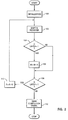
- Step 100 is the initialisation step.
- the exponent in binary form is loaded into the N register 10 and the base value (the integer) is loaded into A register 48.
- a decimal "1" is initially placed in the M register 46.
- step 102 the content of the N register 10 is shifted one bit position to the right with the right hand bit being shifted out. The bit that is shifted out of N register 10 is placed into C latch 12.
- step 104 if the C latch content is a binary "1", then the content of M register 46 is multiplied by the content of the A register 48. This is accomplished in step 106.
- Step 106 is performed by loading the content of the M register 46 over line 58, through the multiplexer 50 and over line 64 into the B register 52. Then multiplier 54 multiplies the contents of the B register 52 from line 66 with the contents of the A register 48 from line 60. The output of the multiplier 54 is provided on line 56 back to the M register 46. The operation then proceeds to step 108. If the C latch content is binary 0 (step 104), the operation proceeds directly to step 108 as shown.
- step 108 the controller determines if the contents of the R latch is a binary 1. If the content is a 1, then the A register is multiplied by itself in the multiplier 54. Specifically, this is accomplished by providing the contents of the A register 48 along line 62 through the multiplexer 50 and line 64 into the B register 52. Then the content of the A register 48 supplied on line 60 is multiplied with the contents of the B register 52 (which is the content of the A register 48) supplied on line 66 through the multiplier circuit 54. The result of this multiplication operation is placed on line 56 and returned to the A register 48. When step 110 is completed, the operation returns to step 102 to shift the content of the N register.
- step 108 if the content of the R latch is 0, then the operation proceeds directly to step 112. At this point, a completion signal is sent from the control circuit on line 18.
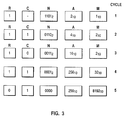
- FIG. 3 A simple numeric example of how the circuitry in Fig. 1 functions may be helpful. This example is the computation of 213 (integer 2 to the power 13). This numerical example is illustrated in Fig. 3.
- cycle 1 is the initialisation cycle.
- the N register 10 is loaded with the exponent 13 in binary form (1101).
- the subscript 2 used in Fig. 3 denotes that the 1101 is binary form.
- the content of the N register 10 will be illustrated in binary form.
- the contents of the other registers will be illustrated in decimal form.
- the base value is 210, which is loaded in the A register 48 (note that the subscript 10 in Fig. 3 denotes decimal notation).
- a decimal "1" is loaded into the M register 46.
- the ORed contents of the binary positions of the N register 10 provides a 1 which becomes the content of the R latch 16 as illustrated.
- the C latch 12 is a "don't care" since this is an initialisation cycle.
- the controller 20 will indicate operation completion on line 18 as soon as N register 10 is all 0's or is in a null state. This results in the operation completion indication being provided before all bit positions in the N register 10 have been shifted since all required multiplications will have been completed.
Landscapes
- Physics & Mathematics (AREA)
- General Physics & Mathematics (AREA)
- Engineering & Computer Science (AREA)
- Computational Mathematics (AREA)
- Mathematical Analysis (AREA)
- Pure & Applied Mathematics (AREA)
- Theoretical Computer Science (AREA)
- Computing Systems (AREA)
- Mathematical Optimization (AREA)
- General Engineering & Computer Science (AREA)
- Complex Calculations (AREA)
Applications Claiming Priority (2)
| Application Number | Priority Date | Filing Date | Title |
|---|---|---|---|
| US07/807,305 US5195052A (en) | 1991-12-13 | 1991-12-13 | Circuit and method for performing integer power operations |
| US807305 | 1991-12-31 |
Publications (2)
| Publication Number | Publication Date |
|---|---|
| EP0550188A2 true EP0550188A2 (fr) | 1993-07-07 |
| EP0550188A3 EP0550188A3 (en) | 1993-09-01 |
Family
ID=25196061
Family Applications (1)
| Application Number | Title | Priority Date | Filing Date |
|---|---|---|---|
| EP19920311360 Withdrawn EP0550188A3 (en) | 1991-12-13 | 1992-12-11 | Arithmetic system for performing integer power calculations |
Country Status (3)
| Country | Link |
|---|---|
| US (1) | US5195052A (fr) |
| EP (1) | EP0550188A3 (fr) |
| JP (1) | JPH05250146A (fr) |
Cited By (1)
| Publication number | Priority date | Publication date | Assignee | Title |
|---|---|---|---|---|
| WO2003027833A1 (fr) * | 2001-09-26 | 2003-04-03 | Intel Corporation | Processeur d'exposants faisant appel a la technique elevation au carre et multiplication |
Families Citing this family (13)
| Publication number | Priority date | Publication date | Assignee | Title |
|---|---|---|---|---|
| US5420809A (en) * | 1993-11-30 | 1995-05-30 | Texas Instruments Incorporated | Method of operating a data processing apparatus to compute correlation |
| US5623527A (en) * | 1996-01-30 | 1997-04-22 | Hewlett-Packard Company | Method and apparatus for determining an integer power of a floating point number |
| DE19709106A1 (de) * | 1997-03-06 | 1998-09-10 | Philips Patentverwaltung | Rechenschaltung zum Berechnen eines Quadrats |
| JPH10283340A (ja) * | 1997-04-10 | 1998-10-23 | Mitsubishi Electric Corp | 演算プロセッサ |
| US5912830A (en) * | 1997-04-30 | 1999-06-15 | Hewlett-Packard Co. | System and method for conditionally calculating exponential values in a geometry accelerator |
| US5926406A (en) * | 1997-04-30 | 1999-07-20 | Hewlett-Packard, Co. | System and method for calculating floating point exponential values in a geometry accelerator |
| US6044389A (en) * | 1997-12-29 | 2000-03-28 | Quantum Corporation | System for computing the multiplicative inverse of a field element for galois fields without using tables |
| GB2355087B (en) * | 1999-10-08 | 2003-12-17 | Mitel Corp | Method & apparatus for calculating energy in A-law or Á-law encoded speech signals |
| US6766346B2 (en) | 1999-11-30 | 2004-07-20 | Mosaid Technologies Incorporation | System and method for computing a square of a number |
| US6779015B1 (en) * | 2000-06-22 | 2004-08-17 | Sony Corporation | Method for implementation of power calculation on a fixed-point processor using table lookup and linear approximation |
| JP2004151234A (ja) * | 2002-10-29 | 2004-05-27 | Canon Inc | べき乗演算装置 |
| US7249154B2 (en) * | 2003-10-14 | 2007-07-24 | Agilent Technologies, Inc. | Method and apparatus for producing an exponential signal |
| JP2009008993A (ja) * | 2007-06-29 | 2009-01-15 | Nec Electronics Corp | べき乗剰余演算器及びその制御方法 |
Family Cites Families (12)
| Publication number | Priority date | Publication date | Assignee | Title |
|---|---|---|---|---|
| JPS6051733B2 (ja) * | 1977-11-19 | 1985-11-15 | 日本電気株式会社 | 指数関数演算装置 |
| US4229801A (en) * | 1978-12-11 | 1980-10-21 | Data General Corporation | Floating point processor having concurrent exponent/mantissa operation |
| JPS56147241A (en) * | 1980-04-15 | 1981-11-16 | Casio Comput Co Ltd | Operation system |
| JPS57211643A (en) * | 1981-06-22 | 1982-12-25 | Fujitsu Ltd | Power calculating device |
| JPS58223847A (ja) * | 1982-06-21 | 1983-12-26 | Sharp Corp | 整数べき乗演算装置 |
| SU1179327A1 (ru) * | 1984-04-21 | 1985-09-15 | Предприятие П/Я В-8751 | Устройство дл возведени в степень |
| SU1246092A1 (ru) * | 1984-10-29 | 1986-07-23 | Glazachev Aleksandr | Устройство дл возведени в степень |
| JPS61141033A (ja) * | 1984-12-14 | 1986-06-28 | Hitachi Ltd | 演算処理装置 |
| US4787056A (en) * | 1986-03-26 | 1988-11-22 | Rca Licensing Corporation | Apparatus for estimating the square of digital samples |
| JPS62256129A (ja) * | 1986-04-30 | 1987-11-07 | Sony Corp | 演算処理装置 |
| SU1411740A1 (ru) * | 1986-05-15 | 1988-07-23 | Таганрогский радиотехнический институт им.В.Д.Калмыкова | Устройство дл вычислени экспоненциальной функции |
| JPH0283728A (ja) * | 1988-09-21 | 1990-03-23 | Hitachi Ltd | 浮動小数点乗算装置 |
-
1991
- 1991-12-13 US US07/807,305 patent/US5195052A/en not_active Expired - Fee Related
-
1992
- 1992-11-11 JP JP4301242A patent/JPH05250146A/ja active Pending
- 1992-12-11 EP EP19920311360 patent/EP0550188A3/en not_active Withdrawn
Cited By (1)
| Publication number | Priority date | Publication date | Assignee | Title |
|---|---|---|---|---|
| WO2003027833A1 (fr) * | 2001-09-26 | 2003-04-03 | Intel Corporation | Processeur d'exposants faisant appel a la technique elevation au carre et multiplication |
Also Published As
| Publication number | Publication date |
|---|---|
| US5195052A (en) | 1993-03-16 |
| EP0550188A3 (en) | 1993-09-01 |
| JPH05250146A (ja) | 1993-09-28 |
Similar Documents
| Publication | Publication Date | Title |
|---|---|---|
| US5058048A (en) | Normalizing pipelined floating point processing unit | |
| US5267186A (en) | Normalizing pipelined floating point processing unit | |
| EP0450804B1 (fr) | Unité du type "pipelined" pour le traitement de nombres représentés en virgule flottante | |
| US4941120A (en) | Floating point normalization and rounding prediction circuit | |
| KR100242274B1 (ko) | 제산 및 제곱근 계산 기능을 갖고 있는 부동 소숫점/정수 프로세서 | |
| US5631858A (en) | System for obtaining strict solution in accordance with accuracy of approximate solutions | |
| US5339266A (en) | Parallel method and apparatus for detecting and completing floating point operations involving special operands | |
| EP0421092B1 (fr) | Procédé et appareil pour l'exécution de fonctions arithmétiques en utilisant l'approximation polynomiale et un multiplieur à format rectangulaire | |
| US4926370A (en) | Method and apparatus for processing postnormalization and rounding in parallel | |
| US5195052A (en) | Circuit and method for performing integer power operations | |
| EP0464493B1 (fr) | Divisionneur à base élevée | |
| EP0040279B1 (fr) | Diviseur binaire | |
| KR910000787B1 (ko) | 데이타 처리 가속기 | |
| EP0529101B1 (fr) | Circuit de division en virgule flottante | |
| US4594680A (en) | Apparatus for performing quadratic convergence division in a large data processing system | |
| US4477879A (en) | Floating point processor architecture which performs square root by hardware | |
| US3829673A (en) | Floating point arithmetic unit adapted for converting a computer to floating point arithmetic | |
| EP0063361B1 (fr) | Circuit de correction pour quotient approché | |
| US4996660A (en) | Selection of divisor multipliers in a floating point divide circuit | |
| JPH05241787A (ja) | 算術演算におけるスティッキイ・ビット値の判別装置 | |
| US5867413A (en) | Fast method of floating-point multiplication and accumulation | |
| EP0394162A2 (fr) | Circuit de division en virgule flottante à deux bits à la fois avec un seul additionneur à sauvegarde de retenue | |
| US4935890A (en) | Format converting circuit for numeric data | |
| EP0512686A2 (fr) | Circuit d'arrondissement dans un multiplieur à virgule flottante | |
| US5539684A (en) | Method and apparatus for calculating floating point exponent values |
Legal Events
| Date | Code | Title | Description |
|---|---|---|---|
| PUAI | Public reference made under article 153(3) epc to a published international application that has entered the european phase |
Free format text: ORIGINAL CODE: 0009012 |
|
| AK | Designated contracting states |
Kind code of ref document: A2 Designated state(s): DE FR GB |
|
| PUAL | Search report despatched |
Free format text: ORIGINAL CODE: 0009013 |
|
| AK | Designated contracting states |
Kind code of ref document: A3 Designated state(s): DE FR GB |
|
| 17P | Request for examination filed |
Effective date: 19931021 |
|
| 18W | Application withdrawn |
Withdrawal date: 19961022 |