EP0553833A2 - Digitaler Dividierer und Verfahren zum Dividieren eines positiven oder negativen Dividends und zum Abrunden nach unten - Google Patents
Digitaler Dividierer und Verfahren zum Dividieren eines positiven oder negativen Dividends und zum Abrunden nach unten Download PDFInfo
- Publication number
- EP0553833A2 EP0553833A2 EP93101365A EP93101365A EP0553833A2 EP 0553833 A2 EP0553833 A2 EP 0553833A2 EP 93101365 A EP93101365 A EP 93101365A EP 93101365 A EP93101365 A EP 93101365A EP 0553833 A2 EP0553833 A2 EP 0553833A2
- Authority
- EP
- European Patent Office
- Prior art keywords
- dividend
- binary
- judging
- negative
- numeral
- Prior art date
- Legal status (The legal status is an assumption and is not a legal conclusion. Google has not performed a legal analysis and makes no representation as to the accuracy of the status listed.)
- Withdrawn
Links
Images



Classifications
-
- G—PHYSICS
- G06—COMPUTING OR CALCULATING; COUNTING
- G06F—ELECTRIC DIGITAL DATA PROCESSING
- G06F7/00—Methods or arrangements for processing data by operating upon the order or content of the data handled
- G06F7/38—Methods or arrangements for performing computations using exclusively denominational number representation, e.g. using binary, ternary, decimal representation
- G06F7/48—Methods or arrangements for performing computations using exclusively denominational number representation, e.g. using binary, ternary, decimal representation using non-contact-making devices, e.g. tube, solid state device; using unspecified devices
- G06F7/52—Multiplying; Dividing
- G06F7/535—Dividing only
-
- G—PHYSICS
- G06—COMPUTING OR CALCULATING; COUNTING
- G06F—ELECTRIC DIGITAL DATA PROCESSING
- G06F7/00—Methods or arrangements for processing data by operating upon the order or content of the data handled
- G06F7/38—Methods or arrangements for performing computations using exclusively denominational number representation, e.g. using binary, ternary, decimal representation
- G06F7/48—Methods or arrangements for performing computations using exclusively denominational number representation, e.g. using binary, ternary, decimal representation using non-contact-making devices, e.g. tube, solid state device; using unspecified devices
- G06F7/499—Denomination or exception handling, e.g. rounding or overflow
- G06F7/49942—Significance control
- G06F7/49947—Rounding
- G06F7/49978—Rounding towards zero
-
- H—ELECTRICITY
- H04—ELECTRIC COMMUNICATION TECHNIQUE
- H04N—PICTORIAL COMMUNICATION, e.g. TELEVISION
- H04N19/00—Methods or arrangements for coding, decoding, compressing or decompressing digital video signals
- H04N19/10—Methods or arrangements for coding, decoding, compressing or decompressing digital video signals using adaptive coding
- H04N19/102—Methods or arrangements for coding, decoding, compressing or decompressing digital video signals using adaptive coding characterised by the element, parameter or selection affected or controlled by the adaptive coding
- H04N19/13—Adaptive entropy coding, e.g. adaptive variable length coding [AVLC] or context adaptive binary arithmetic coding [CABAC]
-
- H—ELECTRICITY
- H04—ELECTRIC COMMUNICATION TECHNIQUE
- H04N—PICTORIAL COMMUNICATION, e.g. TELEVISION
- H04N19/00—Methods or arrangements for coding, decoding, compressing or decompressing digital video signals
- H04N19/60—Methods or arrangements for coding, decoding, compressing or decompressing digital video signals using transform coding
-
- H—ELECTRICITY
- H04—ELECTRIC COMMUNICATION TECHNIQUE
- H04N—PICTORIAL COMMUNICATION, e.g. TELEVISION
- H04N19/00—Methods or arrangements for coding, decoding, compressing or decompressing digital video signals
- H04N19/90—Methods or arrangements for coding, decoding, compressing or decompressing digital video signals using coding techniques not provided for in groups H04N19/10-H04N19/85, e.g. fractals
- H04N19/91—Entropy coding, e.g. variable length coding [VLC] or arithmetic coding
Definitions
- the present invention relates generally to a digital divider utilized for a normalization processing or a scaling processing, and more particularly to a digital divider in which a positive or negative dividend expressed by a binary notation is divided and a remainder is rounded down. Also, the present invention relates to a dividing method of a positive or negative dividend in which picture information is clearly reproduced.
- Digital signals obtained by encoding picture information are generally compressed or expanded to efficiently decode the signals according to a normalization processing, a scaling processing or an inverse quantization processing. That is, values of the digital signals are adjusted within a given value in the normalization processing, and a scaled signal is output each time several digital signals are input in the scaling processing. Also, each of values of the digital signals is expressed by a binary numeral consisting of a series of binary digits. In this case, the binary numeral is multiplied or divided many times to execute the normalization processing, the scaling processing, or the inverse quantization processing.
- the binary numeral is shifted to the left or the right by predetermined bits according to a conventional shift operation.
- the binary digits constituting the binary numeral are shifted to the left by the n bits to obtain a product.
- the binary digits are shifted to the right by the n bits to obtain a quotient.
- Fig. 1 is a block diagram of a conventional digital divider to show the relationship between a dividend and a quotient obtained by dividing the dividend by a divisor 24, a remainder being rounded down to obtain the quotient in the conventional digital divider.
- a dividend consisting of eight bits of binary digits A(7) to A(0) is input in a conventional digital divider 11.
- the highest bit occupied by the binary digit A(7) denotes the most significant bit of the dividend
- the lowest bit occupied by the binary digit A(0) denotes the least significant bit of the dividend.
- the dividend is divided by a divisor in the conventional digital divider 11 to obtain the result equivalent to a quotient.
- the value of the divisor is 24, higher four bits of binary digits A(7) to A(4) are selected as the resulting quotient consisting of four bits of binary digits B(3) to B(0) in the conventional digital divider 11. That is, the number of the significant digits is four in the resulting quotient.
- the bit occupied by the binary digit B(3) agreeing with the binary digit A(7) denotes the most significant bit of the resulting quotient
- the bit occupied by the binary digit B(0) agreeing with the binary digit A(4) indicates the least significant bit of the resulting quotient.
- the resulting quotient B(3) to B(0) are output as the quotient from the conventional digital divider 11.
- the binary digits A(3) to A(0) of the dividend positioned at lower places than the fourth place of the dividend are not adopted as the quotient, a remainder generated by dividing the dividend by the divisor is rounded down.
- the selection executed in the conventional digital divider 11 is equivalent to a shift operation executed in a shift register in which a piece of input data is shifted to the right by four bits.
- pieces of positive data and pieces of negative data are frequently multiplied or divided.
- IDCT inverse discrete cosine transform
- the positive data and the negative data are required to be multiplied and divided in advance according to the inverse quantization processing to execute the normalization processing or the scaling processing.
- Fig. 2 shows a plurality of eight bits of positive and negative dividends expressed by the binary notation and resulting quotient obtained by dividing the dividends by a divisor 24 in the conventional digital divider shown in Fig. 1, in tabular form.
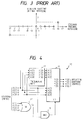
- Fig. 3 graphically shows the relationship between the dividend shown in Fig. 2 and the resulting quotient shown in Fig. 2.
- a first absolute value of the resulting quotient obtained by dividing a positive value differs from a second absolute value of the resulting quotient obtained by dividing a negative value of which the absolute value is equal to the positive value and is not the multiple of the divisor.
- the second absolute value is larger than the first absolute value by a value 1.
- a first object of the present invention is to provide, with due consideration to the drawbacks of such a conventional digital divider, a digital divider in which a picture reproduced by compressing or expanding digital picture signals is clearly displayed on a screen even though each of the signals is transformed to a piece of negative data before the piece of negative data is divided by a divisor.
- a second object of the present invention is to provide a digitally dividing method for reproducing a picture by compressing or expanding digital picture signals to clearly display on a screen even though each of the signals is transformed to a piece of negative data before the piece of negative data is divided by a divisor.
- the first object is achieved by the provision of a digital divider for dividing a dividend to obtain a quotient, comprising: adding means for adding a value 1 to a first binary numeral consisting of a series of binary digits positioned at higher places of the dividend to generate a second binary numeral; first judging means for judging whether or not a third binary numeral consisting of a series of binary digits positioned at lower places of the dividend is zero, the dividend consisting of the binary digits positioned at the higher places thereof and the binary digits positioned at the lower places thereof; second judging means for judging whether or not the dividend is negative; and selecting means for selecting the second binary numeral generated by the adding means as the quotient in cases where it is judged by the first judging means that the third binary numeral is not zero and it is judged by the second judging means that the dividend is negative, selecting the first binary numeral as the quotient in cases where it is judged by the first judging means that the third binary numeral is zero, selecting the first binary
- the dividend consisting of a series of binary digits is conceptually splitted into the first binary numeral consisting of a series of binary digits positioned at the higher places of the dividend and the third binary numeral consisting of a series of binary digits positioned at the lower places of the dividend.
- the first binary numeral is added a value 1 by the adding means to generate the second binary numeral.
- the second binary numeral is provided to the selecting means.
- the first binary numeral is provided to the selecting means.
- both the judging result of the first judging means and the judging result of the second judging means are transferred to the selecting means.
- either the first binary numeral or the second binary numeral is selected according to both the judging results.
- an absolute value of the first binary numeral is larger than a value of a fourth binary numeral consisting of a series of binary digits positioned at higher places of a positive dividend of which the value agrees with the absolute value of the negative dividend. Therefore, the second binary numeral is selected as the quotient.
- the first binary numeral is selected as the quotient.
- the absolute value of the first binary numeral agrees with the value of the fourth binary numeral. Therefore, the first binary numeral is selected as the quotient.
- the definition of the picture displayed on a screen does not deteriorate. That is, the picture reproduced by compressing or expanding the digital picture signals can be clearly displayed on the screen even though each of the signals is transformed to a piece of negative data before the piece of negative data is divided by divisors.
- the adding means be an incremental unit in which the binary digits positioned at the higher places of the dividend are provided to increment the value of the first binary numeral before incremented binary digits are output as the second binary numeral.
- the adding means is easily embodied.
- the first judging means be a logical OR gate in which the binary digits positioned at the lower places of the dividend are received before a first judging signal logically generated according to a function of an OR gate is output.
- the second judging means be a logical AND gate in which both the binary digit positioned at the highest place of the dividend and the first judging signal generated by the logical OR gate are received before a second judging signal logically generated according to a function of an AND gate is provided to the selecting means.
- the bit positioned at the highest place of the dividend functions as a sign bit. Therefore, the sign of the dividend can be distinguished by judging the binary digit positioned at the highest place of the dividend. For example, in cases where the binary digit positioned at the highest place of the dividend is "1", the dividend is negative. Also, in cases where the binary digit positioned at the highest place of the dividend is "0", the dividend is not negative but positive or zero.
- the second judging signal is designated by the binary digit "1". Also, in cases where the dividend is not negative, the second judging signal is designated by the binary digit "0". Also, in cases where the first judging signal is designated by the binary digit "0", the second judging signal is designated by the binary digit "0".
- the second judging signal designated by the binary digit "1" is provided to the selecting means
- the second binary numeral generated by the adding means is selected by the selecting means as the quotient.
- the second judging signal designated by the binary digit "0" is provided to the selecting means
- the first binary numeral generated by the adding means is selected by the selecting means as the quotient.
- the digital divider further include: first buffer means for storing digital signals obtained by encoding picture information; second buffer means for storing a natural number N to specify a value 2 N of a divisor, the number of binary digits constituting a third binary numeral judged by the first judging means being equal to the natural number N; decoding means for decoding the digital signals stored in the first buffer means to produce dividends which each are added by the adding means and are judged in the first judging means and the second judging means; and reproducing means for reproducing the picture information by dividing each of the dividends decoded by the decoding means by the divisor stored in the second buffer means, the picture information reproduced by the reproducing means consisting of the quotients selected by the selecting means.
- the digital signals are decoded to reproduce the picture information by utilizing the digital divider according to the present invention.
- the picture information generally obtained by photographing a subject is encoded to the digital signals.
- the digital signals are stored in the first buffer means before the digital signals are decoded by the decoding means. Thereafter, the dividends produced from the digital signals decoded by the decoding means are divided by the divisor to reproduce the picture information.
- each of the digital signals is transformed to a piece of negative data before the piece of negative data is divided by the divisor, the picture information reproduced by compressing or expanding the digital signals can be clearly displayed on a screen.
- the second object is achieved by the provision of a method for dividing a dividend consisting of M bits of binary digits (M is a natural number) by a divisor 2 N (N is a natural number and M ⁇ N) to obtain a quotient, comprising the steps of: judging whether or not at least one of lower N bits of binary digits of the dividend is "1"; outputting a first binary numeral consisting of a series of upper M-N bits of binary digits of the dividend as the quotient in cases where all of the lower N bits of binary digits of the dividend is "0"; judging whether or not the dividend is negative in cases where at least one of the lower N bits of binary digits of the dividend is "1"; outputting the first binary numeral in cases where the dividend is not negative; adding a value 1 to the first binary numeral to produce a second binary numeral in cases where the dividend is negative; and outputting the second binary numeral as the quotient in cases where at least one of the lower N bits of binary digits
- a picture reproduced by compressing or expanding digital picture signals can be clearly displayed on a screen even though each of the signals is transformed to a piece of negative data before the piece of negative data is divided by divisors.
- the step of judging whether or not the dividend is negative include: checking whether a binary digit positioned at a highest place of the dividend is "1" or "0"; judging the dividend to be negative in cases where the binary digit is "1”; and judging the dividend not to be negative in cases where the binary digit is "0".
- the most significant bit of the dividend functions as a sign bit. Therefore, in cases where the binary digit positioned at the highest place (or the most significant bit) of the dividend is "1”, the dividend is negative. Also, in cases where the binary digit is "0", the dividend is not negative.
- the method further include: storing digital signals obtained by encoding picture information in a first buffer; storing the number N in a second buffer to specify the value of the divisor; decoding the digital signals to the dividends which each are judged in the judging steps; and reproducing the picture information from the first binary numerals and the second binary numerals which each are output by the outputting steps.
- each of the digital signals is decoded to the dividend so that the dividend is divided according to the method of the present invention.
- the first binary numerals and the second binary numerals obtained by dividing the dividends are, for example, transformed according to the inverse discrete cosine transform processing to reproduce the picture information.
- the method for dividing the dividend is very useful for the reproduction of the picture information. Also, the picture information can be clearly reproduced.
- Fig. 4 is a block diagram of a digital divider according to a first embodiment of the present invention, a positive or negative dividend being divided by a divisor, and a remainder designated by binary digits positioned at lower places than the fifth place being rounded down.
- an eight-bit of dividend consisting of a series of binary digits A(7) to A(0) is input in a digital divider 12 to obtain a four-bit of resulting quotient consisting of a series of binary digits Y(3) to Y(0) after dividing the dividend by a divisor of which the value is 24.
- the bit occupied by the binary digit A(7) denotes the most significant bit of the dividend
- the bit occupied by the binary digit A(0) denotes the least significant bit of the dividend.
- the digital divider 12 comprises an incremental unit 13 for adding a value 1 to a first binary numeral designated by the higher four binary digits A(7) to A(4) of the dividend to output a second binary numeral designated by a series of binary digits P(3) to P(0), a logical OR gate 14 for receiving the lower four binary digits A(3) to A(0) of the dividend in parallel and logically judging whether or not a remainder is generated when the dividend is divided by the divisor before outputting a judged signal Sj, a logical AND gate for receiving both the binary digit A(7) and the judged signal Sj provided from the logical OR gate 14 and outputting a selecting signal SEL.
- the selecting signal SEL output from the logical AND gate 15 is designated by the binary digit "1". Also, in cases where the dividend is positive or in cases where the remainder is not generated, the selecting signal SEL is designated by the binary digit "0".
- the digital divider 12 further comprises a four-bit selector 16 for receiving the second binary numeral consisting of the four binary digits P(3) to P(0) provided from the incremental unit 13, receiving the first binary numeral consisting of the higher four binary digits A(7) to A(4) of the dividend, receiving the selecting signal SEL provided from the logical AND gate 15, and outputting either the first binary numeral or the second binary numeral as the resulting quotient consisting of binary digits Y(3) to Y(0) according to the selecting signal SEL.
- the bit occupied by the binary digit Y(3) denotes the most significant bit of the resulting quotient
- the bit occupied by the binary digit Y(0) denotes the least significant bit of the resulting quotient.
- either the four binary digits P(3) to P(0) or the higher four binary digits A(7) to A(4) of the dividend are selected as the resulting quotient consisting of the four binary digits Y(3) to Y(0) according to the selecting signal SEL. That is, when the selecting signal SEL is designated by the binary digit "1", the second binary numeral consisting of the four binary digits P(3) to P(0) is selected. On the other hand, when the selecting signal SEL is designated by the binary digit "0", the first binary numeral consisting of the four binary digits A(7) to A(4) is selected.
- the selecting signal SEL is designated by the binary digit "0" because the binary digit A(7) is "0". Therefore, the first binary numeral consisting of the four binary digits A(7) to A(4) is selected. In short, the resulting quotient obtained in the digital divider 12 is the same as that obtained by the conventional digital divider 11.
- the selecting signal SEL is designated by the binary digit "0" because the remainder is not generated. Therefore, the first binary numeral consisting of the four binary digits A(7) to A(4) is selected in the four-bit selector 16. In short, the resulting quotient obtained in the digital divider 12 is the same as that obtained by the conventional digital divider 11.
- the binary digit A(7) is "1" because the negative dividend is designated according to the twos complement expression
- the judged signal Sj is designated by the binary digit "1” because at least one of the lower four binary digits A(3) to A(0) of the dividend is "1" as shown in Fig. 5. Therefore, the selecting signal SEL is designated by the binary digit "1” so that the second binary numeral consisting of the four binary digits P(3) to P(0) is selected in the four-bit selector 16. In this case, because the second binary numeral is larger than the first binary numeral by a value 1 and because the second binary numeral is zero or negative, the absolute value of the first binary numeral is larger than that of the second binary numeral by a value 1.
- the first binary numeral is designated by a binary digit string "1111” denoting a negative value -1 in the decimal expression
- the second binary numeral is designated by a binary digit string "0000” denoting a zero. Therefore, the absolute value of the first binary numeral is higher than that of the second binary numeral by a value 1.
- the first binary numeral is designated by a binary digit string "1110" denoting a negative value -2 in the decimal expression
- the second binary numeral is designated by a binary digit string "1111” denoting a value -1. Therefore, the absolute value of the first binary numeral is larger than that of the second binary numeral by a value 1.
- the definition of the picture displayed on a screen does not deteriorate. That is, the picture reproduced by compressing or expanding the digital picture signals can be clearly displayed on the screen even though each of the signals is transformed to a piece of negative data before the piece of negative data is divided by a divisor.
- the dividend input in the digital divider 12 ranges from -128 to +127 in the decimal expression because the most significant bit of the dividend functions as the sign bit.
- the range of the dividend is not limited. That is, in cases where the number of higher places of binary digits of the dividend received by the incremental unit 13 is suitably set and the number of binary digits selected by the four-bit selector 16 agrees with the number of binary digits received by the incremental unit 13, the number of binary digitals constituting the dividend can be increased. Therefore, the range of the dividend can be arbitrarily set.
- the value of the divisor is 24 in the first embodiment because the four lower places of binary digits A(3) to A(0) of the dividend are not provided to the four-bit selector 16 but provided to the logical OR gate 14.
- the value of the divisor is not limited to 24 in cases where the number of lower places of binary digits of the dividend is suitably set. That is, the value of the divisor can be set to 2 N (N is the arbitrary number of lower places of binary digits of the dividend).
- Fig. 7 is a flow chart showing the procedure of a method for dividing a positive or negative dividend by a divisor to obtain a quotient and rounding down a remainder.
- the dividend is determined by decoding a digital signal obtained by encoding picture information.
- the bit occupied by the binary digit A(M-1) is the most significant bit and functions as a sign bit because the dividend is designated according to the twos complement expression.
- the bit occupied by the binary digit A(0) is the least significant digit.
- a number N (N is a natural number and M ⁇ N) representative of a divisor 2 N by which the divider should divide the divident is stored in a second buffer.
- the dividend stored in the first buffer and the number N which is representative of the divisor 2 N and is stored in the second buffer are transmitted to a first judging circuit.
- the judging circuit as shown in Fig. 7, it is judged in a step 101 whether or not at least one of lower N binary digits A(N-1) to A(0) of the dividend is "1". In cases where all of the binary digits A(N-1) to A(0) is "0", A remainder is not generated when the dividend is divided by the divisor.
- a first absolute value of a quotient obtained by dividing a positive dividend agrees with a second absolute value of a quotient obtained by dividing a negative dividend of which the absolute value is equal to the positive dividend. Therefore, the procedure proceeds to a step 102.
- a first binary numeral consisting of a series of higher M-N binary digits A(M-1) to A(N) of the dividend is output to a printer as a quotient obtained by dividing the dividend by the divisor.
- a printer On the other hand, in cases where at least one of lower N binary digits A(N-1) to A(0) of the dividend is "1”, a remainder is generated when the dividend is divided by the divisor. Therefore, the procedure proceeds to a step 103.
- step 103 it is judged in a second judging circuit whether or not the dividend is negative by checking the binary digit A(M-1) of the sign bit. In cases where the dividend is not negative but positive or zero, the procedure proceeds to the step 102 so that the first binary numeral is output to the printer. On the other hand, in cases where the dividend is negative, the first absolute value is smaller than the second absolute value. Therefore, the procedure proceeds to a step 104.
- the first binary numeral is transmitted from the second judging circuit to an arithmetic processing unit and is added a value 1 to produce a second binary numeral. Thereafter, the second binary numeral is output as the quotient to the printer.
- the method for dividing the negative or positive dividend by the divisor according to the present invention can be executed in a data processing system. Therefore, even though the dividend is negative, the division cab be accurately executed according to the method.
- the picture reproduced by compressing or expanding digital picture signals can be clearly displayed on the screen even though each of the signals is transformed to a piece of negative data before the piece of negative data is divided by a divisor, in the same manner as in the digital divider 12 shown in Fig. 4.
- Fig. 8 is a block diagram of a data processing system in which the method of which the procedure is shown in Fig. 7 is executed according to the inverse quantization processing.
- a plurality of digital signals obtained by encoding picture information are stored in a buffer 21.
- the digital signals are multiplexed to efficiently transmit through a physical transmission route or a physical transmission medium according to a conventional procedure.
- the digital signals are demultiplexed in a demultiplexing circuit 22. Therefore, the digital signals can be decoded independent of one another to reproduce the picture information on a display.
- each of the digital signals demultiplexed in the demultiplexing circuit 22 is decoded in a variable length decoding circuit 23 to produce a piece of decoded data of which the number of bits is variable.
- each piece of decoded data produced in the variable length decoding circuit 23 is inversely quantized in an inverse quantization circuit 24 to obtain a piece of inversely quantized data according to the inverse quantization processing.
- the decoded data is treated as a dividend which is divided by a divisor according to the method shown in FIg. 8.
- the inversely quantized data is transformed in an inverse discrete cosine transform circuit 25 to reproduce the picture information.
- the picture information reproduced in the inverse discrete cosine transform circuit 25 is displayed on a display 26.
- the method for dividing the dividend can be utilized to reproduce the picture information in the data processing system.
- the method described with reference to Fig. 7 is programmed to divide the dividend by the divisor in a computer system.
- the method is embodied without utilizing any buffer nor any circuit other than the computer system.
- the digital divider 12 shown in Fig. 4 is incorporated in the inverse quantization circuit 24.
- the digital signals can be decoded to reproduce the picture information by utilizing the digital divider 12.
Landscapes
- Physics & Mathematics (AREA)
- General Physics & Mathematics (AREA)
- Engineering & Computer Science (AREA)
- Computational Mathematics (AREA)
- Mathematical Analysis (AREA)
- Mathematical Optimization (AREA)
- Pure & Applied Mathematics (AREA)
- Theoretical Computer Science (AREA)
- Computing Systems (AREA)
- General Engineering & Computer Science (AREA)
- Complex Calculations (AREA)
- Compression, Expansion, Code Conversion, And Decoders (AREA)
Applications Claiming Priority (2)
| Application Number | Priority Date | Filing Date | Title |
|---|---|---|---|
| JP4206692A JPH05216629A (ja) | 1992-01-31 | 1992-01-31 | 除算装置 |
| JP42066/92 | 1992-01-31 |
Publications (2)
| Publication Number | Publication Date |
|---|---|
| EP0553833A2 true EP0553833A2 (de) | 1993-08-04 |
| EP0553833A3 EP0553833A3 (en) | 1993-10-13 |
Family
ID=12625722
Family Applications (1)
| Application Number | Title | Priority Date | Filing Date |
|---|---|---|---|
| EP19930101365 Withdrawn EP0553833A3 (en) | 1992-01-31 | 1993-01-29 | Digital divider and method for dividing positive or negative dividend and rounding down a remainder |
Country Status (2)
| Country | Link |
|---|---|
| EP (1) | EP0553833A3 (de) |
| JP (1) | JPH05216629A (de) |
Cited By (1)
| Publication number | Priority date | Publication date | Assignee | Title |
|---|---|---|---|---|
| GB2317516A (en) * | 1996-09-24 | 1998-03-25 | Kashinath Narayan Dandeker | A control switch based on extensions of the recognition of the infinite patterns which mean minus zero |
Family Cites Families (2)
| Publication number | Priority date | Publication date | Assignee | Title |
|---|---|---|---|---|
| US4589084A (en) * | 1983-05-16 | 1986-05-13 | Rca Corporation | Apparatus for symmetrically truncating two's complement binary signals as for use with interleaved quadrature signals |
| JPS6170635A (ja) * | 1984-09-14 | 1986-04-11 | Hitachi Ltd | 丸め制御装置 |
-
1992
- 1992-01-31 JP JP4206692A patent/JPH05216629A/ja active Pending
-
1993
- 1993-01-29 EP EP19930101365 patent/EP0553833A3/en not_active Withdrawn
Cited By (2)
| Publication number | Priority date | Publication date | Assignee | Title |
|---|---|---|---|---|
| GB2317516A (en) * | 1996-09-24 | 1998-03-25 | Kashinath Narayan Dandeker | A control switch based on extensions of the recognition of the infinite patterns which mean minus zero |
| GB2317516B (en) * | 1996-09-24 | 1998-09-02 | Kashinath Narayan Dandeker | A control switch based on extensions of the recognition of the infinite patterns which mean minus zero |
Also Published As
| Publication number | Publication date |
|---|---|
| JPH05216629A (ja) | 1993-08-27 |
| EP0553833A3 (en) | 1993-10-13 |
Similar Documents
| Publication | Publication Date | Title |
|---|---|---|
| US4286256A (en) | Method and means for arithmetic coding utilizing a reduced number of operations | |
| US5500812A (en) | Multiplication circuit having rounding function | |
| US4912668A (en) | Mono-dimensional reverse cosine transform computing device | |
| US4989000A (en) | Data string compression using arithmetic encoding with simplified probability subinterval estimation | |
| US5444835A (en) | Apparatus and method for forming a composite image pixel through pixel blending | |
| JP3199371B2 (ja) | 丸め装置 | |
| US6900747B2 (en) | Method of compressing lookup table for reducing memory, non-linear function generating apparatus having lookup table compressed using the method, and non-linear function generating method | |
| EP0663762B1 (de) | Quantisierungs- und Entquantisierungsschaltung mit reduzierter Grösse | |
| EP0328063A2 (de) | Absolutwertberechnende Schaltung mit einem einzigen Addierer | |
| US5317530A (en) | Rounding operation circuit | |
| US5008668A (en) | Method and apparatus for encoding and decoding data in residue number system | |
| US5951625A (en) | Interpolated lookup table circuit | |
| US5208770A (en) | Accumulation circuit having a round-off function | |
| EP0928100A1 (de) | Lauflängenkodierung | |
| US5668748A (en) | Apparatus for two-dimensional discrete cosine transform | |
| US4977534A (en) | Operation circuit based on floating-point representation with selective bypass for increasing processing speed | |
| US6232894B1 (en) | Reproducible data conversion and/or compression method of digital signals and a data converter and a digital computer | |
| US4788654A (en) | Device for real time processing of digital signals by convolution | |
| US5691930A (en) | Booth encoder in a binary multiplier | |
| US6470371B1 (en) | Parallel multiplier | |
| EP0447244A2 (de) | Multiplizierer mit Nachschlagtabellen | |
| KR100241077B1 (ko) | 단일명령사이클내의 선택된 sin 3식을 연산하기 위한 방법 | |
| US6081824A (en) | Method and apparatus for fast unsigned integral division | |
| JP4354648B2 (ja) | バイアスを招かないで固定少数点フォーマットに信号を圧縮するための方法と装置 | |
| US4716538A (en) | Multiply/divide circuit for encoder PCM samples |
Legal Events
| Date | Code | Title | Description |
|---|---|---|---|
| PUAI | Public reference made under article 153(3) epc to a published international application that has entered the european phase |
Free format text: ORIGINAL CODE: 0009012 |
|
| AK | Designated contracting states |
Kind code of ref document: A2 Designated state(s): DE FR GB |
|
| PUAL | Search report despatched |
Free format text: ORIGINAL CODE: 0009013 |
|
| AK | Designated contracting states |
Kind code of ref document: A3 Designated state(s): DE FR GB |
|
| STAA | Information on the status of an ep patent application or granted ep patent |
Free format text: STATUS: THE APPLICATION IS DEEMED TO BE WITHDRAWN |
|
| 18D | Application deemed to be withdrawn |
Effective date: 19940414 |