EP0556517A1 - Couches de diamant - Google Patents
Couches de diamant Download PDFInfo
- Publication number
- EP0556517A1 EP0556517A1 EP92311296A EP92311296A EP0556517A1 EP 0556517 A1 EP0556517 A1 EP 0556517A1 EP 92311296 A EP92311296 A EP 92311296A EP 92311296 A EP92311296 A EP 92311296A EP 0556517 A1 EP0556517 A1 EP 0556517A1
- Authority
- EP
- European Patent Office
- Prior art keywords
- plasma
- substrate
- flow control
- further comprised
- control means
- Prior art date
- Legal status (The legal status is an assumption and is not a legal conclusion. Google has not performed a legal analysis and makes no representation as to the accuracy of the status listed.)
- Withdrawn
Links
Images


Classifications
-
- C—CHEMISTRY; METALLURGY
- C23—COATING METALLIC MATERIAL; COATING MATERIAL WITH METALLIC MATERIAL; CHEMICAL SURFACE TREATMENT; DIFFUSION TREATMENT OF METALLIC MATERIAL; COATING BY VACUUM EVAPORATION, BY SPUTTERING, BY ION IMPLANTATION OR BY CHEMICAL VAPOUR DEPOSITION, IN GENERAL; INHIBITING CORROSION OF METALLIC MATERIAL OR INCRUSTATION IN GENERAL
- C23C—COATING METALLIC MATERIAL; COATING MATERIAL WITH METALLIC MATERIAL; SURFACE TREATMENT OF METALLIC MATERIAL BY DIFFUSION INTO THE SURFACE, BY CHEMICAL CONVERSION OR SUBSTITUTION; COATING BY VACUUM EVAPORATION, BY SPUTTERING, BY ION IMPLANTATION OR BY CHEMICAL VAPOUR DEPOSITION, IN GENERAL
- C23C16/00—Chemical coating by decomposition of gaseous compounds, without leaving reaction products of surface material in the coating, i.e. chemical vapour deposition [CVD] processes
- C23C16/22—Chemical coating by decomposition of gaseous compounds, without leaving reaction products of surface material in the coating, i.e. chemical vapour deposition [CVD] processes characterised by the deposition of inorganic material, other than metallic material
- C23C16/26—Deposition of carbon only
- C23C16/27—Diamond only
- C23C16/276—Diamond only using plasma jets
-
- C—CHEMISTRY; METALLURGY
- C23—COATING METALLIC MATERIAL; COATING MATERIAL WITH METALLIC MATERIAL; CHEMICAL SURFACE TREATMENT; DIFFUSION TREATMENT OF METALLIC MATERIAL; COATING BY VACUUM EVAPORATION, BY SPUTTERING, BY ION IMPLANTATION OR BY CHEMICAL VAPOUR DEPOSITION, IN GENERAL; INHIBITING CORROSION OF METALLIC MATERIAL OR INCRUSTATION IN GENERAL
- C23C—COATING METALLIC MATERIAL; COATING MATERIAL WITH METALLIC MATERIAL; SURFACE TREATMENT OF METALLIC MATERIAL BY DIFFUSION INTO THE SURFACE, BY CHEMICAL CONVERSION OR SUBSTITUTION; COATING BY VACUUM EVAPORATION, BY SPUTTERING, BY ION IMPLANTATION OR BY CHEMICAL VAPOUR DEPOSITION, IN GENERAL
- C23C16/00—Chemical coating by decomposition of gaseous compounds, without leaving reaction products of surface material in the coating, i.e. chemical vapour deposition [CVD] processes
- C23C16/44—Chemical coating by decomposition of gaseous compounds, without leaving reaction products of surface material in the coating, i.e. chemical vapour deposition [CVD] processes characterised by the method of coating
- C23C16/50—Chemical coating by decomposition of gaseous compounds, without leaving reaction products of surface material in the coating, i.e. chemical vapour deposition [CVD] processes characterised by the method of coating using electric discharges
- C23C16/513—Chemical coating by decomposition of gaseous compounds, without leaving reaction products of surface material in the coating, i.e. chemical vapour deposition [CVD] processes characterised by the method of coating using electric discharges using plasma jets
Definitions
- This invention relates to an apparatus ad method for making large area diamond films using a high temperature plasma reactor with plasma reactor stream flow controller constructed of a non-carbonaceous refractory metal such as tungsten or rhenium where hydrocarbon injection is used.
- a high temperature plasma reactor with plasma reactor stream flow controller constructed of a non-carbonaceous refractory metal such as tungsten or rhenium where hydrocarbon injection is used.
- Such structures of this type generally, allow large area diamond films to be created on a substrate in a efficient, cost-effective manner.
- thermocouples of tungsten/rhenium were formed into a rake and the rake was deployed within the plasma gun plume. Typically, tungsten melts at approximately 3500-3600°K.
- thermocouples did not melt. Basically, this is because tungsten is a refractory material and a good thermal radiator thus, the thermocouples exhibited a excellent balance between thermal radiation and thermal absorption. In short, the tungsten thermocouple in this case was able to rapidly cool itself as it was deployed in the gun plume. This cooling effect of the tungsten thermocouple allowed accurate measurements of the local temperature of the plasma to be performed which, in turn, allowed the temperature of the gun plasma to be more accurately controlled. However, a more advantageous system, then, would be presented if other refractory materials which exhibit good thermal radiation techniques could be employed.
- a DC torch is employed that has a diffuser attached. While this technique creates diamond films, these films do not achieve the desired size in surface area coverage. This is because, typically, the diffuser is constructed of copper and is water cooled. The diffuser must be constantly cooled in order to keep the diffuser from destructing due to the high temperatures of the plasma stream and this cooling adversely affects the deposition characteristics of the stream and the overall economics of the process. Also, the stream must be recirculated within the diffuser in order to spread the stream flow out to create a diamond film. The spreading of the flow should create a large diamond film, but, typically, the recirculation of the flow traps the flow and a large area diamond film is not created.
- this invention fulfills these needs by providing an apparatus for producing large area diamond films on a substrate, comprising a plasma gun means having a plasma stream, a hydrocarbon injection means located substantially adjacent said gun means and a plasma stream flow control means substantially constructed of a non-carbonaceous refractory material having high thermal radiation properties and substantially located between said gun means and said substrate.
- the plasma gun means are a DC torch or an RF torch.
- the plasma stream flow control means is a grid, a nozzle or a basket-like structure constructed of tungsten or rhenium.
- the hydrocarbon injection means injects methane or any suitably selected hydrocarbon.
- the flow control means spreads out the plasma stream to create several secondary streams such that a diamond film is formed and the construction of the grid, the nozzle or the basket-like structure allows the plasma stream to be spread out over the substrate so that the diamond film is formed over a relatively large area of the substrate.
- the preferred system offers the following advantages: smaller size, easy assembly; good economy; easy formation of larger area diamond films; good stability; excellent durability; and high strength for safety.
- these factors of ease of diamond film formation and durability are optimized to an extent considerably higher than heretofore achieved in prior, known diamond film formation systems.
- Carbon (C) and hydrogen (H2) have a strong affinity over a wide range of temperatures and their chemistry plays an important role in the formation of diamond in the plasma jet or hot filament process.
- hydrocarbons such as methane
- injected into the plasma decompose into carbon, hydrogen and other intermediary products, forming the diamond film on the suitably located and cooled substrate.
- Measurements show that a refractory structure inserted into such a plasma can basically survive in these plasmas so long as there is sufficient cooling for it, in the form of radiant sinks or internal (gas - helium or even liquid - water) cooling.
- the refractory structure is a tungsten-rhenium thermocouple, it can be used to measure the temperature of the plasma. Such measurements can be used to monitor the reaction and the quality of the product made.
- a sample set of temperature measurements for a tungsten-rhenium thermocouple traversed along the axis of a RF torch operating with a pure argon gas, at 250 torr, with torch (plate) power setting of about 58 KW are illustrated in Figure 1.
- the thermocouple effectively cooled itself by radiation to the water cooled walls of the tank held at about 350°K.
- the underlying theory for this phenomena is the effective survivability of the refractory structure, suitably designed ad suitably located in a plasma, provided the refractory structure has a low temperature sink it can radiate to. Plasma temperatures as high as 1000°K have been monitored in this way. The presence of a tungsten structure at a suitable location appears to aid in the process of forming atomic hydrogen from molecular hydrogen.
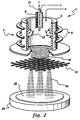
- apparatus 2 which creates a large area diamond film 22 on a substrate 24.
- apparatus 2 includes, in part, a conventional reactor 4. While reactor 4 is shown as a RF (inductively coupled) plasma reactor, other reactors such as a DC torch could be used.
- RF plasma reactor 4 typically, includes RF coils 6, fuel gas guide 8, injector 10 and RF fire ball 12.
- Fuel gas guide 8 allows fuel gas, such as a mixture of argon (Ar) and hydrogen (H2) to enter into reactor chamber 5 along the direction of arrow A.
- the sheath gas may be introduced along the direction of arrow B. The primary function of sheath gas is to help in the cooling of the walls of reactor chamber 5.
- Injector 10 introduces methane (or similar such hydrocarbon) along the direction of arrow C into chamber 5.
- fuel gas such as Ar, H2, and (methane if added to create the diamond sheets)
- RF fireballs 12 are created according to well known RF plasma reactor techniques and a plasma stream 16 is created.
- Grid 18 Located below reactor 4 is grid 18.
- a refractory material is desired in the shape of grid 18 to spread out the flow of stream 16 to form a more uniform secondary flow 20 from which carbon is deposited on substrate 24 to create large area diamond film 22. It is to be understood that several apparatus 2 can be placed side-by-side (not shown) and a larger grid 18 employed in order to create an even larger film 22 on a very large substrate 24.
- Substrate 24 preferably, is constructed of silicon, molybdenum or niobium.
- the proper selection of the substrate and its temperature is very important.
- the selection of the substrate temperature is a function of a number of parameters, including the amount of stresses built up in film 22. In general, a substrate temperature in excess of 700°K is preferred.
- the substrate temperature determines the amount of hydrogen left in film 22, in that, the higher the substrate temperature, the lower the retained hydrogen in the film. It is possible that the temperature may have to be as high as 1200-1300°K, especially if hydrogen free films are desired. There is clearly an upper bound to this temperature, because beyond a certain point, the graphitization of the deposited film is favored, not to mention the difficulty of operating with most substrate materials at such high temperatures.
- grid 18 can be moved up or down by a conventional movement means without affecting the level of hydrogen in the plasma.
- the surface temperature of grid 18 may also be controlled by suitable choice of diameter, or by conventional hollow, water cooled rods (not shown), regardless of local plasma conditions. By so doing, the temperature at which primary reaction takes place and its kinetics can be changed at will.
- the grid can aid in the dissociation of molecular hydrogen, into atomic hydrogen, which is thought to play an important role in forming diamond film 22. Indeed, the presence of atomic hydrogen impedes the formation of graphite under rapid quenching. The high temperatures of the thermal plasma insures that molecular hydrogen will be dissociated into atomic hydrogen over bulk of the plasma plume.
- apparatus 100 for producing a large are diamond film 122 on substrate 124 is illustrated.
- Apparatus 100 is depicted in much the same construction as apparatus 2 ( Figure 2).
- apparatus 100 includes, in part, a conventional reactor 104.
- reactor 104 is shown as a RF plasma reactor, other reactors such as a DC torch could be use RF plasma reactor 104, typically, includes RF coils 106, sheath 108, injector 110 and RF fireball 112.
- Sheath 108 allows sheath gases, such as a mixture of argon (Ar) and hydrogen (H2) to enter into reactor chamber 105 along the direction of arrows A' and B' in the same manner as gases enter along the direction of arrow A and B in Figure 2.
- sheath gases such as a mixture of argon (Ar) and hydrogen (H2)
- Injector 110 introduces methane along the direction of arrow C' into chamber 105.
- RF fireballs 112 are created according to well known RF plasma reactor techniques and a plasma stream 116 is created.
- Basket 118 Located below reactor 4 is basket 118.
- Basket 118 preferably, is constructed of the same material as grid 18 ( Figure 1). The material is formed in the shape of basket 118 in order to spread out the flow of stream 116 to form secondary flows 120 which is deposited on substrate 124 to create large area diamond film 122.
- Substrate 124 preferably, is constructed of the same material as substrate 24 ( Figure 1).
- the diamond films 22 and 122 are generally formed in the same manner.
- the reactor (4 and 104, respectively) is activated to create the plasma stream (16 and 116, respectively).
- the stream contacts the non-carbonaceous refractory material (grid 18 in Figure 2 and basket 118 in Figure 4).
- Secondary flows (20 and 120, respectively) are created by refractory material and the flows are deposited on the substrate (24 and 124, respectively) to form large area diamond films (22 and 122, respectively).
- the substrates may be oscillated by a conventional oscillator in order to create the film as shown in Figure 3.
Landscapes
- Chemical & Material Sciences (AREA)
- Engineering & Computer Science (AREA)
- Physics & Mathematics (AREA)
- Plasma & Fusion (AREA)
- Chemical Kinetics & Catalysis (AREA)
- General Chemical & Material Sciences (AREA)
- Materials Engineering (AREA)
- Mechanical Engineering (AREA)
- Metallurgy (AREA)
- Organic Chemistry (AREA)
- Inorganic Chemistry (AREA)
- Crystals, And After-Treatments Of Crystals (AREA)
- Chemical Vapour Deposition (AREA)
Applications Claiming Priority (2)
| Application Number | Priority Date | Filing Date | Title |
|---|---|---|---|
| US81361891A | 1991-12-26 | 1991-12-26 | |
| US813618 | 1991-12-26 |
Publications (1)
| Publication Number | Publication Date |
|---|---|
| EP0556517A1 true EP0556517A1 (fr) | 1993-08-25 |
Family
ID=25212921
Family Applications (1)
| Application Number | Title | Priority Date | Filing Date |
|---|---|---|---|
| EP92311296A Withdrawn EP0556517A1 (fr) | 1991-12-26 | 1992-12-10 | Couches de diamant |
Country Status (3)
| Country | Link |
|---|---|
| EP (1) | EP0556517A1 (fr) |
| JP (1) | JPH05270984A (fr) |
| ZA (1) | ZA929640B (fr) |
Cited By (1)
| Publication number | Priority date | Publication date | Assignee | Title |
|---|---|---|---|---|
| CN102505112A (zh) * | 2011-12-26 | 2012-06-20 | 宋勃 | 一种贴敷石墨烯薄膜的装置及方法 |
Citations (4)
| Publication number | Priority date | Publication date | Assignee | Title |
|---|---|---|---|---|
| GB2128637A (en) * | 1982-09-28 | 1984-05-02 | Technion Res & Dev Foundation | Depositing a carbon film on a substrate |
| JPS61136678A (ja) * | 1984-12-06 | 1986-06-24 | Matsushita Electric Ind Co Ltd | 高硬度炭素膜形成方法 |
| US4767608A (en) * | 1986-10-23 | 1988-08-30 | National Institute For Research In Inorganic Materials | Method for synthesizing diamond by using plasma |
| US5068871A (en) * | 1989-08-04 | 1991-11-26 | Kabushiki Kaisha Toyota Chuo Kenkyusho | Process for synthesizing diamond and apparatus therefor |
-
1992
- 1992-12-10 EP EP92311296A patent/EP0556517A1/fr not_active Withdrawn
- 1992-12-11 ZA ZA929640A patent/ZA929640B/xx unknown
- 1992-12-22 JP JP4340845A patent/JPH05270984A/ja not_active Withdrawn
Patent Citations (4)
| Publication number | Priority date | Publication date | Assignee | Title |
|---|---|---|---|---|
| GB2128637A (en) * | 1982-09-28 | 1984-05-02 | Technion Res & Dev Foundation | Depositing a carbon film on a substrate |
| JPS61136678A (ja) * | 1984-12-06 | 1986-06-24 | Matsushita Electric Ind Co Ltd | 高硬度炭素膜形成方法 |
| US4767608A (en) * | 1986-10-23 | 1988-08-30 | National Institute For Research In Inorganic Materials | Method for synthesizing diamond by using plasma |
| US5068871A (en) * | 1989-08-04 | 1991-11-26 | Kabushiki Kaisha Toyota Chuo Kenkyusho | Process for synthesizing diamond and apparatus therefor |
Non-Patent Citations (2)
| Title |
|---|
| PATENT ABSTRACTS OF JAPAN vol. 10, no. 328 (C-383)(2384) 7 November 1986 & JP-A-61 136 678 ( MATSUSHITA ELECTRIC IND. CO. LTD ) 24 June 1986 * |
| PATENT ABSTRACTS OF JAPAN vol. 15, no. 403 (C-875)(4931) 15 October 1991 & JP-A-31 66 378 ( SUMITOMO ELECTRIC INDUSTRIES LTD ) 18 July 1991 * |
Cited By (1)
| Publication number | Priority date | Publication date | Assignee | Title |
|---|---|---|---|---|
| CN102505112A (zh) * | 2011-12-26 | 2012-06-20 | 宋勃 | 一种贴敷石墨烯薄膜的装置及方法 |
Also Published As
| Publication number | Publication date |
|---|---|
| JPH05270984A (ja) | 1993-10-19 |
| ZA929640B (en) | 1993-08-30 |
Similar Documents
| Publication | Publication Date | Title |
|---|---|---|
| Bachmann et al. | Diamond deposition technologies | |
| Yoshida | The future of thermal plasma processing for coating | |
| CA2756143C (fr) | Reacteur a plasma utilise pour la synthese de nanopoudres et le traitement des materiaux | |
| US4948485A (en) | Cascade arc plasma torch and a process for plasma polymerization | |
| US4935303A (en) | Novel diamond-like carbon film and process for the production thereof | |
| DE3884653T2 (de) | Verfahren und Vorrichtung zur Gasphasenabscheidung von Diamant. | |
| DE69521969T2 (de) | Verfahren und Vorrichtung zur Lichtbogen unterstützten CVD | |
| US7445817B2 (en) | Plasma-assisted formation of carbon structures | |
| US4042006A (en) | Pyrolytic process for producing a band-shaped metal layer on a substrate | |
| WO2003095699A1 (fr) | Revetement ameliore assiste par plasma | |
| US5643365A (en) | Method and device for plasma vapor chemical deposition of homogeneous films on large flat surfaces | |
| US5159173A (en) | Apparatus for reducing plasma constriction by intermediate injection of hydrogen in RF plasma gun | |
| Hopfe et al. | Linear Extended ArcJet‐CVD–a New PECVD Approach for Continuous Wide Area Coating Under Atmospheric Pressure | |
| EP0556517A1 (fr) | Couches de diamant | |
| EP0552547A1 (fr) | Couches de diamant | |
| EP0772699B1 (fr) | Procede de production par cvd de tubes en carbone a phase diamant | |
| US5095189A (en) | Method for reducing plasma constriction by intermediate injection of hydrogen in RF plasma gun | |
| CN121666285A (zh) | 体积等离子体及生成与使用体积等离子体的系统和方法 | |
| JPH0382765A (ja) | 微粒および/または等軸粒組織のコーティングを有する物品 | |
| EP0549207A1 (fr) | Couches de diamant | |
| EP0549187A1 (fr) | Couches de diamant | |
| EP0549186A1 (fr) | Couches de diamant | |
| EP1019209B1 (fr) | Systeme moule de moulage continu ameliore, et processus y relatifs | |
| Pickrell et al. | Downstream plasma‐enhanced diamond film deposition | |
| Hill et al. | A comparison of the reactions of phosphorus precursors on deposited GaP and InP films |
Legal Events
| Date | Code | Title | Description |
|---|---|---|---|
| PUAI | Public reference made under article 153(3) epc to a published international application that has entered the european phase |
Free format text: ORIGINAL CODE: 0009012 |
|
| AK | Designated contracting states |
Kind code of ref document: A1 Designated state(s): BE DE FR GB IE SE |
|
| 18D | Application deemed to be withdrawn |
Effective date: 19940226 |