EP0558977A2 - Hochfestige, rasch erstarrte Legierung - Google Patents
Hochfestige, rasch erstarrte Legierung Download PDFInfo
- Publication number
- EP0558977A2 EP0558977A2 EP93102273A EP93102273A EP0558977A2 EP 0558977 A2 EP0558977 A2 EP 0558977A2 EP 93102273 A EP93102273 A EP 93102273A EP 93102273 A EP93102273 A EP 93102273A EP 0558977 A2 EP0558977 A2 EP 0558977A2
- Authority
- EP
- European Patent Office
- Prior art keywords
- rapidly solidified
- volume fraction
- main metal
- intermetallic compound
- solidified alloy
- Prior art date
- Legal status (The legal status is an assumption and is not a legal conclusion. Google has not performed a legal analysis and makes no representation as to the accuracy of the status listed.)
- Granted
Links
Images
Classifications
-
- C—CHEMISTRY; METALLURGY
- C22—METALLURGY; FERROUS OR NON-FERROUS ALLOYS; TREATMENT OF ALLOYS OR NON-FERROUS METALS
- C22C—ALLOYS
- C22C21/00—Alloys based on aluminium
-
- C—CHEMISTRY; METALLURGY
- C22—METALLURGY; FERROUS OR NON-FERROUS ALLOYS; TREATMENT OF ALLOYS OR NON-FERROUS METALS
- C22C—ALLOYS
- C22C45/00—Amorphous alloys
- C22C45/08—Amorphous alloys with aluminium as the major constituent
Definitions
- the present invention relates to a high strength, rapidly solidified alloy which is produced by the rapid solidification process and excellent in the strength as well as in the toughness.
- An aluminum-based alloy having a high strength and a high heat resistance has hitherto been produced by the liquid quenching process or the like.
- an aluminum alloy produced by the liquid quenching process disclosed in Japanese Patent Laid-Open No. 275732/1989 is in an amorphous or finely crystalline form and is an excellent alloy having a high strength, a high heat resistance and a high corrosion resistance.
- the above-described conventional aluminum-based alloy is an alloy having a high strength, a heat resistance and a high corrosion resistance, and is excellent in the workability as a high strength material, there is a room for an improvement in the toughness as a material required to have a high toughness.
- an alloy produced by the rapid solidification process is liable to undergo a thermal influence during working, and the thermal influence causes excellent properties such as strength to be rapidly lost. This is true of the above-described alloy, so that a room for an improvement in this respect as well.
- an object of the present invention is to provide a high strength, rapidly solidified aluminum alloy which has an improved strength at room temperature and a high toughness and can maintain the properties inherent in a material produced by the rapid solidification process even when it undergoes a thermal influence during working.
- the present invention provides a high strength, rapidly solidified alloy consisting of a main metal element and, added thereto, additive elements, characterized in that the mean crystal grain size of the main metal element is 40 to 1000 nm, the mean particle size of a stable phase or a metastable phase of various intermetallic compounds formed from the main metal element and the additive elements and/or various intermetallic compounds formed from the additive elements themselves is 10 to 800 nm, and the intermetallic compound particles are distributed in a volume fraction of 20 to 50% in a matrix consisting of the main metal element.
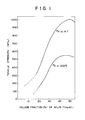
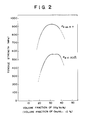
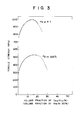
- FIGS. 1 to 3 are each a graph showing the relationship between the volume fraction of a compound phase and the tensile strength in the alloys described in the Examples of the present invention.
- the mean crystal grain size of the main metal element is that of a matrix consisting of the main metal element or a supersaturated solid solution of the main metal element.
- the mean crystal grain size of the matrix is limited to 40 to 1000 nm because when it is less than 40 nm, the ductility is unsatisfactory although the strength is high, while when it exceeds 1000 nm, it becomes impossible to prepare a high strength alloy due to a rapid lowering in the strength.
- the mean particle size of the intermetallic compounds is the mean particle size of a stable phase or a metastable phase of various intermetallic compounds formed from the above-described matrix element and other alloying elements and/or various intermetallic compounds formed from other alloying elements themselves.
- the mean particle size is limited to 10 to 800 nm because when it is outside this range, the intermetallic compounds do not function as a strengthening element for the main metal element matrix. Specifically, when the mean particle size is less than 10 nm, the intermetallic compounds do not contribute to strengthening of the matrix. In this case, when the intermetallic compounds are excessively dissolved in the solid solution form in the matrix, there is a possibility that the material might become brittle. On the other hand, when the mean particle size exceeds 800 nm, the particle size becomes so large that the strength cannot be maintained and, at the same time, the intermetallic compounds do not function as a strengthening element.
- the mean crystal grain size of the main metal element and the mean particle size of the intermetallic compounds are in the above-described respective ranges, it becomes possible to improve the Young's modulus, high-temperature strength and fatigue strength.
- the volume fraction of the particles of the intermetallic compounds to be incorporated into the the main element matrix is limited to 20 to 50% because when the volume fraction is less than 20%, an increase in the strength at room temperature and the rigidity is unsatisfactory, whereas when the volume fraction exceeds 50%, the ductility at room temperature is so poor that the working of the resultant alloy is unsatisfactory, which makes it impossible to attain the object of the present invention.
- the main metal element is AI or Mg
- the additive elements preferably consist of a first additive element consisting of at least one element selected from among rare earth elements (including Y), Zr and Ti and a second additive element consisting of at least one element selected from among transition elements exclusive of the elements belonging to the first additive element, Li, Si, Mg and Al.
- the main metal element is Al
- the second additive element is exclusive of Al.
- the main metal element is Mg
- the second additive element is exclusive of Mg.
- Mm mischmetal
- lanthanoid rare earth elements exclusive of La and Ce and unavoidable impurities (Si, Fe, Mg, Al, etc.) as well belongs to the rare earth element of the first additive element.
- the above-mentioned aluminum alloys include (I) an alloy represented by the general formula Al, oo -a- b X a M b wherein X represents at least one element selected from among La, Ce, Mm, Zr, Ti and Y; M represents at least one metal selected from Ni and Co; and a and b each an atomic %, provided that 0.1 ⁇ a 5 5 and 5 ⁇ b 10; and (II) an alloy represented by the general formula Al,oo-a- b -cXaM b Qc wherein X represents at least one element selected from among La, Ce, Mm, Zr, Ti and Y; M represents at least one metal selected from Ni and Co; Q represents at least one element selected from among Mg, Si, Cu and Zn; and a, b and c are each an atomic %, provided that 0.1 ⁇ a 5, 5 ⁇ b 10 and 0.1 ⁇ c ⁇ 2.
- a, b and c in the above-described general formulae are limited to 0.1 to 5, 5 to 10 and 0.1 to 2, respectively, in terms of atomic % because when a, b and c are in the above-described respective ranges, the strength of the alloys at a temperature in the range of from room temperature to 300 ° C is higher than that of the conventional (commercially available) high strength aluminum alloy and the alloys have a ductility sufficient to withstand practical working.
- the X element is at least one element selected from among La, Ce, Mm, Ti and Zr. It has a small diffusibility in the AI matrix, forms various metastable or stable intermetallic compounds and contributes to the stabilization of a microcrystalline structure.
- the M element is at least one element selected from Ni and Co. It has a relatively small diffusibility in the AI matrix. When it is finely dispersed as intermetallic compounds in the AI matrix, it has the effect of strengthening the matrix and, at the same time, regulating the growth of crystal grains. Specifically, it contributes to a remarkable improvement in the hardness, strength and rigidity of the alloy and stabilizes the microcrystalline phase not only at room temperature but also at high temperature, so that the heat resistance can be imparted to the material.
- the Q element is at least one element selected from among Mg, Si, Cu and Zn, and combines with AI to form compounds or combines with another Q element to form compounds, thus strengthening the matrix and contributing to an improvement in the heat resistance. Further, the specific strength and specific modulus are improved.
- the mean crystal grain size of a matrix of AI or a supersaturated solid solution of AI should be 40 to 1000 nm
- the mean size of particles of a stable phase or a metastable phase of various intermetallic compounds formed from the above-described matrix element and other alloying elements and/or various intermetallic compounds formed from other alloying elements themselves should be 10 to 800 nm
- the volume fraction of the intermetallic compound particles incorporated into the AI matrix should be 20 to 50%.
- the volume fraction of the AI-X type compound is preferably 1 to 30%.
- the volume fraction is less than 1 %, the matrix is coarsened and the strength is lowered.
- the volume fraction exceeds 30%, the ductility is extremely lowered.
- the volume fraction of the Al-M type compound is preferably 19 to 40%. When the volume fraction is less than 19%, the strength at room temperature lowers, while when the volume fraction exceeds 40%, the ductility lowers.
- preferred examples of the dispersed Al-M type compound include Al 3 Ni and Al 9 Co 2 and preferred examples of the AI-X type compound include Ce 3 AI, 1 , AI 4 Ce, La 3 AIl 1 , MmaAl 1 1 , AI 3 Ti and AI 3 Zr.
- a compound of a metastable phase has a higher effect of contribution to a fine dispersion.
- the alloy of the present invention can be directly prepared in the form of a thin ribbon, powder, fine wire, etc., by the liquid quenching process such as the single-roller melt-spinning process, the gas or water atomization process or the in-rotating-water melt-spinning process through a proper regulation of the cooling rate of the ordinary solidification process to 10 7 to 10 2 K/sec.
- the liquid quenching process such as the single-roller melt-spinning process, the gas or water atomization process or the in-rotating-water melt-spinning process through a proper regulation of the cooling rate of the ordinary solidification process to 10 7 to 10 2 K/sec.
- vapor phase deposition means such as sputtering, ion beam sputtering, vapor deposition or the like.
- the powder can be prepared also by the mechanical alloying process (MA process).
- a consolidated material of the alloy according to the present invention can be directly prepared by two- stage solidification means as described in Japanese Patent Laid-Open No. 253525/1991 through a proper control of the cooling rate.
- the alloy is prepared in the form of a consolidated material, a material in the form of a thin ribbon, powder, fine wire, foil or the like prepared by the above-described process may be consolidated and worked by the conventional plastic deforming means.
- a powder, flake or the like having a fine structure prepared by rapid solidification or the like is desirably subjected to plastic deformation at a temperature of preferably 50 to 500 ° C, still preferably 320 to 440 ° C.
- the heat history in this case provides a more suitable crystalline structure.
- the alloy of the present invention produced by the above-described process enables superplastic working or diffusion bonding in the case of the superplastic working to be conducted at a temperature in the range of from 300 to 600 ° C at a rate of strain in the range of from 10- 3 to 10 2 S- 1 .
- An aluminum-based alloy powder (AI bai Ni 5-10 Ce 0.5-4 ) having a predetermined composition was prepared by a gas atomizing apparatus.
- the aluminum-based alloy powder thus produced was filled into a metallic capsule, and a billet for extrusion was prepared with degassing. This billet was extruded at a temperature of 320 to 440 ° C by an extruder to prepare samples.
- the volume fraction of the above-described intermetallic compounds was measured by subjecting the resultant consolidated material to an image analysis under a TEM.
- the intermetallic compounds precipitated from the above-described samples were mainly Al 3 Ni, Ce 3 Al 11 , etc.
- Observation under a TEM revealed that the above-described samples each comprised a matrix consisting of aluminum or a supersaturated solid solution of aluminum and having a mean crystal grain size of 40 to 1000 nm, that particles consisting of a stable phase or a metastable phase of various intermetallic compounds formed from the matrix element and other alloying elements and/or various intermetallic compounds formed from other alloying elements themselves were homogeneously distributed in the matrix, and that the mean particle size of the particles of the intermetallic compounds was 10 to 800 nm.
- the strength at room temperature and the strength at 200 ° C rapidly increased when the volume fraction exceeded 20% and gradually decreased when the volume fraction exceeded about 50%.
- the ductility of the sample at room temperature decreased with an increasing volume fraction of the intermetallic compound particles, and became lower than the lower limit (2%) of the ductility necessary for general working when the volume fraction exceeded 50%.
- the strength at room temperature and the strength at a high temperature of 200 ° C rapidly increased when the volume fraction of the Al 3 Ni intermetallic compound particles exceeded 19% and rapidly lowered when the volume fraction exceeded 40%. Further, as is apparent from FIG. 3, the strength at room temperature and the strength at a high temperature of 200 ° C rapidly increased when the volume fraction of the Ce 3 Al 11 intermetallic compound particles exceeded 1 %. The strength at room temperature rapidly lowered when the volume fraction exceeded 20% and the strength at the high temperature rapidly lowered when the volume fraction exceeded 30%. The ductility at room temperature of the above-described samples became lower than the lower limit (2%) of the ductility necessary for general working when the volume fraction exceeded 40% for the Al 3 Ni intermetallic compound and exceeded 30% for the Ce 3 Al 11 intermetallic compound.
- Extruded materials consisting of various ingredients specified in Table 1 were prepared in the same manner as that of Example 1 to examine the mechanical properties (tensile strength) of these materials at room temperature.
- mechanical properties tensile strength
- the extruded materials (consolidated materials) of the present invention have an excellent tensile strength at room temperature.
- the alloy of this Example comprised a matrix consisting of aluminum or a supersaturated solid solution of aluminum and having a mean crystal grain size of 40 to 1000 nm, and particles consisting of a stable phase or a metastable phase of various intermetallic compounds formed from the matrix element and other alloying elements and/or various intermetallic compounds formed from other alloying elements themselves were homogeneously distributed in the matrix.
- the mean size of the particles of intermetallic compounds was 10 to 800 nm.
- the rapidly solidified alloy according to the present invention is excellent in the strength at room temperature and high temperature as well as in the toughness. Further, it can maintain excellent properties inherent in a material produced by the rapid solidification process even when it undergoes a thermal influence during working.
Landscapes
- Chemical & Material Sciences (AREA)
- Engineering & Computer Science (AREA)
- Materials Engineering (AREA)
- Mechanical Engineering (AREA)
- Metallurgy (AREA)
- Organic Chemistry (AREA)
- Powder Metallurgy (AREA)
- Manufacture Of Metal Powder And Suspensions Thereof (AREA)
Applications Claiming Priority (2)
| Application Number | Priority Date | Filing Date | Title |
|---|---|---|---|
| JP28022/92 | 1992-02-14 | ||
| JP4028022A JP2954775B2 (ja) | 1992-02-14 | 1992-02-14 | 微細結晶組織からなる高強度急冷凝固合金 |
Publications (3)
| Publication Number | Publication Date |
|---|---|
| EP0558977A2 true EP0558977A2 (de) | 1993-09-08 |
| EP0558977A3 EP0558977A3 (en) | 1993-11-10 |
| EP0558977B1 EP0558977B1 (de) | 1997-05-28 |
Family
ID=12237128
Family Applications (1)
| Application Number | Title | Priority Date | Filing Date |
|---|---|---|---|
| EP93102273A Expired - Lifetime EP0558977B1 (de) | 1992-02-14 | 1993-02-12 | Hochfestige, rasch erstarrte Legierung |
Country Status (4)
| Country | Link |
|---|---|
| US (1) | US5647919A (de) |
| EP (1) | EP0558977B1 (de) |
| JP (1) | JP2954775B2 (de) |
| DE (1) | DE69310954T2 (de) |
Cited By (3)
| Publication number | Priority date | Publication date | Assignee | Title |
|---|---|---|---|---|
| EP0693567A3 (de) * | 1994-07-19 | 1996-10-23 | Toyota Motor Co Ltd | Hochfeste und hochduktile Aluminium-Legierung und Verfahren zu deren Herstellung |
| EP0866143A4 (de) * | 1996-09-09 | 1999-09-29 | Sumitomo Electric Industries | Hochfeste, hochzähe aluminiumlegierung und verfahren zu deren herstellung |
| EP0997546A1 (de) * | 1998-10-30 | 2000-05-03 | Sumitomo Electric Industries, Ltd. | Aluminiumlegierung und Verfahren zur Herstellung eines Aluminiumlegierungsteiles |
Families Citing this family (14)
| Publication number | Priority date | Publication date | Assignee | Title |
|---|---|---|---|---|
| JPH07179974A (ja) * | 1993-12-24 | 1995-07-18 | Takeshi Masumoto | アルミニウム合金およびその製造方法 |
| JPH07179975A (ja) * | 1993-12-24 | 1995-07-18 | Takeshi Masumoto | アルミニウム合金およびその製造方法 |
| JP2785910B2 (ja) * | 1994-08-25 | 1998-08-13 | 本田技研工業株式会社 | 耐熱・耐摩耗性アルミニウム合金、アルミニウム合金製リテーナ及びアルミニウム合金製バルブリフタ |
| US6610548B1 (en) * | 1999-03-26 | 2003-08-26 | Sony Corporation | Crystal growth method of oxide, cerium oxide, promethium oxide, multi-layered structure of oxides, manufacturing method of field effect transistor, manufacturing method of ferroelectric non-volatile memory and ferroelectric non-volatile memory |
| US7387578B2 (en) * | 2004-12-17 | 2008-06-17 | Integran Technologies Inc. | Strong, lightweight article containing a fine-grained metallic layer |
| CN103219119A (zh) * | 2013-04-18 | 2013-07-24 | 安泰科技股份有限公司 | 一种μ90高磁导率Fe基非晶磁粉芯的制备方法 |
| DE102015220766B4 (de) * | 2014-10-23 | 2019-05-23 | Leibniz-Institut Für Festkörper- Und Werkstoffforschung Dresden E.V. | Verfahren zur Herstellung eines umgeformten Körpers aus vollkristallinen, metastabilen Materialien |
| US12305267B2 (en) * | 2017-02-22 | 2025-05-20 | Ut-Battelle, Llc | Rapidly solidified aluminum-rare earth element alloy and method of making the same |
| CN109750192B (zh) * | 2019-03-08 | 2024-05-07 | 王泰峰 | 一种无火花超耐磨刹车制动盘及其制备方法 |
| US11312869B2 (en) * | 2019-07-18 | 2022-04-26 | Integran Technologies Inc. | Articles comprising durable water repellent, icephobic and/or biocidal coatings |
| US11319450B2 (en) * | 2019-07-18 | 2022-05-03 | Integran Technologies Inc. | Articles comprising durable icephobic coatings |
| US12247272B2 (en) | 2019-10-30 | 2025-03-11 | Ut-Battelle, Llc | Aluminum-cerium-copper alloys for metal additive manufacturing |
| US11986904B2 (en) | 2019-10-30 | 2024-05-21 | Ut-Battelle, Llc | Aluminum-cerium-nickel alloys for additive manufacturing |
| US11608546B2 (en) | 2020-01-10 | 2023-03-21 | Ut-Battelle Llc | Aluminum-cerium-manganese alloy embodiments for metal additive manufacturing |
Family Cites Families (8)
| Publication number | Priority date | Publication date | Assignee | Title |
|---|---|---|---|---|
| US4409041A (en) * | 1980-09-26 | 1983-10-11 | Allied Corporation | Amorphous alloys for electromagnetic devices |
| US4743317A (en) * | 1983-10-03 | 1988-05-10 | Allied Corporation | Aluminum-transition metal alloys having high strength at elevated temperatures |
| US4675157A (en) * | 1984-06-07 | 1987-06-23 | Allied Corporation | High strength rapidly solidified magnesium base metal alloys |
| DE3524276A1 (de) * | 1984-07-27 | 1986-01-30 | BBC Aktiengesellschaft Brown, Boveri & Cie., Baden, Aargau | Aluminiumlegierung zur herstellung von ultra-feinkoernigem pulver mit verbesserten mechanischen und gefuegeeigenschaften |
| FR2584095A1 (fr) * | 1985-06-28 | 1987-01-02 | Cegedur | Alliages d'al a hautes teneurs en li et si et un procede de fabrication |
| JPH0621326B2 (ja) * | 1988-04-28 | 1994-03-23 | 健 増本 | 高力、耐熱性アルミニウム基合金 |
| DE69115394T2 (de) * | 1990-08-14 | 1996-07-11 | Ykk Corp | Hochfeste Legierungen auf Aluminiumbasis |
| US5509978A (en) * | 1992-08-05 | 1996-04-23 | Yamaha Corporation | High strength and anti-corrosive aluminum-based alloy |
-
1992
- 1992-02-14 JP JP4028022A patent/JP2954775B2/ja not_active Expired - Fee Related
-
1993
- 1993-02-12 EP EP93102273A patent/EP0558977B1/de not_active Expired - Lifetime
- 1993-02-12 DE DE69310954T patent/DE69310954T2/de not_active Expired - Fee Related
-
1994
- 1994-10-05 US US08/318,531 patent/US5647919A/en not_active Expired - Fee Related
Cited By (5)
| Publication number | Priority date | Publication date | Assignee | Title |
|---|---|---|---|---|
| EP0693567A3 (de) * | 1994-07-19 | 1996-10-23 | Toyota Motor Co Ltd | Hochfeste und hochduktile Aluminium-Legierung und Verfahren zu deren Herstellung |
| EP0866143A4 (de) * | 1996-09-09 | 1999-09-29 | Sumitomo Electric Industries | Hochfeste, hochzähe aluminiumlegierung und verfahren zu deren herstellung |
| US6149737A (en) * | 1996-09-09 | 2000-11-21 | Sumitomo Electric Industries Ltd. | High strength high-toughness aluminum alloy and method of preparing the same |
| EP0997546A1 (de) * | 1998-10-30 | 2000-05-03 | Sumitomo Electric Industries, Ltd. | Aluminiumlegierung und Verfahren zur Herstellung eines Aluminiumlegierungsteiles |
| US6402860B2 (en) | 1998-10-30 | 2002-06-11 | Sumitomo Electric Industries, Ltd. | Aluminum alloy and method for manufacturing aluminum-alloy member |
Also Published As
| Publication number | Publication date |
|---|---|
| JP2954775B2 (ja) | 1999-09-27 |
| JPH05222491A (ja) | 1993-08-31 |
| EP0558977B1 (de) | 1997-05-28 |
| US5647919A (en) | 1997-07-15 |
| DE69310954D1 (de) | 1997-07-03 |
| DE69310954T2 (de) | 1998-01-08 |
| EP0558977A3 (en) | 1993-11-10 |
Similar Documents
| Publication | Publication Date | Title |
|---|---|---|
| US5593515A (en) | High strength aluminum-based alloy | |
| US5509978A (en) | High strength and anti-corrosive aluminum-based alloy | |
| US5647919A (en) | High strength, rapidly solidified alloy | |
| EP0558957B1 (de) | Hochfestige und verschleissfestige Aluminiumlegierung | |
| EP0587186B1 (de) | Hochfeste, wärmeresistente Legierung auf Aluminiumbasis | |
| US5607523A (en) | High-strength aluminum-based alloy | |
| US5900210A (en) | High-strength and high-ductility aluminum-base alloy | |
| EP0584596A2 (de) | Rostfeste und hochfeste Aluminiumlegierung | |
| EP0606572B1 (de) | Hochfeste und wärmebeständige Aluminiumlegierung, verdichteter und verfestigter Werkstoff daraus und Verfahren zur Herstellung | |
| US5489418A (en) | High-strength, heat-resistant aluminum-based alloy, compacted and consolidated material thereof, and process for producing the same | |
| US6334911B2 (en) | High-strength, high-ductility aluminum alloy | |
| JP2807374B2 (ja) | 高強度マグネシウム基合金およびその集成固化材 | |
| JP2790935B2 (ja) | アルミニウム基合金集成固化材並びにその製造方法 | |
| EP0540056B1 (de) | Verdichtete und verfestigte Wirkstoffe aus Aluminium-Legierung | |
| EP0577944B1 (de) | Hochfestige Legierung auf Aluminiumbasis und verdichteter und verfestigter Werkstoff daraus | |
| JP3203564B2 (ja) | アルミニウム基合金集成固化材並びにその製造方法 | |
| JP3485961B2 (ja) | 高強度アルミニウム基合金 | |
| EP0524527B1 (de) | Verdichtete und verfestigte Werkstoffe auf Aluminiumbasis und Verfahren zur Herstellung dieser Werkstoffe | |
| JP3053267B2 (ja) | アルミニウム基合金集成固化材の製造方法 | |
| JP2807400B2 (ja) | 高力マグネシウム基合金材およびその製造方法 | |
| JP2798840B2 (ja) | 高強度アルミニウム基合金集成固化材並びにその製造方法 | |
| JP3299404B2 (ja) | 高強度アルミニウム合金およびその製造方法 |
Legal Events
| Date | Code | Title | Description |
|---|---|---|---|
| PUAI | Public reference made under article 153(3) epc to a published international application that has entered the european phase |
Free format text: ORIGINAL CODE: 0009012 |
|
| AK | Designated contracting states |
Kind code of ref document: A2 Designated state(s): DE FR GB |
|
| PUAL | Search report despatched |
Free format text: ORIGINAL CODE: 0009013 |
|
| AK | Designated contracting states |
Kind code of ref document: A3 Designated state(s): DE FR GB |
|
| 17P | Request for examination filed |
Effective date: 19940216 |
|
| 17Q | First examination report despatched |
Effective date: 19940725 |
|
| RAP1 | Party data changed (applicant data changed or rights of an application transferred) |
Owner name: YKK CORPORATION |
|
| GRAG | Despatch of communication of intention to grant |
Free format text: ORIGINAL CODE: EPIDOS AGRA |
|
| GRAH | Despatch of communication of intention to grant a patent |
Free format text: ORIGINAL CODE: EPIDOS IGRA |
|
| GRAH | Despatch of communication of intention to grant a patent |
Free format text: ORIGINAL CODE: EPIDOS IGRA |
|
| GRAA | (expected) grant |
Free format text: ORIGINAL CODE: 0009210 |
|
| AK | Designated contracting states |
Kind code of ref document: B1 Designated state(s): DE FR GB |
|
| ET | Fr: translation filed | ||
| REF | Corresponds to: |
Ref document number: 69310954 Country of ref document: DE Date of ref document: 19970703 |
|
| PLBE | No opposition filed within time limit |
Free format text: ORIGINAL CODE: 0009261 |
|
| STAA | Information on the status of an ep patent application or granted ep patent |
Free format text: STATUS: NO OPPOSITION FILED WITHIN TIME LIMIT |
|
| 26N | No opposition filed | ||
| REG | Reference to a national code |
Ref country code: GB Ref legal event code: IF02 |
|
| PGFP | Annual fee paid to national office [announced via postgrant information from national office to epo] |
Ref country code: FR Payment date: 20020212 Year of fee payment: 10 |
|
| PGFP | Annual fee paid to national office [announced via postgrant information from national office to epo] |
Ref country code: GB Payment date: 20020213 Year of fee payment: 10 |
|
| PG25 | Lapsed in a contracting state [announced via postgrant information from national office to epo] |
Ref country code: GB Free format text: LAPSE BECAUSE OF NON-PAYMENT OF DUE FEES Effective date: 20030212 |
|
| GBPC | Gb: european patent ceased through non-payment of renewal fee | ||
| PG25 | Lapsed in a contracting state [announced via postgrant information from national office to epo] |
Ref country code: FR Free format text: LAPSE BECAUSE OF NON-PAYMENT OF DUE FEES Effective date: 20031031 |
|
| REG | Reference to a national code |
Ref country code: FR Ref legal event code: ST |
|
| PGFP | Annual fee paid to national office [announced via postgrant information from national office to epo] |
Ref country code: DE Payment date: 20080207 Year of fee payment: 16 |
|
| PG25 | Lapsed in a contracting state [announced via postgrant information from national office to epo] |
Ref country code: DE Free format text: LAPSE BECAUSE OF NON-PAYMENT OF DUE FEES Effective date: 20090901 |