EP0561239B1 - Optischer Festphasenbiosensor auf Basis fluoreszenzfarbstoffmarkierter polyionischer Schichten - Google Patents
Optischer Festphasenbiosensor auf Basis fluoreszenzfarbstoffmarkierter polyionischer Schichten Download PDFInfo
- Publication number
- EP0561239B1 EP0561239B1 EP93103585A EP93103585A EP0561239B1 EP 0561239 B1 EP0561239 B1 EP 0561239B1 EP 93103585 A EP93103585 A EP 93103585A EP 93103585 A EP93103585 A EP 93103585A EP 0561239 B1 EP0561239 B1 EP 0561239B1
- Authority
- EP
- European Patent Office
- Prior art keywords
- dye
- biosensor according
- optical biosensor
- coumarin
- tetramethylrhodamine
- Prior art date
- Legal status (The legal status is an assumption and is not a legal conclusion. Google has not performed a legal analysis and makes no representation as to the accuracy of the status listed.)
- Expired - Lifetime
Links
- 0 CC1(*C(C=C)=O)C=CC(C2=Cc(ccc(*)c3)c3OC2=O)=CC1 Chemical compound CC1(*C(C=C)=O)C=CC(C2=Cc(ccc(*)c3)c3OC2=O)=CC1 0.000 description 1
Images

Classifications
-
- G—PHYSICS
- G01—MEASURING; TESTING
- G01N—INVESTIGATING OR ANALYSING MATERIALS BY DETERMINING THEIR CHEMICAL OR PHYSICAL PROPERTIES
- G01N33/00—Investigating or analysing materials by specific methods not covered by groups G01N1/00 - G01N31/00
- G01N33/48—Biological material, e.g. blood, urine; Haemocytometers
- G01N33/50—Chemical analysis of biological material, e.g. blood, urine; Testing involving biospecific ligand binding methods; Immunological testing
- G01N33/53—Immunoassay; Biospecific binding assay; Materials therefor
- G01N33/543—Immunoassay; Biospecific binding assay; Materials therefor with an insoluble carrier for immobilising immunochemicals
-
- G—PHYSICS
- G01—MEASURING; TESTING
- G01N—INVESTIGATING OR ANALYSING MATERIALS BY DETERMINING THEIR CHEMICAL OR PHYSICAL PROPERTIES
- G01N33/00—Investigating or analysing materials by specific methods not covered by groups G01N1/00 - G01N31/00
- G01N33/48—Biological material, e.g. blood, urine; Haemocytometers
- G01N33/50—Chemical analysis of biological material, e.g. blood, urine; Testing involving biospecific ligand binding methods; Immunological testing
- G01N33/53—Immunoassay; Biospecific binding assay; Materials therefor
- G01N33/543—Immunoassay; Biospecific binding assay; Materials therefor with an insoluble carrier for immobilising immunochemicals
- G01N33/54366—Apparatus specially adapted for solid-phase testing
- G01N33/54373—Apparatus specially adapted for solid-phase testing involving physiochemical end-point determination, e.g. wave-guides, FETS, gratings
-
- G—PHYSICS
- G01—MEASURING; TESTING
- G01N—INVESTIGATING OR ANALYSING MATERIALS BY DETERMINING THEIR CHEMICAL OR PHYSICAL PROPERTIES
- G01N33/00—Investigating or analysing materials by specific methods not covered by groups G01N1/00 - G01N31/00
- G01N33/48—Biological material, e.g. blood, urine; Haemocytometers
- G01N33/50—Chemical analysis of biological material, e.g. blood, urine; Testing involving biospecific ligand binding methods; Immunological testing
- G01N33/58—Chemical analysis of biological material, e.g. blood, urine; Testing involving biospecific ligand binding methods; Immunological testing involving labelled substances
- G01N33/582—Chemical analysis of biological material, e.g. blood, urine; Testing involving biospecific ligand binding methods; Immunological testing involving labelled substances with fluorescent label
-
- G—PHYSICS
- G01—MEASURING; TESTING
- G01N—INVESTIGATING OR ANALYSING MATERIALS BY DETERMINING THEIR CHEMICAL OR PHYSICAL PROPERTIES
- G01N33/00—Investigating or analysing materials by specific methods not covered by groups G01N1/00 - G01N31/00
- G01N33/48—Biological material, e.g. blood, urine; Haemocytometers
- G01N33/50—Chemical analysis of biological material, e.g. blood, urine; Testing involving biospecific ligand binding methods; Immunological testing
- G01N33/94—Chemical analysis of biological material, e.g. blood, urine; Testing involving biospecific ligand binding methods; Immunological testing involving narcotics or drugs or pharmaceuticals, neurotransmitters or associated receptors
- G01N33/9453—Cardioregulators, e.g. antihypotensives, antiarrhythmics
-
- Y—GENERAL TAGGING OF NEW TECHNOLOGICAL DEVELOPMENTS; GENERAL TAGGING OF CROSS-SECTIONAL TECHNOLOGIES SPANNING OVER SEVERAL SECTIONS OF THE IPC; TECHNICAL SUBJECTS COVERED BY FORMER USPC CROSS-REFERENCE ART COLLECTIONS [XRACs] AND DIGESTS
- Y10—TECHNICAL SUBJECTS COVERED BY FORMER USPC
- Y10S—TECHNICAL SUBJECTS COVERED BY FORMER USPC CROSS-REFERENCE ART COLLECTIONS [XRACs] AND DIGESTS
- Y10S435/00—Chemistry: molecular biology and microbiology
- Y10S435/808—Optical sensing apparatus
Definitions
- the present invention relates to an optical biosensor for the detection of Molecules that can be labeled with a fluorescent dye for Detection of dissolved substances (hereinafter referred to as analytes) for which one specifically recognizing biomolecule (hereinafter called receptor) exists.
- a fluorescent dye for Detection of dissolved substances hereinafter referred to as analytes
- receptor one specifically recognizing biomolecule
- It is a solid phase sensor with fluorescent dye, which an energy transfer process to one to be detected, with a second Fluorescent dye labeled molecule determining its presence and quantity allowed. It is about a displacement or a sandwich reaction Unlabeled analytes can also be determined.
- Immunoassay methods are generally based on ability a receptor molecule, for example an antibody, the structure and molecular organization of a ligand molecule, be it by nonpolar and / or Polar interactions are defined, specifically recognized and based on this molecule to bind in a very specific way.
- Immunoassays are carried out using various methods. These include the use of various labeling techniques, mostly radioactive, enzyme-linked and fluorescent in nature (EF Ulman, PL Khanna, Methods in Enzymology, 74 (1981), 28-60). A special case of the latter method can be considered the radiationless fluorescence energy transfer, with which the approximation of two fluorescent dyes and indirectly the approximation of a receptor / ligand pair can be measured (L. Stryer, Annual Reviews in Biochemistry 47 (1978), 819- 846). This principle has been mentioned several times in the technology of immunoassays and biosensors (SM Barnard, DR Walt, Science 251, 927 (1991), EP 150 905, DE 3938598).
- Glasses such as, for example, come as supports for the layers to be applied Float glass or quartz glass, semiconductor materials like silicon, plastics like Polyester, vinyl polymers or polycarbonate, as well as metals in question.
- the Have a sufficient surface of the carrier surface.
- some of the mentioned materials, such as the glasses or silicon oxidized on the surface this is already the case to some extent. If this is not enough, they can Carrier materials also by chemical surface modification with ionic Groups are occupied, for example with aminopropyl-ethoxy-dimethylsilane, such as described in German patent application DE 4 026 978.
- an oxidative treatment for example by wet chemical oxidation, by Corona discharge or by plasma treatment of the carrier materials is one suitable method known to the person skilled in the art to create ionizable surfaces produce.
- the surfaces can also contain groups that start with the first layer to be applied chemically to form covalent bonds can react, such as vinylidene chloride activation Coverage with polyamino compounds.
- Polyanions and polycations are required as adsorbing polyions.
- Polycations are preferably compounds with amino functions, such as polylysine, polyallylamine, polyvinylpyridine, with amino functions modified dextrans (e.g. DEAE-dextran) and chitosan.
- the amino compounds can either by simple protonation or by quaternization in the ionized state is transferred. To a lesser extent they can Amino groups also with functional groups, e.g. the donor dye and / or reactive groups for binding receptor molecules.
- Polycarboxylic acids and polysulfonic acids are preferably used as polyanions
- polyglutamate polystyrene sulfonic acid, or dextran sulfate.
- functional groups to be appropriate.
- vinylic sulfonic acids have been shown to incorporate acrylated coumarin dyes or aminofluorescein as suitable. Examples of connections of this type are described in application example 1 and in German patent application DE 4 114 482.
- a functional multi-layer is now built up by successive, alternating immersion of the carrier in aqueous solutions, which also contains additives organic solvents, polyions e.g. Polycation, Polyanion, polycation, etc., with rinsing processes carried out in between.
- the Polyions are preferably in concentrations between 0.01 and 1 g / l in Solvent dissolved, the optimum concentration of the molecular weight and the type of coating technology used and in individual cases must be optimized.
- the pH of the solution is adjusted to 10 or less it being important that the polyamino compounds, insofar as they are not are anyway quaternized, are in protonated form and also not in subsequent immersion of the support in a polycation solution deprotonated and be relieved.
- One of the top layers should contain the polyion to which a fluorescent dye is bound.
- An antibody molecule for example, is then attached to the top layer or immobilized an antigen with a reactive anchor group.
- the methods and reagents known from the literature offer antibodies such as N-hydroxysuccinimide esters, isocyanates and isothiocyanates.
- Application example 2 shows, alternatively, the binding of activated digitoxigenin on polylysine.
- acceptor dyes mentioned can be reacted with protein receptors as well as with various low molecular weight substances, provided they have amino groups, in a manner known to those skilled in the art.
- a fluorescence-labeled binding partner can then be detected at these binding sites using a fluorescent dye which is complementary to the bound in the layer layers by Förster energy transfer.
- a monoclonal antibody labeled with tetramethylrhodamine isothiocyanate (TRITC) or an Fab fragment thereof can be bound to the digitoxigenin-modified polylysine (application example 2).
- Free digoxin can be detected in this arrangement by displacement of the antibody from the solid phase or by prior reaction with the labeled antibody [analog: RG Sommer et al., Clin. Chem. 36 , 201-206 (1990)].
- Analytes are detected by simply contacting the coated one Carrier with the sample solution and subsequent fluorescence measurement.
- a Förster energy transfer can be done in conventional fluorescence spectrometers, however also in specially designed devices, e.g. described in German application DE 4 116 116.
- the solution is placed in the polymerization apparatus.
- the apparatus is evacuated, charged with ultrapure nitrogen and this process is repeated three times; the solution is then heated to 65 ° C and reacted for 15 h.
- the reaction solution is added dropwise in 200 ml of acetone, the precipitate formed is filtered off and dried.
- the crude polymer is subjected to ultrafiltration (cutoff 10,000 daltons). Yield 70 - 80% of theory.
- poly-DL-lysine 25 mg poly-DL-lysine are dissolved in 15 ml methanol and mixed with 20 ul triethylamine. 22 mg of digitoxigenin (6-aminocaproyl-carboxy) -N-hydroxysuccinimide are added with stirring at room temperature added dropwise in 5 ml of isopropanol / chloroform (1: 1, v / v). The solution is then stirred under reflux for 2 h, then at room temperature for 8 h. The reaction mixture is evaporated in vacuo, taken up in 2 ml of water and chromatographed on a Sephadex G-25 column (50 cm ⁇ 16 cm ⁇ , UV detection 254 nm, eluent: water).
- a slide made of float glass is treated with water in an ultrasound bath for 1 minute and carefully dried with nitrogen, the surfaces being cleaned dust-free. Then the plate is pre-cleaned in a mixture of conc. Bred sulfuric acid and hydrogen peroxide (7: 3, v / v) and treated in it at 80 ° C for one hour in an ultrasonic bath. After cooling to room temperature, the plate is treated 3 times in water for 60 seconds in an ultrasonic bath and washed with water until it is acid-free. It is then placed in a mixture of H 2 O / H 2 O 2 / NH 3 (5: 1: 1, v / v / v) and treated therein at 80 ° C. for 5 minutes. The plate is then washed carefully with water until it is free of salt.
- the platelet is used to remove traces of water before the silanization reaction each treated for 2 minutes in methanol, methanol / toluene (1: 1, v / v) and toluene. Then it is left under a nitrogen atmosphere for 15 h in a 5% (v / v) React 3-aminopropyldimethylethoxysilane solution in toluene. Finally it will Platelets for 1 minute each with toluene, toluene / dimethyl sulfoxide (DMSO) (1: 1, v / v) and DMSO treated in an ultrasonic bath.
- DMSO dimethyl sulfoxide
- the slides made of float glass are made according to Example 3.2. pretreated and in Modification of the general procedure can only be demonstrated by immersion in solution B.
- the solutions from 4.1.1. up to 4.1.4.
- a piece of polyester film surface-activated with vinylidene chloride is without further cleaning steps are coated analogously to the general procedure above. It the solutions from 4.1.1. until 4.1.4. use.
- a according to example 4.1.3 The coated carrier is then coated with a specifically binding layer by immersion in a solution of 0.1 mg / ml digitoxigenin-derivatized polylysine (example 2) and washing according to the general procedure.
- the plate is then wetted with 50 ⁇ l of a solution of TRITC anti-digoxin IgG (produced by the reaction of tetramethylrhodamine isothiocyanate and anti-digoxin IgG) in contact (protein concentration 0.1 mg / ml).
Landscapes
- Health & Medical Sciences (AREA)
- Life Sciences & Earth Sciences (AREA)
- Engineering & Computer Science (AREA)
- Immunology (AREA)
- Molecular Biology (AREA)
- Hematology (AREA)
- Chemical & Material Sciences (AREA)
- Urology & Nephrology (AREA)
- Biomedical Technology (AREA)
- Physics & Mathematics (AREA)
- Biochemistry (AREA)
- Biotechnology (AREA)
- Pathology (AREA)
- Microbiology (AREA)
- Cell Biology (AREA)
- General Physics & Mathematics (AREA)
- Food Science & Technology (AREA)
- Medicinal Chemistry (AREA)
- General Health & Medical Sciences (AREA)
- Analytical Chemistry (AREA)
- Bioinformatics & Cheminformatics (AREA)
- Cardiology (AREA)
- Heart & Thoracic Surgery (AREA)
- Pharmacology & Pharmacy (AREA)
- Investigating, Analyzing Materials By Fluorescence Or Luminescence (AREA)
- Investigating Or Analysing Materials By The Use Of Chemical Reactions (AREA)
Description
| Donor(F1) | Akzeptor (F2) |
| Fluoresceinderivate | Tetramethylrhodamin |
| Fluoresceinderivate | Texasrot |
| Cumarin der Formel I | Tetramethylrhodamin |
| Cumarin der Formel II | Tetramethylrhodamin |
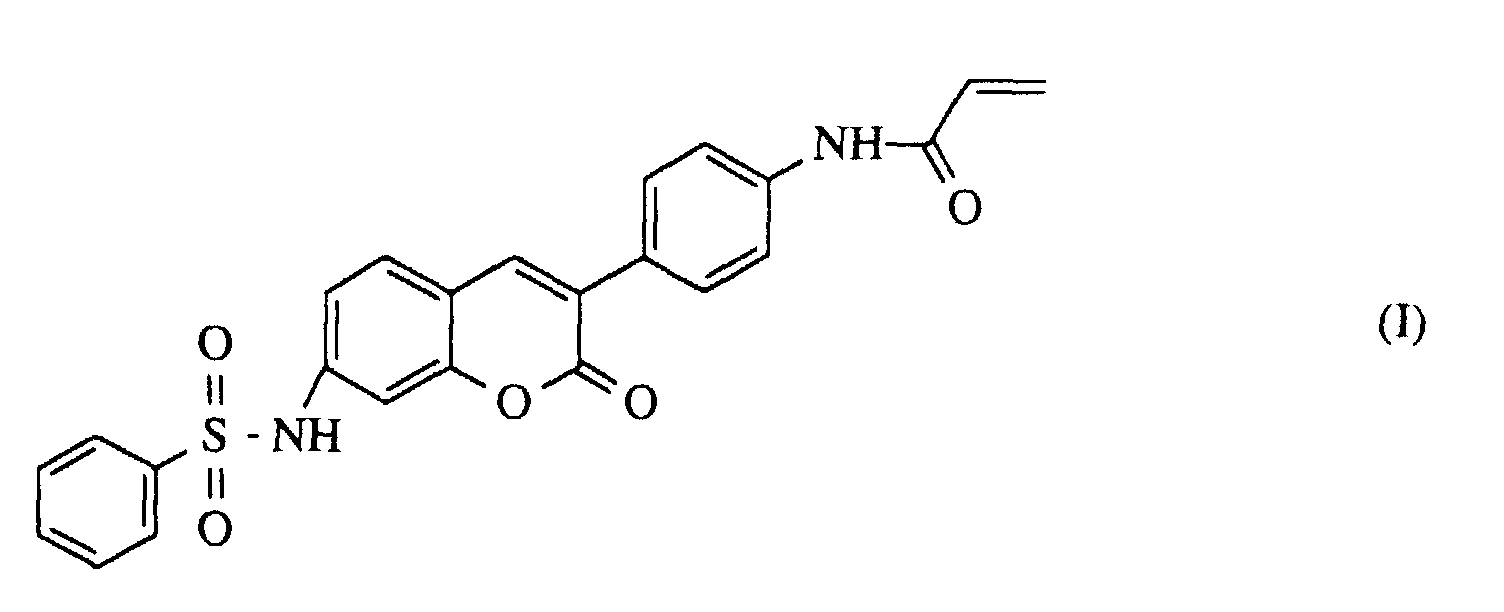
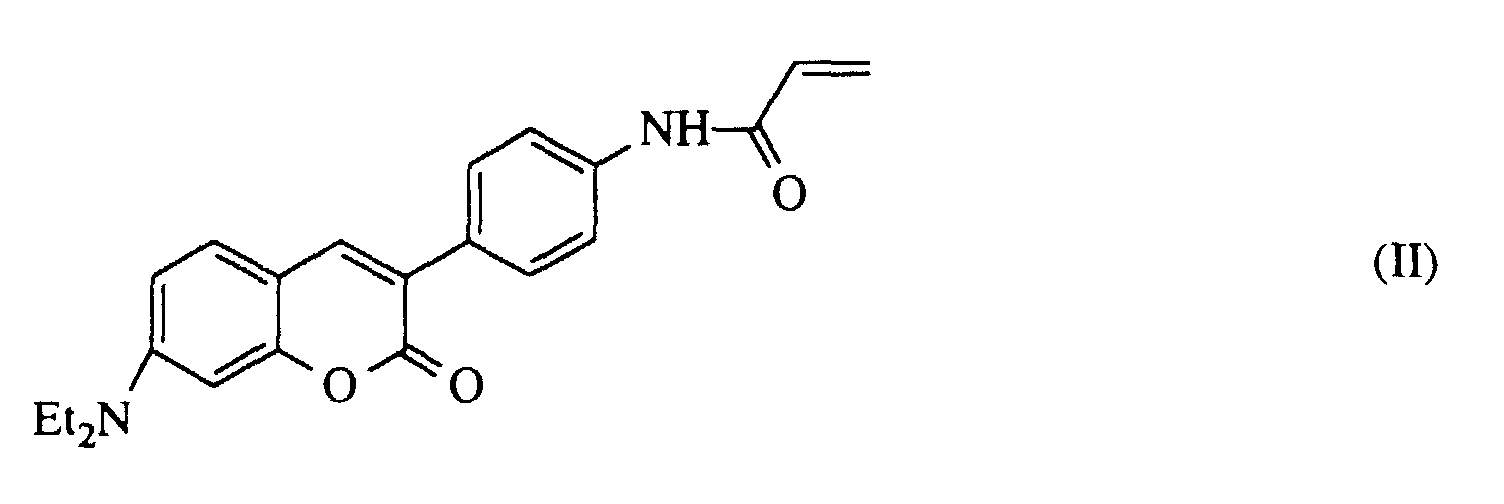


Ausbeute 70 - 80 % der Theorie.
| Fluoreszenz (gemessen in H2O, pH 10) | ||
| Polymere A, B: | Polymer C | |
| λexc | 385 nm | 410 nm |
| λem | 498 nm | 499 nm |
| Polymer A | Polymer B | Polymer C |
| 150 000 | 250 000 | 180 000 |

1H-NMR (250 MHz, CDCl3): 1,45 (m), 1,71 (m), 2,66 (s), 2,99 (m), 4,30 (m), 4,80 (m)ppm.
- 4.
1. Auf Floatglas, ohne Belegung mit Aminogruppen
Die Objektträger aus Floatglas werden nach Beispiel 3.1. vorbehandelt und nach obiger Prozedur durch sukzessives Tauchen in folgende Lösungen belegt: - 4.1.1.
Lösung A: 5 mg Polylysin in 10 ml 0.05 M Carbonatpuffer pH 8;
Lösung B: 5 mg Polymer C in 10 ml 0.05 M Carbonatpuffer pH 8. - 4.1.2.
Lösung A: 0.5 mg DEAE-Dextran in 10 ml 0.05 M Carbonatpuffer pH 8;
Lösung B: 0.5 mg Polymer C in 10 ml 0.05 M Carbonatpuffer pH 8. - 4.1.3.
Lösung A: 10 mg Polylysin in 10 ml 0.05 M Carbonatpuffer pH 8;
Lösung B: 1 mg Polymer C in 10 ml 0.05 M Carbonatpuffer pH 8. - 4.1.4.
Lösung A: 1 mg DEAE-Dextran in 10 ml 3 mM Salzsäure;
Lösung B: 1 mg Polymer C in 10 ml 3 mM Salzsäure. - 4.1.5.
Lösung A: 0.1 mg Polyvinylpyridin (Reilline 2200) in 10 ml 3 mM Salzsäure;
Lösung B: 10 mg Polymer A in 10 ml 3 mM Salzsäure.
Das Plättchen wird anschließend mit 50 µl einer Lösung von TRITC-Anti-Digoxin-IgG (hergestellt durch Reaktion von Tetramethylrhodamin-isothiocyanat und Anti-Digoxin-IgG) in Kontakt benetzt (Proteinkonzentration 0.1 mg/ml). Nach Spülen mit einem Puffer (15 mM KH2PO4, 25 mM Citrat, 1 mM MgCl2, 50 mM KCl, 0.4 g/l NaN3, 1 g/l Rinderserumalbumin, pH 6.4) wird die Fluoreszenz nochmals gemessen, wobei die des Cumarins aus dem Polymer C (509 nm) zugunsten der Fluoreszenz des TRITC (587 nm) gelöscht wird (Figur 1, Kurve a). Zur Kontrolle wird anstelle des Digitoxigenin-derivatisierten Polylysin underivatisiertes Polylysin in gleicher Konzentration eingesetzt, wodurch die oberste Schicht nicht zur Bindung befähigt ist und sich kein Energietransfer ergibt (Figur 1, Kurve b).
Claims (12)
- Optischer Festphasenbiosensor, markierbar mit einem Farbstoff F1 und einem Rezeptormolekül zur Detektion von Analytmolekülen in flüssiger Phase, markierbar mit einem Farbstoff F2 unter Ausnutzung des Försterenergietransfers zwischen F1 und F2, der ausa) einem gegebenenfalls transparenten Träger,b) einer daraufliegenden Multischicht besteht,c) in der obersten Schicht oder einer der obersten Schichten den Fluoreszenzfarbstoff F1 als Donorfarbstoff chemisch gebunden undd) ein Antikörper oder Antigen als Rezeptor kovalent oder ionisch an die oberste Schicht gebunden enthält, an welcheme) ein Antigen bzw. Antikörper als Analytmolekül gebunden werden kann, das wiederum mit dem Fluoreszenzfarbstoff F2 markiert ist, wobei die Farbstoffmoleküle einen Abstand einnehmen, der einen strahlungslosen Försterenergietransfer ermöglicht, dadurch gekennzeichnet, daß als Multischicht b) mehrere alternierende Schichten als Polyanionen und Polykationen eingesetzt werden, und daß die Konzentration des gebundenen Analytmoleküls in Abhängigkeit von der Zunahme der relativen Fluoreszenzintensität von F2 bzw. der Abnahme der Fluoreszenzintensität von F1 oder der Veränderung des Verhältnisses von beiden Intensitäten gemessen wird.
- Optischer Biosensor gemäß Anspruch 1, in dem das Analytmolekül e) ein mit dem Fluoreszenzfarbstoff F2 markiertes, an die oberste Schicht gebundenes Molekül, das nicht der Analyt ist, von der obersten Schicht verdrängt und die Konzentration des schließlich gebundenen Analytmoleküls in Abhängigkeit von der Abnahme der relativen Fluoreszenzintensität von F2 bzw. der Zunahme der Fluoreszenzintensität von F1 oder der Änderung des Verhältnisses von beiden Intensitäten gemessen wird.
- Optischer Biosensor gemäß Anspruch 1 oder 2, in dem als Trägermaterial a) Floatglas, Quarzglas, Silizium, Polyester, Vinylpolymere oder Polycarbonat eingesetzt werden.
- Optischer Biosensor nach Anspruch 1 oder 2, bei dem es sich bei den polyanionischen Verbindungen um Polyglutaminsäure, Polystyrolsulfonsäure, Dextransulfat oder ein Copolymeres aus Styrolsulfonsäure oder anderen vinylischen Sulfonsäuren und einem Vinylderivat eines Fluoreszenzfarbstoffes handelt.
- Optischer Biosensor nach Anspruch 4, bei dem es sich bei den polyanionischen Verbindungen um Copolymere aus Styrolsulfonat oder Sulfopropylmethacrylat und dem Acrylat eines Cumarinfarbstoffs handelt.
- Optischer Biosensor nach Anspruch 1 oder 2, bei dem es sich bei den polykationischen Verbindungen um Polylysin, Polyallylamin, Polyvinylpyridin, Chitosan oder deren durch Permethylierung quaternisierte Ammoniumsalze, oder um DEAE-Dextran handelt.
- Optischer Biosensor nach Anspruch 6, bei dem es sich bei den polykationischen Verbindungen um teilweise mit Fluorescein-isothiocyanat oder einem anderen Reaktivfarbstoff derivatisierte Polyaminoverbindungen wie Polylysin oder Polyallylamin handelt.
- Optischer Biosensor nach Anspruch 1 oder 2, dadurch gekennzeichnet, daß als für einen Förstertransfer geeignetes Farbstoffpaar F1 und F2Fluoresceinderivate und Tetram ethylrhodamin,Fluoresceinderivate und Texasrot,Cumarin der Formel I und Tetramethylrhodaminoder
 Cumarin der Formel II und Tetramethylrhodamin,eingesetzt werden.
- Optischer Biosensor nach Anspruch 8, in demals Farbstoffpaar F1 und F2 eingesetzt werden.Cumarin der Formel I und Tetramethylrhodamin
oderCumarin der Formel II und Tetramethylrhodamin - Verfahren zur Bestimmung von Digoxin als Analytmolekül mit einem Biosensor gemäß Anspruch 1, dadurch gekennzeichnet, daß auf einen Glasträger als erste Schicht ein Polylysin, als zweite Schicht ein Copolymer aus Kaliumsulfopropylmethacrylat und einem Cumarin der Formel II als Farbstoff F1und als oberste Schicht ein Polylysin, derivatisiert mit Digitoxigenin als Rezeptor, aufgetragen wird, Anti-Digoxin-Immunglobulin G mit Tetramethylrhodaminisothiocyanat als Farbstoff F2 in Lösung markiert wird, der Sensor in die Lösung eingetaucht wird, anschließend in eine Digitoxinhaltige Lösung eingetaucht wird und die Abnahme der Fluoreszenzintensität aus dem Farbstoff F2 bzw. die Zunahme der Fluoreszenzintensität aus dem Farbstoff F1 oder die Änderung des Verhältnisses von beiden gemessen wird.

- Verfahren zur Herstellung eines optischen Biosensors gemäß Anspruch 1 oder 2, dadurch gekennzeichnet, daß auf einem gegebenenfalls transparenten Träger durch sukzessives alternierendes Eintauchen des Trägers in Lösungen von polyanionischen und polykationischen Verbindungen mehrere Schichten aufgetragen werden, der Träger nach jedem Schichtauftrag gewaschen und getrocknet wird, in dem eine der obersten Polyionen-Schichten einen fluoreszenzfähigen Farbstoff F1 chemisch gebunden enthält und die oberste Schicht einen Rezeptor kovalent oder ionisch gebunden enthält.
- Verwendung des optischen Biosensors nach Anspruch 1 oder 2 zur Detektion biochemisch aktiver Verbindungen.
Applications Claiming Priority (2)
| Application Number | Priority Date | Filing Date | Title |
|---|---|---|---|
| DE4208645 | 1992-03-18 | ||
| DE4208645A DE4208645A1 (de) | 1992-03-18 | 1992-03-18 | Optischer festphasenbiosensor auf basis fluoreszenzfarbstoffmarkierter polyionischer schichten |
Publications (2)
| Publication Number | Publication Date |
|---|---|
| EP0561239A1 EP0561239A1 (de) | 1993-09-22 |
| EP0561239B1 true EP0561239B1 (de) | 1998-06-03 |
Family
ID=6454353
Family Applications (1)
| Application Number | Title | Priority Date | Filing Date |
|---|---|---|---|
| EP93103585A Expired - Lifetime EP0561239B1 (de) | 1992-03-18 | 1993-03-05 | Optischer Festphasenbiosensor auf Basis fluoreszenzfarbstoffmarkierter polyionischer Schichten |
Country Status (6)
| Country | Link |
|---|---|
| US (1) | US5711915A (de) |
| EP (1) | EP0561239B1 (de) |
| JP (1) | JP3456660B2 (de) |
| AT (1) | ATE166974T1 (de) |
| CA (1) | CA2091635A1 (de) |
| DE (2) | DE4208645A1 (de) |
Families Citing this family (79)
| Publication number | Priority date | Publication date | Assignee | Title |
|---|---|---|---|---|
| GB9425138D0 (en) * | 1994-12-12 | 1995-02-08 | Dynal As | Isolation of nucleic acid |
| DE19530078A1 (de) * | 1995-08-16 | 1997-02-20 | Bayer Ag | Optischer Festphasenbiosensor auf Basis von Streptavidin und Biotin |
| US6232124B1 (en) | 1996-05-06 | 2001-05-15 | Verification Technologies, Inc. | Automated fingerprint methods and chemistry for product authentication and monitoring |
| US6544193B2 (en) * | 1996-09-04 | 2003-04-08 | Marcio Marc Abreu | Noninvasive measurement of chemical substances |
| US6120460A (en) * | 1996-09-04 | 2000-09-19 | Abreu; Marcio Marc | Method and apparatus for signal acquisition, processing and transmission for evaluation of bodily functions |
| US6156274A (en) * | 1997-02-27 | 2000-12-05 | St. John's University | Optical membrane films for polycation detection |
| JP2002515932A (ja) * | 1997-04-18 | 2002-05-28 | カリフォルニア インスティチュート オブ テクノロジー | 多機能性ポリマー性組織コーティング |
| US7632651B2 (en) * | 1997-09-15 | 2009-12-15 | Mds Analytical Technologies (Us) Inc. | Molecular modification assays |
| US20050227294A1 (en) * | 1997-09-15 | 2005-10-13 | Molecular Devices Corporation | Molecular modification assays involving lipids |
| US7070921B2 (en) | 2000-04-28 | 2006-07-04 | Molecular Devices Corporation | Molecular modification assays |
| US7745142B2 (en) * | 1997-09-15 | 2010-06-29 | Molecular Devices Corporation | Molecular modification assays |
| US6348322B1 (en) * | 1997-10-17 | 2002-02-19 | Duke University | Method of screening for specific binding interactions |
| US5976813A (en) * | 1997-12-12 | 1999-11-02 | Abbott Laboratories | Continuous format high throughput screening |
| US6331163B1 (en) | 1998-01-08 | 2001-12-18 | Microsense Cardiovascular Systems (1196) Ltd. | Protective coating for bodily sensor |
| US6919076B1 (en) | 1998-01-20 | 2005-07-19 | Pericor Science, Inc. | Conjugates of agents and transglutaminase substrate linking molecules |
| US6958148B1 (en) | 1998-01-20 | 2005-10-25 | Pericor Science, Inc. | Linkage of agents to body tissue using microparticles and transglutaminase |
| JP3936058B2 (ja) * | 1998-03-12 | 2007-06-27 | 株式会社メニコン | コンタクトレンズ用液剤 |
| WO1999067640A1 (en) | 1998-06-22 | 1999-12-29 | The Regents Of The University Of California | Triggered optical biosensor |
| DE19850593A1 (de) * | 1998-11-03 | 2000-05-04 | Biochip Technologies Gmbh | Verfahren zum Nachweis von Hybridisierungsereignissen bei DNA |
| US6490030B1 (en) | 1999-01-18 | 2002-12-03 | Verification Technologies, Inc. | Portable product authentication device |
| DE60041255D1 (de) * | 1999-04-28 | 2009-02-12 | Eidgenoess Tech Hochschule | Polyionische beschichtungen für analytische und sensor-vorrichtungen |
| US7079230B1 (en) | 1999-07-16 | 2006-07-18 | Sun Chemical B.V. | Portable authentication device and method of authenticating products or product packaging |
| EP1206213B1 (de) | 1999-08-26 | 2005-01-26 | Novartis AG | Augenanalytfühler |
| US6512580B1 (en) | 1999-10-27 | 2003-01-28 | Verification Technologies, Inc. | Method and apparatus for portable product authentication |
| EP1122535A3 (de) * | 2000-01-31 | 2004-09-22 | The Penn State Research Foundation | Verfahren zur Prüfung des Inhalts eines verschlossenen Behälters |
| US20040000787A1 (en) * | 2000-04-24 | 2004-01-01 | Rakesh Vig | Authentication mark for a product or product package |
| US20030112423A1 (en) * | 2000-04-24 | 2003-06-19 | Rakesh Vig | On-line verification of an authentication mark applied to products or product packaging |
| US7124944B2 (en) * | 2000-06-30 | 2006-10-24 | Verification Technologies, Inc. | Product packaging including digital data |
| US6638593B2 (en) | 2000-06-30 | 2003-10-28 | Verification Technologies, Inc. | Copy-protected optical media and method of manufacture thereof |
| WO2002002301A1 (en) | 2000-06-30 | 2002-01-10 | Verification Technologies Inc. | Copy-protected optical media and method of manufacture thereof |
| US7486790B1 (en) | 2000-06-30 | 2009-02-03 | Verification Technologies, Inc. | Method and apparatus for controlling access to storage media |
| US7660415B2 (en) * | 2000-08-03 | 2010-02-09 | Selinfreund Richard H | Method and apparatus for controlling access to storage media |
| US6706479B2 (en) | 2000-10-05 | 2004-03-16 | Virginia Tech Intellectual Properties, Inc. | Bio-chip, photoluminescent methods for identifying biological material, and apparatuses for use with such methods and bio-chips |
| US6740409B1 (en) | 2000-11-15 | 2004-05-25 | Board Of Trustees Of University Of Illinois | Polymer films |
| US7470420B2 (en) | 2000-12-05 | 2008-12-30 | The Regents Of The University Of California | Optical determination of glucose utilizing boronic acid adducts |
| AT410601B (de) * | 2000-12-29 | 2003-06-25 | Hoffmann La Roche | Sensor zur lumineszenz-optischen bestimmung eines analyten sowie reagens, das nach dem fret-prinzip arbeitet |
| US20040243093A1 (en) * | 2001-01-10 | 2004-12-02 | Ron Berenson | System for growth, analysis, storage, validation and distribution of cells and tissues used for biomedical purposes |
| WO2003014234A1 (en) * | 2001-08-03 | 2003-02-20 | Florida State University Research Foundation, Inc. | Composite polyelectrolyte films for corrosion control |
| US6790709B2 (en) * | 2001-11-30 | 2004-09-14 | Intel Corporation | Backside metallization on microelectronic dice having beveled sides for effective thermal contact with heat dissipation devices |
| CN1617938A (zh) | 2002-01-16 | 2005-05-18 | 戴诺生物技术有限公司 | 从单个样品中分离核酸和蛋白质的方法 |
| US20040210289A1 (en) * | 2002-03-04 | 2004-10-21 | Xingwu Wang | Novel nanomagnetic particles |
| US20050084645A1 (en) * | 2002-02-07 | 2005-04-21 | Selinfreund Richard H. | Method and system for optical disc copy-protection |
| EP1565100A4 (de) | 2002-04-22 | 2008-11-19 | Marcio Marc Abreu | Vorrichtung und verfahren zur messung biologischer parameter |
| US9848815B2 (en) | 2002-04-22 | 2017-12-26 | Geelux Holdings, Ltd. | Apparatus and method for measuring biologic parameters |
| US8328420B2 (en) | 2003-04-22 | 2012-12-11 | Marcio Marc Abreu | Apparatus and method for measuring biologic parameters |
| US8849379B2 (en) * | 2002-04-22 | 2014-09-30 | Geelux Holdings, Ltd. | Apparatus and method for measuring biologic parameters |
| US7141369B2 (en) * | 2002-04-25 | 2006-11-28 | Semibio Technology, Inc. | Measuring cellular metabolism of immobilized cells |
| US7101947B2 (en) * | 2002-06-14 | 2006-09-05 | Florida State University Research Foundation, Inc. | Polyelectrolyte complex films for analytical and membrane separation of chiral compounds |
| US20040023397A1 (en) * | 2002-08-05 | 2004-02-05 | Rakesh Vig | Tamper-resistant authentication mark for use in product or product packaging authentication |
| US9034623B2 (en) | 2002-09-07 | 2015-05-19 | Jeffrey T. LaBelle | Nanoengineered biophotonic hybrid device |
| US7067293B2 (en) * | 2002-09-07 | 2006-06-27 | Labelle Jeffrey T | Nanoengineered biophotonic hybrid device |
| US8173407B2 (en) * | 2002-09-07 | 2012-05-08 | Labelle Jeffrey T | Nanoengineered biophotonic hybrid device |
| AU2003261568B2 (en) * | 2002-09-13 | 2006-12-07 | Hitachi Chemical Co., Ltd | Fixation carrier and solid phase |
| MXPA05003218A (es) * | 2002-09-26 | 2005-09-12 | Verification Technologies Inc | Autentificacion de items que utilizan materiales de cambio transitorio de estado optico. |
| GB0229287D0 (en) * | 2002-12-16 | 2003-01-22 | Dna Res Innovations Ltd | Polyfunctional reagents |
| US20060203700A1 (en) * | 2003-02-06 | 2006-09-14 | Verification Technologies, Inc. | Method and system for optical disk copy-protection |
| US20040254419A1 (en) * | 2003-04-08 | 2004-12-16 | Xingwu Wang | Therapeutic assembly |
| US20070010702A1 (en) * | 2003-04-08 | 2007-01-11 | Xingwu Wang | Medical device with low magnetic susceptibility |
| US20070149496A1 (en) * | 2003-10-31 | 2007-06-28 | Jack Tuszynski | Water-soluble compound |
| TWI227322B (en) * | 2003-11-13 | 2005-02-01 | Ind Tech Res Inst | Polyallylamine conjugates and applications thereof for biological signal amplification |
| US8481017B2 (en) * | 2004-02-23 | 2013-07-09 | Florida State University Research Foundation, Inc. | Thin films for controlled protein interaction |
| US10227063B2 (en) | 2004-02-26 | 2019-03-12 | Geelux Holdings, Ltd. | Method and apparatus for biological evaluation |
| US7722752B2 (en) * | 2004-03-02 | 2010-05-25 | Florida State University Research Foundation | Variable charge films for controlling microfluidic flow |
| US7238536B1 (en) * | 2004-03-22 | 2007-07-03 | Florida State University Research Foundation, Inc. | Controlled transport through multiple reversible interaction point membranes |
| US20050249667A1 (en) * | 2004-03-24 | 2005-11-10 | Tuszynski Jack A | Process for treating a biological organism |
| US7713629B2 (en) * | 2004-03-26 | 2010-05-11 | Florida State University Research Foundation | Hydrophobic fluorinated polyelectrolyte complex films and associated methods |
| US9056125B2 (en) * | 2004-05-17 | 2015-06-16 | Florida State University Research Foundation, Inc. | Films for controlled cell growth and adhesion |
| DE102004046618A1 (de) * | 2004-09-25 | 2006-03-30 | Robert Bosch Gmbh | Schaltungsanordnung zum Analog/Digital-Wandeln |
| DK1951110T3 (da) | 2005-10-24 | 2013-01-21 | Marcio Marc Aurelio Martins Abreu | Apparatur til måling af biologiske parametre |
| US20100233225A1 (en) * | 2007-02-09 | 2010-09-16 | Bingyun Li | Method of surface coating devices to incorporate bioactive molecules |
| JP2013120120A (ja) * | 2011-12-07 | 2013-06-17 | Konica Minolta Medical & Graphic Inc | ラテラルフロー型クロマト法用テストストリップ、およびそれを用いたアナライトの検出または定量方法 |
| AU2012394195A1 (en) * | 2012-11-07 | 2015-05-28 | Canox4Drug S.P.A. | Method and kit for determination of free copper in serum |
| CA2980062A1 (en) | 2013-10-11 | 2015-04-16 | Marcio Marc Abreu | Method and apparatus for biological evaluation |
| CN106102566A (zh) | 2014-01-10 | 2016-11-09 | 马尔西奥·马克·阿布雷乌 | 用于测量abreu脑热通道的红外输出的装置 |
| JP2017505657A (ja) | 2014-01-10 | 2017-02-23 | マーシオ マーク アブリュー | Abreu脳トンネルでモニタして治療を提供するデバイス |
| AU2015209304A1 (en) | 2014-01-22 | 2016-07-21 | Marcio Marc Abreu | Devices configured to provide treatment at an Abreu brain thermal tunnel |
| EP3267877A1 (de) | 2015-03-10 | 2018-01-17 | Marcio Marc Abreu | Vorrichtungen, einrichtungen, systeme und verfahren zur messung der temperatur eines abtt-terminus |
| US11773322B2 (en) | 2022-02-28 | 2023-10-03 | Jiangsu University | Preparation and application of dye-functionalized flexible upconversion-luminescence solid-phase sensor |
| CN114674791B (zh) * | 2022-02-28 | 2023-01-17 | 江苏大学 | 一种染料功能化的柔性上转换发光固相传感器的制备方法及其应用 |
Family Cites Families (8)
| Publication number | Priority date | Publication date | Assignee | Title |
|---|---|---|---|---|
| EP0150905A3 (de) * | 1984-01-05 | 1987-01-14 | Ortho Diagnostic Systems Inc. | Anti-Idiotyptest unter Verwendung fluoreszierender Energieübertragung |
| US5071909A (en) * | 1989-07-26 | 1991-12-10 | Millipore Corporation | Immobilization of proteins and peptides on insoluble supports |
| ATE106566T1 (de) * | 1989-11-21 | 1994-06-15 | Bayer Ag | Optischer biosensor. |
| DE3938598A1 (de) * | 1989-11-21 | 1991-05-23 | Bayer Ag | Optischer biosensor |
| US5019521A (en) * | 1990-03-12 | 1991-05-28 | Photest Diagnostics, Inc. | Paired polypeptides |
| DE4026978A1 (de) * | 1990-08-25 | 1992-02-27 | Bayer Ag | Auf traegern angebrachte ein- oder mehrlagige schichtelemente und ihre herstellung |
| DE4114482A1 (de) * | 1991-05-03 | 1992-11-05 | Bayer Ag | Polymere farbstoffe, verfahren zu deren herstellung und deren verwendung |
| DE4116116A1 (de) * | 1991-05-17 | 1992-11-19 | Bayer Ag | Fluoreszenzlichtmessgeraet fuer bindungsassaysysteme |
-
1992
- 1992-03-18 DE DE4208645A patent/DE4208645A1/de not_active Withdrawn
-
1993
- 1993-03-05 DE DE59308625T patent/DE59308625D1/de not_active Expired - Lifetime
- 1993-03-05 AT AT93103585T patent/ATE166974T1/de active
- 1993-03-05 EP EP93103585A patent/EP0561239B1/de not_active Expired - Lifetime
- 1993-03-12 JP JP07745093A patent/JP3456660B2/ja not_active Expired - Fee Related
- 1993-03-15 CA CA002091635A patent/CA2091635A1/en not_active Abandoned
-
1995
- 1995-10-24 US US08/547,272 patent/US5711915A/en not_active Expired - Lifetime
Also Published As
| Publication number | Publication date |
|---|---|
| CA2091635A1 (en) | 1993-09-19 |
| JPH0627106A (ja) | 1994-02-04 |
| DE59308625D1 (de) | 1998-07-09 |
| DE4208645A1 (de) | 1993-09-23 |
| ATE166974T1 (de) | 1998-06-15 |
| JP3456660B2 (ja) | 2003-10-14 |
| EP0561239A1 (de) | 1993-09-22 |
| US5711915A (en) | 1998-01-27 |
Similar Documents
| Publication | Publication Date | Title |
|---|---|---|
| EP0561239B1 (de) | Optischer Festphasenbiosensor auf Basis fluoreszenzfarbstoffmarkierter polyionischer Schichten | |
| DE3685600T2 (de) | Stabilisierte fluoreszierende seltenerd-indikatoren und physiologisch-reaktive kennsatz-spezies. | |
| DE3856544T2 (de) | Verfahren zur Lagerung labiler Proteine | |
| EP0429907B1 (de) | Optischer Biosensor | |
| DE69731306T2 (de) | Verfahren und kit zur bestimmung eines analyts mittels massenbestimmung | |
| DE69521253T2 (de) | Schnellnachweis von analyten mit auf löslichen submikron-teilchen immobilisierten rezeptoren | |
| DE68924345T2 (de) | Reagenzien zum Ionenfangen und Verfahren zur Verrichtung von Bindungsmessungen. | |
| DE69214942T2 (de) | Verfahren für spezifische bindungsassays unter verwendung eines freisetzbaren liganden | |
| DE69735532T2 (de) | Bestimmung von antigenen mittels oligonukleotid-antikörper-konjugaten | |
| DE69620902T2 (de) | Fluoreszent- und lumineszentmarkierungszusammensetzungen und verfahren zu ihrer verwendung | |
| DE68927118T2 (de) | Ionenfang-Teste und -Vorrichtungen | |
| DE69121021T2 (de) | Bindungsnachweisverfahren mit Konjugatrückgewinnung | |
| DE69223510T2 (de) | Verfahren und reagenzien zur ausführung von ioneneinfang-digoxin-assays | |
| DE68925112T2 (de) | Haptenderivatisierte aufnahmemembran und diagnostische tests, die eine solche membran verwenden | |
| DE69106002T2 (de) | Testverfahren und reagenziensatz dafür. | |
| EP2797680A1 (de) | Poröse membranen mit einer polymerbeschichtung sowie verfahren zu ihrer herstellung und verwendung | |
| EP0849595A1 (de) | Synthetische Partikel als Agglutinationsreagenzien | |
| EP0762122A1 (de) | Optischer Festphasenbiosensor auf Basis von Streptavidin und Biotin | |
| DE68920251T2 (de) | Bestimmung eines chlamydialen oder gonokokkalen Antigens unter Verwendung eines positiv geladenen ionischen Bindungsträgers. | |
| DE69226526T2 (de) | Reagenzien und verfahren zur ausführung eines zweistufigen ioneneinfang-assay | |
| EP1332365B1 (de) | Verfahren und testkit zum nachweis von analyten in einer probe | |
| DE68918643T2 (de) | Artikel zur Durchführung von Immuntests unter Verwendung von organischen Farbstoffen sowie Methoden zu seiner Herstellung und seiner Verwendung. | |
| EP1032826A1 (de) | Verfahren zur bildung lateral organisierter strukturen auf trägeroberflächen | |
| DE3883729T2 (de) | Immunobestimmung mit Nichtmetallmarkierungen. | |
| DE3889479T2 (de) | Mit Nieder-pI-Protein beschichtete Membranstruktur und Verfahren zu ihrer Herstellung und Verwendung. |
Legal Events
| Date | Code | Title | Description |
|---|---|---|---|
| PUAI | Public reference made under article 153(3) epc to a published international application that has entered the european phase |
Free format text: ORIGINAL CODE: 0009012 |
|
| AK | Designated contracting states |
Kind code of ref document: A1 Designated state(s): AT BE CH DE FR GB IT LI NL SE |
|
| 17P | Request for examination filed |
Effective date: 19940208 |
|
| 17Q | First examination report despatched |
Effective date: 19960904 |
|
| GRAG | Despatch of communication of intention to grant |
Free format text: ORIGINAL CODE: EPIDOS AGRA |
|
| GRAG | Despatch of communication of intention to grant |
Free format text: ORIGINAL CODE: EPIDOS AGRA |
|
| GRAH | Despatch of communication of intention to grant a patent |
Free format text: ORIGINAL CODE: EPIDOS IGRA |
|
| GRAH | Despatch of communication of intention to grant a patent |
Free format text: ORIGINAL CODE: EPIDOS IGRA |
|
| GRAA | (expected) grant |
Free format text: ORIGINAL CODE: 0009210 |
|
| AK | Designated contracting states |
Kind code of ref document: B1 Designated state(s): AT BE CH DE FR GB IT LI NL SE |
|
| PG25 | Lapsed in a contracting state [announced via postgrant information from national office to epo] |
Ref country code: NL Free format text: LAPSE BECAUSE OF FAILURE TO SUBMIT A TRANSLATION OF THE DESCRIPTION OR TO PAY THE FEE WITHIN THE PRESCRIBED TIME-LIMIT Effective date: 19980603 |
|
| REF | Corresponds to: |
Ref document number: 166974 Country of ref document: AT Date of ref document: 19980615 Kind code of ref document: T |
|
| REG | Reference to a national code |
Ref country code: CH Ref legal event code: EP |
|
| GBT | Gb: translation of ep patent filed (gb section 77(6)(a)/1977) |
Effective date: 19980604 |
|
| REF | Corresponds to: |
Ref document number: 59308625 Country of ref document: DE Date of ref document: 19980709 |
|
| ITF | It: translation for a ep patent filed | ||
| PG25 | Lapsed in a contracting state [announced via postgrant information from national office to epo] |
Ref country code: SE Free format text: LAPSE BECAUSE OF FAILURE TO SUBMIT A TRANSLATION OF THE DESCRIPTION OR TO PAY THE FEE WITHIN THE PRESCRIBED TIME-LIMIT Effective date: 19980903 |
|
| ET | Fr: translation filed | ||
| NLV1 | Nl: lapsed or annulled due to failure to fulfill the requirements of art. 29p and 29m of the patents act | ||
| PG25 | Lapsed in a contracting state [announced via postgrant information from national office to epo] |
Ref country code: AT Free format text: LAPSE BECAUSE OF NON-PAYMENT OF DUE FEES Effective date: 19990305 |
|
| PG25 | Lapsed in a contracting state [announced via postgrant information from national office to epo] |
Ref country code: LI Free format text: LAPSE BECAUSE OF NON-PAYMENT OF DUE FEES Effective date: 19990331 Ref country code: CH Free format text: LAPSE BECAUSE OF NON-PAYMENT OF DUE FEES Effective date: 19990331 Ref country code: BE Free format text: LAPSE BECAUSE OF NON-PAYMENT OF DUE FEES Effective date: 19990331 |
|
| PLBE | No opposition filed within time limit |
Free format text: ORIGINAL CODE: 0009261 |
|
| 26N | No opposition filed | ||
| BERE | Be: lapsed |
Owner name: BAYER A.G. Effective date: 19990331 |
|
| REG | Reference to a national code |
Ref country code: CH Ref legal event code: PL |
|
| REG | Reference to a national code |
Ref country code: GB Ref legal event code: IF02 |
|
| PGFP | Annual fee paid to national office [announced via postgrant information from national office to epo] |
Ref country code: IT Payment date: 20100324 Year of fee payment: 18 Ref country code: FR Payment date: 20100325 Year of fee payment: 18 |
|
| PGFP | Annual fee paid to national office [announced via postgrant information from national office to epo] |
Ref country code: GB Payment date: 20100311 Year of fee payment: 18 |
|
| PGFP | Annual fee paid to national office [announced via postgrant information from national office to epo] |
Ref country code: DE Payment date: 20100521 Year of fee payment: 18 |
|
| REG | Reference to a national code |
Ref country code: GB Ref legal event code: 732E Free format text: REGISTERED BETWEEN 20100923 AND 20100929 |
|
| REG | Reference to a national code |
Ref country code: FR Ref legal event code: TP |
|
| GBPC | Gb: european patent ceased through non-payment of renewal fee |
Effective date: 20110305 |
|
| REG | Reference to a national code |
Ref country code: FR Ref legal event code: ST Effective date: 20111130 |
|
| PG25 | Lapsed in a contracting state [announced via postgrant information from national office to epo] |
Ref country code: FR Free format text: LAPSE BECAUSE OF NON-PAYMENT OF DUE FEES Effective date: 20110331 Ref country code: DE Free format text: LAPSE BECAUSE OF NON-PAYMENT OF DUE FEES Effective date: 20111001 |
|
| REG | Reference to a national code |
Ref country code: DE Ref legal event code: R119 Ref document number: 59308625 Country of ref document: DE Effective date: 20111001 |
|
| PG25 | Lapsed in a contracting state [announced via postgrant information from national office to epo] |
Ref country code: IT Free format text: LAPSE BECAUSE OF NON-PAYMENT OF DUE FEES Effective date: 20110305 Ref country code: GB Free format text: LAPSE BECAUSE OF NON-PAYMENT OF DUE FEES Effective date: 20110305 |