EP0561649A2 - Système de conférence électronique - Google Patents
Système de conférence électronique Download PDFInfo
- Publication number
- EP0561649A2 EP0561649A2 EP93302107A EP93302107A EP0561649A2 EP 0561649 A2 EP0561649 A2 EP 0561649A2 EP 93302107 A EP93302107 A EP 93302107A EP 93302107 A EP93302107 A EP 93302107A EP 0561649 A2 EP0561649 A2 EP 0561649A2
- Authority
- EP
- European Patent Office
- Prior art keywords
- message
- messages
- linked
- read
- electronic conference
- Prior art date
- Legal status (The legal status is an assumption and is not a legal conclusion. Google has not performed a legal analysis and makes no representation as to the accuracy of the status listed.)
- Withdrawn
Links
Images










Classifications
-
- H—ELECTRICITY
- H04—ELECTRIC COMMUNICATION TECHNIQUE
- H04M—TELEPHONIC COMMUNICATION
- H04M3/00—Automatic or semi-automatic exchanges
- H04M3/42—Systems providing special services or facilities to subscribers
- H04M3/56—Arrangements for connecting several subscribers to a common circuit, i.e. affording conference facilities
- H04M3/567—Multimedia conference systems
-
- H—ELECTRICITY
- H04—ELECTRIC COMMUNICATION TECHNIQUE
- H04L—TRANSMISSION OF DIGITAL INFORMATION, e.g. TELEGRAPHIC COMMUNICATION
- H04L12/00—Data switching networks
- H04L12/02—Details
- H04L12/16—Arrangements for providing special services to substations
- H04L12/18—Arrangements for providing special services to substations for broadcast or conference, e.g. multicast
- H04L12/1813—Arrangements for providing special services to substations for broadcast or conference, e.g. multicast for computer conferences, e.g. chat rooms
-
- H—ELECTRICITY
- H04—ELECTRIC COMMUNICATION TECHNIQUE
- H04J—MULTIPLEX COMMUNICATION
- H04J2203/00—Aspects of optical multiplex systems other than those covered by H04J14/05 and H04J14/07
- H04J2203/0001—Provisions for broadband connections in integrated services digital network using frames of the Optical Transport Network [OTN] or using synchronous transfer mode [STM], e.g. SONET, SDH
- H04J2203/0064—Admission Control
- H04J2203/0067—Resource management and allocation
- H04J2203/0071—Monitoring
-
- H—ELECTRICITY
- H04—ELECTRIC COMMUNICATION TECHNIQUE
- H04J—MULTIPLEX COMMUNICATION
- H04J2203/00—Aspects of optical multiplex systems other than those covered by H04J14/05 and H04J14/07
- H04J2203/0001—Provisions for broadband connections in integrated services digital network using frames of the Optical Transport Network [OTN] or using synchronous transfer mode [STM], e.g. SONET, SDH
- H04J2203/0073—Services, e.g. multimedia, GOS, QOS
Definitions
- the present invention relates to an electronic conference system for supporting communications among a plurality of users over computer systems, and more specifically to an electronic conference system for controlling the posting activities and accumulation messages of participants, the permission for the access to the messages, and the computations over the registered data items, etc.
- the above described electronic conference system is applied as follows. For example, a user participating in a conference, that is, a participant, registers his presence. A registered participant of a conference managed by an electronic conference system can post his own messages made during the conference, comments and opinions on other participants' messages, etc. only by logging in to the electronic conference system. After a first participant posts a comment or opinion in an electronic conference system, a second participant reads the first participant's posted comment or opinion through a display, and posts his own comment and opinion in the electronic conference system. Thus, the conference is operated. There are electronic conference systems allowing any users to freely participate in a conference where they are free to post their opinions.
- the posting activities of comments and opinions, etc. are controlled using participant identifiers issued on registration for the conference and/or user numbers of the computer system already assigned to the participants.
- the message number assigned to the message must be designated, the link-data between the messages are obtained, and each message is provided with the information.
- a linked-to message is read by obtaining a relation with the linked-to message according to the relation to the information indicating the link, that is, the link information, or a linked-from message is read after obtaining a relation with the linked-from message likewise.
- the linked-to message means a message provided at a point at which a link from a noted message ends and the linked-from message means a message provided at a point at which a link-to a noted message starts.
- votes are sometimes required from participants during the process of an electronic conference.
- each participant posts a message indicating yes or no.
- the contents of the message file is viewed by a participant such as a chairman to obtain the result.
- a voting is conducted by preparing an axe system, for example, separately from the electric conference system.
- a linked-to message is read according to linked-from message information using the above described link information, or a linked-from message is read according to linked-to message information.
- link information there are no units in the system for storing the information that a new message relates to a plurality of existing messages. Therefore, a message is inconveniently processed as a comment on only one of the existing messages in the system although it actually relates to a plurality of them.
- the permission or restriction for reading a message must be determined individually for each participant identifier so as to strictly control the permission or restriction for communications among participants in an electronic conference.
- the present invention relates to an electronic conference system in which a plurality of participants store their messages in a file in a computer system, read the contents of the stored messages, and proceed with an electronic conference according to the well-known message storing and exchanging method.
- the present invention aims at realizing an electronic conference system for effectively and efficiently proceeding with discussions, processing data for secret votes and personal researches, automatically obtaining the processing result as a message, and having a discussion in various patterns of group communications.
- the present invention comprises a control information storing unit for storing message link information, which is inputted when a message is posted and indicates that the message is associated with more than one existing message, control information indicating that a message is a program, and control of storage and reading of messages as attributes information; and a read control unit for reading the messages, executing a program when an instruction to read a message that is a program is given, and controlling the storage and reading of messages according to the attribute information.
- Figure 1 shows a system configuration of an embodiment of the present invention.
- 1 is a participant in a conference.
- a terminal unit 2 is used by a participant in a conference in writing a message and reading another participant's message.
- 3 is a communication network.
- a host computer (hereafter referred to as a host for short) controls the posting and reading of messages in an electronic conference.
- Files (storage units) 5-1 and 5-2 store messages from the terminals 2 and state variables.
- 5-3 is a system file used by the system and temporary work file.
- a control information table 6 shows the links between existing message files containing posted data from terminals and data sent to the terminals, information of summaries, and the information showing that stored messages are programs. Each piece of the information is read from an area added to each message and set each time a message to be accessed is updated.
- a group identification information table 7 is used to show to which group a participant of an electronic conference belongs.
- a control information table 8 contains the selection of attributes used by groups of users (participants) when each of them posts a message, and the information as to whether or not a message identified by an attribute can be read by a specified group.
- a control information table 8 and a group identification information table 7 are assigned for each electronic conference.
- the control information tables 6 and 8 and the group identification information table 7 can be provided in a memory within the host 4 or in an auxiliary storage unit.
- FIG. 1 shows a typical personal computer communication system, and an electronic conference service is regarded as a service in personal computer communications. Obviously, it is not limited to this application, but any hardware configuration will do as long as an electronic conference service can be appropriately provided by transmitting data between a host and terminals, and the host comprises the files (storage units) 5-1 through 5-3 for storing messages, the control information table 6 used by the host 4 in controlling writing and reading of messages, and the group identification information table 7.
- the operation of the system is explained below.
- the participant 1 calls the host by operating the terminal 2, and selects an electronic conference according to a service of the system. Then, the participant 1 selects one of the conference provided in the electronic conference services according to the information, etc. transmitted by the host to the terminal. According to the selection, the host 4 acknowledges the participant's taking part in the specified electronic conference.
- the acknowledgement by the host 4 guarantees the participant the access to a message file. For example, the participant is permitted to post a comment or original contribution as a message, and read a message of another participant.
- the participant 1 posts a new message, that is, a summary of a plurality of messages already posted in the current conference after specifying as a list of message numbers a message group to be summarized.
- file 5-1 stores as control information the text and the title of the message, and a number list of a linked-to i.e. link destination message group associated with the new linked-from i.e. link source message and the information indicating the link and the summary.
- link refers to multiple comments
- the file stores the text, the title, the semantic information, and the linked-to message number list.
- the system according to the embodiment of the present invention has the functions of providing multiple comments, issuing a summary, aggregating data, and controlling attributes.
- the function of providing multiple comments is to allow a comment to be associated with a plurality of existing messages. For example, it includes pointing out similarities and differences of a new messages to a plurality of existing messages, proposing the integration and division of arguments, collectively representing support or objection, citing references, etc., and preparing a general comment on a plurality of messages if they are issued by one author.
- the function of preparing a summary message is to generate a new message summarizing a plurality of existing messages, and to automatically set control information such that the summarized messages are excluded from the objects to be read by normal operations. For example, if a participant can be free to post messages, the summary function summarizes the messages as one summary message, and if the argument has diverged and become a plurality of arguments, then the function generates a plurality of summary messages to summarize the separate arguments, thereby consolidating the conference and provides the conference with a new base of further logic, reduces the existing speeches to the smallest possible number by picking up the summaries so that participants joining midway can keep up with the current argument, and invites a decision maker in the conference after summarizing various arguments, thereby to obtain new summaries.
- the aggregate function gathers message information from participants.
- the attribute control function is such that all participants in a group communication post and read messages using their own attribute identifiers to realize communications in group units in various manners.
- the message group involved in the summary is designated and posted by referring to a message identification number list.
- the identification number list of a linked-to message group having the messages as linked-from messages in addition to the texts and titles of the messages, and the information indicating that the link means a summarization are stored as the control information in the file 5.
- the link means a multiple commentary
- the information indicating a linked-to number list are stored in addition to the texts and titles, etc.
- the control information corresponding to the message is read by the host 4 from file 5-1 and set in the control information table 6.
- the host 4 refers to the control information in the control information table 6, accepts a read request, reads specified messages, and outputs them to the terminal 2, if the current message is an ordinary message. It rejects a request for a read if summary message is linked to the current message. As a result, the message seems to the participant 1 as if it did not exist at all.
- linked-to message numbers are obtained by referring to the control information in the control information table 6 if the participant 1 specifies a read of the messages to which the current message is to be linked, and the entire message group is read or a part of it is selected and read.
- a similar operation is performed immediately after a linked-from message of multiple-reference comments is read.
- the participant 1 requests the host 4 to read a message from which the current message is linked immediately after a linked-to message of multiple-reference comments is read, linked-from message numbers are obtained by referring to the control information 6, and the entire message group is read or a part of it is selected and read.
- the participant 1 can issue a request to read summarized message group by specifying the numbers of the current summary message without reading the current summary message itself.
- the control information is read from file 5-1 without reading the text of the current message, and the entire linked-to message group is read or a part of it is selected and read according to the control information.
- the control information of the current message is set in the control information table 6. Therefore, if the current message is further linked to another linked-to message the linked-to message is read.
- the control information table 6 stores link information associated with the current message when it is read or updated.
- the link information is transferred from file 50-1 to the control information table each time the above described read or update is performed.
- the system according to the embodiment of the present invention performs each process based on the current state.
- the process is by no means limited to the above described processes. The contents of the processes are explained below in further detail.
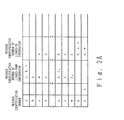
- Figure 2A is a control information table showing in detail the control information table 6 associated with the multiple-comment function and the summary message function.
- a message identification number is appended on each time a message is posted, and messages are managed using the message identification numbers assigned individually.
- Figure 2A shows all the links in duplicate in the table to indicate the links of messages a through z individually.
- one piece of link information is temporarily stored corresponding to a message to be accessed.
- the message having the message identification number a is linked from messages having the message identification numbers c , d , and v .
- the message having the message identification number b is linked from the message having the message identification number x .
- the message having the message identification number c is linked from the message having the identification number w , and linked to the message having the message identification number a .
- the message having the message identification number d is linked from the message having the identification number u , and linked to the message having the message identification number a .
- the message having the message identification number u is linked from the messages having the message identification number x and z s , and linked to the message having the message identification number d .
- the message having the message identification number v is linked from the message having the message identification number x , and linked to the message having the message identification number a .
- the message having the message identification number w is linked from the message having the message identification number z s , and linked to the message having the message identification number c .
- the message having the message identification number x is linked to the messages having the message identification numbers b , u , and v .
- the message having identification number z s is linked to the messages having the message identification numbers u and w .
- the messages having the message identification numbers d , c , and v refer to the message having the message identification number a to make a comment.
- the message having the message identification number u refers to the message having the message identification number d to make a comment.
- the messages having the message identification numbers x and z s refer to the message having the message identification number u make a comment, etc.
- the message having the message identification number w refers to the message identification number c .
- the message having the message identification number z s refers to the message having the message identification number w .
- the message having the message identification number x refers to the messages having the message identification numbers v and b .
- the message having the message identification number z s indicates summary speech information of the messages having the message identification numbers u and w .
- Figures 2B and 2C are tables indicating the relationships among messages.
- the above described summary is controlled in accordance with control information.
- the messages having the message identification numbers u and w are summarized by the message having the message identification number z .
- the control information on the messages having the message identification numbers a and w contains "sum" for summary and the linked-from information message identification number z .
- the message identification number u is commented by the message having the message identification number x .
- the control information on the message identification number z contains a summary flag "sum" and the message identification numbers u and w in the link destination column indicating the link destination.
- Figure 2C shows the control information on the message identification number u .
- the information contains a message identification number as the link destination information, and, in the relationship column, the comment from the message having the message identification number x and the information that the present message is summarized by the message having the message identification number z . This is limited to the case where the contents of the view are limited to the summary. Otherwise, all the contents of the message having the message identification number z can be accessed.
- the control information is stored in the control information table as link information for each message. For example, a table of messages containing messages and comments for each participant and the correspondence of a message to another message is prepared according to the above described link information so that the process of the conference can be informed immediately when these data are read by users.
- the embodiment of the present invention supports a command issued through a terminal to the host computer 4.
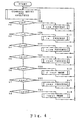
- the host computer executes the process of the first flowchart of the embodiment of the present invention shown in Figure 4, when the participant 1 issues a request for entering an electronic conference through the terminal 2.
- step S1 a command inputted through a terminal in response to the prompt is analyzed in step S1.
- the result of the analysis of the inputted command is determined in the following steps: whether or not it indicates com (comment) in step S2; whether or not it indicates ro (read original) in steps S3; whether or not it indicates room (read comment) in step S4; whether or not it indicates read in step S5; whether or not it indicate dread in step S6; whether or not it indicates psay (program posting) in step S7; and whether or not it indicates input in step S8.
- the embodiment of the present invention provides various utilities such as commands for use in an electronic conference. In step S8 and the following steps, each of these commands are detected.
- step S12 If it is determined that a com command is imputted (yes in step S11), com process is performed in step S12.
- a com process is a message posting process associated with a one-to-multiple message link. If "com x, y, z" is inputted, it indicates a multiple-reference comment message to be linked to existing messages x, y, and z.
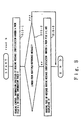
- Figure 5 is a flowchart of a message posting process.
- a new message posting process is performed n step S12-1.
- the text of a message is stored in file 5-1 in this process, and the linked-to message information (message identification numbers and types of links) is added as control information to the text of the message in file 5-1.
- step S12-2 the control information of linked-to messages is updated.
- the update is a process of adding linked-from message information (message identification numbers and types of links) as control information to the link information of each linked-to message.
- the control information is stored in the control information table 6. Then, the entire process of step S12-1 is completed. According to the posting, a speech becomes linked from the multiple existing messages.
- step S3 a process of reading a linked-to message through a linked-from message is performed.
- the command represented as "ro x" is a command to read a plurality of messages referred to by the message having the message identification number x.
- Figure 6 is a flowchart of a process of reading a linked-to message.
- the control information of the message x registered in file 5-1 is read to the control information table 6 in step S13-1.
- step S13-2 linked-to message numbers are read from the control information table.
- step S13-3 a linked-to message group is read from file 5-1 according to the linked-to message numbers, and then displayed.
- these messages are not displayed simultaneously. That is, if there are a plurality of linked messages, then the titles of the comments are displayed first. If there are no titles, the leading lines are displayed, and then the remaining lines are displayed when specified by the operator 1.
- step S14 If it is determined that an rcom command is inputted in step S4, the rcom process is performed in step S14.
- a linked-from message is read through its linked-to message. For example, when "rcom z" is inputted, a plurality of linked-from messages commenting on the message having the message identification number z are read.
- Figure 7 is a flowchart of a process of reading a linked-from message.
- the control information of, for example, the message having the message identification number z stored in file 5-1 is read to the control information table 6 in step S14-1.
- step S14-2 a linked-from message number is read from the control information table 6.
- a group of linked-from messages are read from file 5-1 and displayed. They are displayed as in step S13-3.
- step S5 if it is determined that a read command is inputted (yes), the read process in step S15, that is, a message reading process, is performed.
- Figure 8 is a flowchart of a process of reading a massage.
- the reading process performed in step S15 restricts the reading from a plurality of messages linked from a message. For example, as shown in Figure 3, if the messages having the message identification numbers u, v and b are linked from the message having the message identification number x, then a process of reading one of the messages is prevented. "read b" indicates a process of reading the message with identification number b.
- step S15-2 it is determined whether of not the message having the message identification number b is linked from a plurality of messages. If yes, the message is not displayed and the process is terminated. If no, the message having the message identification number b is read from file 5-1 and displayed in step S15-3. Then, the process in step S15 is terminated.
- FIG. 9 is a flowchart of a process of reading a linked-to message.
- the control information of the message having the message identification number x is read from file 5-1 to the control information table 6 in step S15-4. Then, it is determined according to the identification information in step S15-5 whether or not a message having the message identification number x is linked to any message. If no, the process is terminated. That is, if a message with a specified message number is independent, the process is terminated. If the specified message is linked to another message, it is displayed in step S15-6.
- a "dread b" command compulsorily reads the message having the message identification number b.
- Figure 10 is a flowchart of a process of compulsorily reading a message in the embodiment of the present invention. When the command is inputted, the message b is read and displayed in step S16.
- a flag is set as shown if Figure 2A. If a flag s is added, a summary is outputted. In each process, a summary can be recognized by the setting of flag. In step S16, in which a specified message is compulsorily displayed, the message or a summary is negated, that is, displayed unconditionally.
- a message simulation program for generating as a message written on a voting from the explanatory text for a secret vote or a set of items one of which is to b selected by a voter posted to the conference. If a reading process is performed on the program as if it were an ordinary message, the program is executed. When the program is executed, the explanation text for the current subjects, voting items, the current aggregate of the votes, and the aggregate for each item are displayed as if they were ordinary messages. Since these descriptions can also be associated with comment messages, they are almost the same as normal messages in function.
- v vote
- a voting process starts, an explanatory text of the subject is displayed, and a set of items one of which is selected by a voter are displayed. If a voter who has finished his voting tries to vote again through his terminal, it is rejected as an illegal double vote. That is, the voting record is updated each time a voting form message is read.
- the voting form message described above can be prepared and posted by a participant through a command different from one used for registering a normal message. At his time, depending on the purpose of the current vote, the voting record of each item is displayed before or after the closing time.
- a posted voting form message rejects any voting after an author has closed the vote, and is converted to a normal message indicating the current voting record. The vote can only be closed by an author.
- a voting process involves the voting of many participants. However, it can be managed by preparing a single voting form message. Additionally, the voting result can also be discussed in an electronic conference.
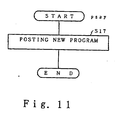
- a psay process shown in Figure 11 that is, a new program registration process, is performed in step S17.
- the process receives a file of a program from a terminal and a host computer, and stores it in file 5-1.
- the control information stores the fact that the message is a program.
- the program can be a source program for an interpreter, or a directly executable program.
- the registration is prepared according to the rules predetermined as follows.
- the program must be operated in the data input mode or the message simulation mode.
- the value of a state variable is changed, that is, updated, while, in the message simulation mode, a message is generated by referring to the state variable.
- this is embodied as an aggregate program. That is, a state variable is set individually by a participant. For example, support, objection or other various items are presented for selection by the voter. If a voter selects "support”, the state variable indicating "support” is incremented.
- the aggregate of messages are outputted as a message by referring to the state variable in the message simulation mode program.
- the state variable is generated in file 5-2.
- the result of the above described message simulation is registered in file 5-1 as a message.
- the result can also be stored as a message in the area where the message simulation program is stored according to the third rule.
- Summing us a program is executed in a data input mode at the voting and changes the value of the state variable. Accordingly, a preparing messages, for example "support” in noting and a chairman's troublesome job of aggregating such messages, can be removed.
- a new program that is, a data input mode program for updating a state variable, and a message simulation mode program for referring to the state variable and generating a message are posted
- an integral aggregating process can be performed.
- a command such as "input a", etc. is inputted.
- the command is inputted, it is detected in step S18-1, and an input process is performed in step S18.
- a program registered at the position specified by message number a is executed in the data input mode.
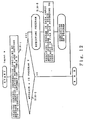
- Figure 12 is a flowchart of a process performed in the input mode. When an execute command is received in the data input mode.
- step S18-1 when an execute command is received in the data input mode, a control information number specified by a message identification number is read in step S18-1, and the process set in the control information table 6 is performed. It is determined in step S18-2 whether or not the control information set in the control information table 6 is a program. If no, the process is terminated without any action.
- step S18-2 the program is executed in the data input mode in step S18-2, and the value of the state variable in file 5-2 is updated according to the data inputted by the user.
- the state variable is stored in the state variable area 5-2, and can be stored in another file.
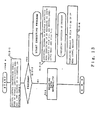
- Figure 13 is a flowchart of the execution using a read command. That is, a program cannot be executed in the message simulation mode in the above described process in step S19 shown in Figure 13.
- the process shown in Figure 13 is composed of the normal read process in step S15 shown in Figure 8 and the process in step S19-1 through S19-4. If a read command is inputted to execute the program, it is detected in step S5, and the process of Figure 13 is started.
- step S29-1 the control information specified by the message identification number a is read in step S19-1, and set in the control information table 6.
- step S19-2 it is determined in step S19-2 whether or not the control information specified by the message identification number a indicates a program. If no, a normal process is performed. That is, the normal read process in step S15 is performed and then terminated. If yes, a stored program is executed in the message simulation mode by referring to the value of the state variable in file 5-2, and the generated text is written in file 5-3. Then, file 5-3 is displayed in step S19-4 as if it were a normal message. As described above, the result of execution of the program in simulation mode is stored in file 5-3 as message information. It can also be stored in file 5-1, after assigning a new message identification number, as message information.
- FIG. 14 is a flowchart of the state variable posting process including the limitation on the number of times, that is, of the process of the execution of a program in the data input mode. If "input a" is inputted and an input process is performed, then the control information of the message having the message identification number a is read in step S18-1, and set in the control information table 6.
- step S18-2 it is determined in step S18-2 whether or not the message having the message identification number a refers to a program. If yes, the number of times that the program has been executed by participants in the input mode is read from file 5-2 in step S18-4. In step S18-5, it is determined whether or not the above described number of times exceeds the limited number of inputs specified by the file identification number a. If yes, the process is terminated. If no, the program is executed in the input data mode in step S18-3.
- FIG 15 is a process flowchart of a snapshot command to post in file 5-1 the result of the program in file 5-1 as a new message. If the "snapshot a" command is started, the control information of the message having the message identification number a is read in step S19-1, and set in the control information table 6. Then, in step S69-2, it is determined whether or not the message having the message identification number a refers to a program. If no, the process is terminated. If yes, the program is executed in the message simulation mode in step S19-3. The processes are so far similar to those shown in Figure 13.
- step S20-4 the process of posting the contents of the file 5-1 as a new message is performed in step S20-4.
- the result of the process shown in Figure 13 is stored in File 5-3, and displayed in step S19-4 as if it were a normal message.
- the generated file is posted as a message in file 5-1.
- the result of the message simulation performed at any time is posted as a normal message at the position where the program is stored, that is, in the area of the file storing the program, and then the program can be deleted.
- Figure 16 is a flowchart of these processes.
- the "terminate a" command executes a program posted at the position specified by the message identification number a in the message simulation mode, the result is posted at the same position as a normal message, and then the program is deleted. At this time, the processes are performed as shown in Figure 13 up to the process in step S19-3. After the process of step S19-3, the process of step S21-4 is performed.
- step S21-4 the contents of file 5-3 are stored in file 5-1, and the program is simultaneously deleted.
- step S21-5 the program attribute of the control information of the message having the message identification number a is deleted, and the message a is stored as a normal message.
- the source program in the message having the message identification number a is executed in the interpreter mode in step S19-3. This is not limited to the interpreter mode. If the program specified by the message identification number a is an executable program, it is loaded and executed when the command is received.
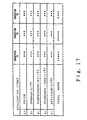
- Figure 17 is an aggregate result table based on the aggregate program.
- * indicates a numerical value.
- Figure 17 is a table in which each participant determines his own evaluation on three suggestions P1, P2, and P3 in price, operability, comprehensibllity, standardizabillty, and applicability, and records a mark for each of these evaluation items. A total mark is outputted for each of the suggestions P1 through P3, and the suggestion acquiring the highest mark is selected.
- a rather complicated quantitative decision making method is successfully realized by this program.
- an evaluation entry message is provided by the executable program.
- the program When the program is started, the message is displayed immediately.
- a participant reads the message, specifies a command in the specific data input mode (stored in the program), and starts the entry.
- the participant sequentially enters a mark for each of the five evaluation items for each of the three suggestions. Thus, the participant finishes the evaluation process.
- the message As shown in Figure 17 is automatically generated.
- a conclusion is required at the end of the argument in a conference, it can be reached after a discussion among the participants and an aggregate obtained from all the participants, by, a secret vote, for example.
- the conventional methods of storing messages and exchanging them among participants cannot obtain such a practical effect.
- a quantitative decision making system through a secret vote, etc. can be set at any point in a conference if necessary, and the result can be posted as a normal message in the conference.
- the conference only involves normal messages posted and stored. Since this enables various data processes for quantitatively aggregating the opinions of participants to be applied effectively and efficiently to the electronic conference, the present invention is very effective in managing an electronic conference requiring a decision making result.
- the participant 1 uses an attribute identifier (ID) in calling the host 4 through the terminal 2, and selects an electronic conference, a service of the computer system. Then, the participant 1 selects one of a plurality of electronic conferences in the electronic conference service according to the information transmitted from the host 4 to the terminal 2.
- ID attribute identifier
- the host 4 refers to the group identification information table 7 according to the ID of the participant 1, and recognizes the name of the group to which the participant belongs. If the participant 1 does not belong to any group in the electronic conference, he should select a group and post it as group identification information.
- the host 4 reads, according to the group information, the selection information of "attributes" from the control information table 8 in which the participant 1 can select one attribute in the group where he belongs, sends it to the terminal 2, and displays it thereon. According to the display, the participant is informed of the probable information to be read, and of the position at which messages such as opinions, etc. should be outputted.
- the embodiment of the present invention has two control information tables 6 and 8.
- the control information table 6 stores control information about messages, while the control information table 8 stores attribute information.
- the participant 1 When the participant 1 sends a message, he selects one "attribute" from the displayed choices, and inputs the title and the message text of the message. If the message to be sent is a comment on an existing, then the identification number of the message is inputted.
- the host 4 When the host 4 receives the information inputted by the terminal 2, it stores in file 5-1 the title of the message, the identifier of the selected attribute, the identification number of the commented message, the participant's identifier (ID), and the message identification number of the current message. If the current message is not a comment, then the message identification number of the commented-on message is not required.
- the participant 1 sends a plurality of messages, then an attribute is selected each time one message is sent. Since a participant selects an attribute each time he posts a message, he can post a plurality of messages as if they were from different participants in an electronic conference. However, he is only allowed to post a message with an attribute permitted for his group, and he must use another ID, etc. if he posts in a different group.
- the host 4 Since the host 4 recognizes the "attribute" identifier of the message to be read by referring to the control information table 8 according to the name of the group to which the participant 1 belongs, the host 4 sends to the terminal 2 the information list of message identification numbers and the message titles only for the message assigned an "attribute" identifier permitted to be read when requested by the terminal 2 (or when the communication has started). According to the information list displayed on the terminal 2, the participant 1 selects and inputs a message identification number to be referred to. Then, the text of the specified message is extracted from the file 5, sent to the terminal 2, and displayed thereon.
- the above described control information indicating the link is used to find the commented message and its author. For example, if a message having a commented message identification number is retrieved, the participant identifier (ID) assigned to the commented message is referred to, and if the participant identifier matches the identifier (ID) of the currently reading participant, then the message being read is a comment on a message previously posted by the current participant. If these messages only are displayed, comments other than those made by the current participant cannot be read. Thus, the privacy of each participant can be successfully protected. If commented message identification numbers and commenting message identification numbers are stored in the information control table shown in Figure 2, the message having the above described commented message identification number need not be retrieved. That is, the necessary information is obtained by referring to the information control table.
- FIG 18 is a flowchart of the operation performed in controlling attributes using attribute identifiers.
- the operation is started when the participant 1 issues a request to enter an electronic conference.
- step S30 it is determined whether or not it is the first entry by referring to the control information table 8. If yes, the participant's group (Gi) is selected in step S31 according to the control information table 8, and is posted in the group identification information table 7. If no, or the process of step S31 is completed, the participant's group is read from the group identification information table 7 in step S33, and set in post Gi. Then, in step S33, a conference command is prompted for.
- step S34 When the conference command is inputted, and if it is a request for reading a message having the message identification number x, that is, read x, then it is determined in step S34 whether or not a read is requested. If yes, the attribute identifier of the message having the message identification number x is read from file 5-1, and set in post Mj in step S35. Then, in step S36, it is determined whether or not f(Gi, read, Mj) is equal to 1, that is, whether or not the message is readable.
- the embodiment of the present invention is provided with the function f(Gi, read, Mj) of determining whether or not it is readable according to group identification information and attribute identifiers. If it does not return 1, the data are not readable. "Read" in the function f has a value of 1 in a reading operation, while it is 0 in a non-reading operation.
- step S36 determines whether “1" is determined in step S36, that is, if it is readable (yes)
- the message having the message identification number x is displayed in step S37. If it is not readable (no in step S36), or if the process of step S37 is completed, then control is returned again to the process of step S33.
- step S38 If a read process is not specified (no in step S34), then it is determined in step S38 whether or not a message is to be posted. If (yes) is obtained in step S38, then the control information table 6 is referred to in step S39, and one of the n attributes which indicates "1" for the function f(Fi, write, Mj) is selected and set in attribute information Mk. Then, in step S40, the attribute information Mk is added to the posted message, and posted in file 5-1.
- step S41 If it is determined that a message is not to be posted, then it is determined whether or not the process is terminated in step S41. If no, or if the process of step S40 is completed, then control is returned to step S33 again. If yes, then the process is terminated.
- f(Gi, rea, Mj) and f(Gi, write, Mj) show group Gi, process read, mask Mj and Group Gi, process write, mask Mj, respectively. attribute control process using attribute identifiers according to the present invention is described above. It is now explained in further detail, by referring to an actual example, how the above described function f is generated on the table.
- a debate is a discussion in which participants argue a specific subject in a supporter group or opponent group. A judge determines the winner group in the discussion.
- participants belonging to a supporter group or an opponent group can view a message open to all participants (group representative message) and a message closed to the other group (message used for group discussion).
- the judge can view open messages only.
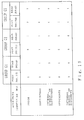
- Figure 19 shows an example of the control information table 8 used in realizing such a debate with an electronic conference system.
- the participants belonging to group G2 can post a message with attributes "supporter” and "internal message of supporters”, and read a message posted with attributes "judge”, "internal message of supporters", and "opponents". Especially, since a message posted with the attribute "internal message of supporters” can be read only by the participants belonging to group G2, the message cannot be viewed by the participants belonging to the other groups. Therefore, it can be used in exchanging opinions in group G2.
- the participants belonging to group G3 can post a message with attributes "opponent” and “internal message of opponents", and read a message posted with attributes "judge”, "supporter”, “opponent”, and "internal message of opponents".
- the participants belonging to group G3 exchange their opinions in the group under attribute "internal message of opponents"
- a message posted by the participants belonging to groups G2 and G3 can be open to the opposing group and group G1 only if it is made under attributes "supporter” and "opponent".
- the participants belonging to group G1 can view messages posted by supporters and opponents.
- An electronic conference in a classroom realizes the communications between a teacher and students in an electronic conference.
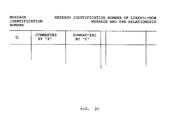
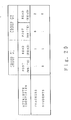
- Figure 20 shows a control information table used in the present embodiment.
- the control information table 8 two groups are defined in an electronic conference, together being called "a class".
- a teacher belongs to group G1, while students belong to group G2.
- a participant belonging to group H1 can post a message as a "teacher”, and read messages of the "teacher” and "students".
- a participant belonging to group H2 can post a message as a "student”, and read a message of the "teacher", where the control information shows "2" indicates that only the teacher's comments on a student's own previous messages, or the teacher's independent messages can be read by the student as readable messages of the "teacher".
- identification information indicating whether the message is issued to all "students" (independent message) or is a comment on a message previously posted by a student is assigned to the message (if it is a comment, it is also assigned the information identifying with which message the comment is associated). According to the identification information, a student can read the teacher's independent messages and comments on his own messages made previously.
- control information indicates "3" instead of "2”
- the read right is further limited such that a "teacher” can read only the comments on the student's question, and cannot read independent massages.
- the links among a plurality of messages posted to an electronic conference can be correctly represented as systematic links.
- the participants in the conference can read comments in the process of the conference or by tracing the process backwards. Since a number of messages posted to an electronic conference can be replaced with a summary message, the number of messages to be normally read can be gradually decremented. Nevertheless, each of the original messages is stored as is, and can be read if necessary. Accordingly, a number of opinions can be appropriately summarized to reach a conclusion in the conference which can be efficiently operated, and it is easy to have participants join midway in the process of the conference.
- the present invention can optionally provide a quantitative decision making method such as a secret vote at any time during a conference. Since the final result of the process can be posted as a normal message in the conference, the electronic conference eventually has records of normal messages posted and stored as in the conventional methods. Furthermore, the present invention effectively and efficiently applies to an electronic conference various data processes for determining the totality of participants' opinions in the conference.
- the present invention makes a number of participants in a conference belong to a plurality of groups, and defines an "attribute" selected for each group. Since a message can be associated with an "attribute", messages posted by a single participant can be processed as originating from different participants in a conference, by using different "attributes”. Conversely, messages posted by different participants can be processed as if posted made by a single participant. This enables an electronic conference system to be operated in various group communication configurations with a poster's privacy successfully protected by appropriately determining control information.
Landscapes
- Engineering & Computer Science (AREA)
- Multimedia (AREA)
- Signal Processing (AREA)
- General Engineering & Computer Science (AREA)
- Computer Networks & Wireless Communication (AREA)
- Information Transfer Between Computers (AREA)
Applications Claiming Priority (2)
| Application Number | Priority Date | Filing Date | Title |
|---|---|---|---|
| JP6405492 | 1992-03-19 | ||
| JP64054/92 | 1992-03-19 |
Publications (2)
| Publication Number | Publication Date |
|---|---|
| EP0561649A2 true EP0561649A2 (fr) | 1993-09-22 |
| EP0561649A3 EP0561649A3 (en) | 1996-11-13 |
Family
ID=13246999
Family Applications (1)
| Application Number | Title | Priority Date | Filing Date |
|---|---|---|---|
| EP93302107A Withdrawn EP0561649A3 (en) | 1992-03-19 | 1993-03-19 | Electronic conference system |
Country Status (2)
| Country | Link |
|---|---|
| EP (1) | EP0561649A3 (fr) |
| CA (1) | CA2092054A1 (fr) |
Cited By (7)
| Publication number | Priority date | Publication date | Assignee | Title |
|---|---|---|---|---|
| GB2284969A (en) * | 1993-12-20 | 1995-06-21 | Intel Corp | Joining participants in a computer conferencing system |
| EP0899953A3 (fr) * | 1993-10-01 | 1999-05-19 | Vicor, Inc. | Localisation de participant dans un système de collaboration multimedia |
| EP1091521A3 (fr) * | 1999-10-07 | 2001-11-28 | Hitachi, Ltd. | Système pour la distribution de données numeriques |
| WO2004025941A3 (fr) * | 2002-09-10 | 2004-06-03 | Myriad Entertainment Inc | Procede et appareil de gestion amelioree de conference telephonique |
| US6772229B1 (en) | 2000-11-13 | 2004-08-03 | Groupserve, Inc. | Centrifugal communication and collaboration method |
| DE102004041882A1 (de) * | 2004-08-30 | 2006-03-09 | Infineon Technologies Ag | Kommunikationssystem, Verfahren zum Durchführen einer Umfrage, Konferenz-Medienmischeinrichtung und Verfahren zum Auswerten von Antwort-Kommunikationsdaten |
| EP1672579A3 (fr) * | 1999-09-20 | 2006-07-26 | Microsoft Corporation | Courrier électronique basé sur fil de discussion |
Family Cites Families (3)
| Publication number | Priority date | Publication date | Assignee | Title |
|---|---|---|---|---|
| CA1304518C (fr) * | 1987-12-23 | 1992-06-30 | Charles Malcolm Napier Cree | Methodes pour annexer une reponse dans le cas d'un systeme de courrier electronique |
| US5101345A (en) * | 1988-11-29 | 1992-03-31 | International Business Machines Inc. | Method of filing stapled documents with a staple relationship involving one or more application programs |
| US5089956A (en) * | 1988-11-29 | 1992-02-18 | International Business Machines Corporation | Method of distributing related documents to identified end users in an information processing system |
-
1993
- 1993-03-19 EP EP93302107A patent/EP0561649A3/en not_active Withdrawn
- 1993-03-19 CA CA 2092054 patent/CA2092054A1/fr not_active Abandoned
Cited By (13)
| Publication number | Priority date | Publication date | Assignee | Title |
|---|---|---|---|---|
| EP0899953A3 (fr) * | 1993-10-01 | 1999-05-19 | Vicor, Inc. | Localisation de participant dans un système de collaboration multimedia |
| US5729687A (en) * | 1993-12-20 | 1998-03-17 | Intel Corporation | System for sending differences between joining meeting information and public meeting information between participants in computer conference upon comparing annotations of joining and public meeting information |
| GB2284969B (en) * | 1993-12-20 | 1998-06-03 | Intel Corp | Method and apparatus for joining participants in a computer conferencing system |
| GB2284969A (en) * | 1993-12-20 | 1995-06-21 | Intel Corp | Joining participants in a computer conferencing system |
| US8015495B2 (en) | 1998-03-13 | 2011-09-06 | Groupserve It Trust Llc | Centrifugal communication and collaboration method |
| EP1672579A3 (fr) * | 1999-09-20 | 2006-07-26 | Microsoft Corporation | Courrier électronique basé sur fil de discussion |
| US7328251B2 (en) | 1999-09-20 | 2008-02-05 | Microsoft Corporation | Thread based email |
| EP1091521A3 (fr) * | 1999-10-07 | 2001-11-28 | Hitachi, Ltd. | Système pour la distribution de données numeriques |
| US6772229B1 (en) | 2000-11-13 | 2004-08-03 | Groupserve, Inc. | Centrifugal communication and collaboration method |
| US6839417B2 (en) | 2002-09-10 | 2005-01-04 | Myriad Entertainment, Inc. | Method and apparatus for improved conference call management |
| WO2004025941A3 (fr) * | 2002-09-10 | 2004-06-03 | Myriad Entertainment Inc | Procede et appareil de gestion amelioree de conference telephonique |
| DE102004041882B4 (de) * | 2004-08-30 | 2006-05-18 | Infineon Technologies Ag | Kommunikationssystem, Verfahren zum Durchführen einer Umfrage, Konferenz-Medienmischeinrichtung und Verfahren zum Auswerten von Antwort-Kommunikationsdaten |
| DE102004041882A1 (de) * | 2004-08-30 | 2006-03-09 | Infineon Technologies Ag | Kommunikationssystem, Verfahren zum Durchführen einer Umfrage, Konferenz-Medienmischeinrichtung und Verfahren zum Auswerten von Antwort-Kommunikationsdaten |
Also Published As
| Publication number | Publication date |
|---|---|
| EP0561649A3 (en) | 1996-11-13 |
| CA2092054A1 (fr) | 1993-09-20 |
Similar Documents
| Publication | Publication Date | Title |
|---|---|---|
| Peters et al. | Situational constraints and work outcomes: The influences of a frequently overlooked construct | |
| US5732200A (en) | Integration of groupware with quality function deployment methodology via facilitated work sessions | |
| US5208748A (en) | Method and apparatus for structuring and managing human communications by explicitly defining the types of communications permitted between participants | |
| KR20070043353A (ko) | 웹 기반 시스템 환경하에서 다중 사용자간 실시간 동시협업형 문서 처리 방법 | |
| JP2006277756A (ja) | データベースへのアクセスを制御するための方法及び装置 | |
| US20130103420A1 (en) | System and method facilitating patient registration across multiple practice groups | |
| KR101883134B1 (ko) | 타로 서비스 제공 서버 및 타로 서비스 제공 방법 | |
| EP0561649A2 (fr) | Système de conférence électronique | |
| US9477941B2 (en) | Genealogy system for interfacing with social networks | |
| US20020023083A1 (en) | Systems and methods for enabling an untrained or novice end-user to rapidly build clinical trials data management systems compliant with all appropriate regulatory guidances | |
| Melcher et al. | Toward a theory of organization communication: Consideration in channel selection | |
| US20020087541A1 (en) | Method of registering users in a centralized database through a plurality of internet sites | |
| CN117196274A (zh) | 一种设计项目的流程管控系统 | |
| US7584115B2 (en) | System for automated control and reporting of sales processes | |
| Shackel | The BLEND system: Programme for the study of some “electronic journals” | |
| JP3839263B2 (ja) | 電子会議システム | |
| US6799183B2 (en) | Operation assistance method and system and recording medium for storing operation assistance method | |
| JP3169470B2 (ja) | 電子会議システム | |
| JP2002324153A (ja) | 派遣社員の勤務状況管理システム、勤務状況管理方法、プログラム | |
| Stevens | Communication throughout libraries | |
| Hall | Implementation of an interactive conference system | |
| JPS62184533A (ja) | 情報サ−ビス処理方法 | |
| US20060099564A1 (en) | Integrated external collaboration tools | |
| JP2000089943A (ja) | 変数名管理システム | |
| JP3912736B2 (ja) | 特許明細書作成支援サーバおよびそのプログラム |
Legal Events
| Date | Code | Title | Description |
|---|---|---|---|
| PUAI | Public reference made under article 153(3) epc to a published international application that has entered the european phase |
Free format text: ORIGINAL CODE: 0009012 |
|
| AK | Designated contracting states |
Kind code of ref document: A2 Designated state(s): DE FR GB |
|
| PUAL | Search report despatched |
Free format text: ORIGINAL CODE: 0009013 |
|
| AK | Designated contracting states |
Kind code of ref document: A3 Designated state(s): DE FR GB |
|
| 17P | Request for examination filed |
Effective date: 19970303 |
|
| 17Q | First examination report despatched |
Effective date: 19990708 |
|
| STAA | Information on the status of an ep patent application or granted ep patent |
Free format text: STATUS: THE APPLICATION IS DEEMED TO BE WITHDRAWN |
|
| 18D | Application deemed to be withdrawn |
Effective date: 19991119 |