EP0562377B1 - Herstellung von Isoxazol-3-carbonsäureamid-4-carbonsäureestern durch selektive Amidierung - Google Patents
Herstellung von Isoxazol-3-carbonsäureamid-4-carbonsäureestern durch selektive Amidierung Download PDFInfo
- Publication number
- EP0562377B1 EP0562377B1 EP93103911A EP93103911A EP0562377B1 EP 0562377 B1 EP0562377 B1 EP 0562377B1 EP 93103911 A EP93103911 A EP 93103911A EP 93103911 A EP93103911 A EP 93103911A EP 0562377 B1 EP0562377 B1 EP 0562377B1
- Authority
- EP
- European Patent Office
- Prior art keywords
- alkyl
- isoxazole
- cycloalkyl
- amidation
- solvent
- Prior art date
- Legal status (The legal status is an assumption and is not a legal conclusion. Google has not performed a legal analysis and makes no representation as to the accuracy of the status listed.)
- Expired - Lifetime
Links
Classifications
-
- C—CHEMISTRY; METALLURGY
- C07—ORGANIC CHEMISTRY
- C07D—HETEROCYCLIC COMPOUNDS
- C07D261/00—Heterocyclic compounds containing 1,2-oxazole or hydrogenated 1,2-oxazole rings
- C07D261/02—Heterocyclic compounds containing 1,2-oxazole or hydrogenated 1,2-oxazole rings not condensed with other rings
- C07D261/06—Heterocyclic compounds containing 1,2-oxazole or hydrogenated 1,2-oxazole rings not condensed with other rings having two or more double bonds between ring members or between ring members and non-ring members
-
- C—CHEMISTRY; METALLURGY
- C07—ORGANIC CHEMISTRY
- C07D—HETEROCYCLIC COMPOUNDS
- C07D261/00—Heterocyclic compounds containing 1,2-oxazole or hydrogenated 1,2-oxazole rings
- C07D261/02—Heterocyclic compounds containing 1,2-oxazole or hydrogenated 1,2-oxazole rings not condensed with other rings
- C07D261/06—Heterocyclic compounds containing 1,2-oxazole or hydrogenated 1,2-oxazole rings not condensed with other rings having two or more double bonds between ring members or between ring members and non-ring members
- C07D261/10—Heterocyclic compounds containing 1,2-oxazole or hydrogenated 1,2-oxazole rings not condensed with other rings having two or more double bonds between ring members or between ring members and non-ring members with hetero atoms or with carbon atoms having three bonds to hetero atoms with at the most one bond to halogen, e.g. ester or nitrile radicals, directly attached to ring carbon atoms
- C07D261/18—Carbon atoms having three bonds to hetero atoms, with at the most one bond to halogen
Definitions
- Isoxazole-3-carboxamide-4-carboxylic acid derivatives I are intermediates for organic syntheses, in particular for the production of crop protection agents (cf. DE-A-39 31 627).
- the object of the present invention was therefore to find a process for the synthesis of the compounds I which is as simple and economical as possible.
- Amines III are preferably used in which R 3 is hydrogen, C 1 -C 6 -alkyl, in particular C 1 -C 4 -alkyl such as methyl, ethyl, propyl, isopropyl, butyl, isobutyl, sec-butyl, tert.- Butyl and C 3 -C 6 cycloalkyl such as cyclopropyl, cyclobutyl, cyclopentyl and cyclohexyl, in particular cyclopropyl and R 4 is an optionally substituted alkyl, cycloalkyl, alkenyl or alkynyl radical.
- R 3 is hydrogen, C 1 -C 6 -alkyl, in particular C 1 -C 4 -alkyl such as methyl, ethyl, propyl, isopropyl, butyl, isobutyl, sec-butyl, tert.- Butyl and C 3 -C 6 cycl
- radicals R 4 are listed: C 1 -C 6 alkyl, in particular C 1 -C 4 alkyl as mentioned under R 3 , which is substituted by cyclopropyl, halogen such as fluorine, chlorine, bromine, cyano or C 1 -C 6 - Alkoxy can be substituted, C 3 -C 6 cycloalkyl, which can be substituted by C 1 -C 4 alkyl or halogen, C 3 -C 6 alkenyl or C 3 -C 6 alkynyl.
- amines III are preferably used in which the radicals R 3 and R 4 together form a C 4 -C 7 methylene chain, which can be interrupted by oxygen, sulfur or N-methyl.
- simple primary aliphatic amines such as methylamine, ethylamine, propylamine, isopropylamine, butylamine, isobutylamine, sec-butylamine, (R) -sec.
- the amine III can be used in a stoichiometric amount or in virtually any molar excess with respect to the reactant II.
- the amine III is advantageously used in a 1 to 8-fold, in particular 1 to 5-fold molar amount.
- it can also be advantageous to add the amine III to the compound II so that a substoichiometric amount of the amine III with respect to the isoxazole-3,4-dicarboxylic acid diester II is present virtually throughout the course of the reaction.
- the amine III used for the amidation is used in excess, based on the isoxazole-3,4-dicarboxylic acid diester II, the excess amine III itself acting as a solvent.
- the reaction according to the invention can optionally be carried out in a solvent which is inert under the reaction conditions.
- Preferred solvents used are ethers such as diethyl ether, diisopropyl ether, methyl tert-butyl ether, dimethoxyethane, diethylene glycol dimethyl ether, tetrahydrofuran or dioxane, halogenated hydrocarbons such as dichloromethane, chloroform or chlorobenzene, aromatic hydrocarbons such as benzene, toluene or xylene and sulfoxides such as dimethyl sulfoxide.
- Particularly preferred solvents are alcohols, e.g.
- Alkanols or cycloalkanols such as n-butanol, isobutanol, tert-butanol, glycol, glycerin, n-propanol, isopropanol, amyl alcohol, cyclohexanol, 2-methyl-4-pentanol, ethylene glycol monoethyl ether, 2-ethyl hexanol, methyl glycol and especially ethanol, methanol.
- solvent mixtures can also be used.
- the isoxazole-3,4-dicarboxylic acid diester II used as the starting compound is reacted with the amine III at temperatures from 0 to 100 ° C., particularly preferably at 20 to 80 ° C.
- the reaction of sterically unhindered amines is expediently carried out at temperatures from 20 to 60 ° C., whereas when using amines III with one or two sterically demanding substituents R 3 and R 4, they are generally carried out at higher temperatures, in particular at 60 to 100 ° C. , is being worked on.
- the process according to the invention is generally carried out at atmospheric pressure. Depending on the type of amine or solvent used, however, it can be particularly advantageous if the reaction is carried out under increased pressure, in particular under autogenously increased pressure Autoclave is performed. This measure leads to advantageous results in particular when low-boiling amines III, such as methylamine, ethylamine, isopropylamine or cyclopropylamine, or low-boiling solvents such as diethyl ether or methanol are used. Of course, the process according to the invention can also be operated under exogenously increased pressure, advantageously in the pressure range from 1 to 50 bar.
- the amidation can be carried out batchwise in stirred tanks or stirred autoclaves as well as continuously in stirred tank cascades or tubular reactors. Overall, the process has no special procedural features, so that further information on this is unnecessary. Depending on the process conditions used, such as pressure and temperature and the starting compounds used, the reaction is generally complete after 1 to 20 hours of reaction. Since the desired isoxazole-3-carboxamide derivatives are formed with a high selectivity by the process according to the invention, in many cases it is sufficient to work up by simply distilling off the solvent and / or the excess amine III in order to obtain a product I which is sufficiently pure for further processing receive. However, it is also possible to work up the reaction mixture in a conventional manner by extracting the excess amine with dilute aqueous acids and isolating the product I from the organic phase. This procedure is particularly preferred when the amine III to be separated is relatively low volatility.
Landscapes
- Chemical & Material Sciences (AREA)
- Organic Chemistry (AREA)
- Heterocyclic Carbon Compounds Containing A Hetero Ring Having Nitrogen And Oxygen As The Only Ring Hetero Atoms (AREA)
- Plural Heterocyclic Compounds (AREA)
- Nitrogen And Oxygen Or Sulfur-Condensed Heterocyclic Ring Systems (AREA)
Description
- Die vorliegende Erfindung betrifft die Herstellung von Isoxazol-3-carbonsäureamid-4-carbonsäureestern der Formel I

- R1
- Wasserstoff, Alkyl, Cycloalkyl, Phenyl oder ein 5- bis 6-gliedriger heterocyclischer Rest, wobei die organischen Reste unter den Reaktionsbedingungen inerte Substituenten tragen können;
- R2
- Alkyl, Cycloalkyl, Benzyl oder ein C3-C6-Alkenylrest;
- R3
- Wasserstoff, Alkyl, Cycloalkyl und
- R4
- ein aliphatischer, cycloaliphatischer oder gegebenenfalls substituierter Phenylrest oder R4 zusammen mit R3 eine 4- bis 7-gliedrige Alkylenkette, die durch Sauerstoff, Schwefel oder N-Methyl unterbrochen sein kann.
- Isoxazol-3-carbonsäureamid-4-carbonsäurederivate I sind Zwischenprodukte für organische Synthesen, insbesondere zur Herstellung von Pflanzenschutzmitteln (vgl. DE-A-39 31 627). Der vorliegenden Erfindung lag deshalb die Aufgabe zugrunde, ein möglichst einfaches und wirtschaftliches Verfahren zur Synthese der Verbindungen I finden.
- Demgemäß wurde ein Verfahren zur Herstellung von Isoxazol-3-carbonsäureamid-4-carbonsäureestern I gefunden, das dadurch gekennzeichnet ist, daß man einen Isoxazol-3,4-dicarbonsäurediester der Formel II


- Das erfindungsgemäße Verfahren besticht durch die Einfachheit des gewählten Lösungsweges, von dem keineswegs zu erwarten gewesen war, daß er zum Erfolg führen würde, da zwei gleiche funktionelle Gruppen am Isoxazolsystem II vorliegen, die beide mit dem Amin III reagieren sollten.
- Überraschenderweise wurde gefunden, daß die Amidierung praktisch ausschließlich an der Estergruppe in 3-Position stattfindet. Die entsprechenden Isoxazol-4-carbonsäureamid-Derivate IV


- Nach dem erfindungsgemäßen Verfahren können die Isoxazol-3,4-dicarbonsäure-Diester II mit praktisch allen primären bzw. sekundären Aminen der Formeln IIIa (R3 = H) bzw. IIIb (R3 ≠ H)
H2N―R4 IIIa

- Vorzugsweise werden Amine III eingesetzt, in denen R3 für Wasserstoff, C1-C6-Alkyl, insbesondere C1-C4-Alkyl wie Methyl, Ethyl, Propyl, Isopropyl, Butyl, Isobutyl, sek.-Butyl, tert.-Butyl und C3-C6-Cycloalkyl wie Cyclopropyl, Cyclobutyl, Cyclopentyl und Cyclohexyl, insbesondere Cyclopropyl steht und R4 einen gegebenenfalls substituierten Alkyl-, Cycloalkyl-, Alkenyl- oder Alkinylrest bedeutet. Beispielsweise seien folgende Reste R4 aufgeführt: C1-C6-Alkyl, insbesondere C1-C4-Alkyl wie unter R3 genannt, das durch Cyclopropyl, Halogen wie Fluor, Chlor, Brom, Cyano oder C1-C6-Alkoxy substituiert sein kann, C3-C6-Cycloalkyl, das durch C1-C4-Alkyl oder Halogen substituiert sein kann, C3-C6-Alkenyl oder C3-C6-Alkinyl. Des weiteren werden vorzugsweise Amine III verwendet, in denen die Reste R3 und R4 gemeinsam eine C4-C7-Methylenkette, welche durch Sauerstoff, Schwefel oder N-Methyl unterbrochen sein kann, bilden.
- Besonders bevorzugt sowohl im Hinblick auf bestimmungsgemäße Verwendung als auch aus verfahrenstechnischer Sicht werden die Isoxazol-3,4-dicarbonsäurediester II mit einfachen primären aliphatischen Aminen wie Methylamin, Ethylamin, Propylamin, Isopropylamin, Butylamin, Isobutylamin, sek-Butylamin, (R)-sek-Butylamin, (S)-sek-Butylamin, tert-Butylamin, Neopentylamin und 1,1-Dimethylpropylamin,
substituierten primären aliphatischen Aminen wie 1-Cyclopropylethylamin, (R)-1-Cyclopropylethylamin, (S)-1-Cyclopropylethylamin und Cyclopropylmethylamin,
Cycloalkylaminen wie Cyclopropylamin, Cyclobutylamin, Cyclopentylamin, Cyclohexylamin, 1-Methylcyclopropylamin,
ungesättigten Aminen wie Prop-2-enylamin, 1-Methylprop-2-enylamin, 1,1-Dimethyl-prop-2-enylamin, Prop-2-inylamin, 1-Methylprop-2-inylamin und 1,1-Dimethylprop-2-inylamin,
einfachen sekundären Aminen wie Dimethylamin, Methylethylamin, Diethylamin, Dipropylamin, Dibutylamin, Methylisopropylamin, Diisopropylamin und Methyl-tert-butylamin,
sowie cyclischen sekundären Aminen wie Pyrrolidin, Piperidin und Morpholin umgesetzt. - Entsprechend den unterschiedlichen Verfahrensweisen kann das Amin III in stöchiometrischer Menge als auch in praktisch beliebigem, molaren Überschuß bezüglich des Reaktanden II eingesetzt werden. Vorteilhaft wird das Amin III bezüglich des Diesters jedoch in der 1- bis 8-fach, insbesondere 1- bis 5-fach molaren Menge angewandt. Es kann jedoch auch vorteilhaft sein, das Amin III so zur vorgelegten Verbindung II zuzugeben, daß praktisch während des gesamten Reaktionsverlaufs eine unterstöchiometrische Menge des Amins III bezüglich des Isoxazol-3,4-dicarbonsäure-diesters II vorliegt.
- Bei einer besonders bevorzugten Arbeitsweise des erfindungsgemäßen Verfahrens wird das zur Amidierung verwendete Amin III im Überschuß, bezogen auf den Isoxazol-3,4-dicarbonsäure-diester II verwendet, wobei das überschüssige Amin III selbst als Lösungsmittel fungiert.
- Die erfindungsgemäße Umsetzung läßt sich gegebenenfalls in einem unter den Reaktionsbedingungen inerten Lösungsmittel durchführen. Vorzugsweise verwendete Lösungsmittel sind Ether wie Diethylether, Diisopropylether, Methyl-tert.-butylether, Dimethoxyethan, Diethylenglykoldimethylether, Tetrahydrofuran oder Dioxan, Halogenkohlenwasserstoffe wie Dichlormethan, Chloroform oder Chlorbenzol, aromatische Kohlenwasserstoffe wie Benzol, Toluol oder Xylol sowie Sulfoxide wie Dimethylsulfoxid oder Sulfolan. Besonders bevorzugte Lösungsmittel sind Alkohole, z.B. Alkanole oder Cycloalkanole wie n-Butanol, Isobutanol, tert.-Butanol, Glykol, Glycerin, n-Propanol, Isopropanol, Amylalkohol, Cyclohexanol, 2-Methyl-4-pentanol, Ethylenglykolmonoethylether, 2-Ethylhexanol, Methylglykol und insbesondere Ethanol, Methanol. Es können selbstverständlich auch Lösungsmittelgemische eingesetzt werden.
- Zweckmäßigerweise verwendet man die 0,5- bis 10-fache, vorzugsweise 1- bis 5-fache Gewichtsmenge an Lösungsmittel bezogen auf II.
- Im erfindungsgemäßen Verfahren wird der als Ausgangsverbindung benutzte Isoxazol-3,4-dicarbonsäure-diester II mit dem Amin III bei Temperaturen von 0 bis 100°C, besonders bevorzugt bei 20 bis 80°C, umgesetzt. Dabei wird zweckmäßigerweise die Umsetzung sterisch nicht gehinderter Amine bei Temperaturen von 20 bis 60°C durchgeführt, wohingegen bei Verwendung von Aminen III mit einem oder zwei sterisch anspruchsvollen Substituenten R3 und R4 im allgemeinen bei höheren Temperaturen, insbesondere bei 60 bis 100°C, gearbeitet wird.
- Das erfindungsgemäße Verfahren wird im allgemeinen bei Atmosphärendruck ausgeführt. Je nach Art des verwendeten Amins oder Lösungsmittels, kann es sich jedoch als besonders vorteilhaft auswirken, wenn die Umsetzung unter erhöhtem Druck, insbesondere unter autogen erhöhtem Druck in einem Autoklaven durchgeführt wird. Diese Maßnahme führt insbesondere dann zu vorteilhaften Ergebnissen, wenn niedrigsiedende Amine III, wie Methylamin, Ethylamin, Isopropylamin oder Cyclopropylamin oder niedrigsiedende Lösungsmittel wie Diethylether oder Methanol verwendet werden. Selbstverständlich kann das erfindungsgemäßen Verfahren auch unter exogen erhöhtem Druck betrieben werden, zweckmäßigerweise im Druckbereich von 1 bis 50 bar.
- Die Amidierung kann sowohl auf konventionelle Weise diskontinuierlich in Rührkesseln oder Rührautoklaven als auch kontinuierlich in Rührkesselkaskaden oder Rohrreaktoren betrieben werden. Insgesamt weist das Verfahren keine verfahrenstechnischen Besonderheiten auf, so daß sich weitere Angaben hierzu erübrigen. Je nach den angewandten Verfahrensbedingungen wie Druck und Temperatur und je nach den verwendeten Ausgangsverbindungen ist die Umsetzung im allgemeinen nach 1 bis 20 Stunden Reaktionsdauer beendet. Da die gewünschten Isoxazol-3-carbonsäureamid-derivate nach dem erfindungsgemäßen Verfahren mit einer hohen Selektivität gebildet werden, genügt es in vielen Fällen zur Aufarbeitung einfach das Lösungsmittel und/oder das überschüssige Amin III abzudestillieren, um ein für die Weiterverarbeitung genügend reines Produkt I zu erhalten. Es ist aber auch möglich, das Reaktionsgemisch auf herkömmliche Weise aufzuarbeiten, indem man das überschüssige Amin mit verdünnten, wäßrigen Säuren extrahiert und das Produkt I aus der organischen Phase isoliert. Diese Verfahrensweise wird insbesondere dann bevorzugt angewendet, wenn das abzutrennende Amin III relativ schwerflüchtig ist.
- Im Hinblick auf die bestimmungsgemäße Verwendung der Isoxazolderivate I werden nach dem erfindungsgemäßen Verfahren vorzugsweise Isoxazol-3,4-dicarbonsäurediester der allgemeinen Formel II, in der die Reste R1 und R2 die folgende Bedeutung haben, zu den entsprechenden Isoxazol-3-carbonsäureamid-4-carbonsäureestern I umgesetzt:
- R1
- Wasserstoff,
ein niedermolekularer Alkylrest wie C1-C6-Alkyl, insbesondere C1-C4-Alkyl wie Methyl, Ethyl, Propyl, Isopropyl, Butyl, Isobutyl, sek.-Butyl, tert.-Butyl, das durch ein bis drei Halogenatome wie Fluor, Chlor, Brom, Iod, insbesondere Fluor und Chlor, einen C1-C3-Alkoxyrest wie Methoxy, Ethoxy, Propoxy, Isopropoxy, insbesondere Methoxy oder einen C3-C6-Cycloalkylrest wie Cyclopropyl, Cyclobutyl, Cyclopentyl und Cyclohexyl, insbesondere Cyclopropyl, substituiert sein kann,
ein Cycloalkylrest wie C3-C8-Cycloalkyl, z.B. Cyclopropyl, Cyclobutyl, Cyclopentyl, Cyclohexyl, Cycloheptyl, Cyclooctyl, insbesondere Cyclopropyl, das ein bis dreimal durch C1-C4-Alkyl wie vorstehend genannt, insbesondere Methyl substituiert sein kann,
ein 5- bis 6-gliedriger gesättigter, ungesättigter oder aromatischer heterocyclischer Rest, enthaltend ein oder zwei Heteroatome, ausgewählt aus der Gruppe Sauerstoff, Schwefel und Stickstoff wie 2-Tetrahydrofuranyl, 3-Tetrahydrofuranyl, 2-Tetrahydrothienyl, 3-Tetrahydrothienyl, 2-Tetrahydropyranyl, 3-Tetrahydropyranyl, 4-Tetrahydropyranyl, 2-Furanyl, 3-Furanyl, 2-Thienyl, 3-Thienyl, 3-Isoxazolyl, 4-Isoxazolyl, 5-Isoxazolyl, 2-Oxazolyl, 4-Oxazolyl, 5-Oxazolyl, 2-Thiazolyl, 4-Thiazolyl, 5-Thiazolyl, 2-Pyridyl, 3-Pyridyl, 4-Pyridyl, der durch C1-C3-Alkyl wie vorstehend genannt, insbesondere Methyl, C1-C3-Alkoxy wie vorstehend genannt, insbesondere Methoxy oder Halogen wie Fluor, Chlor, Brom und Iod, insbesondere Fluor und Chlor, substituiert sein kann;
Phenyl, das eine bis drei der folgenden Gruppen tragen kann: C1-C4-Alkyl wie vorstehend genannt, insbesondere Methyl, C1-C4-Halogenalkyl, insbesondere Trifluormethyl, C1-C4-Alkoxy, insbesondere Methoxy, C1-C4-Halogenalkoxy, insbesondere Trifluormethoxy, Halogen wie vorstehend genannt, insbesondere Fluor und Chlor, Nitro und Cyano; - R2, R2'
- C1-C4-Alkyl wie unter R1 genannt, insbesondere Methyl und Ethyl, C3-C6-Cycloalkyl wie unter R1 genannt, insbesondere Cyclohexyl, Benzyl und C3-C6-Alkenyl, insbesondere Allyl.
-

a) in Gegenwart eines Lösungsmittels
b) in Abwesenheit eines Lösungsmittels
a) Zu einer Lösung von 0,3 mol 5-Alkyl-isoxazol-3,4-dicarbonsäuredialkylester I in 100 ml trockenem Alkohol werden bei 25°C 0,6 mol Cyclopropylamin zugetropft, anschließend wird 12 h bei Raumtemperatur nachgerührt. Nach Beendigung der Reaktion werden das überschüssige Cyclopropylamin und das Solvens im Vakuum abgezogen. In analoger Weise können andere primäre oder sekundäre Amine umgesetzt werden. Die Versuchsergebnisse sind in der Tabelle zusammengestellt.Tabelle Beispiel Nr. R1 R2 R3 R4 Lösungsmittel Ausbeute (%) Fp [°C]; 1H-NMR (CDCl3); 250 MHz; δ in ppm 1 Me Me H cyclo-Pr MeOH 74 0,60-0,92 (m,4H); 2,70 (s,3H); 2,93 (m,1H); 3,92 (s,3H); 8,27 (bs,1H,NH) 2 Et Me H cyclo-Pr MeOH 93 0,58-0,95 (m,4H); 1,34 (t,3H); 2,93 (m,1H); 3,10 (q,2H); 3,92 (s,3H); 7,95 (bs,1H,NH) 3 iPr Me H cyclo-Pr MeOH 87 0,60-0,93 (m,4H); 1,36 (d, 6H); 2,92 (m,1H); 3,70 (sp,1H); 3,89 (s,3H); 7,84 (bs,1H,NH) 4 iPr Et H cyclo-Pr EtOH 85 0,60-0,90 (m,4H); 1,36 (d,6H); 1,37 (t,3H); 2,93 (m,1H); 3,73 (sp,1H); 4,35 (q,2H); 7,75 (bs,1H,NH) Me = Methyl, Et = Ethyl, Pr = Propyl
b) 32,0 g (0,15 mol) 5-Ethyl-isoxazol-3,4-dicarbonsäuredimethylester und 44,3 g (0,75 mol) Methylethylamin werden in einem 300 ml Miniautoklav 6 Stunden auf 60°C erhitzt. Anschließend wird das Reaktionsgemisch am Rotationsverdampfer eingeengt, in Ether aufgenommen und zweimal mit je 50 ml 1n HCl extrahiert. Die organische Phase wird über Magnesiumsulfat getrocknet und das Solvens im Vakuum abgezogen. Man erhält 30,1 g (84 %) 5-Ethyl-3-methylethylcarbamoyl-isoxazol-4-carbonsäuremethylester als Gemisch aus zwei Amid-Rotameren. 1H-NMR (CDCl3; 250 MHz) δ=1,17 und 1,27 (2t; 2x3H), 1,35 (t; 3H), 2,89 und 3,12 (2s; 2x3H), 3,18 (q; 2H), 3,25 und 3,63 (2q; 2x2H), 3,84 (s; 3H). - Bei der gaschromatographischen Untersuchung der Reaktionsmischungen vor der Aufarbeitung konnte in den beschriebenen Versuchen kein Isoxazol-4-carbonsäureamid IV nachgewiesen werden. Die Menge an Diamid V lag bei maximal 3 Prozent.
Claims (5)
- Verfahren zur Herstellung von Isoxazol-3-carbonsäureamid-4-carbonsäureestern der Formel I
 R1 Wasserstoff, Alkyl, Cycloalkyl, Phenyl oder ein 5- bis 6-gliedriger heterocyclischer Rest, wobei die organischen Reste unter den Reaktionsbedingungen inerte Substituenten tragen können;R2 Alkyl, Cycloalkyl, Benzyl oder ein C3-C6-Alkenylrest;R3 Wasserstoff, Alkyl, Cycloalkyl undR4 ein aliphatischer, cycloaliphatischer oder gegebenenfalls substituierter Phenylrest oder R4 zusammen mit R3 eine 4- bis 7-gliedrige Alkylenkette, die durch Sauerstoff, Schwefel oder N-Methyl unterbrochen sein kann; dadurch gekennzeichnet, daß man einen Isoxazol-3,4-dicarbonsäurediester der Formel IIin Gegenwart oder Abwesenheit eines Lösungsmittels selektiv an der Estergruppe in 3-Position amidiert.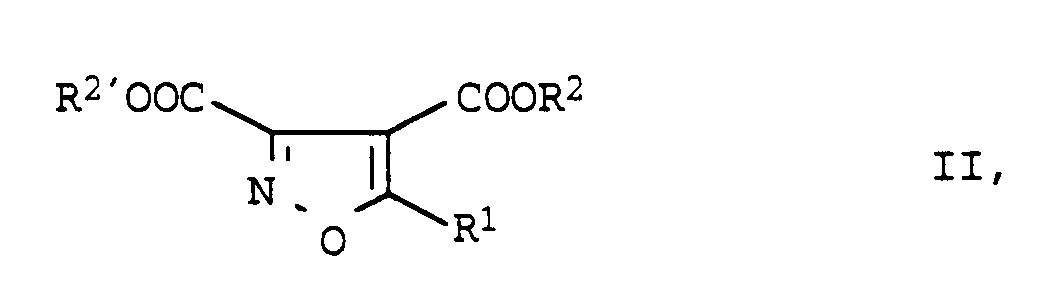

- Verfahren nach Anspruch 1, dadurch gekennzeichnet, daß man ein primäres Amin III zur Amidierung verwendet.
- Verfahren nach Anspruch 1, dadurch gekennzeichnet, daß man das Amin in einer Menge von 1 bis 5 mol, bezogen auf den Diester II verwendet.
- Verfahren nach Anspruch 1, dadurch gekennzeichnet, daß man die Amidierung in Abwesenheit eines Lösungsmittels und mit einem Überschuß an Amin, bezogen auf II, vornimmt.
- Verfahren nach Anspruch 1, dadurch gekennzeichnet, daß man die Amidierung in einem niedermolekularen Alkanol als Lösungsmittel vornimmt.
Applications Claiming Priority (2)
| Application Number | Priority Date | Filing Date | Title |
|---|---|---|---|
| DE4209849A DE4209849A1 (de) | 1992-03-26 | 1992-03-26 | Herstellung von Isoxazol-3-carbonsäureamid-4-carbonsäureestern durch selektive Amidierung |
| DE4209849 | 1992-03-26 |
Publications (2)
| Publication Number | Publication Date |
|---|---|
| EP0562377A1 EP0562377A1 (de) | 1993-09-29 |
| EP0562377B1 true EP0562377B1 (de) | 1997-05-14 |
Family
ID=6455083
Family Applications (1)
| Application Number | Title | Priority Date | Filing Date |
|---|---|---|---|
| EP93103911A Expired - Lifetime EP0562377B1 (de) | 1992-03-26 | 1993-03-11 | Herstellung von Isoxazol-3-carbonsäureamid-4-carbonsäureestern durch selektive Amidierung |
Country Status (6)
| Country | Link |
|---|---|
| US (1) | US5276160A (de) |
| EP (1) | EP0562377B1 (de) |
| JP (1) | JPH0616650A (de) |
| KR (1) | KR930019653A (de) |
| DE (2) | DE4209849A1 (de) |
| ES (1) | ES2101891T3 (de) |
Families Citing this family (1)
| Publication number | Priority date | Publication date | Assignee | Title |
|---|---|---|---|---|
| WO1994024095A1 (en) * | 1993-04-16 | 1994-10-27 | Abbott Laboratories | Immunosuppressive agents |
Family Cites Families (3)
| Publication number | Priority date | Publication date | Assignee | Title |
|---|---|---|---|---|
| DE3931627A1 (de) * | 1989-09-22 | 1991-04-04 | Basf Ag | Carbonsaeureamide |
| EP0418667B1 (de) * | 1989-09-22 | 1995-08-16 | BASF Aktiengesellschaft | Carbonsäureamide |
| US5001124A (en) * | 1990-02-02 | 1991-03-19 | Syntex (U.S.A.) Inc. | 4-isoxazolecarboxamide derivatives |
-
1992
- 1992-03-26 DE DE4209849A patent/DE4209849A1/de not_active Withdrawn
-
1993
- 1993-03-11 DE DE59306426T patent/DE59306426D1/de not_active Expired - Lifetime
- 1993-03-11 EP EP93103911A patent/EP0562377B1/de not_active Expired - Lifetime
- 1993-03-11 ES ES93103911T patent/ES2101891T3/es not_active Expired - Lifetime
- 1993-03-22 JP JP5061719A patent/JPH0616650A/ja not_active Withdrawn
- 1993-03-23 US US08/035,660 patent/US5276160A/en not_active Expired - Fee Related
- 1993-03-25 KR KR1019930004652A patent/KR930019653A/ko not_active Withdrawn
Also Published As
| Publication number | Publication date |
|---|---|
| JPH0616650A (ja) | 1994-01-25 |
| EP0562377A1 (de) | 1993-09-29 |
| ES2101891T3 (es) | 1997-07-16 |
| US5276160A (en) | 1994-01-04 |
| KR930019653A (ko) | 1993-10-18 |
| DE4209849A1 (de) | 1993-09-30 |
| DE59306426D1 (de) | 1997-06-19 |
Similar Documents
| Publication | Publication Date | Title |
|---|---|---|
| DE3615473A1 (de) | Verfahren zur herstellung von o-substituierten hydroxylaminen | |
| EP0352504B1 (de) | Verfahren zur gemeinschaftlichen Herstellung von 3-Dialkylaminopropionitrilen, Bis-(2-cyanoethyl)-ether und gewünschtenfalls Ethylencyanhydrin | |
| EP0562377B1 (de) | Herstellung von Isoxazol-3-carbonsäureamid-4-carbonsäureestern durch selektive Amidierung | |
| EP1607090B1 (de) | Asimadolin für die Behandlung des Irritable Bowel Syndroms | |
| EP0217018B1 (de) | Verfahren zur Herstellung von 3-Aminoacrylsäureestern | |
| DE3884070T2 (de) | Verfahren zur Herstellung von Harnstoffen. | |
| EP0537534B1 (de) | Verfahren zur Herstellung von N-(Hydroxyalkyl)-carbamidsäure- alkylestern | |
| EP1252159B1 (de) | Verfahren zur herstellung von heterocyclischen verbindungen | |
| EP0508215A1 (de) | Verfahren zur Herstellung von 2-Chlorpyridinen | |
| EP1232151A1 (de) | Verfahren zur herstellung von benzofuranonoximen | |
| EP0421224B1 (de) | Verfahren zur Herstellung von Isoxazol-5-carbonsäureamid-Derivaten | |
| EP1066251B1 (de) | Verfahren zur herstellung von 1,3-disubstituierten 2-nitroguanidinen | |
| DE69410432T2 (de) | Verfahren zur herstellung von 3-amino-2-hydroxy-1-propanol-derivaten | |
| EP0971907A1 (de) | Verfahren zur herstellung von 1,3-disubstituierten 2-nitroguanidinen | |
| EP2867208B1 (de) | Verfahren zur herstellung von 2,2-difluorethylamin-derivaten durch alkylierung von 2,2-difluorethylamin | |
| DE69734479T2 (de) | Herstellung von Thiazolen | |
| EP0562382B1 (de) | Verfahren zur Herstellung von Isoxazol-3,4-dicarbonsäurederivaten | |
| DE10308580B3 (de) | Verfahren zur elektrophilen Substitution von Thiazolidinen oder Oxazolidinen | |
| EP0242551A2 (de) | Verfahren zur Herstellung von Diaziridinen und Produkte daraus | |
| DE2500840A1 (de) | Verfahren zur herstellung von 1h- tetrazol-1-essigsaeure | |
| DE2742686A1 (de) | Enamine von 1-hydroperfluoralken- (1)-yl-carbonsaeureestern und verfahren zu deren herstellung | |
| DE2310185A1 (de) | Verfahren zur herstellung von isoxazol | |
| EP0697399A2 (de) | Verfahren zur Herstellung von N-Alkenylcarbonsäureamiden | |
| DD151623A5 (de) | Verfahren zur herstellung von aromatischen azomethinen | |
| EP0468308A2 (de) | Verfahren zur Herstellung von Beta-Fluoralkoholen |
Legal Events
| Date | Code | Title | Description |
|---|---|---|---|
| PUAI | Public reference made under article 153(3) epc to a published international application that has entered the european phase |
Free format text: ORIGINAL CODE: 0009012 |
|
| 17P | Request for examination filed |
Effective date: 19930514 |
|
| AK | Designated contracting states |
Kind code of ref document: A1 Designated state(s): BE CH DE ES FR GB IT LI NL |
|
| GRAG | Despatch of communication of intention to grant |
Free format text: ORIGINAL CODE: EPIDOS AGRA |
|
| GRAH | Despatch of communication of intention to grant a patent |
Free format text: ORIGINAL CODE: EPIDOS IGRA |
|
| 17Q | First examination report despatched |
Effective date: 19961007 |
|
| GRAH | Despatch of communication of intention to grant a patent |
Free format text: ORIGINAL CODE: EPIDOS IGRA |
|
| GRAA | (expected) grant |
Free format text: ORIGINAL CODE: 0009210 |
|
| AK | Designated contracting states |
Kind code of ref document: B1 Designated state(s): BE CH DE ES FR GB IT LI NL |
|
| REG | Reference to a national code |
Ref country code: CH Ref legal event code: EP |
|
| REF | Corresponds to: |
Ref document number: 59306426 Country of ref document: DE Date of ref document: 19970619 |
|
| GBT | Gb: translation of ep patent filed (gb section 77(6)(a)/1977) |
Effective date: 19970616 |
|
| REG | Reference to a national code |
Ref country code: ES Ref legal event code: FG2A Ref document number: 2101891 Country of ref document: ES Kind code of ref document: T3 |
|
| ET | Fr: translation filed | ||
| PLBE | No opposition filed within time limit |
Free format text: ORIGINAL CODE: 0009261 |
|
| 26N | No opposition filed | ||
| PGFP | Annual fee paid to national office [announced via postgrant information from national office to epo] |
Ref country code: FR Payment date: 20010219 Year of fee payment: 9 |
|
| PGFP | Annual fee paid to national office [announced via postgrant information from national office to epo] |
Ref country code: NL Payment date: 20010228 Year of fee payment: 9 Ref country code: CH Payment date: 20010228 Year of fee payment: 9 |
|
| PGFP | Annual fee paid to national office [announced via postgrant information from national office to epo] |
Ref country code: GB Payment date: 20010301 Year of fee payment: 9 |
|
| PGFP | Annual fee paid to national office [announced via postgrant information from national office to epo] |
Ref country code: ES Payment date: 20010307 Year of fee payment: 9 |
|
| PGFP | Annual fee paid to national office [announced via postgrant information from national office to epo] |
Ref country code: DE Payment date: 20010316 Year of fee payment: 9 |
|
| PGFP | Annual fee paid to national office [announced via postgrant information from national office to epo] |
Ref country code: BE Payment date: 20010409 Year of fee payment: 9 |
|
| REG | Reference to a national code |
Ref country code: GB Ref legal event code: IF02 |
|
| PG25 | Lapsed in a contracting state [announced via postgrant information from national office to epo] |
Ref country code: DE Free format text: LAPSE BECAUSE OF THE APPLICANT RENOUNCES Effective date: 20020309 |
|
| PG25 | Lapsed in a contracting state [announced via postgrant information from national office to epo] |
Ref country code: GB Free format text: LAPSE BECAUSE OF NON-PAYMENT OF DUE FEES Effective date: 20020311 |
|
| PG25 | Lapsed in a contracting state [announced via postgrant information from national office to epo] |
Ref country code: ES Free format text: LAPSE BECAUSE OF NON-PAYMENT OF DUE FEES Effective date: 20020312 |
|
| PG25 | Lapsed in a contracting state [announced via postgrant information from national office to epo] |
Ref country code: LI Free format text: LAPSE BECAUSE OF NON-PAYMENT OF DUE FEES Effective date: 20020331 Ref country code: CH Free format text: LAPSE BECAUSE OF NON-PAYMENT OF DUE FEES Effective date: 20020331 Ref country code: BE Free format text: LAPSE BECAUSE OF NON-PAYMENT OF DUE FEES Effective date: 20020331 |
|
| BERE | Be: lapsed |
Owner name: *BASF A.G. Effective date: 20020331 |
|
| PG25 | Lapsed in a contracting state [announced via postgrant information from national office to epo] |
Ref country code: NL Free format text: LAPSE BECAUSE OF NON-PAYMENT OF DUE FEES Effective date: 20021001 |
|
| GBPC | Gb: european patent ceased through non-payment of renewal fee |
Effective date: 20020311 |
|
| REG | Reference to a national code |
Ref country code: CH Ref legal event code: PL |
|
| PG25 | Lapsed in a contracting state [announced via postgrant information from national office to epo] |
Ref country code: FR Free format text: LAPSE BECAUSE OF NON-PAYMENT OF DUE FEES Effective date: 20021129 |
|
| NLV4 | Nl: lapsed or anulled due to non-payment of the annual fee |
Effective date: 20021001 |
|
| REG | Reference to a national code |
Ref country code: FR Ref legal event code: ST |
|
| REG | Reference to a national code |
Ref country code: ES Ref legal event code: FD2A Effective date: 20030410 |
|
| PG25 | Lapsed in a contracting state [announced via postgrant information from national office to epo] |
Ref country code: IT Free format text: LAPSE BECAUSE OF NON-PAYMENT OF DUE FEES;WARNING: LAPSES OF ITALIAN PATENTS WITH EFFECTIVE DATE BEFORE 2007 MAY HAVE OCCURRED AT ANY TIME BEFORE 2007. THE CORRECT EFFECTIVE DATE MAY BE DIFFERENT FROM THE ONE RECORDED. Effective date: 20050311 |