EP0562382A1 - Verfahren zur Herstellung von Isoxazol-3,4-dicarbonsäurederivaten - Google Patents
Verfahren zur Herstellung von Isoxazol-3,4-dicarbonsäurederivaten Download PDFInfo
- Publication number
- EP0562382A1 EP0562382A1 EP93103978A EP93103978A EP0562382A1 EP 0562382 A1 EP0562382 A1 EP 0562382A1 EP 93103978 A EP93103978 A EP 93103978A EP 93103978 A EP93103978 A EP 93103978A EP 0562382 A1 EP0562382 A1 EP 0562382A1
- Authority
- EP
- European Patent Office
- Prior art keywords
- alkyl
- radical
- cycloalkyl
- formula
- methyl
- Prior art date
- Legal status (The legal status is an assumption and is not a legal conclusion. Google has not performed a legal analysis and makes no representation as to the accuracy of the status listed.)
- Granted
Links
Classifications
-
- C—CHEMISTRY; METALLURGY
- C07—ORGANIC CHEMISTRY
- C07D—HETEROCYCLIC COMPOUNDS
- C07D261/00—Heterocyclic compounds containing 1,2-oxazole or hydrogenated 1,2-oxazole rings
- C07D261/02—Heterocyclic compounds containing 1,2-oxazole or hydrogenated 1,2-oxazole rings not condensed with other rings
- C07D261/06—Heterocyclic compounds containing 1,2-oxazole or hydrogenated 1,2-oxazole rings not condensed with other rings having two or more double bonds between ring members or between ring members and non-ring members
- C07D261/10—Heterocyclic compounds containing 1,2-oxazole or hydrogenated 1,2-oxazole rings not condensed with other rings having two or more double bonds between ring members or between ring members and non-ring members with hetero atoms or with carbon atoms having three bonds to hetero atoms with at the most one bond to halogen, e.g. ester or nitrile radicals, directly attached to ring carbon atoms
- C07D261/18—Carbon atoms having three bonds to hetero atoms, with at the most one bond to halogen
Definitions
- the object of the present invention was to find a process for the synthesis of the compounds Ia and Ib which is as simple and economical as possible and which are used as intermediates for organic syntheses, in particular for the production of crop protection agents (cf. DE-A 39 31 627).
- Substituted alkyl or alkenyl groups are suitable as aliphatic radicals with the meaning R6.
- Examples are C1-C6-alkyl, especially C1-C4-alkyl such as methyl, ethyl, propyl, isopropyl, butyl, isobutyl, sec-butyl, tert-butyl, once by C1-C4 alkoxy such as methoxy, ethoxy, propoxy , Isopropoxy, butoxy, isobutoxy, sec-butoxy, tert-butoxy, especially methoxy and ethoxy, C1-C4-alkylthio such as methylthio, ethylthio, propylthio, isopropylthio, butylthio, isobutylthio, sek-butylthio, tert.-butylthio, especially methylthio and ethylthio, halogen as mentioned under R
- magnesium alcoholates are those of C1-C6 alcohols such as methanol, ethanol, n-propanol, isopropanol, n-butanol, iso-butanol, n-pentanol, iso-pentanol, n-hexanol or isohexanol and of C3-C6 alkenols such as Allyl alcohol and cycloalkyl alcohols such as cyclopentanol and cyclohexanol come into consideration.
- magnesium alcoholates such as magnesium methylate, ethylate and propylate, which are commercially available, are particularly preferred.
- the reaction according to the invention is preferably carried out in such a way that the ⁇ -keto acid or the ⁇ -keto ester II in an inert organic solvent at temperatures from -20 ° C to the boiling point of the organic solvent, preferably at temperatures between 0 ° C-50 ° C, with the 1-5 times, preferably 1-2 times the molar amount of the magnesium alcoholate IV converted into the magnesium enolate.
- the magnesium alcoholate IV is preferably initially introduced in the solvent and this mixture is mixed with a solution of the starting material II.
- the hydroxamic acid chloride IIIa or IIIb is then added dropwise at temperatures between 0 ° C. to the boiling point of the organic solvent, preferably at 20-70 ° C.
- the addition should be slow, i.e. within 1-12 hours, preferably 3-8 hours, keeping the concentration low.
- Suitable organic solvents are very generally hydrocarbons such as pentane, hexane, heptane, petroleum ether, ligroin or cyclohexane, halogenated hydrocarbons such as dichloromethane, carbon tetrachloride and chlorobenzene, nitriles such as acetonitrile, butyronitrile and benzonitrile, amides such as formamide, methylformamide, dimethylformamide and diethyl sulfoxide and sulfyl formamide such as dimethyl sulfoxide and sulfolane.
- hydrocarbons such as pentane, hexane, heptane, petroleum ether, ligroin or cyclohexane
- halogenated hydrocarbons such as dichloromethane, carbon tetrachloride and chlorobenzene
- nitriles such as acetonitrile, butyronitrile and benzon
- ethers such as diethyl ether, ethyl n-propyl ether, di-n-butyl ether, diisoamyl ether, cyclohexyl methyl ether, methyl tert-butyl ether, diisopropyl ether, ethylene glycol dimethyl ether, diethylene glycol dimethyl ether, tetrahydrofuran, dioxane, anisole, phenol or aromatic hydrocarbons such as benzene are suitable or xylene. Mixtures of these solvents can of course also be used.
- the amount of solvent is not critical. Normally 1-20 times, preferably 1-10 times the amount by weight of solvent, based on the amount by weight of ⁇ -keto acid or ⁇ -ketoester II.
- the solution is acidified with a suitable acid and the reaction mixture is heated under reflux for 1-6 hours. It may be advantageous to remove the water formed during the cyclization from the reaction mixture.
- a water separator is expediently used, in the case of water-miscible solvents a Soxhlet extractor, the extraction sleeve of which is filled with a suitable drying agent, for example molecular sieve.
- the reaction product I can then be isolated as usual by adding water and then extracting it with an organic solvent.
- the acids used are advantageously carboxylic and sulfonic acids such as formic acid, acetic acid, propionic acid, oxalic acid, methanesulfonic acid or p-toluenesulfonic acid, inorganic acids such as sulfuric acid, hydrochloric acid, phosphoric acid and salts such as ammonium chloride and amine hydrochlorides.
- carboxylic and sulfonic acids such as formic acid, acetic acid, propionic acid, oxalic acid, methanesulfonic acid or p-toluenesulfonic acid
- inorganic acids such as sulfuric acid, hydrochloric acid, phosphoric acid and salts such as ammonium chloride and amine hydrochlorides.
- the process can be carried out either continuously or batchwise.
- An example of the continuous mode of operation is the reaction of the reactants in a tubular reactor.
- ⁇ -keto acids or ⁇ -keto esters II required for the process according to the invention are either commercially available or can be prepared by generally known processes (for example Org. Synth., 61, p. 5 (1982); Org. Synth. Coll. Vol. 4 , p. 415 (1963); J. Org. Chem., 44, p. 310 (1979); J. Org. Chem., 43, p. 2087 (1978); Synthesis, 1978, p. 829; Org. Prep. Proced Int., 10, p. 221 (1978)).
- hydroxamic acid chlorides IIIb are known from the literature (cf. e.g. DE-A1-28 17 838; J. Org. Chem., Vol. 48, No. 3, 1983; US 3,557,190).
- hydroxamic acid chlorides IIIa can be prepared, for example, from acetoacetamides by the process described in the specification DE 19 63 061.
- hydroxamic acid chlorides which have not previously been described in the literature can also be prepared by this general process. An example is described below.
- the hydroxamic acid chloride formed in the reaction can be isolated either by filtration at 0 ° C or by multiple extraction with 200 ml of ethyl acetate and removal of the solvent in vacuo.
- the solid obtained in this way is washed with water and dried at a maximum of 40 ° C. in vacuo. 72.1 g (89%) of cyclopropylcarbamoylformhydroxamoyl chloride are obtained as a white solid.
- the reaction is started by adding a few drops of bromine or carbon tetra or a spatula tip of iodine. After the reaction has ended, the excess alcohol is removed in vacuo.
- 0.3 mol of ⁇ -ketoester II in 50 ml of solvent are then added dropwise at 10 to 20 ° C. to a suspension of the magnesium alcoholate prepared in this way in 400 ml of a dry, inert organic solvent. The mixture is stirred for about 3 hours at room temperature.
- 0.3 mol of hydroxamic acid IIIa in 300 ml of dry inert organic solvent are slowly added to the solution of the magnesium enolate formed at room temperature. The addition takes place over 5 hours.
- the mixture is stirred for 4 to 12 h at room temperature, the solution is acidified by adding about 45 g of acetic acid and heated under reflux for 1 to 4 h.
- the complete conversion to the cyclization product is checked by means of HPLC analysis.
- the mixture is allowed to cool, the reaction mixture is taken up in a mixture of water and ethyl acetate, the phases are separated, the aqueous phase is extracted with ethyl acetate, the combined organic phases are dried and the solvents are removed on a rotary evaporator. If necessary, the crude product thus obtained is purified by column filtration on silica gel (cyclohexane / ethyl acetate).
Landscapes
- Chemical & Material Sciences (AREA)
- Organic Chemistry (AREA)
- Heterocyclic Carbon Compounds Containing A Hetero Ring Having Nitrogen And Oxygen As The Only Ring Hetero Atoms (AREA)
- Organic Low-Molecular-Weight Compounds And Preparation Thereof (AREA)
- Pharmaceuticals Containing Other Organic And Inorganic Compounds (AREA)
Abstract
Description
- Die vorliegende Erfindung betrifft ein Verfahren zur Herstellung von Isoxazol-3,4-dicarbonsäurederivaten der Formel I

in der die Substituenten die folgende Bedeutung haben: - R¹
- Wasserstoff, ein Alkyl-, Cycloalkyl- oder Phenylrest oder ein 5- bis 6-gliedriger heterocyclischer Rest, wobei die organischen Reste unter den Reaktionsbedingungen inerte Substituenten tragen können;
- R²
- Wasserstoff, ein Alkyl-, Cycloalkyl-, Benzyl- oder C₃-C₆-Alkenylrest;
- A
- eine Aminogruppe NR³R⁴, in der R³ für Wasserstoff, einen aliphatischen oder cycloaliphatischen Rest steht und R⁴ einen aliphatischen, einen cycloaliphatischen oder einen ggf. substituierten Phenylrest bedeutet oder R³ zusammen mit R⁴ eine 4- bis 7-gliedrige Alkylenkette bildet, die durch Sauerstoff, Schwefel oder N-Methyl unterbrochen sein kann oder
eine Gruppe OR⁵, in der R⁵ für einen Alkyl-, Cycloalkyl-, Benzyl- oder Alkenylrest steht; - Literaturbekannt dagegen ist die baseninduzierte Reaktion von β-Ketoestern mit Hydroxamsäurechloriden der Formel IIIb

in der R⁵ Methyl oder Ethyl bedeutet (L. Panizzi, Gazz. Chim Ital., 69, 322ff (1939); V. Spiro, E. Aiello und A. Mazza, Ann. Chimica 57, Nr. 7, 836-845 (1967); V. Maywald et al., DE-A-39 31 627 sowie die Umsetzung von Alkyl-γ,γ-diethoxyacetoacetaten mit Hydroxamsäurechloriden der Formel IIIb, in der R⁵ Alkyl sowie Benzyl bedeutet (K. Butler; L.H. Conover, R.B. Woodward, U.S.-Patent 3,699,117). Bei diesen Verfahren werden jedoch entweder Natriumalkoholate oder Natriumhydrid als Base zur Überführung des β-Ketoesters in das Enolat verwendet. Nach diesen bekannten Verfahren sind die Produkte Ib
jedoch meist nur in geringen Ausbeuten zugänglich. - Der vorliegenden Erfindung lag nun die Aufgabe zugrunde, ein möglichst einfaches und wirtschaftliches Verfahren zur Synthese der Verbindungen Ia und Ib zu finden, die als Zwischenprodukte für organische Synthesen, insbesondere zur Herstellung von Pflanzenschutzmitteln (vgl. DE-A 39 31 627) Verwendung finden.
- Demgemäß wurde ein Verfahren zur Herstellung von Isoxazol-3,4-dicarbonsäurederivaten der Formel I

in der die Substituenten die eingangs definierte Bedeutung haben, durch Deprotonierung einer CH-aciden Verbindung der Formel II
mittels einer Base und Umsetzung des Anions mit Hydroxamsäurechloriden der Formel III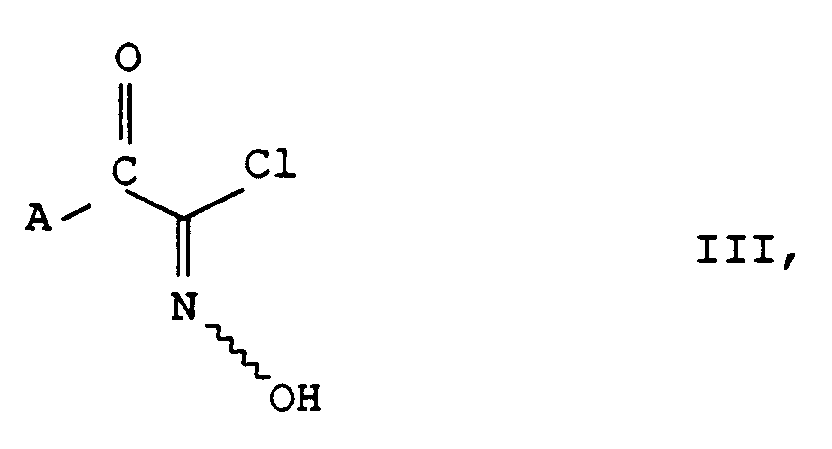
gefunden, das dadurch gekennzeichnet ist, daß man zur Deprotonierung ein Magnesiumalkoholat der Formel IV
Mg(OR⁶)₂ IV,
in der R⁶ einen aliphatischen oder cycloaliphatischen Rest bedeutet, verwendet. - Als aliphatische Reste in der Bedeutung R⁶ kommen ggf. substituierte Alkyl- oder Alkenylgruppen in Betracht. Beispiele sind C₁-C₆-Alkyl, insbesondere C₁-C₄-Alkyl wie Methyl, Ethyl, Propyl, Isopropyl, Butyl, Isobutyl, sek-Butyl, tert.-Butyl, das einmal durch C₁-C₄-Alkoxy wie Methoxy, Ethoxy, Propoxy, Isopropoxy, Butoxy, Isobutoxy, sek-Butoxy, tert.-Butoxy, insbesondere Methoxy und Ethoxy, C₁-C₄-Alkylthio wie Methylthio, Ethylthio, Propylthio, Isopropylthio, Butylthio, Isobutylthio, sek-Butylthio, tert.-Butylthio, insbesondere Methylthio und Ethylthio, Halogen wie unter R¹ genannt, insbesondere Fluor und Chlor, C₃-C₆-Cycloalkyl wie unter R¹ genannt, insbesondere Cyclopropyl, Cyano oder Phenyl substituiert sein kann; C₃-C₆-Alkenyl, insbesondere C₃-C₅-Alkenyl wie 2-Propenyl, 1-Methyl-2-propenyl, 1,1-Dimethyl-2-propenyl. Cycloaliphatische Reste sind beispielsweise Cyclopentyl und Cyclohexyl.
- Durch die Verwendung von Magnesiumalkoholaten als Base wurden überraschend weitaus höhere Ausbeuten erzielt als nach literaturbekannten Verfahren, die Ausbeuten von nur 14 bis 44 % bei Verwendung von Natriumalkoholaten bzw. 21 bis 63 % bei Verwendung von Natriumhydrid mit sich bringen wie die Zusammenstellung in Tabelle I zeigt.
Tabelle I R¹ R⁵ R² Base Lösungsmittel Ausbeute Literatur Me Et Et NaOMe MeOH 44 % 1) Me Me Me NaOMe MeOH 38 % 2) Me Me Me NaH Benzol 48 % 3) Et Me Me NaH Toluol 21 % 3) iPr Me Me NaH Toluol 31 % 3) iPr Me Me NaH Benzol 28 % 3) iPr Me Et NaH Toluol 32 % 3) iPr Me Me NaOMe MeOH 18 % 2) iPr Me Me NaOMe THF 14 % 2) erfindungsgemäßes Verfahren iPr Me Me Mg(OMe)₂ THF 74 % iPr Me Et Mg(OEt)₂ THF 78 % iPr Me Et Mg(OEt)₂ Toluol 69 % THF = Tetrahydrofuran
Me = Methyl; Et = Ethyl; i-Pr = Isopropyl
1) L. Panizzi, Gazz. Chim. Ital., 69, 322 (1939) ;
2) analog Lit. 1 durchgeführt
3) V. Maywald et al., DE-A-39 31 627 - Als Magnesiumalkoholate kommen solche von C₁-C₆-Alkoholen wie Methanol, Ethanol, n-Propanol, Isopropanol, n-Butanol, iso-Butanol, n-Pentanol, iso-Pentanol, n-Hexanol oder Isohexanol sowie von C₃-C₆-Alkenolen wie Allylalkohol und Cycloalkylalkohole wie Cyclopentanol und Cyclohexanol in Betracht.
- Besonders bevorzugt sind leicht zugängliche und billige Magnesiumalkoholate wie Magnesiummethylat, -ethylat und propylat, die kommerziell erhältlich sind.
- Herstellverfahren für Erdalkalialkoholate sind literaturbekannt (siehe Houben-Weyl, Methoden der Organischen Chemie, 4. Auflage, Band VI/2, Sauerstoffverbindungen I, S. 15, Georg Thieme Verlag).
- Die erfindungsgemäße Umsetzung erfolgt bevorzugt in der Weise, daß man die β-Ketosäure bzw. den β-Ketoester II in einem inerten organischen Lösungsmittel bei Temperaturen von -20°C bis zum Siedepunkt des organischen Lösungsmittels, vorzugsweise bei Temperaturen zwischen 0°C-50°C, mit der 1-5fach, bevorzugt 1-2fach molaren Menge des Magnesiumalkoholats IV in das Magnesiumenolat überführt. Vorzugsweise wird dabei das Magnesiumalkoholat IV im Lösungsmittel vorgelegt und diese Mischung mit einer Lösung des Ausgangsstoffes II versetzt. Anschließend wird das Hydroxamsäurechlorid IIIa oder IIIb bei Temperaturen zwischen 0°C bis zum Siedepunkt des organischen Lösungsmittels, vorzugsweise bei 20-70°C zugetropft. Um die Bildung von Furoxanen, die durch Dimerisierung der Hydroxamsäurechloride III oder deren Folgeprodukte entstehen können, zu vermeiden, sollte die Zugabe langsam, d.h. innerhalb von 1-12 Stunden, vorzugsweise 3-8 Stunden, erfolgen, wodurch die Konzentration niedrig gehalten wird.
- Als organisches Lösungsmittel eignen sich ganz allgemein Kohlenwasserstoffe wie Pentan, Hexan, Heptan, Petrolether, Ligroin oder Cyclohexan, Halogenkohlenwasserstoffe wie Dichlormethan, Tetrachlorkohlenstoff und Chlorbenzol, Nitrile wie Acetonitril, Butyronitril und Benzonitril, Amide wie Formamid, Methylformamid, Dimethylformamid und Diethylformamid, Sulfoxide und Sulfone wie Dimethylsulfoxid und Sulfolan. Insbesondere eignen sich Ether wie Diethylether, Ethyl-n-propylether, Di-n-butylether, Diisoamylether, Cyclohexylmethylether, Methyl-tert.-butylether, Diisopropylether, Ethylenglykoldimethylether, Diethylenglykoldimethylether, Tetrahydrofuran, Dioxan, Anisol, Phenetol oder aromatische Kohlenwasserstoffe wie Benzol, Toluol oder Xylol. Selbstverständlich können auch Gemische dieser Lösungsmittel verwendet werden.
- Die Menge an Lösungsmittel ist nicht kritisch. Normalerweise verwendet man die 1-20-fache, vorzugsweise die 1-10-fache Gewichtsmenge an Lösungsmittel, bezogen auf die Gewichtsmenge β-Ketosäure bzw. β-Ketoester II.
- Nach erfolgter Umsetzung (nach ca. 1-24 Stunden) säuert man die Lösung mit einer geeigneten Säure an und erhitzt das Reaktionsgemisch 1-6 Stunden unter Rückfluß. Dabei kann von Vorteil sein, das bei der stattfindenden Cyclisierung entstehende Wasser aus dem Reaktionsgemisch zu entfernen. Bei mit Wasser nicht mischbaren Lösungsmitteln verwendet man dazu zweckmäßigerweise einen Wasserabscheider, bei mit Wasser mischbaren Lösungsmitteln einen Soxhlet-Extraktor, dessen Extraktionshülse mit einem geeigneten Trockenmittel, beispielsweise Molekularsieb, gefüllt ist. Das Reaktionsprodukt I kann dann wie üblich durch Zugabe von Wasser und anschließende Extraktion mit einem organischen Lösungsmittel isoliert werden.
- Als Säuren verwendet man zweckmäßigerweise Carbon- und Sulfonsäuren wie Ameisensäure, Essigsäure, Propionsäure, Oxalsäure, Methansulfonsäure oder p-Toluolsulfonsäure, anorganische Säuren wie Schwefelsäure, Salzsäure, Phosphorsäure sowie Salze wie Ammoniumchlorid und Aminhydrochloride.
- Besondere Bedingungen bezüglich des Druckes sind nicht erforderlich, im allgemeinen nimmt man die Umsetzung bei Atmosphärendruck vor.
- Das Verfahren kann sowohl kontinuierlich als auch diskontinuierlich durchgeführt werden. Als ein Beispiel der kontinuierlichen Arbeitsweise sei die Umsetzung der Reaktionspartner in einem Rohrreaktor genannt.
- Im Hinblick auf die bestimmungsgemäße Verwendung der Zwischenprodukte I haben die Substituenten R¹, R² und A insbesondere die folgende Bedeutung:
- R¹
- Wasserstoff;
ein niedermolekularer Alkylrest wie C₁-C₆-Alkyl, insbesondere C₁-C₄-Alkyl wie Methyl, Ethyl, Propyl, Isopropyl, Butyl, Isobutyl, sek.-Butyl, tert.-Butyl, das durch ein bis drei Halogenatome wie Fluor, Chlor, Brom, Iod, insbesondere Fluor und Chlor, einen C₁-C₃-Alkoxyrest wie Methoxy, Ethoxy, Propoxy und Isopropoxy, insbesondere Methoxy und Ethoxy oder einen C₃-C₆-Cycloalkylrest wie Cyclopropyl, Cyclobutyl, Cyclopentyl und Cyclohexyl, insbesondere Cyclopropyl, substituiert sein kann;
ein Cycloalkylrest wie C₃-C₈-Cycloalkyl, z.B. Cyclopropyl, Cyclobutyl, Cyclopentyl, Cyclohexyl, Cycloheptyl, Cyclooctyl, insbesondere Cyclopropyl, das ein- bis dreimal durch C₁-C₄-Alkyl wie vorstehend genannt, insbesondere Methyl, substituiert sein kann;
ein 5- bis 6-gliedriger gesättigter, ungesättigter oder aromatischer heterocyclischer Rest, enthaltend ein oder zwei Heteroatome, ausgewählt aus der Gruppe Sauerstoff, Schwefel und Stickstoff wie 2-Tetrahydrofuranyl, 3-Tetrahydrofuranyl, 2-Tetrahydrothienyl, 3-Tetrahydrothienyl, 2-Tetrahydropyranyl, 3-Tetrahydropyranyl, 4-Tetrahydropyranyl, 2-Furanyl, 3-Furanyl, 2-Thienyl, 3-Thienyl, 3-Isoxazolyl, 4-Isoxazolyl, 5-Isoxazolyl, 2-Oxazolyl, 4-Oxazolyl, 5-Oxazolyl, 2-Thiazolyl, 4-Thiazolyl, 5-Thiazolyl, 2-Pyridyl, 3-Pyridyl, 4-Pyridyl, der durch C₁-C₃-Alkyl wie vorstehend genannt, insbesondere Methyl, C₁-C₃-Alkoxy wie Methoxy, Ethoxy, Propoxy und Isopropoxy, insbesondere Methoxy oder Halogen wie Fluor, Chlor, Brom und Iod, insbesondere Fluor und Chlor, substituiert sein kann;
Phenyl, das eine bis drei der folgenden Gruppen tragen kann: C₁-C₄-Alkyl wie vorstehend genannt, insbesondere Methyl, C₁-C₄-Halogenalkyl, insbesondere Trifluormethyl, C₁-C₄-Alkoxy wie vorstehend genannt, insbesondere Methoxy, C₁-C₄-Halogenalkoxy, insbesondere Trifluormethoxy, Halogen wie vorstehend genannt, insbesondere Fluor und Chlor, Nitro und Cyano; - R²
- Wasserstoff; Alkyl wie unter R¹ genannt, z.B. C₁-C₄-Alkyl, insbesondere Methyl und Ethyl, Cycloalkyl wie unter R¹ genannt, insbesondere Cyclohexyl, Benzyl und C₃-C₆-Alkenyl, insbesondere Allyl;
- A
- eine Aminogruppe NR³R⁴, worin
- R³
- Wasserstoff, einen aliphatischen Alkyl-, Alkenyl- oder Alkinylrest wie C₁-C₆-Alkyl, bevorzugt C₁-C₃-Alkyl wie vorstehend genannt, insbesondere Methyl, Ethyl und Isopropyl, C₃-C₆-Alkenyl, insbesondere C₃-C₅-Alkenyl wie 2-Propenyl, 1-Methyl-2-propenyl, 1,1-Dimethyl-2-propenyl, C₃-C₆-Alkinyl, insbesondere C₃-C₅-Alkinyl wie 2-Propinyl, 1-Methyl-2-propinyl, 1,1-Dimethyl-2-propinyl, C₃-C₆-Cycloalkyl wie vorstehend genannt, insbesondere Cyclopropyl und
- R⁴
- einen aliphatischen, z.B. ggf. substituierten Alkyl-, Alkenyl- oder Alkinylrest wie C₁-C₆-Alkyl, insbesondere C₁-C₄-Alkyl wie Methyl, Ethyl, Propyl, Isopropyl, Butyl, Isobutyl, sek-Butyl, tert.-Butyl, das einmal durch C₁-C₄-Alkoxy wie Methoxy, Ethoxy, Propoxy, Isopropoxy, Butoxy, Isobutoxy, sek-Butoxy, tert.-Butoxy, insbesondere Methoxy und Ethoxy, C₁-C₄-Alkylthio wie Methylthio, Ethylthio, Propylthio, Isopropylthio, Butylthio, Isobutylthio, sek-Butylthio, tert.-Butylthio, insbesondere Methylthio und Ethylthio, Halogen wie unter R¹ genannt, insbesondere Fluor und Chlor, C₃-C₆-Cycloalkyl wie unter R¹ genannt, insbesondere Cyclopropyl, Cyano oder Phenyl substituiert sein kann;
C₃-C₆-Alkenyl, insbesondere C₃-C₅-Alkenyl wie 2-Propenyl, 1-Methyl-2-propenyl, 1,1-Dimethyl-2-propenyl,
C₃-C₆-Alkinyl, insbesondere C₃-C₅-Alkinyl wie 2-Propinyl, 1-Methyl-2-propinyl, 1,1-Dimethyl-2-propinyl,
ein cycloaliphatischer Rest, z.B. C₃-C₆-Cycloalkyl wie unter R¹ genannt, insbesondere Cyclopropyl, Cyclopentyl und Cyclohexyl, das bis zu zweimal durch C₁-C₄-Alkyl wie vorstehend genannt, insbesondere Methyl und Ethyl oder Halogen wie unter R¹ genannt, insbesondere Fluor und Chlor, substituiert sein kann;
Phenyl, das einen bis drei der folgenden Reste tragen kann: C₁-C₄-Alkyl wie unter R¹ genannt, insbesondere Methyl, C₁-C₄-Halogenalkyl, insbesondere Trifluormethyl, C₁-C₄-Alkoxy, insbesondere Methoxy, Halogen wie unter R¹ genannt, insbesondere Fluor und Chlor, Cyano, Nitro, - R³,R⁴
- gemeinsam eine Methylenkette mit 4 bis 7 Gliedern, welche durch Sauerstoff, Schwefel oder N-Methyl unterbrochen sein kann,
- R⁵
- C₁-C₄-Alkyl wie unter R¹ genannt, insbesondere Methyl und Ethyl, C₃-C₆-Cycloalkyl wie unter R¹ genannt, insbesondere Cyclohexyl, Benzyl und C₃-C₆-Alkenyl, insbesondere Allyl bedeutet.
- Die für das erfindungsgemäße Verfahren benötigten β-Ketosäuren bzw. β-Ketoester II sind entweder kommerziell erhältlich oder nach allgemein bekannten Verfahren herstellbar (z.B. Org. Synth., 61, p. 5 (1982); Org. Synth. Coll. Vol. 4, p. 415 (1963); J. Org. Chem., 44, p. 310 (1979) ; J. Org. Chem., 43, p. 2087 (1978) ; Synthesis, 1978, p. 829; Org. Prep. Proced Int., 10, p. 221 (1978)).
- Die Hydroxamsäurechloride IIIb sind literaturbekannt (vgl. z.B. DE-A1-28 17 838; J. Org. Chem., Vol. 48, No. 3, 1983; US 3,557,190).
- Die Hydroxamsäurechloride IIIa sind beispielsweise nach dem in der Auslegeschrift DE 19 63 061 beschriebenen Verfahren ausgehend von Acetoacetamiden herstellbar. Nach diesem allgemeinen Verfahren lassen sich prinzipiell auch Hydroxamsäurechloride, die bisher nicht in der Literatur beschrieben sind, herstellen. Ein Beispiel ist nachstehend beschrieben.
-

- 28,5 g (0,5 mol) Cyclopropylamin werden in 500 ml Wasser bei Raumtemperatur vorgelegt und anschließend 42,0 g (0,5 mol) Diketen zugetropft. Dabei sinkt der pH-Wert von 12.0 auf 5.5-6.5 ab. Man rührt 10 min nach, versetzt mit 37,9 g (0,55 mol) Natriumnitrit und gibt anschließend ca. 75 ml konz. Salzsäure so zu, daß der pH-Wert stets oberhalb von 4.5 bleibt. Nach vollendeter Zugabe werden bei Raumtemperatur 41,1 g (0,58 mol) elementares Chlor eingegast. Der vollständige Umsatz wird mittels DC oder HPLC kontrolliert. Das bei der Reaktion entstehende Hydroxamsäurechlorid kann entweder durch Filtration bei 0°C oder durch mehrfache Extraktion mit je 200 ml Ethylacetat und Abziehen des Solvens im Vakuum isoliert werden. Der so erhaltene Feststoff wird mit Wasser gewaschen und bei maximal 40°C im Vakuum getrocknet. Man erhält 72,1 g (89 %) Cyclopropylcarbamoylformhydroxamoylchlorid als weißen Feststoff.
¹H-NMR (250 MHz, DMSO): δ = 0,50-0,78 (m; 4H), 2,75 (m; 1H), 8,48 (d; 1H, NH), 12,80 (s; 1H, OH)
Allgemeine Vorschrift zur Herstellung von Isoxazol-3-carbonsäureamid-4-carbonsäureestern Ia via Umsetzung von β-Ketoestern IIa mit Hydroxamsäurechloriden IIIa in Anwesenheit von Magnesiumalkoholaten.
R² = R⁶ = Methyl oder Ethyl
0,31 mol Magnesiumspäne läßt man unter Feuchtigkeitsausschuß mit 50 ml trockenem Alkohol (R⁶OH) reagieren. Die Reaktion wird durch Zugabe weniger Tropfen Brom oder Tetrakohlenstoff bzw. einer Spatelspitze Jod in Gang gebracht. Nach Beendigung der Reaktion wird der überschüssige Alkohol im Vakuum entfernt. Zu einer Suspension des auf diese Weise hergestellten Magnesiumalkoholats in 400 ml eines trockenen, inerten organischen Lösungsmittels werden anschließend 0,3 mol β-Ketoester II in 50 ml Lösungsmittel bei 10 bis 20°C zugetropft. Man rührt ca. 3 h bei Raumtemperatur. Zu der Lösung des gebildeten Magnesiumenolats werden langsam 0.3 mol Hydroxamsäurechlorid IIIa in 300 ml trockenem inerten organischen Lösungsmittel bei Raumtemperatur zugegeben. Die Zugabe erfolgt über 5 Stunden. Man läßt 4 bis 12 h bei Raumtemperatur nachrühren, säuert die Lösung durch Zugabe von ca. 45 g Essigsäure an und erhitzt 1 - 4 h unter Rückfluß. Der vollständige Umsatz zum Cyclisierungsprodukt wird mittels HPLC-Analytik kontrolliert. Man läßt abkühlen, nimmt das Reaktionsgemisch in einem Gemisch aus Wasser und Ethylacetat auf, trennt die Phasen, extrahiert die wässrige Phase mit Ethylacetat, trocknet die vereinigten organischen Phasen und zieht die Solventien am Rotationsverdampfer ab. Falls nötig wird das so erhaltene Rohprodukt durch Säulenfiltration an Kieselgel (Cyclohexan/Ethylacetat) gereinigt.

- Allgemeine Vorschrift zur Herstellung von Isoxazol-3,4-dicarbonsäureestern Ib via Umsetzung von β-Ketoestern IIa mit Hydroxamsäurechloriden IIIb in Anwesenheit von Magnesiumalkoholaten.

R² = R⁶ = Methyl oder Ethyl
Zu einer Lösung von 0,31 mol kommerziell erhältlichem Magnesiummethylat oder -ethylat in 400 ml trockenem inerten organischen Lösungsmittel werden 0,3 mol β-Ketoester IIa bei 10 bis 20°C zugegeben. Man rührt ca. 3 h bei Raumtemperatur. Zu der Lösung des gebildeten Magnesiumenolats werden langsam 0,3 mol Hydroxamsäurechlorid IIIb in 300 ml trockenem, inerten organischen Lösungsmittel bei Raumtemperatur zugegeben. Die Zugabe erfolgt über 5 Stunden. Man läßt 4 bis 12 h bei Raumtemperatur nachrühren, säuert die Lösung durch Zugabe von 45 g Essigsäure an, erhitzt 1 - 4 h unter Rückfluß und verfährt weiter wie vorstehend beschrieben.
- Zu einer Lösung von 10,8 g (0,2 mol) Natriummethylat (krist.) in 150 ml trockenem Methanol gibt man bei 0 - 10°C 23,2 g (0,2 mol) Acetessigsäuremethylester in 50 ml absoluten Methanol und rührt 3 h bei dieser Temperatur. Anschließend tropft man bei 0 - 10°C langsam 27,5 g (0,2 mol) Methyl-α-chloro-α-oximinoacetat in 100 ml absoluten Methanol zu und rührt 12 h bei Raumtemperatur. Zur Aufarbeitung engt man die Lösung weitgehend ein, gibt 800 ml Wasser zu, wobei sich das Produkt als Öl absetzt. Die organische Phase wird abgetrennt, die wässrige Phase mit Dichlormethan extrahiert, die vereinigten organischen Phasen getrocknet und das Solvens am Rotationsverdampfer abgezogen. Der Rückstand wird durch Säulenchromatographie an Kieselgel (Lösungsmittel Cyclohexan/Ethylacetat 3:1) gereinigt. Man erhält 15,1 g (38 % d. Theorie) 5-Methylisoxazol-3,4-dicarbonsäuredimethylester.
¹HNMR (250 MHz; CDCl₃) d = 2.72 (s;3H), 3.87 (s;3H), 4.00 (s;3H) - Zu 9,9 g (0,33 mol) Natriumhydrid (100 %) in 500 ml trockenem Toluol bzw. Benzol tropft man bei Raumtemperatur 0,3 mol β-Ketoester in 100 ml Lösungsmittel und rührt 3 h. Anschließend gibt man 0,3 mol Methyl-α-chloro-α-oximinoacetat in 200 ml Lösungsmittel zu und rührt 12 h bei Raumtemperatur. Danach überführt man das Reaktionsgemisch in eine Soxhletapparatur (Extraktionshülse gefüllt mit Molekularsieb 4 Å) fügt 3 g Methansulfonsäure hinzu und erhitzt 1 - 4 h unter Rückfluß. Man läßt abkühlen, wäscht die organische Phase einmal mit Wasser und zieht das Solvens im Vakuum ab. Gegebenenfalls wird das Rohprodukt durch Säulenfiltration an Kieselgel (Lösungsmittel Cyclohexan/Ethylacetat) gereinigt. Die Ergebnisse der verschiedenen Versuche sind in Tabelle 3 aufgeführt.


mittels einer Base und Umsetzung mit Hydroxamsäurechloriden der Formel III

Die direkte Synthese von Isoxazol-3-carbonsäureamid-4-carbonsäurederivaten Ia

durch baseninduzierte Umsetzung von β-Ketoestern oder -säuren II mit Hydroxamsäurechloriden der Formel IIIa

ist nicht in der Literatur beschrieben.
Claims (5)
- Verfahren zur Herstellung von Isoxazol-3,4-dicarbonsäurederivaten der Formel I
 R¹ Wasserstoff, ein Alkyl-, Cycloalkyl- oder Phenylrest oder ein 5- bis 6-gliedriger heterocyclischer Rest, wobei die organischen Reste unter den Reaktionsbedingungen inerte Substituenten tragen können;R² Wasserstoff, ein Alkyl-, Cycloalkyl-, Benzyl- oder C₃-C₆-Alkenylrest;A eine Aminogruppe NR³R⁴, in der R³ für Wasserstoff, einen aliphatischen oder cycloaliphatischen Rest steht und R⁴ einen aliphatischen, einen cycloaliphatischen oder einen ggf. substituierten Phenylrest bedeutet oder R³ zusammen mit R⁴ eine 4- bis 7-gliedrige Alkylenkette bildet, die durch Sauerstoff, Schwefel oder N-Methyl unterbrochen sein kann oderdurch Deprotonierung einer CH-aciden Verbindung der Formel II
eine Gruppe OR⁵, in der R⁵ für einen Alkyl-, Cycloalkyl-, Benzyl- oder Alkenylrest steht;

Mg(OR⁶)₂ IV,
in der R⁶ einen aliphatischen oder cycloaliphatischen Rest bedeutet, verwendet. - Verfahren nach Anspruch 1, dadurch gekennzeichnet, daß man Magnesiummethylat oder Magnesiumethylat als Base verwendet.
- Verfahren nach den Ansprüchen 1 und 2, dadurch gekennzeichnet, daß man die Base in einer Menge von 1- bis 5 mol, bezogen auf den β-Ketoester II (R² ≠ H) bzw. 2- bis 5 mol, bezogen auf die β-Ketosäure II (R² = H) verwendet.
- Verfahren nach den Ansprüchen 1 bis 3, dadurch gekennzeichnet, daß man die Umsetzung in Gegenwart eines aromatischen Kohlenwasserstoffs oder eines Ethers als Lösungsmittel vornimmt.
- Verfahren nach Anspruch 4, dadurch gekennzeichnet, daß man Toluol oder Tetrahydrofuran als Lösungsmittel verwendet.
Applications Claiming Priority (2)
| Application Number | Priority Date | Filing Date | Title |
|---|---|---|---|
| DE4209848A DE4209848A1 (de) | 1992-03-26 | 1992-03-26 | Verfahren zur Herstellung von Isoxazol-3,4-dicarbonsäurederivaten |
| DE4209848 | 1992-03-26 |
Publications (2)
| Publication Number | Publication Date |
|---|---|
| EP0562382A1 true EP0562382A1 (de) | 1993-09-29 |
| EP0562382B1 EP0562382B1 (de) | 1998-01-21 |
Family
ID=6455082
Family Applications (1)
| Application Number | Title | Priority Date | Filing Date |
|---|---|---|---|
| EP93103978A Expired - Lifetime EP0562382B1 (de) | 1992-03-26 | 1993-03-11 | Verfahren zur Herstellung von Isoxazol-3,4-dicarbonsäurederivaten |
Country Status (4)
| Country | Link |
|---|---|
| US (1) | US5264580A (de) |
| EP (1) | EP0562382B1 (de) |
| DE (2) | DE4209848A1 (de) |
| ES (1) | ES2111661T3 (de) |
Families Citing this family (1)
| Publication number | Priority date | Publication date | Assignee | Title |
|---|---|---|---|---|
| WO1994024095A1 (en) * | 1993-04-16 | 1994-10-27 | Abbott Laboratories | Immunosuppressive agents |
Citations (2)
| Publication number | Priority date | Publication date | Assignee | Title |
|---|---|---|---|---|
| US3502660A (en) * | 1967-01-12 | 1970-03-24 | Pfizer & Co C | 2-((5'-(3' and/or 4'-substituted)isoxazoyl) methylidene)-3,4,10-trioxo-1,2,3,4,4a,9,9a,10-octahydroanthracenes |
| EP0418667A2 (de) * | 1989-09-22 | 1991-03-27 | BASF Aktiengesellschaft | Carbonsäureamide |
Family Cites Families (2)
| Publication number | Priority date | Publication date | Assignee | Title |
|---|---|---|---|---|
| US3699117A (en) * | 1969-07-29 | 1972-10-17 | Pfizer | 2-((5'-(3'-and/or 4'-substituted) isoxazolyl) aminoethyl) - 3,4,10 - trioxo-1,2,3,4,4,9,9,10-octahydroanthracenes and related compounds |
| DE3931627A1 (de) * | 1989-09-22 | 1991-04-04 | Basf Ag | Carbonsaeureamide |
-
1992
- 1992-03-26 DE DE4209848A patent/DE4209848A1/de not_active Withdrawn
-
1993
- 1993-03-11 EP EP93103978A patent/EP0562382B1/de not_active Expired - Lifetime
- 1993-03-11 DE DE59308002T patent/DE59308002D1/de not_active Expired - Lifetime
- 1993-03-11 ES ES93103978T patent/ES2111661T3/es not_active Expired - Lifetime
- 1993-03-23 US US08/039,573 patent/US5264580A/en not_active Expired - Fee Related
Patent Citations (2)
| Publication number | Priority date | Publication date | Assignee | Title |
|---|---|---|---|---|
| US3502660A (en) * | 1967-01-12 | 1970-03-24 | Pfizer & Co C | 2-((5'-(3' and/or 4'-substituted)isoxazoyl) methylidene)-3,4,10-trioxo-1,2,3,4,4a,9,9a,10-octahydroanthracenes |
| EP0418667A2 (de) * | 1989-09-22 | 1991-03-27 | BASF Aktiengesellschaft | Carbonsäureamide |
Non-Patent Citations (1)
| Title |
|---|
| CHEMICAL ABSTRACTS, vol. 33, no. 21, 10. November 1939, Columbus, Ohio, US; abstract no. 8612, L. PANIZZI 'New synthesis of isoxazolepolycarboxylic acids' * |
Also Published As
| Publication number | Publication date |
|---|---|
| DE59308002D1 (de) | 1998-02-26 |
| ES2111661T3 (es) | 1998-03-16 |
| EP0562382B1 (de) | 1998-01-21 |
| US5264580A (en) | 1993-11-23 |
| DE4209848A1 (de) | 1993-09-30 |
Similar Documents
| Publication | Publication Date | Title |
|---|---|---|
| DE69126350T2 (de) | Verfahren zur Herstellung von Chlorothiazolderivaten | |
| DE3881408T2 (de) | Thiazolidinon-Derivate, ihre Herstellung und ihre Verwendung. | |
| DE69023171T2 (de) | Kondensierte heterozyklische Verbindungen, ihre Herstellung und Verwendung. | |
| EP3421470B1 (de) | Substituierte 5-fluor-1h-pyrazolopyridine in kristalliner form | |
| EP0419944B1 (de) | Oxazol- bzw. Thiazolcarbonsäureamide | |
| EP0645389A1 (de) | Verfahren zur Herstellung von Imidazopyridinderivaten | |
| DE69225123T2 (de) | Thiazolidinederivate, die eine Quinone-Gruppe enthalten, ihre Herstellung und therapeutische Anwendung | |
| DE3486438T2 (de) | Verfahren zur Herstellung von 1-(Phenyl)-1-hydroxy-2-amino-3-fluor-propan-Derivaten | |
| DE69626682T2 (de) | Verfahren zur herstellung von guanidinderivaten, zwischenprodukte dafür und ihre herstellung | |
| EP0388744A1 (de) | Verfahren zur Herstellung von beta-Amino-acrylsäureestern | |
| DE69525021T2 (de) | Verfahren zur Herstellung vor insektiziden Arylpyrrolen aus Oxazolamin Zwischenprodukte | |
| DE60307682T2 (de) | Cyklisierungsverfahren für benzothiazolderivate | |
| DE69632919T2 (de) | Verfahren zur herstellung von 2-chlor-5-chloromethyl-thiazol | |
| DE69804212T2 (de) | Verfahren und zwischenprodukte zur herstellung substituierter indazolderivate | |
| DE69401486T2 (de) | Verfahren zur Herstellung 2-cyanoimidazol Derivate | |
| EP0562382B1 (de) | Verfahren zur Herstellung von Isoxazol-3,4-dicarbonsäurederivaten | |
| DE69703115T2 (de) | Zwischenprodukte um 2-imidazolin-5onederivate herzustellen. | |
| EP0184981B1 (de) | Neue Pyrrolinone und deren Zwischenprodukte | |
| EP0194521A1 (de) | Phosphorhaltige alpha-Aminonitrile und Verfahren zu ihrer Herstellung | |
| DE4025892A1 (de) | Verfahren zur herstellung von substituierten 3-aminoacrylestern | |
| EP0971907B1 (de) | Verfahren zur herstellung von 1,3-disubstituierten 2-nitroguanidinen | |
| EP0378046B1 (de) | Verfahren zur Herstellung von 3-Phenylpyrrolderivaten | |
| EP3301092A2 (de) | Verfahren zur herstellung von spiroketal-substituierten phenylacetylaminosäureestern und spiroketal-substituierten cyclischen ketoenolen | |
| DE69427148T2 (de) | Verfahren zur Herstellung von 2,4,5-Tribrompyrrol-3-carbonitril | |
| EP1373237B1 (de) | Verfahren zur herstellung von oxirancarbonsäuren und derivaten davon |
Legal Events
| Date | Code | Title | Description |
|---|---|---|---|
| PUAI | Public reference made under article 153(3) epc to a published international application that has entered the european phase |
Free format text: ORIGINAL CODE: 0009012 |
|
| 17P | Request for examination filed |
Effective date: 19930508 |
|
| AK | Designated contracting states |
Kind code of ref document: A1 Designated state(s): BE CH DE ES FR GB IT LI NL |
|
| GRAG | Despatch of communication of intention to grant |
Free format text: ORIGINAL CODE: EPIDOS AGRA |
|
| 17Q | First examination report despatched |
Effective date: 19970221 |
|
| GRAG | Despatch of communication of intention to grant |
Free format text: ORIGINAL CODE: EPIDOS AGRA |
|
| GRAH | Despatch of communication of intention to grant a patent |
Free format text: ORIGINAL CODE: EPIDOS IGRA |
|
| GRAH | Despatch of communication of intention to grant a patent |
Free format text: ORIGINAL CODE: EPIDOS IGRA |
|
| GRAA | (expected) grant |
Free format text: ORIGINAL CODE: 0009210 |
|
| AK | Designated contracting states |
Kind code of ref document: B1 Designated state(s): BE CH DE ES FR GB IT LI NL |
|
| REG | Reference to a national code |
Ref country code: CH Ref legal event code: EP |
|
| REF | Corresponds to: |
Ref document number: 59308002 Country of ref document: DE Date of ref document: 19980226 |
|
| GBT | Gb: translation of ep patent filed (gb section 77(6)(a)/1977) |
Effective date: 19980212 |
|
| REG | Reference to a national code |
Ref country code: ES Ref legal event code: FG2A Ref document number: 2111661 Country of ref document: ES Kind code of ref document: T3 |
|
| ITF | It: translation for a ep patent filed | ||
| ET | Fr: translation filed | ||
| PLBE | No opposition filed within time limit |
Free format text: ORIGINAL CODE: 0009261 |
|
| 26N | No opposition filed | ||
| PGFP | Annual fee paid to national office [announced via postgrant information from national office to epo] |
Ref country code: FR Payment date: 20010219 Year of fee payment: 9 |
|
| PGFP | Annual fee paid to national office [announced via postgrant information from national office to epo] |
Ref country code: NL Payment date: 20010228 Year of fee payment: 9 Ref country code: CH Payment date: 20010228 Year of fee payment: 9 |
|
| PGFP | Annual fee paid to national office [announced via postgrant information from national office to epo] |
Ref country code: GB Payment date: 20010301 Year of fee payment: 9 |
|
| PGFP | Annual fee paid to national office [announced via postgrant information from national office to epo] |
Ref country code: ES Payment date: 20010307 Year of fee payment: 9 |
|
| PGFP | Annual fee paid to national office [announced via postgrant information from national office to epo] |
Ref country code: DE Payment date: 20010316 Year of fee payment: 9 |
|
| PGFP | Annual fee paid to national office [announced via postgrant information from national office to epo] |
Ref country code: BE Payment date: 20010409 Year of fee payment: 9 |
|
| REG | Reference to a national code |
Ref country code: GB Ref legal event code: IF02 |
|
| PG25 | Lapsed in a contracting state [announced via postgrant information from national office to epo] |
Ref country code: DE Free format text: LAPSE BECAUSE OF THE APPLICANT RENOUNCES Effective date: 20020309 |
|
| PG25 | Lapsed in a contracting state [announced via postgrant information from national office to epo] |
Ref country code: GB Free format text: LAPSE BECAUSE OF NON-PAYMENT OF DUE FEES Effective date: 20020311 |
|
| PG25 | Lapsed in a contracting state [announced via postgrant information from national office to epo] |
Ref country code: ES Free format text: LAPSE BECAUSE OF NON-PAYMENT OF DUE FEES Effective date: 20020312 |
|
| PG25 | Lapsed in a contracting state [announced via postgrant information from national office to epo] |
Ref country code: LI Free format text: LAPSE BECAUSE OF NON-PAYMENT OF DUE FEES Effective date: 20020331 Ref country code: CH Free format text: LAPSE BECAUSE OF NON-PAYMENT OF DUE FEES Effective date: 20020331 Ref country code: BE Free format text: LAPSE BECAUSE OF NON-PAYMENT OF DUE FEES Effective date: 20020331 |
|
| BERE | Be: lapsed |
Owner name: *BASF A.G. Effective date: 20020331 |
|
| PG25 | Lapsed in a contracting state [announced via postgrant information from national office to epo] |
Ref country code: NL Free format text: LAPSE BECAUSE OF NON-PAYMENT OF DUE FEES Effective date: 20021001 |
|
| GBPC | Gb: european patent ceased through non-payment of renewal fee |
Effective date: 20020311 |
|
| REG | Reference to a national code |
Ref country code: CH Ref legal event code: PL |
|
| PG25 | Lapsed in a contracting state [announced via postgrant information from national office to epo] |
Ref country code: FR Free format text: LAPSE BECAUSE OF NON-PAYMENT OF DUE FEES Effective date: 20021129 |
|
| NLV4 | Nl: lapsed or anulled due to non-payment of the annual fee |
Effective date: 20021001 |
|
| REG | Reference to a national code |
Ref country code: FR Ref legal event code: ST |
|
| REG | Reference to a national code |
Ref country code: ES Ref legal event code: FD2A Effective date: 20030410 |
|
| PG25 | Lapsed in a contracting state [announced via postgrant information from national office to epo] |
Ref country code: IT Free format text: LAPSE BECAUSE OF NON-PAYMENT OF DUE FEES;WARNING: LAPSES OF ITALIAN PATENTS WITH EFFECTIVE DATE BEFORE 2007 MAY HAVE OCCURRED AT ANY TIME BEFORE 2007. THE CORRECT EFFECTIVE DATE MAY BE DIFFERENT FROM THE ONE RECORDED. Effective date: 20050311 |