EP0562814A1 - Korrektur der optischen Defokussierung eines Bildes - Google Patents
Korrektur der optischen Defokussierung eines Bildes Download PDFInfo
- Publication number
- EP0562814A1 EP0562814A1 EP93302187A EP93302187A EP0562814A1 EP 0562814 A1 EP0562814 A1 EP 0562814A1 EP 93302187 A EP93302187 A EP 93302187A EP 93302187 A EP93302187 A EP 93302187A EP 0562814 A1 EP0562814 A1 EP 0562814A1
- Authority
- EP
- European Patent Office
- Prior art keywords
- image
- defocus
- data
- optical
- determining
- Prior art date
- Legal status (The legal status is an assumption and is not a legal conclusion. Google has not performed a legal analysis and makes no representation as to the accuracy of the status listed.)
- Granted
Links
- 230000003287 optical effect Effects 0.000 title claims abstract description 57
- 238000012937 correction Methods 0.000 title claims abstract description 22
- 238000000034 method Methods 0.000 claims description 20
- 238000012545 processing Methods 0.000 claims description 17
- 108091008695 photoreceptors Proteins 0.000 claims 7
- 238000003384 imaging method Methods 0.000 abstract description 10
- 230000000875 corresponding effect Effects 0.000 abstract description 4
- 230000003044 adaptive effect Effects 0.000 abstract description 2
- 230000002596 correlated effect Effects 0.000 abstract description 2
- 238000001914 filtration Methods 0.000 abstract 1
- 230000006870 function Effects 0.000 description 26
- 238000013461 design Methods 0.000 description 11
- 230000008569 process Effects 0.000 description 11
- 230000004044 response Effects 0.000 description 11
- 238000005259 measurement Methods 0.000 description 9
- 230000009467 reduction Effects 0.000 description 8
- 230000033001 locomotion Effects 0.000 description 7
- 238000003491 array Methods 0.000 description 6
- 230000004075 alteration Effects 0.000 description 5
- 238000009472 formulation Methods 0.000 description 5
- 238000005286 illumination Methods 0.000 description 5
- 239000000203 mixture Substances 0.000 description 5
- 239000011521 glass Substances 0.000 description 4
- 238000012546 transfer Methods 0.000 description 4
- 239000000654 additive Substances 0.000 description 3
- 230000000996 additive effect Effects 0.000 description 3
- 230000002441 reversible effect Effects 0.000 description 3
- 238000001228 spectrum Methods 0.000 description 3
- 230000003466 anti-cipated effect Effects 0.000 description 2
- 238000013459 approach Methods 0.000 description 2
- 238000004891 communication Methods 0.000 description 2
- 230000000593 degrading effect Effects 0.000 description 2
- 238000001514 detection method Methods 0.000 description 2
- 239000000835 fiber Substances 0.000 description 2
- 239000005357 flat glass Substances 0.000 description 2
- 238000012634 optical imaging Methods 0.000 description 2
- 230000000284 resting effect Effects 0.000 description 2
- 238000005070 sampling Methods 0.000 description 2
- 238000000926 separation method Methods 0.000 description 2
- 229910021417 amorphous silicon Inorganic materials 0.000 description 1
- 238000004458 analytical method Methods 0.000 description 1
- 230000006399 behavior Effects 0.000 description 1
- 230000005540 biological transmission Effects 0.000 description 1
- 230000015556 catabolic process Effects 0.000 description 1
- 230000008859 change Effects 0.000 description 1
- 239000003086 colorant Substances 0.000 description 1
- 150000001875 compounds Chemical class 0.000 description 1
- 239000012141 concentrate Substances 0.000 description 1
- 230000001143 conditioned effect Effects 0.000 description 1
- 230000003750 conditioning effect Effects 0.000 description 1
- 229910021419 crystalline silicon Inorganic materials 0.000 description 1
- 230000007547 defect Effects 0.000 description 1
- 238000006731 degradation reaction Methods 0.000 description 1
- 230000001419 dependent effect Effects 0.000 description 1
- 238000012938 design process Methods 0.000 description 1
- 230000001627 detrimental effect Effects 0.000 description 1
- 230000009977 dual effect Effects 0.000 description 1
- 230000000694 effects Effects 0.000 description 1
- 239000003365 glass fiber Substances 0.000 description 1
- 238000004519 manufacturing process Methods 0.000 description 1
- 239000000463 material Substances 0.000 description 1
- 230000003595 spectral effect Effects 0.000 description 1
- 239000012780 transparent material Substances 0.000 description 1
- 238000011144 upstream manufacturing Methods 0.000 description 1
Images




Classifications
-
- H—ELECTRICITY
- H04—ELECTRIC COMMUNICATION TECHNIQUE
- H04N—PICTORIAL COMMUNICATION, e.g. TELEVISION
- H04N1/00—Scanning, transmission or reproduction of documents or the like, e.g. facsimile transmission; Details thereof
- H04N1/00002—Diagnosis, testing or measuring; Detecting, analysing or monitoring not otherwise provided for
- H04N1/00007—Diagnosis, testing or measuring; Detecting, analysing or monitoring not otherwise provided for relating to particular apparatus or devices
- H04N1/00013—Reading apparatus
-
- H—ELECTRICITY
- H04—ELECTRIC COMMUNICATION TECHNIQUE
- H04N—PICTORIAL COMMUNICATION, e.g. TELEVISION
- H04N1/00—Scanning, transmission or reproduction of documents or the like, e.g. facsimile transmission; Details thereof
- H04N1/00002—Diagnosis, testing or measuring; Detecting, analysing or monitoring not otherwise provided for
-
- H—ELECTRICITY
- H04—ELECTRIC COMMUNICATION TECHNIQUE
- H04N—PICTORIAL COMMUNICATION, e.g. TELEVISION
- H04N1/00—Scanning, transmission or reproduction of documents or the like, e.g. facsimile transmission; Details thereof
- H04N1/00002—Diagnosis, testing or measuring; Detecting, analysing or monitoring not otherwise provided for
- H04N1/00026—Methods therefor
- H04N1/00034—Measuring, i.e. determining a quantity by comparison with a standard
-
- H—ELECTRICITY
- H04—ELECTRIC COMMUNICATION TECHNIQUE
- H04N—PICTORIAL COMMUNICATION, e.g. TELEVISION
- H04N1/00—Scanning, transmission or reproduction of documents or the like, e.g. facsimile transmission; Details thereof
- H04N1/00002—Diagnosis, testing or measuring; Detecting, analysing or monitoring not otherwise provided for
- H04N1/00026—Methods therefor
- H04N1/00045—Methods therefor using a reference pattern designed for the purpose, e.g. a test chart
-
- H—ELECTRICITY
- H04—ELECTRIC COMMUNICATION TECHNIQUE
- H04N—PICTORIAL COMMUNICATION, e.g. TELEVISION
- H04N1/00—Scanning, transmission or reproduction of documents or the like, e.g. facsimile transmission; Details thereof
- H04N1/00002—Diagnosis, testing or measuring; Detecting, analysing or monitoring not otherwise provided for
- H04N1/00026—Methods therefor
- H04N1/00053—Methods therefor out of service, i.e. outside of normal operation
-
- H—ELECTRICITY
- H04—ELECTRIC COMMUNICATION TECHNIQUE
- H04N—PICTORIAL COMMUNICATION, e.g. TELEVISION
- H04N1/00—Scanning, transmission or reproduction of documents or the like, e.g. facsimile transmission; Details thereof
- H04N1/00002—Diagnosis, testing or measuring; Detecting, analysing or monitoring not otherwise provided for
- H04N1/00026—Methods therefor
- H04N1/00063—Methods therefor using at least a part of the apparatus itself, e.g. self-testing
-
- H—ELECTRICITY
- H04—ELECTRIC COMMUNICATION TECHNIQUE
- H04N—PICTORIAL COMMUNICATION, e.g. TELEVISION
- H04N1/00—Scanning, transmission or reproduction of documents or the like, e.g. facsimile transmission; Details thereof
- H04N1/00002—Diagnosis, testing or measuring; Detecting, analysing or monitoring not otherwise provided for
- H04N1/00071—Diagnosis, testing or measuring; Detecting, analysing or monitoring not otherwise provided for characterised by the action taken
- H04N1/00082—Adjusting or controlling
-
- H—ELECTRICITY
- H04—ELECTRIC COMMUNICATION TECHNIQUE
- H04N—PICTORIAL COMMUNICATION, e.g. TELEVISION
- H04N1/00—Scanning, transmission or reproduction of documents or the like, e.g. facsimile transmission; Details thereof
- H04N1/40—Picture signal circuits
- H04N1/409—Edge or detail enhancement; Noise or error suppression
- H04N1/4092—Edge or detail enhancement
Definitions
- This invention relates to optical imaging systems in electronic reprographic equipment. More specifically, the invention relates to a system for correction of optical defocus and related optical system errors by correction of electrical signals representative of the optically produced image data.
- Electronic reprographic equipment and facsimile transmission equipment employ scanners for optically scanning an image, such as a document, and converting the optical information to an electrical image signal.
- Several types of optical systems are commonly employed to achieve the raster scanning of input documents and produce the representative electrical signal.
- Figure 1 illustrates one of several configurations frequently used with reduction optical systems to scan a document and produce a reduced size image on a linear array of photosensors. This configuration is relatively tolerant of errors in the object conjugate of the lens; i.e., errors in the optical path length from the lens, through the mirrors, to the original document.
- Variations in this path length of ⁇ 1 millimeters while causing noticeable change in magnification, will typically have little degrading effect on the focus, or sharpness, of the optical image formed on the photosensor array. Since only one compound lens is used, however, there may exist a variation in image quality along the linear portion of the image sensed by the photosensor array. Variations in image quality from the end of such a scanned image line to the center of this line frequently occur with a reasonable degree of symmetry about the center of the scanned image. These variations in quality may, for example, be caused by the curvature of the surface of best focus of the lens, or by other related lens aberrations which are well known to vary with the distance from the center of the optical field.
- a second class of optical systems frequently used for document scanning in electronic reprographic equipment is the "full-width" scanner type, shown in Figure 2.
- an array of lenses extends (into the page in the figure) the full extent of the line on the input document which is to be imaged at unity magnification onto the full-width photosensor array.
- Full-width scanners have been developed which utilize amorphous or crystalline silicon photosensor arrays that offer the advantages of high responsivity (which yields high scanning speeds), low illumination requirements (which reduces power consumption) and compactness. These scanners require compact, full width lens arrays to achieve these performance advantages.
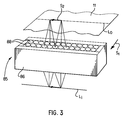
- the most commonly used lenses for this purpose are gradient index fiber lens arrays, as illustrated in Figure 3.
- gradient index lens arrays While commercially available gradient index lens arrays provide good optical efficiency and excellent control of the unity magnification requirement, they have poor depth-of-field capabilities when compared with, for example, reduction optics designs; i. e., they are considerably more sensitive to errors in the object conjugate length than reduction optics designs.
- the depth-of-field for high efficiency gradient index lens arrays is approximately ⁇ 0.25 to ⁇ 0.50 millimeters.
- Figure 4 illustrates the depth-of-field characteristics of a typical gradient index lens array.
- the graph of Figure 4 plots the modulation transfer function (MTF) achievable by the lens array as a function of defocus distance at a predetermined spatial frequency; for example, Figure 4 shows these characteristics for a commercially available lens at 6 cycles per mm.
- the MTF value correlates directly to the fidelity level of the image from the lens array.
- the curves show the defocus distances (or depth-of-field) of the lens array necessary to maintain the desired MTF.
- the zero on the abscissa represents the best focus position and the small divisions along the abscissa are tenths of a millimeter.
- Curve M represents the characteristics of the lens in the main scanning direction along a line coincident with the line of photosensors
- curve S represents the characteristics of the lens in the subscanning direction; i. e., perpendicular to the main scanning direction.
- An object of the invention is to provide a system for improving image fidelity in optical/electrical imaging systems.
- an image input terminal designated generally by the numeral 10, having a platen 12.
- the exemplary image input terminal 10 is a multi-mode, in this case, dual mode, input terminal which in a first mode scans a document original 11 resting face down on platen 12 line by line at a first scan station 13, and in a second mode scans a moving document at a second scan station 14.
- image input terminal 10 converts the document image being scanned to video image signals or pixels which are output to a suitable user (not shown) such as a memory, communication channel, raster output scanner, etc.
- Image input terminal 10 has a suitable frame or housing 18 with base member 20, side members (not shown), end members 24, 25 and top member 26 which cooperate with platen 12 to provide an interior 27 within which a scan carriage 32 is movably disposed.
- Platen 12 which is made of a suitably transparent material, normally glass, is typically rectangular in shape with a length and width sized to accommodate the largest sized document to be scanned by input terminal 10 in the first mode plus the platen area necessary for the second mode.
- scan carriage 32 is supported for back and forth or reciprocating scanning movement (in the direction shown by the solid line arrow of Fig. 1) within the interior 27 of image input terminal 10 by a pair of parallel carriage support rods 34.
- Support rods 34 are suitably mounted on frame 18 in predetermined spaced relation below platen 12 with carriage 32 supported for slidable movement on rods 34 by suitable bearings (not shown).
- a drive screw 37 is threadedly engaged with carriage 32.
- a reversible drive motor 39 rotates screw 37 in either a clockwise or counter-clockwise direction to move the carriage 32 back and forth along carriage support rods 34.
- a linear scanning or image reading photosensor array 40 which may, for example, comprise a Toshiba Model TCD141C CCD chip, is mounted on carriage 32.
- Array 40 has a series (i.e. 5000) of individual photosensitive elements adapted to generate signals having a potential proportional to the reflectance of the object line viewed by the array 40.
- the signals output by array 40 are thereafter input to suitable signal processing circuitry (described below) to provide video image signals or pixels representative of the image scanned.
- An optical system consisting of imaging lens 55 and folding mirrors 56, 57, 58 cooperate to form an optical imaging path 54 through which array 40 views platen 12 and a line-like portion of the document being scanned, the light rays reflected from the document line passing downwardly through platen 12 to mirror 56 and from mirror 56 through mirrors 57, 58 to lens 55 and array 40.
- an illumination assembly 64 consisting of an elongated exposure lamp 65 and cooperating reflector 70 is provided on carriage 32 adjacent the underside of platen 12. Lamp 65 and reflector 70 extend in a direction generally perpendicular to the direction of scanning movement of scan carriage 32. As will be understood, reflector 70 serves to enhance and concentrate light emitted by lamp 65 onto platen 12 at the document line being scanned by array 40.
- scan carriage 32 In the first scan mode, scan carriage 32 is moved by motor 34 from a Start of Scan (SOS) position 72 at one end of platen 12 to an End of Scan (EOS) position 73 and back to SOS position 72.
- SOS Start of Scan
- EOS End of Scan
- Array 40, imaging lens 55, folding mirrors 56, 57, 58 and illumination sensor 64 are fixedly attached to scan carriage 32 and move in unison with the carriage 32.
- EOS position 73 which cooperates with SOS position 72 to delineate first scan station 13, is slightly upstream of the platen end to leave room for a second scan station 14.
- the distance between SOS and EOS positions 72, 73, respectively is chosen to accommodate the largest size document image to be scanned at first scan station 13.
- scan carriage 32 is moved beyond EOS station 73 to a predetermined fixed scan position 74. During scanning in this mode, scan carriage 32 is stationary while the document being scanned is moved past the fixed scan position 74.
- CVT 80 has a plurality of spaced document transport rolls 81 disposed opposite scan position 74, rolls 81 cooperating with the surface 15 of platen 12 opposite thereto to form a document feeding nip 83 therebetween.
- an image input terminal designated generally by the number 90, that employs a full width scanning arrangement. Elements of image input terminal 90 having a structure and function similar to like elements of the image input terminal shown in Figure 1 are similarly numbered.
- the image input terminal 90 is also a multi-mode input terminal, which in a first mode scans a document original 11 resting face down on platen 12 line by line at a first scan station 13, and in a second mode scans a moving document at a second scan station 14.
- imaging input terminal 90 converts the document image being scanned to video image signals or pixels which are output to a suitable user (not shown) such as a memory, communications channel, raster output scanner, etc.
- Image input terminal 90 has a suitable frame or housing 18 with base member 20, end members 24, 25 and top member 26, which cooperate with the platen 12 to provide an interior 27 within which a scan carriage 33 is movably disposed.
- a document 11 placed on platen 12 is scanned in the same manner as described with respect to the Figure 1 terminal.
- the controlled scanning movement is imparted to carriage 33 by drive screw 37 which is threadedly engaged with carriage 33.
- a reversible drive motor 39 rotates screw 37 in forward or reverse directions, thereby moving carriage 33 back and forth along carriage support rods 34.
- the carriage 33 has mounted therein a photosensor array 82 that extends across the carriage 33 in a direction normal to the plane of the drawing.
- the width of the photosensor array 82 corresponds to the maximum width of the document to be imaged on platen 12.
- the illumination assembly 64 comprising the exposure lamp 65 and reflector 70 is mounted on carriage 33 by a suitable mounting arrangement (not shown).
- a gradient index lens array 85 is also mounted on carriage 33.
- the optical axis of the lens array 85 coincides with the optical axis between platen 12 and photosensor array 82, which in the Figure 2 embodiment is substantially vertical.
- the gradient index lens array 85 extends transversely across the carriage 33 in a direction normal to the plane of the drawing.
- the width of the lens array 85 corresponds to the maximum width of the document to be scanned on platen 12 and thus generally corresponds to the width of photosensor array 82.
- an image input terminal can include a two dimensional area array of individual photosensors.
- the photosensitive elements can extend along one direction of the imaged portion of the platen 12, for example the width as in the Figure 1 and Figure 2 scanners, and also along all or a portion of the length of the imaged portion of the platen 12. In this manner, all or a significant portion of the area of a document can be electronically scanned.
- FIG. 3 a typical scanning arrangement using the gradient index lens array 85 is schematically illustrated.
- Successive lines L0 on the document 11 are scanned as the lens array 85 is moved in the direction of arrow S1, which comprises the subscanning direction.
- Line L0 is scanned in a transverse direction of arrow S2 (main scanning direction) electronically by successive scanning of the photosensor array 82, which may, for example, comprise multiple CCD chips, each of which comprises a series of individual photosensitive elements adapted to generate signals having a potential proportional to the reflectance of the object line viewed by the array 82.
- the signals output by array 82 are thereafter input to suitable signal processing circuitry (described below) to provide video image signals or pixels representative of the image scanned.
- the gradient index lens array 85 can comprise, for example, two aligned series of gradient index glass fiber lenses 88.
- An example of such a lens array 85 is the type SLA09 lens sold under the tradename SELFOC by Nippon Sheet Glass.
- Successive lines L0 are imaged through the lens array 85 to form image line L i on photosensor array 82.
- optical image information from a given point (pixel location) on line L0 may pass through one or more of the individual fiber lenses 88, to be imaged on the photosensor array 82.
- Raster scanning of document 11 on platen 12 occurs as a result of the electronic scanning of the linear photosensor array 82, combined with the mechanical motion of the lens 85 and sensor 82 in the subscanning direction.
- the output of the linear photosensor array 82 is an electronic image signal representative of the reflectance information along the single line on the document which lens 85 has imaged onto the sensor array 82. This signal thus represents the information in a row of picture elements, or pixels, which is sampled in the electronic or main scanning direction.
- the sampling pitch in this direction on the document 11 is frequently 12 to 24 samples per mm, as determined by the lens 85 magnification and the spacing of the individual sensors in the linear photosensor array 82.
- Mechanical motion of the sensor 82 and lens 85 in the subscanning direction permits a sequence of rows of pixels to be sensed, with the subscanning pitch or spacing determined by the distance the optical assembly has advanced from the beginning of one electronic line scan to the beginning of the next electronic line scan.
- This subscanning pitch, or separation between rows of pixels is also typically in the range of 12 to 24 rows per mm, although it is not necessarily identical to the pixel pitch within one row.
- Sensor control clocks 91 provide the necessary timing information to the photosensor array 82 to determine the rate at which pixels in a single row are clocked out into the analog signal buffer 92 and the time at which each line scan in the sequence of electronic line scans is to be initiated.
- the analog signal buffer 92 receives this sequence of pixels, one line at a time, and provides the necessary analog signal conditioning (such as signal gain and offset) to properly drive the analog-to-digital (A/D) converter stage 93.
- A/D converter 93 each analog pixel signal is converted into a digital value so that it may be subsequently stored and further processed by digital electronic methods.
- analog pixel signals may be conditioned to vary from 0 volts (representing a point where the document reflectance was 0%) to a value of 1 volt (representing a point where a document reflectance of 95% was sensed).
- the signal, so represented, may be manipulated by conventional digital electronics.
- a linear photosensor array 82 frequently contains between 2000 and 8000 individual photosensor sites which sample the line of information on the document 11 in the electronic scan direction, as previously described. Because of small variations in size and other related parameters, each of these photosensor sites will vary slightly in its photoresponse and dark offset voltage. In high quality reprographic systems it is necessary to compensate for these variations to prevent image defects, such as streaks in the captured image.
- One technique for obtaining such a calibration utilizes a calibration strip 101 which is located on the platen 12 and outside the area to be occupied by the document 11 placed on the platen 12. A common position for calibration strip 101 is between the top of the platen surface 15 and the bottom surface of the document registration guide 100.
- the calibration strip 101 may consist of a uniform high-reflectance area approximately 6 to 10 mm wide and extending the full distance sensed by one line of the photosensor array 82, and an adjacent low-reflectance area of the same size, both areas facing into the scanner towards the lens 85. Under control of the system CPU 99, the lens 85 and photosensor array 82 are positioned so that the linear photosensor array 82 views only the uniform, high-reflectance area of this strip 101.
- the multiplicative factors required to adjust each pixel to a constant output voltage are computed and stored in the pixel calibration RAM 96, one factor for each sensor site in the photosensor array 82.
- the lens 85 and photosensor array 82 are next moved to a position which permits the photosensor array 82 to view the adjacent low-reflectance or black area of the calibration strip 101.
- an additive factor is computed for each pixel which will cause all pixels to produce the same output signal in the presence of little or no light.
- the additive correction factor for each of the individual sensor sites in the photosensor array 82 is also stored in the pixel correction RAM 96.
- the multiplicative and additive correction factors for the individual sensor element which sensed that pixel are read from the pixel calibration RAM 96 and applied to the current pixel signal. In this manner each pixel is corrected for the small deviations in gain and offset which result from the variation in characteristics of the individual sensor elements in the photosensor array 85.
- This calibration technique also compensates for variations in illumination along the photosensor array 82 caused by the lens 85 and lamp 65 characteristics.
- the pixel context 102 for image processing may be expressed in terms of the number of adjacent rows and the number of adjacent pixels in each row required to process the current pixel.
- a 3 X 5 pixel context 102 implies that three adjacent scan lines (or pixel rows) with five pixels from each row are to be used for image processing.
- the position of the pixels may be labeled as shown in Figure 6.
- the pixels are numbered with two indices. The first index represents the scan line position relative to the scan line of the current pixel.
- the second index represents the pixel position along the same scan line relative to the current pixel. If the pixel currently being processed is designated as p 0,0 , then the pixel in the scan line directly above p 0,0 is p -1,0 ; directly to the right is p 0,1 , etc. When a new pixel is to be processed, the new pixel becomes p 0, 0 and the 3 X 5 pixel context 102 shifts to the same relative position about the new pixel. In this example, it is clearly necessary to have pixel signal information available for 3 adjacent scan lines, and this information is stored in the pixel line buffer 95.
- each pixel in the selected pixel context 102 is multiplied by a preselected coefficient stored in the filter coefficient read only memory (ROM) 98 and the resulting products are summed to produce a new value for the current pixel.
- ROM read only memory
- This process is repeated for every pixel, with the selected set of coefficients applied to the new pixel and the surrounding pixels in the new pixel's context. For example, in the 3 X 5 context 102 previously cited, a set of 15 coefficients would be stored in the filter coefficient ROM 98.
- the digital image processing circuit will convert the current pixel, p 0,0 , to a new value, p new , according to
- the filter coefficient ROM 98 may be maintained in the filter coefficient ROM 98, with each set preselected to process a specific type of image. One set may be preferable for continuous tone images, and another set for text images. The appropriate set of coefficients may be manually selected by the operator of the scanner, or may be automatically selected by a circuit (not shown) which recognizes a particular class of images. The coefficient set which is applied to the current pixel may be changed very rapidly; i.e., it may be changed on a pixel-to-pixel basis, if there is a need to do so. It is understood that the System CPU 99 generally coordinates the circuits and activities described above, operating from computer code stored in its associated read only memory (not shown).
- the defocus characteristics of lens 85 are measured and/or computed at several steps or levels of defocus throughout an expected range of focal errors for the purpose of determining appropriate image restoration filters for each step.
- a point spread or line spread function of the selected lens design is determined as a function of defocus error, typically at several steps over a range of 0-4 millimeters of defocus.
- the number of steps or levels within the expected range of defocus at which the point spread function is determined is dependent upon the type of lens 85, the anticipated assembly error for the scanner optical system, and the possible document position errors. Typically, the number of levels at which the point or line spread function would be determined is greater than 2 and less than 10.
- FIG. 7 a typical point spread function is illustrated which was measured in green light for a Nippon Sheet Glass SLA09 lens array when a defocus error of 0.5 mm was introduced.
- This figure illustrates that a point of light on the document 11 is not imaged on the photosensor array 82 as a corresponding point, but has a defocused intensity distribution which blurs over an x-position range of approximately 0.15 mm and over a y-position of approximately 0.10 mm at the photosensor array 82.
- Point spread functions of the type shown in Figure 7 are thus computed or measured and recorded at several defocus positions throughout the range of anticipated defocus errors. For example, they may be recorded for steps of 0.5, 1.0, 1.5, 2.0, 2.5, 3.0, 3.5 and 4.0 mm of defocus, producing a set of eight descriptions of the defocus blur. If the scanner operates in a color separation mode, it may also be necessary to capture this set of eight point spread functions in each of the illuminant colors, if the lens behavior changes significantly with the spectral properties of the illuminant. In this manner, the chromatic aberrations of lens 85 may be taken into account in determining the defocus characteristics of the optical system.
- H(f x , f y ) may take on very small values, approaching zero, the computed inverse restoration filter frequency response, H I (f x , f y ) may take on very high values (relative to unity) at the higher spatial frequencies. This leads to the significant enhancement of any noise in the originally captured image during the remainder of the restoration process which will be subsequently described.
- H(f x , f y ) is the Wiener type filter expressed by where H W (f x , f y ) describes the frequency response of the filter in the two-dimensional spatial frequency domain, S n (f x , f y ) is the noise power spectrum and S f (f x , f y ) is the signal power spectrum.
- a common variant on the Wiener formulation is to replace the ratio of power spectra in the denominator of the above equation with a single constant approximating the system's noise power-to-signal power ratio.
- the inverse and Wiener filter formulations are two of a variety of restoration filter formulations employed in digital filter designs.
- An aspect of this invention is that one of these generally known techniques is employed to compute the appropriate restoration filter frequency response for each of the recorded defocus blur responses; i.e., there is a specific restoration filter design for each step at which the blur response has been recorded. While the symbol H(f x , f y ) was used above to describe the 2-D MTF due to the blurring properties of lens 85 at each level of defocus, it should be clear that other predictable blurring errors, such as the blurring due to the finite size of the sampling aperture on each photosite of the photosensor array 82 may, optionally, be included in H(f x , f y ).
- the pixel coefficients, described previously as a i,j which are to be applied to the current pixel context are obtained from the computed restoration filter frequency response, typically by performing an inverse Fourier transform on the frequency response H W (f x , f y ) or H I (f x , f y ) of the restoration filter. While this theoretically leads to an infinite set of pixel coefficients, all but a few of the coefficients surrounding a 0,0 may be discarded while still maintaining a good approximation to the restoration properties of the computed restoration filter.
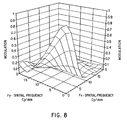
- Figure 9 illustrates a restoration filter frequency response, H I (f x ,f y ), which was computed using the inverse filter formulation, above, for the restoration of an image blurred according to the 0.5 mm defocus error illustrated by the H(f x ,f y ) of Figure 8.
- each of the recorded defocus levels for lens 85 has derived
- a target is placed on the platen glass 12 or on some other convenient structure for establishing the level of defocus correction required to compensate for assembly and component errors existing in a specific assembly.
- the target may comprise an isolated line or a small multiple bar target of known modulation, having a spatial frequency sufficiently high so that it is sensitive to defocus errors.
- the target should be located in a plane which is representative of the position (i.e., object conjugate), of the document or image to be scanned.
- the target may be located in a region of the platen frequently used for calibration targets 101 or under a side registration strip, where it can be monitored periodically during the scanning process.
- the optical system including the lens 85, the photosensor array 82 and the illuminator 64 are caused to be positioned under the known location of the focus measurement target under control of the system CPU 99.
- the image of the target is then projected onto the photosensor array 82, this image containing an amount of optical blur similar to that which will be experienced when document 11 is imaged.
- the digital signal from the photosensor array 82 may then be used, under control of system CPU 99, to compute the reduced modulation of the target, for example, by storing the maximum and minimum signal values obtained while scanning across the multiple bar target and computing modulation as the ratio of the difference of these maximum and minimum values to the sum of these maximum and minimum values. Since the blur characteristics of lens 85 have been previously determined and the focus target has a known spatial frequency and modulation, the reduction in modulation of this target can be correlated directly with one of the previously measured states of defocus. For this purpose a look-up table which identifies one of the previously measured states of defocus with the currently determined reduction in modulation of the focus measurement target is placed in a ROM (not shown) of the system CPU 99.
- the specific state of defocus of the optical system comprising the platen glass 12, the lens 85 and the photosensor array 82 is determined, and this state may be directly identified with one of the previously evaluated levels of defocus and the associated digital filter coefficient set required to correct this defocus level.
- the frequency at which a defocus determination is made is variable.
- the target may be sensed once after final assembly and alignment, using a removable target on the platen, and the required level of defocus correction may be stored for the life of the machine.
- a target may be built into the machine and may be sensed during each machine warmup so that any changes in the optical components (for example, resulting from field replacements) can be compensated.
- the target may be sensed several times during the scan of a single image to correct for object conjugate variations during the scanning process.
- the target may be sensed in each color to detect and correct for defocus resulting from chromatic differences in focus. In this manner, the restoration filter coefficient set used in the digital image processing circuit 97 can be modified for each color, thereby compensating for the chromatic aberrations of the lens 85.
- the restoration of the blurred image is undertaken in the digital image processing circuit 97 using filter coefficients stored in the filter coefficient ROM 98.
- Each of the image restoration coefficient sets determined for the multiple levels of possible optical defocus are stored in the filter coefficient ROM 98. This is preferably accomplished prior to the assembly of the image input terminal, but could be achieved subsequently by replacing the ROM chips with random access memory into which coefficients may be dynamically downloaded at any time.
- the system CPU 99 provides information to the digital image processing circuit 97 indicating which of the predetermined levels of defocus most accurately represents the current machine defocus state. The digital image processing circuit is thus enabled to read and apply to the pixel signal the set of image restoration filter coefficients most appropriate to the machine's current state of defocus.
- the automatic detection of focus state and subsequent selection of optimum restoration filter coefficients is the preferred operating mode, it may be desirable under certain circumstances to manually override this selection. For example, if a relatively noisy document is to be imaged, the automatically selected restoration filter may provide excessive enhancement of high frequency noise. In such cases it is desirable to permit the user to enter information on a user interface (not shown) which signals the system CPU 99 to substitute a user designated filter selection in place of the automatically sensed selection.
- Such multiple states of defocus along one scan line may be detected and corrected using a multiplicity of focus detection targets in a location which may be sensed by the scan line.
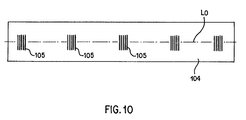
- a strip of material 104 which may be, for example, mounted on the platen 12 with focus measurement targets 105 facing the full-width lens 85 or single lens 55. Mechanically placing the optical system such that a line in the main scanning direction senses targets 105 as indicated along line L o , will permit the state of focus to be detected at multiple positions along a single scan line.
- Such multiple states are computed and communicated to the digital image processing circuit 97 prior to the start of the scanning of document 11.
- the restoration filter coefficients appropriate to the current pixel's position along the scan line are correctly identified and applied.
- This approach to correction of multiple states of defocus within a document may similarly be extended to focus variations in the subscanning direction by mounting and sensing a multiple target strip of the type shown in Figure 10 along the edge of a document which is perpendicular to the main scanning direction.
- the depth of field of a scanner system can be electronically enhanced in an adaptive manner to maximize image reproduction fidelity.
- the system compensates for focus errors induced by optical component and alignment tolerances.
- the system permits relaxation of these tolerances while maintaining image quality.
Landscapes
- Engineering & Computer Science (AREA)
- Multimedia (AREA)
- Signal Processing (AREA)
- Health & Medical Sciences (AREA)
- Biomedical Technology (AREA)
- General Health & Medical Sciences (AREA)
- Facsimile Scanning Arrangements (AREA)
- Facsimile Image Signal Circuits (AREA)
Applications Claiming Priority (2)
| Application Number | Priority Date | Filing Date | Title |
|---|---|---|---|
| US858828 | 1992-03-27 | ||
| US07/858,828 US5307175A (en) | 1992-03-27 | 1992-03-27 | Optical image defocus correction |
Publications (2)
| Publication Number | Publication Date |
|---|---|
| EP0562814A1 true EP0562814A1 (de) | 1993-09-29 |
| EP0562814B1 EP0562814B1 (de) | 1997-10-29 |
Family
ID=25329292
Family Applications (1)
| Application Number | Title | Priority Date | Filing Date |
|---|---|---|---|
| EP93302187A Expired - Lifetime EP0562814B1 (de) | 1992-03-27 | 1993-03-23 | Korrektur der optischen Defokussierung eines Bildes |
Country Status (4)
| Country | Link |
|---|---|
| US (1) | US5307175A (de) |
| EP (1) | EP0562814B1 (de) |
| JP (1) | JPH0654182A (de) |
| DE (1) | DE69314833T2 (de) |
Cited By (3)
| Publication number | Priority date | Publication date | Assignee | Title |
|---|---|---|---|---|
| US5903659A (en) * | 1997-04-17 | 1999-05-11 | Raytheon Company | Adaptive non-uniformity compensation algorithm |
| EP0930585A1 (de) * | 1998-01-14 | 1999-07-21 | Canon Kabushiki Kaisha | Bildverarbeitungsgerät |
| EP1326416A1 (de) * | 2002-01-03 | 2003-07-09 | Fujifilm Electronic Imaging Limited | Kompensation von Linsenfeldkrümmungen |
Families Citing this family (72)
| Publication number | Priority date | Publication date | Assignee | Title |
|---|---|---|---|---|
| EP0525408A3 (en) * | 1991-07-01 | 1993-12-22 | Eastman Kodak Co | Method for multiframe wiener restoration of noisy and blurred image sequences |
| JPH06339026A (ja) * | 1993-05-31 | 1994-12-06 | Matsushita Electric Ind Co Ltd | 補正データ生成装置 |
| JP3275010B2 (ja) * | 1995-02-03 | 2002-04-15 | ザ・リジェンツ・オブ・ザ・ユニバーシティ・オブ・コロラド | 拡大された被写界深度を有する光学システム |
| US20020118457A1 (en) * | 2000-12-22 | 2002-08-29 | Dowski Edward Raymond | Wavefront coded imaging systems |
| US20020195548A1 (en) * | 2001-06-06 | 2002-12-26 | Dowski Edward Raymond | Wavefront coding interference contrast imaging systems |
| US7218448B1 (en) * | 1997-03-17 | 2007-05-15 | The Regents Of The University Of Colorado | Extended depth of field optical systems |
| US6911638B2 (en) | 1995-02-03 | 2005-06-28 | The Regents Of The University Of Colorado, A Body Corporate | Wavefront coding zoom lens imaging systems |
| JP2001503922A (ja) * | 1995-03-03 | 2001-03-21 | ノースロップ グラマン コーポレーション | Mtf試験用の適応ウィンドによる固定パターン補償 |
| US5710829A (en) * | 1995-04-27 | 1998-01-20 | Lucent Technologies Inc. | System and method for focused-based image segmentation for video signals |
| JPH10229473A (ja) * | 1997-01-21 | 1998-08-25 | Xerox Corp | 二重焦点深度入力スキャナ |
| US6212663B1 (en) | 1997-10-23 | 2001-04-03 | Sony Corporation | Apparatus and method for recovery of quantization codes in a lossy transmission environment |
| US6581170B1 (en) | 1997-10-23 | 2003-06-17 | Sony Corporation | Source coding to provide for robust error recovery during transmission losses |
| US6282684B1 (en) | 1997-10-23 | 2001-08-28 | Sony Corporation | Apparatus and method for recovery of data in a lossy transmission environment |
| US6097856A (en) * | 1998-07-10 | 2000-08-01 | Welch Allyn, Inc. | Apparatus and method for reducing imaging errors in imaging systems having an extended depth of field |
| US6547139B1 (en) | 1998-07-10 | 2003-04-15 | Welch Allyn Data Collection, Inc. | Method and apparatus for extending operating range of bar code scanner |
| US6567570B1 (en) * | 1998-10-30 | 2003-05-20 | Hewlett-Packard Development Company, L.P. | Optical image scanner with internal measurement of point-spread function and compensation for optical aberrations |
| US6603514B1 (en) * | 1999-01-26 | 2003-08-05 | Mustek Systems, Inc. | Focus controlling method and system by evaluating a resolution index |
| US6611292B1 (en) * | 1999-01-26 | 2003-08-26 | Mustek Systems, Inc. | Focus controlling method and system for an image capturing system |
| US6591398B1 (en) | 1999-02-12 | 2003-07-08 | Sony Corporation | Multiple processing system |
| US6307560B1 (en) | 1999-02-12 | 2001-10-23 | Sony Corporation | Classified adaptive spatio-temporal format conversion method and apparatus |
| US6170074B1 (en) | 1999-02-12 | 2001-01-02 | Sony Corporation | Source coding to provide for robust error recovery |
| US6519369B1 (en) | 1999-02-12 | 2003-02-11 | Sony Corporation | Method and apparatus for filter tap expansion |
| US7010737B2 (en) * | 1999-02-12 | 2006-03-07 | Sony Corporation | Method and apparatus for error data recovery |
| US6621936B1 (en) * | 1999-02-12 | 2003-09-16 | Sony Corporation | Method and apparatus for spatial class reduction |
| US6363118B1 (en) | 1999-02-12 | 2002-03-26 | Sony Corporation | Apparatus and method for the recovery of compression constants in the encoded domain |
| US6418548B1 (en) | 1999-02-12 | 2002-07-09 | Sony Corporation | Method and apparatus for preprocessing for peripheral erroneous data |
| US6307979B1 (en) | 1999-02-12 | 2001-10-23 | Sony Corporation | Classified adaptive error recovery method and apparatus |
| US6535148B1 (en) | 1999-02-12 | 2003-03-18 | Sony Corporation | Method and apparatus for truncated decoding |
| US6330361B1 (en) * | 1999-03-16 | 2001-12-11 | Litton Systems, Inc. | Adaptively aligned optical correlator and method |
| US6677948B1 (en) * | 1999-06-14 | 2004-01-13 | Mitutoyo Corporation | Systems and methods for multi-resolution image defocusing |
| US6473876B1 (en) | 1999-06-29 | 2002-10-29 | Sony Corporation | Method and apparatus for encoding of bitstreams using rotation |
| US6493842B1 (en) | 1999-06-29 | 2002-12-10 | Sony Corporation | Time-varying randomization for data synchronization and implicit information transmission |
| US6549672B1 (en) | 1999-06-29 | 2003-04-15 | Sony Corporation | Method and apparatus for recovery of encoded data using central value |
| US6389562B1 (en) | 1999-06-29 | 2002-05-14 | Sony Corporation | Source code shuffling to provide for robust error recovery |
| US7516896B2 (en) * | 1999-08-05 | 2009-04-14 | Microvision, Inc. | Frequency tunable resonant scanner with auxiliary arms |
| US6522785B1 (en) | 1999-09-24 | 2003-02-18 | Sony Corporation | Classified adaptive error recovery method and apparatus |
| US6351494B1 (en) | 1999-09-24 | 2002-02-26 | Sony Corporation | Classified adaptive error recovery method and apparatus |
| US6539517B1 (en) | 1999-11-09 | 2003-03-25 | Sony Corporation | Data transformation for explicit transmission of control information |
| US6754371B1 (en) | 1999-12-07 | 2004-06-22 | Sony Corporation | Method and apparatus for past and future motion classification |
| US6536898B1 (en) * | 2000-09-15 | 2003-03-25 | The Regents Of The University Of Colorado | Extended depth of field optics for human vision |
| US6763141B2 (en) | 2000-12-28 | 2004-07-13 | Xerox Corporation | Estimation of local defocus distance and geometric distortion based on scanned image features |
| US6873733B2 (en) | 2001-01-19 | 2005-03-29 | The Regents Of The University Of Colorado | Combined wavefront coding and amplitude contrast imaging systems |
| US6842297B2 (en) | 2001-08-31 | 2005-01-11 | Cdm Optics, Inc. | Wavefront coding optics |
| US7773316B2 (en) * | 2003-01-16 | 2010-08-10 | Tessera International, Inc. | Optics for an extended depth of field |
| US20070236573A1 (en) * | 2006-03-31 | 2007-10-11 | D-Blur Technologies Ltd. | Combined design of optical and image processing elements |
| US8294999B2 (en) | 2003-01-16 | 2012-10-23 | DigitalOptics Corporation International | Optics for an extended depth of field |
| WO2004063989A2 (en) * | 2003-01-16 | 2004-07-29 | D-Blur Technologies Ltd. | Camera with image enhancement functions |
| JP4749332B2 (ja) * | 2003-05-30 | 2011-08-17 | オムニビジョン テクノロジーズ, インコーポレイテッド | 拡大された焦点深度を有するリソグラフィックシステムおよび方法 |
| DE10333712A1 (de) * | 2003-07-23 | 2005-03-03 | Carl Zeiss | Verfahren zum fehlerreduzierten Abbilden eines Objekts |
| US7193196B2 (en) * | 2003-10-29 | 2007-03-20 | Lockheed Martin Corporation | Methods and systems for evaluating optical systems |
| US7215493B2 (en) * | 2005-01-27 | 2007-05-08 | Psc Scanning, Inc. | Imaging system with a lens having increased light collection efficiency and a deblurring equalizer |
| US7499090B2 (en) | 2005-01-27 | 2009-03-03 | Datalogic Scanning, Inc. | Rolling-reset imager with optical filter |
| US7616841B2 (en) * | 2005-06-17 | 2009-11-10 | Ricoh Co., Ltd. | End-to-end design of electro-optic imaging systems |
| US20070239417A1 (en) * | 2006-03-31 | 2007-10-11 | D-Blur Technologies Ltd. | Camera performance simulation |
| US20070236574A1 (en) * | 2006-03-31 | 2007-10-11 | D-Blur Technologies Ltd. | Digital filtering with noise gain limit |
| US7450225B1 (en) * | 2007-04-13 | 2008-11-11 | Nanometrics Incorporated | Correction of optical metrology for focus offset |
| US7536281B2 (en) * | 2007-06-01 | 2009-05-19 | Lexmark International, Inc. | Method for compensating for a contaminated calibration target used in calibrating a scanner |
| JP4813446B2 (ja) * | 2007-11-16 | 2011-11-09 | 富士フイルム株式会社 | 撮像システム、この撮像システムを備えた撮像装置、携帯端末機器、車載機器、および医療機器、並びに撮像システムの製造方法 |
| JP4813447B2 (ja) * | 2007-11-16 | 2011-11-09 | 富士フイルム株式会社 | 撮像システム、並びにこの撮像システムを備えた撮像装置、携帯端末機器、車載機器、および医療機器 |
| JP2009122514A (ja) | 2007-11-16 | 2009-06-04 | Fujinon Corp | 撮像システム、この撮像システムを備えた撮像装置、携帯端末機器、車載機器、および医療機器、並びに撮像システムの製造方法 |
| US8077247B2 (en) | 2007-12-07 | 2011-12-13 | Fujinon Corporation | Imaging system, imaging apparatus, portable terminal apparatus, onboard apparatus, medical apparatus and method of manufacturing the imaging system |
| US8111318B2 (en) * | 2007-12-07 | 2012-02-07 | Fujinon Corporation | Imaging system, imaging apparatus, portable terminal apparatus, onboard apparatus, medical apparatus and method of manufacturing the imaging system |
| KR101460610B1 (ko) * | 2008-07-30 | 2014-11-13 | 삼성전자주식회사 | 색수차 제거 방법 및 장치 |
| US8248511B2 (en) * | 2009-09-30 | 2012-08-21 | Ricoh Co., Ltd. | Dual-mode extended depth-of-field imaging systems |
| JP2011229111A (ja) * | 2010-03-29 | 2011-11-10 | Fujifilm Corp | 画像撮像装置 |
| JP5528173B2 (ja) * | 2010-03-31 | 2014-06-25 | キヤノン株式会社 | 画像処理装置、撮像装置および画像処理プログラム |
| TWI418914B (zh) * | 2010-03-31 | 2013-12-11 | Pixart Imaging Inc | 適用於光感測系統之失焦校正模組及其方法 |
| JP5535053B2 (ja) * | 2010-11-26 | 2014-07-02 | キヤノン株式会社 | 画像処理装置、及び画像処理方法 |
| KR101055853B1 (ko) * | 2011-01-04 | 2011-08-09 | (주)올라웍스 | 입력되는 바코드 영상을 디블러링하기 위한 방법, 단말 장치 및 컴퓨터 판독 가능한 기록 매체 |
| US9675430B2 (en) | 2014-08-15 | 2017-06-13 | Align Technology, Inc. | Confocal imaging apparatus with curved focal surface |
| US10761011B2 (en) * | 2015-02-24 | 2020-09-01 | The University Of Tokyo | Dynamic high-speed high-sensitivity imaging device and imaging method |
| WO2018037806A1 (ja) * | 2016-08-25 | 2018-03-01 | 富士フイルム株式会社 | 画像処理装置、画像処理システム、画像処理方法、及び撮像光学系セット |
Citations (2)
| Publication number | Priority date | Publication date | Assignee | Title |
|---|---|---|---|---|
| WO1989011196A1 (en) * | 1988-05-02 | 1989-11-16 | Hughes Aircraft Company | Electronic focus correction |
| EP0439357A2 (de) * | 1990-01-25 | 1991-07-31 | Hewlett-Packard Company | Verfahren und Vorrichtung zur Ausstattung eines Dokumentenlesers mit Sensorkompensation |
Family Cites Families (21)
| Publication number | Priority date | Publication date | Assignee | Title |
|---|---|---|---|---|
| US4573070A (en) * | 1977-01-31 | 1986-02-25 | Cooper J Carl | Noise reduction system for video signals |
| US4287536A (en) * | 1979-10-12 | 1981-09-01 | Xerox Corporation | Gain control for scanning arrays |
| US4295167A (en) * | 1979-10-12 | 1981-10-13 | Xerox Corporation | Carriage speed control for a raster scanner |
| NL8103505A (nl) * | 1981-07-24 | 1983-02-16 | Philips Nv | Inrichting voor het puntsgewijs aftasten van een voorwerp. |
| JPS5916460A (ja) * | 1982-07-20 | 1984-01-27 | Canon Inc | 画像走査装置 |
| FR2558671B1 (fr) * | 1984-01-20 | 1987-01-16 | Thomson Csf | Dispositif de correction de diffusion optique pour tube de prise de vues de television et camera de television comportant un tel dispositif |
| US4613986A (en) * | 1984-06-14 | 1986-09-23 | Ncr Canada Ltd. | Digital filter for enhancement of document images |
| JPS6153868A (ja) * | 1984-08-24 | 1986-03-17 | Dainippon Screen Mfg Co Ltd | 画像走査信号処理におけるキャリブレーション装置 |
| US4751376A (en) * | 1985-04-12 | 1988-06-14 | Minolta Camera Kabushiki Kaisha | Image reader with focus and magnification detection control |
| US4712010A (en) * | 1986-01-30 | 1987-12-08 | Hughes Aircraft Company | Radiator scanning with image enhancement and noise reduction |
| US4704632A (en) * | 1986-03-20 | 1987-11-03 | Terminal Data Corporation | Electronic camera for digital processing of CCD data |
| JPS62297977A (ja) * | 1986-06-17 | 1987-12-25 | Toshiba Corp | 画像情報記憶検索装置 |
| JPS63314955A (ja) * | 1987-06-18 | 1988-12-22 | Toshiba Corp | 画像処理装置 |
| JPS6469157A (en) * | 1987-09-10 | 1989-03-15 | Minolta Camera Kk | Picture reader |
| ATE99480T1 (de) * | 1988-07-28 | 1994-01-15 | Contraves Ag | Automatische steuerung der fokussierung einer video-kamera fuer industrielle/militaerische zwecke. |
| JP2751254B2 (ja) * | 1988-11-10 | 1998-05-18 | ソニー株式会社 | 固体撮像装置の信号処理回路 |
| US4918543A (en) * | 1989-01-24 | 1990-04-17 | Eastman Kodak Company | Apparatus for thresholding an image signal |
| US4912569A (en) * | 1989-01-24 | 1990-03-27 | Eastman Kodak Company | Method for thresholding an image signal |
| JP2751346B2 (ja) * | 1989-03-15 | 1998-05-18 | ミノルタ株式会社 | プリンタ |
| JP2932575B2 (ja) * | 1990-03-06 | 1999-08-09 | ソニー株式会社 | オートフォーカス制御装置及びその制御方法 |
| US5107337A (en) * | 1990-07-24 | 1992-04-21 | Matsushita Electric Industrial Co., Ltd. | Automatic focusing apparatus of video camera |
-
1992
- 1992-03-27 US US07/858,828 patent/US5307175A/en not_active Expired - Fee Related
-
1993
- 1993-03-19 JP JP5085676A patent/JPH0654182A/ja active Pending
- 1993-03-23 DE DE69314833T patent/DE69314833T2/de not_active Expired - Fee Related
- 1993-03-23 EP EP93302187A patent/EP0562814B1/de not_active Expired - Lifetime
Patent Citations (2)
| Publication number | Priority date | Publication date | Assignee | Title |
|---|---|---|---|---|
| WO1989011196A1 (en) * | 1988-05-02 | 1989-11-16 | Hughes Aircraft Company | Electronic focus correction |
| EP0439357A2 (de) * | 1990-01-25 | 1991-07-31 | Hewlett-Packard Company | Verfahren und Vorrichtung zur Ausstattung eines Dokumentenlesers mit Sensorkompensation |
Cited By (4)
| Publication number | Priority date | Publication date | Assignee | Title |
|---|---|---|---|---|
| US5903659A (en) * | 1997-04-17 | 1999-05-11 | Raytheon Company | Adaptive non-uniformity compensation algorithm |
| EP0930585A1 (de) * | 1998-01-14 | 1999-07-21 | Canon Kabushiki Kaisha | Bildverarbeitungsgerät |
| US6914599B1 (en) | 1998-01-14 | 2005-07-05 | Canon Kabushiki Kaisha | Image processing apparatus |
| EP1326416A1 (de) * | 2002-01-03 | 2003-07-09 | Fujifilm Electronic Imaging Limited | Kompensation von Linsenfeldkrümmungen |
Also Published As
| Publication number | Publication date |
|---|---|
| US5307175A (en) | 1994-04-26 |
| DE69314833D1 (de) | 1997-12-04 |
| EP0562814B1 (de) | 1997-10-29 |
| DE69314833T2 (de) | 1998-05-20 |
| JPH0654182A (ja) | 1994-02-25 |
Similar Documents
| Publication | Publication Date | Title |
|---|---|---|
| EP0562814B1 (de) | Korrektur der optischen Defokussierung eines Bildes | |
| US6587224B1 (en) | Image reading apparatus that can correct chromatic aberration caused by optical system and chromatic aberration correction method | |
| US5969829A (en) | Image reader that stores sets of luminance correction data corresponding to document a surface height | |
| EP0509549B1 (de) | Abtastlesemethode | |
| GB2376827A (en) | Defect detection for document scanners | |
| US6775419B2 (en) | Image processing method, image processing apparatus, and storage medium for storing control process | |
| JPH0591258A (ja) | 画像読取装置 | |
| US5331428A (en) | Automatic offset and gain control in a document scanner | |
| US4757389A (en) | Calibration improvement with dither for a raster input scanner | |
| US6958834B1 (en) | Image reading apparatus | |
| US20020071141A1 (en) | Image reading device and image reading method | |
| US20020100863A1 (en) | Optical image scanner with color and intensity compensation during lamp warmup | |
| US6603514B1 (en) | Focus controlling method and system by evaluating a resolution index | |
| US6201619B1 (en) | Autofocus process and system with fast multi-region sampling | |
| JP3087684B2 (ja) | 画像読取装置 | |
| EP0851658A2 (de) | Von der angeforderten Abtastauflösung und von angeforderten Datentyp abhängiger Bildabtaster mit variabler Geschwindigkeit und variablem Signal-Rausch-Verhältnis | |
| WO2001088512A1 (en) | Detection and correction of defects from scanner calibration references | |
| JP2924746B2 (ja) | 画像読取り装置 | |
| EP0569063B1 (de) | Automatische Verschiebung und Verstärkungssteuerung für einen Dokumentenabtaster | |
| JPH0698167A (ja) | 基準濃度調整方法 | |
| US20040201869A1 (en) | Method for controlling image reader | |
| Baltsavias | The Agfa Horizon scanner: characteristics, testing and evaluation | |
| JP2025114929A (ja) | 画像読取装置 | |
| JPS63142960A (ja) | 画像読取装置 | |
| US20040164223A1 (en) | Automatic object plane selection in an optical image scanner |
Legal Events
| Date | Code | Title | Description |
|---|---|---|---|
| PUAI | Public reference made under article 153(3) epc to a published international application that has entered the european phase |
Free format text: ORIGINAL CODE: 0009012 |
|
| AK | Designated contracting states |
Kind code of ref document: A1 Designated state(s): DE FR GB |
|
| 17P | Request for examination filed |
Effective date: 19940228 |
|
| 17Q | First examination report despatched |
Effective date: 19960813 |
|
| GRAG | Despatch of communication of intention to grant |
Free format text: ORIGINAL CODE: EPIDOS AGRA |
|
| GRAH | Despatch of communication of intention to grant a patent |
Free format text: ORIGINAL CODE: EPIDOS IGRA |
|
| GRAH | Despatch of communication of intention to grant a patent |
Free format text: ORIGINAL CODE: EPIDOS IGRA |
|
| GRAA | (expected) grant |
Free format text: ORIGINAL CODE: 0009210 |
|
| AK | Designated contracting states |
Kind code of ref document: B1 Designated state(s): DE FR GB |
|
| REF | Corresponds to: |
Ref document number: 69314833 Country of ref document: DE Date of ref document: 19971204 |
|
| ET | Fr: translation filed | ||
| PLBE | No opposition filed within time limit |
Free format text: ORIGINAL CODE: 0009261 |
|
| STAA | Information on the status of an ep patent application or granted ep patent |
Free format text: STATUS: NO OPPOSITION FILED WITHIN TIME LIMIT |
|
| 26N | No opposition filed | ||
| PGFP | Annual fee paid to national office [announced via postgrant information from national office to epo] |
Ref country code: FR Payment date: 20010313 Year of fee payment: 9 |
|
| PGFP | Annual fee paid to national office [announced via postgrant information from national office to epo] |
Ref country code: DE Payment date: 20010319 Year of fee payment: 9 |
|
| PGFP | Annual fee paid to national office [announced via postgrant information from national office to epo] |
Ref country code: GB Payment date: 20010321 Year of fee payment: 9 |
|
| REG | Reference to a national code |
Ref country code: GB Ref legal event code: IF02 |
|
| PG25 | Lapsed in a contracting state [announced via postgrant information from national office to epo] |
Ref country code: GB Free format text: LAPSE BECAUSE OF NON-PAYMENT OF DUE FEES Effective date: 20020323 |
|
| PG25 | Lapsed in a contracting state [announced via postgrant information from national office to epo] |
Ref country code: DE Free format text: LAPSE BECAUSE OF NON-PAYMENT OF DUE FEES Effective date: 20021001 |
|
| GBPC | Gb: european patent ceased through non-payment of renewal fee |
Effective date: 20020323 |
|
| PG25 | Lapsed in a contracting state [announced via postgrant information from national office to epo] |
Ref country code: FR Free format text: LAPSE BECAUSE OF NON-PAYMENT OF DUE FEES Effective date: 20021129 |
|
| REG | Reference to a national code |
Ref country code: FR Ref legal event code: ST |