EP0564404A1 - Verfahren zum Färben von Leder mit Farbstoffmischungen - Google Patents
Verfahren zum Färben von Leder mit Farbstoffmischungen Download PDFInfo
- Publication number
- EP0564404A1 EP0564404A1 EP93810208A EP93810208A EP0564404A1 EP 0564404 A1 EP0564404 A1 EP 0564404A1 EP 93810208 A EP93810208 A EP 93810208A EP 93810208 A EP93810208 A EP 93810208A EP 0564404 A1 EP0564404 A1 EP 0564404A1
- Authority
- EP
- European Patent Office
- Prior art keywords
- dye
- formula
- hydrogen
- process according
- alkyl
- Prior art date
- Legal status (The legal status is an assumption and is not a legal conclusion. Google has not performed a legal analysis and makes no representation as to the accuracy of the status listed.)
- Granted
Links
- 239000000975 dye Substances 0.000 title claims abstract description 104
- 239000010985 leather Substances 0.000 title claims abstract description 55
- 239000000203 mixture Substances 0.000 title claims abstract description 52
- 238000004043 dyeing Methods 0.000 title claims abstract description 40
- 238000000034 method Methods 0.000 title claims description 63
- AJDUTMFFZHIJEM-UHFFFAOYSA-N n-(9,10-dioxoanthracen-1-yl)-4-[4-[[4-[4-[(9,10-dioxoanthracen-1-yl)carbamoyl]phenyl]phenyl]diazenyl]phenyl]benzamide Chemical group O=C1C2=CC=CC=C2C(=O)C2=C1C=CC=C2NC(=O)C(C=C1)=CC=C1C(C=C1)=CC=C1N=NC(C=C1)=CC=C1C(C=C1)=CC=C1C(=O)NC1=CC=CC2=C1C(=O)C1=CC=CC=C1C2=O AJDUTMFFZHIJEM-UHFFFAOYSA-N 0.000 claims abstract description 30
- 239000001043 yellow dye Substances 0.000 claims abstract description 30
- 239000001045 blue dye Substances 0.000 claims abstract description 26
- 239000001044 red dye Substances 0.000 claims abstract description 26
- -1 sulpho Chemical class 0.000 claims abstract description 7
- 125000003178 carboxy group Chemical group [H]OC(*)=O 0.000 claims abstract description 6
- 229910052739 hydrogen Inorganic materials 0.000 claims description 36
- 239000001257 hydrogen Substances 0.000 claims description 36
- 125000000020 sulfo group Chemical group O=S(=O)([*])O[H] 0.000 claims description 25
- 125000004178 (C1-C4) alkyl group Chemical group 0.000 claims description 23
- 125000002496 methyl group Chemical group [H]C([H])([H])* 0.000 claims description 18
- 229910052736 halogen Chemical group 0.000 claims description 16
- 150000002367 halogens Chemical group 0.000 claims description 16
- 150000002431 hydrogen Chemical group 0.000 claims description 16
- 125000004435 hydrogen atom Chemical group [H]* 0.000 claims description 16
- UFHFLCQGNIYNRP-UHFFFAOYSA-N Hydrogen Chemical group [H][H] UFHFLCQGNIYNRP-UHFFFAOYSA-N 0.000 claims description 14
- 239000000460 chlorine Substances 0.000 claims description 11
- 229910052801 chlorine Inorganic materials 0.000 claims description 11
- 125000001309 chloro group Chemical group Cl* 0.000 claims description 8
- 125000001495 ethyl group Chemical group [H]C([H])([H])C([H])([H])* 0.000 claims description 8
- ZAMOUSCENKQFHK-UHFFFAOYSA-N Chlorine atom Chemical group [Cl] ZAMOUSCENKQFHK-UHFFFAOYSA-N 0.000 claims description 7
- 239000001049 brown dye Substances 0.000 claims description 6
- 125000003830 C1- C4 alkylcarbonylamino group Chemical group 0.000 claims description 3
- 125000000229 (C1-C4)alkoxy group Chemical group 0.000 claims description 2
- 229910006069 SO3H Inorganic materials 0.000 claims description 2
- 229910006147 SO3NH2 Inorganic materials 0.000 claims description 2
- 125000000449 nitro group Chemical group [O-][N+](*)=O 0.000 claims description 2
- 150000003973 alkyl amines Chemical class 0.000 claims 1
- XLYOFNOQVPJJNP-UHFFFAOYSA-N water Substances O XLYOFNOQVPJJNP-UHFFFAOYSA-N 0.000 description 19
- BDAGIHXWWSANSR-UHFFFAOYSA-N methanoic acid Natural products OC=O BDAGIHXWWSANSR-UHFFFAOYSA-N 0.000 description 14
- VYZAMTAEIAYCRO-UHFFFAOYSA-N Chromium Chemical compound [Cr] VYZAMTAEIAYCRO-UHFFFAOYSA-N 0.000 description 12
- QGZKDVFQNNGYKY-UHFFFAOYSA-N Ammonia Chemical compound N QGZKDVFQNNGYKY-UHFFFAOYSA-N 0.000 description 8
- OSWFIVFLDKOXQC-UHFFFAOYSA-N 4-(3-methoxyphenyl)aniline Chemical compound COC1=CC=CC(C=2C=CC(N)=CC=2)=C1 OSWFIVFLDKOXQC-UHFFFAOYSA-N 0.000 description 7
- 235000019253 formic acid Nutrition 0.000 description 7
- WSFSSNUMVMOOMR-UHFFFAOYSA-N Formaldehyde Chemical compound O=C WSFSSNUMVMOOMR-UHFFFAOYSA-N 0.000 description 6
- 239000003795 chemical substances by application Substances 0.000 description 6
- 238000004040 coloring Methods 0.000 description 5
- 229910021529 ammonia Inorganic materials 0.000 description 4
- 125000000129 anionic group Chemical group 0.000 description 3
- 239000007859 condensation product Substances 0.000 description 3
- 150000003839 salts Chemical class 0.000 description 3
- 238000005406 washing Methods 0.000 description 3
- 125000004169 (C1-C6) alkyl group Chemical group 0.000 description 2
- NLXLAEXVIDQMFP-UHFFFAOYSA-N Ammonia chloride Chemical compound [NH4+].[Cl-] NLXLAEXVIDQMFP-UHFFFAOYSA-N 0.000 description 2
- UIIMBOGNXHQVGW-UHFFFAOYSA-M Sodium bicarbonate Chemical compound [Na+].OC([O-])=O UIIMBOGNXHQVGW-UHFFFAOYSA-M 0.000 description 2
- 150000001412 amines Chemical class 0.000 description 2
- 150000003863 ammonium salts Chemical class 0.000 description 2
- 239000007788 liquid Substances 0.000 description 2
- 230000020477 pH reduction Effects 0.000 description 2
- 159000000000 sodium salts Chemical class 0.000 description 2
- 239000011550 stock solution Substances 0.000 description 2
- ZCYVEMRRCGMTRW-UHFFFAOYSA-N 7553-56-2 Chemical compound [I] ZCYVEMRRCGMTRW-UHFFFAOYSA-N 0.000 description 1
- WKBOTKDWSSQWDR-UHFFFAOYSA-N Bromine atom Chemical compound [Br] WKBOTKDWSSQWDR-UHFFFAOYSA-N 0.000 description 1
- JZTZRYMRAOVZCR-UHFFFAOYSA-N C[S](c1ccccc1)(N)(=O)=O Chemical compound C[S](c1ccccc1)(N)(=O)=O JZTZRYMRAOVZCR-UHFFFAOYSA-N 0.000 description 1
- 241000283707 Capra Species 0.000 description 1
- LMNSTFYYSDVEOA-UHFFFAOYSA-N Cc(c(CNC(c1ccccc1)=O)c1C)cc(C)c1Nc(cc(c(N)c1C(c2ccccc22)=O)S(O)(=O)=O)c1C2=O Chemical compound Cc(c(CNC(c1ccccc1)=O)c1C)cc(C)c1Nc(cc(c(N)c1C(c2ccccc22)=O)S(O)(=O)=O)c1C2=O LMNSTFYYSDVEOA-UHFFFAOYSA-N 0.000 description 1
- IAYPIBMASNFSPL-UHFFFAOYSA-N Ethylene oxide Chemical compound C1CO1 IAYPIBMASNFSPL-UHFFFAOYSA-N 0.000 description 1
- PIICEJLVQHRZGT-UHFFFAOYSA-N Ethylenediamine Chemical compound NCCN PIICEJLVQHRZGT-UHFFFAOYSA-N 0.000 description 1
- PXGOKWXKJXAPGV-UHFFFAOYSA-N Fluorine Chemical compound FF PXGOKWXKJXAPGV-UHFFFAOYSA-N 0.000 description 1
- WHXSMMKQMYFTQS-UHFFFAOYSA-N Lithium Chemical compound [Li] WHXSMMKQMYFTQS-UHFFFAOYSA-N 0.000 description 1
- ZLMJMSJWJFRBEC-UHFFFAOYSA-N Potassium Chemical compound [K] ZLMJMSJWJFRBEC-UHFFFAOYSA-N 0.000 description 1
- XSQUKJJJFZCRTK-UHFFFAOYSA-N Urea Chemical compound NC(N)=O XSQUKJJJFZCRTK-UHFFFAOYSA-N 0.000 description 1
- 239000002253 acid Substances 0.000 description 1
- 150000007513 acids Chemical class 0.000 description 1
- 239000000654 additive Substances 0.000 description 1
- 150000001338 aliphatic hydrocarbons Chemical class 0.000 description 1
- 229910052783 alkali metal Inorganic materials 0.000 description 1
- 150000001447 alkali salts Chemical class 0.000 description 1
- 125000000217 alkyl group Chemical group 0.000 description 1
- 235000019270 ammonium chloride Nutrition 0.000 description 1
- 239000002518 antifoaming agent Substances 0.000 description 1
- 239000002585 base Substances 0.000 description 1
- GDTBXPJZTBHREO-UHFFFAOYSA-N bromine Substances BrBr GDTBXPJZTBHREO-UHFFFAOYSA-N 0.000 description 1
- 229910052794 bromium Inorganic materials 0.000 description 1
- 239000004202 carbamide Substances 0.000 description 1
- 239000003086 colorant Substances 0.000 description 1
- QGBSISYHAICWAH-UHFFFAOYSA-N dicyandiamide Chemical compound NC(N)=NC#N QGBSISYHAICWAH-UHFFFAOYSA-N 0.000 description 1
- 235000014113 dietary fatty acids Nutrition 0.000 description 1
- 229930195729 fatty acid Chemical class 0.000 description 1
- 239000000194 fatty acid Chemical class 0.000 description 1
- 150000004665 fatty acids Chemical class 0.000 description 1
- 229910052731 fluorine Inorganic materials 0.000 description 1
- 239000011737 fluorine Substances 0.000 description 1
- 229910052740 iodine Inorganic materials 0.000 description 1
- 239000011630 iodine Substances 0.000 description 1
- 125000000959 isobutyl group Chemical group [H]C([H])([H])C([H])(C([H])([H])[H])C([H])([H])* 0.000 description 1
- 125000001449 isopropyl group Chemical group [H]C([H])([H])C([H])(*)C([H])([H])[H] 0.000 description 1
- 239000000991 leather dye Substances 0.000 description 1
- 229910052744 lithium Inorganic materials 0.000 description 1
- 235000013372 meat Nutrition 0.000 description 1
- WSFSSNUMVMOOMR-NJFSPNSNSA-N methanone Chemical compound O=[14CH2] WSFSSNUMVMOOMR-NJFSPNSNSA-N 0.000 description 1
- 125000004108 n-butyl group Chemical group [H]C([H])([H])C([H])([H])C([H])([H])C([H])([H])* 0.000 description 1
- 125000004123 n-propyl group Chemical group [H]C([H])([H])C([H])([H])C([H])([H])* 0.000 description 1
- 238000006386 neutralization reaction Methods 0.000 description 1
- 230000003472 neutralizing effect Effects 0.000 description 1
- 229910052700 potassium Inorganic materials 0.000 description 1
- 239000011591 potassium Substances 0.000 description 1
- 239000000843 powder Substances 0.000 description 1
- 238000002360 preparation method Methods 0.000 description 1
- 125000002914 sec-butyl group Chemical group [H]C([H])([H])C([H])([H])C([H])(*)C([H])([H])[H] 0.000 description 1
- 229910000030 sodium bicarbonate Inorganic materials 0.000 description 1
- 235000017557 sodium bicarbonate Nutrition 0.000 description 1
- 239000000243 solution Substances 0.000 description 1
- 150000003460 sulfonic acids Chemical class 0.000 description 1
- 125000000999 tert-butyl group Chemical group [H]C([H])([H])C(*)(C([H])([H])[H])C([H])([H])[H] 0.000 description 1
- 239000000080 wetting agent Substances 0.000 description 1
Classifications
-
- D—TEXTILES; PAPER
- D06—TREATMENT OF TEXTILES OR THE LIKE; LAUNDERING; FLEXIBLE MATERIALS NOT OTHERWISE PROVIDED FOR
- D06P—DYEING OR PRINTING TEXTILES; DYEING LEATHER, FURS OR SOLID MACROMOLECULAR SUBSTANCES IN ANY FORM
- D06P3/00—Special processes of dyeing or printing textiles, or dyeing leather, furs, or solid macromolecular substances in any form, classified according to the material treated
- D06P3/02—Material containing basic nitrogen
- D06P3/04—Material containing basic nitrogen containing amide groups
- D06P3/32—Material containing basic nitrogen containing amide groups leather skins
- D06P3/3206—Material containing basic nitrogen containing amide groups leather skins using acid dyes
- D06P3/3213—Material containing basic nitrogen containing amide groups leather skins using acid dyes monoazo
-
- C—CHEMISTRY; METALLURGY
- C09—DYES; PAINTS; POLISHES; NATURAL RESINS; ADHESIVES; COMPOSITIONS NOT OTHERWISE PROVIDED FOR; APPLICATIONS OF MATERIALS NOT OTHERWISE PROVIDED FOR
- C09B—ORGANIC DYES OR CLOSELY-RELATED COMPOUNDS FOR PRODUCING DYES, e.g. PIGMENTS; MORDANTS; LAKES
- C09B67/00—Influencing the physical, e.g. the dyeing or printing properties of dyestuffs without chemical reactions, e.g. by treating with solvents grinding or grinding assistants, coating of pigments or dyes; Process features in the making of dyestuff preparations; Dyestuff preparations of a special physical nature, e.g. tablets, films
- C09B67/0033—Blends of pigments; Mixtured crystals; Solid solutions
- C09B67/0046—Mixtures of two or more azo dyes
-
- D—TEXTILES; PAPER
- D06—TREATMENT OF TEXTILES OR THE LIKE; LAUNDERING; FLEXIBLE MATERIALS NOT OTHERWISE PROVIDED FOR
- D06P—DYEING OR PRINTING TEXTILES; DYEING LEATHER, FURS OR SOLID MACROMOLECULAR SUBSTANCES IN ANY FORM
- D06P3/00—Special processes of dyeing or printing textiles, or dyeing leather, furs, or solid macromolecular substances in any form, classified according to the material treated
- D06P3/02—Material containing basic nitrogen
- D06P3/04—Material containing basic nitrogen containing amide groups
- D06P3/32—Material containing basic nitrogen containing amide groups leather skins
- D06P3/3206—Material containing basic nitrogen containing amide groups leather skins using acid dyes
- D06P3/3226—Material containing basic nitrogen containing amide groups leather skins using acid dyes dis-polyazo
Definitions
- the present invention relates to a method for dyeing leather with dye mixtures, in particular a method for trichromatic dyeing of leather, and to the leather dyed by the method.
- the present invention had for its object to provide a method for dyeing leather with dye mixtures, according to which dyeing in brilliant shades is possible.
- Particularly suitable dye mixtures should also enable trichromatic dyeing of leather in brilliant shades.
- the invention thus relates to a process for dyeing leather with dye mixtures, which is characterized in that at least two metal-free dyes each having a single sulfo or carboxy group and a molecular weight between 450 and 700 are used.
- the dyes of the formulas (1), (2) and (3) each have a single sulfo or carboxy group, preferably one sulfo group each.
- the alkyl groups can be linear or branched. As C1-C4 alkyl are therefore methyl, ethyl, n- or iso-propyl and n-, iso-, sec- or tert-butyl. Preferred among these are methyl and ethyl.
- Halogen means fluorine, bromine, iodine or especially chlorine.
- a dye mixture is preferably used, comprising a yellow dye of the formula (1), a red dye of the formula (2) and a blue dye of the formula (3).
- R1 is preferably methyl.
- R3 is preferably chlorine and R4 is preferably sulfo or hydrogen.
- R5 are sulfo or a group or the phenyl radicals in the latter two groups being unsubstituted or substituted by chlorine.
- R6 are hydrogen, chlorine or a group wherein R7 is hydrogen, methyl or ethyl, R1 is methyl and n is 0, 1 or 2.
- a particularly preferred embodiment of the process according to the invention consists in that the yellow dye of the formula used.
- a further preferred embodiment of the process according to the invention is characterized in that a red dye of the formula (2) is used, in which R8 sulfo or means, where R7 is methyl or ethyl.
- R9 sulfo means, where R7 is methyl or ethyl and n is 1.
- a very particularly preferred embodiment of the process according to the invention consists in that the red dye of the formula used.
- a further preferred embodiment of the process according to the invention is characterized in that a blue dye of the formula (3) is used in which R14 is methyl and R12 and R13 are hydrogen or methyl.
- dyes of the formula (3) are preferred, in which R15 is hydrogen, methyl or -CH2-NH-CO-CH2-Cl, and such dyes of the formula (3) in which R16 -SO2-NH-C2H4-OH , -CH2-NH-CO-CH2-Cl or -CH2-NH-CO-C6H5 means.
- a very particularly preferred embodiment of the process according to the invention consists in that the blue dye of the formula used.
- the parachor of which is between 900 and 1200 and the log P of which is between 1 and 4.
- the Parachor is used according to the article by OR Quayle [Chem. Rev. 53 439 (1953)] and log P means the relative lipophilicity, the calculation of which by C. Hansch et al. [J. Med. Chem. 16 , 1207 (1973)].
- a very particularly important embodiment of the process according to the invention is that a dye mixture containing the yellow dye of the formula (4), the red dye of the formula (5) and the blue dye of the formula (6) is used for trichromatic dyeing.
- dyes of the formulas (2), (3) or (4) can be used in the dyeing process according to the invention. This can e.g. be useful if the shade should be cloudy or darker or in a slightly changed color than is achievable with the dyes mentioned.
- Preferably used as further dyes are those which likewise have a sulfo or carboxy group and a molecular weight between 450 and 700.
- a black dye of the formula is used above all as an additional dye wherein R19 is hydrogen, C1-C4-alkyl, C1-C4-alkoxy or C1-C4-alkanoylamino and R20 is chlorine or nitro, or a brown dye of the formula wherein R21 means -COOH, -CONH2, -SO3H or -SO3NH2.
- the black dye of the formula is preferably used as an additional black dye and as an additional brown dye, the brown dye of the formula is preferably used
- the dyes according to the invention are anionic in nature and are advantageously used in the form of their salts, in particular alkali metal salts or ammonium salts.
- the alkali salts are in particular the lithium, potassium or sodium salts and ammonium salts are also understood to mean salts of organic amines, e.g. those which are substituted with C1-C6-alkyl or hydroxy-C1-C6-alkyl groups.
- the dyes used in the process according to the invention are known or can be are produced in a manner known per se.
- the amounts in which the dyes used according to the invention are used in the dye baths can vary within wide limits depending on the desired depth of color. In general, amounts of dye of 0.1 to 10, preferably 0.5 to 4,% by weight, based on the weight of the leather to be dyed, are advantageous.
- the dye liquor can also contain other additives, e.g. Acids, bases or salts to adjust the desired pH value, as well as auxiliaries such as Wetting agents, greasing agents, color-deepening aids, leveling agents, penetrants and / or anti-foaming agents.
- additives e.g. Acids, bases or salts to adjust the desired pH value, as well as auxiliaries such as Wetting agents, greasing agents, color-deepening aids, leveling agents, penetrants and / or anti-foaming agents.
- the method according to the invention has the great advantage that it is not only suitable for a certain type of leather, but can also be used for the various types of leather, for example chrome leather, retanned leather or suede from goat, cow or pig.
- the dyeing is preferably carried out using the exhaust method, e.g. at a liquor ratio of 1: 1.5 to 1:20, preferably 1: 2 to 1:10, and at temperatures of 20 to 100 ° C, preferably 30 to 60 ° C.
- the leather can be pretreated be subjected to, for example, a neutralization or Walke.
- the dyeing time varies depending on the type of leather and the desired depth of color, but is generally between 30 and 180 minutes. After the dyeing, the leather is rinsed and finished as usual.
- the process according to the invention gives leather dyeings in brilliant shades and with good fastness properties, such as Light and wet fastness properties. Since the individual dyes penetrate approximately the same depth into the leather, the nuance of the colors on the surface and in the deeper layers of the leather is the same.
- the individual dyes are mixed with one another for use in dyeing.
- the dyes can be prepared individually as stock solutions for the dyeing process or formulated together in a single stock solution.
- the invention further provides dye trichromatic mixtures containing at least one yellow dye of the formula (1), at least one red dye of the formula (2) and at least one blue dye of the formula (3).
- Preferred dye trichromatic mixtures contain 1 to 98% by weight of a yellow dye of the formula (1), 1 to 98% by weight of a red dye of the formula (2) and 1 to 98% by weight of a blue dye of the formula (3), in particular 10 to 70% by weight of a yellow dye of the formula (1), 10 to 50% by weight of a red dye of the formula (2) and 10 to 50% by weight of a blue dye of the formula (3).
- Example 1 100 parts of chrome-tanned cowhide (fold weight) are washed for 15 minutes in 300 parts of water at 30 ° C. and then for 60 minutes in one of 300 parts of water, 2 parts of neutralizing agent (sodium salts of aromatic sulfonic acids and aliphatic dicarboxylic acids) and 0. 5 parts of sodium bicarbonate existing liquor neutralized at 30 ° C. This is followed by a 15-minute washing operation in 300 parts of water at room temperature.
- neutralizing agent sodium salts of aromatic sulfonic acids and aliphatic dicarboxylic acids
- the leather treated in this way is now in a freshly set float composed of 300 parts of water and 2.46 parts of the dye mixture, consisting of 1.88 parts of the yellow dye of the formula and 0.58 parts of the blue dye of the formula
- Example 2 100 parts of chrome cowhide (shaved weight) are neutralized as described in Example 1 and then treated at 30 ° C. in the same liquor with 7 parts of a liquid synthetic retanning agent (condensation products of polyphenolic sulfonic acids with formaldehyde and urea) for a further 60 minutes. This is followed by a 15-minute washing process in 300 parts of water at room temperature. This retanned chrome cowhide is then dyed at 50 ° C. in a liquor consisting of 300 parts of water and 4.92 parts of the dye mixture used in Example 1.
- a liquid synthetic retanning agent condensation products of polyphenolic sulfonic acids with formaldehyde and urea
- Example 3 If the procedure described in Example 2 is followed, but instead of the retanning agent used there, 3 parts of a strongly anionic retanning agent (formaldehyde condensation product of phenolic sulfonic acids) are obtained, leather with a very anionic surface is obtained.
- the coloration obtained largely corresponds in terms of hue to that on non-retanned chrome cowhide according to Example 1 and that on retanned chrome cowhide according to Example 2.
- Example 4 If the procedure described in Example 1 is used, however, 1.88 parts of a dye mixture consisting of 0.92 parts of the yellow dye of the formula (4) and 0.50 parts of the blue dye of the formula (6) are used instead of the dye mixture used there ) and 0.46 parts of the red dye of the formula so you get red-brown colored leather.
- the dyestuffs can be combined very well. If the leather surface is lightly sanded, you can see that all dyes dye leather to the same depth.
- Example 6 100 parts of chrome cowhide (shaved weight) are neutralized and retanned as described in Example 2 and then in a liquor containing 300 parts of water, 2.5 parts of the dye of the formula (4) and 0.8 part of the dye of the formula (6 ) dyed at 50 ° C for 30 minutes. After 30 minutes, 3 is added Parts of the synthetic fatliquor from Example 1 and after a further 30 minutes an addition of 1 part of 85% formic acid. After acidification, the treatment is continued for 30 minutes at 50 ° C.
- the leather is then aftertreated in a fresh bath with 1 part of a color-deepening auxiliary (polyquaternary amine / ethylene oxide adduct) in 300 parts of water. After a treatment period of 15 minutes, half an amount of the above-mentioned dyes is added to the dyebath and then further dyeing at 50 ° C. for 15 minutes. Then 0.25 part of 85% formic acid is added. The coloring is complete after a further 20 minutes. It is then rinsed in cold water.
- a color-deepening auxiliary polyquaternary amine / ethylene oxide adduct
- the dyeing finished as usual is characterized by good fastness properties and a full, pure green color. It is much fuller and stronger than a corresponding coloring without the color-deepening aid. The same results are also obtained with the other dye mixtures from the dyes of the formulas (4), (5) and (6).
- Example 7 100 parts of chrome-colored suede clothing (dry weight) are rolled on at 50 ° C. in a solution of 1000 parts of water and 2 parts of 24% ammonia for 60 minutes. This is followed by a washing process of 15 minutes in 1000 parts of water at 50 ° C.
- the leather is dyed in a liquor of 50 parts of water, 2 parts of 24% ammonia and 19.68 parts of the dye mixture used in Example 1.
- the mixture After a dyeing time of 60 minutes, the mixture is acidified with 4 parts of 85% formic acid and then dyeing is continued for 20 minutes.
- the dyed leather is finished after treatment in a fresh bath with 1000 parts of water, 2.5 parts of a condensation product of formaldehyde, dicyandiamide, ammonium chloride and ethylenediamine and 0.5 part of 85% formic acid for 45 minutes at 50 ° C.
- the dyed leather obtained has a pure green color. It is characterized by good fastness properties and good opacity.
- Example 8 100 parts of chrome split suede leather (dry weight) are tumbled in 1000 parts of water and 2 parts of 24% ammonia for 60 minutes at 50 ° C. and then washed with 1000 parts of water at 50 ° C. for 15 minutes.
- the leather prepared in this way is then dyed at 50 ° C. in a fresh liquor consisting of 1000 parts of water, 2 parts of 24% ammonia and 9.84 parts of the dye mixture used in Example 1. After 60 minutes, 4 parts of 85% formic acid are added and dyeing is carried out for a further 20 minutes at this temperature.
- the dyed leather is rinsed in cold water and finished.
- a pure green color is obtained, which is characterized by good fastness properties and the same shade between the velor and the meat side.
- EXAMPLE 9 The procedure is as described in Example 1, but instead of the dye mixture used there, 1.38 parts of a dye mixture consisting of 0.5 part of the yellow dye of the formula are used and 0.88 part of the blue dye of the formula (6), this gives a leather with a strong color of medium green.
- EXAMPLE 10 If the procedure is as described in Example 2, but 2.76 parts of the dye mixture used in Example 9 are used instead of the dye mixture used there, a dyeing is obtained which also has the same color tone as that of chrome cowhide according to Example 9 obtained on non-retanned leather Coloring matches.
- EXAMPLE 11 The procedure is as described in Example 1, but instead of the dye mixture used there, 1.5 parts of a dye mixture consisting of 0.5 part of the yellow dye of the formula (8) given in Example 9 and 1.0 part of the blue are used Dye of the formula so you get a bright green leather.
- Example 12 If the procedure described in Example 2 is followed, except that 3.00 parts of the dye mixture used in Example 11 are used instead of the dye mixture used there, a dyeing is obtained which, in the same shade, is also obtained with chrome cowhide according to Example 11 on non-retanned leather Coloring matches.
- EXAMPLE 13 The procedure is as described in Example 1, but instead of the dye mixture used there, 2.4 parts of a dye mixture consisting of 1.4 parts of the yellow dye of the formula (4) given in Example 1 and 1.0 part of the blue are used Dye of the formula so you get a bright green leather.
- Example 14 Work as described in Example 1, but use instead of Dye mixture used there 1.6 parts of a dye mixture consisting of 0.6 parts of the red dye of the formula and 1.0 part of the blue dye of the formula (9) given in Example 11, this gives a deeply violet-colored leather.
- EXAMPLE 15 If the procedure is as described in Example 2, but 3.20 parts of the dye mixture used in Example 14 are used instead of the dye mixture used there, a dyeing is obtained which also has the same color tone as that of chrome cowhide according to Example 14 obtained on non-retanned leather Coloring matches.
- EXAMPLE 16 The procedure is as described in Example 1, but instead of the dye mixture used there, 2.4 parts of a dye mixture consisting of 1.4 parts of the yellow dye of the formula (4) given in Example 1 and 1.0 part of the blue are used Dye of the formula so you get a bright green leather.
- EXAMPLE 17 The procedure is as described in Example 1, but 2.7 parts of a dye mixture consisting of 1.4 parts of the yellow dye of the formula (4) given in Example 1 and 1.3 parts are used instead of the dye mixture used there of the red dye of the formula so you get a bright orange leather.
- EXAMPLE 18 The procedure is as described in Example 1, but instead of the dye mixture used there, 2.08 parts of a dye mixture consisting of 1.2 parts of the yellow dye of the formula are used and 0.88 part of the blue dye of the formula (6) given in Example 1, this gives a bright green leather.
- Examples 19 to 36 Using the processes described in Examples 1, 2 and 4, the yellow dye of the formula (4), the red dye of the formula (5) and the blue dye of the formula (6) are used when used in the specified amounts (parts) leather dyeings in the specified shades.
- Example 37 According to the processes described in Examples 1 to 4, 0.62 part of the red dye of the formula (5) listed there, 0.18 part of the blue dye of the formula (6) and 1.0 part of the black Dye of the formula a leather color with a subtle purple hue.
- Example 38 The process described in Examples 1 to 4 gives 0.23 part of the yellow dye of the formula (4) listed there, 0.27 part of the red dye of the formula (5) and 1.2 parts of the brown Dye of the formula a leather dye with an orange-brown shade.
Landscapes
- Engineering & Computer Science (AREA)
- Textile Engineering (AREA)
- Chemical & Material Sciences (AREA)
- Chemical Kinetics & Catalysis (AREA)
- Organic Chemistry (AREA)
- Coloring (AREA)
Abstract
Description
- Die vorliegende Erfindung betrifft ein Verfahren zum Färben von Leder mit Farbstoffmischungen, insbesondere ein Verfahren zum Trichromiefärben von Leder, sowie das nach dem Verfahren gefärbte Leder.
- Verfahren zum Färben von Leder mit Farbstoffmischungen, auch das Trichromiefärben von Leder, sind bereits bekannt und werden auch in der Praxis mit grossem Erfolg angewendet. Die bekannten Farbstoffmischungen sind jedoch zum Färben in brillanten Farbtönen nur bedingt geeignet und das Trichromiefärben von Leder in brillanten Tönen ist mit den bekannten Farbstoffmischungen bisher nicht möglich. Beim Trichromiefärben werden nämlich besondere Anforderungen an die Kombinierbarkeit der verwendeten Farbstoffe gestellt, um einen gleichmässigen Farbaufbau zur Erzielung nuancenkonstanter, reproduzierbarer Färbungen in unterschiedlichen Konzentrationen zu gewährleisten. Ausserdem sollten die genannten Bedingungen für Ledersorten verschiedener Herkunft und unterschiedlicher Vorbehandlung erfüllt sein.
- Der vorliegenden Erfindung lag die Aufgabe zugrunde, ein Verfahren zum Färben von Leder mit Farbstoffmischungen zur Verfügung zu stellen, nach dem das Färben in brillanten Nuancen möglich ist. Besonders geeignete Farbstoffmischungen sollten darüber hinaus auch das Trichromiefärben von Leder in brillanten Tönen ermöglichen.
- Diese Aufgabe wird durch das erfindungsgemässe Verfahren gelöst.
- Gegenstand der Erfindung ist somit ein Verfahren zum Färben von Leder mit Farbstoffmischungen, welches dadurch gekennzeichnet ist, dass man mindestens zwei metallfreie Farbstoffe mit jeweils einer einzigen Sulfo- oder Carboxygruppe und einem Molekulargewicht zwischen 450 und 700 verwendet.
- Eine bevorzugte Ausführungsform des erfindungsgemässen Verfahrens besteht darin, dass man mindestens zwei Farbstoffe verwendet, ausgewählt aus der Gruppe, bestehend aus
- a) einem gelben Farbstoff der Formel

R₁ C₁-C₄-Alkyl,
R₂ OH oder NH₂,
R₃ Wasserstoff oder Halogen,
R₄ Wasserstoff oder Sulfo,
R₅ Wasserstoff, Halogen, Sulfo oder eine Gruppe

R₆ Wasserstoff, Halogen oder eine Gruppe
bedeutet, - b) einem roten Farbstoff der Formel

R₈ Sulfo oder


R₁₀ Wasserstoff, C₁-C₄-Alkylcarbonylamino oder Halogen-C₁-C₄-alkylcarbonylamino und
R₁₁ Wasserstoff oder Halogen bedeutet, und - c) einem blauen Farbstoff der Formel

R₁₅ -SO₂-NH-R₁₇ oder -CH₂-NH-CO-R₁₈ und
R₁₆ Wasserstoff, C₁-C₄-Alkyl oder R₁₅ bedeutet, wobei R₁₇ Hydroxy-C₁-C₄-Alkyl und
R₁₈ Phenyl oder Halogen-C₁-C₄-alkyl bedeutet. - Die Farbstoffe der Formeln (1), (2) und (3) besitzen jeder eine einzige Sulfo- oder Carboxygruppe, vorzugsweise je eine Sulfogruppe.
- Die Alkylgruppen können linear oder verzweigt sein. Als C₁-C₄-Alkyl kommen somit Methyl, Ethyl, n- oder iso-Propyl sowie n-, iso-, sec.- oder tert.-Butyl in Betracht. Bevorzugt unter diesen sind Methyl und Ethyl.
- Halogen bedeutet Fluor, Brom, Jod oder vor allem Chlor.
- Zum Trichromiefärben nach dem erfindungsgemässen Verfahren verwendet man vorzugsweise eine Farbstoffmischung, enthaltend einen gelben Farbstoff der Formel (1), einen roten Farbstoff der Formel (2) und einen blauen Farbstoff der Formel (3).
- Bei den Farbstoffen der Formel (1) bedeutet R₁ vorzugsweise Methyl. R₃ bedeutet vorzugsweise Chlor und R₄ bedeutet vorzugsweise Sulfo oder Wasserstoff.
- Bevorzugte Bedeutungen von R₅ sind Sulfo oder eine Gruppe

oder
wobei die Phenylreste in den beiden letztgenannten Gruppen unsubstituiert oder durch Chlor substituiert sind. - Bevorzugte Bedeutungen von R₆ sind Wasserstoff, Chlor oder eine Gruppe

worin R₇ Wasserstoff, Methyl oder Ethyl, R₁ Methyl und n 0, 1 oder 2 bedeutet. - Eine besonders bevorzugte Ausführungsform des erfindungsgemässen Verfahrens besteht darin, dass man den gelben Farbstoff der Formel

verwendet. - Eine weitere bevorzugte Ausführungsform des erfindungsgemässen Verfahrens ist dadurch gekennzeichnet, dass man einen roten Farbstoff der Formel (2) verwendet, worin R₈ Sulfo oder

bedeutet, wobei R₇ Methyl oder Ethyl bedeutet. - Ausserdem ist die Verwendung solcher Farbstoffe der Formel (2) bevorzugt, worin R₉ Sulfo,
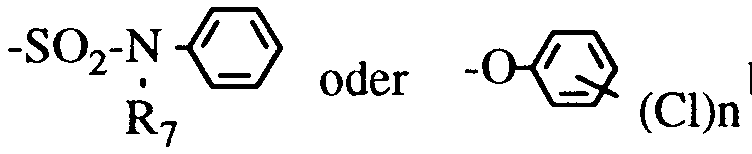
bedeutet, wobei R₇ Methyl oder Ethyl und n 1 bedeutet. - Ausserdem ist die Verwendung solcher Farbstoffe der Formel (2) bevorzugt, worin R₁₀ Wasserstoff oder Chlormethylcarbonylamino bedeutet, sowie solcher Farbstoffe der Formel (2), worin R₁₁ Wasserstoff oder Chlor bedeutet.
- Eine ganz besonders bevorzugte Ausführungsform des erfindungsgemässen Verfahrens besteht darin, dass man den roten Farbstoff der Formel
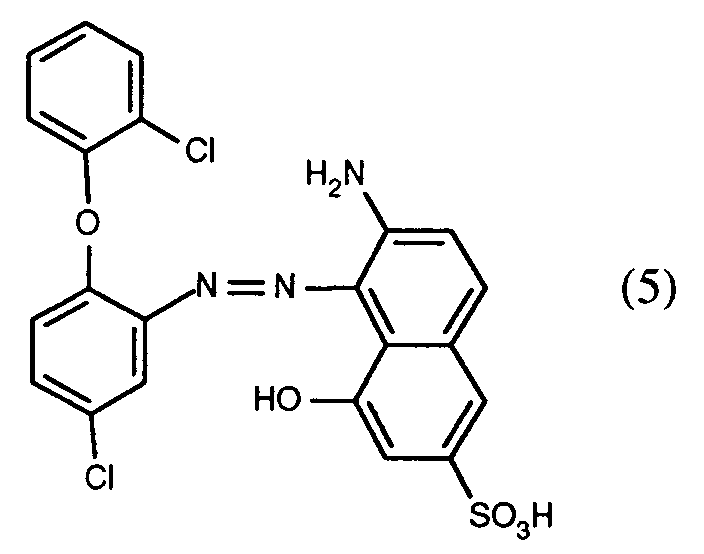
verwendet. - Eine weitere bevorzugte Ausführungsform des erfindungsgemässen Verfahrens ist dadurch gekennzeichnet, dass man einen blauen Farbstoff der Formel (3) verwendet, worin R₁₄ Methyl und R₁₂ und R₁₃ Wasserstoff oder Methyl bedeuten.
- Ausserdem ist die Verwendung solcher Farbstoffe der Formel (3) bevorzugt, worin R₁₅ Wasserstoff, Methyl oder -CH₂-NH-CO-CH₂-Cl bedeutet, sowie solcher Farbstoffe der Formel (3), worin R₁₆ -SO₂-NH-C₂H₄-OH, -CH₂-NH-CO-CH₂-Cl oder -CH₂-NH-CO-C₆H₅ bedeutet.
- Eine ganz besonders bevorzugte Ausführungsform des erfindungsgemässen Verfahrens besteht darin, dass man den blauen Farbstoff der Formel

verwendet. - Ausserdem ist es bevorzugt, im erfindungsgemässen Verfahren mindestens zwei Farbstoffe zu verwenden, deren Parachor zwischen 900 und 1200 liegt und deren log P zwischen 1 und 4 liegt. Der Parachor wird dabei gemäss dem Artikel von O. R. Quayle [Chem. Rev. 53 439 (1953)] berechnet und log P bedeutet die relative Lipophilität, deren Berechnung von C. Hansch et al. [J. Med. Chem. 16, 1207 (1973)] beschrieben wurde.
- Eine ganz besonders wichtige Ausführungsform des erfindungsgemässen Verfahrens besteht darin, dass man zum Trichromiefärben eine Farbstoffmischung, enthaltend den gelben Farbstoff der Formel (4), den roten Farbstoff der Formel (5) und den blauen Farbstoff der Formel (6), verwendet.
- Zusätzlich zu den Farbstoffen der Formeln (2), (3) oder (4) kann man im erfindungsgemässen Färbeverfahren noch weitere Farbstoffe einsetzen. Dies kann z.B. zweckmässig sein, wenn die Nuance trüber oder dunkler oder in etwas geändertem Farbton ausfallen soll, als sie mit den genannten Farbstoffen erreichbar ist. Vorzugsweise setzt man als weitere Farbstoffe solche ein, die ebenfalls eine Sulfo- oder Carboxygruppe und ein Molekulargewicht zwischen 450 und 700 aufweisen.
- Wegen der guten Kombinierbarkeit mit den Farbstoffen der Formeln (2), (3) oder (4) verwendet man als zusätzlichen Farbstoff vor allen Dingen einen schwarzen Farbstoff der Formel

worin R₁₉ Wasserstoff, C₁-C₄-Alkyl, C₁-C₄-Alkoxy oder C₁-C₄-Alkanoylamino und R₂₀ Chlor oder Nitro bedeutet,
oder einen braunen Farbstoff der Formel
worin R₂₁ -COOH, -CONH₂, -SO₃H oder -SO₃NH₂ bedeutet. - Als zusätzlichen schwarzen Farbstoff verwendet man vorzugsweise den schwarzen Farbstoff der Formel

und als zusätzlichen braunen Farbstoff verwendet man vorzugsweise den braunen Farbstoff der Formel
- Die erfindungsgemässen Farbstoffe sind anionischer Natur und werden vorteilhaft in Form ihrer Salze, insbesondere Alkalisalze oder Ammoniumsalze, eingesetzt. Als Alkalisalze kommen vor allem die Lithium-, Kalium- oder Natriumsalze in Betracht und unter Ammoniumsalzen sind auch Salze organischer Amine zu verstehen, z.B. solcher, die mit C₁-C₆-Alkyl- oder Hydroxy-C₁-C₆-alkylgruppen substituiert sind.
- Die im erfindungsgemässen Verfahren verwendeten Farbstoffe sind bekannt oder können auf an sich bekannte Art und Weise hergestellt werden.
- Die Mengen, in denen die erfindungsgemäss verwendeten Farbstoffe in den Färbebädern eingesetzt werden, können je nach der gewünschten Farbtiefe in weiten Grenzen schwanken. Im allgemeinen sind Farbstoffmengen von 0,1 bis 10, vorzugsweise 0,5 bis 4 Gew.%, bezogen auf das Gewicht des zu färbenden Leders, vorteilhaft.
- Neben Wasser und den Farbstoffen kann die Färbeflotte noch weitere Zusätze enthalten, z.B. Säuren, Basen oder Salze zur Einstellung des gewünschten pH-Wertes, sowie Hilfsmittel, wie z.B. Netzmittel, Fettungsmittel, farbvertiefende Hilfsmittel, Egalisiermittel, Penetrationsmittel und/oder Antischaummittel.
- Das erfindungsgemässe Verfahren weist den grossen Vorteil auf, dass es nicht nur für einen bestimmten Ledertyp geeignet, sondern auf die verschiedenen Ledertypen anwendbar ist, beispielsweise auf Chromleder, nachgegerbtes Leder oder Velourleder von Ziege, Rind oder Schwein.
- Das Färben erfolgt vorzugsweise nach dem Ausziehverfahren, z.B. bei einem Flottenverhältnis von 1:1,5 bis 1:20, vorzugsweise 1:2 bis 1:10, und bei Temperaturen von 20 bis 100° C, vorzugsweise 30 bis 60° C. Falls erwünscht oder erforderlich, kann das Leder einer Vorbehandlung unterworfen werden, beispielsweise einer Neutralisation oder Walke.
- Die Färbedauer schwankt je nach Art des Leders und der gewünschten Farbtiefe, liegt im allgemeinen jedoch zwischen 30 und 180 Minuten. Im Anschluss an die Färbung wird das Leder gespült und wie üblich fertiggestellt.
- Man erhält nach dem erfindungsgemässen Verfahren Lederfärbungen in brillanten Farbtönen und mit guten Echtheiten, wie z.B. Licht- und Nassechtheiten. Da die einzelnen Farbstoffe etwa gleich tief in das Leder eindringen, ist die Nuance der Färbungen an der Oberfläche und in tieferen Schichten des Leders gleich.
- Für den Einsatz zum Färben werden die einzelnen Farbstoffe miteinander vermischt. Die Farbstoffe können dabei einzeln als Stammlösungen für das Färbeverfahren vorbereitet oder zusammen in eine einzige Stammlösung formuliert werden.
- Ein weiterer Gegenstand der Erfindung sind Farbstofftrichromie-Mischungen, enthaltend mindestens einen gelben Farbstoff der Formel (1), mindestens einen roten Farbstoff der Formel (2) und mindestens einen blauen Farbstoff der Formel (3).
- Bevorzugte Farbstofftrichromie-Mischungen enthalten 1 bis 98 Gew.% eines gelben Farbstoffes der Formel (1), 1 bis 98 Gew.% eines roten Farbstoffes der Formel (2) und 1 bis 98 Gew.% eines blauen Farbstoffes der Formel (3), insbesondere 10 bis 70 Gew.% eines gelben Farbstoffes der Formel (1), 10 bis 50 Gew.% eines roten Farbstoffes der Formel (2) und 10 bis 50 Gew.% eines blauen Farbstoffes der Formel (3).
- Die nachfolgenden Beispiele veranschaulichen die Erfindung, ohne sie darauf zu beschränken. Teile bedeuten Gewichsteile und Prozente Gewichtsprozente. Die Farbstoffe werden in handelsüblicher Pulver- oder Flüssigform eingesetzt.
- Beispiel 1: 100 Teile chromgegerbtes Rindleder (Falzgewicht) werden 15 Minuten lang in 300 Teilen Wasser bei 30°C gewaschen und anschliessend 60 Minuten in einer aus 300 Teilen Wasser, 2 Teilen Neutralisationsmittel (Na- Salze aromatischer Sulfosäuren und aliphatischer Dicarbonsäuren) und 0,5 Teilen Natriumbicarbonat bestehenden Flotte bei 30°C neutralisiert. Anschliessend folgt eine 15 Minuten dauernde Waschoperation in 300 Teilen Wasser bei Raumtemperatur.
- Das derart behandelte Leder wird nun in einer frisch angesetzten Flotte aus 300 Teilen Wasser und 2,46 Teilen der Farbstoffmischung, bestehend aus 1,88 Teilen des gelben Farbstoffes der Formel

und 0,58 Teilen des blauen Farbstoffes der Formel
- 30 Minuten bei 50°C gefärbt. Dann werden der Färbeflotte 3 Teile eines synthetischen Fettungsmittels (Zubereitung auf Basis von sulfonierten aliphatischen Kohlenwasserstoffen, Fettsäuren und deren Derivate) und nach weiteren 30 Minuten 0,5 Teile 85 %ige Ameisensäure zugesetzt. Man färbt noch 30 Minuten bei unveränderter Temperatur weiter und stellt das gefärbte Leder nach dem Spülen wie üblich fertig.
- Man erhält ein egales grüngefärbtes Leder mit guten Echtheiten und reiner Nuance. Die Kombinierbarkeit der verwendeten Farbstoffe ist besonders gut. Wenn die Lederoberfläche leicht angeschliffen wird, sieht man, dass beide Farbstoffe Leder gleich tief eingefärbt haben.
- Beispiel 2: 100 Teile Chromrindleder (Falzgewicht) werden nach den Angaben im Beispiel 1 neutralisiert und dann bei 30°C in gleicher Flotte mit 7 Teilen eines flüssigen syntetischen Nachgerbstoffes (Kondensationsprodukte von polyphenolischen Sulfosäuren mit Formaldehyd und Harnstoff) weitere 60 Minuten behandelt. Danach folgt ein Waschprozess von 15 Minuten Dauer in 300 Teilen Wasser bei Raumtemperatur. Dieses nachgegerbte Chromrindleder wird anschliessend bei 50° C in einer Flotte, bestehend aus 300 Teilen Wasser sowie 4,92 Teilen der im Beispiel 1 eingesetzten Farbstoffmischung, gefärbt. Nach einer Färbedauer von 30 Minuten erfolgt ein Zusatz von 3 Teilen des synthetischen Fettungsmittels aus Beispiel 1 und nach weiteren 30 Minuten eine Zugabe von 1 Teil 85 %iger Ameisensäure. Nach dem Ansäuern wird die Behandlung noch 30 Minuten bei 50°C fortgesetzt. Anschliessend wird in kaltem Wasser gespült und fertiggestellt. Die erhaltene reine grüne Färbung zeichnet sich durch gute Echtheitseigenschaften und eine reine Nuance aus. Die Kombinierbarkeit der Farbstoffe ist auch auf diesem Leder sehr gut, was wie im Beispiel 1 geprüft wird. Ausserdem stimmt die Färbung im Farbton weitgehend überein mit der nach Beispiel 1 auf nicht nachgegerbtem Chromrindleder mit der gleichen Farbstoffmischung erhalten Ausfärbung.
- Beispiel 3: Arbeitet man wie im Beispiel 2 beschrieben, verwendet jedoch anstelle des dort eingesetzten Nachgerbstoffs 3 Teile eines stark anionischen Nachgerbstoffs (Formaldehyd-Kondensationsprodukt von phenolischen Sulfosäuren), so erhält man Leder mit einer sehr anionischen Oberfläche.
Die erhaltene Färbung stimmt vom Farbton her weitgehend überein mit derjenigen auf nicht nachgegertem Chromrindleder nach Beispiel 1 und derjenigen auf nachgegerbtem Chromrindleder nach Beispiel 2. - Beispiel 4: Arbeitet man wie im Beispiel 1 beschrieben, verwendetjedoch anstelle der dort eingesetzten Farbstoffmischung 1,88 Teile einer Farbstoffmischung, bestehend aus 0,92 Teilen des gelben Farbstoffs der Formel (4), 0,50 Teilen des blauen Farbstoffs der Formel (6) und 0,46 Teilen des roten Farbstoffs der Formel

so erhält man rotbraun gefärbtes Leder. - Die Kombinierbarkeit der Farbstoffe ist sehr gut. Wenn die Lederoberfläche leicht angeschliffen wird, sieht man, dass alle Farbstoffe Leder gleich tief färben.
- Beispiel 5: Arbeitet man wie im Beispiel 2 beschrieben, verwendet jedoch anstelle der dort eingesetzten Farbstoffmischung 3,76 Teile der im Beispiel 4 eingesetzten Farbstoffmischung, so erhält man eine Färbung, die im Farbton ebenfalls mit der auf nicht nachgegerbtem Chromrindleder nach Beispiel 4 erhaltenen Ausfärbung übereinstimmt.
- Beispiel 6: 100 Teile Chromrindleder (Falzgewicht) werden nach den Angaben im Beispiel 2 neutralisiert und nachgegerbt und danach in einer Flotte, enthaltend 300 Teile Wasser, 2,5 Teile des Farbstoffes der Formel (4) und 0.8 Teile des Farbstoffes der Formel (6) während 30 Minuten bei 50°C gefärbt. Nach 30 Minuten erfolgt ein Zusatz von 3 Teilen des synthetischen Fettungsmittels aus Beispiel 1 und nach weiteren 30 Minuten eine Zugabe von 1 Teil 85 %iger Ameisensäure. Nach dem Ansäuern wird die Behandlung noch 30 Minuten bei 50°C fortgesetzt.
- Anschliessend wird in einem frischen Bad noch mit 1 Teil eines farbvertiefenden Hilfsmittel (polyquaternäres Amin-Äthylenoxid-Addukt) in 300 Teilen Wasser das Leder nachbehandelt. Nach einer Behandlungsdauer von 15 Minuten wird dem Färbebad eine halbe Menge der obengenannten Farbstoffe zugesetzt und danach 15 Minuten bei 50°C weitergefärbt. Dann erfolgt ein Zusatz von 0,25 Teilen 85 %iger Ameisensäure. Nach weiteren 20 Minuten ist die Färbung beendet. Es wird dann in kaltem Wasser gespült.
- Die wie üblich fertiggestellte Färbung zeichnet sich durch gute Echtheiten und einen vollen, reinen grünen Farbton aus. Sie ist wesentlich voller und stärker als eine entsprechende Färbung ohne das farbvertiefende Hilfsmittel. Gleiche Ergebnisse erhält man auch mit den anderen Farbstoffmischungen aus den Farbstoffen der Formeln (4), (5) und (6).
- Beispiel 7: 100 Teile chromgares Bekleidungsveloursleder (Trockengewicht) werden bei 50°C in einer Lösung von 1000 Teilen Wasser und 2 Teilen 24 %igem Ammoniak während 60 Minuten aufgewalkt. Danach folgt ein Waschprozess von 15 Minuten Dauer in 1000 Teilen Wasser von 50°C.
- Nach diesen vorbereitenden Operationen wird das Leder in einer Flotte aus 1000 Teilen Wasser, 2 Teilen Ammoniak 24%ig und 19,68 Teilen der im Beispiel 1 eingesetzten Farbstoffmischung bei 50°C gefärbt.
- Nach einer Färbedauer von 60 Minuten wird mit 4 Teilen 85 %iger Ameisensäure angesäuert und hierauf noch 20 Minuten weitergefärbt.
- Die Fertigstellung des gefärbten Leders erfolgt nach einer Behandlung in frischem Bad mit 1000 Teilen Wasser, 2,5 Teilen eines Kondensationsproduktes aus Formaldehyd, Dicyandiamid, Ammoniumchlorid und Ethylendiamin sowie 0,5 Teilen 85 %iger Ameisensäure während 45 Minuten bei 50°C. Das erhaltene gefärbte Leder besitzt einen reinen grünen Farbton. Es zeichnet sich durch gute Echtheiten und gutes Deckvermögen aus.
- Beispiel 8: 100 Teile Chromspaltvelours-Leder (Trockengewicht) werden in 1000 Teilen Wasser und 2 Teilen 24 %igem Ammoniak 60 Minuten lang bei 50°C aufgewalkt und anschliessend mit 1000 Teilen Wasser von 50°C während 15 Minuten gewaschen.
- Das derart vorbereitete Leder wird nun in einer frischen Flotte, bestehend aus 1000 Teilen Wasser, 2 Teilen 24%igem Ammoniak und 9,84 Teilen der im Beispiel 1 eingesetzten Farbstoffmischung, bei 50°C gefärbt. Nach 60 Minuten fügt man noch 4 Teile 85 %ige Ameisensäure hinzu und färbt weitere 20 Minuten bei diese Temperatur.
- Das gefärbte Leder wird in kaltem Wasser gespült und fertiggestellt. Man erhält eine reine grüne Färbung, die sich durch gute Echtheiten und Nuancengleichheit zwischen Velours- und Fleischseite auszeichnet.
- Beispiel 9: Arbeitet man wie im Beispiel 1 beschrieben, verwendet jedoch anstelle der dort eingesetzten Farbstoffmischung 1,38 Teile einer Farbstoffmischung, bestehend aus 0,5 Teilen des gelben Farbstoffes der Formel

und 0,88 Teile des blauen Farbstoffes der Formel (6), so erhält man ein farbstark mittelgrün gefärbtes Leder. - Beispiel 10: Arbeitet man wie im Beispiel 2 beschrieben, verwendet jedoch anstelle der dort eingesetzten Farbstoffmischung 2,76 Teile der im Beispiel 9 eingesetzten Farbstoffmischung, so erhält man eine Färbung, die im Farbton ebenfalls mit der auf nicht nachgegerbtem Leder Chromrindleder nach Beispiel 9 erhaltenen Ausfärbung übereinstimmt.
- Beispiel 11: Arbeitet man wie im Beispiel 1 beschrieben, verwendet jedoch anstelle der dort eingesetzten Farbstoffmischung 1,5 Teile einer Farbstoffmischung, bestehend aus 0,5 Teilen des gelben Farbstoffes der im Beispiel 9 angegebenen Formel (8) und 1,0 Teilen des blauen Farbstoffes der Formel
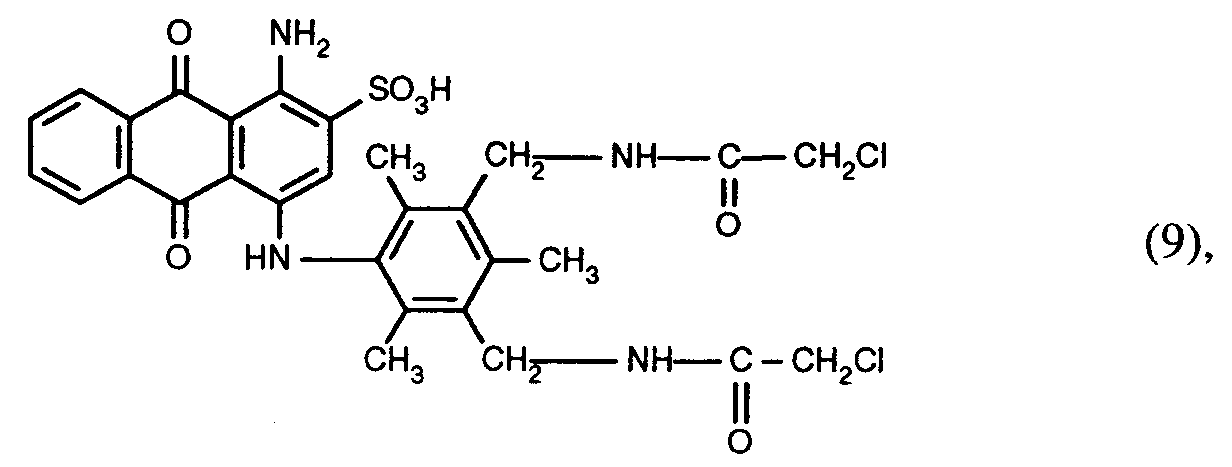
so erhält man ein farbstark grün gefärbtes Leder. - Beispiel 12: Arbeitet man wie im Beispiel 2 beschrieben, verwendet jedoch anstelle der dort eingesetzten Farbstoffmischung 3,00 Teile der im Beispiel 11 eingesetzten Farbstoffmischung, so erhält man eine Färbung, die im Farbton ebenfalls mit der auf nicht nachgegerbtem Leder Chromrindleder nach Beispiel 11 erhaltenen Ausfärbung übereinstimmt.
- Beispiel 13: Arbeitet man wie im Beispiel 1 beschrieben, verwendet jedoch anstelle der dort eingesetzten Farbstoffmischung 2,4 Teile einer Farbstoffmischung, bestehend aus 1,4 Teilen des gelben Farbstoffes der im Beispiel 1 angegebenen Formel (4) und 1,0 Teilen des blauen Farbstoffes der Formel

so erhält man ein farbstark grün gefärbtes Leder. - Beispiel 14: Arbeitet man wie im Beispiel 1 beschrieben, verwendet jedoch anstelle der dort eingesetzten Farbstoffmischung 1,6 Teile einer Farbstoffmischung, bestehend aus 0,6 Teilen des roten Farbstoffes der Formel

und 1,0 Teilen des blauen Farbstoffes der im Beispiel 11 angegebenen Formel (9), so erhält man ein farbstark violett gefärbtes Leder. - Beispiel 15: Arbeitet man wie im Beispiel 2 beschrieben, verwendet jedoch anstelle der dort eingesetzten Farbstoffmischung 3,20 Teile der im Beispiel 14 eingesetzten Farbstoffmischung, so erhält man eine Färbung, die im Farbton ebenfalls mit der auf nicht nachgegerbtem Leder Chromrindleder nach Beispiel 14 erhaltenen Ausfärbung übereinstimmt.
- Beispiel 16: Arbeitet man wie im Beispiel 1 beschrieben, verwendet jedoch anstelle der dort eingesetzten Farbstoffmischung 2,4 Teile einer Farbstoffmischung, bestehend aus 1,4 Teilen des gelben Farbstoffes der im Beispiel 1 angegebenen Formel (4) und 1,0 Teilen des blauen Farbstoffes der Formel

so erhält man ein farbstark grün gefärbtes Leder. - Beispiel 17: Arbeitet man wie im Beispiel 1 beschrieben, verwendet jedoch anstelle der dort eingesetzten Farbstoffmischung 2,7 Teile einer Farbstoffmischung, bestehend aus 1,4 Teilen des gelben Farbstoffes der im Beispiel 1 angegebenen Formel (4) und 1,3 Teilen des roten Farbstoffes der Formel

so erhält man ein farbstark orange gefärbtes Leder. - Beispiel 18: Arbeitet man wie im Beispiel 1 beschrieben, verwendet jedoch anstelle der dort eingesetzten Farbstoffmischung 2,08 Teile einer Farbstoffmischung, bestehend aus 1,2 Teilen des gelben Farbstoffes der Formel

und 0,88 Teilen des blauen Farbstoffes der im Beispiel 1 angegebenen Formel (6), so erhält man ein farbstark grün gefärbtes Leder. - Beispiele 19 bis 36: Nach den in den Beispielen 1, 2 und 4 beschriebenen Verfahren erhält man mit dem dort aufgeführten gelben Farbstoff der Formel (4), dem roten Farbstoff der Formel (5) und dem blauen Farbstoff der Formel (6) bei Anwendung in den angegebenen Mengen (Teile) Lederfärbungen in den angegebenen Nuancen.
Beispiel Farstoff (4) Farbstoff (5) Farbstoff (6) Nuance 19 1,68 0,12 0,53 grünstichig braun 20 1,4 0,31 0,44 rotstichig braun 21 1,20 0,17 0,76 grünstichig grau 22 0,84 0,74 0,18 bordeaux 23 0,90 0,42 0,6 braun 24 1,2 0,17 0,76 dunkelgrün 25 0,7 0,62 0,44 bordeaux 26 0,7 0,31 0,88 dumpfes violett 27 0,42 0,87 0,26 bordeaux 28 0,28 0,74 0,53 blaustichig bordeaux 29 1,88 0,42 --- rotstichig orange 30 1,4 0,62 --- scharlachrot 31 0,92 0,82 --- neutrales rot 32 --- 0,42 1,18 violett 33 --- 0,62 0,88 rotstichig violett 34 --- 0,82 0,58 blaustichig bordeaux 35 0,92 --- 1,18 blaustichig grün 36 1,40 --- 0,88 grün - Beispiel 37: Nach den in den Beispielen 1 bis 4 beschriebenen Verfahren erhält man mit 0,62 Teilen des dort aufgeführten roten Farbstoffes der Formel (5), 0,18 Teilen des blauen Farbstoffes der Formel (6) und 1,0 Teilen des schwarzen
Farbstoffes der Formel
eine Lederfärbungen mit gedeckt violetter Nuance. - Beispiel 38: Nach den in den Beispielen 1 bis 4 beschriebenen Verfahren erhält man mit 0,23 Teilen des dort aufgeführten gelben Farbstoffes der Formel (4), 0,27 Teilen des roten Farbstoffes der Formel (5) und 1,2 Teilen des braunen Farbstoffes der Formel

eine Lederfärbungen mit orangebrauner Nuance.
Claims (28)
- Verfahren zum Färben von Leder mit Farbstoffmischungen, dadurch gekennzeichnet, dass man mindestens zwei metallfreie Farbstoffe mit jeweils einer einzigen Sulfo- oder Carboxygruppen und einem Molekulargewicht zwischen 450 und 700 verwendet.
- Verfahren gemäss Anspruch 1, dadurch gekennzeichnet, dass man mindestens zwei Farbstoffe verwendet, ausgewählt aus der Gruppe, bestehend ausa) einem gelben Farbstoff der Formel

R₁ C₁-C₄-Alkyl,
R₂ OH oder NH₂,
R₃ Wasserstoff oder Halogen,
R₄ Wasserstoff oder Sulfo,
R₅ Wasserstoff, Halogen, Sulfo oder eine Gruppe

R₆ Wasserstoff, Halogen oder eine Gruppe b) einem roten Farbstoff der Formel
R₈ Sulfo oder

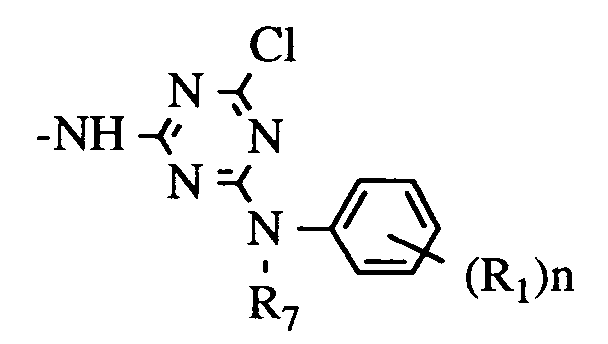
R₁₀ Wasserstoff, C₁-C₄-Alkylcarbonylamino oder Halogen-C₁-C₄-alkylcarbonylamino und
R₁₁ Wasserstoff oder Halogen bedeutet, undc) einem blauen Farbstoff der Formel
R₁₅ -SO₂-NH-R₁₇ oder -CH₂-NH-CO-R₁₈ und
R₁₆ Wasserstoff, C₁-C₄-Alkyl oder R₁₅ bedeutet, wobei R₁₇ Hydroxy-C₁-C₄-Alkyl und
R₁₈ Phenyl oder Halogen-C₁-C₄-alkyl bedeutet. - Verfahren gemäss Ansprüchen 1 und 2, dadurch gekennzeichnet, dass man zum Trichromiefärben eine Farbstoffmischung, enthaltend einen gelben Farbstoff der Formel (1), einen roten Farbstoff der Formel (2) und einen blauen Farbstoff der Formel (3), verwendet.
- Verfahren gemäss einem der Ansprüche 1 bis 3, dadurch gekennzeichnet, dass man einen gelben Farbstoff der Formel (1) verwendet, worin R₁ Methyl bedeutet.
- Verfahren gemäss einem der Ansprüche 1 bis 4, dadurch gekennzeichnet, dass man einen gelben Farbstoff der Formel (1) verwendet, worin R₃ Chlor bedeutet.
- Verfahren gemäss einem der Ansprüche 1 bis 5, dadurch gekennzeichnet, dass man einen gelben Farbstoff der Formel (1) verwendet, worin R₄ Sulfo oder Wasserstoff bedeutet.
- Verfahren gemäss einem der Ansprüche 1 bis 6, dadurch gekennzeichnet, dass man einen gelben Farbstoff der Formel (1) verwendet, worin R₅ Sulfo oder eine Gruppe

- Verfahren gemäss einem der Ansprüche 1 bis 7, dadurch gekennzeichnet, dass man einen gelben Farbstoff der Formel (1) verwendet, worin R₆ Wasserstoff, Chlor oder eine Gruppe

R₁ Methyl und n 0, 1 oder 2 bedeutet. - Verfahren gemäss einem der Ansprüche 1 bis 8, dadurch gekennzeichnet, dass man den gelben Farbstoff der Formel

- Verfahren gemäss einem der Ansprüche 1 bis 9, dadurch gekennzeichnet, dass man einen roten Farbstoff der Formel (2) verwendet, worin R₈ Sulfo oder

- Verfahren gemäss einem der Ansprüche 1 bis 10, dadurch gekennzeichnet, dass man einen roten Farbstoff der Formel (2) verwendet, worin R₉ Sulfo,


- Verfahren gemäss einem der Ansprüche 1 bis 11, dadurch gekennzeichnet, dass man einen roten Farbstoff der Formel (2) verwendet, worin R₁₀ Wasserstoff oder Chlormethylcarbonylamino bedeutet.
- Verfahren gemäss einem der Ansprüche 1 bis 12, dadurch gekennzeichnet, dass man einen roten Farbstoff der Formel (2) verwendet, worin R₁₁ Wasserstoff oder Chlor bedeutet.
- Verfahren gemäss einem der Ansprüche 1 bis 13, dadurch gekennzeichnet, dass man den roten Farbstoff der Formel

- Verfahren gemäss einem der Ansprüche 1 bis 14, dadurch gekennzeichnet, dass man einen blauen Farbstoff der Formel (3) verwendet, worin R₁₄ Methyl und R₁₂ und R₁₃ Wasserstoff oder Methyl bedeuten.
- Verfahren gemäss einem der Ansprüche 1 bis 15, dadurch gekennzeichnet, dass man einen blauen Farbstoff der Formel (3) verwendet, worin R₁₅ Wasserstoff, Methyl oder -CH₂-NH-CO-CH₂-Cl bedeutet.
- Verfahren gemäss einem der Ansprüche 1 bis 16, dadurch gekennzeichnet, dass man einen blauen Farbstoff der Formel (3) verwendet, worin, worin R₁₆ -SO₂-NH-C₂H₄-OH, -CH₂-NH-CO-CH₂-Cl oder -CH₂-NH-CO-C₆H₅ bedeutet.
- Verfahren gemäss einem der Ansprüche 1 bis 17, dadurch gekennzeichnet, dass man den blauen Farbstoff der Formel

- Verfahren gemäss einem der Ansprüche 1 bis 18, dadurch gekennzeichnet, dass man mindestens zwei Farbstoffe verwendet, deren Parachor zwischen 900 und 1200 liegt und deren log P zwischen 1 und 4 liegt.
- Verfahren gemäss einem der Ansprüche 1 bis 19, dadurch gekennzeichnet, dass man zusätzlich einen schwarzen Farbstoff der Formel

oder einen braunen Farbstoff der Formel
- Verfahren gemäss einem der Ansprüche 1 bis 20, dadurch gekennzeichnet, dass man zusätzlich den schwarzen Farbstoff der Formel


- Verfahren gemäss den Ansprüchen 1, 3, 9, 14 und 18, dadurch gekennzeichnet, dass man zum Trichromiefärben eine Farbstoffmischung, enthaltend den gelben Farbstoff der Formel (4), den roten Farbstoff der Formel (5) und den blauen Farbstoff der Formel (6), verwendet.
- Verfahren gemäss einem der Ansprüche 1 bis 22, dadurch gekennzeichnet, dass man eine Färbeflotte verwendet, welche zusätzlich ein farbvertiefendes Hilfsmittel enthält.
- Verfahren gemäss Anspruch 23, dadurch gekennzeichnet, dass man eine Färbeflotte verwendet, welche als farbvertiefendes Hilfsmittel ein ethoxyliertes Alkylamin enthält.
- Farbstofftrichromie-Mischungen, enthaltend mindestens einen gelben Farbstoff der Formel (1), mindestens einen roten Farbstoff der Formel (2) und mindestens einen blauen Farbstoff der Formel (3) gemäss Anspruch 2.
- Farbstofftrichromie-Mischungen gemäss Anspruch 25, enthaltend 1 bis 98 Gew.% eines gelben Farbstoffes der Formel (1), 1 bis 98 Gew.% eines roten Farbstoffes der Formel (2) und 1 bis 98 Gew.% eines blauen Farbstoffes der Formel (3).
- Farbstofftrichromie-Mischungen gemäss Anspruch 26, enthaltend 10 bis 70 Gew.% eines gelben Farbstoffes der Formel (1), 10 bis 50 Gew.% eines roten Farbstoffes der Formel (2) und 10 bis 50 Gew.% eines blauen Farbstoffes der Formel (3).
- Das nach dem Verfahren gemäss den Ansprüchen 1 bis 24 oder mit den Farbstofftrichromie-Mischungen gemäss den Ansprüchen 25 bis 27 gefärbte Leder.
Applications Claiming Priority (2)
| Application Number | Priority Date | Filing Date | Title |
|---|---|---|---|
| CH1053/92 | 1992-04-01 | ||
| CH105392 | 1992-04-01 |
Publications (2)
| Publication Number | Publication Date |
|---|---|
| EP0564404A1 true EP0564404A1 (de) | 1993-10-06 |
| EP0564404B1 EP0564404B1 (de) | 1997-06-25 |
Family
ID=4201357
Family Applications (1)
| Application Number | Title | Priority Date | Filing Date |
|---|---|---|---|
| EP93810208A Expired - Lifetime EP0564404B1 (de) | 1992-04-01 | 1993-03-23 | Verfahren zum Färben von Leder mit Farbstoffmischungen |
Country Status (5)
| Country | Link |
|---|---|
| US (1) | US5354341A (de) |
| EP (1) | EP0564404B1 (de) |
| JP (1) | JPH0649778A (de) |
| DE (1) | DE59306811D1 (de) |
| ES (1) | ES2105192T3 (de) |
Families Citing this family (7)
| Publication number | Priority date | Publication date | Assignee | Title |
|---|---|---|---|---|
| DE19851389A1 (de) * | 1998-11-07 | 2000-05-11 | Dystar Textilfarben Gmbh & Co | Gelbe Farbstoffmischungen von wasserlöslichen faserreaktiven Azofarbstoffen und ihre Verwendung |
| US7001435B2 (en) * | 2002-05-30 | 2006-02-21 | Automotive Technology, Inc. | Leather treatment |
| WO2011139817A2 (en) | 2010-04-28 | 2011-11-10 | University Of Georgia Research Foundation, Inc. | Photochemical cross-linkable polymers, methods of marking photochemical cross-linkable polymers, methods of using photochemical cross-linkable polymers, and methods of making articles containing photochemical cross-linkable polymers |
| EP2731999A4 (de) * | 2011-07-15 | 2015-09-23 | Univ Georgia | Permanente befestigung von mitteln an oberflächen mit c-h- funktionalität |
| WO2013056007A2 (en) | 2011-10-14 | 2013-04-18 | University Of Georgia Research Foundation, Inc. | Photochemical cross-linkable polymers, methods of making photochemical cross-linkable plolymers, methods of using photochemical cross-linkable poloymers, and methods of making articles containing photochemical cross-linkable polymers |
| CN103275516B (zh) * | 2013-06-06 | 2016-05-11 | 恒升化工(启东)有限公司 | 一种含活性基团的酸性黄色染料的生产方法 |
| CN114575171A (zh) * | 2021-12-22 | 2022-06-03 | 浙江中辉裘革科技有限公司 | 一种羊皮低温染色用染料及其染色工艺 |
Citations (5)
| Publication number | Priority date | Publication date | Assignee | Title |
|---|---|---|---|---|
| CH191165A (de) * | 1936-03-05 | 1937-05-31 | Geigy Ag J R | Verfahren zur Darstellung eines neuen Monoazofarbstoffes. |
| FR2133803A1 (de) * | 1971-04-19 | 1972-12-01 | Ciba Geigy Ag | |
| FR2201329A1 (de) * | 1972-10-03 | 1974-04-26 | Baychem Corp | |
| DE3326954A1 (de) * | 1982-08-06 | 1984-02-09 | Sandoz-Patent-GmbH, 7850 Lörrach | Anionische monoazoverbindungen, verfahren zur herstellung und ihre verwendung bei faerbe- und druckverfahren |
| EP0181292A2 (de) * | 1984-11-08 | 1986-05-14 | Ciba-Geigy Ag | Verfahren zum Kontinuierlichen Trichromie-Färben von synthetischen Polyamidmaterialien |
Family Cites Families (10)
| Publication number | Priority date | Publication date | Assignee | Title |
|---|---|---|---|---|
| LU78597A1 (de) * | 1977-11-28 | 1979-06-13 | Ciba Geigy Ag | Neue anthrachinonverbindungen,deren herstellung und verwendung |
| US4452602A (en) * | 1981-03-23 | 1984-06-05 | Puentener Alois | Process for dyeing leather with mixtures of dyes |
| DE3363254D1 (en) * | 1982-04-08 | 1986-06-05 | Ciba Geigy Ag | Process for trichromatic dyeing or printing |
| CH654845A5 (de) * | 1982-08-06 | 1986-03-14 | Sandoz Ag | Anionische monoazoverbindungen, verfahren zur herstellung und ihre verwendung bei faerbe- und druckverfahren. |
| EP0127579B1 (de) * | 1983-05-25 | 1987-10-07 | Ciba-Geigy Ag | Verfahren zum Trichromie-Färben oder -Bedrucken |
| US4652269A (en) * | 1984-11-08 | 1987-03-24 | Ciba-Geigy Corporation | Process for the continuous trichromatic dyeing of synthetic polyamide materials: including a blue anthraquinone reactive dye |
| US4799933A (en) * | 1986-01-21 | 1989-01-24 | Ciba-Geigy Corporation | Process for the trichromatic dyeing of leather |
| FR2640988B1 (de) * | 1988-12-22 | 1993-02-19 | Sandoz Sa | |
| GB2236542B (en) * | 1989-10-06 | 1992-04-15 | Sandoz Ltd | Dye mixtures and their use in trichromatic dyeing processes |
| EP0425435A1 (de) * | 1989-10-23 | 1991-05-02 | Ciba-Geigy Ag | Verfahren zum Trichromie-Färben oder -Bedrucken |
-
1993
- 1993-03-23 ES ES93810208T patent/ES2105192T3/es not_active Expired - Lifetime
- 1993-03-23 DE DE59306811T patent/DE59306811D1/de not_active Expired - Fee Related
- 1993-03-23 EP EP93810208A patent/EP0564404B1/de not_active Expired - Lifetime
- 1993-03-26 US US08/037,194 patent/US5354341A/en not_active Expired - Fee Related
- 1993-04-01 JP JP5074906A patent/JPH0649778A/ja not_active Withdrawn
Patent Citations (5)
| Publication number | Priority date | Publication date | Assignee | Title |
|---|---|---|---|---|
| CH191165A (de) * | 1936-03-05 | 1937-05-31 | Geigy Ag J R | Verfahren zur Darstellung eines neuen Monoazofarbstoffes. |
| FR2133803A1 (de) * | 1971-04-19 | 1972-12-01 | Ciba Geigy Ag | |
| FR2201329A1 (de) * | 1972-10-03 | 1974-04-26 | Baychem Corp | |
| DE3326954A1 (de) * | 1982-08-06 | 1984-02-09 | Sandoz-Patent-GmbH, 7850 Lörrach | Anionische monoazoverbindungen, verfahren zur herstellung und ihre verwendung bei faerbe- und druckverfahren |
| EP0181292A2 (de) * | 1984-11-08 | 1986-05-14 | Ciba-Geigy Ag | Verfahren zum Kontinuierlichen Trichromie-Färben von synthetischen Polyamidmaterialien |
Non-Patent Citations (3)
| Title |
|---|
| CHEMICAL ABSTRACTS, vol. 102, 14. Januar 1985, Columbus, Ohio, US; abstract no. 8244, CHEKALIN, M. A. ET AL. 'Acid disazo dye' * |
| CHEMICAL ABSTRACTS, vol. 90, 19. März 1979, Columbus, Ohio, US; abstract no. 88722, ZANIC, JURAJ 'Effect of constitution on the hue and dyeing properties of dyes' * |
| K. VENKATARAMAN 'The chemistry of synthetic dyes. Band I' , ACADEMIC PRESS , LONDON, GB * |
Also Published As
| Publication number | Publication date |
|---|---|
| ES2105192T3 (es) | 1997-10-16 |
| US5354341A (en) | 1994-10-11 |
| JPH0649778A (ja) | 1994-02-22 |
| DE59306811D1 (de) | 1997-07-31 |
| EP0564404B1 (de) | 1997-06-25 |
Similar Documents
| Publication | Publication Date | Title |
|---|---|---|
| EP0061670B2 (de) | Verfahren zum Färben von Leder und Pelzen mit Farbstoffmischungen | |
| EP0501197A1 (de) | Verfahren zum Färben von Leder mit wasserunlöslichen Schwefelfarbstoffen | |
| EP0564404B1 (de) | Verfahren zum Färben von Leder mit Farbstoffmischungen | |
| DE2818653C2 (de) | ||
| EP0577556B1 (de) | Verfahren zum Trichromiefärben von Leder mit Farbstoffmischungen | |
| EP0558450B1 (de) | Verfahren zum Färben von Leder mit Farbstoffmischungen | |
| EP0350803B1 (de) | Verfahren zur Badpigmentierung von Leder | |
| EP0046250B1 (de) | Farbstoffpräparation sowie deren Verwendung als Warn- und Signalfarbe | |
| EP0147783A2 (de) | Mischungen blauer Dispersions-Azofarbstoffe für das Färben von synthetischen Fasern | |
| EP0905201B1 (de) | Wasserlösliche Reaktivfarbstoffmischungen und ihre Verwendung zum Färben | |
| DE1444281A1 (de) | Verfahren zum Faerben von geformten Gebilden aus Polyurethan mit wasserloeslichen Farbstoffen | |
| DE2539671B2 (de) | Verfahren zum faerben chromgegerbter und/oder nachgegerbter leder | |
| DE1619349A1 (de) | Farbstoffgemisch zum Braunfaerben von Pelz | |
| EP0095441B1 (de) | Asymmetrische 1:2-Chromkomplexfarbstoffe | |
| DE1260427B (de) | Verfahren zum Faerben von Wolle | |
| EP0423561A1 (de) | Verfahren zum Färben von Leder | |
| EP0648816B1 (de) | Färben von Leder mit Farbstoffmischungen | |
| EP0651028A1 (de) | Verfahren zum Trichromie-Färben oder -Bedrucken | |
| DE1292277B (de) | Verfahren zur Herstellung von Polyazofarbstoffen | |
| DE3427806C2 (de) | ||
| DE2638236A1 (de) | Verfahren zum faerben von leder durch gleichzeitige anwendung saurer und basischer farbstoffe | |
| DE2856883A1 (de) | Verfahren zum abtrueben von lederfaerbungen | |
| DE950004C (de) | Verfahren zur Herstellung von Kupferkomplexen direktziehender metallisierbarer Farbsotffe | |
| DE2211874C3 (de) | Verfahren zur Erhöhung der Affinität von anionischen Farbstoffen zu Textilien aus hochmolekularen organischen wasserunlöslichen Verbindungen | |
| EP0099336B1 (de) | 1:2-Kobaltkomplexazofarbstoffe |
Legal Events
| Date | Code | Title | Description |
|---|---|---|---|
| PUAI | Public reference made under article 153(3) epc to a published international application that has entered the european phase |
Free format text: ORIGINAL CODE: 0009012 |
|
| AK | Designated contracting states |
Kind code of ref document: A1 Designated state(s): BE CH DE ES FR GB IT LI NL |
|
| 17P | Request for examination filed |
Effective date: 19940316 |
|
| 17Q | First examination report despatched |
Effective date: 19941219 |
|
| GRAG | Despatch of communication of intention to grant |
Free format text: ORIGINAL CODE: EPIDOS AGRA |
|
| GRAH | Despatch of communication of intention to grant a patent |
Free format text: ORIGINAL CODE: EPIDOS IGRA |
|
| RAP1 | Party data changed (applicant data changed or rights of an application transferred) |
Owner name: CIBA SC HOLDING AG |
|
| RAP3 | Party data changed (applicant data changed or rights of an application transferred) |
Owner name: CIBA SPECIALTY CHEMICALS HOLDING INC. |
|
| GRAH | Despatch of communication of intention to grant a patent |
Free format text: ORIGINAL CODE: EPIDOS IGRA |
|
| GRAA | (expected) grant |
Free format text: ORIGINAL CODE: 0009210 |
|
| AK | Designated contracting states |
Kind code of ref document: B1 Designated state(s): BE CH DE ES FR GB IT LI NL |
|
| REG | Reference to a national code |
Ref country code: CH Ref legal event code: EP |
|
| ET | Fr: translation filed | ||
| REF | Corresponds to: |
Ref document number: 59306811 Country of ref document: DE Date of ref document: 19970731 |
|
| GBT | Gb: translation of ep patent filed (gb section 77(6)(a)/1977) |
Effective date: 19970909 |
|
| REG | Reference to a national code |
Ref country code: ES Ref legal event code: FG2A Ref document number: 2105192 Country of ref document: ES Kind code of ref document: T3 |
|
| PGFP | Annual fee paid to national office [announced via postgrant information from national office to epo] |
Ref country code: FR Payment date: 19980129 Year of fee payment: 6 |
|
| PGFP | Annual fee paid to national office [announced via postgrant information from national office to epo] |
Ref country code: NL Payment date: 19980212 Year of fee payment: 6 |
|
| PLBE | No opposition filed within time limit |
Free format text: ORIGINAL CODE: 0009261 |
|
| STAA | Information on the status of an ep patent application or granted ep patent |
Free format text: STATUS: NO OPPOSITION FILED WITHIN TIME LIMIT |
|
| PGFP | Annual fee paid to national office [announced via postgrant information from national office to epo] |
Ref country code: BE Payment date: 19980518 Year of fee payment: 6 |
|
| 26N | No opposition filed | ||
| PGFP | Annual fee paid to national office [announced via postgrant information from national office to epo] |
Ref country code: CH Payment date: 19990201 Year of fee payment: 7 |
|
| PGFP | Annual fee paid to national office [announced via postgrant information from national office to epo] |
Ref country code: GB Payment date: 19990217 Year of fee payment: 7 |
|
| PGFP | Annual fee paid to national office [announced via postgrant information from national office to epo] |
Ref country code: ES Payment date: 19990316 Year of fee payment: 7 |
|
| PG25 | Lapsed in a contracting state [announced via postgrant information from national office to epo] |
Ref country code: BE Free format text: LAPSE BECAUSE OF NON-PAYMENT OF DUE FEES Effective date: 19990331 |
|
| BERE | Be: lapsed |
Owner name: CIBA SPECIALTY CHEMICALS HOLDING INC. Effective date: 19990331 |
|
| PG25 | Lapsed in a contracting state [announced via postgrant information from national office to epo] |
Ref country code: NL Free format text: LAPSE BECAUSE OF NON-PAYMENT OF DUE FEES Effective date: 19991001 |
|
| PG25 | Lapsed in a contracting state [announced via postgrant information from national office to epo] |
Ref country code: FR Free format text: LAPSE BECAUSE OF NON-PAYMENT OF DUE FEES Effective date: 19991130 |
|
| NLV4 | Nl: lapsed or anulled due to non-payment of the annual fee |
Effective date: 19991001 |
|
| REG | Reference to a national code |
Ref country code: FR Ref legal event code: ST |
|
| PG25 | Lapsed in a contracting state [announced via postgrant information from national office to epo] |
Ref country code: GB Free format text: LAPSE BECAUSE OF NON-PAYMENT OF DUE FEES Effective date: 20000323 |
|
| PG25 | Lapsed in a contracting state [announced via postgrant information from national office to epo] |
Ref country code: ES Free format text: LAPSE BECAUSE OF NON-PAYMENT OF DUE FEES Effective date: 20000324 |
|
| PG25 | Lapsed in a contracting state [announced via postgrant information from national office to epo] |
Ref country code: LI Free format text: LAPSE BECAUSE OF NON-PAYMENT OF DUE FEES Effective date: 20000331 Ref country code: CH Free format text: LAPSE BECAUSE OF NON-PAYMENT OF DUE FEES Effective date: 20000331 |
|
| GBPC | Gb: european patent ceased through non-payment of renewal fee |
Effective date: 20000323 |
|
| REG | Reference to a national code |
Ref country code: CH Ref legal event code: PL |
|
| REG | Reference to a national code |
Ref country code: ES Ref legal event code: FD2A Effective date: 20010910 |
|
| PG25 | Lapsed in a contracting state [announced via postgrant information from national office to epo] |
Ref country code: IT Free format text: LAPSE BECAUSE OF NON-PAYMENT OF DUE FEES;WARNING: LAPSES OF ITALIAN PATENTS WITH EFFECTIVE DATE BEFORE 2007 MAY HAVE OCCURRED AT ANY TIME BEFORE 2007. THE CORRECT EFFECTIVE DATE MAY BE DIFFERENT FROM THE ONE RECORDED. Effective date: 20050323 |
|
| PGFP | Annual fee paid to national office [announced via postgrant information from national office to epo] |
Ref country code: DE Payment date: 20070331 Year of fee payment: 15 |
|
| PG25 | Lapsed in a contracting state [announced via postgrant information from national office to epo] |
Ref country code: DE Free format text: LAPSE BECAUSE OF NON-PAYMENT OF DUE FEES Effective date: 20081001 |