EP0181292A2 - Verfahren zum Kontinuierlichen Trichromie-Färben von synthetischen Polyamidmaterialien - Google Patents
Verfahren zum Kontinuierlichen Trichromie-Färben von synthetischen Polyamidmaterialien Download PDFInfo
- Publication number
- EP0181292A2 EP0181292A2 EP85810510A EP85810510A EP0181292A2 EP 0181292 A2 EP0181292 A2 EP 0181292A2 EP 85810510 A EP85810510 A EP 85810510A EP 85810510 A EP85810510 A EP 85810510A EP 0181292 A2 EP0181292 A2 EP 0181292A2
- Authority
- EP
- European Patent Office
- Prior art keywords
- dye
- formula
- hydrogen
- methyl
- alkyl
- Prior art date
- Legal status (The legal status is an assumption and is not a legal conclusion. Google has not performed a legal analysis and makes no representation as to the accuracy of the status listed.)
- Granted
Links
- 238000000034 method Methods 0.000 title claims abstract description 60
- 238000004043 dyeing Methods 0.000 title claims abstract description 33
- 239000000463 material Substances 0.000 title claims abstract description 18
- 239000004952 Polyamide Substances 0.000 title claims abstract description 14
- 229920002647 polyamide Polymers 0.000 title claims abstract description 14
- 125000000020 sulfo group Chemical group O=S(=O)([*])O[H] 0.000 claims abstract description 46
- 239000001000 anthraquinone dye Substances 0.000 claims abstract description 25
- 239000000987 azo dye Substances 0.000 claims abstract description 10
- -1 naphthoxy Chemical group 0.000 claims description 331
- 229910052739 hydrogen Inorganic materials 0.000 claims description 95
- 239000001257 hydrogen Substances 0.000 claims description 95
- UFHFLCQGNIYNRP-UHFFFAOYSA-N Hydrogen Chemical compound [H][H] UFHFLCQGNIYNRP-UHFFFAOYSA-N 0.000 claims description 87
- 239000000975 dye Substances 0.000 claims description 82
- 125000002496 methyl group Chemical group [H]C([H])([H])* 0.000 claims description 67
- 150000002431 hydrogen Chemical class 0.000 claims description 46
- 125000001997 phenyl group Chemical group [H]C1=C([H])C([H])=C(*)C([H])=C1[H] 0.000 claims description 40
- 239000000203 mixture Substances 0.000 claims description 34
- 125000000217 alkyl group Chemical group 0.000 claims description 32
- 229910052736 halogen Inorganic materials 0.000 claims description 31
- 150000002367 halogens Chemical group 0.000 claims description 31
- 150000003254 radicals Chemical class 0.000 claims description 28
- ZAMOUSCENKQFHK-UHFFFAOYSA-N Chlorine atom Chemical group [Cl] ZAMOUSCENKQFHK-UHFFFAOYSA-N 0.000 claims description 23
- 125000003545 alkoxy group Chemical group 0.000 claims description 22
- 239000001043 yellow dye Substances 0.000 claims description 22
- 239000000460 chlorine Chemical group 0.000 claims description 21
- 229910052801 chlorine Inorganic materials 0.000 claims description 21
- 239000001045 blue dye Substances 0.000 claims description 18
- 125000000951 phenoxy group Chemical group [H]C1=C([H])C([H])=C(O*)C([H])=C1[H] 0.000 claims description 17
- 125000001495 ethyl group Chemical group [H]C([H])([H])C([H])([H])* 0.000 claims description 14
- AJDUTMFFZHIJEM-UHFFFAOYSA-N n-(9,10-dioxoanthracen-1-yl)-4-[4-[[4-[4-[(9,10-dioxoanthracen-1-yl)carbamoyl]phenyl]phenyl]diazenyl]phenyl]benzamide Chemical compound O=C1C2=CC=CC=C2C(=O)C2=C1C=CC=C2NC(=O)C(C=C1)=CC=C1C(C=C1)=CC=C1N=NC(C=C1)=CC=C1C(C=C1)=CC=C1C(=O)NC1=CC=CC2=C1C(=O)C1=CC=CC=C1C2=O AJDUTMFFZHIJEM-UHFFFAOYSA-N 0.000 claims description 14
- 125000002023 trifluoromethyl group Chemical group FC(F)(F)* 0.000 claims description 14
- 239000001044 red dye Substances 0.000 claims description 13
- 125000000113 cyclohexyl group Chemical group [H]C1([H])C([H])([H])C([H])([H])C([H])(*)C([H])([H])C1([H])[H] 0.000 claims description 12
- 125000000956 methoxy group Chemical group [H]C([H])([H])O* 0.000 claims description 12
- 239000001048 orange dye Substances 0.000 claims description 11
- 125000000738 acetamido group Chemical group [H]C([H])([H])C(=O)N([H])[*] 0.000 claims description 9
- 125000001449 isopropyl group Chemical group [H]C([H])([H])C([H])(*)C([H])([H])[H] 0.000 claims description 9
- 125000000542 sulfonic acid group Chemical group 0.000 claims description 9
- 150000005840 aryl radicals Chemical class 0.000 claims description 8
- 125000005236 alkanoylamino group Chemical group 0.000 claims description 7
- 125000004104 aryloxy group Chemical group 0.000 claims description 7
- 125000002887 hydroxy group Chemical group [H]O* 0.000 claims description 7
- 125000006705 (C5-C7) cycloalkyl group Chemical group 0.000 claims description 6
- KHUXNRRPPZOJPT-UHFFFAOYSA-N phenoxy radical Chemical compound O=C1C=C[CH]C=C1 KHUXNRRPPZOJPT-UHFFFAOYSA-N 0.000 claims description 6
- 239000000654 additive Substances 0.000 claims description 5
- 125000003118 aryl group Chemical group 0.000 claims description 5
- 125000000753 cycloalkyl group Chemical group 0.000 claims description 5
- 125000000547 substituted alkyl group Chemical group 0.000 claims description 5
- 239000004753 textile Substances 0.000 claims description 5
- XLYOFNOQVPJJNP-UHFFFAOYSA-N water Substances O XLYOFNOQVPJJNP-UHFFFAOYSA-N 0.000 claims description 5
- 125000004760 (C1-C4) alkylsulfonylamino group Chemical group 0.000 claims description 4
- 125000003647 acryloyl group Chemical group O=C([*])C([H])=C([H])[H] 0.000 claims description 4
- 125000001931 aliphatic group Chemical group 0.000 claims description 4
- 125000004391 aryl sulfonyl group Chemical group 0.000 claims description 4
- 125000000623 heterocyclic group Chemical group 0.000 claims description 4
- 125000002347 octyl group Chemical group [H]C([*])([H])C([H])([H])C([H])([H])C([H])([H])C([H])([H])C([H])([H])C([H])([H])C([H])([H])[H] 0.000 claims description 4
- 125000003170 phenylsulfonyl group Chemical group C1(=CC=CC=C1)S(=O)(=O)* 0.000 claims description 4
- 125000002668 chloroacetyl group Chemical group ClCC(=O)* 0.000 claims description 3
- 125000001624 naphthyl group Chemical group 0.000 claims description 3
- 125000005146 naphthylsulfonyl group Chemical group C1(=CC=CC2=CC=CC=C12)S(=O)(=O)* 0.000 claims description 3
- 125000003944 tolyl group Chemical group 0.000 claims description 3
- NAWXUBYGYWOOIX-SFHVURJKSA-N (2s)-2-[[4-[2-(2,4-diaminoquinazolin-6-yl)ethyl]benzoyl]amino]-4-methylidenepentanedioic acid Chemical compound C1=CC2=NC(N)=NC(N)=C2C=C1CCC1=CC=C(C(=O)N[C@@H](CC(=C)C(O)=O)C(O)=O)C=C1 NAWXUBYGYWOOIX-SFHVURJKSA-N 0.000 claims description 2
- 125000000242 4-chlorobenzoyl group Chemical group ClC1=CC=C(C(=O)*)C=C1 0.000 claims description 2
- FVJRBJIENDRNBE-UHFFFAOYSA-N N-(6-aminohexyl)-1-naphthalenesulfonamide Chemical compound C1=CC=C2C(S(=O)(=O)NCCCCCCN)=CC=CC2=C1 FVJRBJIENDRNBE-UHFFFAOYSA-N 0.000 claims description 2
- 125000004414 alkyl thio group Chemical group 0.000 claims description 2
- LCIYFINKFGDAHD-UHFFFAOYSA-N azepane;3-nitrobenzoic acid Chemical compound C1CCCNCC1.OC(=O)C1=CC=CC([N+]([O-])=O)=C1 LCIYFINKFGDAHD-UHFFFAOYSA-N 0.000 claims description 2
- USIUVYZYUHIAEV-UHFFFAOYSA-N diphenyl ether Natural products C=1C=CC=CC=1OC1=CC=CC=C1 USIUVYZYUHIAEV-UHFFFAOYSA-N 0.000 claims description 2
- 125000004435 hydrogen atom Chemical group [H]* 0.000 claims description 2
- VXPLXMJHHKHSOA-UHFFFAOYSA-N propham Chemical compound CC(C)OC(=O)NC1=CC=CC=C1 VXPLXMJHHKHSOA-UHFFFAOYSA-N 0.000 claims description 2
- BDHFUVZGWQCTTF-UHFFFAOYSA-N sulfonic acid Chemical group OS(=O)=O BDHFUVZGWQCTTF-UHFFFAOYSA-N 0.000 claims 1
- CBENFWSGALASAD-UHFFFAOYSA-N Ozone Chemical compound [O-][O+]=O CBENFWSGALASAD-UHFFFAOYSA-N 0.000 abstract description 15
- 238000010014 continuous dyeing Methods 0.000 abstract description 5
- 125000004178 (C1-C4) alkyl group Chemical group 0.000 description 14
- 125000003178 carboxy group Chemical group [H]OC(*)=O 0.000 description 14
- 229910052731 fluorine Inorganic materials 0.000 description 11
- 239000011737 fluorine Substances 0.000 description 11
- WKBOTKDWSSQWDR-UHFFFAOYSA-N Bromine atom Chemical compound [Br] WKBOTKDWSSQWDR-UHFFFAOYSA-N 0.000 description 10
- UHOVQNZJYSORNB-UHFFFAOYSA-N Benzene Chemical compound C1=CC=CC=C1 UHOVQNZJYSORNB-UHFFFAOYSA-N 0.000 description 9
- CIUQDSCDWFSTQR-UHFFFAOYSA-N [C]1=CC=CC=C1 Chemical compound [C]1=CC=CC=C1 CIUQDSCDWFSTQR-UHFFFAOYSA-N 0.000 description 9
- GDTBXPJZTBHREO-UHFFFAOYSA-N bromine Substances BrBr GDTBXPJZTBHREO-UHFFFAOYSA-N 0.000 description 9
- 229910052794 bromium Inorganic materials 0.000 description 9
- PXGOKWXKJXAPGV-UHFFFAOYSA-N Fluorine Chemical compound FF PXGOKWXKJXAPGV-UHFFFAOYSA-N 0.000 description 8
- 125000003277 amino group Chemical group 0.000 description 7
- 125000000959 isobutyl group Chemical group [H]C([H])([H])C([H])(C([H])([H])[H])C([H])([H])* 0.000 description 6
- 125000000999 tert-butyl group Chemical group [H]C([H])([H])C(*)(C([H])([H])[H])C([H])([H])[H] 0.000 description 6
- 125000000229 (C1-C4)alkoxy group Chemical group 0.000 description 5
- 0 C*CCC1C2=C1CC*2 Chemical compound C*CCC1C2=C1CC*2 0.000 description 5
- 125000000484 butyl group Chemical group [H]C([*])([H])C([H])([H])C([H])([H])C([H])([H])[H] 0.000 description 5
- 125000004432 carbon atom Chemical group C* 0.000 description 5
- 238000004040 coloring Methods 0.000 description 5
- 125000001301 ethoxy group Chemical group [H]C([H])([H])C([H])([H])O* 0.000 description 5
- 229910052757 nitrogen Inorganic materials 0.000 description 5
- 125000001436 propyl group Chemical group [H]C([*])([H])C([H])([H])C([H])([H])[H] 0.000 description 5
- 150000003839 salts Chemical class 0.000 description 5
- 125000002914 sec-butyl group Chemical group [H]C([H])([H])C([H])([H])C([H])(*)C([H])([H])[H] 0.000 description 5
- 125000002915 carbonyl group Chemical group [*:2]C([*:1])=O 0.000 description 3
- 230000000052 comparative effect Effects 0.000 description 3
- 150000002790 naphthalenes Chemical class 0.000 description 3
- IJGRMHOSHXDMSA-UHFFFAOYSA-N nitrogen Substances N#N IJGRMHOSHXDMSA-UHFFFAOYSA-N 0.000 description 3
- 239000011734 sodium Substances 0.000 description 3
- 125000004169 (C1-C6) alkyl group Chemical group 0.000 description 2
- JYEUMXHLPRZUAT-UHFFFAOYSA-N 1,2,3-triazine Chemical group C1=CN=NN=C1 JYEUMXHLPRZUAT-UHFFFAOYSA-N 0.000 description 2
- 125000000094 2-phenylethyl group Chemical group [H]C1=C([H])C([H])=C(C([H])=C1[H])C([H])([H])C([H])([H])* 0.000 description 2
- YLQBMQCUIZJEEH-UHFFFAOYSA-N Furan Chemical compound C=1C=COC=1 YLQBMQCUIZJEEH-UHFFFAOYSA-N 0.000 description 2
- 229920002292 Nylon 6 Polymers 0.000 description 2
- 229920002302 Nylon 6,6 Polymers 0.000 description 2
- JUJWROOIHBZHMG-UHFFFAOYSA-N Pyridine Chemical compound C1=CC=NC=C1 JUJWROOIHBZHMG-UHFFFAOYSA-N 0.000 description 2
- SMWDFEZZVXVKRB-UHFFFAOYSA-N Quinoline Chemical compound N1=CC=CC2=CC=CC=C21 SMWDFEZZVXVKRB-UHFFFAOYSA-N 0.000 description 2
- YTPLMLYBLZKORZ-UHFFFAOYSA-N Thiophene Chemical compound C=1C=CSC=1 YTPLMLYBLZKORZ-UHFFFAOYSA-N 0.000 description 2
- YUDRVAHLXDBKSR-UHFFFAOYSA-N [CH]1CCCCC1 Chemical group [CH]1CCCCC1 YUDRVAHLXDBKSR-UHFFFAOYSA-N 0.000 description 2
- 125000003282 alkyl amino group Chemical group 0.000 description 2
- 150000003863 ammonium salts Chemical class 0.000 description 2
- 239000007864 aqueous solution Substances 0.000 description 2
- 125000003710 aryl alkyl group Chemical group 0.000 description 2
- CREXVNNSNOKDHW-UHFFFAOYSA-N azaniumylideneazanide Chemical group N[N] CREXVNNSNOKDHW-UHFFFAOYSA-N 0.000 description 2
- IOJUPLGTWVMSFF-UHFFFAOYSA-N benzothiazole Chemical compound C1=CC=C2SC=NC2=C1 IOJUPLGTWVMSFF-UHFFFAOYSA-N 0.000 description 2
- 125000001797 benzyl group Chemical group [H]C1=C([H])C([H])=C(C([H])=C1[H])C([H])([H])* 0.000 description 2
- 239000003795 chemical substances by application Substances 0.000 description 2
- 125000001309 chloro group Chemical group Cl* 0.000 description 2
- 125000004093 cyano group Chemical group *C#N 0.000 description 2
- 239000000835 fiber Substances 0.000 description 2
- 125000005842 heteroatom Chemical group 0.000 description 2
- 229920000847 nonoxynol Polymers 0.000 description 2
- SNQQPOLDUKLAAF-UHFFFAOYSA-N nonylphenol Chemical class CCCCCCCCCC1=CC=CC=C1O SNQQPOLDUKLAAF-UHFFFAOYSA-N 0.000 description 2
- TVMXDCGIABBOFY-UHFFFAOYSA-N octane Chemical compound CCCCCCCC TVMXDCGIABBOFY-UHFFFAOYSA-N 0.000 description 2
- LVOICKNPHXSSQM-UHFFFAOYSA-N prop-2-en-1-one Chemical compound C=C[C]=O LVOICKNPHXSSQM-UHFFFAOYSA-N 0.000 description 2
- 239000000985 reactive dye Substances 0.000 description 2
- 229920006395 saturated elastomer Polymers 0.000 description 2
- 125000001439 semicarbazido group Chemical group [H]N([H])C(=O)N([H])N([H])* 0.000 description 2
- 238000005406 washing Methods 0.000 description 2
- 239000000080 wetting agent Substances 0.000 description 2
- 125000006273 (C1-C3) alkyl group Chemical group 0.000 description 1
- 125000004191 (C1-C6) alkoxy group Chemical group 0.000 description 1
- 125000004209 (C1-C8) alkyl group Chemical group 0.000 description 1
- BCMCBBGGLRIHSE-UHFFFAOYSA-N 1,3-benzoxazole Chemical compound C1=CC=C2OC=NC2=C1 BCMCBBGGLRIHSE-UHFFFAOYSA-N 0.000 description 1
- HYZJCKYKOHLVJF-UHFFFAOYSA-N 1H-benzimidazole Chemical compound C1=CC=C2NC=NC2=C1 HYZJCKYKOHLVJF-UHFFFAOYSA-N 0.000 description 1
- SPSSDDOTEZKOOV-UHFFFAOYSA-N 2,3-dichloroquinoxaline Chemical compound C1=CC=C2N=C(Cl)C(Cl)=NC2=C1 SPSSDDOTEZKOOV-UHFFFAOYSA-N 0.000 description 1
- ZLRFPQPVXRIBCQ-UHFFFAOYSA-N 2-$l^{1}-oxidanyl-2-methylpropane Chemical compound CC(C)(C)[O] ZLRFPQPVXRIBCQ-UHFFFAOYSA-N 0.000 description 1
- LSNNMFCWUKXFEE-UHFFFAOYSA-M Bisulfite Chemical compound OS([O-])=O LSNNMFCWUKXFEE-UHFFFAOYSA-M 0.000 description 1
- NHGJFFNTHWWQSZ-UHFFFAOYSA-N C1C2(C3)C1C3CC2 Chemical compound C1C2(C3)C1C3CC2 NHGJFFNTHWWQSZ-UHFFFAOYSA-N 0.000 description 1
- 229920001353 Dextrin Polymers 0.000 description 1
- 239000004375 Dextrin Substances 0.000 description 1
- WZKSXHQDXQKIQJ-UHFFFAOYSA-N F[C](F)F Chemical compound F[C](F)F WZKSXHQDXQKIQJ-UHFFFAOYSA-N 0.000 description 1
- DGAQECJNVWCQMB-PUAWFVPOSA-M Ilexoside XXIX Chemical compound C[C@@H]1CC[C@@]2(CC[C@@]3(C(=CC[C@H]4[C@]3(CC[C@@H]5[C@@]4(CC[C@@H](C5(C)C)OS(=O)(=O)[O-])C)C)[C@@H]2[C@]1(C)O)C)C(=O)O[C@H]6[C@@H]([C@H]([C@@H]([C@H](O6)CO)O)O)O.[Na+] DGAQECJNVWCQMB-PUAWFVPOSA-M 0.000 description 1
- WHXSMMKQMYFTQS-UHFFFAOYSA-N Lithium Chemical compound [Li] WHXSMMKQMYFTQS-UHFFFAOYSA-N 0.000 description 1
- 239000004677 Nylon Substances 0.000 description 1
- 240000007817 Olea europaea Species 0.000 description 1
- ZLMJMSJWJFRBEC-UHFFFAOYSA-N Potassium Chemical compound [K] ZLMJMSJWJFRBEC-UHFFFAOYSA-N 0.000 description 1
- WTKZEGDFNFYCGP-UHFFFAOYSA-N Pyrazole Chemical compound C=1C=NNC=1 WTKZEGDFNFYCGP-UHFFFAOYSA-N 0.000 description 1
- CZPWVGJYEJSRLH-UHFFFAOYSA-N Pyrimidine Chemical compound C1=CN=CN=C1 CZPWVGJYEJSRLH-UHFFFAOYSA-N 0.000 description 1
- 229910006074 SO2NH2 Inorganic materials 0.000 description 1
- NINIDFKCEFEMDL-UHFFFAOYSA-N Sulfur Chemical compound [S] NINIDFKCEFEMDL-UHFFFAOYSA-N 0.000 description 1
- GSEJCLTVZPLZKY-UHFFFAOYSA-N Triethanolamine Chemical compound OCCN(CCO)CCO GSEJCLTVZPLZKY-UHFFFAOYSA-N 0.000 description 1
- 238000010521 absorption reaction Methods 0.000 description 1
- 125000002777 acetyl group Chemical group [H]C([H])([H])C(*)=O 0.000 description 1
- 239000002253 acid Substances 0.000 description 1
- CQPFMGBJSMSXLP-UHFFFAOYSA-M acid orange 7 Chemical compound [Na+].OC1=CC=C2C=CC=CC2=C1N=NC1=CC=C(S([O-])(=O)=O)C=C1 CQPFMGBJSMSXLP-UHFFFAOYSA-M 0.000 description 1
- 125000002252 acyl group Chemical group 0.000 description 1
- 125000004442 acylamino group Chemical group 0.000 description 1
- 230000000996 additive effect Effects 0.000 description 1
- 235000010443 alginic acid Nutrition 0.000 description 1
- 229920000615 alginic acid Polymers 0.000 description 1
- 229910052783 alkali metal Inorganic materials 0.000 description 1
- 150000001340 alkali metals Chemical class 0.000 description 1
- 229910052784 alkaline earth metal Inorganic materials 0.000 description 1
- 150000001342 alkaline earth metals Chemical class 0.000 description 1
- 125000004466 alkoxycarbonylamino group Chemical group 0.000 description 1
- 150000001412 amines Chemical class 0.000 description 1
- 125000004397 aminosulfonyl group Chemical group NS(=O)(=O)* 0.000 description 1
- QGZKDVFQNNGYKY-UHFFFAOYSA-O ammonium group Chemical group [NH4+] QGZKDVFQNNGYKY-UHFFFAOYSA-O 0.000 description 1
- 229910052921 ammonium sulfate Inorganic materials 0.000 description 1
- 235000011130 ammonium sulphate Nutrition 0.000 description 1
- 125000000129 anionic group Chemical group 0.000 description 1
- 239000002518 antifoaming agent Substances 0.000 description 1
- 125000001691 aryl alkyl amino group Chemical group 0.000 description 1
- 125000001769 aryl amino group Chemical group 0.000 description 1
- QVGXLLKOCUKJST-UHFFFAOYSA-N atomic oxygen Chemical compound [O] QVGXLLKOCUKJST-UHFFFAOYSA-N 0.000 description 1
- 125000003236 benzoyl group Chemical group [H]C1=C([H])C([H])=C(C([H])=C1[H])C(*)=O 0.000 description 1
- 125000004063 butyryl group Chemical group O=C([*])C([H])([H])C([H])([H])C([H])([H])[H] 0.000 description 1
- 125000003917 carbamoyl group Chemical group [H]N([H])C(*)=O 0.000 description 1
- 125000002837 carbocyclic group Chemical group 0.000 description 1
- 229920002678 cellulose Polymers 0.000 description 1
- 239000001913 cellulose Substances 0.000 description 1
- 229920003086 cellulose ether Polymers 0.000 description 1
- 238000010411 cooking Methods 0.000 description 1
- 235000019425 dextrin Nutrition 0.000 description 1
- FPVGTPBMTFTMRT-UHFFFAOYSA-L disodium;2-amino-5-[(4-sulfonatophenyl)diazenyl]benzenesulfonate Chemical compound [Na+].[Na+].C1=C(S([O-])(=O)=O)C(N)=CC=C1N=NC1=CC=C(S([O-])(=O)=O)C=C1 FPVGTPBMTFTMRT-UHFFFAOYSA-L 0.000 description 1
- 125000006125 ethylsulfonyl group Chemical group 0.000 description 1
- 239000004744 fabric Substances 0.000 description 1
- 235000019233 fast yellow AB Nutrition 0.000 description 1
- 239000003063 flame retardant Substances 0.000 description 1
- 125000001153 fluoro group Chemical group F* 0.000 description 1
- 239000006260 foam Substances 0.000 description 1
- 125000003187 heptyl group Chemical group [H]C([*])([H])C([H])([H])C([H])([H])C([H])([H])C([H])([H])C([H])([H])C([H])([H])[H] 0.000 description 1
- 125000004051 hexyl group Chemical group [H]C([H])([H])C([H])([H])C([H])([H])C([H])([H])C([H])([H])C([H])([H])* 0.000 description 1
- 125000000717 hydrazino group Chemical group [H]N([*])N([H])[H] 0.000 description 1
- 125000002510 isobutoxy group Chemical group [H]C([H])([H])C([H])(C([H])([H])[H])C([H])([H])O* 0.000 description 1
- 229910052744 lithium Inorganic materials 0.000 description 1
- 125000004170 methylsulfonyl group Chemical group [H]C([H])([H])S(*)(=O)=O 0.000 description 1
- 125000004108 n-butyl group Chemical group [H]C([H])([H])C([H])([H])C([H])([H])C([H])([H])* 0.000 description 1
- 125000004123 n-propyl group Chemical group [H]C([H])([H])C([H])([H])C([H])([H])* 0.000 description 1
- 125000000449 nitro group Chemical group [O-][N+](*)=O 0.000 description 1
- 229920001778 nylon Polymers 0.000 description 1
- 229910052760 oxygen Inorganic materials 0.000 description 1
- 239000001301 oxygen Substances 0.000 description 1
- 125000001147 pentyl group Chemical group C(CCCC)* 0.000 description 1
- 239000004014 plasticizer Substances 0.000 description 1
- 229910052700 potassium Inorganic materials 0.000 description 1
- 239000011591 potassium Substances 0.000 description 1
- 239000002243 precursor Substances 0.000 description 1
- 125000002924 primary amino group Chemical group [H]N([H])* 0.000 description 1
- 125000001501 propionyl group Chemical group O=C([*])C([H])([H])C([H])([H])[H] 0.000 description 1
- UMJSCPRVCHMLSP-UHFFFAOYSA-N pyridine Natural products COC1=CC=CN=C1 UMJSCPRVCHMLSP-UHFFFAOYSA-N 0.000 description 1
- 239000005871 repellent Substances 0.000 description 1
- 230000002940 repellent Effects 0.000 description 1
- 229910052708 sodium Inorganic materials 0.000 description 1
- 239000000243 solution Substances 0.000 description 1
- 238000001228 spectrum Methods 0.000 description 1
- 238000001694 spray drying Methods 0.000 description 1
- 239000000126 substance Substances 0.000 description 1
- 125000001424 substituent group Chemical group 0.000 description 1
- 125000003107 substituted aryl group Chemical group 0.000 description 1
- 229910052717 sulfur Inorganic materials 0.000 description 1
- 239000011593 sulfur Substances 0.000 description 1
- 125000004213 tert-butoxy group Chemical group [H]C([H])([H])C(O*)(C([H])([H])[H])C([H])([H])[H] 0.000 description 1
- 238000010998 test method Methods 0.000 description 1
- 239000002562 thickening agent Substances 0.000 description 1
- 125000003396 thiol group Chemical group [H]S* 0.000 description 1
- 229930192474 thiophene Natural products 0.000 description 1
- 125000003866 trichloromethyl group Chemical group ClC(Cl)(Cl)* 0.000 description 1
- 125000003774 valeryl group Chemical group O=C([*])C([H])([H])C([H])([H])C([H])([H])C([H])([H])[H] 0.000 description 1
- 210000002268 wool Anatomy 0.000 description 1
Classifications
-
- D—TEXTILES; PAPER
- D06—TREATMENT OF TEXTILES OR THE LIKE; LAUNDERING; FLEXIBLE MATERIALS NOT OTHERWISE PROVIDED FOR
- D06P—DYEING OR PRINTING TEXTILES; DYEING LEATHER, FURS OR SOLID MACROMOLECULAR SUBSTANCES IN ANY FORM
- D06P1/00—General processes of dyeing or printing textiles, or general processes of dyeing leather, furs, or solid macromolecular substances in any form, classified according to the dyes, pigments, or auxiliary substances employed
- D06P1/38—General processes of dyeing or printing textiles, or general processes of dyeing leather, furs, or solid macromolecular substances in any form, classified according to the dyes, pigments, or auxiliary substances employed using reactive dyes
-
- D—TEXTILES; PAPER
- D06—TREATMENT OF TEXTILES OR THE LIKE; LAUNDERING; FLEXIBLE MATERIALS NOT OTHERWISE PROVIDED FOR
- D06P—DYEING OR PRINTING TEXTILES; DYEING LEATHER, FURS OR SOLID MACROMOLECULAR SUBSTANCES IN ANY FORM
- D06P3/00—Special processes of dyeing or printing textiles, or dyeing leather, furs, or solid macromolecular substances in any form, classified according to the material treated
- D06P3/02—Material containing basic nitrogen
- D06P3/04—Material containing basic nitrogen containing amide groups
- D06P3/24—Polyamides; Polyurethanes
- D06P3/241—Polyamides; Polyurethanes using acid dyes
-
- C—CHEMISTRY; METALLURGY
- C09—DYES; PAINTS; POLISHES; NATURAL RESINS; ADHESIVES; COMPOSITIONS NOT OTHERWISE PROVIDED FOR; APPLICATIONS OF MATERIALS NOT OTHERWISE PROVIDED FOR
- C09B—ORGANIC DYES OR CLOSELY-RELATED COMPOUNDS FOR PRODUCING DYES, e.g. PIGMENTS; MORDANTS; LAKES
- C09B67/00—Influencing the physical, e.g. the dyeing or printing properties of dyestuffs without chemical reactions, e.g. by treating with solvents grinding or grinding assistants, coating of pigments or dyes; Process features in the making of dyestuff preparations; Dyestuff preparations of a special physical nature, e.g. tablets, films
- C09B67/0033—Blends of pigments; Mixtured crystals; Solid solutions
- C09B67/0041—Blends of pigments; Mixtured crystals; Solid solutions mixtures containing one azo dye
-
- D—TEXTILES; PAPER
- D06—TREATMENT OF TEXTILES OR THE LIKE; LAUNDERING; FLEXIBLE MATERIALS NOT OTHERWISE PROVIDED FOR
- D06P—DYEING OR PRINTING TEXTILES; DYEING LEATHER, FURS OR SOLID MACROMOLECULAR SUBSTANCES IN ANY FORM
- D06P3/00—Special processes of dyeing or printing textiles, or dyeing leather, furs, or solid macromolecular substances in any form, classified according to the material treated
- D06P3/02—Material containing basic nitrogen
- D06P3/04—Material containing basic nitrogen containing amide groups
- D06P3/24—Polyamides; Polyurethanes
- D06P3/248—Polyamides; Polyurethanes using reactive dyes
Definitions
- the present invention relates to a process for the continuous trichromatic dyeing of synthetic polyamide materials with at least one blue-coloring, fiber-reactive sulfo-containing anthraquinone dye, at least one red-dyeing, sulfo-containing azo dye and at least one yellow or orange-dyeing, sulfo-containing azo dye.
- Trichromatic dyeings on synthetic polyamide materials repeatedly show that the dyeings do not meet the current ophthalmic requirements.
- the object underlying the present invention was to find a process for dyeing synthetic polyamide materials with dyes suitable for combination according to the trichromatic principle, which gives dyeings of very good ozone fastness.
- the present invention thus relates to a process for the continuous trichromatic dyeing of synthetic polyamide materials, which is characterized in that at least one blue-dyeing, fiber-reactive sulfo-containing anthraquinone dye is used together with at least one red-dyeing, sulfo-containing azo dye and at least one yellow or orange-dyeing sulfo-containing azo dye.
- Trichromatic is to be understood as the additive color mixture of suitably selected yellow or orange, red and blue coloring dyes, with which any desired shade of the visible color spectrum can be adjusted by a suitable choice of the proportions of the dyes.
- fiber-reactive sulfo-containing anthraquinone dyes come e.g. the anthraquinone dyes indicated in the Color Index as reactive blue.
- red-, yellow- or orange-coloring sulfo-containing azo dyes come e.g. those in the Color Index as Acid Red or
- Acid Yellow or Acid Orange specified azo dyes are Acid Yellow or Acid Orange specified azo dyes.
- the alkyl radical for Y i in formula (1) is a straight-chain or branched alkyl radical, such as, for example, methyl, ethyl, propyl, isopropyl, butyl, sec-butyl, isobutyl, tert-butyl, pentyl, hexyl, heptyl and octyl .
- Possible C 5-7 cycloalkyl radicals for Y 1 in formula (1) and R 2 in formula (2) independently of one another are, for example, the cyclohexyl radical or a cyclohexyl radical substituted by alkyl such as methyl.
- a suitable phenyl radical for Y 1 in formula (1) is a phenyl radical which is optionally substituted by C 1-4 -alkyl, C 1-4 -alkoxy or halogen and which may be further substituted by a sulfonic acid group and a fiber-reactive radical; the phenyl radical is preferably substituted by a sulfonic acid group and a fiber-reactive radical.
- Suitable phenyl-C 1-8 -alkyl radicals for Y 1 and Y 3 in formula (1) independently of one another are, for example, the benzyl, phenethyl, phenylbutyl or phenyl-sec.-butyl radical, which is preferably formed by a sulfonic acid group and at least one a fiber-reactive radical is substituted.
- Y 3 in formula (1) is a phenyl radical
- Y 3 in formula (1) is a phenyl radical
- phenyl radical into consideration, which is further substituted by a sulfonic acid group and preferably one or two fiber-reactive radicals.
- Fiber-reactive radicals T are understood to mean those which react with the hydroxyl groups of cellulose, the amino, carboxy, hydroxyl and thiol groups in wool and silk, or with the amino and possibly carboxy groups of synthetic polyamides to form covalent chemical bonds capital.
- Suitable alkyl radicals for A, B 1 , B 2 , E 1 , R 1 , X, Z 1 , Z 2 and Z 3 in the formulas (2), (3) and (4) independently of one another are straight-chain or branched alkyl radicals such as methyl, ethyl, propyl, isopropyl, butyl, sec-butyl, isobutyl and tert-butyl.
- the radical A as an alkyl radical can be substituted, for example by halogen, such as chlorine or bromine and in particular fluorine, A is preferably a C 1-4 perfluoroalkyl radical, in particular the trifluoromethyl radical, as the alkyl radical.
- An optionally substituted phenyl radical for R 2 and R 3 is a phenyl radical substituted by C 1-4 alkyl, C 1-4 alkoxy or halogen; preferably R 2 or R 3 is an unsubstituted phenyl radical.
- An optionally substituted phenoxy radical for R 3 is a phenoxy radical substituted by C 1-4 -alkyl, in particular methyl, C 1-4 -alkoxy or halogen, in particular chlorine; R 3 as phenoxy radical is preferably an unsubstituted or chlorine-substituted phenoxy radical.
- Halogen B, Z 1 , Z 2 and Z 3 in the formulas (2) and (4) is fluorine or bromine and in particular chlorine.
- the C 2-4 alkanoylamino for B in formula (2) is, for example, the acetylamino, propionylamino or butyrylamino radical.
- the C 5-8 cycloalkoxycarbonylamino for B is in particular the cyclohexyloxycarbonylamino radical.
- the C 1-4 alkylsulfonylamino for B is the methyl, ethyl, propyl, isopropyl, butyl, tert-butyl, isobutyl or sec-butylsulfonyl amino radical.
- a phenylsulfonylamino radical for B is a phenylsulfonylamino radical which is substituted by C 1-4 -alkyl, C 1-4 -alkoxy or halogen; preferably an unsubstituted or methyl-substituted phenylsulfonylamino radical.
- alkoxy radicals for B 1 , B 2 , E 1 , Z 1 , Z 2 and Z 3 in formulas (3) and (4) are, for example, the methoxy, ethoxy, propoxy, isopropoxy, butoxy, sec. -Butoxy-, isobutoxy or tert-butoxy radical into consideration.
- a straight-chain or branched hydroxyalkyl radical such as, for example, the ⁇ -hydroxyethyl, ⁇ -hydroxypropyl, ⁇ -hydroxybutyl or the ⁇ -ethyl- ⁇ -hydroxyethyl radical, is suitable as the hydroxyalkyl radical for X in formula (3).
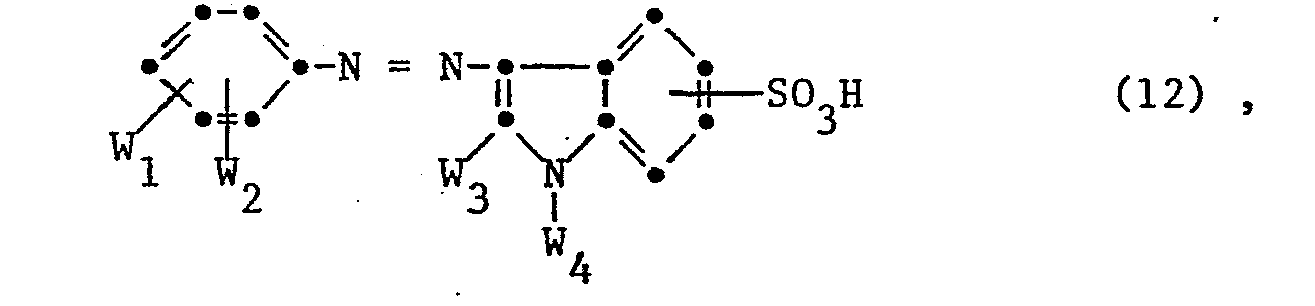
- W 1 is C 1-4 -alkyl, it is methyl, ethyl, n-propyl, isopropyl, n-butyl, sec-butyl, isobutyl or tert-butyl.
- WC 1-4 is alkoxy, then it is methoxy, ethoxy, n-propoxy, isopropoxy, n-butoxy, sec-butoxy, isobutoxy or tert-butoxy.
- W is C2-4-alkanoylamino, it is, for example, acetylamino, propionylamino or butyrylamino.
- aryl preferably means a radical of the benzene or naphthalene series which can be further substituted, for example by C 1-4 alkyl groups, such as methyl and ethyl, C 1-4 alkoxy groups such as methoxy and ethoxy, halogen such as fluorine, chlorine and bromine, alkanoylamino groups having 1 to 6 carbon atoms such as acetylamino and hydroxy.
- W and / or W 2 is halogen, it is fluorine, chlorine or bromine.
- W 2 is an optionally substituted aryloxy or aryloxysulfonyl radical
- aryl means a radical of the benzene or naphthalene series which may be further substituted, for example by C 1-4 alkyl groups, such as methyl and ethyl, C 1-4 alkoxy groups, such as methoxy and ethoxy, halogen such as fluorine, chlorine and bromine, alkanoylamino groups having 1 to 6 carbon atoms such as acetylamino and hydroxy.
- W 2 , W 3 , W 5 or W 6 represent an optionally substituted alkyl radical, it is preferably, independently of one another, a straight-chain or branched C 1-12 -alkyl, in particular C 1-4 -alkyl radical, which can be further substituted, for example by halogen, such as fluorine, chlorine or bromine, hydroxy, cyano, C 1-4 alkoxy, such as methoxy or ethoxy, and alkanoyl groups with 1 to 6 carbon atoms, such as the acetyl or propionyl group, and the benzoyl group.
- the alkyl radical W 3 can also be substituted by sulfo.
- W 2 , W 3 , W 5 and W 6 as alkyl radicals are: methyl, ethyl, propyl, isopropyl, butyl, sec-butyl, tert-butyl, isobutyl and trifluoromethyl.
- W 3 , W 5 and W 6 are an optionally substituted aryl radical, then this independently of one another preferably belongs to the benzene or naphthalene series; it can be further substituted, for example by C 1-4 alkyl groups, such as methyl, C 1-4 alkoxy groups such as methoxy and ethoxy, halogen such as fluorine, chlorine or bromine, trifluoromethyl, alkanoylamino groups having 1 to 6 carbon atoms such as acetylamino, hydroxy and carboxy.
- the aryl radical W 3 can also be substituted by sulfo.
- W 3 , W 5 and W 6 as aryl radical is a phenyl radical which can be substituted by methyl, trifluoromethyl and chlorine.
- W 4 is an alkyl radical
- a straight-chain or branched C 1-12 -alkyl and in particular C 1-8 -alkyl radical is preferred. Examples include: methyl, ethyl, propyl, isopropyl, butyl, sec-butyl, tert-butyl, isobutyl, pentyl- (1), pentyl- (3), heptyl- (1), heptyl- (3) and octyl- (l).
- W 5 and W 6 are an optionally substituted cycloalkyl radical
- cycloalkyl groups with 5- to 7-membered rings which may be further substituted, for example by C 1-4 -alkyl, such as methyl, are preferably used independently of one another.
- the cyclohexyl group is particularly suitable.
- T in formula (1) preferably denotes a fiber-reactive radical of the aliphatic, aromatic or heterocyclic series which is bonded to the radical Y and / or Y 3 directly or via a bridge member.
- T is preferably directly or via an optionally monoalkylated amino group, such as, for example, -NH-, -N (CH 3 ) -, -N (C 2 H 5 ) - or -N (C 3 H 7 ) - or via a bridge member containing an amino group bound to the radical Y 1 and / or Y 3 .
- an optionally monoalkylated amino group such as, for example, -NH-, -N (CH 3 ) -, -N (C 2 H 5 ) - or -N (C 3 H 7 ) - or via a bridge member containing an amino group bound to the radical Y 1 and / or Y 3 .
- fiber-reactive radicals T from the heterocyclic series should be mentioned, such as, for example, 2,4-dichlorotriazinyl-6, hono- di- or trihalopyrimidinyl radicals, such as 2,4-dichloropyrimidinyl-6-, 2,4,5-tri - chloropyrimidinyl- 6-, 2,4-dichloro-5-nitro- or 5-methyl- or -5-carboxymethyl- or -5-carboxy- or -5-cyano- or -5-vinyl- or -5-sulfo- or - 5-mono-, -di or trichloromethyl or 5-methylsulfonylpyrimidinyl-6-, 2,5-dichloro-4-methylsufonyl-pyrimidinyl-6-, 2-fluoro-4-pyrimidinyl-, 2,6-difluoro-4 -pyrimidinyl-, 2,6-difluoro-5-chloro-4-pyrimi
- Fiber-reactive radicals are chlorine or fluoro-1,3,5-triazine radicals of the formula where the substituents V on the triazine ring are in particular: Halogen, such as chlorine or fluorine, C 1-8 alkoxy, such as methoxy, cyclohexyloxy, phenoxy, C 1-6 alkyl mercapto, such as methyl mercapto, phenyl mercapto, -NH 2 , alkylamino-, N, N-dialkylamino, cycloalkylamino- , N, N-Di-cycloalkylamino, aralkylamino, arylamino groups, mixed substituted amino groups, such as N-alkyl-N-cyclohexylamino and N-alkyl-N-arylamino groups, furthermore amino groups which contain heterocyclic radicals which contain further fused carbocyclic rings may have, and amino groups in which the amino nitrogen atom is a member of an
- alkyl radicals can be straight-chain or branched, low molecular weight or higher molecular weight; alkyl radicals having 1 to 6 carbon atoms are preferred; suitable cycloalkyl, aralkyl and aryl radicals are, in particular, cyclohexyl, benzyl, phenethyl, phenyl and naphthyl radicals; heterocyclic radicals are especially furan, thiophene, pyrazole, pyridine, pyrimidine, quinoline, benzimidazole, benzothiazole and benzoxazole; and as amino groups in which the amino nitrogen atom is a member of an N-heterocyclic ring, preference is given to residues of six-membered N-heterocyclic compounds which may contain nitrogen, oxygen or sulfur as further heteroatoms.
- alkyl, cycloalkyl, aralkyl and aryl radicals mentioned above, the heterocyclic radicals and the N-heterocyclic rings can be further substituted, for example by: halogen, such as fluorine, chlorine and bromine, nitro, cyano, trifluoromethyl, sulfamoyl, carbamoyl, C. 1-4 alkyl, C 1-4 alkoxy, acylamino groups such as acetylamino or benzoylamino, ureido, hydroxy, carboxy, sulfomethyl or sulfo.
- halogen such as fluorine, chlorine and bromine
- sulfamoyl carbamoyl
- acylamino groups such as acetylamino or benzoylamino, ureido, hydroxy, carboxy, s
- amino groups are: -NH 2 , methylamino, ethylamino, propylamino, isopropylamino, butylamino, hexylamino, ⁇ -methoxyethylamino, y-methoxypropylamino, ⁇ -ethoxyethylamino, NN-dimethylamino, N, N-diethylamino, ⁇ -chloroethylamino, ⁇ -cyanoethylamino, y-cyanopropylamino, ⁇ -carboxyethylamino, sulfomethylamino, ⁇ -sulfoethylamino, ⁇ -hydroxyethylamino, N, N-di-ß-hydroxyethylamino, y-hydroxypropylamino, benzylamino, phenethylamino, tolylamino, cyclohexylamin
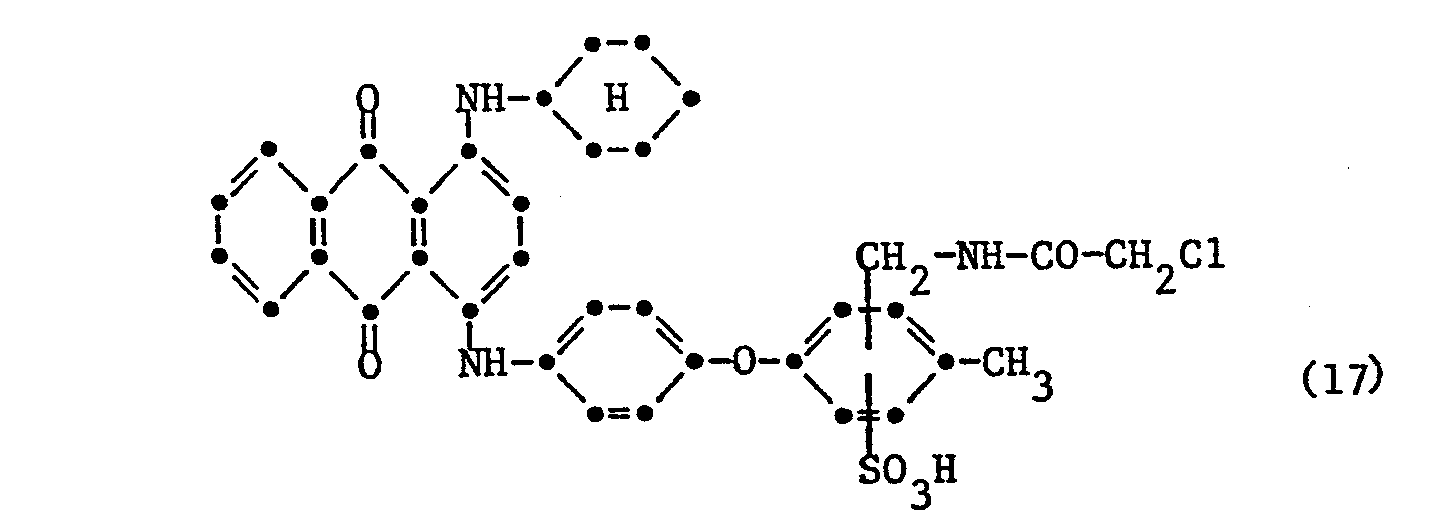
- the dye of the formula (1) in which Y 1 is cyclohexyl, Y 2 is hydrogen and Y 3 is 4- (4'-methylphenoxy) phenyl is preferred, the phenyl ring of the phenoxy group being substituted by sulfo and chloroacetylaminomethyl is substituted.
- a particularly important embodiment of the process according to the invention is characterized in that a blue dye of the formula (13) in which G 1 , G 2 , G 4 and G 5 is hydrogen and G 3 a, ⁇ -dibromopropionylamino, or in which G 1 , G 3 , G 4 and G 5 are hydrogen and G 2 is vinylsulfonyl, chloroacetylamino, 2-methoxy-4-fluoro-s-triazinylamino or 2-ethylamino-4-fluoro-s-triazinylamino, or wherein G 1 is methyl, G 2 2,6-difluoro-f-chloropyrimidinylamino, G 3 and G 5 is hydrogen and G 4 sulfo, or wherein G 1 is methoxy, G 2 , G 3 and G 5 is hydrogen and G 4 ß-sulfato is ethylsulfonyl, or wherein G 1 , G 3 and G 5 are methyl,
- Mixtures of two or more anthraquinone dyes according to the definition can also be used in the process according to the invention.
- a mixture of two anthraquinone dyes is used, the individual components of which each contain one or two fiber-reactive groups and one or two sulfonic acid groups.
- Each individual component of the mixture preferably corresponds to one of the anthraquinone dyes specified above under formula (1).
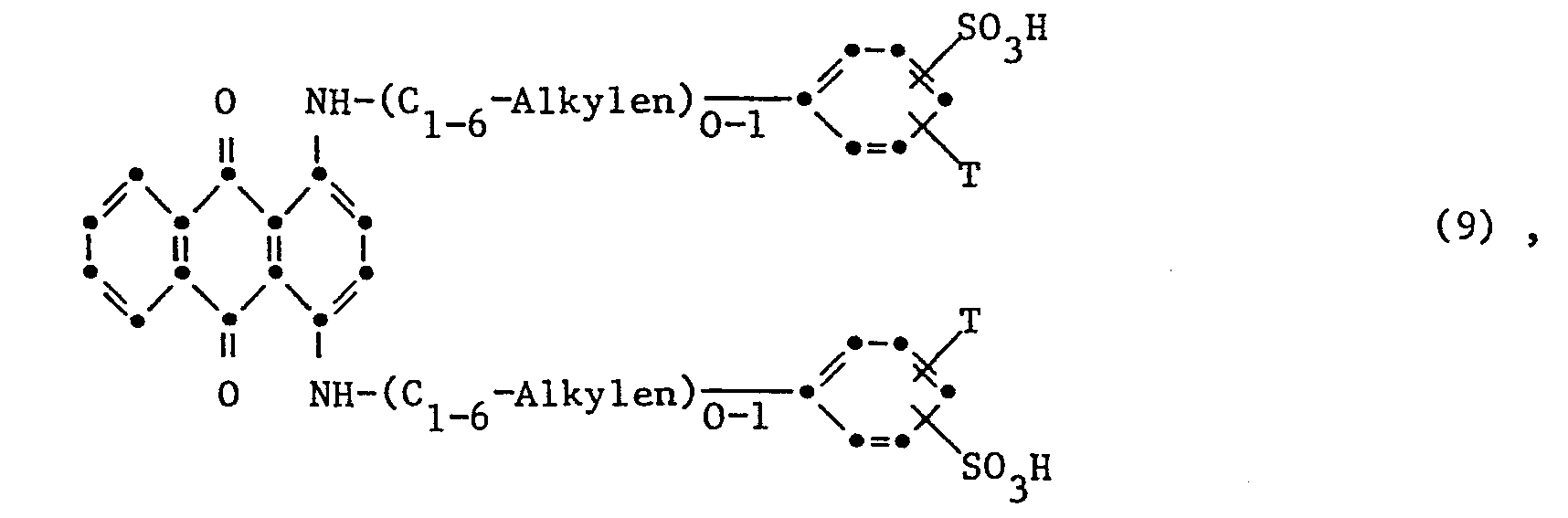
- mixtures of anthraquinone dyes of the formulas (6), (7), (8) or (9) in the process according to the invention i.e. Mixtures in which one component corresponds to a dye of formula (6), (7), (8) or (9) and the other component corresponds to a dye of formula (6), (7), (8) or (9).
- a mixture of two anthraquinone dyes is used, in which one component corresponds to a dye of the formula (6) and the other component corresponds to a dye of the formula (6) or (7).
- anthraquinone dyes which can be used in the process according to the invention is characterized in that one component corresponds to a dye of the formula (14), (15) or a dye of the formula (7), in which Y4 is cyclohexyl, L2 by p -Methylphenoxy is substituted and T is chloroacetylaminomethyl and the dye of formula (7) contains only one sulfo group and the other component corresponds to a dye of formula (13), wherein G 1 , G 2 , G 4 and G 5 are hydrogen, and G 3 a, ⁇ -dibromopropionylamino, or wherein G 1 , G 3 , G 4 and G are hydrogen and G 2 vinylsulfonyl, chloroacetylamino, 2-methoxy-4-fluoro-s-triazinylamino or 2-ethylamino-4-fluoro-s- is triazinylamino, or wherein G 1 is
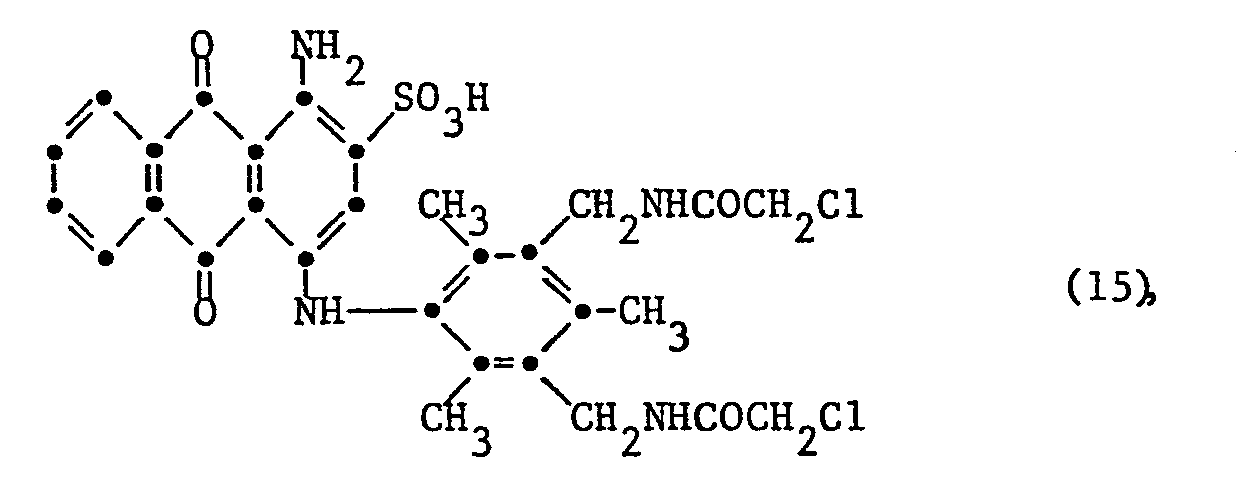
- a particularly important mixture of anthraquinone dyes which can be used in the process according to the invention is characterized in that one component corresponds to the dye of the formula (14) or (15) and the other component corresponds to the dye of the formula (7), in which Y 4 cyclohexyl, L 2 is substituted by p-methylphenoxy and T is chloroacetylaminomethyl and the dye of the formula (7) contains only one sulfo group.
- Another particularly important mixture of anthraquinone dyes which can be used in the process according to the invention is characterized in that one component corresponds to the dye of the formula (14) or (15) and the other component corresponds to the dye of the formula (13), where G 1 , G 2 , G 4 and G are hydrogen and G 3 is chloroacetylamino.
- a very particularly important mixture of anthraquinone dyes which can be used in the process according to the invention is characterized in that one component corresponds to the dye of the formula (15) and the other component corresponds to the dye of the formula (17).
- the weight ratio of the dyes of the formulas (15) to (17) is preferably 90:10 to 70:30, in particular 80:20.
- the weight ratio of the anthraquinone dyes in the mixtures used according to the invention can vary within wide limits.
- a weight ratio of 90:10 to 10:90 and in particular 70:30 to 30:70 has proven to be advantageous.
- the anthraquinone dyes of the formula (1) used in the process according to the invention or the components of the mixtures of the anthraquinone dyes preferably contain only a single sulfonic acid group.
- the process according to the invention is preferably used as the red dye
- red dye of formula (2) wherein A is hydrogen, N-methyl-N-cyclohexylsulfamoyl, phenylsulfonyl, N-ethyl-N-phenylsulfamoyl, phenoxysulfonyl or trifluoromethyl and B is hydrogen, acetylamino or cyclohexyloxycarbonylamino, and in particular
- k) a red dye of the formula (2), in which A is hydrogen and B is acetylamino or cyclohexyloxycarbonylamino or A is trifluoromethyl and B is acetylamino or A is phenylsulfonyl, N-methyl-N-cyclohexylsulfamoyl, N-ethyl-N-phenylsulfamoyl or phenoxysulfonyl and B is hydrogen ; and as a yellow or orange dye of the formula (3) to (5)
- a very particularly preferred embodiment of the process according to the invention is characterized in that a blue dye of the formulas (14), (15), (16) or (17) or a mixture of the dyes of the formulas (15) and (17) in a weight ratio from in particular 70:30 with a red dye of the formulas
- a very particularly important embodiment of the process according to the invention is characterized in that a dye of the formula (14) or (15) is used together with the dye of the formula (22) and the dye of the formula (19).
- the dyes used in the trichromatic dyeing process according to the invention are known or can be prepared analogously to known processes.
- the dyes of the formula (1) according to the specifications of German Offenlegungsschriften 2 305 206 and 3 142 852 of the Swiss patent specification 466.470, the British patent specification 903590, the dyes of the formula (2) according to the specifications of the German patent specifications 702 932 and 2 063 907 of German Offenlegungsschrift 27 12 170 and the dyes of formulas (3) and (4) according to the information in German Offenlegungsschrift 21 42 412 and the German Ausleschrift 11 00 846.
- dye mixtures are used in the process according to the invention, these can be prepared by mixing the individual dyes. This mixing process takes place, for example, in suitable mills, e.g. Ball and pin mills, as well as in kneaders or mixers.
- the dye mixtures of the dyes can be prepared by spray drying the aqueous dye mixtures.
- the dyes used in the process according to the invention are either in the form of their free sulfonic acid or preferably as their salts.
- suitable salts are the alkali metal, alkaline earth metal or ammonium salts or the salts of an organic amine.
- suitable salts include the sodium, lithium, potassium or ammonium salts or the salt of triethanolamine.
- the dyes used in the process according to the invention generally contain further additives such as Cooking salt or dextrin.
- the process according to the invention for trichromatic dyeing can be applied to the customary continuous dyeing processes.
- the dyeing liquors can contain other additives, for example wetting agents, anti-foaming agents, leveling agents or agents influencing the properties of the textile material, such as Plasticizers, flame retardants or dirt, water and oil repellents as well as water softeners and natural or synthetic thickeners such as Alginates and cellulose ethers.
- the process according to the invention is particularly suitable for dyeing from short liquors, such as suitable for continuous dyeing processes and / or continuous foam coloring processes.
- the dyes used in the process according to the invention are distinguished in trichromatic dyeing by uniform color build-up, good draw-up behavior, good constancy of shades even in different concentrations, good fastness properties, in particular very good ozone fastness and good combinability.
- the process according to the invention is suitable for the continuous dyeing of synthetic polyamide materials such as e.g. Nylon or Ferlon, especially polyamide 6.6 and preferably polyamide 6 materials.
- synthetic polyamide materials such as e.g. Nylon or Ferlon, especially polyamide 6.6 and preferably polyamide 6 materials.
- the textile material mentioned can be in a wide variety of processing forms, such as as fiber, yarn, woven or knitted fabric and in particular in the form of carpets.
- the particularly good ozone fastness to be emphasized of the dyeings obtained by the process according to the invention is determined in accordance with the regulations of the American Association of Textile Chemists and Colorists Test Method 109-1975 and 129-1975.
- the amounts in which the dyes or mixtures are used in the dyebaths can vary within wide limits depending on the desired depth of color. In general, amounts of from 0.001 to percent by weight, based on the material to be dyed, have proven to be advantageous.
- the liquor ratio can be selected within a wide range, in particular from 1: 1 to 1: 5 for continuous dyeing processes.
- the dyeing is carried out from an aqueous liquor at temperatures between 60 and 98 ° C.
- Hot padding is preferably carried out or hot sprayed onto the goods.
- the pH of the dye liquor can vary in the range from 5 to 9. In general, a pH of 6 to 8.5 has proven advantageous.
- parts represent parts by weight.
- the temperatures are degrees Celsius.
- the relationship between parts by weight and parts by volume is the same as that between grams and cubic centimeters.
- 0.29 g / 1 of the dye of the formula and 0.57 g / 1 of the dye of the formula and 3 g / 1 of an anionic wetting agent is adjusted to pH 8.2 with Na 3 PO 4 .
- the ozone fastness of the dyeings obtained is carried out in accordance with the test specification AATCC [American Association of Textile Chemists and Colorists] 129-1975 and the color change is assessed on the gray scale (SNV Swiss Standards Association - Standard 95805), with a rating of 1 the worst and a rating of 5 the best rating is.
- the dyeing obtained with the above dyes has an authenticity rating of 4.
- Example 2 An aqueous solution containing 0.15 g / 1 of the dye of the formula
- Example 1 If one proceeds as indicated in Example 1 and instead of the combination of the dyes of the formulas (19), (22) and (15) mentioned in Example 1, the combination of dyes indicated in the following table in Examples 3 to 12 in column II in the amounts given there, carpets dyed in a uniform olive to brown shade with good ozone fastness are obtained, the ozone fastness being assessed as in Example 1 and the authenticity mark being given in column III.
- Example 1 the 0.57 g / l of the dye of the formula (15) is replaced by 1.26 g / l of the non-fiber-reactive dye of the formula If the procedure is otherwise identical, a carpet of brown shade is obtained which, according to the test instructions for ozone fastness [AATCC 129-1975], has a fastness rating of only 2 for changing the color [SNV standard 95805].
- Example 1 the 0.57 g / l of the dye of the formula (15) is replaced by 1.09 g / l of the non-fiber-reactive dye of the formula this gives a carpet dyed in a brown shade which, according to the test instructions given in Comparative Example 1, has a fastness rating of 2 for the ozone fastness.
Landscapes
- Engineering & Computer Science (AREA)
- Textile Engineering (AREA)
- Chemical & Material Sciences (AREA)
- Chemical Kinetics & Catalysis (AREA)
- Organic Chemistry (AREA)
- Coloring (AREA)
- Processes Of Treating Macromolecular Substances (AREA)
Abstract
Description
- Die vorliegende Erfindung betrifft ein Verfahren zum kontinuierlichen Trichromie-Färben von synthetischen Polyamidmaterialien mit mindestens einem blaufärbenden, faserreaktiven sulfogruppenhaltigen Anthrachinonfarbstoff,mindestens einem rotfärbenden, sulfogruppenhaltigen Azofarbstoff und mindestens einem gelb-oder orangefärbenden, sulfogruppenhaltigen Azofarbstoff.
- Bei Trichromie-Färbungen auf synthetischen Polyamidmaterialien wird immer wieder eine den heutigen Anforderungen nicht genügende Ozonechtheit der Färbungen festgestellt.
- Die der vorliegenden Erfindung zugrundeliegende Aufgabe war es, ein Verfahren zum Färben von synthetischen Polyamidmaterialien mit zur Kombination nach dem Trichromie-Prinzip geeigneten Farbstoffen zu finden, welches Färbungen von sehr guter Ozonechtheit ergibt.
- Es wurde nun gefunden, dass man diese Aufgabe erfindungsgemäss durch das nachfolgend beschriebene Verfahren lösen kann. Die so erhaltenen Färbungen genügen den gestellten Anforderungen bezüglich Ozonechtheit.
- Gegenstand der vorliegenden Erfindung ist somit ein Verfahren zum kontinuierlichen Trichromie-Färben von synthetischen Polyamidmaterialien, welches dadurch gekennzeichnet ist, dass man mindestens einen blaufärbenden, faserreaktiven sulfogruppenhaltigen Anthrachinonfarbstoff zusammen mit mindestens einem rotfärbenden, sulfogruppenhaltigen Azofarbstoff und mindestens einem gelb- oder orangefärbenden sulfogruppenhaltigen Azofarbstoff verwendet.
- Unter Trichromie ist die additive Farbmischung passend gewählter gelb- bzw. orange-, rot- und blaufärbender Farbstoffe zu verstehen, mit denen jede gewünschte Nuance des sichtbaren Farbspektrums durch geeignete Wahl der Mengenverhältnisse der Farbstoffe eingestellt werden kann.
- Mit dem erfindungsgemässen Verfahren werden Färbungen von guter bis sehr guter Ozonechtheit erhalten.
- Als blaufärbende, faserreaktive sulfogruppenhaltige Anthrachinonfarbstoffe kommen z.B. die im Colour Index als Reactive Blue angegebenen Anthrachinonfarbstoffe in Betracht.
- Als rot- bzw. gelb- oder orangefärbende sulfogruppenhaltige Azofarbstoffe kommen z.B. die im Colour Index als Acid Red bzw.
- Acid Yellow oder Acid Orange angegebenen Azofarbstoffe in Betracht.
- Eine bevorzugte Ausführungsform des erfindungsgemässen Verfahrens ist dadurch gekennzeichnet, dass man mindestens einen blauen Farbstoff der Formel

- worin der Ring L durch Hydroxy, Halogen oder Sulfo substituiert sein kann, Y1 Wasserstoff, C1-8-Alkyl, C5-7-Cycloalkyl, Phenyl oder Phenyl-C1-3-alkyl, Y2 Wasserstoff oder Halogen, wie Chlor oder Brom sowie vorzugsweise eine Sulfonsäuregruppe, Y3 gegebenenfalls durch C1-4-Alkyl, C1-4-Alkoxy, Phenoxy, Cl-4-Alkylphenoxy oder Naphthoxy substituiertes Phenyl oder Phenyl-C1-8-alkyl und T einen direkt ober ein Brückenglied gebundenen faserreaktiven Rest bedeuten, zusammen mit mindestens einem roten Farbstoff der Formel

- worin A Wasserstoff, gegebenenfalls substituiertes C1-4-Alkyl,

gegebenenfalls substituiertes C5-7-Cycloalkyl oder gegebenenfalls substituiertes Phenyl und R3 gegebenenfalls substituiertes Phenyl oder gegebenenfalls substituiertes Phenoxy ist, und B Wasserstoff, Halogen, C2-4-Alkanoylamino, C5-8-Cycloalkoxycarbonylamino, C1-4-Alkoxycarbonylamino, C1-4-Alkylsulfonylamino oder gegebenenfalls substituiertes Phenylsufonylamino bedeutet, und mindestens einem gelben oder orangen Farbstoff der Formeln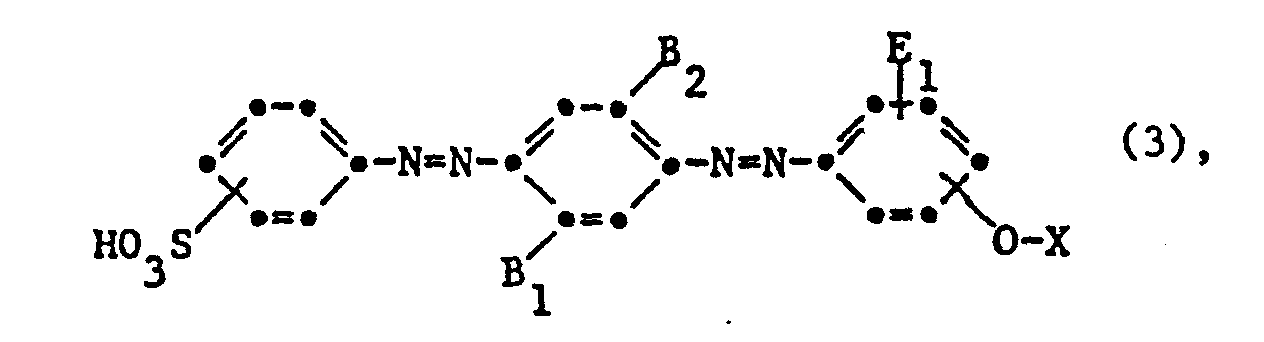
- worin B1, B2 und E1 Wasserstoff, C1-4-Alkyl oder C1-4-Alkoxy und X geradkettiges oder verzweigtes C1-4-Alkyl oder geradkettiges oder verzweigtes C2-4-Hydroxyalkyl bedeuten, oder

- worin Z19 Z2 und Z3 unabhängig voneinander Wasserstoff, Halogen, C1-4-Alkyl oder C1-4-Alkoxy bedeuten, oder Mischungen von Farbstoffen der Formeln (3) und (4), oder einem gelben Farbstoff der Formel
-


ter Alkyl- oder Arylrest, W4 Wasserstoff oder Alkyl und W5 und W6 unabhängig voneinander Wasserstoff oder ein gegebenenfalls substituierter Alkyl-,Cycloalkyl- oder Arylrest ist, verwendet. - Als Alkylrest kommt für Yi in Formel (1) ein geradkettiger oder verzweigter Alkylrest in Betracht, wie beispielsweise Methyl, Aethyl, Propyl, Isopropyl, Butyl, sek.-Butyl, Isobutyl, tert.-Butyl, Pentyl, Hexyl, Heptyl und Octyl.
- Als C5-7-Cycloalkylrest kommt für Y1 in Formel (1) und R2 in Formel (2) unabhängig voneinander beispielsweise der Cyclohexylrest oder ein durch Alkyl, wie Methyl, substituierter Cyclohexylrest in Betracht.
- Als Phenylrest kommt für Y1 in Formel (1) ein gegebenenfalls durch C1-4-Alkyl, C1-4-Alkoxy oder Halogen substituierter Phenylrest in Betracht, der durch eine Sulfonsäuregruppe und einen faserreaktiven Rest weitersubstituiert sein kann; vorzugsweise ist der Phenylrest durch eine Sulfonsäuregruppe und einen faserreaktiven Rest substituiert.
- Als Phenyl-C1-8-alkylrest kommt für Y1 und Y3 in Formel (1) unabhängig voneinander z.B. der Benzyl-, Phenäthyl, Phenylbutyl oder Phenyl-sek.-butyl-Rest in Betracht, der vorzugsweise durch eine Sulfonsäuregruppe und mindestens einen faserreaktiven Rest substituiert ist.
- Bedeutet Y3 in Formel (1) einen Phenylrest, so kommt ein durch C1-4 Alkyl, insbesondere Methyl, C1-4-Alkoxy, insbesondere Methoxy, Phenoxy, C1-4-Alkylphenoxy, wie z.B. p-Methylphenoxy, oder Naphthoxy substituierter Phenylrest in Betracht, der durch eine Sulfonsäuregruppe und vorzugsweise ein oder zwei faserreaktive Reste weitersubstituiert ist.
- Unter faserreaktiven Resten T sind solche zu verstehen, die mit den Hydroxygruppen der Cellulose, den Amino-, Carboxy-, Hydroxy-und Thiolgruppen bei Wolle und Seide, oder mit den Amino- und eventuell Carboxygruppen von synthetischen Polyamiden unter Bildung kovalenter chemischer Bindungen zu reagieren vermögen.
- Als Alkylreste kommen für A, B1, B2, E1, R1, X, Z1, Z2 und Z3 in den Formeln (2), (3) und (4) unabhängig voneinander geradkettige oder verzweigte Alkylreste in Betracht, wie beispielsweise Methyl, Aethyl, Propyl, Isopropyl, Butyl, sek.-Butyl, Isobutyl und tert.-Butyl.
- Der Rest A als Alkylrest kann substituiert sein z.B. durch Halogen, wie Chlor oder Brom und insbesondere Fluor, vorzugsweise ist A als Alkylrest ein C1-4-Perfluoralkylrest, insbesondere der Trifluormethylrest.
- Als gegebenenfalls substituierter Phenylrest kommt für R2 und R3 ein durch C1-4-Alkyl, C1-4-Alkoxy oder Halogen substituierter Phenylrest in Betracht; vorzugsweise ist R2 oder R3 ein unsubstituierter Phenylrest.
- Als gegebenenfalls substituierter Phenoxyrest kommt für R3 ein durch C1-4-Alkyl, insbesondere Methyl, C1-4-Alkoxy oder Halogen, insbesondere Chlor, substituierter Phenoxyrest in Betracht; vorzugsweise ist R3 als Phenoxyrest ein unsubstituierter oder durch Chlor substituierter Phenoxyrest.
- Als Halogen kommt für B, Z1, Z2 und Z3 in den Formeln (2) und (4), Fluor oder Brom und insbesondere Chlor in Betracht.
- Als C2-4-Alkanoylamino kommt für B in Formel (2) beispielsweise der Acetylamino-, Propionylamino- oder Butyrylaminorest in Betracht.
- Als C5-8-Cycloalkoxycarbonylamino kommt für B insbesondere der Cyclohexyloxycarbonylaminorest in Betracht.
- Als C1-4-Alkylsulfonylamino kommt für B der Methyl-, Aethyl-, Propyl-, Isopropyl-, Butyl-, tert.-Butyl-, Isobutyl- oder sek.-Butylsulfonyl- aminorest in Betracht.
- Als Phenylsulfonylaminorest kommt für B ein durch C1-4-Alkyl, C1-4-Alkoxy oder Halogen substituierter Phenylsulfonylaminorest in Betracht; vorzugsweise ein unsubstituierter oder durch Methyl substituierter Phenylsulfonylaminorest.
- Als Alkoxyreste kommen für B1, B2, E1, Z1, Z2 und Z3 in den Formeln (3) und (4) beispielsweise der Methoxy-, Aethoxy-, Propoxy-, Isopropoxy-, Butoxy-, sek.-Butoxy-, Isobutoxy- oder tert.-Butoxyrest in Betracht.
- Als Hydroxyalkylrest kommt für X in Formel (3) ein geradkettiger oder verzweigter Hydroxyalkylrest in Betracht, wie beispielsweise der ß-Hydroxyäthyl-, β-Hydroxypropyl-, β-Hydroxybutyl- oder der α-Aethyl-ß-hydroxyäthylrest.
- Bedeutet W1 C1-4-Alkyl, so handelt es sich um Methyl, Aethyl, n-Propyl, Isopropyl, n-Butyl, sek.-Butyl, Isobutyl oder tert.-Butyl.
- Bedeutet W C1-4-Alkoxy, so handelt es sich um Methoxy, Aethoxy, n-Propoxy, Isopropoxy, n-Butoxy, sek.-Butoxy, Isobutoxy oder tert.-Butoxy.
- Bedeutet W C2-4-Alkanoylamino, so handelt es sich beispielsweise um Acetylamino, Propionylamino oder Butyrylamino.
- Bedeutet W einen gegebenenfalls substituierten Arylsulfonyl-, Aryloxy-oder Arylcarbonylrest, so bedeutet Aryl vorzugsweise einen Rest der Benzol- oder Naphthalinreihe, der weitersubstituiert sein kann, beispielsweise durch C1-4-Alkylgruppen, wie Methyl und Aethyl, C1-4-Alkoxygruppen, wie Methoxy und Aethoxy, Halogen, wie Fluor, Chlor und Brom, Alkanoylaminogruppen mit 1 bis 6 Kohlenstoffatomen, wie Acetylamino, und Hydroxy.
- Bedeutet W und/oder W2 Halogen, so handelt es sich um Fluor, Chlor oder Brom.
- Bedeutet W2 einen gegebenenfalls substituierten Aryloxy- oder Aryloxysulfonylrest, so bedeutet Aryl einen Rest der Benzol- oder Naphthalinreihe, der weitersubstituiert sein kann, beispielsweise durch C1-4-Alkylgruppen, wie Methyl und Aethyl, C1-4-Alkoxygruppen, wie Methoxy und Aethoxy, Halogen, wie Fluor, Chlor und Brom, Alkanoylaminogruppen mit 1 bis 6 Kohlenstoffatomen, wie Acetylamino, und Hydroxy.
- Bedeuten W2, W3, W5 oder W6 einen gegebenenfalls substituierten Alkyrest, so handelt es sich unabhängig voneinander vorzugsweise um einen geradkettigen oder verzweigten C1-12-Alkyl- insbesondere C1-4-Alkylrest, der weitersubstituiert sein kann, z.B. durch Halogen, wie Fluor, Chlor oder Brom, Hydroxy, Cyano, C1-4-Alkoxy, wie Methoxy oder Aethoxy, und Alkanoylgruppen mit 1 bis 6 Kohlenstoffatomen, wie die Acetyl- oder Propionylgruppe, und die Benzoylgruppe. Der Alkylrest W3 kann auch durch Sulfo substituiert sein. Als Beispiele für W2, W3, W5 und W6 als Alkylrest seien genannt: Methyl, Aethyl, Propyl, Isopropyl, Butyl, sek.-Butyl, tert.-Butyl, Isobutyl und Trifluormethyl.
- Bedeuten W3, W5 und W6 einen gegebenenfalls substituierten Arylrest, so gehört dieser unabhängig voneinander vorzugsweise der Benzol- oder Naphthalinreihe an, er kann weitersubstituiert sein, beispielsweise durch C1-4-Alkylgruppen, wie Methyl, C1-4-Alkoxygruppen, wie Methoxy und Aethoxy, Halogen, wie Fluor, Chlor oder Brom, Trifluormethyl, Alkanoylaminogruppen mit 1 bis 6 Kohlenstoffatomen, wie Acetylamino, Hydroxy und Carboxy. Der Arylrest W3 kann auch durch Sulfo substituiert sein. Insbesondere ist W3, W5 und W6 als Arylrest ein Phenylrest, der durch Methyl, Trifluormethyl und Chlor substituiert sein kann.
- Bedeutet W4 einen Alkylrest, so kommt vorzugsweise ein geradkettiger oder verzweigter C1-12-Alkyl- und insbesondere C1-8-Alkylrest in Betracht. Als Beispiele seien genannt: Methyl, Aethyl, Propyl, Isopropyl, Butyl, sek.-Butyl, tert.-Butyl, Isobutyl, Pentyl-(l), Pentyl-(3), Heptyl-(1), Heptyl-(3) und Octyl-(l).
- Bedeuten W5 und W6 einen gegebenenfalls substituierten Cycloalkylrest, so kommen unabhängig voneinander vorzugsweise Cycloalkylgruppen mit 5- bis 7-gliedrigen Ringen in Betracht, die weitersubstituiert sein können, z.B. durch C1-4-Alkyl, wie Methyl. Insbesondere kommt die Cyclohexylgruppe in Betracht.
- Vorzugsweise bedeutet T in Formel (1) einen faserreaktiven Rest der aliphatischen, aromatischen oder heterocyclischen Reihe, der direkt oder über ein Brückenglied an den Rest Y und/oder Y3 gebunden ist.
- Vorzugsweise ist T direkt oder über eine gegebenenfalls monoalkylierte Aminogruppe wie z.B. -NH-, -N(CH3)-, -N(C2H5)- oder -N(C3H7) - oder über ein eine Aminogruppe enthaltendes Brückenglied an den Rest Y1 und/oder Y3 gebunden.
- Als faserreaktive Reste T in Formel (1) kommen z.B. die folgenden aliphatischen und aromatischen Reste in Betracht:
- Vinylsulfonyl-, β-Chloräthylsulfonyl-, β-Sulfatoäthylsulfonyl-, β-Acetoxy-äthylsulfonyl-, Phosphonooxyäthylsulfonyl-, β-Thiosulfato- äthylsulfonyl, N-Methyl-N-(p-sulfatoäthyl-sulfonyl)-amino, Acryloyl, Mono-, Di- oder Trichloracryloyl wie -CO-CCl=CH2,-CO-CH=CH-Cl, -CO-CCl=H-CH3; Mono-, Di- oder Tribromacryloyl wie -CO-CBr=CH2, -CO-CH=CH-Br, -CO-CBr=CH-CH3; sowie -CO-CCl=CH-COOH, -CO-CH=CC1-COOH, -CO-CBr=CH-COOH, -CO-CH-CBr-COOH; -CO-CCl=CCl-COOH, -CO-CBr=CBr-COOH; Vorstufen des Acryloyl-Restes und der Derivate des Acryloyl-Restes wie β-Chlor- oder β-Brompropionyl, 3-Phenylsulfonylpropionyl, 3-Methylsulfonylpropionyl, 3-Chlor-3-phenylsulfonylpropionyl, 2,3-Dichlorpropionyl, 2,3-Dibrompropionyl; sowie 2-Fluor-2-chlor-3,3-di- fluorcyclobutan-l-carbonyl, 2,2,3,3-Tetrafluorcyclobutan-carbonyl-1-oder sulfonyl-l-, β-(2,2,3,3-Tetrafluorcyclobutyl-1)-acryloyl, L- oder β-Alk yl- oder Arylsulfonyl-acryloyl-Gruppe wie L- oder β-Methylsulfonylacryloyl, Propiolyl, Chloracetyl, Bromacetyl, 4-(p-Chloräthyl-sulfonyl)-butyryl, 4-Vinylsulfonyl-butyryl, 5-(ß-Chloräthyl-sulfonyl)-valeryl, 5-Vinylsulfonyl-valeryl, 6-(p-Chloräthyl-sulfonyl)-caproyl, 6-Vinylsulfonyl-carproyl; sowie 4-Fluor-3-nitro-benzoyl, 4-Fluor-3-nitrophenyl sulfonyl, 4-Fluor-3-methyl- sulfonylbenzoyl, 4-Fluor-3-cyanbenzoyl, 2-Fluor-5-methylsulfonyl- benzoyl.
- Des weiteren sind faserreaktive Reste T der heterocyclischen Reihe zu nennen, wie z.B. 2,4-Dichlortriazinyl-6-, Hono- Di- oder Trihalogenpyrimidinylreste, wie 2,4-Dichlorpyrimidinyl-6-, 2,4,5-Tri- chlorpyrimidinyl-6-, 2,4-Dichlor-5-nitro- oder 5-methyl- oder -5-carboxymethyl- oder -5-carboxy- oder -5-cyano- oder -5-vinyl-oder -5-sulfo- oder -5-mono-, -di- oder trichlormethyl- oder 5-methylsulfonylpyrimidinyl-6-, 2,5-Dichlor-4-methylsufonyl-pyrimidinyl-6-, 2-Fluor-4-pyrimidinyl-,2,6-Difluor-4-pyrimidinyl-,2,6-Difluor-5-chlor-4-pyrimidinyl-, 2-Fluor-5,6-dichlor-4-pyrimidinyl-, 2,6-Difluor-5-methyl-4-pyrimidinyl-, 2,5-Difluor-6-methyl-4-pyrimidinyl-, 2-Fluor-5-methyl-6-chlor-4-pyrimidinyl-, 2-Fluor-5-nitro-6-chlor-4-pyrimidinyl-, 2-Fluor-5-nitro-6-chlor-4-pyrimidinyl-,5-Brom-2-fluor-4-pyrimidinyl-, 2-Fluor-S-cyan-4-pyrimidinyl-, 2-Fluor-5-methyl-4-pyrimidinyl-, 2,5,6-Trifluor-4-pyrimidinyl-, 5-Chlor-6-chlormethyl-2-fluor-4-pyrimidinyl-, 2,6-Difluor-S-brom-4-pyrimidinyl-, 2-Fluor-5-brom-6-chlormethyl-4-pyrimidinyl-, 2,6-Difluor-5-chlormethyl-4-pyrimidinyl-, 2,6-Difluor-5-nitro-4-pyrimidinyl-, 2-Fluor-6-methyl-4-pyrimidinyl-, 2-Fluor-5-chlor-6-methyl-4-pyrimidinyl-, 2-Fluor-5-chlor-4-pyrimidinyl-, 2-Fluor-6-chlor-4-pyrimidinyl-, 6-Trifluormethyl-5-chlor-2-fluor-4-pyrimidinyl, 6-Trifluormethyl-2-fluor-4-pyrimidinyl-, 2-Fluor-5-nitro-4-pyrimidinyl, 2-Fluor-5-trifluormethyl-4-pyrimidinyl-, 2-Fluor-5-phenyl-oder 5-methylsulfonyl-4-pyrimidinyl-, 2-Fluor-5-carbonamido-4-pyrimidinyl-, 2-Fluor-5-carbomethoxy-4-pyrimidinyl-, 2-Fluor-5-brom-6-trifluormethyl-4-pyrimidinyl-, 2-Fluor-6-carbonamido-4-pyrimidinyl-, 2-Fluor-6-carbomethoxy-4-pyrimidinyl-, 2-Fluor-6-phenyl-4-pyrimidinyl-, 2-Fluor-6-cyan-4-pyrimidinyl-, 2,6-Difluor-5-methylsulfonyl-4-pyrimidinyl-, 2-Fluor-5-sulfonamido-4-pyrimidinyl-, 2-Fluor-5-chlor-6-carbomethoxy-4-pyrimidinyl-, 2,6-Difluor-5-trifluormethyl-4-pyrimidinyl; 2,4-Bis-methylsulfonyl-pyrimidinyl-4-, 2,5-Bis-methylsulfonyl-5-chlor-pyrimidinyl-4-, 2-Methylsulfonyl-pyrimidinyl-4-, 2-Phenylsulfonyl-pyrimidinyl-4-, 2-Methylsulfonyl-S-chlor-6-methyl- pyrimidinyl-4-, 2-Methylsulfonyl-5-brom-6-methyl-pyrimidinyl-4-, 2-Methylsulfonyl-5-chlor-6-äthyl-pyrimidinyl-4-, 2-Methylsulfonyl-5-chlor-methyl-pyrimidinyl-4-, 2-Methylsulfonyl-5-aitro-6-methyl- pyrimidinyl-4-, 2,5,6-Tris-methylsulfonyl-pyrimidinyl-4-, 2-Methylsulfonyl-5,6-dimethyl-pyrimidinyl-4-, 2-Aethylsulfonyl-5-chlor-6-methyl-pyrimidinyl-4-, 2-Methylsulfonyl-6-chlor-pyrimidinyl-4-, 2,6-Bis-methylsulfonyl-S-chlor-pyrimidinyl-4-, 2-Methylsulfonyl-6-carboxy- pyrimidinyl-4-, 2-Methylsulfonyl-5-sulfo-pyrimidinyl-4-, 2-Methylsulfonyl-6-carbomethoxy-pyrimidinyl-4-, 2-Methylsulfonyl-5-carboxy- pyrimidinyl-4-, 2-Methylsulfonyl-5-cyan-6-methoxy-pyrimidinyl-4-, 2-Methylsulfonyl-5-chlor-pyrimidinyl-4-, 2-Sulfoäthylsulfonyl-6-methyl-pyrimidinyl-4-, 2-Methylsulfonyl-5-brom-pyrimidinyl-4-, 2-Phenylsulfonyl-S-chlor-pyrimidinyl-4-, 2-Carboxymethylsulfonyl-S-chlor-6-methyl-pyrimidinyl-4-, 2,4-Dichlorpyrimidin-6-carbonyl oder 6-sulfonyl, 2,4-Dichlorpyrimidin-S-carbonyl- oder 5-sulfonyl, 2-Chlor-4-methylpyrimidin-5-carbonyl, 2-Methyl-4-chlorpyrimidin-5-carbonyl, 2-Methylthio-4-fluorpyrimidin-5-carbonyl, 6-Methyl-2,4-dichlorpyrimidin-5-carbonyl, 2,4,6-Trichlorpyrimidin-S-carbonyl, 2,4-Dichlorpyrimidin-5-sulfonyl, 2,4-Dichlor-6-methyl-pyrimidin-S-carbonyl oder 5-sulfonyl, 2-Methylsulfonyl-6-chlorpyrimidin-4- und 5-carbonyl, 2,6-Bis-(methylsulfonyl)-pyrimidin-4- oder -5-carbonyl, 2-Ethylsulfonyl-6-chlorpyrimidin-5-carbonyl, 2,4-Bis-(methylsulfonyl)-pyrimidin-5-sulfonyl, 2-Methylsulfonyl-4-chlor-6-methylpyrimidin-5-sulfonyl- oder -5-carbonyl, 2-Chlorchinoxalin-3-carbonyl, 2- oder 3-Monochlorchinoxalin-6-carbonyl, 2- oder 3-Monochlorchinoxalin-6-sulfonyl, 2,3-Dichlorchinoxalin-5- oder -6-carbonyl, 2,3-Dichlor- chinoxalin-5- oder -6-sulfonyl, 1,4-Dichlorphthalazin-6-sulfonyl- oder -6-carbonyl, 2,4-Dichlorchinazolin-7- oder -6-sulfonyl- oder carbonyl, 2,4,6-Trichlorchinazolin-7- oder -8-sulfonyl, 2- oder 3- oder 4-(4',5'-Dichlorpyridazon-6'-yl-1')-phenylsulfonyl- oder carbonyl, β-(4',5'-Di- chlorpyridazinon-6'-yl-l')-propionyl, 3,6-Dichlorpyridazin-4-carbonyl-oder 4-sulfonyl, 2-Chlorbenzthiazol-5- oder 6-carbonyl- oder -5-oder -6-sulfonyl, 2-Arylsulfonyl- oder -Alkylsulfonylbenzthiazol-5-oder -6-carbonyl- oder -5- oder -6-sulfonyl, vie 2-Methylsulfonyl-oder 2-Ethylsulfonylbenzthiazol-5- oder -6-sulfonyl- oder -carbonyl, 2-Phenylsulfonyl-benzthiazol-5- oder -6-sulfonyl- oder carbonyl und die entsprechenden im ankondensierten Benzolring Sulfogruppen enthaltenden 2-Sulfonylbenzthiazol-5- oder -6-carbonyl- oder -aulfonyl-Derivate, 2-Chlorbenzoxazol-5- oder.-6-carbonyl- oder -sulfonyl, 2-Chlorbenzimidazol-5- oder -6-carbonyl- oder -sulfonyl, 2-Chlor-l-methylbenzimidazol-5- oder -6-carbonyl- oder -sulfonyl, 2-Chlor-4-methylthiazol-(1,3)-5-carbonyl) oder -4- oder -5-sulfonyl; ammoniumgruppenhaltige Triazinringe, wie 2-Trimethylammonium-4-phenylamino- oder -4-(0-, m- oder p-sulfophenyl)-amino-triazinyl-6-, 2-(l,l-Dimethylhydrazinium)-4-phenylamino- oder -4-(o-, m- oder p-sulfophenyl)-aminotriazinyl-6-, 2-(2-Isopropyliden-1,1-dimethyl)-hydrazinium-4-phenylamino- oder -4-(o-, m- oder p-sulfophenyl)-ami- notriazinyl-6-, 2-N-Aminopyrrolidinium- oder 2-N-Aminopiperidinium-4-phenylamino-oder -4-(o-, m- oder p-sulfophenyl)-aminotriazinyl-6-, ferner 4-Phenylamino- oder 4-(aulfophenylamino)-triazinyl-6-Reste, die in 2-Stellung über eine Stickstoffbindung das 1,4-Bis-aza-bicyc- lo[2,2,2]-octan oder das 1,2-Bis-aza-bicyclo-[0,3,3]-octan quartär gebunden enthalten, 2-Pyridinium-4-phenylamino- oder -4-(o-, m- oder p-sulfophenyl)-amino-triazinyl-6- sowie entsprechende 2-0niumtriazi- nyl-6-Reste, die in 4-Stellung durch Alkylamino-, wie Methylamino, Aethylamino- oder β-Hydroxy-äthylamino-, oder Alkoxy-, wie Methoxy-oder Aethoxy-, oder Aryloxy-, wie Phenoxy-, oder Sulfophenoxy-Gruppen substituiert sind.
- Ferner interessante faserreaktive Reste sind Chlor- oder Fluor-1,3,5-triazinreste der Formel

wobei als Substituenten V am Triazinring insbesondere zu nennen sind: Halogen, wie z.B. Chlor oder Fluor, C1-8-Alkoxy, wie z.B. Methoxy, Cyclohexyloxy, Phenoxy, C1-6-Alkylmercapto, wie Methylmercapto, Phenylmercapto, -NH2, Alkylamino-, N,N-Dialkylamino, Cycloalkylamino-, N,N-Di- cycloalkylamino-, Aralkylamino-, Arylaminogruppen, gemischt substituierte Aminogruppen, wie N-Alkyl-N-cyclohexylamino- und N-Alkyl-N-arylaminogruppen, ferner Aminogruppen, die heterocyclische Reste enthalten, welche weitere ankondensierte carbocyclische Ringe aufweisen können, und Aminogruppen, worin das Aminostickstoffatom Glied eines N-heterocyclischen Ringes ist, der gegebenenfalls weitere Heteroatome enthält, sowie Hydrazino und Semicarbazido. Die oben genannten Alkylreste können geradkettig oder verzweigt, niedrigmolekular oder höhermolekular sein, bevorzugt sind Alkylreste mit 1 bis 6 Kohlenstoffatomen; als Cycloalkyl-, Aralkyl- und Arylreste kommen insbesondere Cyclohexyl-, Benzyl-, Phenäthyl-, Phenyl- und Naphthylreste in Frage; heterocyclische Reste sind vor allem Furan-, Thiophen-, Pyrazol-, Pyridin-, Pyrimidin-, Chinolin-, Benzimidazol-, Benzthiazol- und Benzoxazolreste; und als Aminogruppen, worin das Aminostickstoffatom Glied eines N-heterocyclischen Ringes ist, kommen vorzugsweise Reste von sechsgliedrigen N-heterocyclischen Verbindungen in Betracht, die als weitere Heteroatome Stickstoff, Sauerstoff oder Schwefel enthalten können. Die oben genannten Alkyl-, Cycloalkyl-, Aralkyl- und Arylreste, die heterocyclischen Resten sowie die N-heterocyclischen Ringe können weitersubstituiert sein, z.B. durch: Halogen, wie Fluor, Chlor und Brom, Nitro, Cyan, Trifluormethyl, Sulfamoyl, Carbamoyl, C1-4-Alkyl, C1-4-Alkoxy, Acylaminogruppen, wie Acetylamino oder Benzoylamino, Ureido, Hydroxy, Carboxy, Sulfomethyl oder Sulfo. Als Beispiele für derartige Aminogruppen seien genannt: -NH2, Methylamino, Aethylamino, Propylamino, Isopropylamino, Butylamino, Hexylamino, ß-Methoxy- äthylamino, y-Methoxypropylamino, β-Aethoxyäthylamino, N.N-Dimethyl- amino, N,N-Diäthylamino, β-Chloräthylamino, β-Cyanäthylamino, y-Cyanpropylamino, β-Carboxyäthylamino, Sulfomethylamino, β-Sulfoäthylamino, β-Hydroxyäthylamino, N,N-Di-ß-hydroxyäthylamino, y-Hydroxypropylamino, Benzylamino, Phenäthylamino, Cyclohexylamino, Phenylamino, Toluidino, Xylidino, Chloranilino, Anisidino, Phenetidino, N-Methyl-N-phenylamino, N-Aethyl-N-phenylamino, N-ß-Hydroxyäthyl-N-phenylamino, 2-, 3- oder 4-Sulfoanilino, 2,5-Disulfoanilino, 4-Sulfomethylanilino, N-Sulfomethylanilino, 2-, 3- oder 4-Carboxyphenylamino, 2-Carboxy-5-sulfophenylamino, 2-Carboxy-4-sulfophenylamino, 4-Sulfonaphthyl-(1)-amino, 3,6-Disulfo- naphthyl-(l)-amino, 3,6,8-Trisulfonaphthyl-(1)-amino, 4,6,8-Trisulfo- naphthyl-(1)-amino, 1-Sulfonaphthyl-(2)-amino, 1,5-Disulfonaphthyl-(2)-amino, 6-Sulfonaphthyl-(2)-amino, Morpholino, Piperidino, Piperazino, Hydrazino und Semicarbazido. - Besonders bevorzugte Ausführungsformen des erfindungsgemässen Verfahrens sind dadurch gekennzeichnet, dass man
- a) einen blauen Farbstoff der Formel

- worin T die unter Formel (1) angegebene Bedeutung hat und der Phenylring L gegebenenfalls durch C1-4-Alkyl, C1-4-Alkoxy oder Phenoxy ein-, zwei-, drei- oder vierfach substituiert ist, oder einen blauen Farbstoff der Formel
-

-

-
- b) mindestens einen roten Farbstoff der Formel (2), worin A Wasserstoff, Methyl, Trifluormethyl,

ist, wobei R1 Methyl oder Aethyl, R2 Cyclohexyl oder Phenyl und R3 Phenyl, Methylphenyl, Phenoxy oder Chlorphenoxy ist und B Wasserstoff, Chlor, Acetylamino, Propionylamino, Cyclohexyloxycarbonylamino, Phenylsulfonylamino oder Methylphenylsulfonylamino ist, verwendet, wobei A und B zusammen nicht beide Wasserstoff bedeuten; und - c) mindestens einen gelben oder orangen Farbstoff der Formel
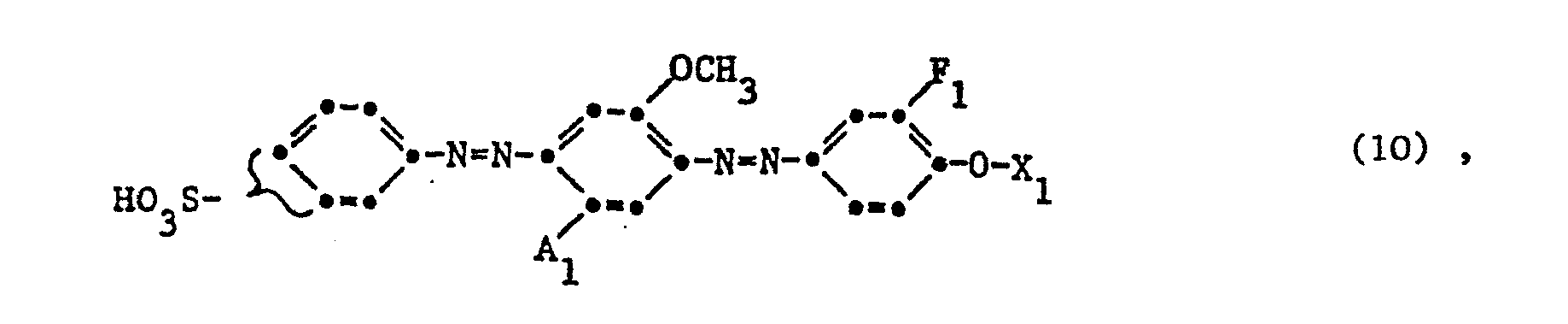
- worin A1 Wasserstoff oder Methyl, F1 Wasserstoff oder Methyl und X1 Methyl, Aethyl, ß-Hydroxyäthyl, β-Hydroxypropyl, β-Hydroxybutyl oder a-Aethyl-ß-hydroxyäthyl ist, oder eine Mischung aus mindestens einem Farbstoff der Formel (10) und einem gelben Farbstoff der Formel
-
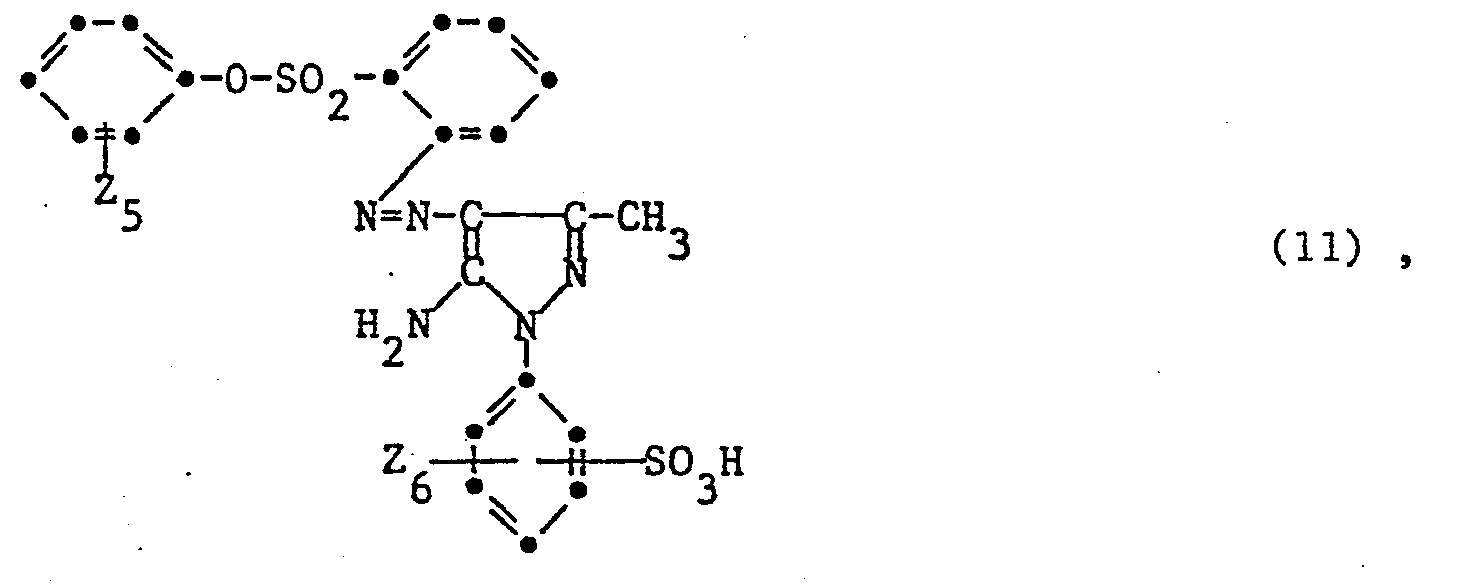
-
Besonders interessante Ausführungsformen des erfindungsgemässen Verfahrens sind dadurch gekennzeichnet, dass man
- d) einen Farbstoff der Formeln (6) oder (7) verwendet;
- e) Anthrachinonfarbstoffe der Formeln (6) bis (9), insbesondere der Formeln (6) oder (7) verwendet, worin T ein gegebenenfalls über ein Brückenglied der Formel


aromatischen oder heterocyclischen Reihe ist, und R4 Wasserstoff oder C1-4-Alkyl bedeutet; - f) Anthrachinonfarbstoffe der Formeln (6) bis (9) verwendet, worin T einen über -NH,


oder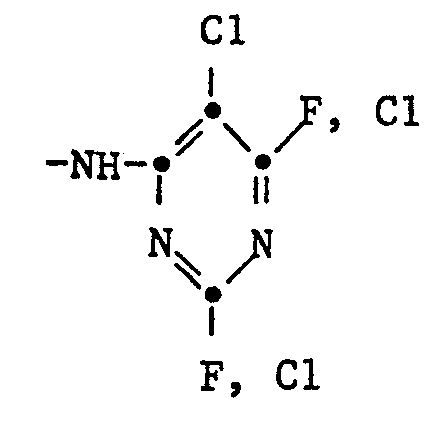
worin R5 C1-6-Alkoxy, C1-6-Alkylmercapto oder ein Rest der Formel
C1-6-Alkyl oder gegebenenfalls substituiertes Phenyl oder Naphthyl bedeuten, oder einen Vinylsulfonyl-, β-Sulfatoäthylsulfonyl-, β-Acetoxyäthylsulfonyl-, β-Chloräthylsulfonyl oder β-(β'-Sulfatoäthylsulfonyl)-propionylaminomethyl-Rest bedeutet; - g) vorzugsweise einen blauen Anthrachinonfarbstoff der Formel
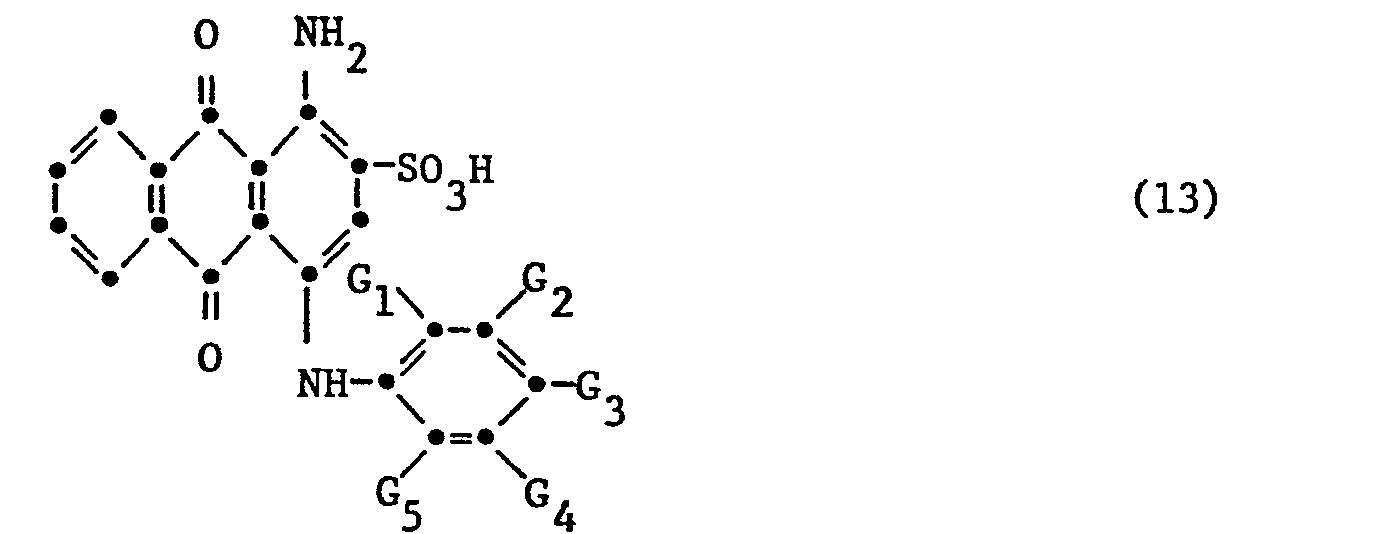
verwendet, worin G1, G3 und G5 Methyl, G4 a,ß-Dibrompropionylamino- methyl, a-Chlor- oder a-Bromacryloylaminomethyl, ß-(ß'-Sulfatoäthylsulfonyl)-propionylaminomethyl, a,ß-Dibrompropionylamino,
oder Chloracetylaminomethyl und G2 Wasserstoff, Sulfo oder Chloracetylaminomethyl oder -CH(COOH)-NH-CO-CHBr-CH2Br ist, oder worin G1 Wasserstoff oder Methoxy, G2, G3 und G5 Wasserstoff und G4 Sulfatoäthylsulfonyl, Chloracetylamino, a,ß-Dibrompropionylamino, Vinylsulfonyl, 2-Methoxy-4-fluor-s-triazinylamino oder 2-Aethylamino-4-fluor-s-triazinylamino ist, oder worin G1, G2, G4 und G5 Wasserstoff und G3 Chloracetylamino oder a,ß-Dibrompropionylamino, 2,6-Difluor-5- chlorpyrimidin-4-ylamino, 2-Chlor-4-amino- oder 4-N,N-dimethylamino-s-triazinylamino ist, oder worin G Methyl, G2 β-Sulfatoäthylsulfonyl und G3, G4 und G5 Wasserstoff ist, oder worin G1 oder G2 Sulfo, G3 α-Bromacryloylamino oder N-Methyl-N-[3-(ß-chloräthylsulfonylbenzoyl]-amino und G2 oder G1 und G4 und G5 Wasserstoff ist, oder G1, G2 und G5 Wasserstoff, G3 Methyl und G4 Chloracetylamino ist, oder worin G Methyl, G2 2,6-Difluor-5-chlorpyrimidinylamino, G4 Sulfo und G3 und G5 Wasserstoff ist; und - h) insbesondere einen Farbstoff der Formel (13) verwendet, worin G1, G2, G4 und G5 Wasserstoff und G3 Chloracetylamino oder a,ß-Dibrompropionyl- amino ist, oder worin G1, G2, G3 und G5 Wasserstoff und G4 Vinylsulfonyl, Chloracetylamino, 2-Methoxy- oder 2-Aethylamino-4-fluor-s-triazinylamino ist, oder worin G1, G3 und G5 Methyl, G2 Wasserstoff und G4 Chloracetylaminomethyl, a,ß-Dibrompropionylaminomethyl oder -CH(COOH)-NH-CO-CHBr-CH2Br ist, oder worin G1 Methoxy, G2, G3 und G5 Wasserstoff und G4 β-Sulfatoäthylsulfonyl ist, oder worin G1, G3 und G5 Wasserstoff und G2 und G4 Chloracetylaminomethyl oder -CH(COOH)-NH-CO-CHBr-CH2Br ist, oder worin G1, G3 und G5 Methyl, G2 a,ß-Dibrompropionylamino und G4 Sulfo ist, oder worin G1 Sulfo, G2, G4 und G5 Wasserstoff und G3 a-Bromacryloylamino ist, oder worin G1 Methyl, G2 2,6-Difluor-5-chlor- pyrimidylamino, G3 und G5 Wasserstoff und G4 Sulfo ist; oder
- i) einen blauen Farbstoff der Formel (1) verwendet, worin Y1 Cyclohexyl, Y2 Wasserstoff, Y3 4-(4'-Methylphenoxy)-phenyl und T Chloracetylaminomethyl ist und der Farbstoff eine einzige Sulfonsäuregruppe enthält, oder worin Y1 Isopropyl, Y2 Wasserstoff und Y3 ein Phenyl-sek.-butylrest ist, der im Phenylring durch Sulfo und Chloracetylaminomethyl substituiert ist, oder ein Diphenylätherrest ist, der im Phenoxyrest durch Sulfo und Acryloylaminomethyl substituiert ist, oder worin Y1 und Y3 je einen Phenyl-sek.-butylrest bedeuten, der im Phenylring durch Sulfo und Chloracetylaminomethyl substituiert ist, und Y2 Wasserstoff ist, oder worin Y1 und Y3 je einen 4-a-Bromacryloylamino-3-sulfophenylrest bedeuten und Y2 Wasserstoff ist.
- Von den unter i) angegebenen Farbstoffen ist der Farbstoff der Formel (1), worin Y1 Cyclohexyl, Y2 Wasserstoff und Y3 4-(4'-Methylphenoxy)-phenyl ist, bevorzugt, wobei der Phenylring der Phenoxygruppe durch Sulfo und Chloracetylaminomethyl substituiert ist.
- Eine besonders wichtige Ausführungsform des erfindungsgemässen Verfahrens ist dadurch gekennzeichnet, dass man einen blauen Farbstoff der Formel (13), worin G1, G2, G4 und G5 Wasserstoff und G3 a,ß-Dibrom- propionylamino ist, oder worin G1, G3, G4 und G5 Wasserstoff und G2 Vinylsulfonyl, Chloracetylamino, 2-Methoxy-4-fluor-s-triazinylamino oder 2-Aethylamino-4-fluor-s-triazinylamino ist, oder worin G1 Methyl, G2 2,6-Difluor-f-chlorpyrimidinylamino, G3 und G5 Wasserstoff und G4 Sulfo ist, oder worin G1 Methoxy, G2, G3 und G5 Wasserstoff und G4 ß-Sulfatoäthylsulfonyl ist, oder worin G1, G3 und G5 Methyl, G2 Wasserstoff oder -CH(COOH)-NH-CO-CHBr-CH2Br und G4 a,ß-Dibrompropionylaminomethyl oder -CH(COOH)-NH-CO-CHBr-CH2Br ist, oder worin G1, G3 und G5 Methyl, G2 a,ß-Dibrompropionylamino und G4 Sulfo ist, oder worin G1 Sulfo, G2, G4 und G5 Wasserstoff und G3 a-Bromacryloylamino ist, zusammen mit einem roten Farbstoff der Formel (2) und den gelben bzw. orangen Farbstoffen der Formeln (3) und/oder (4) oder (5) verwendet.
- Ganz besonders wichtige Ausführungsformen des erfindungsgemässen Verfahrens sind dadurch gekennzeichnet, dass man den blauen Farbstoff der Formel

- oder den Farbstoff der Formel
-
-

verwendet. - In dem erfindungsgemässen Verfahren können auch Mischungen von zwei oder mehr definitionsgemässen Anthrachinonfarbstoffen verwendet werden. Insbesondere verwendet man eine Mischung aus zwei Anthrachinonfarbstoffen, deren Einzelkomponenten je ein oder zwei faserreaktive Gruppen und ein oder zwei Sulfonsäuregruppen enthalten.
- Vorzugsweise entspricht jede Einzelkomponente der Mischung einem der unter Formel (1) weiter oben angegebenen Anthrachinonfarbstoffe.
- Ganz besonders bevorzugt verwendet man in dem erfindungsgemässen Verfahren Mischungen von Anthrachinonfarbstoffen der Formeln (6), (7), (8) oder (9), d.h. Mischungen worin eine Komponente einem Farbstoff der Formel (6), (7), (8) oder (9) entspricht, und die andere Komponente einem Farbstoff der Formel (6), (7), (8) oder (9) entspricht. Insbesondere verwendet man eine Mischung aus zwei Anthrachinonfarbstoffen, worin eine Komponente einem Farbstoff der Formel (6) entspricht und die andere Komponente einem Farbstoff der Formel (6) oder (7) entspricht.
- Eine wichtige Mischung von Anthrachinonfarbstoffen, die in dem erfindungsgemässen Verfahren verwendet werden kann, ist dadurch gekennzeichnet, dass eine Komponente einem Farbstoff der Formel (14), (15) oder einem Farbstoff der Formel (7) entspricht, worin Y4 Cyclohexyl, L2 durch p-Methylphenoxy substituiert ist und T Chloracetylaminomethyl ist und der Farbstoff der Formel (7) nur eine Sulfogruppe enthält, und die andere Komponente einem Farbstoff der Formel (13) entspricht, worin G1, G2, G4 und G5 Wasserstoff, und G3 a,ß-Dibrompropionylamino ist, oder worin G1, G3, G4 und G Wasserstoff und G2 Vinylsulfonyl, Chloracetylamino, 2-Methoxy-4-fluor-s-triazinylamino oder 2-Aethylamino-4-fluor-s-triazinylamino ist, oder worin G1 Methyl, G2 2,6-Difluor-5-chlorpyrimidinylamino, G3 und G5 Wasserstoff und G4 Sulfo ist, oder worin G1 Sulfo, G2, G4 und G Wasserstoff und G3 a-Bromacryloylamino ist, oder worin G1, G3 und G5 Methyl, G2 a,ß-Dibrompropionylaminomethyl, -CH(COOH)-NH-CO-CHBr-CH2Br oder a,ß-Dibrompropionylamino und G4 Wasserstoff, -CH(COOH)-NH-CO-CHBr-CH2Br oder Sulfo ist, oder worin G Methoxy, G2, G3 und G5 Wasserstoff und G4 β-Sulfatoäthylsulfonyl ist.
- Eine besonders wichtige Mischung von Anthrachinonfarbstoffen, die in dem erfindungsgemässen Verfahren verwendet werden kann, ist dadurch gekennzeichnet, dass eine Komponente dem Farbstoff der Formel (14) oder (15) entspricht und die andere Komponente dem Farbstoff der Formel (7) entspricht, worin Y4 Cyclohexyl, L2 durch p-Methylphenoxy substituiert ist und T Chloracetylaminomethyl ist und der Farbstoff der Formel (7) nur eine Sulfogruppe enthält.
- Eine weitere besonders wichtige Mischung von Anthrachinonfarbstoffen, die in dem erfindungsgemässen Verfahren verwendet werden kann, ist dadurch gekennzeichnet, dass eine Komponente dem Farbstoff der Formel (14) oder (15) entspricht, und die andere Komponente dem Farbstoff der Formel (13) entspricht, worin G1, G2, G4 und G Wasserstoff und G3 Chloracetylamino ist.
- Eine ganz besonders wichtige Mischung von Anthrachinonfarbstoffen die in dem erfindungsgemässen Verfahren verwendet werden kann, ist dadurch gekennzeichnet, dass eine Komponente dem Farbstoff der Formel (15) entspricht und die andere Komponente dem Farbstoff der Formel (17) entspricht. Vorzugsweise ist das Gewichtsverhältnis der Farbstoffe der Formeln (15) zu (17) 90:10 bis 70:30, insbesondere 80:20.
- Im allgemeinen kann das Gewichtsverhältnis der Anthrachinonfarbstoffe in den erfindungsgemäss verwendeten Mischungen in weiten Grenzen schwanken. Ein Gewichtsverhältnis von 90:10 bis 10:90 und insbesondere von 70:30 bis 30:70 hat sich als vorteilhaft erwiesen.
- Die in dem erfindungsgemässen Verfahren verwendeten Anthrachinonfarbstoffe der Formel (1) oder die Komponenten der Mischungen der Anthrachinonfarbstoffe enthalten vorzugsweise nur eine einzige Sulfonsäuregruppe.
- In dem erfindungsgemässen Verfahren verwendet man vorzugsweise als roten Farbstoff
- j) einen roten Farbstoff der Formel (2), worin A Wasserstoff, N-Methyl-N-cyclohexylsulfamoyl, Phenylsulfonyl, N-Aethyl-N-phenylsulfamoyl, Phenoxysulfonyl oder Trifluormethyl und B Wasserstoff, Acetylamino oder Cyclohexyloxycarbonylamino ist, und insbesondere
- k) einen roten Farbstoff der Formel (2), worin A Wasserstoff und B Acetylamino oder Cyclohexyloxycarbonylamino oder A Trifluormethyl und B Acetylamino oder A Phenylsulfonyl, N-Methyl-N-cyclohexylsulfamoyl, N-Aethyl-N-phenylsulfamoyl oder Phenoxysulfonyl und B Wasserstoff ist; und als gelben oder orangen Farbstoff der Formel (3) bis (5)
- 1) den gelben Farbstoff der Formel

- oder den orangen Farbstoff der Formel
-

- oder eine Mischung der Farbstoffe der Formeln (18) und/oder (19) mit dem Farbstoff der Formel
-

-


oder
und
dem gelben Farbstoff der Formel (18), (19) oder (21) oder der Mischung der gelben Farbstoffe der Formeln (18) und (20) im Gewichtsverhältnis 70:30 verwendet. - Eine ganz besonders wichtige Ausführungsform des erfindungsgemässen Verfahrens ist dadurch gekennzeichnet, dass man einen Farbstoff der Formel (14) oder (15) zusammen mit dem Farbstoff der Formel (22) und dem Farbstoff der Formel (19) verwendet.
- Die in dem erfindungsgemässen Verfahren zum Trichromie-Färben verwendeten Farbstoffe sind bekannt oder können in Analogie zu bekannten Verfahren hergestellt werden. So können beispielsweise die Farbstoffe der Formel (1) gemäss den Angaben der deutschen Offenlegungsschriften 2 305 206 und 3 142 852 der schweizer Patentschrift 466.470, der britischen Patentschrift 903590, die Farbstoffe der Formel (2) gemäss den Angaben der deutschen Patentschriften 702 932 und 2 063 907 der deutschen Offenlegungschrift 27 12 170 und die Farbstoffe der Formeln (3) und (4) gemäss den Angaben der deutschen Offenlegungsschrift 21 42 412 und der deutschen Auslegeschrift 11 00 846 hergestellt werden.
- Werden in dem erfindungsgemässen Verfahren Farbstoffmischungen verwendet, so können diese durch Mischung der Einzelfarbstoffe hergestellt werden. Dieser Mischprozess erfolgt beispielsweise in geeigneten Mühlen, z.B. Kugel- und Stiftmühlen, sowie in Knetern oder Mixern.
- Ferner können die Farbstoffmischungen der Farbstoffe durch Zerstäubungstrocknen der wässrigen Farbstoffmischungen hergestellt werden.
- Die in dem erfindungsgemässen Verfahren verwendeten Farbstoffe liegen entweder in der Form ihrer freien Sulfonsäure oder vorzugsweise als deren Salze vor.
- Als Salze kommen beispielsweise die Alkali-, Erdalkali- oder Ammoniumsalze oder die Salze eines organischen Amins in Betracht. Als Beispiele seien die Natrium-, Lithium-, Kalium- oder Ammoniumsalze oder das Salz des Triäthanolamins genannt.
- Die in dem erfindungsgemässen Verfahren verwendeten Farbstoffe enthalten in der Regel weitere Zusätze wie z.B. Kochsalz oder Dextrin.
- Das erfindungsgemässe Verfahren zum Trichromie-Färben kann auf die üblichen kontinuierlichen.Färbeverfahren angewendet werden. Die Färbeflotten können ausser Wasser und den Farbstoffen weitere Zusätze, beispielsweise Netzmittel, Antischaummittel, Egalisiermittel oder die Eigenschaft des Textilmaterials beeinflussende Mittel wie z.B. Weichmachungsmittel, Zusätze zum Flammfestausrüsten oder schmutz-, wasser- und öl-abweisende Mittel sowie wasserenthärtende Mittel und natürliche oder synthetische Verdicker, wie z.B. Alginate und Celluloseäther, enthalten.
- Das erfindungsgemässe Verfahren ist besonders zum Färben aus Kurzflotten, wie z.B. bei Kontinuefärbeverfahren oder/und kontinuierlichen Schaumfärbeverfahren, geeignet.
- Die in dem erfindungsgemässen Verfahren verwendeten Farbstoffe zeichnen sich beim Trichromie-Färben durch gleichmässigen Farbaufbau, gutes Aufziehverhalten, gute Nuancenkonstanz auch in verschiedenem Konzentrationen, gute Echtheiten, insbesondere durch sehr gute Ozonechtheit und gute Kombinierbarkeit aus.
- Das erfindungsgemässe Verfahren eignet sich zum kontinuierlichen Färben von synthetischen Polyamidmaterialien wie z.B. Nylon oder Ferlon, insbesondere Polyamid 6.6- und vorzugsweise Polyamid 6-Materialien.
- Das genannte Textilmaterial kann dabei in den verschiedensten Verarbeitungsformen vorliegen, wie z.B. als Faser, Garn, Gewebe oder Gewirke und insbesondere in Form von Teppichen.
- Die besonders hervorzuhebende gute Ozonechtheit der nach dem erfindungsgemässen Verfahren erhaltenen Färbungen wird gemäss den Vorschriften der American Association of Textile Chemists and Colorists Test Methode 109-1975 bzw. 129-1975 bestimmt.
- Die Mengen, in denen die Farbstoffe oder Mischungen in den Färbebädern verwendet werden, können je nach der gewünschten Farbtiefe in weiten Grenzen schwanken, im allgemeinen haben sich Mengen von 0,001 bis Gewichtsprozent, bezogen auf das Färbegut, als vorteilhaft erwiesen.
- Das Flottenverhältnis kann innerhalb eines weiten Bereichs gewählt werden, insbesondere von 1:1 bis 1:5 für kontinuierliche Färbeverfahren.
- Das Färben erfolgt aus wässriger Flotte bei Temperaturen zwischen 60und 98°C. Vorzugsweise wird heiss foulardiert oder heiss auf die Ware aufgesprüht.
- Der pH-Wert der Färbeflotte kann im Bereich von 5 bis 9 schwanken. Im allgemeinen hat sich ein pH von 6 bis 8,5 als vorteilhaft erwiesen.
- In den folgenden Beispielen stehen Teile für Gewichtsteile. Die Temperaturen sind Celsiusgrade. Die Beziehung zwischen Gewichtsteilen und Volumenteilen ist dieselbe wie diejenige zwischen Gramm und Kubikzentimeter.
- Eine wässrige Lösung enthaltend 0,65 g/1 des Farbstoffes der Formel
-


und 0,57 g/1 des Farbstoffes der Formel
sowie 3 g/1 eines anionischen Netzmittels wird mit Na3P04 auf einen pH von 8,2 eingestellt. - Von dieser Flotte werden 300%, bezogen auf das Teppichgewicht, auf einen nicht vorgenetzten Polyamid-6-Rohteppich bei einer Temperatur der Flotte von 22° und einer Teppichgeschwindigkeit von 8 Meter pro Minute aufgetragen. Der getränkte Teppich gelangt dann in einen Dämpfer, wo er während 4 Minuten mit Sattdampf von 98 bis 100° behandelt wird.
- Nach dem Waschen in einer Breitwaschmaschine erhält man einen in gleichmässiger brauner Nuance bezüglich der Fläche als auch der Einzelfaser gefärbten Teppich mit guter Ozonechtheit.
- Die Ozonechtheit der erhaltenen Färbungen wird nach der Prüfvorschrift AATCC [American Association of Textile Chemists and Colorists] 129-1975 durchgeführt und die Farbänderung mit dem Graumassstab (SNV Schweizerische Normenvereinigung - Norm 95805) bewertet, wobei die Note 1 die schlechteste und die Note 5 die beste Bewertung ist.
- Die mit obigen Farbstoffen erhaltene Färbung hat die Echtheitsnote 4.
- Verwendet man anstelle der kalten Flotte des obigen Beispiels eine auf 90° erhitzte Flotte so erhält man ohne Verwendung eines Dämpfers oder mit einer Verweilzeit von 1 Minute im Sattdampf von 98 bis 100° einen ebenfalls gleichmässig braun gefärbten Teppich von guter Ozonechtheit mit der Echtheitsnote 4.
-

-

-
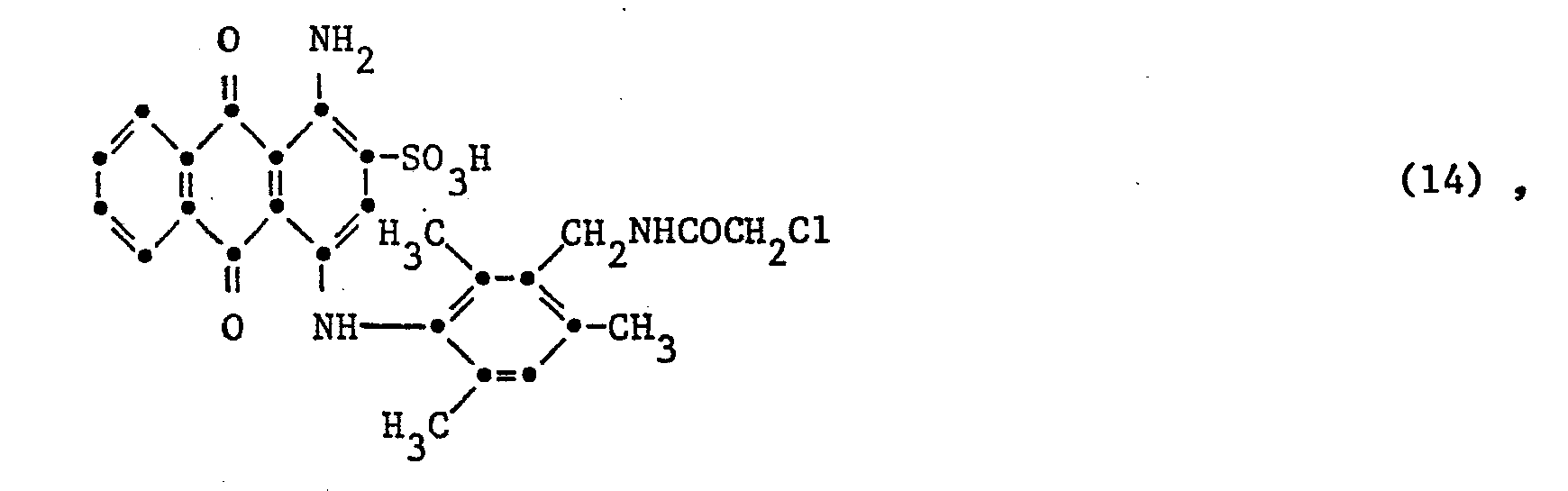
- 2,0 g/l des Ammoniumsulfatesters von äthoxyliertem Nonylphenol und 0,5 g/1 äthoxyliertes Nonylphenol, die mit einer Mischung aus Na2HPO4 und NaH2PO4 auf einen pH von 8.0 eingestellt ist, wird auf 96 bis 98° erhitzt. Die heisse Lösung wird in einer geschlossenen Kammer mit einem Druck von 3 atm durch eine Reihe von Düsen auf einen Polyamid-66-Teppich gesprüht, welcher kontinuierlich durch die Kammer geführt wird. Die Verweilzeit des Teppichs in der Kammer beträgt ca. 5 Sekunden. Die Flottenaufnahme beträgt ca. 500% bezogen auf das Teppichgewicht. Man erhält einen gleichmässig braun gefärbten Polyamid-66-Tepppich mit einer Ozonechtheit von 3-4, wobei die Bewertung der Ozonechtheit wie in Beispiel 1 angegeben erfolgt.
- Wenn man wie in Beispiel 1 angegeben verfährt und anstelle der in Beispiel 1 genannten Kombination der Farbstoffe der Formeln (19), (22) und (15) die in der folgenden Tabelle in den Beispielen 3 bis 12 in Spalte II angegebene Kombination von Farbstoffen in den dort angegebenen Mengen verwendet, so erhält man ebenfalls in gleichmässig olive bis brauner Nuance gefärbte Teppiche mit guter Ozonechtheit, wobei die Bewertung der Ozonechtheit wie in Beispiel 1 erfolgt und die Echtheitsnote in Spalte III angegeben ist.
-

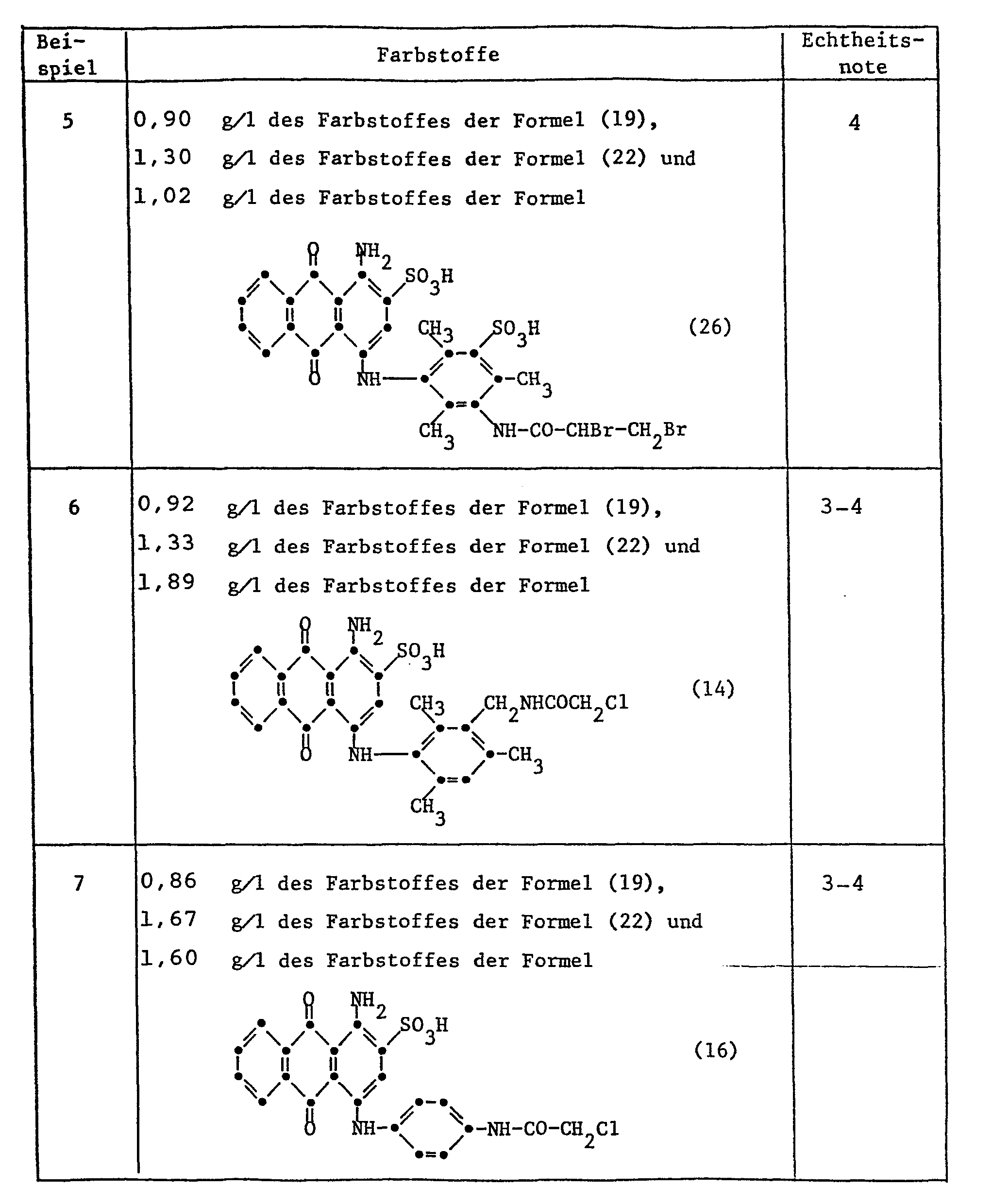


- Ersetzt man im Beispiel 1 die 0,57 g/1 des Farbstoffes der Formel (15) durch 1,26g/l des nicht faserreaktiven Farbstoffes der Formel
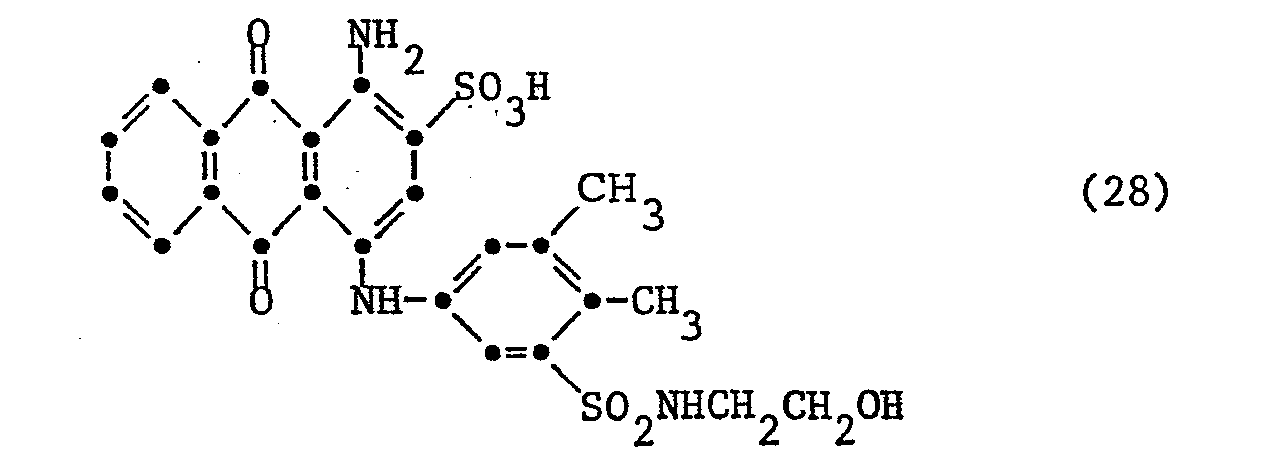
bei sonst identischer Verfahrensweise, so erhält man einen Teppich von brauner Nuance, der gemäss der Prüfvorschrift für die Ozonechtheit [AATCC 129-1975] eine Echtheitsnote für das Aendern der Farbe [SNV-Norm 95805] von nur 2 aufweist. - Ersetzt man im Beispiel 1 die 0,57 g/1 des Farbstoffes der Formel (15) durch 1,09g/l des nicht faserreaktiven Farbstoffes der Formel
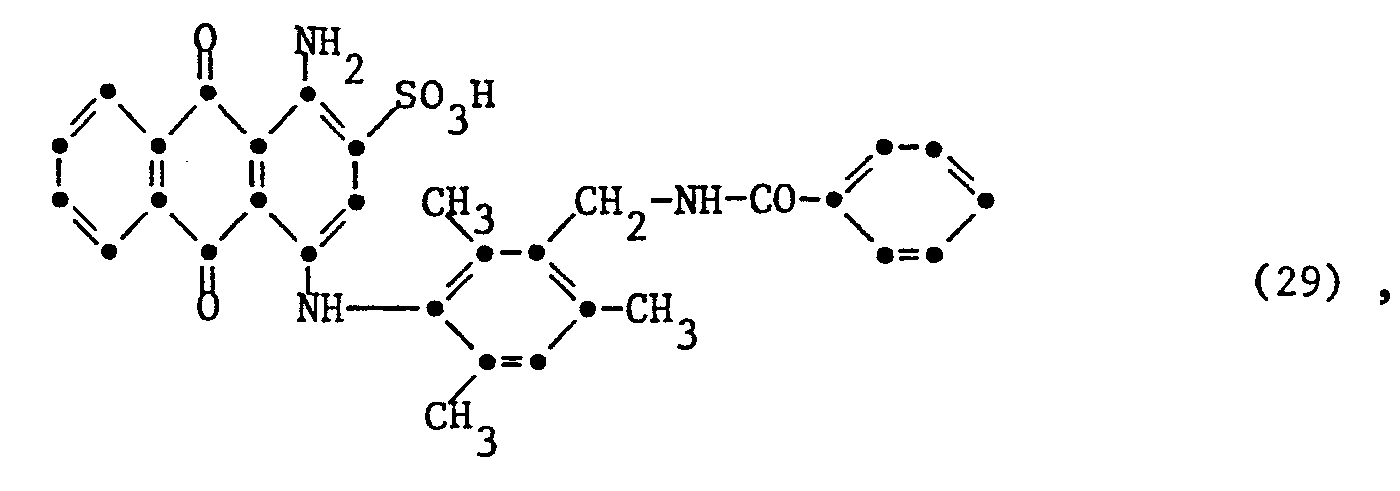
so erhält man einen in brauner Nuance gefärbten Teppich, der gemäss der im Vergleichsbeispiel 1 angegebenen Prüfvorschrift eine Echtheitsnote von 2 für die Ozonechtheit aufweist.

Claims (23)


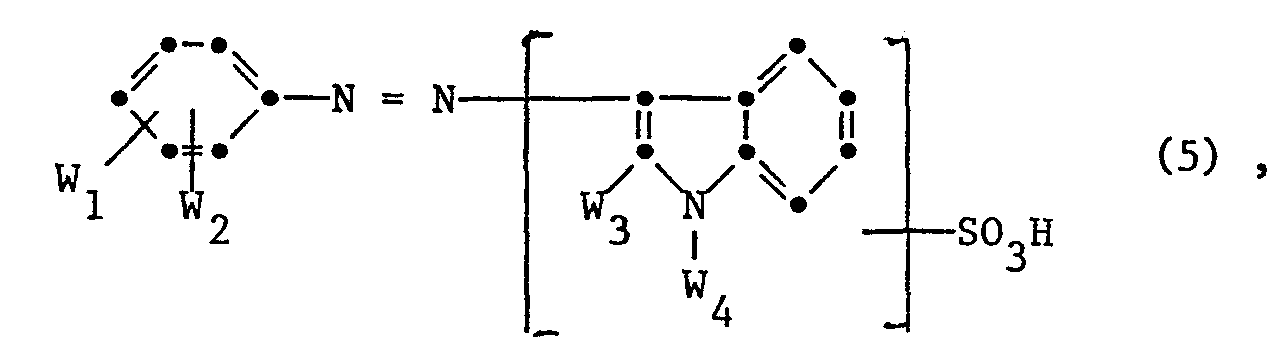
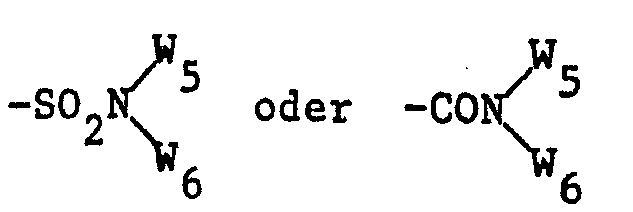


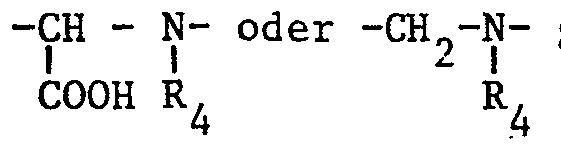
gebundener faserreaktiver Rest der aliphatischen,
aromatischen oder heterocyclischen Reihe ist, und R4 Wasserstoff oder C1-4-Alkyl bedeutet.
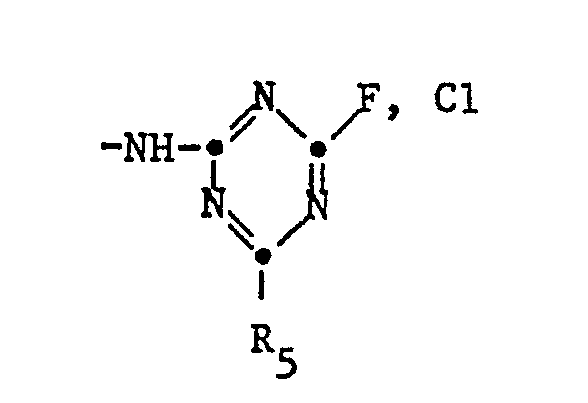
oder

worin R5 C1-6-Alkoxy, C1-6-Alkylmercapto oder ein Rest der Formel

C1-6-Alkyl oder gegebenenfalls substituiertes Phenyl oder Naphthyl bedeuten, oder einen Vinylsulfonyl-, β-Sulfatoäthylsulfonyl-, β-Acetoxyäthylsulfonyl-, ß-Chloräthylsulfonyl oder β-(ß'-Sulfatoäthylsulfonyl)-propionylaminomethyl-Rest bedeutet.

verwendet, worin G1, G3 und G5 Methyl, G4 a,ß-Dibrompropionylamino- methyl, a-Chlor- oder a-Bromacryloylaminomethyl, ß-(ß'-Sulfatoäthylsulfonyl)-propionylaminomethyl, a,ß-Dibrompropionylamino, -CH(COOH)-NH-CO-CHBr-CH2Br oder Chloracetylaminomethyl und G2 Wasserstoff, Sulfo oder Chloracetylaminomethyl oder -CH(COOH)-NH-CO-CHBr-CH2Br ist, oder worin G Wasserstoff oder Methoxy, G2, G3 und G5 Wasserstoff und G4 Sulfatoäthylsulfonyl, Chloracetylamino, a,ß-Dibrompropionylamino, Vinysulfonyl, 2-Methoxy-4-fluor-s-triazinylamino oder 2-Aethylamino-4-fluor-s-triazinylamino ist, oder worin G1, G2, G4 und G5 Wasserstoff und G3 Chloracetylamino oder α,β-Dibrompropionylamino, 2,6-Difluor-5- chlorpyrimidin-4-ylamino, 2-Chlor-4-amino- oder 4-N,N-Dimethylamino-s-triazinylamino ist, oder worin G1 Methyl, G2 ß-Sulfatoäthylsulfonyl und G3, G4 und G5 Wasserstoff ist, oder worin G1 oder G2 Sulfo, G3 a-Bromacryloylamino oder N-Methyl-N-[3-(ß-chloräthylsulfonylbenzoyl]-amino und G2 oder G1 und G4 und G5 Wasserstoff ist, oder G1, G2 und G5 Wasserstoff, G3 Methyl und G4 Chloracetylamino ist, oder worin G1 Methyl, G2 2,6-Difluor-5-chlorpyrimidinylamino, G4 Sulfo und G3 und G5 Wasserstoff ist.


oder

verwendet.


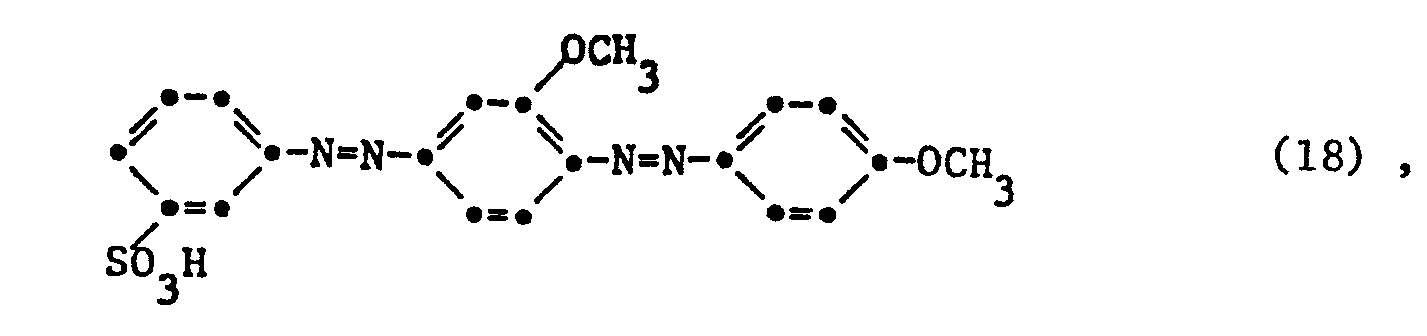

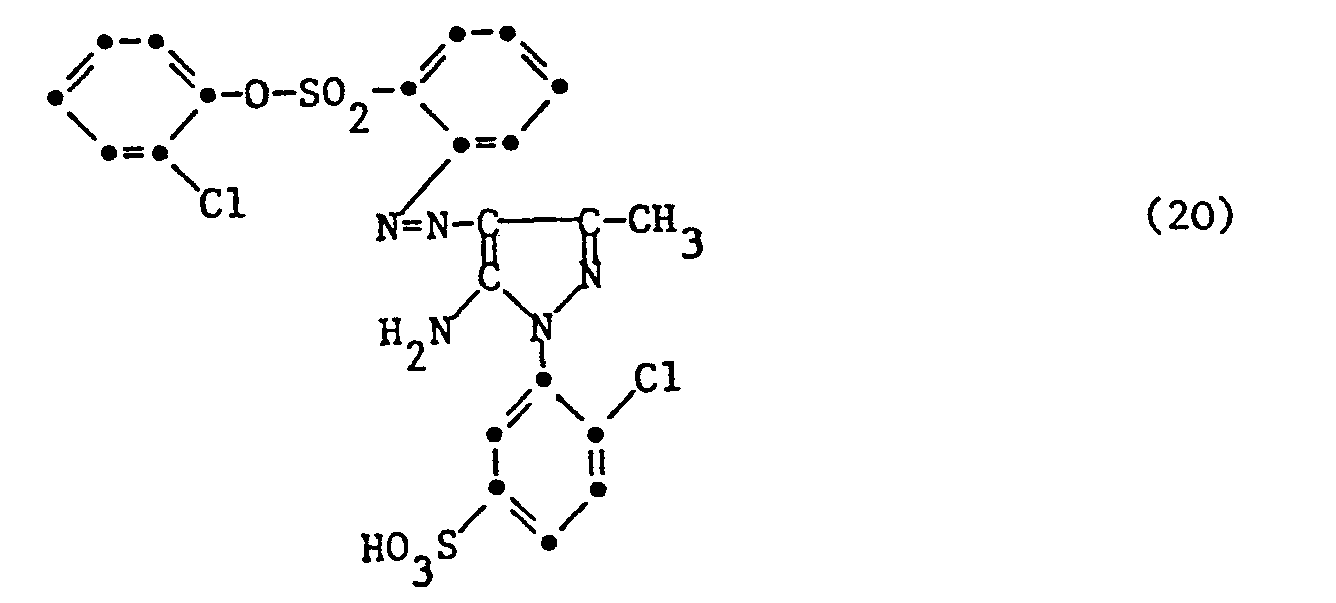


oder

und den gelben Farbstoff der Formel (18), (19) oder (21) oder der Mischung der gelben Farbstoffe der Formeln (18) und (20) im Gewichtsverhältnis 70:30 verwendet.

und dem orangen Farbstoff der Formel

verwendet.
Applications Claiming Priority (2)
| Application Number | Priority Date | Filing Date | Title |
|---|---|---|---|
| US66954984A | 1984-11-08 | 1984-11-08 | |
| US669549 | 1984-11-08 |
Publications (3)
| Publication Number | Publication Date |
|---|---|
| EP0181292A2 true EP0181292A2 (de) | 1986-05-14 |
| EP0181292A3 EP0181292A3 (en) | 1987-10-14 |
| EP0181292B1 EP0181292B1 (de) | 1990-07-25 |
Family
ID=24686762
Family Applications (1)
| Application Number | Title | Priority Date | Filing Date |
|---|---|---|---|
| EP85810510A Expired - Lifetime EP0181292B1 (de) | 1984-11-08 | 1985-11-04 | Verfahren zum Kontinuierlichen Trichromie-Färben von synthetischen Polyamidmaterialien |
Country Status (6)
| Country | Link |
|---|---|
| EP (1) | EP0181292B1 (de) |
| JP (1) | JPS61119781A (de) |
| KR (1) | KR860004202A (de) |
| CA (1) | CA1249902A (de) |
| DE (1) | DE3578870D1 (de) |
| DK (1) | DK165338C (de) |
Cited By (12)
| Publication number | Priority date | Publication date | Assignee | Title |
|---|---|---|---|---|
| EP0360735A1 (de) * | 1988-08-26 | 1990-03-28 | Ciba-Geigy Ag | Verfahren zum Trichromie-Färben oder -Bedrucken |
| EP0181293B1 (de) * | 1984-11-08 | 1990-10-24 | Ciba-Geigy Ag | Verfahren zum Färben von synthetischen Polyamidmaterialien mit faserreaktiven Anthrachinonfarbstoffen |
| GB2236542A (en) * | 1989-10-06 | 1991-04-10 | Sandoz Ltd | Trichromatic dyeing of polyamide |
| EP0425435A1 (de) * | 1989-10-23 | 1991-05-02 | Ciba-Geigy Ag | Verfahren zum Trichromie-Färben oder -Bedrucken |
| EP0430878A3 (en) * | 1989-11-28 | 1991-11-13 | Ciba-Geigy Ag | Mixtures of dyes and their use |
| EP0430879A3 (en) * | 1989-11-28 | 1991-11-13 | Ciba-Geigy Ag | Mixtures of dyes and their use |
| EP0430877A3 (en) * | 1989-11-28 | 1991-11-13 | Ciba-Geigy Ag | Mixtures of dyes and their use |
| EP0534112A1 (de) * | 1991-09-27 | 1993-03-31 | Ruan Co., Ltd. | Farbstoffmischung, Färbeprozess und gefärbte Proteinfaser |
| EP0564404A1 (de) * | 1992-04-01 | 1993-10-06 | Ciba-Geigy Ag | Verfahren zum Färben von Leder mit Farbstoffmischungen |
| EP0593392A1 (de) * | 1992-09-30 | 1994-04-20 | Ciba-Geigy Ag | Verfahren zum Färben von natürlichen und synthetischen Polyamidfasermaterialien mit Farbstoffmischungen |
| EP0726297A1 (de) * | 1995-02-10 | 1996-08-14 | Ciba-Geigy Ag | Farbstoffmischungen und ihre Verwendung |
| WO2006082207A1 (en) * | 2005-02-07 | 2006-08-10 | Dystar Textilfarben Gmbh & Co Deutschland Kg | Acid dye mixture |
Families Citing this family (1)
| Publication number | Priority date | Publication date | Assignee | Title |
|---|---|---|---|---|
| JP2003082254A (ja) * | 2001-09-17 | 2003-03-19 | Yamada Chem Co Ltd | 紺色反応性染料組成物及びこれを使用した天然タンパク質繊維又はその混紡物の染色方法 |
Family Cites Families (7)
| Publication number | Priority date | Publication date | Assignee | Title |
|---|---|---|---|---|
| DE1016230B (de) * | 1953-12-15 | 1957-09-26 | Ciba Geigy | Verfahren zur Herstellung echter Faerbungen |
| GB1009955A (en) * | 1961-07-06 | 1965-11-17 | Sandoz Ltd | Process for the level dyeing of textile materials of polyamide fibers possessing irregular affinity for dyestuffs |
| GB1371781A (en) * | 1970-09-22 | 1974-10-30 | Sandoz Ltd | Finishing process |
| EP0089004B1 (de) * | 1982-03-12 | 1986-04-16 | Ciba-Geigy Ag | Verfahren zum Färben von Fasermaterial aus natürlichen Polyamiden |
| DE3363254D1 (en) * | 1982-04-08 | 1986-06-05 | Ciba Geigy Ag | Process for trichromatic dyeing or printing |
| US4514187A (en) * | 1982-07-21 | 1985-04-30 | Ciba-Geigy Corporation | Process for dyeing differential-dyeing polyamide fibres |
| US4563192A (en) * | 1983-09-19 | 1986-01-07 | Ciba-Geigy Corporation | Process for dyeing fibre material made of synthetic polyamides with anionic dyes and an auxiliary mixture |
-
1985
- 1985-11-04 EP EP85810510A patent/EP0181292B1/de not_active Expired - Lifetime
- 1985-11-04 DE DE8585810510T patent/DE3578870D1/de not_active Expired - Lifetime
- 1985-11-06 CA CA000494712A patent/CA1249902A/en not_active Expired
- 1985-11-07 KR KR1019850008311A patent/KR860004202A/ko not_active Withdrawn
- 1985-11-07 DK DK513685A patent/DK165338C/da not_active IP Right Cessation
- 1985-11-08 JP JP60250606A patent/JPS61119781A/ja active Pending
Cited By (18)
| Publication number | Priority date | Publication date | Assignee | Title |
|---|---|---|---|---|
| EP0181293B1 (de) * | 1984-11-08 | 1990-10-24 | Ciba-Geigy Ag | Verfahren zum Färben von synthetischen Polyamidmaterialien mit faserreaktiven Anthrachinonfarbstoffen |
| US4999027A (en) * | 1988-08-26 | 1991-03-12 | Ciba-Geigy Corporation | Process for trichromatic dyeing or printing |
| EP0360735A1 (de) * | 1988-08-26 | 1990-03-28 | Ciba-Geigy Ag | Verfahren zum Trichromie-Färben oder -Bedrucken |
| GB2236542B (en) * | 1989-10-06 | 1992-04-15 | Sandoz Ltd | Dye mixtures and their use in trichromatic dyeing processes |
| GB2236542A (en) * | 1989-10-06 | 1991-04-10 | Sandoz Ltd | Trichromatic dyeing of polyamide |
| EP0425435A1 (de) * | 1989-10-23 | 1991-05-02 | Ciba-Geigy Ag | Verfahren zum Trichromie-Färben oder -Bedrucken |
| EP0430879A3 (en) * | 1989-11-28 | 1991-11-13 | Ciba-Geigy Ag | Mixtures of dyes and their use |
| EP0430877A3 (en) * | 1989-11-28 | 1991-11-13 | Ciba-Geigy Ag | Mixtures of dyes and their use |
| EP0430878A3 (en) * | 1989-11-28 | 1991-11-13 | Ciba-Geigy Ag | Mixtures of dyes and their use |
| EP0534112A1 (de) * | 1991-09-27 | 1993-03-31 | Ruan Co., Ltd. | Farbstoffmischung, Färbeprozess und gefärbte Proteinfaser |
| EP0564404A1 (de) * | 1992-04-01 | 1993-10-06 | Ciba-Geigy Ag | Verfahren zum Färben von Leder mit Farbstoffmischungen |
| US5354341A (en) * | 1992-04-01 | 1994-10-11 | Ciba-Geigy Corporation | Process for dyeing leather with dye mixtures |
| EP0593392A1 (de) * | 1992-09-30 | 1994-04-20 | Ciba-Geigy Ag | Verfahren zum Färben von natürlichen und synthetischen Polyamidfasermaterialien mit Farbstoffmischungen |
| US5356445A (en) * | 1992-09-30 | 1994-10-18 | Ciba-Geigy Corporation | Process for dyeing natural or synthetic polyamide fibre material with dye mixtures |
| EP0726297A1 (de) * | 1995-02-10 | 1996-08-14 | Ciba-Geigy Ag | Farbstoffmischungen und ihre Verwendung |
| WO2006082207A1 (en) * | 2005-02-07 | 2006-08-10 | Dystar Textilfarben Gmbh & Co Deutschland Kg | Acid dye mixture |
| US8323358B2 (en) | 2005-02-07 | 2012-12-04 | Dystar Colours Deutschland Gmbh | Acid dye mixture |
| USRE47618E1 (en) | 2005-02-07 | 2019-09-24 | Dystar Colours Distribution Gmbh | Acid dye mixture |
Also Published As
| Publication number | Publication date |
|---|---|
| JPS61119781A (ja) | 1986-06-06 |
| DK513685D0 (da) | 1985-11-07 |
| EP0181292B1 (de) | 1990-07-25 |
| DK165338C (da) | 1993-03-29 |
| DK165338B (da) | 1992-11-09 |
| CA1249902A (en) | 1989-02-14 |
| KR860004202A (ko) | 1986-06-18 |
| DK513685A (da) | 1986-05-09 |
| DE3578870D1 (de) | 1990-08-30 |
| EP0181292A3 (en) | 1987-10-14 |
Similar Documents
| Publication | Publication Date | Title |
|---|---|---|
| EP0437184B1 (de) | Verfahren zum Trichromiefärben oder -bedrucken von cellulosehaltigen textilen Fasermaterialien | |
| EP0775776B1 (de) | Verfahren zum Di- oder Trichromie-Färben oder -Bedrucken | |
| EP0387201B1 (de) | Farbstoffmischung und deren Verwendung | |
| EP0478503A2 (de) | Faserreaktive Farbstoffe und Farbstoffmischungen und deren Verwendung | |
| DE69307301T2 (de) | Verfahren zum färben von cellulosehaltigen fasermaterialien mit reaktivfarbstoffen | |
| EP0181292B1 (de) | Verfahren zum Kontinuierlichen Trichromie-Färben von synthetischen Polyamidmaterialien | |
| EP0127579A1 (de) | Verfahren zum Trichromie-Färben oder -Bedrucken | |
| EP0177449B1 (de) | Verfahren zum Bedrucken von Cellulosefasern | |
| EP0425434B1 (de) | Farbstoffmischungen und deren Verwendung | |
| EP0124679B1 (de) | Verfahren zum Färben oder Bedrucken von Polyamidfasern | |
| EP0144093B1 (de) | Lagerstabile Druckpasten und deren Verwendung | |
| EP0099859B1 (de) | Verfahren zum Färben von differential-dyeing-Fasern | |
| EP0549529B1 (de) | Verfahren zum Färben oder Bedrucken von hydroxylgruppenhaltigen Fasermaterialien | |
| EP0625551B1 (de) | Farbstoffmischungen, Verfahren zu deren Herstellung und deren Verwendung | |
| EP0178255B1 (de) | Verfahren zum Fixieren von Färbungen oder Drucken | |
| EP0748850B1 (de) | Farbstoffe, Verfahren zu deren Herstellung und deren Verwendung | |
| EP0764694A1 (de) | Reaktivfarbstoffe, ihre Herstellung und Verwendung | |
| EP0242324B1 (de) | Verfahren zum endengleichen Färben von Cellulosefasern | |
| EP0352222B1 (de) | Faserreaktive Formazanfarbstoffe, Verfahren zu deren Herstellung und deren Verwendung | |
| EP0209494B1 (de) | Verfahren zum Nuancenstabilen Färben oder Bedrucken | |
| EP0755985A2 (de) | Farbstoffmischungen, Verfahren zu ihrer Herstellung und ihre Verwendung | |
| EP0776947B1 (de) | Faserreaktive Farbstoffe, ihre Herstellung und Verwendung | |
| EP0181293B1 (de) | Verfahren zum Färben von synthetischen Polyamidmaterialien mit faserreaktiven Anthrachinonfarbstoffen | |
| EP0425435A1 (de) | Verfahren zum Trichromie-Färben oder -Bedrucken | |
| EP0601971B1 (de) | Verfahren zum Trichromie-Färben oder -Bedrucken |
Legal Events
| Date | Code | Title | Description |
|---|---|---|---|
| PUAI | Public reference made under article 153(3) epc to a published international application that has entered the european phase |
Free format text: ORIGINAL CODE: 0009012 |
|
| 17P | Request for examination filed |
Effective date: 19851106 |
|
| AK | Designated contracting states |
Kind code of ref document: A2 Designated state(s): CH DE FR GB IT LI NL |
|
| PUAL | Search report despatched |
Free format text: ORIGINAL CODE: 0009013 |
|
| AK | Designated contracting states |
Kind code of ref document: A3 Designated state(s): CH DE FR GB IT LI NL |
|
| 17Q | First examination report despatched |
Effective date: 19881014 |
|
| GRAA | (expected) grant |
Free format text: ORIGINAL CODE: 0009210 |
|
| AK | Designated contracting states |
Kind code of ref document: B1 Designated state(s): CH DE FR GB IT LI NL |
|
| ET | Fr: translation filed | ||
| REF | Corresponds to: |
Ref document number: 3578870 Country of ref document: DE Date of ref document: 19900830 |
|
| GBT | Gb: translation of ep patent filed (gb section 77(6)(a)/1977) | ||
| ITF | It: translation for a ep patent filed | ||
| PLBE | No opposition filed within time limit |
Free format text: ORIGINAL CODE: 0009261 |
|
| STAA | Information on the status of an ep patent application or granted ep patent |
Free format text: STATUS: NO OPPOSITION FILED WITHIN TIME LIMIT |
|
| 26N | No opposition filed | ||
| ITTA | It: last paid annual fee | ||
| PGFP | Annual fee paid to national office [announced via postgrant information from national office to epo] |
Ref country code: CH Payment date: 19960212 Year of fee payment: 11 |
|
| PGFP | Annual fee paid to national office [announced via postgrant information from national office to epo] |
Ref country code: FR Payment date: 19960926 Year of fee payment: 12 |
|
| PGFP | Annual fee paid to national office [announced via postgrant information from national office to epo] |
Ref country code: NL Payment date: 19960930 Year of fee payment: 12 |
|
| PGFP | Annual fee paid to national office [announced via postgrant information from national office to epo] |
Ref country code: DE Payment date: 19961004 Year of fee payment: 12 |
|
| PGFP | Annual fee paid to national office [announced via postgrant information from national office to epo] |
Ref country code: GB Payment date: 19961024 Year of fee payment: 12 |
|
| PG25 | Lapsed in a contracting state [announced via postgrant information from national office to epo] |
Ref country code: LI Effective date: 19961130 Ref country code: CH Effective date: 19961130 |
|
| NLS | Nl: assignments of ep-patents |
Owner name: CIBA SC HOLDING AG |
|
| REG | Reference to a national code |
Ref country code: FR Ref legal event code: TP |
|
| REG | Reference to a national code |
Ref country code: GB Ref legal event code: 732E |
|
| NLT1 | Nl: modifications of names registered in virtue of documents presented to the patent office pursuant to art. 16 a, paragraph 1 |
Owner name: CIBA SPECIALTY CHEMICALS HOLDING INC. |
|
| REG | Reference to a national code |
Ref country code: CH Ref legal event code: PL |
|
| PG25 | Lapsed in a contracting state [announced via postgrant information from national office to epo] |
Ref country code: GB Free format text: LAPSE BECAUSE OF NON-PAYMENT OF DUE FEES Effective date: 19971104 |
|
| PG25 | Lapsed in a contracting state [announced via postgrant information from national office to epo] |
Ref country code: FR Free format text: THE PATENT HAS BEEN ANNULLED BY A DECISION OF A NATIONAL AUTHORITY Effective date: 19971130 |
|
| REG | Reference to a national code |
Ref country code: FR Ref legal event code: CD |
|
| PG25 | Lapsed in a contracting state [announced via postgrant information from national office to epo] |
Ref country code: NL Free format text: LAPSE BECAUSE OF NON-PAYMENT OF DUE FEES Effective date: 19980601 |
|
| GBPC | Gb: european patent ceased through non-payment of renewal fee |
Effective date: 19971104 |
|
| PG25 | Lapsed in a contracting state [announced via postgrant information from national office to epo] |
Ref country code: DE Free format text: LAPSE BECAUSE OF NON-PAYMENT OF DUE FEES Effective date: 19980801 |
|
| NLV4 | Nl: lapsed or anulled due to non-payment of the annual fee |
Effective date: 19980601 |
|
| REG | Reference to a national code |
Ref country code: FR Ref legal event code: ST |