EP0565155A1 - Système et méthode assurant un meilleur positionnement d'un transducteur de lecture/écriture dans une unité de stockage à accès direct - Google Patents
Système et méthode assurant un meilleur positionnement d'un transducteur de lecture/écriture dans une unité de stockage à accès direct Download PDFInfo
- Publication number
- EP0565155A1 EP0565155A1 EP93200686A EP93200686A EP0565155A1 EP 0565155 A1 EP0565155 A1 EP 0565155A1 EP 93200686 A EP93200686 A EP 93200686A EP 93200686 A EP93200686 A EP 93200686A EP 0565155 A1 EP0565155 A1 EP 0565155A1
- Authority
- EP
- European Patent Office
- Prior art keywords
- signal
- read
- write head
- signals
- responsive
- Prior art date
- Legal status (The legal status is an assumption and is not a legal conclusion. Google has not performed a legal analysis and makes no representation as to the accuracy of the status listed.)
- Withdrawn
Links
Images



Classifications
-
- G—PHYSICS
- G05—CONTROLLING; REGULATING
- G05B—CONTROL OR REGULATING SYSTEMS IN GENERAL; FUNCTIONAL ELEMENTS OF SUCH SYSTEMS; MONITORING OR TESTING ARRANGEMENTS FOR SUCH SYSTEMS OR ELEMENTS
- G05B13/00—Adaptive control systems, i.e. systems automatically adjusting themselves to have a performance which is optimum according to some preassigned criterion
- G05B13/02—Adaptive control systems, i.e. systems automatically adjusting themselves to have a performance which is optimum according to some preassigned criterion electric
- G05B13/0265—Adaptive control systems, i.e. systems automatically adjusting themselves to have a performance which is optimum according to some preassigned criterion electric the criterion being a learning criterion
- G05B13/0275—Adaptive control systems, i.e. systems automatically adjusting themselves to have a performance which is optimum according to some preassigned criterion electric the criterion being a learning criterion using fuzzy logic only
-
- G—PHYSICS
- G11—INFORMATION STORAGE
- G11B—INFORMATION STORAGE BASED ON RELATIVE MOVEMENT BETWEEN RECORD CARRIER AND TRANSDUCER
- G11B21/00—Head arrangements not specific to the method of recording or reproducing
- G11B21/02—Driving or moving of heads
- G11B21/08—Track changing or selecting during transducing operation
- G11B21/081—Access to indexed tracks or parts of continuous track
- G11B21/083—Access to indexed tracks or parts of continuous track on discs
Definitions
- the present invention relates to position control of a read/write transducer in a direct access storage device, and more particularly, to providing rapid and consistent settling of the position of the read/write transducer over a selected track on a storage media disk at the conclusion of a seek to that track. Still more particularly, the invention relates to utilization of a fuzzy logic controller to provide adaptive gain control to a proportional-integral-derivative controller.
- a direct access storage device is one application for a feedback control system that exhibits difficulties in settling.
- Feedback control systems operate to achieve prescribed relationships between selected system variables by comparing functions of those variables and using the comparison to effect control.
- System variables are those quantities or conditions of the system which are subject to change. Examples of such variables include an electrical voltage level generated by an amplifier or physical force applied to an object by an actuator.
- the strength of the magnetic field generated by the voice coil in a rotary or linear actuator is such a system variable.
- Control is the governing of the response of a controlled subsystem.
- the position of an actuator, or more precisely, the substantially motionless position of a read/write transducer, carried by the actuator, centered over one of the plurality of concentric or spiral tracks of one of a plurality of disks, is the response of interest.
- PID proportional-integral-derivative
- a disk drive control system including a read/write head, an actuator for the read/write head, a position signal generator for the read/write head, a source for a reference input signal for a desired position of the read/write head, a summer for combining the position signal and the reference input signal to generate a position error signal, and a proportional-integral-derivative controller for processing selected input signals including the position error signal (the 'proportional' signal), a signal to the rate of change in position (the 'derivative' signal) and a signal proportional to the integral of the position error signal for generating an actuator signal controlling position of the read/write head, a method of providing improved settling of a read/write head with respect to a selected track on one or more disks is taught.
- a first signal proportional to the position error signal and a second signal proportional to a rate of change of the position error signal are provided.
- the first and second signals are applied to a fuzzy logic controller, which utilizes the values for the first and second signals in membership functions relating to particular characteristic states to determine possibility weights relating to the same states.
- the possibility weights are further processed by application of rule action functions to generate a plurality of boost signals, which are then combined to generate gain adjustment signals for the Proportional-Integral-Derivative ("PID") controller. Gains relating to both position error and rate of change in position error in the PID controller are then adjusted in response to the gain adjustment signals.
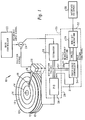
- Disk drive 10 includes one or more rotatable magnetic or optical media disks 12 on which are a plurality of concentric or spiral tracks 14. Data files are written on and recovered from tracks 14 by a separate read/write head 16 for each disk. Read/write head 16 is carried between positions centered over a currently selected track at the end of an armature arm 18. By reading back data stored along a track 14, read/write head 16 positioning information may be recovered. Armature arm 18 may be moved linearly orrotationally by an actuation controller 20.
- a read back signal is generated as disk 12 moves under read/write head 16.
- Positional information is derived from the read back signal in a manner well known in the art and is passed as a feedback signal to a summer 24.
- Summer 24 combines the position information signal with a reference input signal from disk controller 22 to generate a position error signal.
- the position information signal, the reference input signal and the position error signal are all digital signals and are, accordingly, updated once each sampling period.
- the signals are used in all operating modes of disk drive 10 which include, a seek mode, a settle mode and a tracking mode. Seek mode is entered upon instruction to change the track over which the read/write head is positioned. Drive operation passes from seek to settle mode to control the final stages of repositioning of read/write head 16. Tracking mode relates to maintaining position of read/write head 16 over a track.
- Disk drive 10 further includes a digital signal processor 25 through which are realized, in accordance with well known programming techniques, a forward controlling element 26 including an estimator 28 and a proportional-integral-derivative ("PID") controller 30.
- PID proportional-integral-derivative
- a TMS 320 digital signal processor (“DSP”) available from Texas Instruments of Dallas, Texas is a preferred processor for this application.
- Estimator 28 may take one of several forms including passing an input signal on in its unaltered, measured form. The output signals from estimator 28 are nonetheless considered to be estimation signals whether processed or not. Estimator 28 passes a first signal proportional to the position error signal from summer 24 and further generates a second signal proportional to the rate of change of the position error signal. All estimation signals used are made available to PID controller 30 and to a fuzzy settle assist processor 32.
- Fuzzy settle assist processor 32 includes a fuzzy logic controller 34 and a rule set generator 36, both realized in digital signal processor 25.
- Fuzzy settle assist processor 32 is active during the settle mode, during which it provides gain adjustment signals to PID controller 30 on signal line 31.
- Fuzzy logic controller 34 receives indication of disk drive operation in the settle mode over a control line 35, which may be supplied from disk controller 22 or determined within the estimator process 28. Fuzzy logic controller operates on first and second estimation signals provided over signal lines 37 from estimator 28.
- Gain adjustment is made on the basis of factors relating to read/write head 16 position relative to a desired position and velocity (radially inward or outward).
- Each variable is represented by an estimation signal.
- Fuzzy logic controller 34 utilizes rules from generator 36. Application of a rule includes the preliminary execution of a plurality of membership functions. Membership functions operate to assign possibility weights to the variables represented by the estimation signals. The possibility weights relate to the degree to which a variable is considered as belonging to a particular classification for that variable, such as "fast” as a characterization for velocity of read/write head 16, or "far removed” as an appropriate characterization of position of the head.
- Fuzzy logic controller 34 obtains the membership functions from rule set generator 36.
- the rule set is established by expert input through an interface 38.
- the results of execution of the membership functions provide the inputs to one or more If/THEN operations.
- a rule action operation is utilized by controller 34 to combine the results from the IF/THEN statements to generate the final gain adjustment signal.
- Such combination can occur in one of several forms, including: (1) taking the maximum result from the IF/THEN statements; (2) determining an average of the results; or, (3) determining a weighted average for the results, among others.
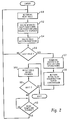
- Figure 2 depicts a logical flow chart for the operation of fuzzy logic controller 34.
- Execution of the routine begins upon entry into the settle mode with retrieval of the next rule from a rule queue at step 50.
- membership functions relating to specific instances of the rule are solved for the contemporaneous samples for read/write head 16 position and velocity.
- the results from determination of the IF/THEN statements are used as inputs to the rule action function for the present rule to determine the contribution of the variables to the gain adjustment signals.
- step 56 it is determined if the rule just processed is the last from the queue. If not, processing is returned to step 50 to process the next rule.
- the gain adjustment signals are determined by combination of the outputs of the rule/action operations (step 57).
- the gain adjustment signals are then returned to PID controller 30 (step 58) and the pointer to the rule queue is reset (step 59).
- step 60 it is determined if disk drive 10 has exited from the settle mode, and if "YES", the process discontinues. If a settle mode remains indicated, step 62 loops the process until the next set of position and velocity samples is received, at which point processing is returned to step 50 to process the rule queue for the new sample set.
- processing of gain adjustment signals can be discontinued responsive to exit from the settle mode with a resetting of the rule queue pointer and discontinuance of the process of Figure 2.
- Settle mode is entered when the seek mode has moved read/write head 16 to within 0.8 track widths of the destination track. At this distance the seek algorithm hands control to a settle algorithm, which in turn activates the fuzzy settle assist processor 34. As noted above, the settle algorithm controls the actuator until the final desired position is reached, whereupon control is handed to a tracking algorithm. During tracking fuzzy logic controller 34 is again inactive.
- the modification of control effected by the fuzzy settle assist processor 32 operates by modifying the control gains of the PID controller 30 for the position and velocity variables of the system during operation in the settle mode. Modification of the control gains is based upon evaluation of the system variables against four fuzzy logic rules.
- PID controller 30 includes a velocity gain parameter acting upon the rate of change in position (velocity) estimation signal and a position gain parameter acting upon the position error signal. Each gainparameter is subject to modification based upon two of the four fuzzy logic rules utilized in the preferred embodiment.
- Figures 3-6 illustrate the four fuzzy logic rules utilized in the invention, their associated membership functions, and the rule action functions utilized in generation of the gain adjustment signals.
- Each of the four rules has a plurality instances, that is, defined circumstances of applicability of the rule.
- Each of the four rules utilize membership functions to relate the read/write head 16 position and velocity information obtained each sampling period to degrees of membership in the characteristic.
- the maximum degree of membership, or possibility weight, respecting a characteristic that can be assigned to a sample is 1.
- the minimum degree is zero.
- the ranges to which weights of 0 and 1 apply may be obtained from an expert or deduced from probability theory.
- a range of fractional weights between the ranges where the maximum and minimum weights apply is also defined in terms of a slope or other gradation. Results obtained from the membership functions are applied to rule action functions.
- Figures 3-6 include graphs relating to each of the rules.
- Each rule has four membership functions and two rule action functions.
- two membership functions are utilized to determine the degree of membership in a characterization for the position variable and two are utilized to determine the degree of membership of the velocity variable.
- Three logical operations are used in expressing the functions. The operators are "AND”, “OR”, and “NOT.” The definitions of these operations for fuzzy logic differ from that for the same symbols in Boolian algebra.
- An “AND” operation returns the minimum value from a set.
- the "OR” operator returns the maximum value from a set.
- the "NOT" operation is defined as subtracting the value for a parameter from 1.
- Figure 3 illustrates a first rule, which is for a stalled arrival case.
- a stalled arrival is one where the position of the read/write head 16 is far from its desired position and the velocity is not high in the direction of the desired position.
- the appropriate response is a boost in the position control gain of the PID controller 30.
- Both of the rule instances include a pair of membership functions logically linked by the fuzzy logical operator "AND.” As an example, head position is taken as 0.4 tracks positive and velocity is -0.15 tracks per sample.
- a position of 0.4 tracks to the positive side of the desired track is considered to have a degree of membership of approximately 0.7 in relation to the characteristic "position far positive” and a degree of membership of zero with respect to the characterization "position far negative.”
- a velocity of -0.15 tracks per sample has a degree of membership of 0.5 to the characterization of velocity as "not high negative” and has a degree of membership of 1.0 with respect to the characterization of velocity a "not high positive.”
- the two membership functions thus have results of .5 and 0, respectively, which are related to two rule action functions for determination of boost components.
- One position boost graph yields a percentage of boost result of 12.5% and the second yields 0. Upon an "OR" operation on the two results the maximum 12.5% boost is obtained.
- Figure 4 illustrates a second rule, which relates to modification of the gain relating to velocity control in PID controller 30.
- the rule is for the "hot arrival" case where the position of the read/write head is close to its desired position but the velocity is high.
- the rule has two defined instances with primary applicability. One occurs where read/write head 16 is in a position slightly positive relative to the desired track and velocity is highly negative. A second occurs in the inverse situation. Again, two membership functions are provided for each instance, including a velocity input and a position input, linked by a fuzzy logical operation "AND.” The result of comparison of a particular variable to the membership functions provides an input into the rule action functions to generate a velocity boost. The two results returned from the velocity boost graphs are then subjected to a fuzzy logic operation "or" to locate the maximum which is applied to the gain adjustment signal to the velocity gain and PID controller 30.
- Figure 5 illustrates a rule relating to a read/write head which is in a position over its target track, but moving off track quickly.
- membership functions are characterized as a "position normal positive only” and “position normal negative only” for which the maximum degree of membership occurs only at a perfectly centered position over a target track.
- position normal positive only a degree of membership exists for positions on or to the positive side of the desired track.
- the velocity membership functions are concatenations of two relationships, here "velocity not normal negative only” concatenated with “velocity not low positive only.” The desired velocity is 0.
- the membership function returns a degree of membership of 0 for that velocity, but some positive degree of membership for any other velocity rising to a weight of 1 at negative 0.025 tracks per sample and at positive 0.01 tracks per sample.
- the membership functions return values which may be used to provide an input to rule action functions to return a percentage of boost to the position gain feature of the PID controller.
- Figure 6 illustrates a rule for the situation of "off track and not moving back quickly", which again has two instances. The first instance occurs when a position is “not normal-positive only” and velocity is "normal-negative only” concatenated with “velocity positive.” The second instance occurs for a position “not normal-negative only” and “velocity normal-positive only” concatenated with “velocity negative.” Again the gain of position control in PID controller 30 is boosted in response to return of nonzero degrees of membership from either membership function.
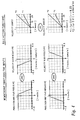
- Figure 7 represents a settling response simulation of a prior art control system for a disk drive.
- Figure 8 illustrates response of a control system for a disk drive in accordance with the present invention.
- the vertical axis is graduated in terms of tenths of a track for each graph.
- the horizontal axis of each graph, the time line, is graduated in sample periods.
- Each line in the graph represents a different initial velocity of a read/write head upon entry to the settle mode, with a step size between tracks of 0.05 tracks per sample.
- the graph lines range from one representing initial velocity of -0.05 tracks per sample to one representing an initial velocity of -0.30 tracks per sample.
- the same range of initial velocities and step size are used in Figure 8 as in Figure 7.
- substantially settled operation is obtained by about the 30th sample, while the prior art controller, represented by Figure 7 settled operation requires between 40 and 45 samples.
Landscapes
- Engineering & Computer Science (AREA)
- Artificial Intelligence (AREA)
- Software Systems (AREA)
- Physics & Mathematics (AREA)
- Health & Medical Sciences (AREA)
- Mathematical Physics (AREA)
- Fuzzy Systems (AREA)
- Computer Vision & Pattern Recognition (AREA)
- Evolutionary Computation (AREA)
- Medical Informatics (AREA)
- General Physics & Mathematics (AREA)
- Automation & Control Theory (AREA)
- Moving Of Head For Track Selection And Changing (AREA)
- Moving Of The Head To Find And Align With The Track (AREA)
Applications Claiming Priority (2)
| Application Number | Priority Date | Filing Date | Title |
|---|---|---|---|
| US86501892A | 1992-04-08 | 1992-04-08 | |
| US865018 | 1992-04-08 |
Publications (1)
| Publication Number | Publication Date |
|---|---|
| EP0565155A1 true EP0565155A1 (fr) | 1993-10-13 |
Family
ID=25344546
Family Applications (1)
| Application Number | Title | Priority Date | Filing Date |
|---|---|---|---|
| EP93200686A Withdrawn EP0565155A1 (fr) | 1992-04-08 | 1993-03-10 | Système et méthode assurant un meilleur positionnement d'un transducteur de lecture/écriture dans une unité de stockage à accès direct |
Country Status (2)
| Country | Link |
|---|---|
| EP (1) | EP0565155A1 (fr) |
| JP (1) | JPH065019A (fr) |
Cited By (3)
| Publication number | Priority date | Publication date | Assignee | Title |
|---|---|---|---|---|
| EP0598594A3 (fr) * | 1992-11-16 | 1994-12-14 | Daewoo Electronics Co Ltd | Système de commande d'entraînement de disque. |
| EP0836188A1 (fr) * | 1996-10-10 | 1998-04-15 | Koninklijke Philips Electronics N.V. | Procédure pour définir un contrÔleur de système dynamique et contrÔleur. |
| US8561268B2 (en) | 2008-09-19 | 2013-10-22 | Aba Hörtnagl Gmbh | Belt buckle and method for producing a belt buckle |
Citations (4)
| Publication number | Priority date | Publication date | Assignee | Title |
|---|---|---|---|---|
| DE3911186A1 (de) * | 1988-04-07 | 1989-10-19 | Hitachi Ltd | Verfahren und vorrichtung zur automatischen einstellung von pid-konstanten |
| EP0381314A2 (fr) * | 1989-01-30 | 1990-08-08 | Fujitsu Limited | Circuit d'asservissement |
| DE4015682A1 (de) * | 1989-05-19 | 1990-11-22 | Mitsubishi Electric Corp | Plattenlaufwerk und regelverfahren zum positionieren seines schreib-/lesekopfes |
| EP0241286B1 (fr) * | 1986-04-11 | 1991-09-11 | Mitsubishi Denki Kabushiki Kaisha | Régulateur auto-ajustable |
Family Cites Families (2)
| Publication number | Priority date | Publication date | Assignee | Title |
|---|---|---|---|---|
| JPH0566841A (ja) * | 1991-09-05 | 1993-03-19 | Matsushita Electric Ind Co Ltd | サーボモータの制御装置 |
| JPH0566842A (ja) * | 1991-09-09 | 1993-03-19 | Matsushita Electric Ind Co Ltd | サーボモータの制御装置 |
-
1993
- 1993-02-25 JP JP3600093A patent/JPH065019A/ja active Pending
- 1993-03-10 EP EP93200686A patent/EP0565155A1/fr not_active Withdrawn
Patent Citations (4)
| Publication number | Priority date | Publication date | Assignee | Title |
|---|---|---|---|---|
| EP0241286B1 (fr) * | 1986-04-11 | 1991-09-11 | Mitsubishi Denki Kabushiki Kaisha | Régulateur auto-ajustable |
| DE3911186A1 (de) * | 1988-04-07 | 1989-10-19 | Hitachi Ltd | Verfahren und vorrichtung zur automatischen einstellung von pid-konstanten |
| EP0381314A2 (fr) * | 1989-01-30 | 1990-08-08 | Fujitsu Limited | Circuit d'asservissement |
| DE4015682A1 (de) * | 1989-05-19 | 1990-11-22 | Mitsubishi Electric Corp | Plattenlaufwerk und regelverfahren zum positionieren seines schreib-/lesekopfes |
Non-Patent Citations (6)
| Title |
|---|
| IBM TECHNICAL DISCLOSURE BULLETIN vol. 32, no. 10A, March 1990, ARMONK, USA pages 411 - 412 'Fast settling time for hard disk file' * |
| IEEE INTERNATIONAL CONFERENCE ON FUZZY SYSTEMS 12 March 1992, SAN DIEGO, USA pages 989 - 997 JIA-YUSH YEN & AL. 'Servo controller design for an optical disk drive using fuzzy control algorithm' * |
| IEEE TRANSLATION JOURNAL ON MAGNETICS IN JAPAN vol. 6, no. 3, March 1991, NEW YORK, USA pages 227 - 239 S. YOSHIDA & AL. 'Bang-bang seek control for HDD with fuzzy algorithm' * |
| PATENT ABSTRACTS OF JAPAN vol. 15, no. 192 (P-1202)17 May 1991 & JP-A-03 044815 ( OMRON CORP ) 26 February 1991 * |
| PATENT ABSTRACTS OF JAPAN vol. 15, no. 296 (P-1231)26 July 1991 & JP-A-03 102670 ( SONY CORP ) 30 April 1991 * |
| PROCEEDINGS OF THE 30TH IEEE COFERENCE ON DECISION AND CONTROL December 1991, BRIGHTON, ENGLAND pages 1905 - 1906 SUJEET CHAND 'On-line, self-monitoring tuner for proportional integral derivative controllers' * |
Cited By (4)
| Publication number | Priority date | Publication date | Assignee | Title |
|---|---|---|---|---|
| EP0598594A3 (fr) * | 1992-11-16 | 1994-12-14 | Daewoo Electronics Co Ltd | Système de commande d'entraînement de disque. |
| US5598304A (en) * | 1992-11-16 | 1997-01-28 | Daewoo Electronics Co., Ltd. | Fuzzy controller for an actuator and the controlling method thereof |
| EP0836188A1 (fr) * | 1996-10-10 | 1998-04-15 | Koninklijke Philips Electronics N.V. | Procédure pour définir un contrÔleur de système dynamique et contrÔleur. |
| US8561268B2 (en) | 2008-09-19 | 2013-10-22 | Aba Hörtnagl Gmbh | Belt buckle and method for producing a belt buckle |
Also Published As
| Publication number | Publication date |
|---|---|
| JPH065019A (ja) | 1994-01-14 |
Similar Documents
| Publication | Publication Date | Title |
|---|---|---|
| US5459624A (en) | Activator control method and apparatus for positioning a transducer using a phase plane trajectory trough function for a direct access storage device with estimated velocity and position states | |
| US5668680A (en) | Time optimal control of a disc drive actuator with vibro-acoustic constraints | |
| KR100413767B1 (ko) | 사인 시크 서보 하드 디스크 드라이브에서의 시크 궤적최적화 방법 및 장치 | |
| US5696647A (en) | Method for carrying out seeks in a hard disc drive to limit the generation of acoustic noise including using a slew rate limit | |
| US6178060B1 (en) | Current profile shaping to reduce disc drive seek time variation and acoustic noise generation | |
| US6166876A (en) | Minimizing settling time in a disc drive servo system | |
| US5793558A (en) | Method for seek time optimization employing voice-coil motor current saturation level to define an adaptive deceleration profile | |
| JP2002501652A (ja) | 可変パラメータを持つ離散滑りモード制御を用いる対象の位置決め | |
| US7206162B2 (en) | Seek trajectory generation using adaptive filtering | |
| WO1993009480A1 (fr) | Procede et dispositif de recherche de bruits acoustiques faibles | |
| US6115205A (en) | Method for adapting seeks of a disc drive transducer to the maximum actuator current available to accelerate and decelerate the transducer | |
| JP2003505817A (ja) | 適応型加速度計フィードフォワード・サーボを使用したディスク・ドライブのための外乱の排除 | |
| Ho | Fast servo bang-bang seek control | |
| US5872674A (en) | Actuator bias prediction using lookup-table hysteresis modeling | |
| US6798611B1 (en) | Disk storage system employing a discrete-time sliding mode controller for servo control | |
| KR0146009B1 (ko) | 자기 동기식 탐색 감속을 위한 방법 및 장치 | |
| US6545838B1 (en) | Self tuning model reference controller in a disc drive | |
| EP0598594A2 (fr) | Système de commande d'entraînement de disque | |
| EP0565155A1 (fr) | Système et méthode assurant un meilleur positionnement d'un transducteur de lecture/écriture dans une unité de stockage à accès direct | |
| US5691617A (en) | Disc drive transducer deadbeat settle method utilizing interval correction | |
| US6762571B2 (en) | Sinusoidal feed-forward seek with adaptive acoustic level constraint | |
| Taktak-Meziou et al. | A prediction-based optimal gain selection in RISE feedback control for hard disk drive | |
| KR100618886B1 (ko) | 서보 제어 방법 및 이에 적합한 장치 | |
| EP0708966B1 (fr) | Procede ameliore de stabilisation d'un transducteur pour une unite de disque dur | |
| US6909576B2 (en) | Method, system, and program for generating control signals to perform a seek operation |
Legal Events
| Date | Code | Title | Description |
|---|---|---|---|
| PUAI | Public reference made under article 153(3) epc to a published international application that has entered the european phase |
Free format text: ORIGINAL CODE: 0009012 |
|
| AK | Designated contracting states |
Kind code of ref document: A1 Designated state(s): DE FR GB |
|
| 17P | Request for examination filed |
Effective date: 19931227 |
|
| STAA | Information on the status of an ep patent application or granted ep patent |
Free format text: STATUS: THE APPLICATION IS DEEMED TO BE WITHDRAWN |
|
| 18D | Application deemed to be withdrawn |
Effective date: 19961001 |