EP0566149A2 - Verbundmaterial und Verfahren zu dessen Herstellung - Google Patents
Verbundmaterial und Verfahren zu dessen Herstellung Download PDFInfo
- Publication number
- EP0566149A2 EP0566149A2 EP93106255A EP93106255A EP0566149A2 EP 0566149 A2 EP0566149 A2 EP 0566149A2 EP 93106255 A EP93106255 A EP 93106255A EP 93106255 A EP93106255 A EP 93106255A EP 0566149 A2 EP0566149 A2 EP 0566149A2
- Authority
- EP
- European Patent Office
- Prior art keywords
- resin
- matrix resin
- liquid crystal
- group
- compatible agent
- Prior art date
- Legal status (The legal status is an assumption and is not a legal conclusion. Google has not performed a legal analysis and makes no representation as to the accuracy of the status listed.)
- Granted
Links
Images



Classifications
-
- C—CHEMISTRY; METALLURGY
- C08—ORGANIC MACROMOLECULAR COMPOUNDS; THEIR PREPARATION OR CHEMICAL WORKING-UP; COMPOSITIONS BASED THEREON
- C08L—COMPOSITIONS OF MACROMOLECULAR COMPOUNDS
- C08L77/00—Compositions of polyamides obtained by reactions forming a carboxylic amide link in the main chain; Compositions of derivatives of such polymers
-
- C—CHEMISTRY; METALLURGY
- C08—ORGANIC MACROMOLECULAR COMPOUNDS; THEIR PREPARATION OR CHEMICAL WORKING-UP; COMPOSITIONS BASED THEREON
- C08L—COMPOSITIONS OF MACROMOLECULAR COMPOUNDS
- C08L101/00—Compositions of unspecified macromolecular compounds
-
- C—CHEMISTRY; METALLURGY
- C08—ORGANIC MACROMOLECULAR COMPOUNDS; THEIR PREPARATION OR CHEMICAL WORKING-UP; COMPOSITIONS BASED THEREON
- C08L—COMPOSITIONS OF MACROMOLECULAR COMPOUNDS
- C08L55/00—Compositions of homopolymers or copolymers, obtained by polymerisation reactions only involving carbon-to-carbon unsaturated bonds, not provided for in groups C08L23/00 - C08L53/00
- C08L55/02—ABS [Acrylonitrile-Butadiene-Styrene] polymers
-
- C—CHEMISTRY; METALLURGY
- C08—ORGANIC MACROMOLECULAR COMPOUNDS; THEIR PREPARATION OR CHEMICAL WORKING-UP; COMPOSITIONS BASED THEREON
- C08L—COMPOSITIONS OF MACROMOLECULAR COMPOUNDS
- C08L67/00—Compositions of polyesters obtained by reactions forming a carboxylic ester link in the main chain; Compositions of derivatives of such polymers
- C08L67/02—Polyesters derived from dicarboxylic acids and dihydroxy compounds
-
- C—CHEMISTRY; METALLURGY
- C08—ORGANIC MACROMOLECULAR COMPOUNDS; THEIR PREPARATION OR CHEMICAL WORKING-UP; COMPOSITIONS BASED THEREON
- C08L—COMPOSITIONS OF MACROMOLECULAR COMPOUNDS
- C08L67/00—Compositions of polyesters obtained by reactions forming a carboxylic ester link in the main chain; Compositions of derivatives of such polymers
- C08L67/02—Polyesters derived from dicarboxylic acids and dihydroxy compounds
- C08L67/03—Polyesters derived from dicarboxylic acids and dihydroxy compounds the dicarboxylic acids and dihydroxy compounds having the carboxyl- and the hydroxy groups directly linked to aromatic rings
-
- C—CHEMISTRY; METALLURGY
- C08—ORGANIC MACROMOLECULAR COMPOUNDS; THEIR PREPARATION OR CHEMICAL WORKING-UP; COMPOSITIONS BASED THEREON
- C08L—COMPOSITIONS OF MACROMOLECULAR COMPOUNDS
- C08L69/00—Compositions of polycarbonates; Compositions of derivatives of polycarbonates
-
- C—CHEMISTRY; METALLURGY
- C08—ORGANIC MACROMOLECULAR COMPOUNDS; THEIR PREPARATION OR CHEMICAL WORKING-UP; COMPOSITIONS BASED THEREON
- C08L—COMPOSITIONS OF MACROMOLECULAR COMPOUNDS
- C08L2205/00—Polymer mixtures characterised by other features
- C08L2205/08—Polymer mixtures characterised by other features containing additives to improve the compatibility between two polymers
-
- C—CHEMISTRY; METALLURGY
- C08—ORGANIC MACROMOLECULAR COMPOUNDS; THEIR PREPARATION OR CHEMICAL WORKING-UP; COMPOSITIONS BASED THEREON
- C08L—COMPOSITIONS OF MACROMOLECULAR COMPOUNDS
- C08L2205/00—Polymer mixtures characterised by other features
- C08L2205/12—Polymer mixtures characterised by other features containing additives being liquid crystalline or anisotropic in the melt
-
- C—CHEMISTRY; METALLURGY
- C08—ORGANIC MACROMOLECULAR COMPOUNDS; THEIR PREPARATION OR CHEMICAL WORKING-UP; COMPOSITIONS BASED THEREON
- C08L—COMPOSITIONS OF MACROMOLECULAR COMPOUNDS
- C08L2205/00—Polymer mixtures characterised by other features
- C08L2205/14—Polymer mixtures characterised by other features containing polymeric additives characterised by shape
- C08L2205/16—Fibres; Fibrils
-
- Y—GENERAL TAGGING OF NEW TECHNOLOGICAL DEVELOPMENTS; GENERAL TAGGING OF CROSS-SECTIONAL TECHNOLOGIES SPANNING OVER SEVERAL SECTIONS OF THE IPC; TECHNICAL SUBJECTS COVERED BY FORMER USPC CROSS-REFERENCE ART COLLECTIONS [XRACs] AND DIGESTS
- Y10—TECHNICAL SUBJECTS COVERED BY FORMER USPC
- Y10T—TECHNICAL SUBJECTS COVERED BY FORMER US CLASSIFICATION
- Y10T428/00—Stock material or miscellaneous articles
- Y10T428/249921—Web or sheet containing structurally defined element or component
- Y10T428/249924—Noninterengaged fiber-containing paper-free web or sheet which is not of specified porosity
- Y10T428/249933—Fiber embedded in or on the surface of a natural or synthetic rubber matrix
Definitions
- the present invention relates to a molding composite composition and a method for molding the same.
- the liquid crystal resin composite for improving a tensile strength of a matrix resin by the liquid crystal resin fibers dispersed therein (see Japanese Patent Tokkaisho 64-90255).
- the liquid crystal resin composite is prepared by melt-extruding a mixture comprising a thermoplastic resin as a matrix resin mixed with a predetermined amount of the liquid crystal resin having a liquid crystal transition point higher than a minimum formable temperature of the thermoplastic resin.
- the composite material comes into public attention as a substitute of the conventional fiber reinforced plastic (FRP) composite because of the advantage of the composite material of being easily recycled. Further, there has been found that a reinforcement property is changed according to a fiber formation degree of the liquid crystal resin and the more the fiber formation degree advances, the more the property improves.
- the melt-extruding process of the mixture should be carried in a manner that the liquid crystal resin fibers result in being formed in the matrix resin with an aspect ratio of 3 or more (see Fig. 2) and the resulting composite is subjected to a drawing treatment.
- the major object of the present invention is therefore to provide a resin composite composition containing a third component for improving the properties of the composite product in order to improve the properties by any other method than the above drawing method.
- thermoplastic composite composition comprising a thermoplastic matrix resin, a liquid crystal resin which has a liquid crystal transition temperature higher than a minimum temperature capable of molding the matrix resin and which content is in a range capable of being melt-extruded into a fiber in the matrix resin, characterized by further comprising a compatible agent for providing an improved bonding power with an interfacing surface between the matrix resin and the liquid crystal resin, which compounding ratio is in a range possible to prevent the liquid crystal resin from being formed into a fiber or fibers having an aspect ratio of less than 3.
- the matrix resin may be selected from the group comprising ABS resin, polystyrene resin, polycarbonate resin, polyphenyleneoxide resin, polyolefin resin, polyester resin, polyarylate resin, polyamide resin and mixtures thereof.
- the liquid crystal resin (hereinafter referred to as LCR) is not limited and may be selected from the thermoplastic resins having a liquid crystal transition temperature higher, preferably by 20°C or more, than the minimum moldable temperature of the matrix resin.
- examples may include a thermoplastic liquid crystal polyester and a thermoplastic liquid crystal polyesteramide.
- the liquid crystal resins of Trade name VECTRA, ECONOL, ZAIDA and so on are commercially available.
- the fiber formable range of LCR is depending on the kind and nature of the matrix resin as shown in Fig. 1.
- a polyamide resin as the matrix resin, it is used preferably from 40 to 80 weight% based on the weight of the composite; in the case of ABS (Acrylonitrile-Butadiene-Styrene copolymer) resin, preferably from 30 to 75 weight%; in the case of PC (polycarbonate)/ABS resin, preferably from 3 to 70 weight%; in the case of PC/PBT (Polybutyleneterephthalate) resin, preferably from 2 to 60 weight%, in the case of PPO (polyphenyleneoxide)/ PA6 (nylon), preferably from 3 to 65 weight%; in the case of the modified PPO resin, preferably from 3 to 60 weight%, in the case of polypropylene, preferably from 2 to 70 weight%; in the case of polycarbonate, preferably from 3 to 70 weight%; and in the case of PBT resin, preferably from 40 to 80 weight%
- the compatible agent may be selected depending on the kind and nature of the matrix resin.
- the compatible agent is preferably selected from a matrix resin modified by a compound having an epoxy group and/or an acid anhydride, which examples include EGMA-g-PS, EGMA-g-AS, an acid anhydride modified polystyrene, N-substituted maleimide copolymer.
- the compatible agent is also preferably selected from matrix resin modified by a compound having an epoxy group and/or an acid anhydride, which examples include EGMA, EGMA-g-olefin.
- the compatible agent may be preferably selected from the group comprising compounds having more than 2 of epoxy group, carboxyl group, oxazolynyl group or hydroxyl group, such as an acid anhydride modified polyolefin, EGMA, epoxy resin, an acid anhydride polyester, phenoxy resin and so on.
- the compatible agent is selected from the group comprising compounds having more than 2 of epoxy group, carboxyl group, oxazolynyl group or amino group such as EGMA, epoxy resin and an acid anhydride modified polyester.
- Preferred combination examples are as follows: Matrix resin compatible agent *PP (polypropylene) (SUMITOMO NOBLEN D501) (ADMER QB540) Epoxy group containing Vinyl Copolymer (BLENMER CP-30) Ethylene-Glycyzylmethacrylate Copolymer (BONDFIRST E) *PC/ABS (TECHNIACE T105) Ethylene-Glycyzylmethacrylate-Acrylonitrile-Styrene Copolymer (MODIPER A4400) *ABS BLENMER CP-30 MODIPER A4400 *PA/PPE Epoxy resin (EPICLONE 7050) Ethylene-Glycyzylmethacrylate-Styrene Copolymer (MODIPER A4100) *PC MODIPER A4400 *PC/PBT EPICLONE 7050 BONDFIRST E *PBT same as in the case of PC/PBT
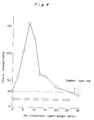
- the compounding ratio of the compatible agent to be added is changed depending on the kind and nature of the matrix resin and the liquid crystal resin. As shown in Fig. 3, the more the compatible agent is added, the more the bonding power on the interfacing surface between the matrix resin and the LCR fiber increases and results in the increased tensile strength caused by the composite function. On the contrary, at the same time, the more the compatible agent is added, the more the surface tension on the interfacing surface between the matrix resin and the LCR fiber decreases and results in the lowered cohesion power of the LCR when melt-extruded because of dispersion stabilization of the LCR in the matrix resin and thus it is difficult to form the LCR into fibers.
- the compatible agent to be added should be limited to the compounding ratio range that can prevent the LCR fibers from having an aspect ratio of 3 or less when melt-extruded, preferably to an amount range that generate a synergetic effect caused by the compatible effect and the fiber forming reinforcement effect.
- the resin composite composition comprising the thermoplastic matrix resin, the liquid crystal resin having the liquid crystal transition higher than the minimum moldable temperature of the matrix resin and the compatible agent, should be melt-extruded by such a shear rate to form the LCR into the fibers having an aspect ratio of 3 or more.
- the shear rate may be from 3 x 10² to 105 sec ⁇ 1.
- the compatible agent may be added on the interfacing surface between the matrix resin and the LCR fibers in a following manner.
- a method for preparing the liquid crystal resin composite material for molding which comprises: a step for mixing a LCR composite comprising the matrix resin and the LCR with the compatible agent, or mixing the matrix resin or the LCR composite with a composite comprising the LCR and the compatible agent or a composite comprising the matrix resin and the compatible agent wherein the compounding ratio of the compatible agent is in a range possible to prevent the liquid crystal resin from being formed into a fiber or fibers having an aspect ratio of less than 3; a step for extruding the mixture at a melting temperature above the liquid crystal transition point by the apparent resin shear rate of 3 x 10² to 105 sec ⁇ 1 to give a molding composite material having the LCR fibers having an aspect ratio of 3 or more.
- the resulting strands may be subjected to the drawing treatment after cooling or continuously without cooling after extruding.
- the drawing ratio cross sectional area before drawing/ that after drawing
- the strands are cut into a predetermined length and used as a molding material.
- the compatible agent which is present at the interface between the matrix resin and the LCR make the bonding power therebetween increased, which results in the increased composite function while maintaining the aspect of 3 or more. Therefore, according to the present invention, only the extruding formation is possible to give a sufficient fiber reinforcement to the LCR composite product. That is, while the composite function caused by use of only the matrix resin and the LCR can not give the sufficient reinforcement because the LCR fibers are damaged or destroyed on molding, which results in lowering the tensile strength after molding.
- the molding composite material prepared according to the present invention has a good productability such that the tensile strength is not lowered by the molding, so that the molding composite material according to the present invention is possible to give a product having a superior property than that of the conventional products.
- Fig. 1 is a graph showing an effect of the content of the LCR on the state variation of the composite material
- Fig. 2 is a graph showing an interaction between the apparent shear rate and the drawing ratio in the respect of the tensile strength
- Fig. 3 is a graph showing an interaction between the compatible function and the fiber-forming function in the respect of the reinforcement effect
- Fig. 4 is a graph showing a relation between the compounding ratio of the compatible agent and the tensile strength in the Example 1
- Fig. 5 is a graph showing a relation between the compounding ratio of the compatible agent and the tensile strength in the Example 2.
- pellets are subjected to an injection molding process by means of Injection Molding Machine (220 ton made by TOSHIBA MACHINE Co., Ltd.) and a die mold for test piece at the molding condition: resin temperature 250°C, injection pressure 1000 kg/cm2.
- Injection Molding Machine 220 ton made by TOSHIBA MACHINE Co., Ltd.
- a die mold for test piece at the molding condition: resin temperature 250°C, injection pressure 1000 kg/cm2.
- pellets are subjected to an injection molding process by means of Injection Molding Machine (220 ton made by TOSHIBA MACHINE Co., Ltd.) and a die mold for test piece at the molding condition: resin temperature 240°C, injection pressure 1000 kg/cm2.
- Injection Molding Machine 220 ton made by TOSHIBA MACHINE Co., Ltd.
- a die mold for test piece at the molding condition: resin temperature 240°C, injection pressure 1000 kg/cm2.
- pellets are subjected to an injection molding process by means of Injection Molding Machine (220 ton made by TOSHIBA MACHINE Co., Ltd.) and a die mold for test piece at the molding conditions: resin temperature 250°C, injection pressure 1000 kg/cm2.
- Injection Molding Machine 220 ton made by TOSHIBA MACHINE Co., Ltd.
- a die mold for test piece at the molding conditions: resin temperature 250°C, injection pressure 1000 kg/cm2.
- pellets are subjected to an injection molding process by means of Injection Molding Machine (220 ton made by TOSHIBA MACHINE Co., Ltd.) and a die mold for test piece at the molding conditions: resin temperature 240°C, injection pressure 1000 kg/cm2.
- Injection Molding Machine 220 ton made by TOSHIBA MACHINE Co., Ltd.
- a die mold for test piece at the molding conditions: resin temperature 240°C, injection pressure 1000 kg/cm2.
- pellets are subjected to an injection molding process by means of Injection Molding Machine (220 ton made by TOSHIBA MACHINE Co., Ltd.) and a die mold for test piece at the molding conditions: resin temperature 240°C, injection pressure 1000 kg/cm2.
- Injection Molding Machine 220 ton made by TOSHIBA MACHINE Co., Ltd.
- a die mold for test piece at the molding conditions: resin temperature 240°C, injection pressure 1000 kg/cm2.
Landscapes
- Chemical & Material Sciences (AREA)
- Health & Medical Sciences (AREA)
- Chemical Kinetics & Catalysis (AREA)
- Medicinal Chemistry (AREA)
- Polymers & Plastics (AREA)
- Organic Chemistry (AREA)
- Compositions Of Macromolecular Compounds (AREA)
- Processing And Handling Of Plastics And Other Materials For Molding In General (AREA)
- Reinforced Plastic Materials (AREA)
- Extrusion Moulding Of Plastics Or The Like (AREA)
Applications Claiming Priority (3)
| Application Number | Priority Date | Filing Date | Title |
|---|---|---|---|
| JP9819392 | 1992-04-17 | ||
| JP9819392 | 1992-04-17 | ||
| JP98193/92 | 1992-04-17 |
Publications (3)
| Publication Number | Publication Date |
|---|---|
| EP0566149A2 true EP0566149A2 (de) | 1993-10-20 |
| EP0566149A3 EP0566149A3 (de) | 1995-04-26 |
| EP0566149B1 EP0566149B1 (de) | 2004-11-17 |
Family
ID=14213173
Family Applications (1)
| Application Number | Title | Priority Date | Filing Date |
|---|---|---|---|
| EP19930106255 Expired - Lifetime EP0566149B1 (de) | 1992-04-17 | 1993-04-16 | Verbundmaterial und Verfahren zu dessen Herstellung |
Country Status (5)
| Country | Link |
|---|---|
| US (1) | US5567485A (de) |
| EP (1) | EP0566149B1 (de) |
| KR (1) | KR0127888B1 (de) |
| CN (1) | CN1037109C (de) |
| DE (1) | DE69333692T2 (de) |
Cited By (7)
| Publication number | Priority date | Publication date | Assignee | Title |
|---|---|---|---|---|
| EP0636644A1 (de) * | 1993-07-09 | 1995-02-01 | Shell Internationale Researchmaatschappij B.V. | Verfahren zur Herstellung von selbstverstärkende Verbundwerkstoffen |
| AU675539B2 (en) * | 1993-07-09 | 1997-02-06 | Shell Internationale Research Maatschappij B.V. | Preparation of a self-reinforcing composite comprising a thermoplastic polymer and a liquid crystalline polymer |
| EP0767815A4 (de) * | 1994-06-28 | 1998-05-13 | Foster Miller Inc | Kompatibilisierte flüssigkristalline polymermischungen |
| WO1999002607A3 (en) * | 1997-07-09 | 1999-04-01 | Du Pont | Liquid crystalline polymer-poly(phenylene oxide) blends |
| EP0957132A1 (de) * | 1998-05-12 | 1999-11-17 | Toray Industries, Inc. | Polyamidharz-Zusammensetzung |
| US6441074B1 (en) | 1999-01-08 | 2002-08-27 | E. I. Du Pont De Nemours And Company | High ARC tracking-index poly(phenylene oxide)-liquid crystalline poly |
| EP0634438B1 (de) * | 1993-07-16 | 2002-11-13 | Mazda Motor Corporation | Polymerverbundmaterial und Verfahren zur Herstellung |
Families Citing this family (6)
| Publication number | Priority date | Publication date | Assignee | Title |
|---|---|---|---|---|
| US6544382B2 (en) | 1999-11-15 | 2003-04-08 | Pactiv Corporation | Apparatus for high-speed heating and cooling of a polymer |
| CN100465231C (zh) * | 2006-08-24 | 2009-03-04 | 华南理工大学 | 一种含热致液晶聚合物的耐热尼龙材料及其制备方法 |
| JP6128299B2 (ja) * | 2011-03-17 | 2017-05-17 | 住友化学株式会社 | 液晶ポリエステル組成物の製造方法 |
| CN108276746A (zh) * | 2017-12-26 | 2018-07-13 | 上海普利特化工新材料有限公司 | 一种液晶聚酯/尼龙合金材料及其制备方法 |
| CN108264741A (zh) * | 2017-12-26 | 2018-07-10 | 上海普利特化工新材料有限公司 | 一种液晶聚酯/尼龙复合材料及其制备方法 |
| JP7118638B2 (ja) * | 2017-12-27 | 2022-08-16 | キヤノン株式会社 | 樹脂組成物、樹脂組成物の製造方法および電子機器 |
Family Cites Families (15)
| Publication number | Priority date | Publication date | Assignee | Title |
|---|---|---|---|---|
| DE3477799D1 (en) * | 1984-07-05 | 1989-05-24 | Celanese Corp | Melt blend of non-thermotropic and thermotropic wholly aromatic polyesters |
| US4728698A (en) * | 1985-09-06 | 1988-03-01 | University Of Akron | Liquid crystal fiber-reinforced polymer composite and process for preparing same |
| FR2620714B1 (de) * | 1987-09-18 | 1993-06-25 | Landler Yvan | |
| JPS6490255A (en) * | 1987-10-01 | 1989-04-06 | Toray Industries | Resin composite |
| JP2770328B2 (ja) * | 1987-12-18 | 1998-07-02 | 東レ株式会社 | ナイロン樹脂複合体の製法 |
| DE68916311T2 (de) * | 1988-04-12 | 1994-12-15 | Jsp Corp | Verfahren zur Herstellung einer thermoplastischen Kunststoffolie und deren Verwendung als Puffermaterial. |
| JP2571709B2 (ja) * | 1988-11-24 | 1997-01-16 | 三菱化学株式会社 | ポリカーボネート樹脂組成物 |
| US5006402A (en) * | 1989-04-28 | 1991-04-09 | The University Of Akron | Wholly aromatic polyester fiber-reinforced high performance thermoplastic and process for preparing same |
| US5006403A (en) * | 1989-04-28 | 1991-04-09 | The University Of Akron | Wholly aromatic polyester fiber-reinforced poly(phenylene oxide) and process for preparing same |
| NL8901737A (nl) * | 1989-07-07 | 1991-02-01 | Stamicarbon | Polymeersamenstelling op basis van een vloeibaar kristallijn polymeer en een polyamide. |
| AU6172790A (en) * | 1989-08-10 | 1991-03-11 | University Of Akron | Self reinforced thermoplastic composite laminate |
| JP2862303B2 (ja) * | 1990-01-19 | 1999-03-03 | ユニチカ株式会社 | ポリマーブレンドの成形方法 |
| US5621041A (en) * | 1991-04-17 | 1997-04-15 | Center For Innovative Technology | Compatible liquid crystal polymer/polyolefin blends |
| US5283114A (en) * | 1991-04-25 | 1994-02-01 | Edison Polymer Innovation Corporation | Wholly aromatic polyester fiber-reinforced polystyrene-poly(phenylene oxide) blend |
| EP1352731A3 (de) * | 1992-03-06 | 2009-10-21 | Mississippi Polymer Technologies, Inc. | Verfahren zur Orientierung von Polymermolekülen |
-
1993
- 1993-04-16 EP EP19930106255 patent/EP0566149B1/de not_active Expired - Lifetime
- 1993-04-16 DE DE1993633692 patent/DE69333692T2/de not_active Expired - Fee Related
- 1993-04-17 KR KR1019930006560A patent/KR0127888B1/ko not_active Expired - Fee Related
- 1993-04-17 CN CN93105706A patent/CN1037109C/zh not_active Expired - Fee Related
-
1994
- 1994-07-01 US US08/266,899 patent/US5567485A/en not_active Expired - Lifetime
Cited By (8)
| Publication number | Priority date | Publication date | Assignee | Title |
|---|---|---|---|---|
| EP0636644A1 (de) * | 1993-07-09 | 1995-02-01 | Shell Internationale Researchmaatschappij B.V. | Verfahren zur Herstellung von selbstverstärkende Verbundwerkstoffen |
| AU675539B2 (en) * | 1993-07-09 | 1997-02-06 | Shell Internationale Research Maatschappij B.V. | Preparation of a self-reinforcing composite comprising a thermoplastic polymer and a liquid crystalline polymer |
| EP0634438B1 (de) * | 1993-07-16 | 2002-11-13 | Mazda Motor Corporation | Polymerverbundmaterial und Verfahren zur Herstellung |
| EP0767815A4 (de) * | 1994-06-28 | 1998-05-13 | Foster Miller Inc | Kompatibilisierte flüssigkristalline polymermischungen |
| WO1999002607A3 (en) * | 1997-07-09 | 1999-04-01 | Du Pont | Liquid crystalline polymer-poly(phenylene oxide) blends |
| EP0957132A1 (de) * | 1998-05-12 | 1999-11-17 | Toray Industries, Inc. | Polyamidharz-Zusammensetzung |
| US6121388A (en) * | 1998-05-12 | 2000-09-19 | Toray Industries, Inc. | Polyamide resin composition |
| US6441074B1 (en) | 1999-01-08 | 2002-08-27 | E. I. Du Pont De Nemours And Company | High ARC tracking-index poly(phenylene oxide)-liquid crystalline poly |
Also Published As
| Publication number | Publication date |
|---|---|
| CN1037109C (zh) | 1998-01-21 |
| DE69333692D1 (de) | 2004-12-23 |
| EP0566149A3 (de) | 1995-04-26 |
| KR0127888B1 (ko) | 1998-04-04 |
| DE69333692T2 (de) | 2005-11-10 |
| KR940005754A (ko) | 1994-03-22 |
| US5567485A (en) | 1996-10-22 |
| CN1078976A (zh) | 1993-12-01 |
| EP0566149B1 (de) | 2004-11-17 |
Similar Documents
| Publication | Publication Date | Title |
|---|---|---|
| EP0319589B1 (de) | Mit hanffasern verstärktes thermoplastisches kompositmaterial | |
| EP0566149A2 (de) | Verbundmaterial und Verfahren zu dessen Herstellung | |
| US5264174A (en) | Process for producing compositely reinforced polypropylene resin composition | |
| EP0342344A1 (de) | Isocyanat-Reaktionsteilnehmer enthaltendes Polymer-Gemisch | |
| CA2621336C (en) | Thermoplastic composites containing lignocellulosic materials and methods of making the same | |
| US5861462A (en) | Method for forming a liquid crystal resin composite | |
| JPS62116666A (ja) | 自己強化重合体複合物及びその製法 | |
| JP3241482B2 (ja) | 成形用複合樹脂組成物及びそれを用いた成形方法 | |
| KR960006785B1 (ko) | 성형용 수지조성물 | |
| JP3186858B2 (ja) | 液晶樹脂複合体の成形方法 | |
| CN1362443A (zh) | 一种可用作风扇材料的热塑性组合物 | |
| JP3241404B2 (ja) | 成形用樹脂組成物とその樹脂成形品の製造方法 | |
| JP3119508B2 (ja) | 液晶ポリマーを含有する再成形品の製造方法 | |
| EP0552742A1 (de) | Verfahren zum Spritzgiessen eines Verbundmaterials aus einem flüssigkristallinen Harz und dadurch hergestellter Gegenstand | |
| JP3224136B2 (ja) | 液晶性ポリマーを含有する再成形品の製造方法 | |
| JP3217091B2 (ja) | 液晶ポリマーを含有する再成形品 | |
| JPH0747546A (ja) | 液晶樹脂複合体成形用素材およびそれを用いる成形方法 | |
| JP3159741B2 (ja) | 液晶性ポリマーを含有する再成形品の製造方法 | |
| JP3224137B2 (ja) | 液晶性ポリマーを含有する再成形品の製造方法 | |
| JP3332258B2 (ja) | 液晶樹脂複合体の成形用素材および成形方法 | |
| JP3217092B2 (ja) | 液晶ポリマーを含有する再成形品 | |
| JPH04146956A (ja) | ポリブチレンテレフタレート樹脂組成物 | |
| JP3124587B2 (ja) | 液晶性ポリマーを含有する再成形品の製造方法 | |
| JP3115655B2 (ja) | 液晶性ポリマーを含有する再成形品の製造方法 | |
| JP3162124B2 (ja) | 液晶性ポリマーを含有する再成形品の製造方法 |
Legal Events
| Date | Code | Title | Description |
|---|---|---|---|
| PUAI | Public reference made under article 153(3) epc to a published international application that has entered the european phase |
Free format text: ORIGINAL CODE: 0009012 |
|
| AK | Designated contracting states |
Kind code of ref document: A2 Designated state(s): DE FR GB |
|
| PUAL | Search report despatched |
Free format text: ORIGINAL CODE: 0009013 |
|
| AK | Designated contracting states |
Kind code of ref document: A3 Designated state(s): DE FR GB |
|
| 17P | Request for examination filed |
Effective date: 19951019 |
|
| 17Q | First examination report despatched |
Effective date: 19971205 |
|
| GRAP | Despatch of communication of intention to grant a patent |
Free format text: ORIGINAL CODE: EPIDOSNIGR1 |
|
| RTI1 | Title (correction) |
Free format text: MOLDING COMPOSITE COMPOSITION AND METHOD FOR PREPARING THE SAME |
|
| GRAS | Grant fee paid |
Free format text: ORIGINAL CODE: EPIDOSNIGR3 |
|
| GRAA | (expected) grant |
Free format text: ORIGINAL CODE: 0009210 |
|
| AK | Designated contracting states |
Kind code of ref document: B1 Designated state(s): DE FR GB |
|
| REG | Reference to a national code |
Ref country code: GB Ref legal event code: FG4D |
|
| REF | Corresponds to: |
Ref document number: 69333692 Country of ref document: DE Date of ref document: 20041223 Kind code of ref document: P |
|
| PLBE | No opposition filed within time limit |
Free format text: ORIGINAL CODE: 0009261 |
|
| ET | Fr: translation filed | ||
| 26N | No opposition filed |
Effective date: 20050818 |
|
| PGFP | Annual fee paid to national office [announced via postgrant information from national office to epo] |
Ref country code: GB Payment date: 20070411 Year of fee payment: 15 |
|
| PGFP | Annual fee paid to national office [announced via postgrant information from national office to epo] |
Ref country code: FR Payment date: 20070411 Year of fee payment: 15 |
|
| GBPC | Gb: european patent ceased through non-payment of renewal fee |
Effective date: 20080416 |
|
| REG | Reference to a national code |
Ref country code: FR Ref legal event code: ST Effective date: 20081231 |
|
| PG25 | Lapsed in a contracting state [announced via postgrant information from national office to epo] |
Ref country code: FR Free format text: LAPSE BECAUSE OF NON-PAYMENT OF DUE FEES Effective date: 20080430 |
|
| PG25 | Lapsed in a contracting state [announced via postgrant information from national office to epo] |
Ref country code: GB Free format text: LAPSE BECAUSE OF NON-PAYMENT OF DUE FEES Effective date: 20080416 |
|
| PGFP | Annual fee paid to national office [announced via postgrant information from national office to epo] |
Ref country code: DE Payment date: 20090409 Year of fee payment: 17 |
|
| PG25 | Lapsed in a contracting state [announced via postgrant information from national office to epo] |
Ref country code: DE Free format text: LAPSE BECAUSE OF NON-PAYMENT OF DUE FEES Effective date: 20101103 |