EP0567104A2 - Schaltung zur Erkennung von Auffrischungadressignalen eines Halbleiterspeichersgeräts - Google Patents
Schaltung zur Erkennung von Auffrischungadressignalen eines Halbleiterspeichersgeräts Download PDFInfo
- Publication number
- EP0567104A2 EP0567104A2 EP93106502A EP93106502A EP0567104A2 EP 0567104 A2 EP0567104 A2 EP 0567104A2 EP 93106502 A EP93106502 A EP 93106502A EP 93106502 A EP93106502 A EP 93106502A EP 0567104 A2 EP0567104 A2 EP 0567104A2
- Authority
- EP
- European Patent Office
- Prior art keywords
- refresh address
- refresh
- address signals
- comparators
- sub
- Prior art date
- Legal status (The legal status is an assumption and is not a legal conclusion. Google has not performed a legal analysis and makes no representation as to the accuracy of the status listed.)
- Granted
Links
Images

Classifications
-
- G—PHYSICS
- G11—INFORMATION STORAGE
- G11C—STATIC STORES
- G11C29/00—Checking stores for correct operation ; Subsequent repair; Testing stores during standby or offline operation
- G11C29/02—Detection or location of defective auxiliary circuits, e.g. defective refresh counters
-
- G—PHYSICS
- G11—INFORMATION STORAGE
- G11C—STATIC STORES
- G11C11/00—Digital stores characterised by the use of particular electric or magnetic storage elements; Storage elements therefor
- G11C11/21—Digital stores characterised by the use of particular electric or magnetic storage elements; Storage elements therefor using electric elements
- G11C11/34—Digital stores characterised by the use of particular electric or magnetic storage elements; Storage elements therefor using electric elements using semiconductor devices
- G11C11/40—Digital stores characterised by the use of particular electric or magnetic storage elements; Storage elements therefor using electric elements using semiconductor devices using transistors
- G11C11/401—Digital stores characterised by the use of particular electric or magnetic storage elements; Storage elements therefor using electric elements using semiconductor devices using transistors forming cells needing refreshing or charge regeneration, i.e. dynamic cells
- G11C11/406—Management or control of the refreshing or charge-regeneration cycles
Definitions
- the present invention relates to a semiconductor memory device and particularly to a self-refresh address test circuit of a semiconductor memory device which has a self-refresh function with using an internal self-refresh address.
- the DRAM comprises a memory cell array consisted of a plurality of memory cells which are coupled with a plurality of word lines and a plurality of bit lines arranged in matrix, and peripheral circuits for controlling read and write operation of data into and from the memory cell selected by a combination of the word line and bit line.
- Each of the memory cells in the DRAM comprises a single MOSFET (metal-oxide-semiconductor field effect transistor) and a single capacitor. Data written into a memory cell is charged in the single capacitor of the memory cell, and the logic state of the data is determined by the amount of the charge stored in the single capacitor.
- MOSFET metal-oxide-semiconductor field effect transistor
- a refresh function is provided to the memory cell in order to restore an original data level of the memory cell.
- the refresh operation is automatically performed with a predetermined period, repeatedly, and made by itself to all the memory cells embedded in the DRAM. Such is called as a self-refresh operation wherein addresses for selecting memory cells in sequent are generated in the DRAM without using external addresses as is in normal operation.
- a self-refresh operation mode is enabled after a predetermined lapse time from when CAS-before-RAS refresh mode (referred to as "CBR mode” hereinafter) is initiated. If a row address strobe signal RAS ⁇ is made active as “low” level while a column address strobe signal CAS ⁇ is being active as “low” level, the CBR mode initiates.
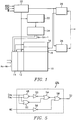
- the conventional DRAM comprises a refresh control circuit 22 generating a refresh clock ⁇ RFSH according to a CBR informing signal made by a control signal generator 20 which receives a row address strobe signal RAS ⁇ , a column address strobe signal CAS ⁇ and a write signal WE ⁇ , a refresh address counter 24 generating a plurality of internal refresh address signals Q0-Q n-1 response to the refresh clock ⁇ RFSH.
- the refresh clock ⁇ RFSH is generated from the refresh control circuit 22 by an oscillator (not shown) therein, reponing to initiation of the CBR informing signal.
- a plurality of internal refresh address signals Q0-Q n-1 are generated from the refresh address counter 24 and applied to a low decoder 12 and a column decoder 16, for the purpose of being used for selecting memory cells in a memory cell array 10 in regular sequence.
- a self-refresh operation is made up to the memory cells in the memory cell array 10.
- the semiconductor memory circuit comprises a memory cell array with a plurality of memory cells, a selection means for selecting one of the memory cells, an input and output means for storing and retrieving data into and from the memory cells, a refresh control circuit for generating a refresh clock, a refresh address counter for generating a plurality of refresh address signals response to the refresh clock and apply the refresh address signals to the selection means, and a refresh address test circuit for detecting whether the refresh address signals has been completely generated or not.
- the refresh address test circuit comprises a plurality of the address test paths, each including a first sub-path with an initial logic level of the refresh address signal and a second sub-path of refresh address signal, a plurality of comparators, each receiving the initial logic level of the refresh address signal from the first sub-path and a present logic level of the refresh address signal from the second sub-path, a test output circuit for receiving the output signals generated from the plurality of comparators.
- the first sub-path comprises latch means for holding the initial logic levels of the refresh address signals, switch means for transferring the initial logic levels of the refresh address signals to the comparators. It is also preferred that the comparators is activated at least before the refresh address signals are commonly on same logic level.
- Fig. 1 is a functional block diagram of a conventional semiconductor memory device employing a self-refresh function.
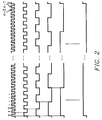
- Fig. 2 is a timing chart diagram of Fig. 1, showing a refresh clock and internal refresh address signals.
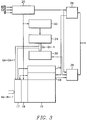
- Fig. 3 is a functional block diagram of a semiconductor memory device comprising a refresh address test circuit according to the present invention.
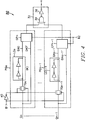
- Fig. 4 shows an embodiment of the refresh address test circuit of Fig,3, according to the present invention.
- Fig. 5 shows an embodiment of a comparator provided to the refresh address test circuit of Fig.4, according to the present invention.
- Fig. 6 is a timing chart diagram of Fig.3, when the semiconductor memory device according to the present invention is performing a self-refresh operation with the refresh address test circuit of Fig.4.
- FIG. 3 Prior to description about an embodiment according to the present invention hereinafter, note that functional block elements of Fig.3 as same as those of Fig.1 are marked with numerals as is in Fig.1. Now, referring to Fig. 3, other components in Fig.3 is as same as those of Fig.1 but a refresh address test circuit 30 which receives a plurality of internal refresh address signals Q0-Q n-1 , generated from a refresh address counter 24 and applies an address test signal to a data output buffer 28.
- a CBR informing signal made from a control signal generator 20 from which an input/output control signal is also generated is applied to a refresh control circuit 22, an address buffer 14, a row decoder 12 and a sense amplifier 18.
- the address buffer 14 turns its input to the internal refresh address from the external address A0-A n-1 when the semiconductor memory device of Fig.3 is in a self-refresh operation mode.
- the data output buffer 28 makes the address test signal be generated out of the semiconductor memory device.
- Detail circuit of the refresh address test circuit 30 is shown in Fig.4.
- the refresh address test circuit 30 comprises a plurality of address test paths PQ0-PQ n-1 receiving the plurality of the internal refresh address signals Q0-Q n-1 applied from the refresh address counter 24, a test output circuit 32 receiving all signals passed through the address test paths PQ0-PQ n-1 and generating the address test signal which detects whether all the refresh addresses Q0-Q n-1 for one self-refresh cycle have been completely generated.
- a first address test path PQ0 is consisted of a first sub-path DA0, a second sub-path DA0', a first comparator CP0 receiving signals on the first and second sub-paths DA0 and DA0' and being controlled by a comparing control signal ⁇ 2.
- the first sub-path DA0 receives a first refresh address signal Q0 and is coupled to one input terminal of the first comparator CP0, including a first transmission gate TG0 transferring the first refresh address signal Q0 by means of a transmission control clock ⁇ 1, a first latch circuit LC0 coupled between the first transmission gate TG0 and the one input terminal of the first comparator CP0.
- the second sub-path DA0' directly applies the first refresh address signal Q0 to the other input terminal of the first comparator CP0. Also in other address test paths such as second address test path PQ1 through n'th address test path PQ n-1 each of them is constructed as is in the first address test path PQ0.
- the address test path PQi is consisted of a first sub-path DAi, a second sub-path DAi', an i'th comparator CPi receiving signals on the first and second sub-paths DAi and DAi' and being controlled by the comparing control clock ⁇ 2;
- the first sub-path DAi receives an i'th refresh address signal Q i and is coupled to one input terminal of the i'th comparator CPi, including an i'th transmission gate TGi transferring the i'th refresh address signal Qi by means of the transmission control clock ⁇ 1 and an i'th latch circuit LCi coupled between the i'th transmission gate TGi and the one input terminal of the i'th comparator CPi;
- the second sub-path DAi' directly applies the i'th refresh address Qi to the other input terminal of the i'th comparator CPi.
- the test output circuit 32 is made of a NAND gate 34 receiving all output signals generated from the plurality of the comparators CP0, CP1,..., CP n-1 and an inverter 36 coupled to an output terminal of the NAND gate 34 to convert the output signal of the NAND gate 36 to the address test signal.
- FIG.5 A logic circuit of the comparator employed in the address test path, as an embodiment according to the present invention, is disclosed in Fig.5.
- the i'th comparator CPi (any one of the first comparator CP0 through the n'th comparator CP n-1 is consisted of a NAND gate 48 and a first NOR gate 52 those input terminals are commonly coupled to the first and second sub-paths DAi and DAi', an inverter 50 inverting an output signal of the NAND gate 48, a second NOR gate 54 receiving output signals from the inverter 50 and the first NOR gate 52, an inverter 56 inverting the comparing control clock ⁇ 2, and a third NOR gate 58 receiving the output signals from the second NOR gate 54 and the inverter 56 to apply a compared output signal to the test output circuit 32.
- Figs. 3 through 5 which illustrates figures of the row address strobe signal RAS ⁇ , a column address strobe signal CAS ⁇ , the CBR informing signal, the refresh clock ⁇ RFSH, the control clocks ⁇ 1 and ⁇ 2, and the plurality of the internal refresh address signals Q0-Q n-1 .
- the CBR informing signal is generated from the control signal generator 20 of Fig.3 at a time t2 to enable a self-refresh operation mode. Then, the refresh control circuit 22 controlled by the CBR informing signal generates the refresh clock ⁇ RFSH, as shown in Fig.6, by means of an oscillator (not shown), and thereby the refresh address counter 24 generates the plurality of the refresh address signals Q0-Q n-1 .
- the transmission control clock ⁇ 1 retains "low”level, the internal refresh address signals Q0-Q n-1 are stored into the latch circuits LC0-LC n-1 on the first sub-paths DA0-DA n-1 , by passing through the transmission gates TG0-TG n-1 .
- the transmission control clock ⁇ 1 becomes "high” level.
- the transmission gates TG0-TG n-1 are closed to be disable so that the stored the initial level of the refresh address signals Q0-Q n-1 are held on the first sub-paths DA0-DA n-1 bythe latch circuits LC0-LCn-l until the self-refresh operation mode has been expired, completely.
- the comparing control clock ⁇ 2 becomes "high” level to activate the comparators CP0-CP n-1 which have two input terminals, respectively, the one connected to the output of the latch circuit storing the initial level of the refresh address signal and the other directly receiving the subsequently toggling level of the refresh address signal.
- the one input terminals of the NAND gate 48 and the first NOR gate 52 are coupled to the initial logic level of the refresh address signal on the first sub-path DAi (any one of the DA0-DA n-1 ), and the other input terminals of the NAND gate 48 and the first NOR gate 52 are coupled to the subsequently toggling logic level of the refresh address signal on the second sub-path DAi' (any one of the DA0'-DA n- 1').
- the second NOR gate 54 receives an output signal of "low” level from the inverter 50 which inverts the output level of the NAND gate 48 and also receives an output signal of "low” level from the first NOR gate 52.
- the third NOR gate 58 can generate an output signal of "low” level and apply it to one of the input terminals of the test output circuit 32 in Fig.4. Because this output signal of "low” level of the third NOR gate 58 of the comparator CPi, that is, an resultant output signal generated from any one of the address test paths PQ0-PQ n-1 , makes the output of the test output circuit 32 be on "low” level, it represents that all the refresh address signals Q0-Q n-1 in need of performing one refresh cycle in the self-refresh operation mode have not been completely generated as a whole.
- each of the refresh address signals Q0-Q n-1 being generated is toggling from its "high” level to “low” level, or its "low” level to “high” level
- all the NAND gates (similar to the NAND gate 48) and the first NOR gates (similar to the first NOR gate 52) of the comparators CP0-CP n-1 can commonly receive the refresh address signals Q0-Q n-1 of "high” levels from the second sub-paths DAi' only at the time of that all the refresh address signals Q0-Q n-1 for the next self-refresh cycle are applied to their own second sub-paths DA0'-DA n-1 ⁇ of the address test paths PQ0-PQ n-1 , as shown in Fig.6.
- the third NOR gate 58 generate an output signal of "high” level, resulting in that the address test signal is generated as “high” level due to all inputs of the HAND gate 34 of the test output circuit 32 becoming “high” level.
- the refresh address signals Q0-Q n-1 in need of performing one self-refresh cycle, that is, the prior self-refresh cycle, in the self-refresh operation mode are completely generated as a whole.
- the generating condition of the internal refresh address signals is detected through the data output buffer 28 and thereby the self-refresh cycle time can be verified.
- the comparing control clock ⁇ 2 is activated at the time of that the second pulse of the refresh clock ⁇ RFSH goes to its "high” level
- the activation time of the clock ⁇ 2 can be designed to be enabled just on or before all the refresh address signals has been on their "low” levels in common, as an example on or before the n-1'th pulse of the refresh clock ⁇ RFSH goes to its "high” level, as shown in Fig.6. This can provide power consumption reducing effect to the semiconductor memory device according to the present invention.
- the number of signals to be applied to the comparator for comparing the initial logic level of the refresh address signal and the present logic level of the refresh address signal, may be obvious to be variable by those skilled in this art.
- the present invention provides a refresh test circuit with means for detecting whether the internal refresh address signals being used for a self-refresh cycle in the self-refresh operation mode has been completely generated or not yet, an accurate self-refresh cycle time can be obtained thereby and the disagreement between the substantial self-refresh cycle time and the standard self-refresh cycle time can be eliminated.
Landscapes
- Engineering & Computer Science (AREA)
- Microelectronics & Electronic Packaging (AREA)
- Computer Hardware Design (AREA)
- Dram (AREA)
- For Increasing The Reliability Of Semiconductor Memories (AREA)
Applications Claiming Priority (2)
| Application Number | Priority Date | Filing Date | Title |
|---|---|---|---|
| KR1019920006728A KR950009390B1 (ko) | 1992-04-22 | 1992-04-22 | 반도체 메모리장치의 리프레시 어드레스 테스트회로 |
| KR672892 | 1992-04-22 |
Publications (3)
| Publication Number | Publication Date |
|---|---|
| EP0567104A2 true EP0567104A2 (de) | 1993-10-27 |
| EP0567104A3 EP0567104A3 (en) | 1996-04-17 |
| EP0567104B1 EP0567104B1 (de) | 1998-07-01 |
Family
ID=19332103
Family Applications (1)
| Application Number | Title | Priority Date | Filing Date |
|---|---|---|---|
| EP93106502A Expired - Lifetime EP0567104B1 (de) | 1992-04-22 | 1993-04-21 | Halbleiterspeichervorrichtung mit Selbstauffrischungsfunktion |
Country Status (7)
| Country | Link |
|---|---|
| US (1) | US5299168A (de) |
| EP (1) | EP0567104B1 (de) |
| JP (1) | JP2843481B2 (de) |
| KR (1) | KR950009390B1 (de) |
| CN (1) | CN1032337C (de) |
| DE (1) | DE69319372T2 (de) |
| TW (1) | TW212251B (de) |
Cited By (2)
| Publication number | Priority date | Publication date | Assignee | Title |
|---|---|---|---|---|
| EP0610862A3 (en) * | 1993-02-10 | 1995-12-13 | Nec Corp | Dynamic random access memory device with self-refresh cycle time directly measurable at data pin. |
| RU2256949C2 (ru) * | 1999-12-30 | 2005-07-20 | Интел Корпорейшн | Способ и устройство дифференциального стробирования на коммуникационной шине |
Families Citing this family (25)
| Publication number | Priority date | Publication date | Assignee | Title |
|---|---|---|---|---|
| JPH06150646A (ja) * | 1992-11-13 | 1994-05-31 | Nec Corp | 半導体メモリ |
| JP3244340B2 (ja) * | 1993-05-24 | 2002-01-07 | 三菱電機株式会社 | 同期型半導体記憶装置 |
| US5450364A (en) * | 1994-01-31 | 1995-09-12 | Texas Instruments Incorporated | Method and apparatus for production testing of self-refresh operations and a particular application to synchronous memory devices |
| JP3426693B2 (ja) * | 1994-03-07 | 2003-07-14 | 株式会社日立製作所 | 半導体記憶装置 |
| KR100372245B1 (ko) * | 1995-08-24 | 2004-02-25 | 삼성전자주식회사 | 워드라인순차제어반도체메모리장치 |
| JPH09161478A (ja) * | 1995-12-12 | 1997-06-20 | Mitsubishi Electric Corp | 半導体記憶装置 |
| US6392948B1 (en) | 1996-08-29 | 2002-05-21 | Micron Technology, Inc. | Semiconductor device with self refresh test mode |
| KR100363108B1 (ko) * | 1998-12-30 | 2003-02-20 | 주식회사 하이닉스반도체 | 반도체 메모리장치와 그 장치의 리프레쉬주기 조절방법 |
| JPH11345486A (ja) * | 1998-06-01 | 1999-12-14 | Mitsubishi Electric Corp | セルフ・リフレッシュ制御回路を備えたdramおよびシステムlsi |
| KR100363103B1 (ko) * | 1998-10-20 | 2003-02-19 | 주식회사 하이닉스반도체 | 셀프 리프레쉬 발진기 |
| KR100364128B1 (ko) * | 1999-04-08 | 2002-12-11 | 주식회사 하이닉스반도체 | 셀프리프레쉬 발진주기 측정장치 |
| US6330203B1 (en) | 2000-12-26 | 2001-12-11 | Vanguard International Semiconductor Corporation | Test mode for verification of on-chip generated row addresses |
| JP2002214296A (ja) * | 2001-01-16 | 2002-07-31 | Toshiba Corp | 半導体装置 |
| US7184728B2 (en) * | 2002-02-25 | 2007-02-27 | Adc Telecommunications, Inc. | Distributed automatic gain control system |
| DE10228527B3 (de) * | 2002-06-26 | 2004-03-04 | Infineon Technologies Ag | Verfahren zum Überprüfen der Refresh-Funktion eines Informationsspeichers |
| KR101130378B1 (ko) | 2004-09-09 | 2012-03-27 | 엘지전자 주식회사 | 식기세척기 및 그 제어방법 |
| US7599711B2 (en) | 2006-04-12 | 2009-10-06 | Adc Telecommunications, Inc. | Systems and methods for analog transport of RF voice/data communications |
| DE102006020098A1 (de) * | 2006-04-29 | 2007-10-31 | Infineon Technologies Ag | Speicherschaltung und Verfahren zum Auffrischen von dynamischen Speicherzellen |
| KR20100128045A (ko) | 2009-05-27 | 2010-12-07 | 삼성전자주식회사 | 반도체 메모리 장치의 셀프 리프레시 주기 측정 방법 |
| KR101752154B1 (ko) * | 2010-11-02 | 2017-06-30 | 삼성전자주식회사 | 로우 어드레스 제어 회로, 이를 포함하는 반도체 메모리 장치 및 로우 어드레스 제어 방법 |
| KR101974108B1 (ko) * | 2012-07-30 | 2019-08-23 | 삼성전자주식회사 | 리프레쉬 어드레스 생성기, 이를 포함하는 휘발성 메모리 장치 및 휘발성 메모리 장치의 리프레쉬 방법 |
| KR102194791B1 (ko) * | 2013-08-09 | 2020-12-28 | 에스케이하이닉스 주식회사 | 메모리, 이를 포함하는 메모리 시스템 및 메모리의 동작방법 |
| US9577922B2 (en) | 2014-02-18 | 2017-02-21 | Commscope Technologies Llc | Selectively combining uplink signals in distributed antenna systems |
| CN105338131B (zh) * | 2015-11-30 | 2019-05-31 | 上海斐讯数据通信技术有限公司 | 一种dhcp服务器地址池容量的测试方法及系统 |
| CN114121074B (zh) * | 2020-08-31 | 2023-09-01 | 长鑫存储技术有限公司 | 存储阵列自刷新频率测试方法与存储阵列测试设备 |
Family Cites Families (6)
| Publication number | Priority date | Publication date | Assignee | Title |
|---|---|---|---|---|
| US4672583A (en) * | 1983-06-15 | 1987-06-09 | Nec Corporation | Dynamic random access memory device provided with test circuit for internal refresh circuit |
| JPS6035398A (ja) * | 1983-08-05 | 1985-02-23 | Nec Corp | ダイナミック型半導体記憶装置 |
| JPS6083294A (ja) * | 1983-10-13 | 1985-05-11 | Nec Corp | 自動リフレツシユ回路 |
| JPH087995B2 (ja) * | 1985-08-16 | 1996-01-29 | 富士通株式会社 | ダイナミツク半導体記憶装置のリフレツシユ方法および装置 |
| JPH0799618B2 (ja) * | 1986-03-24 | 1995-10-25 | 日本電気株式会社 | 半導体メモリのテスト回路 |
| US4933908A (en) * | 1988-10-28 | 1990-06-12 | Unisys Corporation | Fault detection in memory refreshing system |
-
1992
- 1992-04-22 KR KR1019920006728A patent/KR950009390B1/ko not_active Expired - Fee Related
-
1993
- 1993-04-20 TW TW082103030A patent/TW212251B/zh not_active IP Right Cessation
- 1993-04-21 DE DE69319372T patent/DE69319372T2/de not_active Expired - Lifetime
- 1993-04-21 EP EP93106502A patent/EP0567104B1/de not_active Expired - Lifetime
- 1993-04-22 US US08/050,780 patent/US5299168A/en not_active Expired - Lifetime
- 1993-04-22 CN CN93105919.4A patent/CN1032337C/zh not_active Expired - Lifetime
- 1993-04-22 JP JP5095973A patent/JP2843481B2/ja not_active Expired - Fee Related
Cited By (2)
| Publication number | Priority date | Publication date | Assignee | Title |
|---|---|---|---|---|
| EP0610862A3 (en) * | 1993-02-10 | 1995-12-13 | Nec Corp | Dynamic random access memory device with self-refresh cycle time directly measurable at data pin. |
| RU2256949C2 (ru) * | 1999-12-30 | 2005-07-20 | Интел Корпорейшн | Способ и устройство дифференциального стробирования на коммуникационной шине |
Also Published As
| Publication number | Publication date |
|---|---|
| JP2843481B2 (ja) | 1999-01-06 |
| DE69319372D1 (de) | 1998-08-06 |
| EP0567104A3 (en) | 1996-04-17 |
| TW212251B (en) | 1993-09-01 |
| KR930022383A (ko) | 1993-11-24 |
| KR950009390B1 (ko) | 1995-08-21 |
| EP0567104B1 (de) | 1998-07-01 |
| US5299168A (en) | 1994-03-29 |
| JPH06103757A (ja) | 1994-04-15 |
| DE69319372T2 (de) | 1998-10-29 |
| CN1078820A (zh) | 1993-11-24 |
| CN1032337C (zh) | 1996-07-17 |
Similar Documents
| Publication | Publication Date | Title |
|---|---|---|
| EP0567104B1 (de) | Halbleiterspeichervorrichtung mit Selbstauffrischungsfunktion | |
| US8040751B2 (en) | Semiconductor memory device | |
| KR920001758B1 (ko) | 내부 셀프-리프레쉬 회로를 가지는 의사(pseudo)-정적 메모리장치 | |
| US5875153A (en) | Internal/external clock option for built-in self test | |
| US5414672A (en) | Semiconductor memory device including address transition detector | |
| US6795363B2 (en) | Refresh control method of semiconductor memory device and semiconductor memory device comprising the same control method | |
| EP0895245B1 (de) | Synchrone Halbleiterspeicheranordnung | |
| US20070268763A1 (en) | Method for controlling precharge timing of memory device and apparatus thereof | |
| US6205069B1 (en) | Semiconductor memory device with fast input/output line precharge scheme and method of precharging input/output lines thereof | |
| US5708624A (en) | Method and structure for controlling internal operations of a DRAM array | |
| US5790468A (en) | Refresh counter for synchronous dynamic random access memory and method of testing the same | |
| US6349072B1 (en) | Random access memory device | |
| US6563760B2 (en) | Circuit and method for generating internal command signals in a semiconductor memory device | |
| EP0239916A2 (de) | Halbleiterspeichervorrichtung mit einem Testmodus und einem Standardmodusbetrieb | |
| KR100462085B1 (ko) | 반도체 기억 회로 | |
| US6501701B2 (en) | Semiconductor memory device | |
| US7167948B2 (en) | Semiconductor memory device | |
| US7668032B2 (en) | Refresh operation of memory device | |
| US5515331A (en) | DRAM refresh control circuit | |
| US6108248A (en) | Column address strobe signal generator for synchronous dynamic random access memory | |
| JP4386657B2 (ja) | 半導体記憶装置 | |
| KR19980040799A (ko) | 반도체 메모리 장치의 자동 프리차아지 신호 발생회로 | |
| US6349066B1 (en) | Semiconductor storage device having a self-refresh circuit for automatically refreshing memory cell | |
| KR100487484B1 (ko) | 반도체메모리장치의리프래시제어회로 | |
| US6408411B1 (en) | Two pass multi-state parallel test for semiconductor device |
Legal Events
| Date | Code | Title | Description |
|---|---|---|---|
| PUAI | Public reference made under article 153(3) epc to a published international application that has entered the european phase |
Free format text: ORIGINAL CODE: 0009012 |
|
| AK | Designated contracting states |
Kind code of ref document: A2 Designated state(s): DE FR GB IT |
|
| PUAL | Search report despatched |
Free format text: ORIGINAL CODE: 0009013 |
|
| AK | Designated contracting states |
Kind code of ref document: A3 Designated state(s): DE FR GB IT |
|
| 17P | Request for examination filed |
Effective date: 19960730 |
|
| 17Q | First examination report despatched |
Effective date: 19961217 |
|
| GRAG | Despatch of communication of intention to grant |
Free format text: ORIGINAL CODE: EPIDOS AGRA |
|
| GRAG | Despatch of communication of intention to grant |
Free format text: ORIGINAL CODE: EPIDOS AGRA |
|
| GRAH | Despatch of communication of intention to grant a patent |
Free format text: ORIGINAL CODE: EPIDOS IGRA |
|
| GRAH | Despatch of communication of intention to grant a patent |
Free format text: ORIGINAL CODE: EPIDOS IGRA |
|
| GRAA | (expected) grant |
Free format text: ORIGINAL CODE: 0009210 |
|
| AK | Designated contracting states |
Kind code of ref document: B1 Designated state(s): DE FR GB IT |
|
| REF | Corresponds to: |
Ref document number: 69319372 Country of ref document: DE Date of ref document: 19980806 |
|
| ET | Fr: translation filed | ||
| PLBE | No opposition filed within time limit |
Free format text: ORIGINAL CODE: 0009261 |
|
| 26N | No opposition filed | ||
| REG | Reference to a national code |
Ref country code: GB Ref legal event code: IF02 |
|
| PGFP | Annual fee paid to national office [announced via postgrant information from national office to epo] |
Ref country code: IT Payment date: 20080429 Year of fee payment: 16 |
|
| PG25 | Lapsed in a contracting state [announced via postgrant information from national office to epo] |
Ref country code: IT Free format text: LAPSE BECAUSE OF NON-PAYMENT OF DUE FEES Effective date: 20090421 |
|
| PGFP | Annual fee paid to national office [announced via postgrant information from national office to epo] |
Ref country code: GB Payment date: 20120328 Year of fee payment: 20 |
|
| PGFP | Annual fee paid to national office [announced via postgrant information from national office to epo] |
Ref country code: DE Payment date: 20120326 Year of fee payment: 20 |
|
| PGFP | Annual fee paid to national office [announced via postgrant information from national office to epo] |
Ref country code: FR Payment date: 20120522 Year of fee payment: 20 |
|
| REG | Reference to a national code |
Ref country code: DE Ref legal event code: R071 Ref document number: 69319372 Country of ref document: DE |
|
| REG | Reference to a national code |
Ref country code: GB Ref legal event code: PE20 Expiry date: 20130420 |
|
| PG25 | Lapsed in a contracting state [announced via postgrant information from national office to epo] |
Ref country code: GB Free format text: LAPSE BECAUSE OF EXPIRATION OF PROTECTION Effective date: 20130420 Ref country code: DE Free format text: LAPSE BECAUSE OF EXPIRATION OF PROTECTION Effective date: 20130423 |