EP0567132A1 - Gasdichter alkalischer Nickel-Wasserstoff-Akkumulator - Google Patents
Gasdichter alkalischer Nickel-Wasserstoff-Akkumulator Download PDFInfo
- Publication number
- EP0567132A1 EP0567132A1 EP93106573A EP93106573A EP0567132A1 EP 0567132 A1 EP0567132 A1 EP 0567132A1 EP 93106573 A EP93106573 A EP 93106573A EP 93106573 A EP93106573 A EP 93106573A EP 0567132 A1 EP0567132 A1 EP 0567132A1
- Authority
- EP
- European Patent Office
- Prior art keywords
- cell
- hydroxide
- electrolyte
- hydrogen
- storage battery
- Prior art date
- Legal status (The legal status is an assumption and is not a legal conclusion. Google has not performed a legal analysis and makes no representation as to the accuracy of the status listed.)
- Granted
Links
Images
Classifications
-
- H—ELECTRICITY
- H01—ELECTRIC ELEMENTS
- H01M—PROCESSES OR MEANS, e.g. BATTERIES, FOR THE DIRECT CONVERSION OF CHEMICAL ENERGY INTO ELECTRICAL ENERGY
- H01M10/00—Secondary cells; Manufacture thereof
- H01M10/24—Alkaline accumulators
- H01M10/26—Selection of materials as electrolytes
-
- H—ELECTRICITY
- H01—ELECTRIC ELEMENTS
- H01M—PROCESSES OR MEANS, e.g. BATTERIES, FOR THE DIRECT CONVERSION OF CHEMICAL ENERGY INTO ELECTRICAL ENERGY
- H01M10/00—Secondary cells; Manufacture thereof
- H01M10/34—Gastight accumulators
- H01M10/345—Gastight metal hydride accumulators
-
- Y—GENERAL TAGGING OF NEW TECHNOLOGICAL DEVELOPMENTS; GENERAL TAGGING OF CROSS-SECTIONAL TECHNOLOGIES SPANNING OVER SEVERAL SECTIONS OF THE IPC; TECHNICAL SUBJECTS COVERED BY FORMER USPC CROSS-REFERENCE ART COLLECTIONS [XRACs] AND DIGESTS
- Y02—TECHNOLOGIES OR APPLICATIONS FOR MITIGATION OR ADAPTATION AGAINST CLIMATE CHANGE
- Y02E—REDUCTION OF GREENHOUSE GAS [GHG] EMISSIONS, RELATED TO ENERGY GENERATION, TRANSMISSION OR DISTRIBUTION
- Y02E60/00—Enabling technologies; Technologies with a potential or indirect contribution to GHG emissions mitigation
- Y02E60/10—Energy storage using batteries
Definitions
- This invention relates to a sealed type nickel/hydrogen alkaline storage battery.
- Hydrogen-occlusion alloys used in this negative electrode include a binary alloy such as LaNi5 and a modified multi-element type alloy such as one of LaNi5 series in which a portion of Ni contained in the LaNi5 alloy has been substitued by Co, Al, Mn or the like in further, for an economical reason, one of MmNi series in which the La element contained in the LaNi5 series has been substituted by misch metal (Mm).
- MmNi series in which the La element contained in the LaNi5 series has been substituted by misch metal (Mm).
- Mmisch metal refers to a mixed rare earth metal prepared by electrolysis of fused rare earth chlorides.
- an aqueous alkaline solution used as the electrolyte therein comprises potassium hydroxide only or a mixture of potassium hydroxide as the main component and lithium hydroxide or sodium hydroxide or a mixture of lithium hydroxide and sodium hydroxide as a secondary component, and the specific gravity of any of electrolyte solution is about 1.22 in general and is 1.30 even at the maximum.
- the above-mentioned conventional battery or cell has not been able to meet all of performance requirements including charge-discharge cycle characteristic, internal pressure characteristic and high-rate discharge characteristic.
- the object of the present invention is to provide a nickel/hydrogen battery specifically designed to get rid of the above-mentioned disadvantages common with the conventional nickel/hydrogen batteries or cells and thereby meet the above-mentioned much desired performance requirement, which is so constructed that a plate assembly assembled by a positive electrode comprising nickel oxide such as nickel hydroxide, a negative electrode comprising a hydrogen-occlusion alloy, and a separator interposed between the positive electrode and the negative electrode is contained in a battery container together with an alkaline electrolyte, and is covered and hermetically sealed, and which is characterized in that the alkaline electrolyte comprises an aqueous solution of potassium hydroxide alone or that comprising potassium hydroxide as a main component and lithium hydroxide and/or sodium hydroxide, and the specific gravity of the resultant electrolyte is adjusted to fall in the range of 1.31 to 1.40 at the temperature of 20°C, and preferably in the range of 1.35 to 1.39 at the temperature of 20°C.
- Another object of the present invention is to provide a sealed type nickel/hydrogen alkaline storage battery which is free from the defects of the above-mentioned conventional battery and meets all of the foregoing performance requirements, and is so constructed that a plate assembly assembled by a positive electrode comprising nickel oxide such as nickel hydroxide, a negative electrode comprising a hydrogen-occlusion alloy, and a separator interposed between the positive electrode and the negative electrode, is contained in a battery container together with an alkaline electrolyte, and is covered and hermetically sealed, and which is characterized in that the electrolyte is composed of potassium hydroxide, lithium hydroxide and sodium hydroxide out of which the potassium hydroxide accounts for 75 wt. % or more of the total weight of the three components, and the specific gravity of the resultant electrolyte is adjusted to fall in the range of 1.31 to 1.40.
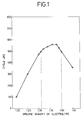
- Fig. 1 is a graph showing the effect of electrolyte's specific gravity change on the cycle life of a nickel/hydrogen battery or cell.
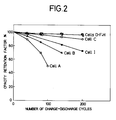
- Fig. 2 is a comparative graph showing for comparsion charge-discharge cycle characteristics of sealed type nickel/hydrogen storage batteries or cells using the electrolytes prepared according to the present invention and those of the batteries or cells using comparative-use electrolytes.
- powdered misch metal, nickel, cobalt and aluminium were weighed and mixed in a predetermined compounding ratio of, for example, MmNi 4.0 Co 0.5 Al 0.5 .
- This mixture was heated and molten by means of an arc melting process and thereafter cooled to obtain a lump of hydrogen-occlusion alloy.
- This lump of the alloy was mechanically pulverized into powder of 0.104 mm (150 mesh) or less.
- This fine powder was mixed with powdered nickel carbonyl of 10 wt. % and powdered tetrafluoroethylene of 3 wt.
- the resultant mixture was then pressed and adhered onto an electrical collector such as a nickel-made gauze to make a plate-like hydrogen-occlusion electrode.
- an electrical collector such as a nickel-made gauze to make a plate-like hydrogen-occlusion electrode.
- This electrode plate which is served as a negative electrode
- a known paste-type nickel electrode plate which is served as a positive electrode, were stacked with each other through a separator placed therebetween, so as to be formed into a plate assembly.
- the plate assembly was then rolled into a spiral one.
- the spiral plate assembly was put into a cylindrical battery container.
- the plate assembly can also, if desired, be used in a flat state in a square container.
- An electrolyte of a predetermined amount, for instance, 2.0 cc was poured into the container, and a battery cover was attached to the container by means of an ordinary process to produce a UM-3 sized cylindrical sealed type nickel/hydrogen alkaline storage battery or cell of 1050 mAH.
- alkaline electrolytes that are composed of potassium hydroxide alone, but are varied in specific gravity ranging from 1.20 to 1.45 (at 20°C), and 2.0 cc of each of the respective electrolytes having different specific gravities was put into each of the respective containers so as to make available a pluralty of test-purpose nickel/hydrogen batteries or cells, each using the electrolyte having a different specific gravity in the above-mentioned range.
- a life test was carried out as described in the following. Namely, the test conditions included that each test cell was charged with 1 C current for 75 minutes and discharged with 1 C current until the cell voltage was dropped to 1.0 V, and this charge-discharge operation was repeated until the discharge capacity of the cell became 650 mA. The test was carried out at a temperature in the range of 20°C - 25°C. Fig. 1 shows the test results.
- the conventional cells using the alkaline electrolytes having 1.30 or less in specific gravity give the charge-discharge cycle of 480 cycles or less which does not reach 500 cycles, while those with the electrolytes having specific gravities falling in the range of 1.31 to 1.40 give a longer cycle life of 500 cycles or more.
- those with the specific gravities in the range of 1.35 to 1.39 are preferable, because the electrolytes having such specific gravity ranges assure much longer cycle life of 520 to 560 cycles.
- the cycle life of the cells was dropped to a level lower than 500 cycles. While what has caused such a decline is yet to be determined, it is assumed that the movement of the OH ions in the electrolyte with such a high specific gravity could become slower contrary to general expectation, thus resulting in lowering in the charge-discharge efficiency.
- an electrolyte aqueous solution composed of potassium hydroxide alone was used as the electrolyte.
- an aqueous solution composed of a mixture of potassium hydroxide as a main component and a small quantity of lithium hydroxide or that of sodium hydroxide or an aqueous solution composed of potassium hydroxide as a main component and a small quantity of a mixture of lithium hydroxide and sodium hydroxide with the specific gravity of such electrolyte being in the range of 1.31 to 1.40.
- the result was an improvement in the cycle life that are equal to or better than the case of using as an electrolyte composed of potassium hydroxide alone.
- the compounding ratio of these alkaline components is, for example, 100 : 20 in the case of potassium hydroxide and lithium hydroxide or sodium hydroxide, and 100 : 15 : 5 or preferably 100 : 17 : 3 in the case of potassium hydroxide, lithium hydroxide and sodium hydroxide, all in terms of weight ratio.
- a hydrogen-occlusion electrode composed mainly of a hydrogen-occlusion alloy of a desired composition and manufactured by an ordinary known process was used as the negative electrode.
- This negative electrode plate and a positive electrode plate made of nickel hydroxide by a conventional process were stacked with each other through a nylon separator interposed therebetween, to form a plate assembly, and the plate assembly is inserted into a cylindrical container after being rolled up into a spiral one or into a square container without being rolled up into a spiral, and a predetermined amount of the electrolyte was poured into the container, and a battery cover was attached thereto to seal it hermetically, so that there was produced a sealed type cylindrical or square alkaline nickel-hydrogen storage battery or cell.
- the abovementioned process and construction are not substantially different from the conventional ones.
- the alkaline electrolyte used in the above-mentioned battery or cell is characterized in that it is composed of three components, namely, potassium hydroxide, lithium hydroxide and sodium hydroxide, and out of which the potassium hydroxide accounts for 75 wt. % or more of the total weight of the three components, and the electrolyte is so prepared as to have the specific gravity adjusted to fall in the range of 1.31 to 1.40.
- the compounding range of potassium hydroxide is in the range of 75 wt.% - 99.5 wt. %.
- the remainder of 0.5 wt. % is preferably lithium hydroxide, though the remainder of 0.5 wt. % may be sodium hydroxide.
- a hydrogen-occlusion alloy comprising Mm 3.5 Co 1.0 Al 0.5 was mechanically pulverized and the resultant powdered alloy, powdered polyvinylidene fluoride (PVdF) as a binding agent, and powdered nickel as an electroconductive agent were mixed together in a proper compounding amount ratio, and a mixture thereof was added with a proper amount of carboxy methyl cellulose (CMC) water solution and was mixed uniformly.
- CMC carboxy methyl cellulose
- the resultant pasty mixture was applied to both surfaces of a perforated steel sheet plated with nickel, and was dried, roll-pressed and put in a heating furnace, and it was heated in vacuum condition under the atmosphere of an inert gas such as nitrogen, argon, etc. in the range of 160 - 200°C, for instance, for two hours at 170°C to manufacture a hydrogen-occlusion plate.
- an inert gas such as nitrogen, argon, etc. in the range of 160 - 200°C, for instance, for two hours at 170°C to manufacture a hydrogen-occlusion plate.
- a nickel electrode plate was manufactured as follows: Powdered nickel hydroxide and powdered nickel carbonyl were mixed in a proper mixing ratio, for instance, in the ratio of 90 : 10 by weight, and a mixture thereof was added and stirred with a CMC water solution of 1.2 %. For instance, 40 g of the foregoing 1.2 % CMC solution was added to 100 g of the mixture. The resultant paste was then applied to be filled in a foam nickel substrate, dried and roll-pressed together to manufacture a nickel electrode plate.
- the hydrogen-occlusion electrode plate thus produced was used as the negative electrode and the nickel electrode plate thus produced was used as the positive electrode.
- the negative electrode plate and the positive electrode plate were stacked with each other through a nylon separator of which the thickness is 0.18 mm, so as to form a plate assembly, and the plate assembly was rolled up to make a rolled plate assembly.
- This plate assembly was inserted into a cylindrical iron made container plated with nickel, and an electrolyte is put in the container, and a cover is applied and sealed hermetically in a conventional manner, to manufacture a sealed type cylindrical nickel/hydrogen alkaline storage battery or cell.
- each of respective electrolytes having respective different components and specific gravities as shown in the following Table 1, in the course of manufacturing the above-mentioned battery or cell.
- Those batteries are labeled as Cell A through Cell I in Table 1.
- the weight-percentage values of the components, KOH, NaOH and LiOH are indicated as dried or solid matter as calculated on the basis of the total weight of the three components taken as 100%.
- Table 2 shows the respective concentrations of the respective electrolytes and rspective weight percents of the three components used in the respective Cell A to I.
- Table 2 COMPOSITION OF AQUEOUS ALKALINE ELECTROLYTE Total concentration in % of metal OH KOH wt.% NaOH wt.% LiOH wt.% Cell A 22 18.48 3.08 0.44 Cell B 27 22.68 3.78 0.54 Cell C 31 26.04 4.34 0.62 Cell D 32 26.88 4.48 0.64 cell E 37 31.08 5.18 0.74 Cell F 40 33.60 5.60 0.80 Cell G 41 34.44 5.74 0.82 Cell H 32 24.00 7.36 0,64 Cell I 32 22.40 8.96 0.64
- These batteries, that is, Cell A through Cell I were all subjected to a charge-discharge cycle test, an internal pressure test and a high-rate discharge test as described in the following. The rated capacity of each of the test batteries, that is, Cell A through Cell I was 1000 mAh.
- each test cell was charged at 1A for 75 minutes and discharged at 1A to the final voltage of 1V.
- the test was conducted at room temperature.
- Fig. 1 shows the results thereof.
- a sealed type nickel/hydrogen alkaline storage battery using the above-mentioned alkaline electrolyte of the present invention has such advantages that the utilization efficiency of the positive electrolyte is increased, and the diffusion of the OH ions is fast, so that the lowering in the capacity is comparatively small, and in addition generation of oxygen gas from the positive electrode is restricted, to prevent the negative electrode from oxidation and absorption of oxygen gas by the negative electrode is accelerated, resulting in the lowering in the internal pressure.
- sodium hydroxide in the electrolyte it serves to improve in the high temperature characteristic
- lithium hydroxide in the electrolyte it serves to improve in the utilization efficiency of the positive electrode.
- a hydrogenocclusion alloy electrode as a negative electrode uses such an alkaline electrode that is composed of KOH alone or a mixture of KOH as a main component and LiOH or/and NaOH as a reminder part, and is adjusted in the specific gravity to be in the range of 1.31 to 1.40, preferably, in the range of 1.35 to 1.39 at 20°C, the charge-discharge cycle characteristic is improved.
- the electrolyte having the specific gravity in the range of 1.31 to 1.40 is composed of the three components of KOH, LiOH and NaOH and KOH accounts for 75 wt. % or more of the total weights of the three components, the capacity retention factor, in other words, the Capacity maintenance coefficient is kept at a higher lever as clear from Fig. 2, and thus all the performance requirements of the charge-discharge characteristic, the internal pressure characteristic and the high-rate discharge characteristic can be improved and assured.
- various modifications can be made within the scope of the aforesaid description. Such modifications being within the ability of one skilled in the art form a part of the present invention and are embraced by the appended claims.
Landscapes
- Engineering & Computer Science (AREA)
- Manufacturing & Machinery (AREA)
- Chemical & Material Sciences (AREA)
- Chemical Kinetics & Catalysis (AREA)
- Electrochemistry (AREA)
- General Chemical & Material Sciences (AREA)
- Secondary Cells (AREA)
- Battery Electrode And Active Subsutance (AREA)
Applications Claiming Priority (4)
| Application Number | Priority Date | Filing Date | Title |
|---|---|---|---|
| JP4129679A JP2750793B2 (ja) | 1992-04-22 | 1992-04-22 | ニッケル・水素電池 |
| JP129679/92 | 1992-04-22 | ||
| JP4180347A JPH0645002A (ja) | 1992-06-15 | 1992-06-15 | 密閉型アルカリ蓄電池 |
| JP180347/92 | 1992-06-15 |
Publications (2)
| Publication Number | Publication Date |
|---|---|
| EP0567132A1 true EP0567132A1 (de) | 1993-10-27 |
| EP0567132B1 EP0567132B1 (de) | 1997-08-13 |
Family
ID=26464993
Family Applications (1)
| Application Number | Title | Priority Date | Filing Date |
|---|---|---|---|
| EP93106573A Revoked EP0567132B1 (de) | 1992-04-22 | 1993-04-22 | Gasdichter alkalischer Nickel-Wasserstoff-Akkumulator |
Country Status (3)
| Country | Link |
|---|---|
| EP (1) | EP0567132B1 (de) |
| CA (1) | CA2093373A1 (de) |
| DE (1) | DE69312998T2 (de) |
Cited By (1)
| Publication number | Priority date | Publication date | Assignee | Title |
|---|---|---|---|---|
| EP0776057A1 (de) * | 1994-05-27 | 1997-05-28 | Matsushita Electric Industrial Co., Ltd. | Zelle und Batteriemodul aus gasdichtem alkalischem Nickel/Metallhydrid-Speicherzelle |
Citations (5)
| Publication number | Priority date | Publication date | Assignee | Title |
|---|---|---|---|---|
| GB2162994A (en) * | 1984-08-10 | 1986-02-12 | Sanyo Electric Co | Metal/hydrogen alkaline storage battery |
| EP0419220A1 (de) * | 1989-09-18 | 1991-03-27 | Toshiba Battery Co., Ltd. | Nickel-Metallhydridsekundärzelle |
| DE4109764A1 (de) * | 1990-03-23 | 1991-09-26 | Sanyo Electric Co | Alkalische speicherzelle |
| EP0477461A2 (de) * | 1990-09-26 | 1992-04-01 | Matsushita Electric Industrial Co., Ltd. | Nickel-Wasserstoff-Akkumulator und Verfahren zu seiner Herstellung |
| EP0523284A2 (de) * | 1991-07-08 | 1993-01-20 | Matsushita Electric Industrial Co., Ltd. | Aktivmasse aus Nickelhydroxidpulver, positive Nickelelektrode, und ihre Verwendung in einer alkalischen Speicherbatterie |
-
1993
- 1993-04-05 CA CA002093373A patent/CA2093373A1/en not_active Abandoned
- 1993-04-22 EP EP93106573A patent/EP0567132B1/de not_active Revoked
- 1993-04-22 DE DE69312998T patent/DE69312998T2/de not_active Revoked
Patent Citations (5)
| Publication number | Priority date | Publication date | Assignee | Title |
|---|---|---|---|---|
| GB2162994A (en) * | 1984-08-10 | 1986-02-12 | Sanyo Electric Co | Metal/hydrogen alkaline storage battery |
| EP0419220A1 (de) * | 1989-09-18 | 1991-03-27 | Toshiba Battery Co., Ltd. | Nickel-Metallhydridsekundärzelle |
| DE4109764A1 (de) * | 1990-03-23 | 1991-09-26 | Sanyo Electric Co | Alkalische speicherzelle |
| EP0477461A2 (de) * | 1990-09-26 | 1992-04-01 | Matsushita Electric Industrial Co., Ltd. | Nickel-Wasserstoff-Akkumulator und Verfahren zu seiner Herstellung |
| EP0523284A2 (de) * | 1991-07-08 | 1993-01-20 | Matsushita Electric Industrial Co., Ltd. | Aktivmasse aus Nickelhydroxidpulver, positive Nickelelektrode, und ihre Verwendung in einer alkalischen Speicherbatterie |
Non-Patent Citations (3)
| Title |
|---|
| PATENT ABSTRACTS OF JAPAN vol. 16, no. 120 (E-1182)26 March 1992 & JP-A-32 89 059 ( SANYO ELECTRIC CO LTD ) * |
| PATENT ABSTRACTS OF JAPAN vol. 4, no. 32 (E-2)(514) 19 March 1980 & JP-A-55 006 740 ( FURUKAWA DENCHI K.K. ) * |
| PATENT ABSTRACTS OF JAPAN vol. 9, no. 248 (E-347)(1971) 4 October 1985 & JP-A-60 97 560 ( MATSUSHITA DENKI SANGYO K.K. ) * |
Cited By (2)
| Publication number | Priority date | Publication date | Assignee | Title |
|---|---|---|---|---|
| EP0776057A1 (de) * | 1994-05-27 | 1997-05-28 | Matsushita Electric Industrial Co., Ltd. | Zelle und Batteriemodul aus gasdichtem alkalischem Nickel/Metallhydrid-Speicherzelle |
| US5747186A (en) * | 1994-05-27 | 1998-05-05 | Matsushita Electric Industrial Co., Ltd. | Cell and module battery of sealed nickel-metal hydride storage |
Also Published As
| Publication number | Publication date |
|---|---|
| CA2093373A1 (en) | 1993-10-23 |
| DE69312998D1 (de) | 1997-09-18 |
| HK1000372A1 (en) | 1998-03-06 |
| DE69312998T2 (de) | 1998-01-29 |
| EP0567132B1 (de) | 1997-08-13 |
Similar Documents
| Publication | Publication Date | Title |
|---|---|---|
| JP3246345B2 (ja) | アルカリ蓄電池用ニッケル正極とこれを用いたニッケル・水素蓄電池 | |
| US6338917B1 (en) | Alkaline storage battery | |
| US20040209166A1 (en) | Nickel hydrogen secondary battery | |
| JP2680669B2 (ja) | アルカリ蓄電池用水素吸蔵合金電極 | |
| US6818348B1 (en) | Nickel hydroxide paste with molasses binder | |
| EP0577991B1 (de) | Verfahren zur Herstellung von gasdichten Batterien, die Elektroden aus Wasserstoffeinlagerungslegierung enthalten und Wasserstoffeinlagerungslegierung dafür | |
| HK1005051B (en) | Method of manufacturing sealed type storage battery using hydrogen-occlusion electrode, and hydrogen-occlusion alloy for electrode thereof | |
| EP0901179B1 (de) | Alkalische aufladbare Batterie | |
| CN111118346B (zh) | 含锆或钛a2b7型储氢合金、负极、电池及制备方法 | |
| CN111118345B (zh) | 多元钐镍储氢材料、负极、电池及制备方法 | |
| EP0567132B1 (de) | Gasdichter alkalischer Nickel-Wasserstoff-Akkumulator | |
| JP3113891B2 (ja) | 金属水素化物蓄電池 | |
| HK1000372B (en) | Sealed type nickel/hydrogen alkaline storage battery | |
| US6329100B1 (en) | Hydrogen absorbing alloy electrode and process for producing same | |
| JPH0613077A (ja) | 水素吸蔵電極 | |
| JPH06145849A (ja) | 水素吸蔵合金電極 | |
| JP2750793B2 (ja) | ニッケル・水素電池 | |
| JPS61233966A (ja) | 密閉形ニツケル−水素蓄電池の製造法 | |
| JP3343413B2 (ja) | アルカリ二次電池 | |
| JP3266153B2 (ja) | 密閉形アルカリ蓄電池の製造方法 | |
| JPH0642374B2 (ja) | 金属−水素アルカリ蓄電池 | |
| JPH11191412A (ja) | アルカリ蓄電池 | |
| JP2957745B2 (ja) | 水素吸蔵合金電極の製造方法 | |
| JPH03289059A (ja) | 金属―水素アルカリ蓄電池 | |
| JP3070081B2 (ja) | 密閉形アルカリ蓄電池 |
Legal Events
| Date | Code | Title | Description |
|---|---|---|---|
| PUAI | Public reference made under article 153(3) epc to a published international application that has entered the european phase |
Free format text: ORIGINAL CODE: 0009012 |
|
| AK | Designated contracting states |
Kind code of ref document: A1 Designated state(s): DE FR GB |
|
| 17P | Request for examination filed |
Effective date: 19931223 |
|
| 17Q | First examination report despatched |
Effective date: 19950502 |
|
| GRAG | Despatch of communication of intention to grant |
Free format text: ORIGINAL CODE: EPIDOS AGRA |
|
| GRAH | Despatch of communication of intention to grant a patent |
Free format text: ORIGINAL CODE: EPIDOS IGRA |
|
| GRAH | Despatch of communication of intention to grant a patent |
Free format text: ORIGINAL CODE: EPIDOS IGRA |
|
| GRAA | (expected) grant |
Free format text: ORIGINAL CODE: 0009210 |
|
| AK | Designated contracting states |
Kind code of ref document: B1 Designated state(s): DE FR GB |
|
| ET | Fr: translation filed | ||
| REF | Corresponds to: |
Ref document number: 69312998 Country of ref document: DE Date of ref document: 19970918 |
|
| PLBQ | Unpublished change to opponent data |
Free format text: ORIGINAL CODE: EPIDOS OPPO |
|
| PLBI | Opposition filed |
Free format text: ORIGINAL CODE: 0009260 |
|
| PLBF | Reply of patent proprietor to notice(s) of opposition |
Free format text: ORIGINAL CODE: EPIDOS OBSO |
|
| 26 | Opposition filed |
Opponent name: ALCATEL ALSTHOM CIE. GEN. D'ELECTRICITE Effective date: 19980512 |
|
| PLBF | Reply of patent proprietor to notice(s) of opposition |
Free format text: ORIGINAL CODE: EPIDOS OBSO |
|
| PGFP | Annual fee paid to national office [announced via postgrant information from national office to epo] |
Ref country code: GB Payment date: 19990403 Year of fee payment: 7 |
|
| PGFP | Annual fee paid to national office [announced via postgrant information from national office to epo] |
Ref country code: FR Payment date: 20000228 Year of fee payment: 8 |
|
| PG25 | Lapsed in a contracting state [announced via postgrant information from national office to epo] |
Ref country code: GB Free format text: LAPSE BECAUSE OF NON-PAYMENT OF DUE FEES Effective date: 20000422 |
|
| PGFP | Annual fee paid to national office [announced via postgrant information from national office to epo] |
Ref country code: DE Payment date: 20000629 Year of fee payment: 8 |
|
| GBPC | Gb: european patent ceased through non-payment of renewal fee |
Effective date: 20000422 |
|
| RDAH | Patent revoked |
Free format text: ORIGINAL CODE: EPIDOS REVO |
|
| RDAG | Patent revoked |
Free format text: ORIGINAL CODE: 0009271 |
|
| 27W | Patent revoked |
Effective date: 20010331 |