EP0567230A2 - Procédé et appareil de détection de microorganismes dans des fioles de culture - Google Patents
Procédé et appareil de détection de microorganismes dans des fioles de culture Download PDFInfo
- Publication number
- EP0567230A2 EP0567230A2 EP93302291A EP93302291A EP0567230A2 EP 0567230 A2 EP0567230 A2 EP 0567230A2 EP 93302291 A EP93302291 A EP 93302291A EP 93302291 A EP93302291 A EP 93302291A EP 0567230 A2 EP0567230 A2 EP 0567230A2
- Authority
- EP
- European Patent Office
- Prior art keywords
- source
- detector
- vial
- vials
- sources
- Prior art date
- Legal status (The legal status is an assumption and is not a legal conclusion. Google has not performed a legal analysis and makes no representation as to the accuracy of the status listed.)
- Ceased
Links
- 238000000034 method Methods 0.000 title claims abstract description 22
- 244000005700 microbiome Species 0.000 title description 6
- 238000009640 blood culture Methods 0.000 title description 5
- 238000010521 absorption reaction Methods 0.000 claims abstract description 36
- 230000004071 biological effect Effects 0.000 claims abstract description 18
- 230000003213 activating effect Effects 0.000 claims abstract description 12
- 230000005855 radiation Effects 0.000 claims description 20
- 230000004913 activation Effects 0.000 claims description 8
- 229910002092 carbon dioxide Inorganic materials 0.000 abstract description 26
- CURLTUGMZLYLDI-UHFFFAOYSA-N Carbon dioxide Chemical compound O=C=O CURLTUGMZLYLDI-UHFFFAOYSA-N 0.000 abstract description 18
- 238000001514 detection method Methods 0.000 abstract description 14
- 239000001569 carbon dioxide Substances 0.000 abstract description 8
- 230000032683 aging Effects 0.000 abstract description 7
- 230000001580 bacterial effect Effects 0.000 abstract description 5
- 230000008569 process Effects 0.000 abstract description 3
- 239000011521 glass Substances 0.000 description 16
- 239000000523 sample Substances 0.000 description 11
- 230000003595 spectral effect Effects 0.000 description 11
- 239000008280 blood Substances 0.000 description 8
- 210000004369 blood Anatomy 0.000 description 8
- 238000005259 measurement Methods 0.000 description 7
- 239000007788 liquid Substances 0.000 description 5
- 238000012544 monitoring process Methods 0.000 description 5
- 241000894006 Bacteria Species 0.000 description 3
- 230000008859 change Effects 0.000 description 3
- 238000010276 construction Methods 0.000 description 3
- 230000006870 function Effects 0.000 description 3
- 230000014509 gene expression Effects 0.000 description 3
- 239000001963 growth medium Substances 0.000 description 3
- 230000035945 sensitivity Effects 0.000 description 3
- 238000009530 blood pressure measurement Methods 0.000 description 2
- 238000012864 cross contamination Methods 0.000 description 2
- 230000000694 effects Effects 0.000 description 2
- 230000005284 excitation Effects 0.000 description 2
- 230000001747 exhibiting effect Effects 0.000 description 2
- 230000006872 improvement Effects 0.000 description 2
- 238000013208 measuring procedure Methods 0.000 description 2
- 239000000203 mixture Substances 0.000 description 2
- 238000012545 processing Methods 0.000 description 2
- 239000000126 substance Substances 0.000 description 2
- 239000013543 active substance Substances 0.000 description 1
- 230000006978 adaptation Effects 0.000 description 1
- 239000000654 additive Substances 0.000 description 1
- 230000003679 aging effect Effects 0.000 description 1
- 230000008901 benefit Effects 0.000 description 1
- 210000001124 body fluid Anatomy 0.000 description 1
- 239000010839 body fluid Substances 0.000 description 1
- 238000009529 body temperature measurement Methods 0.000 description 1
- 239000006227 byproduct Substances 0.000 description 1
- 230000009849 deactivation Effects 0.000 description 1
- 230000007547 defect Effects 0.000 description 1
- 230000001419 dependent effect Effects 0.000 description 1
- 238000005516 engineering process Methods 0.000 description 1
- 238000001914 filtration Methods 0.000 description 1
- 230000031700 light absorption Effects 0.000 description 1
- 239000006194 liquid suspension Substances 0.000 description 1
- 230000007246 mechanism Effects 0.000 description 1
- 239000002609 medium Substances 0.000 description 1
- 230000002503 metabolic effect Effects 0.000 description 1
- 230000004060 metabolic process Effects 0.000 description 1
- 230000000813 microbial effect Effects 0.000 description 1
- 238000012986 modification Methods 0.000 description 1
- 230000004048 modification Effects 0.000 description 1
- 230000003287 optical effect Effects 0.000 description 1
- 230000004044 response Effects 0.000 description 1
- 238000005316 response function Methods 0.000 description 1
- 239000004065 semiconductor Substances 0.000 description 1
- 238000012360 testing method Methods 0.000 description 1
- 238000011179 visual inspection Methods 0.000 description 1
Images


Classifications
-
- G—PHYSICS
- G01—MEASURING; TESTING
- G01N—INVESTIGATING OR ANALYSING MATERIALS BY DETERMINING THEIR CHEMICAL OR PHYSICAL PROPERTIES
- G01N21/00—Investigating or analysing materials by the use of optical means, i.e. using sub-millimetre waves, infrared, visible or ultraviolet light
- G01N21/17—Systems in which incident light is modified in accordance with the properties of the material investigated
- G01N21/25—Colour; Spectral properties, i.e. comparison of effect of material on the light at two or more different wavelengths or wavelength bands
- G01N21/27—Colour; Spectral properties, i.e. comparison of effect of material on the light at two or more different wavelengths or wavelength bands using photo-electric detection ; circuits for computing concentration
- G01N21/274—Calibration, base line adjustment, drift correction
-
- C—CHEMISTRY; METALLURGY
- C12—BIOCHEMISTRY; BEER; SPIRITS; WINE; VINEGAR; MICROBIOLOGY; ENZYMOLOGY; MUTATION OR GENETIC ENGINEERING
- C12M—APPARATUS FOR ENZYMOLOGY OR MICROBIOLOGY; APPARATUS FOR CULTURING MICROORGANISMS FOR PRODUCING BIOMASS, FOR GROWING CELLS OR FOR OBTAINING FERMENTATION OR METABOLIC PRODUCTS, i.e. BIOREACTORS OR FERMENTERS
- C12M41/00—Means for regulation, monitoring, measurement or control, e.g. flow regulation
- C12M41/46—Means for regulation, monitoring, measurement or control, e.g. flow regulation of cellular or enzymatic activity or functionality, e.g. cell viability
-
- G—PHYSICS
- G01—MEASURING; TESTING
- G01N—INVESTIGATING OR ANALYSING MATERIALS BY DETERMINING THEIR CHEMICAL OR PHYSICAL PROPERTIES
- G01N21/00—Investigating or analysing materials by the use of optical means, i.e. using sub-millimetre waves, infrared, visible or ultraviolet light
- G01N21/17—Systems in which incident light is modified in accordance with the properties of the material investigated
- G01N21/59—Transmissivity
- G01N21/5907—Densitometers
- G01N2021/5969—Scanning of a tube, a cuvette, a volume of sample
-
- G—PHYSICS
- G01—MEASURING; TESTING
- G01N—INVESTIGATING OR ANALYSING MATERIALS BY DETERMINING THEIR CHEMICAL OR PHYSICAL PROPERTIES
- G01N21/00—Investigating or analysing materials by the use of optical means, i.e. using sub-millimetre waves, infrared, visible or ultraviolet light
- G01N21/17—Systems in which incident light is modified in accordance with the properties of the material investigated
- G01N21/25—Colour; Spectral properties, i.e. comparison of effect of material on the light at two or more different wavelengths or wavelength bands
- G01N21/31—Investigating relative effect of material at wavelengths characteristic of specific elements or molecules, e.g. atomic absorption spectrometry
- G01N21/35—Investigating relative effect of material at wavelengths characteristic of specific elements or molecules, e.g. atomic absorption spectrometry using infrared light
- G01N21/3504—Investigating relative effect of material at wavelengths characteristic of specific elements or molecules, e.g. atomic absorption spectrometry using infrared light for analysing gases, e.g. multi-gas analysis
-
- G—PHYSICS
- G01—MEASURING; TESTING
- G01N—INVESTIGATING OR ANALYSING MATERIALS BY DETERMINING THEIR CHEMICAL OR PHYSICAL PROPERTIES
- G01N2201/00—Features of devices classified in G01N21/00
- G01N2201/06—Illumination; Optics
- G01N2201/061—Sources
- G01N2201/06106—Plural sources used for calibration
-
- G—PHYSICS
- G01—MEASURING; TESTING
- G01N—INVESTIGATING OR ANALYSING MATERIALS BY DETERMINING THEIR CHEMICAL OR PHYSICAL PROPERTIES
- G01N2201/00—Features of devices classified in G01N21/00
- G01N2201/06—Illumination; Optics
- G01N2201/066—Modifiable path; multiple paths in one sample
-
- G—PHYSICS
- G01—MEASURING; TESTING
- G01N—INVESTIGATING OR ANALYSING MATERIALS BY DETERMINING THEIR CHEMICAL OR PHYSICAL PROPERTIES
- G01N2201/00—Features of devices classified in G01N21/00
- G01N2201/06—Illumination; Optics
- G01N2201/066—Modifiable path; multiple paths in one sample
- G01N2201/0662—Comparing measurements on two or more paths in one sample
-
- Y—GENERAL TAGGING OF NEW TECHNOLOGICAL DEVELOPMENTS; GENERAL TAGGING OF CROSS-SECTIONAL TECHNOLOGIES SPANNING OVER SEVERAL SECTIONS OF THE IPC; TECHNICAL SUBJECTS COVERED BY FORMER USPC CROSS-REFERENCE ART COLLECTIONS [XRACs] AND DIGESTS
- Y10—TECHNICAL SUBJECTS COVERED BY FORMER USPC
- Y10S—TECHNICAL SUBJECTS COVERED BY FORMER USPC CROSS-REFERENCE ART COLLECTIONS [XRACs] AND DIGESTS
- Y10S435/00—Chemistry: molecular biology and microbiology
- Y10S435/808—Optical sensing apparatus
Definitions
- the present invention relates to a non-invasive methods and apparatus for detecting biological activities in a specimen such as blood by measuring the absorption of light, and in particular to systems wherein the degree of absorption within the gaseous headspace above a specimen and a culture medium contained in a sealed container varies with the concentration of carbon dioxide generated by the metabolic processes of microorganisms.
- the presence of biologically active agents such as bacteria in a patient's body fluid, and especially in blood is determined using blood culture vials.
- a small quantity of blood is injected through an enclosing rubber septum into a sterile vial containing a culture medium.
- the vial is typically incubated at 37°C and monitored for bacterial growth.
- Common visual inspection involves monitoring the turbidity or observing eventual color changes of the liquid suspension.
- Known instrumented methods detect changes in the carbon dioxide content of the culture bottles, which is a metabolic byproduct of the bacterial growth.
- Monitoring the carbon dioxide content can be accomplished by methods well established in the art, such as radiochemical (e.g., BACTEC®, Becton-Dickinson, Franklin Lakes, NJ, USA), infrared absorption at a carbon dioxide spectral line (e.g., NR-BACTEC@, Becton-Dickinson, Franklin Lakes, NJ, USA), or pressure/vacuum measurement such as those disclosed in U.S. Patent No. 4,152,213 -- Ahnell.
- radiochemical e.g., BACTEC®, Becton-Dickinson, Franklin Lakes, NJ, USA
- infrared absorption at a carbon dioxide spectral line e.g., NR-BACTEC@, Becton-Dickinson, Franklin Lakes
- the term invasive implies that the confines of the sample container must be entered in order to determine if bacteria are present, e.g., a probe is inserted into a sealed vial.
- the headspace gas must be removed for analysis.
- any temperature change within the vial headspace also generates a pressure change that is not related to biological activity.
- the objectives set forth above are achieved by introducing a culture medium and a sample, such as a blood specimen, into a sealable glass vial and arranging a first and a second infrared light source on the side of the vial, positioned above the level of the liquid within the vial and at a fixed distance from each other.
- a first and a second narrow-band infrared detector on the side of the vial approximately opposite the sources and also above the liquid level within the vial, the sources of error are cancelled.
- the present invention sequentially measures the photocurrents generated at each detector with no source turned on, with the first source turned on, and with the second source turned on and the first source turned off.
- the C0 2 absorption coefficient of the vial headspace gas is then calculated based on the photocurrents measured.
- This arrangement and measuring procedure allow compensation for source aging, detector aging, and vial wall thickness changes.
- the present invention permits a determination of the absolute absorption coefficient at a selected wavelength, most preferably about 4.26 ⁇ m, which is the C0 2 absorption characteristic wavelength.
- the determination of the absolute C0 2 concentration within the headspace permits the detection of bacterial growth processes.
- the present invention therefore provides methods of identifying the presence of biological activity within a sample contained in a vial that comprise the steps of disposing a first and a second source of infrared radiation at adjacent points on the vial and disposing a first and a second infrared detector at adjacent points on the vial that are substantially opposite from the first and second source.
- the first detector is activated to measure a background signal, l co
- the first source is activated and an output signal, I cA , is measured with the first detector.
- the first source is then deactivated and the second source activated to measure an output signal, I cs , with the first detector.
- the first detector and the second source are deactivated and a background signal, I DO , is measured with the second detector.
- the second detector is also used to measure an output signal from thefirstand second sources, I SA and I DB .
- the methods of the present invention then proceed by calculating an absorption value from the background and output signals and repeating the steps of measuring the background and output signals from both the sources and both the detectors to determine further absorption values over time. The absorption values are then compared to determine if biological activity is present.
- the steps of activating and deactivating the sources and the detectors is carried out by a computer, as is the step of determining the absorption value.
- the step of determining the absorption value preferably comprises calculating the output signals for the first and second detectors as the first and second sources are activated and deactivated; and computing a value R according to the equation: wherein I co is the background signal of the first detector and I DO is the background signal of the second detector.
- the output signal of the first detector with the first source activated is I CA and with the second source activated is I cs .
- the output of he second detector is represented by I DA and I DB for the first and second sources, respectively.
- the methods of the present invention are carried out to identify the presence of biological activity for a plurality of samples.
- the steps of activating and deactivating the first and second sources associated with each of the plurality of samples most preferably comprises transmitting an activation signal to a multiplexer and directing the activation signal to the first and second sources associated with one of the plurality of vials.
- the activation and deactivation of the first and second detectors associated with each of the plurality of samples most preferably comprises the steps of receiving an output signal from a demultiplexer and creating a demultiplexer output signal associated with one of the plurality of vials.
- the infrared sources are not modulated and no rotating filter wheel is required.
- the photocurrents are measured at a relatively low electronic detection bandwidth and preferably stored within a computer.
- the low detection bandwidth results in a high signal-to-noise ratio for the measured photocurrents.
- the function commonly accomplished by a mechanical chopper is taken over by the computer.
- the present invention therefore avoids any mechanically actuated sections.
- the source/detector combination disclosed herein can be produced at low cost. Therefore, each vial preferably has its own source/detector combination, thereby allowing the construction of diagnostic instruments capable of monitoring a plurality of vials at the same time.
- Apparatus for identifying the presence of biological activity within a sample contained in a vial made in accordance with the present invention therefore preferably comprises a first and a second source of infrared radiation disposed at adjacent points on the vial and a first and a second infrared detector disposed at adjacent points on the vial substantially opposite from the second and the first source respectively.
- a signal source selectively activates and deactivates the sources of infrared radiation.
- a processor calculates an absorption value from an output signal received from at least each of the first and the second detector to permit the detection of biological activity if the absorption value measured is significantly higher than a absorption value measured at a previous point in time.
- the apparatus of the present invention identifies the presence of biological activity in a plurality of samples.
- Theses embodiments include a first and second source of infrared radiation associated with each of the plurality of samples; and a signal source for transmitting an activation signal to a multiplexer for selectively directing the activation signal to the first and second sources associated with one of the plurality of samples.
- the apparatus also preferably comprises a first and second detector associated with each of the plurality of vials; and a demultiplexer for selectively receiving an output signal from the detectors associated with one of the plurality of vials and creating a demultiplexer output signal associated with one of the plurality of vials.
- the first and second sources of infrared radiation emit radiation at a wavelength of about 4.26 ⁇ m.
- FIG. 1 there is shown a top view of a blood culture vial 11 with a first infrared source 20A and a second infrared source 20B disposed on one side of the vial, and a first 4.26 f..lm narrow-band infrared detector 20C and a second 4.26 ⁇ m narrow-band infrared detector 20D disposed at two points on the other side.
- the first infrared source 20A and the second detector 20D are arranged opposite to each other, as are the second infrared source 20B and first detector 20C.
- the angle between the lines connecting the first source 20Awith the second detector 20D, and the second source 20B with the first detector 20C is between about 20° and about 90°.
- each source/detector pair should be diametrically opposed, i.e., L 1 in FIG. 1 should pass through the geometric center of the vial 11.
- apparatus made according to the present invention is not restricted to the geometrical arrangement depicted in FIG. 1.
- the sources 20A,20B and detectors 20C,20D can be arranged at different heights above the liquid level in order to establish path length differences between the straight lines AD and AC as well as between BC and BD if desired.
- the infrared sources 20A,20B and detectors 20C,20D emit and receive infrared radiation at a wavelength of about 4.26 ⁇ m, the characteristic wavelength of carbon dioxide.
- Methods for measuring the absorption coefficient according to the present invention preferably comprise a first step of detecting a background signal when no infrared source is turned on.
- the background signal, l oo , of the detector 20C is measured and background signal, I DO , of the detector 20D is also measured.
- the first infrared source 20A is turned on, and the signal, I CA , of detector 20C is measured.
- This signal can be described in the form:
- I A is the infrared power emitted by the first infrared source 20A
- R c is the responsivity of first detector 20C
- F is a general geometry factor taking into account such properties as source emission divergence and detector aperture.
- the quantity k characterizes the spectral fraction of radiation absorbed by C0 2 molecules relative to the spectral window of the infrared detector.
- the glass absorption is represented by ⁇ 9, and the C0 2 absorption coefficient is w a .
- the thickness of the vial wall at the first source 20A is denominated by a, and the thickness at the first detector 20C by c.
- the quantities a' and c' in equation (1) are different from a and c, because the first source 20A and the first detector 20C are not arranged exactly opposite one another, as shown by line L 1 in FIG. 1.
- the radiation emitted by the first source 20A is then measured with the second detector 20D.
- the output signal of this detector 20D is:
- the first source 20A is turned off, source 20B is turned on, and the signal, I CB , of the first detector 20C is measured.
- This signal can be described in the form:
- I B is the infrared power emitted by the second source 20B.
- the next step comprises measuring the radiation emitted by the second source 20B with the second detector 20D.
- the output signal of this detector is:
- All these output signals from the detectors 20C, 20D are preferably stored within the memory of a computer.
- the computer calculates the quantity, R(w a ), with:
- Equation (6) shows that the power of the infrared sources I A and I B , the geometry factor F, and the responsivities of the defectors R c and R D are cancelled out using the'arrangement of sources and detectors described above with reference to FIG. 1. Therefore, the present invention provides a system that does not show any aging drifts related to the sources 20A,20B or detectors 20C,20D.
- the photocurrents are measured at a relatively low electronic detection bandwidth and are preferably stored within a computer.
- the low detection bandwidth results in a high signal-to-noise ratio for the measured photocurrents.
- the function of detector background signal discrimination, accomplished in the prior art by a mechanical chopper, is taken over by the computer. This principle avoids any mechanically moving parts and the source/detector combination described above and shown in FIG. 1 can be produced at low cost, permitting each vial 11 to have its own source/detector combination and allowing the construction of diagnostic instruments capable of processing hundreds of non-moving vials.
- the quantity q is equal to (1/cos ⁇ )-1.
- ⁇ values up to about 20° i.e., for a-values up to about 30°
- q can be approximated by (1/2)(s/nv) 2
- q Z 0.05 is valid.
- equation (7) is used to obtain the relation:
- the quantity k in equation (6) characterizes the spectral fraction of radiation absorbed by C0 2 molecules, relative to the spectral window of the infrared detectors 20C,20D.
- a high k-value is preferred, most preferably as close to 1 as possible.
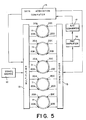
- FIG. 5 A preferred embodiment of a detection apparatus for monitoring a plurality of vials that embodies the principles and concepts of the present invention described above is depicted schematically in FIG. 5.
- the apparatus is preferably comprised of a plurality of sealed glass vials 11 inoculated with a medium/blood mixture, i.e., typical blood culture vials.
- a medium/blood mixture i.e., typical blood culture vials.
- first and second infrared sources 20A,20B are arranged on one side of each vial above the liquid level
- first and second narrow-band infrared detectors 20C,20D are arranged on the otherside of each vial above the liquid level.
- the apparatus made according to the present invention further comprises a DC power supply 12which is connected to the input of a multiplexer 13 which is controlled by a computer 14 to selectively activate the sources and detectors in the manner described above, as well as to sequentially cause such activation to occur vial-to-vial.
- the output channels of the multiplexer 13 are connected to the first and second infrared sources 20A,20B located adjacent each vial 11 and the electrical signal provided by the multiplexer activates the sources 20A,20B.
- the outputs of all the infrared detectors 20C,20D are connected to the inputs of a demultiplexer 15 which is also preferably controlled by the computer 14.
- the demultiplexer 15 functions to coordinate the signals received from the plurality of detector pairs so that the data associated with each vial can be identified.
- the analog output signal of the demultiplexer 15 is fed to the input of a preamplifier 16 and the amplified output signal is preferably digitized by an analog-to-digital converter 17.
- the digital output signal of the analog-to-digital converter 17 is preferably stored in the computer 14 for processing as described above.
- the computer-controlled multiplexer 13 sequentially carries out the steps described above with reference to FIG. 1 on each vial 11 by alternately activating and deactivating the first source 20A and second source 20B.
- the demultiplexer 15 ensures that the data that are related to the individual vials are kept separated and identified when output and stored.
- the system cycles through each vial 11 in the instrument and then begins the process again.
- the presence of bacterial growth will cause a marked increase in the concentration of CO 2 in the headspace gas above the blood/culture sample disposed within each vial 11.
- the data collected by the system depicted in FIG. 5 can therefore be used by either transmitting these data to an operator or by programming the computer 14 to identify those vials 11 exhibiting increased C0 2 concentration.
Landscapes
- Chemical & Material Sciences (AREA)
- Life Sciences & Earth Sciences (AREA)
- Health & Medical Sciences (AREA)
- Engineering & Computer Science (AREA)
- Physics & Mathematics (AREA)
- Zoology (AREA)
- Bioinformatics & Cheminformatics (AREA)
- Organic Chemistry (AREA)
- Analytical Chemistry (AREA)
- Biochemistry (AREA)
- General Health & Medical Sciences (AREA)
- Wood Science & Technology (AREA)
- Biomedical Technology (AREA)
- Mathematical Physics (AREA)
- Cell Biology (AREA)
- Immunology (AREA)
- Spectroscopy & Molecular Physics (AREA)
- Biotechnology (AREA)
- Microbiology (AREA)
- Sustainable Development (AREA)
- General Physics & Mathematics (AREA)
- Pathology (AREA)
- General Engineering & Computer Science (AREA)
- Genetics & Genomics (AREA)
- Theoretical Computer Science (AREA)
- Investigating Or Analysing Materials By Optical Means (AREA)
- Medical Treatment And Welfare Office Work (AREA)
- Apparatus Associated With Microorganisms And Enzymes (AREA)
- Measuring Or Testing Involving Enzymes Or Micro-Organisms (AREA)
Applications Claiming Priority (2)
| Application Number | Priority Date | Filing Date | Title |
|---|---|---|---|
| US87423992A | 1992-04-24 | 1992-04-24 | |
| US874239 | 1992-04-24 |
Publications (2)
| Publication Number | Publication Date |
|---|---|
| EP0567230A2 true EP0567230A2 (fr) | 1993-10-27 |
| EP0567230A3 EP0567230A3 (fr) | 1995-04-26 |
Family
ID=25363295
Family Applications (1)
| Application Number | Title | Priority Date | Filing Date |
|---|---|---|---|
| EP93302291A Ceased EP0567230A3 (fr) | 1992-04-24 | 1993-03-25 | Procédé et appareil de détection de microorganismes dans des fioles de culture. |
Country Status (6)
| Country | Link |
|---|---|
| US (1) | US5482842A (fr) |
| EP (1) | EP0567230A3 (fr) |
| JP (1) | JPH0777560B2 (fr) |
| AU (1) | AU665246B2 (fr) |
| BR (1) | BR9301589A (fr) |
| CA (1) | CA2092372C (fr) |
Cited By (3)
| Publication number | Priority date | Publication date | Assignee | Title |
|---|---|---|---|---|
| AU702209B2 (en) * | 1996-07-16 | 1999-02-18 | Roche Diagnostics Gmbh | Analytical system with means for detecting too small sample volumes |
| WO1999060094A3 (fr) * | 1998-05-20 | 2000-03-16 | Forschungszentrum Juelich Gmbh | Procede pour la realisation d'une mesure de l'interaction de produits chimiques avec des cellules |
| EP2250501B1 (fr) * | 2007-12-07 | 2016-02-24 | Diesse Diagnostica Senese S.p.a. | Dispositif et procédé d'analyse microbiologique d'échantillons biologiques |
Families Citing this family (17)
| Publication number | Priority date | Publication date | Assignee | Title |
|---|---|---|---|---|
| US6573991B1 (en) | 2000-04-26 | 2003-06-03 | Martin Paul Debreczeny | Self-compensating radiation sensor with wide dynamic range |
| RU2176390C1 (ru) * | 2000-07-05 | 2001-11-27 | Колмогоров Анатолий Борисович | Способ определения биологической активности вещества |
| US6639678B1 (en) * | 2000-07-13 | 2003-10-28 | Lighthouse Instruments Llc | Apparatus and method for nondestructive monitoring of gases in sealed containers |
| US7427501B2 (en) * | 2000-09-29 | 2008-09-23 | Becton, Dickinson And Company | System and method for optically monitoring the concentration of a gas, or the pressure, in a sample vial to detect sample growth |
| EP1371041A4 (fr) * | 2001-02-02 | 2006-04-19 | Bristol Myers Squibb Pharma Co | Appareil et procedes de surveillance en ligne de matiere fluoree dans le vide d'un flacon |
| US6709857B2 (en) * | 2001-06-26 | 2004-03-23 | Becton, Dickinson And Company | System and method for optically monitoring the concentration of a gas in a sample vial using photothermal spectroscopy to detect sample growth |
| US7126685B1 (en) | 2003-01-02 | 2006-10-24 | Southwest Sciences Incorporated | Optical absorbance sensitivity and reliability improvement via rotation of sample container |
| US7334482B2 (en) * | 2004-07-20 | 2008-02-26 | Martin Lehmann | Method of monitoring pressure of a gas species and apparatus to do so |
| EP1809760A4 (fr) * | 2004-10-21 | 2012-05-09 | Peter E Rising | Mesure infrarouge destinee a l'enumeration rapide de concentrations microbiennes |
| EP2392643B1 (fr) * | 2009-01-29 | 2016-10-26 | Hitachi High-Technologies Corporation | Dispositif et procédé pour l'analyse automatique de bactéries et de champignons |
| US9739788B2 (en) | 2010-07-20 | 2017-08-22 | Biomerieux, Inc. | Detector arrangement for blood culture bottles with colorimetric sensors |
| CN102590137A (zh) * | 2011-12-19 | 2012-07-18 | 浙江师范大学 | 一种血培养仪检测系统 |
| US9176050B2 (en) | 2012-05-03 | 2015-11-03 | Lighthouse Instruments, Llc. | Method and apparatus for increased purge efficacy in optical absorption spectroscopic measurements of gases in sealed containers |
| US9441260B2 (en) | 2012-06-17 | 2016-09-13 | Vayu Sense Ag | Method and system for real-time, non-invasive monitoring of a biological material in a sealed container |
| US20150099274A1 (en) | 2012-06-17 | 2015-04-09 | Physical Logic Ag | Method and system for use in monitoring biological material |
| WO2014049831A1 (fr) * | 2012-09-28 | 2014-04-03 | ニプロ株式会社 | Dispositif de mesure et procédé de mesure de concentration de fluide |
| JP2018119894A (ja) * | 2017-01-27 | 2018-08-02 | 日立造船株式会社 | レーザ分光検査方法およびレーザ分光検査装置 |
Family Cites Families (13)
| Publication number | Priority date | Publication date | Assignee | Title |
|---|---|---|---|---|
| US3975727A (en) * | 1974-06-28 | 1976-08-17 | Technicon Instruments Corporation | Automated calibration and standardization apparatus |
| US4017193A (en) * | 1976-03-02 | 1977-04-12 | Leo Loiterman | Apparatus for measuring the transmittance or opacity of a gaseous medium carrying particulate matter through a conduit |
| US4152213A (en) * | 1977-03-10 | 1979-05-01 | Johnston Laboratories, Inc. | Vacuum detection of bacteria |
| US4448534A (en) * | 1978-03-30 | 1984-05-15 | American Hospital Corporation | Antibiotic susceptibility testing |
| JPS5733592A (en) * | 1980-08-01 | 1982-02-23 | Fujisawa Pharmaceut Co Ltd | Equipment for identifying bacteria |
| AU564610B2 (en) * | 1982-08-31 | 1987-08-20 | Becton Dickinson & Company | Detecting biological activity by infrared analysis |
| US5155019A (en) * | 1982-08-31 | 1992-10-13 | Becton, Dickinson And Company | Detection of the presence of biological activity in a sealed container utilizing infrared analysis of carbon dioxide and apparatus therefor |
| US4971900A (en) * | 1984-04-06 | 1990-11-20 | Becton, Dickinson And Company | Method for the detection of biologically active agents |
| SU1366922A1 (ru) * | 1985-05-15 | 1988-01-15 | Казанский Научно-Исследовательский Технологический И Проектный Институт Химико-Фотографической Промышленности | Нефелометр |
| US4889992A (en) * | 1987-11-12 | 1989-12-26 | Max Hoberman | Automatic infrared microorganism detection instrument |
| US4945060A (en) * | 1988-03-15 | 1990-07-31 | Akzo N. V. | Device for detecting microorganisms |
| AU645557B2 (en) * | 1990-05-07 | 1994-01-20 | University Of Sydney, The | Gas detection by infrared absorption |
| CH681747A5 (fr) * | 1992-06-02 | 1993-05-14 | Zuellig Ag |
-
1993
- 1993-03-24 CA CA002092372A patent/CA2092372C/fr not_active Expired - Fee Related
- 1993-03-25 EP EP93302291A patent/EP0567230A3/fr not_active Ceased
- 1993-04-16 AU AU37002/93A patent/AU665246B2/en not_active Ceased
- 1993-04-19 BR BR9301589A patent/BR9301589A/pt not_active IP Right Cessation
- 1993-04-26 JP JP5099608A patent/JPH0777560B2/ja not_active Expired - Lifetime
-
1994
- 1994-04-07 US US08/224,054 patent/US5482842A/en not_active Expired - Lifetime
Cited By (3)
| Publication number | Priority date | Publication date | Assignee | Title |
|---|---|---|---|---|
| AU702209B2 (en) * | 1996-07-16 | 1999-02-18 | Roche Diagnostics Gmbh | Analytical system with means for detecting too small sample volumes |
| WO1999060094A3 (fr) * | 1998-05-20 | 2000-03-16 | Forschungszentrum Juelich Gmbh | Procede pour la realisation d'une mesure de l'interaction de produits chimiques avec des cellules |
| EP2250501B1 (fr) * | 2007-12-07 | 2016-02-24 | Diesse Diagnostica Senese S.p.a. | Dispositif et procédé d'analyse microbiologique d'échantillons biologiques |
Also Published As
| Publication number | Publication date |
|---|---|
| BR9301589A (pt) | 1993-10-26 |
| US5482842A (en) | 1996-01-09 |
| JPH0670794A (ja) | 1994-03-15 |
| AU665246B2 (en) | 1995-12-21 |
| CA2092372C (fr) | 2000-03-14 |
| EP0567230A3 (fr) | 1995-04-26 |
| CA2092372A1 (fr) | 1993-10-25 |
| AU3700293A (en) | 1993-10-28 |
| JPH0777560B2 (ja) | 1995-08-23 |
Similar Documents
| Publication | Publication Date | Title |
|---|---|---|
| US5482842A (en) | Methods for detecting microorganisms in blood culture vials | |
| US5427920A (en) | Methods and apparatus for detecting biological activities in a specimen | |
| JP2738500B2 (ja) | 培養容器内生物学的活性を測定する装置 | |
| US5422720A (en) | Blood culture sensor station utilizing two distinct light sources | |
| CA2101886C (fr) | Methode et dispositif de detection de microorganismes | |
| CA2179364C (fr) | Methode et appareil utilises pour detecter les micro-organismes | |
| JP2628406B2 (ja) | 生物学的活性の検出方法 | |
| US5266486A (en) | Method and apparatus for detecting biological activities in a specimen | |
| US5770394A (en) | Method and apparatus for detecting bacteria using a blood culture froth | |
| AU667884B2 (en) | Detection of bacteria in blood culture bottles by time-resolved light scattering and absorption measurement | |
| EP0448923B1 (fr) | Méthode et dispositif pour la détection d'activités biologiques dans un échantillon | |
| JP2674736B2 (ja) | 蛍光化学センサからの放射光を分析する方法と装置 | |
| EP2596118B1 (fr) | Agencement détecteur pour flacons d'hémoculture à capteurs colorimétriques | |
| US4013368A (en) | Sample cartridge for use in apparatus for evaluation of biological fluid | |
| EP0697460B1 (fr) | Détecteur optique d'une hémoculture | |
| JPH11513243A (ja) | 蛍光検出器 | |
| EP0597584A1 (fr) | Méthode et appareil pour la detection d'activites biologiques dans un échantillon | |
| AU706915B2 (en) | Multiple sample container | |
| US3983006A (en) | Method for determining minimum inhibitory concentration of antibiotic | |
| US3938049A (en) | Baseline correction system for pulse trains | |
| USRE28800E (en) | Apparatus for evaluation of biological fluid |
Legal Events
| Date | Code | Title | Description |
|---|---|---|---|
| PUAI | Public reference made under article 153(3) epc to a published international application that has entered the european phase |
Free format text: ORIGINAL CODE: 0009012 |
|
| AK | Designated contracting states |
Kind code of ref document: A2 Designated state(s): DE ES FR GB IT SE |
|
| PUAL | Search report despatched |
Free format text: ORIGINAL CODE: 0009013 |
|
| AK | Designated contracting states |
Kind code of ref document: A3 Designated state(s): DE ES FR GB IT SE |
|
| 17P | Request for examination filed |
Effective date: 19951023 |
|
| 17Q | First examination report despatched |
Effective date: 19980724 |
|
| RTI1 | Title (correction) |
Free format text: METHODS FOR DETECTING MICROORGANISMS IN BLOOD CULTURE VIALS |
|
| GRAG | Despatch of communication of intention to grant |
Free format text: ORIGINAL CODE: EPIDOS AGRA |
|
| STAA | Information on the status of an ep patent application or granted ep patent |
Free format text: STATUS: THE APPLICATION HAS BEEN REFUSED |
|
| 18R | Application refused |
Effective date: 20010329 |