EP0567732A2 - Dispositif de reprise de bouteilles vides - Google Patents
Dispositif de reprise de bouteilles vides Download PDFInfo
- Publication number
- EP0567732A2 EP0567732A2 EP93102613A EP93102613A EP0567732A2 EP 0567732 A2 EP0567732 A2 EP 0567732A2 EP 93102613 A EP93102613 A EP 93102613A EP 93102613 A EP93102613 A EP 93102613A EP 0567732 A2 EP0567732 A2 EP 0567732A2
- Authority
- EP
- European Patent Office
- Prior art keywords
- sliding door
- empty bottle
- bottle
- empty
- return device
- Prior art date
- Legal status (The legal status is an assumption and is not a legal conclusion. Google has not performed a legal analysis and makes no representation as to the accuracy of the status listed.)
- Withdrawn
Links
Images




Classifications
-
- G—PHYSICS
- G07—CHECKING-DEVICES
- G07F—COIN-FREED OR LIKE APPARATUS
- G07F7/00—Mechanisms actuated by objects other than coins to free or to actuate vending, hiring, coin or paper currency dispensing or refunding apparatus
- G07F7/06—Mechanisms actuated by objects other than coins to free or to actuate vending, hiring, coin or paper currency dispensing or refunding apparatus by returnable containers, i.e. reverse vending systems in which a user is rewarded for returning a container that serves as a token of value, e.g. bottles
- G07F7/0609—Mechanisms actuated by objects other than coins to free or to actuate vending, hiring, coin or paper currency dispensing or refunding apparatus by returnable containers, i.e. reverse vending systems in which a user is rewarded for returning a container that serves as a token of value, e.g. bottles by fluid containers, e.g. bottles, cups, gas containers
Definitions
- the invention relates to an empty bottle return device with a housing, with an input chamber accessible from the outside through a closable housing opening for upright empty bottles, with a bottle receiving chamber adjoining the input chamber, with a motor-driven conveying device for transporting individual empty bottles from the input chamber into the bottle receiving chamber at least two sensing elements engaging at different heights in the input chamber, striking against the lateral surface of an empty bottle located there, emitting an output signal, and having a control device responsive to the output signals for controlling the conveying device and possibly issuing a deposit.
- the input chamber has the shape of a channel pointing in the conveying direction, in which the pushbuttons designed as sliding buttons engage transversely and there against the surface of an empty bottle guided on guide bars on the opposite side for groping Plant. Switches are actuated by the sliding buttons, releasing the position signals, which lie in the power line of an electric motor which is connected by a chain drive to a vertically running shaft which carries driving disks, the shaft also being provided with devices for switching on the motor and for triggering a money return is.
- the device for detecting only one type of bottle is suitable and that it is possible due to the special design of the input channel to push the bottles through the scanning area by hand, so that incorrect operation cannot be excluded.
- the object of the invention is to develop an empty bottle return device of the type specified at the outset, which can be programmed with simple means for accepting several bottle types of different sizes and surface contours.
- control device comprises a preferably microprocessor-controlled evaluation arrangement, via which, when the sliding door is closed, a comparison of the temporarily stored value group of the scanned empty bottle with the reference value groups can be triggered and according to the result of the comparison and, if necessary, according to the associated test and / or control values the conveyor and possibly a deposit coin can be controlled.
- a further advantageous embodiment of the invention provides that the sensing elements engaging in the input chamber in the open state of the sliding door under the Apply the action of a spring against a door stop and can be lifted off the door stop when it hits the empty bottle surface during the closing process.
- the pretension of the spring is dimensioned such that the empty bottle can first be displaced against a reference system within the input chamber via the first touching sensing element.
- the pushbuttons engaging in the input chamber are displaceable against their spring force from their closest stop in a sliding guide of the sliding door oriented in the sliding direction of the sliding door.
- the displacement sensor is advantageously connected to the sensing element which strikes first against the lateral surface of the bottle, preferably to the lowermost sensing element.
- the measuring process of the displacement sensor and the counting process of the associated meter can accordingly be triggered via this touch organ.
- the displacement encoder is advantageously designed as an incremental encoder connected to the sensing element, the output of which is connected to the counter input of the counter.
- the toothed or threaded rod is advantageously connected to the feeler element, while the induction coil and the steel pin can be arranged on a circuit board connected to the sliding door, on which the electronic components of an amplifier and pulse shaping stage connected to the output of the induction coil are additionally arranged, an incremental or counting signal can be tapped at the output thereof.
- a push-close microswitch is actuated by triggering a push-button signal via the other pushbuttons when striking against the surface of the bottle and lifting off the door stop.
- a sliding switch that is fixed to the housing can preferably be actuated by triggering a further push-button signal via an actuating element fixed to the housing.
- the microprocessor-controlled evaluation arrangement advantageously has a counting input which can be acted upon by the counting signal of the displacement sensor, and a plurality of input ports which can be acted upon by the tactile signals for triggering storage and control processes.
- the sliding door can be temporarily locked in its closed position.
- each one closable input chamber with empty bottles that can be filled with bottle receiving chambers are provided, and that each bottle receiving chamber is assigned its own reference value group.
- the incremental or counting outputs of the displacement sensors in the area of the various sliding doors can be connected via OR logic to the counter input of a common microprocessor arrangement, while the sensing elements of each input chamber are expediently assigned a separate input port of the microprocessor arrangement.
- each bottle receiving chamber it is also possible for each bottle receiving chamber to be assigned its own microprocessor arrangement.
- the sensing elements In order to ensure that the sensing elements always strike tangentially perpendicular to the direction of displacement against the empty bottle regardless of the absolute diameter of the empty bottle to be scanned, the sensing elements have a measuring leg-like extension projecting perpendicularly to the direction of displacement at their bottle-side end.
- the coin value can be easily issued by the after closing the sliding door for the first time opening and closing the sliding door corresponding to the number of coins are generated.
- the empty bottle return device shown in FIG. 1 consists of a cabinet-like housing 10 with four bottle receiving chambers 12 arranged directly one above the other and a box receiving chamber 14 arranged in the lower region, the interior of which is connected to one with a Lock 16 lockable swing door 18 are accessible from the outside for the purpose of emptying and for maintenance purposes.
- the deposit is issued via a shaft 26 located in the appliance door 18.
- the sliding door 22 has a positioning stop 28 for the empty bottles 30 set in the input chamber 20, which engages obliquely into the input chamber 20 from the sliding door 22.
- the input chamber 20 there is also a turnstile 32 which can be driven step by step via a geared motor 34 in the direction of the arrow 36.
- the empty bottle 30 located in the input chamber 20 is transported into the bottle receiving chamber 12.
- the empty bottles 30 transported through the turnstile 32 into the bottle receiving chamber 12 are pushed onto the empty bottles 30 already arranged upright there in mutual contact. As long as there is still empty space in the bottle receiving chamber 12, a movement of the bottle pack in the direction of arrow 38 is triggered.
- a suitable arrangement of the guide surfaces 40, 42, 44, 46 ensures that the bottle receiving chamber can be filled to over 90% with empty bottles before the limit switch 48 is triggered by an empty bottle arriving there. After actuation of the limit switch 48, the bottle receiving chamber in question is automatically blocked for further bottle input by blocking the drive motor 34. As long as the remaining bottle holding chambers are not yet full, further empty bottles can be introduced there. After opening the appliance door 18, the bottle holding chambers 12 can be emptied by hand.
- three sensing elements 50, 52, 54 arranged at different heights are provided on the inside of the sliding door 22 and can be displaced in the sliding guides 56, 58, 60 of the sliding door 22 in the form of telescopic rails in the sliding direction of the sliding door (FIG. 3).
- the feeler elements each have a feeler shoe 62 which engages vertically in the input chamber 20 in the manner of a measuring leg and which can be struck tangentially against the lateral surface thereof regardless of the diameter of the empty bottles 30.
- the sensing elements 50, 52, 54 strike under the action of a tension spring 64 against a door stop 66 in each case.
- the sensing elements 50, 52, 54 with their sensing shoes 62 hit one after the other against the outer surface of the empty bottle 30 located in the input chamber 20 and become counter to the force of the tension springs 64 while sliding along the slide guides 56, 58, 60 lifted from their closest stops 66.
- the lowermost sensing element 50 carries on a cantilever 70 a threaded rod 72 made of soft magnetic material which is aligned in the direction of displacement and which rests on a door-fixed steel pin 74 made of hardened steel which projects vertically inward beyond the sliding door.
- the steel pin forms the core of an induction coil 76 and is premagnetized via a permanent magnet 78 (FIG. 4).
- the induction coil 76 with steel pin 74 and permanent magnet 78 is located on a board 80 which is fixed to the door and which is additionally equipped with the electronic components of an amplifier 82 and pulse shaper (comparator) 84 connected to the induction coil 76.
- the threaded rod 72 on the one hand and the induction coil 76 with steel pin and permanent magnet as well as evaluation electronics 82, 84 on the other hand together form an incremental displacement sensor, with which the displacement path of the sensing element 50 relative to the sliding door can be continuously measured and converted into counting signals.
- a microswitch 86, 88 which is actuated immediately after the relevant sensing element 52, 54 has hit the bottle surface and has been lifted from its stop 66.
- a microswitch 90 which, when the sliding door is closed, can be actuated via a cantilever 92 of the reference rail 94 fixed to the housing and emitting a "door to" signal.
- the sliding door is also provided with a locking element 98 which can be actuated by an electromagnet 96 and which, in the closed position of the sliding door 22, engages behind the locking plate 100 projecting on the reference rail fixed to the housing.
- a green and a red signal lamp 102 and 104 which visually indicate whether an entered empty bottle is taken over by the device or not.
- the sliding doors of all four input chambers are equipped with touch devices in the sense of FIG. 3.
- the sliding doors are each guided in their displacement direction in upper and lower guide rails 106.
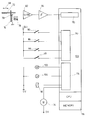
- Count signal of the incremental displacement encoder 72, 76 converted at a predetermined level is applied to the counting input of an 8-bit counter 110 integrated in a microprocessor 108.
- the limit switches 86, 88, 90 of the plunger and the sliding door and the jam switch 48 of the bottle receiving chamber are connected to input ports 112 of the microprocessor via 24 volt logic, while the signal lamps 102, 104, the locking magnet 96 and the turnstile motor 34 are connected via output ports 114 of the microprocessor can be controlled.
- the status of the input ports is queried cyclically via a microprocessor program.
- the interrogation cycle corresponds to the program cycle frequency, which must in any case be greater than the counting frequency of the encoder.
- the incoming signals are evaluated by means of a software program stored in the memory 116 of the microprocessor using reference value sets likewise stored in a part of the memory 116.
- a reference table In order to enable bottle detection, a reference table must first be saved for all bottle types to be accepted by the bottle return device using a learning process.
- an EE-PROM is expediently used as a memory, which can be written to electrically, but which is non-volatile and which does not require a backup battery.
- the learning process is triggered via a service switch, not shown.
- the bottles to be stored in the form of reference value sets are used in succession for learning set in the input chamber.
- the program cycle shown in FIG. 5 is triggered: By querying the input ports 112, it is checked cyclically whether the limit switches 86, 88 and 90 are closed. If the closed state is determined for the first time, the current counter reading of the counter 110 is stored in a predetermined storage location of the data memory 116. It should be taken into account that the counting process of the displacement sensor is triggered via the lower sensing element 50 before one of the three switches 86 to 90 is closed.
- the program expects an external deposit to be entered.
- the deposit to be issued can be entered, for example, in that the number of coins is programmed by the number of closing operations of the sliding door after the scanning operation.
- These input steps are acknowledged by the flashing of the signal lamps 112 and / or 114.
- the set of values can either be adopted indirectly, after intermediate storage or immediately in the reference memory.
- the bottle acceptance according to the flowchart in FIG. 6 corresponds completely to the learning cycle according to FIG. 5 in the scanning area.
- the input ports are monitored for their closed position with the switches 86, 88, 90 and, when the respective event occurs, the associated counter reading in one Buffer saved.
- a comparison cycle is initiated in which the value set of the buffer store is compared with the reference value sets of the reference memory. If a match is found, i.e. if a valid bottle is found, the associated bottle deposit is paid out in accordance with the reference value set, the turnstile motor is started to take the bottle into the bottle receiving chamber and then the input chamber is released again. If no valid bottle is found, the empty bottle determined to be defective remains in the input chamber and must be removed from it before inserting a new empty bottle.
- the invention relates to an empty bottle return device with automatic deposit payment for receiving upright empty bottles 30.
- the device has an input chamber 20 that can be filled with empty bottles 30 through a closable housing opening 24, a bottle receiving chamber 12 adjoining the input chamber, a motor-driven conveyor device 32 for the transport of individuals Empty bottles 30 from the input chamber 20 into the bottle receiving chamber 12, at least two which engage in the input chamber 20 at different heights, against the outer surface of one located there Empty bottle 30 touching sensing element and a control device responsive to the output signals of the sensing elements.
- the sensing elements 50, 52, 54 are arranged on a sliding door 22 closing the housing opening.
- One of the sensing elements is connected to a displacement sensor 72, 74, 76 which responds to the sliding movement of the sliding door 22 and which is connected on the output side to a counter.
- Storage means are also provided for the intermediate storage of counter readings of the counter in the form of a value group defining the contour and size of the scanned empty bottle, as well as software for comparing this value group with reference value groups. (Fig. 3)
Landscapes
- Physics & Mathematics (AREA)
- General Physics & Mathematics (AREA)
- Sorting Of Articles (AREA)
Applications Claiming Priority (2)
| Application Number | Priority Date | Filing Date | Title |
|---|---|---|---|
| DE4214250 | 1992-04-30 | ||
| DE19924214250 DE4214250A1 (de) | 1992-04-30 | 1992-04-30 | Leerflaschenruecknahmegeraet |
Publications (2)
| Publication Number | Publication Date |
|---|---|
| EP0567732A2 true EP0567732A2 (fr) | 1993-11-03 |
| EP0567732A3 EP0567732A3 (en) | 1994-07-27 |
Family
ID=6457840
Family Applications (1)
| Application Number | Title | Priority Date | Filing Date |
|---|---|---|---|
| EP19930102613 Withdrawn EP0567732A3 (en) | 1992-04-30 | 1993-02-19 | Apparatus for collecting empty bottles |
Country Status (2)
| Country | Link |
|---|---|
| EP (1) | EP0567732A3 (fr) |
| DE (1) | DE4214250A1 (fr) |
Cited By (4)
| Publication number | Priority date | Publication date | Assignee | Title |
|---|---|---|---|---|
| WO1995019020A1 (fr) * | 1994-01-07 | 1995-07-13 | Trautwein Sb-Technik Gmbh | Appareil de reprise des bouteilles vides |
| EP0895201A1 (fr) * | 1997-07-31 | 1999-02-03 | Sanden Corporation | Appareil de reprise de bouteilles vides ayant un espace réduit pour une zone d'admission de bouteille |
| AT407924B (de) * | 1996-06-13 | 2001-07-25 | Halton System Oy | Vorrichtung und verfahren zur handhabung von rückgabeflaschen |
| EP1467328A1 (fr) * | 1996-07-12 | 2004-10-13 | Tomra Systems A/S | Méthode et machine de déconsignation pour le traitement de conteneurs vides de boissons |
Families Citing this family (2)
| Publication number | Priority date | Publication date | Assignee | Title |
|---|---|---|---|---|
| DE4429541C1 (de) * | 1994-06-23 | 1995-10-19 | Smk Euro Cup Mehrwegsysteme Gm | Vorrichtung zum Identifizieren eines Gegenstandes, insbesondere eines becherartigen Trinkgefäßes |
| DE19519221A1 (de) * | 1995-05-24 | 1996-11-28 | Klose Klaus Dieter | Annahmevorrichtung für Stückgüter |
Family Cites Families (12)
| Publication number | Priority date | Publication date | Assignee | Title |
|---|---|---|---|---|
| DE7312603U (de) * | 1973-12-06 | Karal E | Flaschenrucknahmeautomat | |
| DE7110203U (de) * | 1971-07-22 | Toepfer K | Flaschen-Rücknahme-Automat | |
| GB553925A (en) * | 1942-01-21 | 1943-06-10 | Alexander Hyde Webster | Improvements in or relating to apparatus for the grading or sorting of irregularly shaped articles, such as containers, bottles, jars and the like |
| DE1084063B (de) * | 1959-06-03 | 1960-06-23 | Georg Wiegandt & Soehne | Rueckkaufautomat fuer leere Flaschen |
| US3343638A (en) * | 1961-05-31 | 1967-09-26 | Taylor Mfg | Article receiving and storage apparatus |
| FR2557332A1 (fr) * | 1983-12-26 | 1985-06-28 | Lesage Gaston | Procede et appareil pour la deconsignation de bouteilles |
| EP0281716A1 (fr) * | 1987-03-12 | 1988-09-14 | ROPELATO, Michel | Machine à déconsigner les bouteilles vides reprises par les magasins à grande surface |
| FR2563926B1 (fr) * | 1984-05-04 | 1986-10-10 | Dejoux Andre | Machine a deconsigner les bouteilles vides reprises par les magasins a grande surface |
| DE3605921A1 (de) * | 1986-02-25 | 1987-08-27 | Rolf Mueller | Getraenkeautomat |
| ATE85538T1 (de) * | 1987-05-12 | 1993-02-15 | Lescha Maschf Gmbh | Vorrichtung zur maschinellen ruecknahme von leergut. |
| DE3715815C2 (de) * | 1987-05-12 | 1996-02-15 | Em Geraetebau Ruecknahmesystem | Vorrichtung zur maschinellen Rücknahme von Leergut |
| DE4127238A1 (de) * | 1991-08-17 | 1993-02-18 | Trautwein Sb Technik Gmbh | Leerflaschenruecknahmegeraet |
-
1992
- 1992-04-30 DE DE19924214250 patent/DE4214250A1/de not_active Withdrawn
-
1993
- 1993-02-19 EP EP19930102613 patent/EP0567732A3/de not_active Withdrawn
Cited By (5)
| Publication number | Priority date | Publication date | Assignee | Title |
|---|---|---|---|---|
| WO1995019020A1 (fr) * | 1994-01-07 | 1995-07-13 | Trautwein Sb-Technik Gmbh | Appareil de reprise des bouteilles vides |
| US5788045A (en) * | 1994-01-07 | 1998-08-04 | Trautwein Sb-Technik Gmbh | Empty bottle collector |
| AT407924B (de) * | 1996-06-13 | 2001-07-25 | Halton System Oy | Vorrichtung und verfahren zur handhabung von rückgabeflaschen |
| EP1467328A1 (fr) * | 1996-07-12 | 2004-10-13 | Tomra Systems A/S | Méthode et machine de déconsignation pour le traitement de conteneurs vides de boissons |
| EP0895201A1 (fr) * | 1997-07-31 | 1999-02-03 | Sanden Corporation | Appareil de reprise de bouteilles vides ayant un espace réduit pour une zone d'admission de bouteille |
Also Published As
| Publication number | Publication date |
|---|---|
| DE4214250A1 (de) | 1993-11-04 |
| EP0567732A3 (en) | 1994-07-27 |
Similar Documents
| Publication | Publication Date | Title |
|---|---|---|
| DE2935539C2 (fr) | ||
| DE69511593T2 (de) | Ausrichtungsvorrichtung für Geldprüf- und -transportgerät und Geldkassette | |
| DE102008027348A1 (de) | Manipulationserkennungssystem für in Geldautomaten entnehmbar einsetzbare Geldkassetten | |
| DE4430777C2 (de) | Abfallschleuse für Mülltonnen bzw. Müllkästen | |
| EP0567732A2 (fr) | Dispositif de reprise de bouteilles vides | |
| DE3840400A1 (de) | Verfahren zur elektronischen muenzpruefung und muenzpruefer zur durchfuehrung des verfahrens | |
| DE10027723B4 (de) | Elektronischer Münzprüfer | |
| DE4443406A1 (de) | Leerflaschen-Rücknahmegerät | |
| DE19519221A1 (de) | Annahmevorrichtung für Stückgüter | |
| DE3806576C2 (fr) | ||
| DE2530984A1 (de) | Tag-/nachttresoranlage | |
| DE102014117281B3 (de) | Münzverarbeitungseinrichtung | |
| DE2338315C2 (de) | Wechselgeldautomat | |
| CH624501A5 (en) | Collecting device for a coin collector | |
| DE3045734C2 (de) | Münzprüfer für unterschiedliche Münzen | |
| EP0680021A1 (fr) | Dispositif pour détecter le niveau dans les tubes d'un distributeur de pièces de monnaie | |
| DE2606894A1 (de) | Verkaufseinrichtung fuer zeitungen und zeitschriften | |
| DE3002222A1 (de) | Vorrichtung zum pruefen von muenzen | |
| AT392698B (de) | Elektronischer muenzpruefer | |
| DE3419533C2 (fr) | ||
| EP0118909A2 (fr) | Dispositif trieur de pièces de monnaie | |
| DE2165969C3 (de) | Kassiereinrichtung. Ausscheidung aus: 2116237 | |
| DE2408395C3 (de) | Münzprüfeinrichtung für Münzautomaten, insbesondere für Münzfernsprecher | |
| DE2402736C3 (de) | Münzprüfeinrichtung für Münzautomaten, insbesondere für Münzfernsprecher | |
| DE3743757A1 (de) | Einwurfvorrichtung fuer muenzen |
Legal Events
| Date | Code | Title | Description |
|---|---|---|---|
| PUAI | Public reference made under article 153(3) epc to a published international application that has entered the european phase |
Free format text: ORIGINAL CODE: 0009012 |
|
| AK | Designated contracting states |
Kind code of ref document: A2 Designated state(s): DE FR IT |
|
| PUAL | Search report despatched |
Free format text: ORIGINAL CODE: 0009013 |
|
| AK | Designated contracting states |
Kind code of ref document: A3 Designated state(s): DE FR IT |
|
| STAA | Information on the status of an ep patent application or granted ep patent |
Free format text: STATUS: THE APPLICATION IS DEEMED TO BE WITHDRAWN |
|
| 18D | Application deemed to be withdrawn |
Effective date: 19950128 |