EP0567836A2 - Schreibstilermittlung und automatische Prototypenherstellung für On-Line-Handschrifterkennung - Google Patents
Schreibstilermittlung und automatische Prototypenherstellung für On-Line-Handschrifterkennung Download PDFInfo
- Publication number
- EP0567836A2 EP0567836A2 EP93105945A EP93105945A EP0567836A2 EP 0567836 A2 EP0567836 A2 EP 0567836A2 EP 93105945 A EP93105945 A EP 93105945A EP 93105945 A EP93105945 A EP 93105945A EP 0567836 A2 EP0567836 A2 EP 0567836A2
- Authority
- EP
- European Patent Office
- Prior art keywords
- user
- prototype
- writings
- style
- alphabet
- Prior art date
- Legal status (The legal status is an assumption and is not a legal conclusion. Google has not performed a legal analysis and makes no representation as to the accuracy of the status listed.)
- Withdrawn
Links
Images


Classifications
-
- G—PHYSICS
- G06—COMPUTING OR CALCULATING; COUNTING
- G06V—IMAGE OR VIDEO RECOGNITION OR UNDERSTANDING
- G06V30/00—Character recognition; Recognising digital ink; Document-oriented image-based pattern recognition
- G06V30/10—Character recognition
- G06V30/24—Character recognition characterised by the processing or recognition method
- G06V30/242—Division of the character sequences into groups prior to recognition; Selection of dictionaries
-
- G—PHYSICS
- G06—COMPUTING OR CALCULATING; COUNTING
- G06F—ELECTRIC DIGITAL DATA PROCESSING
- G06F18/00—Pattern recognition
- G06F18/20—Analysing
- G06F18/28—Determining representative reference patterns, e.g. by averaging or distorting; Generating dictionaries
Definitions
- the invention is in the field of handwriting recognition, and specifically is directed to automatically detecting the writing style of a user, and creating a user prototype set by selecting from the user writings and prestored subsets of an alphabet, termed style sets, and a default set.
- On-line handwriting recognition systems usually keep a set of writings with proper labels, and checks if a new unknown writing is similar to any of the prestored writings. The label of the prestored writing that best matches the unknown becomes the recognition result.
- the most obvious way of creating a prototype set is to collect writings from the user, and make them into prototypes. For example, prescribed sentences are presented to the user, and users are asked to copy the sentences in fixed positions. Then the computer associates the alphabets of the sentences to the user's writings and the user prototype set is created.
- a user rather than collecting a complete prototype set from a user, which is very time consuming, a user writes just a few letters, rather than a complete alphabet set.
- Previously collected writings of others are classified into subsets of the alphabet based on different writing styles, and a default set of characters is also created.
- the user written characters, and one or more style sets which match the writing style of the user, and the default set are merged to form a user prototype set.
- a handwriting recognition system method and apparatus is set forth for creating a user prototype set.
- Writings of an alphabet set are collected from a plurality of writers.
- the collected writings are classified into subsets of the alphabet set based on different writing styles.
- a default set of characters is created for characters that do not belong to any of the subsets.
- Less than a complete alphabet set of writings from a user is sampled.
- Each character of the sampled writings of the user are compared with the j prototype style sets to determine which user written characters match one or more of the j prototype style sets.
- the user written characters and the matched prototype style sets and the default set and the created user style set are then merged to form a user prototype set for the user.
- This invention is directed to creating a user prototype set for a handwriting recognition system, where the user prototype set is created in as short a time as possible.
- each writer has a distinct writing style and there are a large number of styles, if the alphabet set is divided into subsets, there are rather few distinct styles for each subset.
- the characters "D” and "P” are commonly written in one or two strokes.
- the writer that writes "D” in one stroke usually writes “P” in one stroke. This results in two different style sets for D and P.
- Left-handed writers often write short horizontal strokes right to left, and right-handed writers write left to right, making two classes or style sets of characters such as "T", "F”, "H”.
- the first step is to collect writings from many writers. Then that large writing set is analyzed and classified into subsets such as (D,P), (T,F,H). Style sets for each of such subsets are created such that there will be a style set with one stroke (D,P), a style set for two strokes (D,P), a style set for left to right (T,F,H) and a style set for right to left (T,F,H). In the example case, there will be a total of 4 prototype style sets.
- the user writings character by character are matched with each style. If any character of a style set is a good match, then the writer has this type of style of writing. For example, if the one stroke "D" was found in the user writing, then the user has a one stroke (D,P) style.
- a good collection of prototype style sets is the key to high accuracy. But even a moderate collection of style sets shortens the training time greatly. In the ideal case, a very short training sequence, that does not necessarily contain every character of the alphabet, can be sufficient to create a user prototype set.
- FIG. 1 there is shown in general an on-line handwriting character recognition system 10 constructed and operated in accordance with the invention.
- the system may be implemented utilizing any general purpose computer.
- the system may be implemented using an IBM PS/2 Model 80 running OS/2.
- IBM and PS/2 and OS/2 are each registered trademarks of the International Business Machines Company.
- System 10 includes a handwriting transducer comprised of an integrated electronic tablet and display 12 having a writing implement, such as a stylus 14.
- the transducer outputs a serial stream of (x,y) coordinate pairs corresponding to a position of the stylus 14 relative to the tablet 12 coordinate system.
- the coordinate pairs are provided to a stroke segmenter 16 that identifies a beginning and an end of discrete handwritten strokes.
- Strokes are provided to a character matcher 18.
- Character matcher 18 is coupled to a store 20 of predetermined character prototypes for comparing points of input strokes to points of stored character prototypes so as to identify, to within some probability, that an input stroke or assemblage of strokes represents a specific character. Recognized characters are output from the matcher 18 via line 19 to tablet and display 12 to display the recognized characters, or may be applied to a utilization device 21 such as a display, an application, such as a word processing program, or the like. In some systems the functionality of the segmenter 16 and the character matcher 18 may be combined within one handwritten stroke processing unit.
- Character prototypes may be provided to the store 20 during a training session held with a user of the system 10.
- the character prototypes may be entered by a specific user of the system and thereafter used only when the specific user enters handwritten characters. Also, a global or universal set of character prototypes may be generated for use with more than one user.
- a starter prototype set may be designed as an initial prototype set to be used by any writer on first using the system 10. If desired, a writer may then add character prototypes in his/her own writing style to obtain a prototype set tailored to the writer, also referred to as an individualized prototype set.
- a starter prototype set is typically created by an expert in handwriting recognition systems, there is no burden placed on a user of the system 10 to follow any writing suggestions or constraints. The details of how a starter prototype set is generated according to this invention is described shortly.
- prototype processor 24 In general, during a training session characters from character matcher 18 are routed through a physical or logical switch 22 to a prototype processor 24, which for example may be an Intel '386 processor.
- the output of prototype processor 24 is a series of averaged prototype characters that are supplied to store 20 for subsequent use during a handwriting recognition session conducted with a user of the system 10.
- Prototype processor 24 may also be coupled to a user input and output device, such as a keyboard 26 and a display device 28 for controlling the operation of prototype processor 24 in the deletion of confusing prototypes as used during a handwriting recognition session conducted with a user of the system 10. It is to be understood that Keyboard 26 and display 28 are optional, as the system is functional with only pen input.
- the integrated electronic tablet and display 12 could be replaced by an electronic tablet not having a display, with display of characters being provided on the utilization device 21 or display 28.
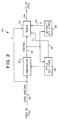
- FIG. 2 is a detailed functional block diagram of the prototype processor 24 of FIG. 1 for creating a user prototype set.
- a user provides user writings on a line 30 to a comparator 32 and a merge unit 34.
- the user writings (u), as previously stated, is less than a completed alphabet set.
- the writings of an alphabet set are collected from a plurality of writers. These collected writings are classified into subsets of the alphabet based on different writing styles. These are created j, where j is an integer greater than or equal to 2, style sets (Sj) for each of the subsets of the alphabet based on different writing styles. There will be many such style sets.
- the style sets Sj be defined as: The j style sets Sj are stored in a style set store 36.
- a default set of characters D is created for characters that do not belong to any of the style sets Sj.
- the default set D may include, for example, "o”, “O”, “c”, “C”, “s”, “S” and most punctuation marks.
- Let the default set D be defined as: D ⁇ O, C, S ... ⁇
- the default set D is stored in a default store set 38.
- the user writing u on line 30 is provided to comparator 32 and merge unit 34.
- the letter A a left to right, is found to compare with style set 3 (S3) and S3 is provided to merge unit 34 on line 40 under control of a control signal on line 42.
- the letter C is found not to compare with any style set in store 36, and the default set D is provided on line 44 to the merge unit 34 under control of the control signal on line 42. It is to be understood that the default set D is always provided to merge unit 34. This occurs even if a default character isn't written by the user.
- the letter D a one stroke letter, is found to compare with style set 1 (S1), and S1 is provided to merge unit 34 on line 40 under control of the control signal on line 42.
- the process occurs for each letter of the less then complete alphabet written by the user.
- the user prototype Pu is initially set equal to the user writings u and the default set D.
- the user writing is comprised of i, where i is an integer ⁇ 1, characters.
- a determination is made if i is greater than the number of characters written by the user. For example, if the user writes 10 characters, the determination is made if i > 10. If so, the procedure ends as indicated at 55. If not, proceed to block 56 where j is set equal to the first style set, in this instance S1.
- any following style set may be compared to the user writing u as previously explained. It is seen that each successive character written by the user is compared with each style set. Whenever a character compares to a given style set, that style set is added to the user's writings and the default set to form a user prototype for the the user.
Landscapes
- Engineering & Computer Science (AREA)
- Theoretical Computer Science (AREA)
- Computer Vision & Pattern Recognition (AREA)
- Physics & Mathematics (AREA)
- General Physics & Mathematics (AREA)
- Data Mining & Analysis (AREA)
- Multimedia (AREA)
- Life Sciences & Earth Sciences (AREA)
- Artificial Intelligence (AREA)
- Bioinformatics & Cheminformatics (AREA)
- Bioinformatics & Computational Biology (AREA)
- Evolutionary Biology (AREA)
- Evolutionary Computation (AREA)
- General Engineering & Computer Science (AREA)
- Character Discrimination (AREA)
Applications Claiming Priority (2)
| Application Number | Priority Date | Filing Date | Title |
|---|---|---|---|
| US87551692A | 1992-04-29 | 1992-04-29 | |
| US875516 | 1992-04-29 |
Publications (2)
| Publication Number | Publication Date |
|---|---|
| EP0567836A2 true EP0567836A2 (de) | 1993-11-03 |
| EP0567836A3 EP0567836A3 (en) | 1994-09-28 |
Family
ID=25365946
Family Applications (1)
| Application Number | Title | Priority Date | Filing Date |
|---|---|---|---|
| EP9393105945A Withdrawn EP0567836A3 (en) | 1992-04-29 | 1993-04-13 | Writer style detection and automatic prototype creation for on-line handwriting recognition |
Country Status (2)
| Country | Link |
|---|---|
| EP (1) | EP0567836A3 (de) |
| JP (1) | JPH07117993B2 (de) |
Cited By (3)
| Publication number | Priority date | Publication date | Assignee | Title |
|---|---|---|---|---|
| EP0867827A3 (de) * | 1997-03-19 | 1999-02-10 | Cadix Inc. | Verfahren zur Erzeugung von Unterschriftsregistrierungsdaten für eine Unteschriftvergleichungsprozedur |
| CN1045679C (zh) * | 1993-12-01 | 1999-10-13 | 摩托罗拉公司 | 以字典为基础与可能的字符串结合的手写物识别方法 |
| EP1665086A4 (de) * | 2003-08-15 | 2009-09-02 | Silverbrook Res Pty Ltd | Verbesserung der genauigkeit bei der digital-farbstoff-suche |
Families Citing this family (1)
| Publication number | Priority date | Publication date | Assignee | Title |
|---|---|---|---|---|
| US7715629B2 (en) * | 2005-08-29 | 2010-05-11 | Microsoft Corporation | Style aware use of writing input |
Family Cites Families (1)
| Publication number | Priority date | Publication date | Assignee | Title |
|---|---|---|---|---|
| US5121441A (en) * | 1990-09-21 | 1992-06-09 | International Business Machines Corporation | Robust prototype establishment in an on-line handwriting recognition system |
-
1993
- 1993-03-01 JP JP5039656A patent/JPH07117993B2/ja not_active Expired - Lifetime
- 1993-04-13 EP EP9393105945A patent/EP0567836A3/en not_active Withdrawn
Cited By (4)
| Publication number | Priority date | Publication date | Assignee | Title |
|---|---|---|---|---|
| CN1045679C (zh) * | 1993-12-01 | 1999-10-13 | 摩托罗拉公司 | 以字典为基础与可能的字符串结合的手写物识别方法 |
| EP0867827A3 (de) * | 1997-03-19 | 1999-02-10 | Cadix Inc. | Verfahren zur Erzeugung von Unterschriftsregistrierungsdaten für eine Unteschriftvergleichungsprozedur |
| US6393138B1 (en) | 1997-03-19 | 2002-05-21 | Cadix Inc. | Method of creating registration signature data for computerized signature collation scheme |
| EP1665086A4 (de) * | 2003-08-15 | 2009-09-02 | Silverbrook Res Pty Ltd | Verbesserung der genauigkeit bei der digital-farbstoff-suche |
Also Published As
| Publication number | Publication date |
|---|---|
| EP0567836A3 (en) | 1994-09-28 |
| JPH0689368A (ja) | 1994-03-29 |
| JPH07117993B2 (ja) | 1995-12-18 |
Similar Documents
| Publication | Publication Date | Title |
|---|---|---|
| EP0565871B1 (de) | Verfahren und Vorrichtung zum Weiterentwickeln einer Anfangssammlung von Handschriftprototypen zu einer anwender-spezifischen Sammlung | |
| KR100297482B1 (ko) | 수기입력의문자인식방법및장치 | |
| US5313527A (en) | Method and apparatus for recognizing cursive writing from sequential input information | |
| US5121441A (en) | Robust prototype establishment in an on-line handwriting recognition system | |
| EP1564675B1 (de) | Anordnung und Verfahren zur Suche nach einer Anfrage in digitaler Tinte | |
| JP4686502B2 (ja) | オンライン文字認識装置 | |
| K Jabde et al. | A comprehensive literature review on air-written online handwritten recognition | |
| Poon et al. | Scribbler: A tool for searching digital ink | |
| US5659633A (en) | Character recognition method utilizing compass directions and torsion points as features | |
| CN110738188A (zh) | 基于预分类的古文字识别系统 | |
| JPH07146918A (ja) | 手書き文字認識装置 | |
| EP0567836A2 (de) | Schreibstilermittlung und automatische Prototypenherstellung für On-Line-Handschrifterkennung | |
| US6320985B1 (en) | Apparatus and method for augmenting data in handwriting recognition system | |
| JP7095450B2 (ja) | 情報処理装置、文字認識方法、および文字認識プログラム | |
| Niels et al. | Introducing Trigraph-trimodal writer identification | |
| Khan et al. | Isolated handwritten pashto characters recognition using KNN classifier | |
| Leedham | Historical perspectives of handwriting recognition systems | |
| EP0737910A2 (de) | Vorrichtung und Verfahren zur Eingabe von Daten | |
| EP0135615A2 (de) | Verfahren und Vorrichtung hinsichtlich Mustererkennung | |
| Newell | On-Line, Alphabet-Independent, Gestural Recognition Using Probabilistic Properties | |
| KR960001102B1 (ko) | 수서인식 시스템에서의 케이스 혼동을 해결하는 방법 | |
| Öksüz | Vision based handwritten character recognition | |
| CA2497586C (en) | Method and apparatus for recognizing cursive writing from sequential input information | |
| JPH05189621A (ja) | オンライン手書き文字認識装置 | |
| Öksüz et al. | A video-based text and equation editor for LaTeX |
Legal Events
| Date | Code | Title | Description |
|---|---|---|---|
| PUAI | Public reference made under article 153(3) epc to a published international application that has entered the european phase |
Free format text: ORIGINAL CODE: 0009012 |
|
| AK | Designated contracting states |
Kind code of ref document: A2 Designated state(s): DE FR GB |
|
| 17P | Request for examination filed |
Effective date: 19931227 |
|
| PUAL | Search report despatched |
Free format text: ORIGINAL CODE: 0009013 |
|
| AK | Designated contracting states |
Kind code of ref document: A3 Designated state(s): DE FR GB |
|
| 18W | Application withdrawn |
Withdrawal date: 19960716 |