EP0568007B1 - Photorécepteur électrophotographique - Google Patents
Photorécepteur électrophotographique Download PDFInfo
- Publication number
- EP0568007B1 EP0568007B1 EP93106808A EP93106808A EP0568007B1 EP 0568007 B1 EP0568007 B1 EP 0568007B1 EP 93106808 A EP93106808 A EP 93106808A EP 93106808 A EP93106808 A EP 93106808A EP 0568007 B1 EP0568007 B1 EP 0568007B1
- Authority
- EP
- European Patent Office
- Prior art keywords
- group
- substituents
- formula
- compound
- electrophotographic photoreceptor
- Prior art date
- Legal status (The legal status is an assumption and is not a legal conclusion. Google has not performed a legal analysis and makes no representation as to the accuracy of the status listed.)
- Expired - Lifetime
Links
- XDTMQSROBMDMFD-UHFFFAOYSA-N C1CCCCC1 Chemical compound C1CCCCC1 XDTMQSROBMDMFD-UHFFFAOYSA-N 0.000 description 7
- UAEPNZWRGJTJPN-UHFFFAOYSA-N CC1CCCCC1 Chemical compound CC1CCCCC1 UAEPNZWRGJTJPN-UHFFFAOYSA-N 0.000 description 6
- IKLNOINQWYDQGM-UHFFFAOYSA-N C1CC[IH]CC1 Chemical compound C1CC[IH]CC1 IKLNOINQWYDQGM-UHFFFAOYSA-N 0.000 description 1
- GARARMSXYRBRKE-UHFFFAOYSA-N C1[IH]CC[IH]C1 Chemical compound C1[IH]CC[IH]C1 GARARMSXYRBRKE-UHFFFAOYSA-N 0.000 description 1
- IUMGGVHCHUQMIB-UHFFFAOYSA-N CCC(CCC(C)C)[F]I Chemical compound CCC(CCC(C)C)[F]I IUMGGVHCHUQMIB-UHFFFAOYSA-N 0.000 description 1
- MLRVZFYXUZQSRU-UHFFFAOYSA-N CCCCCCCl Chemical compound CCCCCCCl MLRVZFYXUZQSRU-UHFFFAOYSA-N 0.000 description 1
- IHSVXVGXOSYWRY-DTWKUNHWSA-N C[C@@H]1CC[C@H](CN)CCC1 Chemical compound C[C@@H]1CC[C@H](CN)CCC1 IHSVXVGXOSYWRY-DTWKUNHWSA-N 0.000 description 1
- UCNHESFCEVHNQO-OALILPRHSA-N C[C@H](CC1)CC[C@H]1/C(/C)=C\C1CCCCC1 Chemical compound C[C@H](CC1)CC[C@H]1/C(/C)=C\C1CCCCC1 UCNHESFCEVHNQO-OALILPRHSA-N 0.000 description 1
- GTMTYOCIGNBPSO-UHFFFAOYSA-N NC(CC1)CCC1I Chemical compound NC(CC1)CCC1I GTMTYOCIGNBPSO-UHFFFAOYSA-N 0.000 description 1
Images
Classifications
-
- G—PHYSICS
- G03—PHOTOGRAPHY; CINEMATOGRAPHY; ANALOGOUS TECHNIQUES USING WAVES OTHER THAN OPTICAL WAVES; ELECTROGRAPHY; HOLOGRAPHY
- G03G—ELECTROGRAPHY; ELECTROPHOTOGRAPHY; MAGNETOGRAPHY
- G03G5/00—Recording-members for original recording by exposure, e.g. to light, to heat or to electrons; Manufacture thereof; Selection of materials therefor
- G03G5/02—Charge-receiving layers
- G03G5/04—Photoconductive layers; Charge-generation layers or charge-transporting layers; Additives therefor; Binders therefor
- G03G5/06—Photoconductive layers; Charge-generation layers or charge-transporting layers; Additives therefor; Binders therefor characterised by the photoconductive material being organic
- G03G5/0601—Acyclic or carbocyclic compounds
- G03G5/0612—Acyclic or carbocyclic compounds containing nitrogen
- G03G5/0614—Amines
- G03G5/06142—Amines arylamine
- G03G5/06144—Amines arylamine diamine
-
- G—PHYSICS
- G03—PHOTOGRAPHY; CINEMATOGRAPHY; ANALOGOUS TECHNIQUES USING WAVES OTHER THAN OPTICAL WAVES; ELECTROGRAPHY; HOLOGRAPHY
- G03G—ELECTROGRAPHY; ELECTROPHOTOGRAPHY; MAGNETOGRAPHY
- G03G5/00—Recording-members for original recording by exposure, e.g. to light, to heat or to electrons; Manufacture thereof; Selection of materials therefor
- G03G5/02—Charge-receiving layers
- G03G5/04—Photoconductive layers; Charge-generation layers or charge-transporting layers; Additives therefor; Binders therefor
- G03G5/06—Photoconductive layers; Charge-generation layers or charge-transporting layers; Additives therefor; Binders therefor characterised by the photoconductive material being organic
- G03G5/0622—Heterocyclic compounds
- G03G5/0624—Heterocyclic compounds containing one hetero ring
- G03G5/0635—Heterocyclic compounds containing one hetero ring being six-membered
- G03G5/0637—Heterocyclic compounds containing one hetero ring being six-membered containing one hetero atom
-
- C—CHEMISTRY; METALLURGY
- C07—ORGANIC CHEMISTRY
- C07C—ACYCLIC OR CARBOCYCLIC COMPOUNDS
- C07C217/00—Compounds containing amino and etherified hydroxy groups bound to the same carbon skeleton
- C07C217/78—Compounds containing amino and etherified hydroxy groups bound to the same carbon skeleton having amino groups and etherified hydroxy groups bound to carbon atoms of six-membered aromatic rings of the same carbon skeleton
- C07C217/80—Compounds containing amino and etherified hydroxy groups bound to the same carbon skeleton having amino groups and etherified hydroxy groups bound to carbon atoms of six-membered aromatic rings of the same carbon skeleton having amino groups and etherified hydroxy groups bound to carbon atoms of non-condensed six-membered aromatic rings
- C07C217/82—Compounds containing amino and etherified hydroxy groups bound to the same carbon skeleton having amino groups and etherified hydroxy groups bound to carbon atoms of six-membered aromatic rings of the same carbon skeleton having amino groups and etherified hydroxy groups bound to carbon atoms of non-condensed six-membered aromatic rings of the same non-condensed six-membered aromatic ring
- C07C217/92—Compounds containing amino and etherified hydroxy groups bound to the same carbon skeleton having amino groups and etherified hydroxy groups bound to carbon atoms of six-membered aromatic rings of the same carbon skeleton having amino groups and etherified hydroxy groups bound to carbon atoms of non-condensed six-membered aromatic rings of the same non-condensed six-membered aromatic ring the nitrogen atom of at least one of the amino groups being further bound to a carbon atom of a six-membered aromatic ring
-
- C—CHEMISTRY; METALLURGY
- C07—ORGANIC CHEMISTRY
- C07C—ACYCLIC OR CARBOCYCLIC COMPOUNDS
- C07C223/00—Compounds containing amino and —CHO groups bound to the same carbon skeleton
- C07C223/06—Compounds containing amino and —CHO groups bound to the same carbon skeleton having amino groups bound to carbon atoms of six-membered aromatic rings of the carbon skeleton
-
- C—CHEMISTRY; METALLURGY
- C07—ORGANIC CHEMISTRY
- C07C—ACYCLIC OR CARBOCYCLIC COMPOUNDS
- C07C251/00—Compounds containing nitrogen atoms doubly-bound to a carbon skeleton
- C07C251/72—Hydrazones
- C07C251/86—Hydrazones having doubly-bound carbon atoms of hydrazone groups bound to carbon atoms of six-membered aromatic rings
-
- G—PHYSICS
- G03—PHOTOGRAPHY; CINEMATOGRAPHY; ANALOGOUS TECHNIQUES USING WAVES OTHER THAN OPTICAL WAVES; ELECTROGRAPHY; HOLOGRAPHY
- G03G—ELECTROGRAPHY; ELECTROPHOTOGRAPHY; MAGNETOGRAPHY
- G03G5/00—Recording-members for original recording by exposure, e.g. to light, to heat or to electrons; Manufacture thereof; Selection of materials therefor
- G03G5/02—Charge-receiving layers
- G03G5/04—Photoconductive layers; Charge-generation layers or charge-transporting layers; Additives therefor; Binders therefor
- G03G5/06—Photoconductive layers; Charge-generation layers or charge-transporting layers; Additives therefor; Binders therefor characterised by the photoconductive material being organic
- G03G5/0601—Acyclic or carbocyclic compounds
- G03G5/0612—Acyclic or carbocyclic compounds containing nitrogen
- G03G5/0614—Amines
- G03G5/06142—Amines arylamine
- G03G5/06147—Amines arylamine alkenylarylamine
-
- G—PHYSICS
- G03—PHOTOGRAPHY; CINEMATOGRAPHY; ANALOGOUS TECHNIQUES USING WAVES OTHER THAN OPTICAL WAVES; ELECTROGRAPHY; HOLOGRAPHY
- G03G—ELECTROGRAPHY; ELECTROPHOTOGRAPHY; MAGNETOGRAPHY
- G03G5/00—Recording-members for original recording by exposure, e.g. to light, to heat or to electrons; Manufacture thereof; Selection of materials therefor
- G03G5/02—Charge-receiving layers
- G03G5/04—Photoconductive layers; Charge-generation layers or charge-transporting layers; Additives therefor; Binders therefor
- G03G5/06—Photoconductive layers; Charge-generation layers or charge-transporting layers; Additives therefor; Binders therefor characterised by the photoconductive material being organic
- G03G5/0601—Acyclic or carbocyclic compounds
- G03G5/0612—Acyclic or carbocyclic compounds containing nitrogen
- G03G5/0616—Hydrazines; Hydrazones
-
- G—PHYSICS
- G03—PHOTOGRAPHY; CINEMATOGRAPHY; ANALOGOUS TECHNIQUES USING WAVES OTHER THAN OPTICAL WAVES; ELECTROGRAPHY; HOLOGRAPHY
- G03G—ELECTROGRAPHY; ELECTROPHOTOGRAPHY; MAGNETOGRAPHY
- G03G5/00—Recording-members for original recording by exposure, e.g. to light, to heat or to electrons; Manufacture thereof; Selection of materials therefor
- G03G5/02—Charge-receiving layers
- G03G5/04—Photoconductive layers; Charge-generation layers or charge-transporting layers; Additives therefor; Binders therefor
- G03G5/06—Photoconductive layers; Charge-generation layers or charge-transporting layers; Additives therefor; Binders therefor characterised by the photoconductive material being organic
- G03G5/0601—Acyclic or carbocyclic compounds
- G03G5/0618—Acyclic or carbocyclic compounds containing oxygen and nitrogen
-
- G—PHYSICS
- G03—PHOTOGRAPHY; CINEMATOGRAPHY; ANALOGOUS TECHNIQUES USING WAVES OTHER THAN OPTICAL WAVES; ELECTROGRAPHY; HOLOGRAPHY
- G03G—ELECTROGRAPHY; ELECTROPHOTOGRAPHY; MAGNETOGRAPHY
- G03G5/00—Recording-members for original recording by exposure, e.g. to light, to heat or to electrons; Manufacture thereof; Selection of materials therefor
- G03G5/02—Charge-receiving layers
- G03G5/04—Photoconductive layers; Charge-generation layers or charge-transporting layers; Additives therefor; Binders therefor
- G03G5/06—Photoconductive layers; Charge-generation layers or charge-transporting layers; Additives therefor; Binders therefor characterised by the photoconductive material being organic
- G03G5/0622—Heterocyclic compounds
- G03G5/0624—Heterocyclic compounds containing one hetero ring
- G03G5/0627—Heterocyclic compounds containing one hetero ring being five-membered
- G03G5/0629—Heterocyclic compounds containing one hetero ring being five-membered containing one hetero atom
-
- G—PHYSICS
- G03—PHOTOGRAPHY; CINEMATOGRAPHY; ANALOGOUS TECHNIQUES USING WAVES OTHER THAN OPTICAL WAVES; ELECTROGRAPHY; HOLOGRAPHY
- G03G—ELECTROGRAPHY; ELECTROPHOTOGRAPHY; MAGNETOGRAPHY
- G03G5/00—Recording-members for original recording by exposure, e.g. to light, to heat or to electrons; Manufacture thereof; Selection of materials therefor
- G03G5/02—Charge-receiving layers
- G03G5/04—Photoconductive layers; Charge-generation layers or charge-transporting layers; Additives therefor; Binders therefor
- G03G5/06—Photoconductive layers; Charge-generation layers or charge-transporting layers; Additives therefor; Binders therefor characterised by the photoconductive material being organic
- G03G5/0622—Heterocyclic compounds
- G03G5/0644—Heterocyclic compounds containing two or more hetero rings
- G03G5/0661—Heterocyclic compounds containing two or more hetero rings in different ring systems, each system containing at least one hetero ring
-
- G—PHYSICS
- G03—PHOTOGRAPHY; CINEMATOGRAPHY; ANALOGOUS TECHNIQUES USING WAVES OTHER THAN OPTICAL WAVES; ELECTROGRAPHY; HOLOGRAPHY
- G03G—ELECTROGRAPHY; ELECTROPHOTOGRAPHY; MAGNETOGRAPHY
- G03G5/00—Recording-members for original recording by exposure, e.g. to light, to heat or to electrons; Manufacture thereof; Selection of materials therefor
- G03G5/02—Charge-receiving layers
- G03G5/04—Photoconductive layers; Charge-generation layers or charge-transporting layers; Additives therefor; Binders therefor
- G03G5/06—Photoconductive layers; Charge-generation layers or charge-transporting layers; Additives therefor; Binders therefor characterised by the photoconductive material being organic
- G03G5/0664—Dyes
- G03G5/0666—Dyes containing a methine or polymethine group
- G03G5/0668—Dyes containing a methine or polymethine group containing only one methine or polymethine group
-
- G—PHYSICS
- G03—PHOTOGRAPHY; CINEMATOGRAPHY; ANALOGOUS TECHNIQUES USING WAVES OTHER THAN OPTICAL WAVES; ELECTROGRAPHY; HOLOGRAPHY
- G03G—ELECTROGRAPHY; ELECTROPHOTOGRAPHY; MAGNETOGRAPHY
- G03G5/00—Recording-members for original recording by exposure, e.g. to light, to heat or to electrons; Manufacture thereof; Selection of materials therefor
- G03G5/02—Charge-receiving layers
- G03G5/04—Photoconductive layers; Charge-generation layers or charge-transporting layers; Additives therefor; Binders therefor
- G03G5/06—Photoconductive layers; Charge-generation layers or charge-transporting layers; Additives therefor; Binders therefor characterised by the photoconductive material being organic
- G03G5/0664—Dyes
- G03G5/0666—Dyes containing a methine or polymethine group
- G03G5/0672—Dyes containing a methine or polymethine group containing two or more methine or polymethine groups
-
- C—CHEMISTRY; METALLURGY
- C07—ORGANIC CHEMISTRY
- C07C—ACYCLIC OR CARBOCYCLIC COMPOUNDS
- C07C2603/00—Systems containing at least three condensed rings
- C07C2603/02—Ortho- or ortho- and peri-condensed systems
- C07C2603/40—Ortho- or ortho- and peri-condensed systems containing four condensed rings
- C07C2603/42—Ortho- or ortho- and peri-condensed systems containing four condensed rings containing only six-membered rings
- C07C2603/50—Pyrenes; Hydrogenated pyrenes
Definitions
- the present invention relates to a highly sensitive electrophotographic photoreceptor of high performance having a photosensitive layer containing a specific arylamine compound as carrier-transporting material.
- inorganic photoconductive substances such as selenium, cadmium sulfide and zinc oxide have been widely used for photosensitive layers of electrophotographic photoreceptors.
- selenium and cadmium sulfide are required to be recovered as poisonous substances, and selenium tends to be crystallized by heat and thus is poor in the heat resistance.
- Cadmium sulfide and zinc oxide are poor in moisture resistance, and zinc oxide lacks in printing resistance. Therefore, efforts have been made for the development of a new photoreceptor.
- a research for the use of organic photoconductive materials for photosensitive layers of electrophotographic photoreceptors has found some progress, and some of them have been practically employed.
- the organic photoconductive materials have advantages such that they are light in weight, they can easily be formed into films, preparation of photoreceptors is thereby easy, transparent photoreceptors can be produced depending upon their types, and they are free from pollution.
- function-separated photoreceptors wherein functions to generate electric charge carriers and to transport the generated carriers are performed by separate compounds, have been the main objects for development, since such function-separated photoreceptors are effective for high sensitivity, and organic photoreceptors of this type have been practically developed.
- a polymer photoconductive compound such as polyvinyl carbazole.
- a low molecular weight photoconductive compound by dispersing and dissolving such a compound in a binder polymer.
- organic low molecular weight photoconductive compound since it is thereby possible to select as the binder a polymer excellent in the film-forming properties, the flexibility and the adhesive properties, and it is readily possible to obtain a photoreceptor excellent in the mechanical properties (see e.g. Japanese Unexamined Patent Publications No. 196767/1985, No. 218652/1985, No. 233156/1985, No. 48552/1988 and No.
- EP-A-0 475 264 discloses arylamine compounds as charge transporting material.
- the wavelength of the light source in this case is about 800 nm, and it is desired to develop a photoreceptor having high sensitivity to a light with a long wavelength of about 800 nm.
- materials to meet this requirement those disclosed in Japanese Unexamined Patent Publications No. 49544/1984, No. 214034/1984, No. 109056/1986, No. 171771/1986, No. 217050/1986, No. 239248/1986, No. 67094/987, No. 134651/1987, No. 275272/1987, No. 198067/1988, No. 198067/1988, No. 210942/1988 and No.
- the present invention has been made to solve the above-mentioned problems.
- the first object of the present invention is to provide an electrophotographic photoreceptor having high sensitivity and high durability.
- the second object is to provide an electrophotographic photoreceptor which has high sensitivity and will undergo no substantial property change even in repeated use with the residual potential sufficiently low even when the film thickness is made thick and which is excellent in the durability.
- the third object is to provide an electrophotographic photoreceptor having high sensitivity even to a light with a long wavelength of about 800 nm, wherein the chargeability, the dark attenuation, the residual potential, etc. are well-balanced.
- the present inventors have conducted extensive researches for organic low molecular weight photoconductive compounds which satisfy these objects, and as a result, have found that certain specific arylamine compounds are suitable for this purpose.
- the present invention has been accomplished the basis of this discovery.
- the present invention provides an electrophotographic photoreceptor comprising an electrically conductive substrate and a photosensitive layer formed thereon, wherein said photosensitive layer contains, as carrier-transporting material, an arylamine compound characterized in that said compound has the following formula (I): wherein X is a hydrogen atom or a group of the formula (II): Y is a group of the formula (III) or (IV): -O-A 1 -O- (III) -A 2 -O-A 3 - (IV) wherein A 1 in the formula (III) is a bivalent hydrocarbon residue which may have substituents, and each of A 2 and A 3 in the formula (IV) is an alkylene group which may have substituents, an arylene group which may have substituents, or a group wherein an alkylene group which may have substituents and an arylene group which may have substituents, are bonded, and A 2 and A 3 may be the same or different from each other; each of Ar 1 and Ar 2
- the present invention provides an electrophotographic photoreceptor comprising an electrically conductive substrate and a photosensitive layer formed thereon, wherein the photosensitive layer contains the arylamine compound of the formula (I) and a pyrenehydrazone compound of the following formula (X): wherein R 11 is an alkyl group, an allyl group, an aryl group which may have substituents, or an aralkyl group which may have substituents, and R 12 is an aryl group which may have substituents.
- the present invention provides an electrophotographic photoreceptor comprising an electrically conductive substrate and a photosensitive layer formed thereon, wherein the photosensitive layer contains the arylamine compound of the formula (I) as a carrier-transporting material and an oxytitanium phthalocyanine showing a main diffraction peak at a Bragg angle (2 ⁇ 0.2°) of 27.3° in the X-ray diffraction spectrum, as a carrier-generating material.
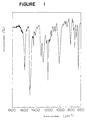
- Figure 1 shows an infrared absorption spectrum of the arylamine compound obtained in Preparation Example 2.
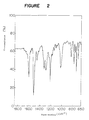
- Figure 2 shows an infrared absorption spectrum of the arylamine compound obtained in Preparation Example 3.
- the photosensitive layer contains an arylamine compound of the above formula (I).
- X is a hydrogen atom or a group of the formula (II):
- Y is a group of the formula (III) or (IV): -O-A 1 -O- (III) -A 2 -O-A 3 - (IV)
- a 1 is a bivalent hydrocarbon residue, for example, an alkylene group such as a methylene group, an ethylene group or a propylene group; an arylene group such as a phenylene group, a biphenylene group or a naphthylene group; a group wherein an alkylene group and a arylene group are bonded, such as xylylene group; a cycloalkylene group such as cyclohexylene group; or a vinylene group.
- each of A 2 and A 3 is an alkylene group, an arylene group or a group wherein an alkylene group and an arylene group are bonded, and A 2 and A 3 may be the same or different from each other.
- Such groups of A 1 , A 2 and A 3 may, respectively, have substituents such as a halogen atom, a hydroxyl group, a saturated or unsaturated hydrocarbon group (such as an alkyl group or an aryl group), an alkoxy group, an aryloxy group, a dialkylamino group and a diarylamino group.
- Each of Ar 1 and Ar 2 which may be the same or different, is an alkyl group such as a methyl group, an ethyl group or a propyl group; an aryl group such as a phenyl group, a naphthyl group or an anthracenyl group; or a heterocyclic group such as a pyrrolyl group, a thiophenyl group, a furyl group or a carbazolyl group, preferably an aryl group or an aromatic heterocyclic group, particularly preferably a phenyl group.
- Such alkyl, aryl and heterocyclic groups may, respectively, have substituents.
- Such substituents may, for example, be a hydroxyl group; a halogen atom such as a chlorine atom, a bromine atom or an iodine atom; an alkyl group such as a methyl group, an ethyl group, a propyl group, a butyl group or a hexyl group; an alkoxy group such as a methoxy group, an ethoxy group or a butoxy group; an allyl group; an aralkyl group such as a benzyl group, a naphthylmethyl group or a phenethyl group; an aryloxy group such as a phenoxy group or a tolyloxy group; an arylalkoxy group such as a benzyloxy group or a phenethyloxy group; an aryl group such as a phenyl group or a naphthyl group; an arylvinyl group such as a st
- R 1 , R 2 , R 3 and R 4 which may be the same or different, is a hydrogen atom; a halogen atom such as a chlorine atom, a bromine atom or an iodine atom; an alkyl group such as a methyl group, an ethyl group or a propyl group; an alkoxy group such as a methoxy group, an ethoxy group or a propyloxy group; a dialkylamino group such as a dimethylamino group; a diarylamino group such as a diphenylamino group; a diaralkylamino group such as a dibenzylamino group; a di-heterocyclic amino group such as a dipyridylamino group; a diallylamino group; or a substituted amino group such as a di-substituted amino group having an optional combination of the above-mentioned substituents for the amino groups.
- a hydrogen atom, a methyl group or a methoxy group is particularly preferred.
- the alkyl group and the alkoxy group may, respectively, have substituents.
- substituents may, for example, be a hydroxyl group; a halogen atom such as a chlorine atom, a bromine atom or an iodine atom; an alkyl group such as a methyl group, an ethyl group, a propyl group, a butyl group or a hexyl group; an alkoxy group such as a methoxy group, an ethoxy group or a butoxy group; an allyl group; an aralkyl group such as a naphthylmethyl group or a phenethyl group; an aryloxy group such as a phenoxy group or a tolyloxy group; an arylalkoxy group such as a benzyloxy group or a phenethyloxy group; an
- R 5 , R 6 , R 7 , R 8 , R 9 and R 10 which may be the same or different, is a hydrogen atom; an alkyl group such as a methyl group, an ethyl group or a propyl group; an aryl group such as a phenyl group, a naphthyl group or an anthracenyl group; or a heterocyclic group such as a pyrrolyl group, a thiophenyl group, a furyl group or a carbazolyl group.
- the heterocyclic group is preferably an aromatic heterocyclic group.
- the alkyl group, the aryl group and the heterocyclic group may, respectively, have substituents.
- Such substituents may, for example, be a hydroxyl group; a halogen atom such as a chlorine atom, a bromine atom or an iodine atom; an alkyl group such as a methyl group, an ethyl group, a propyl group, a butyl group or a hexyl group; an alkoxy group such as a methoxy group, an ethoxy group or a butoxy group; an allyl group; an aralkyl group such as a benzyl group, a naphthylmethyl group or a phenethyl group; an aryloxy group such as a phenoxy group or a tolyloxy group; an arylalkoxy group such as a benzyloxy group or a phenethyloxy group; an aryl group such as a phenyl group or a naphthyl group; an arylvinyl group such as a st
- R 6 and R 7 , or R 9 and R 10 may be condensed to form a single bond; a carbon ring group with a methylene group, an ethylene group, a carbonyl group, a vinylidene group or an ethylenylene group; or a heterocyclic group containing an oxygen atom, a sulfur atom or a nitrogen atom. Further, such rings may, respectively, have substituents.
- Such substituents may, for example, be an alkyl group such as a methyl group, an ethyl group or a propyl group; an aryl group such as a phenyl group, a naphthyl group or an anthracenyl group; a cyano group; an alkoxycarbonyl group; an aryloxycarbonyl group; a nitro group; or a halogen atom such as a chlorine atom, a bromine atom or an iodine atom.
- each of R 5 , R 6 , R 7 , R 8 , R 9 and R 10 which may be the same or different, is a hydrogen atom, an alkyl group which may have substituents, an aryl group which may have substituents, or a heterocyclic group which may have substituents, provided that with respect to the pair of R 6 and R 7 and the pair of R 9 and R 10 , when one of each pair is a hydrogen atom or an alkyl group, the other is an aryl group or a heterocyclic group, or R 6 and R 7 , or R 9 and R 10 , may be condensed as shown by a dotted line in the following formula (I') or (II') to form a carbon ring group or a heterocyclic group, and such a ring may have substituents; whereby it is preferred that (1) when X is a hydrogen atom, R 6 and R 7 are condensed to form the
- the arylamine compound of the formula (V) is reacted with a formylating agent such as N,N-dimethylformamide or N-methylformanilide in the presence of phosphorus oxychloride to obtain an aldehyde product of the formula (VIII) wherein Ar 1 , Ar 2 , R 1 , R 2 , R 3 , R 4 , R 5 and R 8 are as defined with respect to the formula (I).
- the formylating agent may be used in a large excess, so that it serves as a solvent for the reaction.
- a solvent inert to the reaction such as o-dichlorobenzene or benzene, may be employed.
- the arylamine compound of the formula (V) is reacted with an acid chloride of the formula Cl-CO-R 5 or Cl-CO-R 8 in a solvent such as nitrobenzene, dichloromethane or carbon tetrachloride in the presence of a Lewis acid such as aluminum chloride, iron chloride or zinc chloride to obtain a ketone product of the formula (VIII).
- a solvent such as nitrobenzene, dichloromethane or carbon tetrachloride
- a Lewis acid such as aluminum chloride, iron chloride or zinc chloride
- R 5 and R 8 may be the same or different from each other, and when R 5 ⁇ R 8 , the acid chloride to be added, may be mixed or stepwise added to accomplish the reaction.
- a product of cis-form, transform or a mixture of cis- and transforms may be obtained.
- the formula (I) represents any one of the cis-form, the trans-form and the mixture of the cis- and trans-forms).
- the compounds of the formulas (VII) and (IX) may be used alone or in combination as a mixture. Otherwise, in some cases, they may be reacted stepwisely.
- the product after completion of the respective steps or after completion of the entire process steps, the product can be purified by a conventional purification method such as recrystallization, sublimation or column chromatography to obtain a high purity product, as the case requires.
- the electrophotographic photoreceptor of the present invention has a photosensitive layer containing at least one arylamine compound of the above formula (I).
- the arylamine compound of the formula (I) exhibits excellent performance as an organic photoconductive material. Especially when used as a carrier transporting medium, it presents a photoreceptor having a high sensitivity and excellent durability.
- the photosensitive layer (the photoconductive layer) may be of a lamination type wherein a carrier generation layer and a carrier transport layer are laminated in this order or in a reversed order, or of a dispersion type in which particles of a carrier-generating material (a substance capable of generating electric charge carriers) are dispersed in a carrier transporting medium.
- a carrier-generating material a substance capable of generating electric charge carriers
- the photosensitive layer may be a photosensitive layer having the arylamine compound and, as the case requires, a colorant or an electron attractive compound which serves as a sensitizer, incorporated in a binder, a photosensitive layer having a carrier generating material (photoconductive particles) capable of generating electric charge carriers at an extremely high efficiency upon absorption of light and the arylamine compound incorporated in a binder, or a photosensitive layer having a carrier transport layer comprising the arylamine compound and a carrier generation layer comprising a carrier-generating material capable of generating electric charge carriers at an extremely high efficiency upon absorption of light, or such a carrier-generating material and a binder, laminated.
- a carrier generating material photoconductive particles
- Such a photosensitive layer may further contain a known other arylamine compound, a hydrazone compound or a stilbene compound having excellent performance as an organic photoconductor, together with the arylamine compound of the formula (I).
- the photosensitive layer contains the arylamine compound of the above formula (I) and a pyrenehydrazone compound of the following formula (X).
- An electrophotographic photoreceptor having two types of such specific compounds incorporated in the photosensitive layer has a very high photosensitivity and shows a low residual potential, and it shows little accumulation of the residual potential even in repeated use. Further, the stability is excellent with little changes in the chargeability and sensitivity. Accordingly, it is excellent in durability and can be used without any problem for a high speed copying machine or printer.
- R 11 is an alkyl group, an allyl group, an aryl group which may have substituents, or an aralkyl group which may have substituents, preferably an aryl group which may have substituents, more preferably a phenyl group or a naphthyl group.
- R 12 is an aryl group which may have substituents, preferably a phenyl group or a naphthyl group.
- the substituents may, for example, be an alkyl group, an allyl group, an alkoxy group, an aryloxy group or a dialkylamino group.
- the blend ratio of the compound of the formula (I) to the compound of the formula (X) is usually within a range of from 95:5 to 20:80, by weight. However, in order to obtain higher effects, it is preferably within a range of from 90:10 to 40:60, by weight.
- the present invention it is possible to obtain a photoreceptor which has a particularly high sensitivity and a low residual potential and which is excellent in the durability with no substantial change in the surface potential or no substantial deterioration of the sensitivity, or no substantial accumulation of the residual potential, in repeated use, especially when the arylamine compound of the above formula (I) is used in the carrier transport layer of the photosensitive layer comprising two layers i.e. the carrier generation layer and the carrier transport layer.
- such a photoreceptor is a lamination type photoreceptor which is usually prepared in such a manner that a carrier-generating material is directly vapor-deposited or coated in the form of a dispersion with a binder, to form a carrier generation layer, and an organic solvent solution containing the above arylamine compound is cast thereon, or the above arylamine compound is dissolved together with e.g. a binder and the resulting dispersion is coated thereon, to form a carrier transport layer containing the carrier-transporting material including the arylamine compound of the above formula (I).
- the order of lamination of the carrier generation layer and the carrier transport layer may be reversed.
- it may be a single layer type photoreceptor having the carrier-generating material and the carrier-transporting material coated on an electrically conductive substrate in a state dispersed or dissolved in a binder.
- the carrier-generating material may, for example, be inorganic photoconductive particles of e.g. selenium, a selenium-tellurium alloy, a sellenium-arsenic alloy, cadmium sulfide or amorphous silicon; or organic photoconductive particles of e.g. metal free phthalocyanine, metal-containing phthalocyanine, perynone pigment, thioindigo, quinacridone, perylene pigment, anthraquinone pigment, azo pigment, bisazo pigment, trisazo pigment, tetrakisazo pigment or cyanine pigment.
- inorganic photoconductive particles e.g. selenium, a selenium-tellurium alloy, a sellenium-arsenic alloy, cadmium sulfide or amorphous silicon
- organic photoconductive particles e.g. metal free phthalocyanine, metal-containing phthalocyanine, perynone pigment, thioindigo, quinacridone, pery
- organic pigments and dyestuffs such as a polycyclic quinone, a pyrylium salt, a thiopyrilium salt, indigo, anthoanthrone and pyranthrone, may be used.
- metal-free phthalocyanine, phthalocyanine having a metal or its oxide or chloride, such as indium copper chloride, galium chloride, tin, oxytitanium, zinc or vanadium, coordinated, or an azo pigment such as a monoazo pigment, a bisazo pigment, a trisazo pigment or polyazo pigment is preferred.
- an electrophotographic photoreceptor having a photosensitive layer containing at least a carrier-generating material and a carrier-transporting material formed on an electrically conductive substrate, wherein an oxytitanium phthalocyanine showing a main diffraction peak at a Bragg angle (2 ⁇ 0.2°) of 27.3° in the X-ray diffraction spectrum, is contained as the carrier-generating material, and the arylamine compound of the above formula (I) is contained as the carrier-transporting material.
- the electrophotographic photoreceptor thus obtained, has a high sensitivity, a low residual potential and high chargeability and will undergo little change in repeated use. It is useful as a highly durable photoreceptor, since the charge stability affecting the image density, is excellent. Further, it has a high sensitivity in a wavelength region from 750 to 850 nm, and it is suitable particularly as a photoreceptor for a semiconductor laser printer.
- the oxytitanium phthalocyanine to be used as the carrier-generating material has a main diffraction peak at a Bragg angle (2 ⁇ 0.2°) of 27.3° in the X-ray diffraction spectrum.
- the "main diffraction peak” means a peak at which the intensity is highest in the X-ray diffraction spectrum.
- the diffraction peak at a Bragg angle (2 ⁇ 0.2°) of 27.3° is the main peak, and other peaks may vary depending upon delicate conditions.
- the intensity (the height of the peak) of each of such other peaks is preferably not higher than 50% of the peak intensity at 27.3° in view of the chargeability and sensitivity of the electrophotographic photoreceptor.
- the method for preparing the oxytitanium phthalocyanine is not particularly limited.
- it can be prepared by the following methods.
- the oxytitanium phthalocyanine particles showing a main diffraction peak at a Bragg angle (2 ⁇ 0.2°) of 27.3° in the X-ray diffraction spectrum are dissolved or dispersed in a solvent together with a binder polymer and optional other organic photoconductive compounds, pigments, electron attractive compounds, etc., and the coating solution thereby obtained, is coated and dried to form a carrier generation layer.
- an oxytitanium phthalocyanine showing a main diffraction peak at a Bragg angle (2 ⁇ 0.2°) of 27.3° in the X-ray diffraction spectrum and an oxytitanium phthalocyanine showing main diffraction peaks at Bragg angles (2 ⁇ 0.2°) of 9.3°, 13.2°, 26.2° and 27.1° in the X-ray diffraction spectrum, or an oxytitanium phthalocyanine showing a main diffraction peak at a Bragg angle (2 ⁇ 0.2°) of 27.3° in the X-ray diffraction spectrum and a dichloro tin phthalocyanine showing main diffraction peaks at Bragg angles (2 ⁇ 0.2°) of 8.5°C, 12.2°, 13.8°, 16.9°, 22.4°, 28.4° and 30.1° in the X-ray diffraction spectrum.
- the dye to be incorporated, as the case requires, in the present invention may, for example, be a triphenylmethane dye such a Methyl Violet, Brilliant Green or Crystal Violet, a thiazine dye such as Methylene Blue, a quinone dye such as Quinizarin, or a cyanine dye as well as a pyrylium salt, a thiapyrilium salt or a benzopyrylium salt.
- a triphenylmethane dye such as Methyl Violet, Brilliant Green or Crystal Violet
- a thiazine dye such as Methylene Blue
- a quinone dye such as Quinizarin
- a cyanine dye as well as a pyrylium salt, a thiapyrilium salt or a benzopyrylium salt.
- the electron attracting compound which forms a carrier-transporting complex together with the arylamine compound may, for example, be a quinone such as chloranil, 2,3-dichloro-1,4-naphthoquinone, 1-nitroanthraquinone, 1-chloro-5-nitroanthraquinone, 2-chloroanthraquinone or phenanthrenequinone; an aldehyde such as 4-nitrobenzaldehyde; a ketone such as 9-benzoylanthracene, indanedione, 3,5-dinitrobenzophenone, 2,4,7-trinitrofluorenone, 2,4,5,7-tetranitrofluorenone or 3,3',5,5'-tetranitrobenzophenone; an acid anhydride such as phthalic anhydride or 4-chloronaphthalic anhydride; a cyano compound such as tetracyano ethylene, terephthalalmalononitrile,
- the carrier generation layer in the lamination type photosensitive layer may be in the form of a dispersion layer wherein the fine particles of such a material are bound by a various binder resin such as a polyester resin, polyvinyl acetate, polyester, polycarbonate, polyvinyl acetoacetal, polyvinyl propional, polyvinyl butyral, a phenoxy resin, an epoxy resin, a urethane resin, a cellulose ester or a cellulose ether.
- a various binder resin such as a polyester resin, polyvinyl acetate, polyester, polycarbonate, polyvinyl acetoacetal, polyvinyl propional, polyvinyl butyral, a phenoxy resin, an epoxy resin, a urethane resin, a cellulose ester or a cellulose ether.
- the binder resin may, for example, be a polymer or a copolymer of a vinyl compound such as styrene, vinyl acetate, vinyl chloride, an acrylic acid ester, a methacrylic acid ester, vinyl alcohol or ethyl vinyl ether, a polyamide or a silicon resin.
- the proportion of the carrier-generating material is usually within a range of from 20 to 2000 parts by weight, preferably from 30 to 500 parts by weight, more preferably from 33 to 500 parts by weight, per 100 parts by weight of the binder resin.
- the thickness of the carrier generation layer is usually from 0.05 to 5 ⁇ m, preferably from 0.1 to 2 ⁇ m, more preferably from 0.15 to 0.8 ⁇ m.
- the carrier generation layer may contain a leveling agent or an antioxidant to improve the coating properties or various additives such as a sensitizer, as the case requires. Further, the carrier generation layer may be a film formed by vapor deposition of the above-mentioned carrier-generating material.
- the particle size of the carrier-generating material is required to be sufficiently small and is preferably not larger than 1 ⁇ m, more preferably not larger than 1.5 ⁇ m.
- the amount of the carrier-generating material dispersed in the photosensitive layer is usually within a range of from 0.5 to 50% by weight. If the amount is too small, no adequate sensitivity will be obtained. On the other hand, if the amount is too much, there will be an adverse effect such as a deterioration in the chargeability or a deterioration in the sensitivity. More preferably, it is used within a range of from 1 to 20% by weight.
- the thickness of the dispersion type photosensitive layer is usually from 5 to 50 ⁇ m, preferably from 10 to 45 ⁇ m.
- a known plasticizer to improve the film-forming properties, the flexibility or the mechanical strength, an additive to control the residual potential, a dispersion adjuvant to improve the stability of the dispersion, a leveling agent to improve the coating property, a surfactant such as silicon oil or a fluorine-type oil, or other additives may be incorporated.
- the photosensitive layer of the electrophotographic photoreceptor of the present invention may contain a well-known plasticizer to improve the film-forming properties, the flexibility or the mechanical strength.
- a plasticizer to be incorporated to the above coating solution for this purpose an aromatic compound such as a phthalic acid ester, a phosphoric acid ester, an epoxy compound, chlorinated paraffin, a chlorinated fatty acid ester or methyl naphthalene, may be mentioned.
- the coating solution may be of the above composition, but the photoconductive particles, the dye and the electron attracting compound may be eliminated or may be incorporated in small amounts.
- the carrier generation layer may be a thin layer formed by coating and drying a coating solution obtained by dissolving or dispersing the above photoconductive particles and optionally a binder polymer as well as other organic photoconductive material, a dye and an electron attracting compound in a solvent, or a layer obtained by forming the above photoconductive particles into a film by a method such as vapor deposition.
- the photoreceptor thus formed may, of course, have a layer for improving the electrical properties or mechanical properties such as an interlayer like a barrier layer, an adhesive layer or a blocking layer, a transparent insulating layer, or a protective layer, as the case requires.
- a conductive substrate on which the photosensitive layer is formed any substrate which is commonly employed in conventional electrophotographic photoreceptors, may be employed. Specifically, a drum or sheet made of a metal material such as aluminum, stainless steel, copper or nickel, or a laminate of foils or such a metal or a vapor-deposited product of such a metal, or an insulating substrate such as a polyester film or paper having a conductive layer of e.g.
- a plastic film, a plastic drum, paper or a paper tube having a conductive material such as metal powder, carbon black, copper iodide or a polymer electrolyte coated together with a suitable binder for conductive treatment may be mentioned.
- a plastic sheet or drum having a conductive material such as metal powder, carbon black or carbon fiber incorporated to have electrical conductivity may be mentioned.
- a plastic film or belt treated for electrical conductivity with a conductive metal oxide such as tin oxide or indium oxide may be mentioned.
- an anodized aluminum film As the barrier layer or the interlayer, an anodized aluminum film, an inorganic layer such as aluminum oxide or aluminum hydroxide, or an organic layer such as polyvinyl alcohol, casein, polyvinyl pyrrolidone, polyacrylic acid, a cellulose, gelatin, starch, polyurethane, polyimide or polyamide, may be used.
- an inorganic layer such as aluminum oxide or aluminum hydroxide
- an organic layer such as polyvinyl alcohol, casein, polyvinyl pyrrolidone, polyacrylic acid, a cellulose, gelatin, starch, polyurethane, polyimide or polyamide
- the electrophotographic photoreceptor of the present invention can be prepared by a conventional method in such a manner that an arylamine compound of the above formula (I) is dissolved in a suitable solvent together with a binder, and as the case requires, a suitable carrier-generating material, a sensitizing dye, an electron attracting compound, other carrier-transporting material, or a conventional additive such as a plasticizer or pigment, is added to obtain a coating solution, which is then coated and dried on a conductive substrate to form a photosensitive layer usually having a film thickness of from a few ⁇ m to a few tens ⁇ m.
- the photoreceptor may be prepared either by coating the above coating solution on a carrier generation layer, or forming a carrier generation layer on a carrier transport layer obtained by coating the above coating solution.
- the solvent for the preparation of the coating solution may be a solvent which is capable of dissolving the arylamine compound, for example, an ether such as tetrahydrofuran or 1,4-dioxane; a ketone such as methyl ethyl ketone or cyclohexanone; an aromatic hydrocarbon such as toluene or xylene; an aprotic polar solvent such as N,N-dimethylformamide, acetonitrile, N-methylpyrrolidone or dimethylsulfoxide; an ester such as ethyl acetate, methyl formate or methyl cellosolve acetate; or a chlorinated hydrocarbon such as dichloroethane or chloroform.
- an ether such as tetrahydrofuran or 1,4-dioxane
- a ketone such as methyl ethyl ketone or cyclohexanone
- an aromatic hydrocarbon such as tolu
- the binder resin to be used for the carrier transport layer in the case of a lamination type photosensitive layer or the binder resin to be used as a matrix in the case of a dispersion type photosensitive layer is preferably a polymer which has good compatibility with the carrier transport material and which is free from phase separation or crystallization of the carrier-transporting material after formation of a coating film.
- it may be a polymer or copolymer of a vinyl compound such as styrene, vinyl acetate, vinyl chloride, an acrylic acid ester, a methacrylic acid ester or butadiene, or various polymers such as polyvinyl acetal, polycarbonate, polyester, polyester carbonate, polysulfone, polyimide, polyphenylene oxide, polyurethane, cellulose ester, cellulose ether, a phenoxy resin, a silicon resin or an epoxy resin. Further, their partially crosslinked cured products may also be used.
- the binder is used usually in an amount of from 0.5 to 30 times by weight, preferably from 0.7 to 10 times by weight, relative to the arylamine compound.
- the carrier transport layer consists essentially of a binder resin, the arylamine compound of the formula (I) and the pyrenehydrazone compound of the formula (X), and in the case of a dispersion-type photosensitive layer, the above-mentioned carrier-generating material is dispersed in a matrix comprising a binder resin and the compounds of the formulas (I) and (X) as main components.
- the binder resin is used in an amount of from 0.5 to 3.3 times by weight, preferably from 0.66 to 2.5 times by weight, to the total amount of the compounds of the formulas (I) and (X).
- the compound of the formula (I) is preferably used in an amount of at least 20% by weight in the carrier transport layer in the case of the lamination-type or in the photosensitive layer in the case of the dispersion-type. However, in order to obtain a higher effect, it is more preferably used within a range of from 25 to 45% by weight.
- the carrier transport layer may further contain various additives such as an antioxidant and a sensitizer and other carrier-transporting material.
- the thickness of the carrier transport layer is usually from 10 to 60 ⁇ m, preferably from 10 to 45 ⁇ m, more preferably from 27 to 40 ⁇ m.
- a conventional overcoat layer made essentially of e.g. a thermoplastic or thermosetting polymer, may be provided.
- the carrier transport layer is formed on the carrier generation layer, but the reverse arrangement is possible.
- a conventional method for forming the respective layers a conventional method may be employed such that coating solutions obtained by dissolving or dispersing in solvents the substances to be incorporated in the respective layers, are sequentially coated.
- the carrier transport layer may further contain various additives to improve the mechanical strength or the durability of the coating layer.
- additives include conventional plasticizers, various stabilizers, fluidity-imparting agents and crosslinking agents.
- the coating method for the photosensitive layer may, for example, be a spray coating method, a spiral coating method, a ring coating method or a dip coating method.
- the spray coating method includes, air spraying, airless spraying, electrostatic air spraying, electrostatic airless spraying, rotary mist-forming electrostatic spraying, hot spraying and hot airless spraying.
- air spraying airless spraying, electrostatic air spraying, electrostatic airless spraying, rotary mist-forming electrostatic spraying, hot spraying and hot airless spraying.
- a rotary mist-forming electrostatic spraying and a transporting method disclosed in republished Japanese PCT Publication No. 805198/1989, i.e. while rotating a cylindrical work, sprayed particles are continuously transported without interruption in its axial direction, whereby an electrophotographic photoreceptor excellent in the uniformity of the film thickness can be obtained in a high overall deposition efficiency.
- the spiral coating method may, for example, be a method of using a liquid-injecting coating machine or a curtain coating machine as disclosed in Japanese Unexamined Patent Publication No. 119651/1977, a method of continuously jetting a coating material in the form of a string from a fine opening as disclosed in Japanese Unexamined Patent Publication No. 231966/1969, or a method of using multi nozzles as disclosed in Japanese Unexamined Patent Publication No. 193161/1991.
- a coating solution for forming a carrier transport layer is prepared so that the total solid content is preferably at least 25%, more preferably at most 40%, and the viscosity is usually from 50 to 300 centipoise, preferably from 100 to 200 centipoise.
- the viscosity of the coating solution is determined substantially by the type of the binder polymer and the molecular weight. However, if the molecular weight is low, the mechanical strength of the polymer itself tends to be low. Accordingly, it is preferred to use a binder polymer having a molecular weight not to impair the mechanical strength.
- a carrier transport layer is formed by a dip coating method.
- the coated layer is dried.
- the drying temperature is usually within a range of from 100 to 250°C, preferably from 110 to 170°C, more preferably from 120 to 140°C.
- a dry air dryer, a steam dryer, an infrared ray dryer and a far infrared ray dryer may be employed.
- the electrophotographic photoreceptor of the present invention has a feature that the sensitivity is very high, the residual potential which causes fogging, is small, and light fatigue is little, whereby it is excellent in the durability with no substantial accumulation of the residual potential and no substantial change in the surface potential and the sensitivity.
- reaction solution was put into 200 g of ice water and hydrolyzed with sodium hydroxide, followed by extraction, concentration and purification treatments by conventional methods to obtain 6.1 g of a known bisformyl compound of the following formula as a yellow oil:
- reaction solution was put into 200 g of ice water, followed by extraction, concentration and purification treatments by conventional methods to obtain 2.9 g of yellow crystals (melting point: 126 - 128°C).
- the pH of the filtrate was not higher than 1. Hot water suspension washing was repeated until the pH of the filtrate became from 6 to 7.
- the X-ray diffraction spectrum of the obtained oxytitanium phthalocyanine shows a sharp peak at a Bragg angle (2 ⁇ 0.2°) of 27.3°, but other peaks are relatively wide peaks.
- the mixture was mixed with a solution obtained by dissolving 0.5 part of polyvinyl butyral (Denka Butyral #6000-C, trade name, manufactured by Denki Kagaku Kogyo K.K.) and 0.5 part of a phenoxy resin (UCAR ® PKHH, manufactured by Union Carbide) in a solvent mixture comprising 6.6 parts of dimethoxyethane and 6 parts of 4-methoxy-4-methylpentanone-2, to obtain a dispersion.
- This dispersion was coated on an aluminum layer vapor deposited on a polyester film having a thickness of 75 ⁇ m, by a wire bar so that the weight after drying would be 0.4 g/m 2 and then dried to form a carrier generation layer.
- the sensitivity i.e. the half value exposure was measured and found to be 0.36 ( ⁇ J/cm 2 ).
- the half value exposure was determined in such a manner that firstly, the photoreceptor was charged with a corona current of 50 ⁇ A in a dark place and then subjected to exposure with a light of 780 nm, whereby the exposure required for attenuation of the surface potential from 450 V to 225 V was measured.
- a photoreceptor was prepared in the same manner as in Example 1 except that a naphthalic acid-type bisazo pigment of the following formula was used instead of the naphthalocyanine pigment used in Example 1.
- the photoreceptor was subjected to exposure with white light, and the half value exposure was measured and found to be 0.75 lux ⁇ sec.
- An electrophotographic photoreceptor was prepared in the same manner as in Example 1 except that the arylamine compound (No. A-54) prepared in Preparation Example 3 was used instead of the arylamine compound used in Example 1.
- the electrophotographic photoreceptor thus obtained was subjected to exposure with a light of 780 nm, and the half value exposure was measured and found to be 0.38 ⁇ J/cm 2 .
- a photoreceptor was prepared in the same manner as in Example 19 except that the same naphthalic acid type bisazo pigment as used in Example 2 was used instead of the phthalocyanine pigment used in Example 19.
- the photoreceptor was subjected to exposure with white light, and the half value exposure was measured and found to be 0.77 lux ⁇ sec.
- Example 2 1.0 Part of the same naphthalic acid type bisazo pigment as used in Example 2 was added to 14 parts of dimethoxyethane, and the mixture was pulverized by a sand grinder. Then, 14 parts of dimethoxyethane and 14 parts of 4-methoxy-4-methylpentanone-2 (manufactured by Mitsubishi Kasei Corporation) were added thereto and diluted.
- the mixture was mixed with a solution prepared by dissolving 0.5 part of polyvinyl butyral (Denka Butyral #6000-C, trade name, manufactured by Denki Kagaku Kogyo K.K.) and 0.5 part of a phenoxy resin (UCAR® PKHH, manufactured by Union Carbide) in a solvent mixture comprising 6.6 parts of dimethoxyethane and 6 parts of 4-methoxy-4-methylpentanone-2, to obtain a dispersion.
- This dispersion was coated on an aluminum layer vapor deposited on a polyester film having a thickness of 75 ⁇ m, by a wire bar so that the weight after drying would be 0.4 g/m 2 and then dried to form a carrier generation layer.
- the electron photographic photoreceptor having a photosensitive layer comprising the two layers thus formed was mounted on a photoreceptor property measuring apparatus (Model EPA-8100, manufactured by Kawaguchi Denki K.K.) and charged so that the flow-in current to the aluminum surface would be 72 ⁇ A, followed by exposure and discharge, whereby the half value exposure sensitivity (E 1/2 , standard potential: 700 V) and the residual potential (Vr) were measured.
- E 1/2 standard potential: 700 V
- Vr residual potential
- Example 37 With respect to the photoreceptor prepared in the same manner as in Example 37 except that a naphthalic acid type bisazo pigment of the following formula was used instead of the naphthalic acid type bisazo pigment used in Example 37, the electrical properties were measured in the same manner as in Example 37, whereby the half value exposure sensitivity was 1.09 lux ⁇ sec and the residual potential was 7 V, and the chargeability under a low temperature condition was particularly good.
- the mixture was mixed with a solution prepared by dissolving 0.5 part of polyvinyl butyral (Denka Butyral #6000-C, trade name, manufactured by Denki Kagaku Kogyo K.K.) and 0.5 part of a phenoxy resin (UCAR® PKHH, manufactured by Union Carbide) in a solvent mixture comprising 6.6 parts of dimethoxyethane and 6 parts of 4-methoxy-4-methylpentanone-2, to obtain a dispersion.
- This dispersion was coated on an aluminum layer vapor deposited on a polyester film having a thickness of 75 ⁇ m by a wire bar so that the weight after drying would be 0.4 g/m 2 and then dried to form a carrier generation layer.
- the electrophotographic photoreceptor having a photosensitive layer comprising the two layers was subjected to exposure with a light of 780 nm, and the half value exposure was measured and found to be 0.18 ⁇ J/cm 2 .
- An electrophotographic photoreceptor was prepared in the same manner as in Example 51 except that the arylamine compound identified in the following Table 7 was used instead of the arylamine compound used in Example 51.
- the sensitivity of such an electrophotographic photoreceptor was measured in the same manner as in Example 51, and the results are shown in Table 7.
- Table 7 Example No. Compound No. Sensitivity ( ⁇ J/cm 2 ) 52 A-19 0.18 53 A-18 0.20 54 A-20 0.19 55 A-25 0.17 56 A-33 0.20 57 A-30 0.18 58 A-31 0.20 59 A-41 0.20
- An electrophotographic photoreceptor was prepared in the same manner as in Example 51 except that 0.5 part of the same oxytitanium phthalocyanine as used in Example 51 and 0.5 part of an oxytitanium phthalocyanine showing main diffraction peaks at Bragg angles (2 ⁇ 0.2°) of 9.3°, 13.2°, 26.2° and 27.1° were used instead of 1.0 part of the oxytitanium phthalocyanine used in Example 51.
- the sensitivity of such an electrophotographic photoreceptor was measured in the same manner as in Example 51, and the results are shown in Table 8. Table 8 Example No. Compound No.
- Sensitivity 60 A-21 0.26 61 A-19 0.28 62 A-18 0.26 63 A-20 0.28 64 A-25 0.29 65 A-33 0.28 66 A-30 0.30 67 A-31 0.29 68 A-41 0.29
- An electrophotographic photoreceptor was prepared in the same manner as in Example 51 except that 0.3 part of the same oxytitanium phthalocyanine as used in Example 51 and 0.7 part of a dichloro tin phthalocyanine showing main diffraction peaks at Bragg angles (2 ⁇ 0.2°) of 8.5°, 12.2°, 13.8°, 16.9°, 22.4°, 28.4° and 30.1° were used instead of 1.0 part of the oxytitanium phthalocyanine used in Example 51.
- the sensitivity of such an electrophotographic photoreceptor was measured in the same manner as in Example 51, and the results are shown in Table 9.
- Table 9 Example No. Compound No. Sensitivity ( ⁇ J/cm 2 ) 69 A-21 0.29 70 A-18 0.30 71 A-20 0.28 72 A-33 0.30 73 A-31 0.30 74 A-30 0.28
- Example 2 10 parts by weight of the same bisazo compound as used in Example 2 was added to 150 parts by weight of 4-methoxy-4-methylpentanone-2 and subjected to pulverization and dispersion treatment by a sand grind mill.
- the pigment dispersion thereby obtained was added to a 5% 1,2-dimethoxyethane solution of polyvinyl butyral (#6000-C, trade name, manufactured by Denki Kagaku Kogyo K.K.) to obtain a dispersion having a final solid content concentration of 4.0%.
- an aluminum cylinder having an outer diameter of 80 mm, a length of 340 mm and a wall thickness of 1.0 mm and having the surface mirror-finished, was subjected to dip coating to form a carrier generation layer having a film thickness after drying of 0.4 g/m 2 .
- the photoreceptor A thus prepared was mounted on a photoreceptor property measuring apparatus and electrified so that the surface potential would be -700 V, whereby the sensitivity was high with a half value exposure sensitivity E 1/2 of 0.66 (lux ⁇ sec), and the residual potential was as low as 8 V.
- the durability test was repeated by a commercially available copying machine having a blade cleaning function, whereby even after copying 100,000 sheets, no change was observed in the image quality with no substantial decrease in the potential, although a slight increase in the residual potential was observed.
- a photoreceptor B was prepared and evaluated in the same manner as in Example 75 except that the amount of the arylamine compound (Compound No. A-21) was changed to 70 parts by weight and the amount of 1-pyrenecarbaldehyde diphenyl hydrazone (Compound No. B-4) was changed to to 40 parts by weight.
- the sensitivity was high with a half value exposure sensitivity E 1/2 of 0.66 (lux ⁇ sec), and the residual potential was as low as 10 V.
- the results of the repeated durability test were excellent as in Example 75.
- a photoreceptor C was prepared and evaluated in the same manner as in Example 75 except that the amount of the arylamine compound (Compound No. A-21) was changed to 55 parts by weight and the amount of 1-pyrenecarbaldehyde diphenyl hydrazone (Compound No. B-4) was changed to 55 parts by weight.
- the sensitivity was high with a half value exposure sensitivity E 1/2 of 0.67 (lux ⁇ sec), and the residual potential was as low as 11 V.
- the results of the repeated durability test were excellent as in Example 75.
- An electrophotographic photoreceptor was prepared in the same manner as in Example 37 except that a polycarbonate resin of the following formula (the following formula indicates that the polycarbonate resin is a copolymer polycarbonate comprising three types of structural units, and the ratios of these structural units in the copolymer polycarbonate are represented by the following numerical values) was used instead of the polycarbonate resin used in Example 37:
- This electrophotographic photoreceptor was mounted on a photoreceptor property measuring apparatus (Model EPA-8100, manufactured by Kawaguchi Denki K.K.) and electrified so that the flow-in current to the aluminum surface would be 72 ⁇ A, followed by exposure and discharge, whereby the half value exposure sensitivity (E 1/2 , standard potential: 700 V) and the residual potential (Vr) were measured. As a result, the half value exposure sensitivity was 0.85 (lux ⁇ sec), and the residual potential was 9 V.
- a photoreceptor was prepared in the same manner as in Example 78 except that the same naphthalic acid bisazo pigment as used in Example 38 was used instead of the naphthalic acid bisazo type pigment used in Example 78, and the electrical properties were measured in the same manner as in Example 78, whereby the half value exposure sensitivity was 1.10 lux ⁇ sec, and the residual potential was 8 V.
- a photoreceptor was prepared in the same manner as in Example 37 except that a compound of the following formula was used instead of the arylamine compound (Compound No. A-21), and the electrical properties were measured in the same manner as in Example 37, whereby the sensitivity (half value exposure) was 0.86 (lux ⁇ sec), and the residual potential was as high as 45 V, which is problematic for practical application.
- a photoreceptor was prepared in the same manner as in Example 37 except that a compound of the following formula was used instead of the arylamine compound (Compound No. A-21), and the electrical properties were measured in the same manner as in Example 37, whereby the sensitivity (half value exposure) was 0.80 (lux ⁇ sec), and the residual potential was extremely high at a level of 120 V, which is problematic for practical application.
- a photoreceptor was prepared in the same manner as in Example 37 except that a compound of the following formula was used instead of the arylamine compound (Compound No. A-21), and the electrical properties were measured in the same manner as in Example 37, whereby the sensitivity (half value exposure) was good at a level of 0.78 (lux ⁇ sec), but the residual potential was high at a level of 55 V. Further, with respect to the running properties in an actual copying operation, it had a problem that the residual potential increased with an increase in the number of sheets copied, which is problematic for practical application.
- a photoreceptor was prepared in the same manner as in Example 38 except that a compound of the following formula was used instead of the arylamine compound (Compound No. A-21), and the electrical properties were measured in the same manner as in Example 37, whereby the sensitivity (half value exposure) was 1.15 (lux ⁇ sec), and the residual potential was as high as 43 V, which is problematic for practical application.
- a photoreceptor was prepared in the same manner as in Example 38 except that a compound of the following formula was used instead of the arylamine compound (Compound No. A-21), and the electrical properties were measured in the same manner as in Example 37, whereby the sensitivity (half value exposure) was 1.06 (lux ⁇ sec), and the residual potential was very high at a level of 115 V, which is problematic for practical application.
- a photoreceptor was prepared in the same manner as in Example 38 except that a compound of the following formula was used instead of the arylamine compound (Compound No. A-21) was used, and the electrical properties were measured in the same manner as in Example 37, whereby the sensitivity (half value exposure) was good at a level of 1.01 (lux ⁇ sec), but the residual potential was very high at a level of 120 V. Further, problems for practical application were found with respect to the chargeability at a low temperature, the response speed and the running properties in the actual copying operation.
- a comparative photoreceptor E was prepared and evaluated in the same manner as in Example 75 except that the amount 1-pyrenecarbaldehyde diphenyl hydrazone (Compound No. B-4) was changed to 110 parts by weight without using the arylamine compound (Compound No. A-21). Both the half value exposure and the repeated durability test results were good, but there was a problem that the residual potential was high.
Landscapes
- Physics & Mathematics (AREA)
- General Physics & Mathematics (AREA)
- Chemical & Material Sciences (AREA)
- Organic Chemistry (AREA)
- Health & Medical Sciences (AREA)
- Emergency Medicine (AREA)
- Photoreceptors In Electrophotography (AREA)
Claims (10)
- Photorécepteur électrophotographique comprenant un substrat conducteur de l'électricité et une couche photosensible formée par-dessus, dans lequel ladite couche photosensible contient, comme matière transporteuse de porteurs, un composé arylamine, caractérisé par le fait que ledit composé a la formule suivante (I) :
 - X est un atome d'hydrogène ou un groupe de formule (II) :
 - Y est un groupe de formule (III) ou (IV) :
-O-A1-O- (III)
-A2-O-A3- (IV)
où :- A1 dans la formule (III) représente un reste hydrocarboné bivalent qui peut avoir des substituants ; et- A2 et A3 dans la formule (IV) représentent chacun un groupe alkylène qui peut avoir des substituants, un groupe arylène qui peut avoir des substituants, ou un groupe dans lequel un groupe alkylène qui peut avoir des substituants et un groupe arylène qui peut avoir des substituants, sont liés, et A2 et A3 peuvent être identiques ou différents l'un de l'autre ;- Ar1 et Ar2, qui peuvent être identiques ou différents, représentent chacun un groupe alkyle qui peut avoir des substituants, un groupe aryle qui peut avoir des substituants, ou un groupe hétérocyclique qui peut avoir des substituants ;- R1, R2, R3 et R4, qui peuvent être identiques ou différents, représentent chacun un atome d'hydrogène, un atome d'halogène, un groupe alkyle qui peut avoir des substituants, un groupe alcoxy qui peut avoir des substituants, ou un groupe amino substitué ;- R5, R6, R7, R8, R9 et R10, qui peuvent être identiques ou différents, représentent chacun un atome d'hydrogène, un groupe alkyle qui peut avoir des substituants, un groupe aryle qui peut avoir des substituants, ou un groupe hétérocyclique qui peut avoir des substituants, ou R6 et R7, ou R9 et R10, sont condensés pour former un groupe cyclique carboné qui peut avoir des substituants, ou un groupe hétérocyclique qui peut avoir des substituants, à la condition qu'en ce qui concerne la paire R6 et R7 et la paire R9 et R10, lorsque l'un des éléments de chaque paire est un atome d'hydrogène ou un groupe alkyle, l'autre est un groupe aryle ou un groupe hétérocyclique. - Photorécepteur électrophotographique selon la revendication 1, dans lequel la couche photosensible contient le composé arylamine de formule (I) et un composé pyrènehydrazone de formule suivante (X) :
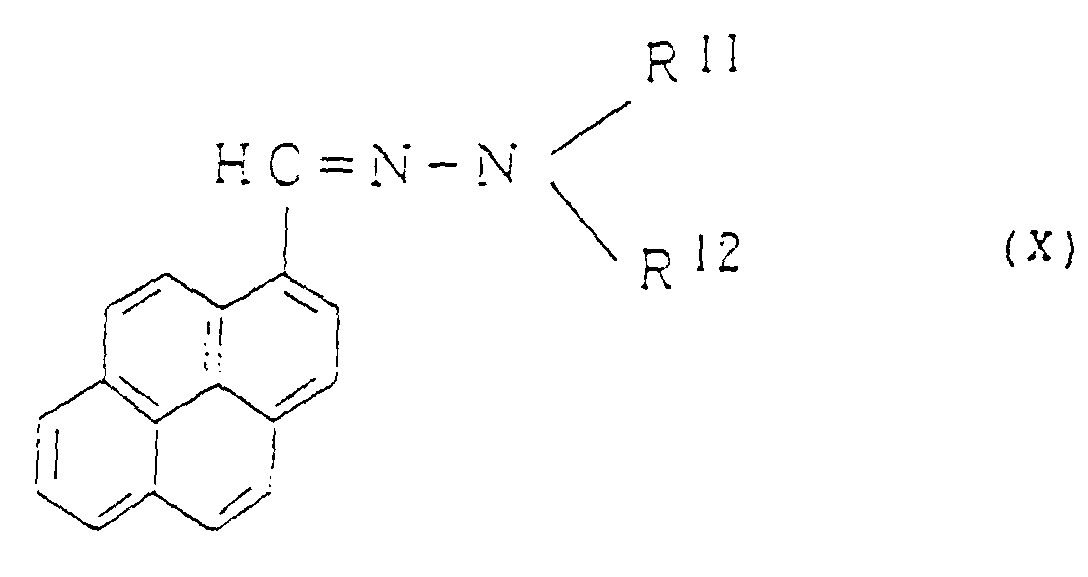 - R11 est un groupe alkyle, un groupe allyle, un groupe aryle qui peut avoir des substituants, ou un groupe aralkyle qui peut avoir des substituants ; et- R12 est un groupe aryle qui peut avoir des substituants.
 - Photorécepteur électrophotographique selon la revendication 1, dans lequel la couche photosensible contient le composé arylamine de formule (I) et une phtalocyanine d'oxytitane présentant un pic de diffraction principal à un angle de Bragg (2θ±0,2°) de 27,3° dans le spectre de diffraction des rayons X, en tant que matière génératrice de porteurs.
- Photorécepteur électrophotographique selon l'une des revendications 1, 2 ou 3, dans lequel Y dans la formule (I) est un groupe de formule (III).
- Photorécepteur électrophotographique selon la revendication 1, dans lequel :- Y dans la formule (I) est un groupe de formule (III) ; et- R5, R6, R7, R8, R9 et R10, qui peuvent être identiques ou différents, représentent chacun un atome d'hydrogène, un groupe alkyle qui peut avoir des substituants, un groupe aryle qui peut avoir des substituants, ou un groupe hétérocyclique qui peut avoir des substituants, à la condition qu'en ce qui concerne la paire R6 et R7 et la paire R9 et R10, lorsque l'un des éléments de chaque paire est un atome d'hydrogène ou un groupe alkyle, l'autre est un groupe aryle ou un groupe hétérocyclique, ou R6 et R7, ou R9 et R10, sont condensés pour former un groupe cyclique carboné qui peut avoir des substituants, ou un groupe hétérocyclique qui peut avoir des substituants ;à la condition que :(1) lorsque X est un atome d'hydrogène, R6 et R7 sont condensés pour former le groupe cyclique carboné ou le groupe hétérocyclique, et(2) lorsque X est un groupe de formule (II), au moins l'une des paires R6 et R7, et R9 et R10 est condensée pour former le groupe cyclique carboné ou le groupe hétérocyclique.
- Photorécepteur électrophotographique selon l'une des revendications 1 à 5, dans lequel la couche photosensible comprend une couche génératrice de porteurs et une couche transporteuse de porteurs, et la couche transporteuse de porteurs contient le composé arylamine de formule (I).
- Photorécepteur électrophotographique selon la revendication 2, dans lequel la couche photosensible comprend une couche génératrice de porteurs et une couche transporteuse de porteurs, et la couche transporteuse de porteurs contient le composé arylamine de formule (I) et le composé pyrènehydrazone de formule (X).
- Photorécepteur électrophotographique selon la revendication 3, dans lequel la couche photosensible comprend une couche génératrice de porteurs et une couche transporteuse de porteurs, et la couche génératrice de porteurs contient la phtalocyanine d'oxytitane montrant un pic de diffraction principal à un angle de Bragg (2θ±0,2°) de 27,3° dans le spectre de diffraction des rayons X, et la couche transporteuse de porteurs contient le composé arylamine de formule (I).
- Photorécepteur électrophotographique selon la revendication 6, dans lequel l'épaisseur de la couche génératrice de porteurs est de 0,05 à 5 µm, et l'épaisseur de la couche transporteuse de porteurs est de 10 à 60 µm.
- Photorécepteur électrophotographique selon la revendication 1, dans lequel la couche photosensible est une couche photosensible de type à dispersion ayant une épaisseur de 5 à 50 µm.
Applications Claiming Priority (8)
| Application Number | Priority Date | Filing Date | Title |
|---|---|---|---|
| JP111828/92 | 1992-04-30 | ||
| JP11182892 | 1992-04-30 | ||
| JP24370192 | 1992-09-11 | ||
| JP243701/92 | 1992-09-11 | ||
| JP28020892 | 1992-10-19 | ||
| JP280208/92 | 1992-10-19 | ||
| JP783293 | 1993-01-20 | ||
| JP7832/93 | 1993-01-20 |
Publications (2)
| Publication Number | Publication Date |
|---|---|
| EP0568007A1 EP0568007A1 (fr) | 1993-11-03 |
| EP0568007B1 true EP0568007B1 (fr) | 1997-02-26 |
Family
ID=27454808
Family Applications (1)
| Application Number | Title | Priority Date | Filing Date |
|---|---|---|---|
| EP93106808A Expired - Lifetime EP0568007B1 (fr) | 1992-04-30 | 1993-04-27 | Photorécepteur électrophotographique |
Country Status (2)
| Country | Link |
|---|---|
| EP (1) | EP0568007B1 (fr) |
| DE (1) | DE69308226T2 (fr) |
Family Cites Families (2)
| Publication number | Priority date | Publication date | Assignee | Title |
|---|---|---|---|---|
| JPS6236674A (ja) * | 1985-08-05 | 1987-02-17 | Fuji Photo Film Co Ltd | 電子写真感光体 |
| JP3042044B2 (ja) * | 1990-09-12 | 2000-05-15 | 三菱化学株式会社 | 電子写真用感光体 |
-
1993
- 1993-04-27 DE DE69308226T patent/DE69308226T2/de not_active Expired - Fee Related
- 1993-04-27 EP EP93106808A patent/EP0568007B1/fr not_active Expired - Lifetime
Also Published As
| Publication number | Publication date |
|---|---|
| DE69308226D1 (de) | 1997-04-03 |
| EP0568007A1 (fr) | 1993-11-03 |
| DE69308226T2 (de) | 1997-09-25 |
Similar Documents
| Publication | Publication Date | Title |
|---|---|---|
| EP0795791B1 (fr) | Photorécepteur électrophotographique | |
| US6030734A (en) | Electrophotographic photoreceptor containing charge-transporting material with butadiene structure | |
| JP3412348B2 (ja) | 電子写真用感光体 | |
| US5389481A (en) | Electrophotographic photoreceptor | |
| JP4157283B2 (ja) | アリールアミン組成物、その製造方法、及びそれを用いた電子写真感光体 | |
| US5955229A (en) | Electrophotographic photoreceptor | |
| EP0511664B1 (fr) | Photorécepteur électrophotographique | |
| JP3748348B2 (ja) | 電子写真感光体 | |
| EP0475264B1 (fr) | Photorécepteur éléctrophotographique | |
| JP4032213B2 (ja) | 電子写真感光体用アリールアミン組成物および当該組成物を使用した電子写真感光体 | |
| JP3582298B2 (ja) | 電子写真感光体 | |
| JP3623662B2 (ja) | 電子写真感光体 | |
| EP0291089B1 (fr) | Elément photosensible électrophotographique | |
| EP0535672B1 (fr) | Photorécepteur électrophotographique | |
| JP3644972B2 (ja) | 電子写真感光体 | |
| JP3235251B2 (ja) | 電子写真用感光体 | |
| JP4240830B2 (ja) | 電子写真感光体用アリールアミン組成物および当該組成物を使用した電子写真感光体 | |
| JP3600455B2 (ja) | 電子写真感光体 | |
| JP3570081B2 (ja) | 電子写真用感光体 | |
| JP3446305B2 (ja) | 電子写真用感光体 | |
| JP3725981B2 (ja) | 電子写真感光体 | |
| JP3722269B2 (ja) | 電子写真用感光体 | |
| EP0568007A1 (fr) | Photorécepteur électrophotographique | |
| JP3577853B2 (ja) | 電子写真感光体 | |
| JP3433582B2 (ja) | 電子写真用感光体 |
Legal Events
| Date | Code | Title | Description |
|---|---|---|---|
| PUAI | Public reference made under article 153(3) epc to a published international application that has entered the european phase |
Free format text: ORIGINAL CODE: 0009012 |
|
| AK | Designated contracting states |
Kind code of ref document: A1 Designated state(s): DE FR GB |
|
| 17P | Request for examination filed |
Effective date: 19940117 |
|
| RAP1 | Party data changed (applicant data changed or rights of an application transferred) |
Owner name: MITSUBISHI CHEMICAL CORPORATION |
|
| GRAG | Despatch of communication of intention to grant |
Free format text: ORIGINAL CODE: EPIDOS AGRA |
|
| 17Q | First examination report despatched |
Effective date: 19960430 |
|
| GRAH | Despatch of communication of intention to grant a patent |
Free format text: ORIGINAL CODE: EPIDOS IGRA |
|
| GRAH | Despatch of communication of intention to grant a patent |
Free format text: ORIGINAL CODE: EPIDOS IGRA |
|
| GRAA | (expected) grant |
Free format text: ORIGINAL CODE: 0009210 |
|
| AK | Designated contracting states |
Kind code of ref document: B1 Designated state(s): DE FR GB |
|
| REF | Corresponds to: |
Ref document number: 69308226 Country of ref document: DE Date of ref document: 19970403 |
|
| ET | Fr: translation filed | ||
| PLBE | No opposition filed within time limit |
Free format text: ORIGINAL CODE: 0009261 |
|
| 26N | No opposition filed | ||
| REG | Reference to a national code |
Ref country code: GB Ref legal event code: IF02 |
|
| PGFP | Annual fee paid to national office [announced via postgrant information from national office to epo] |
Ref country code: FR Payment date: 20090417 Year of fee payment: 17 Ref country code: DE Payment date: 20090428 Year of fee payment: 17 |
|
| PGFP | Annual fee paid to national office [announced via postgrant information from national office to epo] |
Ref country code: GB Payment date: 20090422 Year of fee payment: 17 |
|
| GBPC | Gb: european patent ceased through non-payment of renewal fee |
Effective date: 20100427 |
|
| REG | Reference to a national code |
Ref country code: FR Ref legal event code: ST Effective date: 20101230 |
|
| PG25 | Lapsed in a contracting state [announced via postgrant information from national office to epo] |
Ref country code: DE Free format text: LAPSE BECAUSE OF NON-PAYMENT OF DUE FEES Effective date: 20101103 |
|
| PG25 | Lapsed in a contracting state [announced via postgrant information from national office to epo] |
Ref country code: GB Free format text: LAPSE BECAUSE OF NON-PAYMENT OF DUE FEES Effective date: 20100427 |
|
| PG25 | Lapsed in a contracting state [announced via postgrant information from national office to epo] |
Ref country code: FR Free format text: LAPSE BECAUSE OF NON-PAYMENT OF DUE FEES Effective date: 20100430 |