EP0568052A2 - Zur Baukunst gehörige Zeichen mit Reliefdarstellungen - Google Patents
Zur Baukunst gehörige Zeichen mit Reliefdarstellungen Download PDFInfo
- Publication number
- EP0568052A2 EP0568052A2 EP93106921A EP93106921A EP0568052A2 EP 0568052 A2 EP0568052 A2 EP 0568052A2 EP 93106921 A EP93106921 A EP 93106921A EP 93106921 A EP93106921 A EP 93106921A EP 0568052 A2 EP0568052 A2 EP 0568052A2
- Authority
- EP
- European Patent Office
- Prior art keywords
- base layer
- overlay film
- film
- alphanumeric characters
- substrate
- Prior art date
- Legal status (The legal status is an assumption and is not a legal conclusion. Google has not performed a legal analysis and makes no representation as to the accuracy of the status listed.)
- Ceased
Links
Images
Classifications
-
- G—PHYSICS
- G09—EDUCATION; CRYPTOGRAPHY; DISPLAY; ADVERTISING; SEALS
- G09B—EDUCATIONAL OR DEMONSTRATION APPLIANCES; APPLIANCES FOR TEACHING, OR COMMUNICATING WITH, THE BLIND, DEAF OR MUTE; MODELS; PLANETARIA; GLOBES; MAPS; DIAGRAMS
- G09B21/00—Teaching, or communicating with, the blind, deaf or mute
- G09B21/001—Teaching or communicating with blind persons
- G09B21/003—Teaching or communicating with blind persons using tactile presentation of the information, e.g. Braille displays
-
- B—PERFORMING OPERATIONS; TRANSPORTING
- B44—DECORATIVE ARTS
- B44C—PRODUCING DECORATIVE EFFECTS; MOSAICS; TARSIA WORK; PAPERHANGING
- B44C1/00—Processes, not specifically provided for elsewhere, for producing decorative surface effects
- B44C1/10—Applying flat materials, e.g. leaflets, pieces of fabrics
- B44C1/105—Applying flat materials, e.g. leaflets, pieces of fabrics comprising an adhesive layer
-
- G—PHYSICS
- G09—EDUCATION; CRYPTOGRAPHY; DISPLAY; ADVERTISING; SEALS
- G09F—DISPLAYING; ADVERTISING; SIGNS; LABELS OR NAME-PLATES; SEALS
- G09F7/00—Signs, name or number plates, letters, numerals, or symbols; Panels or boards
- G09F7/16—Letters, numerals, or other symbols adapted for permanent fixing to a support
-
- Y—GENERAL TAGGING OF NEW TECHNOLOGICAL DEVELOPMENTS; GENERAL TAGGING OF CROSS-SECTIONAL TECHNOLOGIES SPANNING OVER SEVERAL SECTIONS OF THE IPC; TECHNICAL SUBJECTS COVERED BY FORMER USPC CROSS-REFERENCE ART COLLECTIONS [XRACs] AND DIGESTS
- Y10—TECHNICAL SUBJECTS COVERED BY FORMER USPC
- Y10T—TECHNICAL SUBJECTS COVERED BY FORMER US CLASSIFICATION
- Y10T156/00—Adhesive bonding and miscellaneous chemical manufacture
- Y10T156/10—Methods of surface bonding and/or assembly therefor
- Y10T156/1002—Methods of surface bonding and/or assembly therefor with permanent bending or reshaping or surface deformation of self sustaining lamina
- Y10T156/1028—Methods of surface bonding and/or assembly therefor with permanent bending or reshaping or surface deformation of self sustaining lamina by bending, drawing or stretch forming sheet to assume shape of configured lamina while in contact therewith
-
- Y—GENERAL TAGGING OF NEW TECHNOLOGICAL DEVELOPMENTS; GENERAL TAGGING OF CROSS-SECTIONAL TECHNOLOGIES SPANNING OVER SEVERAL SECTIONS OF THE IPC; TECHNICAL SUBJECTS COVERED BY FORMER USPC CROSS-REFERENCE ART COLLECTIONS [XRACs] AND DIGESTS
- Y10—TECHNICAL SUBJECTS COVERED BY FORMER USPC
- Y10T—TECHNICAL SUBJECTS COVERED BY FORMER US CLASSIFICATION
- Y10T156/00—Adhesive bonding and miscellaneous chemical manufacture
- Y10T156/10—Methods of surface bonding and/or assembly therefor
- Y10T156/1089—Methods of surface bonding and/or assembly therefor of discrete laminae to single face of additional lamina
- Y10T156/1092—All laminae planar and face to face
- Y10T156/1093—All laminae planar and face to face with covering of discrete laminae with additional lamina
-
- Y—GENERAL TAGGING OF NEW TECHNOLOGICAL DEVELOPMENTS; GENERAL TAGGING OF CROSS-SECTIONAL TECHNOLOGIES SPANNING OVER SEVERAL SECTIONS OF THE IPC; TECHNICAL SUBJECTS COVERED BY FORMER USPC CROSS-REFERENCE ART COLLECTIONS [XRACs] AND DIGESTS
- Y10—TECHNICAL SUBJECTS COVERED BY FORMER USPC
- Y10T—TECHNICAL SUBJECTS COVERED BY FORMER US CLASSIFICATION
- Y10T428/00—Stock material or miscellaneous articles
- Y10T428/14—Layer or component removable to expose adhesive
- Y10T428/1438—Metal containing
-
- Y—GENERAL TAGGING OF NEW TECHNOLOGICAL DEVELOPMENTS; GENERAL TAGGING OF CROSS-SECTIONAL TECHNOLOGIES SPANNING OVER SEVERAL SECTIONS OF THE IPC; TECHNICAL SUBJECTS COVERED BY FORMER USPC CROSS-REFERENCE ART COLLECTIONS [XRACs] AND DIGESTS
- Y10—TECHNICAL SUBJECTS COVERED BY FORMER USPC
- Y10T—TECHNICAL SUBJECTS COVERED BY FORMER US CLASSIFICATION
- Y10T428/00—Stock material or miscellaneous articles
- Y10T428/24—Structurally defined web or sheet [e.g., overall dimension, etc.]
- Y10T428/24479—Structurally defined web or sheet [e.g., overall dimension, etc.] including variation in thickness
- Y10T428/24488—Differential nonuniformity at margin
-
- Y—GENERAL TAGGING OF NEW TECHNOLOGICAL DEVELOPMENTS; GENERAL TAGGING OF CROSS-SECTIONAL TECHNOLOGIES SPANNING OVER SEVERAL SECTIONS OF THE IPC; TECHNICAL SUBJECTS COVERED BY FORMER USPC CROSS-REFERENCE ART COLLECTIONS [XRACs] AND DIGESTS
- Y10—TECHNICAL SUBJECTS COVERED BY FORMER USPC
- Y10T—TECHNICAL SUBJECTS COVERED BY FORMER US CLASSIFICATION
- Y10T428/00—Stock material or miscellaneous articles
- Y10T428/24—Structurally defined web or sheet [e.g., overall dimension, etc.]
- Y10T428/24479—Structurally defined web or sheet [e.g., overall dimension, etc.] including variation in thickness
- Y10T428/24521—Structurally defined web or sheet [e.g., overall dimension, etc.] including variation in thickness with component conforming to contour of nonplanar surface
-
- Y—GENERAL TAGGING OF NEW TECHNOLOGICAL DEVELOPMENTS; GENERAL TAGGING OF CROSS-SECTIONAL TECHNOLOGIES SPANNING OVER SEVERAL SECTIONS OF THE IPC; TECHNICAL SUBJECTS COVERED BY FORMER USPC CROSS-REFERENCE ART COLLECTIONS [XRACs] AND DIGESTS
- Y10—TECHNICAL SUBJECTS COVERED BY FORMER USPC
- Y10T—TECHNICAL SUBJECTS COVERED BY FORMER US CLASSIFICATION
- Y10T428/00—Stock material or miscellaneous articles
- Y10T428/24—Structurally defined web or sheet [e.g., overall dimension, etc.]
- Y10T428/24628—Nonplanar uniform thickness material
- Y10T428/24736—Ornamental design or indicia
-
- Y—GENERAL TAGGING OF NEW TECHNOLOGICAL DEVELOPMENTS; GENERAL TAGGING OF CROSS-SECTIONAL TECHNOLOGIES SPANNING OVER SEVERAL SECTIONS OF THE IPC; TECHNICAL SUBJECTS COVERED BY FORMER USPC CROSS-REFERENCE ART COLLECTIONS [XRACs] AND DIGESTS
- Y10—TECHNICAL SUBJECTS COVERED BY FORMER USPC
- Y10T—TECHNICAL SUBJECTS COVERED BY FORMER US CLASSIFICATION
- Y10T428/00—Stock material or miscellaneous articles
- Y10T428/24—Structurally defined web or sheet [e.g., overall dimension, etc.]
- Y10T428/24802—Discontinuous or differential coating, impregnation or bond [e.g., artwork, printing, retouched photograph, etc.]
-
- Y—GENERAL TAGGING OF NEW TECHNOLOGICAL DEVELOPMENTS; GENERAL TAGGING OF CROSS-SECTIONAL TECHNOLOGIES SPANNING OVER SEVERAL SECTIONS OF THE IPC; TECHNICAL SUBJECTS COVERED BY FORMER USPC CROSS-REFERENCE ART COLLECTIONS [XRACs] AND DIGESTS
- Y10—TECHNICAL SUBJECTS COVERED BY FORMER USPC
- Y10T—TECHNICAL SUBJECTS COVERED BY FORMER US CLASSIFICATION
- Y10T428/00—Stock material or miscellaneous articles
- Y10T428/24—Structurally defined web or sheet [e.g., overall dimension, etc.]
- Y10T428/24802—Discontinuous or differential coating, impregnation or bond [e.g., artwork, printing, retouched photograph, etc.]
- Y10T428/24851—Intermediate layer is discontinuous or differential
- Y10T428/24868—Translucent outer layer
-
- Y—GENERAL TAGGING OF NEW TECHNOLOGICAL DEVELOPMENTS; GENERAL TAGGING OF CROSS-SECTIONAL TECHNOLOGIES SPANNING OVER SEVERAL SECTIONS OF THE IPC; TECHNICAL SUBJECTS COVERED BY FORMER USPC CROSS-REFERENCE ART COLLECTIONS [XRACs] AND DIGESTS
- Y10—TECHNICAL SUBJECTS COVERED BY FORMER USPC
- Y10T—TECHNICAL SUBJECTS COVERED BY FORMER US CLASSIFICATION
- Y10T428/00—Stock material or miscellaneous articles
- Y10T428/24—Structurally defined web or sheet [e.g., overall dimension, etc.]
- Y10T428/24942—Structurally defined web or sheet [e.g., overall dimension, etc.] including components having same physical characteristic in differing degree
- Y10T428/2495—Thickness [relative or absolute]
-
- Y—GENERAL TAGGING OF NEW TECHNOLOGICAL DEVELOPMENTS; GENERAL TAGGING OF CROSS-SECTIONAL TECHNOLOGIES SPANNING OVER SEVERAL SECTIONS OF THE IPC; TECHNICAL SUBJECTS COVERED BY FORMER USPC CROSS-REFERENCE ART COLLECTIONS [XRACs] AND DIGESTS
- Y10—TECHNICAL SUBJECTS COVERED BY FORMER USPC
- Y10T—TECHNICAL SUBJECTS COVERED BY FORMER US CLASSIFICATION
- Y10T428/00—Stock material or miscellaneous articles
- Y10T428/249921—Web or sheet containing structurally defined element or component
- Y10T428/249953—Composite having voids in a component [e.g., porous, cellular, etc.]
- Y10T428/249978—Voids specified as micro
-
- Y—GENERAL TAGGING OF NEW TECHNOLOGICAL DEVELOPMENTS; GENERAL TAGGING OF CROSS-SECTIONAL TECHNOLOGIES SPANNING OVER SEVERAL SECTIONS OF THE IPC; TECHNICAL SUBJECTS COVERED BY FORMER USPC CROSS-REFERENCE ART COLLECTIONS [XRACs] AND DIGESTS
- Y10—TECHNICAL SUBJECTS COVERED BY FORMER USPC
- Y10T—TECHNICAL SUBJECTS COVERED BY FORMER US CLASSIFICATION
- Y10T428/00—Stock material or miscellaneous articles
- Y10T428/249921—Web or sheet containing structurally defined element or component
- Y10T428/249953—Composite having voids in a component [e.g., porous, cellular, etc.]
- Y10T428/249978—Voids specified as micro
- Y10T428/24998—Composite has more than two layers
-
- Y—GENERAL TAGGING OF NEW TECHNOLOGICAL DEVELOPMENTS; GENERAL TAGGING OF CROSS-SECTIONAL TECHNOLOGIES SPANNING OVER SEVERAL SECTIONS OF THE IPC; TECHNICAL SUBJECTS COVERED BY FORMER USPC CROSS-REFERENCE ART COLLECTIONS [XRACs] AND DIGESTS
- Y10—TECHNICAL SUBJECTS COVERED BY FORMER USPC
- Y10T—TECHNICAL SUBJECTS COVERED BY FORMER US CLASSIFICATION
- Y10T428/00—Stock material or miscellaneous articles
- Y10T428/25—Web or sheet containing structurally defined element or component and including a second component containing structurally defined particles
- Y10T428/259—Silicic material
-
- Y—GENERAL TAGGING OF NEW TECHNOLOGICAL DEVELOPMENTS; GENERAL TAGGING OF CROSS-SECTIONAL TECHNOLOGIES SPANNING OVER SEVERAL SECTIONS OF THE IPC; TECHNICAL SUBJECTS COVERED BY FORMER USPC CROSS-REFERENCE ART COLLECTIONS [XRACs] AND DIGESTS
- Y10—TECHNICAL SUBJECTS COVERED BY FORMER USPC
- Y10T—TECHNICAL SUBJECTS COVERED BY FORMER US CLASSIFICATION
- Y10T428/00—Stock material or miscellaneous articles
- Y10T428/31504—Composite [nonstructural laminate]
- Y10T428/31678—Of metal
- Y10T428/31692—Next to addition polymer from unsaturated monomers
Definitions
- This invention relates to architectural signage, particularly to signage with raised graphics and to a method of making such signage.
- ADA Americans with Disabilities Act
- the Act specifies that the characters be raised at least 32 mils above their supporting surface, so as to be easily distinguished, even by touch by a disabled person.
- the sign should also look aesthetically pleasing and be durable under heavy use conditions.
- ADA compliance signage can be fabricated from metals, such as solid brass, copper and magnesium.
- Such signage is also available that has been fabricated using routing, injection molding, plastic casting, and photo and/or chemical etching techniques.
- routing, injection molding, plastic casting, and photo and/or chemical etching techniques there does not presently exist an economic means for providing compliance signs in limited quanities or custom designs.
- an architectural sign having raised graphics comprising (a) a substrate, (b) a base layer adhesively fastened to one surface of the rigid substrate, (c) one or more alphanumeric characters positioned on a portion of the upper surface of the base layer, (d) an overlay film conformably and adhesively fastened over the upper surface of the sign, such that the overlay film conforms to and seals the alphanumeric character.
- a method to make an architectural sign comprising the steps (a) adhesively applying a base layer to the upper surface of a substrate; (b) applying one or more alphanumeric characters to the upper surface of the base layer; (c) adhesively applying an overlay film, adhesive side down over the configuration of step (b); and (d) processing the configuration of step (c) in a heat vacuum applicator at a pressure and temperature sufficient to conform the overlay film to the alphanumeric characters and tightly bond the overlay film to the alphanumeric characters and the base layer.
- alphanumeric character means a letter, a numeral, or a graphic, including pictures, symbols, logos, and the like
- tacile means an object that can be perceived using the sense of touch
- signal means information displayed as text, symbols, or picturegrams that can be read visually or tactilely
- adheresive means any substance that is capable of bonding other substances together by surface attachment
- porous means lateral porosity
- base layer means a layer of material, such as a porous film, a nonporous film, a textured nonporous film, a non-woven material, paper stock, and the like
- accessible means accessibility of the location by disabled persons.
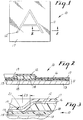
- Figure 1 is a plane view of a sign face of the present invention.
- Figure 2 is a cross section of the sign face of Figure 1 at 2-2.
- Figure 3 is an enlargement of air pocket 19 illustrated in Figure 2.
- Figure 1 illustrates a sign face 10 having a sign base 11 and an alphanumeric character 12.
- sign base 11 comprises a substrate 13, overlaid with a base layer 15 adhesively (first adhesive layer 14) fastened to substrate 13.
- Alphanumeric character 12, with an optional second adhesive layer 18 are positioned on a portion of base layer 15.
- an overlay film 17 is conformably and adhesively (third adhesive layer 16) fastened over the upper surface of the sign 10, such that overlay film 17 conforms to and seals alphanumeric character 12.
- an air pocket 19 is created when overlay film 17 is conformed to the sign face 10.
- the size of air pocket 19 is determined as average maximum lift, measured by the length (represented by 20) from the edge of alphanumeric character 12 to the point (represented by 21) where adhesive layer 16 of overlay film 17 contacts with base layer 15.
- Preferred overlay films generally have an average maximum lift of less than 2 millimeters.
- Suitable substrates include rigid materials, such as metal, wood, plastics, ceramics, or laminates thereof. Suitable substrates may also include flexible materials, such as liners, plastic films like a plastic cover film or heavy gauge plastic.
- the sign face can be fabricated on a release liner substrate, and applied to a permanent substrate, such as a wall or pre-exisiting sign blank, by removing and discarding the release liner.
- the substrates are non-porous.
- an aspect of the present invention is the ability to laterally transport and evacuate air between the two layers. This may be accomplished via several different routes.
- one method of providing lateral transport of the trapped air is to have a base layer that is laterally porous, that is, a "porous" material with laterally connected pores (interstices), or relatively impermeable surface-textured (roughened) films having laterally connected surface channels.
- An alternative method for lateral transport between the overlay film and the base layer is to provide a textured adhesive layer on the undersurface of the overlay film or to provide a textured undersurface of the overlay film itself.
- a porous base layer added to the substrate is preferred.
- the vacuum pressure generated in a heat vacuum applicator is able to pull the film down to conform tightly around the alphanumeric characters. While not intending to be bound by theory, it is believed that any trapped air is allowed to escape out the edges of the base layer material, resulting in a tight intimate bond of the overlay film around the alphanumeric characters, thereby minimizing any air pockets around the alphanumeric characters, as well as any other air bubbles that may be trapped on the surface of the sign face.
- Suitable base layer materials include open-cell, microporous films.
- a suitable film is one comprising essentially linear ultrahigh molecular weight polyolefin that is essentially linear ultrahigh molecular weight polyethylene, filled with a finely divided particulate substantially water insoluble siliceous filler, having a weight ratio of the filler to polymer in the mixture of from about 1:1 to 9:1.
- Such films are described in U.S. Patent No. 4,833,172 and such description is incorporated herein by reference.
- Suitable base layer materials also include microporous materials comprising polyethylene, polypropylene-polyethylene copolymers, polyethylene terephthalate, polycaprolactam, polyvinylidene fluoride, and polybutylene terephthalate. Such films are described in U.S. Patent No. 4,539,256 and such description is incorporated herein by reference.
- Base layer materials that are also within the scope of the present invention are porous materials such as fibrous woven materials or fibrous non-woven materials, such as, for example spunbonded webs, air-laid webs, or melt-blown microfiber web or paper products.
- Through-porosity is one means of identifying potential porous base layer materials.
- the porosity of such base layer materials without an adhesive backing layer are typically less than 20,000 seconds per 50 cubic centimeters.
- relatively smooth, films made porous with spaced perforations or pinholes that are not laterally connected tend to be insufficient as base layer materials.
- Suitable porous base layer materials can be characterized as having a network of interconnected micropores (interstices).
- the pores may be analyzed by scanning electron microscope of the surface and cross-section.
- a typical property of many laterally porous base layer materials is the ability to laterally wick some types of solvent. For example, this property could be observed by applying a suitable dyed solvent onto the material and observing the lateral migration of the dyed solvent.
- base layer materials An interesting feature of some base layer materials is that, after heating, the material will become transparent allowing the color of the substrate to be visible.
- the raised graphic sign is processable to induce transparency of the base layer.
- the new ADA legislation recommends a color contrast differential of approximately 70%.
- the alternative method for lateral transport between the overlay film and the base layer provides a textured adhesive layer on the undersurface of the overlay film or provides a textured undersurface of the overlay film itself.
- the adhesive layer coated onto the overlay film can be structured or textured as is known in the art.
- the overlay film, as described below can be textured.
- the composition of the overlay film is such that no seperate and distinct adhesive layer is needed, and the adhesive fastening of the overlay film to the base layer is accomplished by a thermoplastic adhesive bond.
- the signage of the present invention is typically laminated using two adhesive layers, and optionally three adhesive layers.
- the first adhesive layer between the substrate and the base layer, and the third adhesive layer between the base layer and the overlay film ideally, comprise an adhesive having a high adhesive strength.
- the optional, second adhesive layer between the alphanumeric characters and the base layer can comprise an adhesive having a lower adhesive strength, although for ease of fabrication, all three layers may be the same adhesive system.
- Suitable adhesives typically have a 180° peel test strength of at least 0.5 lb/inch as described in ASTM D 3330-87 (Peel Adhesion of Pressure-Sensitive Tape at 180 Degrees Angle).
- the preferred adhesives are pressure sensitive adhesives, that is an adhesive that develops sufficient bonding power by applying only a light pressure.
- the adhesive systems include pressure sensitive adhesives, thermoplastic (heat activated), cross-linking adhesive system, or other types of adhesive systems to bond the various layers to provide more durability.
- an overlay film can be fastened to the base layer using a thermoplastic adhesive bond.
- an adhesion enhancer or primer may be applied to one or both bonding surfaces to enhance adhesion.
- a three-dimensional alphanumeric character can be fabricated using film materials having a thickness of 10 to 50 mils, preferably 10 to 40 mils, wherein the material can withstand the operating conditions of a heat vacuum applicator (HVA) (Dayco Industries, PanaflexTM II Systems Applicator).
- Standard operating conditions for the HVA include temperatures in the range of 68 to 250°F and vacuum gauge readings of 20 to 30 inches of mercury, preferably temperatures in the range of 150 to 250°F and vacuum gauge readings of 23 to 26 inches of mercury.
- filled rubber material for example, commercially available from the 3M under the trade name "Letterperfect" No. 511) advantageously permits fabrication of the alphanumeric characters on an electronic cutter.
- the overlay film provides durability and optionally, dirt and vandal resistance.
- the overlay film is conformable under processing conditions and has a thickness in the range of 0.25 mil to 15 mils, preferably in the range of 0.5 mil to 10 mils, more preferably in the range of 1 mil to 6 mils.
- the overlay film is conformable at temperatures in the range of 150 to 250°F.
- the overlay film can be transparent, translucent, or opaque. Further, it is often desirable for the overlay film to have a matte finish.
- the overlay film is preferably a colorless, transparent, matte-finish film, preferably a transparent, matte finish vinyl film.
- Suitable overlay films have an elongation of greater than 50% at room temperature. However, elongation of the film can be affected by heat when used in the heat vacuum applicator.
- suitable overlay films include but are not limited to vinyl (for example, commercially available from 3M as ScotchcalTM 3669 or 210-314 film), polyvinylidene fluoride acrylic laminate film, polyethylene, cast polypropylene, cast polystyrene, and the like.
- the overlay film can be a film, that once it is conformed can be cured or hardened, thus imparting an increased durability to the sign face.
- the raised graphic sign comprises (a) a metallic substrate; (b) an essentially linear ultrahigh molecular weight polyolefin filled with a finely divided particulate substantially water insoluble siliceous filler, having a weight ratio of the filler to polymer in the mixture of from about 1:1 to 9:1 base layer coated with a layer of pressure sensitive adhesive; (c) one or more alphanumeric characters fabricated from a filled rubber material undercoated with a layer of pressure sensitive adhesive; and (d) a matte finish vinyl film undercoated with a pressure sensitive adhesive, conformably fastened to the upper surface of the sign.
- a method to make the architectural signs of the present invention comprise the steps (a) adhesively applying a base layer to an upper surface of substrate; (b) applying one or more alphanumeric characters to the upper surface of the base layer; (c) adhesively applying an overlay film, adhesive side down over the configuration of step (b); and (d) preferably, processing the configuration of step (c) in a heat vacuum applicator at a vacuum gauge reading in the range of 20 to 30 inches of mercury and a temperature in the range of 150 to 250°F conforming the overlay film to the alphanumeric characters and tightly bonding the overlay film to the alphanumeric characters and the base layer.
- An alternative method is to process the configuration of step (c) in a hydraulic press, wherein the overlay film is conformed at room temperature under high pressure, for example pressures in the range of 5,000 to 30,000 psi.
- high pressure for example pressures in the range of 5,000 to 30,000 psi.
- a conformable pad is positioned over the sign face prior to processing in the hydraulic press.
- High pressure lamination can also be carried out at elevated temperatures, for example, up to 250°F, thus permitting a reduction in operating pressure.
- step (c) of a sign of the present invention can be hand laminated, using laminating aids such as a stylus, hand squeegee, rivet brush applicator, and the like.
- the through-porosity of the base layer without an adhesive backing layer may be measured according to ASTM-D-726-58, Method A, by using a Gurley densimeter (Model 4110) to measure the time in seconds to pass 50 cubic centimeters of air through the film.
- Gurley densimeter Model 4110
- Through-porous films generally have a Gurley porosity of less than 20,000 seconds per 50 cubic centimeters of air through the film.
- the average maximum length (20) of separated areas between overlay film 17 and the base layer 15 (referring to Figure 3) in a processed laminate were determined and reported as average maximum lift.
- Preferred materials afforded average maximum lifts of less than about 2 millimeters.
- Raised graphics sign constructions were prepared as follows: Base layers for Examples 1-5 were open-celled microporous, air permeable films as summarized in Table 1. The base layers were backed with a pressure sensitive adhesive layer and bonded to a 1.5 millimeter gray-painted aluminum control substrate. The raised characters were cut from adhesive-backed filled-rubber material (available from 3M under the trade name "Letterperfect” No. 511) using an electronic cutter. The characters where applied to the upper surface of the base layer. A colorless, transparent overlay film having a tacky pressure sensitive adhesive layer (available from 3M under the trade name "Scotchcal" No.
- Example 5 was a control base. Examples 1-5 were evaluated using the Air Pocket Test.
- Table 1 The results are summarized in Table 1 and illustrate excellent visual ratings for sign constructions using a microporous film.
- Table 1 Ex Base layer Gurley Porosity (sec/50 cc) Sheffield Units Average Maximum Lift (mm) Visual Rating 1 4.5 mil vinyl a 7 --- ⁇ 0.5 5 2 5.5 mil polypropylene b 130 --- ⁇ 0.5 5 3 2 mil high density polyethylene b 16 --- 2.2 4 4 7 mil polyethylene c 1300 --- 0.5 5 C5 None I d 30 8.8 1 (a) microporous film available from Mitsubishi; (b) microporous film as described in U.S. Patent 4,539,256; (c) microporous film available from PPG Industries under the trade name of "Teslin"; and (d) impermeable
- Raised graphics sign constructions were made according to Examples 1-4, except the base layer was selected from other air permeable materials that were backed with pressure sensitive adhesive.
- the overlay film was the same film as used in Examples 1-4.
- the examples were evaluated using the Air Pocket Test. The results are summarized in Table 2.
- Raised graphic sign constructions were made according to the method described in Examples 1-4, except the base layer was selected from relatively air-impermeable materials having a backing of pressure sensitive adhesive.
- the overlay film was the same film as used in Examples 1-4.
- the examples were evaluated using the Air Pocket Test. The results are summarized in Table 3. The results show a variety of transparent, translucent, and colored materials with sufficient surface roughness are useful in practicing the present invention. With transparent or translucent base layers, the background color was the gray color of the base plate. Some of the comparative examples, as indicated, showed poorer construction integrity and visual appearance because of the poor bond between the overlay film and the base layer.
- Raised graphics sign constructions were prepared according to the method described in Examples 1-4, except various types of overlay films and adhesive backing layers were used.
- the base layer was the same as described in Example 4.
- Example 29 had no adhesive layer on the thermoplastic overlay film.
- the examples were evaluated using the Air Pocket Test. The results are summarized in Table 4. The examples indicate that a variety of overlay films conformable at the process temperature are useful. Further, other types of adhesive backing layers, such as those that are bondable at the process temperature, are useful in the present invention.
- Example 3 A raised graphic sign construction similar to Example 3 was prepared using the overlay film of Example 26. The sign was placed in a 291°F oven for 5 minutes, at which point the white background base layer became transparent, and changed the background color to the gray color of the substrate. In similar fashion, a stainless steel substrate was used to afford a raised graphic sign with a shiny metallic background.
- a raised graphic sign construction was made having alphanumeric characters positioned directly on the substrate, that is, without a base layer.
- the overlay film was a 2 mil clear vinyl film having a textured thermally-activated adhesive layer (Sheffield No. > 430) on the under side of the overlay film.
- the processed sign had a visual rating between 4 and 5.
- a 1.1 mm average maximum lift was determined using the Air Pocket Test.
- a raised graphic sign construction was made according to the procedure of Examples 1-4, except only the adhesive backing layer was applied as the base layer on the substrate.
- the processed sign had a visual rating of about 4.
- a 1.8 mm average maximum lift was determined using the Air Pocket Test.
- a raised graphic sign construction was made according to Example 4, except the substrate was a Post-itTM Bulletin Board 558, available from 3M. After processing, the substrate was peeled from the sign laminate to produce a pressure sensitive adhesive back raised graphic sign construction. This construction could be adhered to other desirable substrates or surfaces.
- a sign construction was prepared according to Example 6 with the following modifications: the base layer was black-dyed "Reemay” 2024 spunbonded polyester with a laminated PSA adhesive backing layer.
- the overlay film of Example 26 was used. A foam sponge and a computer mouse pad were place on top of the overlay film as processing aids, and the construction was processed in a Preco hydraulic press at 25,000 psi at room temperature. The laminate was then heated to 212°F.
- the matte black sign construction having 35 mil raised light green characters had an excellent visual rating of 5. The average maximum lift as determined using the Air Pocket Test was less than 0.5 mm.
- a sign construction was prepared using the materials of Example 4. The construction was processed in a hydraulic press according to the procedure described in Example 34 for 20 minutes at room temperature. A sign construction with 42 mils raised characters had a visual rating of 4. The average maximum lift, as determined using the Air Pocket Test was 1.5 mm.
- a wood block was sized and fitted into the standard metal holder assembly of a Gardner Abrasion Tester (Model AG 8100).
- a Faber CastellTM Pink Pearl Eraser 101 was attached to the bottom of the block with a screw such that the 25 mm wide pointed end of the eraser extended at about a 50 degree angle from horizontal downwards and away from the block. The pointed end projected lower than the base of the eraser.
- the total assembly weight was 375 grams.
- Test panels with a one inch high, 35 mils thick graphic "M" character adhered thereto were taped onto the stage of the tester such that the pointed leading edge of the abrasive pick hit the raised character edge in the forward direction.
- a cycle is one forward and one backward stroke. The results are summarized in Table 5.
Landscapes
- Engineering & Computer Science (AREA)
- Physics & Mathematics (AREA)
- General Physics & Mathematics (AREA)
- Theoretical Computer Science (AREA)
- Health & Medical Sciences (AREA)
- Audiology, Speech & Language Pathology (AREA)
- General Health & Medical Sciences (AREA)
- Business, Economics & Management (AREA)
- Educational Administration (AREA)
- Educational Technology (AREA)
- Laminated Bodies (AREA)
- Adhesive Tapes (AREA)
Applications Claiming Priority (2)
| Application Number | Priority Date | Filing Date | Title |
|---|---|---|---|
| US876057 | 1992-04-28 | ||
| US07/876,057 US5246757A (en) | 1992-04-28 | 1992-04-28 | Architectural signs with raised graphics |
Publications (2)
| Publication Number | Publication Date |
|---|---|
| EP0568052A2 true EP0568052A2 (de) | 1993-11-03 |
| EP0568052A3 EP0568052A3 (en) | 1995-12-13 |
Family
ID=25366908
Family Applications (1)
| Application Number | Title | Priority Date | Filing Date |
|---|---|---|---|
| EP19930106921 Ceased EP0568052A3 (en) | 1992-04-28 | 1993-04-28 | Architectural signs with raised graphics |
Country Status (3)
| Country | Link |
|---|---|
| US (2) | US5246757A (de) |
| EP (1) | EP0568052A3 (de) |
| JP (1) | JPH0623073U (de) |
Cited By (1)
| Publication number | Priority date | Publication date | Assignee | Title |
|---|---|---|---|---|
| US8801887B2 (en) | 2005-12-23 | 2014-08-12 | The Boeing Company | Textured structure and method of making the textured structure |
Families Citing this family (43)
| Publication number | Priority date | Publication date | Assignee | Title |
|---|---|---|---|---|
| US5589021A (en) * | 1993-04-19 | 1996-12-31 | Colorprinting Specialists, Inc. | Method of producing a sign |
| US5399217A (en) * | 1993-04-19 | 1995-03-21 | Colorprinting Specialists, Inc. | Method of producing a sign |
| BR9406052A (pt) * | 1993-04-28 | 1995-12-26 | Minnesota Mining & Mfg | Processo para produzir uma construção de placa de sinalização tridimensional construção de face de uma placa de sinalização tridimensional e placa de sinalização gráfica em relevo tridimensional |
| US5389413A (en) * | 1993-04-28 | 1995-02-14 | Minnesota Mining And Manufacturing Company | Three dimensional signage and a method of making |
| US5438781A (en) * | 1993-10-29 | 1995-08-08 | Landmann; David W. | Building sign system |
| US5733127A (en) * | 1995-05-01 | 1998-03-31 | Mecum; Robert Charles | Touch perceptible floor plan map and method for use |
| AUPN516795A0 (en) * | 1995-09-01 | 1995-09-28 | Armacel Pty Limited | Layered structural article |
| US5665446A (en) * | 1995-11-16 | 1997-09-09 | Minnesota Mining And Manufacturing Company | Laminate for precise application of graphics to a substrate |
| US5920977A (en) * | 1995-12-07 | 1999-07-13 | Wyckoff; James L. | Porcelain coated substrate and process for making same |
| US5686170A (en) * | 1995-12-21 | 1997-11-11 | Minnesota Mining And Manufacturing Company | Labor-saving process and article for making dimensional sign graphics |
| GB9716726D0 (en) * | 1997-08-08 | 1997-10-15 | Pyramid Screen Print Ltd | Improvements relating to forming and using plastics sheet material |
| GB2318203B (en) * | 1997-09-06 | 2001-01-24 | George Jeha | Three dimensional signage |
| IT243441Y1 (it) * | 1997-11-05 | 2002-03-04 | Electrolux Zanussi Elettrodome | Dispositivo perfezionato di applicazione di marchiature |
| US6180228B1 (en) | 1998-03-02 | 2001-01-30 | 3M Innovative Properties Company | Outdoor advertising system |
| US6685790B2 (en) | 1998-04-29 | 2004-02-03 | William R. Apel | Advertising placard |
| US6126112A (en) * | 1998-04-29 | 2000-10-03 | William R. Apel | Advertising placard |
| US6001427A (en) * | 1998-06-23 | 1999-12-14 | Breazeale; C. L. | Process for coating selected portions of a substrate using a powder transfer member |
| US9855732B2 (en) | 1999-01-25 | 2018-01-02 | 3M Innovative Properties Company | Method of applying adhesive coated film |
| DE60004966T2 (de) | 1999-01-25 | 2004-07-22 | 3M Innovative Properties Co., Saint Paul | Verfahren zum auftragen eines mit klebemittel beschichteten films |
| US6499421B1 (en) * | 1999-05-19 | 2002-12-31 | Richard F. Honigsbaum | Tactiovisual distance-to-exit exit-finding system |
| WO2001059744A2 (en) * | 2000-02-11 | 2001-08-16 | In-Transit Communications, Inc. | Method and apparatus for advertising on an aircraft tray table |
| US20040182508A1 (en) * | 2001-06-01 | 2004-09-23 | Apel William R. | Advertising placard |
| JP2003039582A (ja) * | 2001-07-19 | 2003-02-13 | Three M Innovative Properties Co | 湿潤防滑性シート及び湿潤防滑構造体 |
| WO2003059602A1 (en) * | 2002-01-08 | 2003-07-24 | 3M Innovative Properties Company | Method of conforming a film to a surface |
| US20070199913A1 (en) * | 2003-02-27 | 2007-08-30 | Erie County Plastics Corporation | Container and container closure with secure molded three dimensional image |
| US20040231211A1 (en) * | 2003-05-02 | 2004-11-25 | Johnson John R. | Three-dimensional automobile badge |
| US8486208B2 (en) * | 2003-08-04 | 2013-07-16 | Parkmarx Advertising, Llc | Cold crack additive on paving advertising and related methods |
| US7021340B2 (en) * | 2004-07-20 | 2006-04-04 | Blind Faith School Of Music And Art | Method of and loom for teaching Braille |
| US7134457B2 (en) * | 2005-03-04 | 2006-11-14 | Blind Faith School Of Music And Art | Method of weaving braille and woven braille textile |
| US8778122B2 (en) | 2006-06-29 | 2014-07-15 | 3M Innovative Properties Company | Adhering graphic films on irregular substrates |
| WO2008051963A2 (en) * | 2006-10-24 | 2008-05-02 | Northern Engraving Corporation | Warp-free decorative article of manufacture and method of making same |
| US20080280265A1 (en) * | 2007-05-01 | 2008-11-13 | Eric Lopez-Jaime | Mobility map and system |
| US8347537B2 (en) * | 2009-03-25 | 2013-01-08 | Ying-Che Huang | Label tag cord |
| US20100242320A1 (en) * | 2009-03-25 | 2010-09-30 | Ying-Che Huang | Label tag cord |
| US20130269228A1 (en) * | 2012-04-12 | 2013-10-17 | George F. Loesel | Safety signs |
| JP6268791B2 (ja) * | 2013-08-02 | 2018-01-31 | 株式会社村田製作所 | 樹脂多層基板およびその製造方法 |
| DE102017006040A1 (de) * | 2017-06-27 | 2018-12-27 | Giesecke+Devrient Mobile Security Gmbh | Sicherheitselement mit räumlich wirkendem Druckbild |
| US10201948B1 (en) | 2018-08-31 | 2019-02-12 | Ronald Mark Buck | Three-dimensional sticker with high-resolution image and removable adhesive |
| US10213983B1 (en) | 2018-08-31 | 2019-02-26 | Ronald Mark Buck | Three-dimensional sticker with high-resolution image and removable adhesive |
| US10217382B1 (en) | 2018-08-31 | 2019-02-26 | Ronald Mark Buck | Three-dimensional sticker with high-resolution image and removable adhesive |
| US10201949B1 (en) | 2018-08-31 | 2019-02-12 | Ronald Mark Buck | Three-dimensional sticker with high-resolution image and removable adhesive |
| US10621891B1 (en) | 2019-09-21 | 2020-04-14 | Ronald Mark Buck | Three-dimensional decal with high-resolution image and removable adhesive |
| US10597561B1 (en) | 2019-10-09 | 2020-03-24 | Ronald Mark Buck | Three-dimensional sticker with high-resolution image and removable adhesive |
Family Cites Families (12)
| Publication number | Priority date | Publication date | Assignee | Title |
|---|---|---|---|---|
| US2620289A (en) * | 1945-08-27 | 1952-12-02 | Minnesota Mining & Mfg | Method of securing flexible sheets to relatively stiff backings |
| GB821539A (en) * | 1956-08-15 | 1959-10-07 | Univ Oxford | Improvements in or relating to the production of embossed articles such as contour maps |
| DE1238186B (de) * | 1961-03-29 | 1967-04-06 | Ford Werke Ag | Vorrichtung zum Verformen von luftdurchlaessigem, plattenfoermigem Fasermaterial |
| US4539256A (en) * | 1982-09-09 | 1985-09-03 | Minnesota Mining And Manufacturing Co. | Microporous sheet material, method of making and articles made therewith |
| FR2590481B1 (fr) * | 1985-11-22 | 1987-12-31 | Gerland | Produit de revetement a relief destine notamment a la signalisation tactile pour aveugles et amblyopes |
| US4677010A (en) * | 1986-01-31 | 1987-06-30 | Stephen Selwyn | Nautical high visibility device |
| US4837956A (en) * | 1987-04-09 | 1989-06-13 | Lustour Corporation | Plastic advertising insert for food packages |
| US4833172A (en) * | 1987-04-24 | 1989-05-23 | Ppg Industries, Inc. | Stretched microporous material |
| DE8707761U1 (de) * | 1987-05-30 | 1988-05-26 | Sensor Verlag Pichler GmbH, 8023 Pullach | Lehr- und Übungsmittel |
| US4804572A (en) * | 1987-12-01 | 1989-02-14 | Imperial Wallcoverings, Inc. | Wall covering with fluorocarbon stain resistant top coating |
| US4976896A (en) * | 1988-08-17 | 1990-12-11 | General Motors Corporation | Process of making thermoformable laminate films and processes |
| US5034077A (en) * | 1989-09-05 | 1991-07-23 | Jack Pata | Method for thermoforming and bonding a paint-coated polymeric film to a substrate |
-
1992
- 1992-04-28 US US07/876,057 patent/US5246757A/en not_active Expired - Fee Related
-
1993
- 1993-04-28 JP JP2253893U patent/JPH0623073U/ja active Pending
- 1993-04-28 EP EP19930106921 patent/EP0568052A3/en not_active Ceased
- 1993-05-24 US US08/065,947 patent/US5346571A/en not_active Expired - Fee Related
Cited By (2)
| Publication number | Priority date | Publication date | Assignee | Title |
|---|---|---|---|---|
| US8801887B2 (en) | 2005-12-23 | 2014-08-12 | The Boeing Company | Textured structure and method of making the textured structure |
| EP1800860B2 (de) † | 2005-12-23 | 2016-06-15 | The Boeing Company | Verfahren zur Herstellung einer texturierten Struktur |
Also Published As
| Publication number | Publication date |
|---|---|
| US5346571A (en) | 1994-09-13 |
| US5246757A (en) | 1993-09-21 |
| EP0568052A3 (en) | 1995-12-13 |
| JPH0623073U (ja) | 1994-03-25 |
Similar Documents
| Publication | Publication Date | Title |
|---|---|---|
| US5246757A (en) | Architectural signs with raised graphics | |
| US5665446A (en) | Laminate for precise application of graphics to a substrate | |
| US5383996A (en) | Method and web for applying graphics to framing substrate | |
| KR100560341B1 (ko) | 미소복제된 지형을 가진 접착제 및 그 접착제의 제조 방법및 사용 방법 | |
| US5368672A (en) | Process for making three-dimensional signage | |
| EP0696374B1 (de) | Dreidimensionale zeichen und verfahren zu ihrer herstellung | |
| BR9814002A (pt) | Material laminado decorativo apropriado para uso como uma pelìcula ou decalque de tinta flexìvel e resistente a intempéries | |
| JPH06506412A (ja) | 戸外ビジュアルサイン情報のためのpvcシート材料 | |
| EP1010158A1 (de) | Arbeitssparendes verfahren und artikel zum erzeugen einer reliefanzeigegraphik | |
| US4991336A (en) | Photographic composite board | |
| GB2217256A (en) | Plastics film laminates having non-adhesive cling properties | |
| EP0575959A1 (de) | Wärmeempfindliche Übertragungsschicht | |
| JP2017049481A (ja) | 路面、床面又は壁面設置用表示シート、及び路面、床面又は壁面設置用表示シート作製セット | |
| EP0365712A1 (de) | Aufhängbare Schreibblockanordnung | |
| WO1994008328A1 (en) | Advertising devices | |
| CA2379707A1 (en) | Braille signage | |
| EP0776351B1 (de) | Laminat zum genauen anbringen von bildern auf einem substrat | |
| JPH07224254A (ja) | 粘着シート | |
| AU2002234624A1 (en) | Composite material | |
| CN219303218U (zh) | 一种防卷不干胶防伪标签 | |
| JP2602184Y2 (ja) | 合成樹脂製床敷体 | |
| JP3003523U (ja) | 積層立体文字基板 | |
| JP3154966B2 (ja) | 化粧金属板 | |
| JP2023177681A (ja) | 加飾フィルム構造体 | |
| JPS6135534Y2 (de) |
Legal Events
| Date | Code | Title | Description |
|---|---|---|---|
| PUAI | Public reference made under article 153(3) epc to a published international application that has entered the european phase |
Free format text: ORIGINAL CODE: 0009012 |
|
| AK | Designated contracting states |
Kind code of ref document: A2 Designated state(s): DE FR GB IT |
|
| PUAL | Search report despatched |
Free format text: ORIGINAL CODE: 0009013 |
|
| AK | Designated contracting states |
Kind code of ref document: A3 Designated state(s): DE FR GB IT |
|
| 17P | Request for examination filed |
Effective date: 19960613 |
|
| 17Q | First examination report despatched |
Effective date: 19961216 |
|
| GRAG | Despatch of communication of intention to grant |
Free format text: ORIGINAL CODE: EPIDOS AGRA |
|
| 18R | Application refused |
Effective date: 19990524 |