EP0568724A2 - Pneumatische Pulverisierungsvorrichtung und Verfahren zur Herstellung von Toner - Google Patents
Pneumatische Pulverisierungsvorrichtung und Verfahren zur Herstellung von Toner Download PDFInfo
- Publication number
- EP0568724A2 EP0568724A2 EP92112064A EP92112064A EP0568724A2 EP 0568724 A2 EP0568724 A2 EP 0568724A2 EP 92112064 A EP92112064 A EP 92112064A EP 92112064 A EP92112064 A EP 92112064A EP 0568724 A2 EP0568724 A2 EP 0568724A2
- Authority
- EP
- European Patent Office
- Prior art keywords
- colliding
- pulverized
- accelerating tube
- powder
- pulverizing chamber
- Prior art date
- Legal status (The legal status is an assumption and is not a legal conclusion. Google has not performed a legal analysis and makes no representation as to the accuracy of the status listed.)
- Granted
Links
- 238000000034 method Methods 0.000 title claims description 22
- 238000010298 pulverizing process Methods 0.000 claims abstract description 151
- 239000000463 material Substances 0.000 claims abstract description 139
- 230000002093 peripheral effect Effects 0.000 claims abstract description 32
- 239000000203 mixture Substances 0.000 claims description 29
- 229920005989 resin Polymers 0.000 claims description 7
- 239000011347 resin Substances 0.000 claims description 7
- 239000011230 binding agent Substances 0.000 claims description 5
- 239000003086 colorant Substances 0.000 claims description 4
- 238000000227 grinding Methods 0.000 claims description 4
- 238000001816 cooling Methods 0.000 claims description 3
- 238000004898 kneading Methods 0.000 claims description 3
- 239000011343 solid material Substances 0.000 claims description 2
- 239000000843 powder Substances 0.000 description 138
- 239000002245 particle Substances 0.000 description 31
- 239000007787 solid Substances 0.000 description 16
- 230000000052 comparative effect Effects 0.000 description 11
- 238000009826 distribution Methods 0.000 description 5
- 239000003792 electrolyte Substances 0.000 description 5
- FAPWRFPIFSIZLT-UHFFFAOYSA-M Sodium chloride Chemical compound [Na+].[Cl-] FAPWRFPIFSIZLT-UHFFFAOYSA-M 0.000 description 4
- 230000000694 effects Effects 0.000 description 3
- 238000010438 heat treatment Methods 0.000 description 3
- 229920005992 thermoplastic resin Polymers 0.000 description 3
- UQSXHKLRYXJYBZ-UHFFFAOYSA-N Iron oxide Chemical compound [Fe]=O UQSXHKLRYXJYBZ-UHFFFAOYSA-N 0.000 description 2
- 238000005054 agglomeration Methods 0.000 description 2
- 230000002776 aggregation Effects 0.000 description 2
- 238000004040 coloring Methods 0.000 description 2
- 238000007796 conventional method Methods 0.000 description 2
- 229920001577 copolymer Polymers 0.000 description 2
- 239000006185 dispersion Substances 0.000 description 2
- 239000006247 magnetic powder Substances 0.000 description 2
- 230000008018 melting Effects 0.000 description 2
- 238000002844 melting Methods 0.000 description 2
- 239000011802 pulverized particle Substances 0.000 description 2
- 239000011780 sodium chloride Substances 0.000 description 2
- 230000001133 acceleration Effects 0.000 description 1
- 239000007864 aqueous solution Substances 0.000 description 1
- 230000002542 deteriorative effect Effects 0.000 description 1
- 239000002270 dispersing agent Substances 0.000 description 1
- 230000002708 enhancing effect Effects 0.000 description 1
- 230000001747 exhibiting effect Effects 0.000 description 1
- 238000004519 manufacturing process Methods 0.000 description 1
- 238000002156 mixing Methods 0.000 description 1
- 239000000178 monomer Substances 0.000 description 1
- 239000002985 plastic film Substances 0.000 description 1
- 229920006255 plastic film Polymers 0.000 description 1
- 238000006116 polymerization reaction Methods 0.000 description 1
- 230000002265 prevention Effects 0.000 description 1
- 230000010349 pulsation Effects 0.000 description 1
- 239000011369 resultant mixture Substances 0.000 description 1
- 239000000126 substance Substances 0.000 description 1
- 239000004094 surface-active agent Substances 0.000 description 1
- 238000011144 upstream manufacturing Methods 0.000 description 1
Images





Classifications
-
- B—PERFORMING OPERATIONS; TRANSPORTING
- B02—CRUSHING, PULVERISING, OR DISINTEGRATING; PREPARATORY TREATMENT OF GRAIN FOR MILLING
- B02C—CRUSHING, PULVERISING, OR DISINTEGRATING IN GENERAL; MILLING GRAIN
- B02C19/00—Other disintegrating devices or methods
- B02C19/06—Jet mills
-
- B—PERFORMING OPERATIONS; TRANSPORTING
- B02—CRUSHING, PULVERISING, OR DISINTEGRATING; PREPARATORY TREATMENT OF GRAIN FOR MILLING
- B02C—CRUSHING, PULVERISING, OR DISINTEGRATING IN GENERAL; MILLING GRAIN
- B02C19/00—Other disintegrating devices or methods
- B02C19/06—Jet mills
- B02C19/066—Jet mills of the jet-anvil type
Definitions
- the present invention relates to a collision type pneumatic pulverizer for pulverizing powder material using a jet of gas (a high-pressure gas), and a process for producing a toner used for developing electrostatic images using such a pulverizer.
- a jet of gas a high-pressure gas
- Collision type pneumatic pulverizers which employ a jet of gas are designed to pulverize powder material by ejecting a flow of particle-gas mixture obtained by mixing a jet of gas with powder material from the outlet of an accelerating tube and thereby making the flow of particle-gas mixture collide against the colliding surface of a colliding member provided in front of the outlet of the accelerating tube.
- a colliding member 4 is provided in opposed relation to an outlet 13 of an accelerating tube 3 connected to a high-pressure gas supply nozzle 2.
- the powder material is sucked into the accelerating tube 3 from a powder material supply port 1 connected to the intermediate portion of the accelerating tube 3 by the flow of a high-pressure gas supplied to the accelerating tube 3.
- the sucked powder material is ejected together with the high-pressure gas in such a manner that it collides against the collision surface of the colliding member 4. Consequently, the powder material is pulverized due to the impact of the collision.
- the colliding surface 14 of the colliding member has a flat surface which is perpendicular to or inclined (by, for example, 45°) with respect to the direction of the flow of powder material-gas mixture (the axial direction of the accelerating tube), as shown in Fig. 8 or 9.
- the pulverizer having the former type colliding member is disclosed in Japanese Patent Application Laid-Open No. 57-50554, and the pulverizer having the latter type colliding member has been proposed in Japanese Patent Application Laid-Open No. 58-143853).
- the powder material having a large particle size is supplied into the accelerating tube 3 from the supply port 1.
- the supplied powder material is made to collide against the colliding surface 14 of the colliding member 4 by the jet of gas supplied from the jet nozzle 2 and is thereby pulverized.
- the pulverized powder is discharged to the outside of a pulverizing chamber from an exhaust port 5.
- the colliding surface 14 is perpendicular to the axial direction of the accelerating tube 3, the rate at which the powder material ejected from the jet nozzle 2 and the powder reflected by the colliding surface 14 co-exist near the colliding surface 14 is high, and the concentration of the powder near the colliding surface 14 is thus high, deteriorating the pulverization efficiency.
- the main collision is the primary collision on the colliding surface 14, and the secondary collision on a wall 6 of the pulverizing chamber is not effectively utilized.
- pulverization of a thermoplastic resin readily generate melting or agglomeration of the powder material due to the local heating generated during collision. Therefore, stable operation of the pulverizer is difficult and the pulverization capability is reduced. These in turn make the use of the powder at a high concentration difficult.
- the concentration of the powder near the colliding surface 14 can be reduced as compared with that in the pulverizer shown in Fig. 8.
- the pulverization pressure is dispersed and hence reduced.
- the secondary collision provided by the wall 6 of the pulverizing chamber cannot be utilized effectively.
- a pulverizer such as that shown in Fig. 9 in which the colliding surface 14 is inclined by 45° with respect to the accelerating tube, occurrence of the aforementioned problems can be lessened during pulverization of a thermoplastic resin.
- the impact force used in pulverization during collision is low, and pulverization by the secondary collision on the wall 6 of the pulverizing chamber is reduced.
- the pulverization capability is reduced to 1/2 or 1/1.5 of that of the pulverizer shown in Fig. 8.
- Japanese Utility Model Application Laid-Open No. 1-148740 and Japanese Patent Application Laid-Open No. 1-254266 disclose the collision type pneumatic pulverizers which can overcome the aforementioned problems.
- a colliding surface 15 of a colliding member is disposed at a right angle with respect to the axis of the accelerating tube, and a conical protrusion 14 is provided on the colliding surface 15 so as to prevent generation of a reflected flow by the colliding surface, as shown in Fig. 11.
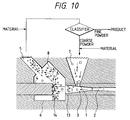
- the distal end portion of the colliding surface of the colliding member is made conical, as shown in Fig. 10, so as to reduce the concentration of the powder near the colliding surface and thereby provide effective secondary collision on the wall 6 of the pulverizing chamber.
- the above-mentioned structures can eliminate the problems of the conventional pulverizers to a certain degree but cannot solve them sufficiently. Also, in recent years, there have been a demand for finer pulverization and that for a pulverizer exhibiting more excellent pulverization efficiency.
- the toner or the coloring resin powder for toner used in the image forming method by the electrophotographic process generally contains at least a binder resin and a coloring agent or magnetic powder.
- the electrostatic image formed on a latent image carrier is developed by the toner, and the developed toner image is transferred onto a transfer material, such as normal paper or a plastic film.
- the toner image on the transfer material is fixed by a fixing device, such as a heating fixing means, a pressure roller fixing means or a heating and pressurizing roller fixing means.
- the binder resin used in the toner is characterized in that it is plastically deformed when applied with a heat and/or a pressure.
- a currently employed method of preparing the toner or the coloring resin powder for toner includes the steps of melting and kneading a mixture consisting of at least a binder resin and a coloring agent or magnetic powder (and a tertiary component, when necessary), cooling the kneaded mixture, pulverizing the cooled mixture and classifying the pulverized material.
- Pulverization of the cooled material generally consists of coarse grinding (or intermediate grinding) by a mechanical impact type pulverizer, and subsequent fine pulverization by a collision type pneumatic pulverizer using a jet of gas.
- the powder material is conveyed by a jet of gas and is made to collide against the colliding member, whereby the powder material is pulverized.
- the conventional pulverizers are those shown in Figs. 8, 9, 10 and 11.
- the toners for developing the electrostatic image manufactured using the collision type pneumatic pulverizers shown in Figs. 8, 9, 10 and 11 are substantially good but are not yet sufficiently good. Also, in recent years, there have been a demand of a toner having a smaller particle size which can be used to achieve high definition and high quality images and a demand for a method of manufacturing a toner more efficiently.
- An object of the present invention is to provide novel collision type pneumatic pulverizer which can overcome the aforementioned problems of the conventional techniques and which is capable of pulverizing powder material efficiently.
- Another object of the present invention is to provide a collision type pneumatic pulverizer which enables generation of agglomerate to be reduced.
- Still another object of the present invention is to provide a collision type pneumatic pulverizer which enables attachment of melted powder in a pulverizing chamber to be less generated.
- Still another object of the present invention is to provide a collision type pneumatic pulverizer which is capable of efficiently producing powder having a small particle size and having a narrow particle size distribution.
- Still another object of the present invention is to provide a collision type pneumatic pulverizer which enables excessive pulverization to be restricted.
- Still another object of the present invention is to provide a process of efficiently producing a toner for developing electrostatic image which can overcome the aforementioned problems of the conventional techniques.
- a pneumatic pulverizer which comprises an accelerating tube for conveying and accelerating a material to be pulverized by a high-pressure gas, and a pulverizing chamber for finely pulverizing the material to be pulverized.
- the pulverizing chamber is provided with a colliding member having a colliding surface provided in opposed relation to an opened surface of an outlet of the accelerating tube.
- the colliding surface of the colliding member has a protruding central portion, and an outer peripheral colliding surface provided around the protruding central portion for secondarily pulverizing the material primarily pulverized by the protruding central portion by collision.
- the pulverizing chamber has a side wall for performing tertiary pulverization on the material secondarily pulverized by the outer peripheral colliding surface by collision.
- a process for producing a toner which comprises the steps of melt-kneading a mixture which contains at least a binder resin and a coloring agent, cooling and solidifying the kneaded material, grinding the solid material to obtain the ground material, finely pulverizing the ground material by a collision type pneumatic pulverizer, and producing the toner from the finely pulverized material.
- the collision type pneumatic pulverizer includes an accelerating tube for conveying and accelerating the material to be pulverized by a high-pressure gas, and a pulverizing chamber for finely pulverizing the material to be pulverized.
- the material to be pulverized which is supplied and accelerated in the accelerating tube is discharged from an outlet of the accelerating tube into the pulverizing chamber.
- the discharged material is primarily pulverized by a protruding portion of a colliding member having a colliding surface provided in opposed relation to an opened surface of the outlet of the accelerating tube.
- the primarily pulverized material is secondarily pulverized by an outer peripheral surface provided on an outer periphery of the protruding portion, and the secondarily pulverized material undergoes tertiary pulverization by a side wall of the pulverizing chamber.
- Fig. 1 is a schematic cross-sectional view of a first embodiment of the present invention and a flowchart of a pulverizing apparatus in which the pulverization process by the pulverizer and the classification process by a classifier are combined.
- a powder material 7 to be pulverized is supplied into an accelerating tube 3 from a powder material port 1 provided in a wall 11 of the pulverizer above the accelerating tube 3.
- the powder material 7 supplied into the accelerating tube 3 is accelerated in an instant by a compressed gas, such as a compressed air, supplied into the accelerating tube 3 from a compressed gas supply nozzle 2.
- the powder material 7 discharged from an outlet 13 of the accelerating tube at a high speed collides against the colliding surface of a colliding member 4 and is thereby pulverized.
- a compressed gas such as a compressed air
- the colliding surface of the colliding member has a conically protruding central portion 14 and an outer peripheral colliding surface 15 provided around the protruding central portion for further pulverizing the powder primarily pulverized by the protruding central portion 14 by collision.
- a pulverizing chamber 8 has a side wall 6 which performs tertiary pulverization by collision on the powder secondarily pulverized by the outer peripheral colliding surface.
- Fig. 2 is a horizontal plan view of Fig. 1.
- the flow of the solid and gas mixture of powder material and compressed air which is ejected from the accelerating tube is primarily pulverized by the surface of the conical protrusion 14 provided at the central portion of the colliding surface, and is then secondarily pulverized by the outer peripheral colliding surface 15.
- the secondarily pulverized solid and gas mixture undergoes tertiary pulverization by the side wall 6 of the pulverizing chamber.
- very efficient pulverization can be achieved when the vertical angle ⁇ (°) of the protruding central portion which protrudes from the colliding surface of the colliding member and an inclined angle ⁇ (°) of the outer peripheral colliding surface with respect to the surface perpendicular to the central axis of the accelerating tube satisfy the conditions expressed by 0 ⁇ ⁇ ⁇ 90 and ⁇ > 0 (desirably, 10 ⁇ ⁇ ⁇ 80 and 5 ⁇ ⁇ ⁇ 40) and 30 ⁇ ⁇ + 2 ⁇ ⁇ 90.
- the reflected flow of the powder which is primarily pulverized by the protruding surface may undesirably disturb the flow of the solid and gas mixture ejected from the accelerating tube.
- the reflected flow generated by the outer peripheral colliding surface is directed toward the downstream side of the flow of solid and gas mixture, reducing the impact force of the tertiary pulverization on the side wall of the pulverizing chamber and hence the pulverization efficiency.
- the pulverizer according to the present invention is characterized by an increased number of collisions and more efficient collision.
- the pulverizer according to the present invention ensures improved pulverization efficiency, prevention of producing of melt-adhesion powder during pulverization, and stable operation.
- Fig. 3 is a schematic cross-sectional view of another preferred embodiment of the present invention and a flowchart of a pulverizing apparatus which includes a combination of the pulverization process which employs the pulverized and the classification process by a classifier.
- Fig. 4 is an enlarged cross-sectional view taken along the line A - A of Fig. 3.
- Fig. 5 is a cross-sectional view taken along the line B - B of Fig. 3.
- the pulverizer shown in Fig. 3 will be described below.
- the pulverizer has an accelerating tube 21 for conveying and accelerating the material powder to be pulverized by a high-pressure gas, and a colliding member 30 having a colliding surface disposed in opposed relation to the outlet of the accelerating tube.
- the accelerating tube 21 has a Laval nozzle-like shape.
- a high-pressure gas ejection nozzle 23 is disposed on the upstream side of the throat portion of the accelerating tube 21, and a material supply port 24 is provided between the outer wall of the high-pressure gas ejection nozzle 23 and the inner wall of the throat portion 22.
- the pulverizing chamber connected to the outlet of the accelerating tube 21 has a circular cross-sectional form and hence has a cylindrical side wall.
- the material supplied from a material supply cylinder 25 reaches the material supply port 24 formed between the inner wall of the throat portion 22 of the accelerating tube 21 whose central axis is disposed in the vertical direction and having a Laval nozzle form and the outer wall of the high-pressure gas ejection nozzle 23 which is disposed coaxially with respect to the accelerating tube 21.
- a high-pressure gas introduced from a high-pressure gas supply port 26 passes first through a high-pressure gas chamber 27 and then through a single or a plurality of high-pressure gas introducing pipes 28, and is ejected from the high-pressure gas ejection nozzle 23 toward the outlet 29 of the accelerating tube while being rapidly expanded.
- the material accompanied by the gas is sucked from the material supply port 24 toward the outlet 29 of the accelerating tube due to the ejector effect generated near the throat portion 22 of the accelerating tube.
- the material is rapidly accelerated while being uniformly mixed with the high-pressure gas flow, and then collides with the colliding surface of the colliding member 30 disposed in opposed relation to the outlet 29 of the accelerating tube in a state of the solid and gas mixture in which the powder is mixed with the gas uniformly without partial concentration of powder.
- the material pulverized by the colliding surface of the colliding member 30 repeatedly collides with the side wall 32 of the pulverizing chamber and the surface of the colliding member 30 to enhance the pulverization efficiency, and is then discharged from an exhaust port 33 disposed behind the colliding member 30.
- the colliding surface of the colliding member has a protruding central portion 14 and an outer peripheral colliding surface 15 provided around the protruding central portion for further pulverizing the powder primarily pulverized by the protruding central portion by collision.
- the pulverizing chamber 34 has a side wall 32 for further pulverizing the powder secondarily pulverized by the outer peripheral colliding surface 15 by collision.
- the material powder to be pulverized is primarily pulverized by the surface of the protrusion on the colliding surface, and is then secondarily pulverized by the outer peripheral colliding surface 15.
- the secondarily pulverized powder material undergoes tertiary pulverization by the side wall 32 of the pulverizing chamber.
- the accelerating tube is disposed in the vertical direction, and the material powder to be pulverized is supplied between the inner wall of the accelerating tube and the outer wall of the high-pressure gas ejection nozzle. That is, the direction in which the high-pressure gas is ejected is made the same as that in which the material powder is supplied. Consequently, the material powder to be pulverized can be dispersed uniformly without partial concentration of powder in the high-pressure gas flow to be ejected.
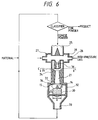
- Fig. 7 is a section taken along the line C - C of Fig. 6.
- the pulverizer shown in Fig. 6 includes the accelerating tube 21 for conveying and accelerating the material powder by the high-pressure gas, and the pulverizing chamber 34 having the colliding surface for pulverizing the powder ejected from the accelerating tube 21 by collision.
- the colliding member 30 is disposed in opposed relation to the outlet of the accelerating tube.
- a powder material supply port 24 is provided in the entire circumferential direction of the accelerating tube between the throat portion 36 of the accelerating tube 21 having Laval form and an outlet 37 of the accelerating tube.
- the pulverizing chamber has a substantially circular cross-sectional form.
- the exhaust port 33 is provided behind the colliding member 30.
- the accelerating tube 21 is disposed such that the central axis thereof is directed in the vertical direction.
- the colliding surface of the colliding member 30 has the protruding central portion 14 and the outer peripheral colliding surface 15 provided around the protruding central portion for further pulverizing the powder primarily pulverized by the protruding central portion by collision.
- the pulverizing chamber 34 has the side wall 32 for further pulverizing the powder secondarily pulverized by the outer peripheral colliding surface 15 by collision.
- the operation of the high-pressure gas will be explained.
- the high-pressure gas enters the high-pressure gas chamber 27 from the high-pressure gas supply ports 26 provided at the right and left sides thereof. After pulsations of the high-pressure gas, such as variations in the pressure, are eliminated, the high-pressure gas flows into the accelerating tube 21 from a Laval nozzle 35 provided at the central portion of the material powder supply cylinder 25.
- the accelerating tube 21 has a Laval form.
- the high-pressure gas which flows into the accelerating tube 21 is accelerated to a supersonic speed while being expanded.
- the pressure of the high-pressure gas is reduced.
- the pressure of the gas is reduced to a value which is substantially the same as that of the pulverizing chamber 34 by the time it comes out of the accelerating tube 21.
- the shape of the pulverizing chamber is not limited to the circular form shown in Fig. 6.
- the jet of gas which comes out of the accelerating tube 21 is further accelerated by the reduction in the pressure on the surface of the colliding member 30.
- the accelerated jet of gas collides with the surface of the colliding member 30.
- the material powder to be pulverized is primarily pulverized by the surface of the protrusion 14 on the colliding surface of the colliding member 30, and is then secondarily pulverized by the outer peripheral colliding surface 15. Thereafter, the material powder undergoes tertiary pulveration by the side wall 32 of the pulverizing chamber.
- the powder material to be pulverized is supplied from the material supply cylinder 25.
- the supplied powder material is sucked into the accelerating tube 21 from the powder material supply port 24 located at the lower portion of the supply cylinder.
- the principle of suction and discharge of the material is the ejector effect caused by the expansion and pressure reduction of the high-pressure gas in the accelerating tube.
- the powder material supply port 24 is provided in the entire circumferential direction of the accelerating tube between the throat portion of the accelerating tube having the Laval form and the outlet of the accelerating tube, the high-speed gas flow can be sufficiently dispersed and accelerated.
- the powder material supply port 24 be provided in the entire circumferential direction. Alternatively, a plurality of powder material supply ports 24 may be provided. If a single powder material supply port is provided, the material is not dispersed in the accelerating tube uniformly, and the pulverization efficiency is thus reduced.
- the powder material sucked into the accelerating tube 21 in a dispersed state is completely dispersed by the high-speed gas flow ejected from the Laval nozzle 35 provided at the central portion of the material supply cylinder 25.
- the dispersed material is accelerated by the high-speed gas flow which flows in the interior of the accelerating tube 21, and thereby becomes a supersonic flow of solid and gas mixture.
- This supersonic flow of solid and gas mixture leaves the accelerating tube 21 as a jet of solid and gas mixture.
- the jet of solid and gas mixture is subjected to the same action as that applied to the aforementioned gas jet, and then collides with the colliding member 30.
- the accelerating tube is disposed such that the central axis thereof is directed in the vertical direction, and a special material supply method is used.
- the powder material to be pulverized is further dispersed, and the pulverization efficiency is enhanced. Consequently, an excellent pulverization ability is obtained.
- the powder material to be pulverized is uniformly dispersed and the concentration thereof is thus made uniform, local attachment of the melted powder material in the colliding member, accelerating tube and pulverizing chamber or wear thereof can be greatly reduced as compared with the conventional collision type pneumatic pulverizer, thus providing stable operation.
- the pulverizers shown in Figs. 3 and 6 differ from that shown in Fig. 1 in the method of charging the material into the accelerating tube.
- the pulverizers shown in Figs. 3 and 6 ensure uniform dispersion of the powder material in the accelerating tube, and thus enable the pulverization efficiency to be enhanced.
- the inner diameter of the outlet of the accelerating tube be smaller than a diameter b of the colliding member. It is also desirable that the distal end of the central portion protruding from the colliding surface of the colliding member be substantially coincident with the central axis of the accelerating tube from the viewpoint of uniform pulverization.
- a distance a between the outlet of the accelerating tube and the end portion of the colliding surface of the colliding member is preferably 0.1 to 2.5 times as large as the diameter b of the colliding member, and more preferably, 0.2 to 1.0 times as large as the diameter b . When the distance a is less than 0.1 times, the concentration of the powder near the colliding surface is increased. When the distance a is more than 2.5 times, the impact force is reduced, thus reducing the pulverization efficiency.
- a shortest distance c between the end portion of the colliding surface of the colliding member and the side wall (inner wall) of the pulverizing chamber is preferably 0.1 to 2 times as large as the diameter b of the colliding member.
- the shortest distance c is less than 0.1 times, the pressure loss during the passage of the high-pressure gas is increased, reducing the pulverization efficiency and providing non-smooth flow of the powder material.
- the shortest distance c is more than 2 times, the effect of the tertiary collision of the powder material on the side wall of the pulverizing chamber is reduced, reducing the pulverization efficiency.
- the pulverizing chamber can have any shape as long as the distance between the end portion of the colliding surface of the colliding member and the side wall of the pulverizing chamber satisfies the aforementioned value.
- Styrene-butyl acrylate-divinylbenzene copolymer (monomer polymerization weight ratio 80.0/19.0/1.0 molecular weight 350,000) 100 parts by weight Magnetic iron oxide (average particle size 0.18 ⁇ m) 100 parts by weight Nigrosine 2 parts by weight Low-molecular-weight ethylene-propylene copolymer 4 parts by weight
- the pulverizing chamber had a box-like shape.
- the toner material was supplied to a forced vortex type air classifier at a rate of 30 kg/H by a quantitative supplier.
- the classified roughly divided powder was introduced to the collision type pneumatic pulverizer and was pulverized using a compressed air having a pressure of 6.0 kg/cm2(G), 6.0 Nm3/min.
- the pulverized powder was supplied again to the classifier, i.e., a closed circuit pulverization was performed.
- the obtained finely divided powder, which was the finely pulverized powder for toner had a weight-average particle diameter of 8.0 ⁇ m. Attachment of the melted powder did not occur, and stable operation was obtained.
- the electrolyte in which the sample was suspended was subjected to dispersion for about 1 to 3 minutes by a supersonic disperser. Thereafter, distribution of 2 to 40 ⁇ particles in the dispersed electrolyte was measured by the Coulter counter TA-II using a 100 ⁇ aperture with the number as the standard to obtain the weight-average particle size of the sample.
- the same toner material as that used in Example 1 was pulverized by the collision type pneumatic pulverizer shown in Fig. 3.
- ⁇ + 2 ⁇ was 75°.
- the inclination of the axis of the accelerating tube with respect to the vertical line was substantially 0°.
- the toner material was supplied to a forced vortex type air classifier at a rate of 46 kg/H by a quantitative supplier.
- the classified roughly divided powder was introduced to the collision type pneumatic pulverizer and was pulverized using a compressed air having a pressure of 6.0 kg/cm2(G), 6.0 Nm3/min.
- the pulverized powder was supplied again to the classifier, i.e., a closed circuit pulverization was performed.
- the obtained finely divided powder, which was the finely pulverized powder for toner had a weight-average particle diameter of 8.1 ⁇ m. Attachment of the melted powder did not occur, and stable operation was obtained.
- the same toner material as that used in Example 1 was pulverized by the collision type pneumatic pulverizer shown in Fig. 6.
- ⁇ + 2 ⁇ was 75°.
- the inclination of the axis of the accelerating tube with respect to the vertical line was substantially 0°.
- the powder material supply port was opened in the entire circumferential direction of the accelerating tube.
- the toner material was supplied to a forced vortex type air classifier at a rate of 45 kg/H by a quantitative supplier.
- the clasified roughly divided powder was introduced to the collision type pneumatic pulverizer and was pulverized using a compressed air having a pressure of 6.0 kg/cm2(G), 6.0 Nm3/min.
- the pulverized powder was supplied again to the classifier, i.e., a closed circuit pulverization was performed.
- the obtained finely divided powder which was the finely pulverized powder for toner, had a weight-average particle diameter of 8.1 ⁇ m. Attachment of the melted powder did not occur, and stable operation was obtained.
- the same toner material as that used in Example 1 was pulverized by the collision type pneumatic pulverizer shown in Fig. 1.
- the collision type pneumatic pulverizer had the same structure as that used in Example 1.
- the toner material was supplied to a forced vortex type air classifier at a rate of 18 kg/H by a quantitative supplier.
- the classified roughly divided powder was introduced to the collision type pneumatic pulverizer and was pulverized using a compressed air having a pressure of 6.0 kg/cm2(G), 6.0 Nm3/min.
- the pulverized powder was supplied again to the classifier, i.e., a closed circuit pulverization was performed.
- the obtained finely divided powder which was the finely pulverized powder for toner, had a weight-average diameter of 6.1 ⁇ m. Attachment of the melted powder did not occur, and stable operation was obtained.
- the same toner material as that used in Example 1 was pulverized by the collision type pneumatic pulverizer shown in Fig. 3.
- the collision type pneumatic pulverizer had the same structure as that used in Example 2.
- the toner material was supplied to a forced vortex type air classifier at a rate of 30 kg/H by a quantitative supplier.
- the classified roughly divided powder was introduced to the collision type pneumatic pulverizer and was pulverized using a compressed air having a pressure of 6.0 kg/cm2(G), 6.0 Nm3/min.
- the pulverized powder was supplied again to the classifier, i.e., a closed circuit pulverization was performed.
- the obtained finely divided powder which was the finely pulverized powder for toner, had a weight-average particle diameter of 6.0 ⁇ m. Attachment of the melted powder did not occur, and stable operation was obtained.
- the same toner material as that used in Example 1 was pulverized by the collision type pneumatic pulverizer shown in Fig. 6.
- the collision type pneumatic pulverizer had the same structure as that used in Example 3.
- the toner material was supplied to a forced vortex type air classifier at a rate of 29 kg/H by a quantitative supplier.
- the classified roughly divided powder was introduced to the collision type pneumatic pulverizer and was pulverized using a compressed air having a pressure of 6.0 kg/cm2(G), 6.0 Nm3/min.
- the pulverized powder was supplied again to the classifier, i.e., a closed circuit pulverization was performed.
- the obtained finely divided powder which was the finely pulverized powder for toner, had a weight-average particle diameter of 6.1 ⁇ m. Attachment of the melted powder did not occur, and stable operation was obtained.
- the same toner material as that used in Example 1 was pulverized by the collision type pneumatic pulverizer shown in Fig. 8.
- the pulverizing chamber had a box-like shape.
- the toner material was supplied to a forced vortex type air classifier at a rate of 18 kg/H by a quantitative supplier.
- the classified roughly divided powder was introduced to the collision type pneumatic pulverizer and was pulverized using a compressed air having a pressure of 6.0 kg/cm2(G), 6.0 Nm3/min.
- the pulverized powder was supplied again to the classifier, i.e., a closed circuit pulverization was performed.
- the obtained finely divided powder which was the finely pulverized powder for toner, had a weight-average particle diameter of 8.3 ⁇ m.
- the supply rate was increased to 18 kg/H or above, the volume-average particle diameter of the obtained finely divided powder increased.
- attachment of the pulverized powder on the colliding member occurred, and agglomerate and rough particles were generated, clogging the material supply port of the accelerating tube. Thus, stable operation could not be obtained.
- the same toner material as that used in Example 1 was pulverized by the collision type pneumatic pulverizer shown in Fig. 10.
- the collision type pneumatic pulverizer had a conical colliding surface whose vertical angle was 160°.
- the pulverizing chamber had a box-like shape.
- the toner material was supplied to a forced vortex type air classifier at a rate of 22 kg/H by a quantitative supplier.
- the classified roughly divided powder was introduced to the collision type pneumatic pulverizer and was pulverized using a compressed air having a pressure of 6.0 kg/cm2(G), 6.0 Nm3/min.
- the pulverized powder was supplied again to the classifier, i.e., a closed circuit pulverization was performed.
- the obtained finely divided powder which was the finely pulverized powder for toner, had a weight-average particle diameter of 8.2 ⁇ m.
- the supply rate was increased to 22 kg/H or above, the weight-average diameter of the obtained finely divided power increased. Attachment of the melted powder did not occur.
- the same toner material as that used in Example 1 was pulverized by the collision type pneumatic pulverizer shown in Fig. 11.
- the pulverizing chamber had a box-like shape.
- the toner material was supplied to a forced vortex type air classifier at a rate of 22 kg/H by a quantitative supplier.
- the classified roughly divided powder was introduced to the collision type pneumatic pulverizer and was pulverized using a compressed air having a pressure of 6.0 kg/cm2(G), 6.0 Nm3/min.
- the pulverized powder was supplied again to the classifier, i.e., a closed circuit pulverization was performed.
- the obtained finely divided powder which was the finely pulverized powder for toner, had a weight-average particle diameter of 8.2 ⁇ m.
- the weight-average diameter of the obtained finely divided powder increased. Attachment of the rough particles did not occur.
- the colliding member was inspected after one-hour operation, it was confirmed that a thin layer of pulverized particles was attached to the colliding surface.
- the same toner material as that used in Example 1 was pulverized by the collision type pneumatic pulverizer shown in Fig. 8.
- the collision type pneumatic pulverizer had the same structure as that used in Comparative Example 1.
- the toner material was supplied to a forced vortex type air classifier at a rate of 8.0 kg/H by a quantitative supplier.
- the classified roughly divided powder was introduced to the collision type pneumatic pulverizer and was pulverized using a compressed air having a pressure of 6.0 kg/cm2(G), 6.0 Nm3/min.
- the pulverized powder was supplied again to the classifier, i.e., a closed circuit pulverization was performed.
- the obtained finely divided powder which was the finely pulverized powder for toner, had a weight-average particle diameter of 6.4 ⁇ m.
- the weight-average particle diameter of the obtained finely divided powder increased. Also, attachment of the pulverized powder on the colliding member occurred, and agglomerate and rough particles were generated, clogging the material supply port of the accelerating tube. Thus, stable operation could not be obtained.
- the same toner material as that used in Example 1 was pulverized by the collision type pneumatic pulverizer shown in Fig. 10.
- the collision type pneumatic pulverizer had the same structure as that used in Comparative Example 2.
- the toner material was supplied to a forced vortex type air classifier at a rate of 14 kg/H by a quantitative supplier.
- the classified roughly divided powder was introduced to the collision type pneumatic pulverizer and was pulverized using a compressed air having a pressure of 6.0 kg/cm2(G), 6.0 Nm3/min.
- the pulverized powder was supplied atain to the classifier, i.e., a closed circuit pulverization was performed.
- the obtained finely divided powder which was the finely pulverized powder for toner, had a weight-average particle diameter of 6.2 ⁇ m.
- the weight-average particle diameter of the obtained finely divided powder increased. Attachment of the melted powder did not occur.
- the same toner material as that used in Example 1 was pulverized by the collision type pneumatic pulverizer shown in Fig. 11.
- the collision type pneumatic pulverizer had the same structure as that used in Comparative Example 3.
- the toner material was supplied to a forced vortex type air classifier at a rate of 14.0 kg/H by a quantitative supplier.
- the classified roughly divided powder was introduced to the collision type pneumatic pulverizer and was pulverized using a compressed air having a pressure of 6.0 kg/cm2(G), 6.0 Nm3/min.
- the pulverized powder was supplied again to the classifier, i.e., a closed circuit pulverization was performed.
- the obtained finely divided powder which was the finely pulverized powder for toner, had a weight-average particle diameter of 6.1 ⁇ m.
- the weight-average particle diameter of the obtained finely divided powder increased. Attachment of the rough particles did not occur.
- the colliding member was inspected after one-hour operation, it was confirmed that a thin layer of pulverized particles was attached to the colliding surface.
- the pulverization efficiency rate is the rate of the amount of material powder supplied under each of the various conditions relative to the amount of material supplied in Comparative Example 2 which is 1.0.
- the flow of solid and gas mixture ejected from the accelerating tube undergoes primarily pulverization by the conical protruding central portion provided on the colliding surface, and the primarily pulverized mixture undergoes secondary pulverization by the outer peripheral colliding surface provided around the protruding central portion. Thereafter, the mixture undergoes tertiary pulverization by the side wall of the pulverizing chamber.
- the pulverization efficiency is greatly enhanced.
- the reflected flow generated by the collision is not directed toward the accelerating tube, disturbance of the flow of solid and gas mixture can be prevented, thus preventing generation of attachment of the melted particles on the colliding surface.
- the flow of solid and gas mixture ejected from the accelerating tube undergoes primary pulverization by the conical protruding central portion provided on the colliding surface, and the primarily pulverized mixture undergoes secondary pulverization by the outer peripheral colliding surface provided around the protruding central portion. Thereafter, the mixture undergoes tertiary pulverization by the side wall of the pulverizing chamber.
- the pulverization efficiency is greatly enhanced.
- the reflected flow generated by the collision is not directed toward the accelerating tube, disturbance of the flow of solid and gas mixture can be prevented, thus preventing generation of attachment of the melted particles on the colliding surface.
- a pneumatic pulverizer includes an accelerating tube for conveying and accelerating a material to be pulverlized by a high-pressure gas, and a pulverizing chamber for finely pulverizing the material to be pulverized.
- the pulverizing chamber is provided with a colliding member having a colliding surface provided in opposed relation to an opened surface of an outlet of the accelerating tube.
- the colliding surface of the colliding member has a protruding central portion, and an outer peripheral colliding surface provided around the protruding central portion for secondarily pulverizing the material primarily pulverized by the protruding central portion by collision.
- the pulverizing chamber has a side wall for performing tertiary pulverization on the material secondarily pulverized by the outer peripheral colliding surface by collision.
Landscapes
- Engineering & Computer Science (AREA)
- Food Science & Technology (AREA)
- Disintegrating Or Milling (AREA)
- Developing Agents For Electrophotography (AREA)
Applications Claiming Priority (2)
| Application Number | Priority Date | Filing Date | Title |
|---|---|---|---|
| JP04116172A JP3101416B2 (ja) | 1992-05-08 | 1992-05-08 | 衝突式気流粉砕機及び静電荷像現像用トナーの製造方法 |
| JP116172/92 | 1992-05-08 |
Publications (3)
| Publication Number | Publication Date |
|---|---|
| EP0568724A2 true EP0568724A2 (de) | 1993-11-10 |
| EP0568724A3 EP0568724A3 (en) | 1993-12-15 |
| EP0568724B1 EP0568724B1 (de) | 1997-11-05 |
Family
ID=14680580
Family Applications (1)
| Application Number | Title | Priority Date | Filing Date |
|---|---|---|---|
| EP92112064A Expired - Lifetime EP0568724B1 (de) | 1992-05-08 | 1992-07-15 | Pneumatische Pulverisierungsvorrichtung und Verfahren zur Herstellung von Toner |
Country Status (6)
| Country | Link |
|---|---|
| US (1) | US5358183A (de) |
| EP (1) | EP0568724B1 (de) |
| JP (1) | JP3101416B2 (de) |
| KR (1) | KR970008350B1 (de) |
| CN (1) | CN1039679C (de) |
| DE (1) | DE69223039T2 (de) |
Cited By (7)
| Publication number | Priority date | Publication date | Assignee | Title |
|---|---|---|---|---|
| GB2276570A (en) * | 1993-04-01 | 1994-10-05 | Ricoh Kk | A collision type supersonic jet crusher |
| GB2295103A (en) * | 1993-04-01 | 1996-05-22 | Ricoh Kk | A collision type supersonic jet crusher |
| EP0850690A1 (de) * | 1996-12-27 | 1998-07-01 | Canon Kabushiki Kaisha | Pneumatische Prallmühle und Verfahren zur Herstellung von Toner |
| RU2162014C1 (ru) * | 1999-06-29 | 2001-01-20 | Общество с ограниченной ответственностью компания "ИНАЛЕТ" | Установка для измельчения сыпучих материалов |
| RU2193448C2 (ru) * | 2000-12-27 | 2002-11-27 | Акционерное общество закрытого типа "АФРУС" | Способ аэродинамического измельчения материалов и устройство для аэродинамического измельчения |
| EP1521127A2 (de) | 2003-10-01 | 2005-04-06 | Ricoh Company, Ltd. | Tonerherstellungsverfahren, Entwickler, Tonerbehälter, Prozesskartusche, Bilderzeugungsapparat und Bildherstellungsverfahren |
| RU2626721C1 (ru) * | 2016-12-07 | 2017-07-31 | Общество с ограниченной ответственностью "УльтраМол" | Роторно-вихревая мельница и ее рабочий орган |
Families Citing this family (19)
| Publication number | Priority date | Publication date | Assignee | Title |
|---|---|---|---|---|
| DE69222480T2 (de) * | 1991-07-16 | 1998-03-05 | Canon Kk | Pneumatische Prallmühle |
| JP3308802B2 (ja) * | 1996-03-15 | 2002-07-29 | シャープ株式会社 | トナーの製造方法およびトナーの製造システム |
| GB9819398D0 (en) * | 1998-09-04 | 1998-10-28 | Garfield Int Invest Ltd | Pulveriser and method of pulverising |
| US6318649B1 (en) | 1999-10-06 | 2001-11-20 | Cornerstone Technologies, Llc | Method of creating ultra-fine particles of materials using a high-pressure mill |
| US20020054995A1 (en) * | 1999-10-06 | 2002-05-09 | Marian Mazurkiewicz | Graphite platelet nanostructures |
| KR100649581B1 (ko) * | 2003-12-29 | 2006-11-28 | 삼성전기주식회사 | 세라믹 분말의 해쇄방법, 이에 사용되는 해쇄밀 및 해쇄된세라믹 분말을 이용한 고분산 슬러리 제조방법 |
| US7178750B2 (en) * | 2004-04-01 | 2007-02-20 | The Regents Of The University Of Califfornia | Inline evenflow material distributor for pneumatic material feed systems |
| KR100653086B1 (ko) * | 2005-01-21 | 2006-12-01 | 삼성전자주식회사 | 폐토너 분쇄장치 및 이를 구비한 토너 카트리지 |
| CN100430144C (zh) * | 2006-06-08 | 2008-11-05 | 华东理工大学 | 粉体破壁机 |
| DE102006055703A1 (de) * | 2006-11-23 | 2008-05-29 | Walter Dr.-Ing. Lachenmeier | Verfahren und Vorrichtung zur Partikelerzeugung |
| JP4660580B2 (ja) * | 2008-09-11 | 2011-03-30 | シャープ株式会社 | トナーの製造方法およびトナー、現像剤、現像装置ならびに画像形成装置 |
| CN101904546B (zh) * | 2010-07-19 | 2012-01-11 | 苏州先阔生物科技有限公司 | 非研磨式咖啡豆粉碎设备 |
| JP6660701B2 (ja) * | 2015-10-07 | 2020-03-11 | 日本ニューマチック工業株式会社 | 粉砕装置 |
| CN105665104B (zh) * | 2016-04-12 | 2018-06-12 | 苏州金宁纳米科技有限公司 | 一种超细颗粒破碎装置及破碎方法 |
| US10994308B2 (en) * | 2016-12-21 | 2021-05-04 | Matthew Rubin | Systems and methods for winnowing food products |
| CN107159420A (zh) * | 2017-05-08 | 2017-09-15 | 磐安富晟食品科技有限公司 | 用于灵芝孢子粉破壁气流粉碎设备 |
| CN112410169A (zh) * | 2020-10-31 | 2021-02-26 | 重庆市金孝生物科技开发有限公司 | 低温灵芝破壁设备 |
| CN115888935B (zh) * | 2022-12-28 | 2025-01-21 | 中国科学院力学研究所 | 一种基于高压气体推进的煤与矸石的分离装置和分离方法 |
| CN120838538A (zh) * | 2025-07-03 | 2025-10-28 | 苏州恒久影像科技有限公司 | 一种碳粉的气流粉碎方法 |
Citations (4)
| Publication number | Priority date | Publication date | Assignee | Title |
|---|---|---|---|---|
| JPS58143853A (ja) | 1982-02-18 | 1983-08-26 | 日本ニユ−マチツク工業株式会社 | 超音速ジエツトミル |
| JPH01254266A (ja) | 1987-11-18 | 1989-10-11 | Canon Inc | 衝突式気流粉砕機及び粉砕方法 |
| EP0445455A1 (de) | 1990-03-09 | 1991-09-11 | Mitsubishi Chemical Corporation | Prallzerkleinerer |
| EP0523653A2 (de) | 1991-07-16 | 1993-01-20 | Canon Kabushiki Kaisha | Pneumatische Prallmühle, Feinpulver-Herstellungsgeräte, und Tonerherstellungsverfahren |
Family Cites Families (8)
| Publication number | Priority date | Publication date | Assignee | Title |
|---|---|---|---|---|
| US4018388A (en) * | 1976-05-13 | 1977-04-19 | Andrews Norwood H | Jet-type axial pulverizer |
| JPS5442141A (en) * | 1977-09-10 | 1979-04-03 | Canon Inc | Developing method |
| JPS5832375B2 (ja) * | 1978-07-28 | 1983-07-12 | キヤノン株式会社 | 現像方法 |
| JPS5750554A (en) * | 1980-09-09 | 1982-03-25 | Canon Kk | Crusher |
| JPS58153544A (ja) * | 1982-03-10 | 1983-09-12 | ホソカワミクロン株式会社 | 摩砕機 |
| US4930707A (en) * | 1987-11-18 | 1990-06-05 | Canon Kabushiki Kaisha | Pneumatic pulverizer and pulverizing method |
| JPH01148740A (ja) * | 1987-12-07 | 1989-06-12 | Yukio Naito | 場所打ちシールドライニング工法用覆工材料 |
| US5111998A (en) * | 1990-03-30 | 1992-05-12 | Canon Kabushiki Kaisha | Process for producing toner for developing electrostatic image and apparatus system therefor |
-
1992
- 1992-05-08 JP JP04116172A patent/JP3101416B2/ja not_active Expired - Lifetime
- 1992-07-15 KR KR1019920012583A patent/KR970008350B1/ko not_active Expired - Lifetime
- 1992-07-15 DE DE69223039T patent/DE69223039T2/de not_active Expired - Lifetime
- 1992-07-15 EP EP92112064A patent/EP0568724B1/de not_active Expired - Lifetime
- 1992-07-16 CN CN92105730A patent/CN1039679C/zh not_active Expired - Fee Related
-
1994
- 1994-01-19 US US08/183,253 patent/US5358183A/en not_active Expired - Lifetime
Patent Citations (4)
| Publication number | Priority date | Publication date | Assignee | Title |
|---|---|---|---|---|
| JPS58143853A (ja) | 1982-02-18 | 1983-08-26 | 日本ニユ−マチツク工業株式会社 | 超音速ジエツトミル |
| JPH01254266A (ja) | 1987-11-18 | 1989-10-11 | Canon Inc | 衝突式気流粉砕機及び粉砕方法 |
| EP0445455A1 (de) | 1990-03-09 | 1991-09-11 | Mitsubishi Chemical Corporation | Prallzerkleinerer |
| EP0523653A2 (de) | 1991-07-16 | 1993-01-20 | Canon Kabushiki Kaisha | Pneumatische Prallmühle, Feinpulver-Herstellungsgeräte, und Tonerherstellungsverfahren |
Cited By (12)
| Publication number | Priority date | Publication date | Assignee | Title |
|---|---|---|---|---|
| GB2276570A (en) * | 1993-04-01 | 1994-10-05 | Ricoh Kk | A collision type supersonic jet crusher |
| GB2295103A (en) * | 1993-04-01 | 1996-05-22 | Ricoh Kk | A collision type supersonic jet crusher |
| GB2276570B (en) * | 1993-04-01 | 1996-11-20 | Ricoh Kk | A collision type supersonic jet crusher |
| GB2295103B (en) * | 1993-04-01 | 1996-11-20 | Ricoh Kk | A collision type supersonic jet crusher |
| EP0850690A1 (de) * | 1996-12-27 | 1998-07-01 | Canon Kabushiki Kaisha | Pneumatische Prallmühle und Verfahren zur Herstellung von Toner |
| US5934575A (en) * | 1996-12-27 | 1999-08-10 | Canon Kabushiki Kaisha | Pneumatic impact pulverizer and process for producing toner |
| RU2162014C1 (ru) * | 1999-06-29 | 2001-01-20 | Общество с ограниченной ответственностью компания "ИНАЛЕТ" | Установка для измельчения сыпучих материалов |
| RU2193448C2 (ru) * | 2000-12-27 | 2002-11-27 | Акционерное общество закрытого типа "АФРУС" | Способ аэродинамического измельчения материалов и устройство для аэродинамического измельчения |
| EP1521127A2 (de) | 2003-10-01 | 2005-04-06 | Ricoh Company, Ltd. | Tonerherstellungsverfahren, Entwickler, Tonerbehälter, Prozesskartusche, Bilderzeugungsapparat und Bildherstellungsverfahren |
| EP1521127A3 (de) * | 2003-10-01 | 2006-04-05 | Ricoh Company, Ltd. | Tonerherstellungsverfahren, Entwickler, Tonerbehälter, Prozesskartusche, Bilderzeugungsapparat und Bildherstellungsverfahren |
| US7498114B2 (en) | 2003-10-01 | 2009-03-03 | Ricoh Company, Ltd. | Toner, process of manufacturing toner, developer, toner container, process cartridge, image forming apparatus, and image forming process |
| RU2626721C1 (ru) * | 2016-12-07 | 2017-07-31 | Общество с ограниченной ответственностью "УльтраМол" | Роторно-вихревая мельница и ее рабочий орган |
Also Published As
| Publication number | Publication date |
|---|---|
| KR970008350B1 (ko) | 1997-05-23 |
| EP0568724B1 (de) | 1997-11-05 |
| EP0568724A3 (en) | 1993-12-15 |
| JPH05309287A (ja) | 1993-11-22 |
| CN1078176A (zh) | 1993-11-10 |
| KR930023069A (ko) | 1993-12-18 |
| US5358183A (en) | 1994-10-25 |
| JP3101416B2 (ja) | 2000-10-23 |
| DE69223039D1 (de) | 1997-12-11 |
| CN1039679C (zh) | 1998-09-09 |
| DE69223039T2 (de) | 1998-03-26 |
Similar Documents
| Publication | Publication Date | Title |
|---|---|---|
| EP0568724B1 (de) | Pneumatische Pulverisierungsvorrichtung und Verfahren zur Herstellung von Toner | |
| EP0449323B1 (de) | Verfahren zur Herstellung von Tonern zur Entwicklung elektrostatischer Bilder und Gerät dafür | |
| EP0417561B1 (de) | Vorrichtung und Verfahren zum Prallstrahlmahlen pulverförmiger Feststoffe | |
| EP0850690A1 (de) | Pneumatische Prallmühle und Verfahren zur Herstellung von Toner | |
| JP3114040B2 (ja) | 衝突式気流粉砕機 | |
| JP3110965B2 (ja) | 衝突式気流粉砕機、及びこれを用いた静電荷像現像用トナー製造方法 | |
| JPH08182936A (ja) | 衝突式気流粉砕機、及びこれを用いた静電荷像現像用トナー製造方法 | |
| JPH06230606A (ja) | トナーの製造方法及びそのための製造装置システム | |
| JPH08103685A (ja) | 衝突式気流粉砕機及び静電荷現像用トナーの製造方法 | |
| JP3703256B2 (ja) | 衝突式気流粉砕機及びトナーの製造方法 | |
| JP2663046B2 (ja) | 衝突式気流粉砕機及び粉砕方法 | |
| JP3093344B2 (ja) | 衝突式気流粉砕機及び粉体原料の粉砕方法 | |
| JP3176757B2 (ja) | 静電荷像現像用トナーの製造方法 | |
| JP3093343B2 (ja) | 衝突式気流粉砕機及び粉体原料の粉砕方法 | |
| JP2704787B2 (ja) | 粉体原料の粉砕方法 | |
| JP2654989B2 (ja) | 粉体の粉砕方法 | |
| JP3101786B2 (ja) | 衝突式気流粉砕機 | |
| JP3313922B2 (ja) | 粉砕装置 | |
| JPH08182938A (ja) | 衝突式気流粉砕機、及びこれを用いた静電荷像現像用トナー製造方法 | |
| JP2704777B2 (ja) | 衝突式気流粉砕機及び粉砕方法 | |
| JP3210132B2 (ja) | 静電荷像現像用トナーの製造方法 | |
| JP3138379B2 (ja) | 静電荷像現像用トナーの製造方法 | |
| JPH03296446A (ja) | 衝突式気流粉砕機及び粉砕方法 | |
| JPH08117633A (ja) | 衝突式気流粉砕機及び静電荷像現像用トナーの製造方法 | |
| JPH0651129B2 (ja) | 衝突式気流粉砕機及び粉砕方法 |
Legal Events
| Date | Code | Title | Description |
|---|---|---|---|
| PUAI | Public reference made under article 153(3) epc to a published international application that has entered the european phase |
Free format text: ORIGINAL CODE: 0009012 |
|
| PUAL | Search report despatched |
Free format text: ORIGINAL CODE: 0009013 |
|
| AK | Designated contracting states |
Kind code of ref document: A2 Designated state(s): DE FR GB IT NL |
|
| AK | Designated contracting states |
Kind code of ref document: A3 Designated state(s): DE FR GB IT NL |
|
| 17P | Request for examination filed |
Effective date: 19940502 |
|
| 17Q | First examination report despatched |
Effective date: 19950818 |
|
| GRAG | Despatch of communication of intention to grant |
Free format text: ORIGINAL CODE: EPIDOS AGRA |
|
| GRAH | Despatch of communication of intention to grant a patent |
Free format text: ORIGINAL CODE: EPIDOS IGRA |
|
| GRAH | Despatch of communication of intention to grant a patent |
Free format text: ORIGINAL CODE: EPIDOS IGRA |
|
| GRAA | (expected) grant |
Free format text: ORIGINAL CODE: 0009210 |
|
| AK | Designated contracting states |
Kind code of ref document: B1 Designated state(s): DE FR GB IT NL |
|
| PG25 | Lapsed in a contracting state [announced via postgrant information from national office to epo] |
Ref country code: NL Free format text: LAPSE BECAUSE OF FAILURE TO SUBMIT A TRANSLATION OF THE DESCRIPTION OR TO PAY THE FEE WITHIN THE PRESCRIBED TIME-LIMIT Effective date: 19971105 |
|
| REF | Corresponds to: |
Ref document number: 69223039 Country of ref document: DE Date of ref document: 19971211 |
|
| ITF | It: translation for a ep patent filed | ||
| ET | Fr: translation filed | ||
| NLV1 | Nl: lapsed or annulled due to failure to fulfill the requirements of art. 29p and 29m of the patents act | ||
| PLBE | No opposition filed within time limit |
Free format text: ORIGINAL CODE: 0009261 |
|
| STAA | Information on the status of an ep patent application or granted ep patent |
Free format text: STATUS: NO OPPOSITION FILED WITHIN TIME LIMIT |
|
| 26N | No opposition filed | ||
| REG | Reference to a national code |
Ref country code: GB Ref legal event code: IF02 |
|
| PGFP | Annual fee paid to national office [announced via postgrant information from national office to epo] |
Ref country code: FR Payment date: 20100806 Year of fee payment: 19 Ref country code: IT Payment date: 20100719 Year of fee payment: 19 Ref country code: DE Payment date: 20100731 Year of fee payment: 19 |
|
| PGFP | Annual fee paid to national office [announced via postgrant information from national office to epo] |
Ref country code: GB Payment date: 20100726 Year of fee payment: 19 |
|
| GBPC | Gb: european patent ceased through non-payment of renewal fee |
Effective date: 20110715 |
|
| REG | Reference to a national code |
Ref country code: FR Ref legal event code: ST Effective date: 20120330 |
|
| PG25 | Lapsed in a contracting state [announced via postgrant information from national office to epo] |
Ref country code: FR Free format text: LAPSE BECAUSE OF NON-PAYMENT OF DUE FEES Effective date: 20110801 Ref country code: DE Free format text: LAPSE BECAUSE OF NON-PAYMENT OF DUE FEES Effective date: 20120201 |
|
| REG | Reference to a national code |
Ref country code: DE Ref legal event code: R119 Ref document number: 69223039 Country of ref document: DE Effective date: 20120201 |
|
| PG25 | Lapsed in a contracting state [announced via postgrant information from national office to epo] |
Ref country code: IT Free format text: LAPSE BECAUSE OF NON-PAYMENT OF DUE FEES Effective date: 20110715 |
|
| PG25 | Lapsed in a contracting state [announced via postgrant information from national office to epo] |
Ref country code: GB Free format text: LAPSE BECAUSE OF NON-PAYMENT OF DUE FEES Effective date: 20110715 |