EP0568923B1 - Câble fonctionnant à hautes températures - Google Patents
Câble fonctionnant à hautes températures Download PDFInfo
- Publication number
- EP0568923B1 EP0568923B1 EP93106967A EP93106967A EP0568923B1 EP 0568923 B1 EP0568923 B1 EP 0568923B1 EP 93106967 A EP93106967 A EP 93106967A EP 93106967 A EP93106967 A EP 93106967A EP 0568923 B1 EP0568923 B1 EP 0568923B1
- Authority
- EP
- European Patent Office
- Prior art keywords
- mixture
- parts
- polyphenylsulfide
- weight
- cable
- Prior art date
- Legal status (The legal status is an assumption and is not a legal conclusion. Google has not performed a legal analysis and makes no representation as to the accuracy of the status listed.)
- Expired - Lifetime
Links
- 0 **1CCCCC1 Chemical compound **1CCCCC1 0.000 description 3
- VISYVAFSSSPXNU-UHFFFAOYSA-N CCCCCCC(C)C(N)=[IH]1CC1 Chemical compound CCCCCCC(C)C(N)=[IH]1CC1 VISYVAFSSSPXNU-UHFFFAOYSA-N 0.000 description 1
- WLDMPODMCFGWAA-UHFFFAOYSA-N O=C(C1C2CCCC1)NC2=O Chemical compound O=C(C1C2CCCC1)NC2=O WLDMPODMCFGWAA-UHFFFAOYSA-N 0.000 description 1
Images

Classifications
-
- H—ELECTRICITY
- H01—ELECTRIC ELEMENTS
- H01B—CABLES; CONDUCTORS; INSULATORS; SELECTION OF MATERIALS FOR THEIR CONDUCTIVE, INSULATING OR DIELECTRIC PROPERTIES
- H01B7/00—Insulated conductors or cables characterised by their form
- H01B7/17—Protection against damage caused by external factors, e.g. sheaths or armouring
- H01B7/29—Protection against damage caused by extremes of temperature or by flame
- H01B7/295—Protection against damage caused by extremes of temperature or by flame using material resistant to flame
-
- C—CHEMISTRY; METALLURGY
- C08—ORGANIC MACROMOLECULAR COMPOUNDS; THEIR PREPARATION OR CHEMICAL WORKING-UP; COMPOSITIONS BASED THEREON
- C08L—COMPOSITIONS OF MACROMOLECULAR COMPOUNDS
- C08L81/00—Compositions of macromolecular compounds obtained by reactions forming in the main chain of the macromolecule a linkage containing sulfur with or without nitrogen, oxygen or carbon only; Compositions of polysulfones; Compositions of derivatives of such polymers
- C08L81/02—Polythioethers; Polythioether-ethers
-
- G—PHYSICS
- G02—OPTICS
- G02B—OPTICAL ELEMENTS, SYSTEMS OR APPARATUS
- G02B6/00—Light guides; Structural details of arrangements comprising light guides and other optical elements, e.g. couplings
- G02B6/44—Mechanical structures for providing tensile strength and external protection for fibres, e.g. optical transmission cables
- G02B6/4401—Optical cables
- G02B6/4429—Means specially adapted for strengthening or protecting the cables
- G02B6/4436—Heat resistant
-
- H—ELECTRICITY
- H01—ELECTRIC ELEMENTS
- H01B—CABLES; CONDUCTORS; INSULATORS; SELECTION OF MATERIALS FOR THEIR CONDUCTIVE, INSULATING OR DIELECTRIC PROPERTIES
- H01B3/00—Insulators or insulating bodies characterised by the insulating materials; Selection of materials for their insulating or dielectric properties
- H01B3/18—Insulators or insulating bodies characterised by the insulating materials; Selection of materials for their insulating or dielectric properties mainly consisting of organic substances
- H01B3/30—Insulators or insulating bodies characterised by the insulating materials; Selection of materials for their insulating or dielectric properties mainly consisting of organic substances plastics; resins; waxes
- H01B3/301—Macromolecular compounds obtained by reactions forming a linkage containing sulfur with or without nitrogen, oxygen or carbon in the main chain of the macromolecule, not provided for in group H01B3/302
-
- H—ELECTRICITY
- H01—ELECTRIC ELEMENTS
- H01B—CABLES; CONDUCTORS; INSULATORS; SELECTION OF MATERIALS FOR THEIR CONDUCTIVE, INSULATING OR DIELECTRIC PROPERTIES
- H01B3/00—Insulators or insulating bodies characterised by the insulating materials; Selection of materials for their insulating or dielectric properties
- H01B3/18—Insulators or insulating bodies characterised by the insulating materials; Selection of materials for their insulating or dielectric properties mainly consisting of organic substances
- H01B3/30—Insulators or insulating bodies characterised by the insulating materials; Selection of materials for their insulating or dielectric properties mainly consisting of organic substances plastics; resins; waxes
- H01B3/303—Macromolecular compounds obtained by reactions forming a linkage containing nitrogen with or without oxygen or carbon in the main chain of the macromolecule, not provided for in groups H01B3/38 or H01B3/302
- H01B3/306—Polyimides or polyesterimides
-
- H—ELECTRICITY
- H01—ELECTRIC ELEMENTS
- H01B—CABLES; CONDUCTORS; INSULATORS; SELECTION OF MATERIALS FOR THEIR CONDUCTIVE, INSULATING OR DIELECTRIC PROPERTIES
- H01B3/00—Insulators or insulating bodies characterised by the insulating materials; Selection of materials for their insulating or dielectric properties
- H01B3/18—Insulators or insulating bodies characterised by the insulating materials; Selection of materials for their insulating or dielectric properties mainly consisting of organic substances
- H01B3/30—Insulators or insulating bodies characterised by the insulating materials; Selection of materials for their insulating or dielectric properties mainly consisting of organic substances plastics; resins; waxes
- H01B3/46—Insulators or insulating bodies characterised by the insulating materials; Selection of materials for their insulating or dielectric properties mainly consisting of organic substances plastics; resins; waxes silicones
-
- H—ELECTRICITY
- H01—ELECTRIC ELEMENTS
- H01B—CABLES; CONDUCTORS; INSULATORS; SELECTION OF MATERIALS FOR THEIR CONDUCTIVE, INSULATING OR DIELECTRIC PROPERTIES
- H01B7/00—Insulated conductors or cables characterised by their form
- H01B7/17—Protection against damage caused by external factors, e.g. sheaths or armouring
- H01B7/29—Protection against damage caused by extremes of temperature or by flame
- H01B7/292—Protection against damage caused by extremes of temperature or by flame using material resistant to heat
-
- C—CHEMISTRY; METALLURGY
- C08—ORGANIC MACROMOLECULAR COMPOUNDS; THEIR PREPARATION OR CHEMICAL WORKING-UP; COMPOSITIONS BASED THEREON
- C08L—COMPOSITIONS OF MACROMOLECULAR COMPOUNDS
- C08L83/00—Compositions of macromolecular compounds obtained by reactions forming in the main chain of the macromolecule a linkage containing silicon with or without sulfur, nitrogen, oxygen or carbon only; Compositions of derivatives of such polymers
- C08L83/10—Block- or graft-copolymers containing polysiloxane sequences
-
- Y—GENERAL TAGGING OF NEW TECHNOLOGICAL DEVELOPMENTS; GENERAL TAGGING OF CROSS-SECTIONAL TECHNOLOGIES SPANNING OVER SEVERAL SECTIONS OF THE IPC; TECHNICAL SUBJECTS COVERED BY FORMER USPC CROSS-REFERENCE ART COLLECTIONS [XRACs] AND DIGESTS
- Y10—TECHNICAL SUBJECTS COVERED BY FORMER USPC
- Y10T—TECHNICAL SUBJECTS COVERED BY FORMER US CLASSIFICATION
- Y10T428/00—Stock material or miscellaneous articles
- Y10T428/31504—Composite [nonstructural laminate]
- Y10T428/31533—Of polythioether
-
- Y—GENERAL TAGGING OF NEW TECHNOLOGICAL DEVELOPMENTS; GENERAL TAGGING OF CROSS-SECTIONAL TECHNOLOGIES SPANNING OVER SEVERAL SECTIONS OF THE IPC; TECHNICAL SUBJECTS COVERED BY FORMER USPC CROSS-REFERENCE ART COLLECTIONS [XRACs] AND DIGESTS
- Y10—TECHNICAL SUBJECTS COVERED BY FORMER USPC
- Y10T—TECHNICAL SUBJECTS COVERED BY FORMER US CLASSIFICATION
- Y10T428/00—Stock material or miscellaneous articles
- Y10T428/31504—Composite [nonstructural laminate]
- Y10T428/31652—Of asbestos
- Y10T428/31663—As siloxane, silicone or silane
-
- Y—GENERAL TAGGING OF NEW TECHNOLOGICAL DEVELOPMENTS; GENERAL TAGGING OF CROSS-SECTIONAL TECHNOLOGIES SPANNING OVER SEVERAL SECTIONS OF THE IPC; TECHNICAL SUBJECTS COVERED BY FORMER USPC CROSS-REFERENCE ART COLLECTIONS [XRACs] AND DIGESTS
- Y10—TECHNICAL SUBJECTS COVERED BY FORMER USPC
- Y10T—TECHNICAL SUBJECTS COVERED BY FORMER US CLASSIFICATION
- Y10T428/00—Stock material or miscellaneous articles
- Y10T428/31504—Composite [nonstructural laminate]
- Y10T428/31721—Of polyimide
Definitions
- the present invention relates to an electric and/or optical cable, of the flame-propagation resistant type, emitting non-corrosive low-toxicity gases and fumes in the presence of a fire, provided with high resistance to thermopressure and designed to work at high operating temperatures, in particular at temperatures even as high as 150°C.
- the invention also relates to materials adapted to produce the above cables and a method of making said cables.
- Known polymeric materials devoid of halogens and other chemical elements capable of giving rise to the formation of corrosive fumes and gases and having a low degree of toxicity in the presence of a fire, which have in themselves a resistance to flame propagation comparable to that of halogenated polymers are polyphenylsulfides (PFS) and silicone ether imide block copolymers (CSEI).
- polyphenylsulfide it is intended a polymer either of the straight or branched type, described for example in US patent 3,919,177, which is deemed to be better represented as a monomer chain corresponding to the formula: wherein R is selected from a hydrogen atom and at least one phenylsulfide radical.
- polyphenylsulfides examples are those available from Bayer under the trade name TEDUR, or from Philips under the trade name RYTON.
- a polyphenylsulfide alone is not appropriate to make coatings for conductors and/or cables designed to operate even occasionally at temperatures higher than 125°C, due to its mechanical features.
- a conductor and/or cable coating made of polyphenylsulfide after staying even for a short period of time at temperatures higher than 125°C, exhibits an ultimate elongation of 10% which makes it unacceptable due to the fact that, as known in the cable field, a conductor and/or cable coating must have an ultimate elongation not lower than 50% and preferably an ultimate elongation at least of 100% in order to enable cables to have an appropriate flexibility.
- the low value of the ultimate elongation (10%) of a polyphenylsulfide coating for conductors and/or cables depends upon the fact that 125°C represent the recrystallization temperature of a polyphenylsulfide. In fact a crystalline polyphenylsulfide has low values as regards ultimate elongation.
- silicone ether imide block copolymers By silicone ether imide block copolymers (CSEI) it is intended a polymer such as for example the one described in patent WO87/00846, which is deemed to be better represented by the formula: wherein:
- copolymer in question is that available from General Electric under the trade name SILTEM STM - 1500.
- Silicone ether imide block copolymers exhibit an ultimate elongation value higher than 100%, which makes them appropriate for producing conductor and/or cable coatings.
- silicone ether imide block copolymers have a weak resistance to thermopressure measured according to standards CEI 20 - 34, they do not allow cables to be manufactured which are capable of working at operating temperatures as high as 150°C according to standard MIL W 22759/18A requiring that a holding-up test at a temperature of 230°C for 7 hours should be passed.
- thermopressure-resisting temperatures high enough to enable a cable coated with them to work at operating temperatures of 150°C and therefore pass tests established by standards MIL W 22759/18A.
- the applicant has instead found that it is possible to make flame-propagation resistant cables which at the same time are capable of working at an operating temperature higher than the temperature corresponding to the weighed average of the operating temperatures of the component polymers depending upon the mixture composition, and in particular working temperatures of 150°C, which polymers in the presence of a fire evolve low-toxicity non-corrosive gases using blends containing mixtures of a polyphenylsulfide (PFS) and a silicone ether imide block copolymer (CSEI), both as hereinafter defined, due to a synergistic effect leading to an improvement in properties not only in connection with tensile stress and ultimate elongation, but above all in connection with resistance to thermopressure occurring in the mixture of said polymers.
- PPS polyphenylsulfide
- CSEI silicone ether imide block copolymer
- PPS straight and branched polyphenylsulfides
- the present invention in one aspect relates to a cable comprising a conductor and at least a coating layer extruded on said conductor, characterized in that said coating comprises a mixture of polyphenylsulfide and a silicone ether imide block copolymer in which polyphenylsulfide has a viscosity greater than or equal to 110 Pa second at 310°C and is in an amount included between 15 and 90 parts by weight per 100 parts by weight of the mixture.
- the present invention in a second aspect relates to a material for forming conductor and/or cable coatings consisting of a polymeric material blend characterized in that said blend comprises a mixture of a polyphenylsulfide and a silicone ether imide block copolymer in which polyphenylsulfide has a viscosity greater than or equal to 110 Pa second at 310°C and is in an amount included between 15 and 90 parts by weight per 100 parts by weight of the mixture.
- the present invention in a third aspect relates to a method of making cables comprising the step of extruding at least one coating layer of a polymeric material blend on the conductor, characterized in that said blend comprises a mixture of polyphenylsulfide and a silicone ether imide block copolymer in which polyphenylsulfide has a viscosity greater than or equal to 110 Pa second at 310°C and is in an amount included between 15 and 90 parts by weight per 100 parts by weight of the mixture.
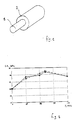
- a cable in accordance with the invention in the particular embodiment shown in Fig. 1, exhibits an electric or optical conductor 1 surrounded by at least a coating layer 2 made of the material of the invention as hereinafter described.
- conductor 1 is an optical conductor, it may for example consist of a single optical fiber, a bundle of optical fibers and generally any optical core into which optical fibers are housed.
- conductor 1 is an electric conductor, it may be for example, when to be used as miniaturized cable for low-voltage (voltage lower than or equal to 1 KV) signallings and controls, a cord of electrically conductive material such as copper or aluminium, for example a cord of 0.5 mm 2 in section formed with 19 strands made of tinned copper, and the coating layer 2 adhering to the cord is 0.2 mm thick and is formed by extrusion around said cord.
- a cord of electrically conductive material such as copper or aluminium, for example a cord of 0.5 mm 2 in section formed with 19 strands made of tinned copper, and the coating layer 2 adhering to the cord is 0.2 mm thick and is formed by extrusion around said cord.
- a material in accordance with the invention to form the coating 2 consists of a blend comprised or preferably consisting of a mixture of a polyphenylsulfide (PFS) as hereinafter defined and a silicone ether imide block copolymer (CSEI) as hereinafter defined.
- PPS polyphenylsulfide
- CSEI silicone ether imide block copolymer
- Silicone ether-imide block copolymer is the one previously defined and it is the only one presently available on the market.
- PFS polyphenylsulfide
- CSEI silicone ether imide block copolymer
- a second mixture group has been made with a straight polyphenylsulfide (PFS) having the same viscosity as above and mixed with the silicone ether imide block copolymer (CSEI) according to the same ratios and following the same modalities as those of the first mixture group.
- PPS polyphenylsulfide
- CSEI silicone ether imide block copolymer
- Test pieces have been made out of said plates by die cutting and tensile stress (CR) and ultimate elongation (AR) properties in accordance with standards CEI 20 - 34 have been determined on said test pieces, at a pulling rate of 50 mm per second. Said mechanical properties have been measured in the absence of heat treatments susceptible of causing a recrystallization of the material.
- glass transition temperature (Tg) values have been determined using a dynamic thermomechanical analyzer DMTA MK -II to 1 Hz frequency.
- Table 1 Branched PFS CSEI CR AR Tg w% w% MPa % °C 0 100 24 89.0 165 25 75 27 31.6 172 50 50 41 12.6 122 75 25 60 10.6 119 100 0 71 3.0 118 Table 2 Straight PFS CSEI CR AR Tg w% w% MPa % °C 0 100 24 89 165 25 75 26 30 165 50 50 42 15 120 75 25 60 10 120 100 0 50 2.5 115
- CR tensile stress
- AR ultimate elongation
- Figs. 2, 3 and 4 the diagrams obtained on the basis of values reproduced in Table 3 are shown, in which the percent of polyphenylsulfide in the mixture is reproduced on the abscissa whereas on the ordinates the following values are respectively reproduced:
- Fig. 2 two lines are drawn, namely a continuous line representing the development of the tensile stress values for unconditioned coatings, that is not submitted to the previously mentioned heat treatment and a dotted line representing the development of the tensile stress values for conditioned coatings.
- Fig. 2 shows above all that the tensile stress values are not only additive as would be predictable from the compatibility of the two polymers, taking into account the existence of a single value of glass transition temperature, but they highlight the existence of a synergistic effect in the mixture in connection with the tensile stress.
- Two lines are also present in Fig. 3, namely a continuous line showing the development of the ultimate elongation for unconditioned coatings and a dotted line showing the development of the ultimate elongation for conditioned coatings.
- Fig. 4 shows the existence of a very marked and unpredictable synergistic effect as regards resistance to thermopressure for unconditioned coatings the development of which is represented by a continuous line.
- the resistance value to thermopressure is greatly and unpredictably high for coatings consisting of mixtures having a polyphenylsulfide content of about 60 parts by weight per 100 parts by weight of mixture and at all events high values of resistance to thermopressure for mixtures having a polyphenylsulfide content included between 50 and 65 parts by weight per 100 parts by weight of mixture.
- Tests relating to toxicity of gases and fumes evolved from cables in the presence of a fire have been carried out according to standards CEI 20 37 - second part, on a cable of the invention and specifically on a cable the coating of which is made of a mixture consisting of 60 parts by weight of a polyphenylsulfide and 40 parts by weight of a silicone ether imide block copolymer.
- the toxicity index of gases and fumes evolved from said cable in the presence of a fire has been 16 and for any composition it has never been higher than 22.
- cables of the invention that are capable of working at operating temperatures even as high as 150°C, show a toxicity index greatly lower than cables having coatings made of halogenated polymers as imposed by standards MIL W 22759/18A for reaching an operating temperature of 150°C.
- Tests for ascertaining the resistance to flame propagation have been carried out following standards IEC 332-2 on cables in accordance with the invention that is cables having a coating made of polyphenylsulfide and silicone ether imide block copolymer mixtures in which polyphenylsulfide is in an amount included between 15 and 90 parts by weight per 100 parts by weight of the mixture.
Landscapes
- Physics & Mathematics (AREA)
- Spectroscopy & Molecular Physics (AREA)
- Chemical & Material Sciences (AREA)
- Chemical Kinetics & Catalysis (AREA)
- General Physics & Mathematics (AREA)
- Optics & Photonics (AREA)
- Health & Medical Sciences (AREA)
- Medicinal Chemistry (AREA)
- Polymers & Plastics (AREA)
- Organic Chemistry (AREA)
- Organic Insulating Materials (AREA)
- Insulated Conductors (AREA)
Claims (15)
- Câble comprenant un conducteur et au moins une couche de revêtement constituée par un matériau polymère extrudé sur ledit conducteur, caractérisé en ce que ledit revêtement comprend un mélange d'un poly(sulfure de phénylène) et d'un copolymère séquencé silicone/étherimide dans lequel le poly(sulfure de phénylène) a une viscosité supérieure ou égale à 110 Pa par seconde à 310°C et il est présent en une quantité comprise entre 15 et 90 parties en poids pour 100 parties en poids du mélange de poly(sulfure de phénylène) et de copolymère séquencé silicone/étherimide.
- Câble conforme à la revendication 1, caractérisé en ce que dans le mélange, le poly(sulfure de phénylène) se trouve de préférence en une quantité comprise entre 25 et 70 parties en poids pour 100 parties en poids du mélange.
- Câble conforme à la revendication 1, caractérisé en ce que dans le mélange, le poly(sulfure de phénylène) se trouve plus préférablement en une quantité comprise entre 50 et 65 parties en poids pour 100 parties en poids du mélange.
- Câble conforme à la revendication 1, caractérisé en ce que le copolymère séquencé silicone/étherimide correspond à la forrnule :
 - R3 représente un groupe aromatique bivalent comportant de 6 à 20 atomes de carbone,- R1 et R2 qui peuvent être identiques ou différents, sont choisis parmi les groupes alkyle comportant de 1 à 14 atomes de carbone,- n et m sont des nombres respectivement compris entre 4 et 10, et 1 et 3.
 - Câble conforme à la revendication 4, caractérisé en ce que R1 représente un groupe méthyle, R2 représente un groupe propyle et R3 représente un groupe dérivé du bisphénol-A.
- Matériau destiné à constituer un conducteur et/ou des revêtements de câbles consistant en une combinaison de matériaux polymères, caractérisé en ce que ladite combinaison comprend un mélange d'un poly(sulfure de phénylène) et d'un copolymère séquencé silicone/étherimide dans lequel le poly(sulfure de phénylène) a une viscosité supérieure ou égale à 110 Pa par seconde à 310°C et se trouve en une quantité comprise entre 15 et 90 parties en poids pour 100 parties en poids du mélange.
- Matériau conforme à la revendication 6, caractérisé en ce que dans le mélange, le poly(sulfure de phénylène) se trouve de préférence en une quantité comprise entre 25 et 70 parties en poids pour 100 parties en poids du mélange.
- Matériau conforme à la revendication 6, caractérisé en ce que dans le mélange, le poly(sulfure de phénylène) se trouve de préférence en une quantité comprise entre 50 et 65 parties en poids pour 100 parties en poids du mélange.
- Matériau conforme à la revendication 6, caractérisé en ce que le copolymère séquencé silicone/étherimide correspond à la formule :
 - R3 représente un groupe aromatique bivalent comportant de 6 à 20 atomes de carbone,- R1 et R2 qui peuvent être identiques ou différents, sont choisis parmi les groupes alkyle comportant de 1 à 14 atomes de carbone,- n et m sont des nombres respectivement compris entre 4 et 10, et 1 et 3.
 - Matériau conforme à la revendication 9, caractérisé en ce que R1 représente un groupe méthyle, R2 représente un groupe propyle et R3 représente un groupe dérivé du bisphénol-A.
- Procédé de fabrication de câbles comprenant l'étape qui consiste à extruder au moins une couche de revêtement constituée par une combinaison de matériaux polymères sur le conducteur, caractérisé en ce que ladite combinaison comprend un mélange d'un poly(sulfure de phénylène) et d'un copolymère séquencé silicone/étherimide dans laquelle le poly(sulfure de phénylène) a une viscosité supérieure ou égale à 110 Pa par seconde à 310°C et il est présent en une quantité comprise entre 15 et 90 parties en poids pour 100 parties en poids du mélange.
- Procédé conforme à la revendication 11, caractérisé en ce que dans le mélange, le poly(sulfure de phénylène) se trouve de préférence en une quantité comprise entre 25 et 70 parties en poids pour 100 parties en poids du mélange.
- Procédé conforme à la revendication 11, caractérisé en ce que dans le mélange, le poly(sulfure de phénylène) se trouve de préférence en une quantité comprise entre 50 et 65 parties en poids pour 100 parties en poids du mélange.
- Procédé conforme à la revendication 11, caractérisé en ce que le copolymère séquencé silicone/étherimide correspond à la formule :
 - R3 représente un groupe aromatique bivalent comportant de 6 à 20 atomes de carbone,- R1 et R2 qui peuvent être identiques ou différents, sont choisis parmi les groupes alkyle comportant de 1 à 14 atomes de carbone,- n et m sont des nombres respectivement compris entre 4 et 10, et 1 et 3.
 - Procédé conforme à la revendication 11, caractérisé en ce que R1 représente un groupe méthyle, R2 représente un groupe propyle et R3 représente un groupe dérivé du bisphénol-A.
Applications Claiming Priority (2)
| Application Number | Priority Date | Filing Date | Title |
|---|---|---|---|
| ITMI921113A IT1255027B (it) | 1992-05-08 | 1992-05-08 | Cavo per alte temperature di esercizio |
| ITMI921113 | 1992-05-08 |
Publications (2)
| Publication Number | Publication Date |
|---|---|
| EP0568923A1 EP0568923A1 (fr) | 1993-11-10 |
| EP0568923B1 true EP0568923B1 (fr) | 1996-11-06 |
Family
ID=11363253
Family Applications (1)
| Application Number | Title | Priority Date | Filing Date |
|---|---|---|---|
| EP93106967A Expired - Lifetime EP0568923B1 (fr) | 1992-05-08 | 1993-04-29 | Câble fonctionnant à hautes températures |
Country Status (6)
| Country | Link |
|---|---|
| US (1) | US5437930A (fr) |
| EP (1) | EP0568923B1 (fr) |
| BR (1) | BR9301057A (fr) |
| DE (1) | DE69305781T2 (fr) |
| ES (1) | ES2096132T3 (fr) |
| IT (1) | IT1255027B (fr) |
Families Citing this family (8)
| Publication number | Priority date | Publication date | Assignee | Title |
|---|---|---|---|---|
| US8168726B2 (en) * | 2006-06-22 | 2012-05-01 | Sabic Innovative Plastics Ip B.V. | Process for making polysiloxane/polymide copolymer blends |
| US8071693B2 (en) * | 2006-06-22 | 2011-12-06 | Sabic Innovative Plastics Ip B.V. | Polysiloxane/polyimide copolymers and blends thereof |
| US8491997B2 (en) * | 2006-06-22 | 2013-07-23 | Sabic Innovative Plastics Ip B.V. | Conductive wire comprising a polysiloxane/polyimide copolymer blend |
| US7847023B2 (en) * | 2007-03-12 | 2010-12-07 | Sabic Innovative Plastics Ip B.V. | Polysiloxane/polyimide copolymer blends |
| US20080236864A1 (en) * | 2007-03-28 | 2008-10-02 | General Electric Company | Cross linked polysiloxane/polyimide copolymers, methods of making, blends thereof, and articles derived therefrom |
| US8013076B2 (en) * | 2008-03-17 | 2011-09-06 | Sabic Innovative Plastics Ip B.V. | Aromatic polyketone and polysiloxane/polyimide block copolymer composition |
| US8013251B2 (en) * | 2008-03-17 | 2011-09-06 | Sabic Innovative Plastics Ip B.V. | Electrical wire comprising an aromatic polyketone and polysiloxane/polyimide block copolymer composition |
| US8618218B2 (en) * | 2011-09-27 | 2013-12-31 | Sabic Innovative Plastics Ip B.V. | Blends of polysiloxane/polyimide block copolymer and poly(arylene sulfide) |
Family Cites Families (5)
| Publication number | Priority date | Publication date | Assignee | Title |
|---|---|---|---|---|
| GB2193216B (en) * | 1986-07-28 | 1991-03-20 | Gen Electric | Zinc borate as a smoke suppressant |
| EP0377080B1 (fr) * | 1988-12-21 | 1995-12-06 | W.L. Gore & Associates GmbH | Conducteur électrique à isolant polymère |
| EP0407061A1 (fr) * | 1989-07-04 | 1991-01-09 | Associated Electrical Industries Limited | Isolation du fil |
| US5001304A (en) * | 1989-07-25 | 1991-03-19 | At&T Bell Laboratories | Building riser cable |
| JP2536628B2 (ja) * | 1989-08-02 | 1996-09-18 | 信越化学工業株式会社 | 半導体素子保護用組成物 |
-
1992
- 1992-05-08 IT ITMI921113A patent/IT1255027B/it active IP Right Grant
-
1993
- 1993-04-16 US US08/048,768 patent/US5437930A/en not_active Expired - Lifetime
- 1993-04-29 ES ES93106967T patent/ES2096132T3/es not_active Expired - Lifetime
- 1993-04-29 EP EP93106967A patent/EP0568923B1/fr not_active Expired - Lifetime
- 1993-04-29 DE DE69305781T patent/DE69305781T2/de not_active Expired - Fee Related
- 1993-05-07 BR BR9301057A patent/BR9301057A/pt not_active IP Right Cessation
Also Published As
| Publication number | Publication date |
|---|---|
| ITMI921113A0 (it) | 1992-05-08 |
| US5437930A (en) | 1995-08-01 |
| IT1255027B (it) | 1995-10-13 |
| EP0568923A1 (fr) | 1993-11-10 |
| ES2096132T3 (es) | 1997-03-01 |
| BR9301057A (pt) | 1993-11-16 |
| DE69305781D1 (de) | 1996-12-12 |
| ITMI921113A1 (it) | 1993-11-08 |
| DE69305781T2 (de) | 1997-05-28 |
Similar Documents
| Publication | Publication Date | Title |
|---|---|---|
| EP2937870B1 (fr) | Fil isolé | |
| EP0395260A1 (fr) | Câble d'installation contenant des matières plastiques halogénées et non halogénées | |
| JP2893640B2 (ja) | 低煙および耐炎性組成物 | |
| EP3423519B1 (fr) | Compositions ignifuges sans halogène présentant des propriétés améliorées de traction | |
| JPH0222350A (ja) | 難燃性エチレン重合体配合物 | |
| EP1422262B1 (fr) | Composite en résine éthylène ignifuge et fil ou cable électrique ignifuge | |
| US4521485A (en) | Electrical insulation | |
| EP0568923B1 (fr) | Câble fonctionnant à hautes températures | |
| US4678709A (en) | Electrical insulation | |
| JP3279206B2 (ja) | 難燃性樹脂組成物とそれを用いた絶縁電線、シールド電線および被覆チューブ | |
| US4797323A (en) | Flame retardant wire with high insulation resistance | |
| US6087591A (en) | Insulated electrical conductors | |
| JP3555101B2 (ja) | 耐火電線 | |
| JP3424803B2 (ja) | 耐火電線 | |
| JP2013161572A (ja) | 耐熱電線 | |
| US4705823A (en) | Extrudable blend | |
| US4592955A (en) | Insulating covering for strand material | |
| EP0103487A2 (fr) | Isolation électrique | |
| EP0084048A4 (fr) | Compositions de retardement de flamme, procede de preparation et leurs produits de cables et fils. | |
| US4656091A (en) | Insulating material for telephone cords and telephone cords incorporating same | |
| JPH01609A (ja) | 難燃性電線・ケ−ブル | |
| JPH11504365A (ja) | ポリエステル組成物 | |
| JPH05303909A (ja) | 絶縁電線 | |
| WO1996035216A1 (fr) | Compositions elastomeres thermoplastiques et conducteurs electriques isoles | |
| JPH0462720A (ja) | 難燃性同軸ケーブル |
Legal Events
| Date | Code | Title | Description |
|---|---|---|---|
| PUAI | Public reference made under article 153(3) epc to a published international application that has entered the european phase |
Free format text: ORIGINAL CODE: 0009012 |
|
| AK | Designated contracting states |
Kind code of ref document: A1 Designated state(s): DE ES FR GB |
|
| 17P | Request for examination filed |
Effective date: 19940421 |
|
| RAP1 | Party data changed (applicant data changed or rights of an application transferred) |
Owner name: PIRELLI CAVI S.P.A. |
|
| 17Q | First examination report despatched |
Effective date: 19951031 |
|
| GRAH | Despatch of communication of intention to grant a patent |
Free format text: ORIGINAL CODE: EPIDOS IGRA |
|
| GRAH | Despatch of communication of intention to grant a patent |
Free format text: ORIGINAL CODE: EPIDOS IGRA |
|
| GRAA | (expected) grant |
Free format text: ORIGINAL CODE: 0009210 |
|
| AK | Designated contracting states |
Kind code of ref document: B1 Designated state(s): DE ES FR GB |
|
| REF | Corresponds to: |
Ref document number: 69305781 Country of ref document: DE Date of ref document: 19961212 |
|
| REG | Reference to a national code |
Ref country code: ES Ref legal event code: FG2A Ref document number: 2096132 Country of ref document: ES Kind code of ref document: T3 |
|
| ET | Fr: translation filed | ||
| PLBE | No opposition filed within time limit |
Free format text: ORIGINAL CODE: 0009261 |
|
| 26N | No opposition filed | ||
| REG | Reference to a national code |
Ref country code: GB Ref legal event code: IF02 |
|
| REG | Reference to a national code |
Ref country code: FR Ref legal event code: TP Ref country code: FR Ref legal event code: CD |
|
| REG | Reference to a national code |
Ref country code: GB Ref legal event code: 732E |
|
| REG | Reference to a national code |
Ref country code: GB Ref legal event code: 732E |
|
| PGFP | Annual fee paid to national office [announced via postgrant information from national office to epo] |
Ref country code: ES Payment date: 20090427 Year of fee payment: 17 |
|
| PGFP | Annual fee paid to national office [announced via postgrant information from national office to epo] |
Ref country code: FR Payment date: 20090417 Year of fee payment: 17 Ref country code: DE Payment date: 20090429 Year of fee payment: 17 |
|
| PGFP | Annual fee paid to national office [announced via postgrant information from national office to epo] |
Ref country code: GB Payment date: 20090429 Year of fee payment: 17 |
|
| GBPC | Gb: european patent ceased through non-payment of renewal fee |
Effective date: 20100429 |
|
| REG | Reference to a national code |
Ref country code: FR Ref legal event code: ST Effective date: 20101230 |
|
| PG25 | Lapsed in a contracting state [announced via postgrant information from national office to epo] |
Ref country code: DE Free format text: LAPSE BECAUSE OF NON-PAYMENT OF DUE FEES Effective date: 20101103 |
|
| PG25 | Lapsed in a contracting state [announced via postgrant information from national office to epo] |
Ref country code: GB Free format text: LAPSE BECAUSE OF NON-PAYMENT OF DUE FEES Effective date: 20100429 |
|
| REG | Reference to a national code |
Ref country code: ES Ref legal event code: FD2A Effective date: 20110715 |
|
| PG25 | Lapsed in a contracting state [announced via postgrant information from national office to epo] |
Ref country code: ES Free format text: LAPSE BECAUSE OF NON-PAYMENT OF DUE FEES Effective date: 20110705 |
|
| PG25 | Lapsed in a contracting state [announced via postgrant information from national office to epo] |
Ref country code: ES Free format text: LAPSE BECAUSE OF NON-PAYMENT OF DUE FEES Effective date: 20100430 |
|
| PG25 | Lapsed in a contracting state [announced via postgrant information from national office to epo] |
Ref country code: FR Free format text: LAPSE BECAUSE OF NON-PAYMENT OF DUE FEES Effective date: 20100430 |