EP0568960A2 - Résistance de dissipation d'énergie pour défibrillateur implantable - Google Patents
Résistance de dissipation d'énergie pour défibrillateur implantable Download PDFInfo
- Publication number
- EP0568960A2 EP0568960A2 EP93107173A EP93107173A EP0568960A2 EP 0568960 A2 EP0568960 A2 EP 0568960A2 EP 93107173 A EP93107173 A EP 93107173A EP 93107173 A EP93107173 A EP 93107173A EP 0568960 A2 EP0568960 A2 EP 0568960A2
- Authority
- EP
- European Patent Office
- Prior art keywords
- electrically
- electrically conductive
- energy dissipation
- layer
- insulating material
- Prior art date
- Legal status (The legal status is an assumption and is not a legal conclusion. Google has not performed a legal analysis and makes no representation as to the accuracy of the status listed.)
- Granted
Links
Images
Classifications
-
- A—HUMAN NECESSITIES
- A61—MEDICAL OR VETERINARY SCIENCE; HYGIENE
- A61N—ELECTROTHERAPY; MAGNETOTHERAPY; RADIATION THERAPY; ULTRASOUND THERAPY
- A61N1/00—Electrotherapy; Circuits therefor
- A61N1/18—Applying electric currents by contact electrodes
- A61N1/32—Applying electric currents by contact electrodes alternating or intermittent currents
- A61N1/38—Applying electric currents by contact electrodes alternating or intermittent currents for producing shock effects
- A61N1/39—Heart defibrillators
- A61N1/3956—Implantable devices for applying electric shocks to the heart, e.g. for cardioversion
-
- H—ELECTRICITY
- H05—ELECTRIC TECHNIQUES NOT OTHERWISE PROVIDED FOR
- H05K—PRINTED CIRCUITS; CASINGS OR CONSTRUCTIONAL DETAILS OF ELECTRIC APPARATUS; MANUFACTURE OF ASSEMBLAGES OF ELECTRICAL COMPONENTS
- H05K1/00—Printed circuits
- H05K1/16—Printed circuits incorporating printed electric components, e.g. printed resistors, capacitors or inductors
Definitions
- the present invention relates to the art of implantable cardiac defibrillators, and in particular, is related to an energy dissipation resistor capable of efficiently and reliably dissipating energy stored in the capacitor(s) of an implantable cardiac defibrillator.
- Some types of implantable defibrillation circuitry are disposed on small, light-weight, and flexible printed circuit boards. Consequently, "board real-estate" becomes increasingly important, as does the size, weight, and flexibility of components mounted thereon. It is, therefore, desirable to minimize the size and weight of individual circuit components, while maximizing their structural flexibility to coincide with that of the flexible circuit board to which they are mounted.
- implantable defibrillation circuitry are disposed on small, light-weight, but rigid printed circuit boards or ceramic substrates. In such cases, it is usually desirable to conserve "board real-estate" while, at the same time, maintaining structural rigidity in the circuit board.
- a still further object of the present invention is to provide an energy dissipation resistor which can be incorporated into a flexible or rigid circuit board in such a manner that the resistor becomes an integral layer of the circuit board.
- an energy dissipation resistor for dissipating stored energy contained in the capacitor(s) or other energy storage devices of an implantable cardiac defibrillator.
- the dissipation resistor comprises a layer of resistive foil sandwiched between two layers of electrically insulative material. Each insulative layer is bonded by a bonding material to the foil layer, and is sufficiently thin to allow for the rapid dissipation of heat energy from the resistive foil.
- the resistive foil itself, forms a preferably circuitous resistive path from one electrical contact to another. The two electrical contacts project through at least one of the insulative layers, thereby providing means by which the resistive foil can be electrically connected to a defibrillation circuit.
- a pair of lead wires may be connected to the electrical contacts of the resistor.
- the energy dissipation resistor can be formed integrally as one layer of a flexible or rigid circuit board which frees up space on the outside surfaces of the flexible or rigid circuit board for other components or for down sizing.
- multiple layers of the resistive foil and insulative material can be applied so as to form a multi-layered energy dissipation resistor.
- the energy dissipation resistor can be heat sunk to a housing which contains the defibrillation circuit.
- the energy dissipation resistor can be molded into a plastic liner inside the housing. Either way, the energy dissipation resistor conforms to the contour of the defibrillation circuit housing or liner, and thus, occupies a minimal amount of usable space therein.
- the energy dissipation resistor can also be integrally formed with a hybrid substrate.
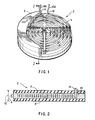
- an energy dissipation resistor 2 comprising a foil resistive layer 4 sandwiched between two layers 6 and 8 of electrically insulative material.
- the foil resistive layer 4 is joined to the insulative layers 6 and 8 by a bonding material 10.
- the layers 6 and 8 allow for the rapid dissipation of thermal energy from the resistive foil 4.
- the resistive foil 4 is comprised of 70 - 30 cupro-nickel (70% copper and 30% nickel); the insulative layers 6 and 8 comprised of "KAPTON”, “MYLAR” OR “NOMEX” (all commercially available from Dupont); and the bonding material 10 comprised of "PYRALUX” or "TEFLON” (also commercially available from Dupont).
- the energy dissipation resistor 2 is constructed with a thin cross section 12 but large surface area so that dissipation of thermal energy is maximized.
- the energy dissipation resistor 2 further comprises two electrical contacts 14 and 16 which are electrically connected to the foil resistive layer 4 and appear through one of the insulative layers 6 or 8.
- the electrical contacts 14 and 16 are preferably plated with tinned copper, nickel, 67/37 silver/lead, or alternatively, a conductive epoxy.
- the energy dissipation resistor 2 can also be equipped with a pair of electrically conductive leads 14A and 16A, each lead extending from one of the contacts 14 and 16.
- the conductive leads 14A and 16A allow the energy dissipation resistor 2 to be located apart from yet be electrically connected to a discharge circuit.
- the foil layer 4 of the energy dissipation resistor 2 is constructed so as to define a circuitous resistive path from electrical contact 14 to electrical contact 16, the exact length of this path being selectively chosen to achieve a desired total resistance from contact 14 to contact 16 of the resistor. By increasing this path length, higher total resistance values are achieved between the contacts 14 and 16. Lower resistance values, on the other hand, result from decreasing the path length.
- One particular application of the energy dissipation resistor 2 relates to the discharging of defibrillation capacitors or other energy storage devices in an implantable cardiac defibrillator.
- an energy dissipation resistor has been created having a surface area between 2in. 2 and 4in. 2 ; a pair of insulative layers 6 and 8 each being between .0005" and .001 " thick; a foil resistive layer 4 between .0006" and .0007” thick; and a bonding material between .0005" and .001 thick on each side of the foil resistive layer 4.
- the foil resistive layer 4 defines a resistive path between 170" and 250" long and between .004" and .010" wide, the exact length of the resistive path being selectively chosen to achieve a desired total resistance between 850Q and 11500.
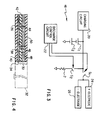
- An exemplary cardiac defibrillation circuit 18 is illustrated schematically in Figure 3.
- the defibrillation circuit 18 comprises a charging circuit 20, a discharge control circuit 22, two series connected defibrillation capacitors C1 and C2, two switches S1 and S2, a pair of electrodes 24 and 26, and the energy dissipation resistor 2.
- the charging circuit 20 provides electrical energy to the defibrillation capacitors C1 and C2 which, in turn, store the electrical energy for future discharge.
- the discharge control circuit 22 then controls whether the capacitors C1 and C2 should be discharged through a patient via the electrodes 24 and 26 or through the energy dissipation resistor 2. This determination is made based on various criteria which may be analyzed by a microprocessor, not shown. Once such a determination is made, the discharge control circuit 22 causes the appropriate switch S1 or S2 to be closed, thereby closing a circuit through either the electrodes 25 and 26 or the energy dissipation resistor 2. More specifically, if the capacitors C1 and C2 are to be discharged through the patient via the electrodes 24 and 26, switch S1 is closed. Otherwise, switch S2 is closed, allowing the capacitors C1 and C2 to be discharged through the energy dissipation resistor 2.
- This is known as an "internal dump", and is often used to divert the capacitor voltage when an arrhythmia has reverted or when it is otherwise desired not to shock the heart of a patient after the capacitors have been charged, as when the implanted device is being tested for remaining life of the batteries, etc.
- this internal dump can be used when the capacitors C1 and C2 need to be "formed” approximately every two months. Forming can be accomplished using both auto- form and manual-form options.
- the energy dissipation resistor 30 is shown to be formed integrally with a flexible circuit board 32.
- the circuit board 32 comprises a layer 34 of electrically conductive circuit lines 36 and 38 between two layers 40 and 42 of insulative material, one of the layers 42 having a pair of conductive contacts 44 and 46 disposed therein.
- the energy dissipation resistor 30 comprises a layer of resistive foil 48 adjacent the insulative layer 42 which contains the contacts 44 and 46 so that the contacts 44 and 46 form an electrically conductive path from their respective circuit lines 36 and 38 to the resistive foil layer 48.
- An insulative layer 50 covers the other surface of the resistive foil layer 48.
- the individual layers 34, 40, 42, 48 and 50 are bonded to one another by a bonding material, as is well known in the art.
- a bonding material for the sake of clarity in Figure 4, the bonding material has been omitted from the drawing except where it fills voids between portions of the resistive path in the resistive foil layer 48, as well as voids between the conductive lines 36 and 38.
- each layer 40, 42, and 50 of insulative material is between .0005" and .001 " thick; the layer 34 of electrically conductive circuit lines is between .0014" and .0028" thick; and the layer of resistive foil 48 is between .0005" and .001 " thick;
- the circuit board and integrally formed dissipation resistor can be formed using conventional techniques known to the art of printed circuit board manufacturing. Etching techniques, for example, can be used by first attaching the resistive foil layer 48 to a film substrate using adhesive material such as "Pyralux” or “Teflon”. The adhesive material is then cured by methods generally known, while "artwork” is created representative of a desired resistive path in the resistive foil layer 48. Next, in accordance with the "artwork,” a photo-resist is selectively applied to the resistive layer 48, which photo-resist prevents the removal of predetermined portions of the resistive foil layer 48 by a subsequently applied etchant.
- the etchant once applied, removes the undesired portions of the resistive layer 48 thereby defining a predetermined resistive path.
- the circuit board and integrally formed energy dissipation resistor can also be manufactured using conventional methods of electro-depositing foil material. That is, the foil layer defining the resistive path can be formed by selectively electro-depositing the foil onto a base or substrate layer of electrically insulative material. Preferably, the electrodeposited foil has a thickness of between .0006" and .0007".
- One modification involves the molding of the energy dissipation resistor into a liner of an implantable defibrillation circuit.
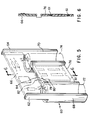
- Figures 5 and 6 illustrate an example of much an embodiment, wherein a plastic liner 60 for defibrillation circuitry has a circuitous resistive path 61 molded therein, which resistive path 61 defines an energy dissipation resistor in accordance with the present invention.
- the plastic liner 60 comprises two elongated support arms 62 and 64 for supporting a defibrillation circuit board 66; two cylindrical support members 68 and 70 for receiving and supporting a pair of capacitors 72 and 74; a planar center member 76 for supporting a pair of adhesively attached rectangular batteries (not shown); and a circuitous resistive path 61 molded inside the plastic of the planar center member 76.
- the resistive path 61 defines an energy dissipation resistor which is integrally formed within the plastic liner 60.
- the circuitous resistive path is electrically connected to the circuit board 66 via a pair of electrically conductive contacts 78 and 80 and leads 82 and 84.
- the combination of the liner 60, the circuit board 66, and the two capacitors 72 and 74 typically measures 3 inches in height, 3 inches in width, and 0.75 inches in thickness.
- the planar center member 76 has a surface area of between 2 in 2 and 4 in 2 , with an overall thickness of approximately 0.005".
- electro-depositing techniques can also be utilized to deposit the energy dissipation resistor of the present invention directly onto a plastic liner for a defibrillation circuit.
- the energy dissipation resistor can be incorporated into, or printed onto, an analog or digital hybrid substrate.
- Hybrid substrates typically comprise a rigid ceramic or cofire ceramic material having favorable electrical properties, such as high resistance to dielectric breakdown.
- the resistor can be incorporated into the substrate using any of the foregoing arrangements or methods for incorporating the resistor into a flexible circuit board.
Landscapes
- Health & Medical Sciences (AREA)
- Cardiology (AREA)
- Heart & Thoracic Surgery (AREA)
- Engineering & Computer Science (AREA)
- Biomedical Technology (AREA)
- Nuclear Medicine, Radiotherapy & Molecular Imaging (AREA)
- Radiology & Medical Imaging (AREA)
- Life Sciences & Earth Sciences (AREA)
- Animal Behavior & Ethology (AREA)
- General Health & Medical Sciences (AREA)
- Public Health (AREA)
- Veterinary Medicine (AREA)
- Electrotherapy Devices (AREA)
Applications Claiming Priority (2)
| Application Number | Priority Date | Filing Date | Title |
|---|---|---|---|
| US07/878,537 US5312442A (en) | 1992-05-05 | 1992-05-05 | Energy dissipation resistor for implantable defibrillation circuitry |
| US878537 | 1992-05-05 |
Publications (3)
| Publication Number | Publication Date |
|---|---|
| EP0568960A2 true EP0568960A2 (fr) | 1993-11-10 |
| EP0568960A3 EP0568960A3 (fr) | 1995-05-10 |
| EP0568960B1 EP0568960B1 (fr) | 1999-08-04 |
Family
ID=25372227
Family Applications (1)
| Application Number | Title | Priority Date | Filing Date |
|---|---|---|---|
| EP93107173A Expired - Lifetime EP0568960B1 (fr) | 1992-05-05 | 1993-05-03 | Défibrillateur cardiaque implantable avec résistance de dissipation d'énergie |
Country Status (10)
| Country | Link |
|---|---|
| US (1) | US5312442A (fr) |
| EP (1) | EP0568960B1 (fr) |
| JP (1) | JP2774919B2 (fr) |
| AT (1) | ATE182802T1 (fr) |
| AU (1) | AU648464B2 (fr) |
| CA (1) | CA2095562C (fr) |
| DE (1) | DE69325847T2 (fr) |
| DK (1) | DK0568960T3 (fr) |
| ES (1) | ES2137956T3 (fr) |
| GR (1) | GR3031594T3 (fr) |
Families Citing this family (12)
| Publication number | Priority date | Publication date | Assignee | Title |
|---|---|---|---|---|
| US5645586A (en) * | 1994-07-08 | 1997-07-08 | Ventritex, Inc. | Conforming implantable defibrillator |
| US5749910A (en) * | 1995-06-07 | 1998-05-12 | Angeion Corporation | Shield for implantable cardioverter defibrillator |
| US5716381A (en) * | 1996-08-06 | 1998-02-10 | Pacesetter, Inc. | Electrophysiology diagnostic device including variable capacitance emulation and voltage threshold determination circuits |
| US5876439A (en) * | 1996-12-09 | 1999-03-02 | Micooptix, Llc | Method and appartus for adjusting corneal curvature using a fluid-filled corneal ring |
| US6094597A (en) * | 1999-02-05 | 2000-07-25 | Medtronic, Inc. | Implantable medical device incorporating distributed core, step-up transformer |
| US6185456B1 (en) * | 1999-02-26 | 2001-02-06 | Medical Research Laboratories, Inc. | Defibrillator disarm circuit utilizing thermal feedback |
| US6353760B1 (en) | 1999-04-30 | 2002-03-05 | Cardiac Pacemakers, Inc. | Implantable cardiac stimulating device with optimized demand |
| US6539258B1 (en) | 2000-10-06 | 2003-03-25 | Medtronic Physio-Control Manufacturing Corp. | Energy adjusting circuit for producing an ultra-low energy defibrillation waveform with fixed pulse width and fixed tilt |
| TWI497535B (zh) | 2011-07-28 | 2015-08-21 | Cyntec Co Ltd | 具有軟性材料層之微電阻元件及其製造方法 |
| US8749949B2 (en) * | 2011-10-31 | 2014-06-10 | Lawrence Livermore National Security, Llc | Resistive foil edge grading for accelerator and other high voltage structures |
| DE102018101419A1 (de) * | 2018-01-23 | 2019-07-25 | Biotronik Se & Co. Kg | Elektrischer Widerstand, insbesondere für medizinische Implantate |
| DE102018114801B4 (de) * | 2018-06-20 | 2025-04-17 | Dyconex Ag | Diffusionsbarriere für implantierbare Elektrodenleitungen |
Family Cites Families (16)
| Publication number | Priority date | Publication date | Assignee | Title |
|---|---|---|---|---|
| US2482316A (en) * | 1945-05-26 | 1949-09-20 | Amalgamated Wireless Australas | Lamella resistance unit |
| US2521894A (en) * | 1950-02-08 | 1950-09-12 | Robert J S Brown | Low inductance resistor |
| US3654580A (en) * | 1969-03-14 | 1972-04-04 | Sanders Associates Inc | Resistor structure |
| FR2053539A5 (fr) * | 1969-07-08 | 1971-04-16 | Electronique Appliquee | |
| GB1319765A (en) * | 1969-10-15 | 1973-06-06 | Atomic Energy Authority Uk | Resistive elements |
| US3798542A (en) * | 1972-07-05 | 1974-03-19 | R Dempsey | Energy measuring device for pulse type defibrillators |
| US4316472C1 (en) * | 1974-04-25 | 2001-08-14 | Mieczyslaw Mirowski | Cardioverting device with stored energy selecting means and discharge initiating means and related method |
| DE2450551C2 (de) * | 1974-10-24 | 1977-01-13 | Heraeus Gmbh W C | Elektrischer messwiderstand fuer ein widerstandsthermometer und verfahren zu seiner herstellung |
| US4164946A (en) * | 1977-05-27 | 1979-08-21 | Mieczyslaw Mirowski | Fault detection circuit for permanently implanted cardioverter |
| US4297670A (en) * | 1977-06-03 | 1981-10-27 | Angstrohm Precision, Inc. | Metal foil resistor |
| US4254775A (en) * | 1979-07-02 | 1981-03-10 | Mieczyslaw Mirowski | Implantable defibrillator and package therefor |
| DE3201434A1 (de) * | 1982-01-19 | 1983-09-08 | Siemens AG, 1000 Berlin und 8000 München | Elektrisches bauelement in chip-bauweise |
| DE3229134A1 (de) * | 1982-08-04 | 1984-02-09 | GS Elektromed. Geräte Günter Stemple, 8912 Kaufering | Elektrische schaltung zur erzeugung von energieimpulsen an zwei schockelektroden eines defibrillators |
| US4488555A (en) * | 1982-12-13 | 1984-12-18 | Mieczyslaw Mirowski | Battery condition warning system for medical implant |
| FR2646019B1 (fr) * | 1989-04-14 | 1991-07-19 | Sgs Thomson Microelectronics | Resistance spirale haute tension |
| US5163427A (en) * | 1990-11-14 | 1992-11-17 | Medtronic, Inc. | Apparatus for delivering single and multiple cardioversion and defibrillation pulses |
-
1992
- 1992-05-05 US US07/878,537 patent/US5312442A/en not_active Expired - Lifetime
-
1993
- 1993-05-03 AT AT93107173T patent/ATE182802T1/de not_active IP Right Cessation
- 1993-05-03 DK DK93107173T patent/DK0568960T3/da active
- 1993-05-03 EP EP93107173A patent/EP0568960B1/fr not_active Expired - Lifetime
- 1993-05-03 ES ES93107173T patent/ES2137956T3/es not_active Expired - Lifetime
- 1993-05-03 DE DE69325847T patent/DE69325847T2/de not_active Expired - Lifetime
- 1993-05-05 AU AU38386/93A patent/AU648464B2/en not_active Ceased
- 1993-05-05 CA CA002095562A patent/CA2095562C/fr not_active Expired - Fee Related
- 1993-05-06 JP JP5105588A patent/JP2774919B2/ja not_active Expired - Fee Related
-
1999
- 1999-10-21 GR GR990402688T patent/GR3031594T3/el unknown
Also Published As
| Publication number | Publication date |
|---|---|
| ATE182802T1 (de) | 1999-08-15 |
| DE69325847D1 (de) | 1999-09-09 |
| DE69325847T2 (de) | 2000-01-13 |
| EP0568960B1 (fr) | 1999-08-04 |
| EP0568960A3 (fr) | 1995-05-10 |
| JP2774919B2 (ja) | 1998-07-09 |
| JPH07265443A (ja) | 1995-10-17 |
| CA2095562C (fr) | 1997-03-25 |
| AU648464B2 (en) | 1994-04-21 |
| AU3838693A (en) | 1993-11-11 |
| DK0568960T3 (da) | 1999-12-06 |
| CA2095562A1 (fr) | 1993-11-06 |
| ES2137956T3 (es) | 2000-01-01 |
| US5312442A (en) | 1994-05-17 |
| GR3031594T3 (en) | 2000-01-31 |
Similar Documents
| Publication | Publication Date | Title |
|---|---|---|
| US5312442A (en) | Energy dissipation resistor for implantable defibrillation circuitry | |
| US5637418A (en) | Package for a flat electrochemical device | |
| US5367431A (en) | Thin power supply unit | |
| US5978204A (en) | Capacitor with dual element electrode plates | |
| US7554424B2 (en) | Electronic component and method of making | |
| US4748537A (en) | Decoupling capacitor and method of formation thereof | |
| US6611421B2 (en) | Non-polarized tantalum capacitor and capacitor array | |
| WO1997020331A1 (fr) | Condensateur a plaques d'electrodes a double element | |
| JP2003524878A (ja) | 改善した導電性ポリマーデバイス及びその製造方法 | |
| JPS6266506A (ja) | 多層セラミツクコンデンサ−を含む高静電容量ブスバ− | |
| US4594641A (en) | Decoupling capacitor and method of formation thereof | |
| US5051542A (en) | Low impedance bus bar | |
| US6114060A (en) | Thin-profile battery circuits and constructions, button-type battery circuits and constructions, methods of forming thin-profile battery circuits and constructions, and methods of forming button-type battery circuits and constructions | |
| JPH06275248A (ja) | 積層型電池の基板への実装構造 | |
| JP2004095816A (ja) | チップ形コンデンサ | |
| JP3459567B2 (ja) | パック電池 | |
| WO2000077927A1 (fr) | Piece electronique | |
| JP3666668B2 (ja) | 固体電解コンデンサとコイルとの複合素子の構造 | |
| EP0200670A2 (fr) | Condensateur de découpage et son procédé de fabrication | |
| JPS59211213A (ja) | 電子部品 | |
| GB2115213A (en) | Laminated bus bar with dielectric inserts | |
| JPS59188113A (ja) | 電力用コンデンサ | |
| JPS59194417A (ja) | 電気二重層コンデンサ | |
| JPS6224685A (ja) | コンデンサ組込み配線基板 | |
| JPS59208714A (ja) | 電気二重層コンデンサ |
Legal Events
| Date | Code | Title | Description |
|---|---|---|---|
| PUAI | Public reference made under article 153(3) epc to a published international application that has entered the european phase |
Free format text: ORIGINAL CODE: 0009012 |
|
| AK | Designated contracting states |
Kind code of ref document: A2 Designated state(s): AT BE CH DE DK ES FR GB GR IE IT LI LU MC NL PT SE |
|
| PUAL | Search report despatched |
Free format text: ORIGINAL CODE: 0009013 |
|
| AK | Designated contracting states |
Kind code of ref document: A3 Designated state(s): AT BE CH DE DK ES FR GB GR IE IT LI LU MC NL PT SE |
|
| 17P | Request for examination filed |
Effective date: 19950420 |
|
| 17Q | First examination report despatched |
Effective date: 19980402 |
|
| GRAG | Despatch of communication of intention to grant |
Free format text: ORIGINAL CODE: EPIDOS AGRA |
|
| GRAG | Despatch of communication of intention to grant |
Free format text: ORIGINAL CODE: EPIDOS AGRA |
|
| GRAH | Despatch of communication of intention to grant a patent |
Free format text: ORIGINAL CODE: EPIDOS IGRA |
|
| GRAH | Despatch of communication of intention to grant a patent |
Free format text: ORIGINAL CODE: EPIDOS IGRA |
|
| GRAA | (expected) grant |
Free format text: ORIGINAL CODE: 0009210 |
|
| AK | Designated contracting states |
Kind code of ref document: B1 Designated state(s): AT BE CH DE DK ES FR GB GR IE IT LI LU MC NL PT SE |
|
| REF | Corresponds to: |
Ref document number: 182802 Country of ref document: AT Date of ref document: 19990815 Kind code of ref document: T |
|
| REG | Reference to a national code |
Ref country code: CH Ref legal event code: EP |
|
| REF | Corresponds to: |
Ref document number: 69325847 Country of ref document: DE Date of ref document: 19990909 |
|
| REG | Reference to a national code |
Ref country code: IE Ref legal event code: FG4D |
|
| ITF | It: translation for a ep patent filed | ||
| ET | Fr: translation filed | ||
| REG | Reference to a national code |
Ref country code: CH Ref legal event code: NV Representative=s name: PATENTANWAELTE SCHAAD, BALASS, MENZL & PARTNER AG |
|
| REG | Reference to a national code |
Ref country code: DK Ref legal event code: T3 |
|
| REG | Reference to a national code |
Ref country code: PT Ref legal event code: SC4A Free format text: AVAILABILITY OF NATIONAL TRANSLATION Effective date: 19991011 |
|
| REG | Reference to a national code |
Ref country code: ES Ref legal event code: FG2A Ref document number: 2137956 Country of ref document: ES Kind code of ref document: T3 |
|
| PG25 | Lapsed in a contracting state [announced via postgrant information from national office to epo] |
Ref country code: LU Free format text: LAPSE BECAUSE OF NON-PAYMENT OF DUE FEES Effective date: 20000503 |
|
| PLBE | No opposition filed within time limit |
Free format text: ORIGINAL CODE: 0009261 |
|
| 26N | No opposition filed | ||
| PG25 | Lapsed in a contracting state [announced via postgrant information from national office to epo] |
Ref country code: MC Free format text: LAPSE BECAUSE OF NON-PAYMENT OF DUE FEES Effective date: 20001130 |
|
| REG | Reference to a national code |
Ref country code: GB Ref legal event code: IF02 |
|
| PGFP | Annual fee paid to national office [announced via postgrant information from national office to epo] |
Ref country code: PT Payment date: 20060502 Year of fee payment: 14 Ref country code: IE Payment date: 20060502 Year of fee payment: 14 Ref country code: GR Payment date: 20060502 Year of fee payment: 14 |
|
| PGFP | Annual fee paid to national office [announced via postgrant information from national office to epo] |
Ref country code: GB Payment date: 20060503 Year of fee payment: 14 |
|
| PGFP | Annual fee paid to national office [announced via postgrant information from national office to epo] |
Ref country code: DK Payment date: 20060509 Year of fee payment: 14 |
|
| PGFP | Annual fee paid to national office [announced via postgrant information from national office to epo] |
Ref country code: ES Payment date: 20060511 Year of fee payment: 14 |
|
| PGFP | Annual fee paid to national office [announced via postgrant information from national office to epo] |
Ref country code: NL Payment date: 20060515 Year of fee payment: 14 |
|
| PGFP | Annual fee paid to national office [announced via postgrant information from national office to epo] |
Ref country code: SE Payment date: 20060517 Year of fee payment: 14 |
|
| PGFP | Annual fee paid to national office [announced via postgrant information from national office to epo] |
Ref country code: CH Payment date: 20060519 Year of fee payment: 14 |
|
| PGFP | Annual fee paid to national office [announced via postgrant information from national office to epo] |
Ref country code: AT Payment date: 20060523 Year of fee payment: 14 |
|
| PGFP | Annual fee paid to national office [announced via postgrant information from national office to epo] |
Ref country code: FR Payment date: 20060529 Year of fee payment: 14 |
|
| PGFP | Annual fee paid to national office [announced via postgrant information from national office to epo] |
Ref country code: BE Payment date: 20060530 Year of fee payment: 14 |
|
| REG | Reference to a national code |
Ref country code: PT Ref legal event code: MM4A Free format text: LAPSE DUE TO NON-PAYMENT OF FEES Effective date: 20071105 |
|
| BERE | Be: lapsed |
Owner name: *CARDIAC PACEMAKERS INC. Effective date: 20070531 |
|
| EUG | Se: european patent has lapsed | ||
| REG | Reference to a national code |
Ref country code: CH Ref legal event code: PL |
|
| REG | Reference to a national code |
Ref country code: DK Ref legal event code: EBP |
|
| GBPC | Gb: european patent ceased through non-payment of renewal fee |
Effective date: 20070503 |
|
| PG25 | Lapsed in a contracting state [announced via postgrant information from national office to epo] |
Ref country code: PT Free format text: LAPSE BECAUSE OF NON-PAYMENT OF DUE FEES Effective date: 20071105 Ref country code: NL Free format text: LAPSE BECAUSE OF NON-PAYMENT OF DUE FEES Effective date: 20071201 |
|
| NLV4 | Nl: lapsed or anulled due to non-payment of the annual fee |
Effective date: 20071201 |
|
| REG | Reference to a national code |
Ref country code: IE Ref legal event code: MM4A |
|
| PG25 | Lapsed in a contracting state [announced via postgrant information from national office to epo] |
Ref country code: AT Free format text: LAPSE BECAUSE OF NON-PAYMENT OF DUE FEES Effective date: 20070503 Ref country code: LI Free format text: LAPSE BECAUSE OF NON-PAYMENT OF DUE FEES Effective date: 20070531 Ref country code: CH Free format text: LAPSE BECAUSE OF NON-PAYMENT OF DUE FEES Effective date: 20070531 |
|
| REG | Reference to a national code |
Ref country code: FR Ref legal event code: ST Effective date: 20080131 |
|
| PG25 | Lapsed in a contracting state [announced via postgrant information from national office to epo] |
Ref country code: BE Free format text: LAPSE BECAUSE OF NON-PAYMENT OF DUE FEES Effective date: 20070531 |
|
| PG25 | Lapsed in a contracting state [announced via postgrant information from national office to epo] |
Ref country code: DK Free format text: LAPSE BECAUSE OF NON-PAYMENT OF DUE FEES Effective date: 20070531 |
|
| PG25 | Lapsed in a contracting state [announced via postgrant information from national office to epo] |
Ref country code: IE Free format text: LAPSE BECAUSE OF NON-PAYMENT OF DUE FEES Effective date: 20070503 Ref country code: GB Free format text: LAPSE BECAUSE OF NON-PAYMENT OF DUE FEES Effective date: 20070503 |
|
| PG25 | Lapsed in a contracting state [announced via postgrant information from national office to epo] |
Ref country code: SE Free format text: LAPSE BECAUSE OF NON-PAYMENT OF DUE FEES Effective date: 20070504 |
|
| PG25 | Lapsed in a contracting state [announced via postgrant information from national office to epo] |
Ref country code: FR Free format text: LAPSE BECAUSE OF NON-PAYMENT OF DUE FEES Effective date: 20070531 |
|
| REG | Reference to a national code |
Ref country code: ES Ref legal event code: FD2A Effective date: 20070504 |
|
| PG25 | Lapsed in a contracting state [announced via postgrant information from national office to epo] |
Ref country code: GR Free format text: LAPSE BECAUSE OF NON-PAYMENT OF DUE FEES Effective date: 20071204 Ref country code: ES Free format text: LAPSE BECAUSE OF NON-PAYMENT OF DUE FEES Effective date: 20070504 |
|
| PG25 | Lapsed in a contracting state [announced via postgrant information from national office to epo] |
Ref country code: IT Free format text: LAPSE BECAUSE OF NON-PAYMENT OF DUE FEES Effective date: 20090503 |
|
| PGFP | Annual fee paid to national office [announced via postgrant information from national office to epo] |
Ref country code: DE Payment date: 20110427 Year of fee payment: 19 |
|
| PGFP | Annual fee paid to national office [announced via postgrant information from national office to epo] |
Ref country code: IT Payment date: 20110516 Year of fee payment: 19 |
|
| PG25 | Lapsed in a contracting state [announced via postgrant information from national office to epo] |
Ref country code: IT Free format text: LAPSE BECAUSE OF NON-PAYMENT OF DUE FEES Effective date: 20120503 |
|
| REG | Reference to a national code |
Ref country code: DE Ref legal event code: R119 Ref document number: 69325847 Country of ref document: DE Effective date: 20121201 |
|
| PG25 | Lapsed in a contracting state [announced via postgrant information from national office to epo] |
Ref country code: DE Free format text: LAPSE BECAUSE OF NON-PAYMENT OF DUE FEES Effective date: 20121201 |