EP0568977A2 - Stabilisierte Aminobenzotrifluoride - Google Patents
Stabilisierte Aminobenzotrifluoride Download PDFInfo
- Publication number
- EP0568977A2 EP0568977A2 EP93107214A EP93107214A EP0568977A2 EP 0568977 A2 EP0568977 A2 EP 0568977A2 EP 93107214 A EP93107214 A EP 93107214A EP 93107214 A EP93107214 A EP 93107214A EP 0568977 A2 EP0568977 A2 EP 0568977A2
- Authority
- EP
- European Patent Office
- Prior art keywords
- aminobenzotrifluoride
- hydrogen
- alkyl
- base
- independently
- Prior art date
- Legal status (The legal status is an assumption and is not a legal conclusion. Google has not performed a legal analysis and makes no representation as to the accuracy of the status listed.)
- Granted
Links
- 0 *=CC=C(C(F)(F)F)C(N)=CC=CCl Chemical compound *=CC=C(C(F)(F)F)C(N)=CC=CCl 0.000 description 1
- QFDYIEHFJROFEW-UHFFFAOYSA-N CCc1c(C(F)(F)F)cccc1N Chemical compound CCc1c(C(F)(F)F)cccc1N QFDYIEHFJROFEW-UHFFFAOYSA-N 0.000 description 1
- CEQNIRIQYOUDCF-UHFFFAOYSA-N Nc(cc1C(F)(F)F)c(C(F)(F)F)cc1N Chemical compound Nc(cc1C(F)(F)F)c(C(F)(F)F)cc1N CEQNIRIQYOUDCF-UHFFFAOYSA-N 0.000 description 1
- VBLXCTYLWZJBKA-UHFFFAOYSA-N Nc1c(C(F)(F)F)cccc1 Chemical compound Nc1c(C(F)(F)F)cccc1 VBLXCTYLWZJBKA-UHFFFAOYSA-N 0.000 description 1
- AUTLVHYEAAAKNM-UHFFFAOYSA-N Nc1cc(C(F)(F)F)ccc1[N+]([O-])=O Chemical compound Nc1cc(C(F)(F)F)ccc1[N+]([O-])=O AUTLVHYEAAAKNM-UHFFFAOYSA-N 0.000 description 1
- ODGIMMLDVSWADK-UHFFFAOYSA-N Nc1ccc(C(F)(F)F)cc1 Chemical compound Nc1ccc(C(F)(F)F)cc1 ODGIMMLDVSWADK-UHFFFAOYSA-N 0.000 description 1
- VIUDTWATMPPKEL-UHFFFAOYSA-N Nc1cccc(C(F)(F)F)c1 Chemical compound Nc1cccc(C(F)(F)F)c1 VIUDTWATMPPKEL-UHFFFAOYSA-N 0.000 description 1
Classifications
-
- C—CHEMISTRY; METALLURGY
- C07—ORGANIC CHEMISTRY
- C07C—ACYCLIC OR CARBOCYCLIC COMPOUNDS
- C07C211/00—Compounds containing amino groups bound to a carbon skeleton
- C07C211/01—Compounds containing amino groups bound to a carbon skeleton having amino groups bound to acyclic carbon atoms
- C07C211/02—Compounds containing amino groups bound to a carbon skeleton having amino groups bound to acyclic carbon atoms of an acyclic saturated carbon skeleton
- C07C211/03—Monoamines
- C07C211/05—Mono-, di- or tri-ethylamine
-
- C—CHEMISTRY; METALLURGY
- C07—ORGANIC CHEMISTRY
- C07C—ACYCLIC OR CARBOCYCLIC COMPOUNDS
- C07C209/00—Preparation of compounds containing amino groups bound to a carbon skeleton
- C07C209/82—Purification; Separation; Stabilisation; Use of additives
- C07C209/90—Stabilisation; Use of additives
-
- C—CHEMISTRY; METALLURGY
- C07—ORGANIC CHEMISTRY
- C07C—ACYCLIC OR CARBOCYCLIC COMPOUNDS
- C07C211/00—Compounds containing amino groups bound to a carbon skeleton
- C07C211/01—Compounds containing amino groups bound to a carbon skeleton having amino groups bound to acyclic carbon atoms
- C07C211/02—Compounds containing amino groups bound to a carbon skeleton having amino groups bound to acyclic carbon atoms of an acyclic saturated carbon skeleton
- C07C211/03—Monoamines
- C07C211/07—Monoamines containing one, two or three alkyl groups, each having the same number of carbon atoms in excess of three
-
- C—CHEMISTRY; METALLURGY
- C07—ORGANIC CHEMISTRY
- C07C—ACYCLIC OR CARBOCYCLIC COMPOUNDS
- C07C211/00—Compounds containing amino groups bound to a carbon skeleton
- C07C211/01—Compounds containing amino groups bound to a carbon skeleton having amino groups bound to acyclic carbon atoms
- C07C211/26—Compounds containing amino groups bound to a carbon skeleton having amino groups bound to acyclic carbon atoms of an unsaturated carbon skeleton containing at least one six-membered aromatic ring
- C07C211/27—Compounds containing amino groups bound to a carbon skeleton having amino groups bound to acyclic carbon atoms of an unsaturated carbon skeleton containing at least one six-membered aromatic ring having amino groups linked to the six-membered aromatic ring by saturated carbon chains
-
- C—CHEMISTRY; METALLURGY
- C07—ORGANIC CHEMISTRY
- C07C—ACYCLIC OR CARBOCYCLIC COMPOUNDS
- C07C211/00—Compounds containing amino groups bound to a carbon skeleton
- C07C211/33—Compounds containing amino groups bound to a carbon skeleton having amino groups bound to carbon atoms of rings other than six-membered aromatic rings
- C07C211/34—Compounds containing amino groups bound to a carbon skeleton having amino groups bound to carbon atoms of rings other than six-membered aromatic rings of a saturated carbon skeleton
- C07C211/35—Compounds containing amino groups bound to a carbon skeleton having amino groups bound to carbon atoms of rings other than six-membered aromatic rings of a saturated carbon skeleton containing only non-condensed rings
-
- C—CHEMISTRY; METALLURGY
- C07—ORGANIC CHEMISTRY
- C07C—ACYCLIC OR CARBOCYCLIC COMPOUNDS
- C07C211/00—Compounds containing amino groups bound to a carbon skeleton
- C07C211/43—Compounds containing amino groups bound to a carbon skeleton having amino groups bound to carbon atoms of six-membered aromatic rings of the carbon skeleton
- C07C211/44—Compounds containing amino groups bound to a carbon skeleton having amino groups bound to carbon atoms of six-membered aromatic rings of the carbon skeleton having amino groups bound to only one six-membered aromatic ring
- C07C211/52—Compounds containing amino groups bound to a carbon skeleton having amino groups bound to carbon atoms of six-membered aromatic rings of the carbon skeleton having amino groups bound to only one six-membered aromatic ring the carbon skeleton being further substituted by halogen atoms or by nitro or nitroso groups
Definitions
- Aminobenzotrifluorides are of great technical importance as starting products for the production of numerous relevant compounds, for example in the field of crop protection agents and pharmaceuticals.
- 2-aminobenzotrifluoride resin ifies at 140 to 150 ° C in less than 2 hours.
- 4-aminobenzotrifluoride is no longer stable even at 120 ° C and becomes resinous within 1.5 hours.
- Chlorine substituents on the ring increase the stability, but resinification occurs here from around 180 ° C. This property makes the preparation of these compounds very difficult, for example by distillation, since the boiling points come very close to the decomposition temperature even under reduced pressure. The distillates are often more unstable than the raw products. Precautions against overheating must also be taken for the storage of these compounds, for example as melts, especially since the resinification is exothermic.
- the object of the present invention was therefore to provide aminobenzotrifluorides in a stabilized form in which they overcome the disadvantages described above.
- aminobenzotrifluorides can be stabilized against thermal decomposition and resinification if a basic compound is added to them.
- Preferred bases for the purposes of the present invention are furthermore alkali metal carbonates, alkaline earth metal carbonates, alkali metal hydrogen carbonates, alkali metal hydrogen phosphates, alkaline earth metal hydrogen phosphates, alkali metal alcoholates, alkaline earth metal alcoholates, alkali metal hydroxides or alkaline earth metal hydroxides, alkali preferably being lithium, sodium or potassium or a mixture of calcium and alkaline earth metal two of the above bases.
- those of the amines are preferably selected whose boiling points are high enough that they remain in the bottom during distillation, although this is not absolutely necessary. Low-boiling amines can also be replenished as required or continuously.
- amines of the formula (IIa) are used, for example: Diethylamine, triethylamine, ethanolamine, diethanolamine, triethanolamine, n- or iso-propylamine, di-n- or di-iso-propylamine, tri-n- or tri-iso-propylamine, n-, iso- or tert-butylamine, Amylamine, hexylamine, cyclohexylamine, dicyclohexylamine, stearylamine, oleylamine, tallow fatty amine, cocoalkylamine, distearylamine, dimethylstearylamine and dimethylbenzylamine.
- the amines of the formula (IIb) are used, for example: Ethylene diamine, propylene diamine, diethylene triamine, dipropylene triamine, triethylene tetramine, tripropylene tetramine, 1,4-diaminobutane, 1,5-diaminopentane and 1,6-diaminohexane.
- the amines of the formula (IIc) are used, for example: Pyrrolidine, piperidine, piperazine, hexahydro-s-triazine, urotropin, hexamethyleneimine, or trimethyleneimine.
- a mixture of at least two of the amines mentioned above can also be used.
- alkali and alkaline earth compounds described above the following are used in particular according to the invention: Sodium hydrogen carbonate, sodium carbonate, potassium carbonate, disodium hydrogen phosphate, dipotassium hydrogen phosphate, calcium hydroxide, sodium hydroxide, potassium hydroxide, sodium ethanolate, potassium ethanolate, sodium methoxide, potassium methoxide, sodium propanolate or a mixture of these bases.
- the bases are used according to the invention in amounts of 0.01 to 10% by weight, preferably 0.1 to 2% by weight, based on the aminobenzotrifluoride. Amounts above 10% by weight of the bases mentioned are also suitable for stabilizing the aminobenzotrifluorides, but are no longer expedient from an ecological and economic point of view.
- aminobenzotrifluorides of the formula (I) are: Of particular technical interest are 2-aminobenzotrifluoride, 4-aminobenzotrifluoride and 2-amino-5-chloro-benzotrifluoride.
- the present invention furthermore relates to a process for stabilizing aminobenzotrifluorides of the formula (I) defined above, characterized in that at least one of the bases mentioned above is added to the aminobenzotrifluoride, preferably before or during thermal stress, for example distillation.
- the bases can also be added continuously or in portions as required during thermal stress.
- the bases can be added to the crude or purified aminobenzotrifluoride to increase the storage stability.
- the stabilizing influence of the bases mentioned on the aminobenzotrifluoride is very high.
- 2-aminobenzotrifluoride can be heated to 150 to 160 ° C for several days with the addition of 0.5% by weight of a base without decomposition occurring with the formation of resin. No decomposition products can be determined by gas chromatographic analysis.
- 4-aminobenzotrifluoride remains Addition of a base is stable over 5 hours at 150 ° C, while it resinifies after only 1.5 hours at 120 ° C.
- Amines are particularly suitable for increasing the storage stability at higher temperatures. These dissolve in the aminobenzotrifluorides, so that constant stirring or circulation of the mixture is unnecessary.
- the present invention therefore also relates to the use of the bases mentioned above to increase the storage stability and the thermal stability of aminobenzotrifluorides of the formula (I).
- Examples 6 to 18 listed in the table below were carried out analogously to Example 4, each with 100 g (0.62 mol) of 2-aminobenzotrifluoride and heated at a temperature of 150 ° C. for 8 hours each.
- example base 6 0.5 g NaHCO3 7 0.5 g Na2CO3 8th 0.5 g NaOH (solid) 9 0.5 g Na2HPO4 10th 0.5 g Ca (OH) 2 11 0.5 g stearylamine 12th 0.5 g dimethylbenzylamine 13 0.5 g trietylamine 14 0.5 g cyclohexylamine 15 0.5 g urotropin 16 0.5 g dimethylstearylamine 17th 0.5 g sodium methoxide 18th 0.5 g distearylamine
Landscapes
- Chemical & Material Sciences (AREA)
- Organic Chemistry (AREA)
- Organic Low-Molecular-Weight Compounds And Preparation Thereof (AREA)
Abstract
- a) einem Aminobenzotrifluorid der Formel (I),
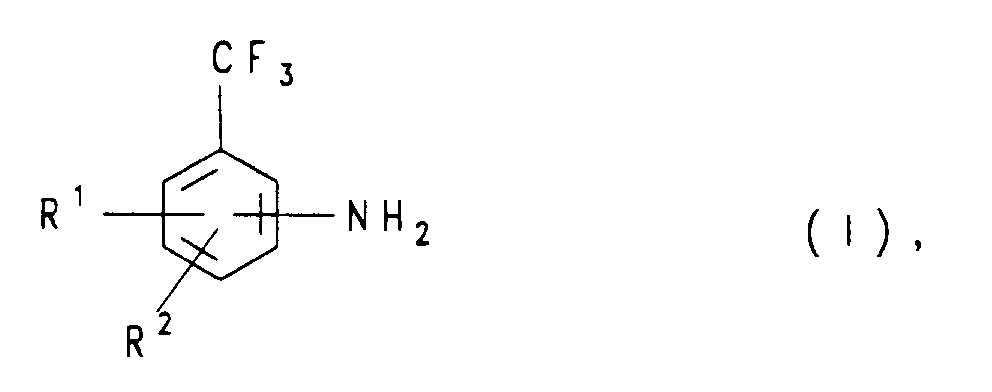
R¹ und R² unabhängig voneinander Wasserstoff, C₁-C₆-Alkyl, C₂-C₆-Alkenyl, substituiertes oder unsubstituiertes Aryl, Halogen, CF₃, Nitro, Amino, Methoxy, Hydroxy oder NR³R⁴ bedeuten, wobei R³ und R⁴ unabhängig voneinander für Wasserstoff oder C₁-C₅-Alkylreste stehen, und
die NH₂-Gruppe in 2-, 3- oder 4-Position zur CF₃-Gruppe stehen kann und - b) mindestens einer Base.
Description
- Aminobenzotrifluoride sind als Ausgangsprodukte zur Herstellung zahlreicher relevanter Verbindungen beispielsweise auf dem Gebiet der Pflanzenschutzmittel und Pharmazeutika von großer technischer Bedeutung.
- Aminobenzotrifluoride besitzen geringe Hitze- und Lagerstabilität. In R.G. Jones, J. Amer. Chem. Soc. 69, 2346 (1947) ist beschrieben, daß 2- und 4-Aminobenzotrifluorid beim Erhitzen in glasartige Polymere übergehen.
- 2-Aminobenzotrifluorid verharzt bei 140 bis 150°C in weniger als 2 Stunden. 4-Aminobenzotrifluorid ist sogar bereits bei 120°C nicht mehr stabil und verharzt innerhalb von 1,5 Stunden. Chlorsubstituenten am Ring erhöhen zwar die Stabilität, jedoch tritt auch hier ab etwa 180°C eine Verharzung ein. Diese Eigenschaft erschwert die Reindarstellung dieser Verbindungen, beispielsweise durch Destillation, erheblich, da die Siedepunkte selbst bei vermindertem Druck der Zersetzungstemperatur sehr nahe kommen. Die Destillate sind oftmals instabiler als die Rohprodukte. Auch für die Lagerung dieser Verbindungen, beispielsweise als Schmelzen, müssen Vorkehrungen gegen Überhitzung getroffen werden, zumal die Verharzung exotherm abläuft.
- Der vorliegenden Erfindung lag daher die Aufgabe zugrunde, Aminobenzotrifluoride in einer stabilisierten Form zur Verfügung zu stellen, in der sie die vorstehend geschilderten Nachteile überwinden.
- Es wurde gefunden, daß man Aminobenzotrifluoride überraschenderweise gegen thermische Zersetzung und Verharzung stabilisieren kann, wenn man ihnen eine basische Verbindung zusetzt.
- Gegenstand der vorliegenden Erfindung sind Präparationen eines stabilisierten Aminobenzotrifluorids, bestehend im wesentlichen aus
- a) einem Aminobenzotrifluorid der Formel (I),

R¹ und R² unabhängig voneinander Wasserstoff, C₁-C₆-Alkyl, vorzugsweise C₁-C₄-Alkyl, insbesondere Methyl; C₂-C₆-Alkenyl, vorzugsweise C₂-C₄-Alkenyl; substituiertes oder unsubstituiertes Aryl, vorzugsweise unsubstituiertes oder substituiertes Phenyl, insbesondere Phenyl, Hydroxyphenyl, Tolyl, Xylyl, Aminophenyl, Halogenphenyl und Nitrophenyl; Halogen, vorzugsweise Fluor, Chlor oder Brom; CF₃, Nitro, Amino, Methoxy, Hydroxy oder -NR³R⁴ bedeuten, wobei R³ und R⁴ unabhängig voneinander für Wasserstoff oder C₁-C₅-Alkylreste, vorzugsweise Wasserstoff oder C₁-C₃-Alkylreste, stehen, und die NH₂-Gruppe in 2-, 3- oder 4-Position zur CF₃-Gruppe stehen kann und - b) mindestens einer Base.
- Als Basen werden erfindungsgemäß vorzugsweise primäre, sekundäre oder tertiäre aliphatische oder araliphatische Amine der Formeln (IIa) oder (IIb) oder cycloaliphatische Amine der Formel (IIc) eingesetzt
R⁵R⁶R⁷N (IIa),
R⁸-[-NR⁹-(CR¹³R¹⁴)n-]m-NR¹⁰R¹¹ (IIb),

worin - R⁵, R⁶ und R⁷
- unabhängig voneinander jeweils für Wasserstoff, C₁-C₄₀-Alkyl, vorzugsweise C₁-C₂₀-Alkyl, C₃-C₈-Cycloalkyl, vorzugsweise C₅-C₆-Cycloalkyl, CY¹Y²-Aryl, wobei Y¹ und Y² unabhängig voneinander C₁-C₄-Alkyl, Aryl oder Wasserstoff bedeuten und Aryl vorzugsweise für substituiertes oder unsubstituiertes Phenyl, insbesondere für Phenyl, Aminophenyl, Hydroxyphenyl, Tolyl, Xylyl, Nitrophenyl und Halogenphenyl, steht,
- R⁸, R⁹, R¹⁰, R¹¹ und R¹²
- jeweils unabhängig voneinander für Wasserstoff, C₁-C₂₀-Alkyl oder C₃-C₈-Cycloalkyl, vorzugsweise für Wasserstoff oder C₁-C₃-Alkyl, stehen, wobei R¹² zusätzlich die Bedeutung -(CR¹³R¹⁴)p- haben kann,
- R¹³ und R¹⁴
- unabhängig voneinander für Wasserstoff oder Methyl stehen,
- m
- für eine ganze Zahl von 1 bis 5, vorzugsweise 1 bis 2,
- n
- für eine ganze Zahl von 2 bis 10, vorzugsweise 2 bis 3,
- p
- für eine ganze Zahl von 1 bis 8, vorzugsweise 1 bis 6, und
- q
- für eine ganze Zahl von 1 bis 5, vorzugsweise 1 bis 4, stehen.
- Bevorzugte Basen im Sinne der vorliegenden Erfindung sind ferner Alkalicarbonate, Erdalkalicarbonate, Alkalihydrogencarbonate, Alkalihydrogenphosphate, Erdalkalihydrogenphosphate, Alkalialkoholate, Erdalkalialkoholate, Alkalihydroxide oder Erdalkalihydroxide, wobei Alkali vorzugsweise für Lithium, Natrium oder Kalium und Erdalkali vorzugsweise für Magnesium oder Calcium stehen, oder eine Mischung aus mindestens zwei der vorstehend genannten Basen.
- Von den Aminen werden zum Zweck der vorliegenden Erfindung vorzugsweise solche ausgewählt, deren Siedepunkte hoch genug liegen, daß sie bei einer Destillation im Sumpf verbleiben, obwohl dies nicht zwingend notwendig ist. Niedrigsiedende Amine kann man auch nach Bedarf oder gegebenenfalls kontinuierlich nachdosieren.
- Von den Aminen der Formel (IIa) werden erfindungsgemäß beispielsweise eingesetzt:
Diethylamin, Triethylamin, Ethanolamin, Diethanolamin, Triethanolamin, n- oder iso-Propylamin, Di-n- oder Di-iso-propylamin, Tri-n- oder Tri-iso-propylamin, n-, iso- oder tert.-Butylamin, Amylamin, Hexylamin, Cyclohexylamin, Dicyclohexylamin, Stearylamin, Oleylamin, Talgfettamin, Cocosalkylamin, Distearylamin, Dimethylstearylamin und Dimethylbenzylamin. - Von den Aminen der Formel (IIb) werden erfindungsgemäß beispielsweise eingesetzt:
Ethylendiamin, Propylendiamin, Diethylentriamin, Dipropylentriamin, Triethylentetramin, Tripropylentetramin, 1,4-Diaminobutan, 1,5-Diaminopentan und 1,6-Diaminohexan. - Von den Aminen der Formel (IIc) werden erfindungsgemäß beispielsweise eingesetzt:
Pyrrolidin, Piperidin, Piperazin, Hexahydro-s-triazin, Urotropin, Hexamethylenimin, oder Trimethylenimin. - Es kann auch eine Mischung aus mindestens zwei der vorstehend genannten Amine eingesetzt werden.
- Von den vorstehend beschriebenen Alkali- und Erdalkaliverbindungen werden erfindungsgemäß insbesondere eingesetzt:
Natriumhydrogencarbonat, Natriumcarbonat, Kaliumcarbonat, Dinatriumhydrogenphosphat, Dikaliumhydrogenphosphat, Calciumhydroxid, Natriumhydroxid, Kaliumhydroxid, Natriumethanolat, Kaliumethanolat, Natriummethanolat, Kaliummethanolat, Natriumpropanolat oder eine Mischung dieser Basen. - Die Basen werden erfindungsgemäß in Mengen von 0,01 bis 10 Gew.-%, vorzugsweise 0,1 bis 2 Gew.-%, bezogen auf das Aminobenzotrifluorid, eingesetzt. Mengen über 10 Gew.-% der genannten Basen sind ebenfalls zur Stabilisierung der Aminobenzotrifluoride geeignet, aber aus ökologischen und ökonomischen Gesichtspunkten nicht mehr zweckmäßig.
- Als Aminobenzotrifluoride der Formel (I) sind beispielsweise von Interesse:
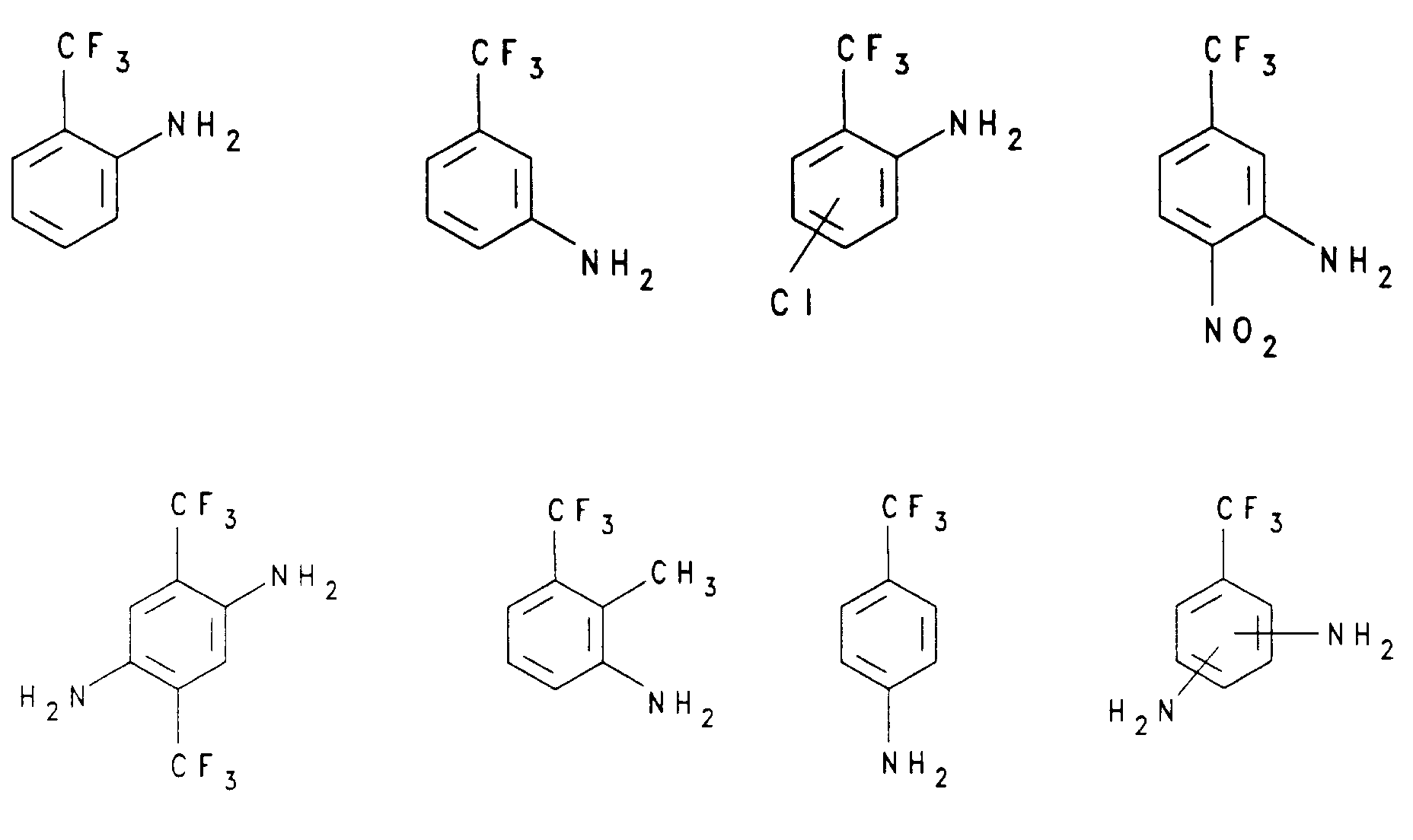
Von besonderem technischen Interesse sind 2-Aminobenzotrifluorid, 4-Aminobenzotrifluorid und 2-Amino-5-chlor-benzotrifluorid. - Gegenstand der vorliegenden Erfindung ist weiterhin ein Verfahren zur Stabilisierung von Aminobenzotrifluoriden der vorstehend definierten Formel (I), dadurch gekennzeichnet, daß man mindestens eine der vorstehend genannten Basen dem Aminobenzotrifluorid zusetzt, vorzugsweise vor oder während einer thermischen Belastung, beispielsweise einer Destillation. Die Basen können während einer thermischen Belastung auch kontinuierlich oder nach Bedarf in Portionen zugegeben werden. Ferner können die Basen zur Erhöhung der Lagerstabilität dem rohen oder gereinigten Aminobenzotrifluorid zugesetzt werden.
- Der stabilisierende Einfluß der genannten Basen auf die Aminobenzotrifluoride ist sehr hoch. So läßt sich beispielsweise 2-Aminobenzotrifluorid bei Zusatz von 0,5 Gew.-% einer Base mehrere Tage auf 150 bis 160°C erhitzen, ohne daß Zersetzung unter Harzbildung eintritt. Durch gaschromatographische Analyse lassen sich keine Zersetzungsprodukte feststellen. 4-Aminobenzotrifluorid bleibt bei Zusatz einer Base über 5 Stunden bei 150°C stabil, während es ohne Zusatz bereits nach 1,5 Stunden bei 120°C verharzt. Besonders geeignet zur Erhöhung der Lagerstabilität bei höheren Temperaturen sind Amine. Diese lösen sich in den Aminobenzotrifluoriden, so daß ein ständiges Rühren oder Umwälzen der Mischung unnötig ist.
- Destilliert man 2-Aminobenzotrifluorid über vorstehend genannte Basen, so ist das Destillat stabiler als ohne Basenzusatz erhaltene Destillate.
- Gegenstand der vorliegenden Erfindung ist daher auch die Verwendung der vorstehend genannten Basen zur Erhöhung der Lagerstabilität sowie der Thermostabilität von Aminobenzotrifluoriden der Formel (I).
- Die nachfolgenden Beispiele erläutern das erfindungsgemäße Verfahren, ohne es darauf zu beschränken.
- 10,0 g (62,1 mmol) 2-Aminobenzotrifluorid wurden unter Stickstoffatmosphäre auf 150°C erhitzt. Nach etwa 1,5 Stunden beobachtete man, daß das Edukt gelb und zähflüssig wurde und nach etwa 2 Stunden war es vollständig verharzt und erstarrt. Im gebildeten Harz ließen sich durch GC-, GC-MS- und MS-Analysen neben geringen Mengen an Edukt etwa 40 % verdampfbare Anteile mit Massen größer als 700 g/mol sowie unverdampfbare Komponenten mit hohen Molmassen nachweisen.
- 5,0 g (31 mmol) 4-Aminobenzotrifluorid wurden unter Stickstoffatmosphäre auf 120°C erhitzt. Nach etwa 1,5 Stunden war das Edukt vollständig verharzt.
- 10,0 g (51,2 mmol) 2-Amino-5-chlor-benzotrifluorid wurden unter Stickstoffatmosphäre auf 180°C erhitzt. Nach etwa 3 Stunden war das Edukt vollständig verharzt.
- Die nachfolgenden Beispiele 4 bis 21 wurden mit gleichem Ergebnis mit und ohne Stickstoffüberlagerung durchgeführt.
- 25,0 g (155 mmol) 2-Aminobenzotrifluorid wurden unter Zusatz von 0,5 g NaHCO₃ 56 Stunden auf 150°C erhitzt. Es wurde keine Verharzung beobachtet. Zersetzungsprodukte ließen sich mittels GC nicht nachweisen.
- 25,0 g (128 mmol) 2-Amino-5-chlor-benzotrifluorid wurden unter Zusatz von 0,5 g NaHCO₃ 56 Stunden auf 150°C erhitzt. Es wurde keine Verharzung beobachtet. Zersetzungsprodukte ließen sich mittels GC nicht nachweisen.
- Die in der nachfolgenden Tabelle aufgeführten Beispiele 6 bis 18 wurden analog zu Beispiel 4 mit jeweils 100 g (0,62 mol) 2-Aminobenzotrifluorid durchgeführt und bei einer Temperatur von 150°C jeweils 8 Stunden erhitzt.
Beispiel Base 6 0,5 g NaHCO₃ 7 0,5 g Na₂CO₃ 8 0,5 g NaOH (fest) 9 0,5 g Na₂HPO₄ 10 0,5 g Ca(OH)₂ 11 0,5 g Stearylamin 12 0,5 g Dimethylbenzylamin 13 0,5 g Trietylamin 14 0,5 g Cyclohexylamin 15 0,5 g Urotropin 16 0,5 g Dimethylstearylamin 17 0,5 g Natriummethanolat 18 0,5 g Distearylamin - In allen aufgeführten Beispielen blieb das 2-Aminobenzotrifluorid stabil. Es wurde keine Verharzung oder Zersetzung beobachtet.
- 10,0 g (62,1 mmol) 4-Aminobenzotrifluorid wurden unter Zusatz von 0,5 g Stearylamin auf 150°C erhitzt. Das 4-Aminobenzotrifluorid blieb über 5 Stunden stabil.
- 100 g (0,52 mol) 2-Amino-5-chlor-benzotrifluorid wurden unter Zusatz von 0,5 g Stearylamin auf 185°C erhitzt. Das 2-Amino-5-chlor-benzotrifluorid blieb über 8 Stunden stabil. Es wurde keine Zersetzung oder Verharzung beobachtet.
- 10,0 g (62,1 mmol) 4-Aminobenzotrifluorid wurden unter Zusatz von 0,5 g NaHCO₃ auf 150°C erhitzt. Das 4-Aminobenzotrifluorid blieb über 5 Stunden stabil.
- 100,0 g (621 mmol) 2-Aminobenzotrifluorid wurden mit 0,5 g Stearylamin gemischt und bei 80°C/0,04 bar über eine 20 cm Vigreux-Kolonne destilliert. Das so erhaltene Destillat wird auf 150°C erhitzt. Erst nach 6 Stunden gab es Anzeichen einer beginnenden Verharzung, nach etwa 7,5 Stunden war der Ansatz vollständig verharzt.
Claims (12)
- Präparation eines stabilisierten Aminobenzotrifluorids, bestehend im wesentlichen ausa) einem Aminobenzotrifluorid der Formel (I),
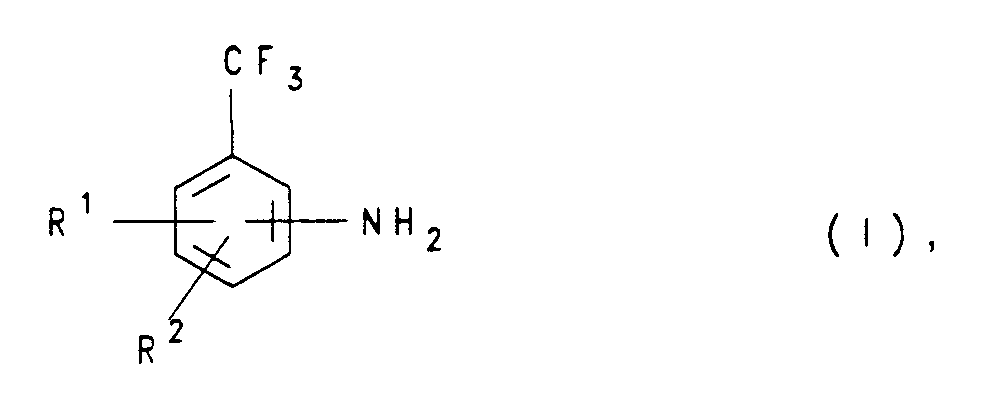
R¹ und R² unabhängig voneinander Wasserstoff, C₁-C₆-Alkyl, C₂-C₆-Alkenyl, substituiertes oder unsubstituiertes Aryl, Halogen, CF₃, Nitro, Amino, Methoxy, Hydroxy oder NR³R⁴ bedeuten, wobei R³ und R⁴ unabhängig voneinander für Wasserstoff oder C₁-C₅-Alkylreste stehen, und die NH₂-Gruppe in 2-, 3- oder 4-Position zur CF₃-Gruppe stehen kann undb) mindestens einer Base. - Präparation gemäß Anspruch 1, dadurch gekennzeichnet, daß im Aminobenzotrifluorid der Formel (I)
R¹ und R² unabhängig voneinander jeweils für Wasserstoff, C₁-C₄-Alkyl, vorzugsweise Methyl, C₂-C₄-Alkenyl, Fluor, Chlor, Brom, CF₃, NO₂, NH₂, OCH₃, OH, substituiertes oder unsubstituiertes Phenyl, vorzugsweise Phenyl, Hydroxyphenyl, Tolyl, Xylyl, Aminophenyl, Halogenphenyl oder Nitrophenyl, oder NR³R⁴, worin R³ und R⁴ unabhängig voneinander Wasserstoff oder C₁-C₃-Alkyl bedeuten, stehen. - Präparation gemäß Anspruch 1 oder 2, dadurch gekennzeichnet, daß das Aminobenzotrifluorid 2-Aminobenzotrifluorid, 3-Aminobenzotrifluorid, 4-Aminobenzotrifluorid, 2-Amino-5-chlor-benzotrifluorid, 3-Amino-4-nitrobenzotrifluorid , 2,5-Diamino-4-trifluormethyl-benzotrifluorid, 3-Amino-2-methylbenzotrifluorid oder ein Diaminobenzotrifluorid ist.
- Präparation nach mindestens einem der Ansprüche 1 bis 3, dadurch gekennzeichnet, daß die Base ein primäres, sekundäres oder tertiäres Amin der Formeln (IIa) oder (IIb) oder ein cycloaliphatisches Amin der Formel (IIc) ist
R⁵R⁶R⁷N (IIa),
R⁸-[-NR⁹-(CR¹³R¹⁴)n-]m-NR¹⁰R¹¹ (IIb),

R⁵, R⁶ und R⁷ unabhängig voneinander jeweils für Wasserstoff, C₁-C₄₀-Alkyl, vorzugsweise C₁-C₂₀-Alkyl, C₃-C₈-Cycloalkyl, vorzugsweise C₅-C₆-Cycloalkyl, CY¹Y²-Aryl, wobei Y¹ und Y² unabhängig voneinander C₁-C₄-Alkyl, Aryl oder Wasserstoff bedeuten und Aryl vorzugsweise für substituiertes oder unsubstituiertes Phenyl, insbesondere für Phenyl, Aminophenyl, Hydroxyphenyl, Tolyl, Xylyl, Nitrophenyl oder Halogenphenyl, steht,
R⁸, R⁹, R¹⁰, R¹¹ und R¹² jeweils unabhängig voneinander für Wasserstoff, C₁-C₂₀-Alkyl oder C₃-C₈-Cycloalkyl, vorzugsweise für Wasserstoff oder C₁-C₃-Alkyl, stehen, wobei R¹² zusätzlich die Bedeutung -(CR¹³R¹⁴)p- haben kann,
R¹³ und R¹⁴ unabhängig voneinander für Wasserstoff oder Methyl stehen,m für eine ganze Zahl von 1 bis 5, vorzugsweise 1 bis 2,n für eine ganze Zahl von 2 bis 10, vorzugsweise 2 bis 3,p für eine ganze Zahl von 1 bis 8, vorzugsweise 1 bis 6, undq für eine ganze Zahl von 1 bis 5, vorzugsweise 1 bis 4, stehen,oder eine Mischung der vorstehend genannten Amine ist. - Präparation nach mindestens einem der Ansprüche 1 bis 4, dadurch gekennzeichnet, daß die Base Stearylamin, Diethylamin, Triethylamin, Cyclohexylamin, Dimethylbenzylamin, Ethanolamin, Diethanolamin, Triethanolamin, n- oder iso-Propylamin, Di-n- oder Di-iso-propylamin, Tri-n- oder Tri-iso-propylamin, n-, iso- oder tert.-Butylamin, Amylamin, Hexylamin, Cyclohexylamin, Oleylamin, Talgfettamin, Cocosalkylamin, Distearylamin, Dimethylstearylamin, Dimethylbenzylamin, Ethylendiamin, Propylendiamin, Diethylentriamin, Dipropylentriamin, Triethylentetramin, Tripropylentetramin, 1,4-Diaminobutan, 1,5-Diaminopentan, 1,6-Diaminohexan, Pyrrolidin, Piperidin, Piperazin, Hexahydro-s-triazin, Urotropin, Hexamethylenimin, Trimethylenimin oder eine Mischung aus mindestens zwei der genannten Amine ist.
- Präparation nach mindestens einem der Ansprüche 1 bis 5, dadurch gekennzeichnet, daß die Base Stearylamin, Triethylamin, Cyclohexylamin, Dimethylstearylamin, Distearylamin, Urotropin oder eine Mischung aus mindestens zwei der genannten Amine ist.
- Präparation nach mindestens einem der Ansprüche 1 bis 3, dadurch gekennzeichnet, daß die Base ein Alkalicarbonat, Erdalkalicarbonat, Alkalihydrogencarbonat, Alkalihydrogenphosphat, Erdalkalihydrogenphosphat, Alkalialkoholat, Erdalkalialkoholat, Alkalihydroxid oder Erdalkalihydroxid ist, wobei Alkali vorzugsweise für Lithium, Natrium oder Kalium und Erdalkali vorzugsweise für Magnesium oder Calcium stehen, oder eine Mischung der vorstehend genannten Basen.
- Präparation nach Anspruch 7, dadurch gekennzeichnet, daß die Base Natriumhydrogencarbonat, Natriumcarbonat, Natriumhydroxid, Natriummethanolat, Dinatriumhydrogenphosphat, Calciumhydroxid oder eine Mischung aus mindestens zwei der genannten Basen ist.
- Präparation nach mindestens einem der Ansprüche 1 bis 8, dadurch gekennzeichnet, daß die Base in einer Menge von 0,01 bis 10 Gew.-%, vorzugsweise 0,1 bis 2 Gew.-%, bezogen auf das Aminobenzotrifluorid, enthalten ist.
- Verfahren zur Stabilisierung von Aminobenzotrifluoriden der Formel (I) nach mindestens einem der Ansprüche 1 bis 3, dadurch gekennzeichnet, daß man dem Aminobenzotrifluorid mindestens eine Base zusetzt.
- Verfahren nach Anspruch 10, dadurch gekennzeichnet, daß man die Base vor oder während einer thermischen Belastung dem Aminobenzotrifluorid zusetzt.
- Verwendung der Basen nach mindestens einem der Ansprüche 4 bis 9 zur Erhöhung der Lagerstabilität und der Thermostabilität von Aminobenzotrifluoriden der Formel (I).
Applications Claiming Priority (2)
| Application Number | Priority Date | Filing Date | Title |
|---|---|---|---|
| DE4214849 | 1992-05-05 | ||
| DE4214849 | 1992-05-05 |
Publications (3)
| Publication Number | Publication Date |
|---|---|
| EP0568977A2 true EP0568977A2 (de) | 1993-11-10 |
| EP0568977A3 EP0568977A3 (en) | 1993-12-15 |
| EP0568977B1 EP0568977B1 (de) | 1996-08-21 |
Family
ID=6458228
Family Applications (1)
| Application Number | Title | Priority Date | Filing Date |
|---|---|---|---|
| EP93107214A Expired - Lifetime EP0568977B1 (de) | 1992-05-05 | 1993-05-04 | Stabilisierte Aminobenzotrifluoride |
Country Status (4)
| Country | Link |
|---|---|
| US (1) | US5349104A (de) |
| EP (1) | EP0568977B1 (de) |
| JP (1) | JPH0641027A (de) |
| DE (1) | DE59303468D1 (de) |
Family Cites Families (8)
| Publication number | Priority date | Publication date | Assignee | Title |
|---|---|---|---|---|
| US2681935A (en) * | 1951-09-28 | 1954-06-22 | Universal Oil Prod Co | Stabilization of aryl amino compounds |
| US2913495A (en) * | 1957-03-25 | 1959-11-17 | Union Carbide Corp | Stabilization of arylamines |
| US2911340A (en) * | 1957-05-06 | 1959-11-03 | Du Pont | Stabilization of chloroanilines under thermal stress |
| DE1121058B (de) * | 1958-03-29 | 1962-01-04 | Basf Ag | Verfahren zum Stabilisieren des Farbtons von am Stickstoffatom substituierten aromatischen Aminen |
| US3324011A (en) * | 1963-11-01 | 1967-06-06 | Du Pont | Stabilization of chloro-substituted aromatic amines during thermal stress |
| JPS62238226A (ja) * | 1986-04-09 | 1987-10-19 | Nippon Kayaku Co Ltd | フロロフェノール類の熱分解防止法 |
| US4990663A (en) * | 1989-05-15 | 1991-02-05 | E. I. Du Pont De Nemours And Company | Process for preparing halogenated aromatic amines |
| JP2771011B2 (ja) * | 1990-04-03 | 1998-07-02 | 三井化学株式会社 | 芳香族アミンの安定化方法 |
-
1993
- 1993-04-30 JP JP5104517A patent/JPH0641027A/ja active Pending
- 1993-05-04 US US08/058,281 patent/US5349104A/en not_active Expired - Fee Related
- 1993-05-04 DE DE59303468T patent/DE59303468D1/de not_active Expired - Fee Related
- 1993-05-04 EP EP93107214A patent/EP0568977B1/de not_active Expired - Lifetime
Also Published As
| Publication number | Publication date |
|---|---|
| EP0568977A3 (en) | 1993-12-15 |
| US5349104A (en) | 1994-09-20 |
| DE59303468D1 (de) | 1996-09-26 |
| JPH0641027A (ja) | 1994-02-15 |
| EP0568977B1 (de) | 1996-08-21 |
Similar Documents
| Publication | Publication Date | Title |
|---|---|---|
| DE2943480A1 (de) | Verfahren zur herstellung von n,o-disubstituierten urethanen, sowie ihre verwendung als ausgangsmaterial zur herstellung von isocyanaten | |
| EP0240867A1 (de) | Verfahren zur Herstellung von Aminoalkyl- oder -aryl-Melaminen | |
| DE2203837A1 (de) | Verfahren zur Herstellung von Benzylphosphonaten | |
| EP0545149B1 (de) | Verfahren zur Herstellung von Derivaten des 6-Trifluormethyl-1,3,5-triazins | |
| DE10228594B4 (de) | Herstellung von farblosem Dibenzylamin | |
| EP0568977B1 (de) | Stabilisierte Aminobenzotrifluoride | |
| DE2206365B2 (de) | Verfahren zur Herstellung von N,Ndisubstituierten Carbaminsäurechloriden | |
| DE69315712T2 (de) | 2,4-Diamino-1,3,5-Triazinyl-6-Phosphonsäurederivate | |
| US2610183A (en) | 3-substituted derivatives of 2, 3-dihydrothianaphthene-1-dioxide | |
| EP0906280B1 (de) | Sterisch gehindertes 4-amino-piperidin mit geringem dimergehalt, seine herstellung und verwendung | |
| CH396870A (de) | Verfahren zur Herstellung von N-substituierten Carbaminsäurederivaten | |
| DE2222708A1 (de) | Benzylierung von Dialkylphosphiten mit Dithiourethanen | |
| EP0390739A2 (de) | Substituierte Aminopyrrole als Stabilisatoren chlorhaltige Polymerisate | |
| US3080406A (en) | Pentavalent derivatives of antimony salts of organic acids and methods of preparing same | |
| DE1695117B2 (de) | Verfahren zur herstellung von chloramino-s-triazinen | |
| US2050190A (en) | Vulcanization of rubber | |
| DE1247318B (de) | Verfahren zur Herstellung von N-[5-Chlormethyloxazolinyl-(2)]-thioharnstoffderivaten | |
| DD301615A5 (de) | Verfahren zur herstellung von estern der phosphorigen und phosphonigen saeuren | |
| DE1198360B (de) | Verfahren zur Herstellung von o-Alkyl-S-(l-phenyl-2-alkoxycarbonyl-äthyl) - alkylthiophosphonaten | |
| DE1670973A1 (de) | Fluortriazinverbindungen | |
| DE2048080A1 (de) | ||
| DE1518338A1 (de) | Verfahren zur Herstellung von Diarylhydrogenphosphonaten | |
| DE1167587B (de) | Insektizides Mittel | |
| DE2551141A1 (de) | Cyclododecylamin-derivate | |
| DE1138390B (de) | Verfahren zur Herstellung von tetra-substituierten Formamidochlorformamidinen |
Legal Events
| Date | Code | Title | Description |
|---|---|---|---|
| PUAI | Public reference made under article 153(3) epc to a published international application that has entered the european phase |
Free format text: ORIGINAL CODE: 0009012 |
|
| PUAL | Search report despatched |
Free format text: ORIGINAL CODE: 0009013 |
|
| AK | Designated contracting states |
Kind code of ref document: A2 Designated state(s): CH DE FR GB IT LI |
|
| AK | Designated contracting states |
Kind code of ref document: A3 Designated state(s): CH DE FR GB IT LI |
|
| 17P | Request for examination filed |
Effective date: 19940411 |
|
| 17Q | First examination report despatched |
Effective date: 19950831 |
|
| GRAH | Despatch of communication of intention to grant a patent |
Free format text: ORIGINAL CODE: EPIDOS IGRA |
|
| GRAA | (expected) grant |
Free format text: ORIGINAL CODE: 0009210 |
|
| AK | Designated contracting states |
Kind code of ref document: B1 Designated state(s): CH DE FR GB IT LI |
|
| REF | Corresponds to: |
Ref document number: 59303468 Country of ref document: DE Date of ref document: 19960926 |
|
| ITF | It: translation for a ep patent filed | ||
| ET | Fr: translation filed | ||
| GBT | Gb: translation of ep patent filed (gb section 77(6)(a)/1977) |
Effective date: 19961025 |
|
| PLBE | No opposition filed within time limit |
Free format text: ORIGINAL CODE: 0009261 |
|
| 26N | No opposition filed | ||
| REG | Reference to a national code |
Ref country code: CH Ref legal event code: PUE Owner name: HOECHST AKTIENGESELLSCHAFT TRANSFER- CLARIANT GMBH |
|
| REG | Reference to a national code |
Ref country code: FR Ref legal event code: TP |
|
| REG | Reference to a national code |
Ref country code: GB Ref legal event code: 732E |
|
| PGFP | Annual fee paid to national office [announced via postgrant information from national office to epo] |
Ref country code: GB Payment date: 20010410 Year of fee payment: 9 Ref country code: DE Payment date: 20010410 Year of fee payment: 9 |
|
| PGFP | Annual fee paid to national office [announced via postgrant information from national office to epo] |
Ref country code: FR Payment date: 20010423 Year of fee payment: 9 |
|
| PGFP | Annual fee paid to national office [announced via postgrant information from national office to epo] |
Ref country code: CH Payment date: 20010425 Year of fee payment: 9 |
|
| REG | Reference to a national code |
Ref country code: GB Ref legal event code: IF02 |
|
| PG25 | Lapsed in a contracting state [announced via postgrant information from national office to epo] |
Ref country code: GB Free format text: LAPSE BECAUSE OF NON-PAYMENT OF DUE FEES Effective date: 20020504 |
|
| PG25 | Lapsed in a contracting state [announced via postgrant information from national office to epo] |
Ref country code: LI Free format text: LAPSE BECAUSE OF NON-PAYMENT OF DUE FEES Effective date: 20020531 Ref country code: CH Free format text: LAPSE BECAUSE OF NON-PAYMENT OF DUE FEES Effective date: 20020531 |
|
| PG25 | Lapsed in a contracting state [announced via postgrant information from national office to epo] |
Ref country code: DE Free format text: LAPSE BECAUSE OF NON-PAYMENT OF DUE FEES Effective date: 20021203 |
|
| GBPC | Gb: european patent ceased through non-payment of renewal fee |
Effective date: 20020504 |
|
| REG | Reference to a national code |
Ref country code: CH Ref legal event code: PL |
|
| PG25 | Lapsed in a contracting state [announced via postgrant information from national office to epo] |
Ref country code: FR Free format text: LAPSE BECAUSE OF NON-PAYMENT OF DUE FEES Effective date: 20030131 |
|
| REG | Reference to a national code |
Ref country code: FR Ref legal event code: ST |
|
| PG25 | Lapsed in a contracting state [announced via postgrant information from national office to epo] |
Ref country code: IT Free format text: LAPSE BECAUSE OF NON-PAYMENT OF DUE FEES;WARNING: LAPSES OF ITALIAN PATENTS WITH EFFECTIVE DATE BEFORE 2007 MAY HAVE OCCURRED AT ANY TIME BEFORE 2007. THE CORRECT EFFECTIVE DATE MAY BE DIFFERENT FROM THE ONE RECORDED. Effective date: 20050504 |