EP0569207A2 - Bilddatenkompression - Google Patents
Bilddatenkompression Download PDFInfo
- Publication number
- EP0569207A2 EP0569207A2 EP93303442A EP93303442A EP0569207A2 EP 0569207 A2 EP0569207 A2 EP 0569207A2 EP 93303442 A EP93303442 A EP 93303442A EP 93303442 A EP93303442 A EP 93303442A EP 0569207 A2 EP0569207 A2 EP 0569207A2
- Authority
- EP
- European Patent Office
- Prior art keywords
- pixel
- values
- code
- frame
- compressed
- Prior art date
- Legal status (The legal status is an assumption and is not a legal conclusion. Google has not performed a legal analysis and makes no representation as to the accuracy of the status listed.)
- Withdrawn
Links
- 238000013144 data compression Methods 0.000 title description 3
- 230000006837 decompression Effects 0.000 claims abstract description 27
- 238000013507 mapping Methods 0.000 claims abstract description 19
- 238000003491 array Methods 0.000 claims abstract description 18
- 230000002123 temporal effect Effects 0.000 claims description 35
- 238000000034 method Methods 0.000 claims description 25
- 230000004044 response Effects 0.000 claims description 16
- 230000015654 memory Effects 0.000 claims description 7
- 238000007906 compression Methods 0.000 abstract description 28
- 230000006835 compression Effects 0.000 abstract description 27
- 230000000295 complement effect Effects 0.000 abstract description 3
- 230000008569 process Effects 0.000 description 14
- 238000012360 testing method Methods 0.000 description 14
- 230000033001 locomotion Effects 0.000 description 12
- 238000012545 processing Methods 0.000 description 12
- 239000003086 colorant Substances 0.000 description 6
- 238000010586 diagram Methods 0.000 description 6
- 230000008901 benefit Effects 0.000 description 5
- 230000002596 correlated effect Effects 0.000 description 5
- 230000000875 corresponding effect Effects 0.000 description 5
- 230000001276 controlling effect Effects 0.000 description 4
- 230000009467 reduction Effects 0.000 description 4
- 238000013459 approach Methods 0.000 description 3
- 230000008859 change Effects 0.000 description 2
- 230000000694 effects Effects 0.000 description 2
- 101001050286 Homo sapiens Jupiter microtubule associated homolog 1 Proteins 0.000 description 1
- 102100023133 Jupiter microtubule associated homolog 1 Human genes 0.000 description 1
- 244000107946 Spondias cytherea Species 0.000 description 1
- 239000000872 buffer Substances 0.000 description 1
- 238000001514 detection method Methods 0.000 description 1
- 239000003973 paint Substances 0.000 description 1
- 238000010422 painting Methods 0.000 description 1
- 230000011664 signaling Effects 0.000 description 1
- 238000005549 size reduction Methods 0.000 description 1
- 230000007480 spreading Effects 0.000 description 1
Images





Classifications
-
- H—ELECTRICITY
- H04—ELECTRIC COMMUNICATION TECHNIQUE
- H04N—PICTORIAL COMMUNICATION, e.g. TELEVISION
- H04N19/00—Methods or arrangements for coding, decoding, compressing or decompressing digital video signals
-
- H—ELECTRICITY
- H04—ELECTRIC COMMUNICATION TECHNIQUE
- H04N—PICTORIAL COMMUNICATION, e.g. TELEVISION
- H04N19/00—Methods or arrangements for coding, decoding, compressing or decompressing digital video signals
- H04N19/50—Methods or arrangements for coding, decoding, compressing or decompressing digital video signals using predictive coding
- H04N19/503—Methods or arrangements for coding, decoding, compressing or decompressing digital video signals using predictive coding involving temporal prediction
- H04N19/507—Methods or arrangements for coding, decoding, compressing or decompressing digital video signals using predictive coding involving temporal prediction using conditional replenishment
-
- H—ELECTRICITY
- H04—ELECTRIC COMMUNICATION TECHNIQUE
- H04N—PICTORIAL COMMUNICATION, e.g. TELEVISION
- H04N19/00—Methods or arrangements for coding, decoding, compressing or decompressing digital video signals
- H04N19/50—Methods or arrangements for coding, decoding, compressing or decompressing digital video signals using predictive coding
- H04N19/503—Methods or arrangements for coding, decoding, compressing or decompressing digital video signals using predictive coding involving temporal prediction
- H04N19/51—Motion estimation or motion compensation
-
- H—ELECTRICITY
- H04—ELECTRIC COMMUNICATION TECHNIQUE
- H04N—PICTORIAL COMMUNICATION, e.g. TELEVISION
- H04N19/00—Methods or arrangements for coding, decoding, compressing or decompressing digital video signals
- H04N19/90—Methods or arrangements for coding, decoding, compressing or decompressing digital video signals using coding techniques not provided for in groups H04N19/10-H04N19/85, e.g. fractals
-
- H—ELECTRICITY
- H04—ELECTRIC COMMUNICATION TECHNIQUE
- H04N—PICTORIAL COMMUNICATION, e.g. TELEVISION
- H04N19/00—Methods or arrangements for coding, decoding, compressing or decompressing digital video signals
- H04N19/10—Methods or arrangements for coding, decoding, compressing or decompressing digital video signals using adaptive coding
- H04N19/102—Methods or arrangements for coding, decoding, compressing or decompressing digital video signals using adaptive coding characterised by the element, parameter or selection affected or controlled by the adaptive coding
- H04N19/13—Adaptive entropy coding, e.g. adaptive variable length coding [AVLC] or context adaptive binary arithmetic coding [CABAC]
-
- H—ELECTRICITY
- H04—ELECTRIC COMMUNICATION TECHNIQUE
- H04N—PICTORIAL COMMUNICATION, e.g. TELEVISION
- H04N19/00—Methods or arrangements for coding, decoding, compressing or decompressing digital video signals
- H04N19/60—Methods or arrangements for coding, decoding, compressing or decompressing digital video signals using transform coding
-
- H—ELECTRICITY
- H04—ELECTRIC COMMUNICATION TECHNIQUE
- H04N—PICTORIAL COMMUNICATION, e.g. TELEVISION
- H04N19/00—Methods or arrangements for coding, decoding, compressing or decompressing digital video signals
- H04N19/90—Methods or arrangements for coding, decoding, compressing or decompressing digital video signals using coding techniques not provided for in groups H04N19/10-H04N19/85, e.g. fractals
- H04N19/91—Entropy coding, e.g. variable length coding [VLC] or arithmetic coding
Definitions
- This invention relates to the field of image data compression.
- a number of software based systems which are able to display moving images are also available, e.g. Apple QuickTime and EIDOS EditOne. Whilst these software based systems can be readily integrated with the operation of the rest of a computer system, they require powerful, and consequently expensive, computers to run them and either cannot manage to play at a uniform frame rate or have a poor picture resolution.
- Moving video images are highly information dense with the result that, even when using large capacity storage media such as CD-ROMs, data compression is required so that a satisfactory playing time can be achieved.
- data compression is required so that a satisfactory playing time can be achieved.
- decompression of the data and its painting on the computer display require a large portion of the processing capacity of even a powerful computer.
- a typical approach is that the video image data is digitised as a sequence of pixel appearance values (e.g. component RGB values) and then compressed using a lossy compression algorithm to achieve a desired data size per frame. Upon replay, the compressed data is read from the storage medium and decompressed back into a frame of pixel appearance values that are mapped to display pixel values of a type matched to and capable of driving the particular display device being used.
- pixel appearance values e.g. component RGB values
- the rate at which data can be read from a CD-ROM is limited to about 150,000 bytes per second which allows about 6000 bytes for each frame at a frame rate of 25 frames per second. This is reduced to about 500 bytes per frame when provision is made recording sound to accompany the moving images and to allow for access latency in the storage device. Compressing an image of an acceptable quality to 5000 bytes per frame requires the use of sophisticated compression and decompression algorithms which in turn place high demands upon the processing capacity of the computer system. Furthermore, in order to provide the flexibility to allow the recorded video images to be replayed using more than one type of video display device, it is necessary to support the overhead of mapping pixel appearance values to pixel display values needed to drive the display device concerned.
- This invention is concerned with the problem of producing video images from a compressed data stream with reduced processing requirements.
- This invention provides apparatus for forming a sequence of arrays of pixel display values for driving a display device from a stream of compressed data, each of said arrays of pixel display values representing a frame of a moving image, said apparatus comprising: means responsive to a pixel copy code within said stream of compressed data for copying one or more previously formed pixel display values to a current position within said array; means responsive to a new pixel code within said stream of compressed data for mapping one or more pixel appearance values specified by said new pixel codes to respective pixel display values; and means for writing said pixel display values derived from said new pixel code to a current position within said array.
- Embodiments of the invention provide a system with reduced data processing requirements.
- the invention both recognises and exploits that by providing pixel copy codes that per se contain no appearance information, no mapping from pixel appearance values to pixel display values need be performed for that code. Mapping pixel appearance values to pixel display values need be performed only when a new pixel is introduced into the image for the first time by a new pixel code, since subsequently the already mapped pixel display value will be copied from position to position as appropriate.
- pixel copy codes can be frequently used as parts of a representation of a new frame of image data with the advantages of both providing effective compression and a reduction in the amount of processing that need by performed upon decompression.
- the mapping of only new pixel codes in accordance with the invention produced a reduction of 30% in the processing time needed to decompress and paint a frame compared to conventional approaches whereby the full image was first decompressed and then subsequently mapped as a whole.
- Such improvements in decompression speed are highly advantageous since it is critical when replaying a sequence moving images that real time operation be achieved. It must also be borne in mind that after having decompressed the images, the computer should have sufficient processing capacity remaining to handle the reproduction of sound to accompany the moving images so as to provide the desired effect.
- mapping of pixel appearance values to pixel display values could take many forms.
- a particularly common form of mapping that is required in computer systems in order to produce an image with a sufficiently broad range of colours and intensities given the limitations of typical computer display systems is to map the pixel appearance values into dithered pixel values whereby each pixel appearance value is represented by a small group of display pixels whose colours and intensities are carefully chosen and slightly different from one another so as to produce an overall effect of a desired colour and shade.
- Mapping to dithered pixel values to represent a full colour image can be a particularly processing intensive operation to which the invention can make a valuable contribution to reducing processing requirements. In such situations the pixel appearance values are typically colour component values.
- preferred embodiments of the invention are such that in response to a pixel copy code that is a temporal copy code, said previously formed pixel display values are copied from a preceding frame.
- Temporal correlation may be present between widely spaced parts of adjacent image frames, but in most sequences of image frames most temporal correlation occurs between regions that are closely spaced in the adjacent image frames.
- said temporal copy code specifies a position within a temporal source window centred on a position within said preceding frame corresponding to said current position from which said previously formed pixel display values are to be copied. This feature allows an increase in the degree of compression achievable since only a relative position need be specified and also reduces the time taken to compress each image frame since temporal correlation is only looked for within the temporal source window.
- spatial correlation can be exploited by preferred embodiments of the invention in which wherein, in response to a pixel copy code that is a spatial copy code, said previously formed pixel display values are copied from that frame currently being formed.
- said spatial copy code specifies a position within a spatial source window adjacent said current position from which said previously formed pixel display values are to be copied.
- Pixel copy codes may be provided based upon various different shapes and sizes of previously formed pixel display values, e.g. rectangles or triangles of previously formed pixels.
- said previously formed pixel display values are copied from consecutive memory locations and form a linear string of pixel values. This feature exploits the fact that many computer processors have efficient and fast machine code instructions for copying data values from consecutive addresses and that with directly mapped display memories the image data is required to be painted in consecutive memory locations.
- the invention also provides a method of forming a sequence of arrays of pixel display values for driving a display device from a stream of compressed data, each of said arrays of pixel display values representing a frame of a moving image, said method comprising the steps of: in response to a pixel copy code within said stream of compressed data, copying one or more previously formed pixel display values to a current position within said array; in response to a new pixel code within said stream of compressed data, mapping one or more pixel appearance value specified by said new pixel codes to respective pixel display values; and writing said pixel display values derived from said new pixel code to a current position within said array.
- a complementary aspect of this invention is a system of compression which produces a stream of compressed data of a form in which mapping of pixel appearance value to pixel display values need only be performed for pixels upon their first occurrence within the image.
- the invention also provides apparatus for forming a stream of compressed data from a sequence of arrays of pixel values, each of said arrays of pixel values representing a frame of a moving image, said apparatus comprising: means for searching through previously compressed pixel values from a preceding frame to identify one or more preceding frame pixel values matching one or more pixel values at a current position within an array of pixel values being compressed and in response to such identification generating a temporal copy code for controlling copying of said preceding frame pixel values to said current position upon subsequent decompression; means for searching through previously compressed pixel values from that frame currently being compressed to identify one or more current frame pixel values matching one or more pixel values at a current position within an array of pixel values being compressed and in response to such identification generating a spatial copy code for controlling copying of said current frame
- This complementary aspect of the invention also provides a method of forming a stream of compressed data from a sequence of arrays of pixel values, each of said arrays of pixel values representing a frame of a moving image, said method comprising the steps of: searching through previously compressed pixel values from a preceding frame to identify one or more preceding frame pixel values matching one or more pixel values at a current position within an array of pixel values being compressed and in response to such identification generating a temporal copy code for controlling copying of said preceding frame pixel values to said current position upon subsequent decompression; searching through previously compressed pixel values from that frame currently being compressed to identify one or more current frame pixel values matching one or more pixel values at a current position within an array of pixel values being compressed and in response to such identification generating a spatial copy code for controlling copying of said current frame pixel values to said current position upon subsequent decompression; and generating a new pixel code representing any non-matching pixel to be compressed that cannot be represented by a temporal copy code or a spatial copy
- FIG. 1 shows a computer system 2 of the type in which the present invention may be embodied.
- the computer system 2 comprises a display 4, a system unit 6 and a keyboard 8 connected to a CD-ROM unit 10 and a video tape recorder 12 (the video tape recorder 12, or another video image source such as a laser disc unit, is not required on machines which are intended only for replay).
- the computer system 2 may be a Acorn Archimedes computer using an ARM2 or ARM3 microprocessor.
- the CD-ROM 10 is used as a high capacity storage device to store compressed moving image data for supply to the system unit 6 where it is decompressed and displayed upon the display 4.
- the video cassette recorder 12 is used as a source of frames of moving image data that is to be compressed into a stream of compressed data that may then be used to master CD-ROM discs.
- the display 4 shows an inset video window 14 displaying a full motion video picture of the type that can be generated from the stream of compressed data. The provision of such an inset window 14 contributes to providing the advantages associated with multimedia computing.
- Figure 2 illustrates a size reduction of a full frame of pixel data that is performed as the first step during compression of source image data.
- a frame of video image data from the video tape recorder 12 is digitised to a full screen size of 768 by 576 pixels at 24 bits per pixel. This uses 1327104 bytes per frame.
- the first step to meeting the required compression is to reduce the size of this full screen to 160 by 128 pixels using 15 bits per pixel (5 bits of each of red, green and blue). All source pixels (or fractions thereof) lying on an output pixel are summed at high resolution and the result scaled to 15 bits per pixel and dithered to avoid quantisation of colours.
- the summing process also effectively removes noise from the original and preserves small features as intermediate, anti-aliased values.
- the anti-aliasing is achieved by spreading the remainder bits from the scaling step among adjacent output pixels yet to be calculated according to the proportions illustrated in Figure 2.
- the reduction in size of the image is calculated on an output pixel by output pixel basis following a zig-zag pattern within the frame as illustrated in Figure 2.
- the process reduces the data to 38400 bytes per frame.
- the compression then has to further compress the data from the 38400 byte form by a factor around 7 in order to reach the CD-ROM data bandwidth target, no known lossless compression scheme is capable of this factor of compression and accordingly a lossy compression scheme is used. Since video images possess frame to frame correlation, and from a practical point of view the format need only provide forward play, the compression system uses a conditional replenishment scheme. This conditional replenishment scheme is capable of dealing with pans and zooms; effectively becoming a motion detection and coding scheme. Since the ARM processor can load and store consecutive memory locations to and from registers in one efficient instruction, this instruction is exploited to make the decompressor as fast as possible by searching for correlated horizontal lines of pixel values which will have consecutive memory addresses.
- Restricting the area of search reduces the compression times.
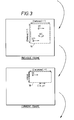
- the compressor searches a temporal source window 16 from (x-move, y-move) to (x+move y+move) in the previous frame. If a matching pixel to that at point C (x, y) is found then the next pixel at position (x+1, y) is compared with the adjacent pixel in the preceding frame to that already found to match so as to identify a string of matching pixels.
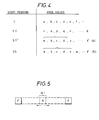
- Figure 4 illustrates the strings of pixel values starting at and following on from a selection of points within the frames illustrated in Figure 3.
- the pixel string starting at C is the string for which it is desired to find a matching previously occurring string for use as a source in a pixel copy code.
- the vast majority of positions at which searches are started will be uncorrelated as illustrated by start position ST and the search will terminate after one or two pixels. However, at some start positions such as ST' and SS a matching string of pixel values of some length will be found. Having fully searched both the temporal source window 16 and the spatial source window 18, the longest matching string of previously compressed pixels will be identified and this used as the basis of a command which will instruct a decompressor to copy those pixels to the current position C (x-y) upon subsequent decompression.
- the point SS in the spatial source window yields the longest matching string of five pixel values. Accordingly, a pixel copy code specifying a string length of five to be copied from relative position SS will be generated. The next pixel that need be considered for compression in the current frame will be at (x+5, y).
- a single value of the threshold is not used, since it represents a very large percentage change for dark colours and a small percentage change for bright colours.
- the compressor has a table of threshold values indexed by the pixels in the original sample: 32768 bytes of different values.
- Figure 5 illustrates an additional level of sophistication that may be incorporated in the matching process. It is inevitable that in non-synthetic image data there will be some noise such as pixel dropouts. Erroneous pixel values produced by such noise may result in pixel strings being deemed not to match when in fact they do. Accordingly, the matching test allows for one badly matching pixel (mismatch less than or equal to 2*"thr") within a string of pixels with good pixel values at each end of the pixel string.
- the compressor If, following all of the above described searching, the compressor has not been able to identify a matching string of pixels of at least two pixels in length, then it generates a new pixel code specifying the pixel appearance value (RGB value) of the non-matching pixel.
- the compressor's output has to be packed into a form which is small and quick to decompress. All packets are made one uniform size: 16 bits. This decision lost around 1/15 (7%) of the coding density of a variable length scheme, but was nearly twice as fast for decompression.
- the possible meanings of a word are: new pixel: coded as ⁇ 15 bits>O
- the position of the source relative to the target is encoded as a 9 bit number.
- 0 represents (x-move, y-move), 1 (x-move+1,y-move) etc. up to (x,y) which is not coded in this form.
- (x+1,y) is the next number.
- the remaining 6 bits of information expresses the length of the horizontal line: 0-63 code for lengths of 2 to 65 pixels.
- spatial coded as ⁇ direction> ⁇ length>1
- the position of the source relative to the target is encoded as a 9 bit number.
- 288 represents (x-smove, y-smove), 289 (x-smove+1, y-smove) etc up to 459 for (x+smove, y-1).
- the remaining 6 bits of information expresses the length of the horizontal line: 0-63 code for lengths of 2 to 65 pixels. skip n pixels: coded as ⁇ 11110> ⁇ length>1
- a five bit header ⁇ 11111> which cannot be a temporal or spatial moving line packet signals a new n pixels packet. 10 bits of information code for values 16 to 1024. This packet is then followed by n 15 bit pixels values. (For values of n less than 16 the compressor uses the new pixel packet form since it is denser and very nearly as fast). After unpacking the 15 bit pixels, the decompressor gets back to the fast 16 bit alignment. end of frame: coded as ⁇ 111001100> ⁇ 0>1
- N is selectable at compression time (e.g. 50 for 25 frames per second (fps) and 25 for 12.5 fps to give 2 second in a chunk) and is a tradeoff between the size of memory buffers needed for a chunk versus the efficiency of fewer disc i/o operations while decompressing (the compressed chunks are double buffered from disc).
- Figure 6 schematically illustrates, in flow diagram form, the operation of the compressor.
- steps 20 and 22 the abovedescribed searches for matching pixels within the temporal source window 16 and the spatial source window 18 are made.
- step 24 if no matching string of pixels of minimum length two pixels was found, then the process proceeds to step 26 where a count of unmatched pixels is incremented.
- step 32 a test is made to determine if the last pixel within the frame to be compressed has been reached. If the last pixel has not been reached, then the process returns to step 20. If the last pixel has been reached, then any pending codes are output at steps 34 and 36. In the case of new pixel codes, these can be either "new pixel" codes or "new n pixel" codes.
- the choice as to which code type is used is made based upon the number of pixels to be encoded. If this number is more than 16, then the "new n pixel" codes are more efficient. If the count is found to be greater than 1024, then more than one "new n pixel" code is generated, since 1024 is the maximum length of new pixels that can be represented by such a code.
- Step 38 outputs the most appropriate code as described above.
- Step 40 selects the longest matching string of pixels that was found during steps 20 and 22.
- step 42 passes control to step 44 where this matched string is merged with any previously detected pending zero motion line codes (i.e. "skip n pixel" codes) before control is passed to step 32. Since zero motion is common within real data it is worthwhile supporting this overhead of merging pending zero motion codes in the interests of improved coding efficiency and speed of decompression.
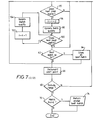
- Figure 7 is a flow diagram schematically illustrating the operation of the searches for matching pixel strings that are performed during steps 20 and 22 of Figure 6.
- a test is made to see if a minimum of two pixels match. If this condition is met, then at step 52 a matching pixel string length value "n" is set equal to two.
- a match quality value for the string found is updated.
- the match quality value gives an indication of how closely the string matches the string to be compressed given that it already passes the threshold test previously described.
- the match quality values can be considered as a counter whose value is incremented if a particular pixel within a string closely matches and decremented if it does not closely match.
- a match quality value for the string identified can be used to discriminate as to which string to use in the compressed data stream should two strings have the same pixel length.
- a test is made as to whether the next pixel matches. If the next pixel does match, then at steps 58 and 60 the value of "n" is incremented and the match quality value updated to reflect the new pixel added to the matching pixel string.
- step 56 When at step 56 the next pixel does not pass the threshold test, a test is made to see how badly the pixel matches. If the mismatch is too great to be tolerated (i.e. > 2*"thr"), then the matching string is immediately terminated and the process passes to step 62. If the mismatch was not too bad and the next pixel is within the threshold limit (step 95), then n is increased by two and the process enters another matching pixel loop about steps 100, 102 and 104. The above allows one badly matching pixel in the middle of a string to be tolerated as discussed in relation to Figure 5.
- step 62 the matching string currently under consideration is compared with any previously detected matching string of pixels and the pixel string which is the best match is chosen via step 64 if appropriate.
- step 66 the start point within the source window is incremented. If at step 68 the incremented start point is not outside of the source window, then the process returns to step 50. If at step 68 the incremented start point is outside of the source window, then steps 70 and 72 operate to return to the main process the best match pixel string found.
- Figure 8 illustrates two image frames.
- Frame 76 includes a circle that is moving rightwards and upwards.
- the movement of this circle has revealed an underlying rectangle of a spatial correlated appearance, e.g. a uniform colour.
- the operation of the compressor seeks to match the strings of pixels forming the circle in frame 78 to the corresponding strings of pixels forming the circle in frame 78. These strings of pixels are illustrated as s1, s2 and s3. When the compressor has identified these strings it will issue appropriate temporal pixel copy commands. Since the circle is present in both frames it is highly likely that the longest matching pixels strings will be found during the search through the temporal source window.
- the rectangle In contrast to the temporal correlation exhibited by the circle, the rectangle is of a uniform colour and accordingly exhibits a spatial correlation within the frame 78.
- the first pixels to be encountered of the rectangle will be the string of pixels n1 and these will be encoded using new pixel codes.
- the search through the spatial source window will reveal matching previously compressed pixels at least the positions corresponding to n1 and accordingly spatial copy codes will be issued.
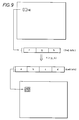
- Figure 9 illustrates a mapping of pixel appearance values to pixel display values.
- a new pixel 80 that has not previously been mapped is encountered during decompression (i.e. a new pixel code is received)
- this specifies a 15 bit appearance value.
- the new pixel 80 is mapped to 4 pixels a, b, c, d each having an 8 bit word specifying their colour.
- the 8 bit words are carefully chosen so as to combine to most closely approximate to the appearance specified in the 15 bit RGB value.
- This mapping is standard colour dithering and, as previously mentioned, is performed using a look up table.
- Figure 10 is a flow diagram schematically illustrating the operation of the decompression.
- a test is made as to whether the code being received is a line code (pixel copy code). If the code received is a line code, then the process proceeds to step 84 and executes the specified pixel copy from previously decompressed pixels within either the current frame or the previously decompressed frame.
- the position within the current frame being decompressed is advanced by the number of pixels represented by the code that has just been decompressed.
- a test is made as to whether the end of the current frame has been reached and, if not, the process returns to step 82.
- step 82 If at step 82, the code to be decompressed was not a line code then the code must be a new pixel code and then process proceeds to step 90 where the dither mapping illustrated in Figure 9 is performed for that new pixel value.
- the dithered pixel values derived at step 90 are then written to the current position within the frame being decompressed at step 92 prior to control being passed to step 86.
- the decompression process is simpler than the compression process and accordingly should operate more rapidly. This is desirable since real time operation is required on decompression whereas non-real time operation can be tolerated during compression.
- the vast majority of pixels will be produced by pixel copy codes via step 84. Only those pixels that cannot be copied from anywhere else are represented by new pixel codes and must accordingly undergo dither mapping. Once a pixel has been dither mapped, it is the dithered value that is the value that will be copied upon a subsequent pixel copy code specifying that dithered pixel. Thus, dithering need only be performed once for each pixel.
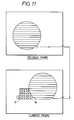
- Figure 11 illustrates the decompression of the image shown in Figure 8.
- a spatial copy code will be issued instructing the decompressor to copy the adjacent pixel string immediately above the pixel of point M so as to form the next line of the rectangle.
- the rectangle is, in this example, of a sufficiently uniform colour to show a high degree of spatial correlation.
- Other forms of spatial correlation are possible other than the simple example of uniform colour.
- a temporal copy code instructs the decompressor to copy the corresponding pixel string from the previous frame to the position starting at point N within the current frame. Since this is a temporal correlation, the circle need not be of uniform appearance providing that matching strings can be found in adjacent frames.
- a separate data structure contains the state of the stream at the start of each data block (which contains two seconds of video), but this data structure need not be considered when computing the compression and data bandwidth required to play the movie.
- the video compressor is "size directed". It compresses the frame under consideration at the current quality threshold (match threshold, "thr”) checks to see if the resultant size is correct for the media the movie will be decompressed from, and tries again at a different quality threshold if necessary.
- match threshold “thr”
- This capability of the compressor allows movies to take maximum benefit of the digital device for which they are mastered.
- the consistent size of the compression version of a frame has a large benefit in that it always requires approximately the same amount of processing power to decompress it. This then makes it easier to achieve uniform display rates from the decompressing computer.
- the continuous data stream does have a disadvantage in that a computer which is not capable of decompressing the data at the full rate cannot cope at all.
- the movie is compressed twice, once at full frame rate and once at half frame rate, and provided as two separate files.
Landscapes
- Engineering & Computer Science (AREA)
- Multimedia (AREA)
- Signal Processing (AREA)
- Compression Or Coding Systems Of Tv Signals (AREA)
Applications Claiming Priority (2)
| Application Number | Priority Date | Filing Date | Title |
|---|---|---|---|
| GB9209646A GB2267624B (en) | 1992-05-05 | 1992-05-05 | Image data compression |
| GB9209646 | 1992-05-05 |
Publications (2)
| Publication Number | Publication Date |
|---|---|
| EP0569207A2 true EP0569207A2 (de) | 1993-11-10 |
| EP0569207A3 EP0569207A3 (de) | 1994-11-17 |
Family
ID=10714997
Family Applications (1)
| Application Number | Title | Priority Date | Filing Date |
|---|---|---|---|
| EP19930303442 Withdrawn EP0569207A3 (de) | 1992-05-05 | 1993-05-04 | Bilddatenkompression. |
Country Status (3)
| Country | Link |
|---|---|
| US (1) | US5497434A (de) |
| EP (1) | EP0569207A3 (de) |
| GB (1) | GB2267624B (de) |
Cited By (3)
| Publication number | Priority date | Publication date | Assignee | Title |
|---|---|---|---|---|
| WO1995016325A1 (en) * | 1993-12-07 | 1995-06-15 | Eidos Plc | Improvements in or relating to video processing systems |
| EP0703549A3 (de) * | 1994-09-20 | 1996-10-02 | Seiko Epson Corp | Zweidimensionales Verfahren und System zur Binärbilddatenkompression |
| EP0870251A4 (de) * | 1995-10-19 | 2000-07-26 | America Online Inc | Apparat und verfahren für die zweidimensionale datenkompression |
Families Citing this family (41)
| Publication number | Priority date | Publication date | Assignee | Title |
|---|---|---|---|---|
| JP2759108B2 (ja) * | 1993-12-29 | 1998-05-28 | カシオ計算機株式会社 | 液晶表示装置 |
| JPH0832962A (ja) * | 1994-07-20 | 1996-02-02 | Seiko Epson Corp | 動画映像信号の圧縮/伸長装置 |
| US5809173A (en) * | 1995-04-18 | 1998-09-15 | Advanced Micro Devices, Inc. | Method and apparatus for improved video decompression using previous frame DCT coefficients |
| US5774600A (en) * | 1995-04-18 | 1998-06-30 | Advanced Micro Devices, Inc. | Method of pixel averaging in a video processing apparatus |
| US5724446A (en) * | 1995-04-18 | 1998-03-03 | Advanced Micro Devices, Inc. | Video decoder apparatus using non-reference frame as an additional prediction source and method therefor |
| US5850207A (en) * | 1995-11-22 | 1998-12-15 | Cirrus Logic, Inc. | Method and apparatus for minimizing effects of slope overload condition when using differential pulse code modulation scheme |
| US5940080A (en) * | 1996-09-12 | 1999-08-17 | Macromedia, Inc. | Method and apparatus for displaying anti-aliased text |
| US6094453A (en) | 1996-10-11 | 2000-07-25 | Digital Accelerator Corporation | Digital data compression with quad-tree coding of header file |
| US6118898A (en) * | 1997-04-10 | 2000-09-12 | Apple Computer, Inc. | Methods and apparatus for compressing and decompressing multiple data sets and for managing memory storage of compressed data sets |
| US6259810B1 (en) * | 1997-04-15 | 2001-07-10 | Microsoft Corporation | Method and system of decoding compressed image data |
| US5966467A (en) * | 1997-09-12 | 1999-10-12 | Xerox Corporation | System for compressing and decompressing binary representations of dithered images |
| US6038346A (en) * | 1998-01-29 | 2000-03-14 | Seiko Espoo Corporation | Runs of adaptive pixel patterns (RAPP) for lossless image compression |
| US6212301B1 (en) | 1998-06-25 | 2001-04-03 | Accusoft Corporation | Systems and methods for digital image compression |
| JP2002359842A (ja) * | 2001-05-31 | 2002-12-13 | Monolith Co Ltd | 画像符号化方法と装置および画像復号方法と装置 |
| JP2003085086A (ja) * | 2001-09-12 | 2003-03-20 | Sony Corp | サービス提供システム、サービス提供方法 |
| US7031540B2 (en) * | 2001-09-12 | 2006-04-18 | Mobitv, Inc. | Transformation to increase the lempel-ziv compressibility of images with minimal visual distortion |
| US20030055907A1 (en) * | 2001-09-18 | 2003-03-20 | Todd Stiers | Clientless electronic mail MIME attachment re-delivery system via the web to reduce network bandwidth usage |
| US7245304B2 (en) * | 2001-11-16 | 2007-07-17 | Lockheed Martin Corporation | System and method for managing compressed graphic image data |
| US20030140081A1 (en) * | 2002-01-15 | 2003-07-24 | De Bonet Jeremy S. | Method and system of accessing shared resources using configurable management information bases |
| US20030145035A1 (en) * | 2002-01-15 | 2003-07-31 | De Bonet Jeremy S. | Method and system of protecting shared resources across multiple threads |
| US7299472B2 (en) * | 2002-01-15 | 2007-11-20 | Mobitv, Inc. | System and method for dynamically determining notification behavior of a monitoring system in a network environment |
| US20030182403A1 (en) * | 2002-01-15 | 2003-09-25 | De Bonet Jeremy S. | System and method for program configuration |
| US7168008B2 (en) * | 2002-01-18 | 2007-01-23 | Mobitv, Inc. | Method and system for isolating and protecting software components |
| US20030167326A1 (en) * | 2002-01-18 | 2003-09-04 | De Bonet Jeremy S. | Highly redundant, high-reliability and high-performance platform logging/billing generation and collection subsystem |
| AU2003209249A1 (en) * | 2002-01-18 | 2003-09-02 | Idetic, Inc. | A multi-tiered caching mechanism for the storage and retrieval of content multiple versions |
| WO2004068277A2 (en) | 2002-01-18 | 2004-08-12 | Idetic, Inc. | Method and system of performing transactions using shared resources and different applications |
| US7469300B2 (en) * | 2002-01-18 | 2008-12-23 | Mobitv, Inc. | System and method for storage and retrieval of arbitrary content and application data |
| US7117506B2 (en) * | 2002-02-07 | 2006-10-03 | Mobitv, Inc. | Plug-in API for modular network transaction processing |
| US7246360B2 (en) * | 2002-02-07 | 2007-07-17 | Mobitv, Inc. | Plug-in API for protocol and payload transformation |
| US6996284B2 (en) * | 2002-03-08 | 2006-02-07 | Global Graphics Software Limited | System and method for flattening spans |
| US20060126718A1 (en) * | 2002-10-01 | 2006-06-15 | Avocent Corporation | Video compression encoder |
| US7321623B2 (en) * | 2002-10-01 | 2008-01-22 | Avocent Corporation | Video compression system |
| US9560371B2 (en) * | 2003-07-30 | 2017-01-31 | Avocent Corporation | Video compression system |
| US7634146B2 (en) * | 2003-10-20 | 2009-12-15 | Logitech Europe S.A. | Methods and apparatus for encoding and decoding video data |
| US7457461B2 (en) * | 2004-06-25 | 2008-11-25 | Avocent Corporation | Video compression noise immunity |
| US7543064B2 (en) * | 2004-09-30 | 2009-06-02 | Logitech Europe S.A. | Multiplayer peer-to-peer connection across firewalls and network address translators using a single local port on the local host |
| US7738468B2 (en) | 2005-03-22 | 2010-06-15 | Logitech Europe S.A. | Method and apparatus for packet traversal of a network address translation device |
| US7555570B2 (en) | 2006-02-17 | 2009-06-30 | Avocent Huntsville Corporation | Device and method for configuring a target device |
| US8718147B2 (en) * | 2006-02-17 | 2014-05-06 | Avocent Huntsville Corporation | Video compression algorithm |
| CA2650663A1 (en) * | 2006-04-28 | 2007-11-08 | Avocent Corporation | Dvc delta commands |
| US9256918B2 (en) | 2012-04-30 | 2016-02-09 | At&T Intellectual Property I, Lp | Method and apparatus for adapting media content for presentation |
Family Cites Families (8)
| Publication number | Priority date | Publication date | Assignee | Title |
|---|---|---|---|---|
| JPS6162286A (ja) * | 1984-09-04 | 1986-03-31 | Univ Nagoya | 画像信号帯域圧縮方式 |
| FR2575351B1 (fr) * | 1984-12-21 | 1988-05-13 | Thomson Csf | Procede adaptatif de codage et de decodage d'une suite d'images par transformation, et dispositifs pour la mise en oeuvre de ce procede |
| US4942466A (en) * | 1985-12-24 | 1990-07-17 | British Broadcasting Corporation | Bandwidth compression for television signals |
| WO1987005770A1 (en) * | 1986-03-19 | 1987-09-24 | British Broadcasting Corporation | Video signal processing for bandwidth reduction |
| GB8724789D0 (en) * | 1987-10-19 | 1987-11-25 | British Telecomm | Signal coding |
| US4847677A (en) * | 1988-04-27 | 1989-07-11 | Universal Video Communications Corp. | Video telecommunication system and method for compressing and decompressing digital color video data |
| JP2755464B2 (ja) * | 1990-02-14 | 1998-05-20 | 富士通株式会社 | 画像データ圧縮方式 |
| US5210605A (en) * | 1991-06-11 | 1993-05-11 | Trustees Of Princeton University | Method and apparatus for determining motion vectors for image sequences |
-
1992
- 1992-05-05 GB GB9209646A patent/GB2267624B/en not_active Expired - Fee Related
-
1993
- 1993-05-04 EP EP19930303442 patent/EP0569207A3/de not_active Withdrawn
-
1994
- 1994-09-23 US US08/312,005 patent/US5497434A/en not_active Expired - Lifetime
Cited By (6)
| Publication number | Priority date | Publication date | Assignee | Title |
|---|---|---|---|---|
| WO1995016325A1 (en) * | 1993-12-07 | 1995-06-15 | Eidos Plc | Improvements in or relating to video processing systems |
| GB2298546A (en) * | 1993-12-07 | 1996-09-04 | Eidos Plc | Improvements in or relating to video processing systems |
| GB2298546B (en) * | 1993-12-07 | 1998-05-13 | Eidos Plc | Improvements in or relating to video processing systems |
| US5831677A (en) * | 1993-12-07 | 1998-11-03 | Eidos Plc. | Comparison of binary coded representations of images for compression |
| EP0703549A3 (de) * | 1994-09-20 | 1996-10-02 | Seiko Epson Corp | Zweidimensionales Verfahren und System zur Binärbilddatenkompression |
| EP0870251A4 (de) * | 1995-10-19 | 2000-07-26 | America Online Inc | Apparat und verfahren für die zweidimensionale datenkompression |
Also Published As
| Publication number | Publication date |
|---|---|
| GB9209646D0 (en) | 1992-06-17 |
| GB2267624B (en) | 1995-09-20 |
| GB2267624A (en) | 1993-12-08 |
| EP0569207A3 (de) | 1994-11-17 |
| US5497434A (en) | 1996-03-05 |
Similar Documents
| Publication | Publication Date | Title |
|---|---|---|
| US5497434A (en) | Image data compression | |
| US5493345A (en) | Method for detecting a scene change and image editing apparatus | |
| JP3877759B2 (ja) | バッファメモリを有するテレビジョン受信機 | |
| US6633725B2 (en) | Layered coding of image data using separate data storage tracks on a storage medium | |
| US6400763B1 (en) | Compression system which re-uses prior motion vectors | |
| EP0821857B1 (de) | Bilddekodiergerät und methode unter verwendung eines nicht-referenzbildes als zusätzliche vorhersagequelle | |
| US6459813B1 (en) | Image predictive decoding method, image predictive decoding apparatus, image predictive coding method, image predictive coding apparatus, and data storage media | |
| US6058241A (en) | Playback method and apparatus for reproducing encoded data in a reverse playback operation | |
| EP0824830B1 (de) | Verfahren und vorrichtung zur kompression von farbvideodaten | |
| US7463776B2 (en) | Method and device for condensed image recording and reproduction | |
| EP0676895A2 (de) | Verfahren und Vorrichtung zur Aufnahme/Wiedergabe von Fernsehdaten in Dateneinheiten als Dateneinheit, die mit einer vorbestimmten Anzahl von Bilder übereinkommt | |
| WO1996033575A1 (en) | Video decoder using block oriented data structures | |
| JP2001527304A (ja) | ディジタル動画の階層的要約及び閲覧方法 | |
| JP4703097B2 (ja) | 改良されたビデオ圧縮のためのトラック | |
| JP2002517176A (ja) | デジタル動きビデオ信号のコード化と復号の方法および装置 | |
| EP0967806A1 (de) | Codierungsverfahren, codierer und speichermediumsowie decodierungsverfahren, decoder und speichermedium | |
| US5809173A (en) | Method and apparatus for improved video decompression using previous frame DCT coefficients | |
| US6075918A (en) | Generation of an intermediate video bitstream from a compressed video bitstream to enhance playback performance | |
| US5768536A (en) | Generation of a secondary video bitstream from a compressed video bitstream to enhance playback performance | |
| US7414632B1 (en) | Multi-pass 4:2:0 subpicture blending | |
| US7305174B2 (en) | System and method for compressing data | |
| US6229930B1 (en) | Image processing apparatus, image processing method, image data structure, and data storage media | |
| JPH0738842A (ja) | 動画編集装置 | |
| US6683980B1 (en) | System and method for compressing data | |
| US6243531B1 (en) | Recording apparatus capable of recording motion image and still image |
Legal Events
| Date | Code | Title | Description |
|---|---|---|---|
| PUAI | Public reference made under article 153(3) epc to a published international application that has entered the european phase |
Free format text: ORIGINAL CODE: 0009012 |
|
| AK | Designated contracting states |
Kind code of ref document: A2 Designated state(s): DE FR GB IT NL |
|
| PUAL | Search report despatched |
Free format text: ORIGINAL CODE: 0009013 |
|
| AK | Designated contracting states |
Kind code of ref document: A3 Designated state(s): DE FR GB IT NL |
|
| 17P | Request for examination filed |
Effective date: 19950502 |
|
| RAP1 | Party data changed (applicant data changed or rights of an application transferred) |
Owner name: ELEMENT 14 LIMITED |
|
| 17Q | First examination report despatched |
Effective date: 19991011 |
|
| RAP1 | Party data changed (applicant data changed or rights of an application transferred) |
Owner name: NEWJAM, INC. |
|
| STAA | Information on the status of an ep patent application or granted ep patent |
Free format text: STATUS: THE APPLICATION IS DEEMED TO BE WITHDRAWN |
|
| 18D | Application deemed to be withdrawn |
Effective date: 20000426 |