EP0569860A1 - Etoffe non-tissée résistante - Google Patents
Etoffe non-tissée résistante Download PDFInfo
- Publication number
- EP0569860A1 EP0569860A1 EP19930107379 EP93107379A EP0569860A1 EP 0569860 A1 EP0569860 A1 EP 0569860A1 EP 19930107379 EP19930107379 EP 19930107379 EP 93107379 A EP93107379 A EP 93107379A EP 0569860 A1 EP0569860 A1 EP 0569860A1
- Authority
- EP
- European Patent Office
- Prior art keywords
- spunbond
- laminate
- nucleating agent
- web
- sorbitol
- Prior art date
- Legal status (The legal status is an assumption and is not a legal conclusion. Google has not performed a legal analysis and makes no representation as to the accuracy of the status listed.)
- Granted
Links
Images


Classifications
-
- B—PERFORMING OPERATIONS; TRANSPORTING
- B32—LAYERED PRODUCTS
- B32B—LAYERED PRODUCTS, i.e. PRODUCTS BUILT-UP OF STRATA OF FLAT OR NON-FLAT, e.g. CELLULAR OR HONEYCOMB, FORM
- B32B5/00—Layered products characterised by the non- homogeneity or physical structure, i.e. comprising a fibrous, filamentary, particulate or foam layer; Layered products characterised by having a layer differing constitutionally or physically in different parts
- B32B5/22—Layered products characterised by the non- homogeneity or physical structure, i.e. comprising a fibrous, filamentary, particulate or foam layer; Layered products characterised by having a layer differing constitutionally or physically in different parts characterised by the presence of two or more layers which are next to each other and are fibrous, filamentary, formed of particles or foamed
- B32B5/24—Layered products characterised by the non- homogeneity or physical structure, i.e. comprising a fibrous, filamentary, particulate or foam layer; Layered products characterised by having a layer differing constitutionally or physically in different parts characterised by the presence of two or more layers which are next to each other and are fibrous, filamentary, formed of particles or foamed one layer being a fibrous or filamentary layer
- B32B5/26—Layered products characterised by the non- homogeneity or physical structure, i.e. comprising a fibrous, filamentary, particulate or foam layer; Layered products characterised by having a layer differing constitutionally or physically in different parts characterised by the presence of two or more layers which are next to each other and are fibrous, filamentary, formed of particles or foamed one layer being a fibrous or filamentary layer another layer next to it also being fibrous or filamentary
-
- D—TEXTILES; PAPER
- D04—BRAIDING; LACE-MAKING; KNITTING; TRIMMINGS; NON-WOVEN FABRICS
- D04H—MAKING TEXTILE FABRICS, e.g. FROM FIBRES OR FILAMENTARY MATERIAL; FABRICS MADE BY SUCH PROCESSES OR APPARATUS, e.g. FELTS, NON-WOVEN FABRICS; COTTON-WOOL; WADDING ; NON-WOVEN FABRICS FROM STAPLE FIBRES, FILAMENTS OR YARNS, BONDED WITH AT LEAST ONE WEB-LIKE MATERIAL DURING THEIR CONSOLIDATION
- D04H3/00—Non-woven fabrics formed wholly or mainly of yarns or like filamentary material of substantial length
- D04H3/005—Synthetic yarns or filaments
- D04H3/007—Addition polymers
-
- A—HUMAN NECESSITIES
- A41—WEARING APPAREL
- A41D—OUTERWEAR; PROTECTIVE GARMENTS; ACCESSORIES
- A41D31/00—Materials specially adapted for outerwear
- A41D31/04—Materials specially adapted for outerwear characterised by special function or use
- A41D31/24—Resistant to mechanical stress, e.g. pierce-proof
- A41D31/245—Resistant to mechanical stress, e.g. pierce-proof using layered materials
-
- B—PERFORMING OPERATIONS; TRANSPORTING
- B32—LAYERED PRODUCTS
- B32B—LAYERED PRODUCTS, i.e. PRODUCTS BUILT-UP OF STRATA OF FLAT OR NON-FLAT, e.g. CELLULAR OR HONEYCOMB, FORM
- B32B5/00—Layered products characterised by the non- homogeneity or physical structure, i.e. comprising a fibrous, filamentary, particulate or foam layer; Layered products characterised by having a layer differing constitutionally or physically in different parts
- B32B5/02—Layered products characterised by the non- homogeneity or physical structure, i.e. comprising a fibrous, filamentary, particulate or foam layer; Layered products characterised by having a layer differing constitutionally or physically in different parts characterised by structural features of a fibrous or filamentary layer
- B32B5/022—Non-woven fabric
-
- D—TEXTILES; PAPER
- D04—BRAIDING; LACE-MAKING; KNITTING; TRIMMINGS; NON-WOVEN FABRICS
- D04H—MAKING TEXTILE FABRICS, e.g. FROM FIBRES OR FILAMENTARY MATERIAL; FABRICS MADE BY SUCH PROCESSES OR APPARATUS, e.g. FELTS, NON-WOVEN FABRICS; COTTON-WOOL; WADDING ; NON-WOVEN FABRICS FROM STAPLE FIBRES, FILAMENTS OR YARNS, BONDED WITH AT LEAST ONE WEB-LIKE MATERIAL DURING THEIR CONSOLIDATION
- D04H1/00—Non-woven fabrics formed wholly or mainly of staple fibres or like relatively short fibres
- D04H1/40—Non-woven fabrics formed wholly or mainly of staple fibres or like relatively short fibres from fleeces or layers composed of fibres without existing or potential cohesive properties
- D04H1/54—Non-woven fabrics formed wholly or mainly of staple fibres or like relatively short fibres from fleeces or layers composed of fibres without existing or potential cohesive properties by welding together the fibres, e.g. by partially melting or dissolving
- D04H1/542—Adhesive fibres
- D04H1/544—Olefin series
-
- D—TEXTILES; PAPER
- D04—BRAIDING; LACE-MAKING; KNITTING; TRIMMINGS; NON-WOVEN FABRICS
- D04H—MAKING TEXTILE FABRICS, e.g. FROM FIBRES OR FILAMENTARY MATERIAL; FABRICS MADE BY SUCH PROCESSES OR APPARATUS, e.g. FELTS, NON-WOVEN FABRICS; COTTON-WOOL; WADDING ; NON-WOVEN FABRICS FROM STAPLE FIBRES, FILAMENTS OR YARNS, BONDED WITH AT LEAST ONE WEB-LIKE MATERIAL DURING THEIR CONSOLIDATION
- D04H1/00—Non-woven fabrics formed wholly or mainly of staple fibres or like relatively short fibres
- D04H1/40—Non-woven fabrics formed wholly or mainly of staple fibres or like relatively short fibres from fleeces or layers composed of fibres without existing or potential cohesive properties
- D04H1/54—Non-woven fabrics formed wholly or mainly of staple fibres or like relatively short fibres from fleeces or layers composed of fibres without existing or potential cohesive properties by welding together the fibres, e.g. by partially melting or dissolving
- D04H1/559—Non-woven fabrics formed wholly or mainly of staple fibres or like relatively short fibres from fleeces or layers composed of fibres without existing or potential cohesive properties by welding together the fibres, e.g. by partially melting or dissolving the fibres being within layered webs
-
- D—TEXTILES; PAPER
- D04—BRAIDING; LACE-MAKING; KNITTING; TRIMMINGS; NON-WOVEN FABRICS
- D04H—MAKING TEXTILE FABRICS, e.g. FROM FIBRES OR FILAMENTARY MATERIAL; FABRICS MADE BY SUCH PROCESSES OR APPARATUS, e.g. FELTS, NON-WOVEN FABRICS; COTTON-WOOL; WADDING ; NON-WOVEN FABRICS FROM STAPLE FIBRES, FILAMENTS OR YARNS, BONDED WITH AT LEAST ONE WEB-LIKE MATERIAL DURING THEIR CONSOLIDATION
- D04H1/00—Non-woven fabrics formed wholly or mainly of staple fibres or like relatively short fibres
- D04H1/40—Non-woven fabrics formed wholly or mainly of staple fibres or like relatively short fibres from fleeces or layers composed of fibres without existing or potential cohesive properties
- D04H1/54—Non-woven fabrics formed wholly or mainly of staple fibres or like relatively short fibres from fleeces or layers composed of fibres without existing or potential cohesive properties by welding together the fibres, e.g. by partially melting or dissolving
- D04H1/56—Non-woven fabrics formed wholly or mainly of staple fibres or like relatively short fibres from fleeces or layers composed of fibres without existing or potential cohesive properties by welding together the fibres, e.g. by partially melting or dissolving in association with fibre formation, e.g. immediately following extrusion of staple fibres
-
- D—TEXTILES; PAPER
- D04—BRAIDING; LACE-MAKING; KNITTING; TRIMMINGS; NON-WOVEN FABRICS
- D04H—MAKING TEXTILE FABRICS, e.g. FROM FIBRES OR FILAMENTARY MATERIAL; FABRICS MADE BY SUCH PROCESSES OR APPARATUS, e.g. FELTS, NON-WOVEN FABRICS; COTTON-WOOL; WADDING ; NON-WOVEN FABRICS FROM STAPLE FIBRES, FILAMENTS OR YARNS, BONDED WITH AT LEAST ONE WEB-LIKE MATERIAL DURING THEIR CONSOLIDATION
- D04H3/00—Non-woven fabrics formed wholly or mainly of yarns or like filamentary material of substantial length
- D04H3/08—Non-woven fabrics formed wholly or mainly of yarns or like filamentary material of substantial length characterised by the method of strengthening or consolidating
- D04H3/14—Non-woven fabrics formed wholly or mainly of yarns or like filamentary material of substantial length characterised by the method of strengthening or consolidating with bonds between thermoplastic yarns or filaments produced by welding
-
- D—TEXTILES; PAPER
- D04—BRAIDING; LACE-MAKING; KNITTING; TRIMMINGS; NON-WOVEN FABRICS
- D04H—MAKING TEXTILE FABRICS, e.g. FROM FIBRES OR FILAMENTARY MATERIAL; FABRICS MADE BY SUCH PROCESSES OR APPARATUS, e.g. FELTS, NON-WOVEN FABRICS; COTTON-WOOL; WADDING ; NON-WOVEN FABRICS FROM STAPLE FIBRES, FILAMENTS OR YARNS, BONDED WITH AT LEAST ONE WEB-LIKE MATERIAL DURING THEIR CONSOLIDATION
- D04H3/00—Non-woven fabrics formed wholly or mainly of yarns or like filamentary material of substantial length
- D04H3/08—Non-woven fabrics formed wholly or mainly of yarns or like filamentary material of substantial length characterised by the method of strengthening or consolidating
- D04H3/16—Non-woven fabrics formed wholly or mainly of yarns or like filamentary material of substantial length characterised by the method of strengthening or consolidating with bonds between thermoplastic filaments produced in association with filament formation, e.g. immediately following extrusion
-
- B—PERFORMING OPERATIONS; TRANSPORTING
- B32—LAYERED PRODUCTS
- B32B—LAYERED PRODUCTS, i.e. PRODUCTS BUILT-UP OF STRATA OF FLAT OR NON-FLAT, e.g. CELLULAR OR HONEYCOMB, FORM
- B32B2262/00—Composition or structural features of fibres which form a fibrous or filamentary layer or are present as additives
- B32B2262/02—Synthetic macromolecular fibres
- B32B2262/0253—Polyolefin fibres
-
- B—PERFORMING OPERATIONS; TRANSPORTING
- B32—LAYERED PRODUCTS
- B32B—LAYERED PRODUCTS, i.e. PRODUCTS BUILT-UP OF STRATA OF FLAT OR NON-FLAT, e.g. CELLULAR OR HONEYCOMB, FORM
- B32B2309/00—Parameters for the laminating or treatment process; Apparatus details
- B32B2309/02—Temperature
-
- B—PERFORMING OPERATIONS; TRANSPORTING
- B32—LAYERED PRODUCTS
- B32B—LAYERED PRODUCTS, i.e. PRODUCTS BUILT-UP OF STRATA OF FLAT OR NON-FLAT, e.g. CELLULAR OR HONEYCOMB, FORM
- B32B2437/00—Clothing
-
- Y—GENERAL TAGGING OF NEW TECHNOLOGICAL DEVELOPMENTS; GENERAL TAGGING OF CROSS-SECTIONAL TECHNOLOGIES SPANNING OVER SEVERAL SECTIONS OF THE IPC; TECHNICAL SUBJECTS COVERED BY FORMER USPC CROSS-REFERENCE ART COLLECTIONS [XRACs] AND DIGESTS
- Y10—TECHNICAL SUBJECTS COVERED BY FORMER USPC
- Y10T—TECHNICAL SUBJECTS COVERED BY FORMER US CLASSIFICATION
- Y10T428/00—Stock material or miscellaneous articles
- Y10T428/24—Structurally defined web or sheet [e.g., overall dimension, etc.]
- Y10T428/24479—Structurally defined web or sheet [e.g., overall dimension, etc.] including variation in thickness
- Y10T428/24595—Structurally defined web or sheet [e.g., overall dimension, etc.] including variation in thickness and varying density
- Y10T428/24603—Fiber containing component
-
- Y—GENERAL TAGGING OF NEW TECHNOLOGICAL DEVELOPMENTS; GENERAL TAGGING OF CROSS-SECTIONAL TECHNOLOGIES SPANNING OVER SEVERAL SECTIONS OF THE IPC; TECHNICAL SUBJECTS COVERED BY FORMER USPC CROSS-REFERENCE ART COLLECTIONS [XRACs] AND DIGESTS
- Y10—TECHNICAL SUBJECTS COVERED BY FORMER USPC
- Y10T—TECHNICAL SUBJECTS COVERED BY FORMER US CLASSIFICATION
- Y10T428/00—Stock material or miscellaneous articles
- Y10T428/24—Structurally defined web or sheet [e.g., overall dimension, etc.]
- Y10T428/24479—Structurally defined web or sheet [e.g., overall dimension, etc.] including variation in thickness
- Y10T428/24612—Composite web or sheet
-
- Y—GENERAL TAGGING OF NEW TECHNOLOGICAL DEVELOPMENTS; GENERAL TAGGING OF CROSS-SECTIONAL TECHNOLOGIES SPANNING OVER SEVERAL SECTIONS OF THE IPC; TECHNICAL SUBJECTS COVERED BY FORMER USPC CROSS-REFERENCE ART COLLECTIONS [XRACs] AND DIGESTS
- Y10—TECHNICAL SUBJECTS COVERED BY FORMER USPC
- Y10T—TECHNICAL SUBJECTS COVERED BY FORMER US CLASSIFICATION
- Y10T428/00—Stock material or miscellaneous articles
- Y10T428/24—Structurally defined web or sheet [e.g., overall dimension, etc.]
- Y10T428/24802—Discontinuous or differential coating, impregnation or bond [e.g., artwork, printing, retouched photograph, etc.]
- Y10T428/24826—Spot bonds connect components
-
- Y—GENERAL TAGGING OF NEW TECHNOLOGICAL DEVELOPMENTS; GENERAL TAGGING OF CROSS-SECTIONAL TECHNOLOGIES SPANNING OVER SEVERAL SECTIONS OF THE IPC; TECHNICAL SUBJECTS COVERED BY FORMER USPC CROSS-REFERENCE ART COLLECTIONS [XRACs] AND DIGESTS
- Y10—TECHNICAL SUBJECTS COVERED BY FORMER USPC
- Y10T—TECHNICAL SUBJECTS COVERED BY FORMER US CLASSIFICATION
- Y10T442/00—Fabric [woven, knitted, or nonwoven textile or cloth, etc.]
- Y10T442/60—Nonwoven fabric [i.e., nonwoven strand or fiber material]
- Y10T442/608—Including strand or fiber material which is of specific structural definition
- Y10T442/614—Strand or fiber material specified as having microdimensions [i.e., microfiber]
- Y10T442/621—Including other strand or fiber material in a different layer not specified as having microdimensions
-
- Y—GENERAL TAGGING OF NEW TECHNOLOGICAL DEVELOPMENTS; GENERAL TAGGING OF CROSS-SECTIONAL TECHNOLOGIES SPANNING OVER SEVERAL SECTIONS OF THE IPC; TECHNICAL SUBJECTS COVERED BY FORMER USPC CROSS-REFERENCE ART COLLECTIONS [XRACs] AND DIGESTS
- Y10—TECHNICAL SUBJECTS COVERED BY FORMER USPC
- Y10T—TECHNICAL SUBJECTS COVERED BY FORMER US CLASSIFICATION
- Y10T442/00—Fabric [woven, knitted, or nonwoven textile or cloth, etc.]
- Y10T442/60—Nonwoven fabric [i.e., nonwoven strand or fiber material]
- Y10T442/608—Including strand or fiber material which is of specific structural definition
- Y10T442/614—Strand or fiber material specified as having microdimensions [i.e., microfiber]
- Y10T442/625—Autogenously bonded
-
- Y—GENERAL TAGGING OF NEW TECHNOLOGICAL DEVELOPMENTS; GENERAL TAGGING OF CROSS-SECTIONAL TECHNOLOGIES SPANNING OVER SEVERAL SECTIONS OF THE IPC; TECHNICAL SUBJECTS COVERED BY FORMER USPC CROSS-REFERENCE ART COLLECTIONS [XRACs] AND DIGESTS
- Y10—TECHNICAL SUBJECTS COVERED BY FORMER USPC
- Y10T—TECHNICAL SUBJECTS COVERED BY FORMER US CLASSIFICATION
- Y10T442/00—Fabric [woven, knitted, or nonwoven textile or cloth, etc.]
- Y10T442/60—Nonwoven fabric [i.e., nonwoven strand or fiber material]
- Y10T442/659—Including an additional nonwoven fabric
- Y10T442/66—Additional nonwoven fabric is a spun-bonded fabric
Definitions
- This inventions relates generally to nonwoven fabrics including nonwoven webs and nonwoven laminates, and more particularly concerns a durable nonwoven fabric.
- Such polypropylene SMS work garments are sold under the mark KLEENGUARD® by Kimberly-Clark Corporation, the assignee of the present invention.
- Such conventional polypropylene SMS work garments generally are only sufficiently durable to withstand a limited number of uses before they tear or pill.
- the prior art discloses the addition of a nucleating agent to polypropylene to make higher tenacity polypropylene fibers.
- Wakatsuki et al. United States Patent No. 5,039,748, discloses a high strength polypropylene fiber obtained by adding 0.05 to 10,000 parts per million by weight of vinylcycloalkane polymer to polypropylene having a molecular weight such that the intrinsic viscosity is from 0.5 to 2.5 dl/g as measured in a tetralin solution at 135° C.
- the molecular weight of the polypropylene has a ratio of weight average molecular weight (Mw) to number average molecular weight (Wn) of not more than 3.5/1.
- the vinylcycloalkane polymer is used as a nucleating agent to strengthen the polypropylene fiber.
- Japanese Patent No. 61,155,437 discloses the addition of nucleating agents, such as alumina and silica of grain size below 5 microns, sodium, potassium, aluminum salt of adipic acid, dibenzylidene sorbitol to polypropylene having a high melt index.
- the polypropylene has a melt index of from 70-500 g/10 min at 230° C.
- the composition is used to produce polypropylene continuous filament nonwoven fabric which is said to have excellent uniformity of weight distribution of filaments.
- the amount of nucleating agent added to the polypropylene is from 0.05 to 0.5% by weight.
- Kawai, United States Patent No. 4,314,039 discloses the addition of 0.005 to 8 parts by weight of 1.3, 2.4-di(alkylbenzylidene) sorbitol with each alkyl group having 2 to 18 carbon atoms to 100 parts by weight of polypropylene.
- the polypropylene composition is useful in the production of molded articles having excellent transparency.
- thermoplastic filaments which are formed from a mixture of a thermoplastic polymer and an effective amount of a nucleating agent.
- the foregoing objectives of the present invention are likewise obtained by a nonwoven fabric laminate which comprises an internal layer of meltblown microfibers sandwiched between two spunbond layers (SMS).
- SMS spunbond layers
- the filaments of the spunbond layer are formed from a mixture of a thermoplastic polymer and an effective amount of a nucleating agent.
- the layers of the fabric laminate are bonded together by means of a pattern of thermal spot bonds.
- the thermoplastic polymer is polypropylene with a meltflow rate at 230°C of or greater than 35 g/10 min. although it is envisaged that melt flow rates of or greater than 12 g/10 min. can be used.
- the nucleating agent constitutes from about 0.1 to 0.3 percent by weight of the mixture of the thermoplastic polymer and the nucleating agent.
- the nucleating agents that are useful for the present invention include dibenzylidene sorbitol di(methylbenzylidene) sorbitol, bis (p-ethylbenzylidene) sorbitol and hydrophobic, fumed silica having particle sizes up to 1 micron in diameter. Other known inorganic and organic nucleating agents could also, no doubt, be useful.
- nucleating agents in the production of the spunbond web (or the spunbond layer for the SMS fabric laminate) did not appear to increase fiber tenacity. This is presumably because the spinning stresses alone induced extremely rapid nucleation effects from which tenacity developed. The process of crystallization during spinning is not accelerated by the nucleating agent as compared to quiescent crystallization where the nucleating agent does accelerate crystallization. It is thought that nucleating agents are not useful therefore in conferring additional tenacity over and above that which naturally occurs due to the act of spinning a spunbond filament.
- the nucleating agent is thought to promote rapid recrystallization favoring retention of strength in the re-solidified polymer.
- the nucleating agent it is also thought that the re-solidified polymer at the bond points and especially at their perimeters is tougher than it would otherwise have been had the nucleating agent been absent.
- nucleating agent additive can be considered to function as a bonding aid and not an additive for enhancing fiber strength.
- Wakatsuki et al. patent does not teach the use of a nucleating agent as a bonding aid for a spunbond web or for a spunbond fabric laminate.
- the spunbond layers of the fabric laminate of the present invention When the spunbond layers of the fabric laminate of the present invention are thermally bonded to the meltblown layer, the spunbond layers contribute enhanced strength and abrasion properties to the nonwoven fabric laminate.
- the meltblown layer contributes barrier properties to the nonwoven fabric laminate. Consequently, the nonwoven fabric laminate is particularly useful for garments to be worn by workers to protect the workers and their clothing from dirt, grease, and non-toxic liquids and sprays.
- the nonwoven fabric laminate of the present invention is also useful for medical apparel, such as surgeons' gowns.
- the thermally bonded spunbond web with an effective amount of nucleating agent added is useful in a variety of other applications.
- the spunbond web of the present invention can be used as a diaper liner. Because of its improved durability as compared to existing spunbond diaper liners, the spunbond web of the present invention can be manufactured at a lower basis weight and therefore lower cost and still provide the same durability of a heavier and more expensive conventional spunbond web.
- the forming machine 10 which is used to produce a nonwoven SMS fabric laminate 12 in accordance with the present invention.
- the forming machine 10 consists of an endless foraminous forming belt 14. Belt 14 is wrapped around rollers 16 and 18 and is driven in the direction shown by the arrows.
- the forming machine 10 has three stations, spunbond station 20, barrier laying station 22, and spunbond station 24. Each station produces a layer for the fabric laminate 12.
- Vacuum source 4 is located under belt 14 to draw the layers of the laminate 12 onto the belt 14. It should be understood that more than two spunbond stations and more than one barrier laying station may be utilized to build up layers of higher basis weight. Alternatively, each of the laminate layers may be formed separately, rolled, and later converted to the fabric laminate off-line.
- the fabric laminate 12 could be formed of more than or less than three layers depending on the requirements for the particular end use for the fabric laminate 12.
- the spunbond stations 20 and 24 are conventional extruders with spinnerettes which form continuous filaments of a polymer and deposit those filaments onto the forming belt 14 in a random interlaced fashion.
- the spunbond stations 20 and 24 may include one or more spinnerette heads depending on the speed of the process and the particular polymer being used.
- Forming spunbond material is conventional in the art, and the design of such a spunbond forming station is thought to be well within the ability of those of ordinary skill in the art.
- the nonwoven spunbond webs 28 and 36 are prepared in conventional fashion such as illustrated by the following patents: Dorschner et al . United States Patent No 3,692,618; Kinney United States Patent Nos. 3,338,992 and 3,341,394; Levy United States Patent No.
- Spunbond materials prepared with continuous filaments generally have at least three common features.
- the polymer is continuously extruded through a spinnerette to form discrete filaments.
- the filaments are drawn either mechanically or pneumatically without breaking in order to molecularly orient the polymer filaments and achieve tenacity.
- the continuous filaments are deposited in a substantially random manner onto a carrier belt to form a web.
- the spunbond station 20 produces spunbond filaments 26 from a fiber forming polymer.
- the filaments are randomly laid on the belt 14 to form a spunbond external layer 28.
- the filament forming polymer is described in greater detail below.
- the barrier layer 32 is a meltblown microfiber web.
- Forming nonwoven webs of thermoplastic fibers by meltblowing is well known in the art and described in various patents and publications, including Naval Research Laboratory Report No. 4364, "Manufacture of Super-fine Organic Fibers” by V. A. Wendt, E. L. Boon, and C. D. Fluharty; Naval Research Laboratory Report No. 5265, "An Improved Device for the Formation of Super-fine Thermoplastic Fibers" by K. D. Lawrence, R. T. Lukas, and J. A. Young; United States Patent Nos. 3,849,241 to Buntin, et al.; 3,676,242 issued to Prentice; and 3,981,650 to Page.
- meltblowing employs an extruder to force a hot melt of thermoplastic material through a row of fine orifices in a die tip of a die head into converging high velocity streams of heated gas, usually air, arranged on each side of the extrusion orifice.
- a conventional die head is disclosed in United States Patent No. 3,825,380 to Harding et al.
- the hot melt exits the orifices, it encounters the high velocity heated gas stream, and the stream of thermoplastic material is attenuated by the gas and broken into discrete fibers which are then deposited on a moving collector surface (not shown), usually a foraminous belt, to form a web of thermoplastic fibers.
- the meltblown web can then either be wound into a roll, such as roll 50, for later use, or the meltblown layer can be formed directly on spunbond web 28 in forming the SMS fabric laminate 12.
- the meltblown web 32 is delivered to the barrier laying station 22 from roll 50.
- the meltblown web 32 is unwound from roll 50 and passes around guide rollers 52 and 54 prior to being laid on the spunbond layer 28.
- spunbond station 24 produces spunbond filaments 34 which are deposited in random orientation on meltblown web 32 to form web 36.
- the layers 28 and 36 each have a basis weight of preferably from about 0.4 ounces per square yard (oz/yd2) to about 0.8 oz/yd2.
- the meltblown barrier layer has a basis weight of preferably about 0.1 oz/yd2 to about 0.6 oz/yd2.
- the resulting fabric laminate 12 (Fig. 2) is then fed through pattern/anvil bonding rollers 38 and 40 and optionally through pattern/anvil embossing rollers 64 and 66.
- the surface of the bonding roller 38 has raised patterns such as spots or grids.
- the bonding rollers are heated to the softening temperature of the polymer used to form the spunbond layers 28 and 36 of the laminate 12.
- the material is compressed and heated by the bonding rollers in accordance with the pattern on roller 38 to create a pattern of discrete areas, such as area 41 shown in Fig. 2, which areas of the fabric laminate 12 are bonded from layer to layer.
- Such discrete area or spot bonding is well known in the art and can be carried out as described by means of heated rollers or by means of ultrasonic heating of the web 12 to produced discrete areas of thermally bonded filaments, fibers, and layers.
- the three layers of laminate 12 are first point bonded together using conventional bonding rollers 38 and 40 with a pattern.
- the preferred pattern for the bonding rollers 38 and 40 is a "wire weave" pattern as disclosed in Rogers United States Patent Des. 264,512. If only the primary bonding rollers 38 and 40 are used, then a wide variety of bonding patterns can be used as desired. It is preferred that the pins on the primary pattern (roller 38) all have rounded edges in place of the usual sharp edges to minimize fracture of the polymer at the periphery of the bond point, thereby maximizing strength.
- the primary bond pattern (rollers 38 and 40) should have sufficiently low bond area both to maintain good drape and to minimize any reduction in the properties of breathability of the meltblown barrier layer which could result from over bonding.
- the laminate 12 After the laminate 12 has been bonded by bonding rollers 38 and 40, it may then be given a secondary surface pattern affect on the pattern side of the primary bonding pattern by passing it through pattern/anvil embossing rollers 64 and 66 which are set to apply light pressure at the softening temperature of the polypropylene.
- the pattern rollers 64 and 66 could, for example, impart a pattern such as Kimberly-Clark's "LT-9" (900 pins per inch) pattern which is a uniform pattern of rounded dots of 30 x 30 dots per square inch with 20% of the area bonded.
- LT-9 900 pins per inch
- the "EHP” pattern is disclosed in Hansen & Pennings United States Patent No. 3,855,046.
- the "714" pattern is disclosed in Fig. 5 and has a pin depth of about 0.037 inch, a pin size of about 0.022 inch, and a percentage bond area of about 13.2%.
- the "dense diamond” is disclosed in Fig. 6 and has a pin depth of about 0.027 inch, a pin size of about 0.017 inch, and a percentage bond area of about 15.5%.
- the objective of the secondary pattern when combined with the primary pattern is to introduce a more complex pattern over the fabric to create a more cloth-like visual appearance while still having good drape properties.
- the secondary pattern could also be introduced by surface embossing the fabric with a plastic or metal wire having a fine pattern. Such secondary embossing is disclosed in Sciaraffa et al. United States Patent 4,333,979 which is assigned to Kimberly-Clark Corporation, the assignee of the present invention.
- the laminate 12 may be impregnated (dipped and squeezed) with a fluorocarbon/antistatic treatment in accordance with conventional practice. The excess water is removed and the laminate is dried and cured.
- An alternative treatment consists of applying a hydrophobic fluorocarbon/antistatic treatment to the embossed surface which is the outer layer of the work garment and applying a wettable treatment to the inner layer next to the body of the wearer.
- This two-sided treatment can be accomplished by either a two-sided spray application of hydrophobic agent and wetting agent or by direct incorporation of these additives into the polymer melt. This further enhancement confers extra comfort because perspiration is absorbed from the skin by the side treated with the wetting agent.
- the spunbond layers are formed from a mixture of a thermoplastic polymer and an effective amount of a nucleating agent.
- a number of polymers are considered useful in carrying out the present invention including polypropylene, polyethylene, and random copolymers based on propylene and ethylene with up to 5% by weight of ethylene.
- the thermoplastic polymer is polypropylene with a meltflow rate at 230°C of or greater than 35 g/10 min although meltflow rates of 12 g/10 min and higher can be used.
- the nucleating agents that are useful for the present invention include dibenzylidene sorbitol, di(methylbenzylidene) sorbitol, bis (p-ethylbenzylidene) sorbitol and hydrophobic, fumed silica having particle sizes up to 1 micron in diameter.
- Other known inorganic and organic nucleating agents could also, no doubt, be useful.
- the most efficient (hence preferred) nucleating agents are the sorbitol types and, in particular, di(methylbenzylidene) sorbitol because it is widely believed that it is distributed as a polymer-like network throughout the polymer melt. This results in a large number of sites being produced for nucleation which is the cause for its enhanced efficiency over other nucleating agents.
- the nucleating agent constitutes from about 0.1 to 0.3 percent by weight of the mixture of the thermoplastic polymer and the nucleating agent.
- the nucleating agents are let down to the desired concentration into the polypropylene feed stock from concentrated pellets.
- the nucleating agents should be uniformly dispersed in the concentrate pellets and in the feed stock. It is believed that the nucleating agents serve to induce rapid re-crystallization of the melted polymer after thermal point bonding, generally increasing the toughness of the melted polymer in the weld zones.
- Webs - spunbond webs such as spunbond layers 28 and 36 of Fig. 1, each having a basis weight 1.35 oz/yd2
- Feedstock polymer - Exxon 3445 polypropylene of MFR 35 at 230°C - Exxon Chemical of Baytown, TX Nucleating agent - Di(methylbenzylidene) sorbital - Millad 3940 - Milliken Chemical of Spartanburg, S.C.; and Compounding polymer - Himont PF 301 polypropylene of MFR 35 at 230°C - Himont Chemical of Wilmington, DE.
- Process Equipment - 14 inches wide (Pilot) equipment utilizing Linear Drawing System (LDS) spinning technology (generally disclosed in Appel et al United States Patent No. 4,340,563) Process parameters: Throughput 0.7 grams per hole per min. (ghm) Melt temperature 430°F Line speed 95 feet per min. (fhm) Bonding rollers (rollers 38 and 40): Pattern 714 spiral Load 45 psi on both rollers
- the nucleating agent in this case, Millad 3940 was compounded into Himont PF301 polypropylene to a level of 10% by weight.
- the compounded polypropylene was then mixed with the Exxon 3445 polypropylene feedstock polymer to provide a level of additive in the final polymer of 0.25% by weight.
- the resulting spunbond material was run through the bonding rollers.
- the secondary embossing rollers were not used for the spunbond web of Example 1.
- Samples 7A, 7B and 7C were made in accordance with the foregoing Example 1. The only difference in Samples 7A, 7B and 7C was the pattern bonding roller temperatures. Sample Temperature of Roller 38 (°F) 7A 270 7B 280 7C 290 Control Samples 2A and 1B were also made at the same bonding temperature and conditions as 7A and 7B respectively except that the nucleating agent Millad 3940 was not added to the polypropylene. No control was made for spunbond web 7C bonded at 290°F.
- the samples were tested for tensile strength in both the machine and cross directions.
- the tensile tests included peak load; percentage elongation; and peak load energy according to ASTM Standards D1776, Conditioning Textiles For Testing. The results are tabulated below in Table 1.
- both peak load values and peak energy values for the invention spunbond webs were higher than the corresponding values for the control spunbond webs. It was observed that when tensile stress was applied to the spunbond webs, the integrity of the bond points appeared to be retained longer in the case of the spunbond webs containing nucleating additive than in the case of the control, non-additive containing spunbond webs, apparently indicating that the bond points in the invention spunbond webs were more resistant to failure.
- the spunbond webs were also tested for abrasion resistance according to ASTM Stand D4970-89, Standard Test Method For Pilling Resistance And Other Related Surface Changes Of Textile Fabrics (Martindale Pressure Tester Method). In this procedure, the pattern side of the spunbond webs was subjected to 120 abrasion cycles with a glass fiber reinforced silicone rubber abradent under a pressure of 1.3 pounds per square inch (psi) or 9 kilopascals (KPa).
- the specimen is examined for the presence of surface fuzzing (fiber lofting), pilling (small clumps of fibers), roping, delamination or holes and assigned a numerical rating of 1, 2, 3, 4 or 5 based on comparison to a set of standard photographs similarly numbered with "1" showing the greatest wear and "5" showing the least.
- surface fuzzing fiber lofting
- pilling small clumps of fibers
- roping delamination or holes
- the spunbond webs were tested for abrasion resistance according to a different test (ASTM Standard D1175, Abrasion Resistance Of Textile Fabrics).
- ASTM Standard D1175, Abrasion Resistance Of Textile Fabrics known as the Table test, the pattern side was subjected to 40 cycles of wear with an abrasive rubber (CS-O) wheel with a 125 gram counter weight.
- the abraded specimen was then compared to a set of standard photographs and assigned a rating of 1, 2, 3, 4 or 5, based on the photograph it most closely resembles with "1" showing the most abrasion and "5" showing the least amount.
- the specimen was rated both horizontally and vertically and the lower of the two ratings was the final rating assigned. The results are shown below in Table 3.
- the comparative wear resistance of the spunbond webs was rated using an A.A.T.C.C. Accelerator according to Kimberly-Clark, Great Britain Test Procedure KCL 050, based on AATCC Test Method 93-1978.
- the samples are randomly tumbled in a chamber fitted with an abrasive liner at a setting of 2000 rpm for various time periods and the loss of tensile strength due to wear action was determined. The test therefore gives an indication of the resistance of a material to breakdown due to stresses encountered by flexing in everyday wear of apparel materials.
- the change in tensile strength with time was measured in terms of peak load according to ASTM Standards D1776, Conditioning Textiles For Testing, in both the machine and cross directions.
- Control fiber 1 corresponded to control fabric 1B, control fiber 2 to control fabric 2A and invention fiber 7 to invention fabrics 7A, 7B and 7C.
- Example 1 The experiment in Example 1 was repeated on a later occasion. In making the spunbond webs, everything remained identical as in the experiment in Example 1 (raw materials, web construction, web weight, additive level, process and process conditions). The only change was that the bonding temperatures were more widely varied in order to more closely study the effect of bonding temperature on the degree of strength enhancement of the web. Samples 6-10 were made in accordance with the present invention and in accordance with the foregoing Example 2. The only difference among the Samples 6-10 was the bonding roller temperatures: Sample No. Temperature Roller 38 (°F) Temperature Roller 40 (°F) 6 266 274 7 275 275 8 282 282 9 289 291 10 300 300 300
- Samples 1-5 correspond to Samples 6-10 except that the nucleating agent Millad 3940 was not added to the polypropylene and there was a slight variation in the bonding roller temperatures as compared to temperatures for Samples 6-10: Sample No. Temperature Roller 38 (°F) Temperature Roller 40 (°F) 1 266 274 2 274 276 3 282 282 4 290 290 5 298 299
- the Samples were tested for tensile strength and for trap tear strength in both the machine and cross machine directions. The tensile tests included peak load, percentage elongation, and peak load energy according to ASTM Standards D1776, Conditioning Textiles for Testing.
- the trap tear test used was ASTM Standard D1117-14, Trapezoid Tearing Strength. The results are tabulated below in Tables 1 and 2.
- Control fabric laminate roll series 301487 to 301491 were made without additive.
- Fabric laminate roll series 301513 to 301521 were made in accordance with the present invention in accordance with foregoing Example 3, the conditions having been optimized for maximum fabric laminate strength. The only difference in the conditions was a 13°F higher bonding temperature in the case of the invention fabric laminate.
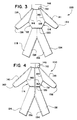
- the fabric laminate 12 of the present invention is useful among other things in the manufacture of work garments such as garment 100 shown by way of example in Figures 3 and 4.
- Figure 3 is a back view of the garment 100
- Figure 4 is a front view of the garment 100.
- the garment 100 comprises a neck piece 146, a right arm piece 142, a left arm piece 138, a right body piece 114 which includes right leg piece 124, and a left body piece 112 which includes left leg piece 118.
- the garment 100 is constructed by first forming the arms out of right arm piece 142 by means of seam 141 and the left arm piece 138 by means of seam 139.
- the right leg 124 is joined along seam 136 and the left leg 118 is joined along seam 134.
- the two body panels 114 and 112 are joined along backseam 128 and by means of zipper 162 ( Figure 4).
- the left arm 138 is then joined to the left body panel 112 along seam 144.
- the right arm piece 142 is joined to the right body panel 114 along seam 140.
- the neck piece 146 is attached to the arms and the body pieces along seam 130.
- Elastic is provided at the waist 120. Because of the durability of the laminate 12 which is used in making the garment 100, the garment 100 is more durable than similar garments constructed from conventional SMS fabric laminates.
Landscapes
- Engineering & Computer Science (AREA)
- Textile Engineering (AREA)
- Nonwoven Fabrics (AREA)
- Laminated Bodies (AREA)
- Artificial Filaments (AREA)
Applications Claiming Priority (2)
| Application Number | Priority Date | Filing Date | Title |
|---|---|---|---|
| US07/884,967 US5366786A (en) | 1992-05-15 | 1992-05-15 | Garment of durable nonwoven fabric |
| US884967 | 1992-05-15 |
Publications (2)
| Publication Number | Publication Date |
|---|---|
| EP0569860A1 true EP0569860A1 (fr) | 1993-11-18 |
| EP0569860B1 EP0569860B1 (fr) | 1997-07-23 |
Family
ID=25385837
Family Applications (1)
| Application Number | Title | Priority Date | Filing Date |
|---|---|---|---|
| EP19930107379 Revoked EP0569860B1 (fr) | 1992-05-15 | 1993-05-06 | Etoffe non-tissée résistante |
Country Status (9)
| Country | Link |
|---|---|
| US (2) | US5366786A (fr) |
| EP (1) | EP0569860B1 (fr) |
| JP (1) | JPH0649761A (fr) |
| KR (1) | KR100236746B1 (fr) |
| AU (1) | AU659548B2 (fr) |
| CA (1) | CA2080084A1 (fr) |
| DE (1) | DE69312387T2 (fr) |
| ES (1) | ES2106224T3 (fr) |
| MX (1) | MX9302491A (fr) |
Cited By (23)
| Publication number | Priority date | Publication date | Assignee | Title |
|---|---|---|---|---|
| FR2705371A1 (fr) * | 1993-05-20 | 1994-11-25 | Kimberly Clark Co | Stratifié léger de nappes non tissées et articles utilisant un tel stratifié. |
| WO1995009261A1 (fr) * | 1993-09-30 | 1995-04-06 | Kimberly-Clark Corporation | Etoffes non tissees liees par des motifs |
| US5492751A (en) * | 1993-05-20 | 1996-02-20 | Kimberly-Clark Corporation | Disposable garment with improved containments means |
| WO1996033068A1 (fr) * | 1995-04-20 | 1996-10-24 | Kimberly-Clark Worldwide, Inc. | Lamine de protection non tisse |
| DE19626997A1 (de) * | 1996-07-05 | 1998-01-08 | Saueressig Gmbh & Co | Verfahren zur Verbindung der einzelnen Lagen von mehrlagigen Hygiene-Zellstoff-Tüchern oder -Vliesen untereinander durch Prägung |
| US5811045A (en) * | 1995-08-30 | 1998-09-22 | Kimberly-Clark Worldwide, Inc. | Process of making multicomponent fibers containing a nucleating agent |
| EP0690163A3 (fr) * | 1994-06-29 | 1999-03-17 | Kimberly-Clark Worldwide, Inc. | Etoffes non-tissées laminées |
| EP0740714A4 (fr) * | 1994-11-23 | 1999-04-21 | Fiberweb North America Inc | Non-tisse extensible |
| EP0821092A3 (fr) * | 1996-07-23 | 2000-04-19 | Fiberweb North America, Inc. | Etoffes non-tissées à propriétés esthétiques differentielles et procédés pour la production |
| DE19917275A1 (de) * | 1999-04-16 | 2000-10-19 | Freudenberg Carl Fa | Reinigungstuch |
| EP1136232A1 (fr) * | 2000-03-17 | 2001-09-26 | Avery Dennison Corporation | Procédé de soudage par ultrasons de feuilles de polypropylène |
| EP1213376A1 (fr) * | 2000-12-07 | 2002-06-12 | Borealis GmbH | Fibres de polyoléfine non post-étirées avec haute tenacité |
| EP1213375A1 (fr) * | 2000-12-07 | 2002-06-12 | Borealis GmbH | Fibres de polyoléfines non post-étirées avec haute tenacité |
| US6506698B1 (en) | 1996-08-27 | 2003-01-14 | Bba Nonwovens Simpsonville, Inc. | Extensible composite nonwoven fabrics |
| WO2004057110A1 (fr) * | 2002-12-20 | 2004-07-08 | Sca Hygiene Products Ab | Production d'une bande a motifs colores |
| WO2004048665A3 (fr) * | 2002-11-21 | 2004-07-29 | Kimberly Clark Co | Stratifie non tisse a uniformite de resistance elevee et procede correspondant |
| WO2004048664A3 (fr) * | 2002-11-21 | 2004-07-29 | Kimberly Clark Co | Materiau et stratifie non tisses uniformes et procede associe |
| WO2004085730A1 (fr) * | 2003-03-21 | 2004-10-07 | E.I. Dupont De Nemours And Company | Tissus non-tisses contrecolles a motif |
| US6926950B2 (en) | 2002-12-20 | 2005-08-09 | Sca Hygiene Products Ab | Production of a dyed patterned web |
| EP1696064A1 (fr) | 2005-02-23 | 2006-08-30 | Carl Freudenberg KG | Lingettes, procédé de fabrication et utilisation |
| US20110081817A1 (en) * | 2008-02-19 | 2011-04-07 | Total Petrochemicals Research Feluy | Fibers and Nonwovens with Improved Mechanical Properties |
| WO2012055797A1 (fr) * | 2010-10-28 | 2012-05-03 | Lummus Novolen Technology Gmbh | Polypropylène additivé pour non-tissés et filés |
| CN109196154A (zh) * | 2016-06-13 | 2019-01-11 | 博里利斯股份公司 | 具有改善的阻隔性能的高质量熔喷网 |
Families Citing this family (89)
| Publication number | Priority date | Publication date | Assignee | Title |
|---|---|---|---|---|
| US5366786A (en) * | 1992-05-15 | 1994-11-22 | Kimberly-Clark Corporation | Garment of durable nonwoven fabric |
| US6150020A (en) * | 1993-09-23 | 2000-11-21 | Bba Nonwovens Simpsonville, Inc. | Articles exhibiting improved hydrophobicity |
| CA2116081C (fr) | 1993-12-17 | 2005-07-26 | Ann Louise Mccormack | Materiau permeable a l'air constitue d'une pellicule et d'un non-tisse colles |
| WO2000061498A2 (fr) | 1999-04-13 | 2000-10-19 | Semitool, Inc. | Traitement electrochimique de pieces |
| BR9711694A (pt) * | 1996-09-06 | 1999-08-24 | Kimberly Clark Co | Tramas de tecido de elevado volume utiliza-Æo substratos nÆo tran-ados |
| US6015764A (en) | 1996-12-27 | 2000-01-18 | Kimberly-Clark Worldwide, Inc. | Microporous elastomeric film/nonwoven breathable laminate and method for making the same |
| US6111163A (en) | 1996-12-27 | 2000-08-29 | Kimberly-Clark Worldwide, Inc. | Elastomeric film and method for making the same |
| US6037281A (en) * | 1996-12-27 | 2000-03-14 | Kimberly-Clark Worldwide, Inc. | Cloth-like, liquid-impervious, breathable composite barrier fabric |
| AU9601298A (en) | 1997-10-03 | 1999-04-27 | Kimberly-Clark Worldwide, Inc. | High performance elastic composite materials made from high molecular weight thermoplastic triblock elastomers |
| US5834381A (en) * | 1997-10-09 | 1998-11-10 | Highland Industries, Inc. | Non-halogenated tri-laminate fabric for automotive security shades or covers |
| US6565729B2 (en) | 1998-03-20 | 2003-05-20 | Semitool, Inc. | Method for electrochemically depositing metal on a semiconductor workpiece |
| US6497801B1 (en) | 1998-07-10 | 2002-12-24 | Semitool Inc | Electroplating apparatus with segmented anode array |
| US7264698B2 (en) | 1999-04-13 | 2007-09-04 | Semitool, Inc. | Apparatus and methods for electrochemical processing of microelectronic workpieces |
| US7189318B2 (en) | 1999-04-13 | 2007-03-13 | Semitool, Inc. | Tuning electrodes used in a reactor for electrochemically processing a microelectronic workpiece |
| US7020537B2 (en) | 1999-04-13 | 2006-03-28 | Semitool, Inc. | Tuning electrodes used in a reactor for electrochemically processing a microelectronic workpiece |
| US7351314B2 (en) | 2003-12-05 | 2008-04-01 | Semitool, Inc. | Chambers, systems, and methods for electrochemically processing microfeature workpieces |
| US7585398B2 (en) | 1999-04-13 | 2009-09-08 | Semitool, Inc. | Chambers, systems, and methods for electrochemically processing microfeature workpieces |
| US7438788B2 (en) | 1999-04-13 | 2008-10-21 | Semitool, Inc. | Apparatus and methods for electrochemical processing of microelectronic workpieces |
| US7351315B2 (en) | 2003-12-05 | 2008-04-01 | Semitool, Inc. | Chambers, systems, and methods for electrochemically processing microfeature workpieces |
| US6916412B2 (en) | 1999-04-13 | 2005-07-12 | Semitool, Inc. | Adaptable electrochemical processing chamber |
| US6322604B1 (en) | 1999-07-22 | 2001-11-27 | Kimberly-Clark Worldwide, Inc | Filtration media and articles incorporating the same |
| JP2002011311A (ja) * | 2000-04-28 | 2002-01-15 | Toyoda Spinning & Weaving Co Ltd | 濾過材の製造方法及び濾過材 |
| JP2004515664A (ja) * | 2000-12-11 | 2004-05-27 | ダウ グローバル テクノロジーズ インコーポレイティド | 熱接着布およびその製造方法 |
| US20020132547A1 (en) * | 2001-01-12 | 2002-09-19 | Grondin Pierre D. | Breathable nonwoven/film laminate |
| JP4350381B2 (ja) * | 2001-05-17 | 2009-10-21 | ミリケン・アンド・カンパニー | 低収縮性ポリプロピレン繊維の製造方法 |
| US6656404B2 (en) * | 2001-05-17 | 2003-12-02 | Milliken & Company | Methods of making low-shrink polypropylene fibers |
| US6541554B2 (en) * | 2001-05-17 | 2003-04-01 | Milliken & Company | Low-shrink polypropylene fibers |
| US6787000B2 (en) | 2001-11-02 | 2004-09-07 | Kimberly-Clark Worldwide, Inc. | Fabric comprising nonwoven elements for use in the manufacture of tissue products having visually discernable background texture regions bordered by curvilinear decorative elements and method thereof |
| US6749719B2 (en) | 2001-11-02 | 2004-06-15 | Kimberly-Clark Worldwide, Inc. | Method of manufacture tissue products having visually discernable background texture regions bordered by curvilinear decorative elements |
| US6746570B2 (en) | 2001-11-02 | 2004-06-08 | Kimberly-Clark Worldwide, Inc. | Absorbent tissue products having visually discernable background texture |
| US6821385B2 (en) | 2001-11-02 | 2004-11-23 | Kimberly-Clark Worldwide, Inc. | Method of manufacture of tissue products having visually discernable background texture regions bordered by curvilinear decorative elements using fabrics comprising nonwoven elements |
| US6790314B2 (en) | 2001-11-02 | 2004-09-14 | Kimberly-Clark Worldwide, Inc. | Fabric for use in the manufacture of tissue products having visually discernable background texture regions bordered by curvilinear decorative elements and method thereof |
| US6996851B2 (en) * | 2001-12-13 | 2006-02-14 | Kimberly-Clark Worldwide, Inc. | Permeable, close to the body liner for swimwear |
| WO2003055671A1 (fr) * | 2001-12-21 | 2003-07-10 | Milliken & Company | Dossiers primaires de polypropylene de nucleation pour constructions de moquette |
| US20030134118A1 (en) * | 2001-12-21 | 2003-07-17 | Morin Brian G. | Low-shrink polypropylene tape fibers |
| CN100562613C (zh) * | 2001-12-21 | 2009-11-25 | 美利肯公司 | 低收缩聚丙烯带状纤维及其制造方法 |
| US20030134082A1 (en) * | 2001-12-21 | 2003-07-17 | Morin Brian G. | Carpet comprising a low-shrink backing of polypropylene tape fibers |
| US6866912B2 (en) * | 2002-03-13 | 2005-03-15 | Milliken & Company | Textile constructions with stabilized primary backings and related methods |
| US6998081B2 (en) * | 2001-12-21 | 2006-02-14 | Milliken & Company | Method of producing low-shrink polypropylene tape fibers |
| US20030175475A1 (en) * | 2002-03-13 | 2003-09-18 | Higgins Kenneth B. | Textile constructions, components or materials and related methods |
| JP3790496B2 (ja) * | 2002-05-20 | 2006-06-28 | 株式会社クラレ | 防護衣料用複合不織布及びその製造方法 |
| US20040002273A1 (en) * | 2002-07-01 | 2004-01-01 | Kimberly-Clark Worldwide, Inc. | Liquid repellent nonwoven protective material |
| US7018945B2 (en) * | 2002-07-02 | 2006-03-28 | Kimberly-Clark Worldwide, Inc. | Composition and method for treating fibers and nonwoven substrates |
| US20040005457A1 (en) * | 2002-07-03 | 2004-01-08 | Kimberly-Clark Worldwide, Inc. | Methods of improving the softness of fibers and nonwoven webs and fibers and nonwoven webs having improved softness |
| US20040084802A1 (en) * | 2002-11-02 | 2004-05-06 | Morin Brian G. | Method of producing low-shrink polypropylene tape fibers comprising high amounts of nucleating agents |
| US6887567B2 (en) * | 2002-11-02 | 2005-05-03 | Milliken & Company | Low-shrink polypropylene tape fibers comprising high amounts of nucleating agents |
| US20040086702A1 (en) * | 2002-11-02 | 2004-05-06 | Morin Brian G. | Articles comprising low-shrink polypropylene tape fibers comprising high amounts of nucleating agents |
| US6863976B2 (en) * | 2002-11-16 | 2005-03-08 | Milliken & Company | Polypropylene monofilament and tape fibers exhibiting certain creep-strain characteristics and corresponding crystalline configurations |
| US6759124B2 (en) * | 2002-11-16 | 2004-07-06 | Milliken & Company | Thermoplastic monofilament fibers exhibiting low-shrink, high tenacity, and extremely high modulus levels |
| US20040096639A1 (en) * | 2002-11-16 | 2004-05-20 | Morin Brian G. | Uniform production methods for colored and non-colored polypropylene fibers |
| US20040152815A1 (en) * | 2002-11-17 | 2004-08-05 | Morin Brian G. | High speed spinning procedures for the manufacture of low denier polypropylene fibers and yarns |
| US7041368B2 (en) * | 2002-11-17 | 2006-05-09 | Milliken & Company | High speed spinning procedures for the manufacture of high denier polypropylene fibers and yarns |
| US20040096621A1 (en) * | 2002-11-17 | 2004-05-20 | Dai Weihua Sonya | High denier textured polypropylene fibers and yarns |
| US20040116015A1 (en) * | 2002-12-17 | 2004-06-17 | Hayes Heather J. | Fluorochemical-containing textile finishes that exhibit wash-durable soil release and moisture wicking properties |
| US6849330B1 (en) | 2003-08-30 | 2005-02-01 | Milliken & Company | Thermoplastic fibers exhibiting durable high color strength characteristics |
| US20050048281A1 (en) * | 2003-08-30 | 2005-03-03 | Royer Joseph R. | Thermoplastic fibers exhibiting durable high color strength characteristics |
| US20050046065A1 (en) * | 2003-08-30 | 2005-03-03 | Cowan Martin E. | Thermoplastic fibers exhibiting durable high color strength characteristics |
| US7358282B2 (en) | 2003-12-05 | 2008-04-15 | Kimberly-Clark Worldwide, Inc. | Low-density, open-cell, soft, flexible, thermoplastic, absorbent foam and method of making foam |
| RU2242150C1 (ru) * | 2003-12-18 | 2004-12-20 | Государственное образовательное учреждение высшего профессионального образования "Санкт-Петербургский государственный университет технологий и дизайна" | Многослойная деталь для одежды |
| US7291382B2 (en) | 2004-09-24 | 2007-11-06 | Kimberly-Clark Worldwide, Inc. | Low density flexible resilient absorbent open-cell thermoplastic foam |
| US7074483B2 (en) * | 2004-11-05 | 2006-07-11 | Innegrity, Llc | Melt-spun multifilament polyolefin yarn formation processes and yarns formed therefrom |
| US8057887B2 (en) * | 2005-08-17 | 2011-11-15 | Rampart Fibers, LLC | Composite materials including high modulus polyolefin fibers |
| US7648607B2 (en) * | 2005-08-17 | 2010-01-19 | Innegrity, Llc | Methods of forming composite materials including high modulus polyolefin fibers |
| US7892633B2 (en) * | 2005-08-17 | 2011-02-22 | Innegrity, Llc | Low dielectric composite materials including high modulus polyolefin fibers |
| US20070060696A1 (en) * | 2005-09-12 | 2007-03-15 | Jiang Li | Silica-containing nucleating agent compositions and methods for using such compositions in polyolefins |
| KR101009787B1 (ko) | 2005-09-12 | 2011-01-19 | 밀리켄 앤드 캄파니 | 실리카-함유 조핵제 조성물 및 이 조성물을 폴리올레핀에사용하는 방법 |
| US8158689B2 (en) | 2005-12-22 | 2012-04-17 | Kimberly-Clark Worldwide, Inc. | Hybrid absorbent foam and articles containing it |
| US7971526B2 (en) * | 2006-04-17 | 2011-07-05 | Kimberly-Clark Worldwide, Inc. | Embossing or bonding device containing facetted impression elements |
| EP2034056A1 (fr) * | 2007-09-04 | 2009-03-11 | Total Petrochemicals Research Feluy | Fibres de polypropylène métallocènes et non tissés dotés de propriétés mécaniques améliorées |
| EP2113591A1 (fr) * | 2008-04-29 | 2009-11-04 | Total Petrochemicals Research Feluy | Fibres et non tissés dotés de propriétés mécaniques et de liaison améliorées |
| US9168718B2 (en) | 2009-04-21 | 2015-10-27 | Exxonmobil Chemical Patents Inc. | Method for producing temperature resistant nonwovens |
| US10161063B2 (en) | 2008-09-30 | 2018-12-25 | Exxonmobil Chemical Patents Inc. | Polyolefin-based elastic meltblown fabrics |
| US8664129B2 (en) | 2008-11-14 | 2014-03-04 | Exxonmobil Chemical Patents Inc. | Extensible nonwoven facing layer for elastic multilayer fabrics |
| US8748693B2 (en) | 2009-02-27 | 2014-06-10 | Exxonmobil Chemical Patents Inc. | Multi-layer nonwoven in situ laminates and method of producing the same |
| US9498932B2 (en) | 2008-09-30 | 2016-11-22 | Exxonmobil Chemical Patents Inc. | Multi-layered meltblown composite and methods for making same |
| JP5452949B2 (ja) * | 2009-02-24 | 2014-03-26 | ユニ・チャーム株式会社 | ロール状シートの製造方法、及び、ロール状シートの製造装置 |
| WO2011022434A2 (fr) * | 2009-08-17 | 2011-02-24 | Mathieson Thomas R | Vêtement de sécurité |
| US8668975B2 (en) | 2009-11-24 | 2014-03-11 | Exxonmobil Chemical Patents Inc. | Fabric with discrete elastic and plastic regions and method for making same |
| CN101956247B (zh) * | 2010-10-13 | 2012-07-04 | 吉林大学 | 常温下利用静电纺丝技术制备聚丙烯超细纤维的方法 |
| EP2799231A1 (fr) * | 2013-04-30 | 2014-11-05 | The Procter & Gamble Company | Emballage souple |
| CN105636562A (zh) | 2013-06-19 | 2016-06-01 | 宝洁公司 | 粘结设备和方法 |
| WO2014204744A1 (fr) | 2013-06-19 | 2014-12-24 | The Procter & Gamble Company | Appareil et procédé de liaison |
| WO2017205195A1 (fr) | 2016-05-24 | 2017-11-30 | The Procter & Gamble Company | Enclume rotative |
| US10478347B2 (en) | 2017-06-21 | 2019-11-19 | The Procter & Gamble Company | Nozzle assembly used to manufacture absorbent articles |
| US11292016B2 (en) | 2018-03-16 | 2022-04-05 | The Procter & Gamble Company | Nozzle assembly used to manufacture absorbent articles |
| EP3666446A1 (fr) | 2018-12-10 | 2020-06-17 | The Procter & Gamble Company | Procédé de fabrication d'un outil industriel, tel qu'un rouleau d'enclume |
| CN113227244A (zh) * | 2018-12-27 | 2021-08-06 | 埃克森美孚化学专利公司 | 具有较快结晶时间的基于丙烯的纺粘织物 |
| IT202200022875A1 (it) * | 2022-11-07 | 2024-05-07 | Dainese Spa | Tuta perfezionata per motociclisti |
| EP4627957A1 (fr) * | 2024-04-04 | 2025-10-08 | Freudenberg Performance Materials B.V. | Article vestimentaire pour protection personnelle contre les chocs |
Citations (3)
| Publication number | Priority date | Publication date | Assignee | Title |
|---|---|---|---|---|
| US4041203A (en) * | 1972-09-06 | 1977-08-09 | Kimberly-Clark Corporation | Nonwoven thermoplastic fabric |
| US4314039A (en) * | 1979-08-21 | 1982-02-02 | Mitsui Toatsu Chemicals, Inc. | Polypropylene composition containing a 1.3,2.4-di(alkylbenzylidene) sorbitol |
| US5039748A (en) * | 1987-11-10 | 1991-08-13 | Sumitomo Chemical Co., Ltd. | High-strength polypropylene fiber |
Family Cites Families (41)
| Publication number | Priority date | Publication date | Assignee | Title |
|---|---|---|---|---|
| CA803714A (en) * | 1969-01-14 | Johnson And Johnson | Continuous filament fabric | |
| US3338992A (en) * | 1959-12-15 | 1967-08-29 | Du Pont | Process for forming non-woven filamentary structures from fiber-forming synthetic organic polymers |
| US3502763A (en) * | 1962-02-03 | 1970-03-24 | Freudenberg Carl Kg | Process of producing non-woven fabric fleece |
| NL292019A (fr) * | 1962-04-26 | |||
| US3502538A (en) * | 1964-08-17 | 1970-03-24 | Du Pont | Bonded nonwoven sheets with a defined distribution of bond strengths |
| US3341394A (en) * | 1966-12-21 | 1967-09-12 | Du Pont | Sheets of randomly distributed continuous filaments |
| US3542615A (en) * | 1967-06-16 | 1970-11-24 | Monsanto Co | Process for producing a nylon non-woven fabric |
| US3849241A (en) * | 1968-12-23 | 1974-11-19 | Exxon Research Engineering Co | Non-woven mats by melt blowing |
| US3676242A (en) * | 1969-08-13 | 1972-07-11 | Exxon Research Engineering Co | Method of making a nonwoven polymer laminate |
| DE1950669C3 (de) * | 1969-10-08 | 1982-05-13 | Metallgesellschaft Ag, 6000 Frankfurt | Verfahren zur Vliesherstellung |
| CA948388A (en) * | 1970-02-27 | 1974-06-04 | Paul B. Hansen | Pattern bonded continuous filament web |
| US3825380A (en) * | 1972-07-07 | 1974-07-23 | Exxon Research Engineering Co | Melt-blowing die for producing nonwoven mats |
| US3909009A (en) * | 1974-01-28 | 1975-09-30 | Astatic Corp | Tone arm and phonograph pickup assemblies |
| US3981650A (en) * | 1975-01-16 | 1976-09-21 | Beloit Corporation | Melt blowing intermixed filaments of two different polymers |
| US3973068A (en) * | 1975-10-28 | 1976-08-03 | Kimberly-Clark Corporation | Soft, nonwoven web having high intensity and low intensity bonds and a lubricant on the surfaces of the synthetic filaments comprising said |
| US4281070A (en) * | 1980-01-07 | 1981-07-28 | The Polymer Corporation | Melt processable UHMWPE |
| USD264512S (en) | 1980-01-14 | 1982-05-18 | Kimberly-Clark Corporation | Embossed continuous sheet tissue-like material or similar article |
| US4340563A (en) * | 1980-05-05 | 1982-07-20 | Kimberly-Clark Corporation | Method for forming nonwoven webs |
| US4333979A (en) * | 1980-08-18 | 1982-06-08 | Kimberly-Clark Corporation | Soft, bulky, lightweight nonwoven web and method of producing; the web has both fused spot bonds and patterned embossments |
| US4774277A (en) * | 1982-03-26 | 1988-09-27 | Exxon Research & Engineering Co. | Blends of polyolefin plastics with elastomeric plasticizers |
| US4379192A (en) * | 1982-06-23 | 1983-04-05 | Kimberly-Clark Corporation | Impervious absorbent barrier fabric embodying films and fibrous webs |
| IT1152491B (it) * | 1982-08-09 | 1986-12-31 | Merak Spa | Fibre poliolefiniche a migliorata termosaldabilita' e procedimento per ottenerle |
| US4461872A (en) * | 1983-02-22 | 1984-07-24 | E. I. Du Pont De Nemours And Company | Blends of a propylene/α-olefin copolymer with isotactic prolypropylene |
| US4514534A (en) * | 1984-04-13 | 1985-04-30 | United States Steel Corporation | Modified polypropylene for film |
| US4585817A (en) * | 1984-06-11 | 1986-04-29 | Mobil Oil Corporation | Crystallizable polyolefin composition having increased crystallization temperature and rate of crystallization |
| JPS61152810A (ja) * | 1984-12-27 | 1986-07-11 | Chisso Corp | 改良されたポリプロピレンモノフイラメントの製造方法 |
| JPS61155437A (ja) * | 1984-12-27 | 1986-07-15 | Asahi Chem Ind Co Ltd | ポリプロピレン樹脂組成物 |
| JPS62149711A (ja) * | 1985-12-17 | 1987-07-03 | Chisso Corp | 高溶融粘弾性エチレン・プロピレン共重合体の連続製造法 |
| US4839228A (en) * | 1987-02-04 | 1989-06-13 | The Dow Chemical Company | Biconstituent polypropylene/polyethylene fibers |
| EP0277707B1 (fr) * | 1987-01-12 | 1994-04-06 | Unitika Ltd. | Fibre de polyoléfine à deux composants et étoffe non tissée fabriquée à partir de cette fibre |
| US4842922A (en) * | 1987-10-27 | 1989-06-27 | The Dow Chemical Company | Polyethylene fibers and spunbonded fabric or web |
| US4845137A (en) * | 1987-11-05 | 1989-07-04 | Becton, Dickinson And Company | Polyolefin compositions of high clarity and resistance to oxidation |
| JPH0639553B2 (ja) * | 1987-11-11 | 1994-05-25 | 出光石油化学株式会社 | プロピレン重合体組成物 |
| US4950720A (en) * | 1988-04-29 | 1990-08-21 | Exxon Chemical Patents Inc. | Modified polypropylene, process for making and article made from the same |
| JPH0689191B2 (ja) * | 1988-05-26 | 1994-11-09 | 出光石油化学株式会社 | ポリプロピレン系樹脂組成物よりなるシート類の製造方法 |
| US5057357A (en) * | 1988-10-21 | 1991-10-15 | Fiberweb North America, Inc. | Soft coverstock with improved dimensional stability and strength and method of manufacturing the same |
| CA1316804C (fr) * | 1988-11-22 | 1993-04-27 | Sylvie Boisse | Doublure absorbante pour vetements impermeables |
| JP2682130B2 (ja) * | 1989-04-25 | 1997-11-26 | 三井石油化学工業株式会社 | 柔軟な長繊維不織布 |
| US5188885A (en) * | 1989-09-08 | 1993-02-23 | Kimberly-Clark Corporation | Nonwoven fabric laminates |
| US5137973A (en) * | 1990-09-10 | 1992-08-11 | Allied-Signal Inc. | Polyolefins containing polyester nucleating agent and articles formed therefrom |
| US5366786A (en) * | 1992-05-15 | 1994-11-22 | Kimberly-Clark Corporation | Garment of durable nonwoven fabric |
-
1992
- 1992-05-15 US US07/884,967 patent/US5366786A/en not_active Expired - Lifetime
- 1992-10-07 CA CA 2080084 patent/CA2080084A1/fr not_active Abandoned
-
1993
- 1993-03-25 KR KR1019930004658A patent/KR100236746B1/ko not_active Expired - Fee Related
- 1993-04-28 MX MX9302491A patent/MX9302491A/es not_active IP Right Cessation
- 1993-05-06 DE DE69312387T patent/DE69312387T2/de not_active Revoked
- 1993-05-06 ES ES93107379T patent/ES2106224T3/es not_active Expired - Lifetime
- 1993-05-06 EP EP19930107379 patent/EP0569860B1/fr not_active Revoked
- 1993-05-11 AU AU38507/93A patent/AU659548B2/en not_active Ceased
- 1993-05-14 JP JP11273193A patent/JPH0649761A/ja active Pending
-
1994
- 1994-08-02 US US08/845,131 patent/US5798167A/en not_active Expired - Fee Related
Patent Citations (3)
| Publication number | Priority date | Publication date | Assignee | Title |
|---|---|---|---|---|
| US4041203A (en) * | 1972-09-06 | 1977-08-09 | Kimberly-Clark Corporation | Nonwoven thermoplastic fabric |
| US4314039A (en) * | 1979-08-21 | 1982-02-02 | Mitsui Toatsu Chemicals, Inc. | Polypropylene composition containing a 1.3,2.4-di(alkylbenzylidene) sorbitol |
| US5039748A (en) * | 1987-11-10 | 1991-08-13 | Sumitomo Chemical Co., Ltd. | High-strength polypropylene fiber |
Cited By (33)
| Publication number | Priority date | Publication date | Assignee | Title |
|---|---|---|---|---|
| WO1994028224A1 (fr) * | 1993-05-20 | 1994-12-08 | Kimberly-Clark Corporation | Non-tisses legers multicouches en bandes continues ayant des proprietes ameliorees du point de vue du confort et de l'effet barriere |
| US5492751A (en) * | 1993-05-20 | 1996-02-20 | Kimberly-Clark Corporation | Disposable garment with improved containments means |
| FR2705371A1 (fr) * | 1993-05-20 | 1994-11-25 | Kimberly Clark Co | Stratifié léger de nappes non tissées et articles utilisant un tel stratifié. |
| WO1995009261A1 (fr) * | 1993-09-30 | 1995-04-06 | Kimberly-Clark Corporation | Etoffes non tissees liees par des motifs |
| US6093665A (en) * | 1993-09-30 | 2000-07-25 | Kimberly-Clark Worldwide, Inc. | Pattern bonded nonwoven fabrics |
| EP0690163A3 (fr) * | 1994-06-29 | 1999-03-17 | Kimberly-Clark Worldwide, Inc. | Etoffes non-tissées laminées |
| EP0740714A4 (fr) * | 1994-11-23 | 1999-04-21 | Fiberweb North America Inc | Non-tisse extensible |
| WO1996033068A1 (fr) * | 1995-04-20 | 1996-10-24 | Kimberly-Clark Worldwide, Inc. | Lamine de protection non tisse |
| US5597647A (en) * | 1995-04-20 | 1997-01-28 | Kimberly-Clark Corporation | Nonwoven protective laminate |
| US5811045A (en) * | 1995-08-30 | 1998-09-22 | Kimberly-Clark Worldwide, Inc. | Process of making multicomponent fibers containing a nucleating agent |
| US6203905B1 (en) | 1995-08-30 | 2001-03-20 | Kimberly-Clark Worldwide, Inc. | Crimped conjugate fibers containing a nucleating agent |
| DE19626997A1 (de) * | 1996-07-05 | 1998-01-08 | Saueressig Gmbh & Co | Verfahren zur Verbindung der einzelnen Lagen von mehrlagigen Hygiene-Zellstoff-Tüchern oder -Vliesen untereinander durch Prägung |
| EP0821092A3 (fr) * | 1996-07-23 | 2000-04-19 | Fiberweb North America, Inc. | Etoffes non-tissées à propriétés esthétiques differentielles et procédés pour la production |
| US6506698B1 (en) | 1996-08-27 | 2003-01-14 | Bba Nonwovens Simpsonville, Inc. | Extensible composite nonwoven fabrics |
| DE19917275A1 (de) * | 1999-04-16 | 2000-10-19 | Freudenberg Carl Fa | Reinigungstuch |
| DE19917275B4 (de) * | 1999-04-16 | 2004-02-26 | Carl Freudenberg Kg | Reinigungstuch |
| US6573204B1 (en) | 1999-04-16 | 2003-06-03 | Firma Carl Freudenberg | Cleaning cloth |
| EP1136232A1 (fr) * | 2000-03-17 | 2001-09-26 | Avery Dennison Corporation | Procédé de soudage par ultrasons de feuilles de polypropylène |
| EP1213375A1 (fr) * | 2000-12-07 | 2002-06-12 | Borealis GmbH | Fibres de polyoléfines non post-étirées avec haute tenacité |
| WO2002046502A1 (fr) * | 2000-12-07 | 2002-06-13 | Borealis Gmbh | Fibres de polyolefines non pre-etiree a haute tenacite |
| EP1213376A1 (fr) * | 2000-12-07 | 2002-06-12 | Borealis GmbH | Fibres de polyoléfine non post-étirées avec haute tenacité |
| CN100473772C (zh) * | 2002-11-21 | 2009-04-01 | 金伯利-克拉克环球有限公司 | 均一非织造材料及其制法 |
| WO2004048665A3 (fr) * | 2002-11-21 | 2004-07-29 | Kimberly Clark Co | Stratifie non tisse a uniformite de resistance elevee et procede correspondant |
| WO2004048664A3 (fr) * | 2002-11-21 | 2004-07-29 | Kimberly Clark Co | Materiau et stratifie non tisses uniformes et procede associe |
| US6926950B2 (en) | 2002-12-20 | 2005-08-09 | Sca Hygiene Products Ab | Production of a dyed patterned web |
| WO2004057110A1 (fr) * | 2002-12-20 | 2004-07-08 | Sca Hygiene Products Ab | Production d'une bande a motifs colores |
| WO2004085730A1 (fr) * | 2003-03-21 | 2004-10-07 | E.I. Dupont De Nemours And Company | Tissus non-tisses contrecolles a motif |
| EP1696064A1 (fr) | 2005-02-23 | 2006-08-30 | Carl Freudenberg KG | Lingettes, procédé de fabrication et utilisation |
| US20110081817A1 (en) * | 2008-02-19 | 2011-04-07 | Total Petrochemicals Research Feluy | Fibers and Nonwovens with Improved Mechanical Properties |
| WO2012055797A1 (fr) * | 2010-10-28 | 2012-05-03 | Lummus Novolen Technology Gmbh | Polypropylène additivé pour non-tissés et filés |
| CN109196154A (zh) * | 2016-06-13 | 2019-01-11 | 博里利斯股份公司 | 具有改善的阻隔性能的高质量熔喷网 |
| CN109196154B (zh) * | 2016-06-13 | 2021-09-28 | 博里利斯股份公司 | 具有改善的阻隔性能的高质量熔喷网 |
| US11668033B2 (en) | 2016-06-13 | 2023-06-06 | Borealis Ag | High quality melt-blown webs with improved barrier properties |
Also Published As
| Publication number | Publication date |
|---|---|
| DE69312387D1 (de) | 1997-09-04 |
| JPH0649761A (ja) | 1994-02-22 |
| ES2106224T3 (es) | 1997-11-01 |
| AU3850793A (en) | 1993-11-18 |
| EP0569860B1 (fr) | 1997-07-23 |
| US5798167A (en) | 1998-08-25 |
| US5366786A (en) | 1994-11-22 |
| CA2080084A1 (fr) | 1993-11-16 |
| MX9302491A (es) | 1993-12-01 |
| AU659548B2 (en) | 1995-05-18 |
| KR930023517A (ko) | 1993-12-18 |
| DE69312387T2 (de) | 1997-11-06 |
| KR100236746B1 (ko) | 2000-03-02 |
Similar Documents
| Publication | Publication Date | Title |
|---|---|---|
| EP0569860B1 (fr) | Etoffe non-tissée résistante | |
| EP0755325B1 (fr) | Stratifie en non-tisses presentant des proprietes barriere accrues | |
| KR100357671B1 (ko) | 차단특성을 갖는 폴리에틸렌 멜트블로 운부직포 | |
| EP0644962B1 (fr) | Non-tisse composite et procede de fabrication | |
| CA2177035C (fr) | Non-tisse composite et articles produits avec ce non-tisse | |
| EP0416620B2 (fr) | Laminé en non-tissé | |
| US5688157A (en) | Nonwoven fabric laminate with enhanced barrier properties | |
| EP1280947B1 (fr) | Toile realisee par fusion-soufflage | |
| EP1200661A1 (fr) | Materiau composite non tisse en feuille | |
| US20040241399A1 (en) | Pattern bonded nonwoven fabrics | |
| CA2210914A1 (fr) | Non tisse de polymeres contenant des types particuliers de copolymeres, esthetique et doux au toucher | |
| PL182266B1 (pl) | Wlókna z termoplastycznego polimeru, wlóknina zawierajaca wlókna z termoplastycznego polimeru oraz mieszanka do wytwarzania wlókien z termoplastycznego polimeru PL PL PL | |
| CA2240945A1 (fr) | Tissus en polyethylene de fusion-soufflage et leurs procedes de fabrication | |
| CA2123979A1 (fr) | Tissus composites non tisses et methode de fabrication | |
| KR20230073108A (ko) | 부직포, 부직포의 제조방법 및 물품 | |
| KR100361596B1 (ko) | 이소택틱및아택틱폴리올레핀의블렌드로부터제조된부직포 | |
| CA2190517A1 (fr) | Non-tisse provenant de melanges de polyolefines isotactique et atactique |
Legal Events
| Date | Code | Title | Description |
|---|---|---|---|
| PUAI | Public reference made under article 153(3) epc to a published international application that has entered the european phase |
Free format text: ORIGINAL CODE: 0009012 |
|
| AK | Designated contracting states |
Kind code of ref document: A1 Designated state(s): BE DE ES FR GB IT NL SE |
|
| 17P | Request for examination filed |
Effective date: 19940228 |
|
| 17Q | First examination report despatched |
Effective date: 19950118 |
|
| GRAG | Despatch of communication of intention to grant |
Free format text: ORIGINAL CODE: EPIDOS AGRA |
|
| GRAH | Despatch of communication of intention to grant a patent |
Free format text: ORIGINAL CODE: EPIDOS IGRA |
|
| GRAH | Despatch of communication of intention to grant a patent |
Free format text: ORIGINAL CODE: EPIDOS IGRA |
|
| GRAA | (expected) grant |
Free format text: ORIGINAL CODE: 0009210 |
|
| AK | Designated contracting states |
Kind code of ref document: B1 Designated state(s): BE DE ES FR GB IT NL SE |
|
| PG25 | Lapsed in a contracting state [announced via postgrant information from national office to epo] |
Ref country code: BE Effective date: 19970723 |
|
| REF | Corresponds to: |
Ref document number: 69312387 Country of ref document: DE Date of ref document: 19970904 |
|
| PG25 | Lapsed in a contracting state [announced via postgrant information from national office to epo] |
Ref country code: SE Effective date: 19971023 |
|
| ET | Fr: translation filed | ||
| REG | Reference to a national code |
Ref country code: ES Ref legal event code: FG2A Ref document number: 2106224 Country of ref document: ES Kind code of ref document: T3 |
|
| RAP2 | Party data changed (patent owner data changed or rights of a patent transferred) |
Owner name: KIMBERLY-CLARK WORLDWIDE, INC. |
|
| NLT2 | Nl: modifications (of names), taken from the european patent patent bulletin |
Owner name: KIMBERLY-CLARK WORLDWIDE, INC. |
|
| PLBQ | Unpublished change to opponent data |
Free format text: ORIGINAL CODE: EPIDOS OPPO |
|
| PLBI | Opposition filed |
Free format text: ORIGINAL CODE: 0009260 |
|
| REG | Reference to a national code |
Ref country code: FR Ref legal event code: TP |
|
| PLBF | Reply of patent proprietor to notice(s) of opposition |
Free format text: ORIGINAL CODE: EPIDOS OBSO |
|
| 26 | Opposition filed |
Opponent name: AKZO NOBEL N.V. Effective date: 19980423 |
|
| NLR1 | Nl: opposition has been filed with the epo |
Opponent name: AKZO NOBEL N.V. |
|
| NLS | Nl: assignments of ep-patents |
Owner name: KIMBERLY-CLARK WORLDWIDE, INC. |
|
| PLBF | Reply of patent proprietor to notice(s) of opposition |
Free format text: ORIGINAL CODE: EPIDOS OBSO |
|
| REG | Reference to a national code |
Ref country code: GB Ref legal event code: 732E |
|
| PLBF | Reply of patent proprietor to notice(s) of opposition |
Free format text: ORIGINAL CODE: EPIDOS OBSO |
|
| PLBF | Reply of patent proprietor to notice(s) of opposition |
Free format text: ORIGINAL CODE: EPIDOS OBSO |
|
| RDAH | Patent revoked |
Free format text: ORIGINAL CODE: EPIDOS REVO |
|
| PGFP | Annual fee paid to national office [announced via postgrant information from national office to epo] |
Ref country code: NL Payment date: 19990322 Year of fee payment: 7 |
|
| PGFP | Annual fee paid to national office [announced via postgrant information from national office to epo] |
Ref country code: GB Payment date: 19990406 Year of fee payment: 7 |
|
| PGFP | Annual fee paid to national office [announced via postgrant information from national office to epo] |
Ref country code: FR Payment date: 19990504 Year of fee payment: 7 |
|
| PGFP | Annual fee paid to national office [announced via postgrant information from national office to epo] |
Ref country code: ES Payment date: 19990513 Year of fee payment: 7 |
|
| PGFP | Annual fee paid to national office [announced via postgrant information from national office to epo] |
Ref country code: DE Payment date: 19990531 Year of fee payment: 7 |
|
| RDAG | Patent revoked |
Free format text: ORIGINAL CODE: 0009271 |
|
| 27W | Patent revoked |
Effective date: 19990329 |
|
| GBPR | Gb: patent revoked under art. 102 of the ep convention designating the uk as contracting state |
Free format text: 990329 |