EP0570337A2 - Stabilisierte chlorhaltige Polymerzusammensetzungen - Google Patents
Stabilisierte chlorhaltige Polymerzusammensetzungen Download PDFInfo
- Publication number
- EP0570337A2 EP0570337A2 EP93810327A EP93810327A EP0570337A2 EP 0570337 A2 EP0570337 A2 EP 0570337A2 EP 93810327 A EP93810327 A EP 93810327A EP 93810327 A EP93810327 A EP 93810327A EP 0570337 A2 EP0570337 A2 EP 0570337A2
- Authority
- EP
- European Patent Office
- Prior art keywords
- alkyl
- phenyl
- acid
- group
- polymer composition
- Prior art date
- Legal status (The legal status is an assumption and is not a legal conclusion. Google has not performed a legal analysis and makes no representation as to the accuracy of the status listed.)
- Granted
Links
- 0 C*Nc1nc(N(C)C2CC(C)(C)NC(C)(C)C2)nc(N(*)C2CC(C)(C)NC(C)(C)C2)n1 Chemical compound C*Nc1nc(N(C)C2CC(C)(C)NC(C)(C)C2)nc(N(*)C2CC(C)(C)NC(C)(C)C2)n1 0.000 description 6
Classifications
-
- C—CHEMISTRY; METALLURGY
- C08—ORGANIC MACROMOLECULAR COMPOUNDS; THEIR PREPARATION OR CHEMICAL WORKING-UP; COMPOSITIONS BASED THEREON
- C08K—Use of inorganic or non-macromolecular organic substances as compounding ingredients
- C08K5/00—Use of organic ingredients
- C08K5/0008—Organic ingredients according to more than one of the "one dot" groups of C08K5/01 - C08K5/59
-
- C—CHEMISTRY; METALLURGY
- C08—ORGANIC MACROMOLECULAR COMPOUNDS; THEIR PREPARATION OR CHEMICAL WORKING-UP; COMPOSITIONS BASED THEREON
- C08K—Use of inorganic or non-macromolecular organic substances as compounding ingredients
- C08K13/00—Use of mixtures of ingredients not covered by one single of the preceding main groups, each of these compounds being essential
- C08K13/02—Organic and inorganic ingredients
-
- C—CHEMISTRY; METALLURGY
- C08—ORGANIC MACROMOLECULAR COMPOUNDS; THEIR PREPARATION OR CHEMICAL WORKING-UP; COMPOSITIONS BASED THEREON
- C08K—Use of inorganic or non-macromolecular organic substances as compounding ingredients
- C08K3/00—Use of inorganic substances as compounding ingredients
- C08K3/34—Silicon-containing compounds
Definitions
- the invention relates to new chlorine-containing polymer compositions and the use of the polymer compositions.
- Stabilized rigid PVC compositions are known from US Pat. No. 4,822,833, which contain at least one 2,2,6,6-tetraalkylpiperidine light stabilizer and at least one organotin stabilizer.
- a stabilizer composition for halogen-containing polymers consisting of ⁇ -diketones and a zeolite.
- the known stabilizers and stabilizer mixtures in the polymers cannot meet all the requirements.
- the scope of the present invention includes e.g. also polymer compositions, as described above, containing one or both of components d) and e) in the stabilizer mixture.
- polymer compositions of the present invention are encompassed which contain components a), b) and c) or, for example, a), b), c) and d) or a), b), c) and e) or a) in the stabilizer mixture, b), c), d) and e) included.
- polymer compositions containing in the stabilizer mixture as a) at least one cyclic sterically hindered amine, in particular a compound from the series of derivatives of polyalkylpipendines which have at least one group of the formula III where R is hydrogen or methyl; the polyalkylpiperidine groups of the formula III are preferably substituted in the 4-position with one or two polar substituents or a polar spiro ring system.
- polymer compositions containing as b) at least one organic zinc compound from the series of the aliphatic saturated C2-C22 carboxylates, the aliphatic olefinic C3-C22 carboxylates, the aliphatic C2-C22 carboxylates with at least one OH -Group are substituted, the cyclic and bicyclic carboxylates with 5-22 carbon atoms, the aromatic C7-C22 carboxylates, the aromatic C7-C22-carboxylates substituted with at least one OH group, the C1-C16 alkyl-substituted phenyl carboxylates, the phenyl C1-C16 alkyl carboxylates, the C6-C18 phenolates, the C5-C26 chelates of 1,3-diketones or ⁇ -ketocarboxylic acid esters or dehydroacetic acid derivatives and the mercaptides based on and mercaptocarboxylic acid
- Polymer compositions as described above, containing c) at least one compound from the series of zeolites are expedient.
- Zeolites can be represented by the general formula (X) M x / n [(AlO2) x (SiO2) y ] ⁇ wH2O (X) where n is the charge of the cation M, M is an element of the first or second main group, y: x is a number between 0.8 and 15, preferably between 0.8 and 1.2, and w is a number between 0 and 300, preferably between 0.5 and 10, to be discribed.
- the preferred known NaA type zeolites which have an average effective pore diameter of 4 ⁇ , which is why they are also referred to as zeolites 4A, can be prepared by known methods.
- Suitable synthetic methods include described in DE-OS 24 12 837. Further details on the nature and preparation of these sodium aluminosilicates can be found, for example, in the following references: DE-OS 26 51 485, DE-OS 26 51 445, DE-OS 26 51 436, DE-OS 26 51 419, DE-OS 26 51 420, DE-OS 26 51 437, U.S. Patent 3 112 176.
- amorphous, finely divided sodium aluminosilicates formed by precipitation can be converted into the crystalline state by heating to 50 to 200 ° C.
- the crystalline sodium aluminosilicate is then separated from the remaining aqueous solution by filtration and generally at 50 to 200 ° C. dried until it has a water content of 13 to 25 percent by weight.
- the crystalline products described, for example, in DE-OS 24 12 837 and used according to the invention have in particular a particle size in the range from 0.1 to 50 ⁇ .
- Sodium aluminosilicates with a particle size of 0.1 to 20 ⁇ are preferably used to carry out the process according to the invention.
- the calcium binding capacity of the sodium aluminosilicates determined at 22 ° C. is at least 50 mg CaO / g anhydrous active substance and can reach values of approximately 200 mg CaO / g active substance.
- This calcium binding capacity is preferably in the range from 100-200 mg CaO / g active substance and usually in the range above 150 mg caO / g. Details on the determination of the calcium binding capacity can be found in the cited DE-OS 24 12 837 and the following information on the production of suitable sodium aluminosilicates.
- crystalline sodium aluminosilicates the particle size of which is at least largely predominantly in the range of 1-10 ⁇ .
- sodium aluminosilicates with rounded corners and edges can also be used.
- zeolites one advantageously starts from an approach whose molar composition is in the range 2.5 - 6.0 Na2O.Al2O3: 0.5 - 5.0 SiO2.60 - 200H2O lies.
- This approach is brought to crystallization in the usual way. This is advantageously done by heating the batch to 70-120 ° C., preferably to 80-95 ° C., with stirring, for at least 1/2 hour. The crystalline product is easily washed off by separation and then dried.
- water-soluble sodium aluminosilicates which have been precipitated and crystallized in the presence of water-soluble inorganic or organic dispersants.
- Suitable water-soluble organic dispersants are surfactants, non-surfactant-like aromatic sulfonic acids and compounds with the ability to form complexes with calcium.
- the dispersants mentioned can be introduced into the reaction mixture in any manner before or during the precipitation; for example, they can be presented as a solution or dissolved in the aluminate and / or silicate solution.
- the amount of the dispersant should be at least 0.05 percent by weight, preferably 0.1-5 percent by weight. based on the total precipitation amount.
- the precipitate is heated to 50 to 200 ° C. for 1/2 to 24 hours.
- sodium lauryl ether sulfate, sodium polyacrylate and the sodium salts of 1-hydroxyethane-1,1-diphosphonic acid can be mentioned as examples.
- alkali / alkaline earth aluminosilicates suitable according to the invention contain, for example, 13 to 25 percent by weight of bound water; products whose water content is in the range from 18 to 25 percent by weight are preferably used.
- R a and R c as alkyl having 1 to 22 C atoms can be, for example, methyl, ethyl, propyl, n-butyl, tert-butyl, pentyl, hexyl, 2-ethylhexyl, nonyl, decyl, undecyl, dodecyl, tridecyl, octadecyl or be eicosyl
- R b as alkyl having 1 to 18 carbon atoms can, for example, have the above meaning without eicosyl.
- C5-C10-hydroxyalkyl examples include 5-hydroxypentyl, 6-hydroxyethyl or 7-hydroxyheptyl.
- R a and R c as alkenyl having 2 to 22 carbon atoms are vinyl, propenyl, allyl, butenyl, methallyl, hexenyl, decenyl or heptadecenyl.
- R b as alkenyl with 2 to 12 C atoms can be taken from the list above.
- the phenyl groups which are preferably substituted by one to three groups from the series -OH, C1-C4-alkyl, C1-C4-alkoxy or halogen, as mentioned for R a and R c can be 4-hydroxyphenyl- to 4-hydroxy-3,5-di-C1-C4-alkylphenyl, where C1-C4-alkyl is, for example, methyl or t-butyl, to methylphenyl, dimethylphenyl, ethylphenyl, n-butylphenyl, tert-butylphenyl, methyl tert-butylphenyl, di-tert-butylphenyl, methoxy or ethoxyphenyl or monochlorophenyl.
- R b is C1-C4-alkyl-substituted phenyl, this includes, for example, methylphenyl, ethylphenyl or tert-butylphenyl.
- phenyl-C1-C4-alkyl for R a , R b and R c is, for example, benzyl or methylbenzyl.
- R a and R c can also mean cycloalkyl having 5 to 12 ring C atoms or cycloalkyl having 5 to 12 ring C atoms substituted by 1 to 3 C1-C4 alkyl groups.
- Examples include cyclopentyl, cyclohexyl, cycloheptyl, cyclobutyl, cyclononyl, cyclododecyl, etc., and also methylcyclohexyl, dimethylcyclohexyl, trimethylcyclohexyl, tert-butylcyclohexyl.
- 1,3-diketones are:
- 1,3-Diketo compounds which can be used as costabilizers are in particular those described in DE-B 2 600 516 and EP-A 35 268, e.g. those of the formula given in the patent claim of DE-B 2 600 516.
- Preferred 1,3-diketo compounds are benzoylstearoylmethane, 2-benzoylacetoacetic acid alkyl (e.g. ethyl) ester and triacylmethane.
- 1,3-diketones of the formula IIb are particularly preferred, wherein R1 is C1-C10-alkyl, C5-C10-hydroxyalkyl, phenyl, hydroxyphenyl, C7-C10-phenylalkyl or on the phenyl ring substituted by an OH group C7-C10-phenylalkyl and R2 is C5-C10-hydroxyalkyl, hydroxyphenyl or on the phenyl ring represents C7-C10-phenylalkyl substituted by an OH group, with the condition that R2 is different from hydroxyphenyl when R1 is phenyl or hydroxyphenyl.
- R1 means as C1-C1 Alkyl alkyl, for example methyl, ethyl, n-propyl, isopropyl, n-butyl, tert-butyl, n-pentyl, n-hexyl, n-heptyl, n-octyl or n-decyl.
- R1 and R2 as C5-C10-hydroxyalkyl are 5-hydroxypentyl, 1,1-dimethyl-3-hydroxypropyl, 6-hydroxyhexyl, 8-hydroxyoctyl and 10-hydroxydecyl.
- 5-Hydroxypentyl, 6-Hydroxyhexyl and 7-Hydroxyheptyl are preferred.
- the hydroxyalkyl group is preferably not in the ⁇ position.
- R2 especially denotes a group of the formula - (CH2) n -OH, where n represents an integer from 5 to 7. Of particular interest is R2 as 5-hydroxypentyl.
- R1 and R2 are hydroxyphenyl, the OH group can be in the ortho, meta or para position. o-Hydroxyphenyl is preferred.
- R1 as C7-C10 phenylalkyl are benzyl and 2-phenylethyl.
- R1 and R2 as C7-C10 phenylalkyl which is substituted on the phenyl ring by an OH group, e.g. (2-hydroxyphenyl) methyl, (3-hydroxyphenyl) methyl, (4-hydroxyphenyl) methyl, 2- (2-hydroxyphenyl) ethyl and 2- (4-hydroxyphenyl) ethyl.
- an OH group e.g. (2-hydroxyphenyl) methyl, (3-hydroxyphenyl) methyl, (4-hydroxyphenyl) methyl, 2- (2-hydroxyphenyl) ethyl and 2- (4-hydroxyphenyl) ethyl.
- R1 is C1-C10-alkyl, C5-C10-hydroxyalkyl, phenyl, hydroxyphenyl, C7-C10-phenylalkyl or C7-C10-phenylalkyl substituted on the phenyl ring by an OH group
- R2 is C5-C10-hydroxyalkyl, hydroxyphenyl or C7-C10-phenylalkyl substituted on the phenyl ring by an OH group, with the condition that R2 is different from hydroxyphenyl when R1 is phenyl or hydroxyphenyl.
- R1 is C1-C10-alkyl, C5-C10-hydroxyalkyl or phenyl and R2 is C5-C10-hydroxyalkyl or Hydroxyphenyl, or very particularly preferably wherein R1 is C1-C4-alkyl or phenyl and R2 is C5-C7-hydroxyalkyl or hydroxyphenyl, furthermore where R2 is a group - (CH2) n -OH, where n is an integer from 5 to 7.
- R1 is methyl, butyl or phenyl and R2 is 5-hydroxypentyl, 6-hydroxyhexyl, 7-hydroxyheptyl or ortho-hydroxyphenyl.
- the preferred compounds of the formula IIb are stearoylbenzoylmethane, dibenzoylmethane, 1-phenyl-8-hydroxyoctane-1,3-dione, 1-t-butyl-8-hydroxyoctane-1,3-dione, 1-methyl-8- hydroxyoctane-1,3-dione or 1- (o-hydroxyphenyl) butane-1,3-dione.
- 1,3-Diketo compounds of the formula IIc are also particularly preferred, wherein R 1 ' and R 3' independently of one another are C1-C12 alkyl, phenyl, phenyl substituted by one to three C1-C12 alkyl groups, C7-C10 phenylalkyl or C7-C10- substituted by one to three C1-C12 alkyl groups Phenylalkyl and R 1 ' additionally denotes -R 2' -SR 3 ' , R 2' represents C1-C10 alkylene and R 4 'is hydrogen, C2-C5-alkoxycarbonyl or C2-C5-alkanoyl. Further explanations, examples and preferences can be found in EP 307 358.
- compositions containing as e) at least one Ca soap of the general formula Ca (OOCR x ) 2, where R x is an alkyl group with 1 to 22 C atoms, an alkenyl group with 2 to 22 C atoms Represents phenyl, phenyl-C1-C4-alkyl or C1-C8-alkylphenyl.
- Ca soap of the general formula Ca (OOCR x ) 2, where R x is an alkyl group with 1 to 22 C atoms, an alkenyl group with 2 to 22 C atoms Represents phenyl, phenyl-C1-C4-alkyl or C1-C8-alkylphenyl.
- R x is, for example, an alkyl group having 1 to 22 carbon atoms
- examples are methyl, ethyl, propyl, isopropyl, n-butyl, i-butyl, tert-butyl, pentyl, hexyl, heptyl, octyl, 2-ethylhexyl , Nonyl, decyl, undecyl, dodecyl, tridecyl, tetradecyl, pentadecyl, hexadecyl, heptadecyl, octadecyl, 2-ethylbutyl, 1-methylpentyl, 1,3-dimethylbutyl, 1,1,3,3-tetramethylbutyl, 1-methylhexyl, isoheptyl, 1-methylheptyl, 1,1,3-trimethylhexyl, 1,1,3,3-tetramethylhexy
- R x as alkenyl with 2 to 22 C atoms can be, for example, allyl, 2-methallyl, 2-butenyl, trans-2-butenyl, 2-hexenyl, trans-2,4-hexadienyl, decenyl, undecenyl, heptadecenyl, Oleyl, cis-9-octadecenyl, trans-9-octadecenyl, cis, cis-9,12-octadecadienyl or cis, cis, cis, cis-9,12,15-octadecatrienyl.
- R x is phenyl-C1-C4-alkyl, examples of which are benzyl or methylbenzyl. If the meaning of R x is C1-C Alkyl-alkylphenyl, examples include methylphenyl, ethylphenyl, propylphenyl, n-butylphenyl, tert-butylphenyl, octylphenyl, dimethylphenyl, methyl-tert-butylphenyl and di-tert-butylphenyl.
- Polymer compositions as described above which contain, as a derivative of polyalkylpiperidines, a derivative of 2,2,6,6-tetramethylpiperidine are particularly useful.
- n is a number from 1 to 4, preferably 1 or 2
- R is hydrogen or methyl
- R11 is hydrogen, oxyl, hydroxyl, C1-C12-alkyl, C3-C8-alkenyl, C3-C8-alkenyl, C7-C12- Aralkyl, C1-C18 alkoxy, C5-C8-cycloalkoxy, C 7-C9-phenyla-alkoxy, C1-C8-alkanoyl, C3-C5-alkenoyl, C1-C18-alkanoyloxy, benzyloxy, glycidyl or a group -CH2CH (OH) -Z, where Z is hydrogen, methyl or phenyl, wherein R11 is preferably H, C1-C4-alkyl, allyl, benzyl, acetyl or acryloyl and R12, when n is 1, is hydrogen, optionallycidyl, methyl or
- substituents are C1-C12-alkyl, they represent e.g. Methyl, ethyl, n-propyl, n-butyl, sec-butyl, tert-butyl, n-hexyl, n-octyl, 2-ethyl-hexyl, n-nonyl, n-decyl, n-undecyl or n- Dodecyl.
- R11 or R12 can e.g. represent the groups listed above and, for example, n-tridecyl, n-tetradecyl, n-hexadecyl or n-octadecyl.
- R11 is C3-C8-alkenyl, it can e.g. are l-propenyl, allyl, methallyl, 2-butenyl, 2-pentenyl, 2-hexenyl, 2-octenyl, 4-tert-butyl-2-butenyl.
- R11 is preferably as C3-C8 alkynyl propargyl.
- R11 is especially phenethyl and especially benzyl.
- R11 is as C1-C8 alkanoyl, for example formyl, propionyl, butyryl, octanoyl, but preferably acetyl and as C3-C5-alkenoyl in particular acryloyl.
- R12 is a monovalent radical of a carboxylic acid, it is, for example, acetic, caproic, stearic, acrylic, methacrylic, benzoic or ⁇ - (3,5-di-tert-butyl-4-hydroxy) - phenyl) propionic acid residue.
- R12 is a divalent radical of a dicarboxylic acid, it is, for example, malonic, succinic, glutaric, adipic, suberic, sebacic, maleic, itaconic, phthalic, dibutylmalonic, dibenzylmalonic, Butyl- (3,5-di-tert-butyl-4-hydroxybenzyl) -malonic acid or bicycloheptenedicarboxylic acid residue.
- R 12 represents a trivalent radical of a tricarboxylic acid, it means e.g. a trimellitic acid, citric acid or nitrilotriacetic acid residue.
- R 12 represents a tetravalent radical of a tetracarboxylic acid, it means e.g. the tetravalent residue of butane-1,2,3,4-tetracarboxylic acid or of pyromellitic acid.
- R12 is a divalent radical of a dicarbamic acid, it represents, for example, a hexamethylene dicarbamic acid or a 2,4-tolylene dicarbamic acid radical.
- Preferred compounds of the formula IV are those in which R is hydrogen, R 11 is hydrogen or methyl, n is 2 and R 12 is the diacyl radical of an aliphatic dicarboxylic acid having 4-12 C atoms.
- any substituents are C5-C7-cycloalkyl, they represent in particular cyclohexyl.
- R13 is especially phenylethyl or especially benzyl.
- R13 is in particular 2-hydroxyethyl or 2-hydroxypropyl.
- R13 is as C2-C18 alkanoyl, for example propionyl, butyryl, octanoyl, dodecanoyl, hexadecanoyl, octadecanoyl, but preferably acetyl and as C3-C5-alkenoyl, in particular acryloyl.
- R14 is C2-C8 alkenyl, then it is e.g. allyl, methallyl, 2-butenyl, 2-pentenyl, 2-hexenyl or 2-octenyl.
- R14 as a C1-C4 alkyl substituted with a hydroxy, cyano, alkoxycarbonyl or carbamide group can e.g. 2-Hydroxyethyl, 2-hydroxypropyl, 2-cyanoethyl, methoxycarbonylmethyl, 2-ethoxycarbonylethyl, 2-aminocarbonylpropyl or 2- (dimethylaminocarbonyl) ethyl.
- substituents are C2-C12 alkylene, they are e.g. around ethylene, propylene, 2,2-dimethylpropylene, tetramethylene, hexamethylene, octamethylene, decamethylene or dodecamethylene.
- substituents are C6-C15 arylene, they represent e.g. o-, m- or p-phenylene, 1,4-naphthylene or 4,4'-diphenylene.
- cyclohexylene should be mentioned in particular.
- R15 means C2-C8-alkylene or hydroxyalkylene, it represents, for example, ethylene, 1-methyl-ethylene, propylene, 2-ethyl-propylene or 2-ethyl-2-hydroxymethylpropylene.
- R15 means e.g. 2-ethyl-2-acetoxymethylpropylene.
- substituents are C1-C12-alkyl, they are, for example, methyl, ethyl, n-propyl, n-butyl, sec-butyl, tert-butyl, n-hexyl, n-octyl, 2-ethyl-hexyl, n -Nonyl, n-decyl, n-undecyl or n-dodecyl.
- C1-C18 alkyl can e.g. represent the groups listed above and, for example, n-tridecyl, n-tetradecyl, n-hexadecyl or n-octadecyl.
- substituents are C2-C6-alkoxyalkyl, they represent e.g. Methoxymethyl, ethoxymethyl, propoxymethyl, tert-butoxymethyl, ethoxyethyl, ethoxypropyl, n-butoxyethyl, tert-butoxyethyl, isopropoxyethyl or propoxypropyl.
- R17 is C3-C5-alkenyl, it means e.g. 1-propenyl, allyl, methallyl, 2-butenyl or 2-pentenyl.
- T1 and T2 are especially phenethyl or especially benzyl. If T1 and T2 form a cycloalkane ring together with the C atom, this can e.g. be a cyclopentane, cyclohexane, cyclooctane or cyclododecane ring.
- R17 is C2-C4-hydroxyalkyl, it is e.g. 2-hydroxyethyl, 2-hydroxypropyl, 2-hydroxybutyl or 4-hydroxybutyl.
- R17, T1 and T2 mean in particular phenyl, ⁇ - or ⁇ -naphthyl, which are optionally substituted by halogen or C1-C4-alkyl.
- R17 is C2-C12 alkylene, it is e.g. around ethylene, propylene, 2,2-dimethylpropylene, tetramethylene, hexamethylene, octamethylene, decamethylene or dodecamethylene.
- R17 means in particular 2-butenylene, 2-pentenylene or 3-hexenylene.
- R17 is C6-C12 arylene, it represents, for example, o-, m- or p-phenylene, 1,4-naphthylene or 4,4'-diphenylene.
- Z 'means C2-C12 alkanoyl, for example propionyl, butyryl, octanoyl, dodecanoyl, but preferably acetyl.
- D has as C2-C10 alkylene, C6-C15 arylene or C6-C12 cycloalkylene the under (b) given meaning.
- substituents are C1-C12-alkyl, they are, for example, methyl, ethyl, n-propyl, n-butyl, sec-butyl, tert-butyl, n-hexyl, n-octyl, 2-ethylhexyl, n-nonyl , n-decyl, n-undecyl or n-dodecyl.
- substituents are C1-C4-hydroxyalkyl, they represent e.g. 2-hydroxyethyl, 2-hydroxypropyl, 3-hydroxypropyl, 2-hydroxybutyl or 4-hydroxybutyl.
- R21 and R22 together represent C4-C5-alkylene or oxaalkylene, this means e.g. Tetramethylene, pentamethylene or 3-oxapentamethylene.
- Preferred compounds of formula IX are those in which R is hydrogen or methyl and R 11 is hydrogen or methyl.
- Cyclic sterically hindered amines which contain no ester groups and preferably those which contain at least one triazine ring in the molecule are particularly advantageously used as component a) in the compositions according to the invention.
- Such amines preferably contain at least one group of the formula III and particularly preferably belong to one of the types (a) to (g) described above.
- the zinc compounds from the series of carboxylates are preferably salts of carboxylic acids having 7 to 20 carbon atoms, for example benzoates, alkenoates or alkanoates, preferably stearates, oleates, laurates, palmitates, hydroxystearates or 2-ethylhexanoates. Stearates, oleates and p-tert-butylbenzoates are particularly preferred.
- the zinc salts of monovalent carboxylic acids such as acetic acid, propionic acid, butyric acid, valeric acid, caproic acid, enanthic acid, caprylic acid, neodecanoic acid, 2-ethylhexanoic acid, pelargonic acid, capric acid, undecanoic acid, lauric acid, tridecanoic acid, isocyanic acid, myristic acid acid, myristic acid acid, should be mentioned as examples , Stearic acid, 12-hydroxystearic acid, behenic acid, montanic acid, benzoic acid, monochlorobenzoic acid, p-tert-butylbenzoic acid, dimethylhydroxybenzoic acid, 3,5-di-tert-butyl-4-hydroxybenzoic acid, tolylic acid, Dimethylbenzoic acid, ethylbenzoic acid, cuminic acid, n-propylbenzoic acid,
- monovalent carboxylic acids such as acetic acid
- Aminobenzoic acid N, N-dimethylbenzoic acid, acetoxybenzoic acid, salicylic acid, p-tert-octylsalicylic acid, oleic acid, elaidic acid, sorbic acid, linoleic acid, linolenic acid, thioglycolic acid, mercaptopropionic acid and octyl mercaptopropionic acid;
- Zinc salts of the monoesters and monoamides of divalent carboxylic acids such as oxalic acid, malonic acid, succinic acid, glutamic acid, adipic acid, pimelic acid, suberic acid, azelaic acid, sebacic acid, phthalic acid, isophthalic acid, terephthalic acid, hydroxyphthalic acid, chlorophthalic acid, malacidic acid, malacidic acid, malacidic acid, malacid acid, Aconitric acid and thiodipropionic
- Examples of chelates of 1,3-diketones and B-ketocarboxylic acid esters are compounds of the formula to call, where R, R 'and R "independently of one another alkyl with 1 to 18 carbon atoms, alkenyl with 2 to 18 carbon atoms, cycloalkyl with 5 to 12 ring carbon atoms, cycloalkyl substituted with 1 to 3 C1-C4-alkyl with 5 to 12 carbon atoms, alkyl with 1 to 18 carbon atoms, which is substituted by cycloalkyl with 5-12 ring carbon atoms, phenyl-C1-C18-alkyl, C1-C18-alkylphenyl, phenyl, haloalkyl, Represent halophenyl, alkoxyalkyl or alkylenedioxyalkyl or phenyl and R 'can also represent hydrogen.
- R, R 'and R are methyl, ethyl, propyl, isopropyl, isobutyl, n-butyl, sec-butyl, tert-butyl, 1-pentyl, 3-pentyl, 1-hexyl, 1-heptyl , 3-heptyl, 1-octyl, 2,4,4-trimethylphenyl, tert-octyl, nonyl, decyl, tridecyl, pentadecyl, heptadec-8-en-1-yl, n-octadecyl, allyl, methallyl, 2-hexenyl , 1-methylcyclopentyl, cyclohexyl, cyclohexylpropyl, phenyl, m-tolyl, p-ethylphenyl, tert-butylphenyl, benzyl, phenylpropyl and
- haloalkyl or halophenyl examples are dichloromethyl, heptafluoropropyl, p-bromophenyl and 3,4-dichlorobenzyl.
- Alkoxyalkyl can be ethoxymethyl, n-Butoxymethyl, 2-methoxyethyl, 2-methoxyphenyl and 4-n-octoxyphenylbenzyl mean.
- Alkylenedioxyalkyl or phenyl can be, for example, 3- (ethylenedioxypropyl) or 3,4-methylenedioxyphenyl.
- Polymer compositions as described above are preferred, containing as c) at least one compound from the series of zeolites.
- the zeolites mentioned can also be water-poor or water-free.
- the polymer compositions can also contain further organic or inorganic Ca and, moreover, Ba and Mg compounds. Calcium compounds are preferred.
- at least one organic or inorganic Ca, Ba and / or Mg compound from the series of aliphatic C1-C22 carboxylates, olefinic C2-C22 carboxylates, aliphatic C2-C22 carboxylates with at least one OH -Group are substituted, the cyclic and bicyclic carboxylates with 5-22 carbon atoms, the aromatic C6-C22 carboxylates, the at least one OH-substituted aromatic C6-C22 carboxylates, the C1-C16 alkyl-substituted phenyl carboxylates, the phenyl -C1-C16 alkyl carboxylates, the C6-C18 phenolates, the C5-C26 chelates of 1,3-diketones or ⁇ -ketocarboxylic acid esters, the dehydr
- Examples and preferences for the organic and inorganic Ca, and in addition Ba and Mg compounds can be derived analogously from the examples and preferences given for the zinc compounds.
- One of the metals in the calcium, barium or magnesium series should be read instead of the zinc.
- chlorine-containing polymers are: polymers of vinyl chloride, vinyl resins containing vinyl chloride units in their structure, such as copolymers of vinyl chloride and vinyl esters of aliphatic acids, in particular vinyl acetate, copolymers of vinyl chloride with esters of acrylic and methacrylic acid and with acrylonitrile, copolymers of vinyl chloride with diene compounds and unsaturated dicarboxylic acids or their anhydrides, such as copolymers of vinyl chloride with diethyl maleate, diethyl fumarate or maleic anhydride, post-chlorinated polymers and copolymers of vinyl chloride, copolymers of vinyl chloride and vinylidene chloride with unsaturated aldehydes, ketones and others such as acrolein, crotonaldehyde, vinyl methyl ketone, vinyl methyl ether, vinyl isobutyl ether and the like; Polymers of vinylidene chloride and copolymers thereof with vinyl chloride and other
- the range also includes the graft polymers of PVC with EVA, ABS and MBS.
- Preferred substrates are also mixtures of the homopolymers and copolymers mentioned above, in particular vinyl chloride homopolymers, with other thermoplastic and / or elastomeric polymers, in particular blends with ABS, MBS, NBR, SAN, EVA, CPE, MBAS, PMA, PMMA, EPDM and Polylactones.
- Suspension and bulk polymers and emulsion polymers are also preferred.
- Polyvinyl chloride is particularly preferred as the chlorine-containing polymer, in particular suspension polymer and bulk polymer.
- Preferred quantitative ranges for the sterically hindered amines in the polymer composition are 0.05 to 1.0 part by weight, based on 100 parts by weight Composition. 0.1 to 0.5 part by weight are particularly preferred.
- Preferred quantitative ranges for the zinc compounds in the polymer composition are 0.05 to 1 part by weight, based on 100 parts by weight of the composition.
- Preferred quantitative ranges for the crystalline alkali / alkaline earth metal aluminosilicates in the polymer composition are 0.3 to 2 parts by weight, based on 100 parts by weight of the composition. 0.4 to 1 part by weight are particularly preferred.
- the chlorine-containing polymer can contain a plasticizer, with chlorine-containing polymers which contain no plasticizer being preferred.
- plasticizers in groups F) to I) can be found in the following manuals:
- Plasticizers from groups A) to E), in particular A) to C), are particularly preferred, especially the plasticizers which are preferred in these groups.
- DOP Di-2-ethylhexyl phthalate
- the plasticizers can be used in an amount of, for example, 15 to 70, advantageously 15 to 60 and in particular 20 to 50 parts by weight, based on 100 parts by weight of the polymer composition.
- the polymer compositions according to the present invention can also contain further stabilizers, such as the above-mentioned component d) 1,3-diketones, which are expedient in amounts of 0.05 to 5, preferably in amounts of 0.10 to 1, part by weight and in particular in amounts of 0.5 to 1 part by weight, based in each case on 100 parts by weight of the composition.
- further stabilizers such as the above-mentioned component d) 1,3-diketones
- component e) described above - the organic or inorganic calcium compounds - which are expediently present in amounts of 0.05 to 5 parts by weight, preferably in amounts of 0.1 to 1 part by weight . Part and in particular in amounts of 0.5 to 1 part by weight, based in each case on 100 parts by weight of composition, can be used.
- compositions according to the invention can also contain further stabilizers customary for chlorine-containing thermoplastics.
- they contain 0-3 parts, based on the composition, in particular 0-1.5, especially 0-1 parts of one or more phosphites.
- Such phosphites can be contained in an amount of approximately 0.01-3, in particular 0.01-1.5, for example 0.01-1, preferably 0.1-0.6, for example 0.2-0.5 parts .
- phosphites are, for example, those of the formulas wherein R1 ", R2" and R3 "are the same or different and are C6-C18 alkyl, C6-C18 alkenyl, a substituted or unsubstituted phenyl radical or C5-C7 cycloalkyl.
- R1 ′′, R2 ′′ and R3 ′′ are C6-C18-alkyl, these are e.g. n-hexyl, n-octyl, n-nonyl, decyl, dodecyl, tetradecyl, hexadecyl or octadecyl.
- Alkyl groups with 8 to 18 carbon atoms are preferred.
- R 1 ′′ , R 2 ′′ and R 3 ′′ are, for example, tolyl, ethylphenyl, xylyl, cumyl, cymyl, cresyl, 4-methoxyphenyl, 2,4-dimethoxyphenyl, ethoxyphenyl, butoxyphenyl, pn-octylphenyl , pn-nonylphenyl or pn-dodecylphenyl.
- Particularly suitable phosphites are trioctyl, tridecyl, tridodecyl, tritetradecyl, tristearyl, trioleyl, triphenyl, tricresyl, tris-p-nonylphenyl or tricyclohexyl phosphite and the aryl dialkyl and alkyl diaryl phosphites are particularly preferred.
- Phosphites such as Phenyldidecyl-, (2,4-di-tert-butylphenyl) -di-dodecylphosphite, (2,6-di-tert-butylphenyl) -di-dodecylphosphite and the dialkyl- and diaryl-pentaerythritol diphosphites, such as distearylpentaerythritol diphosphite.
- Preferred organic phosphites are distearyl pentaerythritol diphosphite, trisnonylphenyl phosphite and phenyl didecyl phosphite.
- compositions according to the invention may furthermore contain other known costabilizers, for example 0-2, in particular 0-1.5 parts, based on the composition. They are then preferably in an amount of 0.01-2, in particular 0.05-1.5, for example 0.1-1, especially 0.1-0.5 parts.
- costabilizers are aminocrotonic acid esters, dehydroacetic acid, 2,4-dihydroxybenzophenone, 2,4-dihydroxy-4'-tert-butylbenzophenone, dihydropyridine derivatives and pyrrole derivatives.
- Suitable aminocrotonic acid esters are, in particular, the esters with monovalent straight-chain C8-C20, especially C12-C18 alcohols and / or with 1,3- or 1,4-butanediol and / or 1,2-dipropylene glycol and / or thiodiethylene glycol.
- pyrrole costabilizers those which are described in EP-A 22 087 and GB-A 2 078 761, e.g. of the formula I given there, preferably those pyrrole derivatives which are defined in claims 2-9 of EP-A 22 087.
- An example is 2-methyl-3-cyclohexyloxycarbonyl-4-phenyl-1H-pyrrole.
- stabilizers which can be used in the compositions according to the invention are polyols.
- the amounts to be used are, for example, up to 3 parts by weight, based on 100 parts by weight of the composition, expediently up to 2 parts by weight and preferably 0.01 to 1 part by weight.
- Typical examples of polyols are pentaerythritol, dipentaerythritol, trimethylolpropane, ditrimethylolpropane, tris (2-hydroxyethyl) isocyanurate (THEIC), the latter being preferred, sorbitol, mannitol and inositol.
- compositions according to the invention can furthermore contain customary antioxidants, light stabilizers and UV absorbers.
- customary antioxidants include:
- each costabilizer being 0 to 2.0 parts by weight, advantageously 0.05-1 , 0 parts by weight and in particular 0.1 to 0.5 parts by weight, based in each case on 100 parts by weight of composition, are listed below by way of example.
- Stabilizer mixtures of an organic acid salt and a polyol the polyol being a synergistic mixture of ditrimethylolpropane in combination with a different polyol having 5 to 15 carbon atoms and 2 to 10 hydroxyl groups and a melting point of not less than 100 ° C.
- a comprehensive description, examples and preferences can be found in European Patent 0 058 447.
- Stabilizer mixtures consisting essentially of nitrogen-free keto acids with at least 8 C atoms and a metal salt of an organic nitrogen-free monocarboxylic acid with 6 to 24 C atoms or the salts of ketoacetic acid with 4 to 33 C atoms and one substituted with a hydrocarbon Phenol.
- a detailed description of such stabilizer mixtures, examples and preferences can be found in GB 1 099 731.
- Containing stabilizer mixtures 0.7-2 parts of thiodiethylene glycol bis-acetoacetate of the formula (H3CCOCH2COOCH2CH2) 2S, 0-0.5 parts of at least one Ca, Ba or / and Mg salt of an aliphatic C8-C24 monocarboxylic acid or hydroxymonocarboxylic acid or benzoic acid or tert-butylbenzoic acid 0.01-0.2 parts of at least one Zn salt of an aliphatic C8-C24 monocarboxylic acid or hydroxymonocarboxylic acid or benzoic acid or tert-butylbenzoic acid, which also with 3-10 parts of epoxidized unsaturated fatty acid esters and 10-70 parts of at least one organic plasticizer are mixed.
- a detailed description, examples and preferences can be found in GB 2 212 808.
- Containing stabilizer mixtures 0.7-2 parts of thiodiethylene glycol bis-acetoacetate of the formula (H3CCOCH2COOCH2CH2) 2S, 0-0.5 parts of a Ca, Ba or / and Mg salt of an aliphatic C8-C24 monocarboxylic acid or hydroxymonocarboxylic acid or benzoic acid or tert.
- -Butylbenzoic acid 0.01-0.2 parts of a Zn salt of an aliphatic C8-C24 monocarboxylic acid or hydroxymonocarboxylic acid or benzoic acid or tert-butylbenzoic acid, and Furthermore 3-10 parts of epoxidized unsaturated fatty acid esters. Further explanations, examples and preferences can be found in GB 2 192 004.
- R1 is C1C22-alkyl, phenyl, phenyl substituted by one or two C1-C9-alkyl, C5-C7-cycloalkyl or a group of the formulas A or B.
- R1 is a group of the formulas ca or cb
- R2 and R3 are independently C1-C20-alkyl, phenyl, phenyl substituted by one or two C1-C9-alkyl or C5-C7-cycloalkyl and R4 is C2-C12-alkylene.
- R1 is hydrogen, hydroxy, C1-C6-alkoxy, carboxy, C2-C6-alkoxycarbonyl, mercapto, C1-C6-alkylthio or a group -S-CH2-COOH or -S-CH2-COO-alkyl (C1-C6) means X is thio, methylene or the group -COO- or -S-CH2-COO-, each bonded to the alkyl through the ester oxygen atom, m is an integer from 1 to 20, n is 1 or 2, R2, if monovalent means hydrogen, hydroxy or mercapto and, if divalent is a direct bond, imino, C1-C6-alkylimino, oxy, thio or methylene, R3 is hydrogen, amino, mercapto or C1-C12-alkylthio and if R3 is hydrogen means R4 is hydrogen, -COOR5, where R5 is hydrogen, -COOR5, where R5 is hydrogen,
- epoxy compounds such as 1,2-epoxides and oxiranes
- epoxy compounds can also advantageously be used in amounts of, for example, up to 10 parts by weight, based on 100 parts by weight of the composition, of up to 5 parts by weight. Parts, and preferably from 0.01 to 2 parts by weight, can be used.
- Examples include epoxidized polybutadiene, epoxidized soybean oil, epoxidized linseed oil, epoxidized fish oil, epoxidized tallow, methylbutyl or 2-ethylhexylepoxystearate, tris (epoxypropyl) isocyanurate, epoxidized castor oil, epoxidized sunflower oil, 3- (2-phenoxane) -1,2-epoxy , Bisphenol A polyglycidyl ether, vinyl cyclohexene diepoxide, dicyclopentadiene diepoxide and 3,4-epoxycyclohexylmethyl-3,4-epoxycyclohexane carboxylate.
- compositions according to the invention can be produced in a manner known per se.
- the stabilizer system is incorporated into the polymer, for which purpose devices known per se, such as calenders, mixers, kneaders and the like, are available.
- compositions stabilized according to the present invention can be brought into the desired shape in known ways. Such processes are, for example, grinding, calendering, extruding, injection molding, sintering or spinning, furthermore extrusion blowing or processing according to the plastisol process.
- the compositions can also be made into foams.
- Preferred stabilized chlorine-containing polymer compositions are not plasticized, respectively. plasticizer-free or essentially plasticizer-free compositions.
- compositions according to the invention are particularly suitable, in the form of hard formulations, for hollow bodies (bottles), packaging films (deep-drawn films), Blown films, crash pad films (automobiles), pipes, foams, heavy profiles (window frames), light wall profiles, building profiles, sidings, fittings, office films and equipment housings (computers, household appliances).
- compositions in the form of soft formulations, are suitable for wire jackets, cable insulation, decorative films, roofing films, foams, agricultural films, hoses, sealing profiles, office films and films for air-inflated halls.
- compositions according to the invention are synthetic leather, floors, textile coatings, wallpapers, coil coatings and underbody protection for motor vehicles.
- Examples of sintered PVC applications of the compositions according to the invention are slush, slush mold and coil coatings.
- polymer compositions described above are hard profiles for outdoor applications and as hard films. Further preferred uses of the polymer compositions described above are “slush mold” or “crash pads”.
- Example 1 Different PVC compositions are produced by mixing the individual components according to the table below (quantities in parts by weight).
- compositions for hard PVC profiles for outdoor applications are formulations for hard PVC profiles for outdoor applications.
- the compositions are subjected to a heat test to check the stabilizing effect in the PVC.
- the sterically hindered amine mentioned in the example has the following meaning according to the respective reference number:
Landscapes
- Chemical & Material Sciences (AREA)
- Health & Medical Sciences (AREA)
- Chemical Kinetics & Catalysis (AREA)
- Medicinal Chemistry (AREA)
- Polymers & Plastics (AREA)
- Organic Chemistry (AREA)
- Compositions Of Macromolecular Compounds (AREA)
- Processes Of Treating Macromolecular Substances (AREA)
Abstract
- a) mindestens ein cyclisches oder nicht cyclisches sterisch gehindertes Amin,
- b) mindestens eine organische Zinkverbindung und/oder anorganische Zinkverbindung aus der Reihe der Carbonate, Chloride, Sulfate, Oxide, Hydroxide, der basischen Oxide und Mischoxide, und
- c) mindestens ein Verbindung aus der Reihe der kristallinen Alkali-/Erdalkali-alumosilikate und gegebenenfalls
- d) mindestens ein 1,3-Diketon und/oder
- e) mindestens eine organische oder anorganische Calcium-Verbindung.
Bevorzugt werden solche Polymerzusammensetzungen für "slush mold"- und "crash-pad"-Anwendungen eingesetzt.
Description
- Die Erfindung betrifft neue chlorhaltige Polymerzusammensetzungen und die Verwendung der Polymerzusammensetzungen.
- Aus der US-A-4,822,833 sind stabilisierte Hart-PVC-Zusammensetzungen bekannt, die mindestens einen 2,2,6,6-Tetraalkylpiperidin-Lichtstabilisator und mindestens einen Organozinn-Stabilisator enthalten.
- Aus der US-A-4,590,233 ist eine Stabilisatorzusammensetzung für halogenhaltige Polymere bekannt, bestehend aus β-Diketonen und einem Zeolith.
- Die bekannten Stabilisatoren und Stabilisatorgemische können in den Polymeren nicht allen gestellten Anforderungen entsprechen.
- Es wurde nun gefunden, dass die chlorhaltigen Polymerzusammensetzungen, stabilisiert nach vorliegender Erfindung, weiter verbesserte Eigenschaften bezüglich der Thermo- und Lichtstabilität aufweisen.
- Erfindungsgemäss wird das mit einer Polymerzusammensetzung mit oder ohne Weichmacher erreicht, enthaltend ein chlorhaltiges Polymer und ein Stabilisatorgemisch, enthaltend:
- a) mindestens ein cyclisches oder nicht cyclisches sterisch gehindertes Amin,
- b) mindestens eine organische Zinkverbindung und/oder anorganische Zinkverbindung der Reihe der Carbonate, Chloride, Sulfate, Oxide, Hydroxide, der basischen Oxide und Mischoxide, und
- c) mindestens eine Verbindung aus der Reihe der kristallinen Alkali-/Erdalkali-alumosilikate.
Die erfindungsgemässen Polymerzusammensetzungen können weitere Komponenten enthalten.
So kann die Polymerzusammensetzung als weiteren Stabilisator - d) mindestens ein 1,3-Diketon enthalten.
Die Polymerzusammensetzung kann als weiteren Stabilisator - e) mindestens eine organische oder anorganische Calciumverbindung enthalten.
- Im Umfange vorliegender Erfindung liegen demnach z.B. auch Polymerzusammensetzungen, wie vorbeschrieben, enthaltend im Stabilisatorgemisch eine oder beide der Komponenten d) und e). Demnach werden Polymerzusammensetzungen von vorliegender Erfindung umfasst, welche im Stabilisatorengemisch die Komponenten a), b) und c) oder beispielsweise a), b), c) und d) oder a), b), c) und e) oder a), b), c), d) und e) enthalten.
- Zweckmässig sind Polymerzusammensetzungen, wie vorbeschrieben, enthaltend im Stabilisatorgemisch als a) mindestens ein cyclisches sterisch gehindertes Amin, insbesondere eine Verbindung aus der Reihe der Derivate von Polyalkylpipendinen die mindestens eine Gruppe der Formel III

worin R Wasserstoff oder Methyl ist, enthalten; vorzugsweise sind die Polyalkylpiperidingruppen der Formel III in 4-Stellung mit einem oder zwei polaren Substituenten oder einen polaren Spiro-Ringsystem substituiert. - Zweckmässig sind Polymerzusammensetzungen, wie oben beschrieben, enthaltend als b) mindestens eine organische Zinkverbindung aus der Reihe der aliphatischen gesättigten C₂-C₂₂-Carboxylate, der aliphatischen olefinischen C₃-C₂₂-Carboxylate, der aliphatischen C₂-C₂₂-Carboxylate, die mit wenigstens einer OH-Gruppe substituiert sind, der cyclischen und bicyclischen Carboxylate mit 5-22 C-Atomen, der aromatischen C₇-C₂₂-Carboxylate, der mit wenigstens einer OH-Gruppe substituierten aromatischen C₇-C₂₂-Carboxylate, der C₁-C₁₆-alkylsubstituierten Phenylcarboxylate, der Phenyl-C₁-C₁₆-alkylcarboxylate, der C₆-C₁₈-Phenolate, der C₅-C₂₆-Chelate von 1,3-Diketonen oder β-Ketocarbonsäureestern oder Dehydracetsäurederivaten sowie der Mercaptide auf der Basis von Mercaptocarbonsäureester und der Glycinate.
- Zweckmässig sind Polymerzusammensetzungen, wie oben beschrieben, enthaltend als c) mindestens eine Verbindung aus der Reihe der Zeolithe.
- Zeolithe können durch die allgemeine Formel (X)
Mx/n[(AlO₂)x(SiO₂)y]·wH₂O (X)
wobei n die Ladung des Kations M,
M ein Element der ersten oder zweiten Hauptgruppe,
y : x eine Zahl zwischen 0,8 und 15, bevorzugt zwischen 0,8 und 1,2, und
w eine Zahl zwischen 0 und 300, bevorzugt zwischen 0,5 und 10, ist,
beschrieben werden. - Weiter sind erfindungsgemäss verwendbare Zeolite aus "Atlas of Zeolithe Structure Types", W.M. Meier und D.H. Olson, Verlag Butterworths, 2. Auflage 1986 bekannt.
- Die bevorzugten an sich bekannten Zeolithe vom Typ NaA, die einen durchschnittlichen wirksamen Porendurchmesser von 4 Å besitzen, weshalb sie auch als Zeolithe 4A bezeichnet werden, können nach bekannten Methoden hergestellt werden.
- Geeignete Syntheseverfahren sind u.a. in der DE-OS 24 12 837 beschrieben. Weitere Einzelheiten zur Beschaffenheit und Herstellung dieser Natrium-Alumosilikate sind beispielsweise den folgenden Literaturstellen zu entnehmen: DE-OS 26 51 485, DE-OS 26 51 445, DE-OS 26 51 436, DE-OS 26 51 419, DE-OS 26 51 420, DE-OS 26 51 437, US-PS 3 112 176.
- Bei der Herstellung können durch Ausfällung entstandene amorphe, feinverteilte Natriumalumosilikate durch Erhitzen auf 50 bis 200°C in den kristallinen Zustand überführt werden. Danach wird das kristalline Natriumalumosilikat durch Filtration von der verbleibenden wässrigen Lösung abgetrennt und in der Regel bei 50 bis 200°C getrocknet, bis es einen Wassergehalt von 13 bis 25 Gewichtsprozent aufweist. Die zum Beispiel in der DE-OS 24 12 837 beschriebenen und erfindungsgemäss eingesetzten kristallinen Produkte weisen insbesondere eine Teilchengrösse im Bereich von 0,1 bis 50 µ auf. Für die Durchführung des erfindungsgemässen Verfahrens werden bevorzugt Natriumalumosilikate mit einer Teilchengrösse von 0,1 bis 20 µ eingesetzt. Das bei 22°C bestimmte Calciumbindevermögen der Natriumalumosilikate beträgt wenigstens 50 mg CaO/g wasserfreier Aktivsubstanz und kann Werte von etwa 200 mg CaO/g Aktivsubstanz erreichen. Bevorzugt liegt dieses Calciumbindevermögen im Bereich von 100-200 mg CaO/g Aktivsubstanz und dabei üblicherweise im Bereich oberhalb 150 mg caO/g. Einzelheiten zur Bestimmung des Calciumbindevermögens sind der zitierten DE-OS 24 12 837 sowie den nachfolgenden Angaben zur Herstellung geeigneter Natriumalumosilikate zu entnehmen.
- Besonders bevorzugt sind kristalline Natriumalumosilikate, deren Teilchengrösse wenigstens weitaus überwiegend im Bereich von 1-10 µ liegt.
- In einer bevorzugten Ausführung der Erfindung können auch Natriumalumosilikate mit abgerundeten Ecken und Kanten verwendet werden. Zur Herstellung solcher Zeolithe geht man mit Vorteil von einem Ansatz aus, dessen molare Zusammensetzung im Bereich
2,5 - 6,0 Na₂O.Al₂O₃ : 0,5 - 5,0 SiO₂.60 - 200H₂O
liegt. Dieser Ansatz wird in üblicher Weise zur Kristallisation gebracht. Dies geschieht vorteilhafterweise dadurch, dass man den Ansatz wenigstens 1/2 Stunde lang auf 70-120°C, vorzugsweise auf 80-95°C unter Rühren erwärmt. Das kristalline Produkt wird auf einfache Weise durch Abtrennen nachgewaschen und dann getrocknet. - Im Rahmen der Erfindung lassen sich auch solche feinteiligen wasserunlöslichen Natriumalumosilikate verwenden, die in Gegenwart von wasserlöslichen anorganischen oder organischen Dispergiermitteln gefällt und kristallisiert wurden. Als wasserlösliche organische Dispergiermittel eignen sich Tenside, nichttensidartige aromatische Sulfonsäuren und Verbindungen mit Komplexbildungsvermögen gegenüber Calcium. Die genannten Dispergiermittel können in beliebiger Weise vor oder während der Fällung in das Reaktionsgemisch eingebracht werden; sie können zum Beispiel als Lösung vorgelegt oder in der Aluminat- und/oder Silikatlösung aufgelöst werden. Die Menge des Dispergiermittels sollte wenigstens 0,05 Gewichtsprozent, vorzugsweise 0,1-5 Gewichtsprozent, bezogen auf den gesamten Fällungsansatz, betragen. Zum Kristallisieren wird das Fällungsprodukt 1/2 bis 24 Stunden auf 50 bis 200°C erhitzt. Aus der Vielzahl brauchbarer Dispergiermittel sind als Beispiele Natriumlaurylethersulfat, Natriumpolyacrylat und die Natriumsalze der 1-Hydroxyethan-1,1-diphosphonsäure zu nennen.
- Die erfindungsgemäss geeigneten Alkali-/Erdalkali-alumosilikate enthalten beispielsweise 13 bis 25 Gewichtsprozent gebundenes Wasser; bevorzugt werden solche Produkte eingesetzt, deren Wassergehalt im Bereich von 18 bis 25 Gewichtsprozent liegen.
- Zweckmässig sind Polymerzusammensetzungen, wie oben beschrieben, enthaltend als d) mindestens ein 1,3-Diketon der allgemeinen Formel II oder IIa,


wobei - Ra
- Alkyl mit 1 bis 22 C-Atomen, C₅-C₁₀-Hydroxyalkyl, Alkenyl mit 2 bis 22 C-Atomen, Phenyl, mit 1 bis 3 Gruppen der Reihe -OH, C₁-C₄-Alkyl, C₁- bis C₄-Alkoxy oder Halogen substituiertes Phenyl, Phenyl-C₁-C₄-alkyl, eine Gruppe der Formel

- Rc
- Alkyl mit 1 bis 22 C-Atomen, C₅-C₁₀-HydroxyaIkyl, Alkenyl mit 2 bis 22 C-Atomen, Phenyl, mit 1 bis 3 Gruppen der Reihe -OH, C₁-C₄-Alkyl, C₁- bis C₄-Alkoxy oder Halogen substituiertes Phenyl oder Phenyl-C₁-C₄-alkyl, eine Gruppe der Formel

- Rb
- -H, Alkyl mit 1 bis 18 C-Atomen, Alkenyl mit 2 bis 12 C-Atomen, Phenyl, C₁-C₄-Alkyl substituiertes Phenyl, Phenyl-C₁-C₄-alkyl, oder eine Gruppe der Formel

- Ra und Rc als Alkyl mit 1 bis 22 C-Atomen kann beispielsweise Methyl, Ethyl, Propyl, n-Butyl, tert.-Butyl, Pentyl, Hexyl, 2-Ethylhexyl, Nonyl, Decyl, Undecyl, Dodecyl, Tridecyl, Octadecyl oder Eicosyl sein, Rb als Alkyl mit 1 bis 18 C-Atomen kann beispielsweise obige Bedeutung ohne Eicosyl haben.
- Beispiele von C₅-C₁₀-Hydroxyalkyl für Ra und Rc sind 5-Hydroxypentyl, 6-Hydroxyethyl oder 7-Hydroxyheptyl.
- Beispiele für Ra und Rc als Alkenyl mit 2 bis 22 C-Atomen sind Vinyl, Propenyl, Allyl, Butenyl, Methallyl, Hexenyl, Decenyl oder Heptadecenyl. Entsprechende Beispiele für Rb als Alkenyl mit 2 bis 12 C-Atomen lassen sich sinngemäss obiger Aufzählung entnehmen.
- Bei den Phenylgruppen, die mit vorzugsweise ein bis drei Gruppen aus der Reihe -OH, C₁-C₄-Alkyl, C₁-C₄-Alkoxy oder Halogen substituiert sind, wie für Ra und Rc erwähnt, kann es sich um 4-Hydroxyphenyl-, um 4-Hydroxy-3,5-di-C₁-C₄-alkylphenyl, wobei C₁-C₄-Alkyl beispielsweise Methyl oder t-Butyl ist, um Methylphenyl, Dimethylphenyl, Ethylphenyl, n-Butylphenyl, tert.-Butylphenyl, Methyl-tert.-butylphenyl, di-tert.-Butylphenyl, um Methoxy oder Ethoxyphenyl oder um Monochlorphenyl handeln.
- Bedeutet Rb C₁-C₄-Alkyl substituiertes Phenyl so sind damit z.B. Methylphenyl, Ethylphenyl oder tert.-Butylphenyl umfasst.
- Die Bedeutung von Phenyl-C₁-C₄-alkyl für Ra, Rb und Rc ist beispielsweise Benzyl oder Methylbenzyl.
- Ra und Rc können auch Cycloalkyl mit 5 bis 12 Ring-C-Atomen oder mit 1 bis 3 C₁-C₄-Alkylgruppen substituietes Cycloalkyl mit 5 bis 12 Ring-C-Atomen bedeuten. Beispiele dafür sind Cyclopentyl, Cyclohexyl, Cycloheptyl, Cyclobutyl, Cyclononyl, Cyclododecyl usw., sowie Methylcyclohexyl, Dimethylcyclohexyl, Trimethylcyclohexyl, tert.-Butylcyclohexyl.
- Dehydracetsäure, Dehydropropionylacetsäure, Dehydrobenzoylacetsäure, Cyclohexan-1,3-dion, Dimedon, 2,2'-Methylenebiscyclohexan-1,3-dion, 2-Benzylcyclohexan-1,3-dion, Acetyltetralon, Palmitoyltetralon, Stearoyltetralon, Benzoyltetralon, 2-Acetylcyclohexanon, 2-Benzoyl-cyclohexanon, 2-Acetyl-cyclohexane-1,3-dion, Benzoyl-p-chlorobenzoylmethan, Bis-(4-methylbenzoyl)methan, Bis-(2-hydroxybenzoyl)methan, Benzoylaceton, Tribenzoylmethan, Diacetylbenzoylmethan, Stearoylbenzoylmethan, Palmitoylbenzoylmethan, Lauroylbenzoylmethan, Dibenzoylmethan, 4-Methoxybenzoylbenzoylmethan, Bis-(4-methoxybenzoyl)methan, Bis-(4-chlorobenzoyl)methan, Bis-(3,4-methylenedioxybenzoyl)methan, Benzoyl-acetyloctylmethan, Benzoylacetylphenylmethan, Stearoyl-4-methoxy-benzoyl-methan, Bis-(4-t-butylbenzoyl)methan, Butanoylaceton, Heptanoylaceton, Distearoylmethan, Acetylaceton, Stearoylaceton, Palmitoylaceton, Lauroylaceton, Benzoylformylmethan, Benzoylphenylacetylmethan, Bis-(cyclohexan-(1,3)-dion-yl)methan oder Di-pivaloylmethan.
- Als Costabilisatoren verwendbare 1,3-Diketoverbindungen sind insbesondere jene, die in der DE-B 2 600 516 und der EP-A 35 268 beschrieben sind, z.B. solche der im Patentanspruch der DE-B 2 600 516 angegebenen Formel. Bevorzugte 1,3-Diketoverbindungen sind Benzoylstearoyl-methan, 2-Benzoylacetessigsäurealkyl(z.B. ethyl)-ester und Triacylmethane.
- Besonders bevorzugt sind 1,3-Diketone der Formel IIb,

worin R₁ C₁-C₁₀-Alkyl, C₅-C₁₀-Hydroxyalkyl, Phenyl, Hydroxyphenyl, C₇-C₁₀-Phenylalkyl oder am Phenylring durch eine OH-Gruppe substituiertes C₇-C₁₀-Phenylalkyl ist und R₂ C₅-C₁₀-Hydroxyalkyl, Hydroxyphenyl oder am Phenylring durch eine OH-Gruppe substituiertes C₇-C₁₀-Phenylalkyl darstellt, mit der Bedingung, dass R₂ verschieden von Hydroxyphenyl ist, wenn R₁ Phenyl oder Hydroxyphenyl bedeutet. - R₁ bedeutet als C₁-C₁₀-Alkyl zum Beispiel Methyl, Ethyl, n-Propyl, Isopropyl, n-Butyl, tert-Butyl, n-Pentyl, n-Hexyl, n-Heptyl, n-Octyl oder n-Decyl. C₁-C₄-Alkyl, insbesondere Methyl und tert-Butyl, ist bevorzugt.
- Beispiele für R₁ und R₂ als C₅-C₁₀-Hydroxyalkyl sind 5-Hydroxypentyl, 1,1-Dimethyl-3-hydroxypropyl, 6-Hydroxyhexyl, 8-Hydroxyoctyl und 10-Hydroxydecyl. 5-Hydroxypentyl, 6-Hydroxyhexyl und 7-Hydroxyheptyl sind bevorzugt. Vorzugsweise befindet sich die Hydroxyalkylgruppe nicht in α-Stellung. R₂ bedeutet insbesondere eine Gruppe der Formel -(CH₂)n-OH, worin n eine ganze Zahl von 5 bis 7 darstellt. Von besonderem Interesse ist R₂ als 5-Hydroxypentyl.
- Bedeuten R₁ und R₂ Hydroxyphenyl, so kann sich die OH-Gruppe in ortho-, meta- oder para-Stellung befinden. o-Hydroxyphenyl ist bevorzugt.
- Beispiele für R₁ als C₇-C₁₀-Phenylalkyl sind Benzyl und 2-Phenylethyl.
- R₁ und R₂ bedeuten als C₇-C₁₀-Phenylalkyl, welches am Phenylring durch eine OH-Gruppe substituiert ist, z.B. (2-Hydroxyphenyl)methyl, (3-Hydroxyphenyl)methyl, (4-Hydroxyphenyl)methyl, 2-(2-Hydroxyphenyl)ethyl und 2-(4-Hydroxyphenyl)ethyl.
- Innerhalb dieser Stabilisatorgruppe sind Verbindungen bevorzugt mit der obigen Formel IIb, worin R₁ C₁-C₁₀-Alkyl, C₅-C₁₀-Hydroxyalkyl, Phenyl, Hydroxyphenyl, C₇-C₁₀-Phenylalkyl oder am Phenylring durch eine OH-Gruppe substituiertes C₇-C₁₀-Phenylalkyl ist und R₂ C₅-C₁₀-Hydroxyalkyl, Hydroxyphenyl oder am Phenylring durch eine OH-Gruppe substituiertes C₇-C₁₀-Phenylalkyl darstellt, mit der Bedingung, dass R₂ verschieden von Hydroxyphenyl ist, wenn R₁ Phenyl oder Hydroxyphenyl bedeutet.
- Besonders bevorzugt sind Verbindungen obiger Formel IIb worin R₁ C₁-C₁₀-Alkyl, C₅-C₁₀-Hydroxyalkyl oder Phenyl bedeutet und R₂ C₅-C₁₀-Hydroxyalkyl oder Hydroxyphenyl ist, oder ganz besonders bevorzugt worin R₁ C₁-C₄-Alkyl oder Phenyl bedeutet und R₂ C₅-C₇-Hydroxyalkyl oder Hydroxyphenyl ist, ferner worin R₂ eine Gruppe -(CH₂)n-OH bedeutet, wobei n eine ganze Zahl von 5 bis 7 darstellt.
- Weitere Beispiele besonders bevorzugter Verbindungen obiger Formel IIb sind solche, worin R₁ Methyl, Butyl oder Phenyl ist und R₂ 5-Hydroxypentyl, 6-Hydroxyhexyl, 7-Hydroxyheptyl oder ortho-Hydroxyphenyl darstellt.
- Namentlich zu erwähnen sind die bevorzugten Verbindungen der Formel IIb Stearoylbenzoylmethan, Dibenzoylmethan, 1-Phenyl-8-hydroxyoctan-1,3-dion, 1-t-Butyl-8-hydroxyoctan-1,3-dion,1-Methyl-8-hydroxyoctan-1,3-dion oder 1-(o-Hydroxyphenyl)butan-1,3-dion.
- Besonders bevorzugt sind auch 1,3-Diketoverbindungen der Formel IIc,

worin R1' und R3' unabhängig voneinander C₁-C₁₂-Alkyl, Phenyl, durch ein bis drei C₁-C₁₂ -Alkylgruppen substituiertes Phenyl, C₇-C₁₀-Phenylalkyl oder durch ein bis drei C₁-C₁₂-Alkylgruppen substituiertes C₇-C₁₀-Phenylalkyl und R1' zusätzlich -R2'-S-R3' bedeutet, R2' C₁-C₁₀-Alkylen darstellt und R4' Wasserstoff, C₂-C₅-Alkoxycarbonyl oder C₂-C₅-Alkanoyl ist. Weitere Ausführungen dazu, Beispiele und Bevorzugungen sind der EP 307 358 zu entnehmen. - Zweckmässig sind Polymerzusammensetzungen, wie oben beschrieben, enthaltend als e) mindestens eine Ca-Seife der allgemeinen Formel Ca-(OOCRx)₂, wobei Rx eine Alkylgruppe mit 1 bis 22 C-Atomen, eine Alkenylgruppe mit 2 bis 22 C-Atomen, Phenyl, Phenyl-C₁-C₄-alkyl oder C₁-C₈-Alkylphenyl darstellt.
- Bedeutet Rx beispielsweise eine Alkylgruppe mit 1 bis 22 C-Atomen, so sind Beispiele dafür Methyl, Ethyl, Propyl, Isopropyl, n-Butyl, i-Butyl, tert.-Butyl, Pentyl, Hexyl, Heptyl, Octyl, 2-Ethylhexyl, Nonyl, Decyl, Undecyl, Dodecyl, Tridecyl, Tetradecyl, Pentadecyl, Hexadecyl, Heptadecyl, Octadecyl, 2-Ethylbutyl, 1-Methylpentyl, 1,3-Dimethylbutyl, 1,1,3,3-Tetramethylbutyl, 1-Methylhexyl, Isoheptyl, 1-Methylheptyl, 1,1,3-Trimethylhexyl, 1,1,3,3-Tetramethylhexyl, 1-Methylundecyl, 3,5,5-Trimethylhexyl, Eicosyl, Henicosyl und Docosyl.
- Die Bedeutung von Rx als Alkenyl mit 2 bis 22 C-Atomen kann beispielsweise Allyl, 2-Methallyl, 2-Butenyl, trans-2-Butenyl, 2-Hexenyl, trans-2,4-Hexadienyl, Decenyl, Undecenyl, Heptadecenyl, Oleyl, cis-9-Octadecenyl, trans-9-Octadecenyl, cis,cis-9,12-Octadecadienyl oder cis,cis,cis-9,12,15-Octadecatrienyl sein.
- Bedeutet Rx Phenyl-C₁-C₄-alkyl, so sind Beispiele dafür Benzyl oder Methylbenzyl. Ist die Bedeutung von Rx C₁-C₈-Alkylphenyl, so sind Beispiele dafür Methylphenyl, Ethylphenyl, Propylphenyl, n-Butylphenyl, tert.-Butylphenyl, Octylphenyl, Dimethylphenyl, Methyl-tert.-butylphenyl und Di-tert.-butylphenyl.
- Besonders zweckmässig sind Polymerzusammensetzungen, wie oben beschrieben, enthaltend als Derivat von Polyalkylpiperidinen ein Derivat des 2,2,6,6-Tetramethylpiperidins.
- Von Bedeutung sind insbesondere die folgenden Klassen von Polyalkylpiperidinen, die mindestens eine Gruppe der Formel III, wie oben angegeben, tragen:
- (a)Verbindungen der Formel IV

worin n eine Zahl von 1 bis 4, vorzugsweise 1 oder 2 bedeutet, R Wasserstoff oder Methyl bedeutet, R¹¹ Wasserstoff, Oxyl, Hydroxyl, C₁-C₁₂-Alkyl, C₃-C₈-Alkenyl, C₃-C₈-Alkenyl,C₇-C₁₂-Aralkyl, C₁-C₁₈-Alkoxy, C₅-C₈-Cycloalkoxy, C ₇-C₉-PhenylaIkoxy, C₁-C₈-Alkanoyl, C₃-C₅-Alkenoyl, C₁-C₁₈-Alkanoyloxy, Benzyloxy, Glycidyl oder eine Gruppe -CH₂CH(OH)-Z, worin Z Wasserstoff, Methyl oder Phenyl ist, bedeutet, wobei R¹¹ vorzugsweise H, C₁-C₄-Alkyl, Allyl, Benzyl, Acetyl oder Acryloyl ist und R¹², wenn n 1 ist, Wasserstoff, gegebenenfalls durch ein oder mehrere Sauerstoffatome unterbrochenes C₁-C₁₈-Alkyl, Cyanethyl, Benzyl, Glycidyl, einen einwertigen Rest einer aliphatischen, cycloaliphatischen, araliphatischen, ungesättigten oder aromatischen Carbonsäure, Carbaminsäure oder Phosphor enthaltenden Säure oder einen einwertigen Silylrest, vorzugsweise einen Rest einer aliphatischen Carbonsäure mit 2 bis 18 C-Atomen, einer cycloaliphatischen Carbonsäure mit 7 bis 15 C-Atomen, einer α,β-ungesättigten Carbonsäure mit 3 bis 5 C-Atomen oder einer aromatischen Carbonsäure mit 7 bis 15 C-Atomen bedeutet, wenn n 2 ist, C₁-C₁₂-Alkylen, C₄-C₁₂-Alkenylen, Xylylen, einen zweiwertigen Rest einer aliphatischen, cycloaliphatischen, araliphatischen oder aromatischen Dicarbonsäure, Dicarbaminsäure oder Phosphor enthaltenden Säure oder einen zweiwertigen Silylrest, vorzugsweise einen Rest einer aliphatischen Dicarbonsäure mit 2 bis 36 C-Atomen, einer cycloaliphatischen oder aromatischen Dicarbonsäure mit 8 - 14 C-Atomen oder einer aliphatischen, cycloaliphatischen oder aromatischen Dicarbaminsäure mit 8 - 14 C-Atomen bedeutet, wenn n 3 ist, einen dreiwertigen Rest einer aliphatischen, cycloaliphatischen oder aromatischen Tricarbonsäure, einer aromatischen Tricarbaminsäure oder einer Phosphor enthaltenden Säure oder einen dreiwertigen Silylkest bedeutet und wenn n 4 ist, einen vierwertigen Rest einer aliphatischen, cycloaliphatischen oder aromatischen Tetracarbonsäure bedeutet. - Von Interesse sind Verbindungen der Formel IV, mit der Massgabe, dass, wenn n = 2 ist, für R¹² Reste von aliphatischen Dicarbonsäuren der Formel -OOC-(CH₂)₈-COO- ausgeschlossen sind. Von Interesse sind auch Verbindungen der Formel IV, mit der Massgabe, dass, wenn n = 2 ist, für R¹², Reste von aliphatischen Dicarbonsäuren mit 8 bis 12 C-Atomen ausgeschlossen sind.
- Bedeuten etwaige Substituenten C₁-C₁₂-Alkyl, so stellen sie z.B. Methyl, Ethyl, n-Propyl, n-Butyl, sek.-Butyl, tert.-Butyl, n-Hexyl, n-Octyl, 2-Ethyl-hexyl, n-Nonyl, n-Decyl, n-Undecyl oder n-Dodecyl dar.
- In der Bedeutung von C₁-C₁₈-Alkyl kann R¹¹ oder R¹² z.B. die oben angeführten Gruppen und dazu noch beispielsweise n-Tridecyl, n-Tetradecyl, n-Hexadecyl oder n-Octadecyl darstellen.
- Wenn R¹¹ C₃-C₈-Alkenyl bedeutet, so kann es sich z.B. um l-Propenyl, Allyl, Methallyl, 2-Butenyl, 2-Pentenyl, 2-Hexenyl, 2-Octenyl, 4-tert.-Butyl-2-butenyl handeln.
- R¹¹ ist als C₃-C₈-Alkinyl bevorzugt Propargyl.
- Als C₇-C₁₂-Aralkyl ist R¹¹ insbesondere Phenethyl und vor allem Benzyl.
- R¹¹ ist als C₁-C₈-Alkanoyl beispielsweise Formyl, Propionyl, Butyryl, Octanoyl, aber bevorzugt Acetyl und als C₃-C₅-Alkenoyl insbesondere Acryloyl.
- Bedeutet R¹² einen einwertigen Rest einer Carbonsäure, so stellt es beispielsweise einen Essigsäure-, Capronsäure-, Stearinsäure-, Acryl-säure-, Methacrylsäure-, Benzoe- oder β-(3,5-Di-tert.-butyl-4-hydroxy- phenyl)-propionsäurerest dar.
- Bedeutet R¹² einen zweiwertigen Rest einer Dicarbonsäure, so stellt es beispielsweise einen Malonsäure-, Bernsteinsäure-, Glutarsäure-, Adipin- säure-, Korksäure-, Sebacinsäure-, Maleinsäure-, Itaconsäure-, Phthal-säure-, Dibutylmalonsäure-, Dibenzylmalonsäure-, Butyl-(3,5-di-tert.-butyl-4-hydroxybenzyl)-malonsäure- oder Bicycloheptendicarbonsäurerest dar.
- Stellt R¹² einen dreiwertigen Rest einer Tricarbonsäure dar, so bedeutet es z.B. einen Trimellitsäure-, Citronensäure- oder Nitrilotriessigsäurerest.
- Stellt R¹² einen vierwertigen Rest einer Tetracarbonsäure dar, so bedeutet es z.B. den vierwertigen Rest von Butan-1,2,3,4-tetracarbonsäure oder von Pyromellitsäure.
- Bedeutet R¹² einen zweiwertigen Rest einer Dicarbaminsäure, so stellt es beispielsweise einen Hexamethylendicarbaminsäure- oder einen 2,4-Toluylen-dicarbaminsäurerest dar.
- Bevorzugt sind Verbindungen der Formel IV, worin R Wasserstoff ist, R¹¹ Wasserstoff oder Methyl ist, n 2 ist und R¹² der Diacylrest einer aliphatischen Dicarbonsäure mit 4-12 C-Atomen ist.
- Beispiele für Polyalkylpiperidin-Verbindungen dieser Klasse sind folgende Verbindungen:
- 1) 4-Hydroxy-2,2,6,6-tetramethylpiperidin
- 2) 1-Allyl-4-hydroxy-2,2,6,6-tetramethylpiperidin
- 3) 1-Benzyl-4-hydroxy-2,2,6,6-tetramethylpiperidin
- 4) 1-(4-tert.-Butyl-2-butenyl)-4-hydroxy-2,2,6,6-tetramethylpiperidin
- 5) 4-Stearoyloxy-2,2,6,6-tetramethylpiperidin
- 6)1-Ethyl-4-salicyloyloxy-2,2,6,6-tetramethylpiperidin
- 7) 4-Methacryloyloxy-1,2,2,6,6-pentamethylpiperidin
- 8) 1,2,2,6,6-Pentamethylpiperidin-4-yl-β-(3,5-di-tert.-butyl-4-hydroxyphenyl)-propionat
- 9) Di-(1-benzyl-2,2,6,6-tetramethylpiperidin4-yl)-maleinat
- 10) Di-(2,2,6,6-tetramethylpiperidin-4-yl)-succinat
- 11) Di-(2,2,6,6-tetramethylpiperidin-4-yl)-glutarat
- 12) Di-(2,2,6,6-tetramethylpiperidin-4-yl)-adipat
- 13) Di-(2,2,6,6-tetramethylpiperidin-4-yl)-sebacat
- 14) Di-(1,2,2,6,6-pentamethylpiperidin-4-yl)-sebacat
- 15) Di-(1,2,3,6-tetramethyl-2,6-diethyl-piperidin-4-yl)-sebacat
- 16) Di-(1-allyl-2,2,6,6-tetramethylpiperidin-4-yl)-phthalat
- 17) 1-Hydroxy-4-β-cyanoethyloxy-2,2,6,6-tetramethylpiperidin
- 18) 1-Acetyl-2,2,6,6-tetramethylpiperidin-4-yl-acetat
- 19) Trimellithsäure-tri-(2,2,6,6-tetramethylpiperidin-4-yl)-ester
- 20) 1-Acryloyl-4-benzyloxy-2,2,6,6-tetramethylpiperidin
- 21) Diethylmalonsäure-di(2,2,6, 6-tetramethylpiperidin-4-yl)-ester
- 22) Dibutyl-malonsäure-di-(1,2,2,6,6-pentamethylpiperidin4-yl)-ester
- 23) Butyl-(3,5-di-tert.-butyl-4-hydroxybenzyl)-malonsäure-di-(1,2,2,6,6-pentamethylpiperidin-4-yl)-ester
- 24) Di-(1-octyloxy-2,2,6,6-tetramethylpiperidin-4-yl)-sebacat
- 25) Di-(1-cyclohexyloxy-2,2,6,6-tetramethylpiperidin-4-yl)-sebaca t
- 26) Hexan-1',6'-bis-(4-carbamoyloxy-1-n-butyl-2,2,6,6-tetramethyl-piperidin)
- 27)Toluol-2',4'-bis-(4-carbamoyloxy-1-n-propyl-2,2,6,6-tetrameth-yl-piperidin)
- 28) Dimethyl-bis-(2,2,6,6-tetramethylpiperidin-4-oxy)-silan
- 29) Phenyl-tris-(2,2,6,6-tetramethylpiperidin-4-oxy)-silan
- 30) Tris-(1-propyl-2,2,6,6-tetramethylpiperidin-4-yl)-phosphit
- 31) Tris-(1-propyl-2,2,6,6-tetramethylpiperidin-4-yl)phosphat
- 32) Phenyl-[bis-(1,2,2,6,6-pentamethylpiperidin-4-yl)]-phosphonat
- 33) 4-Hydroxy-1,2,2,6,6-pentamethylpiperidin
- 34) 4-Hydroxy-N-hydroxyethyl-2,2,6,6-tetramethylpiperidin
- 35) 4-Hydroxy-N-(2-hydroxypropyl)-2,2,6,6-tetramethylpiperidin
- 36) 1-Glycidyl-4-hydroxy-2,2,6,6-tetramethylpiperidin
- (b) Verbindungen der Formel (V)

worin n die Zahl 1 oder 2 bedeutet, R und R¹¹ die unter (a) angegebene Bedeutung haben, R¹³ Wasserstoff, C₁-C₁₂-Alkyl, C₂-C₅-Hydroxyalkyl, C₅-C₇-Cycloalkyl, C₇-C₈-Aralkyl, C₂-C₁₈-Alkanoyl, C₃-C₅-Alkenoyl, Benzoyl oder eine Gruppe der Formel
ist und R¹⁴ wenn n 1 ist, Wasserstoff, C₁-C₁₈-Alkyl, C₃-C₈-Alkenyl, C₅-C₇-Cycloalkyl, mit einer Hydroxy-, Cyano-, Alkoxycarbonyl- oder Carbamidgruppe substituiertes C₁-C₄-Alkyl, Glycidyl, eine Gruppe der Formel -CH₂-CH(OH)-Z oder der Formel -CONH-Z ist, worin Z Wasserstoff, Methyl oder Phenyl bedeutet; wenn n 2 ist, C₂-C₁₂-Alkylen, C₆-C₁₂-Arylen, Xylylen, eine -CH₂-CH(OH)-CH₂-Gruppe oder eine Gruppe -CH₂-CH(OH)-CH₂-O-D-O- bedeutet, worin D C₂-C₁₀-Alkylen, C₆-C₁₅-Arylen, C₆-C₁₂-Cycloalkylen ist, oder vorausgesetzt, dass R¹³ nicht Alkanoyl, Alkenoyl oder Benzoyl bedeutet, R¹⁴ auch einen zweiwertigen Rest einer aliphatischen, cycloaliphatischen oder aromatischen Dicarbonsäure oder Dicarbaminsäure oder auch die Gruppe -CO- bedeuten kann, oder R¹³ und R¹⁴ zusammen, wenn n 1 ist, den zweiwertigen Rest einer aliphatischen, cycloaliphatischen oder aromatischen 1,2- oder 1,3-Dicarbonsäure bedeuten können. - Stellen etwaige Substituenten C₁-C₁₂- oder C₁-C₁₈-Alkyl dar, so haben sie die bereits unter (a) angegebene Bedeutung.
- Bedeuten etwaige Substituenten C₅-C₇-Cycloalkyl, so stellen sie insbesondere Cyclohexyl dar.
- Als C₇-C₈-Aralkyl ist R¹³ insbesondere Phenylethyl oder vor allem Benzyl. Als C₂-C₅-Hydroxyalkyl ist R¹³ insbesondere 2-Hydroxyethyl oder 2-Hydroxypropyl.
- R¹³ ist als C₂-C₁₈-Alkanoyl beispielsweise Propionyl, Butyryl, Octanoyl, Dodecanoyl, Hexadecanoyl, Octadecanoyl, aber bevorzugt Acetyl und als C₃-C₅-Alkenoyl insbesondere Acryloyl.
- Bedeutet R¹⁴ C₂-C₈-Alkenyl, dann handelt es sich z.B. um Allyl, Methallyl, 2-Butenyl, 2-Pentenyl, 2-Hexenyl oder 2-Octenyl.
- R¹⁴ als mit einer Hydroxy-, Cyano-, Alkoxycarbonyl- oder Carbamidgruppe substituiertes C₁-C₄-Alkyl kann z.B. 2-Hydroxyethyl, 2-Hydroxypropyl, 2-Cyanethyl, Methoxycarbonylmethyl, 2-Ethoxycarbonylethyl, 2-Aminocarbonylpropyl oder 2-(Dimethylaminocarbonyl)-ethyl sein.
- Stellen etwaige Substituenten C₂-C₁₂-Alkylen dar, so handelt es sich z.B. um Ethylen, Propylen, 2,2-Dimethylpropylen, Tetramethylen, Hexamethylen, Octamethylen, Decamethylen oder Dodecamethylen.
- Bedeuten etwaige Substituenten C₆-C₁₅-Arylen, so stellen sie z.B. o-, m- oder p-Phenylen, 1,4-Naphthylen oder 4,4'-Diphenylen dar.
- Als C₆-C₁₂-Cycloalkylen ist insbesondere Cyclohexylen zu nennen.
- Bevorzugt sind Verbindungen der Formel V, worin n 1 oder 2 ist, R Wasserstoff ist, R¹¹ Wasserstoff oder Methyl ist, R¹³ Wasserstoff, C₁-C₁₂-Alkyl oder eine Gruppe der Formel

ist und R¹⁴ im Fall von n=1 Wasserstoff oder C₁-C₁₂-Alkyl ist, und im Fall von n=2 C₂-C₈-Alkylen ist. - Beispiele für Polyalkylpiperidin-Verbindungen dieser Klasse sind folgende Verbindungen:
- 37) N,N'-Bis-(2,2,6,6-tetramethylpiperidin-4-yl)-hexamethylen-1,6-diamin
- 38) N,N'-Bis-(2,2,6,6-tetramethylpiperidin-4-yl)-hexamethylen-1,6-di-acetamid
- 39) Bis-(2,2,6,6-tetramethylpiperidin-4-yl)-amin
- 40) 4-Benzoylamino-2,2,6,6-tetramethylpiperidin
- 41) N,N'-Bis-(2,2,6,6-tetramethylpiperidin-4-yl)-N,N'-dibutyl-adipamid
- 42) N,N'-Bis-(2,2,6,6-tetramethylpiperidin-4-yl)-N,N' -dicyclohexyl-2-hydroxypropylen-1,3-diamin
- 43) N,N'-Bis-(2,2,6,6-tetramethylpiperidin-4-yl)-p-xylylen-diamin
- 44) N,N'-Bis-(2,2,6,6-tetramethylpiperidin-4-yl)-succindiamid
- 45) N-(2,2,6,6-Tetramethylpipendin4-yl)-β-aminodipropionsäure-di-(2,2,6,6-tetramethylpiperidin-4-yl)-ester
- 46) Die Verbindung der Formel
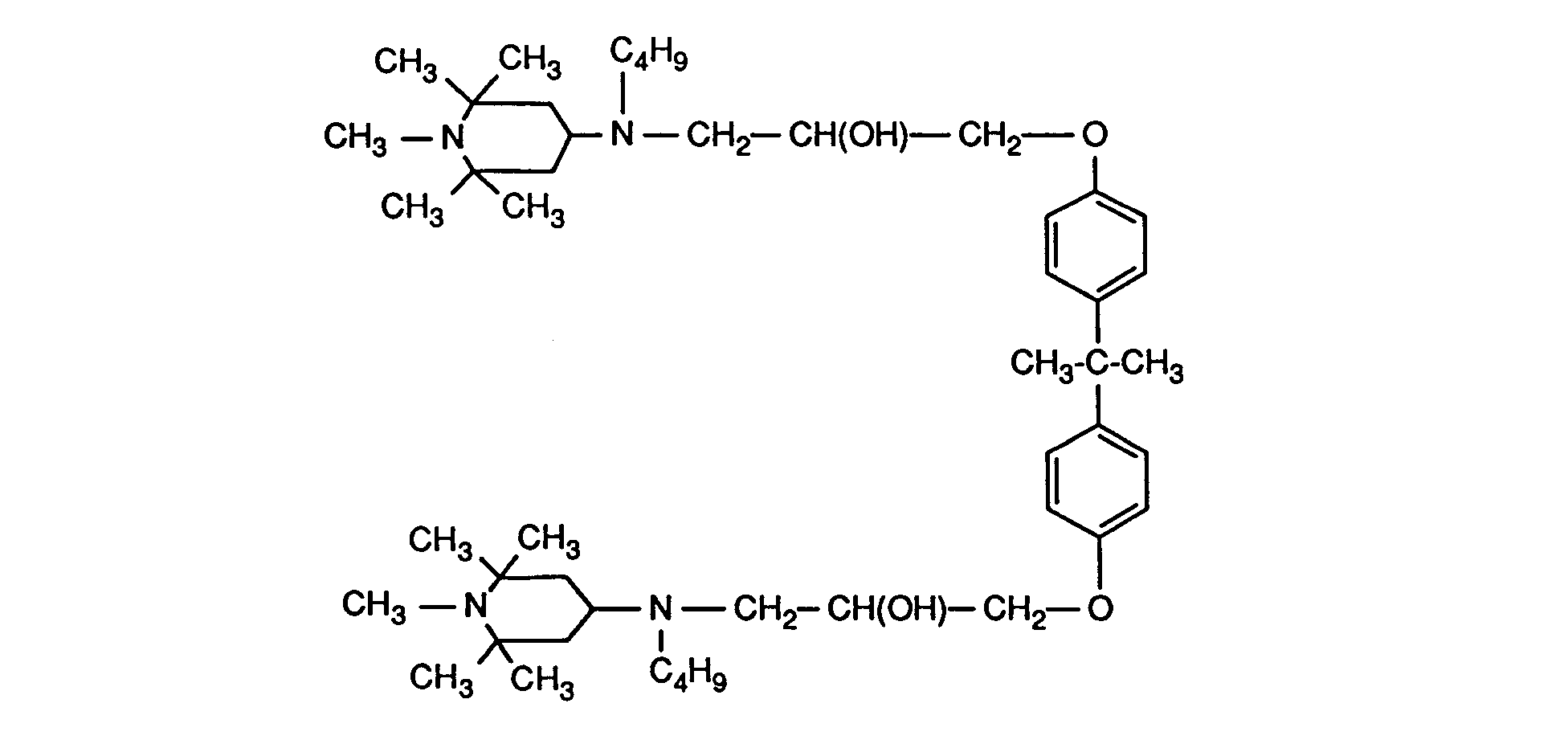
- 47) 4-(Bis-2-hydroxyethyl-amino)-1,2,2,6,6-pentamethylpiperidin
- 48) 4-(3-Methyl-4-hydroxy-5-tert.-butyl-benzoesäureamido)-2,2,6,6-tetra-methylpiperidin
- 49) 4-Methacrylamido-1,2,2,6,6-pentamethylpiperidin
- (c) Verbindungen der Formel (VI)

worin n die Zahl 1 oder 2 bedeutet, R und R¹¹ die unter (a) angegebene Bedeutung haben und R¹⁵, wenn n 1 ist, C₂-C₈-Alkylen oder -Hydroxyalkylen oder C₄-C₂₂-Acyloxyalkylen, wenn n 2 ist, die Gruppe (-CH₂)₂C(CH₂-)₂ bedeutet. - Bedeutet R¹⁵ C₂-C₈-Alkylen oder -Hydroxyalkylen, so stellt es beispielsweise Ethylen, 1-Methyl-ethylen, Propylen, 2-Ethyl-propylen oder 2-Ethyl-2-hydroxymethylpropylen dar.
- Als C₄-C₂₂-Acyloxyalkylen bedeutet R¹⁵ z.B. 2-Ethyl-2-acetoxymethylpropylen.
- Beispiele für Polyalkylpiperidin-Verbindungen dieser Klasse sind folgende Verbindungen:
- 50) 9-Aza-8,8,10,10-tetramethyl-1,5-dioxaspiro[5.5]undecan
- 51) 9-Aza-8,8,10,10-tetramethyl-3-ethyl-1,5-dioxaspiro[5.5]undecan
- 52) 8-Aza-2,7,7,8,9,9-hexamethyl-1,4-dioxaspiro[4.5]decan
- 53) 9-Aza-3-hydroxymethyl-3-ethyl-8,8,9,10,10-pentamethyl-1,5-dioxaspir o[5.5]undecan
- 54) 9-Aza-3-ethyl-3-acetoxymethyl-9-acetyl-8,8,10,10-tetramethyl-1,5-dioxaspiro[5.5]undecan
- 55) 2,2,6,6-Tetramethylpiperidin-4-spiro-2'-(1',3,-dioxan)-5'-spiro-5''-(1'',3''-dioxan)-2''-spiro-4'''-(2''',2''',6''',6'''-tetramethylpiperidin).
- (d)Verbindungen der Formeln VIIA, VIIB und VIIC, wobei Verbindungen der Formeln VIIA bevorzugt sind,


worin n die Zahl 1 oder 2 bedeutet, R und R¹¹ die unter (a) angegebene Bedeutung haben, R¹⁶ Wasserstoff, C₁-C₁₂-Alkyl, Allyl, Benzyl, Glycidyl oder C₂-C₆-Alkoxyalkyl ist und R¹⁷, wenn n 1 ist, Wasserstoff, C₁-C₁₂-Alkyl, C₃-C₅-Alkenyl, C₇-C₉-Aralkyl, C₅-C₇ Cycloalkyl, C₂-C₄-Hydroxyalkyl, C₂-C₆-Alkoxyalkyl, C₆-C₁₀-Aryl, Glycidyl oder eine Gruppe der Formel -(CH₂)p-COO-Q oder der Formel -(CH₂)p-O-CO-Q ist, worin p 1 oder 2 und Q C₁-C₄ Alkyl oder Phenyl sind, wenn n 2 ist, C₂-C₁₂ Alkylen, C₄-C₁₂-Alkenylen, C₆-C₁₂ Arylen, eine Gruppe -CH₂-CH(OH)-CH₂-O-D-O-CH₂-CH(OH)-CH₂-, worin D C₂-C₁₀ Alkylen, C₆-C₁₅-Arylen, C₆-C₁₂ Cycloalkylen ist, oder eine Gruppe -CH₂CH(OZ')CH₂-(OCH₂-CH(OZ')CH₂)₂- bedeutet, worin Z' Wasserstoff, C₁-C₁₈-Alkyl, Allyl, Benzyl, C₂-C₁₂-Alkanoyl oder Benzoyl ist, T₁ und T₂ unabhängig voneinander Wasserstoff, C₁-C₁₈-Alkyl oder gegebenenfalls durch Halogen oder C₁-C₄-Alkyl substituiertes C₆-C₁₀-Aryl oder C₇-C₉-Aralkyl bedeuten oder T₁ und T₂ zusammen mit dem sie bindenden C-Atom einen C₅-C₁₂-Cycloalkanring bilden. - Bedeuten etwaige Substituenten C₁-C₁₂-Alkyl, so stellen sie z.B. Methyl, Ethyl, n-Propyl, n-Butyl, sek.-Butyl, tert.-Butyl, n-Hexyl, n-Octyl, 2-Ethyl-hexyl, n-Nonyl, n-Decyl, n-Undecyl oder n-Dodecyl dar.
- Etwaige Substituenten in der Bedeutung von C₁-C₁₈-Alkyl können z.B. die oben angeführten Gruppen und dazu noch beispielsweise n-Tridecyl, n-Tetradecyl, n-Hexadecyl oder n-Octadecyl darstellen.
- Bedeuten etwaige Substituenten C₂-C₆-Alkoxyalkyl, so stellen sie z.B. Methoxymethyl, Ethoxymethyl, Propoxymethyl, tert.-Butoxymethyl, Ethoxyethyl, Ethoxypropyl, n-Butoxyethyl, tert.-Butoxyethyl, Isopropoxyethyl oder Propoxypropyl dar.
- Stellt R¹⁷ C₃-C₅-Alkenyl dar, so bedeutet es z.B. 1-Propenyl, Allyl, Methallyl, 2-Butenyl oder 2-Pentenyl.
- Als C₇-C₉-Aralkyl sind R¹⁷, T₁ und T₂ insbesondere Phenethyl oder vor allem Benzyl. Bilden T₁ und T₂ zusammen mit dem C-Atom einen Cycloalkanring, so kann dies z.B. ein Cyclopentan-, Cyclohexan-, Cyclooctan- oder Cyclododecanring sein.
- Bedeutet R¹⁷ C₂-C₄-Hydroxyalkyl, so stellt es z.B. 2-Hydroxyethyl, 2-Hydroxypropyl, 2-Hydroxybutyl oder 4-Hydroxybutyl dar.
- Als C₆-C₁₀-Aryl bedeuten R¹⁷, T₁ und T₂ insbesondere Phenyl, α- oder β-Naphthyl, die gegebenenfalls mit Halogen oder C₁-C₄-Alkyl substituiert sind.
- Stellt R¹⁷ C₂-C₁₂-Alkylen dar, so handelt es sich z.B. um Ethylen, Propylen, 2,2-Dimethylpropylen, Tetramethylen, Hexamethylen, Octamethylen, Decamethylen oder Dodecamethylen.
- Als C₄-C₁₂-Alkenylen bedeutet R¹⁷ insbesondere 2-Butenylen, 2-Pentenylen oder 3-Hexenylen.
- Bedeutet R¹⁷ C₆-C₁₂ Arylen, so stellt es beispielsweise o-, m- oder p-Phenylen, 1,4-Naphthylen oder 4,4'-Diphenylen dar.
- Bedeutet Z' C₂-C₁₂ Alkanoyl, so stellt es beispielsweise Propionyl, Butyryl, Octanoyl, Dodecanoyl, aber bevorzugt Acetyl dar.
- D hat als C₂-C₁₀ Alkylen, C₆-C₁₅ Arylen oder C₆-C₁₂ Cycloalkylen die unter (b) angegebene Bedeutung.
- Beispiele für Polyalkylpiperidin-Verbindungen dieser Klasse sind folgende Verbindungen:
- 56) 3-Benzyl-1,3,8-triaza-7,7,9,9-tetramethylspiro[4.5]decan-2,4-dion
- 57) 3-n-Octyl-1,3,8-triaza-7,7,9,9-tetrarnethylspiro[4.5]decan-2,4-dion
- 58) 3-Allyl-1,3,8-triaza-1,7,7,9,9-pentamethylspiro[4.5]decan-2,4-dion
- 59) 3-Glycidyl-1,3,8-triaza-7,7,8,9,9-pentamethylspiro[4.5]decan-2,4-dion
- 60) 1,3,7,7,8,9,9-Heptamethyl-1,3,8-triazaspiro[4.5]decan-2,4-dion
- 61) 2-Iso-propyl-7,7,9,9-tetramethyl-1-oxa-3,8-diaza-4-oxo-spiro-[4.5]decan
- 62) 2,2-Dibutyl-7,7,9,9-tetramethyl-1-oxa-3,8-diaza-4-oxo-spiro-[4.5]-decan
- 63) 2,2,4,4-Tetramethyl-7-oxa-3,20-diaza-21-oxo-dispiro[5.1.11.2]-heneicosan
- 64) 2-Butyl-7,7,9,9-tetramethyl-1-oxa-4,8-diaza-3-oxo-spiro-[4,5]decan und bevorzugt:
- 65) 8-Acetyl-3-dodecyl-1,3,8-triaza-7,7,9,9-tetramethylspiro[4,5]-decan-2,4-dion
oder die Verbindungen der folgenden Formeln:
- (e) Verbindungen der Formel VIII, die ihrerseits bevorzugt sind,

worin n die Zahl 1 oder 2 ist und R¹⁸ eine Gruppe der Formel
bedeutet, worin R und R¹¹ die unter (a) angegebene Bedeutung haben, E-O- oder -NR¹¹- ist, A C₂-C₆-Alkylen oder -(CH₂)₃-O- und x die Zahlen O oder 1 bedeuten, R¹⁹ gleich R¹⁸ oder eine der Gruppen -NR²¹R²², -OR²³, -NHCH₂OR²³ oder -N(CH₂OR²³)₂ ist, R²⁰, wenn n = 1 ist, gleich R¹⁸ oder R¹⁹, und wenn n = 2 ist, eine Gruppe -E-B-E- ist, worin B gegebenenfalls durch -N(R²¹)- unterbrochenes C₂-C₆-Alkylen bedeutet, R²¹ C₁-C₁₂-Alkyl, Cyclohexyl, Benzyl oder C₁-C₄-Hydroxyalkyl oder eine Gruppe der Formel
ist, R²² C₁-C₁₂ Alkyl, Cyclohexyl, Benzyl, C₁-C₄ Hydroxyalkyl und R²³ Wasserstoff, C₁-C₁₂ Alkyl oder Phenyl bedeuten oder R²¹ und R²² zusammen C₄-C₅-Alkylen oder -Oxaalkylen, beispielsweise
oder eine Gruppe der Formel
sind oder auch R²¹ und R²² jeweils eine Gruppe der Formel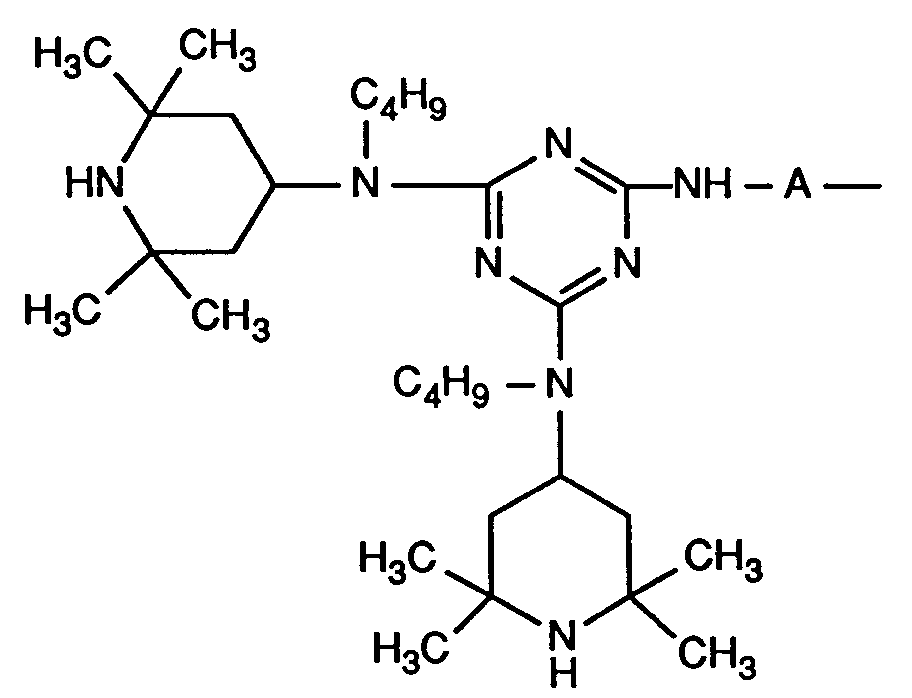
bedeuten. - Bedeuten etwaige Substituenten C₁-C₁₂-Alkyl, so stellen sie beispielsweise Methyl, Ethyl, n-Propyl, n-Butyl, sek.-Butyl, tert.-Butyl, n-Hexyl, n-Octyl, 2-Ethylhexyl, n-Nonyl, n-Decyl, n-Undecyl oder n-Dodecyl dar.
- Bedeuten etwaige Substituenten C₁-C₄-Hydroxyalkyl, so stellen sie z.B. 2-Hydroxyethyl, 2-Hydroxypropyl, 3-Hydroxypropyl, 2-Hydroxybutyl oder 4-Hydroxybutyl dar.
- Bedeutet A C₂-C₆ Alkylen, so stellt es beispielsweise Ethylen, Propylen, 2,2-Dimethylpropylen, Tetramethylen oder Hexamethylen dar.
- Stellen R²¹ und R²² zusammen C₄-C₅-Alkylen oder Oxaalkylen dar, so bedeutet dies z.B. Tetramethylen, Pentamethylen oder 3-Oxapentamethylen.
- Beispiele für Polyalkylpiperidin-Verbindungen dieser Klasse sind die Verbindungen der folgenden Formeln:
- 70)

- 71)

- 72)

- 73)

- 74)

- 75)

- 76)


- 77)

- 78)

- 79)

- (80)

- (f) Oligomere oder polymere Verbindungen, deren wiederkehrende Struktureinheit einen 2,2,6,6-Tetraalkylpiperidinrest der Formel III enthält, insbesondere Polyester, Polyäther, Polyamide, Polyamine, Polyurethane, Polyharnstoffe, Polyaminotriazine, Poly(meth)acrylate, Poly(meth)acrylamide und deren Copolymere, die solche Reste enthalten.
- Beispiele für 2,2,6,6-Polyalkylpiperidin-Lichtschutzmittel dieser Klasse sind die Verbindungen der folgenden Formeln, wobei m eine Zahl von 2 bis etwa 200 bedeutet.
- (81)

- 82)

- 83)

- (84)

- (85)

- (86)

- (87)

- (88)

- (89)

- 90)

- 91)

- 92)

- 93)

- 94)

- (g) Verbindungen der Formel IX
- Bevorzugt sind Verbindungen der Formel IX, worin R Wasserstoff oder Methyl ist und R¹¹ Wasserstoff oder Methyl ist.
- Beispiele für solche Verbindungen sind:
- 95) 2,2,6,6-Tetramethyl-4-piperidon (Triacetonamin)
- 96) 1,2,2,6,6-Pentamethyl-4-piperidon
- 97) 2,2,6,6-Tetramethyl-4-pipendon-1-oxyd
- 98) 2,3,6-Trimethyl-2,6-diethyl-4-piperidon
- Besonders zweckmässig werden in den erfindungsgemässen Zusammensetzungen als Komponente a) cyclische sterisch gehinderte Amine eingesetzt, die keine Estergruppen enthalten und bevorzugt solche, die im Molekül mindestens einen Triazinring enthalten. Solche Amine enthalten vorzugsweise mindestens eine Gruppe der Formel III und gehören besonders bevorzugt einer der vorstehend geschilderten Typen (a) bis (g) an.
- Bevorzugt sind Polymerzusammensetzungen, wie beschrieben, enthaltend als b) eine organische Zinkverbindung, wobei die Zinkverbindung ein Salz einer Carbonsäure mit 7 bis 20 C-Atomen oder ein C₇-C₂₀-Alkylphenolat darstellt.
- Bei den Zinkverbindungen aus der Reihe der Carboxylate handelt es sich bevorzugt um Salze von Carbonsäuren mit 7 bis 20 C-Atomen, beispielsweise Benzoate, Alkenoate oder Alkanoate, bevorzugt Stearate, Oleate, Laurate, Palmitate, Hydroxystearate oder 2-Ethylhexanoate. Besonders bevorzugt sind Stearate, Oleate und p-tert-Butylbenzoate.
- Namentlich zu erwähnen sind, als Beispiele, die Zinksalze der monovalenten Carbonsäuren, wie Essigsäure, Propionsäure, Buttersäure, Valeriansäure, Capronsäure, Enanthsäure, Caprylsäure, Neodecansäure, 2-Ethylhexansäure, Pelargonsäure, Caprinsäure, Undecansäure, Laurinsäure, Tridecansäure, Myristylsäure, Palmitinsäure, Isostearinsäure, Stearinsäure, 12-Hydroxystearinsäure, Behensäure, Montansäure, Benzoesäure, Monochlorbenzoesäure, p-tert-Butylbenzoesäure, Dimethylhydroxybenzoesäure, 3,5-Di-tert-butyl-4-hydroxybenzoesäure, Tolylsäure, Dimethylbenzoesäure, Ethylbenzoesäure, Cuminsäure, n-Propylbenzoesäure,
- Aminobenzoesäure, N,N-Dimethylbenzoesäure, Acetoxybenzoesäure, Salicylsäure, p-tert-Octylsalicylsäure, Oleinsäure, Elaidinsäure, Sorbinsäure, Linolsäure, Linolensäure, Thioglykolsäure, Mercaptopropionsäure und Octylmercaptopropionsäure; Zinksalze der Monoester und Monoamide der divalenten Carbonsäuren, wie Oxalsäure, Malonsäure, Bernsteinsäure, Glutaminsäure, Adipinsäure, Pimelinsäure, Suberinsäure, Azelainsäure, Sebacinsäure, Phthalsäure, Isophthalsäure, Terephthalsäure, Hydroxyphthalsäure, Chlorphthalsäure, Aminophthalsäure, Maleinsäure, Fumarsäure, Citraconsäure, Mesaconsäure, Itaconsäure, Aconitrinsäure und Thiodipropionsäure; und der Di- oder Triester der tri-oder tetravalenten Carbonsäuren, wie Hemimellitsäure, Trimellitsäure, Mellophansäure, Pyromellitsäure und Mellitsäure.
- Als Chelate von 1,3-Diketonen und B-Ketocarbonsäureestern sind beispielsweise Verbindungen der Formel

zu nennen,
wobei R, R' und R" unabhängig voneinander Alkyl mit 1 bis 18 C-Atomen, Alkenyl mit 2 bis 18 C-Atomen, Cycloalkyl mit 5 bis 12 Ring-C-Atomen, mit 1 bis 3 C₁-C₄-Alkyl substituiertes Cycloalkyl mit 5 bis 12 C-Atomen, Alkyl mit 1 bis 18 C-Atomen, das mit Cycloalkyl mit 5-12 Ring-C-Atomen substituiert ist, Phenyl-C₁-C₁₈-alkyl, C₁-C₁₈-Alkylphenyl, Phenyl, Halogenalkyl, Halogenphenyl, Alkoxyalkyl oder Alkylendioxyalkyl oder -phenyl darstellen und R' ausserdem noch für Wasserstoff stehen kann. - Beispiele für R, R', und R" sind Methyl, Ethyl, Propyl, Isopropyl, Isobutyl, n-Butyl, sec.-Butyl, tert.-Butyl, 1-Pentyl, 3-Pentyl, 1-Hexyl, 1-Heptyl, 3-Heptyl, 1-Octyl, 2,4,4-Trimethylphenyl, tert-Octyl, Nonyl, Decyl, Tridecyl, Pentadecyl, Heptadec-8-en-1-yl, n-Octadecyl, Allyl, Methallyl, 2-Hexenyl, 1-Methylcyclopentyl, Cyclohexyl, Cyclohexylpropyl, Phenyl, m-Tolyl, p-Ethylphenyl, tert.Butylphenyl, Benzyl, Phenylpropyl und Nonylbenzyl.
- Beispiele für Halogenalkyl oder Halogenphenyl sind Dichlormethyl, Heptafluoropropyl, p-Bromphenyl und 3,4-Dichlorobenzyl. Alkoxyalkyl kann Ethoxymethyl, n-Butoxymethyl, 2-Methoxyethyl, 2-Methoxyphenyl und 4-n-Octoxyphenylbenzyl bedeuten. Alkylendioxyalkyl oder -phenyl kann beispielsweise 3-(Ethylendioxypropyl) oder 3,4-Methylendioxyphenyl sein.
- Sinngemäss lassen sich auch alle mit obiger Aufstellung nicht umfassten bereits genannten 1,3-Diketone in Form ihrer Zink-Chelat-Form als organische Zinkverbindungen einsetzen.
- Bevorzugt sind Polymerzusammensetzungen wie oben beschrieben, enthaltend als c) mindestens eine Verbindung aus der Reihe der Zeolithe.
- Bevorzugt sind Polymerzusammensetzungen, wie oben beschrieben, enthaltend mindestens eine der Verbindungen der Formeln
Na₁₂Al₁₂Si₁₂O₄₈·27H₂O [Zeolith A],
Na₆Al₆Si₆O₂₄· 2NaX · 7,5 H₂O, X = OH, Cl, ClO₄, 1/2CO₃ [Sodalith]
Na₆Al₆Si₃₀O₇₂ · 24 H₂O,
Na₈Al₈Si₄₀O₉₆ · 24 H₂O,
Na₁₆Al₁₆Si₂₄O₈₀ · 16 H₂O,
Na₁₆Al₁₆Si₃₂O₉₆·16H₂O,
Na₅₆Al₅₆Si₁₃₆O₃₈₄· 250 H₂O, [Zeolith Y]
Na₈₆Al₈₆Si₁₀₆·O₃₈₄· 264H₂O [Zeolith X]
oder die durch teilweisen bzw. vollständigen Austausch der Na-Atome durch Li-, K-, Mg-, Ca-, Sr-, Ba- oder Zn-Atome darstellbaren Zeolithe wie
(Na,K)₁₀Al₁₀Si₂₂O₆₄ · 20 H₂O.
Ca4,5Na₃[(AlO₂)₁₂(SiO₂)₁₂] · 30 H₂O
K₉Na₃[(AlO₂)₁₂(SiO₂)₁₂]·27H₂O
- Die angeführten Zeolithe können auch wasserärmer bzw. wasserfrei sein.
- Die Polymerzusammensetzungen können auch weitere organische oder anorganische Ca- und darüberhinaus Ba- und Mg-Verbindungen enthalten. Bevorzugt sind Calcium-Verbindungen. Zweckmässig wird mindestens eine organische oder anorganische Ca-, Ba- und/oder Mg-Verbindung aus der Reihe der aliphatischen C₁-C₂₂-Carboxylate, der olefinischen C₂-C₂₂-Carboxylate, der aliphatischen C₂-C₂₂-Carboxylate, die mit wenigstens einer OH-Gruppe substituiert sind, der cyclischen und bicyclischen Carboxylate mit 5-22 C-Atomen, der aromatischen C₆-C₂₂- Carboxylate, der mit wenigstens einer OH-substituierten aromatischen C₆-C₂₂-Carboxylate, der C₁-C₁₆-alkylsubstituierten Phenylcarboxylate, der Phenyl-C₁-C₁₆-alkylcarboxylate, der C₆-C₁₈-Phenolate, der C₅-C₂₆-Chelate von 1,3-Diketonen oder β-Ketocarbonsäureestern, der Dehydracetsäure und deren Derivaten, der Carbonate, Sulfate, Oxide, Hydroxide, basischen Oxide und Misch-Oxide, der Mercaptide auf der Basis von Mercaptocarbonsäureestern, der Glycinate, Phosphate, Phosphite, Phosphonite, Phosphonate, der Partialester von Phosphonaten, der Sulfonate und Sulfinate, wobei die Carbonate, Sulfate und Phosphite auch in überbasischen Formen angewendet werden können, angewendet.
- Beispiele und Bevorzugungen für die organischen und anorganischen Ca-, und darüber hinaus Ba- und Mg-Verbindungen sind sinngemäss aus den Beispielen und Bevorzugungen, die zu den Zinkverbindungen angegeben sind, abzuleiten. Dabei soll jeweils anstelle des Zinks eines der Metalle der Reihe Calcium, Barium oder Magnesium gelesen werden.
- Als chlorhaltige Polymere können beispielsweise aufgezählt werden: Polymere des Vinylchlorides, Vinylharze, enthaltend Vinylchlorideinheiten in deren Struktur, wie Copolymere des Vinylchlorids und Vinylester von aliphatischen Säuren, insbesondere Vinylacetat, Copolymere des Vinylchlorids mit Estern der Acryl- und Methycrylsäure und mit Acrylnitril, Copolymere des Vinylchlorids mit Dienverbindungen und ungesättigten Dicarbonsäuren oder deren Anhydride, wie Copolymere des Vinylchlorids mit Diethylmaleat, Diethylfumarat oder Maleinsäureanhydrid, nachchlorierte Polymere und Copolymere des Vinylchlorids, Copolymere des Vinylchlorids und Vinylidenechlorids mit ungesättigten Aldehyden, Ketonen und anderen, wie Acrolein, Crotonaldehyd, Vinylmethylketon, Vinylmethylether, Vinylisobutylether und ähnliche; Polymere des Vinylidenchlorids und Copolymere desselben mit Vinylchlorid und anderen polymerisierbaren Verbindungen; Polymere des Vinylchloracetates und Dichlordivinylethers; chlorierte Polymere des Vinylacetates, chlorierte polymerische Ester der Acrylsäure und der alpha-substituierten Acrylsäure; Polymere von chlorierten Styrolen, zum Beispiel Dichlorstyrol; chlorierte Gummis; chlorierte Polymere des Ethylens; Polymere und nachchlorierte Polymere von Chlorbutadiens und deren Copolymere mit Vinylchlorid, Gummi-Hydrochlorid und chloriertes Gummi-Hydrochlorid; sowie Mischungen der genannten Polymere unter sich oder mit anderen polymerisierbaren Verbindungen.
- Ferner sind umfasst die Pfropfpolymerisate von PVC mit EVA, ABS und MBS. Bevorzugte Substrate sind auch Mischungen der vorstehend genannten Homo-und Copolymerisate, insbesondere Vinylchlorid-Homopolymerisate, mit anderen thermoplastischen oder/und elastomeren Polymeren, insbesondere Blends mit ABS, MBS, NBR, SAN, EVA, CPE, MBAS, PMA, PMMA, EPDM und Polylactonen.
- Weiterhin bevorzugt sind Suspensions- und Massepolymere, sowie Emulsionspolymere.
- Als chlorhaltiges Polymerisat ist Polyvinylchlorid besonders bevorzugt, insbesondere Suspensionspolymerisat und Massepolymerisat.
- Zweckmässig sind Polymerzusammensetzungen, wie vorstehend beschrieben, enthaltend, bezogen auf 100 Gew.-Teile Zusammensetzung,
- a) 0,01 bis 1,5 Gew.-Teile an cyclischen oder nicht-cyclischen sterisch gehinderten Aminen,
- b) 0,01 bis 2 Gew.-Teile an organischen oder anorganischen Zinkverbindungen und
- c) 0,1 bis 3 Gew.-Teile an Verbindungen aus der Reihe der kristallinen Alkali-/Erdalkali-alumosilikate.
- Bevorzugte Mengenbereiche für die sterisch gehinderten Amine in der Polymerzusammensetzung sind 0,05 bis 1,0 Gew.-Teile, bezogen auf 100 Gew.-Teile Zusammensetzung. Besonders bevorzugt sind 0,1 bis 0,5 Gew.-Teile.
- Bevorzugte Mengenbereiche für die Zinkverbindungen in der Polymerzusammensetzung sind 0,05 bis 1 Gew.-Teile, bezogen auf 100 Gew.-Teile Zusammensetzung.
- Bevorzugte Mengenbereiche für die kristallinen Alkali-/Erdalkali-alumosilikate in der Polymerzusammensetzung sind 0,3 bis 2 Gew.-Teile, bezogen auf 100 Gew.-Teile Zusammensetzung. Besonders bevorzugt sind 0,4 bis 1 Gew.-Teil.
- Das chlorhaltige Polymer kann einen Weichmacher enthalten, wobei chlorhaltige Polymere, die keinen Weichmacher enthalten, bevorzugt sind.
- Als organische Weichmacher kommen beispielsweise solche aus den folgenden Gruppen in Betracht:
- A) Phthalate (Phthalsäureester)
Beispiele für solche Weichmacher sind Dimethyl-, Diethyl-, Dibutyl-, Dihexyl-, Di-2-ethylhexyl-, Di-n-octyl-, Di-iso-octyl-, Di-iso-nonyl-, Di-iso-decyl-, Di-iso-tridecyl-, Dicyclohexyl-, Di-methylcyclohexyl-, Dimethylglycol-, Dibutylglycol-, Benzylbutyl- und Diphenyl-phthalat sowie Mischungen von Phthalaten wie C₇C₉- und C₉-C₁₁-Alkylphthalate aus überwiegend linearen Alkoholen, C₆-C₁₀-n-Alkylphthalate und C₈-C₁₀-n-Alkylphthalate. Bevorzugt sind davon Dibutyl-, Dihexyl-, Di-2-ethylhexyl-, Di-n-octyl-, Di-iso-octyl-, Di-iso-nonyl-, Di-iso-decyl-, Di-iso-tridecyl- und Benzylbutyl-phthalat sowie die genannten Mischungen von Alkylphthalaten. Besonders bevorzugt ist Di-2-ethylhexylphthalat (DOP). - B) Ester aliphatischer Dicarbonsäuren, insbesondere Ester von Adipin-, Azelain- und Sebazinsäure
Beispiele für solche Weichmacher sind Di-2-ethylhexyladipat, Di-isooctyladipat (Gemisch), Di-iso-nonyladipat (Gemisch), Di-iso-decyladipat (Gemisch), Benzylbutyladipat, Benzyloctyladipat, Di-2-ethylhexylazelat, Di-2-ethylhexylsebacat und Di-iso-decylsebacat (Gemisch). Bevorzugt sind Di-2-ethylhexyladipat und Di-iso-octyladipat. - C) Trimellithsäureester,
beispielsweise Tri-2-ethylhexyltrimellithat, Tri-iso-decyltrimellithat (Gemisch), Tri-iso-tridecyltrimellithat, Tri-iso-octyltrimellithat (Gemisch) sowie Tri-C₆-C₈-alkyl, Tri-C₆-C₁₀-alkyl-, Tri-C₇-C₉-alkyl- und Tri-C₉-C₁₁-alkyl-trimellithate. Die letztgenannten Trimellithate entstehen durch Veresterung der Trimellithsäure mit den entsprechenden Alkanolgemischen. Bevorzugte Trimellithate sind Tri-2-ethylhexyltrimellithat und die genannten Trimellithate aus Alkanolgemischen. - D) Polymerweichmacher
Eine Definition dieser Weichmacher und Beispiele für solche sind im "Plastics Additives Handbook", Herausgeber H. Gächter und H. Müller, Hanser Publishers, 1985, Seite 284, Kapitel 5.7.10 sowie in "PVC Technology", Herausgeber W.V. Titow, 4th. Ed., Elsevier Publ., 1984, Seiten 165-170 angegeben. Die gebräuchlichsten Ausgangsmaterialien für die Herstellung der Polyesterweichmacher sind: Dicarbonsäuren wie Adipin-, Phthal-, Azelain- und Sebacinsäure; Diole wie 1,2-Propandiol, 1,3-Butandiol, 1,4-Butandiol, 1,6-Hexandiol, Neopentylglycol und Diethylenglykol; Monocarbonsäuren wie Essig-, Capron-, Capryl-, Laurin-, Myristin-, Palmitin-, Stearin-, Pelargon-und Benzoesäure; monofunktionelle Alkohole wie Isooctanol, 2-Ethylhexanol, Isodecanol sowie C₇-C₉-Alkanol- und C₉-C₁₁-Alkanolgemische. Besonders vorteilhaft sind Polyesterweichmacher aus den genannten Dicarbonsäuren und monofunktionellen Alkoholen. - E) Phosphorsäureester
Eine Definition dieser Ester ist im vorstehend genannten "Plastics Additives Handbook" auf Seite 271, Kapitel 5.7.2 zu finden. Beispiele für solche Phosphorsäureester sind Tributylphosphat, Tri-2-ethylbutylphosphat, Tri-2-ethylhexylphosphat, Trichlorethylphosphat, 2-Ethyl-hexyl-di-phenylphosphat, Kresyldiphenylphosphat, Triphenylphosphat, Trikresylphosphat und Trixylenylphosphat. Bevorzugt ist Tri-2-ethylhexyl-phosphat. - F) Chlorierte Kohlenwasserstoffe (Paraffine)
- G) Kohlenwasserstoffe
- H) Monoester, z.B. Butyloleat, Phenoxyethyloleat, Tetrahydrofurfuryloleat und Alkylsulfonsäureester.
- I) Glycolester, z.B. Diglykolbenzoate.
- Definitionen und Beispiele für Weichmacher der Gruppen F) bis I) sind den folgenden Handbüchern zu entnehmen:
- "Plastics Additives Handbook", Herausgeber H. Gächter und H. Müller, Hanser Publishers, 1985, Seite 284, Kapitel 5.7.11 (Gruppe F)), und Kapitel 5.7.13 (Gruppe G)).
- "PVC Technology", Herausgeber W.V. Titow, 4th. Ed., Elsevier Publishers, 1984, Seiten 171-173, Kapitel 6.10.2 (Gruppe F)), Seite 174, Kapitel 6.10.5 (Gruppe G)), Seite 173, Kapitel 6.10.3 (Gruppe H)) und Seiten 173-174, Kapitel 6.10.4 (Gruppe I)). Besonders bevorzugt sind Weichmacher aus den Gruppen A) bis E), insbesondere A) bis C), vor allem die in diesen Gruppen als bevorzugt herausgestellten Weichmacher.
- Besonders günstig ist Di-2-ethylhexylphthalat (DOP).
- Die Weichmacher können in einer Menge von beispielsweise 15 bis 70, zweckmässig 15 bis 60 und insbesondere 20 bis 50 Gew.-Teilen, bezogen auf 100 Gew.-Teile Polymerzusammensetzung, angewendet werden.
- Die Polymerzusammensetzungen nach vorliegender Erfindung können auch weitere Stabilisatoren enthalten, so die vorstehend genannte Komponente d) 1,3-Diketone, die zweckmässig in Mengen von 0,05 bis 5, vorzugsweise in Mengen von 0,10 bis 1 Gew.-Teil und insbesondere in Mengen von 0,5 bis 1 Gew.-Teil, jeweils bezogen auf 100 Gew.-Teile Zusammensetzung, angewendet werden kann.
- Ein anderer Stabilisator, der ebenfalls Anwendung finden kann, ist die vorstehend beschriebene Komponente e) - die organischen oder anorganischen Calciumverbindungen -, die zweckmässig in Mengen von 0,05 bis 5 Gew.-Teilen, vorzugsweise in Mengen von 0,1 bis 1 Gew.-Teil und insbesondere in Mengen von 0,5 bis 1 Gew.-Teil, jeweils bezogen auf 100 Gew.-Teile Zusammensetzung, angewendet werden können.
- Finden weitere Stabilisatoren aus der Reihe der organischen oder anorganischen Ca-, Ba-, Mg- oder Pb-Verbindungen, wie oben erwähnt, Anwendung, so können beispielsweise 0 bis 5 Gew.-Teile, bezogen auf die Zusammensetzung, eingesetzt werden. Zweckmässig sind 0,05 bis 5 Gew.-Teile, bevorzugt 0,1 bis 1 Gew.-Teile.
- Die erfindungsgemässen Zusammensetzungen können auch weitere, für chlorhaltige Thermoplasten übliche Stabilisatoren enthalten. So enthalten sie beispielsweise 0-3 Teile, bezogen auf die Zusammensetzung, insbesondere 0-1,5, vor allem 0-1 Teile eines oder mehrerer Phosphite. Solche Phosphite können etwa in einer Menge von 0,01-3, insbesondere 0,01-1,5, z.B. 0,01-1, bevorzugt 0,1-0,6, z.B. 0,2-0,5 Teilen enthalten sein. Beispiele für derartige Phosphite sind etwa solche der Formeln

worin R¹'', R²'' und R³'' gleich oder verschieden sind und C₆-C₁₈-Alkyl, C₆-C₁₈-Alkenyl, einen substituierten oder unsubstituierten Phenylrest oder C₅-C₇-Cycloalkyl bedeuten. - Bedeuten R¹'', R²'' und R³'' C₆-C₁₈-Alkyl, so handelt es sich dabei z.B. um n-Hexyl, n-Octyl, n-Nonyl, Decyl, Dodecyl, Tetradecyl, Hexadecyl oder Octadecyl. Bevorzugt sind Alkylgruppen mit 8 bis 18 C-Atomen.
- Als substituiertes Phenyl bedeuten R1'', R2'' und R3'' beispielsweise Tolyl, Ethylphenyl, Xylyl, Cumyl, Cymyl, Kresyl, 4-Methoxyphenyl, 2,4-Di-methoxyphenyl, Ethoxyphenyl, Butoxyphenyl, p-n-Octylphenyl, p-n-Nonylphenyl oder p-n-Dodecylphenyl.
- Besonders geeignete Phosphite sind Trioctyl-, Tridecyl-, Tridodecyl-, Tritetradecyl, Tristearyl-, Trioleyl-, Triphenyl-, Trikresyl-, Tris-p-nonylphenyl- oder Tricyclohexylphosphit und besonders bevorzugt sind die Aryl-Dialkyl- sowie die Alkyl-Diaryl-Phosphite, wie z.B. Phenyldidecyl-, (2,4-Di-tert.-butylphenyl)-di-dodecylphosphit, (2,6-Di-tert.-butylphenyl)-di-dodecylphosphit und die Dialkyl-und Diaryl-pentaerythrit-diphosphite, wie Distearylpentaerythrit-diphosphit.
- Bevorzugte organische Phosphite sind Distearyl-pentaerythrit-diphosphit, Trisnonylphenylphosphit und Phenyl-didecyl-phosphit.
- Ferner können in den erfindungsgemässen Zusammensetzungen weitere bekannte Costabilisatoren enthalten sein, beispielsweise 0-2, insbesondere 0-1,5 Teile, bezogen auf die Zusammensetzung. Sie sind dann vorzugsweise in einer Menge von 0,01-2, insbesondere 0,05-1,5, z.B. 0,1-1, vor allem 0,1-0,5 Teilen vorhanden. Als derartige Costabilisatoren seien Aminocrotonsäureester, Dehydracetsäure, 2,4-Dihydroxybenzophenon, 2,4-Dihydroxy-4'-tert.-butylbenzophenon Dihydropyridin-Derivate und Pyrrolderivate genannt.
- Als Aminocrotonsäureester kommen insbesondere die Ester mit einwertigen geradkettigen C₈-C₂₀-, insbesondere C₁₂-C₁₈-Alkoholen und/oder mit 1,3- bzw. 1,4-Butandiol und/oder 1,2-Dipropylenglykol und/oder Thiodiethylenglykol in Betracht.
- Als Pyrrol-Costabilisatoren sind jene besonders zu erwähnen, die in der EP-A 22 087 und der GB-A 2 078 761 beschrieben sind, z.B. der dort angegebenen Formel I, vorzugsweise jene Pyrrolderivate, die in den Ansprüchen 2-9 der EP-A 22 087 definiert sind. Als Beispiel sei 2-Methyl-3-cyclohexyloxycarbonyl-4-phenyl-1H-pyrrol genannt.
- Ferner können die erfindungsgemässen Zusammensetzungen neben den vorstehend genannten fakultativen Costabilisatoren oder an deren Stelle noch weitere fakultative Bestandteile enthalten, z.B. organische Antimonverbindungen, wie Antimon-tris-[isooctyl-thioglykolat] (Isooctyl = 2-Ethylhexyl).
- Andere Stabilisatoren, die in den erfindungsgemässen Zusammensetzungen angewendet werden können, sind Polyole. Die anzuwendenden Mengen sind beispielsweise bis zu 3 Gew.-Teile, bezogen auf 100 Gew.-Teile Zusammensetzung, zweckmässig bis zu 2 Gew.-Teilen und vorzugsweise 0,01 bis 1 Gew.-Teil. Typische Beispiele von Polyolen sind Pentaerythrit, Dipentaerythrit, Trimethylolpropan, Ditrimethylolpropan, Tris-(2-hydroxyethyl)isocyanurat (THEIC), wobei letzteres bevorzugt ist, Sorbit, Mannit und Inosit.
- Ferner können die erfindungsgemässen Zusammensetzungen übliche Antioxidantien, Lichtstabilisatoren und UV-Absorber enthalten. Beispiele dafür sind:
-
- 1.1. Alkylierte Monophenole, z.B. 2,6-Di-tert.butyl-4-methylphenol, 2-Tert.butyl-4,6-dimethylphenol, 2,6-Di-tert.butyl-4-ethylphenol, 2,6-Di-tert.butyl-4-n-butylphenol, 2,6-Di-tert.butyl-4-i-butylphenol, 2,6-Di-cyclopentyl-4-methylphenol, 2-(α-Methylcyclohexyl)-4,6-dimethylphenol, 2,6-Di-octadecyl-4-methylphenol, 2,4,6-Tri-cyclohexylphenol, 2,6-Di-tert.butyl-4-methoxymethylphenol, 2,6-Di-nonyl-4-methylphenol.
- 1.2. Alkylierte Hydrochinone, z.B. 2,6-Di-tert. butyl-4-methoxyphenol, 2,5-Di-tert.butyl-hydrochinon, 2,5-Di-tert.amyl-hydrochinon, 2,6-Di-phenyl-4-octadecyloxyphenol.
- 1.3. Hydroxylierte Thiodiphenylether, z.B. 2,2'-Thio-bis-(6-tert.-butyl-4-methylphenol), 2,2'-Thio-bis-(4-octylphenol), 4,4'-Thio-bis-(6-tert.butyl-3-methylphenol), 4,4'-Thio-bis-(6-tert.butyl-2-methylphenol).
- 1.4. Alkyliden-Bisphenole, z.B. 2,2'-Methylen-bis-(6-tert butyl-4-methylphenol), 2,2'-Methylen-bis-(6-tert.butyl-4-ethylphenol), 2,2'-Methylen-bis-[4-methyl-6-(α-methylcyclohexyl)-phenol], 2,2'-Methylen-bis-(4-methyl-6-cyclohexylphenol), 2,2'-Methylen-bis-(6-nonyl-4-methylphenol), 2,2'-Methylen-bis-(4,6-di-tert.butylphenol), 2,2'-Ethyliden-bis-(4,6-di-tert.butylphenol),2,2'-Ethyliden-bis-(6-tert.butyl-4-isobutylphenol), 2,2'-Methylen-bis-[6-(α-methylbenzyl)-4-nonylphenol], 2,2'-Methylen-bis-[6-(α,α-dimethylbenzyl)-4-nonylphenol], 4,4'-Methylen-bis-(2,6-di-tert.-butylphenol), 4,4 '-Methylen-bis-(6-tert.butyl-2-methylphenol), 1,1-Bis-(5-tert.butyl-4-hydroxy-2-methylphenyl)-butan, 2,6-Bis-(3-tert.butyl-5-methyl-2-hydroxybenzyl)-4-methylphenol, 1,1,3-Tris-(5-tert .butyl-4-hydroxy-2-methylphenyl)-butan, 1,1-Bis-(5-tert.butyl-4-hydroxy-2-methyl-phenyl)-3-n-dodecylmercaptobutan, Ethylenglycol-bis-[3,3-bis-(3'-tert.-butyl-4'-hydroxyphenyl)-butyrat], Bis-(3-tert.butyl-4-hydroxy-5-methyl-phenyl)-dicyclopentadien, Bis-[2-(3'-tert.butyl-2'-hydroxy-5'-methyl-benzyl)-6-tertbutyl-4-methyl-phenyl]-terephthalat.
- 1.5 Benzylverbindungen, z.B. 1,3,5-Tris-(3,5-di-tert.butyl-4-hydroxybenzyl)-2,4,6-trimethylbenzol, Bis-(3,5-di-tert.butyl-4-hydroxybenzyl)-sulfid, 3,5-Di-tert.butyl-4-hydroxybenzyl-mercaptoessigsäure-isooctylester, Bis-(4-tert butyl-3-hydroxy-2,6-dimethylbenzyl)dithiol-terephthalat, 1,3,5-Tris-(3,5-di-tert.butyl-4-hydroxybenzyl)-isocyanurat, 1,3,5-Tris-(4-tert.butyl-3-hydroxy-2,6-dimethylbenzyl)-isocya nurat, 3,5-Di-tert.butyl-4-hydroxybenzyl-phosphonsäure-dioctadecyles ter, Ca-Salz des 3,5-Di-tert.butyl-4-hydroxybenzyl-phosphonsäure-monoethylester, 1,3,5-Tris-(3,5-dicyclohexyl-4-hydroxybenzyl)isocyanurat.
- 1.6. Acylaminophenole, z.B. 4-Hydroxy-laurinsäureanilid, 4-Hydroxystearinsäureanilid, 2,4-Bis-(octylmercapto)-6-(3,5-di-tert.butyl-4-hydroxyanilino)-s-triazin, N-(3,5-di-tert.butyl-4-hydroxyphenyl)-carbaminsäureoctylester.
- 1.7. Ester der β-(3.5-Di-tert.butyl-4-hydroxyphenyl)-propionsäure mit ein- oder mehrwertigen Alkoholen, wie z.B. mit Methanol, Octa- decanol, 1,6-Hexandiol, Neopentylglycol, Thiodiethylenglycol, Diethylenglycol, Triethylenglycol, Pentaerythrit, Tris-(hydroxyethyl)-isocyanurat, N,N'-Bis-(hydroxyethyl)-oxalsäurediamid.
- 1.8. Ester der β-(-5-tert.Butyl-4-hydroxy-3-methylphenyl)-propionsäure mit ein- oder mehrwertigen Alkoholen, wie z.B. mit Methanol, Octadecanol, 1,6-Hexandiol, Neopentylglycol, Thiodiethylenglycol, Diethylenglycol, Triethylenglycol, Pentaerythrit, Tris-(hydroxy)ethyl-isocyanurat, N,N'-Bis-(hydroxyethyl)-oxalsäurediamid.
- 1.9. Ester der β-(3,5-Dicyclohexyl-4-hydroxyphenyl)-propionsäure mit ein- oder mehrwertigen Alkoholen, wie z.B. mit Methanol, Octadecanol, 1,6-Hexandiol, Neopentylglycol, Thiodiethylenglycol, Diethylenglycol, Triethylenglycol, Pentaerythrit, Tris-(hydroxy)ethyl-isocyanurat, N,N'-Bis-(hydroxyethyl)-oxalsäurediamid.
- 1.10. Amide der β-(3,5-Di-tert.butvl-4-hydroxyphenyl)-propionsäure, wie z.B. N,N'-Bis-(3,5-di-tert.butyl-4-hydroxyphenylpropionyl)-hexamethylendiamin, N,N'-Bis-(3,5-di-tert.butyl-4-hydroxyphenylpropionyl)-trimethylendiamin, N,N'-Bis-(3,5-di-tert.butyl-4-hydroxyphenylpropionyl)-hydrazin.
-
- 2.1. 2-(2'-Hydroxyphenyl)-benztriazole, wie z.B. das 5'-Methyl-, 3',5'-Di-tert.butyl-, 5'-tert.Butyl-,5'-(1,1,3,3-Tetramethylbutyl)-,5-Chlor-3',5'-di-tert.butyl-, 5-Chlor-3'-tert.butyl-5'-methyl-,3'-sec.Butyl-5'-tert.butyl,4'-Octoxy-, 3',5'-Di-tert.amyl-,3',5'-Bis-(α,α-dimethylbenzyl)-Derivat.
- 2.2.2-Hydroxybenzophenone, wie z.B. das 4-Hydroxy-, 4-Methoxy-, 4-Octoxy-, 4-Decyloxy-, 4-Dodecyloxy-, 4-Benzyloxy-, 4,2',4'-Trihydroxy-, 2'-Hydroxy-4,4'-dimethoxy-Derivat.
- 2.3. Ester von gegebenenfalls substituierten Benzoesäuren, wie z.B. 4-tert Butyl-phenylsalicylat, Phenylsalicylat, Octylphenyl-salicylat, Dibenzoylresorcin, Bis-(4-tert.butylbenzoyl)-resorcin, Benzoylresorcin, 3,5-Di-tert.butyl-4-hydroxybenzoesäure-2,4-di-tert.butylphenylester , 3,5-Di-tert.butyl-4-hydroxybenzoesäurehexadecylester.
- 2.4. Acrylate, wie z.B. α-Cyan-β,β-diphenylacrylsäure-ethylester bzw. -isooctylester, α-Carbomethoxy-zimtsäuremethylester, α-Cyano-β-methyl-p-methoxy-zimtsäuremelylester bzw.-butylester, α-Carbomethoxy-p-methoxyzimtsäure-methylester, N-(β-Carbomethoxy-β-cyanovinyl)-2-methyl-indolin.
- 2.5. Nickelverbindungen, wie z.B. Nickelkomplexe des 2,2'-Thio-bis-[4-(1,1,3,3-tetramethylbutyl)-phenols], wie der 1:1- oder der 1:2-Komplex, gegebenenfalls mit zusätzlichen Liganden, wie n-Butylamin, Triethanolamin oder N-Cyclohexyl-diethanolamin, Nickeldibutyldithiocarbamat, Nickelsalze von 4-Hydroxy-3,5-di-tert.butylbenzylphosphonsäure-monoalkylestern, wie vom Methyl- oder Ethylester, Nickelkomplexe von Ketoximen, wie von 2-Hydroxy-4-methyl-phenyl-undecylketoxim, Nickelkomplexe des 1-Phenyl-4-lauroyl-5-hydroxy-pyrazols, gegebenenfalls mit zusätzlichen Liganden.
- 2.6. Oxalsäurediamide, wie z.B. 4,4'-Di-octyloxy-oxanilid, 2,2'-Di-octyloxy-5,5'-di-tert.butyl-oxanilid,2,2'-Di-dodecyloxy-5,5'di-tert.butyloxanilid, 2-Ethoxy-2'ethyl-oxanilid, N,N'-Bis-(3-dimethylaminopropyl)oxalamid, 2-Ethoxy-5-tert.butyl-2'-ethyloxanilid und dessen Gemisch mit 2-Ethoxy-2'ethyl-5,4'-di-tert.butyl-oxanilid, Gemische von o-und p-Methoxy- sowie von o- und p-Ethoxy-di-substituierten Oxaniliden.
- 2.7.2-(2-Hydroxyphenyl)-1,3,5-triazine, wie z.B. 2,4,6-Tris(2-hydroxy-4-octyloxyphenyl)- 1 ,3,5-triazin, 2-(2-Hydroxy-4-octyloxyphenyl)-4,6-bis-(2,4-dimethylphenyl)-1,3,5-triazin, 2-(2,4-Dihydroxyphenyl)-4,6-bis(2,4-dimethylphenyl)-1,3,5-triazin, 2,4-Bis(2-hydroxy-4-propyloxyphenyl)-6-(2,4-dimethylphenyl)-1,3,5-triazin, 2-(2-Hydroxy-4-octyloxyphenyl)-4,6-bis(4-methylphenyl)-1,3,5-triazin, 2-(2-Hydroxy-4-dodecyloxyphenyl)-4,6-bis(2,4-dimethylphenyl)-1,3,5-triazin.
Je nach Verwendungszweck können in die erfindungsgemässen Zusammensetzungen ausserdem noch weitere übliche Zusätze eingearbeitet werden, wie z.B. - 3. Phosphite und Phosphonite, wie z.B. Triphenylphosphit, Diphenylalkylphosphite, Phenyldialkylphosphite, Tris-(nonylphenyl)-phosphit, Trilaurylphosphit, Trioctadecylphosphit, Distearyl-pentaerythritdiphosphit, Tris-(2,4-di-tert.butylphenyl)-phosphit, Diisodecylpentaerythrit-diphosphit, Bis-(2,4-di-tert.butylphenyl)-pentaerythritdiphosphit, Tristearyl-sorbit-triphosphit, Tetrakis-(2,4-di-tert.butylpheny1)4,4'-biphenylen-diphosphonit, 3,9-Bis-(2,4-di-tert.butylphenoxy)-2,4,8,8,10-tetraoxa-3,9-diphosphaspiro[5.5]undecan.
- 4. Peroxidzerstörende Verbindungen , wie z.B. Ester der β-Thio-dipropionsäure, beispielsweise der Lauryl-, Stearyl-, Myristyl- oder Tridecylester, Mercaptobenzimidazol, das Zinksalz des 2-Mercaptobenzimidazols, Zink-dibutyl-dithiocarbamat, Dioctadecyldisulfid, Pentaerythrit-tetrakis-(β-dodecylmercapto)-propionat.
- 5. Basische Co-Stabilisatoren, wie z.B. Harnstoff-Derivate, Thioharnstoff-Derivate, Alkali- und Erdalkalisalze höherer Fettsäuren, beispielsweise Mg-Stearat, Na-Ricinoleat, K-Palmitat, Trishydroxyethylisocyanurat.
- 6. Füllstoffe und Verstärkungsmittel, wie z.B. Calciumcarbonat, Silikate, Glasfasern, Talk, Kaolin, Glimmer, Bariumsulfat, Metalloxide und -hydroxide, Russ, Graphit.
- 7. Sonstige Zusätze, wie z.B. Weichmacher, Gleitmittel, Emulgatoren, Pigmente, Optische Aufheller, Flammschutzmittel, Antistatika, Treibmittel.
- Beispiele weiterer besonders wertvoller Costabilisatoren, die einzeln oder zu mehreren - neben den oder an Stelle der - vorstehend genannten fakultativen Costabilisatoren angewendet werden können, wobei die Einsatzmenge beispielsweise für jeden Costabilisator 0 bis 2,0 Gew.-Teile, zweckmässig 0,05-1,0 Gew.-Teile und insbesondere 0,1 bis 0,5 Gew.-Teile, jeweils bezogen auf 100 Gew.-Teile Zusammensetzung, beträgt, sind nachfolgend beispielhaft aufgezählt.
- Stabilisatorgemische aus einem Salz einer organischen Säure und einem Polyol, wobei das Polyol ein synergistisches Gemisch aus Ditrimethylolpropan in Kombination mit einem unterschiedlichen Polyol mit 5 bis 15 Kohlenstoffatomen und 2 bis 10 Hydroxylgruppen und einem Schmelzpunkt von nicht unter 100°C darstellt. Eine umfassende Darstellung, Beispiele und Bevorzugungen sind der Europäischen Patentschrift 0 058 447 zu entnehmen.
- Stabilisatorgemische im wesentlichen bestehend aus Stickstoff-freien Ketosäuren mit mindestens 8-C-Atomen und einem Metallsalz einer organischen Stickstoff-freien Monocarboxylsäure mit 6 bis 24 C-Atomen oder den Salzen der Ketoessigsäure mit 4 bis 33 C-Atomen und einem mit einem Kohlenwasserstoff substituierten Phenol. Eine ausführliche Beschreibung derartiger Stabilisatorgemische, Beispiele und Bevorzugungen sind der GB 1 099 731 zu entnehmen.
- Stabilisatorgemische enthaltend
0,7-2 Teile Thiodiethylenglykol-bis-acetoacetat der Formel
(H₃CCOCH₂COOCH₂CH₂)₂S,
0-0,5 Teile mindestens eines Ca-, Ba- oder/und Mg-Salzes einer aliphatischen C₈-C₂₄-Monocarbonsäure oder -Hydroxymonocarbonsäure oder der Benzoesäure oder tert.-Butylbenzoesäure
0,01-0,2 Teile mindestens eines Zn-Salzes einer aliphatischen C₈-C₂₄-Monocarbonsäure oder -Hydroxymonocarbonsäure oder der Benzoesäure oder tert.-Butylbenzoesäure, die ferner mit
3-10 Teile von epoxidierten ungesättigten Fettsäureestern und
10-70 Teile mindestens eines organischen Weichmachers gemischt sind. Eine ausführliche Beschreibung, Beispiele und Bevorzugungen sind der GB 2 212 808 zu entnehmen. - Stabilisatorgemische enthaltend
0,7-2 Teile Thiodiethylenglykol-bis-acetoacetat der Formel
(H₃CCOCH₂COOCH₂CH₂)₂S,
0-0,5 Teile eines Ca-, Ba- oder/und Mg-Salzes einer aliphatischen C₈-C₂₄-Monocarbonsäure oder -Hydroxymonocarbonsäure oder der Benzoesäure oder tert. -Butylbenzoesäure
0,01-0,2 Teile eines Zn-Salzes einer aliphatischen C₈-C₂₄-Monocarbonsäure oder -Hydroxymonocarbonsäure oder der Benzoesäure oder tert.-Butylbenzoesäure, und darüberhinaus
3-10 Teile von epoxidierten ungesättigten Fettsäureestern. Weitere Erläuterungen, Beispiele und Bevorzugungen sind der GB 2 192 004 zu entnehmen. - Verbindungen der Formel a und b

worin R¹ C₁C₂₂-Alkyl, Phenyl, durch ein oder zwei C₁-C₉-Alkyl substituiertes Phenyl, C₅-C₇-Cycloalkyl oder eine Gruppe der Formeln A oder B ist
oder R¹ eine Gruppe der Formeln ca oder cb ist

R² und R³ unabhängig voneinander C₁-C₂₀-Alkyl, Phenyl, durch ein oder zwei C₁-C₉-Alkyl substituiertes Phenyl oder C₅-C₇-Cycloalkyl sind und R⁴ C₂-C₁₂-Alkylen ist. Weiterführende Erläuterungen, Beispiele und Bevorzugungen sind der EP 224 438 zu entnehmen. - Weitere Stabilisatoren sind Triazole der Formel

worin R₁ Wasserstoff, Hydroxy, C₁-C₆-Alkoxy, Carboxy, C₂-C₆-Alkoxycarbonyl, Merkapto, C₁-C₆-Alkylthio oder eine Gruppe -S-CH₂-COOH oder -S-CH₂-COO-Alkyl(C₁-C₆) bedeutet, X Thio, Methylen oder die Gruppe -COO- oder -S-CH₂-COO-, jeweils durch das Estersauerstoffatom an das Alkyl gebunden, ist, m eine ganze Zahl von 1 bis 20 ist, n 1 oder 2 ist, R₂, falls einwertig, Wasserstoff, Hydroxy oder Merkapto bedeutet und, falls zweiwertig eine direkte Bindung, Imino, C₁-C₆-Alkylimino, Oxy, Thio oder Methylen ist, R₃ Wasserstoff, Amino, Merkapto oder C₁-C₁₂-Alkylthio ist und, falls R₃ Wasserstoff bedeutet, R₄ Wasserstoff, -COOR₅, worin R₅ Wasserstoff, C₁-C₈-Alkyl oder -CH₂-COO-Alkyl(C₁-C₈) ist, oder -S-R₆, wobei R₆ Wasserstoff, C₁-C₁₂-Alkyl, -CH₂-COO-Alkyl(C₁-C₈) oder C₁-C₁₂-Alkylthio ist oder -NH-X'-NH-
ist, worin X' für die Gruppe -CO-NH-Alkylen-NH-CO-, -CO-Alkylen-S-Alkylen-CO mit jeweils 1-12 C-Atomen in der Alkylenkette oder für (C₁-C₁₂)-Alkylen steht, falls R₃ NH₂ ist, R₄ C₁-C₄-Alkyl, Merkapto, C₁-C₄-Alkylthio oder -S-Alkylen-S-
mit 1-12 C-Atomen in der Alkylenkette bedeutet, falls R₃ Merkapto ist, R₄ gegebenenfalls substituiertes Phenyl bedeutet, und falls R₃ C₁-C₁₂-Alkylthio ist, R₄ für C₁-C₄ -Alkyl, C₁-C₁₂-Alkylthio oder für gegebenenfalls substituiertes Phenyl steht. - Solche Stabilisatoren, weitere Ausführungsformen , Beispiele und Bevorzugungen sind aus der DE 30 48 659 ersichtlich.
- Stabilisatorgemische bestehend aus einem Thioäther der Formel

worin - n
- die Zahlen Null oder 1 bedeutet,
- R
- C₁-C₁₈-Alkyl, C₅-C₈-Cycloalkyl, gegebenenfalls mit C₁-C₄-Alkyl substituiertes C₆-C₁₀-Aryl und
- R
- Wasserstoff oder C₁-C₄-Alkyl sind,
- X
- als wiederholt vorkommendes Symbol gleich oder verschieden Wasserstoff oder eine Gruppe der Formel
- Y
- als wiederholt vorkommendes Symbol gleich oder verschieden C₁-C₆-Alkylen oder eine Gruppe der Formel

- Weitere Ausführungen dazu, Beispiele und Bevorzugungen sind der EP 19 576 zu entnehmen.
- Neben den genannten Stabilisatoren und Costabilisatoren nach dieser Erfindung können auch Epoxyverbindungen, wie 1,2-Epoxide und Oxirane, in Mengen von beispielsweise bis zu 10 Gew.-Teilen, bezogen auf 100 Gew.-Teile Zusammensetzung, zweckmässig bis zu 5 Gew.-Teilen und vorzugsweise von 0,01 bis zu 2 Gew.-Teilen, angewendet werden. Beispiele dafür sind epoxidiertes Polybutadien, epoxidiertes Sojabohnenöl, epoxidiertes Leinsamenöl, epoxidiertes Fischöl, epoxidierter Talg, Methylbutyl- oder 2-Ethylhexylepoxystearat, Tris(epoxypropyl)isocyanurat, epoxidiertes Ricinusöl, epoxidiertes Sonnenblumenöl, 3-(2-Phenoxy)-1,2-epoxypropan, Bisphenol-A-polyglycidylether, Vinylcyclohexendiepoxyd, Dicyclopentadiendiepoxyd und 3,4-Epoxycyclohexylmethyl-3,4-epoxycyclohexancarboxylat.
- Die erfindungsgemässen Zusammensetzungen können auf an sich bekannte Weise hergestellt werden. In der Regel wird das Stabilisatorsystem in das Polymer eingearbeitet, wozu sich an sich bekannte Vorrichtungen, wie Kalander, Mischer, Kneter und dergleichen, anbieten.
- Die nach vorliegender Erfindung stabilisierten Zusammensetzungen können auf bekannte Weisen in die gewünschte Form gebracht werden. Solche Verfahren sind beispielsweise Mahlen, Kalandrieren, Extrudieren, Spritzgiessen, Sintern oder Spinnen, ferner Extrusions-Blasen oder eine Verarbeitung nach dem Plastisol-Verfahren. Die Zusammensetzungen können auch zu Schaumstoffen verarbeitet werden.
- Bevorzugte stabilisierte chlorhaltige Polymerzusammensetzungen sind nicht weichgemachte, resp. weichmacherfreie oder im wesentlichen weichmacherfreie Zusammensetzungen.
- Die erfindungsgemässen Zusammensetzungen eignen sich insbesondere, in Form von Hart-Rezepturen, für Hohlkörper (Flaschen), Verpackungsfolien (Tiefziehfolien), Blasfolien, Crash pad-Folien (Automobile), Rohre, Schaumstoffe, Schwerprofile (Fensterrahmen), Lichtwandprofile, Bauprofile, Sidings, Fittings, Bürofolien und Apparatur-Gehäuse (Computer, Haushalteräte).
- Andere Zusammensetzungen, in Form von Weich-Rezepturen sind für Drahtummantelungen, Kabelisolierungen, Dekorationsfolien, Dachfolien, Schaumstoffe, Agrarfolien, Schläuche, Dichtungsprofile, Bürofolien und Folien für Traglufthallen geeignet.
- Beispiele für die Anwendung der erfindungsgemässen Zusammensetzungen als Plastisole sind Kunstleder, Fussböden, Textilbeschichtungen, Tapeten, Coil-Coatings und Unterbodenschutz für Kraftfahrzeuge.
- Beispiele für Sinter-PVC-Anwendungen der erfindungsgemässen Zusammensetzungen sind Slush, Slush Mould und Coil-Coatings.
- Bevorzugt wird die Verwendung der oben beschriebenen Polymerzusammensetzungen als Hartprofile für Aussenanwendungen und als Hartfolien. Weitere bevorzugte Verwendungen der oben beschriebenen Polymerzusammensetzungen sind "slush mold" oder "crash pads".
- Die nachfolgenden Beispiele erläutern die Erfindung näher. Alle Angaben in Teilen und Prozenten beziehen sich auf das Gewicht, sofern nicht anders angegeben.
- Beispiel 1: Verschiedene PVC-Zusammensetzungen werden durch Vermischen der einzelnen Komponenten gemäss nachfolgender Tabelle hergestellt (Mengenangaben in Gew.-Teilen).

- Es handelt sich um Rezepturen für Hart-PVC-Profile für Aussenanwendungen. Die Zusammensetzungen werden einem Hitzetest ausgesetzt, um die Stabilisatorwirkung im PVC zu prüfen.
- Das in dem Beispiel erwähnte sterisch gehinderte Amin hat, entsprechend der jeweiligen Bezugsnunummer, die nachfolgende Bedeutung:

- Mmittel= 2500 ; m= 2-200
wobei Rd-CH₃, -C₂H₅ oder Phenyl darstellt, oder worin
Ra und Rb zusammen die Bedeutung eines Tetramethylenrestes oder eines Tetramethylenrestes, der mit einem Benzorest anelliert ist, aufweisen oder Ra und Rc zusammen die Bedeutung eines Trimethylenrestes oder eines mit 1 bis 3 C₁-C₄-Alkylgruppen substituierten Trimethylenrestes aufweisen, und X Alkylen mit 1-4 C-Atomen bedeutet.

worin R und R¹¹ die unter (a) angegebene Bedeutung haben.

bedeutet,
ist, wobei die (̵CH₂


bedeutet, n die Zahlen 1 bis 4 und p die Zahlen Null bis 3 sein können, Z C₁-C₆-Alkylen oder eine Gruppe der Formel

ist, und
b) einem ein Metall aus der Gruppe Zink, Calcium, Barium, Magnesium oder Antimon oder ferner auch Zink kombiniert mit mindestens einem der vorgenannten Metalle enthaltenden Stabilisator.
Claims (23)
- Stabilisierte chlorhaltige Polymerzusammensetzung, enthaltend ein chlorhaltiges Polymer und ein Stabilisatorgemisch, enthaltend: a) mindestens ein cyclisches oder nicht cyclisches sterisch gehindertes Amin,b) mindestens eine organische Zinkverbindung und/oder anorganische Zinkverbindung der Reihe der Carbonate, Chloride, Sulfate, Oxide, Hydroxide, der basischen Oxide und Mischoxide, undc) mindestens ein Verbindung aus der Reihe der kristallinen Alkali-/Erdalkali-alumosilikate.
- Polymerzusammensetzung nach Anspruch 1, enthaltend d) mindestens ein 1,3-Diketon.
- Polymerzusammensetzung nach Anspruch 1, enthaltend e) mindestens eine organische oder anorganische Calcium-Verbindung.
- Polymerzusammensetzung nach Anspruch 1, enthaltend als a) mindestens ein cyclisches sterisch gehindertes Amin, insbesondere eine Verbindung aus der Reihe der Derivate von Polyalkylpiperidinen, die mindestens eine Gruppe der Formel III,

- Polymerzusammensetzung nach Anspruch 4, worin der Polyalkylpiperidinrest der Formel III in 4-Stellung mit einem oder 2 polaren Substituenten oder einem polaren Spiro-Ringsystem substituiert ist.
- Polymerzusammensetzung nach Anspruch 1, enthaltend als b) mindestens eine organische Zinkverbindung aus der Reihe der aliphatischen gesättigten C₂-C₂₂-Carboxylate, der aliphatischen olefinischen C₃-C₂₂-Carboxylate, der aliphatischen C₂-C₂₂-Carboxylate, die mit wenigstens einer OH-Gruppe substituiert sind, der cyclischen und bicyclischen Carboxylate mit 5-22 C-Atomen, der aromatischen C₇-C₂₂-Carboxylate, der mit wenigstens einer OH-Gruppe substituierten aromatischen C₇-C₂₂-Carboxylate, der C₁-C₁₆ -alkylsubstituierten Phenylcarboxylate, der Phenyl-C₁-C₁₆-alkylcarboxylate, der C₆-C₁₈-Phenolate, der C₅-C₂₆-Chelate von 1,3-Diketonen oder β-Ketocarbonsäureestern oder Dehydracetsäurederivaten sowie der Mercaptide auf der Basis von Mercaptocarbonsäureestern und der Glycinate.
- Polymerzusammensetzung nach Anspruch 1, enthaltend als c) mindestens eine Verbindung aus der Reihe der NaA-Zeolithe.
- Polymerzusammensetzung gemäss Anspruch 7, enthaltend als c) Wessalith P.
- Polymerzusammensetzung gemäss Anspruch 2, enthaltend als d) mindestens ein 1,3-Diketon der allgemeinen Formel II oder IIa,

 Ra Alkyl mit 1 bis 22 C-Atomen, C₅-C₁₀-Hydroxyalkyl, Alkenyl mit 2 bis 22 C-Atomen, Phenyl, mit -OH, C₁-C₄-Alkyl, C₁- bis C₄-Alkoxy oder Halogen substituiertes Phenyl, Phenyl-C₁-C₄-alkyl, eine Gruppe der Formel
 Rc Alkyl mit 1 bis 22 C-Atomen, C₅-C₁₀-Hydroxyalkyl, Alkenyl mit 2 bis 22 C-Atomen, Phenyl, mit -OH, C₁-C₄-Alkyl, C₁- bis C₄-Alkoxy oder Halogen, substituiertes Phenyl oder Phenyl-C₁-C₄-alkyl, eine Gruppe der Formel
 Rb -H, Alkyl mit 1 bis 18 C-Atomen, Alkenyl mit 2 bis 12 C-Atomen, Phenyl, C₁-C₄-Alkyl substituiertes Phenyl, Phenyl-C1-C4-alkyl, oder eine Gruppe der Formelwobei Rd-CH₃, -C₂H₅ oder Phenyl darstellt oder worin
Ra und Rb zusammen die Bedeutung eines Tetramethylenrestes oder eines Tetramethylenrestes, der mit einem Benzorest anelliert ist, aufweisen, und X Alkylen mit 1 bis 4 C-Atomen bedeutet. - Polymerzusammensetzung gemäss Anspruch 2, enthaltend als d) mindestens ein 1,3-Diketon der allgemeinen Formel IIb

- Polymerzusammensetzung nach Anspruch 3, enthaltend als e) mindestens eine Ca-Seife der allgemeinen Formel Ca-(OOCRx)₂, wobei Rx eine Alkylgruppe mit 1 bis 22 C-Atomen oder eine Alkenylgruppe mit 2 bis 22 C-Atomen, Phenyl, Phenyl-C₁-C₄-alkyl oder C₁-C₈-Alkylphenyl darstellt.
- Polymerzusammensetzung nach Anspruch 4, enthaltend als Derivat von Polyalkylpiperidinen ein Derivat des 2,2,6,6-Tetramethylpiperidins.
- Polymerzusammensetzung nach Anspruch 4, enthaltend als Derivat von Polyalkylpiperidinen eine Verbindung der Formel VIII


- Polymerzusammensetzung nach Anspruch 13, enthaltend eine der Verbindungen der Formel


- Polymerzusammensetzung nach Anspruch 4, enthaltend als Derivat von Polyalkylpiperidinen eine oligomere oder polymere Verbindung aus der Reihe der Polyester, Polyäther, Polyamide, Polyamine, Polyurethane, Polyharnstoffe, Polyaminotriazine, Poly(meth)acrylate, Poly(meth)acrylamide und deren Copolymere, deren wiederkehrende Struktureinheit einen 2,2,6,6-Tetramethylpiperidinrest der Formel III enthält.
- Polymerzusammensetzung nach Anspruch 15, enthaltend eine Verbindung der Formel

- Polymerzusammensetzung nach Anspruch 6, enthaltend als b) eine organische Zinkverbindung, wobei die organische Zinkverbindung ein Salz einer Carbonsäure mit 7 bis 20 C-Atomen oder ein C₇-C₂₀-Alkylphenolat darstellt.
- Polymerzusammensetzung nach Anspruch 1, enthaltend, bezogen auf die Zusammensetzung,a) 0,01 bis 1,5 Gew.-Teile an cyclischen oder nicht cyclischen sterisch gehinderten Aminen,b) 0,01 bis 2 Gew.-Teile an organischer oder anorganischer Zinkverbindung, undc) 0,1 bis 3 Gew.-Teile an Verbindungen aus der Reihe der kristallinen Alkali-/Erdalkali-alumosilikate.
- Polymerzusammensetzung nach Anspruch 1, enthaltend
d) 0,05 - 5 Gew.-Teile eines 1,3-Diketons. - Polymerzusammensetzung nach Anspruch 1, enthaltend
e) 0,05 - 5 Gew.-Teile einer organischen oder anorganischen Calcium-Verbindung. - Polymerzusammensetzung nach Anspruch 1, worin das Polymer Polyvinylchlorid ist oder dieses enthält.
- Verwendung von Polymerzusammensetzungen nach Anspruch 1 als Hartprofile für Aussenanwendung oder als Hartfolien.
- Verwendung von Polymerzusammensetzungen nach Anspruch 1 als "slush mold" oder als "crash-pads".
Applications Claiming Priority (2)
| Application Number | Priority Date | Filing Date | Title |
|---|---|---|---|
| CH1536/92 | 1992-05-13 | ||
| CH153692 | 1992-05-13 |
Publications (3)
| Publication Number | Publication Date |
|---|---|
| EP0570337A2 true EP0570337A2 (de) | 1993-11-18 |
| EP0570337A3 EP0570337A3 (de) | 1994-01-05 |
| EP0570337B1 EP0570337B1 (de) | 1998-03-18 |
Family
ID=4212723
Family Applications (1)
| Application Number | Title | Priority Date | Filing Date |
|---|---|---|---|
| EP93810327A Expired - Lifetime EP0570337B1 (de) | 1992-05-13 | 1993-05-04 | Stabilisierte chlorhaltige Polymerzusammensetzungen |
Country Status (5)
| Country | Link |
|---|---|
| US (1) | US5350785A (de) |
| EP (1) | EP0570337B1 (de) |
| JP (1) | JP3385430B2 (de) |
| DE (1) | DE59308266D1 (de) |
| ES (1) | ES2115744T3 (de) |
Cited By (5)
| Publication number | Priority date | Publication date | Assignee | Title |
|---|---|---|---|---|
| GB2300192A (en) * | 1995-04-26 | 1996-10-30 | Ciba Geigy Ag | Stabilizer combination for synthetic organic polymers |
| FR2746405A1 (fr) * | 1996-03-22 | 1997-09-26 | Ciba Geigy Ag | Combinaisons de stabilisants a base de derives de 2,2,6,6-tetramethylpiperidine et de composes organiques du zinc pour des polymeres chlores |
| FR2746408A1 (fr) * | 1996-03-22 | 1997-09-26 | Ciba Geigy Ag | Combinaisons de stabilisants a base de n-piperidinylmelamines monomeres et de composes organiques du zinc pour des polymeres chlores |
| FR2772774A1 (fr) * | 1997-12-23 | 1999-06-25 | Ciba Geigy Ag | Melange stabilisant pour polyolefines, composition le contenant et son procede d'utilisation |
| GB2345695B (en) * | 1996-03-22 | 2000-10-04 | Ciba Sc Holding Ag | Stabilizer combinations for halogen-containing polymers |
Families Citing this family (24)
| Publication number | Priority date | Publication date | Assignee | Title |
|---|---|---|---|---|
| DE4238567A1 (de) * | 1992-11-16 | 1994-05-19 | Henkel Kgaa | Stabilisatormischungen für Polymerisate mit Granaten |
| DE59405937D1 (de) * | 1993-04-16 | 1998-06-18 | Ciba Geigy Ag | Stabilisiertes Polyvinylchlorid |
| TW321670B (de) * | 1994-04-15 | 1997-12-01 | Ciba Sc Holding Ag | |
| US5582873A (en) * | 1994-08-04 | 1996-12-10 | Carol M. Botsolas | Acid scavenger stabilized halogen containing organic polymers and method for processing |
| US5739188A (en) * | 1994-10-14 | 1998-04-14 | Desai; Nirav | Thermoplastic polymer compositions with improved processability and method of processing |
| US5935891A (en) * | 1995-05-26 | 1999-08-10 | W. R. Grace & Co.-Conn. | High-loading adsorbent/organic matrix composites |
| WO1996037289A1 (en) * | 1995-05-26 | 1996-11-28 | W.R. Grace & Co.-Conn. | High-loading adsorbent/organic matrix composites |
| US5872166A (en) * | 1995-06-20 | 1999-02-16 | Witco Corporation | Overbased PVC stabilizer |
| TW411352B (en) * | 1995-06-30 | 2000-11-11 | Witco Vinyl Additives Gmbh | Composition of containing a stabilised halogen-containing polymer |
| ATE312874T1 (de) * | 1996-03-22 | 2005-12-15 | Wolfgang Wehner | Stabilisatorkombination für chlorhaltige polymere |
| US5879764A (en) * | 1996-11-06 | 1999-03-09 | W. R. Grace & Co.-Conn. | Desiccation using polymer-bound desiccant beads |
| GB2332678B (en) * | 1997-12-23 | 2000-09-27 | Ciba Sc Holding Ag | Stabilizer mixtures containing a sterically hindered amine |
| JP4334033B2 (ja) * | 1998-03-23 | 2009-09-16 | アキレス株式会社 | 農業用塩化ビニル系樹脂フィルム |
| US6414071B1 (en) | 1999-07-29 | 2002-07-02 | Pq Corporation | Aluminosilicate stabilized halogenated polymers |
| US6096820A (en) * | 1999-07-29 | 2000-08-01 | Pq Corporation | Aluminosilicate stabilized halogenated polymers |
| CN1223400C (zh) | 2000-03-17 | 2005-10-19 | Pq控股公司 | 具有增强的阳离子交换性能的沸石及沸石混合物的制备方法 |
| FR2811324B1 (fr) * | 2000-07-04 | 2003-08-29 | Rhodia Chimie Sa | Stabilisation de polymeres halogenes au moyen de pyrroles ou derives et compositions les comprenant |
| US6653380B2 (en) | 2001-07-18 | 2003-11-25 | R. T. Vanderbilt Company, Inc. | Latex film compound with improved tear resistance |
| US7048977B2 (en) | 2001-07-18 | 2006-05-23 | R.T. Vanderbilt Company, Inc. | Latex film compound with improved tear resistance |
| US20040006165A1 (en) * | 2002-07-08 | 2004-01-08 | Julius Fakinlede | Overbased metal carbonate/carboxylate microemulsions and halogen-containing polymers containing same |
| US6835328B2 (en) * | 2002-07-08 | 2004-12-28 | Crompton Corporation | Overbased metal carbonate/carboxylate microemulsions and halogen-containing polymers containing same |
| US9458451B2 (en) | 2007-06-21 | 2016-10-04 | Gen-Probe Incorporated | Multi-channel optical measurement instrument |
| US20090022462A1 (en) * | 2007-07-20 | 2009-01-22 | Polymer Products Company, Inc. | Fire resistant jacket composition for electrical coaxial and fiber optic cable |
| EP3747976A4 (de) * | 2018-02-02 | 2021-11-10 | Adeka Corporation | Stabilisatorzusammensetzung, diese enthaltende vinylchloridharzzusammensetzung und daraus geformter gegenstand |
Family Cites Families (12)
| Publication number | Priority date | Publication date | Assignee | Title |
|---|---|---|---|---|
| US4000100A (en) * | 1971-06-04 | 1976-12-28 | W. R. Grace & Co. | Thermal and light stabilized polyvinyl chloride resins |
| IT1052501B (it) * | 1975-12-04 | 1981-07-20 | Chimosa Chimica Organica Spa | Composti politriazinici utilizzabili per la stabilizzazione di polimeri sintetici e procedimento per la loro preparazione |
| IT1151035B (it) * | 1980-07-31 | 1986-12-17 | Chimosa Chimica Organica Spa | Piperidil-derivati di copolimeri triazinici,processi per la loro preparazione e composizioni stabilizzate che li comprendono |
| DE3113442A1 (de) * | 1981-04-03 | 1982-10-21 | Henkel KGaA, 4000 Düsseldorf | "stabilisierte polyvinylchlorid-formmassen" |
| US4822833A (en) * | 1986-03-10 | 1989-04-18 | Ciba-Geigy Corporation | Stabilized rigid polyvinyl chloride compositions |
| IT1215455B (it) * | 1987-05-05 | 1990-02-14 | Ciba Geigy Spa | Composizione stabilizzante per polietilene comprendente composti contenenti gruppi piperidinici e composti metallici |
| US5141980A (en) * | 1989-06-23 | 1992-08-25 | Elf Atochem North America, Inc. | Composition usable for the thermal and ultaviolet stabilization of thermoplastic resins and thermoplastic resins containing such a stabilizing composition |
| JP2758031B2 (ja) * | 1989-07-04 | 1998-05-25 | 協和化学工業株式会社 | 含ハロゲン樹脂用の安定剤組成物 |
| EP0421933B1 (de) * | 1989-10-06 | 1996-06-12 | Ciba-Geigy Ag | Stabilisierte chlorhaltige Polymerzusammensetzungen |
| DE59106533D1 (de) * | 1990-11-30 | 1995-10-26 | Ciba Geigy Ag | Stabilisierte chlorhaltige Polymere. |
| JPH0517648A (ja) * | 1991-07-16 | 1993-01-26 | Nippon Zeon Co Ltd | 粉体成形用塩化ビニル系樹脂組成物 |
| US5216058A (en) * | 1992-04-02 | 1993-06-01 | Vista Chemical Company | Stabilizer compositions for halogen-containing polymers and polymer compositions containing same |
-
1993
- 1993-05-04 EP EP93810327A patent/EP0570337B1/de not_active Expired - Lifetime
- 1993-05-04 ES ES93810327T patent/ES2115744T3/es not_active Expired - Lifetime
- 1993-05-04 DE DE59308266T patent/DE59308266D1/de not_active Expired - Fee Related
- 1993-05-06 US US08/058,853 patent/US5350785A/en not_active Expired - Lifetime
- 1993-05-13 JP JP13530393A patent/JP3385430B2/ja not_active Expired - Fee Related
Cited By (17)
| Publication number | Priority date | Publication date | Assignee | Title |
|---|---|---|---|---|
| US5948836A (en) * | 1995-04-26 | 1999-09-07 | Ciba Specialty Chemicals Corporation | Stabilizer combination for synthetic organic polymers |
| DE19616185B4 (de) * | 1995-04-26 | 2009-04-16 | Ciba Holding Inc. | Polyethylen- oder Ethylen-Copolymer-Folie enthaltend eine Stabilisatorkombination, Verfahren zu deren Stabilisierung und deren Verwendung |
| GB2300192A (en) * | 1995-04-26 | 1996-10-30 | Ciba Geigy Ag | Stabilizer combination for synthetic organic polymers |
| GB2300192B (en) * | 1995-04-26 | 1999-10-06 | Ciba Geigy Ag | Stabilizer combination for synthetic organic polmers |
| NL1005609C2 (nl) * | 1996-03-22 | 2000-06-06 | Witco Vinyl Additives Gmbh | Monomere N-piperidinylmelaminen als stabilisatoren voor chloor-houdende polymeren. |
| ES2142221A1 (es) * | 1996-03-22 | 2000-04-01 | Witco Vinyl Additives Gmbh | N-piperidinilmelaminas monomeras como estabilizadores para polimeros clorados. |
| NL1005608C2 (nl) * | 1996-03-22 | 2000-05-22 | Witco Vinyl Additives Gmbh | 4-acylamidopiperidine-verbindingen in stabilisatorcombinaties voor chloor-houdende polymeren. |
| FR2746408A1 (fr) * | 1996-03-22 | 1997-09-26 | Ciba Geigy Ag | Combinaisons de stabilisants a base de n-piperidinylmelamines monomeres et de composes organiques du zinc pour des polymeres chlores |
| BE1012198A5 (fr) * | 1996-03-22 | 2000-07-04 | Witco Vinyl Additives Gmbh | Combinaisons de stabilisants a base de derives de 2,2,6,6-tetramethylpiperidine et de composes organiques du zinc pour des polymeres chlores. |
| ES2147078A1 (es) * | 1996-03-22 | 2000-08-16 | Witco Vinyl Additives Gmbh | Compuestos 4-acilamido-piperidina en combinaciones de estabilizadores para polimeros clorados. |
| GB2345695B (en) * | 1996-03-22 | 2000-10-04 | Ciba Sc Holding Ag | Stabilizer combinations for halogen-containing polymers |
| GB2311292B (en) * | 1996-03-22 | 2000-10-04 | Ciba Sc Holding Ag | Stabilizer combinations for halogen-containing polymers |
| BE1012427A3 (fr) * | 1996-03-22 | 2000-11-07 | Witco Vinyl Additives Gmbh | Combinaisons de stabilisants a base de n-piperidinylmelamines monomeres et de composes organiques du zinc pour des polymeres chlores. |
| FR2746405A1 (fr) * | 1996-03-22 | 1997-09-26 | Ciba Geigy Ag | Combinaisons de stabilisants a base de derives de 2,2,6,6-tetramethylpiperidine et de composes organiques du zinc pour des polymeres chlores |
| FR2772774A1 (fr) * | 1997-12-23 | 1999-06-25 | Ciba Geigy Ag | Melange stabilisant pour polyolefines, composition le contenant et son procede d'utilisation |
| ES2154577A1 (es) * | 1997-12-23 | 2001-04-01 | Ciba Sc Holding Ag | Mezclas estabilizadoras. |
| BE1012828A5 (fr) * | 1997-12-23 | 2001-04-03 | Ciba Sc Holding Ag | Melange stabilisant pour polyolefines, composition le contenant et son procede d'utilisation. |
Also Published As
| Publication number | Publication date |
|---|---|
| JPH0649273A (ja) | 1994-02-22 |
| ES2115744T3 (es) | 1998-07-01 |
| EP0570337A3 (de) | 1994-01-05 |
| US5350785A (en) | 1994-09-27 |
| JP3385430B2 (ja) | 2003-03-10 |
| EP0570337B1 (de) | 1998-03-18 |
| DE59308266D1 (de) | 1998-04-23 |
Similar Documents
| Publication | Publication Date | Title |
|---|---|---|
| EP0570337B1 (de) | Stabilisierte chlorhaltige Polymerzusammensetzungen | |
| EP0716123B1 (de) | Stabilisiertes Polyvinylchlorid | |
| AU714489B2 (en) | Stabiliser combinations for chlorine-containing polymers | |
| EP0290391B1 (de) | Gegen Lichtschädigung stabilisierte Polyolefine | |
| EP0421933B1 (de) | Stabilisierte chlorhaltige Polymerzusammensetzungen | |
| EP0625546B1 (de) | Stabilisiertes Polyvinylchlorid | |
| EP0796888B1 (de) | Stabilisatorkombination für chlorhaltige Polymere | |
| EP0677549B1 (de) | Stabilisierte halogenhaltige Polymere | |
| DE19741777A1 (de) | Monomere und oligomere Bisphosphite als Stabilisatoren für Polyvinylchlorid | |
| EP0488951B1 (de) | Stabilisierte chlorhaltige Polymere | |
| EP0488950B1 (de) | Stabilisierte chlorhaltige Polymere | |
| EP0446171A2 (de) | Stabilisierte chlorhaltige Polymerzusammensetzungen | |
| EP0432096A1 (de) | Stabilisierte chlorhaltige Zusammensetzung | |
| AT413210B (de) | Stabilisatorkombination für halogenhaltige polymere | |
| DE4141661A1 (de) | Stabilisierte chlorhaltige polymere | |
| DE19711691A1 (de) | Monomere N-Piperidinylmelamine als Stabilisatoren für chlorhaltige Polymere | |
| EP0796840A2 (de) | Stabilisatoren für chlorhaltige Polymere | |
| WO2004039877A2 (de) | Stabilisatormischung | |
| AU7257200A (en) | Stabiliser combinations for chlorine-containing polymers | |
| EP0682064A2 (de) | Stabilisierte halogenhaltige Polymere |
Legal Events
| Date | Code | Title | Description |
|---|---|---|---|
| PUAI | Public reference made under article 153(3) epc to a published international application that has entered the european phase |
Free format text: ORIGINAL CODE: 0009012 |
|
| PUAL | Search report despatched |
Free format text: ORIGINAL CODE: 0009013 |
|
| AK | Designated contracting states |
Kind code of ref document: A2 Designated state(s): CH DE ES FR GB LI |
|
| AK | Designated contracting states |
Kind code of ref document: A3 Designated state(s): CH DE ES FR GB LI |
|
| 17P | Request for examination filed |
Effective date: 19940624 |
|
| 17Q | First examination report despatched |
Effective date: 19961111 |
|
| RAP1 | Party data changed (applicant data changed or rights of an application transferred) |
Owner name: CIBA SC HOLDING AG |
|
| RAP3 | Party data changed (applicant data changed or rights of an application transferred) |
Owner name: CIBA SPECIALTY CHEMICALS HOLDING INC. |
|
| GRAG | Despatch of communication of intention to grant |
Free format text: ORIGINAL CODE: EPIDOS AGRA |
|
| GRAG | Despatch of communication of intention to grant |
Free format text: ORIGINAL CODE: EPIDOS AGRA |
|
| GRAH | Despatch of communication of intention to grant a patent |
Free format text: ORIGINAL CODE: EPIDOS IGRA |
|
| GRAH | Despatch of communication of intention to grant a patent |
Free format text: ORIGINAL CODE: EPIDOS IGRA |
|
| GRAA | (expected) grant |
Free format text: ORIGINAL CODE: 0009210 |
|
| AK | Designated contracting states |
Kind code of ref document: B1 Designated state(s): CH DE ES FR GB LI |
|
| REG | Reference to a national code |
Ref country code: CH Ref legal event code: EP |
|
| REF | Corresponds to: |
Ref document number: 59308266 Country of ref document: DE Date of ref document: 19980423 |
|
| GBT | Gb: translation of ep patent filed (gb section 77(6)(a)/1977) |
Effective date: 19980406 |
|
| REG | Reference to a national code |
Ref country code: ES Ref legal event code: FG2A Ref document number: 2115744 Country of ref document: ES Kind code of ref document: T3 |
|
| ET | Fr: translation filed | ||
| REG | Reference to a national code |
Ref country code: CH Ref legal event code: PUE Owner name: CIBA SPECIALTY CHEMICALS HOLDING INC. TRANSFER- WI |
|
| REG | Reference to a national code |
Ref country code: FR Ref legal event code: TP |
|
| PLBE | No opposition filed within time limit |
Free format text: ORIGINAL CODE: 0009261 |
|
| STAA | Information on the status of an ep patent application or granted ep patent |
Free format text: STATUS: NO OPPOSITION FILED WITHIN TIME LIMIT |
|
| 26N | No opposition filed | ||
| REG | Reference to a national code |
Ref country code: ES Ref legal event code: PC2A |
|
| REG | Reference to a national code |
Ref country code: CH Ref legal event code: PFA Free format text: WITCO VINYL ADDITIVES GMBH TRANSFER- CROMPTON VINYL ADDITIVES GMBH |
|
| REG | Reference to a national code |
Ref country code: FR Ref legal event code: CD |
|
| REG | Reference to a national code |
Ref country code: GB Ref legal event code: IF02 |
|
| REG | Reference to a national code |
Ref country code: FR Ref legal event code: CD |
|
| REG | Reference to a national code |
Ref country code: ES Ref legal event code: PC2A |
|
| PGFP | Annual fee paid to national office [announced via postgrant information from national office to epo] |
Ref country code: ES Payment date: 20070528 Year of fee payment: 15 |
|
| PGFP | Annual fee paid to national office [announced via postgrant information from national office to epo] |
Ref country code: CH Payment date: 20070530 Year of fee payment: 15 |
|
| PGFP | Annual fee paid to national office [announced via postgrant information from national office to epo] |
Ref country code: DE Payment date: 20070702 Year of fee payment: 15 |
|
| PGFP | Annual fee paid to national office [announced via postgrant information from national office to epo] |
Ref country code: GB Payment date: 20070525 Year of fee payment: 15 |
|
| PGFP | Annual fee paid to national office [announced via postgrant information from national office to epo] |
Ref country code: FR Payment date: 20070517 Year of fee payment: 15 |
|
| REG | Reference to a national code |
Ref country code: CH Ref legal event code: PL |
|
| GBPC | Gb: european patent ceased through non-payment of renewal fee |
Effective date: 20080504 |
|
| PG25 | Lapsed in a contracting state [announced via postgrant information from national office to epo] |
Ref country code: LI Free format text: LAPSE BECAUSE OF NON-PAYMENT OF DUE FEES Effective date: 20080531 Ref country code: CH Free format text: LAPSE BECAUSE OF NON-PAYMENT OF DUE FEES Effective date: 20080531 |
|
| REG | Reference to a national code |
Ref country code: FR Ref legal event code: ST Effective date: 20090119 |
|
| PG25 | Lapsed in a contracting state [announced via postgrant information from national office to epo] |
Ref country code: FR Free format text: LAPSE BECAUSE OF NON-PAYMENT OF DUE FEES Effective date: 20080602 Ref country code: DE Free format text: LAPSE BECAUSE OF NON-PAYMENT OF DUE FEES Effective date: 20081202 |
|
| PG25 | Lapsed in a contracting state [announced via postgrant information from national office to epo] |
Ref country code: GB Free format text: LAPSE BECAUSE OF NON-PAYMENT OF DUE FEES Effective date: 20080504 |
|
| REG | Reference to a national code |
Ref country code: ES Ref legal event code: FD2A Effective date: 20080505 |
|
| PG25 | Lapsed in a contracting state [announced via postgrant information from national office to epo] |
Ref country code: ES Free format text: LAPSE BECAUSE OF NON-PAYMENT OF DUE FEES Effective date: 20080505 |