EP0571114B1 - Composition d'encaustique contenant des dérivés d'amines organiques et d'époxides silylés - Google Patents
Composition d'encaustique contenant des dérivés d'amines organiques et d'époxides silylés Download PDFInfo
- Publication number
- EP0571114B1 EP0571114B1 EP93303583A EP93303583A EP0571114B1 EP 0571114 B1 EP0571114 B1 EP 0571114B1 EP 93303583 A EP93303583 A EP 93303583A EP 93303583 A EP93303583 A EP 93303583A EP 0571114 B1 EP0571114 B1 EP 0571114B1
- Authority
- EP
- European Patent Office
- Prior art keywords
- polish
- polycycloaliphatic
- silane coupling
- polish composition
- coupling agent
- Prior art date
- Legal status (The legal status is an assumption and is not a legal conclusion. Google has not performed a legal analysis and makes no representation as to the accuracy of the status listed.)
- Expired - Lifetime
Links
- 150000001412 amines Chemical class 0.000 title claims description 31
- 150000002118 epoxides Chemical class 0.000 title claims description 14
- 239000000203 mixture Substances 0.000 claims description 58
- 239000001993 wax Substances 0.000 claims description 37
- 238000009472 formulation Methods 0.000 claims description 28
- 239000006087 Silane Coupling Agent Substances 0.000 claims description 22
- 229920001296 polysiloxane Polymers 0.000 claims description 22
- BPSIOYPQMFLKFR-UHFFFAOYSA-N trimethoxy-[3-(oxiran-2-ylmethoxy)propyl]silane Chemical compound CO[Si](OC)(OC)CCCOCC1CO1 BPSIOYPQMFLKFR-UHFFFAOYSA-N 0.000 claims description 14
- 239000004615 ingredient Substances 0.000 claims description 13
- 239000000463 material Substances 0.000 claims description 13
- 239000000654 additive Substances 0.000 claims description 12
- 230000000996 additive effect Effects 0.000 claims description 10
- 239000000839 emulsion Substances 0.000 claims description 10
- 239000002904 solvent Substances 0.000 claims description 10
- 150000003961 organosilicon compounds Chemical class 0.000 claims description 9
- DZIHTWJGPDVSGE-UHFFFAOYSA-N 4-[(4-aminocyclohexyl)methyl]cyclohexan-1-amine Chemical group C1CC(N)CCC1CC1CCC(N)CC1 DZIHTWJGPDVSGE-UHFFFAOYSA-N 0.000 claims description 7
- 239000007795 chemical reaction product Substances 0.000 claims description 7
- 239000004094 surface-active agent Substances 0.000 claims description 7
- OXYZDRAJMHGSMW-UHFFFAOYSA-N 3-chloropropyl(trimethoxy)silane Chemical compound CO[Si](OC)(OC)CCCCl OXYZDRAJMHGSMW-UHFFFAOYSA-N 0.000 claims description 6
- XDLMVUHYZWKMMD-UHFFFAOYSA-N 3-trimethoxysilylpropyl 2-methylprop-2-enoate Chemical compound CO[Si](OC)(OC)CCCOC(=O)C(C)=C XDLMVUHYZWKMMD-UHFFFAOYSA-N 0.000 claims description 6
- 239000003082 abrasive agent Substances 0.000 claims description 6
- 239000004593 Epoxy Substances 0.000 claims description 4
- IDSLNGDJQFVDPQ-UHFFFAOYSA-N bis(7-oxabicyclo[4.1.0]heptan-4-yl) hexanedioate Chemical compound C1CC2OC2CC1OC(=O)CCCCC(=O)OC1CC2OC2CC1 IDSLNGDJQFVDPQ-UHFFFAOYSA-N 0.000 claims description 4
- 239000003086 colorant Substances 0.000 claims description 4
- PHQOGHDTIVQXHL-UHFFFAOYSA-N n'-(3-trimethoxysilylpropyl)ethane-1,2-diamine Chemical compound CO[Si](OC)(OC)CCCNCCN PHQOGHDTIVQXHL-UHFFFAOYSA-N 0.000 claims description 4
- 229910052710 silicon Inorganic materials 0.000 claims description 4
- 239000002562 thickening agent Substances 0.000 claims description 4
- LOSLJXKHQKRRFN-UHFFFAOYSA-N 2-trimethoxysilylethanethiol Chemical compound CO[Si](OC)(OC)CCS LOSLJXKHQKRRFN-UHFFFAOYSA-N 0.000 claims description 3
- UUEWCQRISZBELL-UHFFFAOYSA-N 3-trimethoxysilylpropane-1-thiol Chemical compound CO[Si](OC)(OC)CCCS UUEWCQRISZBELL-UHFFFAOYSA-N 0.000 claims description 3
- OECTYKWYRCHAKR-UHFFFAOYSA-N 4-vinylcyclohexene dioxide Chemical compound C1OC1C1CC2OC2CC1 OECTYKWYRCHAKR-UHFFFAOYSA-N 0.000 claims description 3
- YXALYBMHAYZKAP-UHFFFAOYSA-N 7-oxabicyclo[4.1.0]heptan-4-ylmethyl 7-oxabicyclo[4.1.0]heptane-4-carboxylate Chemical compound C1CC2OC2CC1C(=O)OCC1CC2OC2CC1 YXALYBMHAYZKAP-UHFFFAOYSA-N 0.000 claims description 3
- NOZAQBYNLKNDRT-UHFFFAOYSA-N [diacetyloxy(ethenyl)silyl] acetate Chemical compound CC(=O)O[Si](OC(C)=O)(OC(C)=O)C=C NOZAQBYNLKNDRT-UHFFFAOYSA-N 0.000 claims description 3
- 239000003205 fragrance Substances 0.000 claims description 3
- ICRFXIKCXYDMJD-UHFFFAOYSA-N n'-benzyl-n'-ethenyl-n-(3-trimethoxysilylpropyl)ethane-1,2-diamine Chemical compound CO[Si](OC)(OC)CCCNCCN(C=C)CC1=CC=CC=C1 ICRFXIKCXYDMJD-UHFFFAOYSA-N 0.000 claims description 3
- 239000010703 silicon Substances 0.000 claims description 3
- SLJFKNONPLNAPF-UHFFFAOYSA-N 3-Vinyl-7-oxabicyclo[4.1.0]heptane Chemical compound C1C(C=C)CCC2OC21 SLJFKNONPLNAPF-UHFFFAOYSA-N 0.000 claims description 2
- 239000007762 w/o emulsion Substances 0.000 claims description 2
- -1 polyethylene Polymers 0.000 description 35
- XLYOFNOQVPJJNP-UHFFFAOYSA-N water Substances O XLYOFNOQVPJJNP-UHFFFAOYSA-N 0.000 description 21
- 239000012530 fluid Substances 0.000 description 10
- 125000004432 carbon atom Chemical group C* 0.000 description 9
- VYPSYNLAJGMNEJ-UHFFFAOYSA-N Silicium dioxide Chemical compound O=[Si]=O VYPSYNLAJGMNEJ-UHFFFAOYSA-N 0.000 description 8
- 239000002245 particle Substances 0.000 description 8
- 239000007788 liquid Substances 0.000 description 7
- 239000003921 oil Substances 0.000 description 7
- BLRPTPMANUNPDV-UHFFFAOYSA-N Silane Chemical compound [SiH4] BLRPTPMANUNPDV-UHFFFAOYSA-N 0.000 description 6
- 239000011521 glass Substances 0.000 description 6
- 229910000077 silane Inorganic materials 0.000 description 6
- 150000001875 compounds Chemical class 0.000 description 5
- 239000003599 detergent Substances 0.000 description 5
- LRHPLDYGYMQRHN-UHFFFAOYSA-N N-Butanol Chemical compound CCCCO LRHPLDYGYMQRHN-UHFFFAOYSA-N 0.000 description 4
- KPUWHANPEXNPJT-UHFFFAOYSA-N disiloxane Chemical class [SiH3]O[SiH3] KPUWHANPEXNPJT-UHFFFAOYSA-N 0.000 description 4
- 229910052500 inorganic mineral Inorganic materials 0.000 description 4
- 239000003350 kerosene Substances 0.000 description 4
- 239000011707 mineral Substances 0.000 description 4
- 238000002156 mixing Methods 0.000 description 4
- 125000001997 phenyl group Chemical group [H]C1=C([H])C([H])=C(*)C([H])=C1[H] 0.000 description 4
- 239000000047 product Substances 0.000 description 4
- 150000003254 radicals Chemical class 0.000 description 4
- DNIAPMSPPWPWGF-UHFFFAOYSA-N Propylene glycol Chemical compound CC(O)CO DNIAPMSPPWPWGF-UHFFFAOYSA-N 0.000 description 3
- XUIMIQQOPSSXEZ-UHFFFAOYSA-N Silicon Chemical group [Si] XUIMIQQOPSSXEZ-UHFFFAOYSA-N 0.000 description 3
- YKTSYUJCYHOUJP-UHFFFAOYSA-N [O--].[Al+3].[Al+3].[O-][Si]([O-])([O-])[O-] Chemical compound [O--].[Al+3].[Al+3].[O-][Si]([O-])([O-])[O-] YKTSYUJCYHOUJP-UHFFFAOYSA-N 0.000 description 3
- 125000000217 alkyl group Chemical group 0.000 description 3
- 238000000576 coating method Methods 0.000 description 3
- 238000005260 corrosion Methods 0.000 description 3
- 230000007797 corrosion Effects 0.000 description 3
- 239000004205 dimethyl polysiloxane Substances 0.000 description 3
- 125000000524 functional group Chemical group 0.000 description 3
- 229930195733 hydrocarbon Natural products 0.000 description 3
- 239000001257 hydrogen Substances 0.000 description 3
- 229910052739 hydrogen Inorganic materials 0.000 description 3
- 125000002887 hydroxy group Chemical group [H]O* 0.000 description 3
- 125000000466 oxiranyl group Chemical group 0.000 description 3
- 229920000435 poly(dimethylsiloxane) Polymers 0.000 description 3
- 229920005989 resin Polymers 0.000 description 3
- 239000011347 resin Substances 0.000 description 3
- 239000000377 silicon dioxide Substances 0.000 description 3
- 239000007787 solid Substances 0.000 description 3
- 235000015096 spirit Nutrition 0.000 description 3
- DSEKYWAQQVUQTP-XEWMWGOFSA-N (2r,4r,4as,6as,6as,6br,8ar,12ar,14as,14bs)-2-hydroxy-4,4a,6a,6b,8a,11,11,14a-octamethyl-2,4,5,6,6a,7,8,9,10,12,12a,13,14,14b-tetradecahydro-1h-picen-3-one Chemical compound C([C@H]1[C@]2(C)CC[C@@]34C)C(C)(C)CC[C@]1(C)CC[C@]2(C)[C@H]4CC[C@@]1(C)[C@H]3C[C@@H](O)C(=O)[C@@H]1C DSEKYWAQQVUQTP-XEWMWGOFSA-N 0.000 description 2
- OKTJSMMVPCPJKN-UHFFFAOYSA-N Carbon Chemical compound [C] OKTJSMMVPCPJKN-UHFFFAOYSA-N 0.000 description 2
- 239000004215 Carbon black (E152) Substances 0.000 description 2
- 229920003270 Cymel® Polymers 0.000 description 2
- RTZKZFJDLAIYFH-UHFFFAOYSA-N Diethyl ether Chemical compound CCOCC RTZKZFJDLAIYFH-UHFFFAOYSA-N 0.000 description 2
- LYCAIKOWRPUZTN-UHFFFAOYSA-N Ethylene glycol Chemical compound OCCO LYCAIKOWRPUZTN-UHFFFAOYSA-N 0.000 description 2
- 241001553290 Euphorbia antisyphilitica Species 0.000 description 2
- UFHFLCQGNIYNRP-UHFFFAOYSA-N Hydrogen Chemical compound [H][H] UFHFLCQGNIYNRP-UHFFFAOYSA-N 0.000 description 2
- 239000005909 Kieselgur Substances 0.000 description 2
- YNAVUWVOSKDBBP-UHFFFAOYSA-N Morpholine Chemical compound C1COCCN1 YNAVUWVOSKDBBP-UHFFFAOYSA-N 0.000 description 2
- 239000004698 Polyethylene Substances 0.000 description 2
- 238000005299 abrasion Methods 0.000 description 2
- 238000013019 agitation Methods 0.000 description 2
- 125000003545 alkoxy group Chemical group 0.000 description 2
- 230000008901 benefit Effects 0.000 description 2
- 229910052799 carbon Inorganic materials 0.000 description 2
- 239000003795 chemical substances by application Substances 0.000 description 2
- 239000011248 coating agent Substances 0.000 description 2
- 239000000470 constituent Substances 0.000 description 2
- 238000010410 dusting Methods 0.000 description 2
- 239000003995 emulsifying agent Substances 0.000 description 2
- 125000004435 hydrogen atom Chemical group [H]* 0.000 description 2
- 230000006872 improvement Effects 0.000 description 2
- 238000004519 manufacturing process Methods 0.000 description 2
- 239000012184 mineral wax Substances 0.000 description 2
- 125000004430 oxygen atom Chemical group O* 0.000 description 2
- 239000003973 paint Substances 0.000 description 2
- 239000012188 paraffin wax Substances 0.000 description 2
- 235000019271 petrolatum Nutrition 0.000 description 2
- 239000004033 plastic Substances 0.000 description 2
- 229920003023 plastic Polymers 0.000 description 2
- 229920000573 polyethylene Polymers 0.000 description 2
- 229920001343 polytetrafluoroethylene Polymers 0.000 description 2
- 229940024463 silicone emollient and protective product Drugs 0.000 description 2
- 239000002689 soil Substances 0.000 description 2
- 229910001220 stainless steel Inorganic materials 0.000 description 2
- 239000010935 stainless steel Substances 0.000 description 2
- 239000000126 substance Substances 0.000 description 2
- 125000001424 substituent group Chemical group 0.000 description 2
- 239000012178 vegetable wax Substances 0.000 description 2
- BTANRVKWQNVYAZ-SCSAIBSYSA-N (2R)-butan-2-ol Chemical compound CC[C@@H](C)O BTANRVKWQNVYAZ-SCSAIBSYSA-N 0.000 description 1
- FALRKNHUBBKYCC-UHFFFAOYSA-N 2-(chloromethyl)pyridine-3-carbonitrile Chemical compound ClCC1=NC=CC=C1C#N FALRKNHUBBKYCC-UHFFFAOYSA-N 0.000 description 1
- QVLFRCGXTLEZIE-UHFFFAOYSA-N 4-ethenyl-7-oxabicyclo[4.1.0]hept-1(6)-ene Chemical compound C1C(C=C)CCC2=C1O2 QVLFRCGXTLEZIE-UHFFFAOYSA-N 0.000 description 1
- 244000180278 Copernicia prunifera Species 0.000 description 1
- 235000010919 Copernicia prunifera Nutrition 0.000 description 1
- PIICEJLVQHRZGT-UHFFFAOYSA-N Ethylenediamine Chemical compound NCCN PIICEJLVQHRZGT-UHFFFAOYSA-N 0.000 description 1
- WSFSSNUMVMOOMR-UHFFFAOYSA-N Formaldehyde Chemical compound O=C WSFSSNUMVMOOMR-UHFFFAOYSA-N 0.000 description 1
- 239000004166 Lanolin Substances 0.000 description 1
- 229920000877 Melamine resin Polymers 0.000 description 1
- 239000004640 Melamine resin Substances 0.000 description 1
- 235000009134 Myrica cerifera Nutrition 0.000 description 1
- MBWMBPJDRDTGHS-UHFFFAOYSA-N NC1CCC(CC(CC2)CCC2NC(CC2)CCC2=CC(CC2)CCC2N)CC1 Chemical compound NC1CCC(CC(CC2)CCC2NC(CC2)CCC2=CC(CC2)CCC2N)CC1 MBWMBPJDRDTGHS-UHFFFAOYSA-N 0.000 description 1
- 239000004264 Petrolatum Substances 0.000 description 1
- 239000004743 Polypropylene Substances 0.000 description 1
- 240000000111 Saccharum officinarum Species 0.000 description 1
- 235000007201 Saccharum officinarum Nutrition 0.000 description 1
- 244000061457 Solanum nigrum Species 0.000 description 1
- 235000021355 Stearic acid Nutrition 0.000 description 1
- 125000001931 aliphatic group Chemical group 0.000 description 1
- 150000001338 aliphatic hydrocarbons Chemical class 0.000 description 1
- 150000001408 amides Chemical class 0.000 description 1
- 125000004103 aminoalkyl group Chemical group 0.000 description 1
- 239000012164 animal wax Substances 0.000 description 1
- 239000005557 antagonist Substances 0.000 description 1
- 229940053200 antiepileptics fatty acid derivative Drugs 0.000 description 1
- 235000013871 bee wax Nutrition 0.000 description 1
- 239000012166 beeswax Substances 0.000 description 1
- 229940092738 beeswax Drugs 0.000 description 1
- 239000000440 bentonite Substances 0.000 description 1
- 229910000278 bentonite Inorganic materials 0.000 description 1
- SVPXDRXYRYOSEX-UHFFFAOYSA-N bentoquatam Chemical compound O.O=[Si]=O.O=[Al]O[Al]=O SVPXDRXYRYOSEX-UHFFFAOYSA-N 0.000 description 1
- 229920001400 block copolymer Polymers 0.000 description 1
- 229910021538 borax Inorganic materials 0.000 description 1
- 239000000378 calcium silicate Substances 0.000 description 1
- 229910052918 calcium silicate Inorganic materials 0.000 description 1
- OYACROKNLOSFPA-UHFFFAOYSA-N calcium;dioxido(oxo)silane Chemical compound [Ca+2].[O-][Si]([O-])=O OYACROKNLOSFPA-UHFFFAOYSA-N 0.000 description 1
- 239000004203 carnauba wax Substances 0.000 description 1
- 235000013869 carnauba wax Nutrition 0.000 description 1
- 238000006243 chemical reaction Methods 0.000 description 1
- 125000004965 chloroalkyl group Chemical group 0.000 description 1
- 239000004927 clay Substances 0.000 description 1
- 238000004140 cleaning Methods 0.000 description 1
- 239000003245 coal Substances 0.000 description 1
- 229920001577 copolymer Polymers 0.000 description 1
- 230000008878 coupling Effects 0.000 description 1
- 238000010168 coupling process Methods 0.000 description 1
- 238000005859 coupling reaction Methods 0.000 description 1
- DNWBGZGLCKETOT-UHFFFAOYSA-N cyclohexane;1,3-dioxane Chemical compound C1CCCCC1.C1COCOC1 DNWBGZGLCKETOT-UHFFFAOYSA-N 0.000 description 1
- OLLFKUHHDPMQFR-UHFFFAOYSA-N dihydroxy(diphenyl)silane Chemical compound C=1C=CC=CC=1[Si](O)(O)C1=CC=CC=C1 OLLFKUHHDPMQFR-UHFFFAOYSA-N 0.000 description 1
- 125000000118 dimethyl group Chemical group [H]C([H])([H])* 0.000 description 1
- 238000001035 drying Methods 0.000 description 1
- 230000007613 environmental effect Effects 0.000 description 1
- 125000004185 ester group Chemical group 0.000 description 1
- 239000000835 fiber Substances 0.000 description 1
- 239000010408 film Substances 0.000 description 1
- 235000019256 formaldehyde Nutrition 0.000 description 1
- 238000009499 grossing Methods 0.000 description 1
- NAQMVNRVTILPCV-UHFFFAOYSA-N hexane-1,6-diamine Chemical compound NCCCCCCN NAQMVNRVTILPCV-UHFFFAOYSA-N 0.000 description 1
- 150000002430 hydrocarbons Chemical class 0.000 description 1
- 230000005660 hydrophilic surface Effects 0.000 description 1
- WGCNASOHLSPBMP-UHFFFAOYSA-N hydroxyacetaldehyde Natural products OCC=O WGCNASOHLSPBMP-UHFFFAOYSA-N 0.000 description 1
- 238000010348 incorporation Methods 0.000 description 1
- 239000003112 inhibitor Substances 0.000 description 1
- JEIPFZHSYJVQDO-UHFFFAOYSA-N iron(III) oxide Inorganic materials O=[Fe]O[Fe]=O JEIPFZHSYJVQDO-UHFFFAOYSA-N 0.000 description 1
- 235000019388 lanolin Nutrition 0.000 description 1
- 229940039717 lanolin Drugs 0.000 description 1
- 239000000314 lubricant Substances 0.000 description 1
- 239000002932 luster Substances 0.000 description 1
- 239000000395 magnesium oxide Substances 0.000 description 1
- CPLXHLVBOLITMK-UHFFFAOYSA-N magnesium oxide Inorganic materials [Mg]=O CPLXHLVBOLITMK-UHFFFAOYSA-N 0.000 description 1
- AXZKOIWUVFPNLO-UHFFFAOYSA-N magnesium;oxygen(2-) Chemical compound [O-2].[Mg+2] AXZKOIWUVFPNLO-UHFFFAOYSA-N 0.000 description 1
- 229910052751 metal Inorganic materials 0.000 description 1
- 239000002184 metal Substances 0.000 description 1
- 238000000034 method Methods 0.000 description 1
- WCYWZMWISLQXQU-UHFFFAOYSA-N methyl Chemical compound [CH3] WCYWZMWISLQXQU-UHFFFAOYSA-N 0.000 description 1
- 229920000609 methyl cellulose Polymers 0.000 description 1
- 125000002496 methyl group Chemical group [H]C([H])([H])* 0.000 description 1
- 239000001923 methylcellulose Substances 0.000 description 1
- 235000010981 methylcellulose Nutrition 0.000 description 1
- BFXIKLCIZHOAAZ-UHFFFAOYSA-N methyltrimethoxysilane Chemical compound CO[Si](C)(OC)OC BFXIKLCIZHOAAZ-UHFFFAOYSA-N 0.000 description 1
- 238000012986 modification Methods 0.000 description 1
- 230000004048 modification Effects 0.000 description 1
- 239000012170 montan wax Substances 0.000 description 1
- 150000002790 naphthalenes Chemical class 0.000 description 1
- 239000007764 o/w emulsion Substances 0.000 description 1
- QIQXTHQIDYTFRH-UHFFFAOYSA-N octadecanoic acid Chemical compound CCCCCCCCCCCCCCCCCC(O)=O QIQXTHQIDYTFRH-UHFFFAOYSA-N 0.000 description 1
- OQCDKBAXFALNLD-UHFFFAOYSA-N octadecanoic acid Natural products CCCCCCCC(C)CCCCCCCCC(O)=O OQCDKBAXFALNLD-UHFFFAOYSA-N 0.000 description 1
- 239000012186 ozocerite Substances 0.000 description 1
- 229940066842 petrolatum Drugs 0.000 description 1
- 239000012169 petroleum derived wax Substances 0.000 description 1
- 235000019381 petroleum wax Nutrition 0.000 description 1
- 229920001921 poly-methyl-phenyl-siloxane Polymers 0.000 description 1
- 229920000642 polymer Polymers 0.000 description 1
- 229920005862 polyol Polymers 0.000 description 1
- 150000003077 polyols Chemical class 0.000 description 1
- 239000000244 polyoxyethylene sorbitan monooleate Substances 0.000 description 1
- 235000010482 polyoxyethylene sorbitan monooleate Nutrition 0.000 description 1
- 229920001155 polypropylene Polymers 0.000 description 1
- 229920000053 polysorbate 80 Polymers 0.000 description 1
- 239000000843 powder Substances 0.000 description 1
- 125000002924 primary amino group Chemical group [H]N([H])* 0.000 description 1
- 230000001681 protective effect Effects 0.000 description 1
- 239000008262 pumice Substances 0.000 description 1
- 239000010458 rotten stone Substances 0.000 description 1
- 238000006748 scratching Methods 0.000 description 1
- 230000002393 scratching effect Effects 0.000 description 1
- 239000012176 shellac wax Substances 0.000 description 1
- 150000004756 silanes Chemical class 0.000 description 1
- 150000004819 silanols Chemical class 0.000 description 1
- 235000010339 sodium tetraborate Nutrition 0.000 description 1
- 239000011877 solvent mixture Substances 0.000 description 1
- 239000008347 soybean phospholipid Substances 0.000 description 1
- 239000012177 spermaceti Substances 0.000 description 1
- 229940084106 spermaceti Drugs 0.000 description 1
- 239000003381 stabilizer Substances 0.000 description 1
- 239000008117 stearic acid Substances 0.000 description 1
- 238000003756 stirring Methods 0.000 description 1
- 239000000758 substrate Substances 0.000 description 1
- 229940014800 succinic anhydride Drugs 0.000 description 1
- XOLBLPGZBRYERU-UHFFFAOYSA-N tin dioxide Chemical compound O=[Sn]=O XOLBLPGZBRYERU-UHFFFAOYSA-N 0.000 description 1
- 229910001887 tin oxide Inorganic materials 0.000 description 1
- DENFJSAFJTVPJR-UHFFFAOYSA-N triethoxy(ethyl)silane Chemical compound CCO[Si](CC)(OCC)OCC DENFJSAFJTVPJR-UHFFFAOYSA-N 0.000 description 1
- JCVQKRGIASEUKR-UHFFFAOYSA-N triethoxy(phenyl)silane Chemical compound CCO[Si](OCC)(OCC)C1=CC=CC=C1 JCVQKRGIASEUKR-UHFFFAOYSA-N 0.000 description 1
- ZNOCGWVLWPVKAO-UHFFFAOYSA-N trimethoxy(phenyl)silane Chemical compound CO[Si](OC)(OC)C1=CC=CC=C1 ZNOCGWVLWPVKAO-UHFFFAOYSA-N 0.000 description 1
- DQZNLOXENNXVAD-UHFFFAOYSA-N trimethoxy-[2-(7-oxabicyclo[4.1.0]heptan-4-yl)ethyl]silane Chemical compound C1C(CC[Si](OC)(OC)OC)CCC2OC21 DQZNLOXENNXVAD-UHFFFAOYSA-N 0.000 description 1
- BSVBQGMMJUBVOD-UHFFFAOYSA-N trisodium borate Chemical compound [Na+].[Na+].[Na+].[O-]B([O-])[O-] BSVBQGMMJUBVOD-UHFFFAOYSA-N 0.000 description 1
- 125000000391 vinyl group Chemical group [H]C([*])=C([H])[H] 0.000 description 1
- 229920002554 vinyl polymer Polymers 0.000 description 1
- 239000002023 wood Substances 0.000 description 1
Classifications
-
- C—CHEMISTRY; METALLURGY
- C09—DYES; PAINTS; POLISHES; NATURAL RESINS; ADHESIVES; COMPOSITIONS NOT OTHERWISE PROVIDED FOR; APPLICATIONS OF MATERIALS NOT OTHERWISE PROVIDED FOR
- C09G—POLISHING COMPOSITIONS; SKI WAXES
- C09G1/00—Polishing compositions
- C09G1/06—Other polishing compositions
Definitions
- This invention relates to a polish formulation containing an additive which is the reaction product of an organosilicon compound and an organic amine or epoxide.
- the resulting polish exhibits improved protection of automotive top coats against abrasion and corrosion and forms light stable coatings.
- Polishes are used to produce a glossy finish on a surface as well as to prolong the useful life of the surface.
- the gloss provided by the polish is the result of components in the polish which leave a coating and that function to smooth and clean the surface.
- Floor polish, furniture polish and shoe polish rely upon a deposited film.
- Car and boat polish formulations result in a glossy and protective film and may contain abrasives for removing weathered paint and soil as well as old built-up polish.
- Metal polishes contain ingredients for abrasive smoothing of the surface being treated and for surface cleaning as well as components that function to remove and retard the build-up of tarnish.
- Motor vehicle polish is specially formulated in order to remove road film and oxidized paint and to provide a continuous glossy film which resists water and its removal by water and car wash detergents.
- vehicle polishes contain several major functional ingredients including an abrasive.
- the abrasive however must be mild enough to avoid scratching of the painted surface and representative of such mild acting materials are fine grades of aluminum silicate, diatomaceous earth and silica.
- Straight and branched chain aliphatic hydrocarbons are employed to facilitate the detergency of the polish against oil based traffic soils and debris and provide solvency characteristics necessary in the production of a stable formulation. These hydrocarbons also control the drying rate of the formulation.
- Wax constitutes another polish ingredient and is one of the two film forming materials in the polish.
- the wax is spread and leveled and produces a high luster following buffing of the surface.
- Blends of soft and hard wax are often employed in order to facilitate ease of buffing and durability of the polish against environmental antagonists.
- Exemplary waxes are paraffin wax, microcrystalline petroleum wax, carnauba wax, candelilla vegetable wax, montan coal derived wax and synthetic polymeric waxes such as oxidized polyethylene.
- Silicone materials are included in polishes as the other film forming ingredient. Such silicone materials also function as lubricants for easing the application of the polish as well as its buffing and act as release agents for dried abrasive. The silicone materials spread easily, provide a uniform high gloss and water repellency. Such materials typically are dimethylsilicones, however, aminofunctional silicone products are also employed. The aminofunctional silicone products result in films having increased resistance to removal from the surface by detergents and the environment as a result of their ability to plate out on a painted surface and to crosslink and bond to that surface.
- a car polish may also contain an emulsifier, a thickener and a stabilizer for the production of a homogeneous stable product of desired consistency.
- Such polishes may be solid in form, semisolid, presoftened or liquid.
- the polish can be solvent based or an emulsion and in either case the polish may be a liquid, semi-solid or solid in constitution.
- liquid emulsions include five to twenty weight percent of an abrasive, ten to thirty-five weight percent of solvent, two to fifteen weight percent of a silicone material and up to about five weight percent wax. In an emulsion paste formulation the wax ingredient is increased in level from three to twenty-five weight percent.
- Polish formulations containing organosilicon compounds are not new.
- aminofunctional siloxanes have been employed in polish formulations as shown in U.S. Patent No. 3,508,933 issued April 28, 1970.
- Such aminofunctional silicones are also disclosed as ingredients in various polish formulations in U.S. Patent No. 3,836,371 issued in September 17, 1974; U.S. Patent No. 3,890,271 issued June 17, 1975; U.S. Patent No. 3,960,575 issued in June 1, 1976; U.S. Patent No. 4,013,475 issued March 22, 1977; U.S. Patent No. 4,218,250, issued August 19, 1980; and in U.S. Patent No.4,898,614 issued February 6, 1990, and U.S. Patent No. 5,110,891 issued May 5, 1992.
- U.S. Patent No. 3,890,271 (Inventor: John G. Kokoszka-Assignee: Dow Corning Corporation) describes a composition which consists essentially of (1) 45 to 99.5% by weight of a hydroxyl endblocked polydimethylsiloxane having a viscosity in the range of 10 to 15,000 cs.
- a silane selected from the group consisting of those having the general formula (RO)3SiR' NHR'' and (RO)3SiR'NHCH2CH2NH2 wherein R is an alkyl radical containing from 1 to 4 carbon atoms, R' is a divalent hydrocarbon radical free of aliphatic unsaturation and contains from 3 to 4 carbon atoms, and R'' is selected from the group consisting of the hydrogen atom and the methyl radical, and (3) 0.2 to 25% by weight of a silane having the general formula X3SiZ wherein X is selected from the group consisting of alkoxy and acyloxy radicals containing from 1 to 4 carbon atoms and Z is a nonhydrolyzable radical selected from the group consisting of hydrocarbon radicals, halogenated hydrocarbon radicals and radicals composed of carbon, hydrogen and oxygen atoms wherein the oxygen atoms are present in hydroxyl groups, ester groups or ether linkages,
- U.S. Patent No. 5,110,891 (Inventors: Martin E. Cifuentes et al - Assignee: Dow Corning Corporation) describes an aminofuntional organosilicon compound of the formula: R3SiO[R2SiO] x [RQ1SiO] y [RQSiO] z SiR3 wherein R denotes an alkyl group of one to four carbons#, OH, an alkoxy group or a phenyl group with the proviso that at least fifty percent of the total R groups are methyl; Q denotes an amine functional substituent of the formula - RZ, wherein R is a divalent alkylene radical of three to six carbon atoms and Z is a monovalent radical selected from the group consisting of: wherein R3 denotes hydrogen or an alkyl group of one to four carbons, R4 denotes an alkyl group of one to four carbons and n is an integer from two to six; x, y
- This invention is directed to a polish formulation containing as components thereof at least one member selected from waxes, solvents, surfactants, film formers, abrasives and other ingredients normally used in making polishes.
- the improvement resides in incorporating into the polish formulation as a film former an organic amine or an epoxide which has been derivatized with an organosilicon compound, more particularly, a siloxane or silane.
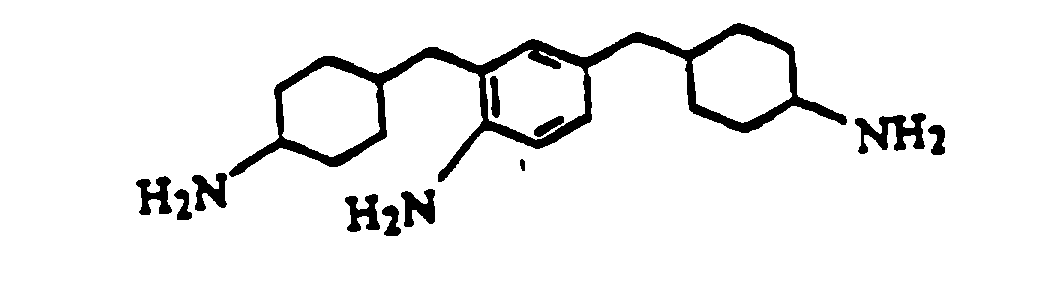
- the invention in one aspect is concerned with a polish composition containing, as components thereof, at least one member selected from waxes, solvents, surfactants, thickening agents, abrasives, colorants, odorants and other ingredients normally used in making polishes, and 2 to 15% by weight of a silicone additive which is incorporated into said polish formulation, characterized in that said silicone additive is an oxysilane additive which is the reaction product of an organosilicon compound and a polycycloaliphatic amine, said organosilicon compound being an alkoxysilane selected from 3methacryloxypropyltrimethoxysilane, 3-glycidoxypropyltrimethoxysilane and 3-chloropropyltrimethoxysilane, and said polycycloaliphatic amine being selected from aminoalkylcyclohexylamines and aminoaralkylcyclohexylamines and having a formula selected from:
- the invention is concerned with a polish composition for use in the treatment of surfaces for producing a glossy finish thereon, said polish composition being in the form of an emulsion and containing 2 to 15% by weight of a silicone film-forming material, characterized in that said film forming material is the reaction product of (i) a silane coupling agent having the formula X3Si(CH2) n Y in which n has a value of zero to three, X is a hydrolysable group on silicon, and Y is a reactive organofunctional group, and (ii) a cycloaliphatic or polycycloaliphatic epoxide, said silane coupling agent being selected from N-(2-aminoethyl)-3-aminopropyltrimethoxysilane, 3-methacryloxypropyltrimethoxysilane, N-[2-(vinylbenzylamino)ethyl]-3-aminopropyltrimethoxysilane, 3-glycid
- a preferred polycycloaliphatic amine is 4,4'-methylene-biscyclohexylamine.
- a preferred silane coupling agent is 3-glycidoxypropyltrimethoxysilane.
- the polish formulation includes 2-15 percent by weight of said additive, 5-20 percent by weight of an abrasive, 10-35 percent by weight of a solvent, 1-5 percent by weight of a wax, 1-5 percent by weight of a surfactant and 10-60 percent by weight of water, the respective percentages being adjusted within a total of 100%.
- the wax is preferably in the form of micronized wax particles having a diameter of 2-45 micrometres (um).
- the polish information is preferably water based and may be in the form of a water in oil emulsion polish although the polish formulation may also be formulated in the form of an oil in water emulsion polish.
- Waxes which may be employed in the polish formulations of this invention are well known in the art and can vary depending on the specific use intended of the polish and the properties being sought.
- suitable waxes include animal waxes such as beeswax, spermaceti, lanolin and shellac wax; vegetable waxes such as carnauba, candelilla, bayberry and sugarcane; mineral waxes such as ozocerite, ceresin, montan, paraffin, microcrystalline and petrolatum; and synthetic waxes such as ethylenic polymers, polyol ether-esters and chlorinated naphthalenes.
- Abrasives which can be used are well known in the art and suitable abrasives include aluminum silicate, diatomaceous earth, pumice, fuller's earth, bentonite, silica, tripoli, hydrated calcium silicate, chalk, colloidal clay, magnesium oxide red iron oxide and tin oxide.
- polish formulation solvents such as VM&P naphtha, Stoddard solvent, naphtha mineral spirits, water, kerosene; surfactants such as polyoxyethylene sorbitan monooleate and fatty alcohol amine sulfates; thickening agents such as soya lecithin and methyl cellulose; detergent resistant additives such as dimethyl and carboxyfunctional silicones; colorants, odorants, corrosion inhibitors and other ingredients normally used in making polishes.
- solvents such as VM&P naphtha, Stoddard solvent, naphtha mineral spirits, water, kerosene
- surfactants such as polyoxyethylene sorbitan monooleate and fatty alcohol amine sulfates
- thickening agents such as soya lecithin and methyl cellulose
- detergent resistant additives such as dimethyl and carboxyfunctional silicones
- colorants, odorants, corrosion inhibitors and other ingredients normally used in making polishes are all well known to the skilled artisan.
- the detergent resistant additives can be organic polysiloxanes which are film formers having a viscosity in the range of about five to as high as several million centistokes ( ⁇ m/sec) preferably about 100 to about 10,000 centistokes ( ⁇ m/sec).
- a mixture of polysiloxanes having relatively higher and relatively lower viscosities is employed.
- Such polysiloxanes have the repeating unit wherein n is an integer having a value greater than one, R1 is an alkyl radical containing 1 to 7 carbon atoms inclusive or a phenyl group, R is hydrogen, an alkyl radical containing 1 to 7 carbon atoms inclusive or a phenyl group.
- polysiloxanes encompassed by the above formula are polydimethylsiloxane, polydiethylsiloxane, polymethylethylsiloxane, polymethylphenylsiloxane, polydiphenylsiloxane, diphenylsilanediol and copolymers of any two or more of the foregoing siloxanes.
- Polysiloxane-oxyalkylene block copolymers may also be utilized.
- the present compositions may include an aminofunctional polysiloxane.
- the aminofunctional polysiloxane is a silicone fluid with highly polar pendant aminoalkyl modifying groups that enhance the durability of the film and promote adhesion of the film to a wide variety of substrates.
- the present composition also contemplates an optional liquid silane constituent which promotes the mutual solubility of other organic silicone compounds present in the mixture.
- Suitable liquid silanes are represented by the formula R'-Si(OR")3 wherein R' can be an alkyl radical containing one to three carbon atoms inclusive or phenyl and R" can be an alkyl radical containing one or two carbon atoms inclusive.
- a preferred liquid silane constituent is an alkyltrialkoxysilane such as methyltrimethoxysilane, ethyltriethoxysilane, phenyltrimethoxysilane and phenyltriethoxysilane.
- Aminofunctional siloxane compositions which can be included are represented by the formula:
- the polish formulation in accordance with the present invention includes as the improvement a polish film former which is a derivatized polycycloaliphatic amine.
- This improved additive for the polish formulation is a silylated derivative of certain polycycloaliphatic amines including monosilylated and disilylated derivatives of aminoalkylcyclohexylamines and aminoaralkylcyclohexylamines.
- Polycycloaliphatic amines are known and are commercial products of Air Products and Chemicals, Inc., Allentown Pennsylvania, USA. Polycycloaliphatic amine compounds which are in accordance with the present invention are shown as follows:
- polycycloaliphatic amines The preferred of the above listed polycycloaliphatic amines is the first shown compound which is 4,4'-methylenebiscyclohexylamine, although other of the listed amines are appropriate for the purposes of the present invention.
- the polycycloaliphatic amines are silylated by reacting the amine with an organosilicon compound which can be silane or a siloxane.
- an organosilicon compound which can be silane or a siloxane.
- Alkoxysilanes are the preferred silylating agent.
- the particular alkoxysilanes employed in accordance with the present invention have been described in the literature as "silane coupling agents".
- Silane coupling agents are known in the art as promoters of adhesion as evidenced for example by U.S. Patent No. 4,689,085 issued August 25, 1987.
- these materials are employed as an interface between hydrophilic mineral surfaces such as glass and silica and organic resins in order to couple these dissimilar surfaces.
- Silane coupling agents are of the general structure x3Si(CH2) n Y in which n is an integer from zero to three, X is a hydrolyzable group on silicon and Y is a reactive organofunctional group such as methacryloxy, epoxy, chloroalkyl, vinyl and amino.
- X is a hydrolyzable group on silicon
- Y is a reactive organofunctional group such as methacryloxy, epoxy, chloroalkyl, vinyl and amino.
- the hydrolyzable groups When applied from water solutions, the hydrolyzable groups generate intermediate silanols which migrate to the hydrophilic surface where they condense with surface hydroxyl groups to form "siloxane" bonds (-SiOSi-) with the surface. It is believed that coupling is achieved with the organic resin because of the compatibility between the resin and the reactive organofunctional group Y of the silane coupling agent.
- Examples of some commercial silane coupling agents are N-(2-aminoethyl)-3-aminopropyltrimethoxysilane; 3-methacryloxypropyltrimethoxysilane; N-[2-(vinylbenzyl-amino)ethyl]-3-aminopropyltrimethoxysilane; 3-glycidoxy propyltrimethoxysilane; vinyltriacetoxysilane; 3-chloropropyltrimethoxysilane; 2-(3,4-epoxycyclohexyl)-ethyltrimethoxysilane; 3-mercaptopropyltrimethoxysilane; and 2-mercaptoethyltrimethoxysilane.
- silylated polycycloaliphatic amines are prepared in accordance with the present invention by reacting the amine and the silane coupling agent as depicted in the following reaction scheme: wherein R is -(CH2)3OCH2CH(OH)CH2- and R' is -(CH2CH(OH)CH2O(CH2)3-.
- the reaction product (III) is a silylated polycycloaliphatic amine in accordance with the present invention and is formed by combining the amine (I) which is 4,4'-methylenebiscyclohexylamine and the silane coupling agent (II) which is 3-glycidoxypropyltrimethoxysilane.
- Silane coupling agents most preferred for use in accordance with the present invention are 3-methacryloxypropyltrimethoxysilane, 3-glycidoxypropyltrimethoxysilane and 3-chloropropyltrimethoxysilane.
- Example 1 Approximately 78.6 grams of kerosene, 6.06 grams Aquabead® 519, 3.06 grams of Witcamide® 511 and 12.14 grams of the fluid described in Example 1 were combined and thoroughly mixed to comprise the oil phase of a polish formulation. This mixture was added to a water phase comprised of 30 grams Kaopolite 1152 suspended in 170.5 grams of water. The oil phase was stirred during addition of the water phase and allowed to continue once addition was complete until the emulsion was well formed and stable.
- Example 2 and NuFINISH® a commercially available polish known for its ease of use characteristics and durability were applied to the surface of a 1991 Chevrolet Caprice.
- the experimental polish exhibited a light degree of dusting, whereas the commercially available polish exhibited a light-to-moderate level of dusting during the buffing step.
- the film produced by the experimental polish was glossy and homogeneous in appearance.
- WITCAMIDE® 511 is a trademark and a modified alkanolamide surfactant available from the Witco Corporation Organics Division, New York, New York.
- Kaopolite 1152 is an aluminum silicate abrasive and AQUABEAD® 519 is a micronized wax.
- the film former of the present invention may also be produced by reacting a silane coupling agent with a cycloaliphatic or a polycycloaliphatic epoxide. These compounds are known in the art and are commercially available from the Union Carbide Chemicals and Plastics Company Inc., Danbury, Connecticut.
- Representative cycloaliphatic and polycycloaliphatic epoxides are vinyl cyclohexene dioxide, 2-[3,4-epoxycyclohexyl-5,5-spiro-3,4-epoxy] cyclohexane-meta dioxane, bis-[3,4-epoxycyclohexyl] adipate, 1,2-epoxy-p-vinylcyclohexene and 3,4-epoxycyclohexylmethyl-3,4-epoxycyclohexane-carboxylate.
- the film former of the present invention is prepared by combining, in the case of the cycloaliphatic amine, 0.1 to 4.0 moles of the silane coupling agent per mole of reactive NH functional group of the cycloaliphatic amine. preferably, there is employed 0.25 to 2.0 moles of the silane coupling agent per mole of reactive NH functional group of the cycloaliphatic amine. Most preferred is 0.4 to 1.0 mole of the silane coupling agent per mole of reactive NH functional group of the cycloaliphatic amine.
- the film former is a reaction product of a silane coupling agent and a cycloaliphatic epoxide
- the film former of the present invention is prepared by combining 0.01 to 10.0 moles of the silane coupling agent per mole of reactive oxirane functional group of the cycloaliphatic epoxide.
- Most preferred is 0.5 to 1.5 moles of the silane coupling agent per mole of reactive oxirane functional group of the cycloaliphatic epoxide.
- An oil-in-water auto polish formulation was made in the following manner. In a 500 ml. stainless steel beaker was weighed 3.0 parts Hoescht “S” wax, 1.0 parts Hoescht “E” wax, 1 part stearic acid, 15 parts mineral spirits and 11.9 parts kerosene. This mixture was heated to approximately 80°C. to melt the waxes and 0.8 parts Morpholine were added and allowed to react for 5 min. To this mixture was added a pre-made mixture of 6 parts mineral spirits, 2 parts of the composition from Example 4 and 3 parts of one thousand centistoke ( ⁇ m/sec) polydimethylsiloxane fluid. The mixture was maintained at approximately 80°C.
- Cymel® 1158 contained in a 4 oz. (118.4 cc) glass bottle, were added 23.63 g. of glycidoxypropyltrimethoxysilane. The bottle was capped with a polyseal cap and agitated by hand to mix. The resulting clear, colorless, low viscosity fluid was then mixed overnight on a rotating mixing wheel.
- Cymel® 1158 is a melamine resin and a product of American Cyanamid Co., Wayne, New Jersey.
- Example 2 was repeated and several water-in-oil polishes I-IV were prepared using the silylated derivatives of Examples 6-9.
- the polish formulations I-IV are shown in the table below and all of the polish formulations I-IV resulted in low viscosity liquid polishes.
- Micronized wax particles employed in the polish formulations of the present invention may be made from any conventional wax but preferably micronized particles of Fischer-Tropsch waxes, polyethylene wax, polyethylene-polytetrafluorethylene wax, polytetrafluorethylene wax, polypropylene wax, natural waxes, mineral waxes, montan wax derivatives, fatty acid derivatives, amide waxes and wax mixtures.
- the particle size of the micronized wax particles may vary from an average diameter of about two microns ( ⁇ m) to about thirty to forty-five microns ( ⁇ m) although particles sizes of from two to five microns ( ⁇ m) are preferred.
- Such micronized wax particles are manufactured by Micro Powders, Inc., Scarsdale, New York.
- Other micronized wax particles suitable for incorporation into the polish formulations of the present invention are disclosed in U.S. Patent No. 4,846,887, issued July 11, 1989.
- the polish formulations in accordance with the present invention are preferably in the form of an emulsion and include an oil phase containing a solvent, an organosilicon detergent resistant film forming derivatized amine functional compound, a surfactant and a wax.
- the water phase can include water, an abrasive, a freeze thaw additive such as propylene glycol and sodium borate and colorants.
- Water in oil emulsions are preferred however oil in water emulsions are also included herein. It has been found that the polish formulations of the present invention possess the advantage in that the polish provides improved protection for an automotive top coat against abrasion and corrosion and produces a coating which is light stable in comparison to conventional and prior art polish formulations which do not contain the derivatized amines.
- the polishes of the present invention are of general application including such surfaces as motor vehicles, boats and navigable crafts, wood surfaces, plastic surfaces and fiber surfaces.
- the films produce a high durable gloss and are easy to apply.
- silylated polycycloaliphatic amines of the present invention possess the advantage in that colorless films can be produced in contrast to silylated polyaromatic amines which produce chromophores because of the aromaticity.
Landscapes
- Chemical & Material Sciences (AREA)
- Organic Chemistry (AREA)
- Paints Or Removers (AREA)
Claims (5)
- Une composition de produit à polir contenant, comme constituants de cette composition, au moins une matière choisie parmi les cires, solvants, agents tensioactifs, agents épaississants, abrasifs, colorants, substances odorantes et autres ingrédients normalement utilisés dans la fabrication des produits à polir, et 2 à 15 % en poids d'un additif silicone qui est incorporé à ladite composition de produit à polir, caractérisée en ce que ledit additif silicone est un additif à groupement oxysilane qui est le produit réactionnel d'un composé organosilicié et d'une amine polycycloaliphatique, ledit composé organosilicié étant un alcoxysilane choisi parmi le 3-méthacryloxypropyltriméthoxysilane, le 3-glycidoxypropyl-triméthoxysilane et le 3-chloropropyltriméthoxysilane, et ladite amine polycycloaliphatique étant choisie parmi les aminoalkylcyclohexylamines et les aminoaralkyl-cyclohexylamines et répondant à une formule choisie parmi :




- Une composition de produit à polir selon la revendication 1, dans laquelle ladite amine polycycloaliphatique est la 4,4'-méthylène-biscyclohexylamine.
- Une composition de produit à polir selon la revendication 1 ou 2, dans laquelle ladite composition est sous la forme d'une émulsion du type eau dans l'huile.
- Une composition de produit à polir à utiliser dans le traitement de surfaces pour leur conférer une finition brillante, ladite composition de produit à polir étant sous la forme d'une émulsion et contenant 2 à 15 % en poids d'une matière filmogène siliciée, caractérisée en ce que ladite matière filmogène est le produit réactionnel de (i) un agent de couplage du type silane répondant à la formule X₃Si(CH₂)nY où la valeur de n est de zéro à trois, X est un groupe hydrolysable fixé au silicium et Y est un groupe réactif à fonctionnalité organique, et (ii) un époxyde cycloaliphatique ou polycycloaliphatique, ledit agent de couplage du type silane étant choisi parmi le N- (2-aminoéthyl)-3-aminopropyltriméthoxysilane, le 3-méthacryl-oxypropyltriméthoxysilane, le N- [2- (vinylbenzylamino) éthyl] - 3-aminopropyltriméthoxysilane, le 3-glycidoxypropyl-triméthoxysilane, le vinyltriacétoxysilane, le 3-chloro-propyltriméthoxysilane, le 2- (3,4-époxycyclohexyl-éthyl) - triméthoxysilane, le 3-mercaptopropyltriméthoxysilane et le 2-mercaptoéthyltriméthoxysilane, et ledit époxyde cycloaliphatique ou polycycloaliphatique étant choisi parmi le dioxyde de vinylcyclohexène, le 2- (3,4-époxycyclohexyl-5,5-spiro-3,4-époxy)cyclohexane-métadioxanne, l'adipate de bis(3,4 époxycyclohexyle), le 1,2-époxy-p-vinylcyclohexane et le 3,4-époxycyclohexane-carboxylate de 3,4-époxycyclohexylméthyle.
- Une composition de produit à polir selon la revendication 4, dans laquelle ledit agent de couplage du type silane est le 3-glycidoxypropyltriméthoxysilane.
Applications Claiming Priority (2)
| Application Number | Priority Date | Filing Date | Title |
|---|---|---|---|
| US880924 | 1992-05-11 | ||
| US07/880,924 US5258063A (en) | 1992-05-11 | 1992-05-11 | Polish containing silylated derivatives of organic amines and epoxides |
Publications (2)
| Publication Number | Publication Date |
|---|---|
| EP0571114A1 EP0571114A1 (fr) | 1993-11-24 |
| EP0571114B1 true EP0571114B1 (fr) | 1996-01-31 |
Family
ID=25377408
Family Applications (1)
| Application Number | Title | Priority Date | Filing Date |
|---|---|---|---|
| EP93303583A Expired - Lifetime EP0571114B1 (fr) | 1992-05-11 | 1993-05-10 | Composition d'encaustique contenant des dérivés d'amines organiques et d'époxides silylés |
Country Status (4)
| Country | Link |
|---|---|
| US (1) | US5258063A (fr) |
| EP (1) | EP0571114B1 (fr) |
| JP (1) | JPH06128534A (fr) |
| DE (1) | DE69301426T2 (fr) |
Families Citing this family (28)
| Publication number | Priority date | Publication date | Assignee | Title |
|---|---|---|---|---|
| US5217758A (en) * | 1992-05-15 | 1993-06-08 | Dow Corning Corporation | Silicone containing automotive vinyl protectant |
| US5496493A (en) * | 1994-05-10 | 1996-03-05 | The Procter & Gamble Company | Ultra mild personal cleansing bar containing smaller-sized particulate wax |
| DE4430729C2 (de) * | 1994-08-30 | 2002-05-23 | Degussa | Acryloxypropylalkoxysilane, Verfahren zu deren Herstellung und deren Verwendung |
| US5962074A (en) * | 1996-06-05 | 1999-10-05 | 3M Innovative Properties Company | Wax composition and method of use |
| US5697991A (en) * | 1996-08-29 | 1997-12-16 | Crescent Marketing, Inc. | Glass treatment compound |
| US5782962A (en) * | 1996-10-16 | 1998-07-21 | Sara Lee Corporation | Cleaning and polishing composition |
| US5871590A (en) * | 1997-02-25 | 1999-02-16 | Ecolab Inc. | Vehicle cleaning and drying compositions |
| US6159551A (en) * | 1998-02-27 | 2000-12-12 | John Yeiser | Wax and method of wax application |
| PT1204709E (pt) | 1999-07-30 | 2007-05-31 | Ppg Ind Ohio Inc | Composições de revestimento que têm resistência ao arranhão melhorada, substratos revestidos e métodos relacionados com eles |
| BR0012882A (pt) | 1999-07-30 | 2002-04-09 | Ppg Ind Ohio Inc | Revestimentos curados tendo resistência ao risco melhorada, substratos revestidos e métodos a eles relacionados |
| US6623791B2 (en) | 1999-07-30 | 2003-09-23 | Ppg Industries Ohio, Inc. | Coating compositions having improved adhesion, coated substrates and methods related thereto |
| CN1209427C (zh) | 1999-07-30 | 2005-07-06 | 匹兹堡玻璃板工业俄亥俄股份有限公司 | 具有改进抗刮性的涂料组合物、涂覆基材及其有关方法 |
| US6610777B1 (en) | 1999-07-30 | 2003-08-26 | Ppg Industries Ohio, Inc. | Flexible coating compositions having improved scratch resistance, coated substrates and methods related thereto |
| US6635341B1 (en) | 2000-07-31 | 2003-10-21 | Ppg Industries Ohio, Inc. | Coating compositions comprising silyl blocked components, coating, coated substrates and methods related thereto |
| CN1255854C (zh) * | 2001-01-16 | 2006-05-10 | 卡伯特微电子公司 | 含有草酸铵的抛光系统及方法 |
| DK1525278T3 (da) * | 2002-07-25 | 2014-12-01 | Biopoint Aps | Fremgangsmåde til behandling af en overflade |
| US20040225079A1 (en) * | 2003-05-05 | 2004-11-11 | Analytical Services And Materials Inc. | Erosion-resistant silicone coatings |
| US7033673B2 (en) * | 2003-07-25 | 2006-04-25 | Analytical Services & Materials, Inc. | Erosion-resistant silicone coatings for protection of fluid-handling parts |
| CA2548239C (fr) * | 2003-12-05 | 2012-01-31 | Ashland, Inc. | Composition de cire pour nettoyage et polissage |
| US7427587B2 (en) * | 2005-06-20 | 2008-09-23 | Crissey Gordon K | Polishing compound |
| US7875584B2 (en) * | 2005-11-28 | 2011-01-25 | Ecolab Usa Inc. | Detergent resistant car polish |
| WO2007070715A2 (fr) * | 2005-12-15 | 2007-06-21 | Ashland Licensing And Intellectual Property Llc | Composition de nettoyage et de polissage pour surfaces metalliques |
| WO2011088186A1 (fr) * | 2010-01-13 | 2011-07-21 | 3M Innovative Properties Company | Composition de lavage et cirage d'un véhicule à moteur |
| US20130122208A1 (en) * | 2011-02-14 | 2013-05-16 | Blue Angel Paint and Coatings, Ltd. | Coating Material and Method for Waterproofing a Surface |
| US10279374B1 (en) * | 2011-08-04 | 2019-05-07 | Anthony Magaro | Methods and compositions for resurfacing wooden surfaces |
| CN103173129A (zh) * | 2013-04-12 | 2013-06-26 | 河北省石家庄市高级技工学校 | 一种漆面抛光剂 |
| CN108192463B (zh) * | 2017-12-29 | 2020-12-01 | 广州双桃精细化工有限公司 | 一种水性纳米抛光膜涂布剂及制备方法和应用 |
| CN118834234B (zh) * | 2024-06-24 | 2025-09-26 | 厦门保沣集团有限公司 | 一种硅烷偶联剂及硅烷表面处理剂 |
Family Cites Families (8)
| Publication number | Priority date | Publication date | Assignee | Title |
|---|---|---|---|---|
| US3927042A (en) * | 1970-07-29 | 1975-12-16 | Bayer Ag | Alkoxysilyl-substituted epoxidized urea derivatives |
| US3890271A (en) * | 1973-02-07 | 1975-06-17 | Dow Corning | Polish ingredient |
| US3836371A (en) * | 1973-02-07 | 1974-09-17 | Dow Corning | Polish ingredient |
| US4036787A (en) * | 1975-09-12 | 1977-07-19 | Blount David H | Process for the production of epoxy silicate compounds and polymers |
| US4273584A (en) * | 1979-12-07 | 1981-06-16 | Union Carbide Corporation | Detergent resistant compositions |
| US5017222A (en) * | 1989-12-07 | 1991-05-21 | Dow Corning Corporation | Polish containing micronized wax particles |
| US5110891A (en) * | 1991-04-11 | 1992-05-05 | Dow Corning Corporation | Amine functional siloxanes |
| US5063260A (en) * | 1991-05-01 | 1991-11-05 | Dow Corning Corporation | Compositions and their use for treating fibers |
-
1992
- 1992-05-11 US US07/880,924 patent/US5258063A/en not_active Expired - Fee Related
-
1993
- 1993-05-10 EP EP93303583A patent/EP0571114B1/fr not_active Expired - Lifetime
- 1993-05-10 DE DE69301426T patent/DE69301426T2/de not_active Expired - Fee Related
- 1993-05-11 JP JP5108961A patent/JPH06128534A/ja active Pending
Also Published As
| Publication number | Publication date |
|---|---|
| EP0571114A1 (fr) | 1993-11-24 |
| DE69301426T2 (de) | 1996-09-05 |
| US5258063A (en) | 1993-11-02 |
| DE69301426D1 (de) | 1996-03-14 |
| JPH06128534A (ja) | 1994-05-10 |
Similar Documents
| Publication | Publication Date | Title |
|---|---|---|
| EP0571114B1 (fr) | Composition d'encaustique contenant des dérivés d'amines organiques et d'époxides silylés | |
| US5154759A (en) | Polish containing amine functional siloxane | |
| KR100239255B1 (ko) | 유도체화된 아민 작용성 유기 규소 화합물을 함유하는 광택제 | |
| US4665116A (en) | Clear cleaner/polish composition | |
| US5110891A (en) | Amine functional siloxanes | |
| US5017222A (en) | Polish containing micronized wax particles | |
| US5782962A (en) | Cleaning and polishing composition | |
| US4247330A (en) | Protective coatings | |
| JPS6024146B2 (ja) | 水中油型艶出配合物 | |
| US7503964B2 (en) | Paste wax composition | |
| US5085694A (en) | Polish compositions | |
| JP3180909B2 (ja) | 噴霧可能な自動車保護剤、噴霧可能な水性オルガノポリシロキサン自動車保護剤エマルションの光沢の改良方法及び支持体に高い光沢を付与する方法 | |
| AU2004297219B2 (en) | Cleaning and polishing wax composition | |
| US6685765B1 (en) | Water based protectant containing UV absorbers | |
| JPS598776A (ja) | つや出し剤組成物 | |
| US3856533A (en) | Surface polishes based on organopolysiloxanes and wax | |
| AU690719B2 (en) | Water based paint protectant | |
| US5025054A (en) | Polish containing a silicone rubber powder | |
| US5705592A (en) | Fluorosiloxane-containing care compositions | |
| EP0582972B1 (fr) | Compositions resistantes aux détergents | |
| US5045584A (en) | Polish containing silicone elastomer particles | |
| JPH069873A (ja) | エマルジョン組成物 | |
| JPH06322356A (ja) | 表面保護剤 | |
| US3960574A (en) | Detergent resistant auto polish | |
| JPH1192694A (ja) | エマルジョン組成物 |
Legal Events
| Date | Code | Title | Description |
|---|---|---|---|
| PUAI | Public reference made under article 153(3) epc to a published international application that has entered the european phase |
Free format text: ORIGINAL CODE: 0009012 |
|
| AK | Designated contracting states |
Kind code of ref document: A1 Designated state(s): DE FR GB |
|
| 17P | Request for examination filed |
Effective date: 19931217 |
|
| 17Q | First examination report despatched |
Effective date: 19940926 |
|
| GRAA | (expected) grant |
Free format text: ORIGINAL CODE: 0009210 |
|
| AK | Designated contracting states |
Kind code of ref document: B1 Designated state(s): DE FR GB |
|
| REF | Corresponds to: |
Ref document number: 69301426 Country of ref document: DE Date of ref document: 19960314 |
|
| ET | Fr: translation filed | ||
| PLBE | No opposition filed within time limit |
Free format text: ORIGINAL CODE: 0009261 |
|
| STAA | Information on the status of an ep patent application or granted ep patent |
Free format text: STATUS: NO OPPOSITION FILED WITHIN TIME LIMIT |
|
| 26N | No opposition filed | ||
| PGFP | Annual fee paid to national office [announced via postgrant information from national office to epo] |
Ref country code: GB Payment date: 20000407 Year of fee payment: 8 |
|
| PGFP | Annual fee paid to national office [announced via postgrant information from national office to epo] |
Ref country code: FR Payment date: 20000410 Year of fee payment: 8 Ref country code: DE Payment date: 20000410 Year of fee payment: 8 |
|
| PG25 | Lapsed in a contracting state [announced via postgrant information from national office to epo] |
Ref country code: GB Free format text: LAPSE BECAUSE OF NON-PAYMENT OF DUE FEES Effective date: 20010510 |
|
| GBPC | Gb: european patent ceased through non-payment of renewal fee |
Effective date: 20010510 |
|
| PG25 | Lapsed in a contracting state [announced via postgrant information from national office to epo] |
Ref country code: FR Free format text: LAPSE BECAUSE OF NON-PAYMENT OF DUE FEES Effective date: 20020131 |
|
| PG25 | Lapsed in a contracting state [announced via postgrant information from national office to epo] |
Ref country code: DE Free format text: LAPSE BECAUSE OF NON-PAYMENT OF DUE FEES Effective date: 20020301 |