EP0571523B1 - Desinfectant utilise dans le traitement de systemes d'eau - Google Patents
Desinfectant utilise dans le traitement de systemes d'eau Download PDFInfo
- Publication number
- EP0571523B1 EP0571523B1 EP92906779A EP92906779A EP0571523B1 EP 0571523 B1 EP0571523 B1 EP 0571523B1 EP 92906779 A EP92906779 A EP 92906779A EP 92906779 A EP92906779 A EP 92906779A EP 0571523 B1 EP0571523 B1 EP 0571523B1
- Authority
- EP
- European Patent Office
- Prior art keywords
- weight
- glycoluril
- tablets
- hydrogen
- composition
- Prior art date
- Legal status (The legal status is an assumption and is not a legal conclusion. Google has not performed a legal analysis and makes no representation as to the accuracy of the status listed.)
- Expired - Lifetime
Links
Classifications
-
- C—CHEMISTRY; METALLURGY
- C02—TREATMENT OF WATER, WASTE WATER, SEWAGE, OR SLUDGE
- C02F—TREATMENT OF WATER, WASTE WATER, SEWAGE, OR SLUDGE
- C02F1/00—Treatment of water, waste water, or sewage
- C02F1/72—Treatment of water, waste water, or sewage by oxidation
- C02F1/76—Treatment of water, waste water, or sewage by oxidation with halogens or compounds of halogens
- C02F1/766—Treatment of water, waste water, or sewage by oxidation with halogens or compounds of halogens by means of halogens other than chlorine or of halogenated compounds containing halogen other than chlorine
-
- A—HUMAN NECESSITIES
- A01—AGRICULTURE; FORESTRY; ANIMAL HUSBANDRY; HUNTING; TRAPPING; FISHING
- A01N—PRESERVATION OF BODIES OF HUMANS OR ANIMALS OR PLANTS OR PARTS THEREOF; BIOCIDES, e.g. AS DISINFECTANTS, AS PESTICIDES OR AS HERBICIDES; PEST REPELLANTS OR ATTRACTANTS; PLANT GROWTH REGULATORS
- A01N59/00—Biocides, pest repellants or attractants, or plant growth regulators containing elements or inorganic compounds
-
- C—CHEMISTRY; METALLURGY
- C02—TREATMENT OF WATER, WASTE WATER, SEWAGE, OR SLUDGE
- C02F—TREATMENT OF WATER, WASTE WATER, SEWAGE, OR SLUDGE
- C02F1/00—Treatment of water, waste water, or sewage
- C02F1/72—Treatment of water, waste water, or sewage by oxidation
- C02F1/76—Treatment of water, waste water, or sewage by oxidation with halogens or compounds of halogens
Definitions
- This invention relates to solid oxidizer compositions that provide either hypochlorous or hypobromous acid for disinfecting water systems, such as swimming pools, spas decorative fountains, recirculating water cooling systems, health related baths, dehumidifier systems, ponds and reservoirs.
- Trichloro- s -triazinetrione can be pressed into a solid composition such as a stick, tablet or puck and placed in an erosion feeder, skimmer, or a floating slow release device.
- solid compositions erode too rapidly. In some cases they do not maintain their integrity as water is circulated through the release device. Consequently, the disinfectant splits, cracks and breaks into small pieces. These small pieces expose more surface area and increased erosion occurs. The disinfectant is released too rapidly and is not satisfactory for the treatment of most water systems.
- blended compositions containing T.C.C.A. and sodium bromide An example blend contains 96% T.C.C.A., 2% sodium bromide and 2% inert. In other cases as the water temperature increases the erosion rate of the disinfectant increases. The disinfectant is then released too rapidly into the water system and is not satisfactory for treatment of most water systems.
- U.S. Patent No. 2,731,472 discloses a method for the preparation of N-halogenated glycolurils containing both bromine and chlorine for use as disinfecting agents.
- the use of haloglycolurils for the sanitizing agent in swimming pools is disclosed in U.S. Patent No. 3,165,521 (Lezak).
- the use of polyhaloglycolurils for controlling algae in water is disclosed in U.S. Patent No. 3,252,901 (Zettler).
- the use of chlorinated glycolurils in the treatment of sewage is disclosed in U.S. Patent No. 3,445,383 (Horvath et al).
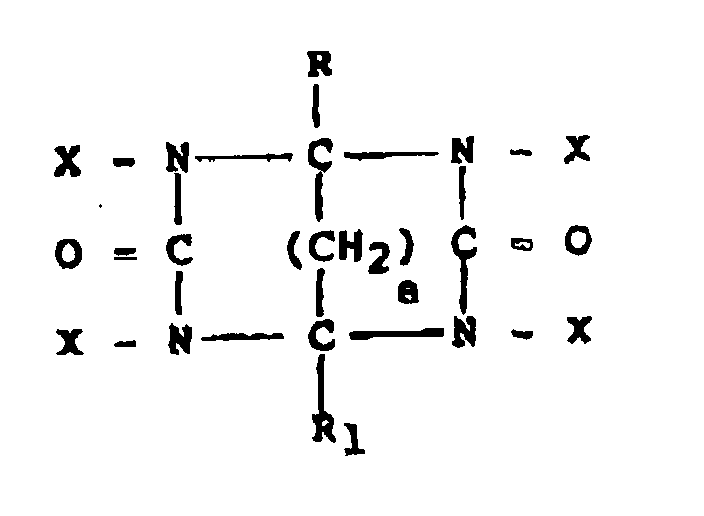
- solid oxidizer compositions to provide hypochlorous acid for disinfecting water systems consisting essentially of a mixture of: (a) approximately 50-99.99% by weight of trichloro- s -triazinetrione and (b) 0.01-50% by weight of glycoluril compounds having the structure: in which R and R 1 are independently selected from the group consisting of hydrogen, lower alkyl radicals of from 1-4 carbon atoms and phenyl; each X is either hydrogen, chlorine or bromine and a is either 0 or 1;
- compositions are blended together and formed or compressed into solid forms, such as tablets, sticks, pucks or other shapes.
- the disinfectant can then be placed in a release device through which water is circulated to disinfect a water system, such as a swimming pool or cooling tower.
- a water system such as a swimming pool or cooling tower.
- the tablet, stick or puck can be placed into a skimmer basket.
- the disinfectants of this invention dissolve at a slower rate in a release device than comparable compositions containing only T.C.C.A. Consequently, the disinfectant of this invention adds hypochlorous acid to a water system at a controlled and uniform rate over a longer period of time.
- This invention produces a solid disinfectant that dissolves at a slow and relatively uniform rate when used in a release device for water sytems.
- the disinfectant consists of a mixture of: (a) approximately 50-99.99% by weight of trichloro- s -triazinetrione and (b) .01-50% by weight of glycoluril compounds having the structure:
- a preferred composition consists essentially of from 80-98% trichloro- s -triazinetrione (T.C.C.A.) and 2-20% of a glycoluril or from 70-90% trichloro- s -triazinetrione (T.C.C.A.).
- glycoluril compounds are glycoluril and the chloroglycoluril compounds, such as dichloroglycoluril and tetrachloroglycoluril. For most applications glycoluril is preferred.
- the T.C.C.A. is available from Monsanto Chemical Co. under the name ACL-90.
- This invention also provides a blue pigment for these disinfectants, with the pigment being stable in the dry form.
- the pigment decomposes so that the water is not colored which would result in staining the walls of swimming pools and spas.
- a chlorine stable pigment has been found which is stable in dry form with the above disinfectants.
- This pigment is ultramarine blue or lazurite, commonly sold under the trade name Pylam Pylaklor Dry BlueTM S-726 (Pigment Blue 29; CI 77007). It has the following composition [(Na, Ca) 4 (AlSi O 4 ) 3 (SO 4 , S, C1)] or [Ca 2 Na 6 (Al 6 (SiO 4 ) 6 SO 4 S] or [Na 5 (Al 3 SiO 4 ) 3 S] or [Na 5 (Al 3 (SiO4 ) 3 S) (C1). This pigment is blue, blue-violet or greenish-blue in color.
- Lazurite is oxidizer stable so that the solid composition is blue in color.
- Lazurite is decomposed by the disinfectant in the water systems. Decomposition of the pigment in the water system is preferred because otherwise the pigment may result in a slight blue tint in the water. This is important for some applications as pigment might be objectionable to users of certain water systems such as swimming pools.
- the lazurite is added to the disinfectant in an amount of from 0.01-.5% by weight. It is preferred that it be present in an amount of 0.05-0.25% by weight.
- glycoluril compounds include glycoluril and the chloroglycoluril compounds, such as dichloroglycoluril and tetrachloroglycoluril, in combination with the lazurite.
- the lazurite is added to the oxidizer by simple mixing.
- the lazurite pigment gives a distinctive blue color to the white disinfectants which is stable for a long period of time.
- the pigmented disinfectant is introduced into the water system, the pigment becomes unstable with certain disinfectants so the water is not colored blue. This is preferred to avoid staining the walls of swimming pools and spas.
- the formulation may include a filler.
- the filler is an inert substance, such as sodium chloride or boric acid, that can be used to assist in the tabletting process.
- a filler can be used in any concentration provided the composition contains the required amount of the disinfectant.
- the filler is preferably present from .05-10% by weight.
- the formulation may also contain other ingredients such as tabletting aids, e.g., mold release agents, binders, corrosion inhibitors, scale inhibitors and other components known to one skilled in the art.
- tabletting aids e.g., mold release agents, binders, corrosion inhibitors, scale inhibitors and other components known to one skilled in the art.
- the tablets, sticks or pucks are formed or compressed into solid form. They can be compressed by a hydraulic or mechanical press.
- the disinfectant of this invention be used in a release device so that the disinfectant is immersed or partially immersed in water within an enclosure in which the disinfectant is gradually eroded and hypochlorous acid is released to disinfect that water system. It can also be used in in-line feeders, floaters, off-line chlorinators or skimmers. The preferred device is a skimmer.
- the disinfectants of this invention dissolve at a slower rate in a release device than comparable compositions containing only trichloro- s -triazinetrione (T.C.C.A.). Consequently the disinfectant of this invention adds hypochlorous acid to a water system at a controlled and uniform rate over a long period of time.
- the solid disinfectants of this invention are useful in disinfecting water systems such as swimming pools, spas, hot tubs and cooling towers. These compositions are normally formed or pressed into tablets, sticks, pucks or other shapes and placed in a release device such as an erosion feeder, skimmer, in-line halogenator or floating release device in the system.
- a release device such as an erosion feeder, skimmer, in-line halogenator or floating release device in the system.
- a pilot batch of the solid disinfectant was prepared adding 123 kg (270 pounds) of T.C.C.A. and 14 kg (30 pounds)of glycoluril into a V-shaped tumble blender . The batch was blended for five minutes. Part of this composition was pressed into 2.5 cm (one inch) tablets using a mechanical press applying approximately 100 MPa (15,000 pounds) of pressure. The rest of the batch was pressed into 11.25 cm (4.5 inch) 227 gm sticks using a hydraulic press applying 230 MPa (35,000 pounds) of pressure. Erosion studies were conducted on the one inch tablets using an erosion control device through which water is circulated at a controlled rate of flow (litres per hour, lt h -1 ). These one inch tablets were compared to one inch tablets containing 100% T.C.C.A. which were produced in the same manner.
- the one inch tablets were placed in an erosion control device.
- the water temperature was maintained at 27°C (80°F), and the flow rate was 75 lt h -1 (20 gallons per hour).
- the tablets containing T.C.C.A. and glycoluril retained 87% of its initial weight.
- the tablet that contained 100% T.C.C.A. only retained 58% of its initial weight.
- the addition of the glycoluril resulted in 3 fold reduction in the erosion rate.
- the stick containing the glycoluril retained 83% of its weight after 48 hours while the stick containing 100% T.C.C.A. only retained 31% of its weight. After 24 hours the glycoluril containing stick retained 92% of its weight while the T.C.C.A. stick only retained 66% of its weight.
- Tablets 2.5 cm (one inch) in diameter and weighing 15 gm were prepared in the laboratory by mixing the ingredients and pressing using a 30 t (30 ton) Carver hydraulic lab press, applying 100 MPa (15,000 pounds) of pressure for 20 seconds.
- One set of tablets was prepared containing 90% T.C.C.A. and 10% glycoluril.
- the other set of tablets contained 95% T.C.C.A. and 5% glycoluril.
- the erosion rates of these tablets were compared to tablets containing 100% T.C.C.A.
- the erosion testing was conducted using the same erosion control device used in Example 1. Water temperature was maintained at 27°C (80°F) with a flow rate of 75 lt h -1 (20 gallons per hour). The weights of the tablets were checked after 72 hours.
- the tablet containing 90% T.C.C.A. and 10% glycoluril retained 88% of its initial weight after 72 hours while the tablet containing 95% T.C.C.A. and 5% glycoluril retained 76% of its weight after 72 hours.
- the tablet with 100% T.C.C.A. only retained 52% of its initial weight after 72 hours.
- Example 2 To test the uniformity of the product from a pilot batch produced in Example 1, erosion studies were conducted on eight one inch tablets containing 90% T.C.C.A. and 10% glycoluril. The erosion rates were obtained using the same erosion testing device as was used in Example 1. Water temperature was maintained from 10°-13°C (50°-55°F) with water circulating at a flow rate of 75 lt h -1 (20 gallons per hour). After eight days the tablets retained the percentage of weight set forth in the Table below. Tablet # % Weight Retention after 8 Days 1 82% 2 83% 3 82% 4 79% 5 81% 6 81% 7 83% 82%
- Tablets 2.5 cm (one inch) in diameter and weighing 15 gm were prepared in the laboratory by mixing the ingredients and pressing into tablets using a 30 t (thirty ton) Carver hydraulic laboratory press. The ingredients were pressed into tablets by applying 100 MPa (15,000 pounds) of pressure for 20 seconds.
- One set of tablets was prepared containing 90% T.C.C.A. and 10% tetrachloroglycoluril (TCGU).
- a second set of tablets was prepared containing 95% T.C.C.A. and 5% tetrachloroglycoluril (TCGU).
- a third set of 2.5 cm (one inch) 15 gm tablets were prepared containing 90% T.C.C.A. and 10% tetrabromoglycoluril (TBGU).
- Tablets 2.5 cm (one inch) in diameter and weighing 15 grams were prepared in the laboratory by hand mixing the ingredients and then pressing using a 30 t (30 ton) Carver hydraulic lab press applying 100 MPa (15,000 lbs) of pressure for 20 seconds.
- the tablets contained glycoluril in amounts ranging from 0.25% to 10.0% and the balance of the formulation was T.C.C.A.
- the erosion rate of the tablets was determined using the erosion testing device from Example 1. The tablets were compared to tablets containing 100% TCCA.
- the water temperature was maintained at 27°C (80°F) with a flow rate of 75 lt h -1 (20 gph).
- the percent weight retention (%WRT) was determined at 24, 48 and 72 hours.
- glycoluril reduces the erosion rate of TCCA. As the amount of glycoluril is increased, the erosion rate is decreased.
- the erosion rates of these tablets were compared to one inch 100% TCCA tablets prepared in the same manner.
- the erosion test was conducted using the same apparatus and methods used in Example 1. The water temperature was maintained at 27°C (80°F) with a flow rate of 75 lt h -1 (twenty gallons per hour).
- the percent weight retention (%WRT) was obtained 24, 48 and 72 hours.
- the test results are summarized below: TEST BLENDS % W.R.T 24 hrs. 48 hrs. 72 hrs 1.
- TCCA 95%/DPGU 5% 89.0 81.0 74.0 5.
- the example illustrates the stability of lazurite blue pigment with halogenated glycolurils.
- Samples containing 0.2% lazurite and 99.8% of either tetrachloroglycoluril of tetrabromoglycoluril and 10% tetrachloroglycoluril and 90% trichloro-s-triazinetrione were blended until a uniform blue color was obtained. These samples were stored at 10°C (50°F) for days. The stability of the blue pigment in the compositions was observed visually at the end of the storage period. The following results were obtained for each sample. DAY 1 DAY 30 STABILITY OF PIGMENT 1. Tetrachloroglycoluril Blue Blue Stable 2. Tetrabromoglycoluril Blue Stable 3. A mixture of 10% by weight of tetrachloroglycoluril and 90% by weight of trichloro- s -trione Blue Blue Stable
Landscapes
- Life Sciences & Earth Sciences (AREA)
- Engineering & Computer Science (AREA)
- Chemical & Material Sciences (AREA)
- Hydrology & Water Resources (AREA)
- Environmental & Geological Engineering (AREA)
- Water Supply & Treatment (AREA)
- Organic Chemistry (AREA)
- Plant Pathology (AREA)
- Wood Science & Technology (AREA)
- Pest Control & Pesticides (AREA)
- Agronomy & Crop Science (AREA)
- Health & Medical Sciences (AREA)
- Dentistry (AREA)
- General Health & Medical Sciences (AREA)
- Inorganic Chemistry (AREA)
- Zoology (AREA)
- Environmental Sciences (AREA)
- Agricultural Chemicals And Associated Chemicals (AREA)
- Separation Using Semi-Permeable Membranes (AREA)
- Nitrogen Condensed Heterocyclic Rings (AREA)
- Pharmaceuticals Containing Other Organic And Inorganic Compounds (AREA)
- Apparatus For Disinfection Or Sterilisation (AREA)
Claims (8)
- Composition solide de désinfection sous la forme d'une pastille, d'un bâton ou d'un galet constitué essentiellement par un mélange de:a. à concurrence de 50 à 99,99% en poids, de trichloro-s-triazinetrione; etb. à concurrence de 0,01 à 50% en poids, de composés de glycolurile possédant la structure:dans laquelle R et R1 sont choisis, indépendamment l'un de l'autre, parmi le groupe constitué par un atome d'hydrogène, par des radicaux alkyle inférieurs contenant de 1 à 4 atomes de carbone et par un groupe phényle; chaque radical X représente, soit un atome d'hydrogène, soit un atome de chlore, soit un atome de brome; et a représente, soit 0, soit 1;
ladite composition procurant une vitesse de libération contrôlée et uniforme d'ions hypochloreux à un système d'amenée d'eau. - Composition selon la revendication 1, dans laquelle R, R1 et X représentent un atome d'hydrogène et a représente 0.
- Composition selon la revendication 2, dans laquelle ladite composition est constituée essentiellement, à concurrence de 80 à 98%, par de la trichloro-s-triazinetrione et, à concurrence de 2 à 20%, par du glycolurile.
- Composition selon la revendication 1, dans laquelle le composé de glycolurile est le dichloroglycolurile ou le tétrachloroglycolurile.
- Procédé pour procurer une libération prolongée d'ions hypochloreux dans un système d'amenée d'eau, qui comprend les étapes consistant à:a. procurer une composition solide de désinfection sous la forme d'une pastille, d'un bâton ou d'un galet constitué essentiellement par un mélange, à concurrence de 50 à 99,99% en poids, de trichloro-s-triazinetrione; et, à concurrence de 0,01 à 50% en poids, de glycoluriles possédant la structure:dans laquelle R et R1 sont choisis, indépendamment l'un de l'autre, parmi le groupe constitué par un atome d'hydrogène, par des radicaux alkyle inférieurs contenant de 1 à 4 atomes de carbone et par un groupe phényle; chaque radical X représente, soit un atome d'hydrogène, soit un atome de chlore, soit un atome de brome; et a représente, soit 0, soit 1; ladite composition procurant une vitesse de libération contrôlée et uniforme d'ions hypochloreux à un système d'amenée d'eau; et
 b. mettre la pastille, le galet ou le bâton en contact avec l'eau pour obtenir une vitesse contrôlée et uniforme de libération d'ions hypochloreux à l'eau.
 - Procédé selon la revendication 5, dans lequel R, R1 et X représentent un atome d'hydrogène et a représente 0.
- Procédé selon la revendication 6, dans lequel ladite composition est constituée essentiellement, à concurrence de 80 à 98%, par de la trichloro-s-triazinetrione et, à concurrence de 2 à 20%, par du glycolurile.
- Procédé selon la revendication 5, dans lequel le composé de glycolurile est le dichloroglycolurile ou le tétrachloroglycolurile.
Applications Claiming Priority (3)
| Application Number | Priority Date | Filing Date | Title |
|---|---|---|---|
| US65298391A | 1991-02-11 | 1991-02-11 | |
| US652983 | 1991-02-11 | ||
| PCT/US1992/000663 WO1992013528A1 (fr) | 1991-02-11 | 1992-01-30 | Desinfectant utilise dans le traitement de systemes d'eau |
Publications (3)
| Publication Number | Publication Date |
|---|---|
| EP0571523A1 EP0571523A1 (fr) | 1993-12-01 |
| EP0571523A4 EP0571523A4 (en) | 1994-06-08 |
| EP0571523B1 true EP0571523B1 (fr) | 2000-05-24 |
Family
ID=24619019
Family Applications (1)
| Application Number | Title | Priority Date | Filing Date |
|---|---|---|---|
| EP92906779A Expired - Lifetime EP0571523B1 (fr) | 1991-02-11 | 1992-01-30 | Desinfectant utilise dans le traitement de systemes d'eau |
Country Status (11)
| Country | Link |
|---|---|
| EP (1) | EP0571523B1 (fr) |
| JP (1) | JP3323197B2 (fr) |
| AT (1) | ATE193184T1 (fr) |
| AU (1) | AU651186B2 (fr) |
| CA (1) | CA2103715C (fr) |
| DE (1) | DE69231092T2 (fr) |
| ES (1) | ES2149173T3 (fr) |
| MX (1) | MX9200563A (fr) |
| PT (1) | PT100112B (fr) |
| WO (1) | WO1992013528A1 (fr) |
| ZA (1) | ZA92798B (fr) |
Families Citing this family (6)
| Publication number | Priority date | Publication date | Assignee | Title |
|---|---|---|---|---|
| ZA926651B (en) * | 1991-09-06 | 1993-03-16 | Bio Lab Inc | Compositions and methods for controlling the growth of microbials in aqueous media. |
| US5478482A (en) * | 1994-05-16 | 1995-12-26 | Bio-Lab, Inc. | Method and compositions for treating recirculating water systems |
| US5707534A (en) * | 1995-07-10 | 1998-01-13 | Buckman Laboratories International, Inc. | Use of tabletized ionene polymers in water treatment |
| US5637308A (en) * | 1995-07-10 | 1997-06-10 | Buckman Laboratories International, Inc. | Tabletized ionene polymers |
| US5709880A (en) * | 1995-07-10 | 1998-01-20 | Buckman Laboratories International, Inc. | Method of making tabletized ionene polymers |
| US6447722B1 (en) * | 1998-12-04 | 2002-09-10 | Stellar Technology Company | Solid water treatment composition and methods of preparation and use |
Family Cites Families (8)
| Publication number | Priority date | Publication date | Assignee | Title |
|---|---|---|---|---|
| US3165521A (en) | 1962-06-21 | 1965-01-12 | Diamond Alkali Co | Halogenated glycolurils |
| US3342674A (en) | 1965-03-03 | 1967-09-19 | Monsanto Co | Sterilizing, sanitizing, and/or disinfecting shapes |
| US4557926A (en) * | 1983-09-06 | 1985-12-10 | Monsanto Company | Method and tablet for sanitizing toilets |
| CA2056379C (fr) * | 1989-06-16 | 2001-01-09 | Thomas C. Kuechler | Compositions biocides pour circuits a eau de recirculation et methodes connexes |
| MX173174B (es) * | 1989-11-06 | 1994-02-04 | Bio Lab Inc | Composiciones de n-halogeno con pigmento azul estable |
| US5015643A (en) | 1989-11-06 | 1991-05-14 | Bio-Lab, Inc. | Disinfectant for the treatment of water systems |
| US5000869A (en) | 1990-02-14 | 1991-03-19 | Safe Aid Products, Inc. | Novel polymer coated bleaching composition |
| AU2479692A (en) * | 1991-08-28 | 1993-04-05 | Occidental Chemical Corporation | Hypochlorite donor/bromide ion donor tablets which are stable in water |
-
1992
- 1992-01-30 AU AU14194/92A patent/AU651186B2/en not_active Expired
- 1992-01-30 ES ES92906779T patent/ES2149173T3/es not_active Expired - Lifetime
- 1992-01-30 CA CA002103715A patent/CA2103715C/fr not_active Expired - Lifetime
- 1992-01-30 WO PCT/US1992/000663 patent/WO1992013528A1/fr not_active Ceased
- 1992-01-30 AT AT92906779T patent/ATE193184T1/de not_active IP Right Cessation
- 1992-01-30 JP JP50660792A patent/JP3323197B2/ja not_active Expired - Lifetime
- 1992-01-30 EP EP92906779A patent/EP0571523B1/fr not_active Expired - Lifetime
- 1992-01-30 DE DE69231092T patent/DE69231092T2/de not_active Expired - Fee Related
- 1992-02-04 ZA ZA92798A patent/ZA92798B/xx unknown
- 1992-02-10 MX MX9200563A patent/MX9200563A/es unknown
- 1992-02-10 PT PT100112A patent/PT100112B/pt not_active IP Right Cessation
Also Published As
| Publication number | Publication date |
|---|---|
| EP0571523A1 (fr) | 1993-12-01 |
| CA2103715C (fr) | 1998-01-06 |
| JPH07506330A (ja) | 1995-07-13 |
| ZA92798B (en) | 1992-11-25 |
| JP3323197B2 (ja) | 2002-09-09 |
| ES2149173T3 (es) | 2000-11-01 |
| ATE193184T1 (de) | 2000-06-15 |
| MX9200563A (es) | 1992-08-01 |
| DE69231092D1 (de) | 2000-06-29 |
| CA2103715A1 (fr) | 1992-08-12 |
| PT100112B (pt) | 1999-06-30 |
| EP0571523A4 (en) | 1994-06-08 |
| AU1419492A (en) | 1992-09-07 |
| DE69231092T2 (de) | 2000-11-02 |
| WO1992013528A1 (fr) | 1992-08-20 |
| AU651186B2 (en) | 1994-07-14 |
| PT100112A (pt) | 1993-06-30 |
Similar Documents
| Publication | Publication Date | Title |
|---|---|---|
| EP0427517B1 (fr) | Composition oxydante N-halogénée et oxydant N-halogéné qui contient un pigment bleu stable | |
| US5498415A (en) | Disinfectant for the treatment of water systems | |
| EP0403465A1 (fr) | Procédés biocides pour circuits aqueux | |
| US4614595A (en) | Method of water treatment | |
| BR0315196B1 (pt) | método e sistema para tratar um volume de água. | |
| JPH06510543A (ja) | 水性媒体中の微生物の成長を制御するための組成物および方法 | |
| US20210084894A1 (en) | Ion enhancement | |
| KR100201013B1 (ko) | 유기 소독제 및 퍼설페이트를 이용한 수처리 방법 | |
| US4035484A (en) | Calcium hypochlorite compositions | |
| US5015643A (en) | Disinfectant for the treatment of water systems | |
| EP0571523B1 (fr) | Desinfectant utilise dans le traitement de systemes d'eau | |
| AU706731B2 (en) | Slow-dissolving multi-functional sanitizer and clarifier | |
| JPH11505245A (ja) | ガス発生が減じられたクロロイソシアヌル酸組成物 | |
| EP2079666B1 (fr) | Composition solide destinée au traitement de l'eau | |
| EP0032944A1 (fr) | Compositions desinfectantes contenant un cyanurate chlore et procede d'utilisation. | |
| US20140369886A1 (en) | Water treatment | |
| EP0590184A1 (fr) | Assaississement de l'eau |
Legal Events
| Date | Code | Title | Description |
|---|---|---|---|
| PUAI | Public reference made under article 153(3) epc to a published international application that has entered the european phase |
Free format text: ORIGINAL CODE: 0009012 |
|
| 17P | Request for examination filed |
Effective date: 19930810 |
|
| AK | Designated contracting states |
Kind code of ref document: A1 Designated state(s): AT BE CH DE ES FR GB IT LI NL |
|
| RHK1 | Main classification (correction) |
Ipc: A01N 59/00 |
|
| A4 | Supplementary search report drawn up and despatched |
Effective date: 19940421 |
|
| AK | Designated contracting states |
Kind code of ref document: A4 Designated state(s): AT BE CH DE ES FR GB IT LI NL |
|
| 17Q | First examination report despatched |
Effective date: 19960115 |
|
| GRAG | Despatch of communication of intention to grant |
Free format text: ORIGINAL CODE: EPIDOS AGRA |
|
| GRAG | Despatch of communication of intention to grant |
Free format text: ORIGINAL CODE: EPIDOS AGRA |
|
| GRAH | Despatch of communication of intention to grant a patent |
Free format text: ORIGINAL CODE: EPIDOS IGRA |
|
| GRAH | Despatch of communication of intention to grant a patent |
Free format text: ORIGINAL CODE: EPIDOS IGRA |
|
| GRAA | (expected) grant |
Free format text: ORIGINAL CODE: 0009210 |
|
| AK | Designated contracting states |
Kind code of ref document: B1 Designated state(s): AT BE CH DE ES FR GB IT LI NL |
|
| PG25 | Lapsed in a contracting state [announced via postgrant information from national office to epo] |
Ref country code: NL Free format text: LAPSE BECAUSE OF FAILURE TO SUBMIT A TRANSLATION OF THE DESCRIPTION OR TO PAY THE FEE WITHIN THE PRESCRIBED TIME-LIMIT Effective date: 20000524 Ref country code: LI Free format text: LAPSE BECAUSE OF FAILURE TO SUBMIT A TRANSLATION OF THE DESCRIPTION OR TO PAY THE FEE WITHIN THE PRESCRIBED TIME-LIMIT Effective date: 20000524 Ref country code: IT Free format text: LAPSE BECAUSE OF FAILURE TO SUBMIT A TRANSLATION OF THE DESCRIPTION OR TO PAY THE FEE WITHIN THE PRE;WARNING: LAPSES OF ITALIAN PATENTS WITH EFFECTIVE DATE BEFORE 2007 MAY HAVE OCCURRED AT ANY TIME BEFORE 2007. THE CORRECT EFFECTIVE DATE MAY BE DIFFERENT FROM THE ONE RECORDED.SCRIBED TIME-LIMIT Effective date: 20000524 Ref country code: CH Free format text: LAPSE BECAUSE OF FAILURE TO SUBMIT A TRANSLATION OF THE DESCRIPTION OR TO PAY THE FEE WITHIN THE PRESCRIBED TIME-LIMIT Effective date: 20000524 Ref country code: BE Free format text: LAPSE BECAUSE OF FAILURE TO SUBMIT A TRANSLATION OF THE DESCRIPTION OR TO PAY THE FEE WITHIN THE PRESCRIBED TIME-LIMIT Effective date: 20000524 Ref country code: AT Free format text: LAPSE BECAUSE OF FAILURE TO SUBMIT A TRANSLATION OF THE DESCRIPTION OR TO PAY THE FEE WITHIN THE PRESCRIBED TIME-LIMIT Effective date: 20000524 |
|
| REF | Corresponds to: |
Ref document number: 193184 Country of ref document: AT Date of ref document: 20000615 Kind code of ref document: T |
|
| REG | Reference to a national code |
Ref country code: CH Ref legal event code: EP |
|
| REF | Corresponds to: |
Ref document number: 69231092 Country of ref document: DE Date of ref document: 20000629 |
|
| ET | Fr: translation filed | ||
| NLV1 | Nl: lapsed or annulled due to failure to fulfill the requirements of art. 29p and 29m of the patents act | ||
| REG | Reference to a national code |
Ref country code: ES Ref legal event code: FG2A Ref document number: 2149173 Country of ref document: ES Kind code of ref document: T3 |
|
| REG | Reference to a national code |
Ref country code: CH Ref legal event code: PL |
|
| PLBE | No opposition filed within time limit |
Free format text: ORIGINAL CODE: 0009261 |
|
| 26N | No opposition filed | ||
| REG | Reference to a national code |
Ref country code: GB Ref legal event code: IF02 |
|
| PGFP | Annual fee paid to national office [announced via postgrant information from national office to epo] |
Ref country code: GB Payment date: 20070125 Year of fee payment: 16 |
|
| PGFP | Annual fee paid to national office [announced via postgrant information from national office to epo] |
Ref country code: ES Payment date: 20070126 Year of fee payment: 16 |
|
| PGFP | Annual fee paid to national office [announced via postgrant information from national office to epo] |
Ref country code: DE Payment date: 20070228 Year of fee payment: 16 |
|
| PGFP | Annual fee paid to national office [announced via postgrant information from national office to epo] |
Ref country code: FR Payment date: 20070117 Year of fee payment: 16 |
|
| GBPC | Gb: european patent ceased through non-payment of renewal fee |
Effective date: 20080130 |
|
| PG25 | Lapsed in a contracting state [announced via postgrant information from national office to epo] |
Ref country code: DE Free format text: LAPSE BECAUSE OF NON-PAYMENT OF DUE FEES Effective date: 20080801 |
|
| REG | Reference to a national code |
Ref country code: FR Ref legal event code: ST Effective date: 20081029 |
|
| PG25 | Lapsed in a contracting state [announced via postgrant information from national office to epo] |
Ref country code: GB Free format text: LAPSE BECAUSE OF NON-PAYMENT OF DUE FEES Effective date: 20080130 |
|
| REG | Reference to a national code |
Ref country code: ES Ref legal event code: FD2A Effective date: 20080131 |
|
| PG25 | Lapsed in a contracting state [announced via postgrant information from national office to epo] |
Ref country code: FR Free format text: LAPSE BECAUSE OF NON-PAYMENT OF DUE FEES Effective date: 20080131 |
|
| PG25 | Lapsed in a contracting state [announced via postgrant information from national office to epo] |
Ref country code: ES Free format text: LAPSE BECAUSE OF NON-PAYMENT OF DUE FEES Effective date: 20080131 |