EP0571526B1 - Compositions polymeres melangees - Google Patents
Compositions polymeres melangees Download PDFInfo
- Publication number
- EP0571526B1 EP0571526B1 EP92906794A EP92906794A EP0571526B1 EP 0571526 B1 EP0571526 B1 EP 0571526B1 EP 92906794 A EP92906794 A EP 92906794A EP 92906794 A EP92906794 A EP 92906794A EP 0571526 B1 EP0571526 B1 EP 0571526B1
- Authority
- EP
- European Patent Office
- Prior art keywords
- functional
- amino
- polymer
- vinyl polymer
- polymeric
- Prior art date
- Legal status (The legal status is an assumption and is not a legal conclusion. Google has not performed a legal analysis and makes no representation as to the accuracy of the status listed.)
- Expired - Lifetime
Links
Classifications
-
- C—CHEMISTRY; METALLURGY
- C09—DYES; PAINTS; POLISHES; NATURAL RESINS; ADHESIVES; COMPOSITIONS NOT OTHERWISE PROVIDED FOR; APPLICATIONS OF MATERIALS NOT OTHERWISE PROVIDED FOR
- C09D—COATING COMPOSITIONS, e.g. PAINTS, VARNISHES OR LACQUERS; FILLING PASTES; CHEMICAL PAINT OR INK REMOVERS; INKS; CORRECTING FLUIDS; WOODSTAINS; PASTES OR SOLIDS FOR COLOURING OR PRINTING; USE OF MATERIALS THEREFOR
- C09D133/00—Coating compositions based on homopolymers or copolymers of compounds having one or more unsaturated aliphatic radicals, each having only one carbon-to-carbon double bond, and at least one being terminated by only one carboxyl radical, or of salts, anhydrides, esters, amides, imides, or nitriles thereof; Coating compositions based on derivatives of such polymers
- C09D133/04—Homopolymers or copolymers of esters
- C09D133/06—Homopolymers or copolymers of esters of esters containing only carbon, hydrogen and oxygen, the oxygen atom being present only as part of the carboxyl radical
- C09D133/062—Copolymers with monomers not covered by C09D133/06
- C09D133/064—Copolymers with monomers not covered by C09D133/06 containing anhydride, COOH or COOM groups, with M being metal or onium-cation
-
- C—CHEMISTRY; METALLURGY
- C09—DYES; PAINTS; POLISHES; NATURAL RESINS; ADHESIVES; COMPOSITIONS NOT OTHERWISE PROVIDED FOR; APPLICATIONS OF MATERIALS NOT OTHERWISE PROVIDED FOR
- C09D—COATING COMPOSITIONS, e.g. PAINTS, VARNISHES OR LACQUERS; FILLING PASTES; CHEMICAL PAINT OR INK REMOVERS; INKS; CORRECTING FLUIDS; WOODSTAINS; PASTES OR SOLIDS FOR COLOURING OR PRINTING; USE OF MATERIALS THEREFOR
- C09D183/00—Coating compositions based on macromolecular compounds obtained by reactions forming in the main chain of the macromolecule a linkage containing silicon, with or without sulfur, nitrogen, oxygen, or carbon only; Coating compositions based on derivatives of such polymers
- C09D183/04—Polysiloxanes
- C09D183/08—Polysiloxanes containing silicon bound to organic groups containing atoms other than carbon, hydrogen, and oxygen
-
- C—CHEMISTRY; METALLURGY
- C08—ORGANIC MACROMOLECULAR COMPOUNDS; THEIR PREPARATION OR CHEMICAL WORKING-UP; COMPOSITIONS BASED THEREON
- C08L—COMPOSITIONS OF MACROMOLECULAR COMPOUNDS
- C08L83/00—Compositions of macromolecular compounds obtained by reactions forming in the main chain of the macromolecule a linkage containing silicon with or without sulfur, nitrogen, oxygen or carbon only; Compositions of derivatives of such polymers
- C08L83/04—Polysiloxanes
- C08L83/08—Polysiloxanes containing silicon bound to organic groups containing atoms other than carbon, hydrogen and oxygen
-
- Y—GENERAL TAGGING OF NEW TECHNOLOGICAL DEVELOPMENTS; GENERAL TAGGING OF CROSS-SECTIONAL TECHNOLOGIES SPANNING OVER SEVERAL SECTIONS OF THE IPC; TECHNICAL SUBJECTS COVERED BY FORMER USPC CROSS-REFERENCE ART COLLECTIONS [XRACs] AND DIGESTS
- Y10—TECHNICAL SUBJECTS COVERED BY FORMER USPC
- Y10T—TECHNICAL SUBJECTS COVERED BY FORMER US CLASSIFICATION
- Y10T428/00—Stock material or miscellaneous articles
- Y10T428/31504—Composite [nonstructural laminate]
- Y10T428/31652—Of asbestos
- Y10T428/31663—As siloxane, silicone or silane
Definitions
- This invention is directed to polymeric compositions that may either be soluble or readily dispersible in water and which can otherwise be characterized as “blended” polymeric compositions or simply “blends” containing at least one acid-functional vinyl polymer and at least one amino-functional siloxane polymer.
- the vinyl polymer has at least two acid-functional pendant moieties; and the siloxane polymer has at least two amino-functional pendant moieties.
- Such aqueous polymeric compositions are able to provide various substrates with surface coatings that are characterized as "quasi-crosslinked", alkali-soluble polymeric networks exhibiting enhanced surface properties.
- the incorporation of specified organo amine groups into such so-called “inorganic” polysiloxanes is known to provide such polysiloxanes with certain desired amino-functional "activity" properties.
- U.S. Pat. No. 3,576,779 to Holdstock et al. is illustrative of a composition-of-matter, characterized as a "salt", which is produced from an amino moiety-containing organo siloxane copolymer and an aliphatic carboxylic acid.
- 3,631,087 to Lewis et al. is illustrative of yet another composition-of-matter of this sort, characterized as a so-called "grafted" organo polysiloxane of specified structure.
- an amino moiety is said to be able to be grafted onto the polysiloxane backbone to provide a desired pendant functional group; and polymerizable "organic" monomers such as acrylic acid and derivatives thereof are said to be able to be thus grafted onto the organo polysiloxane.
- EP-A-O 412 324 discloses an aqueous dispersion containing an emulsifiable polyethylene which is known to contain acid-functional groups such as carboxylic acid groups, an amine-functional siloxane polymer and, optionally, fabric softening agents. These emulsion dispersions are said to be useful for treating fibrous materials such as woven fabrics.
- Emulsions of the wax, prepared by neutralizing the carboxylic acid groups with potassium hydroxide, and emulsions of the amino-functional siloxane polymers, prepared separately, are mixed together to form a fabric treating solution.
- EP-A-O 220 400 describes wet abrasion resistant yarn and cordage which is treated with an aqueous overfinish composition.
- the composition includes an oxidized polyethylene emulsified with non-nitrogen, non-ionic emulsifier and neutralized with an alkali hydroxide (such as NaOH, KOH and NH 4 OH), and a compound selected from the group consisting of a siloxane of the comonomers dimethyl and 3-[(2-aminoethyl)aminopropyl], and an amide melamine wax.
- an alkali hydroxide such as NaOH, KOH and NH 4 OH
- Alkali-soluble coatings that are able to provide various substrate surfaces with enhanced "slip" qualities and that are also able to provide such substrates with water-resistance, solvent-resistance, and/or corrosion-resistance characteristics are presently in great commercial demand.
- compositions-of-matter utilizing aqueous media, or carrier, wherein such compositions are able to contain an acid-functional vinyl polymer and a water-insoluble amino-functional polysiloxane.
- aqueous media or carrier
- such compositions are able to contain an acid-functional vinyl polymer and a water-insoluble amino-functional polysiloxane.
- VOCs volatile organic compounds
- my novel blended polymeric compositions are either totally soluble or readily dispersible in water.
- my novel aqueous polymeric compositions are therefore presently highly desirable.
- the blended polymeric compositions of my invention when applied via aqueous solution to various substrates, are able to provide such substrates with enhanced solvent-resistance (in certain situations), with water-resistance, and with corrosion-resistance characteristic properties.
- substrates include but are not limited to asphalt, cardboard, ceramics, concrete, fabrics, glass, linoleum, metal, paper, plastic, stone, tile, wood, and a wide assortment of other porous and nonporous surfaces.
- One aspect of my invention is directed to an aqueous polymeric composition, able to produce an alkali-soluble polymeric network on a substrate upon evaporation of volatile components within the composition, produced by a method comprising the step of: combining ingredients consisting essentially of an alkali-soluble acid-functional vinyl polymer and an amino-functional siloxane polymer in volatile aqueous media to form an aqueous vinyl polymer siloxane polymer mixture, wherein the vinyl polymer has at least two acid-functional pendant moieties, wherein the siloxane polymer has at least two amino-functional pendant moieties, wherein the aqueous media includes a volatile base in an amount that is effective for preventing the acid-functional moieties of the vinyl polymer from chemically reacting with the amino-functional moieties of the siloxane polymer, and wherein the amino-functional siloxane polymer is structurally defined as: R 3 (R 1 ) 2 Si-(A) an (B) bn O-Si(R 1
- Such aqueous polymeric compositions in general, comprise 60-99.9 parts-by-weight of the acid-functional vinyl polymer and 0.1-40 parts-by-weight of the amino-functional siloxane polymer.
- the vinyl polymer has at least two acid-functional pendant moieties; and the siloxane polymer has at least two amino-functional pendant moieties.
- the siloxane polymer in particular, may have pendant amino-functional groups on at least two different side chains, or may have pendant amino-functional groups on at least two different chain terminal ends, or may have two different pendant amino-functional groups present, one of which is present on a side chain and the other of which is present on a chain terminal end.
- the aqueous formulation accordingly includes water as a necessary ingredient, and further includes an alkaline or "basic" ingredient in an amount that is effective for preventing the acid-functional moieties of the vinyl polymer in the aqueous blend from chemically reacting with the amino-functional moieties of the siloxane polymer in the blend.
- a base is volatile.
- the novel polymeric composition of my invention may thus further be characterized as "volatile aqueous median, with the above-noted base being dissolved in (or dispersed throughout) such media, for purposes of producing an evaporable aqueous solution containing not only the acid-functional vinyl polymer but also the amino-functional siloxane polymer.
- aqueous polymeric compositions of the present invention thus also necessarily include volatile components in addition to the above-mentioned acid-functional vinyl and amino-functional siloxane polymeric ingredients.
- Another aspect of my invention is directed to a method of producing an alkali-soluble polymeric network on a substrate upon evaporation of volatile components within a composition, the method comprising the steps of: combining ingredients consisting essentially of an alkali-soluble acid-functional vinyl polymer with volatile aqueous media which includes an effective amount of a volatile base for the purpose of rendering the acid-functional moieties of the vinyl polymer non-reactive chemically with respect to amino-functional moieties; combining an amino-functional siloxane polymer into the volatile aqueous media, and moderately agitating the media, wherein the degree of agitation and the amount of amino-functional siloxane polymer that is present in the volatile aqueous media is effective for purposes of producing an alkaline solution containing dissolved vinyl polymer and dissolved or dispersed siloxane polymer, wherein the ratio of amino-functional moiety of the siloxane polymer to acid-functional moieties of the vinyl polymer is 1:10,000 to 1:2.5, to thereby produce
- the thus-dissolved or thus-dispersed aqueous polymeric compositions of this invention may initially be cloudy at the time they are produced or after a period of time in storage; but I have observed that the aqueous blended polymeric compositions-of-matter of this invention generally become clear upon mixing. Moreover, upon evaporation of the volatile components, the aqueous blended polymeric compositions of this invention are able to provide various substrates with "quasi-crosslinked", alkali-soluble polymeric networks exhibiting a number of enhanced surface properties or characteristics. Suitable substrates for such a purpose are enumerated hereinabove.
- the quasi-crosslinked polymeric networks thus-provided typically exhibit not only water-resistance characteristics or physical properties but may also provide certain "enhanced" solvent-resistance physical properties as well.
- those solvents to which the quasi-crosslinked polymeric network exhibits solvent-resistance characteristics include aromatic hydrocarbons such as benzene, toluene, and xylene.
- Other solvents to which the polymeric network exhibits solvent-resistance physical properties or characteristics include aliphatic hydrocarbons such as pentane, hexane, and the petroleum oil distillate known as "Petroleum Ether".
- the thus-blended polymeric compositions can be so formulated as to be able to provide so-called "quasi-crosslinked" polymeric networks exhibiting not only preselected water-resistance and solvent-resistance physical properties or characteristics but also certain enhanced film-integrity physical properties as well.
- the blended polymeric compositions can readily be so formulated as to provide quasi-crosslinked polymeric networks exhibiting a marked decrease in the co-efficient of friction. (That is, the so-called "slip" quality of a particular coating or film can be increased markedly.)
- Those skilled in the art know full well that such a physical property or characteristic can, at times, be highly desirable.
- aqueous polymeric compositions of this invention are thus particularly useful for purposes of providing a suitable substrate with a water-borne surface coating or film.
- the polymeric compositions of this invention may also be incorporated into various presently-known water-borne coating formulations, as well as certain well-known film-forming ingredients, for purposes of enhancing certain physical properties or characteristics of those coating formulations which are presently produced by known methods.
- the novel blended polymeric compositions of my invention may be incorporated into certain coating compositions of the type disclosed in U.S. Pat. Nos. 3,308,078 and 3,320,196, both to Rogers.
- compositions or blends of my invention in general, comprise 60-99.9 parts-by-weight of an acid-functional vinyl polymer and 0.1-40 parts-by-weight of an amino-functional siloxane polymer, based upon total weight of the aqueous vinyl polymer siloxane polymer mixture.
- the polymeric compositions comprise 80-99.9 parts-by-weight of the acid-functional vinyl polymer and 0.1-20 parts-by-weight of the amino-functional siloxane polymer
- the vinyl polymer has at least two acid-functional pendant moieties; and the siloxane polymer has at least two amino-functional pendant moieties.
- the polymeric composition further includes, as was mentioned above, a sufficient amount of volatile aqueous media, and base in the media, for purposes of producing an evaporable aqueous solution containing not only the acid-functional vinyl polymer but also the amino-functional siloxane polymer.
- the amount of volatile base, in the aqueous media is effective for preventing the acid-functional moieties of the vinyl polymer from reacting with the amino-functional moieties of the siloxane polymer.
- the volatile aqueous media thus typically comprises water and base.
- the volatile aqueous media may optionally further include such water-miscible volatile organic liquids as acetone, alcohol, ether, glyme, diglyme, ethylene and propylene glycol, glycerol, so-called "low molecular weight" polyethylene oxide as well as its alkyl and dialkyl ethers (i.e., oxides and ethers having a number-average molecular weight of less than about 200), dimethyl formamide, dimethyl acetamide, N-methyl-2-pyrrolidone (“NMP”), and various mixtures and combinations thereof.
- water-miscible volatile organic liquids as acetone, alcohol, ether, glyme, diglyme, ethylene and propylene glycol, glycerol, so-called "low molecular weight" polyethylene oxide as well as its alkyl and dialkyl ethers (i.e., oxides and ethers having a number-average molecular weight of less than about 200), dimethyl formamide, di
- suitable volatile base is selected from volatile amines, ammonia, and various mixtures thereof.
- Volatile amines that are suitable for purposes of my invention include but are not limited to methyl amine, dimethyl amine, trimethyl amine, ethyl amine, diethyl amine, triethyl amine, propyl amine, isopropyl amine, di-isopropyl amine, dipropyl amine, butyl amine, sec -butyl amine, tert -butyl amine, and various mixtures and combinations thereof.
- the acid-functional vinyl polymer is a carboxylic acid moiety-containing vinyl polymer having a molecular weight that ranges between 1,000 and 2,000,000 and possessing an acid number of from 100 to 700.
- molecular weight is understood to mean number-average molecular weight ("Mn"), unless otherwise indicated.
- acid number is herein defined as the number of milligrams of potassium hydroxide that are required to neutralize the pendant, acidic acid moieties that are present in a one-gram sample of the above-mentioned vinyl polymer. Neutralization occurs at pH 7; and the neutralization determination is generally performed by titrating the sample in distilled water at an ambient temperature of about 25 degrees Celsius using phenolphthalein as an endpoint indicator.
- Acid-functional vinyl polymers that are suitable for purposes of my invention have at least two carboxylic acid-functional pendant moieties.
- Suitable vinyl polymers in this regard, comprise 10-90 weight-percent ("wt.-%") of an acid-functional vinyl monomer, 10-90 wt.-% of an aromatic vinyl monomer, and 0-40 wt.-% of a non-aromatic monomer.
- Suitable acid-functional vinyl monomers include but are not limited to aconitic acid, acrylic acid, beta -carboxyethyl acrylate, cinnamic acid, crotonic acid, fumaric acid, itaconic acid, maleic acid, methacrylic acid, and mixtures thereof. Also suitable are certain monomers that are said to contain so-called "latent"-acid moieties, such as cyclic anhydrides. Accordingly, suitable cyclic anhydrides include but are not limited to itaconic anhydride, maleic anhydride, and mixtures thereof.
- Suitable aromatic vinyl monomers include but are not limited to styrene, alpha -methyl styrene, beta -methyl styrene, cis -stilbene, trans -stilbene, para -methyl styrene, tert -butyl styrene, vinyl naphthalene, and various mixtures and combinations thereof.
- Suitable non-aromatic monomers include but are not limited to alpha -olefins; vinyl esters and ethers; acrylate and methacrylate esters; acrylamides and methacrylamides; vinyl amides; and various mixtures and combinations thereof.
- the amount of volatile base that is present in the aqueous polymeric composition, relative to the acid-functional vinyl polymer that is present, is between 100 to 350 mole percent ("mol.-%") .
- the amino-functional siloxane polymer is an alkylamino moiety-containing silicone polymer that is water-insoluble.
- an amino-functional siloxane polymer has a molecular weight range of 1,000 to 30,000 and a viscosity that ranges between 0.01 and 5 Pa.s [10 and 5000 centipoises (“cPs.”)].
- water insoluble is herein defined to mean less than 1 gram of amino-functional siloxane polymer, in solution at a temperature of about 25 degrees Celsius, per 1000 grams of distilled water.
- the amount of amino-functional siloxane polymer that is present in the polymeric composition, relative to the acid-functional vinyl polymer that is present, is between 0.1 weight percent ("wt.-%") to 40 wt.-%.
- the amount of amino-functional siloxane that is present relative to the acid-functional vinyl polymer that is present is 0.1-20 wt.-%.
- the amino-functional siloxane polymers are structurally defined as follows. R 3 (R 1 ) 2 Si-(A) an (B) bn O-Si(R 1 ) 2 R 3 wherein "A” is structurally represented by wherein “B” is structurally represented by and wherein “an” as well as “bn” are, independently, each an integer ranging in value from 1 to 300, inclusive.
- R 1 is representative of a monovalent radical such as alkyl (e.g. C 1 -C 4 ), phenyl, or combinations thereof.
- R 2 represents a divalent radical such as an alkylene moiety having 2-20 carbon atoms, an arylene moiety having 6-20 carbon atoms, an aryl-alkylene moiety having 7-20 carbon atoms, or combinations thereof.
- R 3 represents a monovalent radical such as alkyl (e.g. C 1 -C 4 ); a phenyl; an amino-containing alkyl group, or aryl group, or arylalkyl group; or combinations thereof.
- R 4 represents hydrogen, a monovalent radical such as those listed for R 3 , or combinations thereof.
- Such a structure is thus indicative of a randomly substituted polysiloxane copolymer.
- One method of producing a polymeric blend for purposes of applying a quasi-crosslinked, alkali-soluble polymeric network onto a suitable substrate is to combine at least one acid-functional vinyl polymer of the sort described above, with an amount of volatile aqueous media that is effective for dissolving the vinyl polymer, for purposes of producing an aqueous solution. Then, into the aqueous solution is added volatile base in an amount that is effective for purposes of dissolving the acid-functional vinyl polymer and rendering the acid-functional moieties of the vinyl polymer (in the aqueous solution) non-reactive with respect to amino-functional moieties (therein).
- At least one amino-functional siloxane polymer is incorporated into the vinyl polymer-containing aqueous solution, wherein the amount of the amino-functional siloxane polymer in the aqueous solution is effective, while the pH of the media is maintained at 7.5 or more, for purposes of producing aqueous media containing dissolved vinyl polymer and dissolved or dispersed siloxane polymer.
- the ratio of amino-functional moieties (of the siloxane polymer) to acid-functional moieties (of the vinyl polymer) are 1:10,000 to 1:2.5.
- Such aqueous media includes volatile components.
- an effective amount of base is applied to the so-called "quasi-crosslinked" polymeric network for purposes of dissolving the polymeric network; whereupon, the now-dissolved polymer can readily be removed from the substrate.
- alkali-soluble quasi-crosslinking present throughout the polymeric network, occurs, after evaporation of the volatile base and other volatile components, as a result of the formation of ionic bonds, which are caused to form as between the acid-functional moieties of the vinyl polymer component and the amino-functional moieties of the siloxane polymer component of the blended polymeric compositions discussed herein.
- the "quasi-crosslinked" blends may be prepared using well known techniques for blending polymers, such as melt blending or blending the polymers in a mutual solvent and removing the solvent thereafter.
- the molecular weight of each polymer was determined via gel permeation chromatography ("GPC") techniques, using tetrahydrofuran (“THF”) as eluent and poly(styrene) standards.
- GPC gel permeation chromatography
- THF tetrahydrofuran
- the poly(styrene) standards thus utilized are more particularly characterized as having number-average molecular weights of 2,250,000; 1,030,000; 570,000; 156,000; 66,000; 28,500; 9,200; 3,250; and 1,250.
- my novel aqueous polymeric composition was utilized to cast a "quasi-crosslinked" polymeric network, as a film, on commercially-available polypropylene.
- 4,546,160 to Brand et al. included about 37.4 weight percent ("wt.-%") alpha -methyl styrene monomer, about 30.7 wt.-% styrene monomer, about 31.9 wt.-% acrylic acid monomer.
- wt.-% weight percent
- alpha -methyl styrene monomer alpha -methyl styrene monomer
- 30.7 wt.-% styrene monomer included about 31.9 wt.-% acrylic acid monomer.
- Such a polymer had a number-average molecular weight of about 4,000.
- the aqueous ammonia solution that was thus-utilized is more particularly prepared by diluting 15.7 milliliters of 28 wt.-% aqueous ammonia with distilled water to a total volume of 200 milliliters ("mLs".).
- the thus-prepared vinyl polymer-containing volatile aqueous media was then divided into two (2) equal 100-gram portions. One such 100-gram portion was set aside for "control" purposes.
- the term "poise” is the so-called “cgs” unit of viscosity; that one poise is equivalent to 0.1 Pa.s [one-hundred (100) centipoises (“cPs.”)]; that the term “stoke” is the so-called “cgs” unit of kinematic viscosity; that one stoke is equivalent to 1x10 -4 m 2 /s [one-hundred (100) centistokes (“cstks.”)]; that the so-called “cgs” unit of density is expressed in grams per cubic centimeter; and that the viscosity value is equivalent to the product of the kinematic viscosity and the density values.
- the viscosity value, expressed in cgs units is arrived at by multiplying the kinematic viscosity value, as expressed in cgs units, by the density value, also expressed in cgs units.
- a suitable amino-functional siloxane polymer will possess the following chemical structure. (CH 3 )- 3 Si-(D) dn (E) en O-Si-(CH 3 ) 3 wherein "D” is structurally represented by wherein “E” is structurally represented by and wherein “dn” as well as “en” are each an integer ranging in value from 1 to 100, inclusive.
- the above-presented chemical structure thus represents a random silicone copolymer containing at least one amino-functional sidechain.
- the thus-added siloxane polymer was observed to form a layer, separate from the vinyl polymer-containing volatile aqueous media. Then, with moderate agitation, over a time period of about one (1) minute and at an ambient temperature of about 25 degrees Celsius, the vinyl polymer-containing and siloxane polymer-containing volatile aqueous media was observed to become a cloudy mixture. However, upon further moderate agitation over an additional time period of about four (4) minutes -- while still at 25 degrees Celsius --the volatile aqueous media was subsequently observed to become a clear, seemingly homogeneous solution. The pH of the thus-produced clear solution, containing dissolved vinyl polymer and dissolved siloxane polymer, was observed to be about 9.5.
- the alkaline solution described immediately above was compared to the above-described "control", namely the vinyl polymer-containing volatile aqueous media (without the amino-functional siloxane polymer), as follows.
- 100-gram quantities of the above-described alkaline solution as well as the "control” were each applied to a respective polypropylene test coupon.
- hexane-soluble, non-volatile material that remained after evaporation of the volatile materials was then weighed on a conventional analytical balance and was found to have a weight of 0.0102 grams in total.
- that portion of the hexane-soluble 10-gram film sample which did not contain silicone was determined by analytical balance to be about 0.0037 grams in weight.
- the silicone polymer itself was observed to be readily soluble in the hexanes thus utilized.
- Additional dry films of the polymeric blend of Example 1 were prepared, substantially as described above, and the solubility of such films in various solvents was determined.
- film solubility of dried films was determined utilizing 50-gram quantities of the above-described vinyl polymer-containing and silicone polymer-containing aqueous solution of Example 1.
- the solubility of the dried films was visibly examined by placing 0.1 grams of the film into 5 mLs. of a particular solvent. Films produced from the polymeric blend of Example 1 were observed to be generally insoluble in a wide assortment of common solvents.
- Such common solvents included hexanes, toluene, diethyl ether, tetrahydrofuran (“THF”), methylene chloride, and water.
- the film was observed to swell slightly when thus-tested utilizing either isopropanol or ethanol as the solvent. The film was observed to become highly swollen, when thus-tested in methanol, and appeared as an opaque gel.
- a second "control" was prepared from a 50-gram portion of the above-described vinyl polymer-containing aqueous solution which did not contain silicone.
- the solubility behavior was found to be substantially the same as for the above-discussed vinyl polymer containing and silicone polymer containing films except that the second control was observed to dissolve readily in methanol, and that the film when so dissolved thus provided a clear solution.
- the blended compositions included 10 wt.-% silicone containing polymer.
- Pre-cleaned commercially-available glass microscope slides (purchased from Corning Glass Works, of Corning, New York) were coated with a 25 ⁇ m thick layer of each one of those above-mentioned aqueous polymeric blends (produced substantially via the method of Example 1), using an adjustable micrometer (“MICROM”) film applicator (or so-called "Doctor Blade”) purchased from Paul N. Gardner Company, Inc., of Pompano Beach, Florida.
- MICROM adjustable micrometer
- Doctor Blade or so-called "Doctor Blade”
- the contact angle of water on the film-coated slides was then measured, in a known manner, utilizing a conventional Rame'-Hart Model 100-07-00 relective goniometer, manufactured by Rame'-Hart, Inc. of Mountain Lakes, New Jersey.
- a 5-microliter aliquot droplet of de-ionized water was placed on each thus-described film-coated microscope slide, and was subsequently allowed to come to equilibrium at an ambient temperature of about 25 degrees Celsius over a time period of about 1 minute. Thereafter, the contact angle of the droplet of water was measured.
- the measurement was made at least 3 times on each plate.
- the quasi-crosslinked polymeric network cast as a film on the commercially-available polypropylene, was prepared in substantially the same manner as described above in connection with Example 1, except that the alkali-soluble acid-functional vinyl polymer utilized (also made in accordance with the principles of U.S. Pat. No. 4,546,160) included about 59.3 wt.-% styrene monomer, about 32.7 wt.-% acrylic acid monomer, and about 8 wt.-% alpha -methyl styrene, and had a number-average molecular weight of about 4,000.
- the alkali-soluble acid-functional vinyl polymer utilized also made in accordance with the principles of U.S. Pat. No. 4,546,160
- the alkali-soluble acid-functional vinyl polymer utilized included about 59.3 wt.-% styrene monomer, about 32.7 wt.-% acrylic acid monomer, and about 8 wt.-% alpha -methyl st
- Example 3 The thus-described vinyl-containing and silicone-containing aqueous polymeric blends of Example 3 became clear in substantially the same manner, as described above, in connection with Example 1. The resultant films were similarly observed to be clear.
- Example 3 the solubility observations of Example 3 are summarized in Table III, below.
- the blended compositions included 10 wt.-% of the silicone-containing polymer.
- Table IV Water Contact Angle As A Function Of Wt.-% Silicone In Silicone-Containing And Vinyl Polymer-Containing Blended Compositions Wt.-% Amine-Functional Silicone Contact Angle (degrees) 0 79.1 ⁇ 2.2 1.1 86.5 ⁇ 1.3 2.3 90.8 ⁇ 0.5 5.1 94.2 ⁇ 1.1 9.9 95.0 ⁇ 0.9
- Example 4 The various solvent-solubility observations of Example 4 are summarized in Table V, below.
- the blended compositions included 10 wt.-% silicone containing polymer.
- Table VI Water Contact Angle As A Function Of Wt.-% Silicone In Silicone-Containing And Vinyl Polymer-Containing Blended Compositions Wt.-% Amine-Functional Silicone Contact Angle (degrees) 0 79.1 ⁇ 2.2 0.9 84.8 ⁇ 1.4 2.2 89.9 ⁇ 1.2 4.8 92.7 ⁇ 0.7 10.2 95.4 ⁇ 1.0
- An opaque polymeric solution was accordingly prepared by adding 10 grams of a vinyl polymer to 40 grams of a 3.0 M aqueous ammonia solution.
- the vinyl polymer is perhaps more particularly characterized as a 28.9 wt.-% styrene/25.9 wt.-% 1-decene/45.2 wt.-% maleic anhydride copolymer.
- the aforementioned copolymer was prepared by methods similar to those described in U.S. Pat. Nos. 4,358,573 and 4,522,992, both to Verbrugge. The thus-produced copolymer was observed to have a number-average molecular weight ("Mn") of about 3000.
- the thus-produced opaque polymeric solution was then separated into two (2) 25-gram portions.
- To one such 25-gram portion of cloudy polymeric solution was added 0.5 grams of the above-described "EF 14882" brand amino-functional silicone fluid, utilizing moderate agitation thereby producing a mixture.
- the resultant mixture was then further stirred for about five (5) minutes at an ambient temperature of about 25 degrees Celsius. After stirring, the mixture was observed to remain cloudy; but no separation of the silicone ingredient from the remainder of the mixture was observed to occur.
- the solutions were compared with respect to appearance, after storing for three days at a temperature of 25 degrees Celsius. No visual differences, such as separation or precipitation, were observed as between the copolymer-containing and silicone-containing mixture and the "control". Films from both solutions were observed to be clear.
- aqueous polymeric mixtures -- Examples 6 through 12 -- were produced from the novel aqueous polymeric composition of my invention, in combination with a polymeric film-forming composition or formulation.
- Example 6 which contained no silicone (and which is thus not within the scope of my invention), served as a "control”. Specific details are as follows.
- Table VII Aqueous Polymeric Compositions Produced From The Volatile Aqueous Media And Siloxane Polymer of Example 1 Aqueous Polymeric Compositions Amount of Siloxane Polymer Contained "A” 0.00 grams "B” 0.04 grams “C” 0.08 grams “D” 0.16 grams “E” 0.32 grams “F” 0.48 grams “G” 0.64 grams
- a 5-gram, representative portion of each one of the seven (7) above-listed aqueous polymeric compositions was then combined, utilizing moderate agitation, with a respective 5-gram, representative portion of a particular polymeric emulsion, to produce a polymeric mixture, discussed in detail below.
- the polymeric emulsion a known film-forming composition, consisted of 13.9 parts-by-weight of the alkali-soluble acid-functional vinyl polymer discussed above in connection with Example 1, 50 parts-by-weight of an aqueous ammonia solution, and 36.1 parts-by-weight of a polymer-containing colloid.
- the pH of the thus-produced polymeric emulsion was about 8.3.
- the polymer-containing colloid a known film-forming ingredient, was produced in accordance with methods set forth below in Example 13 (below), except that no amino-functional siloxane polymer was utilized. More particularly, the polymer-containing colloid was produced from a monomer mixture that consisted of about 9 parts-by-weight of butyl acrylate monomer, about 41 part-by-weight of methyl methacrylate monomer, and about 50 parts-by-weight of 2-ethylhexyl acrylate monomer.
- the polymeric materials of the polymeric emulsion (which included the colloid and the acid-functional vinyl polymer) were determined via gel permeation chromatography ("GPC") techniques as having a number-average molecular weight (“Mn”) of about 5,500 and a weight-average molecular weight (“Mw”) of about 200,000.
- GPC gel permeation chromatography
- Example II Each one of the seven (7) aqueous polymeric mixtures was then applied to a substrate utilizing methods set forth above in Example 2, to produce seven (7) different surface coatings.
- the water-contact angle as a function of the weight-percent ("wt.-%") amine-functional silicone in each aqueous polymeric mixture was determined in accordance with methods set forth above in Example 2, and those results are summarized in Table VIII, below.
- Table VIII Water Contact Angle As A Function of Wt.-% Silicone In Aqueous Polymeric Mixture Example No.
- My novel silicone-containing polymeric composition can also be utilized, in conjunction with conventional emulsion-polymerization methods or techniques, to produce novel film-forming compositions or formulations. Specific details shall now be discussed.
- a monomer mixture was prepared by combining the ingredients, set forth in Table IX (below), at an ambient temperature of about 25 degrees Celsius, into a conventional 250-milliliter flask over a time period of about 10 minutes, utilizing moderate agitation.
- Table IX Monomer Mixture Ingredients Ingredient Function Weight 2-Ethylhexyl Acrylate Polymerizable Monomer 50.4 grams Methyl Methacrylate Polymerizable Monomer 41.7 grams Butyl Acrylate Polymerizable Monomer 8.9 grams Triton X-45 Emulsifier 3.9 grams
- the above-presented emulsifier is more particularly characterized as a liquid nonionic octylphenoxy polyethoxy ethanol having an HLB value of 10.4.
- HLB hydrophile-lipophile balance value
- the above-presented emulsifier moreover, can be purchased from the Rohm and Haas Company of Philadelphia, Pennsylvania, under the "TRITON X-45" brand name. (See, e.g., page 192 of "McCutcheon's" Emulsifiers & Detergents, volume 1, North American Edition, published in 1990 by the MC Publishing Company of Glen Rock, New Jersey.)
- suitable emulsifiers can be selected from anionic emulsifiers, cationic emulsifiers, nonionic emulsifiers, amphoteric emulsifiers, and combinations thereof. (See, e.g., page 31 of the 28 January 1991 issue of Chemical & Engineering News, volume 69, number 4, published by the American Chemical Society.)
- Flask No. 2 a conventional 500-milliliter 4-necked flask (Flask No. 2"), equipped with a stirrer and heating means, was obtained.
- Flask No. 2 Into Flask No. 2 was added, utilizing moderate agitation, 130.8 grams of the vinyl polymer-containing volatile aqueous media having a pH of about 8.5 and produced as discussed above in connection with Examples 6 through 12, 48.2 grams of de-ionized water, 1.5 grams of the amino-functional siloxane polymer discussed above in connection with Example 1, and 3.6 grams of "POLYGLYCOL P-1200" brand nonionic emulsifier, obtained from the Dow Chemical Company of Midland, Michigan. The contents of Flask No.
- Flask No. 2 were then stirred, utilizing moderate agitation, and heated over a time period of about 30 minutes, to a desired emulsion-polymerization reaction temperature of about 88 degrees Celsius, while nitrogen (an inert gas) was maintained in the headspace of Flask No. 2.
- nitrogen an inert gas
- Flask No. 2 was added 0.89 grams of ammonium persulfate (a free-radical initiator) in 13.6 grams of de-ionized water, while maintaining the desired reaction temperature.
- Both polymeric emulsions contained about 48.4 weight percent nonvolatiles on a total weight basis.
- Films were prepared from both polymeric emulsions, in accordance with methods set forth in Example 2 (above).
- Table X Measured Water-Contact Angle Film Produced "Control” Wt.-% Amino-Functional Silicone Contact Angle (Degrees) "Control” 0.0 87.2 ⁇ 1.8 Ex. 13 1.0 94.7 ⁇ 2.1
- aqueous polymeric blended composition is also described. Also described is a novel quasi-crosslinked, alkali-soluble polymeric network that can be applied as a film or other surface coating on a suitable substrate. Methods of applying the novel blended polymeric compositions to the substrate for the purpose of producing the quasi-crosslinked, alkali-soluble polymeric network on the substrate are described herein as well. While the aqueous blended polymeric composition of my invention has been described with reference to several preferred embodiments or examples, it is to be understood that my invention is not to be limited to such preferred embodiments.
Landscapes
- Chemical & Material Sciences (AREA)
- Organic Chemistry (AREA)
- Life Sciences & Earth Sciences (AREA)
- Engineering & Computer Science (AREA)
- Materials Engineering (AREA)
- Wood Science & Technology (AREA)
- Chemical Kinetics & Catalysis (AREA)
- Compositions Of Macromolecular Compounds (AREA)
- Paints Or Removers (AREA)
- Silicon Polymers (AREA)
- Compositions Of Oxide Ceramics (AREA)
- Inorganic Insulating Materials (AREA)
- Addition Polymer Or Copolymer, Post-Treatments, Or Chemical Modifications (AREA)
Claims (11)
- Composition polymère aqueuse, capable de produire un réseau polymère soluble en milieu alcalin, sur un substrat par évaporation des composants volatils de la composition, pouvant être préparée par un procédé comprenant l'étape consistant à :
combiner les ingrédients consistant essentiellement en un polymère vinylique acidofonctionnel, soluble en milieu alcalin et un polymère de siloxane aminofonctionnel, dans un milieu aqueux volatil pour former un mélange aqueux polymère vinylique-polymère de siloxane, où le polymère vinylique a au moins deux parties pendantes acidofonctionnelles, où le polymère de siloxane a au moins deux parties pendantes aminofonctionnelles, où le milieu aqueux comprend une base volatile en une quantité efficace pour prévenir la réaction chimique des parties acidofonctionnelles du polymère vinylique, avec les parties aminofonctionnelles du polymère de siloxane, et où le polymère de siloxane aminofonctionnel est défini structurellement comme :
R3(R1)2Si-(A)an(B)bnO-Si(R1)2R3
où "A" est représenté structurellement par : où "B" est représenté structurellement par :
 où "an" ainsi que "bn" sont, indépendamment, chacun un nombre entier situé dans l'intervalle de 1 à 300, y compris,où R1 est alcoyle, phényle ou leurs combinaisons,où R2 est une partie alcoylène ayant 2 à 20 atomes de carbone, une partie arylène ayant 6 à 20 atomes de carbone, une partie arylalcoylène ayant 7 à 20 atomes de carbone, ou leurs combinaisons,où R3 est alcoyle, phényle, un radical alcoyle contenant un amino, un radical aryle, un radical arylalcoyle, ou leurs combinaisons, etoù R4 est hydrogène, alcoyle, phényle, un radical alcoyle contenant un amino, un radical aryle, un radical arylalcoyle, ou leurs combinaisons.
 - Composition polymère aqueuse suivant la revendication 1, dans laquelle un ingrédient polymérique filmogène est incorporé dans le mélange aqueux polymère vinylique-polymère de siloxane.
- Composition polymère aqueuse suivant la revendication 1, dans laquelle la base est choisie parmi les amines volatiles, l'ammoniaque et leurs mélanges.
- Composition polymère aqueuse suivant la revendication 3, dans laquelle les amines volatiles sont choisies parmi la méthylamine, la diméthylamine, la triméthylamine, l'éthylamine, la diéthylamine, la triéthylamine, la propylamine, l'isopropylamine, la diisopropylamine, la dipropylamine, la butylamine, la s-butylamine, la t-butylamine et leurs combinaisons.
- Composition polymère aqueuse suivant la revendication 1, dans laquelle le polymère vinylique acidofonctionnel est présent en une quantité de 60-99,9 parties en poids sur base du poids total du mélange aqueux polymère vinylique-polymère de siloxane, et où le polymère de siloxane aminofonctionnel est présent en une quantité de 0,1-40 parties en poids sur base du poids total du mélange polymère vinylique-polymère de siloxane.
- Composition polymère aqueuse suivant la revendication 1, dans laquelle le polymère vinylique acidofonctionnel est présent en une quantité de 80-99,9 parties en poids sur base du poids total du mélange polymère vinylique-polymère de siloxane, et où le polymère de siloxane aminofonctionnel est présent en une quantité de 0,1-20 parties en poids sur base du poids total du mélange polymère vinylique-polymère de siloxane.
- Procédé de préparation d'une composition polymère aqueuse, capable de produire un réseau polymère soluble en milieu alcalin sur un substrat, par évaporation des composants volatils de la composition, comprenant l'étape consistant à :
combiner les ingrédients consistant essentiellement en un polymère vinylique acidofonctionnel, soluble en milieu alcalin et un polymère de siloxane aminofonctionnel, dans un milieu aqueux volatil pour former un mélange aqueux polymère vinylique-polymère de siloxane, où le polymère vinylique a au moins deux parties pendantes acidofonctionnelles, où le polymère de siloxane a au moins deux parties pendantes aminofonctionnelles, où le milieu aqueux comprend une base volatile en une quantité efficace pour prévenir la réaction chimique des parties acidofonctionnelles du polymère vinylique, avec les parties aminofonctionnelles du polymère de siloxane, et où le polymère de siloxane aminofonctionnel est défini structurellement comme :
R3(R1)2Si-(A)an(B)bnO-Si(R1)2R3
où "A" est représenté structurellement par : où "B" est représenté structurellement par :
 où "an" ainsi que "bn" sont, indépendamment, chacun un nombre entier situé dans l'intervalle de 1 à 300, y compris, où R1 est alcoyle, phényle ou leurs combinaisons,où R2 est une partie alcoylène ayant 2 à 20 atomes de carbone, une partie arylène ayant 6 à 20 atomes de carbone, une partie arylalcoylène ayant 7 à 20 atomes de carbone, ou leurs combinaisons,où R3 est alcoyle, phényle, un radical alcoyle contenant un amino, un radical aryle, un radical arylalcoyle, ou leurs combinaisons, etoù R4 est hydrogène, alcoyle, phényle, un radical alcoyle contenant un amino, un radical aryle, un radical arylalcoyle, ou leurs combinaisons.
 - Procédé suivant la revendication 7, comprenant en outre, l'étape d'incorporation d'un ingrédient polymérique filmogène au mélange aqueux polymère vinylique-polymère de siloxane.
- Procédé de préparation d'un réseau polymère soluble en milieu alcalin sur un substrat, par évaporation des composants volatils d'une composition, le procédé comprenant les étapes consistant à :combiner les ingrédients consistant essentiellement en un polymère vinylique acidofonctionnel, soluble en milieu alcalin, avec un milieu aqueux volatil qui comprend une quantité efficace d'une base volatile dans le but de rendre les parties acidofonctionnelles du polymère vinylique, chimiquement non réactives par rapport aux parties aminofonctionnelles;combiner un polymère de siloxane aminofonctionnel dans le milieu aqueux volatil, et agiter modérément le milieu, où le taux d'agitation et la quantité de polymère de siloxane aminofonctionnel qui est présent dans le milieu aqueux volatil est efficace dans le but de produire une solution alcaline contenant le polymère vinylique dissous et le polymère de siloxane dissous ou dispersé, où le rapport de la partie aminofonctionnelle du polymère de siloxane aux parties acidofonctionnelles du polymère vinylique est de 1:10 000 à 1:2,5, pour produire ainsi une composition évaporable contenant des polymères, qui comprend des composants volatils, où le polymère de siloxane aminofonctionnel est défini structurellement comme :
R3(R1)2Si-(A)an(B)bnO-Si(R1)2R3
où "A" est représenté structurellement par : où "B" est représenté structurellement par :
 où "an" ainsi que "bn" sont, indépendamment, chacun un nombre entier situé dans l'intervalle de 1 à 300, y compris, où R1 est alcoyle, phényle ou leurs combinaisons,où R2 est une partie alcoylène ayant 2 à 20 atomes de carbone, une partie arylène ayant 6 à 20 atomes de carbone, une partie arylalcoylène ayant 7 à 20 atomes de carbone, ou leurs combinaisons,où R3 est alcoyle, phényle, un radical alcoyle contenant un amino, un radical aryle, un radical arylalcoyle, ou leurs combinaisons, etoù R4 est hydrogène, alcoyle, phényle, un radical alcoyle contenant un amino, un radical aryle, un radical arylalcoyle, ou leurs combinaisons;appliquer une partie de la composition évaporable contenant des polymères sur un substrat, etévaporer les composants volatils de la composition appliquée sur le substrat, pour produire un réseau polymérique soluble en milieu alcalin sur le substrat.
 - Procédé de préparation d'une formulation polymérique filmogène, capable de produire un réseau polymérique soluble en milieu alcalin sur un substrat, par évaporation des composants volatils de la composition, comprenant les étapes consistant à :
combiner des ingrédients monomériques polymérisables préalablement sélectionnés, à une température de réaction prédéterminée et pendant une période prédéterminée, dans le but de produire une formulation polymérique filmogène, dans laquelle la polymérisation des ingrédients monomériques prend place en présence d'une composition polymérique consistant essentiellement en un polymère vinylique acidofonctionnel, soluble en milieu alcalin et un polymère de siloxane aminofonctionnel, où le polymère vinylique a au moins deux parties pendantes acidofonctionnelles, où le polymère de siloxane a au moins deux parties pendantes aminofonctionnelles, où le polymère de siloxane aminofonctionnel est défini structurellement comme :
R3(R1)2Si-(A)an(B)bnO-Si(R1)2R3
où "A" est représenté structurellement par :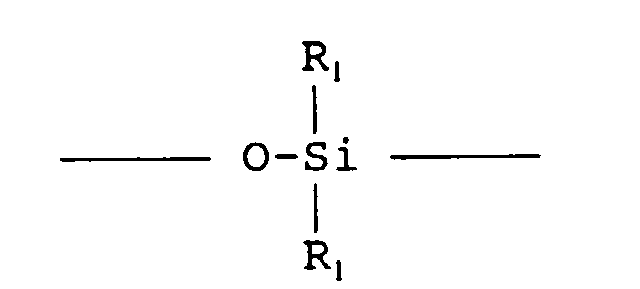 où "B" est représenté structurellement par :
 où "an" ainsi que "bn" sont, indépendamment, chacun un nombre entier situé dans l'intervalle de 1 à 300, y compris, où R1 est alcoyle, phényle ou leurs combinaisons,où R2 est une partie alcoylène ayant 2 à 20 atomes de carbone, une partie arylène ayant 6 à 20 atomes de carbone, une partie arylalcoylène ayant 7 à 20 atomes de carbone, ou leurs combinaisons,où R3 est alcoyle, phényle, un radical alcoyle contenant un amino, un radical aryle, un radical arylalcoyle, ou leurs combinaisons, etoù R4 est hydrogène, alcoyle, phényle, un radical alcoyle contenant un amino, un radical aryle, un radical arylalcoyle, ou leurs combinaisons,où la composition polymère comprend en outre, un milieu aqueux volatil comprenant une base volatile en une quantité qui est efficace pour prévenir la réaction chimique des parties acidofonctionnelles du polymère vinylique, avec les parties aminofonctionnelles du polymère de siloxane, où la quantité de composition polymère en rapport à la quantité d'ingrédient monomérique polymérisable, présent dans la formulation polymérique aqueuse, est efficace pour permettre à la formulation polymérique aqueuse de pouvoir être utilisée pour produire un réseau polymérique soluble en milieu alcalin sur un substrat.
 - Formulation polymérique filmogène, aqueuse préparée suivant le procédé de la revendication 10.
Applications Claiming Priority (3)
| Application Number | Priority Date | Filing Date | Title |
|---|---|---|---|
| US66333191A | 1991-02-14 | 1991-02-14 | |
| US663331 | 1991-02-14 | ||
| PCT/US1992/000643 WO1992014788A1 (fr) | 1991-02-14 | 1992-01-27 | Compositions polymeres melangees |
Publications (3)
| Publication Number | Publication Date |
|---|---|
| EP0571526A4 EP0571526A4 (fr) | 1993-09-10 |
| EP0571526A1 EP0571526A1 (fr) | 1993-12-01 |
| EP0571526B1 true EP0571526B1 (fr) | 1997-04-02 |
Family
ID=24661365
Family Applications (1)
| Application Number | Title | Priority Date | Filing Date |
|---|---|---|---|
| EP92906794A Expired - Lifetime EP0571526B1 (fr) | 1991-02-14 | 1992-01-27 | Compositions polymeres melangees |
Country Status (12)
| Country | Link |
|---|---|
| US (1) | US5399612A (fr) |
| EP (1) | EP0571526B1 (fr) |
| JP (1) | JPH06505296A (fr) |
| AT (1) | ATE151103T1 (fr) |
| CA (1) | CA2103559C (fr) |
| DE (1) | DE69218761T2 (fr) |
| DK (1) | DK0571526T3 (fr) |
| ES (1) | ES2100337T3 (fr) |
| FI (1) | FI933593A7 (fr) |
| MX (1) | MX9200616A (fr) |
| NO (1) | NO305086B1 (fr) |
| WO (1) | WO1992014788A1 (fr) |
Families Citing this family (24)
| Publication number | Priority date | Publication date | Assignee | Title |
|---|---|---|---|---|
| IL109303A0 (en) * | 1993-04-26 | 1994-07-31 | Rohm & Haas | Use of a coating comprising an acid-functional polymer and an organosilane |
| US5527619A (en) * | 1993-04-26 | 1996-06-18 | Rohm And Haas Company | Tannin stain blocking coated substrate |
| US5370922A (en) * | 1993-10-06 | 1994-12-06 | Rohm And Haas Company | Aminosilanes for non-bleed aqueous liquid paper |
| KR950018342A (ko) * | 1993-12-15 | 1995-07-22 | 윌리엄 이. 램버트 3세 | 백악질 기질에 대한 코팅제의 접착력을 개선시키는 혼합조성물 |
| JPH1060280A (ja) * | 1996-08-14 | 1998-03-03 | Japan Synthetic Rubber Co Ltd | 水系分散体 |
| AU728596B2 (en) | 1996-12-19 | 2001-01-11 | S.C. Johnson Commercial Markets, Inc. | Dispersions of blended polycarboxypolyamide resins and alkali dispersible resins, their preparation and their use |
| US6162860A (en) * | 1997-11-12 | 2000-12-19 | S. C. Johnson Commercial Markets, Inc. | Solvent based interactive polymeric compositions containing a substantially non-gelled composition |
| CA2308448C (fr) * | 1997-11-12 | 2005-01-25 | S.C. Johnson Commercial Markets, Inc. | Compositions polymeres, leur preparation et utilisation |
| US6143419A (en) * | 1997-12-25 | 2000-11-07 | Dainichiseika Color & Chemicals Mfg. Co., Ltd. | Ink-jet recording sheet comprising a molecule containing tertiary amino groups and polysiloxane segments |
| US6107380A (en) | 1998-06-25 | 2000-08-22 | General Electric Company | Fluorosilicone primer free of volatile organic compounds |
| DE69917280T2 (de) | 1998-07-10 | 2005-04-14 | Johnson Polymer, LLC, Sturtevant | Verfahren zur herstellung von polymeren durch ein freies radikal verfahren, polymerisations- und condensationsreaktion und apparat dafür sowie hergestellte produkte |
| KR100619648B1 (ko) | 1998-07-10 | 2006-09-05 | 존슨 폴리머, 엘엘씨 | 연속 벌크 중합 및 에스테르화 방법, 그리고 중합물을포함하는 조성물 |
| EP1198481B1 (fr) | 1999-07-14 | 2006-01-04 | Johnson Polymer, Inc. | Procede de production en continu de polymeres styrene-epoxy-(meth)acrilique et leur utilisation dans des revetements |
| US6387997B1 (en) * | 1999-11-10 | 2002-05-14 | Ppg Industries Ohio, Inc. | Solvent-free film-forming compositions, coated substrates and method related thereto |
| US6605681B1 (en) | 2000-07-12 | 2003-08-12 | Johnson Polymer, Inc. | Process for the continuous production of epoxylated addition polymers, and powder and liquid coating applications containing epoxylated addition polymers |
| US6432270B1 (en) | 2001-02-20 | 2002-08-13 | Kimberly-Clark Worldwide, Inc. | Soft absorbent tissue |
| US20040242725A1 (en) * | 2001-10-18 | 2004-12-02 | Gordon Kotora | Ionically cross-linked paste inks |
| US6576087B1 (en) | 2001-11-15 | 2003-06-10 | Kimberly-Clark Worldwide, Inc. | Soft absorbent tissue containing polysiloxanes |
| US6582558B1 (en) | 2001-11-15 | 2003-06-24 | Kimberly-Clark Worldwide, Inc. | Soft absorbent tissue containing hydrophilic polysiloxanes |
| US6511580B1 (en) | 2001-11-15 | 2003-01-28 | Kimberly-Clark Worldwide, Inc. | Soft absorbent tissue containing derivitized amino-functional polysiloxanes |
| US6599393B1 (en) | 2001-11-15 | 2003-07-29 | Kimberly-Clark Worldwide, Inc. | Soft absorbent tissue containing hydrophilically-modified amino-functional polysiloxanes |
| US6514383B1 (en) | 2001-11-15 | 2003-02-04 | Kimberly-Clark Worldwide, Inc. | Soft absorbent tissue containing derivitized amino-functional polysiloxanes |
| JP4695829B2 (ja) * | 2002-12-27 | 2011-06-08 | エスケー化研株式会社 | 水性塗料組成物 |
| JP4711615B2 (ja) * | 2002-12-27 | 2011-06-29 | エスケー化研株式会社 | 水性塗料組成物、及び無機質基材の塗装方法 |
Family Cites Families (77)
| Publication number | Priority date | Publication date | Assignee | Title |
|---|---|---|---|---|
| US3075941A (en) * | 1957-10-03 | 1963-01-29 | Union Carbide Corp | Copolymer comprising a vinyl polysiloxane, an unsaturated polyester ester resin and a vinyl compound, and coating composition thereof |
| BE621846A (fr) * | 1961-08-31 | 1900-01-01 | ||
| US3471460A (en) * | 1961-08-31 | 1969-10-07 | Du Pont | Amine-modified hydrocarbon polymers |
| US3203919A (en) * | 1962-09-19 | 1965-08-31 | Du Pont | Acrylic/siloxane copolymer, polysiloxane composition containing same, and article coated with the composition |
| US3836598A (en) * | 1964-04-02 | 1974-09-17 | Union Carbide Corp | Olefinic silicone-organic graft copolymers |
| US3328367A (en) * | 1965-04-29 | 1967-06-27 | Du Pont | Copolymers |
| US3437512A (en) * | 1965-08-13 | 1969-04-08 | Ford Motor Co | Radiation curable cyclic siliconemodified paint binders |
| US3437513A (en) * | 1965-08-13 | 1969-04-08 | Ford Motor Co | Radiation curable acyclic siliconemodified paint binders |
| US3575910A (en) * | 1965-08-25 | 1971-04-20 | Dow Corning | Siloxane-acrylate copolymers and emulsions thereof |
| US3467634A (en) * | 1966-08-10 | 1969-09-16 | Xerox Corp | Organosilicon terpolymers |
| US3488304A (en) * | 1967-06-19 | 1970-01-06 | Ppg Industries Inc | Interpolymers containing organopolysiloxanes and coating compositions made therefrom |
| US3617362A (en) * | 1968-07-11 | 1971-11-02 | Johnson & Johnson | Acrylate adhesive tape and composition |
| US3576779A (en) * | 1968-07-17 | 1971-04-27 | Gen Electric | Amine-functional organopolysiloxane, salt thereof and polish composition therefrom |
| US3627836A (en) * | 1968-11-15 | 1971-12-14 | Stauffer Wacker Silicone Corp | Modified organopolysiloxanes with mono and polyolefinic cross-linked particles generated in situ |
| US3577264A (en) * | 1968-11-18 | 1971-05-04 | Ford Motor Co | Siloxane-unsaturated ester coated product |
| US3577265A (en) * | 1968-11-18 | 1971-05-04 | Ford Motor Co | Vinyl resin-siloxane coated article |
| US3661628A (en) * | 1969-09-29 | 1972-05-09 | Union Carbide Corp | Inorganic oxide substrate coated with water dispersible ethylene and acrylic-methacrylic copolymer salts with siloxane |
| BE756793A (fr) * | 1969-09-29 | 1971-03-29 | Stauffer Wacker Silicone Corp | Procédé de préparation d'organo-polysiloxanes modifiés |
| US3794694A (en) * | 1970-11-09 | 1974-02-26 | Stauffer Chemical Co | Room temperature vulcanizable graft copolymers on silicone containing backbone |
| US3694478A (en) * | 1970-11-23 | 1972-09-26 | Stauffer Chemical Co | Process for grafting organopolysiloxanes |
| US3776875A (en) * | 1971-12-30 | 1973-12-04 | Stauffer Chemical Co | Preparation of modified organopoly-siloxanes in a solvent system |
| US3808178A (en) * | 1972-06-16 | 1974-04-30 | Polycon Laboratories | Oxygen-permeable contact lens composition,methods and article of manufacture |
| USRE31406E (en) * | 1972-06-16 | 1983-10-04 | Syntex (U.S.A.) Inc. | Oxygen permeable contact lens composition, methods and article of manufacture |
| US3878263A (en) * | 1972-07-10 | 1975-04-15 | Stauffer Chemical Co | Acrylate-functional polysiloxane polymers |
| DE2405828C2 (de) * | 1974-02-07 | 1985-11-14 | Consortium für elektrochemische Industrie GmbH, 8000 München | Verfahren zum Herstellen von modifizierten Organopolysiloxanen |
| US4154618A (en) * | 1974-08-29 | 1979-05-15 | Union Camp Corporation | Novel coating compositions |
| US3997492A (en) * | 1975-01-22 | 1976-12-14 | Nalco Chemical Company | High HLB latex polymers |
| US4070152A (en) * | 1976-01-12 | 1978-01-24 | Ciba-Geigy Corporation | Textile treating compositions for increasing water and oil repellency of textiles |
| US4423195A (en) * | 1976-04-15 | 1983-12-27 | Danker Laboratories, Inc. | Ocular membrane and method for preparation thereof |
| US4070414A (en) * | 1976-04-23 | 1978-01-24 | Dow Corning Corporation | Toughened mercaptosiloxane modified bulk polymerized vinylic polymers |
| JPS5324347A (en) * | 1976-08-19 | 1978-03-07 | Shin Etsu Chem Co Ltd | Curable polybutadiene composition |
| US4136250A (en) * | 1977-07-20 | 1979-01-23 | Ciba-Geigy Corporation | Polysiloxane hydrogels |
| US4208506A (en) * | 1977-07-25 | 1980-06-17 | Bausch & Lomb Incorporated | Polyparaffinsiloxane shaped article for use in biomedical applications |
| US4153641A (en) * | 1977-07-25 | 1979-05-08 | Bausch & Lomb Incorporated | Polysiloxane composition and contact lens |
| US4189546A (en) * | 1977-07-25 | 1980-02-19 | Bausch & Lomb Incorporated | Polysiloxane shaped article for use in biomedical applications |
| US4166078A (en) * | 1977-12-16 | 1979-08-28 | Sws Silicones Corporation | Modified organopolysiloxane compositions |
| US4152508A (en) * | 1978-02-15 | 1979-05-01 | Polymer Technology Corporation | Silicone-containing hard contact lens material |
| US4314068A (en) * | 1979-01-26 | 1982-02-02 | George F. Tsuetaki | Oxygen-permeable contact lens compositions, methods, and articles of manufacture |
| US4216303A (en) * | 1979-01-26 | 1980-08-05 | George F. Tsuetaki | Oxygen-permeable contact lens compositions, methods and articles of manufacture |
| DE2917754A1 (de) * | 1979-05-02 | 1980-11-13 | Wacker Chemie Gmbh | Hydrophile, vernetzte, modifizierte organopolysiloxane verfahren zu ihrer herstellung und ihre verwendung |
| US4242483A (en) * | 1979-08-13 | 1980-12-30 | Novicky Nick N | Oxygen permeable hard and semi-hard contact lens compositions, methods and articles of manufacture |
| US4248989A (en) * | 1979-09-11 | 1981-02-03 | Novicky Nick N | Oxygen permeable hard and semi-hard contact lens compositions, methods and articles of manufacture II |
| US4276402A (en) * | 1979-09-13 | 1981-06-30 | Bausch & Lomb Incorporated | Polysiloxane/acrylic acid/polcyclic esters of methacrylic acid polymer contact lens |
| DE2944591A1 (de) * | 1979-11-05 | 1981-05-14 | Wacker-Chemie GmbH, 8000 München | Fluessigkristalline phasen aufweisende zusammensetzungen |
| DE2947966A1 (de) * | 1979-11-28 | 1981-07-23 | Bayer Ag, 5090 Leverkusen | Pfropfpolymerisate, verfahren zu deren herstellung und deren verwendung |
| DE2947963A1 (de) * | 1979-11-28 | 1981-06-19 | Bayer Ag, 5090 Leverkusen | Propfpolymerisat-dispersionen |
| US4352917A (en) * | 1980-09-18 | 1982-10-05 | Sws Silicones Corporation | Hydrophilic coatings for textile materials |
| US4369289A (en) * | 1980-09-30 | 1983-01-18 | Union Carbide Corporation | Masterbatch composition comprising a matrix having a polysiloxane dispersed therein and a method for the preparation thereof |
| DE3106186A1 (de) * | 1981-02-19 | 1982-09-09 | Wacker-Chemie GmbH, 8000 München | Verfahren zur herstellung von organopolysiloxanen und verwendung dieser organop |
| US4355147A (en) * | 1981-02-26 | 1982-10-19 | Bausch & Lomb Incorporated | Polysiloxane with polycyclic modifier composition and biomedical devices |
| US4341889A (en) * | 1981-02-26 | 1982-07-27 | Bausch & Lomb Incorporated | Polysiloxane composition and biomedical devices |
| US4348454A (en) * | 1981-03-02 | 1982-09-07 | General Electric Company | Ultraviolet light curable acrylic functional silicone compositions |
| ZA823554B (en) * | 1981-06-19 | 1983-03-30 | Dow Corning Ltd | Siloxane compositions and process for treatment of materials |
| US4565846A (en) * | 1981-07-17 | 1986-01-21 | Matsushita Electric Industrial Company, Limited | Selective gas-permeable films |
| US4581184A (en) * | 1981-11-09 | 1986-04-08 | Precision-Cosmet Co., Inc. | Oxygen permeable lens |
| US4611039A (en) * | 1981-11-09 | 1986-09-09 | Precision-Cosmet Co., Inc. | Wettable, gas permeable contact lens |
| DE3201194A1 (de) * | 1982-01-16 | 1983-07-28 | Bayer Ag, 5090 Leverkusen | Vernetzbare pfropfpolymerisat-dispersionen aus hydrogensiloxan-gruppen und si-vinyl-gruppen enthaltenden organopolysiloxanen |
| DE3214984C2 (de) * | 1982-04-22 | 1985-05-15 | Th. Goldschmidt Ag, 4300 Essen | Verfahren zur Herstellung von eines in organischen Lösungsmitteln löslichen, hitzehärtbaren Siliconharzes |
| US4529787A (en) * | 1982-06-15 | 1985-07-16 | S. C. Johnson & Son, Inc. | Bulk polymerization process for preparing high solids and uniform copolymers |
| US4450264A (en) * | 1982-08-09 | 1984-05-22 | Polymatic Investment Corp., N.V. | Siloxane-containing polymers and contact lenses therefrom |
| JPS5959750A (ja) * | 1982-09-30 | 1984-04-05 | Nitto Electric Ind Co Ltd | 剥離性皮膜形成材 |
| US4663228A (en) * | 1983-05-03 | 1987-05-05 | Advanced Glass Systems Corp. | Laminated safety glass |
| US4508884A (en) * | 1983-05-25 | 1985-04-02 | Coopervision, Inc. | Oxygen permeable hard contact lens |
| JPS59230065A (ja) * | 1983-06-10 | 1984-12-24 | Kansai Paint Co Ltd | 常温乾燥型塗料組成物 |
| DE3406266A1 (de) * | 1984-02-21 | 1985-08-29 | Wacker-Chemie GmbH, 8000 München | Verfahren zur herstellung von schutzueberzuegen auf beschichtungen aus asphaltbeton und ueberzogene beschichtungen |
| US4546160A (en) * | 1984-02-29 | 1985-10-08 | S. C. Johnson & Son, Inc. | Bulk polymerization process for preparing high solids and uniform copolymers |
| US4558082A (en) * | 1984-05-10 | 1985-12-10 | General Electric Company | Acrylated polymers |
| DE3426087C1 (de) * | 1984-07-14 | 1986-03-06 | Th. Goldschmidt Ag, 4300 Essen | acrylsaeureestermodifizierte Organopolysiloxangemische,deren Herstellung und Verwendung als abhaesive Beschichtungsmassen |
| US4619973A (en) * | 1984-08-17 | 1986-10-28 | Advanced Glass Systems, Inc. | Ionomer resin films |
| US4623683A (en) * | 1984-10-12 | 1986-11-18 | S.C. Johnson & Son, Inc. | Fabric finish with alpha olefin resins and process |
| US4677169A (en) * | 1984-11-02 | 1987-06-30 | General Electric Company | Silicone-organic block polymers and method for making |
| DE3447636A1 (de) * | 1984-12-28 | 1986-07-03 | Wacker-Chemie GmbH, 8000 München | Bei verduennen mit wasser durchsichtige gemische ergebende, polysiloxan enthaltende zusammensetzungen |
| US4767646A (en) * | 1985-10-24 | 1988-08-30 | Allied Corporation | Wet abrasion resistant yarn and cordage |
| US4670500A (en) * | 1985-12-20 | 1987-06-02 | Pennzoil Company | Surface coating composition |
| US4673718A (en) * | 1986-01-06 | 1987-06-16 | E. I. Du Pont De Nemours And Company | Polysiloxane graft copolymers, flexible coating compositions comprising same and branched polysiloxane macromers for preparing same |
| US4693935A (en) * | 1986-05-19 | 1987-09-15 | Minnesota Mining And Manufacturing Company | Polysiloxane-grafted copolymer pressure sensitive adhesive composition and sheet materials coated therewith |
| DE4007136A1 (de) * | 1989-08-05 | 1991-09-12 | Pfersee Chem Fab | Zusammensetzung in form einer waessrigen dispersion und verfahren zur behandlung von fasermaterialien |
-
1992
- 1992-01-27 DE DE69218761T patent/DE69218761T2/de not_active Expired - Fee Related
- 1992-01-27 ES ES92906794T patent/ES2100337T3/es not_active Expired - Lifetime
- 1992-01-27 DK DK92906794.0T patent/DK0571526T3/da active
- 1992-01-27 FI FI933593A patent/FI933593A7/fi unknown
- 1992-01-27 CA CA002103559A patent/CA2103559C/fr not_active Expired - Fee Related
- 1992-01-27 AT AT92906794T patent/ATE151103T1/de not_active IP Right Cessation
- 1992-01-27 JP JP4506604A patent/JPH06505296A/ja active Pending
- 1992-01-27 EP EP92906794A patent/EP0571526B1/fr not_active Expired - Lifetime
- 1992-01-27 WO PCT/US1992/000643 patent/WO1992014788A1/fr not_active Ceased
- 1992-02-13 MX MX9200616A patent/MX9200616A/es unknown
-
1993
- 1993-03-23 US US08/035,539 patent/US5399612A/en not_active Expired - Fee Related
- 1993-08-13 NO NO932897A patent/NO305086B1/no unknown
Also Published As
| Publication number | Publication date |
|---|---|
| NO305086B1 (no) | 1999-03-29 |
| JPH06505296A (ja) | 1994-06-16 |
| US5399612A (en) | 1995-03-21 |
| NO932897D0 (no) | 1993-08-13 |
| FI933593L (fi) | 1993-09-03 |
| MX9200616A (es) | 1992-08-01 |
| EP0571526A4 (fr) | 1993-09-10 |
| FI933593A7 (fi) | 1993-09-03 |
| FI933593A0 (fi) | 1993-08-13 |
| WO1992014788A1 (fr) | 1992-09-03 |
| CA2103559A1 (fr) | 1992-08-15 |
| DE69218761T2 (de) | 1997-07-17 |
| DK0571526T3 (da) | 1997-10-13 |
| ES2100337T3 (es) | 1997-06-16 |
| DE69218761D1 (de) | 1997-05-07 |
| ATE151103T1 (de) | 1997-04-15 |
| EP0571526A1 (fr) | 1993-12-01 |
| NO932897L (no) | 1993-10-12 |
| CA2103559C (fr) | 2000-07-18 |
Similar Documents
| Publication | Publication Date | Title |
|---|---|---|
| EP0571526B1 (fr) | Compositions polymeres melangees | |
| US3753769A (en) | Coating composition and plastic articles coated therewith | |
| JPS6026015A (ja) | 新規タ−ポリマ−及びそれを含む被覆組成物 | |
| CN101861342B (zh) | 使用水性油墨在非多孔性基材上进行高清晰印刷 | |
| JP2017507203A (ja) | 改善されたオープンタイムを有する水溶型コーティング組成物 | |
| KR940018431A (ko) | 가교시켜 엘라스토머를 생성하는 오르가노폴리실록산 조성물 | |
| JP4996013B2 (ja) | 低mfiエチレンアクリル酸コポリマーを含むコーティング組成物 | |
| US4335030A (en) | Aqueous dispersion of fluoropolymers in combination with epoxy-type film formers | |
| CA1248671A (fr) | ENDUITS A TENEUR DE TERPOLYMERE D'OLEFINE .alpha. | |
| WO1991014715A1 (fr) | Revetements de surface reticulables et methodes de fabrication de ceux-ci | |
| US3251817A (en) | Vinylidene chloride copolymer coating compositions | |
| JPH0625369A (ja) | 水性シリコーン変性樹脂 | |
| JP3605833B2 (ja) | 加熱硬化型防曇剤組成物 | |
| GB2191205A (en) | Conductive film-forming composition | |
| JP3216262B2 (ja) | 車両灯具用加熱硬化型防曇剤組成物及び車両灯具 | |
| Bousquet et al. | Structured multistimuli‐responsive functional polymer surfaces obtained by interfacial diffusion of amphiphilic block copolymers | |
| EP0129913B1 (fr) | Terpolymère d'alpha oléfine et composition de revêtement contenant ce terpolymère | |
| US4812364A (en) | Polyether siloxane graft polymers | |
| Šňupárek et al. | Synthesis and some properties of functionalized film‐forming latexes | |
| JP4205768B2 (ja) | 帯電防止剤 | |
| CA1205240A (fr) | Vernis aqueux thermodurcissables | |
| US6713538B2 (en) | Post-treatment of a polymeric composition | |
| JPH10139975A5 (fr) | ||
| US20060183813A1 (en) | Hot melt coating compositions and methods of preparing same | |
| Gan et al. | Thin-film morphologies of random copolymers as functions of thermal history |
Legal Events
| Date | Code | Title | Description |
|---|---|---|---|
| PUAI | Public reference made under article 153(3) epc to a published international application that has entered the european phase |
Free format text: ORIGINAL CODE: 0009012 |
|
| 17P | Request for examination filed |
Effective date: 19930512 |
|
| AK | Designated contracting states |
Kind code of ref document: A1 Designated state(s): AT BE CH DE DK ES FR GB GR IT LI LU MC NL SE |
|
| 17Q | First examination report despatched |
Effective date: 19951019 |
|
| GRAG | Despatch of communication of intention to grant |
Free format text: ORIGINAL CODE: EPIDOS AGRA |
|
| GRAH | Despatch of communication of intention to grant a patent |
Free format text: ORIGINAL CODE: EPIDOS IGRA |
|
| GRAH | Despatch of communication of intention to grant a patent |
Free format text: ORIGINAL CODE: EPIDOS IGRA |
|
| GRAA | (expected) grant |
Free format text: ORIGINAL CODE: 0009210 |
|
| AK | Designated contracting states |
Kind code of ref document: B1 Designated state(s): AT BE CH DE DK ES FR GB GR IT LI LU MC NL SE |
|
| PG25 | Lapsed in a contracting state [announced via postgrant information from national office to epo] |
Ref country code: GR Free format text: LAPSE BECAUSE OF FAILURE TO SUBMIT A TRANSLATION OF THE DESCRIPTION OR TO PAY THE FEE WITHIN THE PRESCRIBED TIME-LIMIT Effective date: 19970402 Ref country code: AT Effective date: 19970402 |
|
| REF | Corresponds to: |
Ref document number: 151103 Country of ref document: AT Date of ref document: 19970415 Kind code of ref document: T |
|
| REG | Reference to a national code |
Ref country code: CH Ref legal event code: NV Representative=s name: E. BLUM & CO. PATENTANWAELTE Ref country code: CH Ref legal event code: EP |
|
| ITF | It: translation for a ep patent filed | ||
| REF | Corresponds to: |
Ref document number: 69218761 Country of ref document: DE Date of ref document: 19970507 |
|
| REG | Reference to a national code |
Ref country code: ES Ref legal event code: FG2A Ref document number: 2100337 Country of ref document: ES Kind code of ref document: T3 |
|
| ET | Fr: translation filed | ||
| REG | Reference to a national code |
Ref country code: CH Ref legal event code: PUE Owner name: S.C. JOHNSON & SON, INC. TRANSFER- S.C. JOHNSON CO |
|
| NLS | Nl: assignments of ep-patents |
Owner name: S.C. JOHNSON COMMERCIAL MARKETS, INC. |
|
| REG | Reference to a national code |
Ref country code: DK Ref legal event code: T3 |
|
| REG | Reference to a national code |
Ref country code: GB Ref legal event code: 732E |
|
| PG25 | Lapsed in a contracting state [announced via postgrant information from national office to epo] |
Ref country code: LU Free format text: LAPSE BECAUSE OF NON-PAYMENT OF DUE FEES Effective date: 19980127 |
|
| PLBE | No opposition filed within time limit |
Free format text: ORIGINAL CODE: 0009261 |
|
| 26N | No opposition filed | ||
| PG25 | Lapsed in a contracting state [announced via postgrant information from national office to epo] |
Ref country code: MC Free format text: LAPSE BECAUSE OF NON-PAYMENT OF DUE FEES Effective date: 19980731 |
|
| REG | Reference to a national code |
Ref country code: FR Ref legal event code: TP |
|
| REG | Reference to a national code |
Ref country code: ES Ref legal event code: PC2A |
|
| PGFP | Annual fee paid to national office [announced via postgrant information from national office to epo] |
Ref country code: FR Payment date: 19991231 Year of fee payment: 9 |
|
| PGFP | Annual fee paid to national office [announced via postgrant information from national office to epo] |
Ref country code: SE Payment date: 20000103 Year of fee payment: 9 Ref country code: DE Payment date: 20000103 Year of fee payment: 9 |
|
| PGFP | Annual fee paid to national office [announced via postgrant information from national office to epo] |
Ref country code: GB Payment date: 20000105 Year of fee payment: 9 |
|
| PGFP | Annual fee paid to national office [announced via postgrant information from national office to epo] |
Ref country code: DK Payment date: 20000106 Year of fee payment: 9 Ref country code: CH Payment date: 20000106 Year of fee payment: 9 |
|
| PGFP | Annual fee paid to national office [announced via postgrant information from national office to epo] |
Ref country code: NL Payment date: 20000110 Year of fee payment: 9 |
|
| PGFP | Annual fee paid to national office [announced via postgrant information from national office to epo] |
Ref country code: ES Payment date: 20000124 Year of fee payment: 9 |
|
| PGFP | Annual fee paid to national office [announced via postgrant information from national office to epo] |
Ref country code: BE Payment date: 20000125 Year of fee payment: 9 |
|
| PG25 | Lapsed in a contracting state [announced via postgrant information from national office to epo] |
Ref country code: GB Free format text: LAPSE BECAUSE OF NON-PAYMENT OF DUE FEES Effective date: 20010127 Ref country code: DK Free format text: LAPSE BECAUSE OF NON-PAYMENT OF DUE FEES Effective date: 20010127 |
|
| PG25 | Lapsed in a contracting state [announced via postgrant information from national office to epo] |
Ref country code: SE Free format text: LAPSE BECAUSE OF NON-PAYMENT OF DUE FEES Effective date: 20010128 |
|
| PG25 | Lapsed in a contracting state [announced via postgrant information from national office to epo] |
Ref country code: ES Free format text: LAPSE BECAUSE OF NON-PAYMENT OF DUE FEES Effective date: 20010129 |
|
| PG25 | Lapsed in a contracting state [announced via postgrant information from national office to epo] |
Ref country code: LI Free format text: LAPSE BECAUSE OF NON-PAYMENT OF DUE FEES Effective date: 20010131 Ref country code: CH Free format text: LAPSE BECAUSE OF NON-PAYMENT OF DUE FEES Effective date: 20010131 Ref country code: BE Free format text: LAPSE BECAUSE OF NON-PAYMENT OF DUE FEES Effective date: 20010131 |
|
| BERE | Be: lapsed |
Owner name: S.C. JOHNSON COMMERCIAL MARKETS INC. (A DELAWARE Effective date: 20010131 |
|
| PG25 | Lapsed in a contracting state [announced via postgrant information from national office to epo] |
Ref country code: NL Free format text: LAPSE BECAUSE OF NON-PAYMENT OF DUE FEES Effective date: 20010801 |
|
| EUG | Se: european patent has lapsed |
Ref document number: 92906794.0 |
|
| REG | Reference to a national code |
Ref country code: CH Ref legal event code: PL |
|
| GBPC | Gb: european patent ceased through non-payment of renewal fee |
Effective date: 20010127 |
|
| REG | Reference to a national code |
Ref country code: DK Ref legal event code: EBP |
|
| PG25 | Lapsed in a contracting state [announced via postgrant information from national office to epo] |
Ref country code: FR Free format text: LAPSE BECAUSE OF NON-PAYMENT OF DUE FEES Effective date: 20010928 |
|
| NLV4 | Nl: lapsed or anulled due to non-payment of the annual fee |
Effective date: 20010801 |
|
| PG25 | Lapsed in a contracting state [announced via postgrant information from national office to epo] |
Ref country code: DE Free format text: LAPSE BECAUSE OF NON-PAYMENT OF DUE FEES Effective date: 20011101 |
|
| REG | Reference to a national code |
Ref country code: FR Ref legal event code: ST |
|
| REG | Reference to a national code |
Ref country code: ES Ref legal event code: FD2A Effective date: 20021116 |
|
| PG25 | Lapsed in a contracting state [announced via postgrant information from national office to epo] |
Ref country code: IT Free format text: LAPSE BECAUSE OF NON-PAYMENT OF DUE FEES;WARNING: LAPSES OF ITALIAN PATENTS WITH EFFECTIVE DATE BEFORE 2007 MAY HAVE OCCURRED AT ANY TIME BEFORE 2007. THE CORRECT EFFECTIVE DATE MAY BE DIFFERENT FROM THE ONE RECORDED. Effective date: 20050127 |