EP0572023B1 - Elektrophoresevorrichtung - Google Patents
Elektrophoresevorrichtung Download PDFInfo
- Publication number
- EP0572023B1 EP0572023B1 EP93108618A EP93108618A EP0572023B1 EP 0572023 B1 EP0572023 B1 EP 0572023B1 EP 93108618 A EP93108618 A EP 93108618A EP 93108618 A EP93108618 A EP 93108618A EP 0572023 B1 EP0572023 B1 EP 0572023B1
- Authority
- EP
- European Patent Office
- Prior art keywords
- sample
- dna
- gel electrophoresis
- introducing device
- sample introducing
- Prior art date
- Legal status (The legal status is an assumption and is not a legal conclusion. Google has not performed a legal analysis and makes no representation as to the accuracy of the status listed.)
- Expired - Lifetime
Links
Images
Classifications
-
- G—PHYSICS
- G01—MEASURING; TESTING
- G01N—INVESTIGATING OR ANALYSING MATERIALS BY DETERMINING THEIR CHEMICAL OR PHYSICAL PROPERTIES
- G01N27/00—Investigating or analysing materials by the use of electric, electrochemical, or magnetic means
- G01N27/26—Investigating or analysing materials by the use of electric, electrochemical, or magnetic means by investigating electrochemical variables; by using electrolysis or electrophoresis
- G01N27/416—Systems
- G01N27/447—Systems using electrophoresis
- G01N27/44704—Details; Accessories
- G01N27/44743—Introducing samples
-
- G—PHYSICS
- G01—MEASURING; TESTING
- G01N—INVESTIGATING OR ANALYSING MATERIALS BY DETERMINING THEIR CHEMICAL OR PHYSICAL PROPERTIES
- G01N27/00—Investigating or analysing materials by the use of electric, electrochemical, or magnetic means
- G01N27/26—Investigating or analysing materials by the use of electric, electrochemical, or magnetic means by investigating electrochemical variables; by using electrolysis or electrophoresis
- G01N27/416—Systems
- G01N27/447—Systems using electrophoresis
- G01N27/44704—Details; Accessories
- G01N27/44717—Arrangements for investigating the separated zones, e.g. localising zones
- G01N27/44721—Arrangements for investigating the separated zones, e.g. localising zones by optical means
Definitions
- This invention relates to a gel electrophoresis apparatus.
- the annealing of the primer onto the template DNA, and the Sanger and PCR methods are repeated several tens of times to produce a large amount of complementary DNA fragments, whereby an improved accuracy of electrophoretic identification can be achieved to determine the sequence of bases in DNA correctly.
- the electrophoretic operation is completely separated from the treatment of a sample by the Sanger method.
- the sample is treated by the Sanger method, and is transferred by a pipette, or the like to a electrophoretic apparatus.
- the above process cannot automatically determine the sequence of bases in DNA.
- US-A-5074981 describes a method and apparatus for high speed gel eletrophoresis employing elevated voltage values and relatively short time periods by using a gel block having special geometry and including sample wells of triangular cross-section, whereby the temperature throughout the gel is continuously monitored at various points in the gel; the heat, generated by employing elevated voltage values is withdrawn from the described gel block in a specific manner.
- the apparatus makes it possible to carry out automatically a series of operations including the treatment of the sample at a controlled temperature and the electrophoretic treatment thereof.
- an apparatus for determining the base sequence of DNA with which the following steps can be performed: the steps of treating DNA in accordance with the Sanger method to form complementary DNA fragments of different lengths ending specifically with four different kinds of bases; separating the fragments from one anther by electrophoresis; and identifying the base at the end of each of the fragments, the step being carried out successively and automatically. It is easier to determine the base sequence of DNA by the apparatus of this invention than by the conventional arrangement in which the step of forming complementary DNA fragments and the step of separating them by electrophoresis are carried out independently of each other.
- the apparatus enables the automatic sequencing of bases in DNA by carrying out the treatment of the sample at a controlled temperature and the electrophoretic treatment thereof successively.
- the apparatus is intended for use in determining the base sequence of DNA in accordance with the Sanger method.
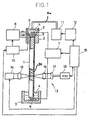
- the apparatus consists mainly of a sample introducing device 2 and an electrophoretic vessel 3 provided at the top and bottom, respectively, of a glass capillary 1.
- the capillary 1 holds a polyacrylamide gel.
- the sample introducing device 2 is adapted for receiving the supply of a sample of DNA, DNA polymerase and a Sanger reagent, as well as an electrolytic buffer solution 4.
- the electrophoretic vessel 3 is adapted for holding the buffer solution 4.
- the sample introducing device 2 and the electrophoretic vessel 3 are each provided with an electrode 6 which is connected to a high-voltage power-supply device 7.
- a heating and cooling device 8 is connected to the sample introducing device 2 for heating or cooling the mixture of the sample and the reagent therein.
- the sample introducing device 2 is provided with a temperature sensor 9.
- the heating and cooling device 8 and the temperature sensor 9 are connected to a temperature controller 10 which controls the heating and cooling device 8 in accordance with the output of the temperature sensor 9.
- a device 11 for supplying the buffer solution has a supply pipe 11a terminating in the sample introducing device 2.
- a device 12 for controlling the supply of the buffer solution is connected to the buffer solution supplying device 11 for controlling it so that it may supply the buffer solution into the sample introducing device 2 upon completion of the treatment of the sample therein.
- a fluorescent detecting device 13 is positioned across the middle portion of the glass capillary 1 for detecting the fluorescent pigment combined with the end of each of DNA fragments separated by electrophoresis in the capillary 1.
- the fluorescent detecting device 13 consists mainly of a laser 14, a converging lens 15 for converging in the capillary 1 light emitted by the laser 14, a lens 16 for diverging into parallel rays the light leaving the capillary 1, an interference filter 17 for detecting the wavelength of the light leaving the lens 16, and a photomultiplier (PM) 18 for detecting the light leaving the filter 17.
- the temperature controller 10, the device 12 for controlling the supply of the buffer solution, the high-voltage power-supply device 7, the laser 14 and the photo-multiplier 18 are connected to a data control analyzer 19 which controls them and determines the base sequence of DNA in accordance with the output of the photomultiplier 18.
- the sample introducing device 2 is supplied with a mixed solution containing DNA of which the base sequence is to be determined, a primer with which a fluorescent substance, such as FITC, is combined, a Sanger reagent, and DNA polymerase required for the PCR reaction.
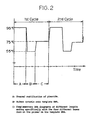
- the heating and cooling device 8 is controlled by the temperature controller 10 to control the temperature of the mixed solution in the sample introducing device 2. More specifically, the solution is maintained at a temperature of 95°C for about one minute, so that the thermal modification of plasmids may cause the conversion of DNA to single-strand, or template DNA.
- the solution is cooled to a temperature of 55°C, and maintained at that temperature for about 30 seconds, so that the primer may be annealed onto the template DNA. Then, the solution is heated again to a temperature of about 75°C, and maintained at that temperature for about one to three minutes, so that complementary DNA fragments of different lengths ending specifically with four different kinds of bases may be formed on the primer on the template DNA by the Sanger reaction.
- the temperature cycle as hereinabove described is repeated.
- the solution is heated to 95°C, and maintained at that temperature for about one minute, the template DNA and the complementary DNA fragments are separated from each other.
- the primer is annealed onto the template DNA again.
- the Sanger reaction takes place again to form complementary DNA fragments on the template DNA.
- the cycle is repeated, for example, 10 to 30 times until the solution is finally maintained at 70°C for seven minutes, whereby a large amount of complementary DNA fragments of different lengths are produced.
- the buffer solution 4 is supplied from the buffer solution supplying device 11 to the sample introducing device 2, and a high voltage is applied across the electrodes 6 by the high-voltage power-supply device 7.
- the complementary DNA fragments of different lengths in the sample introducing device 2 start electrophoretic movement through the glass capillary 1, and are separated from one another in the polyacrylamide gel, beginning with ones of short length, and resulting in the formation of a DNA band 20, as shown in Fig. 1.
- Each DNA band 20 emits fluorescent light upon application of laser light, as the complementary DNA fragments forming it contain a fluorescent pigment.
- each DNA band 20 is determined by the photomultiplier 18, it is possible to identify the base at the end of the complementary DNA fragment forming the DNA band 20.
- the bases at the ends of the complementary DNA fragments are determined one after another from the lower DNA bands 20, it is possible to determine the base sequence of DNA.
- the electrophoretic apparatus as hereinabove described makes it possible to carry out successively the Sanger treatment of the sample combined with the PCR method and the electrophoretic treatment thereof, and thereby determine the base sequence of DNA automatically.
Landscapes
- Health & Medical Sciences (AREA)
- Life Sciences & Earth Sciences (AREA)
- Molecular Biology (AREA)
- Chemical & Material Sciences (AREA)
- Chemical Kinetics & Catalysis (AREA)
- Electrochemistry (AREA)
- Physics & Mathematics (AREA)
- Analytical Chemistry (AREA)
- Biochemistry (AREA)
- General Health & Medical Sciences (AREA)
- General Physics & Mathematics (AREA)
- Immunology (AREA)
- Pathology (AREA)
- Measuring Or Testing Involving Enzymes Or Micro-Organisms (AREA)
- Investigating, Analyzing Materials By Fluorescence Or Luminescence (AREA)
Claims (5)
- Gelelektrophorese-DNA-Sequenziervorrichtung zur Bildung, gemäß dem Verfahren von Sanger, basenspezifisch terminierter DNA-Fragmente, die komplementär zu den zu sequenzierenden DNA-Templates sind, und zur gleichzeitigen Anwendung des PCR-Verfahrens zur Amplifizierung der basenspezifisch terminierten DNA-Fragmente, enthaltend
eine Probeneinführungsvorrichtung (2), in der Polymeraseketten- und Sanger-Reaktionen an der zu sequenzierenden Proben-DNA, wobei es sich um fluoreszierende farbstoffmarkierte DNA handeln kann, durchgeführt werden, wobei die Probeneinführungsvorrichtung (2) Produkte der Polymerasekettenund Sanger-Reaktionen in ein Gelelektrophoresemittel (1) einführt, und
Mittel (9, 10) zum Erfassen und Regulieren der Temperatur der Probe in der Probeneinführungsvorrichtung (2),
wobei die Gelelektrophorese-DNA-Sequenziervorrichtung dadurch gekennzeichnet ist, dass sie außerdem
ein Gelelektrophoresemittel (1) zur Durchführung der Elektrophorese der temperaturregulierten Probe in einem Gel zur Trennung der Probe in Fragmente, von denen ein Ende mit der Probeneinführungsvorrichtung (2) verbunden ist, und
einen Datensteueranalysator (19), der mit Temperaturfühl- (9) und -reguliermitteln (10) und mit dem Gelelektrophoresemittel (1) und Mitteln (14, 15, 16, 17, 18) zur Analyse der Fragmente verbunden ist, enthält. - Gelelektrophorese-DNA-Sequenziervorrichtung gemäß Anspruch 1, welche außerdem eine Heiz- und Kühlvorrichtung (8) zum Erwärmen oder Abkühlen der Mischung von Probe und Reagenz in der Probeneinführungsvorrichtung enthält.
- Gelelektrophorese-DNA-Sequenziervorrichtung gemäß Anspruch 2, wobei das Temperaturfühl- (9) und -reguliermittel (10)
einen Temperaturfühler (9) in der Probeneinführungsvorrichtung (2) und
einen Temperaturregler (10) zur Regulierung der Heiz- und Kühlvorrichtung (8) enthält, wobei der Temperaturfühler (9) mit dem Temperaturregler (10) verbunden ist. - Gelelektrophorese-DNA-Sequenziervorrichtung gemäß Anspruch 3, welche außerdem
Mittel (11) zum Zuführen einer Pufferlösung in die Probeneinführungsvorrichtung (2) und
einen Pufferzufuhrregler (12), welcher mit der Pufferlösungszufuhrvorrichtung (11) verbunden ist, enthält. - Gelelektrophorese-DNA-Sequenziervorrichtung gemäß Anspruch 4, wobei
das Gelelektrophoresemittel eine Gelelektrophorese-Glaskapillare (1) enthält, von der ein Ende mit der Probeneinführungsvorrichtung (2) verbunden ist, und das entgegengesetzte Ende sich in einem Pufferlösungsgefäß (3) befindet, wobei ein Paar von Elektroden (6) sich in der Probeneinführungsvorrichtung (2) und in dem Pufferlösungsgefäß (3) befindet, wobei das Elektrodenpaar (6) mit einem Hochspannungsnetzgerät (7) verbunden ist, und wobei
der Datensteueranalysator (19) nach Beendigung der Polymerasekettenreaktion und des thermischen Kreislaufs der Sanger-Reaktionen den Pufferzufuhrregler (12) derart steuert, dass er Pufferlösung der Probeneinführungsvorrichtung (2) zuführt, und das Hochspannungsnetzgerät (7) derart steuert, dass es eine hohe Spannung an die Elektroden (6) anlegt, um die elektrophoretische Bewegung der Sequenzierfragmente in der Probeneinführungsvorrichtung (2) durch die Gelelektrophoresekapillare (1) zu initiieren.
Applications Claiming Priority (3)
| Application Number | Priority Date | Filing Date | Title |
|---|---|---|---|
| JP138568/92 | 1992-05-29 | ||
| JP13856892 | 1992-05-29 | ||
| JP4138568A JPH05332992A (ja) | 1992-05-29 | 1992-05-29 | 電気泳動装置 |
Publications (3)
| Publication Number | Publication Date |
|---|---|
| EP0572023A2 EP0572023A2 (de) | 1993-12-01 |
| EP0572023A3 EP0572023A3 (en) | 1995-09-20 |
| EP0572023B1 true EP0572023B1 (de) | 2003-08-27 |
Family
ID=15225182
Family Applications (1)
| Application Number | Title | Priority Date | Filing Date |
|---|---|---|---|
| EP93108618A Expired - Lifetime EP0572023B1 (de) | 1992-05-29 | 1993-05-27 | Elektrophoresevorrichtung |
Country Status (4)
| Country | Link |
|---|---|
| US (1) | US5370782A (de) |
| EP (1) | EP0572023B1 (de) |
| JP (1) | JPH05332992A (de) |
| DE (1) | DE69333165T2 (de) |
Families Citing this family (8)
| Publication number | Priority date | Publication date | Assignee | Title |
|---|---|---|---|---|
| US5759375A (en) * | 1996-05-17 | 1998-06-02 | Purdue Research Foundation | Miniaturized disposable gels for DNA analysis |
| WO1998008978A1 (en) * | 1996-08-27 | 1998-03-05 | Visible Genetics Inc. | Apparatus and method for performing sequencing of nucleic acid polymers |
| US6299747B1 (en) | 1997-12-17 | 2001-10-09 | Cetek Corporation | Capillary electrophoretic methods to detect new biologically active compounds in complex biological material |
| US6524866B1 (en) | 1997-12-24 | 2003-02-25 | Cetek Corporation | Capillary electrophoretic method to detect target-binding ligands and to determine their relative affinities |
| US6432651B1 (en) | 1998-07-10 | 2002-08-13 | Cetek Corporation | Method to detect and analyze tight-binding ligands in complex biological samples using capillary electrophoresis and mass spectrometry |
| US20020028434A1 (en) * | 2000-09-06 | 2002-03-07 | Guava Technologies, Inc. | Particle or cell analyzer and method |
| DE112010002222B4 (de) | 2009-06-04 | 2024-01-25 | Leidos Innovations Technology, Inc. (n.d.Ges.d. Staates Delaware) | Mehr-Proben-Mikrofluidchip fur DNA-Analyse |
| GB2497501A (en) | 2010-10-15 | 2013-06-12 | Lockheed Corp | Micro fluidic optic design |
Family Cites Families (4)
| Publication number | Priority date | Publication date | Assignee | Title |
|---|---|---|---|---|
| IT1086463B (it) * | 1977-09-06 | 1985-05-28 | Fisauli Francesco | Densitometro per la determinazione quantitativa di frazioni proteiche separate per via elettroforetica,particolarmente per la diagnosi clinica |
| CA1258611A (en) * | 1984-01-16 | 1989-08-22 | Lloyd M. Smith | Method of dna sequencing |
| JP3023793B2 (ja) * | 1988-02-16 | 2000-03-21 | アプライド バイオシステムズ インコーポレイテッド | 毛管電気泳動方法及びその装置 |
| US5074981A (en) * | 1989-04-26 | 1991-12-24 | The University Of Tennessee Research Corporation | High speed gel electrophoresis |
-
1992
- 1992-05-29 JP JP4138568A patent/JPH05332992A/ja active Pending
-
1993
- 1993-05-25 US US08/066,244 patent/US5370782A/en not_active Expired - Lifetime
- 1993-05-27 EP EP93108618A patent/EP0572023B1/de not_active Expired - Lifetime
- 1993-05-27 DE DE69333165T patent/DE69333165T2/de not_active Expired - Fee Related
Also Published As
| Publication number | Publication date |
|---|---|
| EP0572023A2 (de) | 1993-12-01 |
| US5370782A (en) | 1994-12-06 |
| DE69333165D1 (de) | 2003-10-02 |
| EP0572023A3 (en) | 1995-09-20 |
| JPH05332992A (ja) | 1993-12-17 |
| DE69333165T2 (de) | 2004-06-03 |
Similar Documents
| Publication | Publication Date | Title |
|---|---|---|
| KR100668320B1 (ko) | 중합 효소 연쇄 반응용 모듈 및 이를 채용한 다중중합효소 연쇄 반응 시스템 | |
| JP3612092B2 (ja) | Dnaの分離・分取法及びその解析法 | |
| US6596487B2 (en) | Mutation detection using denaturing gradients | |
| EP0157280A2 (de) | Bestimmung von einer DNS-Sequenz | |
| EP0895544A1 (de) | Ein verfahren und ein gerät sowie probensätze für die sequenzierung von nukleinsäuren unter verwendung verschiedener farbstoffe | |
| WO1999057321A8 (en) | Method of determining the nucleotide sequence of oligonucleotides and dna molecules | |
| EP0572023B1 (de) | Elektrophoresevorrichtung | |
| Wiemann et al. | Simultaneous on-line DNA sequencing on both strands with two fluorescent dyes | |
| EP0711840A2 (de) | Verfahren und Vorrichtung zur DNS Analyse | |
| WO2001004618A1 (en) | Increased throughput analysis of small compounds using multiple temporally spaced injections | |
| EP0803730A2 (de) | DNA-Analysegerät | |
| EP2956550B1 (de) | Verbesserte sondenanbindung | |
| US6436641B1 (en) | Method and apparatus for DNA sequencing | |
| ATE398186T1 (de) | Integriertes verfahren und system zur amplifizierung und zum nachweis von nukleinsäuren | |
| US20070117092A1 (en) | Dna analysis system | |
| CA2185590A1 (en) | Dna sequencing method and dna sample preparation method | |
| Irie et al. | Automated DNA fragment collection by capillary array gel electrophoresis in search of differentially expressed genes | |
| JP3419850B2 (ja) | 核酸分別方法 | |
| US6162602A (en) | Automatic direct sequencing of bases in nucleic acid chain elongation | |
| JP2683549B2 (ja) | オリゴヌクレオチドを標識するキット | |
| US5468364A (en) | Base sequencing apparatus | |
| JP2007510407A (ja) | 統合された生物分析及びサンプル調製システム | |
| US20040048276A1 (en) | System and method for determining the presence of methylated cytosines in polynucleotides | |
| AU2001235856A1 (en) | Method for analysing the length of a nucleic acid molecule | |
| JP2004512850A5 (de) |
Legal Events
| Date | Code | Title | Description |
|---|---|---|---|
| PUAI | Public reference made under article 153(3) epc to a published international application that has entered the european phase |
Free format text: ORIGINAL CODE: 0009012 |
|
| AK | Designated contracting states |
Kind code of ref document: A2 Designated state(s): CH DE GB LI |
|
| PUAL | Search report despatched |
Free format text: ORIGINAL CODE: 0009013 |
|
| AK | Designated contracting states |
Kind code of ref document: A3 Designated state(s): CH DE GB LI |
|
| 17P | Request for examination filed |
Effective date: 19960117 |
|
| 17Q | First examination report despatched |
Effective date: 19981001 |
|
| GRAH | Despatch of communication of intention to grant a patent |
Free format text: ORIGINAL CODE: EPIDOS IGRA |
|
| GRAH | Despatch of communication of intention to grant a patent |
Free format text: ORIGINAL CODE: EPIDOS IGRA |
|
| GRAA | (expected) grant |
Free format text: ORIGINAL CODE: 0009210 |
|
| AK | Designated contracting states |
Designated state(s): CH DE GB LI |
|
| REG | Reference to a national code |
Ref country code: GB Ref legal event code: FG4D |
|
| REG | Reference to a national code |
Ref country code: CH Ref legal event code: EP |
|
| REF | Corresponds to: |
Ref document number: 69333165 Country of ref document: DE Date of ref document: 20031002 Kind code of ref document: P |
|
| REG | Reference to a national code |
Ref country code: CH Ref legal event code: NV Representative=s name: ARNOLD & SIEDSMA AG |
|
| REG | Reference to a national code |
Ref country code: GB Ref legal event code: 746 Effective date: 20040505 |
|
| PLBE | No opposition filed within time limit |
Free format text: ORIGINAL CODE: 0009261 |
|
| STAA | Information on the status of an ep patent application or granted ep patent |
Free format text: STATUS: NO OPPOSITION FILED WITHIN TIME LIMIT |
|
| 26N | No opposition filed |
Effective date: 20040528 |
|
| PGFP | Annual fee paid to national office [announced via postgrant information from national office to epo] |
Ref country code: GB Payment date: 20060524 Year of fee payment: 14 |
|
| PGFP | Annual fee paid to national office [announced via postgrant information from national office to epo] |
Ref country code: DE Payment date: 20060525 Year of fee payment: 14 |
|
| PGFP | Annual fee paid to national office [announced via postgrant information from national office to epo] |
Ref country code: CH Payment date: 20060530 Year of fee payment: 14 |
|
| REG | Reference to a national code |
Ref country code: CH Ref legal event code: PL |
|
| GBPC | Gb: european patent ceased through non-payment of renewal fee |
Effective date: 20070527 |
|
| PG25 | Lapsed in a contracting state [announced via postgrant information from national office to epo] |
Ref country code: LI Free format text: LAPSE BECAUSE OF NON-PAYMENT OF DUE FEES Effective date: 20070531 Ref country code: CH Free format text: LAPSE BECAUSE OF NON-PAYMENT OF DUE FEES Effective date: 20070531 |
|
| PG25 | Lapsed in a contracting state [announced via postgrant information from national office to epo] |
Ref country code: DE Free format text: LAPSE BECAUSE OF NON-PAYMENT OF DUE FEES Effective date: 20071201 |
|
| PG25 | Lapsed in a contracting state [announced via postgrant information from national office to epo] |
Ref country code: GB Free format text: LAPSE BECAUSE OF NON-PAYMENT OF DUE FEES Effective date: 20070527 |