EP0573392A1 - Thiosemicarbazonderivate und ihre Anwendung als Arzneimittelwirkstoff - Google Patents
Thiosemicarbazonderivate und ihre Anwendung als Arzneimittelwirkstoff Download PDFInfo
- Publication number
- EP0573392A1 EP0573392A1 EP93810382A EP93810382A EP0573392A1 EP 0573392 A1 EP0573392 A1 EP 0573392A1 EP 93810382 A EP93810382 A EP 93810382A EP 93810382 A EP93810382 A EP 93810382A EP 0573392 A1 EP0573392 A1 EP 0573392A1
- Authority
- EP
- European Patent Office
- Prior art keywords
- allyl
- ylidene
- pharmaceutically acceptable
- thiosemicarbazone
- acceptable salt
- Prior art date
- Legal status (The legal status is an assumption and is not a legal conclusion. Google has not performed a legal analysis and makes no representation as to the accuracy of the status listed.)
- Withdrawn
Links
- 229940042396 direct acting antivirals thiosemicarbazones Drugs 0.000 title abstract description 4
- 150000003584 thiosemicarbazones Chemical class 0.000 title abstract description 3
- 239000003814 drug Substances 0.000 title 1
- 150000003839 salts Chemical class 0.000 claims abstract description 77
- 125000000217 alkyl group Chemical group 0.000 claims abstract description 70
- 150000001875 compounds Chemical class 0.000 claims abstract description 69
- 239000001257 hydrogen Substances 0.000 claims abstract description 28
- 229910052739 hydrogen Inorganic materials 0.000 claims abstract description 28
- 150000002431 hydrogen Chemical class 0.000 claims abstract description 19
- 238000000034 method Methods 0.000 claims abstract description 19
- 125000003118 aryl group Chemical group 0.000 claims abstract description 18
- 125000003545 alkoxy group Chemical group 0.000 claims abstract description 15
- 125000001072 heteroaryl group Chemical group 0.000 claims abstract description 11
- 239000000825 pharmaceutical preparation Substances 0.000 claims abstract description 10
- UFHFLCQGNIYNRP-UHFFFAOYSA-N Hydrogen Chemical compound [H][H] UFHFLCQGNIYNRP-UHFFFAOYSA-N 0.000 claims abstract description 8
- 125000003342 alkenyl group Chemical group 0.000 claims abstract description 7
- 125000004104 aryloxy group Chemical group 0.000 claims abstract description 7
- 238000002360 preparation method Methods 0.000 claims abstract description 6
- 125000001118 alkylidene group Chemical group 0.000 claims abstract description 5
- 229920006395 saturated elastomer Polymers 0.000 claims abstract description 5
- -1 pyrryl Chemical group 0.000 claims description 70
- 239000000203 mixture Substances 0.000 claims description 33
- 239000004480 active ingredient Substances 0.000 claims description 29
- 239000002253 acid Substances 0.000 claims description 21
- SRVJKTDHMYAMHA-WUXMJOGZSA-N thioacetazone Chemical compound CC(=O)NC1=CC=C(\C=N\NC(N)=S)C=C1 SRVJKTDHMYAMHA-WUXMJOGZSA-N 0.000 claims description 21
- 125000004178 (C1-C4) alkyl group Chemical group 0.000 claims description 18
- 125000002496 methyl group Chemical group [H]C([H])([H])* 0.000 claims description 18
- 125000001997 phenyl group Chemical group [H]C1=C([H])C([H])=C(*)C([H])=C1[H] 0.000 claims description 18
- 125000004076 pyridyl group Chemical group 0.000 claims description 15
- 125000001544 thienyl group Chemical group 0.000 claims description 13
- 125000003903 2-propenyl group Chemical group [H]C([*])([H])C([H])=C([H])[H] 0.000 claims description 12
- 125000001797 benzyl group Chemical group [H]C1=C([H])C([H])=C(C([H])=C1[H])C([H])([H])* 0.000 claims description 11
- 125000002541 furyl group Chemical group 0.000 claims description 10
- 125000005394 methallyl group Chemical group 0.000 claims description 9
- 125000000956 methoxy group Chemical group [H]C([H])([H])O* 0.000 claims description 6
- 125000001624 naphthyl group Chemical group 0.000 claims description 6
- 150000002148 esters Chemical class 0.000 claims description 5
- 125000001495 ethyl group Chemical group [H]C([H])([H])C([H])([H])* 0.000 claims description 5
- 125000000719 pyrrolidinyl group Chemical group 0.000 claims description 5
- 125000003718 tetrahydrofuranyl group Chemical group 0.000 claims description 5
- 150000001412 amines Chemical class 0.000 claims description 4
- 125000005843 halogen group Chemical group 0.000 claims description 4
- 229910052740 iodine Inorganic materials 0.000 claims description 4
- 125000000286 phenylethyl group Chemical group [H]C1=C([H])C([H])=C(C([H])=C1[H])C([H])([H])C([H])([H])* 0.000 claims description 4
- 125000006173 tetrahydropyranylmethyl group Chemical group 0.000 claims description 4
- 150000004820 halides Chemical class 0.000 claims description 3
- LMBFAGIMSUYTBN-MPZNNTNKSA-N teixobactin Chemical compound C([C@H](C(=O)N[C@@H]([C@@H](C)CC)C(=O)N[C@@H](CO)C(=O)N[C@H](CCC(N)=O)C(=O)N[C@H]([C@@H](C)CC)C(=O)N[C@@H]([C@@H](C)CC)C(=O)N[C@@H](CO)C(=O)N[C@H]1C(N[C@@H](C)C(=O)N[C@@H](C[C@@H]2NC(=N)NC2)C(=O)N[C@H](C(=O)O[C@H]1C)[C@@H](C)CC)=O)NC)C1=CC=CC=C1 LMBFAGIMSUYTBN-MPZNNTNKSA-N 0.000 claims description 3
- 241001465754 Metazoa Species 0.000 claims description 2
- 125000005336 allyloxy group Chemical group 0.000 claims description 2
- 125000004435 hydrogen atom Chemical group [H]* 0.000 claims description 2
- 125000001412 tetrahydropyranyl group Chemical group 0.000 claims description 2
- 239000007795 chemical reaction product Substances 0.000 claims 1
- 239000013067 intermediate product Substances 0.000 claims 1
- 239000002994 raw material Substances 0.000 claims 1
- RWRDLPDLKQPQOW-UHFFFAOYSA-N tetrahydropyrrole Natural products C1CCNC1 RWRDLPDLKQPQOW-UHFFFAOYSA-N 0.000 claims 1
- 230000001225 therapeutic effect Effects 0.000 claims 1
- YMWUJEATGCHHMB-UHFFFAOYSA-N Dichloromethane Chemical compound ClCCl YMWUJEATGCHHMB-UHFFFAOYSA-N 0.000 description 99
- LFQSCWFLJHTTHZ-UHFFFAOYSA-N Ethanol Chemical compound CCO LFQSCWFLJHTTHZ-UHFFFAOYSA-N 0.000 description 91
- RTZKZFJDLAIYFH-UHFFFAOYSA-N Diethyl ether Chemical compound CCOCC RTZKZFJDLAIYFH-UHFFFAOYSA-N 0.000 description 52
- 235000002639 sodium chloride Nutrition 0.000 description 40
- WEVYAHXRMPXWCK-UHFFFAOYSA-N Acetonitrile Chemical compound CC#N WEVYAHXRMPXWCK-UHFFFAOYSA-N 0.000 description 39
- 239000013078 crystal Substances 0.000 description 22
- 150000007857 hydrazones Chemical class 0.000 description 20
- ZMANZCXQSJIPKH-UHFFFAOYSA-N Triethylamine Chemical compound CCN(CC)CC ZMANZCXQSJIPKH-UHFFFAOYSA-N 0.000 description 18
- 239000002904 solvent Substances 0.000 description 18
- 238000006243 chemical reaction Methods 0.000 description 13
- HQKMJHAJHXVSDF-UHFFFAOYSA-L magnesium stearate Substances [Mg+2].CCCCCCCCCCCCCCCCCC([O-])=O.CCCCCCCCCCCCCCCCCC([O-])=O HQKMJHAJHXVSDF-UHFFFAOYSA-L 0.000 description 13
- 238000010992 reflux Methods 0.000 description 13
- YXFVVABEGXRONW-UHFFFAOYSA-N Toluene Chemical compound CC1=CC=CC=C1 YXFVVABEGXRONW-UHFFFAOYSA-N 0.000 description 12
- 238000001914 filtration Methods 0.000 description 11
- WYURNTSHIVDZCO-UHFFFAOYSA-N Tetrahydrofuran Chemical compound C1CCOC1 WYURNTSHIVDZCO-UHFFFAOYSA-N 0.000 description 10
- 239000002585 base Substances 0.000 description 10
- 239000003826 tablet Substances 0.000 description 10
- GUBGYTABKSRVRQ-QKKXKWKRSA-N Lactose Natural products OC[C@H]1O[C@@H](O[C@H]2[C@H](O)[C@@H](O)C(O)O[C@@H]2CO)[C@H](O)[C@@H](O)[C@H]1O GUBGYTABKSRVRQ-QKKXKWKRSA-N 0.000 description 9
- 238000001816 cooling Methods 0.000 description 9
- 239000008101 lactose Substances 0.000 description 9
- PSHKMPUSSFXUIA-UHFFFAOYSA-N n,n-dimethylpyridin-2-amine Chemical compound CN(C)C1=CC=CC=N1 PSHKMPUSSFXUIA-UHFFFAOYSA-N 0.000 description 9
- QGJOPFRUJISHPQ-UHFFFAOYSA-N Carbon disulfide Chemical compound S=C=S QGJOPFRUJISHPQ-UHFFFAOYSA-N 0.000 description 8
- JUJWROOIHBZHMG-UHFFFAOYSA-N Pyridine Chemical compound C1=CC=NC=C1 JUJWROOIHBZHMG-UHFFFAOYSA-N 0.000 description 8
- 238000001953 recrystallisation Methods 0.000 description 8
- XLYOFNOQVPJJNP-UHFFFAOYSA-N water Substances O XLYOFNOQVPJJNP-UHFFFAOYSA-N 0.000 description 8
- 125000001931 aliphatic group Chemical group 0.000 description 7
- 239000002775 capsule Substances 0.000 description 7
- 230000003197 catalytic effect Effects 0.000 description 7
- 239000012043 crude product Substances 0.000 description 7
- 235000019359 magnesium stearate Nutrition 0.000 description 7
- 239000000243 solution Substances 0.000 description 7
- SMWDFEZZVXVKRB-UHFFFAOYSA-N Quinoline Chemical compound N1=CC=CC2=CC=CC=C21 SMWDFEZZVXVKRB-UHFFFAOYSA-N 0.000 description 6
- VYPSYNLAJGMNEJ-UHFFFAOYSA-N Silicium dioxide Chemical compound O=[Si]=O VYPSYNLAJGMNEJ-UHFFFAOYSA-N 0.000 description 6
- QAOWNCQODCNURD-UHFFFAOYSA-N Sulfuric acid Chemical compound OS(O)(=O)=O QAOWNCQODCNURD-UHFFFAOYSA-N 0.000 description 6
- 238000009833 condensation Methods 0.000 description 6
- 230000005494 condensation Effects 0.000 description 6
- 150000003254 radicals Chemical class 0.000 description 6
- 239000007858 starting material Substances 0.000 description 6
- RYHBNJHYFVUHQT-UHFFFAOYSA-N 1,4-Dioxane Chemical compound C1COCCO1 RYHBNJHYFVUHQT-UHFFFAOYSA-N 0.000 description 5
- 108010010803 Gelatin Proteins 0.000 description 5
- 239000002202 Polyethylene glycol Substances 0.000 description 5
- 150000007513 acids Chemical class 0.000 description 5
- 239000000010 aprotic solvent Substances 0.000 description 5
- 239000008273 gelatin Substances 0.000 description 5
- 229920000159 gelatin Polymers 0.000 description 5
- 229940014259 gelatin Drugs 0.000 description 5
- 235000019322 gelatine Nutrition 0.000 description 5
- 235000011852 gelatine desserts Nutrition 0.000 description 5
- 229920001223 polyethylene glycol Polymers 0.000 description 5
- 239000003586 protic polar solvent Substances 0.000 description 5
- 239000000126 substance Substances 0.000 description 5
- 239000000454 talc Substances 0.000 description 5
- 235000012222 talc Nutrition 0.000 description 5
- 229910052623 talc Inorganic materials 0.000 description 5
- YLQBMQCUIZJEEH-UHFFFAOYSA-N tetrahydrofuran Natural products C=1C=COC=1 YLQBMQCUIZJEEH-UHFFFAOYSA-N 0.000 description 5
- 229920002261 Corn starch Polymers 0.000 description 4
- PEDCQBHIVMGVHV-UHFFFAOYSA-N Glycerine Chemical compound OCC(O)CO PEDCQBHIVMGVHV-UHFFFAOYSA-N 0.000 description 4
- CSNNHWWHGAXBCP-UHFFFAOYSA-L Magnesium sulfate Chemical compound [Mg+2].[O-][S+2]([O-])([O-])[O-] CSNNHWWHGAXBCP-UHFFFAOYSA-L 0.000 description 4
- 229920000168 Microcrystalline cellulose Polymers 0.000 description 4
- NBIIXXVUZAFLBC-UHFFFAOYSA-N Phosphoric acid Chemical compound OP(O)(O)=O NBIIXXVUZAFLBC-UHFFFAOYSA-N 0.000 description 4
- FAPWRFPIFSIZLT-UHFFFAOYSA-M Sodium chloride Chemical compound [Na+].[Cl-] FAPWRFPIFSIZLT-UHFFFAOYSA-M 0.000 description 4
- DBMJMQXJHONAFJ-UHFFFAOYSA-M Sodium laurylsulphate Chemical compound [Na+].CCCCCCCCCCCCOS([O-])(=O)=O DBMJMQXJHONAFJ-UHFFFAOYSA-M 0.000 description 4
- 229920002472 Starch Polymers 0.000 description 4
- 239000003795 chemical substances by application Substances 0.000 description 4
- 239000008120 corn starch Substances 0.000 description 4
- 229940099112 cornstarch Drugs 0.000 description 4
- 239000007903 gelatin capsule Substances 0.000 description 4
- 239000008187 granular material Substances 0.000 description 4
- 229940016286 microcrystalline cellulose Drugs 0.000 description 4
- 235000019813 microcrystalline cellulose Nutrition 0.000 description 4
- 239000008108 microcrystalline cellulose Substances 0.000 description 4
- ZNNZYHKDIALBAK-UHFFFAOYSA-M potassium thiocyanate Chemical compound [K+].[S-]C#N ZNNZYHKDIALBAK-UHFFFAOYSA-M 0.000 description 4
- 239000000047 product Substances 0.000 description 4
- UMJSCPRVCHMLSP-UHFFFAOYSA-N pyridine Natural products COC1=CC=CN=C1 UMJSCPRVCHMLSP-UHFFFAOYSA-N 0.000 description 4
- 239000000741 silica gel Substances 0.000 description 4
- 229910002027 silica gel Inorganic materials 0.000 description 4
- 235000019333 sodium laurylsulphate Nutrition 0.000 description 4
- 235000019698 starch Nutrition 0.000 description 4
- 238000003756 stirring Methods 0.000 description 4
- 125000001424 substituent group Chemical group 0.000 description 4
- 239000000725 suspension Substances 0.000 description 4
- CSCPPACGZOOCGX-UHFFFAOYSA-N Acetone Chemical compound CC(C)=O CSCPPACGZOOCGX-UHFFFAOYSA-N 0.000 description 3
- FBPFZTCFMRRESA-FSIIMWSLSA-N D-Glucitol Natural products OC[C@H](O)[C@H](O)[C@@H](O)[C@H](O)CO FBPFZTCFMRRESA-FSIIMWSLSA-N 0.000 description 3
- FBPFZTCFMRRESA-JGWLITMVSA-N D-glucitol Chemical compound OC[C@H](O)[C@@H](O)[C@H](O)[C@H](O)CO FBPFZTCFMRRESA-JGWLITMVSA-N 0.000 description 3
- 150000001351 alkyl iodides Chemical class 0.000 description 3
- CJZGTCYPCWQAJB-UHFFFAOYSA-L calcium stearate Chemical compound [Ca+2].CCCCCCCCCCCCCCCCCC([O-])=O.CCCCCCCCCCCCCCCCCC([O-])=O CJZGTCYPCWQAJB-UHFFFAOYSA-L 0.000 description 3
- 235000013539 calcium stearate Nutrition 0.000 description 3
- 239000008116 calcium stearate Substances 0.000 description 3
- 125000004432 carbon atom Chemical group C* 0.000 description 3
- 238000000576 coating method Methods 0.000 description 3
- 125000000623 heterocyclic group Chemical group 0.000 description 3
- 238000002347 injection Methods 0.000 description 3
- 239000007924 injection Substances 0.000 description 3
- 229910052500 inorganic mineral Inorganic materials 0.000 description 3
- 239000007788 liquid Substances 0.000 description 3
- 229910052751 metal Inorganic materials 0.000 description 3
- 239000002184 metal Substances 0.000 description 3
- 235000010755 mineral Nutrition 0.000 description 3
- 239000011707 mineral Substances 0.000 description 3
- 238000002156 mixing Methods 0.000 description 3
- 125000002950 monocyclic group Chemical group 0.000 description 3
- 229910052757 nitrogen Inorganic materials 0.000 description 3
- 125000004433 nitrogen atom Chemical group N* 0.000 description 3
- 125000004430 oxygen atom Chemical group O* 0.000 description 3
- 238000007911 parenteral administration Methods 0.000 description 3
- 239000003208 petroleum Substances 0.000 description 3
- 239000001267 polyvinylpyrrolidone Substances 0.000 description 3
- 235000013855 polyvinylpyrrolidone Nutrition 0.000 description 3
- 229920000036 polyvinylpyrrolidone Polymers 0.000 description 3
- 229920001592 potato starch Polymers 0.000 description 3
- 239000000600 sorbitol Substances 0.000 description 3
- 235000010356 sorbitol Nutrition 0.000 description 3
- 239000003381 stabilizer Substances 0.000 description 3
- 150000003626 triacylglycerols Chemical class 0.000 description 3
- KWGRBVOPPLSCSI-WPRPVWTQSA-N (-)-ephedrine Chemical compound CN[C@@H](C)[C@H](O)C1=CC=CC=C1 KWGRBVOPPLSCSI-WPRPVWTQSA-N 0.000 description 2
- BJEPYKJPYRNKOW-REOHCLBHSA-N (S)-malic acid Chemical compound OC(=O)[C@@H](O)CC(O)=O BJEPYKJPYRNKOW-REOHCLBHSA-N 0.000 description 2
- XGNXYCFREOZBOL-UHFFFAOYSA-N 1,3-benzodioxol-5-amine Chemical compound NC1=CC=C2OCOC2=C1 XGNXYCFREOZBOL-UHFFFAOYSA-N 0.000 description 2
- PLIKAWJENQZMHA-UHFFFAOYSA-N 4-aminophenol Chemical compound NC1=CC=C(O)C=C1 PLIKAWJENQZMHA-UHFFFAOYSA-N 0.000 description 2
- 125000004070 6 membered heterocyclic group Chemical group 0.000 description 2
- QGZKDVFQNNGYKY-UHFFFAOYSA-N Ammonia Chemical compound N QGZKDVFQNNGYKY-UHFFFAOYSA-N 0.000 description 2
- IJGRMHOSHXDMSA-UHFFFAOYSA-N Atomic nitrogen Chemical compound N#N IJGRMHOSHXDMSA-UHFFFAOYSA-N 0.000 description 2
- CPELXLSAUQHCOX-UHFFFAOYSA-N Hydrogen bromide Chemical class Br CPELXLSAUQHCOX-UHFFFAOYSA-N 0.000 description 2
- HSHXDCVZWHOWCS-UHFFFAOYSA-N N'-hexadecylthiophene-2-carbohydrazide Chemical compound CCCCCCCCCCCCCCCCNNC(=O)c1cccs1 HSHXDCVZWHOWCS-UHFFFAOYSA-N 0.000 description 2
- 229910019142 PO4 Inorganic materials 0.000 description 2
- 239000005662 Paraffin oil Substances 0.000 description 2
- 208000025747 Rheumatic disease Diseases 0.000 description 2
- 229920001800 Shellac Polymers 0.000 description 2
- VMHLLURERBWHNL-UHFFFAOYSA-M Sodium acetate Chemical compound [Na+].CC([O-])=O VMHLLURERBWHNL-UHFFFAOYSA-M 0.000 description 2
- 235000021355 Stearic acid Nutrition 0.000 description 2
- GWEVSGVZZGPLCZ-UHFFFAOYSA-N Titan oxide Chemical compound O=[Ti]=O GWEVSGVZZGPLCZ-UHFFFAOYSA-N 0.000 description 2
- 239000013543 active substance Substances 0.000 description 2
- 125000004423 acyloxy group Chemical group 0.000 description 2
- 150000001298 alcohols Chemical class 0.000 description 2
- 150000003973 alkyl amines Chemical class 0.000 description 2
- 229910000147 aluminium phosphate Inorganic materials 0.000 description 2
- SOIFLUNRINLCBN-UHFFFAOYSA-N ammonium thiocyanate Chemical compound [NH4+].[S-]C#N SOIFLUNRINLCBN-UHFFFAOYSA-N 0.000 description 2
- SRSXLGNVWSONIS-UHFFFAOYSA-N benzenesulfonic acid Chemical class OS(=O)(=O)C1=CC=CC=C1 SRSXLGNVWSONIS-UHFFFAOYSA-N 0.000 description 2
- MDKCFLQDBWCQCV-UHFFFAOYSA-N benzyl isothiocyanate Chemical compound S=C=NCC1=CC=CC=C1 MDKCFLQDBWCQCV-UHFFFAOYSA-N 0.000 description 2
- 125000002619 bicyclic group Chemical group 0.000 description 2
- 239000011230 binding agent Substances 0.000 description 2
- 238000009835 boiling Methods 0.000 description 2
- 239000001506 calcium phosphate Substances 0.000 description 2
- 239000000969 carrier Substances 0.000 description 2
- 235000010980 cellulose Nutrition 0.000 description 2
- 229920002678 cellulose Polymers 0.000 description 2
- 239000001913 cellulose Substances 0.000 description 2
- 238000002425 crystallisation Methods 0.000 description 2
- 230000008025 crystallization Effects 0.000 description 2
- HCAJEUSONLESMK-UHFFFAOYSA-N cyclohexylsulfamic acid Chemical class OS(=O)(=O)NC1CCCCC1 HCAJEUSONLESMK-UHFFFAOYSA-N 0.000 description 2
- 201000010099 disease Diseases 0.000 description 2
- 208000037265 diseases, disorders, signs and symptoms Diseases 0.000 description 2
- 239000008298 dragée Substances 0.000 description 2
- 239000010685 fatty oil Substances 0.000 description 2
- 239000000945 filler Substances 0.000 description 2
- 238000009472 formulation Methods 0.000 description 2
- 210000004051 gastric juice Anatomy 0.000 description 2
- 235000011187 glycerol Nutrition 0.000 description 2
- BXWNKGSJHAJOGX-UHFFFAOYSA-N hexadecan-1-ol Chemical compound CCCCCCCCCCCCCCCCO BXWNKGSJHAJOGX-UHFFFAOYSA-N 0.000 description 2
- 229930195733 hydrocarbon Natural products 0.000 description 2
- 150000002430 hydrocarbons Chemical class 0.000 description 2
- 150000003840 hydrochlorides Chemical class 0.000 description 2
- 125000002887 hydroxy group Chemical group [H]O* 0.000 description 2
- 239000001866 hydroxypropyl methyl cellulose Substances 0.000 description 2
- 235000010979 hydroxypropyl methyl cellulose Nutrition 0.000 description 2
- 229920003088 hydroxypropyl methyl cellulose Polymers 0.000 description 2
- 239000000543 intermediate Substances 0.000 description 2
- VYFOAVADNIHPTR-UHFFFAOYSA-N isatoic anhydride Chemical compound NC1=CC=CC=C1CO VYFOAVADNIHPTR-UHFFFAOYSA-N 0.000 description 2
- 150000002540 isothiocyanates Chemical class 0.000 description 2
- 239000000314 lubricant Substances 0.000 description 2
- 229910052943 magnesium sulfate Inorganic materials 0.000 description 2
- 235000019341 magnesium sulphate Nutrition 0.000 description 2
- 238000004519 manufacturing process Methods 0.000 description 2
- 239000000463 material Substances 0.000 description 2
- AFVFQIVMOAPDHO-UHFFFAOYSA-M methanesulfonate group Chemical class CS(=O)(=O)[O-] AFVFQIVMOAPDHO-UHFFFAOYSA-M 0.000 description 2
- LXCFILQKKLGQFO-UHFFFAOYSA-N methylparaben Chemical compound COC(=O)C1=CC=C(O)C=C1 LXCFILQKKLGQFO-UHFFFAOYSA-N 0.000 description 2
- QIQXTHQIDYTFRH-UHFFFAOYSA-N octadecanoic acid Chemical compound CCCCCCCCCCCCCCCCCC(O)=O QIQXTHQIDYTFRH-UHFFFAOYSA-N 0.000 description 2
- OQCDKBAXFALNLD-UHFFFAOYSA-N octadecanoic acid Natural products CCCCCCCC(C)CCCCCCCCC(O)=O OQCDKBAXFALNLD-UHFFFAOYSA-N 0.000 description 2
- 239000012188 paraffin wax Substances 0.000 description 2
- 230000000144 pharmacologic effect Effects 0.000 description 2
- QKFJKGMPGYROCL-UHFFFAOYSA-N phenyl isothiocyanate Chemical compound S=C=NC1=CC=CC=C1 QKFJKGMPGYROCL-UHFFFAOYSA-N 0.000 description 2
- 235000021317 phosphate Nutrition 0.000 description 2
- 150000003013 phosphoric acid derivatives Chemical class 0.000 description 2
- QELSKZZBTMNZEB-UHFFFAOYSA-N propylparaben Chemical compound CCCOC(=O)C1=CC=C(O)C=C1 QELSKZZBTMNZEB-UHFFFAOYSA-N 0.000 description 2
- 239000004208 shellac Substances 0.000 description 2
- 229940113147 shellac Drugs 0.000 description 2
- ZLGIYFNHBLSMPS-ATJNOEHPSA-N shellac Chemical compound OCCCCCC(O)C(O)CCCCCCCC(O)=O.C1C23[C@H](C(O)=O)CCC2[C@](C)(CO)[C@@H]1C(C(O)=O)=C[C@@H]3O ZLGIYFNHBLSMPS-ATJNOEHPSA-N 0.000 description 2
- 235000013874 shellac Nutrition 0.000 description 2
- 235000012239 silicon dioxide Nutrition 0.000 description 2
- 239000011780 sodium chloride Substances 0.000 description 2
- 239000007787 solid Substances 0.000 description 2
- 239000008107 starch Substances 0.000 description 2
- 239000008117 stearic acid Substances 0.000 description 2
- 150000003467 sulfuric acid derivatives Chemical class 0.000 description 2
- 239000000829 suppository Substances 0.000 description 2
- 239000002511 suppository base Substances 0.000 description 2
- JOXIMZWYDAKGHI-UHFFFAOYSA-N toluene-4-sulfonic acid Chemical class CC1=CC=C(S(O)(=O)=O)C=C1 JOXIMZWYDAKGHI-UHFFFAOYSA-N 0.000 description 2
- QORWJWZARLRLPR-UHFFFAOYSA-H tricalcium bis(phosphate) Chemical class [Ca+2].[Ca+2].[Ca+2].[O-]P([O-])([O-])=O.[O-]P([O-])([O-])=O QORWJWZARLRLPR-UHFFFAOYSA-H 0.000 description 2
- DTGKSKDOIYIVQL-WEDXCCLWSA-N (+)-borneol Chemical compound C1C[C@@]2(C)[C@@H](O)C[C@@H]1C2(C)C DTGKSKDOIYIVQL-WEDXCCLWSA-N 0.000 description 1
- REPVLJRCJUVQFA-UHFFFAOYSA-N (-)-isopinocampheol Natural products C1C(O)C(C)C2C(C)(C)C1C2 REPVLJRCJUVQFA-UHFFFAOYSA-N 0.000 description 1
- AAWZDTNXLSGCEK-LNVDRNJUSA-N (3r,5r)-1,3,4,5-tetrahydroxycyclohexane-1-carboxylic acid Chemical compound O[C@@H]1CC(O)(C(O)=O)C[C@@H](O)C1O AAWZDTNXLSGCEK-LNVDRNJUSA-N 0.000 description 1
- MIOPJNTWMNEORI-XVKPBYJWSA-N (R)-camphorsulfonic acid Chemical compound C1C[C@]2(CS(O)(=O)=O)C(=O)C[C@H]1C2(C)C MIOPJNTWMNEORI-XVKPBYJWSA-N 0.000 description 1
- KWTSXDURSIMDCE-QMMMGPOBSA-N (S)-amphetamine Chemical compound C[C@H](N)CC1=CC=CC=C1 KWTSXDURSIMDCE-QMMMGPOBSA-N 0.000 description 1
- IWYDHOAUDWTVEP-ZETCQYMHSA-N (S)-mandelic acid Chemical compound OC(=O)[C@@H](O)C1=CC=CC=C1 IWYDHOAUDWTVEP-ZETCQYMHSA-N 0.000 description 1
- NGNKMRBGZPDABE-UHFFFAOYSA-N 1,2,3,4,5-pentafluoro-6-isothiocyanatobenzene Chemical compound FC1=C(F)C(F)=C(N=C=S)C(F)=C1F NGNKMRBGZPDABE-UHFFFAOYSA-N 0.000 description 1
- 125000004515 1,2,4-thiadiazol-3-yl group Chemical group S1N=C(N=C1)* 0.000 description 1
- 125000001305 1,2,4-triazol-3-yl group Chemical group [H]N1N=C([*])N=C1[H] 0.000 description 1
- 125000004521 1,3,4-thiadiazol-2-yl group Chemical group S1C(=NN=C1)* 0.000 description 1
- 125000004520 1,3,4-thiadiazolyl group Chemical group 0.000 description 1
- XQACWEBGSZBLRG-UHFFFAOYSA-N 1-bromo-4-isothiocyanatobenzene Chemical compound BrC1=CC=C(N=C=S)C=C1 XQACWEBGSZBLRG-UHFFFAOYSA-N 0.000 description 1
- NFIUJHJMCQQYDL-UHFFFAOYSA-N 1-fluoro-4-isothiocyanatobenzene Chemical compound FC1=CC=C(N=C=S)C=C1 NFIUJHJMCQQYDL-UHFFFAOYSA-N 0.000 description 1
- IXPNQXFRVYWDDI-UHFFFAOYSA-N 1-methyl-2,4-dioxo-1,3-diazinane-5-carboximidamide Chemical compound CN1CC(C(N)=N)C(=O)NC1=O IXPNQXFRVYWDDI-UHFFFAOYSA-N 0.000 description 1
- 125000001637 1-naphthyl group Chemical group [H]C1=C([H])C([H])=C2C(*)=C([H])C([H])=C([H])C2=C1[H] 0.000 description 1
- QKWWDTYDYOFRJL-UHFFFAOYSA-N 2,2-dimethoxyethanamine Chemical compound COC(CN)OC QKWWDTYDYOFRJL-UHFFFAOYSA-N 0.000 description 1
- WOXFMYVTSLAQMO-UHFFFAOYSA-N 2-Pyridinemethanamine Chemical compound NCC1=CC=CC=N1 WOXFMYVTSLAQMO-UHFFFAOYSA-N 0.000 description 1
- 125000004174 2-benzimidazolyl group Chemical group [H]N1C(*)=NC2=C([H])C([H])=C([H])C([H])=C12 0.000 description 1
- 125000002941 2-furyl group Chemical group O1C([*])=C([H])C([H])=C1[H] 0.000 description 1
- DGMOBVGABMBZSB-UHFFFAOYSA-N 2-methylpropanoyl chloride Chemical compound CC(C)C(Cl)=O DGMOBVGABMBZSB-UHFFFAOYSA-N 0.000 description 1
- 125000001622 2-naphthyl group Chemical group [H]C1=C([H])C([H])=C2C([H])=C(*)C([H])=C([H])C2=C1[H] 0.000 description 1
- VMZCDNSFRSVYKQ-UHFFFAOYSA-N 2-phenylacetyl chloride Chemical compound ClC(=O)CC1=CC=CC=C1 VMZCDNSFRSVYKQ-UHFFFAOYSA-N 0.000 description 1
- 125000001494 2-propynyl group Chemical group [H]C#CC([H])([H])* 0.000 description 1
- 125000004105 2-pyridyl group Chemical group N1=C([*])C([H])=C([H])C([H])=C1[H] 0.000 description 1
- 125000000175 2-thienyl group Chemical group S1C([*])=C([H])C([H])=C1[H] 0.000 description 1
- 125000003349 3-pyridyl group Chemical group N1=C([H])C([*])=C([H])C([H])=C1[H] 0.000 description 1
- 125000001541 3-thienyl group Chemical group S1C([H])=C([*])C([H])=C1[H] 0.000 description 1
- YBAZINRZQSAIAY-UHFFFAOYSA-N 4-aminobenzonitrile Chemical compound NC1=CC=C(C#N)C=C1 YBAZINRZQSAIAY-UHFFFAOYSA-N 0.000 description 1
- 125000000339 4-pyridyl group Chemical group N1=C([H])C([H])=C([*])C([H])=C1[H] 0.000 description 1
- 125000002373 5 membered heterocyclic group Chemical group 0.000 description 1
- HBAQYPYDRFILMT-UHFFFAOYSA-N 8-[3-(1-cyclopropylpyrazol-4-yl)-1H-pyrazolo[4,3-d]pyrimidin-5-yl]-3-methyl-3,8-diazabicyclo[3.2.1]octan-2-one Chemical class C1(CC1)N1N=CC(=C1)C1=NNC2=C1N=C(N=C2)N1C2C(N(CC1CC2)C)=O HBAQYPYDRFILMT-UHFFFAOYSA-N 0.000 description 1
- 229920001817 Agar Polymers 0.000 description 1
- GUBGYTABKSRVRQ-XLOQQCSPSA-N Alpha-Lactose Chemical compound O[C@@H]1[C@@H](O)[C@@H](O)[C@@H](CO)O[C@H]1O[C@@H]1[C@@H](CO)O[C@H](O)[C@H](O)[C@H]1O GUBGYTABKSRVRQ-XLOQQCSPSA-N 0.000 description 1
- 206010002556 Ankylosing Spondylitis Diseases 0.000 description 1
- 206010003267 Arthritis reactive Diseases 0.000 description 1
- 241000416162 Astragalus gummifer Species 0.000 description 1
- BVKZGUZCCUSVTD-UHFFFAOYSA-M Bicarbonate Chemical compound OC([O-])=O BVKZGUZCCUSVTD-UHFFFAOYSA-M 0.000 description 1
- WKBOTKDWSSQWDR-UHFFFAOYSA-N Bromine atom Chemical group [Br] WKBOTKDWSSQWDR-UHFFFAOYSA-N 0.000 description 1
- 0 CC(*)(C(N1*)=O)SC1=NN(*)C(*)=S Chemical compound CC(*)(C(N1*)=O)SC1=NN(*)C(*)=S 0.000 description 1
- OKTJSMMVPCPJKN-UHFFFAOYSA-N Carbon Chemical compound [C] OKTJSMMVPCPJKN-UHFFFAOYSA-N 0.000 description 1
- BVKZGUZCCUSVTD-UHFFFAOYSA-L Carbonate Chemical compound [O-]C([O-])=O BVKZGUZCCUSVTD-UHFFFAOYSA-L 0.000 description 1
- 206010009900 Colitis ulcerative Diseases 0.000 description 1
- 208000027932 Collagen disease Diseases 0.000 description 1
- AAWZDTNXLSGCEK-UHFFFAOYSA-N Cordycepinsaeure Natural products OC1CC(O)(C(O)=O)CC(O)C1O AAWZDTNXLSGCEK-UHFFFAOYSA-N 0.000 description 1
- 208000011231 Crohn disease Diseases 0.000 description 1
- FBPFZTCFMRRESA-KVTDHHQDSA-N D-Mannitol Chemical compound OC[C@@H](O)[C@@H](O)[C@H](O)[C@H](O)CO FBPFZTCFMRRESA-KVTDHHQDSA-N 0.000 description 1
- 229920002307 Dextran Polymers 0.000 description 1
- FEWJPZIEWOKRBE-JCYAYHJZSA-N Dextrotartaric acid Chemical compound OC(=O)[C@H](O)[C@@H](O)C(O)=O FEWJPZIEWOKRBE-JCYAYHJZSA-N 0.000 description 1
- LVGKNOAMLMIIKO-UHFFFAOYSA-N Elaidinsaeure-aethylester Natural products CCCCCCCCC=CCCCCCCCC(=O)OCC LVGKNOAMLMIIKO-UHFFFAOYSA-N 0.000 description 1
- 208000009386 Experimental Arthritis Diseases 0.000 description 1
- 201000005569 Gout Diseases 0.000 description 1
- VEXZGXHMUGYJMC-UHFFFAOYSA-N Hydrochloric acid Chemical compound Cl VEXZGXHMUGYJMC-UHFFFAOYSA-N 0.000 description 1
- DGAQECJNVWCQMB-PUAWFVPOSA-M Ilexoside XXIX Chemical compound C[C@@H]1CC[C@@]2(CC[C@@]3(C(=CC[C@H]4[C@]3(CC[C@@H]5[C@@]4(CC[C@@H](C5(C)C)OS(=O)(=O)[O-])C)C)[C@@H]2[C@]1(C)O)C)C(=O)O[C@H]6[C@@H]([C@H]([C@@H]([C@H](O6)CO)O)O)O.[Na+] DGAQECJNVWCQMB-PUAWFVPOSA-M 0.000 description 1
- 208000003456 Juvenile Arthritis Diseases 0.000 description 1
- 206010059176 Juvenile idiopathic arthritis Diseases 0.000 description 1
- FYYHWMGAXLPEAU-UHFFFAOYSA-N Magnesium Chemical compound [Mg] FYYHWMGAXLPEAU-UHFFFAOYSA-N 0.000 description 1
- 229930195725 Mannitol Natural products 0.000 description 1
- QAADZYUXQLUXFX-UHFFFAOYSA-N N-phenylmethylthioformamide Natural products S=CNCC1=CC=CC=C1 QAADZYUXQLUXFX-UHFFFAOYSA-N 0.000 description 1
- DNGWXFRISKYABJ-UHFFFAOYSA-N N=C=S.CCOC(=O)CN Chemical compound N=C=S.CCOC(=O)CN DNGWXFRISKYABJ-UHFFFAOYSA-N 0.000 description 1
- QMGVPVSNSZLJIA-UHFFFAOYSA-N Nux Vomica Natural products C1C2C3C4N(C=5C6=CC=CC=5)C(=O)CC3OCC=C2CN2C1C46CC2 QMGVPVSNSZLJIA-UHFFFAOYSA-N 0.000 description 1
- 240000007594 Oryza sativa Species 0.000 description 1
- 235000007164 Oryza sativa Nutrition 0.000 description 1
- 206010031299 Osteosis Diseases 0.000 description 1
- 229920001214 Polysorbate 60 Polymers 0.000 description 1
- AAWZDTNXLSGCEK-ZHQZDSKASA-N Quinic acid Natural products O[C@H]1CC(O)(C(O)=O)C[C@H](O)C1O AAWZDTNXLSGCEK-ZHQZDSKASA-N 0.000 description 1
- HVUMOYIDDBPOLL-XWVZOOPGSA-N Sorbitan monostearate Chemical compound CCCCCCCCCCCCCCCCCC(=O)OC[C@@H](O)[C@H]1OC[C@H](O)[C@H]1O HVUMOYIDDBPOLL-XWVZOOPGSA-N 0.000 description 1
- 208000007156 Spondylarthritis Diseases 0.000 description 1
- 201000002661 Spondylitis Diseases 0.000 description 1
- PPBRXRYQALVLMV-UHFFFAOYSA-N Styrene Chemical group C=CC1=CC=CC=C1 PPBRXRYQALVLMV-UHFFFAOYSA-N 0.000 description 1
- CZMRCDWAGMRECN-UGDNZRGBSA-N Sucrose Chemical compound O[C@H]1[C@H](O)[C@@H](CO)O[C@@]1(CO)O[C@@H]1[C@H](O)[C@@H](O)[C@H](O)[C@@H](CO)O1 CZMRCDWAGMRECN-UGDNZRGBSA-N 0.000 description 1
- 229930006000 Sucrose Natural products 0.000 description 1
- 241000534944 Thia Species 0.000 description 1
- 229920001615 Tragacanth Polymers 0.000 description 1
- 235000021307 Triticum Nutrition 0.000 description 1
- 244000098338 Triticum aestivum Species 0.000 description 1
- 201000006704 Ulcerative Colitis Diseases 0.000 description 1
- 240000008042 Zea mays Species 0.000 description 1
- 235000005824 Zea mays ssp. parviglumis Nutrition 0.000 description 1
- 235000002017 Zea mays subsp mays Nutrition 0.000 description 1
- SMEGJBVQLJJKKX-HOTMZDKISA-N [(2R,3S,4S,5R,6R)-5-acetyloxy-3,4,6-trihydroxyoxan-2-yl]methyl acetate Chemical compound CC(=O)OC[C@@H]1[C@H]([C@@H]([C@H]([C@@H](O1)O)OC(=O)C)O)O SMEGJBVQLJJKKX-HOTMZDKISA-N 0.000 description 1
- SZPWXAOBLNYOHY-UHFFFAOYSA-N [C]1=CC=NC2=CC=CC=C12 Chemical group [C]1=CC=NC2=CC=CC=C12 SZPWXAOBLNYOHY-UHFFFAOYSA-N 0.000 description 1
- 235000010489 acacia gum Nutrition 0.000 description 1
- 239000001785 acacia senegal l. willd gum Substances 0.000 description 1
- 150000001242 acetic acid derivatives Chemical class 0.000 description 1
- DPXJVFZANSGRMM-UHFFFAOYSA-N acetic acid;2,3,4,5,6-pentahydroxyhexanal;sodium Chemical compound [Na].CC(O)=O.OCC(O)C(O)C(O)C(O)C=O DPXJVFZANSGRMM-UHFFFAOYSA-N 0.000 description 1
- WETWJCDKMRHUPV-UHFFFAOYSA-N acetyl chloride Chemical compound CC(Cl)=O WETWJCDKMRHUPV-UHFFFAOYSA-N 0.000 description 1
- 239000012346 acetyl chloride Substances 0.000 description 1
- 229940081735 acetylcellulose Drugs 0.000 description 1
- 230000002378 acidificating effect Effects 0.000 description 1
- 239000008186 active pharmaceutical agent Substances 0.000 description 1
- 239000008272 agar Substances 0.000 description 1
- 235000010419 agar Nutrition 0.000 description 1
- 235000010443 alginic acid Nutrition 0.000 description 1
- 239000000783 alginic acid Substances 0.000 description 1
- 229920000615 alginic acid Polymers 0.000 description 1
- 229960001126 alginic acid Drugs 0.000 description 1
- 150000004781 alginic acids Chemical class 0.000 description 1
- 229910052783 alkali metal Inorganic materials 0.000 description 1
- 150000008044 alkali metal hydroxides Chemical class 0.000 description 1
- 229930013930 alkaloid Natural products 0.000 description 1
- 150000003797 alkaloid derivatives Chemical class 0.000 description 1
- 125000004453 alkoxycarbonyl group Chemical group 0.000 description 1
- 150000001350 alkyl halides Chemical class 0.000 description 1
- BJEPYKJPYRNKOW-UHFFFAOYSA-N alpha-hydroxysuccinic acid Natural products OC(=O)C(O)CC(O)=O BJEPYKJPYRNKOW-UHFFFAOYSA-N 0.000 description 1
- 229910021529 ammonia Inorganic materials 0.000 description 1
- 229940025084 amphetamine Drugs 0.000 description 1
- 229940040526 anhydrous sodium acetate Drugs 0.000 description 1
- 230000002456 anti-arthritic effect Effects 0.000 description 1
- 239000007864 aqueous solution Substances 0.000 description 1
- 150000005840 aryl radicals Chemical class 0.000 description 1
- JSBSUOACGGNEHM-UHFFFAOYSA-N azane isocyanatosulfanylimino(oxo)methane Chemical compound N.O=C=NSN=C=O JSBSUOACGGNEHM-UHFFFAOYSA-N 0.000 description 1
- 229910052788 barium Inorganic materials 0.000 description 1
- DSAJWYNOEDNPEQ-UHFFFAOYSA-N barium atom Chemical compound [Ba] DSAJWYNOEDNPEQ-UHFFFAOYSA-N 0.000 description 1
- 125000003785 benzimidazolyl group Chemical group N1=C(NC2=C1C=CC=C2)* 0.000 description 1
- 125000005605 benzo group Chemical group 0.000 description 1
- 125000000499 benzofuranyl group Chemical group O1C(=CC2=C1C=CC=C2)* 0.000 description 1
- 125000001164 benzothiazolyl group Chemical group S1C(=NC2=C1C=CC=C2)* 0.000 description 1
- 125000004196 benzothienyl group Chemical group S1C(=CC2=C1C=CC=C2)* 0.000 description 1
- 125000004541 benzoxazolyl group Chemical group O1C(=NC2=C1C=CC=C2)* 0.000 description 1
- PASDCCFISLVPSO-UHFFFAOYSA-N benzoyl chloride Chemical compound ClC(=O)C1=CC=CC=C1 PASDCCFISLVPSO-UHFFFAOYSA-N 0.000 description 1
- 125000003236 benzoyl group Chemical group [H]C1=C([H])C([H])=C(C([H])=C1[H])C(*)=O 0.000 description 1
- CPEKAXYCDKETEN-UHFFFAOYSA-N benzoyl isothiocyanate Chemical compound S=C=NC(=O)C1=CC=CC=C1 CPEKAXYCDKETEN-UHFFFAOYSA-N 0.000 description 1
- HSDAJNMJOMSNEV-UHFFFAOYSA-N benzyl chloroformate Chemical compound ClC(=O)OCC1=CC=CC=C1 HSDAJNMJOMSNEV-UHFFFAOYSA-N 0.000 description 1
- 125000000051 benzyloxy group Chemical group [H]C1=C([H])C([H])=C(C([H])=C1[H])C([H])([H])O* 0.000 description 1
- 229940116229 borneol Drugs 0.000 description 1
- CKDOCTFBFTVPSN-UHFFFAOYSA-N borneol Natural products C1CC2(C)C(C)CC1C2(C)C CKDOCTFBFTVPSN-UHFFFAOYSA-N 0.000 description 1
- RRKTZKIUPZVBMF-IBTVXLQLSA-N brucine Chemical compound O([C@@H]1[C@H]([C@H]2C3)[C@@H]4N(C(C1)=O)C=1C=C(C(=CC=11)OC)OC)CC=C2CN2[C@@H]3[C@]41CC2 RRKTZKIUPZVBMF-IBTVXLQLSA-N 0.000 description 1
- RRKTZKIUPZVBMF-UHFFFAOYSA-N brucine Natural products C1=2C=C(OC)C(OC)=CC=2N(C(C2)=O)C3C(C4C5)C2OCC=C4CN2C5C31CC2 RRKTZKIUPZVBMF-UHFFFAOYSA-N 0.000 description 1
- 239000007853 buffer solution Substances 0.000 description 1
- 125000000484 butyl group Chemical group [H]C([*])([H])C([H])([H])C([H])([H])C([H])([H])[H] 0.000 description 1
- 239000006227 byproduct Substances 0.000 description 1
- FUFJGUQYACFECW-UHFFFAOYSA-L calcium hydrogenphosphate Chemical compound [Ca+2].OP([O-])([O-])=O FUFJGUQYACFECW-UHFFFAOYSA-L 0.000 description 1
- 235000011010 calcium phosphates Nutrition 0.000 description 1
- 125000001589 carboacyl group Chemical group 0.000 description 1
- 125000002837 carbocyclic group Chemical group 0.000 description 1
- 229910052799 carbon Inorganic materials 0.000 description 1
- QGJOPFRUJISHPQ-NJFSPNSNSA-N carbon disulfide-14c Chemical compound S=[14C]=S QGJOPFRUJISHPQ-NJFSPNSNSA-N 0.000 description 1
- 125000003178 carboxy group Chemical group [H]OC(*)=O 0.000 description 1
- 239000001768 carboxy methyl cellulose Substances 0.000 description 1
- 150000001735 carboxylic acids Chemical class 0.000 description 1
- 125000002057 carboxymethyl group Chemical group [H]OC(=O)C([H])([H])[*] 0.000 description 1
- 239000012876 carrier material Substances 0.000 description 1
- 229920002301 cellulose acetate Polymers 0.000 description 1
- 229960000541 cetyl alcohol Drugs 0.000 description 1
- 229910052801 chlorine Inorganic materials 0.000 description 1
- 150000001805 chlorine compounds Chemical class 0.000 description 1
- 125000001309 chloro group Chemical group Cl* 0.000 description 1
- KMPWYEUPVWOPIM-UHFFFAOYSA-N cinchonidine Natural products C1=CC=C2C(C(C3N4CCC(C(C4)C=C)C3)O)=CC=NC2=C1 KMPWYEUPVWOPIM-UHFFFAOYSA-N 0.000 description 1
- KMPWYEUPVWOPIM-LSOMNZGLSA-N cinchonine Chemical compound C1=CC=C2C([C@@H]([C@H]3N4CC[C@H]([C@H](C4)C=C)C3)O)=CC=NC2=C1 KMPWYEUPVWOPIM-LSOMNZGLSA-N 0.000 description 1
- LOUPRKONTZGTKE-UHFFFAOYSA-N cinchonine Natural products C1C(C(C2)C=C)CCN2C1C(O)C1=CC=NC2=CC=C(OC)C=C21 LOUPRKONTZGTKE-UHFFFAOYSA-N 0.000 description 1
- 239000011248 coating agent Substances 0.000 description 1
- 235000005822 corn Nutrition 0.000 description 1
- 125000004093 cyano group Chemical group *C#N 0.000 description 1
- KWGRBVOPPLSCSI-UHFFFAOYSA-N d-ephedrine Natural products CNC(C)C(O)C1=CC=CC=C1 KWGRBVOPPLSCSI-UHFFFAOYSA-N 0.000 description 1
- 238000000354 decomposition reaction Methods 0.000 description 1
- 230000003412 degenerative effect Effects 0.000 description 1
- 235000019700 dicalcium phosphate Nutrition 0.000 description 1
- 235000014113 dietary fatty acids Nutrition 0.000 description 1
- 239000007884 disintegrant Substances 0.000 description 1
- DTGKSKDOIYIVQL-UHFFFAOYSA-N dl-isoborneol Natural products C1CC2(C)C(O)CC1C2(C)C DTGKSKDOIYIVQL-UHFFFAOYSA-N 0.000 description 1
- 239000002552 dosage form Substances 0.000 description 1
- 238000001035 drying Methods 0.000 description 1
- 239000000975 dye Substances 0.000 description 1
- 239000000839 emulsion Substances 0.000 description 1
- 229960002179 ephedrine Drugs 0.000 description 1
- 125000001301 ethoxy group Chemical group [H]C([H])([H])C([H])([H])O* 0.000 description 1
- HFGPJGYMWDOQEQ-UHFFFAOYSA-N ethyl 2-aminoacetate;isocyanic acid Chemical compound N=C=O.CCOC(=O)CN HFGPJGYMWDOQEQ-UHFFFAOYSA-N 0.000 description 1
- WBJINCZRORDGAQ-UHFFFAOYSA-N ethyl formate Chemical compound CCOC=O WBJINCZRORDGAQ-UHFFFAOYSA-N 0.000 description 1
- LVGKNOAMLMIIKO-QXMHVHEDSA-N ethyl oleate Chemical compound CCCCCCCC\C=C/CCCCCCCC(=O)OCC LVGKNOAMLMIIKO-QXMHVHEDSA-N 0.000 description 1
- 229940093471 ethyl oleate Drugs 0.000 description 1
- 125000000219 ethylidene group Chemical group [H]C(=[*])C([H])([H])[H] 0.000 description 1
- 239000000194 fatty acid Substances 0.000 description 1
- 229930195729 fatty acid Natural products 0.000 description 1
- VZCYOOQTPOCHFL-OWOJBTEDSA-L fumarate(2-) Chemical class [O-]C(=O)\C=C\C([O-])=O VZCYOOQTPOCHFL-OWOJBTEDSA-L 0.000 description 1
- 239000000499 gel Substances 0.000 description 1
- 239000011521 glass Substances 0.000 description 1
- 229910052736 halogen Inorganic materials 0.000 description 1
- 150000002367 halogens Chemical class 0.000 description 1
- 238000010438 heat treatment Methods 0.000 description 1
- 150000004677 hydrates Chemical class 0.000 description 1
- BRWIZMBXBAOCCF-UHFFFAOYSA-N hydrazinecarbothioamide Chemical compound NNC(N)=S BRWIZMBXBAOCCF-UHFFFAOYSA-N 0.000 description 1
- 150000002429 hydrazines Chemical class 0.000 description 1
- IXCSERBJSXMMFS-UHFFFAOYSA-N hydrogen chloride Substances Cl.Cl IXCSERBJSXMMFS-UHFFFAOYSA-N 0.000 description 1
- 229910000041 hydrogen chloride Inorganic materials 0.000 description 1
- IYUKFAFDFHZKPI-UHFFFAOYSA-N hydron;methyl 2-aminopropanoate;chloride Chemical compound Cl.COC(=O)C(C)N IYUKFAFDFHZKPI-UHFFFAOYSA-N 0.000 description 1
- 229940031704 hydroxypropyl methylcellulose phthalate Drugs 0.000 description 1
- 229920003132 hydroxypropyl methylcellulose phthalate Polymers 0.000 description 1
- 125000002883 imidazolyl group Chemical group 0.000 description 1
- 238000001727 in vivo Methods 0.000 description 1
- 125000001041 indolyl group Chemical group 0.000 description 1
- 238000001802 infusion Methods 0.000 description 1
- 229910017053 inorganic salt Inorganic materials 0.000 description 1
- NONOKGVFTBWRLD-UHFFFAOYSA-N isocyanatosulfanylimino(oxo)methane Chemical compound O=C=NSN=C=O NONOKGVFTBWRLD-UHFFFAOYSA-N 0.000 description 1
- XUGNVMKQXJXZCD-UHFFFAOYSA-N isopropyl palmitate Chemical compound CCCCCCCCCCCCCCCC(=O)OC(C)C XUGNVMKQXJXZCD-UHFFFAOYSA-N 0.000 description 1
- 125000002183 isoquinolinyl group Chemical group C1(=NC=CC2=CC=CC=C12)* 0.000 description 1
- 125000001786 isothiazolyl group Chemical group 0.000 description 1
- 125000000842 isoxazolyl group Chemical group 0.000 description 1
- 229940116298 l- malic acid Drugs 0.000 description 1
- 238000002372 labelling Methods 0.000 description 1
- 206010025135 lupus erythematosus Diseases 0.000 description 1
- 238000012792 lyophilization process Methods 0.000 description 1
- 229910052749 magnesium Inorganic materials 0.000 description 1
- 150000002688 maleic acid derivatives Chemical class 0.000 description 1
- 235000011090 malic acid Nutrition 0.000 description 1
- 150000002690 malonic acid derivatives Chemical class 0.000 description 1
- 239000000594 mannitol Substances 0.000 description 1
- 235000010355 mannitol Nutrition 0.000 description 1
- 229920000609 methyl cellulose Polymers 0.000 description 1
- 239000004292 methyl p-hydroxybenzoate Substances 0.000 description 1
- 235000010270 methyl p-hydroxybenzoate Nutrition 0.000 description 1
- 239000001923 methylcellulose Substances 0.000 description 1
- 235000010981 methylcellulose Nutrition 0.000 description 1
- 229960002900 methylcellulose Drugs 0.000 description 1
- 125000000325 methylidene group Chemical group [H]C([H])=* 0.000 description 1
- 229960002216 methylparaben Drugs 0.000 description 1
- 244000005700 microbiome Species 0.000 description 1
- 125000004573 morpholin-4-yl group Chemical group N1(CCOCC1)* 0.000 description 1
- 125000002757 morpholinyl group Chemical group 0.000 description 1
- 239000012452 mother liquor Substances 0.000 description 1
- 125000000449 nitro group Chemical group [O-][N+](*)=O 0.000 description 1
- 239000002674 ointment Substances 0.000 description 1
- 230000003287 optical effect Effects 0.000 description 1
- 239000008183 oral pharmaceutical preparation Substances 0.000 description 1
- 150000007530 organic bases Chemical group 0.000 description 1
- 125000001477 organic nitrogen group Chemical group 0.000 description 1
- 239000012074 organic phase Substances 0.000 description 1
- 239000003960 organic solvent Substances 0.000 description 1
- 239000003791 organic solvent mixture Substances 0.000 description 1
- 150000003891 oxalate salts Chemical class 0.000 description 1
- 125000002971 oxazolyl group Chemical group 0.000 description 1
- 125000000369 oxido group Chemical group [*]=O 0.000 description 1
- AHWALFGBDFAJAI-UHFFFAOYSA-N phenyl carbonochloridate Chemical compound ClC(=O)OC1=CC=CC=C1 AHWALFGBDFAJAI-UHFFFAOYSA-N 0.000 description 1
- 229940117953 phenylisothiocyanate Drugs 0.000 description 1
- 239000008363 phosphate buffer Substances 0.000 description 1
- XNGIFLGASWRNHJ-UHFFFAOYSA-L phthalate(2-) Chemical compound [O-]C(=O)C1=CC=CC=C1C([O-])=O XNGIFLGASWRNHJ-UHFFFAOYSA-L 0.000 description 1
- 239000000049 pigment Substances 0.000 description 1
- 239000004014 plasticizer Substances 0.000 description 1
- 125000003367 polycyclic group Chemical group 0.000 description 1
- 229940116317 potato starch Drugs 0.000 description 1
- CAEWJEXPFKNBQL-UHFFFAOYSA-N prop-2-enyl carbonochloridate Chemical compound ClC(=O)OCC=C CAEWJEXPFKNBQL-UHFFFAOYSA-N 0.000 description 1
- 125000001436 propyl group Chemical group [H]C([*])([H])C([H])([H])C([H])([H])[H] 0.000 description 1
- 239000004405 propyl p-hydroxybenzoate Substances 0.000 description 1
- 235000010232 propyl p-hydroxybenzoate Nutrition 0.000 description 1
- 229960003415 propylparaben Drugs 0.000 description 1
- UIRPOZKMSMHJBQ-KXPSTEIISA-N pubchem11605 Chemical compound OC(=O)C(F)(F)F.C([C@H]1OB(O[C@]11C)[C@@H](N)C)[C@H]2C(C)(C)[C@@H]1C2 UIRPOZKMSMHJBQ-KXPSTEIISA-N 0.000 description 1
- 125000000246 pyrimidin-2-yl group Chemical group [H]C1=NC(*)=NC([H])=C1[H] 0.000 description 1
- 125000004527 pyrimidin-4-yl group Chemical group N1=CN=C(C=C1)* 0.000 description 1
- 125000000714 pyrimidinyl group Chemical group 0.000 description 1
- 125000002943 quinolinyl group Chemical group N1=C(C=CC2=CC=CC=C12)* 0.000 description 1
- 239000011541 reaction mixture Substances 0.000 description 1
- 208000002574 reactive arthritis Diseases 0.000 description 1
- 230000001105 regulatory effect Effects 0.000 description 1
- 230000000552 rheumatic effect Effects 0.000 description 1
- 206010039073 rheumatoid arthritis Diseases 0.000 description 1
- 235000009566 rice Nutrition 0.000 description 1
- 229940100486 rice starch Drugs 0.000 description 1
- 238000000926 separation method Methods 0.000 description 1
- 239000008159 sesame oil Substances 0.000 description 1
- 235000011803 sesame oil Nutrition 0.000 description 1
- RMAQACBXLXPBSY-UHFFFAOYSA-N silicic acid Chemical compound O[Si](O)(O)O RMAQACBXLXPBSY-UHFFFAOYSA-N 0.000 description 1
- 239000000377 silicon dioxide Substances 0.000 description 1
- 239000011734 sodium Substances 0.000 description 1
- 229910052708 sodium Inorganic materials 0.000 description 1
- 239000001632 sodium acetate Substances 0.000 description 1
- 235000017281 sodium acetate Nutrition 0.000 description 1
- 235000010413 sodium alginate Nutrition 0.000 description 1
- 239000000661 sodium alginate Substances 0.000 description 1
- 229940005550 sodium alginate Drugs 0.000 description 1
- 235000019812 sodium carboxymethyl cellulose Nutrition 0.000 description 1
- 229920001027 sodium carboxymethylcellulose Polymers 0.000 description 1
- GGCZERPQGJTIQP-UHFFFAOYSA-N sodium;9,10-dioxoanthracene-2-sulfonic acid Chemical compound [Na+].C1=CC=C2C(=O)C3=CC(S(=O)(=O)O)=CC=C3C(=O)C2=C1 GGCZERPQGJTIQP-UHFFFAOYSA-N 0.000 description 1
- 239000007901 soft capsule Substances 0.000 description 1
- 241000894007 species Species 0.000 description 1
- 239000005720 sucrose Substances 0.000 description 1
- 150000003460 sulfonic acids Chemical class 0.000 description 1
- 150000003892 tartrate salts Chemical class 0.000 description 1
- 125000004213 tert-butoxy group Chemical group [H]C([H])([H])C(O*)(C([H])([H])[H])C([H])([H])[H] 0.000 description 1
- 125000006223 tetrahydrofuranylmethyl group Chemical group 0.000 description 1
- 125000003831 tetrazolyl group Chemical group 0.000 description 1
- 125000000335 thiazolyl group Chemical group 0.000 description 1
- QIQITDHWZYEEPA-UHFFFAOYSA-N thiophene-2-carbonyl chloride Chemical compound ClC(=O)C1=CC=CS1 QIQITDHWZYEEPA-UHFFFAOYSA-N 0.000 description 1
- ZWZVWGITAAIFPS-UHFFFAOYSA-N thiophosgene Chemical compound ClC(Cl)=S ZWZVWGITAAIFPS-UHFFFAOYSA-N 0.000 description 1
- 239000004408 titanium dioxide Substances 0.000 description 1
- 235000010487 tragacanth Nutrition 0.000 description 1
- 239000000196 tragacanth Substances 0.000 description 1
- 229940116362 tragacanth Drugs 0.000 description 1
- 125000001425 triazolyl group Chemical group 0.000 description 1
- 229940078499 tricalcium phosphate Drugs 0.000 description 1
- 235000019731 tricalcium phosphate Nutrition 0.000 description 1
- 229910000391 tricalcium phosphate Inorganic materials 0.000 description 1
- 239000003981 vehicle Substances 0.000 description 1
- 238000005303 weighing Methods 0.000 description 1
- 229940100445 wheat starch Drugs 0.000 description 1
Classifications
-
- C—CHEMISTRY; METALLURGY
- C07—ORGANIC CHEMISTRY
- C07D—HETEROCYCLIC COMPOUNDS
- C07D417/00—Heterocyclic compounds containing two or more hetero rings, at least one ring having nitrogen and sulfur atoms as the only ring hetero atoms, not provided for by group C07D415/00
- C07D417/02—Heterocyclic compounds containing two or more hetero rings, at least one ring having nitrogen and sulfur atoms as the only ring hetero atoms, not provided for by group C07D415/00 containing two hetero rings
- C07D417/12—Heterocyclic compounds containing two or more hetero rings, at least one ring having nitrogen and sulfur atoms as the only ring hetero atoms, not provided for by group C07D415/00 containing two hetero rings linked by a chain containing hetero atoms as chain links
-
- A—HUMAN NECESSITIES
- A61—MEDICAL OR VETERINARY SCIENCE; HYGIENE
- A61P—SPECIFIC THERAPEUTIC ACTIVITY OF CHEMICAL COMPOUNDS OR MEDICINAL PREPARATIONS
- A61P19/00—Drugs for skeletal disorders
- A61P19/08—Drugs for skeletal disorders for bone diseases, e.g. rachitism, Paget's disease
- A61P19/10—Drugs for skeletal disorders for bone diseases, e.g. rachitism, Paget's disease for osteoporosis
-
- A—HUMAN NECESSITIES
- A61—MEDICAL OR VETERINARY SCIENCE; HYGIENE
- A61P—SPECIFIC THERAPEUTIC ACTIVITY OF CHEMICAL COMPOUNDS OR MEDICINAL PREPARATIONS
- A61P29/00—Non-central analgesic, antipyretic or antiinflammatory agents, e.g. antirheumatic agents; Non-steroidal antiinflammatory drugs [NSAID]
-
- A—HUMAN NECESSITIES
- A61—MEDICAL OR VETERINARY SCIENCE; HYGIENE
- A61P—SPECIFIC THERAPEUTIC ACTIVITY OF CHEMICAL COMPOUNDS OR MEDICINAL PREPARATIONS
- A61P43/00—Drugs for specific purposes, not provided for in groups A61P1/00-A61P41/00
-
- C—CHEMISTRY; METALLURGY
- C07—ORGANIC CHEMISTRY
- C07D—HETEROCYCLIC COMPOUNDS
- C07D277/00—Heterocyclic compounds containing 1,3-thiazole or hydrogenated 1,3-thiazole rings
- C07D277/02—Heterocyclic compounds containing 1,3-thiazole or hydrogenated 1,3-thiazole rings not condensed with other rings
- C07D277/20—Heterocyclic compounds containing 1,3-thiazole or hydrogenated 1,3-thiazole rings not condensed with other rings having two or three double bonds between ring members or between ring members and non-ring members
- C07D277/32—Heterocyclic compounds containing 1,3-thiazole or hydrogenated 1,3-thiazole rings not condensed with other rings having two or three double bonds between ring members or between ring members and non-ring members with hetero atoms or with carbon atoms having three bonds to hetero atoms with at the most one bond to halogen, e.g. ester or nitrile radicals, directly attached to ring carbon atoms
- C07D277/54—Nitrogen and either oxygen or sulfur atoms
Definitions
- the invention relates to new thiosemicarbazones of the formula I.
- R1 is lower alkyl, lower alk-2-en-1-yl or also lower alk-2-in-1-yl
- R2 and R3 independently of one another are hydrogen or lower alkyl or together represent lower alkylidene
- lower radicals and compounds are understood to mean, for example, those which have up to and with 7, preferably up to and with 4, carbon atoms (C atoms).
- Lower alk-2-en-1-yl is, for example, C3-C5-alk-2-en-1-yl, such as in particular allyl or methallyl.
- Lower alk-2-in-1-yl is for example C3-C5-alk-2-in-1-yl, such as in particular prop-2-in-1-yl or but-2-in-1-yl.
- Lower alkyl is, for example, C1-C4 alkyl, such as methyl, ethyl, propyl or butyl.
- Lower alkylidene is, for example, C1-C4 alkylidene, such as especially methylene or ethylidene.
- Lower alkoxy is e.g. n-propoxy, isopropoxy, n-butoxy or tert-butoxy, preferably ethoxy and especially methoxy.
- Aryl - as such and also in compound terms such as aryl-lower alkyl is, for example, phenyl or naphthyl, such as 1- or 2-naphthyl, or substituted phenyl or naphthyl, such as phenyl or naphthyl, which is substituted by lower alkyl, Hydroxy-lower alkyl, halogen-lower alkyl, hydroxy, lower alkoxy, lower alkanoyloxy, halogen, cyano and / or nitro are substituted.
- Aryl is preferably unsubstituted or substituted phenyl as indicated above, and especially phenyl.
- Aryl-lower alkyl is preferably phenyl-lower alkyl and especially benzyl.
- Aryl-lower alkenyl is preferably phenyl-lower alkenyl, in particular phenylallyl or also phenylvinyl (phenylethylene).
- Aryloxy is, for example, phenyloxy.
- Aryl lower alkoxy is e.g. Phenyl-C1-C4-alkoxy, especially benzyloxy.
- Lower alk-2-en-1-yloxy is, for example, C3-C5-alk-2-en-1-yloxy, such as, in particular, allyl or methallyloxy.
- Lower alkoxycarbonyl-lower alkyl is e.g. Methoxy- or ethoxycarbonylmethyl or -ethyl.
- Unsaturated heterocyclyl-lower alkyl is for example hetaryl-lower alkyl.
- Hetaryl in compound terms such as, for example, hetaryl-lower alkyl - is in particular a monocyclic, but also bi- or polycyclic, heterocyclic radical to understand aromatic character.
- Bi- and polycyclic hetaryl can be composed of several heterocyclic rings or preferably consist of a heterocycle and one or more, for example one or two and in particular one, fused carbocyclic ring, in particular benzo ring. Each individual ring contains, for example, 3, 5, 6 or 7 and in particular 5 or 6 ring members.
- Hetaryl in particular represents an aza, thia, oxa, thiaza, thiadiaza, oxaza, diaza, triaza and tetrazacyclic radical.
- Hetaryl is primarily monocyclic monoaza, monothia or monooxacyclic radicals such as pyrryl, e.g. 2-pyrryl or 3-pyrryl, pyridyl, e.g. 2-, 3- or 4-pyridyl, thienyl, e.g. 2- or 3-thienyl, or furyl, e.g. 2-furyl; bicyclic monoaza, monooxa or monothiacyclic residues such as indolyl, e.g. 2- or 3-indolyl, quinolinyl, e.g. 2- or 4-quinolinyl, isoquinolinyl, e.g.
- 2-oxazolyl isoxazolyl, e.g. 3- or 4-isoxazolyl, thiazolyl, e.g. 2-thiazolyl, isothiazolyl, e.g. 3- or 4-isothiazolyl or 1,2,4- or 1,3,4-thiadiazolyl, e.g. 1,2,4-thiadiazol-3-yl or 1,3,4-thiadiazol-2-yl; or bicyclic diaza, oxaza or thiazacyclic radicals such as benzimidazolyl, e.g. 2-benzimidazolyl, benzoxazolyl, e.g. 2-benzoxazolyl, or benzthiazolyl, e.g. 2-benzothiazolyl.
- Hetaryl residues are unsubstituted or carry substituents.
- Ring nitrogen atoms can be substituted, for example, by lower alkyl, aryl-lower alkyl, lower alkanoyl, benzoyl, carboxy, lower alkoxycarbonyl, hydroxy, lower alkoxy, lower alkanoyloxy or oxido (- O ⁇ ⁇
- Hetaryl is primarily pyridyl, thienyl, pyrryl or furyl.
- Hetaryl-lower alkyl is primarily pyridyl, thienyl, pyrryl or furylmethyl.
- Saturated heterocyclyl-lower alkyl contains a 5- or 6-membered saturated heterocyclic ring which has a nitrogen or oxygen atom and in particular represents an aza- or oxacyclic radical which can optionally be substituted.
- a saturated 6-membered heterocyclic ring can also contain a nitrogen atom in addition to an oxygen atom.
- a saturated 5- or 6-membered heterocyclic ring is, for example, pyrrolidinyl, piperidino, piperidyl, tetrahydrofuranyl or tetrahydropyranyl, in which one or more hydrogen atoms can be replaced by one or more substituents, for example by lower alkyl.
- a saturated 6-membered heterocyclic radical which, in addition to an oxygen atom, also contains a nitrogen atom is, for example, morpholino or morpholinyl.
- Saturated heterocyclyl-lower alkyl is above all pyrrolidinyl-, tetrahydrofuranyl- or also tetrahydropyranylmethyl.
- Pharmaceutically usable acid addition salts of compounds of formula I are, for example, their pharmaceutically usable salts with suitable mineral acids, such as hydrohalic acids, sulfuric acid or phosphoric acid, e.g. Hydrochlorides, hydrobromides, sulfates, hydrogen sulfates or phosphates, salts with suitable aliphatic or aromatic sulfonic acids or N-substituted sulfamic acids, e.g.
- Salts of compounds of formula I are, for example, their acid addition salts, for example their pharmaceutically usable salts with suitable mineral acids, such as hydrohalic acids, sulfuric acid or phosphoric acid, e.g.
- Hydrochlorides hydrobromides, sulfates, hydrogen sulfates or phosphates, or salts with suitable aliphatic or aromatic sulfonic acids or N-substituted sulfamic acids, e.g. Methanesulfonates, benzenesulfonates, p-toluenesulfonates or N-cyclohexylsulfaminates (cyclamates).
- suitable aliphatic or aromatic sulfonic acids e.g. Methanesulfonates, benzenesulfonates, p-toluenesulfonates or N-cyclohexylsulfaminates (cyclamates).
- the compounds of formula I and their pharmaceutically usable salts have valuable pharmacological properties. In particular, they have pronounced antiarthritic properties. These can be demonstrated in vivo, for example, using the rat adjuvant arthritis model according to I. Wiesenberg et al. Clin. Exp. Immunol. 78 , 245 (1989) in the dose range from about 0.1 to about 10.0 mg / kg po or ip, in particular from about 0.1 to about 3.0 mg / kg po or ip.
- the compounds of formula I and their pharmaceutically acceptable salts can therefore be used for the treatment of diseases of the rheumatoid type.
- diseases of the rheumatoid type include in particular rheumatoid arthritis, juvenile arthritis, the ankylosing spondylitis and other seronegative spondylathritis, e.g. spondylarthritis in ulcerative colitis and Crohn's disease, but also reactive arthritis, collagen diseases such as lupus erythematosus, degenerative rheumatic diseases, extra-articular rheumatic and pararheumatic diseases, e.g. gout and osteosis.
- the invention relates in particular to compounds of the formula I in which R1 is C3-C5-alk-2-en-1-yl, such as allyl or methallyl or C3-C5-alk-2-in-1-yl, such as prop-2- in-1-yl means.
- R2 and R3 are both hydrogen or the same C1-C4-alkyl, such as methyl groups
- -R6 means in which R6 for C1-C4-alkyl groups, such as the methyl group, phenyl, pyridyl, thienyl, phenyloxy, benzyloxy or C3-C5-alk-2-en-1- yloxy, such as allyl or methallyloxy, and R5 phenyl, phenyl-lower alkyl, such as benzyl or phenylethyl, pyridyl-, thienyl-,
- the invention relates in particular to the compounds of the formula I mentioned in the examples and their salts, in particular their pharmaceutically usable salts.
- the condensation of the compounds of the formula II with compounds of the formula III is carried out in a conventional manner in a protic or aprotic solvent, such as, for example, an aliphatic halogenated hydrocarbon, such as in dichloromethane, in particular methylene chloride, or an aliphatic or cycloaliphatic ether, for example in Tetrahydrofuran or dioxane.
- a protic or aprotic solvent such as, for example, an aliphatic halogenated hydrocarbon, such as in dichloromethane, in particular methylene chloride, or an aliphatic or cycloaliphatic ether, for example in Tetrahydrofuran or dioxane.
- a protic or aprotic solvent such as, for example, an aliphatic halogenated hydrocarbon, such as in dichloromethane, in particular methylene chloride, or an aliphatic or cycloaliphatic ether, for example in Tetrahydrofuran or
- the substances are at a temperature of -50 - + 120 ° C, advantageously at 0 - 80 ° C, optionally in the presence of a basic condensing agent such as e.g. Dimethylaminopyridine, triethylamine, quinoline or pyridine implemented.
- a basic condensing agent such as e.g. Dimethylaminopyridine, triethylamine, quinoline or pyridine implemented.
- isothiocyanate compounds of the formula III can generally be obtained from the corresponding amines of the formula IV R5-NH2 (IV) in which R5 has the meaning given above can be prepared by treatment with thiophosgene.
- compounds of the formula I can also be prepared by combining compounds of the formula II with a compound of the formula V in which R5 has the meaning given above and R'6 means lower alkyl, under analogous condensation conditions as described above under process variant a).
- compounds of the formula I can be prepared by using compounds of the formula VI in which R1, R2 and R3 have the meanings given above and R'6 represents a lower alkyl radical, with corresponding amines of the formula IV given above R5-NH2 (IV) in which R5 has the meanings given above.
- the condensation of the compounds of the formula VI with compounds of the formula IV is carried out in a customary manner, advantageously in a protic or aprotic solvent, such as e.g. in an aliphatic halogenated hydrocarbon such as in dichloromethane, especially methylene chloride, or in an aliphatic or cycloaliphatic ether, e.g. Tetrahydrofuran or dioxane.
- a protic or aprotic solvent such as e.g. in an aliphatic halogenated hydrocarbon such as in dichloromethane, especially methylene chloride, or in an aliphatic or cycloaliphatic ether, e.g. Tetrahydrofuran or dioxane.
- acetonitrile, ethanol or toluene for example, can also be used as the solvent.
- the substances are at a temperature of 25-120 °, advantageously at boiling temperature of the solvent in the presence of a basic condensing agent such as dimethylaminopyridine, tri-lower alkylamine, for example triethylamine or quinoline and pyridine.
- a basic condensing agent such as dimethylaminopyridine, tri-lower alkylamine, for example triethylamine or quinoline and pyridine.
- Starting compounds of the formula VI are new and can be obtained from the corresponding, previously mentioned hydrazone compound of the formula II can be obtained by conversion with carbon disulfide, CS2 and subsequent reaction with a lower alkyl iodide.
- the conversion of a compound of formula II with carbon disulfide takes place in the presence of a tertiary organic base, such as a tri-lower alkylamine, Hünig's base or an organic nitrogen base, such as pyridine or quinoline.
- the subsequent conversion with a lower alkyl iodide is carried out by cooling the reaction mixture obtained to a temperature between -10 ° and + 10 ° C, preferably to a temperature of 0 ° to + 5 ° C.
- compounds of the formula I in which R4 is lower alkyl, lower alkoxy, aryl or aryl-lower alkyl can be prepared by using compounds of the formula VII wherein R4 has the meanings given above and R5 has the meanings given under formula I, with a haloacetic acid of the formula VIII X-CH2COOH (VIII) wherein X is a halogen atom, in particular bromine atom, to the corresponding thiazolidinone thiosemicarbazone of the formula I closes.
- the reaction takes place in the presence of a basic condensing agent, e.g. Sodium acetate at a temperature between 25-80 ° C, preferably at a temperature between 30-50 ° C.
- a basic condensing agent e.g. Sodium acetate
- the condensation of the compounds of formula VII with compounds of formula VIII is carried out in a conventional manner in a protic or aprotic solvent, such as e.g. an aliphatic or cycloaliphatic ether, e.g. in tetrahydrofuran or dioxane, but preferably ethanol and acetonitrile.
- a protic or aprotic solvent such as e.g. an aliphatic or cycloaliphatic ether, e.g. in tetrahydrofuran or dioxane, but preferably ethanol and acetonitrile.
- a protic or aprotic solvent such as, for example, an aliphatic halogenated hydrocarbon, such as in dichloromethane, in particular methylene chloride, or an aliphatic or cycloaliphatic ether, for example in tetrahydrofuran or also dioxane.
- a protic or aprotic solvent such as, for example, an aliphatic halogenated hydrocarbon, such as in dichloromethane, in particular methylene chloride, or an aliphatic or cycloaliphatic ether, for example in tetrahydrofuran or also dioxane.
- a protic or aprotic solvent such as, for example, an aliphatic halogenated hydrocarbon, such as in dichloromethane, in particular methylene chloride, or an aliphatic or cycloaliphatic ether, for example in tetrahydrofuran or also dioxane.
- the substances are at a temperature of 25-120 °, advantageously at the boiling point of the solvent in the presence of a basic condensing agent such as e.g. Diemthylaminopyridin, triethylamine or pyridine.
- a basic condensing agent such as e.g. Diemthylaminopyridin, triethylamine or pyridine.
- the condensation of the compounds of formula XI with compounds of formula XII is carried out in a conventional manner in a protic or aprotic solvent, such as e.g. an aliphatic halogenated hydrocarbon, such as in dichloromethane, especially methylene chloride, or an aliphatic or cycloaliphatic ether, e.g. in tetrahydrofuran or also dioxane.
- a protic or aprotic solvent such as e.g. an aliphatic halogenated hydrocarbon, such as in dichloromethane, especially methylene chloride, or an aliphatic or cycloaliphatic ether, e.g. in tetrahydrofuran or also dioxane.
- a protic or aprotic solvent such as e.g. an aliphatic halogenated hydrocarbon, such as in dichloromethane, especially methylene chloride, or an aliphatic or cycloali
- the substances are reacted with one another at a temperature between -10 ° to + 30 ° C, preferably between 0 ° C to + 20 ° C.
- the compounds of the formula I which are obtainable as an isomer mixture according to process variants a) -d) can be separated into the individual isomers and / or free compounds obtainable according to the invention into a salt or a salt obtainable according to the invention into a free compound or into another salt be transferred.
- Salts obtained can be converted into the free compounds in a manner known per se, e.g. by treatment with a base, such as an alkali metal hydroxide, a metal carbonate or hydrogen carbonate, or ammonia, or another salt-forming base mentioned above or with an acid, such as a mineral acid, e.g. with hydrogen chloride, or another salt-forming acid mentioned at the beginning.
- a base such as an alkali metal hydroxide, a metal carbonate or hydrogen carbonate, or ammonia
- an acid such as a mineral acid, e.g. with hydrogen chloride, or another salt-forming acid mentioned at the beginning.
- Salts obtained can be converted into other salts in a manner known per se, acid addition salts e.g. by treatment with a suitable metal salt, such as a sodium, barium or silver salt, another acid in a suitable solvent in which an inorganic salt which forms is insoluble and thus leaves the reaction equilibrium, and base salts by releasing the free acid and renewed Salinization.
- a suitable metal salt such as a sodium, barium or silver salt
- another acid in a suitable solvent in which an inorganic salt which forms is insoluble and thus leaves the reaction equilibrium
- base salts by releasing the free acid and renewed Salinization.
- the compounds of formula I can also be obtained in the form of hydrates or include the solvent used for the crystallization.
- the free compounds and their salts are also to be understood as meaningful and appropriate, if appropriate, the corresponding salts or free compounds.
- Racemates obtained can furthermore be broken down into the optical antipodes by known methods, for example by recrystallization from an optically active solvent, with the aid of microorganisms or by reaction of the diastereomer mixture or racemate obtained with an optically active auxiliary compound, e.g. corresponding to the acidic, basic or functionally changeable groups contained in compounds of the formula I with an optically active acid, base or an optically active alcohol, in mixtures of diastereomeric salts or functional derivatives, such as esters, separation of the same into the diastereomers from which each Desired enantiomers can be released in the usual manner.
- an optically active auxiliary compound e.g. corresponding to the acidic, basic or functionally changeable groups contained in compounds of the formula I with an optically active acid, base or an optically active alcohol, in mixtures of diastereomeric salts or functional derivatives, such as esters, separation of the same into the diastereomers from which each Desired enantiomers can be released in
- Suitable bases, acids or alcohols are, for example, optically active alkaloid bases, such as strychnine, cinchonine or brucine, or D- or L- (1-phenyl) ethylamine, 3-pipecolin, ephedrine, amphetamine and similar synthetically accessible bases, optically active carbon - or sulfonic acids, such as quinic acid or D- or L-tartaric acid, D- or L-di-O-toluyltartaric acid, D- or L-malic acid, D- or L-mandelic acid, or D- or L-camphorsulfonic acid, or optically active alcohols, such as borneol or D- or L- (1-phenyl) ethanol.
- optically active alkaloid bases such as strychnine, cinchonine or brucine, or D- or L- (1-phenyl) ethylamine, 3-pipecolin, ephedrine, amphetamine and similar
- the invention also relates to those embodiments of the process according to which one starts from a compound obtainable as an intermediate at any stage of the process and carries out the missing steps or uses a starting material in the form of a salt or in particular forms under the reaction conditions.
- compositions according to the invention which contain the compound according to the invention or pharmaceutically usable salts thereof, are those for enteral, such as oral, further rectal, and parenteral administration to warm-blooded animals, the pharmacological active ingredient alone or together with a pharmaceutical applicable carrier material is included.
- enteral such as oral, further rectal, and parenteral administration to warm-blooded animals
- the pharmacological active ingredient alone or together with a pharmaceutical applicable carrier material is included.
- the daily dosage of the active ingredient depends on the age and the individual condition as well as on the mode of administration.
- the new pharmaceutical preparations contain e.g. from about 10% to about 80%, preferably from about 20% to about 60%, of the active ingredient.
- Pharmaceutical preparations according to the invention for enteral or parenteral administration are e.g. those in unit dosage forms, such as coated tablets, tablets, capsules or suppositories, and also ampoules. These are made in a manner known per se, e.g. manufactured using conventional mixing, granulating, coating, solution or lyophilization processes.
- pharmaceutical preparations for oral use can be obtained by combining the active ingredient with solid carriers, optionally granulating a mixture obtained, and processing the mixture or granules, if desired or necessary, into tablets or dragée kernels after adding suitable auxiliaries.
- Suitable carriers are in particular fillers such as sugar, e.g. Lactose, sucrose, mannitol or sorbitol, cellulose preparations and / or calcium phosphates, e.g. Tricalcium phosphate or calcium hydrogen phosphate, further binders, such as starch paste, using e.g.
- disintegrants such as the starches mentioned above, carboxymethyl starch, crosslinked polyvinylpyrrolidone, agar, alginic acid or a salt thereof, such as sodium alginate, auxiliaries are primarily flow, flow regulating and lubricants, e.g. Silicic acid, talc, stearic acid or salts thereof, such as magnesium or calcium stearate, and / or polyethylene glycol.
- Dragée kernels are provided with suitable, possibly gastric juice-resistant coatings, whereby one of the things Concentrated sugar solutions, which may contain arabic gum, talc, polyvinylpyrrolidone, polyethylene glycol and / or titanium dioxide, Lac solutions in suitable organic solvents or solvent mixtures or, for the production of gastric juice-resistant coatings, solutions of suitable cellulose preparations, such as acetyl cellulose phthalate or hydroxypropylmethyl cellulose phthalate. Dyes or pigments, e.g. for identification or for labeling different doses of active ingredient.
- Concentrated sugar solutions which may contain arabic gum, talc, polyvinylpyrrolidone, polyethylene glycol and / or titanium dioxide, Lac solutions in suitable organic solvents or solvent mixtures or, for the production of gastric juice-resistant coatings, solutions of suitable cellulose preparations, such as acetyl cellulose phthalate or hydroxypropylmethyl cellulose phthalate.
- Dyes or pigments e.g. for identification or
- capsules made of gelatin as well as soft, closed capsules made of gelatin and a plasticizer, such as glycerin or sorbitol.
- the capsules can contain the active ingredient in the form of granules, for example in a mixture with fillers, such as lactose, binders, such as starches, and / or lubricants, such as talc or magnesium stearate, and optionally stabilizers.
- suitable liquids such as fatty oils, paraffin oil or liquid polyethylene glycol, and stabilizers can also be added.
- suppositories into consideration consist of a combination of the active ingredient with a suppository base.
- Suitable suppository bases are e.g. natural or synthetic triglycerides, paraffin hydrocarbons, polyethylene glycol or higher alkanols.
- Gelatin rectal capsules can also be used, which contain a combination of the active ingredient with a base material.
- the basic materials are e.g. liquid triglycerides, polyethylene glycol or paraffin hydrocarbons in question.
- aqueous solutions of an active ingredient in water-soluble form e.g. a water-soluble salt
- further suspensions of the active ingredient such as corresponding oily injection suspensions
- suitable lipophilic solvents or vehicles such as fatty oils, e.g. Sesame oil, or synthetic fatty acid esters, e.g. Ethyl oleate or triglycerides, or aqueous injection suspensions containing viscosity-increasing substances, e.g. Sodium carboxymethyl cellulose, sorbitol and / or dextran, and optionally also contain stabilizers.
- the invention also relates to the use of the compounds of the formula I, preferably in the form of pharmaceutical preparations.
- the dosage of the active ingredient depends on the warm-blooded species, the age and the individual condition as well as the mode of administration. In the normal case, an approximate daily dose of approximately 5 mg to approximately 1000 mg, in particular of approximately 10 mg to approximately 200 mg, is to be estimated for a patient weighing approximately 75 kg when administered orally. This can be given in one go or in several, e.g. 2 to 4 single doses can be distributed.
- Pharmaceutical preparations in unit dose form thus contain from approximately 5 mg to approximately 250 mg, in particular from approximately 10 mg to approximately 50 mg.
- Example 2 Analogously to Example 1, 1 g of 1- (3-allyl-4-oxothiazolidin-2-ylidene) hydrazone and 1.38 g of p-bromophenyl isothiocyanate in 15 ml of ethanol are heated at 50 ° C. for 0.5 hours. After filtration, crystals of 1- (3-allyl-4-oxo-thiazolidin-2-ylidene) -4-p-bromophenyl-thiosemicarbazones with an F.P. Obtained 178-180 ° C.
- Example 2 Analogously to Example 1, 0.7 g of 1- (3-allyl-4-oxothiazolidin-2-ylidene) hydrazone and 0.7 g of p-fluorophenyl isothiocyanate in 15 ml of ethanol are boiled under reflux for 1 hour. After filtration, crystals of 1- (3-allyl-4-oxo-thiazolidin-2-ylidene) -4-p-fluorophenyl-thiosemicarbazone with an F.P. Get 152-154 ° C.
- Example 2 Analogously to Example 1, 0.7 g of 1- (3-allyl-4-oxothiazolidin-2-ylidene) hydrazone and 0.6 ml of pentafluorophenyl isothiocyanate in 15 ml of ethanol are boiled under reflux for 1 hour. After cooling, crystals of the 1- (3-allyl-4-oxo-thiazolidin-2-ylidene) -4-pentafluorophenylthiosemicarbazone obtained are filtered off, F.P. 176-178 ° C.
- Example 2 Analogously to Example 1, 1 g of 1- (3-allyl-4-oxothiazolidin-2-ylidene) hydrazone and 1 g of tolyl isothiocyanate in 20 ml of ethanol are refluxed for 1 hour. After filtration, crystals of 1- (3-allyl-4-oxo-thiazolidin-2-ylidene) -4-tolyl-thiosemicarbazone are obtained, F.P. 173-175 ° C.
- Example 4 Analogously to Example 4, 0.75 g of 1- (3-allyl-4-oxo-thiazolidin-2-ylidene) hydrazono-1-dithio formic acid methyl ester amide and 0.4 g of 4-aminobenzonitrile with a catalytic amount of dimethylaminopyridine in 20 ml of ethanol are used for 5 hours at reflux Obtained cyanophenyl thiosemicarbazone, FP 192-193 ° C.
- Example 2 Analogously to Example 1, 2 g of 1- (3-allyl-4-oxothiazolidin-2-ylidene) hydrazone and 1.75 g of benzyl isothiocyanate in 30 ml of ethanol are boiled under reflux for 2 hours. After filtration, crystals of 1- (3-allyl-4-oxothiazolidin-2-ylidene) -4-benzylthiosemicarbazone are obtained, F.P. 120 ° C.
- Example 2 Analogously to Example 1, 1 g of 1- (3-allyl-4-oxothiazolidin-2-ylidene) hydrazone and 1.35 g of thiophene-2-methylisothiocyanate in 20 ml of ethanol are boiled under reflux for 0.5 hours. After filtration, crystals of 1- (3-allyl-4-oxo-thiazolidin-2-ylidene) 4- (thiophene-2-methyl) thiosemicarbazone are obtained, F.P. 114-115 ° C.
- Example 2 Analogously to Example 1, 0.5 g of 1- (3-allyl-4-oxothiazolidin-2-ylidene) hydrazone and 1.0 g of furan-2-methylisothiocyanate in 20 ml of ethanol are boiled under reflux for 0.5 hours. After filtration, crystals of 1- (3-allyl-4-oxothiazolidin-2-ylidene) -4- (furan-2-methyl) thiosemicarbazone are obtained, F.P. 120-122 ° C.
- Example 2 Analogously to Example 1, 1 g of 1- (3-allyl-4-oxothiazolidin-2-ylidene) hydrazone and 1.1 g of phenylethyl isothiocyanate in 20 ml of ethanol are heated at 50 ° C. for 1 hour. After cooling and filtration, crystals of 1- (3-allyl-4-oxo-thiazolidin-2-ylidene) -4-phenylethyl-thiosemicarbazone are obtained, F.P. 140-141 ° C.
- Example 2 Analogously to Example 1, 1.7 g of 1- (3-allyl-4-oxothiazolidin-2-ylidene) hydrazone and 1.4 g of glycine ethyl ester isocyanate in 25 ml of ethanol are refluxed for 1.5 hours cooked. After cooling, the mixture is concentrated. The crude product is recrystallized from methylene chloride / ether / petroleter. The 1- (3-allyl-4-oxothiazolidin-2-ylidene) -4-glycinylethyl ester thiosemicarbazone, FP 131-132 ° C. is obtained.
- Example 2 Analogously to Example 1, 5 g of 1- (5,5-dimethyl-3-methallyl-4-oxothiazolidin-2-ylidene) hydrazone and 3.2 g of glycine ethyl ester isothiocyanate in 80 ml of ethanol are boiled under reflux for 3 hours. After cooling and filtration, the crude product obtained is chromatographed with methylene chloride on silica gel and recrystallized from ether / petroleum ether. The 1- (5,5-dimethyl-3-methallyl-4-oxothiazolidin-2-ylidene) -4-glycinylethyl ester thiosemicarbazone, F.P. 112-113 ° C.
- Example 4 Analogously to Example 4, 1.0 g of methyl 2- (3-allyl-4-oxothiazolidin-2-ylidene) hydrazono-1-dithio formate and 0.58 g of 3,4-methylenedioxyaniline are added Hydrazono-1-dithio formic acid methyl ester amide and 0.58 g of 3,4-methylenedioxyaniline in 20 ml of ethanol with a catalytic amount of dimethylaminopyridine boiled under reflux for 7 hours.
- crystals of 1- (3-allyl-4-oxo-thiazolidin-2-ylidene) -4- (3,4-methylenedioxyphen-1-yl-thiosemicarbazone are obtained from methylene chloride / ether, FP 165-167 ° C.
- the 1- (5,5-dimethyl-3-methallyl-4-oxothiazolidin-2-ylidene) -4-benzoyl-thiosemicarbazone is obtained with an FP 152-155 ° C.
- 1.4 ml of thiophene-2-carboxylic acid chloride were added at 0 ° C., and 2 g of 1- (3-allyl-4-oxothiazolidin-2-ylidene) hydrazone were then added.
- the mixture is then stirred at room temperature for 3.5 hours.
- Tablets each containing 10 mg of active ingredient, can be manufactured as follows:
- composition (10000 tablets)
- the active ingredient is mixed with the lactose and 292 g of potato starch, the mixture is moistened with an ethanolic solution of the gelatin and granulated through a sieve. After drying, the rest of the potato starch, the magnesium stearate, the talc and the silicon dioxide are mixed in and the mixture is pressed into tablets each having a weight of 100.0 mg and an active substance content of 10.0 mg, which, if desired, are provided with partial notches for finer adjustment of the dosage can.
- Gelatin capsules containing 20 mg of active ingredient can e.g. are manufactured as follows:
- Composition for 1000 capsules
- the sodium lauryl sulfate is sieved through a sieve with a mesh size of 0.2 mm to the lyophilized active ingredient. Both components are mixed intimately. Then the lactose is first sieved through a sieve with a mesh size of 0.6 mm and then the microcrystalline cellulose through a sieve with a mesh size of 0.9 mm. The mixture is then thoroughly mixed again for 10 minutes. Finally, the magnesium stearate is sieved in through a sieve with a mesh size of 0.8 mm. After mixing for a further 3 minutes, 300 mg each of the formulation obtained are filled into size 0 gelatin capsules.
- Push-fit gelatin capsules containing 100 mg of active ingredient can e.g. are manufactured as follows:
- Composition for 1000 capsules
- the sodium lauryl sulfate is sieved through a sieve with a mesh size of 0.2 mm to the lyophilized active ingredient. Both components are mixed intimately. Then the lactose is first sieved through a sieve with a mesh size of 0.6 mm and then the microcrystalline cellulose through a sieve with a mesh size of 0.9 mm. The mixture is then thoroughly mixed again for 10 minutes. Finally, the magnesium stearate is sieved in through a sieve with a mesh size of 0.8 mm. After further mixing for 3 minutes, 390 mg each of the formulation obtained are filled into size 0 gelatin capsules.
- Coated tablets each containing 50 mg of active ingredient, can be produced as follows:
- composition for 1000 coated tablets
- the active ingredient, the lactose and 40 g of the corn starch are mixed and moistened and granulated with a paste made from 15 g of corn starch and water (with heating).
- the granules are dried, the rest of the corn starch, the talc and the calcium stearate are added and mixed with the granules.
- the mixture is pressed into tablets (weight: 240 mg) and these are coated with a solution of the hydroxypropylmethylcellulose and the shellac in methylene chloride; Final weight of the tablet: 283 mg.
- a 0.2% solution for injection or infusion of an active ingredient can be prepared, for example, as follows:
- composition for 1000 ampoules
- the active ingredient and sodium chloride are dissolved in 1000 ml of water and filtered through a microfilter.
- the buffer solution is added and the volume is made up to 2500 ml with water.
- To produce unit dose forms 1.0 or 2.5 ml are filled into glass ampoules, which then contain 2.0 or 5.0 mg of active ingredient.
- ointment containing an active ingredient, with the following composition: Active substance 1.0 g Cetyl alcohol 3.0 g Glycerin 6.0 g Methyl paraben 0.18 g Propyl paraben 0.05 g Arlacel 60 0.6 g Tween 60 4.4 g Stearic acid 9.0 g Isopropyl palmitate 2.0 g Paraffin oil viscous 10.0 g Demineralize water qs ad 100.0 g
Landscapes
- Chemical & Material Sciences (AREA)
- Organic Chemistry (AREA)
- Health & Medical Sciences (AREA)
- Life Sciences & Earth Sciences (AREA)
- Rheumatology (AREA)
- General Chemical & Material Sciences (AREA)
- Medicinal Chemistry (AREA)
- Nuclear Medicine, Radiotherapy & Molecular Imaging (AREA)
- Physical Education & Sports Medicine (AREA)
- Pharmacology & Pharmacy (AREA)
- Chemical Kinetics & Catalysis (AREA)
- Animal Behavior & Ethology (AREA)
- General Health & Medical Sciences (AREA)
- Public Health (AREA)
- Veterinary Medicine (AREA)
- Engineering & Computer Science (AREA)
- Orthopedic Medicine & Surgery (AREA)
- Bioinformatics & Cheminformatics (AREA)
- Pain & Pain Management (AREA)
- Pharmaceuticals Containing Other Organic And Inorganic Compounds (AREA)
- Plural Heterocyclic Compounds (AREA)
- Organic Low-Molecular-Weight Compounds And Preparation Thereof (AREA)
- Acyclic And Carbocyclic Compounds In Medicinal Compositions (AREA)
Abstract
Die Erfindung betrifft neue Thiosemicarbazone der Formel I <IMAGE> worin R1 Niederalkyl, Niederalk-2-en-1-yl oder auch Niederalk-2-in-1-yl bedeutet, R2 und R3 unabhängig voneinander Wasserstoff oder Niederalkyl bedeuten oder gemeinsam für Niederalkyliden stehen, R4 Wasserstoff, Niederalkyl, Niederalkoxy, Aryl oder Arylniederalkyl oder die Gruppe -C(=O)-R6 bedeutet, in der R6 für Niederalkyl, Aryl, Heteroaryl, Aryloxy, Arylniederalkoxy oder Nieder-2-en-1-yloxy steht, R5 Aryl, Arylniederalkyl, ungesättigtes oder gesättigtes Heterocyclylniederalkyl, Niederalkoxycarbonylniederalkyl oder die Gruppe -C(=O)-R7 bedeutet, in der R7 für Niederalkyl, Aryl, Arylniederalkyl, Arylniederalkenyl, Heteroaryl, Aryloxy, Arylniederalkoxy oder Nieder-2-en-1-yloxy steht oder R5 auch Niederalkyl, Niederalk-2-en-1-yl oder Niederalk-2-in-1-yl bedeutet, wenn R4 verschieden von Wasserstoff, und ihre Salze, Verfahren zur Herstellung der genannten Verbindungen, diese enthaltende pharmazeutische Präparate und ihre Verwendung als Arzneimittelwirkstoff.
Description
- Die Erfindung betrifft neue Thiosemicarbazone der Formel I

worin R₁ Niederalkyl, Niederalk-2-en-1-yl oder auch Niederalk-2-in-1-yl bedeutet, R₂ und R₃ unabhängig voneinander Wasserstoff oder Niederalkyl bedeuten oder gemeinsam für Niederalkyliden stehen,
R₄ Wasserstoff, Niederalkyl, Niederalkoxy, Aryl, Arylniederalkyl oder die Gruppe -C(=O)-R₆ bedeutet, in der R₆ für Niederalkyl, Aryl, Heteroaryl, Aryloxy, Arylniederalkoxy oder Niederalk-2-en-1-yloxy steht,
R₅ Aryl, Arylniederalkyl, ungesättigtes oder gesättigtes Heterocyclylniederalkyl, Niederalkoxycarbonylniederalkyl oder die Gruppe -C(=O)-R₇ bedeutet, in der R₇ für Niederalkyl, Aryl, Arylniederalkyl, Arylniederalkenyl, Heteroaryl, Aryloxy, Arylniederalkoxy oder Niederalk-2-en-1-yloxy steht oder R₅ auch Niederalkyl, Mederalk-2-en-1-yl oder Niederalk-2-in-1-yl bedeutet, wenn R₄ verschieden von Wasserstoff ist, und ihre Salze, Verfahren zur Herstellung der genannten Verbindungen, diese enthaltende pharmazeutische Präparate und ihre Verwendung als Arzneimittelwirkstoff. - Vor- und nachstehend sind unter niederen Resten und Verbindungen beispielsweise solche zu verstehen, die bis und mit 7, vorzugsweise bis und mit 4, Kohlenstoffatome (C-Atome) aufweisen.
- Niederalk-2-en-1-yl ist beispielsweise C₃-C₅-Alk-2-en-1-yl, wie insbesondere Allyl oder Methallyl.
- Niederalk-2-in-1-yl ist beispielsweise C₃-C₅-Alk-2-in-1-yl, wie insbesondere Prop-2-in-1-yl oder auch But-2-in-1-yl.
- Niederalkyl ist beispielsweise C₁-C₄-Alkyl, wie Methyl, Ethyl, Propyl oder Butyl.
- Niederalkyliden ist beispielsweise C₁-C₄-Alkyliden, wie insbesondere Methylen oder auch Ethyliden.
- Niederalkoxy ist z.B. n-Propoxy, Isopropoxy, n-Butoxy oder tert.-Butoxy, vorzugsweise Ethoxy und vor allem Methoxy.
- Aryl - als solches und auch in zusammengesetzten Begriffen wie z.B. Arylniederalkyl ist z.B. Phenyl oder Naphthyl, wie 1- oder 2-Naphthyl, oder substituiertes Phenyl oder Naphthyl, wie z.B. Phenyl oder Naphthyl, welche durch Niederalkyl,
Hydroxy-niederalkyl, Halogen-niederalkyl, Hydroxy, Niederalkoxy, Niederalkanoyloxy, Halogen, Cyano und/oder Nitro substituiert sind. Aryl ist bevorzugt unsubstituiertes oder wie oben angegeben substituiertes Phenyl, und insbesondere Phenyl. - Arylniederalkyl ist vorzugsweise Phenylniederalkyl und insbesondere Benzyl.
- Arylniederalkenyl ist vorzugsweise PhenylniederaIkenyl, insbesondere Phenylallyl oder auch Phenylvinyl (Phenylethylen).
- Aryloxy ist beispielsweise Phenyloxy.
- Arylniederalkoxy ist z.B. Phenyl-C₁-C₄-alkoxy, insbesondere Benzyloxy.
- Niederalk-2-en-1-yloxy ist beispielsweise C₃-C₅-Alk-2-en-1-yloxy, wie insbesondere Allyl- oder Methallyloxy.
- Niederalkoxycarbonylniederalkyl ist z.B. Methoxy- oder Ethoxycarbonylmethyl oder auch -ethyl.
- Ungesättigstes Heterocyclylniederalkyl ist z.B.Hetarylniederalkyl.
Unter Hetaryl in zusammengesetzten Begriffen wie z.B. Hetarylniederalkyl - ist ein insbesondere monocyclischer, aber auch bi- oder polycyclischer, heterocyclischer Rest aromatischen Charakters zu verstehen. Bi- und polycyclisches Hetaryl kann aus mehreren heterocyclischen Ringen zusammengesetzt sein oder bevorzugt aus einem Heterocyclus und einem oder mehreren, z.B. einem oder zwei und insbesondere einem, annellierten carbocyclischen Ring, insbesondere Benzoring, bestehen. Jeder einzelne Ring enthält z.B. 3, 5, 6 oder 7 und insbesondere 5 oder 6 Ringglieder. Hetaryl steht insbesondere für einen aza-, thia-, oxa-, thiaza-, thiadiaza-, oxaza-, diaza-, triaza- und tetrazacyclischen Rest. - Hetaryl steht in erster Linie für monocyclische monoaza-, monothia- oder monooxacyclische Reste, wie etwa Pyrryl, z.B. 2-Pyrryl oder 3-Pyrryl, Pyridyl, z.B. 2-, 3- oder 4-Pyridyl, Thienyl, z.B. 2- oder 3-Thienyl, oder Furyl, z.B. 2-Furyl; bicyclische monoaza-, monooxa- oder monothiacyclische Reste, wie Indolyl, z.B. 2- oder 3-Indolyl, Chinolinyl, z.B. 2- oder 4-Chinolinyl, Isochinolinyl, z.B. 1-Isochinolinyl, Benzofuranyl, z.B. 2- oder 3-Benzofuranyl, oder Benzothienyl, z.B. 2- oder 3-Benzothienyl; monocyclische diaza-, triaza-, tetraza, oxaza-, thiaza- oder thiadiazacyclische Reste, wie Imidazolyl, z.B. 2-Imidazolyl, Pyrimidinyl, z.B. 2- oder 4-Pyrimidinyl, Triazolyl, z.B. 1,2,4-Triazol-3-yl, Tetrazolyl, z.B. 1- oder 5-Tetrazolyl, Oxazolyl, z.B. 2-Oxazolyl, Isoxazolyl, z.B. 3- oder 4-Isoxazolyl, Thiazolyl, z.B. 2-Thiazolyl, Isothiazolyl, z.B. 3- oder 4-Isothiazolyl oder 1,2,4- oder 1,3,4-Thiadiazolyl, z.B. 1,2,4-Thiadiazol-3-yl oder 1,3,4-Thiadiazol-2-yl; oder bicyclische diaza-, oxaza- oder thiazacyclische Reste, wie Benzimidazolyl, z.B. 2-Benzimidazolyl, Benzoxazolyl, z.B. 2-Benzoxazolyl, oder Benzthiazolyl, z.B. 2-Benzthiazolyl.
- Hetarylreste sind unsubstituiert oder tragen Substituenten. Als Substituenten an Ringkohlenstoffatomen kommen z.B. die oben für Arylreste angegebenen Substituenten in Frage und zusätzlich Oxo (=O). Ringstickstoffatome können z.B. durch Niederalkyl, Arylniederalkyl, Niederalkanoyl, Benzoyl, Carboxy, Niederalkoxycarbonyl, Hydroxy, Niederalkoxy, Niederalkanoyloxy oder Oxido (-

- Hetaryl ist vor allen Dingen Pyridyl, Thienyl, Pyrryl oder Furyl.
- Hetarylniederalkyl ist vor allen Dingen Pyridyl-, Thienyl-, Pyrryl- oder Furylmethyl. Gesättigtes Heterocyclylniederalkyl enthält einen 5- oder 6- gliedrigen gesättigten heterocyclischen Ring, der ein Stickstoff- oder Sauerstofatom aufweist und steht insbesondere für einen aza- oder oxacyclischen Rest, der gegebenfalls substituiert sein kann.
Ein gesättigter 6-gliedriger heterocyclischer Ring kann neben einem Sauerstoffatom zusätzlich noch ein Stickstoffatom enthalten. - Ein gesättigter 5- oder 6-gliedriger heterocyclischer Ring steht beispielsweise für Pyrrolidinyl, Piperidino, Piperidyl, Tetrahydrofuranyl oder Tetrahydropyranyl, worin ein oder mehrere Wasserstoffatome durch einen oder mehrere Substituenten, beispielsweise durch Niederalkyl ersetzt sein können.
Ein gesättigter 6-gliedriger heterocyclischer Rest, der neben einem Sauerstoffatom auch ein Stickstoffatom enthält ist beispielsweise Morpholino oder auch Morpholinyl. Gesättigtes Heterocyclylniederalkyl ist vor allen Dingen Pyrrolidinyl-, Tetrahydrofuranyl- oder auch Tetrahydropyranylmethyl. - Pharmazeutisch verwendbare Säureadditionssalze von Verbindungen der Formel I sind beispielsweise deren pharmazeutisch verwendbare Salze mit geeigneten Mineralsäuren, wie Halogenwasserstoffsäuren, Schwefelsäure oder Phosphorsäure, z.B. Hydrochloride, Hydrobromide, Sulfate, Hydrogensulfate oder Phosphate, Salze mit geeigneten aliphatischen oder aromatischen Sulfonsäuren oder N-substituierten Sulfaminsäuren, z.B. Methansulfonate, Benzolsulfonate, p-Toluolsulfonate oder N-Cyclohexylsulfaminate (Cyclamate), oder Salze mit starken organischen Carbonsäuren, wie Niederalkancarbonsäuren oder gegebenenfalls ungesättigten oder hydroxylierten aliphatischen Dicarbonsäuren, z.B. Acetate, Oxalate, Malonate, Maleinate, Fumarate, Maleate, Tartrate oder Citronate. Salze von Verbindungen der Formel I sind beispielsweise deren Säureadditionssalze, beispielsweise deren pharmazeutisch verwendbare Salze mit geeigneten Mineralsäuren, wie Halogenwasserstoffsäuren, Schwefelsäure oder Phosphorsäure, z.B. Hydrochloride, Hydrobromide, Sulfate, Hydrogensulfate oder Phosphate, oder Salze mit geeigneten aliphatischen oder aromatischen Sulfonsäuren oder N-substituierten Sulfaminsäuren, z.B. Methansulfonate, Benzolsulfonate, p-Toluolsulfonate oder N-Cyclohexylsulfaminate (Cyclamate).
- Die Verbindungen der Formel I und ihre pharmazeutisch verwendbaren Salze weisen wertvolle pharmakologische Eigenschaften auf. Insbesondere weisen sie ausgeprägte antiarthritische Eigenschaften auf. Diese können in vivo beispielsweise am Modell der Adjuvans-Arthritis der Ratte nach I. Wiesenberg et al. Clin. Exp. Immunol. 78, 245 (1989) im Dosisbereich ab etwa 0,1 bis etwa 10,0 mg/kg p.o. oder i.p., insbesondere ab etwa 0,1 bis etwa 3,0 mg/kg p.o. oder i.p. nachgewiesen werden.
- Die Verbindungen der Formel I und ihre pharmazeutisch verwendbaren Salze können deshalb zur Behandlung von Erkrankungen des rheumatoiden Formenkreises eingesetzt werden. Zu diesen gehören insbesondere die rheumatoide Arthritis, die juvenile Arthritis, die ankylosierende Spondylitis und andere seronegative Spondylathritiden, z.B. Spondylarthritis bei Colitis ulcerosa und Morbus Crohn, aber auch reaktive Arthritiden, Kollagenkrankheiten wie Lupus erythematosus, degenerative rheumatische Erkrankungen, extraartikuläre rheumatische und pararheumatische Erkrankungen, z.B. Gicht und Osteoporose.
- Die Erfindung betrifft in erster Linie Verbindungen der Formel I, worin R₁ C₁-C₄-Alkyl, C₃-C₅-Alk-2-en-1-yl oder C₃-C₅-Alk-2-in-1-yl bedeutet,
R₂ und R₃ unabhängig voneinander Wasserstoff, gleiche C₁-C₄-Alkyl oder C₁-C₄-Alkyliden darstellen und R₄ Wasserstoff, C₁-C₄-Alkyl, C₁-C₂-Alkoxy, Phenyl oder Phenylniederalkyl oder die Gruppe -C(=O)-R₆ bedeutet, in der R₆ für C₁-C₄-Alkyl, Phenyl, Naphthyl, Pyridyl, Thienyl, Pyrryl, Furyl, Phenyloxy, Phenyl-C₁-C₄-alkoxy oder C₃-C₅-Alk-2-en-1-yloxy steht,
R₅ Phenyl, Naphthyl, Phenylniederalkyl, Pyridyl-, Thienyl-, Pyrryl- oder Furyl-, Pyrrolidinyl-, Tetrahydrofuranyl- oder Tetrahydropyranylniederalkyl oder C₁-C₄-Alkoxy-carbonyl-C1-C4-alkyl oder die Gruppe -C(=O)-R₇bedeutet, in der R₇ die für R₄ angegebenen Bedeutungen von R₆ hat oder Phenylniederalkyl oder auch Phenylniederalkenyl bedeutet oder R₅ auch C₁-C₄-Alkyl, C₃-C₅-Alk-2-en-1yl oder C₃-C₅-Alk-2-in-1yl bedeutet, wenn R₄ verschieden von Wasserstoff ist, und ihre Salze, insbesondere pharmazeutisch verwendbaren Salze. - Die Erfindung betrifft vor allem Verbindungen der Formel I, worin R₁ C₃-C₅-Alk-2-en-1-yl, wie Allyl oder Methallyl oder C₃-C₅-Alk-2-in-1-yl, wie Prop-2-in-1-yl bedeutet. R₂ und R₃ beide Wasserstoff oder gleiche C₁-C₄-Alkyl, wie Methylgruppen bedeuten, R₄ Wasserstoff, C₁-C₄-Alkyl, wie Methyl oder Ethyl, C₁-C₂-Alkoxy, wie Methoxy oder Ethoxy, Phenyl, Phenylniederalkyl, wie z.B. Benzyl oder Phenylethyl oder die Gruppe -C(=O)-R₆bedeutet, in der R₆ für C₁-C₄-Alkylgruppen, wie z.B. die Methylgruppe, Phenyl, Pyridyl, Thienyl, Phenyloxy, Benzyloxy oder C₃-C₅-Alk-2-en-1-yloxy, wie Allyl- oder Methallyloxy steht,
und R₅ Phenyl, Phenylniederalkyl, wie z.B. Benzyl oder Phenylethyl, Pyridyl-, Thienyl-, Pyrryl-, Furyl- oder Pyrrolidinyl-, Tetrahydrofuranyl- oder Tetrahydropyranylniederalkyl, wie z.B. Pyridyl-, Thienyl-, Pyrryl-, oder Furyl- Pyrrolidinyl-, Tetrahydrofuranyl- oder Tetrahydropyranylmethyl, C₁-C₄-Alkoxycarbonyl-C₁-C₄-alkyl, wie z.B. Methoxy- oder ethoxycarbonylmethyl oder -ethyl oder die Gruppe -C(=O)-R₇ bedeutet, in der R₇ die für R₄ angegebenen Bedeutungen von R₆ hat oder auch Benzyl oder Phenylallyl bedeutet oder R₅ auch C₁-C₄-Alykl, wie z.B. Methyl, C₃-C₅-Alk-2-en--1-yl, wie z.B. Allyl oder Methallyl, C₃-C₅-Alk-2-in-1-yl, wie z.B. Prop-2-in-1yl bedeutet, wenn R₄ verschieden von Wasserstoff ist, und ihre Salze, insbesondere pharmazeutisch verwendbare Salze. - Die Erfindung betrifft insbesondere Verbindungen der Formel I, worin R₁ Allyl oder Methallyl, R₂ und R₃ beide Wasserstoff und R₄ Wasserstoff, Methyl oder Methoxy oder die Gruppe -C(=O)-R₆ bedeuten, in der R₆ für Methyl, Phenyl, Phenyloxy, Benzyloxy oder Allyloxy steht und R₅ Phenyl, Benzyl, Pyridyl-, Furyl- oder Tetrahydrofuranylmethyl oder Methoxycarbonylmethyl oder die Gruppe -C(=O)-R₇ bedeutet, in der R₇ die für R₄ angegebenen Bedeutungen von R₆ hat oder auch Benzyl oder Phenylallyl bedeutet oder R₅ auch Methyl, Allyl, Methallyl, Prop-2-in-1y1 bedeutet, wenn R₄ verschieden von Wasserstoff ist, ihre Salze, insbesondere pharmazeutisch verwendbaren Salze.
- Die Erfindung betrifft namentlich die in den Beispielen genannten Verbindungen der Formel I und ihre Salze, insbesondere ihre pharmazeutisch verwendbaren Salze.
- Verbindungen der Formel I können in an sich bekannter Weise hergestellt werden, indem man a) eine Verbindung der Formel II

in der R₁, R₂ und R₃ die oben angegebenen Bedeutungen haben, mit einer Isothiocyanatverbindung der Formel III
R₅-NCS (III)
umsetzt. - Die Kondensation der Verbindungen der Formel II mit Verbindungen der Formel III erfolgt in üblicher Weise in einem protischen oder aprotischen Lösungsmittel, wie z.B. eines aliphatischen Halogenkohlenwasserstoffes, wie in Dichlormethan, insbesondere Methylenchlorid, oder eines aliphatischen oder cycloaliphatischen Ethers, z.B. in Tetrahydrofuran oder auch Dioxan. Ferner kommen als Lösungsmitel beispielsweise noch Acetonitril, Ethanol und Toluol in Frage.
- Die Substanzen werden bei einer Temperatur von -50 - +120°C, vorteilhafterweise bei 0 - 80°C gegebenenfalls in Gegenwart eines basischen Kondensationsmittels wie z.B. Dimethylaminopyridin, Triethylamin, Chinolin oder Pyridin umgesetzt.
- Ausgangsverbindungen der obigen Formel III, wenn R₅ die Gruppe -C(=O)-R₇ bedeutet, sind zum Teil instabil und werden gegebenfalls in status nascendi aus entsprechenden Säurehalogeniden, insbesondere Säurechloride der Formel IIIa

worin R₇ die oben angegebenen Bedeutungen hat und X ein Halogenatom, insbesondere Chloratom bedeutet, durch Umsetzung mit einem Metallthioisocyanat, beispielsweise Alkalimetallthioisocyanat oder Ammoniumthioisocyanat erhalten. - Die Ausgangsverbindungen der Formel II sind bekannt und in der DE-OS-2,035,419 beziehungsweise in der schweizerischen Patentschrift Nr. 511,877 beschrieben.
- Die Isothiocyanatverbindungen der Formel III können im allgemeinen jedoch aus den entsprechenden Aminen der Formel IV
R₅-NH₂ (IV)
in der R₅ die oben angegebene Bedeutung hat durch Behandlung mit Thiophosgen hergestellt werden. - Gemäss einer weiteren Verfahrensvariante b) zu Verfahren a) können jedoch auch Verbindungen der Formel I hergestellt werden, indem man Verbindungen der Formel II mit einer Verbindung der Formel V

in der R₅ die oben angegebene Bedeutung hat und R'₆ Niederalkyl bedeutet, unter analogen Kondensationsbedingungen, wie oben unter Verfahrensvariante a) beschrieben, umsetzt. - Verbindungen der Formel V werden erhalten, indem man die entsprechenden Amine der Formel IV R₅NH₂ mit Schwefelkohlenstoff umsetzt und nachträglich mit einem Niederalkylhalogenid, insbesondere Niederalkyljodid behandelt.
- Nach einem weiteren Verfahren c) lassen sich Verbindungen der Formel I herstellen, indem man Verbindungen der Formel VI

in der R₁, R₂ und R₃ die oben angegebenen Bedeutungen haben und R'₆ einen Niederalkylrest bedeutet, mit entsprechenden Aminen der oben angegebenen Formel IV
R₅-NH₂ (IV)
in der R₅ die oben angegebenen Bedeutungen hat, umsetzt. - Die Kondensation der Verbindungen der Formel VI mit Verbindungen der Formel IV erfolgt in üblicher Weise, vorteilhaft in einem protischen oder aprotischen Lösungsmittel, wie z.B. in einem aliphatischen Halogenkohlenwasserstoff, wie in Dichlormethan, insbesondere Methylenchlorid, oder eines aliphatischen oder cycloaliphatischen Ethers, z.B. Tetrahydrofuran oder auch Dioxan. Ferner können als Lösungsmittel beispielsweise noch Acetonitril, Ethanol oder auch Toluol verwendet werden.
- Die Substanzen werden bei einer Temperatur von 25-120°, vorteilhafterweise bei Siedetemperatur des Lösungsmittels in Gegenwart eines basischen Kondensationsmittels wie z.B. Dimethylaminopyridin, Triniederalkylamin, beispielsweise Triethylamin oder auch Chinolin und Pyridin umgesetzt.
- Ausgangsverbindungen der Formel VI sind neu und können aus der entsprechenden, vorher erwähnten Hydrazonverbindung der Formel II

durch Umsatz mit Schwefelkohlenstoff, CS₂ und anschliessender Reaktion mit einem Niederalkyljodid erhalten werden. Der Umsatz einer Verbindung der Formel II mit Schwefelkohlenstoff erfolgt in Gegenwart einer tertiären organischen Base, wie eines Triniederalkylamins, von Hünig'scher Base oder einer organischen Stickstoffbase, wie z.B. Pyridin oder Chinolin. Der nachfolgende Umsatz mit einem Niederalkyljodid erfolgt under Kühlen des erhaltenen Reaktionsgemisches auf eine Temperatur zwischen -10° und +10°C, vorzugsweise auf eine Temperatur 0° bis +5°C. - Nach einem weiteren Verfahren d) lassen sich Verbindungen der Formel I, worin R₄ Niederalkyl, Niederalkoxy, Aryl oder Arylniederalkyl bedeutet, herstellen, indem man Verbindungen der Formel VII

worin R₄ die oben angegebenen Bedeutungen hat und R₅ die unter der Formel I angegebenen Bedeutungen hat, mit einer Halogenessigsäure der Formel VIII
X-CH₂COOH (VIII)
worin X ein Halogenatom, insbesondere Bromatom bedeutet, zum entsprechenden Thiazolidinon-thiosemicarbazon der Formel I ringschliesst. - Die Umsetzung erfolgt in Gegenwart eines basischen Kondesationsmittels, wie z.B. Natriumacetat bei einer Temperatur zwischen 25-80°C, vorzugsweise bei einer Temperatur zwischen 30-50°C.
- Die Kondensation der Verbindungen der Formel VII mit Verbindungen der Formel VIII erfolgt in üblicher Weise in einem protischen oder aprotischen Lösungsmittel, wie z.B. eines aliphatischen oder cycloaliphatischen Ethers, z.B. in Tetrahydrofuran oder auch Dioxan, vorzugsweise jedoch Ethanol und Acetonitril.
- Verbindungen der Formel VII lassen sich aus dem entsprechenden Thiosemicarbazid der Formel IX

durch Umsetzung mit einem Isothiocyanat der Formel X
R₁-NCS (X)
erhalten. - Die Kondensation der Verbindungen der Formel IX mit Verbindungen der Formel X erfolgt in üblicher Weise in einem protischen oder aprotischen Lösungsmittel, wie z.B. eines aliphatischen Halogenkohlenwasserstoffes, wie in Dichlormethan, insbesondere Methylenchlorid, oder eines aliphatischen oder cycloaliphatischen Ethers, z.B. in Tetrahydrofuran oder auch Dioxan. Ferner kommen als Lösungsmittel beispielsweise noch Acetonitril, Ethanol und Toluol in Frage.
- Die Substanzen werden bei einer Temperatur von 25-120°, vorteilhafterweise bei Siede-temperatur des Lösungsmittels in Gegenwart eines basischen Kondensationsmittels wie z.B. Diemthylaminopyridin, Triethylamin oder Pyridin umsetzt.
- Verbindungen der Formel IX lassen sich aus den entsprechenden Hydrazinen der Formel XI

durch Umsetzung mit einem Isothiocyanat der Formel III
R₅-NCS (III)
erhalten - Die Kondensation der Verbindungen der Formel XI mit Verbindungen der Formel XII erfolgt in üblicher Weise in einem protischen oder aprotischen Lösungsmittel, wie z.B. eines aliphatischen Halogenkohlenwasserstoffes, wie in Dichlormethan, insbesondere Methylenchlorid, oder eines aliphatischen oder cycloaliphatischen Ethers, z.B. in Tetrahydrofuran oder auch Dioxan. Ferner kommen als Lösungsmittel beispielsweise noch Acetonitril, Ethanol und Toluol in Frage.
- Die Substanzen werden bei einer Temperatur zwischen -10° bis +30°C, vorzugsweise zwischen 0°C bis +20°C miteinander umgesetzt.
- Die nach den Verfahrensvarianten a)-d) erfindungsgemäss erhältlichen als Isomerengemisch vorliegenden Verbindungen der Formel I können gewünschtenfalls in die einzelnen Isomeren aufgetrennt werden und/oder erfindungsgemäss erhältliche freie Verbindungen in ein Salz oder ein erfindungsgemäss erhältliches Salz in eine freie Verbindung oder in ein anderes Salz überführt werden.
- Verfahrensgemäss erhältliche Verbindungen können in üblicher Weise in andere Verbindungen der Formel I überführt werden.
- Beispielsweise können Verbindungen der Formel I

worin R₁, R₂, R₃ und R₅ die oben angegebenen Bedeutungen haben und R₄ Wasserstoff bedeutet, mit einem Säurehalogenid der Formel IIIb X-C(=O)-R₆ umgesetzt werden, in der X ein Halogenatom bedeutet, um Verbindungen der Formel I zu erhalten, in denen R₄ die Gruppe
bedeutet. - Erhaltene Salze können in an sich bekannter Weise in die freien Verbindungen umgewandelt werden, z.B. durch Behandeln mit einer Base, wie einem Alkalimetallhydroxid, einem Metallcarbonat oder -hydrogencarbonat, oder Ammoniak, oder einer anderen eingangs genannten salzbildenden Base bzw. mit einer Säure, wie einer Mineralsäure, z.B. mit Chlorwasserstoff, oder einer anderen eingangs genannten salzbildenden Säure.
- Erhaltene Salze können in an sich bekannter Weise in andere Salze überführt werden, Säureadditionssalze z.B. durch Behandeln mit einem geeigneten Metallsalz, wie einem Natrium-, Barium- oder Silbersalz, einer anderen Säure in einem geeigneten Lösungsmittel, in welchem ein sich bildendes anorganisches Salz unlöslich ist und damit aus dem Reaktionsgleichgewicht ausscheidet, und Basesalze durch Freisetzung der freien Säure und erneute Versalzung.
- Die Verbindungen der Formel I, einschliesslich ihrer Salze, können auch in Form von Hydraten erhalten werden oder das zur Kristallisation verwendete Lösungsmittel einschliessen.
- Infolge der engen Beziehung zwischen den neuen Verbindungen in freier Form und in Form ihrer Salze sind vorstehend und nachfolgend unter den freien Verbindungen und ihren Salzen sinn- und zweckgemäss gegebenenfalls auch die entsprechenden Salze bzw. freien Verbindungen zu verstehen.
- Erhaltene Racemate lassen sich ferner nach bekannten Methoden in die optischen Antipoden zerlegen, beispielsweise durch Umkristallisation aus einem optisch aktiven Lösungsmittel, mit Hilfe von Mikroorganismen oder durch Umsetzung des erhaltenen Diastereomerengemisches bzw. Racemates mit einer optisch aktiven Hilfsverbindung, z.B. entsprechend der in Verbindungen der Formel I enthaltenen sauren, basischen oder funktionell abwandelbaren Gruppen mit einer optisch aktiven Säure, Base oder einem optisch aktiven Alkohol, in Gemische diastereomerer Salze bzw. funktioneller Derivate, wie Ester, Trennung derselben in die Diastereomeren, aus denen das jeweils gewünschte Enantiomere in der jeweils üblichen Weise freigesetzt werden kann. Dafür geeignete Basen, Säuren bzw. Alkohole sind beispielsweise optisch aktive Alkaloidbasen, wie Strychnin, Cinchonin oder Brucin, oder D- oder L-(1-Phenyl)ethylamin, 3-Pipecolin, Ephedrin, Amphetamin und ähnliche synthetisch zugängliche Basen, optisch aktive Carbon- oder Sulfonsäuren, wie Chinasäure oder D- oder L-Weinsäure, D- oder L-Di-O-toluylweinsäure, D- oder L-Äpfelsäure, D- oder L-Mandelsäure, oder D- oder L-Camphersulfonsäure, bzw. optisch aktive Alkohole, wie Borneol oder D- oder L-(1-Phenyl)ethanol.
- Die Erfindung betrifft auch diejenigen Ausführungsformen des Verfahrens, nach denen man von einer auf irgendeiner Stufe des Verfahrens als Zwischenprodukt erhältlichen Verbindung ausgeht und die fehlenden Schritte durchführt oder einen Ausgangsstoff in Form eines Salzes verwendet oder insbesondere unter den Reaktionsbedingungen bildet.
- Die neuen Ausgangsstoffe, die speziell für die Herstellung der erfindungsgemässen Verbindungen entwickelt wurden, insbesondere die zu den eingangs als bevorzugt gekennzeicheten Verbindungen der Formel I führende Ausgangsstoffauswahl, die Verfahren zu ihrer Herstellung und ihre Verwendung als Zwischenprodukte bilden ebenfalls einen Gegenstand der Erfindung.
- Bei den erfindungsgemassen pharmazeutischen Präparaten, welche die erfindungsgemässe Verbindung oder pharmazeutisch verwendbare Salze davon enthalten, handelt es sich um solche zur enteralen, wie oralen, ferner rektalen, und parenteralen Verabreichung an Warmblüter(n), wobei der pharmakologische Wirkstoff allein oder zusammen mit einem pharmazeutisch anwendbaren Trägermaterial enthalten ist. Die tägliche Dosierung des Wirkstoffes hängt von dem Alter und dem individuellen Zustand sowie von der Applikationsweise ab.
- Die neuen pharmazeutischen Präparate enthalten z.B. von etwa 10 % bis etwa 80 %, vorzugsweise von etwa 20 % bis etwa 60 %, des Wirkstoffs. Erfindungsgemässe pharmazeutische Präparate zur enteralen bzw. parenteralen Verabreichung sind z.B. solche in Dosiseinheitsformen, wie Dragées, Tabletten, Kapseln oder Suppositorien, ferner Ampullen. Diese werden in an sich bekannter Weise, z.B. mittels konventioneller Misch-, Granulier-, Dragier-, Lösungs- oder Lyophilisierungsverfahren hergestellt. So kann man pharmazeutische Präparate zur oralen Anwendung erhalten, indem man den Wirkstoff mit festen Trägerstoffen kombiniert, ein erhaltenes Gemisch gegebenenfalls granuliert, und das Gemisch bzw. Granulat, wenn erwünscht oder notwendig, nach Zugabe von geeigneten Hilfsstoffen zu Tabletten oder Dragée-Kernen verarbeitet.
- Geeignete Trägerstoffe sind insbesondere Füllstoffe, wie Zucker, z.B. Lactose, Saccharose, Mannit oder Sorbit, Cellulosepräparate und/oder Calciumphosphate, z.B. Tricalciumphosphat oder Calciumhydrogenphosphat, ferner Bindemittel, wie Starke-kleister, unter Verwendung z.B. von Mais-, Weizen-, Reis- oder Kartoffelstärke, Gelatine, Tragakanth, Methylcellulose und/oder Polyvinylpyrrolidon, wenn erwünscht, Sprengmittel, wie die obengenannten Stärken, ferner Carboxymethylstärke, quervernetztes Polyvinylpyrrolidon, Agar, Alginsäure oder ein Salz davon, wie Natriumalginat, Hilfsmittel sind in erster Linie Fliess-, Fliessregulier- und Schmiermittel, z.B. Kieselsäure, Talk, Stearinsäure oder Salze davon, wie Magnesium- oder Calciumstearat, und/oder Polyethylenglykol. Dragée-Kerne werden mit geeigneten, gegebenenfalls Magensaft-resistenten Überzügen versehen, wobei man u.a. konzentrierte Zuckerlösungen, welche gegebenenfalls arabischen Gummi, Talk, Polyvinylpyrrolidon, Polyethylenglykol und/oder Titandioxid enthalten, LacMösungen in geeigneten organischen Lösungsmitteln oder Lösungsmittelgemische oder, zur Herstellung von Magensaft-resistenten Überzügen, Lösungen von geeigneten Cellulosepräparaten, wie Acetylcellulosephthalat oder Hydroxypropylmethylcellulosephthalat, verwendet. Den Tabletten oder Dragée-Überzügen können Farbstoffe oder Pigmente, z.B. zur Identifizierung oder zur Kennzeichnung verschiedener Wirkstoffdosen, beigefügt werden.
- Weitere oral anwendbare pharmazeutische Präparate sind Steckkapseln aus Gelatine, sowie weiche, geschlossene Kapseln aus Gelatine und einem Weichmacher, wie Glycerin oder Sorbit. Die Steckkapseln können den Wirkstoff in Form eines Granulates, z.B. im Gemisch mit Füllstoffen, wie Lactose, Bindemitteln, wie Stärken, und/oder Gleitmitteln, wie Talk oder Magnesiumstearat, und gegebenenfalls Stabilisatoren, enthalten. In weichen Kapseln ist der Wirkstoff vorzugsweise in geeigneten Flüssigkeiten, wie fetten Ölen, Paraffinöl oder flüssigen Polyethylenglykol, gelöst oder suspendiert, wobei ebenfalls Stabilisatoren zugefügt sein können.
- Als rektal anwendbare pharmazeutische Präparate kommen z.B. Suppositorien in Betracht, welche aus einer Kombination des Wirkstoffs mit einer Suppositoriengrundmasse bestehen. Als Suppositoriengrundmasse eignen sich z.B. natürliche oder synthetisch Triglyceride, Paraffinkohlenwasserstoffe, Polyethylenglykol oder höhere Alkanole. Ferner können auch Gelatine-Rektalkapseln verwendet werden, die eine Kombination des Wirkstoffs mit einem Grundmassenstoff enthalten. Als Grundmassenstoffe kommen z.B. flüssige Triglyceride, Polyethylenglykol oder Paraffinkohlenwasserstoffe in Frage.
- Zur parenteralen Verabreichung eignen sich in erster Linie wässrige Lösungen eines Wirkstoffs in wässerlöslicher Form, z.B. eines wasserlöslichen Salzes, ferner Suspensionen des Wirkstoffs, wie entsprechende ölige Injektionssuspensionen, wobei man geeignete lipophile Lösungsmittel oder Vehikel, wie fette Öle, z.B. Sesamöl, oder synthetische Fettsäureester, z.B. Ethyloleat oder Triglyceride, verwendet oder wässrige Injektionssuspensionen, welche viskositätserhöhende Stoffe, z.B. Natrium-carboxymethylcellulose, Sorbit und/oder Dextran, und gegebenenfalls auch Stabilisatoren enthalten.
- Die Erfindung betrifft ebenfalls die Verwendung der Verbindungen der Formel I, vorzugsweise in Form von pharmazeutischen Präparaten. Die Dosierung des Wirkstoffes hängt von der Warmblüter-Spezies, dem Alter und dem individuellen Zustand sowie der Applikationsweise ab. Im Normalfall ist für einen etwa 75 kg schweren Patienten bei oraler Applikation eine ungefähre Tagesdosis von etwa 5 mg bis etwa 1000 mg, insbesondere von etwa 10 mg bis etwa 200 mg zu veranschlagen. Diese kann auf auf einmal gegeben oder auf mehrere, z.B. 2 bis 4 Einzeldosen verteilt werden. Pharmazeutische Präparate in Dosiseinheitsform enthalten somit von etwa 5 mg bis etwa 250 mg, insbesondere von etwa 10 mg bis etwa 50 mg.
- Die nachfolgen Beispiele dienen zur Illustration der Erfindung; Temperaturen sind in Celsiusgraden, Drucke in mbar angegeben.
- 1,0 g 1-(3-Allyl-4-oxo-thiazolidin-2-yliden)-hydrazon und 0,87 g Phenylisothiocyanat werden in 15 ml Ethanol als Lösungsmittel 1 Stunde lang bei Raumtemperatur gerührt. Das gut kristallisierende Produkt wird abfiltriert, mit kaltem Ethanol oder Ether und Petrolether gewaschen und am Hochvakuum getrocknet. Man erhält das kristalline 1-(3-Allyl-4-oxo-thiazolidin-2-yliden)-4-phenyl-thiosemicarbazon mit einem F.P. 156-158°C.
- Analog zu Beispiel 1 werden 1 g 1-(3-Allyl-4-oxo-thiazolidin-2-yliden)-hydrazon und 1,38 g p-Bromphenylisothiocyanat in 15 ml Ethanol für 0,5 Stunden auf 50°C erhitzt. Nach Filtration werden analog wie unter Beispiel 1 beschrieben Kristalle des 1-(3-Allyl-4-oxo-thiazolidin-2-yliden)-4-p-bromphenyl-thiosemicarbazones mit einem F.P. 178-180°C erhalten.
- Analog zu zu Beispiel 1 werden 0,7 g 1-(3-Allyl-4-oxo-thiazolidin-2-yliden)-hydrazon und 0,7 g p-Fluorphenylisothiocyanat in 15 ml Ethanol für 1 Stunde am Rückfluss gekocht. Nach Filtration werden Kristalle des 1-(3-Allyl-4-oxo-thiazolidin-2-yliden)-4-p-fluorphenyl-thiosemicarbazons mit einem F.P. 152-154°C erhalten.
- 0,65 g 1-(3-Allyl-4-oxo-thiazolidin-2-yliden)-hydrazono-1-dithioameisensäuremethylesteramid und 0,27 g 4-Aminophenol werden mit einer katalytischen Menge Dimethylaminopyridin in 20 ml Ethanol 5 Stunden lang unter Rückfluss bis zur Vervollständigung der Reaktion erwärmt. Nach dem Abkühlen wird das erhaltene kristallisierende Produkt 1-(3-Allyl-4-oxo-thiazolidin-2-yliden)-4-p-hydroxyphenyl-thiosemicarbazon abfiltriert, F.P. 212-214°C.
- Analog zu Beispiel 1 werden 0,7 g 1-(3-Allyl-4-oxo-thiazolidin-2-yliden)-hydrazon und 0,6 ml Pentafluorphenylisothiocyanat in 15 ml Ethanol für 1 Stunde am Rückfluss gekocht. Nach dem Abkühlen werden Kristalle des erhaltenen 1-(3-Allyl-4-oxo-thiazolidin-2-yliden)-4-pentafluorophenylthiosemicarbazons abfiltriert, F.P. 176-178°C.
- Analog zu Beispiel 1 werden 1 g 1-(3-Allyl-4-oxo-thiazolidin-2-yliden)-hydrazon und 1 g Tolylisothiocyanat in 20 ml Ethanol für 1 Stunde am Rückfluss gekocht. Nach Filtration werden Kristalle des 1-(3-Allyl-4-oxo-thiazolidin-2-yliden)-4-tolyl-thiosemicarbazons erhalten, F.P. 173-175°C.
- Analog zu Beispiel 4 werden 0,75 g 1-(3-Allyl-4-oxo-thiazolidin-2-yliden)-hydrazono-1-dithioameisensäuremethylesteramid und 0,4 g 4-Aminobenzonitril mit einer katalytischen Menge Dimethylaminopyridin in 20 ml Ethanol für 5 Stunden am Rückfluss cyanophenyl-thiosemicarbazons erhalten, F.P. 192-193°C.
- Analog zu Beispiel 1 werden 2 g 1-(3-Allyl-4-oxo-thiazolidin-2-yliden)-hydrazon und 1,75 g Benzylisothiocyanat in 30 ml Ethanol 2 Stunden am Rückfluss gekocht. Nach Filtration werden Kristalle des 1-(3-Allyl-4-oxo-thiazolidin-2-yliden)-4-benzylthiosemicarbazons erhalten, F.P. 120°C.
- Analog zu Beispiel 1 werden 1 g 1-(3-Allyl-4-oxo-thiazolidin-2-yliden)-hydrazon und 1,35 g Thiophen-2-methylisothiocyanat in 20 ml Ethanol 0,5 Stunden am Rückfluss gekocht. Nach Filtration werden Kristalle des 1-(3-Allyl-4-oxo-thiazolidin-2-yliden)4-(thiophen-2-methyl)-thiosemicarbazons erhalten, F.P. 114-115°C.
- Analog zu Beispiel 1 werden 0,5 g 1-(3-Allyl-4-oxo-thiazolidin-2-yliden)-hydrazon und 1,0 g Furan-2-methylisothiocyanat in 20 ml Ethanol 0,5 Stunden am Rückfluss gekocht. Nach Filtration werden Kristalle des 1-(3-Allyl-4-oxo-thiazolidin-2-yliden)-4-(furan-2-methyl)-thiosemicarbazons erhalten, F.P. 120-122°C .
- Analog Beispiel 1 werden 1,6 g 1-(3-Allyl-4-oxo-thiazolidin-2-yliden)-hydrazon und 1,4 g Tetrahydrofuran-2-methylisothiocyanat in 20 ml Ethanol 1 Stunde am Rückfluss gekocht. Nach Filtration und zweimaliger Umkristallisation aus Ethanol/Methylenchlorid werden Kristalle des 1-(3-Allyl-4-oxo-thiazolidin-2-yliden)-4-(tetrahydrofuran-2-methyl)-thiosemicarbazons erhalten, F.P. 120-122°C.
- Analog zu Beispiel 4 werden 0,7 g 2-(3-Allyl-4-oxo-thiazolidin-2-yliden)-hydrazono-1-dithioameisensäuremethylesteramid und 0,32 g 2-Picolylamin in 20 ml Ethanol mit einer katalytischen Menge Dimethylaminopyridin 3 Stunden am Rückfluss gekocht. Nach Filtration werden Kristalle des 1-(3-Allyl-4-oxo-thiazolidin-2-yliden)-4-(2-picolyl)-thiosemicarbazons erhalten, F.P. 177-178°C.
- Analog zu Beispiel 1 werden 1 g 1-(3-Allyl-4-oxo-thiazolidin-2-yliden)-hydrazon und 1,1 g Phenylethylisothiocyanat in 20 ml Ethanol 1 Stunde auf 50°C erhitzt. Nach Abkühlen und Filtration werden Kristalle des 1-(3-Allyl-4-oxo-thiazolidin-2-yliden)-4-phenylethyl-thiosemicarbazons erhalten, F.P. 140-141°C.
- Analog zu Beispiel 1 werden 1,7 g 1-(3-Allyl-4-oxo-thiazolidin-2-yliden)-hydrazon und 1,4 g Glycinethylester-isocyanat in 25 ml Ethanol 1,5 Stunden am Rückfluss gekocht. Nach dem Abkühlen wird das Gemisch eingeengt. Das Rohprodukt wird aus Methylenchlorid/Ether/Petroleter umkristallisiert. Man erhält das 1-(3-Allyl-4-oxo-thiazolidin-2-yliden)-4-glycinylethylester-thiosemicarbazon, F.P. 131-132°C.
- Analog zu Beispiel 1 werden 5 g 1-(5,5-Dimethyl-3-methallyl-4-oxo-thiazolidin-2-yliden)-hydrazon und 3,2 g Glycinethylester-isothiocyanat in 80 ml Ethanol 3 Stunden am Rückfluss gekocht. Nach Abkühlen und Filtration wird das erhaltene Roh-produkt mit Methylenchlorid chromatographiert an Kieselgel und aus Ether/Petrolether umkristallisiert. Man erhält das 1-(5,5-Dimethyl-3-methallyl-4-oxo-thiazolidin-2-yliden)-4-glycinylethylester-thiosemicarbazon, F.P. 112-113°C.
- Analog zu Beispiel 4 werden 0,65 g 2-(3-Allyl-4-oxo-thiazolidin-2-yliden)-hydrazono-1-dithioameisensäuremethylesteramid und 0,3 ml Aminoacetaldehyddimethyl-acetal in 20 ml Ethanol mit einer katalytischen Menge Dimethylaminopyridin 12 Stunden am Rückfluss gekocht. Nach dem Abziehen des Lösungsmittels werden aus Methylenchlorid/Ether Kristalle des 1-(3-Allyl-4-oxo-thiazolidin-2-yliden)-4-(2',2'-dimethoxyethyl)-thiosemicarbazons erhalten, F.P. 113-114°C.
- 1,9 g 4-Allyl-1-methyl-thiosemicarbazon-1-methyl-amino-thioamid werden mit 1,5 g Bromessigsäure und 1,75 g wasserfreiem Natriumacetat in 20 ml Ethanol als Lösungsmittel vemischt und 6 Stunden bei Raumtemperatur und anschliessend weitere 14 Stunden bei 50°C gerührt. Nach dem Abkühlen wird das Lösungsmittel am Rotations-verdampfer abgezogen und das erhaltene Rohprodukt an Kieselgel mit Methylenchlorid chromatographiert und anschliessend aus Methylenchlorid/Ether umkristallisiert. Man erhält kristallines 1-(3-Allyl-4-oxo-thiazolidin-2-yliden)-2,4-dimethylthiosemicarbazon mit einem F.P. 142-143°C.
- Analog zu Beispiel 4 werden 1.3 g 2-(3-Allyl-4-oxo-thiazolidin-2-yliden)-hydrazono-1-dithioameisensäremethylesteramid und 0.7 g 2-Aminobenzylalkohol in 20 ml Ethanol mit einer katalytischen Menge Dimethyaminopyridin 8 Stunden am Rückfluss gekocht. Nach dem Abziehen des Lösungsmittels werden aus Methylenchlorid/Ether Kristalle des 1-(3-Allyl-4-oxothiazolidin-2-yliden)-4-hydroxymethylphenyl-thiosemicarbazons erhalten, F.P. 146-147°C.
- Analog zu Beispiel 4 werden 1,0 g 2-(3-Allyl-4-oxo-thiazolidin-2-yliden)-hydrazono-1-dithioameisensäuremethylesteramid und 0.58 g 3,4-Methylendioxyanilin in hydrazono-1-dithioameisensäuremethylesteramid und 0.58 g 3,4-Methylendioxyanilin in 20 ml Ethanol mit einer katalytischen Menge Dimethylaminopyridin 7 Stunden am Rückfluss gekocht. Nach dem Abziehen des Lösungsmittels werden aus Methylenchlorid/Ether Kristalle des 1-(3-Allyl-4-oxo-thiazolidin-2-yliden)-4-(3,4-methylendioxyphen-1-yl-thiosemicarbazons erhalten, F.P. 165-167°C.
- Analog zu Beispiel 4 werden 3.5 g 2-(3-Allyl-4-oxo-thiazolidin-2-yliden)-hydrazono-1-dithioameisensäuremethylesteramid und 2.1 g D,L-Alaninmethylesterhydrochlorid in 20 ml Ethanol und 2.1 ml Triethylamin mit einer katalytischen Menge Dimethylaminopyridin 8 Stunden am Rückfluss gekocht. Nach dem Abkühlen wird das Lösungsmittel am Rotationsverdampfer abgezogen und das erhaltene Rohprodukt an Kieselgel mit Methylenchlorid/Aceton chromatographiert und anschliessend aus Methylenchlorid/Ether umkristallisiert. Man erhält kristallines 1-(3-Allyl-4-oxo-thiazolidin-2-yliden)-4-(propionäureethylester-2-yl)-thiosemicarbazon, F.P. 110-111°C.
- Bei 0°C werden zu einer Suspension von 1,35 g Kaliumrhodanid in 30 ml Acetonitril unter Rühren 1,4 ml Isobuttersäurechlorid zugetropft und auf Raumtemperatur aufwärmen gelassen. Nach 30 Minuten werden 2 g 1-(3-Allyl-4-oxo-thiazolidin-2-yliden)-hydrazon hinzugetropft und die erhaltene Mischung 3 Stunden bis zur Vervollständigung der Reaktion bei Raumtemperatur gerührt. Das Lösungsmittel wird am Rotationsverdampfer abgezogen und der erhaltene Rückstand in Methylenchlorid aufgenommen, mit Wasser gewaschen, über Magnesiumsulfat getrocknet und auf 2/3 seines Volumens eingeengt. Nach Zugabe von Ether kristallisiert das erhaltene Produkt aus und wird nach dem Abfiltrieren aus Methylenchlorid/Ether umkristallisiert. Man erhält reine Kristalle des 1-(3-Allyl-4-oxo-thiazolidin-2-yliden)-4-(2-methyl-propionyl)-thiosemicarbazons mit F.P. 165-166°C.
- 1,2 g Benzoylisothiocyanat werden in 30 ml Acetonitril vorgelegt und 2 g 1-(5,5-Dimethyl-3-methallyl-4-oxo-thiazolidin-2-yliden)-hydrazon in wenig Acetonitril zugetropft. Das Gemisch wird unter Rühren 1,5 Stunden under Rückfluss erwärmt. Nach dem Abkühlen auf Raumtemperatur wird der Festkpörper abfiltriert und mit Ether/Petrolether gewaschen und das erhaltene Rohprodukt an Kieselgel mit Methylenchlorid chromatographiert. Man erhält das 1-(5,5-Dimethyl-3-methallyl-4-oxo-thiazolidin-2-yliden)-4-benzoyl-thiosemicarbazon mit einem F.P. 152-155°C. bei 0°C mit 1,4 ml Thiophen-2-carbonsäurechlorid versetzt und anschliessend 2 g 1-(3-Allyl-4-oxo-thiazolidin-2-yliden)-hydrazon zugegeben. Das Gemisch wird anschliessend 3,5 Stunden bei Raumtemperatur gerührt. Nach Aufarbeitung und anschliessender Umkristallisation aus Methylenchlorid/Ether werden Kristalle des 1-(3-Allyl-4-oxo-thiazolidin-2-yliden)-4-(thiophen-2-carbonyl)-thiosemicarbazons mit einem F.P. 185°C erhalten.
- Analog zu Beispiel 21 werden 1,35 g Kaliumrhodanid in 30 ml Acetonitril bei 0°C mit 1,73 ml Phenylacetylchlorid versetzt und anschliessend 2,0 g 1-(3-Allyl-4-oxo-thiazolidin-2-yliden)-hydrazon zugegeben. Das Gemisch wird anschliessend 3 Stunden bei Raumtemperatur gerührt. Nach Aufarbeitung und anschliessender Umkristallisation aus Methylenchlorid/Ether werden Kristalle des 1-(3-Allyl-4-oxo-thiazolidin-2-yliden)-4-phenylacetyl-thiosemicarbazons F.P. 190-191°C erhalten.
- Analog zu Beispiel 21 werden 0,85 g Ammoniumrhodanid in 30 ml Acetonitril bei 0°C mit 1,4 ml Chlorameisensäurephenylester versetzt und anschliessend 1,7 g 1-(3-Allyl-4-oxo-thiazolidin-2-yliden)-hydrazon zugegeben. Das Gemisch wird anschliessend 15 Minuten bei Raumtemperatur gerührt. Nach Aufarbeitung und anschliessender Umkristallisation aus Ethanol/Methylenchlorid werden Kristalle des 1-(3-Allyl-4-oxo-thiazolidin-2-yliden)-4-phenoxycarbonyl-thiosemicarbazons mit einem F.P. 173°C (Zersetzung) erhalten.
- Analog zu Beispiel 21 werden 0,7 g Kaliumrhodanid in 30 ml Acetonitril bei 0°C mit 0,9 ml Chlorameisensäurebenzylester versetzt und anschliessend 1 g 1-(3- Allyl-4-oxo-thiazolidin-2-yliden)-hydrazon zugegeben. Das Gemisch wird anschliessend 3 Stunden bei Raumtemperatur gerührt. Nach Aufarbeitung and anschliessender Umkristallisation aus Ethanol/Methylenchlorid werden Kristalle des 1-(3-Allyl-4-oxo-thiazolidin-2-yliden)-4-benzyloxycarbonyl-thiosemicarbazons mit einem F.P. 165°C erhalten.
- Zu einer Mischung von 2,4 g 1-(3-Allyl-4-oxo-thiazolidin-2-yliden)-4-methyl-thiosemicarbazon und 1,5 ml Triethylamin in 20 ml Methylenchlorid werden unter Rühren bei 0°C mit 0.8 ml Acetylchlorid versetzt und anschliessend auf Raumtemperatur aufwärmen gelassen. Nach 1 stündigem Rühren bei Raumtemperatur wird das Gemisch mit Wasser extrahiert und die organische Phase über Magnesiumsulfat getrocknet eingeengt. Das Rohprodukt wird aus Ether/Methylenchlorid umkristallisiert und das net eingeengt. Das Rohprodukt wird aus Ether/Methylenchlorid umkristallisiert und das abfiltrierte Produkt am Hochvakuum getrocknet. Man erhält Kristalle des 1-(3-Allyl-4-oxo-thiazolidin-2-yliden)-2-acetyl-4-methyl-thiosemicarbazons mit einem F.P. 125°C.
- Analog zu Beispiel 27 werden 1,2 g 1-(3-Allyl-4-oxo-thiazolidin-2-yliden)-4-thiosemicarbazon und 1,5 ml Triethylamin in 20 ml Methylenchlorid unter Rühren bei 0°C mit 1,3 ml Benzoylchlorid versetzt. Nach Aufarbeitung und anschliessender Kristallisation aus Ether werden Kristalle des 1-(3-Allyl-4-oxo-thiazolidin-2-yliden)-2-benzoyl-4-methyl-thiosemicarbazon mit einem F.P. 113°C erhalten.
- Analog zu Beispiel 21 werden 1,0 g Kaliumrhodanid in 30 ml Acetonitril bei 0°C mit 1,2 ml Chlorameisensäureallylester versetzt und anschliessend 1,2 g 1-(3-Allyl-4-oxo-thiazolidin-2-yliden)-hydrazon zugegeben. Das Gemisch wird anschliessend 3 Stunden bei Raumtemperatur gerührt. Nach Aufarbeitung und anschliessender Umkristallisation aus Ethanol/Methylenchlorid werden Kristalle des 1-(3-Allyl-4-oxo-thiazolidin-2-yliden)-4-allyloxycarbonyl-thiosemicarbazons erhalten.
- Analog zu Beispiel 21 werden 0.85 g Ammoniumrhodanid in 30 ml Acetonitril bei O°C mit 1.82 g Zimtsäurechlorid versetzt und anschliessend 1.7 g 1-(3-Allyl-4-oxo-thiazolidin-2-yliden)-hydrazon dazu gegeben. Das erhaltene Gemisch wird anschliessend 3 Stunden bei Raumtemperatur gerührt. Nach Aufarbeitung und anschliessender Umkristallisation aus Methylenchlorid/Ether wird zuerst acyliertes Hydrazon als Nebenprodukt abgetrennt und aus der Mutterlauge werden nach Zugabe einer weiteren Portion Ether Kristalle des 1-(3-Allyl-4-oxo-thiazolidin-2-yliden)-4-cinnamoyl-thiosemicarbazons erhalten, F.P. 142-144°C.
- Tabletten, enthaltend je 10 mg Wirkstoff, können wie folgt hergestellt werden:
-
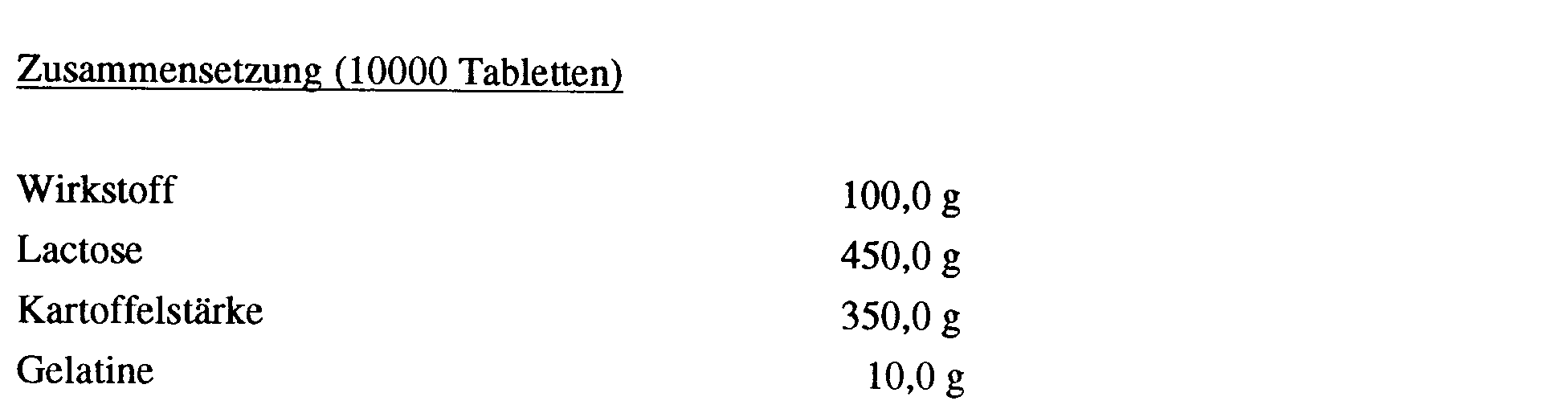

- Der Wirkstoff wird mit der Lactose und 292 g Kartoffelstärke vermischt, die Mischung mit einer ethanolischen Lösung der Gelatine befeuchtet und durch ein Sieb granuliert. Nach dem Trocknen mischt man den Rest der Kartoffelstärke, das Magnesiumstearat, das Talk und das Siliciumdioxid zu und presst das Gemisch zu Tabletten von je 100,0 mg Gewicht und 10,0 mg Wirkstoffgehalt, die gewünschtenfalls mit Teilkerben zur feineren Anpassung der Dosierung versehen sein können.
- Gelatinesteckkapseln, enthaltend 20 mg Wirkstoff, können z.B. folgendermassen hergestellt werden:
-
Wirkstoff 20,0 g Lactose 240,0 g mikrokristalline Zellulose 30,0 g Natriumlaurylsulfat 2,0 g Magnesiumstearat 8,0 g - Das Natriumlaurylsulfat wird durch ein Sieb mit einer Maschenweite von 0,2 mm zu dem lyophilisierten Wirkstoff hinzugesiebt. Beide Komponenten werden innig vermischt. Dann wird zunächst die Lactose durch ein Sieb mit einer Maschenweite von 0,6 mm und dann die mikrokristalline Zellulose durch ein Sieb mit einer Maschenweite von 0,9 mm hinzugesiebt. Daraufhin wird erneut 10 Minuten innig gemischt. Zuletzt wird das Magnesiumstearat durch ein Sieb mit einer Maschenweite von 0,8 mm hinzugesiebt. Nach 3- minütigem weiteren Mischen werden je 300 mg der erhaltenen Formulierung in Gelatinesteckkapseln der Grösse 0 abgefüllt.
- Gelatinesteckkapseln, enthaltend 100 mg Wirkstoff, können z.B. folgendermassen hergestellt werden:
-
Lactose 250,0 g mikrokristalline Zellulose 30,0 g Natriumlaurylsulfat 2,0 g Magnesiumstearat 8,0 g - Das Natriumlaurylsulfat wird durch ein Sieb mit einer Maschenweite von 0,2 mm zu dem lyophilisierten Wirkstoff hinzugesiebt. Beide Komponenten werden innig vermischt. Dann wird zunächst die Lactose durch ein Sieb mit einer Maschenweite von 0,6 mm und dann die mikrokristalline Zellulose durch ein Sieb mit einer Maschenweite von 0,9 mm hinzugesiebt. Daraufhin wird erneut 10 Minuten innig gemischt. Zuletzt wird das Magnesiumstearat durch ein Sieb mit einer Maschenweite von 0,8 mm hinzugesiebt. Nach 3- minütigem weiteren Mischen werden je 390 mg der erhaltenen Formulierung in Gelatinesteck-kapseln der Grösse 0 abgefüllt.
- Lacktabletten, enthaltend je 50 mg Wirkstoff, können wie folgt hergestellt werden:
-
Wirkstoff 50,0 g Lactose 100,0 g Maisstärke 70,0 g Talk 10,0 g Calciumstearat 2,0 g Hydroxypropylmethylcellulose 2,36 g Schellack 0,64 g Wasser q.s. Methylenchlorid q.s - Der Wirkstoff, die Lactose und 40 g der Maisstärke werden gemischt und mit einem Kleister, hergestellt aus 15 g Maisstärke und Wasser (unter Erwärmen), befeuchtet und granuliert. Das Granulat wird getrocknet, der Rest der Maisstärke, der Talk und das Calciumstearat zugegeben und mit dem Granulat vermischt. Das Gemisch wird zu Tabletten (Gewicht: 240 mg) verpresst und diese mit einer Lösung der Hydroxypropylmethylcellulose und des Schellacks in Methylenchlorid lackiert; Endgewicht der Lack-tablette: 283 mg.
- Eine 0,2%-ige Injektions- oder Infusionslösung eines Wirkstoffes kann beispielsweise folgendermassen hergestellt werden:
-
Wirkstoff 5,0 g Natriumchlorid 22,5 g Phosphatpuffer pH=7,4 300,0 g entmineralisiertes Wasser ad 2500,0 ml - Der Wirkstoff und das Natriumchlorid werden in 1000 ml Wasser gelöst und durch ein Mikrofilter filtriert. Man versetzt mit der Pufferlösung und füllt mit Wasser auf 2500 ml auf. Zur Herstellung von Dosiseinheitsformen werden je 1,0 oder 2,5 ml in Glasampullen abgefüllt, die dann je 2,0 bzw. 5,0 mg Wirkstoff enthalten.
- 1 %-ige Salbe (O/W-Emulsion), einen Wirkstoff enthaltend, mit folgender Zusammensetzung:
Wirskstoff 1,0 g Cetylalkohol 3,0 g Glycerin 6,0 g Methylparaben 0,18 g Propylparaben 0,05 g Arlacel 60 0,6 g Tween 60 4,4 g Stearinsäure 9,0 g Isopropylpalmitat 2,0 g Paraffinöl dickflüssig 10,0 g Wasser entmin. q.s. ad 100,0 g - 1%-iges Gel, einen Wirkstoff enthaltend, mit folgender Zusammensetzung:


Claims (38)
- Verbindungen der Formel I
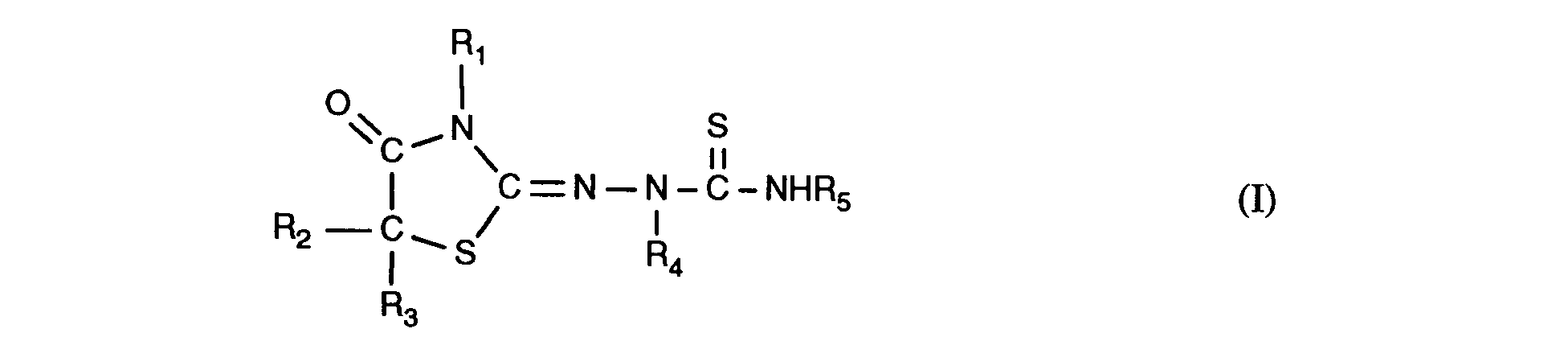
R₄ Wasserstoff, Niederalkyl, Niederalkoxy, Aryl oder Arylniederalkyl oder die Gruppe -C(=O)-R₆ bedeutet, in der R₆ für Niederalkyl, Aryl, Heteroaryl, Aryloxy,
Arylniederalkoxy oder Niederalk-2-en-lyloxy steht,
R₅ Aryl, Arylniederalkyl, ungesättigtes oder gesättigtes Heterocyclylniederalkyl, Niederalkoxycarbonylniederalkyl oder die Gruppe -C(=O)-R₇ bedeutet, in der R₇ für Niederalkyl, Aryl, Arylniederalkyl, Arylniederalkenyl, Heteroaryl, Aryloxy, Arylniederalkoxy oder Niederalk-2-en-1-yloxy steht oder R₅ auch Niederalkyl, Niederalk-2-en-1-yl oder Niederalk-2-in-1-yl bedeutet, wenn R₄ verschieden von Wasserstoff ist, und ihre Salze. - Verbindungen gemäss Anspruch 1 der Formel I, worin R₁ C₁-C₄-Alkyl, C₃-C₅-Alk-2-en-1-yl oder C₃-C₅-Alk-2-in-1-yl bedeutet,
R₂ und R₃ unabhängig voneinander Wasserstoff, gleiche C₁-C₄-Alkyl oder Phenylniederalkyl oder die Gruppe -C(=O)-R₆ bedeutet in der R₆ für C₁-C₄-Akyl, Phenyl, Phenylniederalkyl Naphthyl, Pyridyl, Thienyl, Pyrryl, Furyl, Phenyloxy, Phenyl-C₁-C₄-alkoxy oder C₃-C₅-Alk-2-en-1-yloxy steht,
R₅ Phenyl, Naphthyl, Phenylniederalkyl, Pyridyl-, Thienyl-, Pyrryl- oder Furyl-, Pyrrolidinyl-, Tetrahydrofuranyl- oder Tetrahydropyranylniederalkyl oder C₁-C₄-Alkoxy-carbonyl-C₁-C₄-alkyl oder die Gruppe -C(=O)-R₇ bedeutet, in der R₇ die für R₄ angegebenen Bedeutungen von R₆ hat oder auch Phenylniederalkyl oder Phenylniederalkenyl bedeutet oder R₅ auch C₁-C₄-Alkyl, C₃-C₅-Alk-2-en-1yl oder C₃-C₅-Alk-2-in-1yl bedeutet, wenn R₄ verschieden von Wasserstoff ist, und ihre pharmazeutisch verwendbaren Salze. - Verbindungen gemäss Anspruch 1 der Formel I, worin R₁ C₃-C₅-Alk-2-en-1-yl, wie Allyl oder Methallyl oder C₃-C₅-Alk-2-in-1-yl, wie Prop-2-in-1-yl bedeutet.
R₂ und R₃ beide Wasserstoff oder gleiche C₁-C₄-Alkyl, wie Methylgruppen bedeuten, R₄ Wasserstoff, C₁-C₄-Alkyl, wie Methyl oder Ethyl, C₁-C₂-Alkoxy, wie Methoxy oder Ethoxy, Phenyl, Phenylniederalkyl, wie z.B. Benzyl oder Phenylethyl oder die Gruppe -C(=O)-R₆ bedeutet, in der R₆ für C₁-C₄-Alkylgruppen, wie z.B. die Methylgruppe, Phenyl, Pyridyl, Thienyl, Phenyloxy, Benzyloxy C₃-C₅-Alk-2-en-1-yloxy, wie Allyl- oder Methallyloxy steht und R₅ Phenyl, Phenylniederalkyl, wie z.B. Benzyl oder Phenylethyl, Pyridyl-, Thienyl-, Pyrryl-, Furyl- Pyrrolidinyl-, Tetrahydrofuranyl- oder Tetrahydropyranylniederalkyl, wie z.B. Pyridyl-, Thienyl-, Pyrryl- oder Furyl-, Pyrrolidinyl-, Tetrahydrofuranyl- oder Tetrahydropyranylmethyl, C₁-C₄-Alkoxycarbonyl-C₁-C₄-alkyl, wie z.B. Methoxy- oder ethoxycarbonylmethyl- oder -ethyl oder die Gruppe -C(=O)-R₇ bedeutet, in der R₇ die für R₄ angegebenen Bedeutungen von R₆ hat oder auch Benzyl oder Phenylallyl bedeutet oder R₅ auch C₁-C₄-Alkyl, wie z.B. Methyl, C₃-C₅-Alkyl-2-en-1-yl, wie z,B. Allyl oder Methallyl, C₃-C₅-Alk-2-in-1-yl, wie z.B. Pro-2-in-lyl bedeutet, wenn R₄ verschieden von Wasserstoff ist und ihre pharmazeutisch verwendbare Salze. - Verbindungen gemäss Anspruch 1 der Formel I, worin R₁ Allyl oder Methallyl, R₂ und R₃ beide Wasserstoff und R₄ Wasserstoff, Methyl oder Methoxy oder die Gruppe -C(=O)-R₆ bedeuten, in der R₆ für Methyl, Phenyl, Phenyloxy, Benzyloxy oder Allyloxy steht und R₅ Phenyl, Benzyl, Pyridyl-, Furyl- oder Tetrahydropyranylmethyl oder Methoxycarbonylmethyl oder die Gruppe -C(=O)-R₇ bedeutet, in der R₇ die für R₄ angegebenen Bedeutungen von R₆ hat oder auch Benzyl oder Phenylallyl bedeutet, oder R₅ auch Methyl, Allyl, Methallyl, Prop-2-in-1yl bedeutet, wenn R₄ verschieden von Wasserstoff ist, und ihre pharmazeutisch verwendbare Salze.
- 1-(3-Allyl-4-oxo-thiazolidin-2-yliden)-4-phenyl-thiosemicarbazon oder ein pharmazeutisch verwendbares Salz davon.
- 1-(3-Allyl-4-oxo-thiazolidin-2-yliden)-4-p-bromphenyl-thiosemicarbazon oder ein pharmazeutisch verwendbares Salz davon.
- 1-(3-Allyl-4-oxo-thiazolidin-2-yliden)-4-p-fluorphenyl-thiosemicarbazon oder ein pharmazeutisch verwendbares Salz davon.
- 1-(3-Allyl-4-oxo-thiazolidin-2-yliden)-4-pentafluorophenyl-thiosemicarbazon oder ein pharmazeutisch verwendbares Salz davon.
- 1-(3-Allyl-4-oxo-thiazolidin-2-yliden)-4-tolyl-thiosemicarbazon oder ein pharmazeutisch verwendbares Salz davon.
- 1-(3-Allyl-4-oxo-thiazolidin-2-yliden)-4-p-cyanophenyl-thiosemicarbazon oder ein pharmazeutisch verwendbares Salz davon.
- 1-(3-Allyl-4-oxo-thiazolidin-2-yliden)-4-benzyl-thiosemicarbazon oder ein pharmazeutisch verwendbares Salz davon.
- 1-(3-Allyl-4-oxo-thiazolidin-2-yliden)-4-(thiophen-2-methyl)-thiosemicarbazon oder ein pharmazeutisch verwendbares Salz davon.
- 1-(3-Allyl-4-oxo-thiazolidin-2-yliden)-4-(furan-2-methyl)-thiosemicarbazon oder ein pharmazeutisch verwendbares Salz davon.
- 1-(3-Allyl-4-oxo-thiazolidin-2-yliden)-4-(tetrahydrofuran-2-methyl)-thiosemicarbazon oder ein pharmazeutisch verwendbares Salz davon.
- 1-(3-Allyl-4-oxo-thiazolidin-2-yliden)-4-(2-picolyl)-thiosemicarbazon oder ein pharmazeutisch verwendbares Salz davon.
- 1-(3-Allyl-4-oxo-thiazolidin-2-yliden)-4-phenylethyl-thiosemicarbazon oder ein pharmazeutisch verwendbares Salz davon.
- 1-(3-Allyl-4-oxo-thiazolidin-2-yliden)-4-glycinylethylester-thiosemicarbazon oder ein pharmazeutisch verwendbares Salz davon.
- 1-(5,5-Dimethyl-3-methallyl-4-oxo-thiazolidin-2-yliden)-4-glycinylethylester-thiosemicarbazon oder ein pharmazeutisch verwendbares Salz davon.
- 1-(3-Allyl-4-oxo-thiazolidin-2-yliden)-4-(2,2-dimethoxyethyl)-thiosemicarbazon oder ein pharmazeutisch verwendbares Salz davon.
- 1-(3-Allyl-4-oxo-thiazolidin-2-yliden)-2,4-dimethyl-thiosemicarbazon oder ein pharmazeutisch verwendbares Salz davon.
- 1-(3-Ally-4-oxo-thiazolidin-2-yliden)-4-hydroxymethyphenyl-thiosemicarbazon oder ein pharmazeutisch verwendbares Salz davon.
- 1-(3-Allyl-4-oxothiazolidin-2-yliden)-4-(3,4-methylendioxyphen-1-yl-thiosemicarbazon oder ein pharmazeutisch verwendbares Salz davon.
- 1-(3-Allyl-4-oxo-thiazolidin-2-yliden)-4-(propionsäureethylester-2-yl)-thiosemicarbazon oder ein pharmazeutisch verwendbares Salz davon.
- 1-(3-Allyl-4-oxo-thiazolidin-2-yliden)-4-(2-methyl-propionyl)-thiosemicarbazon oder ein pharmazeutisch verwendbares Salz davon.
- 1-(5,5-Dimethyl-3-methallyl-4-oxo-thiazolidin-2-yliden)-4-benzoyl-thiosemicarbazon oder ein pharmazeutisch verwendbares Salz davon.
- 1-(3-Allyl-4-oxo-thiazolidin-2-yliden)-4-(thiophen-2-carbonyl)-thiosemicarbazon oder ein pharmazeutisch verwendbares Salz davon.
- 1-(3-Allyl-4-oxo-thiazolidin-2-yliden)-4-phenylacetyl-thiosemicarbazon oder ein pharmazeutisch verwendbares Salz davon.
- 1-(3-Allyl-4-oxo-thiazolidin-3-yliden)-4-phenoxycarbonyl-thiosemicarbazon oder ein pharmazeutisch verwendbares Salz davon.
- 1-(3-Allyl-4-oxo-thiazolidin-2-yliden)-4-benzyloxycarbonyl-thiosemicarbazon oder ein pharmazeutisch verwendbares Salz davon.
- 1-(3-Allyl-4-oxo-thiazolidin-2-yliden)-2-acetyl-4-methyl-thiosemicarbazon oder ein pharmazeutisch verwendbares Salz davon.
- 1-(3-Allyl-4-oxo-thiazolidin-2-yliden)-4-p-hydroxyphenyl-thiosemicarbazon oder ein pharmazeutisch verwendbares Salz davon.
- 1-(3-Allyl-4-oxo-thiazolidin-2-yliden)-2-benzoyl-4-methyl-thiosemicarbazon oder ein pharmazeutisch verwendbares Salz davon.
- 1-(3-Allyl-4-oxo-thiazolidin-2-yliden)-4-allyloxycarbonyl-thiosemicarbazon oder ein pharmazeutisch verwendbares Salz davon.
- 1-(3-Allyl-4-oxo-thiazolidin-2-yliden)-4-cinnamoyl-thiosemicarbazon oder ein pharmazeutisch verwendbares Salz davon.
- Verbindungen gemäss einem der Ansprüche 1 bis 34 zur Anwendung in einem Verfahren zur therapeutischen Behandlung des menschlichen oder tierischen Körpers.
- Pharmazeutische Präparate, neben üblichen pharmazeutischen Hilfsstoffen als pharmazeutischen Wirkstoff enthaltend eine Verbindung gemäss einem der Ansprüche 1 bis 34 in freier Form oder in pharmazeutisch verwendbarer Salzform.
- Verfahren zur Herstellung neuer Verbindungen der Formel I gemäss Anspruch 1, dadurch gekennzeichnet, dass mana) eine Verbindung der Formel II

R₅-NCS (III)
umsetzt, oderb) dass man eine Verbindung der Formel II mit einer Verbindung der Formel V c) dass man eine Verbindung der Formel VI

R₅-NH₂ (IV)
in der R₅ die oben angegebenen Bedeutungen hat, umsetzt, oderd) dass man eine Verbindung der Formel
X-CH₂COOH (VIII)
umsetzt, und gewünschtenfalls, wenn man Verbindungen der Formel I, in der R₄ die Gruppe


- Das Verfahren der Beispiele, verfahrensgemäss verwendete neue Ausgangsstoffe, verfahrensgemäss gebildete neue Zwischenprodukte und verfahrensgemäss erhältliche neue Endstoffe.
Applications Claiming Priority (6)
| Application Number | Priority Date | Filing Date | Title |
|---|---|---|---|
| CH177892 | 1992-06-03 | ||
| CH1779/92 | 1992-06-03 | ||
| CH177992 | 1992-06-03 | ||
| CH1778/92 | 1992-06-03 | ||
| CH311492 | 1992-10-06 | ||
| CH3114/92 | 1992-10-06 |
Publications (1)
| Publication Number | Publication Date |
|---|---|
| EP0573392A1 true EP0573392A1 (de) | 1993-12-08 |
Family
ID=27173241
Family Applications (1)
| Application Number | Title | Priority Date | Filing Date |
|---|---|---|---|
| EP93810382A Withdrawn EP0573392A1 (de) | 1992-06-03 | 1993-05-25 | Thiosemicarbazonderivate und ihre Anwendung als Arzneimittelwirkstoff |
Country Status (11)
| Country | Link |
|---|---|
| US (1) | US5344842A (de) |
| EP (1) | EP0573392A1 (de) |
| JP (1) | JPH06172333A (de) |
| KR (1) | KR940005600A (de) |
| AU (1) | AU665073B2 (de) |
| CA (1) | CA2097485A1 (de) |
| FI (1) | FI932511A7 (de) |
| HU (1) | HUT67605A (de) |
| IL (1) | IL105887A (de) |
| NO (1) | NO932003L (de) |
| NZ (1) | NZ247749A (de) |
Cited By (2)
| Publication number | Priority date | Publication date | Assignee | Title |
|---|---|---|---|---|
| WO1995014685A1 (en) * | 1993-11-25 | 1995-06-01 | Ciba-Geigy Ag | Novel substituted thiosemicarbazone derivatives |
| CN102453028A (zh) * | 2010-10-22 | 2012-05-16 | 沈阳药科大学 | 抗真菌剂—2-[(2,3-二氢-4H-苯并[b]噻喃-4-亚基)亚肼基]-4-氧代四氢噻(噁)唑-5-乙酸衍生物 |
Families Citing this family (6)
| Publication number | Priority date | Publication date | Assignee | Title |
|---|---|---|---|---|
| AU664084B2 (en) * | 1992-06-03 | 1995-11-02 | Ciba-Geigy Ag | Novel thiosemicarbazonic acid esters |
| US6747061B2 (en) | 2000-03-21 | 2004-06-08 | Atherogenics, Inc. | N-substituted dithiocarbamates for the treatment of biological disorders |
| KR20030030636A (ko) * | 2001-10-12 | 2003-04-18 | 주식회사 싸이제닉 | 버섯 자실체의 발효를 이용하여 고활성 항암 단백다당체를제조하는 방법 |
| CN1738797A (zh) | 2002-11-19 | 2006-02-22 | 阿基里昂药品公司 | 取代的芳基硫脲和相关的化合物,病毒复制的抑制剂 |
| KR100468649B1 (ko) * | 2003-01-29 | 2005-01-27 | 학교법인 영광학원 | 항보체 활성을 갖는 운지버섯 자실체 유래의 다당체 및 그분리방법 |
| TW200600492A (en) * | 2004-05-18 | 2006-01-01 | Achillion Pharmaceuticals Inc | Substituted aryl acylthioureas and related compounds; inhibitors of viral replication |
Citations (3)
| Publication number | Priority date | Publication date | Assignee | Title |
|---|---|---|---|---|
| DE2035419A1 (de) * | 1969-07-17 | 1971-01-28 | J R Geigy AG, Basel (Schweiz) | Neue Arzneimittel mit antineoplasüscher Wirksamkeit |
| GB1325061A (en) * | 1970-07-03 | 1973-08-01 | Ciba Geigy Ag | Process for the production of azines |
| EP0508955A1 (de) * | 1991-04-12 | 1992-10-14 | Ciba-Geigy Ag | Verwendung von 2-Iminothiazolidin-4-onderivaten als neuartige Arzneimittelwirkstoffe |
Family Cites Families (5)
| Publication number | Priority date | Publication date | Assignee | Title |
|---|---|---|---|---|
| US3699116A (en) * | 1965-10-29 | 1972-10-17 | Ciba Geigy Corp | 2,2'-azines of 2,4-thiazolidinediones |
| US3674780A (en) * | 1970-01-19 | 1972-07-04 | American Cyanamid Co | Novel 2,5-disubstituted thiazole carboxaldehyde and derivatives of the same |
| AR204619A1 (es) * | 1973-02-13 | 1976-02-20 | Ciba Geigy Ag | Procedimiento para la elaboracion de un nuevo derivado de 2,2-azina-2,4-tiazolidindiona |
| EP0085275B1 (de) * | 1982-01-22 | 1986-02-19 | Ciba-Geigy Ag | Substituierte Thiazolidinylester von Mineralsäuren |
| AU664084B2 (en) * | 1992-06-03 | 1995-11-02 | Ciba-Geigy Ag | Novel thiosemicarbazonic acid esters |
-
1993
- 1993-05-13 AU AU38567/93A patent/AU665073B2/en not_active Ceased
- 1993-05-24 US US08/066,815 patent/US5344842A/en not_active Expired - Fee Related
- 1993-05-25 EP EP93810382A patent/EP0573392A1/de not_active Withdrawn
- 1993-06-01 NZ NZ247749A patent/NZ247749A/en unknown
- 1993-06-01 KR KR1019930009770A patent/KR940005600A/ko not_active Withdrawn
- 1993-06-01 CA CA002097485A patent/CA2097485A1/en not_active Abandoned
- 1993-06-02 JP JP5132089A patent/JPH06172333A/ja active Pending
- 1993-06-02 FI FI932511A patent/FI932511A7/fi not_active Application Discontinuation
- 1993-06-02 HU HU9301616A patent/HUT67605A/hu unknown
- 1993-06-02 NO NO932003A patent/NO932003L/no unknown
- 1993-06-02 IL IL10588793A patent/IL105887A/xx not_active IP Right Cessation
Patent Citations (3)
| Publication number | Priority date | Publication date | Assignee | Title |
|---|---|---|---|---|
| DE2035419A1 (de) * | 1969-07-17 | 1971-01-28 | J R Geigy AG, Basel (Schweiz) | Neue Arzneimittel mit antineoplasüscher Wirksamkeit |
| GB1325061A (en) * | 1970-07-03 | 1973-08-01 | Ciba Geigy Ag | Process for the production of azines |
| EP0508955A1 (de) * | 1991-04-12 | 1992-10-14 | Ciba-Geigy Ag | Verwendung von 2-Iminothiazolidin-4-onderivaten als neuartige Arzneimittelwirkstoffe |
Non-Patent Citations (1)
| Title |
|---|
| CHEMICAL ABSTRACTS, vol. 61, no. 10, 9. November 1964, Columbus, Ohio, US; abstract no. 12008a, Seite 12007 ; * |
Cited By (4)
| Publication number | Priority date | Publication date | Assignee | Title |
|---|---|---|---|---|
| WO1995014685A1 (en) * | 1993-11-25 | 1995-06-01 | Ciba-Geigy Ag | Novel substituted thiosemicarbazone derivatives |
| US5641776A (en) * | 1993-11-25 | 1997-06-24 | Ciba-Geigy Corporation | Substituted thiosemicarbazone derivatives |
| CN102453028A (zh) * | 2010-10-22 | 2012-05-16 | 沈阳药科大学 | 抗真菌剂—2-[(2,3-二氢-4H-苯并[b]噻喃-4-亚基)亚肼基]-4-氧代四氢噻(噁)唑-5-乙酸衍生物 |
| CN102453028B (zh) * | 2010-10-22 | 2014-07-30 | 沈阳药科大学 | 抗真菌剂—2-[(2,3-二氢-4H-苯并[b]噻喃-4-亚基)亚肼基]-4-氧代四氢噻(噁)唑-5-乙酸衍生物 |
Also Published As
| Publication number | Publication date |
|---|---|
| FI932511A0 (fi) | 1993-06-02 |
| AU665073B2 (en) | 1995-12-14 |
| IL105887A0 (en) | 1993-10-20 |
| HUT67605A (en) | 1995-04-28 |
| CA2097485A1 (en) | 1993-12-04 |
| KR940005600A (ko) | 1994-03-21 |
| JPH06172333A (ja) | 1994-06-21 |
| HU9301616D0 (en) | 1993-09-28 |
| IL105887A (en) | 1997-01-10 |
| NO932003L (no) | 1993-12-06 |
| NO932003D0 (no) | 1993-06-02 |
| NZ247749A (en) | 1995-08-28 |
| US5344842A (en) | 1994-09-06 |
| FI932511A7 (fi) | 1993-12-04 |
| AU3856793A (en) | 1993-12-09 |
Similar Documents
| Publication | Publication Date | Title |
|---|---|---|
| DE60117605T2 (de) | Thiazolyl-inhibitoren von tyrosinkinasen der tec-familie | |
| EP1119557B1 (de) | Indeno-, naphtho- und benzocyclohepta-dihydrothiazol derivate, deren herstellung und deren verwendung als anorektische arzneimittel | |
| DE69004164T2 (de) | Diphenylharnstoffderivate. | |
| DE3878708T2 (de) | Thiazolderivate mit aktivitaet auf das cholinergische system, verfahren zu deren herstellung und diese enthaltende pharmazeutische zusammenstellungen. | |
| EP1261593B1 (de) | 8,8a-dihydro-indeno 1,2-d]thiazol-derivate, die in 2-stellung einen substituenten mit einer sulfonamidstruktur oder sulfonstruktur tragen; verfahren zu ihrer herstellung und ihre verwendung als arzneimittel | |
| DE2652201A1 (de) | Benzisothiazolone, verfahren zu ihrer herstellung und diese verbindungen enthaltende arzneipraeparate | |
| DE3315106A1 (de) | Benzoazacycloalkyl-spiro-imidazolidine, verfahren zu ihrer herstellung und sie enthaltende pharmazeutische zubereitungen | |
| EP0409048B1 (de) | Aminoalkylsubstituierte 2-Aminothiazole und diese enthaltende therapeutische Mittel | |
| US5344842A (en) | Thiosemicarbazone derivatives | |
| DE69813539T2 (de) | Neue amid-derivate und medizinische zusammensetzungen die diese enthalten | |
| DE69629931T2 (de) | 1-(hetero)aryl-4-(kondensiertes thiazol-2-ylalkyl)-piperazin derivate, deren herstellung und deren verwendung in der behandlung von 5-ht1a-rezeptor vermittelten krankheiten | |
| DE2800062A1 (de) | Benzokondensierte heterocyclische fuenfring, ihre herstellung und verwendung | |
| DE102005024012A1 (de) | Verwendung von 2,5-disubstituierten Thiazol-4-on-Derivaten in Arzneimitteln | |
| EP0573391A1 (de) | Thiosemicarbazonsäureester und ihre Anwendung als Arzneimittelwirkstoff | |
| EP0548017A1 (de) | Neue Thiazole | |
| DE69107874T2 (de) | Imidazolderivate und diese Imidazolderivate als Wirkstoffe enthaltende Antiepileptika. | |
| US5641776A (en) | Substituted thiosemicarbazone derivatives | |
| DE102005020104A1 (de) | Neue Thiazolidinone ohne basischen Stickstoff, deren Herstellung und Verwendung als Arzneimittel | |
| EP0548018A1 (de) | Neue Imidazole | |
| US5627180A (en) | Substituted thiosemicarbazonethiones | |
| DE3531504A1 (de) | 3-aminomethylpyrrol-1-yl-alkylamine und diese verbindungen enthaltende therapeutische mittel | |
| AU672047B2 (en) | Novel thiosemicarbazonethiones | |
| US5633253A (en) | Substituted thiosemicarbazonic acid esters | |
| DE102005020105A1 (de) | Neue Thiazolidinone ohne basischen Stickstoff, deren Herstellung und Verwendung als Arzneimittel | |
| DE2621828A1 (de) | Pyridochinoline, verfahren zu ihrer herstellung und diese verbindungen enthaltende arzneimittel |
Legal Events
| Date | Code | Title | Description |
|---|---|---|---|
| PUAI | Public reference made under article 153(3) epc to a published international application that has entered the european phase |
Free format text: ORIGINAL CODE: 0009012 |
|
| AK | Designated contracting states |
Kind code of ref document: A1 Designated state(s): AT BE CH DE DK ES FR GB GR IE IT LI LU NL PT SE |
|
| 17P | Request for examination filed |
Effective date: 19940425 |
|
| 17Q | First examination report despatched |
Effective date: 19961230 |
|
| RAP1 | Party data changed (applicant data changed or rights of an application transferred) |
Owner name: NOVARTIS AG |
|
| STAA | Information on the status of an ep patent application or granted ep patent |
Free format text: STATUS: THE APPLICATION IS DEEMED TO BE WITHDRAWN |
|
| 18D | Application deemed to be withdrawn |
Effective date: 19970510 |