EP0573679A1 - Schwellbestimmungsverfahren - Google Patents
Schwellbestimmungsverfahren Download PDFInfo
- Publication number
- EP0573679A1 EP0573679A1 EP19920109217 EP92109217A EP0573679A1 EP 0573679 A1 EP0573679 A1 EP 0573679A1 EP 19920109217 EP19920109217 EP 19920109217 EP 92109217 A EP92109217 A EP 92109217A EP 0573679 A1 EP0573679 A1 EP 0573679A1
- Authority
- EP
- European Patent Office
- Prior art keywords
- density
- background
- threshold
- area
- distribution
- Prior art date
- Legal status (The legal status is an assumption and is not a legal conclusion. Google has not performed a legal analysis and makes no representation as to the accuracy of the status listed.)
- Withdrawn
Links
Images
Classifications
-
- H—ELECTRICITY
- H04—ELECTRIC COMMUNICATION TECHNIQUE
- H04N—PICTORIAL COMMUNICATION, e.g. TELEVISION
- H04N1/00—Scanning, transmission or reproduction of documents or the like, e.g. facsimile transmission; Details thereof
- H04N1/40—Picture signal circuits
- H04N1/407—Control or modification of tonal gradation or of extreme levels, e.g. background level
- H04N1/4072—Control or modification of tonal gradation or of extreme levels, e.g. background level dependent on the contents of the original
- H04N1/4074—Control or modification of tonal gradation or of extreme levels, e.g. background level dependent on the contents of the original using histograms
-
- G—PHYSICS
- G06—COMPUTING OR CALCULATING; COUNTING
- G06T—IMAGE DATA PROCESSING OR GENERATION, IN GENERAL
- G06T7/00—Image analysis
- G06T7/10—Segmentation; Edge detection
- G06T7/11—Region-based segmentation
-
- G—PHYSICS
- G06—COMPUTING OR CALCULATING; COUNTING
- G06T—IMAGE DATA PROCESSING OR GENERATION, IN GENERAL
- G06T7/00—Image analysis
- G06T7/10—Segmentation; Edge detection
- G06T7/136—Segmentation; Edge detection involving thresholding
-
- H—ELECTRICITY
- H04—ELECTRIC COMMUNICATION TECHNIQUE
- H04N—PICTORIAL COMMUNICATION, e.g. TELEVISION
- H04N1/00—Scanning, transmission or reproduction of documents or the like, e.g. facsimile transmission; Details thereof
- H04N1/40—Picture signal circuits
- H04N1/403—Discrimination between the two tones in the picture signal of a two-tone original
Definitions
- the present invention relates to a threshold determination method for binarizing, in order for a copy machine to recognize and construct an image, for example.
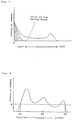
- FIG. 4 A conventional method for controlling density for a copy machine is shown in Fig. 4: i) determining a predetermine density D0, ii) extracting a density with pixels equal to or more than a predetermined number of pixels "N" in the density ranges darker than the predetermined density in i) and lighter than it, iii) calculating the minimal value D1 and the maximal value D2, iv) determining a copy density "A" of the copy machine by correcting the predetermined density D0 according to D1 and D2 in iii).
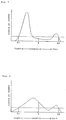
- the characteristic of a histogram may be different from each original sheet to be copied as shown in Figs. 5 and 6.
- the histogram in Fig. 5 is an example easy to part the area of background and information such as a character.
- density "A" determined according to density D0, D1 and D2 is threshold, the background is reduced completely and the image is binarized clearly.
- each area of information and background has an independent peak on the histogram.
- the information area has darker density than the background area.
- Fig. 6 shows the histogram of an image whose background histogram distributes because of its colors and patterns.
- pixels in the background remain as noise. This is an example produced a poorer image than the original sheet to be copied by binarization.
- the present invention is invented to solve such a conventional problem and has an object to provide a threshold deciding method possible to binarize clearly corresponding to the density distribution of an image.
- the threshold deciding method according to the present invention has the characteristics that the upper limit of the density range of the background is determined as the threshold by regarding the density distribution of the background to be the normal distribution and calculating the density range of the background after settling maximal number of pixels of density histogram to be the configuration density (not background density). As the information area is parted clearly by binarizing with the threshold determined in this way, the poor image caused by a copy machine can be prevented.
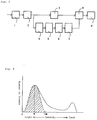
- Fig. 1 shows a block diagram of a copy machine according to the present invention.
- Fig. 2 shows an embodiment in which the dynamic range is enough to indicate all of the density of the background.
- Fig. 3 shows an embodiment in which a part of the density of the background is lost because of the insufficiency of dynamic range.
- Fig. 4 shows a histogram for explaining the conventional method to control density.
- Fig. 5 shows a histogram of a sheet to be copied whose information area and background area can be easily divided.
- Fig. 6 shows a histogram of a sheet to be copied whose distribution of the background spreads because of the colors of the background and so forth.
- Figs. 2 and 3 show the examples of density histogram of a copy machine. Especially, Fig. 2 shows the case with enough dynamic range and Fig. 3 shows the case in which a part of the density of the background density is lost because of, for example, insufficiency of dynamic range.
- both of the background part and information part have peaks with nearly the same normalized distribution.
- the peak of the background part is larger than that of the information part.
- the part with lighter density more correctly reflects the density distribution of only background than the density "m" of the peak of the background.
- the maximum value is to be the threshold.
- the area to be regarded as the background is generally evaluated by the standard deviation ⁇ .
- the area +-1 ⁇ , +-2 ⁇ and +-3 ⁇ (They are called 1 ⁇ grade, 2 ⁇ grade and 3 ⁇ grade.) occupy 68.3%, 95.5% and 97.7%, respectively, of the whole of normalized distribution.
- the area to be regarded as the background is determined.
- the broken line shows the curve approximate to the quadratic curve.
- Fig. 1 shows the block diagram of the system of a copy machine using the present invention.
- Circuit 4 calculates the brightness of each pixel of the image inputted to be copied, and calculates how many pixels with the same brightness exist in the image. This circuit can calculates the histogram of the image.
- the histogram has two peaks; in the information area and the background area. As the density of the background area is lighter than that of the information area, the calculation is performed regarding the peak in the minimal density area to be the maximal value of the background. Such a calculation is performed in circuit 5.
- Circuit 6 calculates the standard deviation of the normal distribution assuming the normal distribution from the calculated maximal value.
- the standard deviation is calculated by i) calculating the mean number of the pixels of each density in the normal distribution, ii) calculating the total of squared difference between the number of pixels of each density and the mean number of pixels, iii) dividing the total value in ii) by the number of pixels in the normal distribution, and iv) calculating the square root of the value calculated in iii).
- the distribution of the pixels in the background can be clear by the standard deviation.
- Threshold circuit 7 calculates the threshold for binarization, which outputs the determined threshold. The threshold is determined according to 1 ⁇ grade, 2 ⁇ grade or 3 ⁇ grade from the calculated standard deviation, considering the error within the background density.
- “1” shows the reading means for a sheet to be copied: such as CCD camera can be used, for example.
- “2” shows an A/D converter to convert an analogue signal inputted from camera and so forth.
- "3” shows a memory to memorize the gray-level of the original image before processing.
- "8” shows a binary circuit to convert the area with lighter density than the threshold outputted from "7” into white color. Regarding the area converted into white color as the background area, the next processing is performed. The processing in “3” and that in "4" to "7” are performed in parallel.
- Binary circuit 8 begins binarization of the image in memory 3 just after the threshold is outputted from threshold circuit 7.
- "9” is a circuit to memorize the binarized image converted in "8".
- the maximum calculation circuit 5 outputs the signal for indicating error in the indication means which is not shown in Fig. 1.
- the present invention makes it possible to prevent the poor image with respect to a copy machine, for example, because the information area is divided properly.
Landscapes
- Engineering & Computer Science (AREA)
- Computer Vision & Pattern Recognition (AREA)
- Physics & Mathematics (AREA)
- General Physics & Mathematics (AREA)
- Theoretical Computer Science (AREA)
- Multimedia (AREA)
- Signal Processing (AREA)
- Facsimile Image Signal Circuits (AREA)
Priority Applications (1)
| Application Number | Priority Date | Filing Date | Title |
|---|---|---|---|
| EP19920109217 EP0573679A1 (de) | 1992-06-01 | 1992-06-01 | Schwellbestimmungsverfahren |
Applications Claiming Priority (1)
| Application Number | Priority Date | Filing Date | Title |
|---|---|---|---|
| EP19920109217 EP0573679A1 (de) | 1992-06-01 | 1992-06-01 | Schwellbestimmungsverfahren |
Publications (1)
| Publication Number | Publication Date |
|---|---|
| EP0573679A1 true EP0573679A1 (de) | 1993-12-15 |
Family
ID=8209669
Family Applications (1)
| Application Number | Title | Priority Date | Filing Date |
|---|---|---|---|
| EP19920109217 Withdrawn EP0573679A1 (de) | 1992-06-01 | 1992-06-01 | Schwellbestimmungsverfahren |
Country Status (1)
| Country | Link |
|---|---|
| EP (1) | EP0573679A1 (de) |
Cited By (1)
| Publication number | Priority date | Publication date | Assignee | Title |
|---|---|---|---|---|
| EP0863486A3 (de) * | 1997-03-06 | 1999-07-14 | Xerox Corporation | Verfahren und Vorrichtung zur automatischen Kantenerkennung eines Dokumentes unter Verwendung eines Scanners |
Citations (1)
| Publication number | Priority date | Publication date | Assignee | Title |
|---|---|---|---|---|
| EP0187911A2 (de) * | 1985-01-15 | 1986-07-23 | International Business Machines Corporation | Verfahren und Vorrichtung zum Setzen eines Schwellwertes an Bilddaten |
-
1992
- 1992-06-01 EP EP19920109217 patent/EP0573679A1/de not_active Withdrawn
Patent Citations (1)
| Publication number | Priority date | Publication date | Assignee | Title |
|---|---|---|---|---|
| EP0187911A2 (de) * | 1985-01-15 | 1986-07-23 | International Business Machines Corporation | Verfahren und Vorrichtung zum Setzen eines Schwellwertes an Bilddaten |
Non-Patent Citations (2)
| Title |
|---|
| PATENT ABSTRACTS OF JAPAN vol. 12, no. 295 (P-743)(3142) 11 August 1988 & JP-A-63 067 684 ( HITACHI LTD. ) 26 March 1988 * |
| PATENT ABSTRACTS OF JAPAN vol. 13, no. 309 (P-898)(3657) 14 July 1989 & JP-A-10 82 270 ( OMRON TATEISI ELECTRONICS CO. ) 23 March 1989 * |
Cited By (1)
| Publication number | Priority date | Publication date | Assignee | Title |
|---|---|---|---|---|
| EP0863486A3 (de) * | 1997-03-06 | 1999-07-14 | Xerox Corporation | Verfahren und Vorrichtung zur automatischen Kantenerkennung eines Dokumentes unter Verwendung eines Scanners |
Similar Documents
| Publication | Publication Date | Title |
|---|---|---|
| EP0494026B1 (de) | Methode zur automatischen Unterscheidung zwischen graphischer Information und Textinformation von Bilddaten | |
| KR960008379B1 (ko) | 다수의 휘도준위를 갖는 화상의 이진화 처리방법 | |
| US5280367A (en) | Automatic separation of text from background in scanned images of complex documents | |
| US5133022A (en) | Normalizing correlator for video processing | |
| EP0803842A2 (de) | Binärbilderzeugungsgerät | |
| EP0287995B1 (de) | Verfahren und Gerät zur Erkennung von Halbtonbildmustern | |
| US6364209B1 (en) | Data reading apparatus | |
| EP0187911B1 (de) | Verfahren und Vorrichtung zum Setzen eines Schwellwertes an Bilddaten | |
| EP0422544A2 (de) | Farbbilddatenverarbeitungsvorrichtung | |
| NL8105256A (nl) | Inrichting voor het dynamisch instellen van een discriminatiedrempel zwart/wit bij het bewerken van beelden met grijsheidswaarden. | |
| JPH05236260A (ja) | 画像処理装置 | |
| EP0238027A2 (de) | Vorrichtung für optische Zeichenerkennung | |
| EP0236594B1 (de) | Verfahren und Vorrichtung zur Erkennung von Halbtonbildinformation | |
| EP0685959B1 (de) | Bildverarbeitungsvorrichtung zum Identifizieren von Zeichen-, Foto- und Rasterbildbereichen einer Vorlage | |
| EP0501450A2 (de) | Vorrichtung zur Unterscheidung zwischen unterschiedlichen Teilen eines Bildes | |
| US6259813B1 (en) | Method and apparatus for image processing using a signal of multiple scale values | |
| US5371610A (en) | Image data processing apparatus | |
| JPH0129113B2 (de) | ||
| US6014465A (en) | Method for transforming a gray-level image into a black-and-white image | |
| JPH05183749A (ja) | 閾値決定方法 | |
| US6798544B1 (en) | Image reading method, image reading device and image processing device | |
| EP0063243B1 (de) | Optischer Zeichen- und Balkencodeleser mit optimisiertem Abtaster | |
| JPH08123901A (ja) | 文字抽出装置及び該装置を用いた文字認識装置 | |
| EP0160364A2 (de) | System das Bildsignale binär macht | |
| JP3966448B2 (ja) | 画像処理装置、画像処理方法、該方法を実行するプログラムおよび該プログラムを記録した記録媒体 |
Legal Events
| Date | Code | Title | Description |
|---|---|---|---|
| PUAI | Public reference made under article 153(3) epc to a published international application that has entered the european phase |
Free format text: ORIGINAL CODE: 0009012 |
|
| 17P | Request for examination filed |
Effective date: 19930428 |
|
| AK | Designated contracting states |
Kind code of ref document: A1 Designated state(s): DE FR GB |
|
| RAP3 | Party data changed (applicant data changed or rights of an application transferred) |
Owner name: SHARP KABUSHIKI KAISHA Owner name: EZEL INC. |
|
| STAA | Information on the status of an ep patent application or granted ep patent |
Free format text: STATUS: THE APPLICATION IS DEEMED TO BE WITHDRAWN |
|
| 18D | Application deemed to be withdrawn |
Effective date: 19960103 |