EP0573848A2 - Gallensäurederivate, Verfahren zu ihrer Herstellung und Verwendung dieser Verbindungen als Arzneimittel - Google Patents
Gallensäurederivate, Verfahren zu ihrer Herstellung und Verwendung dieser Verbindungen als Arzneimittel Download PDFInfo
- Publication number
- EP0573848A2 EP0573848A2 EP93108559A EP93108559A EP0573848A2 EP 0573848 A2 EP0573848 A2 EP 0573848A2 EP 93108559 A EP93108559 A EP 93108559A EP 93108559 A EP93108559 A EP 93108559A EP 0573848 A2 EP0573848 A2 EP 0573848A2
- Authority
- EP
- European Patent Office
- Prior art keywords
- radical
- alkyl
- substituted
- bile acid
- chain
- Prior art date
- Legal status (The legal status is an assumption and is not a legal conclusion. Google has not performed a legal analysis and makes no representation as to the accuracy of the status listed.)
- Granted
Links
- 0 CC(C)C1(*)CC(*)(C(C)(*)C2)C2(C)C1 Chemical compound CC(C)C1(*)CC(*)(C(C)(*)C2)C2(C)C1 0.000 description 9
- HDCJCKUEFRKKMT-DMTRMAFISA-N CCC(C)(CC)COCCC(NCCO[C@@H](CC1)C[C@@H](C2)[C@@]1(C)CC(C[C@@H]([C@@]1(C)[C@H]3CCC1C(C)CCC(OC)=O)O)[C@H]3[C@@H]2O)=O Chemical compound CCC(C)(CC)COCCC(NCCO[C@@H](CC1)C[C@@H](C2)[C@@]1(C)CC(C[C@@H]([C@@]1(C)[C@H]3CCC1C(C)CCC(OC)=O)O)[C@H]3[C@@H]2O)=O HDCJCKUEFRKKMT-DMTRMAFISA-N 0.000 description 1
Classifications
-
- C—CHEMISTRY; METALLURGY
- C07—ORGANIC CHEMISTRY
- C07H—SUGARS; DERIVATIVES THEREOF; NUCLEOSIDES; NUCLEOTIDES; NUCLEIC ACIDS
- C07H9/00—Compounds containing a hetero ring sharing at least two hetero atoms with a saccharide radical
-
- C—CHEMISTRY; METALLURGY
- C07—ORGANIC CHEMISTRY
- C07J—STEROIDS
- C07J41/00—Normal steroids containing one or more nitrogen atoms not belonging to a hetero ring
- C07J41/0033—Normal steroids containing one or more nitrogen atoms not belonging to a hetero ring not covered by C07J41/0005
- C07J41/0055—Normal steroids containing one or more nitrogen atoms not belonging to a hetero ring not covered by C07J41/0005 the 17-beta position being substituted by an uninterrupted chain of at least three carbon atoms which may or may not be branched, e.g. cholane or cholestane derivatives, optionally cyclised, e.g. 17-beta-phenyl or 17-beta-furyl derivatives
-
- A—HUMAN NECESSITIES
- A61—MEDICAL OR VETERINARY SCIENCE; HYGIENE
- A61P—SPECIFIC THERAPEUTIC ACTIVITY OF CHEMICAL COMPOUNDS OR MEDICINAL PREPARATIONS
- A61P1/00—Drugs for disorders of the alimentary tract or the digestive system
-
- A—HUMAN NECESSITIES
- A61—MEDICAL OR VETERINARY SCIENCE; HYGIENE
- A61P—SPECIFIC THERAPEUTIC ACTIVITY OF CHEMICAL COMPOUNDS OR MEDICINAL PREPARATIONS
- A61P3/00—Drugs for disorders of the metabolism
-
- A—HUMAN NECESSITIES
- A61—MEDICAL OR VETERINARY SCIENCE; HYGIENE
- A61P—SPECIFIC THERAPEUTIC ACTIVITY OF CHEMICAL COMPOUNDS OR MEDICINAL PREPARATIONS
- A61P3/00—Drugs for disorders of the metabolism
- A61P3/06—Antihyperlipidemics
-
- A—HUMAN NECESSITIES
- A61—MEDICAL OR VETERINARY SCIENCE; HYGIENE
- A61P—SPECIFIC THERAPEUTIC ACTIVITY OF CHEMICAL COMPOUNDS OR MEDICINAL PREPARATIONS
- A61P7/00—Drugs for disorders of the blood or the extracellular fluid
-
- C—CHEMISTRY; METALLURGY
- C07—ORGANIC CHEMISTRY
- C07J—STEROIDS
- C07J41/00—Normal steroids containing one or more nitrogen atoms not belonging to a hetero ring
- C07J41/0005—Normal steroids containing one or more nitrogen atoms not belonging to a hetero ring the nitrogen atom being directly linked to the cyclopenta(a)hydro phenanthrene skeleton
-
- C—CHEMISTRY; METALLURGY
- C07—ORGANIC CHEMISTRY
- C07J—STEROIDS
- C07J9/00—Normal steroids containing carbon, hydrogen, halogen or oxygen substituted in position 17 beta by a chain of more than two carbon atoms, e.g. cholane, cholestane, coprostane
- C07J9/005—Normal steroids containing carbon, hydrogen, halogen or oxygen substituted in position 17 beta by a chain of more than two carbon atoms, e.g. cholane, cholestane, coprostane containing a carboxylic function directly attached or attached by a chain containing only carbon atoms to the cyclopenta[a]hydrophenanthrene skeleton
Definitions
- Bile acids are synthesized from cholesterol in the liver in several enzymatic steps. They are stored in the gallbladder, from which they are secreted into the small intestine with the bile. There they perform important physiological functions during the digestive process, e.g. B. as cofactors or pancreatic lipases and as natural detergents in the absorption of fats and fat-soluble vitamins. Through active and passive transport processes, most of the bile acids from the small intestine get back to the liver via the portal vein blood.
- Bile acid binding polymers have been used as therapeutic agents for a long time. They are used for diseases in which inhibition of bile acid reabsorption is desirable. With increased cholesterol blood levels, an increased synthesis of bile acids from cholesterol can be induced in the liver by reducing the bile acids in the enterohepatic circulation. This leads to increased LDL cholesterol uptake from the blood into the liver and accelerated LDL catabolism. The effect achieved is a reduction in atherogenic LDL cholesterol in the blood.
- the polymers used for this purpose as pharmaceuticals e.g. B. cholestyramine or colestipol have very high daily doses of 12 to 30 g. In addition to the high dosage, taste and smell make acceptance more difficult for patients and doctors.
- the polymers mentioned have side effects because of their low selectivity. They show too high binding rates to vitamins and simultaneously given pharmaceuticals, furthermore they change the qualitative bile acid composition in the bile. These properties are expressed in various gastrointestinal disorders (e.g. constipation, steatorrhea), avitaminosis and increased risk of cholelithiasis.
- a modified bile acid residue GS is understood to mean a bile acid derivative in the form of the free acid, the ester, in the form of amides and in the salt form, as well as bile acid residues and dimeric bile acid derivatives derivatized on the alcohol groups, the bile acid derivatives being linked to one another directly or via a linker .
- Suitable dimeric bile acid derivatives are e.g. B. in EP-A-0 489 423 (corresponding to US Patent Application Serial No. 07/802 413).
- GS can be linked via X to Z via all rings. Linking via ring A is preferred.
- the bile acid derivative of the formula II is linked to X preferably at the 3-position in the ⁇ or ⁇ position.
- the central bridge group Z has 3 to 4 which are connected to X-GS via NH groups.
- Z preferably represents an open-chain alkyl radical with up to 20 carbon atoms, the alkyl radical being straight-chain or branched and optionally interrupted with up to 6 ether bridges, a cycloalkyl radical with 3 to 8 carbon atoms or a phenyl radical, the radicals mentioned 3 to 4th have and bound to X via -NH are and wherein said radicals can be substituted with z.
- B NH2, NO2, C1-C3 alkyl, preferably methyl, or phenyl.
- the linkage of GS with X is preferably in the 3 position (ring A) in the ⁇ or ⁇ position.
- GS is a radical of the formula II and X is NH or a hydrocarbon chain having 2 to 8 carbon atoms, which has 1 to 3 oxygen atoms or 1 to 2 is interrupted and the binding to GS takes place via -O-, -NH- or -CH2-.
- the invention further relates to a process for the preparation of compounds of the formula I, characterized in that activated carboxylic acid derivatives are reacted with suitable amines to form an amide bond.
- the carboxylic acid derivatives have the central bridging group, while the amines have the X-GS group.
- the oligocarboxylic acids used are either known from the literature or they are prepared by adding hydroxyl compounds to acrylonitrile and then saponifying the nitrile functions.
- oligocarboxylic acids are, for. B. activated by formation of anhydride or acid chloride.
- Other exemplary options are activation with a) dicyclohexylcarbodiimide / hydroxybenzotriazole (DCC / HOBT) b) 2-ethoxy-1-ethoxycarbonyl-1,2-dihydroisoquinoline (EEDQ) or c) 0 - [(cyano-ethoxycarbonylmethylene) -amino] -N, N , N ', N'-tetramethyluronium tetrafluoroborate (TOTU).
- DCC / HOBT dicyclohexylcarbodiimide / hydroxybenzotriazole
- EEDQ 2-ethoxy-1-ethoxycarbonyl-1,2-dihydroisoquinoline
- TOTU 2-ethoxy-1-ethoxycarbonyl-1,2-dihydroisoquinoline
- the esters of the formula I formed are saponified in a basic manner, using hydrogenolytic means in the case of benzyl esters, and can then be converted into the alkali metal salts.
- the reaction sequence "activation” and “condensation” can be carried out several times with different amino gallic acid derivatives, for. B. a) anhydride / acid chloride formation, b) 1. condensation, c) activation of remaining free carboxyl groups with DCC / HOBT and d) 2. condensation.
- the compounds of formula (I) according to the invention have a high affinity for the specific bile acid transport system of the small intestine and inhibit bile acid reabsorption in a concentration-dependent and competitive manner.
- Compounds of formula (I) are not themselves absorbed and therefore do not enter the bloodstream.
- the enterohepatic circulation can be intervened much more selectively by reversible inhibition.
- Avitaminoses are not expected, nor is there any qualitative change in the bile acid composition in the bile.
- a targeted lowering of the serum cholesterol level can be achieved without the known side effects being observed.
- the compounds according to the invention can be used for the treatment of liver diseases with cholostasis, since through the Disruption of the enterohepatic cycle reduces the recirculation of bile acids, which are responsible for hepatocellular damage and necrosis under cholostasis conditions.
- the daily doses are much lower than for the commercially available polymers; this also leads to a high level of acceptance among patients and doctors.
- the compounds have valuable pharmacological properties and are therefore particularly suitable as hypolipidemics.
- the invention therefore also relates to medicaments based on the compounds of the formula (I) and the use of the compounds as medicaments, in particular for lowering the cholesterol level.
- the compounds according to the invention were tested biologically by determining the inhibition of the [3 H] taurocholate uptake in brush border membrane vesicles of the rabbit ileum.
- the inhibition test was carried out as follows:
- the preparation of brush border membrane vesicles from the intestinal cells of the small intestine was carried out using the so-called Mg2+ precipitation method.
- Male New Zealand rabbits (2 to 2.5 kg body weight) were killed by intravenous injection of 0.5 ml of an aqueous solution of 2.5 mg tetracaine HCl, 100 T 61 R and 25 mg mebezonium iodide.
- the small intestine was removed and rinsed with ice-cold physiological saline.
- the terminal 7/10 of the small intestine (measured in the oral rectal direction, ie the terminal ileum, which is the active Na+-dependent bile acid transport system contains) were used to prepare the brush border membrane vesicles.
- the intestines were frozen in plastic bags under nitrogen at -80 ° C. To prepare the membrane vesicles, the frozen intestines were thawed at 30 ° C in a water bath. The mucosa was scraped off and dissolved in 60 ml ice-cold 12 mM Tris / HCl buffer (pH 7.1) / 300 mM mannitol, 5 mM EGTA / 10 mg / l phenylmethylsulfonyl fluoride / 1 mg / l trypsin inhibitor v. Soybeans (32 U / mg) / 0.5 mg / l Trypsin Inhibitor v.
- the precipitate was taken up in 0.5 to 2 ml of Tris / Hepes buffer (pH 7.4) / 280 mM mannitol (final concentration 20 mg / ml) and resuspended with a 27 gauge needle using a tuberculin syringe.
- the vesicles were either used immediately after preparation for transport studies or stored in 4 mg portions in liquid nitrogen at -196 ° C.
- the uptake of substrates in the brush border membrane vesicles described above was determined by means of the so-called membrane filtration technique. 10 ⁇ l of the vesicle suspension (100 ⁇ g protein) were pipetted as drops onto the wall of a polystyrene incubation tube (11 x 70 mm), which contained the incubation medium with the corresponding ligands (90 ⁇ l).
- the incubation medium was filtered through a polyvinylidene fluoride membrane filter (SYHV LO 4NS, 0.45 ⁇ m, 4 mm ⁇ , Millipore, Eschborn, FRG).
- the transport measurement was started by mixing the vesicles with the incubation medium.
- the concentration of taurocholate in the incubation mixture was 50 ⁇ M.
- the transport was stopped by adding 1 ml of ice-cold stop solution (10 mM Tris / Hepes, (pH 7.4) / 150 mM KCl).
- the resulting mixture was immediately suctioned off under a vacuum of 25 to 35 mbar through a membrane filter made of cellulose nitrate (ME 25, 0.45 ⁇ m, 25 mm diameter, Schleicher & Schuell, Dassell, FRG). The filter was washed with 5 ml of ice-cold stop solution.
- the membrane filter was dissolved with 4 ml of the Quickszint 361 scintillator (Zinsser Analytik GmbH, Frankfurt, FRG) and the radioactivity was measured by liquid scintillation measurement in a TriCarb 2500 measuring device (Canberra Packard GmbH, Frankfurt, FRG) .
- the measured values were after calibration of the device using standard samples and after correction of any chemiluminescence present as dpm (decompositions per minute).
- control values were determined in Na-T-P and K-T-P, respectively.
- the difference between the uptake in Na-T-P and K-T-P resulted in the Na+-dependent transport share.
- the IC50 Na+ was the concentration of inhibitor at which the Na+-dependent transport fraction was inhibited by 50% - based on the control.
- the table shows measured values of the inhibition of the [3 H] taurocholate uptake in brush border membrane vesicles of the rabbit ileum.
- the invention further relates to the use of the compounds according to the invention for the production of a medicinal product.
- the compounds of general formula I are dissolved or suspended in pharmacologically acceptable solvents, such as mono- or polyhydric alcohols, such as. As ethanol or glycerol, in triacetin, oils such as. B. sunflower oil, cod liver oil, ethers, such as. B. diethylene glycol dimethyl ether or polyethers such. B. polyethylene glycol, or in the presence of other pharmacologically acceptable polymer carriers, such as. As polyvinylpyrrolidone, or other pharmaceutically acceptable additives such as starch, cyclodextrin or polysaccharides.
- the compounds according to the invention can be given in combination with other medicinal substances.
- the compounds of the formula I are administered in various dosage forms, preferably orally in the form of tablets, capsules or liquids.
- the daily dose varies depending on the body weight and constitution of the patient in the range of 3 mg to 5000 mg, but preferably in the dose range 10 to 1000 mg.
- H3C-C (-CH2-O- (CH2) 3-O- (CH2) 2-CN) 3 ⁇ H3C-C (-CH2-O- (CH2) 3-O- (CH2) 2-COOCH3) 3
- Example 2 5.2 g (11.5 mmol) of Example 1 were dissolved in 60 ml of methanolic HCl and heated under reflux for 3 h. The precipitate was filtered off and the solvent was concentrated. The residue obtained was heated in 50 ml of toluene under reflux on a water separator for 3 h. The mixture was then concentrated in vacuo. Yield: 4.0 g (63%, 7.2 mmol) "Example 2". C26H48O12 (552), MS (FAB, 3-NBA / LiCl): 559 (M + Li+).
- Example 2 4.0 g (7.2 mmol) of Example 2 were saponified in 40 ml of 2 M aqueous NaOH at room temperature. For working up, it was acidified with 2 M HCl and extracted with ethyl acetate. After drying and concentrating the organic phase, the mixture was purified on a short silica gel column (CHCl3 / MeOH 4: 1). Yield: 3.0 g (5.9 mmol, 82%) Example 3 ". C23H42O12 (510), MS (FAB, 3-NBA / LiCl): 517 (M + Li+).
- Example 5 100 g (287 mmol) of Example 5 were refluxed in 500 ml of concentrated HCl for 1 h. After cooling, the mixture was saturated with NaCl and extracted with ethyl acetate. After drying and concentrating the organic phase, the mixture was filtered through silica gel (ethyl acetate). Yield: 83.5 g (197 mmol, 69%) "Example 5". C17H28O12 (424), MS (FAB, 3-NBA / LiCl): 431 (M + Li+).
- Example 7 200 mg (0.108 mmol) of Example 6 were hydrogenated in 15 ml of methanol in the presence of 10 mg of Pd / C at atmospheric pressure. The catalyst was filtered off and concentrated. 150 mg (0.095 mmol, 88%) of "Example 7" were obtained. C88H144N4O20 (1577), MS (FAB, 3-NBA / LiCl): 1584 (M + Li+).
- Example 9 500 mg (0.29 mmol) of Example 8 were saponified with 2 ml of 1 M aqueous NaOH in 10 ml of ethanol. For working up, water was added and the ethanol was stripped off, the residue was acidified with HCl and extracted with ethyl acetate. After drying and concentrating the solvent, it was chromatographed on silica gel (CHCl3 / MeOH 4: 1, then 1: 1). Yield: 260 mg (0.15 mmol, 53%) "Example 9". C86H141N3O18 (1504), MS (FAB, 3-NBA / LiCl): 1511 (M + Li+).
- Example 10 From 1,1,1-tris- (2-carboxyethoxymethyl) ethane and 3 ⁇ - (2-aminoethoxy) -7 ⁇ , 12 ⁇ -dihydroxycholanoic acid methyl ester "Example 10" was obtained analogously to Examples 8 and 9.
- Example 11 was obtained from Examples 3 and 3 ⁇ -amino-3a, 7 ⁇ -dihydroxycholanoic acid analogously to Examples 8 and 9.
- Example 13 was saponified analogously to the method described for Example 9 in Example 14. The purification was carried out by chromatography on RP-8 silica gel with methanol / water 85: 5 as the eluent. C121H20N4O28 (2157), MS (FAB, 3-NBA / LiCl): 2164 (M + Li+).
- Example 15 16.8 g of Example 15 were dissolved in 200 ml of dioxane and half-concentrated at 0 ° C. with 100 ml. Sodium hydroxide solution added. After stirring for 2 h at room temperature, 300 ml of water were added and the mixture was stirred at room temperature overnight. After the reaction had ended, the mixture was diluted with a further 500 ml of water, acidified with dilute hydrochloric acid and stirred in an ice bath for 1 h. The resulting precipitate was filtered off, washed with water, recrystallized from ethanol / water and dried in vacuo. 15.1 g (92%) were obtained "Example 16" in microcrystalline form. C102H171N3O18 (1727), MS (FAB, AcOH, NBA): 1728 (M + H+); Mp: 168 ° C.
- Example 17 345 mg (0.2 mmol) of Example 16 were dissolved in 5 ml of dry methanol and 1 ml of 0.2 N methanolic sodium hydroxide solution was added. The sodium salt was precipitated by adding about 50 ml of dry ether and stirring at 0 ° C. for 1 h, filtered off with suction, washed with cold ether and dried in vacuo. 310 mg (87%) of "Example 17" were obtained. C102H168N3Na3O18 (1792), MS (FAB, NBA) 1728 (M-3Na+ + 4H+); Mp: 201 - 203 ° C.
- Example 38 633 mg (0.5 mmol) "Example 38" are dissolved in 30 ml THF and activated with 70 mg (0.52 mmol) hydroxybenzotriazole and 110 mg (0.53 mmol) dicyclohexylcarbodiimide. 243 mg (0.52 mmol) of amine a are added and the mixture is stirred overnight at room temperature. The mixture is then worked up as described under "Example 15". After chromatographic purification, 582 mg (68%) of product b are obtained . C101H169N3O18 (1712), MS (FAB, 3-NBA): 1713 (M + H+)
- Example 40 The substance is prepared analogously to "Example 40" using the dimeric amine corresponding to R '. C132H222N4O22 (2216), MS (FAB, 3-NBA): 2217 (M + H+)
- Example 40 The substance is prepared analogously to "Example 40” using the dimeric amine corresponding to R '. C132H222N4O22 (2216), MS (FAB, 3-NBA): 2217 (M + H+)
- the following example substances are prepared analogously to the reactions described in Examples 15 and 16 using the corresponding oligocarboxylic acids and amines.
Landscapes
- Chemical & Material Sciences (AREA)
- Health & Medical Sciences (AREA)
- Organic Chemistry (AREA)
- General Health & Medical Sciences (AREA)
- Engineering & Computer Science (AREA)
- Life Sciences & Earth Sciences (AREA)
- Animal Behavior & Ethology (AREA)
- Veterinary Medicine (AREA)
- General Chemical & Material Sciences (AREA)
- Medicinal Chemistry (AREA)
- Nuclear Medicine, Radiotherapy & Molecular Imaging (AREA)
- Chemical Kinetics & Catalysis (AREA)
- Pharmacology & Pharmacy (AREA)
- Public Health (AREA)
- Bioinformatics & Cheminformatics (AREA)
- Diabetes (AREA)
- Hematology (AREA)
- Obesity (AREA)
- Molecular Biology (AREA)
- Biotechnology (AREA)
- Genetics & Genomics (AREA)
- Biochemistry (AREA)
- Steroid Compounds (AREA)
- Pharmaceuticals Containing Other Organic And Inorganic Compounds (AREA)
- Organic Low-Molecular-Weight Compounds And Preparation Thereof (AREA)
- Acyclic And Carbocyclic Compounds In Medicinal Compositions (AREA)
- Saccharide Compounds (AREA)
- Train Traffic Observation, Control, And Security (AREA)
- Motorcycle And Bicycle Frame (AREA)
Abstract
Z(X-GS)n
worin GS, X, Z und n die angegebenen Bedeutungen haben sowie Verfahren zur Herstellung diese Verbindungen beschrieben. Die Verbindungen sind pharmakologisch wirksam und können daher als Arzneimittel, insbesondere als Hypolipidamikum, verwendet werden.
Description
- Gallensäuren werden in der Leber in mehreren enzymatischen Schritten aus Cholesterin synthetisiert. Sie werden in der Gallenblase gespeichert, aus der sie mit der Gallenflüssigkeit in den Dünndarm sezerniert werden. Dort erfüllen sie während des Verdauungsvorgangs wichtige physiologische Funktionen, z. B. als Cofaktoren oder pankreatischen Lipasen und als natürliche Detergentien bei der Resorption von Fetten und fettlöslichen Vitaminen. Durch aktive und passive Transportprozesse gelangt der größte Teil der Gallensäuren aus dem Dünndarm über das Pfortaderblut zurück in die Leber.
- Gallensäurebindende Polymere werden seit längerer Zeit als Therapeutika eingesetzt. Sie finden Anwendung bei Erkrankungen, bei denen eine Hemmung der Gallensäurerückresorption wünschenswert ist. So kann bei erhöhtem Cholesterin-Blutspiegel durch Reduktion der im enterohepatischen Kreislauf befindlichen Gallensäuren eine erhöhte Synthese von Gallensäuren aus Cholesterin in der Leber induziert werden. Dies führt zu einer erhöhten LDL-Cholesterinaufnahme aus dem Blut in die Leber und zu einem beschleunigten LDL-Katabolismus. Der erzielte Effekt ist eine Senkung des atherogenen LDL-Cholesterins im Blut.
- Die zu diesen Zweck als Arzneimittel verwendeten Polymere, z. B. Cholestyramin oder Colestipol besitzen sehr hohe Tagesdosen von 12 bis 30 g. Neben der hohen Dosierung erschweren Geschmack und Geruch die Akzeptanz bei Patient und Arzt.
- Die erwähnten Polymere besitzen Nebenwirkungen wegen ihrer zu geringen Selektivität. Sie zeigen zu hohe Bindungsraten an Vitamine und simultan gegebene Pharmaka, weiterhin verändern sie die qualitative Gallensäurezusammensetzung in der Galle. Diese Eigenschaften äußern sich in verschiedenen gastrointestinalen Störungen (z. B. Obstipation, Steatorrhoe), Avitaminosen und erhöhtem Risiko für Cholelithiasis.
- Überraschenderweise wurden nun Gallensäurederivate gefunden, die die genannten Nachteile nicht besitzen.
- Die Erfindung betrifft daher Gallensäurederivate der Formel (I),
(I) Z(-X-GS)n
in der - GS
- einen Gallensäurerest oder modifizierten Gallensäurerest bedeutet,
- X
- eine Brückengruppe oder ein kovalente Bindung, wobei GS beliebig über X verbunden ist, darstellt,
- Z
- eine zentrale Brückengruppe bedeutet und
- n
- drei oder vier ist.
- Unter einem modifizierten Gallensäurerest GS wird ein Gallensäurederivat in Form der freien Säure, der Ester, in Form von Amiden und in der Salzform verstanden, sowie an den Alkoholgruppen derivatisierte Gallensäurereste und dimere Gallensäurederivate, wobei bei letzteren die Gallensäurederivate direkt oder über einen Linker miteinander verbunden sind. Geeignete dimere Gallensäurederivate sind z. B. in EP-A-0 489 423 (entsprechend US-Patentanmeldung Serial-Nr. 07/802 413) beschrieben.
- Die Verknüpfung von GS über X mit Z kann prizipiell über alle Ringe erfolgen. Bevorzugt ist die Verknüpfung über Ring A.
- GS ist vorzugsweise ein Rest der Formel II

worin - E
- eine einfache Bindung, Sauerstoff oder NH bedeutet,
- Y
- eine freie Valenz zur Bindung der Gruppe X oder die folgenden Bedeutungen hat
-OL, -NHL, -NL₂,
eine über die Aminogruppe gebundene Aminosäure oder Aminosulfonsäure, wie z. B.
wobei L
H, einen Alkyl- oder Alkenylrest mit bis zu 10 C-Atomen, der verzweigt oder unverzweigt ist,
einen Cycloalkylrest mit 3 bis 8 C-Atomen,
einen Phenylrest, der unsubstituiert oder 1 bis 3fach substituiert ist mit F, Cl, Br, (C₁-C₄)Alkyl oder (C₁-C₄)-Alkoxy,
einen Benzylrest, der unsubstituiert oder 1 bis 3fach substituiert ist mit F, Cl, Br, (C₁-C₄)Alkyl oder (C₁-C₄)-Alkoxy,
und R⁶
Methyl, Isopropyl, Isobutyl, 2-Butyl, Benzyl, 4-Hydroxybenzyl, Hydroxymethyl, 1-Hydroxyethyl, H₃CSCH₂CH₂-, HO₂CCH₂-, HOCCH₂CH₂- bedeutet, oder
Y bedeutet eine freie Valenz zur Bindung eines weiteren Gallensäurerestes oder modifizierten Gallensäurerestes über dessen Ring A, wobei die Bindung über einen Linker mit der Bedeutung von X erfolgt, - R¹
- eine freie Valenz zur Bindung der Gruppe X oder H,
einen Alkylrest oder Alkenylrest mit bis zu 10 C-Atomen, der verwzeigt oder unverzweigt ist,
einen Cycloalkylrest mit 3 bis 8 C-Atomen,
einen Phenylrest, der unsubstituiert oder 1 bis 3fach substituiert ist mit F, Cl, Br, (C₁-C₄)-Alkyl oder (C₁-C₄)-Alkoxy, -N⊕H₃, -OPO₃⊖,
einen Benzylrest, der im Kern unsubstituiert oder 1 bis 3fach substituiert ist mit F, Cl, Br, (C₁-C₄)Alkyl, (C₁-C₄)-Alkoxy, -N⊕H₃, -OPO₃⊖ oder Phenyl, das seinerseits 1 bis 3fach substituiert sein kann mit F, Cl, Br, (C₁-C₄)-Alkyl oder (C₁-C₄)-Alkoxy, -N⊕H₃, -OPO₃⊖,
einen Biphenylmethylrest, der unsubstituiert oder 1 bis 3fach substituiert ist mit F, Cl, Br, (C₁-C₄)Alkyl, (C₁-C₄)-Alkoxy, -N⊕H₃, -OPO₃⊖,
einen Triphenylmethylrest, der unsubstituiert oder 1 bis 3fach substituiert ist mit F, Cl, Br, (C₁-C₄)-Alkyl oder (C₁-C₄)-Alkoxy, -N⊕H₃, -OPO₃⊖,
einen 1- oder 2-Naphthylmethylrest, der unsubstituiert oder 1 bis 3fach substituiert ist mit F, Cl, Br, (C₁-C₄)-Alkyl oder (C₁-C₄)-Alkoxy, -N⊕H₃, -OPO₃⊖,
einen 9-Fluorenylrest, der unsubstituiert oder 1 bis 3fach substituiert ist mit F, Cl, Br, (C₁-C₄)-Alkyl oder (C₁-C₄)-Alkoxy, -N⊕H₃, -OPO₃⊖,
einen 2-, 3- oder 4-Pyridylrest,
einen Rest
R² bis R⁵, wobei R² und R³ bzw. R⁴ und R⁵ jeweils gemeinsam der Sauerstoff einer Carbonylgruppe, oder einzeln und jeweils unabhängig voneinander
- X
- ist vorzugsweise eine Einfachbindung oder eine Gruppe der allgemeinen Formel III

- A
- eine Alkylenkette, die verzweigt oder unverzweigt ist und in der Kette gegebenenfalls durch -O-, -S- oder Phenylen unterbrochen sein kann, wobei die Verknüpfung

- B
- eine Alkylenkette, die verzweigt oder unverzweigt ist und in der Kette gegebenenfalls durch -O-, -S- oder Phenylen unterbrochen sein kann, wobei die Verknüpfung

- L¹, L², L³
- gleich oder verschieden sind und die Bedeutung von L haben, insbesondere aber Wasserstoff, C₁-C₄-Alkyl oder Benzyl bedeuten, sowie
- q
- 0 bis 5,
- r
- 0 oder 1,
- s
- 0 oder 1 und
- t
- 0 oder 1
- Die Verknüpfung des Gallensäurederivates der Formel II mit X erfolgt bevorzugt an 3-Position in α- oder β-Stellung.
- Die zentrale Brückengruppe Z weist 3 bis 4

auf, die über NH-Gruppen mit X-GS verbunden sind. - Z stellt vorzugsweise einen offenkettigen Alkylrest mit bis zu 20 C-Atomen, wobei der Alkylrest geradkettig oder verzweigt ist und gegebenenfalls mit bis zu 6-Ätherbrücken unterbrochen ist, einen Cycloalkylrest mit 3 bis 8 C-Atomen oder einen Phenylrest dar, wobei die genannten Reste 3 bis 4

aufweisen und über -NH an X gebunden
sind und wobei die genannten Reste substituiert sein können mit z. B. NH₂, NO₂, C₁-C₃-Alkyl, vorzugsweise Methyl, oder Phenyl. - Falls die Brückengruppen verschiedene sterische Anordnungen aufweisen können, so sind durch die obige Definition für Z alle möglichen Anordnungen umfaßt.
- Die Verknüpfung von GS mit X ist bevorzugt in 3-Position (Ring A) in α- oder β-Stellung.
- Bevorzugt sind Verbindungen der Formel I, worin GS einen Rest der Formel II bedeutet und X NH oder eine Kohlenwasserstoffkette mit 2 bis 8 C-Atomen darstellt, die durch 1 bis 3 Sauerstoffatome oder 1 bis 2
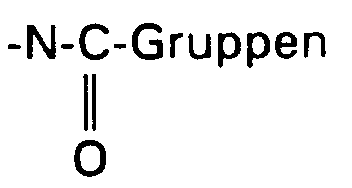
unterbrochen ist und wobei die Bindung zu GS über -O-, -NH- oder -CH₂-erfolgt. - Gegenstand der Erfindung ist weiterhin ein Verfahren zur Herstellung von Verbindungen der Formel I, dadurch gekennzeichnet, daß man aktivierte Carbonsäurederivate mit geeigneten Aminen unter Ausbildung einer Amidbindung zur Reaktion bringt.
- Die Carbonsäurederivate weisen die zentrale Brückengruppe auf, während die Amine die Gruppierung X-GS aufweisen. Die verwendeten Oligocarbonsäuren sind entweder literaturbekannt oder sie werden durch Addition von Hydroxyverbindungen an Acrylnitril und anschließende Verseifung der Nitrilfunktionen hergestellt.
- Als Zentralbaustein geeignete Oligocarbonsäuren werden z. B. durch Bildung von Anhydrid oder Säurechlorid aktiviert. Weitere beispielhafte Möglichkeiten sind die Aktivierung mit a) Dicyclohexylcarbodiimid/Hydroxybenzotriazol (DCC/HOBT) b) 2-Ethoxy-1-ethoxycarbonyl-1,2-dihydroisochinolin (EEDQ) oder c) 0-[(Cyan-ethoxycarbonylmethylen)-amino]-N,N,N',N'-tetramethyluroniumtetrafluoroborat (TOTU).
- Die Umsetzung mit - z. T auch geschützten - Aminogallensäurederivaten erfolgt je nach Reaktivität im Temperaturbereich von -15 bis + 75°C, vorzugsweise in inerten Lösemitteln wie Tetrahydrofuran, Dichlormethan, Dimethylformamid oder Ethylacetat.
- Die gebildeten Ester der Formel I werden nach üblicher Methodik basisch - bei Benzylestern hydrogenolytisch - verseift und können anschließend in die Alkalisalze überführt werden.
Zur Herstellung von Verbindungen mit unterschiedlichen Resten am Zentralbaustein kann die Reaktionsfolge "Aktivierung" und "Kondensation" mit verschiedenen Aminogallensäurederivaten mehrfach durchgeführt werden, z. B. a) Anhydrid/Säurechloridbildung, b) 1. Kondensation, c) Aktivierung verbleibender freier Carboxylgruppen mit DCC/HOBT und d) 2. Kondensation. - Die erfindungsgemäßen Verbindungen der Formel (I) besitzen eine hohe Affinität zum spezifischen Gallensäuretransportsystem des Dünndarms und hemmen die Gallensäurerückresorption konzentrationsabhängig und kompetitiv.
- Verbindungen der Formel (I) werden selbst nicht resorbiert und gelangen somit nicht in den Blutkreislauf. Durch reversible Hemmung kann wesentlich selektiver in den enterohepatischen Kreislauf eingegriffen werden. Avitaminosen sind nicht zu erwarten, ebensowenig kommt es zu einer qualitativen Veränderung der Gallensäurezusammensetzung in der Galle. Mit den erfindungsgemäßen Verbindungen läßt sich eine gezielte Senkung des Serumcholesterinspiegels erreichen, ohne daß die bekannten Nebenwirkungen beobachtet werden. Weiterhin können die erfindungsgemäßen Verbindungen zur Behandlung von Lebererkrankungen mit Cholostase eingesetzt werden, da durch die Unterbrechung des enterohepatischen Kreislaufs die Rezirkulation von Gallensäuren vermindert wird, die unter Cholostase-Bedingungen für hepatozelluläre Schädigungen und Nekrosen verantwortlich sind.
- Wegen der hohen Affinität der erfindungsgemäßen Verbindungen zum Gallensäuretransportsystem kommt man zu sehr viel geringeren Tagesdosen als bei den im Handel befindlichen Polymeren; dies führt auch zu einer hohen Akzeptanz bei Patient und Arzt.
- Die Verbindungen besitzen wertvolle pharmakologische Eigenschaften und eignen sich daher insbesondere als Hypolipidämika.
- Die Erfindung betrifft daher auch Arzneimittel auf Basis der Verbindungen der Formel (I) sowie die Verwendung der Verbindungen als Arzneimittel, insbesondere zur Senkung des Cholesterinspiegels.
- Die biologische Prüfung der erfindungsgemäßen Verbindungen erfolgte durch Ermittlung der Hemmung der [³H]-Taurocholataufnahme in Bürstensaummembranvesikel des Ileums von Kaninchen. Der Hemmtest wurde wie folgt durchgeführt:
- Die Präparation von Bürstensaummembranvesikeln aus den Darmzellen des Dünndarm erfolgte mit der sogenannten Mg²⁺-Präzipitationsmethode. Männliche Neuseeland-Kaninchen (2 bis 2,5 kg Körpergewicht) wurden durch intravenöse Injektion von 0,5 ml einer wäßrigen Lösung von 2,5 mg Tetracain HCl, 100 T 61R und 25 mg Mebezoniumjodid getötet. Der Dünndarm wurde entnommen und mit eiskalter physiologischer Kochsalzlösung gespült. Die terminalen 7/10 des Dünndarms (gemessen in oral rectaler Richtung, d. h. das terminale Ileum, welches das aktive Na⁺-abhängige Gallensäuretransportsystem enthält) wurden zur Präparation der Bürstensaummembranvesikel verwendet. Die Därme wurden in Kunststoffbeuteln unter Stickstoff bei -80°C eingefroren. Zur Präparation der Membranvesikel wurden die eingefrorenen Därme bei 30°C im Wasserbad aufgetaut. Die Mucosa wurde abgeschabt und in 60 ml eiskaltem 12 mM Tris/HCl-Puffer (pH 7,1)/300 mM Mannit, 5 mM EGTA/10 mg/l Phenylmethyl-sulfonylfluorid/1 mg/l Trypsin lnhibitor v. Sojabohnen (32 U/mg)/0,5 mg/l Trypsin Inhibitor v. Rinderlunge (193 U/mg)/5 mg/l Bacitracin suspendiert. Nach dem Verdünnen auf 300 ml mit eiskaltem destilliertem Wasser wurde mit einem Ultraturrax (18-Stab, IKA Werk Staufen, BRD) 3 Minuten bei 75 % max. Leistung unter Eiskühlung homogenisiert. Nach Zugabe von 3 ml 1 M MgCl₂-Lösung (Endkonzentration 10 mM) ließ man exakt 1 Minute bei 0°C stehen. Durch Zugabe von Mg²⁺ aggregieren die Zellmembranen und präzipitieren mit Ausnahme der Bürstensaummembranen. Nach einer 15-minütigen Zentrifugation bei 3000 x g (5000 rpm, SS-34-Rotor) wird der Niederschlag verworfen und der Überstand, der die Bürstensaummembranen enthält, 30 Minuten bei 267000 x g (15000 rpm, SS-34-Rotor) zentrifugiert. Der Überstand wurde verworfen, der Niederschlag in 60 ml 12 mM Tris/HCl-Puffer (pH 7,1)/60 mM Mannit, 5 mM EGTA mit einem Potter Elvejhem Homogenisator (Braun, Melsungen, 900 rpm, 10 Hübe) rehomogenisiert. Nach Zugabe von 0,1 ml 1 M MgCl₂-Lösung und 15-minütiger Inkubationszeit bei 0°C wurde erneut 15 Minuten bei 3000 x g zentrifugiert. Der Überstand wurde anschließend nochmals 30 Minuten bei 46000 x g (15000 rpm, SS-34-Rotor) zentrifugiert. Der Niederschlag wurde in 30 ml 10 mM Tris/Hepes-Puffer (pH 7,4)/300 mM Mannit aufgenommen und durch 20 Hübe in einem Potter Elvejhem Homogenisator bei 1000 rpm homogen resuspendiert. Nach 30 minütiger Zentrifugation bei 48000 x g (20000 rpm, SS-34-Rotor) wurde der Niederschlag in 0,5 bis 2 ml Tris/Hepes-Puffer (pH 7,4)/280 mM Mannit (Endkonzentration 20 mg/ml) aufgenommen und mit Hilfe einer Tuberkulinspritze mit einer 27 Gauge-Nadel resuspendiert. Die Vesikel wurden entweder unmittelbar nach der Präparation für Transportuntersuchungen verwendet oder bei -196°C in 4 mg Portionen in flüssigem Stickstoff aufbewahrt.
- Die Aufnahme von Substraten in die vorstehend beschriebenen Bürstensaummembranvesikel wurde mittels der sogenannten Membranfiltrationstechnik bestimmt. 10 µl der Vesikelsuspension (100 µg Protein) wurden als Tropfen an die Wand eines Polystyrolinkubationsröhrchens (11 x 70 mm) pipettiert, welches das Inkubationsmedium mit den entsprechenden Liganden enthielt (90 µl). Das Inkubationsmedium enthielt 0,75 µl = 0,75 µCi [³H(G)]-Taurocholat (spezifische Aktivität: 2,1 Ci/mMol), /0,5 µl 10 mM Taurocholat/8,75 µl Natrium-Transport-Puffer (10 mM Tris/Hepes, (pH 7,4)/100 mM Mannit/100 mM NaCl) (Na-T-P) bzw. 8,75 µl Kalium-Transport-Puffer (10 mM Tris/Hepes (pH 7,4)/100 mM Mannit/100 mM KCl) (K-T-P) und 80 µl der betreffenden Inhibitorlösung, je nach Experiment in Na-T-Puffer bzw. K-T-Puffer gelöst. Das Inkubationsmedium wurde durch ein Polyvinylidenfluorid-Membranfilter (SYHV LO 4NS, 0,45 µm, 4 mm ø, Millipore, Eschborn, BRD) filtriert. Durch Vermischung der Vesikel mit dem Inkubationsmedium wurde die Transportmessung gestartet. Die Konzentration an Taurocholat im Inkubationsansatz betrug 50 µM. Nach der gewünschten Inkubationszeit (üblicherweise 1 Minute) wurde der Transport durch Zugabe von 1 ml eiskalter Stoplösung (10 mM Tris/Hepes, (pH 7,4)/150 mM KCl) gestoppt. Die entstehende Mischung wurde sofort bei einem Vakuum von 25 bis 35 mbar über ein Membranfilter aus Cellulosenitrat (ME 25, 0,45 µm, 25 mm Durchmesser, Schleicher & Schuell, Dassell, BRD) abgesaugt. Der Filter wurde mit 5 ml eiskalter Stoplösung nachgewaschen.
- Zur Messung der Aufnahme des radioaktiv markierten Taurocholats wurde das Membranfilter mit 4 ml des Szintillators Quickszint 361 (Zinsser Analytik GmbH, Frankfurt, BRD) aufgelöst und die Radioaktivität durch Flüssigkeits-Szintillationsmessung in einem Meßgerät TriCarb 2500 (Canberra Packard GmbH, Frankfurt, BRD) gemessen. Die gemessenen Werte wurden nach Eichung des Gerätes mit Hilfe von Standardproben und nach Korrektur evtl. vorhandener Chemilumineszenz als dpm (Decompositions per Minute) erhalten.
- Die Kontrollwerte wurden jeweils in Na-T-P und K-T-P ermittelt. Die Differenz zwischen der Aufnahme in Na-T-P und K-T-P ergab den Na⁺-abhängigen Transportanteil. Als IC₅₀ Na⁺ wurde diejenige Konzentration an Inhibitor bezeichnet, bei der der Na⁺-abhängige Transportanteil um 50 % - bezogen auf die Kontrolle - gehemmt war.
- Die Tabelle zeigt Meßwerte der Hemmung der [³H]-Taurocholataufnahme in Bürstensaummembranvesikel des Ileums von Kaninchen. Angegeben sind die Quotienten aus den IC₅₀- bzw. IC50Na-Werten des in jeder Vesikelpräparation als Standard untersuchten Taurochenodesoxycholats (TCDC) und der jeweiligen Substanz.
Substanz aus Beispiel IC₅₀ (TCDC) IC50Na (TCDC) IC₅₀ (Substanz) IC50Na (Substanz) 7 0,29 0,34 10 0,24 0,26 11 0,29 0,36 16 0,37 0,31 18 0,85 0,76 20 0,43 0,86 21 0,29 0,59 31 1,26 0,93 33 0,77 1,04 45 0,32 0,23 47 0,24 0,23 - Die Erfindung betrifft weiterhin die Verwendung der erfindungsgemäßen Verbindungen zur Herstellung eines Heilmittels.
Hierzu werden die Verbindungen der allgemeinen Formel I gelöst oder suspendiert in pharmakologisch unbedenklichen Lösungsmitteln, wie ein- oder mehrwertigen Alkoholen, wie z. B. Ethanol oder Glycerin, in Triacetin, Ölen wie z. B. Sonnenblumenöl, Lebertran, Ethern, wie z. B. Diethylenglykoldimethylether oder auch Polyethern wie z. B. Polyethylenglykol, oder auch in Gegenwart anderer pharmakologisch unbedenklicher Polymerträger, wie z. B. Polyvinylpyrrolidon, oder anderen pharmazeutisch annehmbaren Zusatzstoffen wie Stärke, Cyclodextrin oder Polysacchariden. Ferner können die erfindungsgemäßen Verbindungen in Kombination mit anderen Arzneistoffen, gegeben werden. - Die Verbvindungen der Formel I werden in verschiedenen Dosierungsformen verabreicht, vorzugsweise oral in Form von Tabletten, Kapseln oder Flüssigkeiten. Die tägliche Dosis bewegt sich je nach Körpergewicht und Konstitution des Patienten im Bereich von 3 mg bis 5000 mg, vorzugsweise jedoch in Dosisbereich 10 bis 1000 mg.
- Zu einer Suspension von 8,0 g (27,2 mmol) 1,1,1-Tris(3-hydroxypropoxymethyl)ethan in 40 ml Dioxan und 0,4 g 40 % wässriger KOH wurden bei Zimmertemperatur langsam 14,5 ml (220 mmol) Acrylnitril zugetropft. Nach 1 h bei 40° C wurde noch 1,0 g 40 % wässriger KOH zugegeben und weitere 2 h bei 70° C gerührt. Nach Beendigung der Reaktion wurden 5 ml 2 M HCl zugegeben, die unlöslichen Produkte abfiltriert und das Lösungsmittel eingeengt. Der Rückstand wurde in CH₂Cl₂ gelöst, mit MgSO₄ getrocknet und wieder eingeengt. Chromatographie über Kieselgel (Cyclohexan/Essigester 1:2) ergab 7,4 g (60 %, 16,3 mmol) "Beispiel 1".
C₂₃H₃₉N₃O₆ (453), MS (FAB, 3-NBA/LiCl): 460 (M + Li⁺). - 5,2 g (11,5 mmol) Beispiel 1 wurden in 60 ml methanolischer HCl gelöst und 3 h unter Rückfluß erhitzt. Der Niederschlag wurde abfiltriert und das Lösungsmittel eingeengt. Der erhaltene Rückstand wurde 3 h in 50 ml Toluol unter Rückfluß am Wasserabscheider erhitzt. Anschließend wurde im Vakuum eingeengt. Ausbeute: 4,0 g (63 %, 7,2 mmol) "Beispiel 2".
C₂₆H₄₈O₁₂ (552), MS (FAB, 3-NBA/LiCl): 559 (M + Li⁺). - 4,0 g (7,2 mmol) Beispiel 2 wurden in 40 ml 2 M wässriger NaOH bei Zimmertemperatur verseift. Zur Aufarbeitung wurde mit 2 M HCl angesäuert und mit Essigester extrahiert. Nach Trocknen und Einengen der organischen Phase wurde über eine kurze Kieselgelsäule (CHCl₃/MeOH 4:1) gereinigt. Ausbeute: 3,0 g (5,9 mmol, 82 %) Beispiel 3".
C₂₃H₄₂O₁₂ (510), MS (FAB, 3-NBA/LiCl): 517 (M + Li⁺). - 218 g (1,56 mol) Pentaerythrit und 5,3 g (0,13 mol) NaOH wurden in 250 ml Wasser gelöst. Es wurden langsam 525 ml (8 mol) Acrylnitril zugetropft. Die Reaktion wurde 12 h bei 50° C gerührt. Anschließend wurde mit HCl neutralisiert und über Kieselgel filtriert (Essigester). Ausbeute: 345 g (0,99 mol, 63 %) "Beispiel 4".
C₁₇H₂₄N₄O₄ (348), MS (FAB, 3-NBA/LiCl): 355 (M + Li⁺). - 100 g (287 mmol) Beispiel 5 wurden in 500 ml konzentrierter HCl 1 h unter Rückfluß erhitzt. Nach dem Abkühlen wurde das Gemisch mit NaCl gesättigt und mit Essigester extrahiert. Nach dem Trocknen und Einengen der organischen Phase wurde über Kieselgel filtriert (Essigester). Ausbeute: 83,5 g (197 mmol, 69 %) "Beispiel 5".
C₁₇H₂₈O₁₂ (424), MS (FAB, 3-NBA/LiCl): 431 (M + Li⁺). -

200 mg (0,72 mmol) Tris-(2-carboxyethyl)-nitromethan wurden in 20 ml Tetrahydrofuran bei 0° C zunächst mit 0,59 ml (4,3 mmol) Triethylamin, dann mit 0,2 ml (2,1 mmol) Chlorameisensäureethylester versetzt. Nach 30 min. bei 0° C wurden 1,16 g (2,1 mmol) 3β-(2-Aminoethoxy)-7α,12α-dihydroxycholansäurebenzylester in 5 ml THF zugegeben. Nach weiteren 3 h bei 0° C und 2 h bei Zimmertemperatur wurde das Reaktionsgemisch eingeengt und über Kieselgel (CH₂Cl₂/Methanol 9:1) chromatographiert. Ausbeute: 780 mg (0,42 mmol, 59 %) "Beispiel 6".
C₁₀₉H₁₆₂N₄O₂₀ (1847), MS (FAB, 3-NBA/LiCl): 1854 (M + Li⁺). -

200 mg (0,108 mmol) Beispiel 6 wurden in 15 ml Methanol in Gegenwart von 10 mg Pd/C bei Normaldruck hydriert. Es wurde vom Katalysator abfiltriert und eingeengt. Man erhielt 150 mg (0,095 mmol, 88 %) "Beispiel 7". C₈₈H₁₄₄N₄O₂₀ (1577), MS (FAB, 3-NBA/LiCl): 1584 (M + Li⁺). -

300 mg (0,59 mmol) 1,1,1-Tris-(2-carboxyethoxymethyl)ethan wurden in 30 ml THF bei 0° C mit 0,56 ml (4,0 mmol) Triethylamin und 0,26 ml (2,72 mmol) Chlorameisensäureethylester versetzt. Nach 15 min. bei 0° C wurden bei -10° C 1,8 g (3,52 mmol) 3β-Amino-7α,12α-dihydroxycholansäuremethylester in 10 ml THF zugegeben, 1 h bei -10° C und 30 min. bei Zimmertemperatur gerührt. Nach Einengen des Reaktionsgemischs wurde der Rückstand über Kieselgel (Essigester/Methanol/Triethylamin 5:1:1) chromatographiert. Ausbeute: 900 mg (5,23 mmol, 89 %) "Beispiel 8".
C₈₉H₁₄₇N₃O₁₈ (1546), MS (FAB, 3-NBA/LiCl): 1553 (M + Li⁺). -

500 mg (0,29 mmol) Beispiel 8 wurden mit 2 ml 1 M wässriger NaOH in 10 ml Ethanol verseift. Zur Aufarbeitung wurde Wasser zugesetzt und das Ethanol abgezogen, der Rückstand mit HCl angesäuert und mit Essigester extrahiert. Nach Trocknen und Einengen des Lösungsmittels wurde über Kieselgel chromatographiert (CHCl₃/MeOH 4:1, dann 1:1). Ausbeute: 260 mg (0,15 mmol, 53 %) "Beispiel 9".
C₈₆H₁₄₁N₃O₁₈ (1504), MS (FAB, 3-NBA/LiCl): 1511 (M + Li⁺). -

Aus 1,1,1-Tris-(2-carboxyethoxymethyl)-ethan und 3β-(2-Aminoethoxy)-7α,12α-dihydroxycholansäuremethylester wurde analog zu den Beispielen 8 und 9 "Beispiel 10" erhalten.
C₉₂H₁₅₃N₃O₂₁ (1636), MS (FAB, 3-NBA/LiCl): 1643 (M + Li⁺). -

Aus Beispiel 3 und 3β-Amino-3a,7α-dihydroxycholansäure wurde analog zu den Beispielen 8 und 9 "Beispiel 11" erhalten.
C₉₅H₁₅₉N₃O₂₁ (1678), MS (FAB, 3-NBA/LiCl): 1685 (M + Li⁺). -

Aus Beispiel 3 und 3β-(2-Aminoethoxy)-7α,12α-dihydroxycholansäuremethylester wurde analog zu den Beispielen 8 und 9 "Beispiel 12" erhalten.
C₁₀₁H₁₇₁N₃O₂₄ (1810), MS (FAB, 3-NBA/LiCl): 1817 (M + Li⁺). -

Eine Lösung von 0,5 g (1,12 mmol) Beispiel 5 und 3,0 g (6,45 mmol) 3β-(2-Aminoethoxy)-7α,12α-cholansäuremethylester in 20 ml trockenem Essigester wurde mit 1,36 g (5,50 mmol) 2-Ethoxy-1-ethoxycarbonyl-1,2-dihydrochinolin versetzt und 20 h unter Rückfluß erhitzt. Nach Beendigung der Reaktion wurde das Lösungsmittel eingedampft und der Rückstand auf Kieselgel chromatographiert (CHCl₃/Methanol 10:1). Man erhielt 1,40 g (0,63 mmol, 54 %) "Beispiel 13".
C₁₂₅H₂₀₈N₄O₂₈ (2213), MS (FAB, 3-NBA/LiCl): 2220 (M + Li⁺). -

Beispiel 13 wurde analog dem für Beispiel 9 beschriebenen Verfahren zu Beispiel 14 verseift. Die Reinigung erfolgte durch Chromatographie über RP-8 Kieselgel mit Methanol/Wasser 85:5 als Laufmittel.
C₁₂₁H₂₀N₄O₂₈ (2157), MS (FAB, 3-NBA/LiCl): 2164 (M + Li⁺). -

Zu einer Lösung von 2,58 g (0,01 mol) Kemp'scher Trisäure (a), 16,5 g (0,03 mol) Amin (b) und 4,46 g (0,033 mol) Hydroxy-benzotriazol (HOBT) in 300 ml THF werden bei 0° C 6,8 g (0,033 mol) Dicyclohexylcarbodiimid (DCC) gegeben. Die Lösung wird 30 min. bei 0° C und dann 20 h bei Raumtemperatur gerührt. Zur Vervollständigung der Umsetzung werden 1,12 g HOBT und 1,7 g DCC hinzugefügt und erneut 20 h gerührt. Anschließend wird der gebildete Niederschlag abfiltriert, das Filtrat eingeengt, der Rückstand mit Essigester aufgenommen und die Lösung nacheinander mit 2 N Citronensäure, Wasser, ges. NaHCO₃-Lösung und Wasser gewaschen. Der nach dem Trocknen und Einengen erhaltene Rückstand wird chromatographisch gereinigt (SiO₂; Essigester/Methanol 10:1). Man erhält 16,8 g (95 %) des Produkts (c), "Beispiel 15".
C₁₀₅H₁₇₇N₃O₁₈ (1768), MS (FAB, 3-NBA/LiCl): 1775 (M + Li⁺). -

16,8 g Beispiel 15 wurden in 200 ml Dioxan gelöst und bei 0° C mit 100 ml halbkonz. Natronlauge versetzt. Nach 2 h Rühren bei Raumtemperatur wurde mit 300 ml Wasser versetzt und über Nacht bei Raumtemperatur gerührt. Nach beendeter Umsetzung wurde mit weiteren 500 ml Wasser verdünnt, mit verdünnter Salzsäure angesäuert und 1 h im Eisbad gerührt. Der entstandene Niederschlag wurde abgesaugt, mit Wasser nachgewaschen, aus Ethanol/Wasser umkristallisiert und im Vakuum getrocknet. Man erhielt 15,1 g (92 %)
"Beispiel 16" in mikrokristalliner Form.
C₁₀₂H₁₇₁N₃O₁₈ (1727), MS (FAB, AcOH, NBA): 1728 (M + H⁺); Schmp.: 168° C. -

345 mg (0,2 mmol) Beispiel 16 wurden in 5 ml trockenem Methanol gelöst und mit 1 ml 0,2 N methanolischer Natronlauge versetzt. Das Natriumsalz wurde durch Zusatz ca. 50 ml trockenen Ether und 1 h Rühren bei 0° C ausgefällt, abgesaugt, mit kaltem Ether nachgewaschen und im Vakuum getrocknet. Man erhielt 310 mg (87 %) "Beispiel 17".
C₁₀₂H₁₆₈N₃Na₃O₁₈ (1792), MS (FAB, NBA) 1728 (M-3Na⁺ + 4H⁺); Schmp.: 201 - 203° C. - Analog zu "Beispiel 15" und "Beispiel 16" wurden folgende Substanzen aus den entsprechenden Carbonsäuren und Aminen hergestellt:
-

C₈₇H₁₃₅N₃O₁₅ (1462), MS (FAB, 3-NBA): 1463 (M + H⁺) -

C₈₇H₁₃₅N₃O₁₈ (1510), MS (FAB, 3-NBA): 1511 (M + H⁺) -

C₉₆H₁₅₃N₃O₁₈ (1636), MS (FAB, 3-NBA): 1637 (M + H⁺) -

C₉₉H₁₅₉N₃O₁₈ (1678), MS (FAB, 3-NBA): 1679 (M + H⁺) -

C₁₆₅H₂₆₄N₆O₂₄ (2714), MS (FAB, 3-NBA, AcOH): 2737 (M + Na⁺) -

C₈₇H₁₄₁N₃O₁₅ (1468), MS (FAB, 3-NBA): 1469 (M + H⁺) -

C₈₇H₁₄₁N₃O₁₈ (1516), MS (FAB, 3-NBA): 1517 (M + H⁺) -
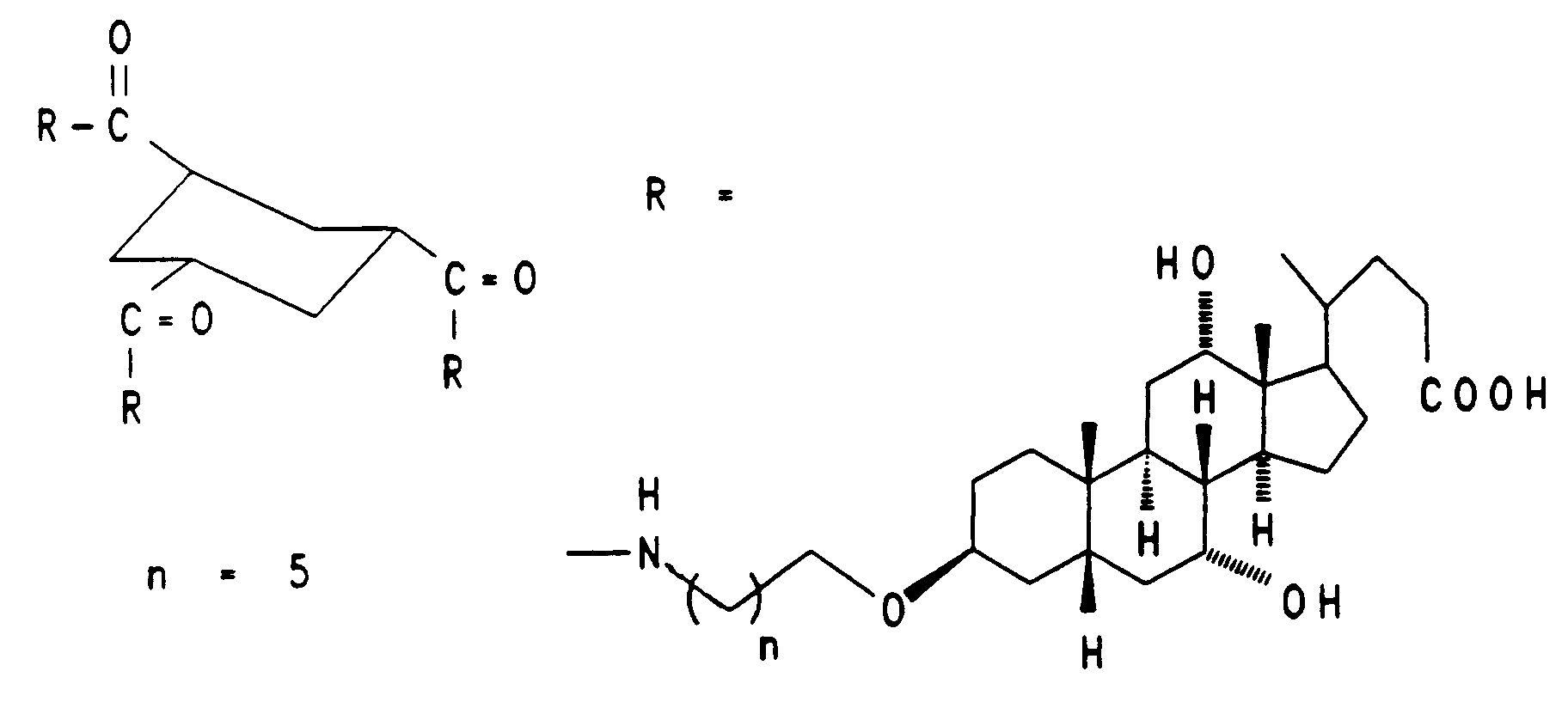
C₉₉H₁₆₅N₃O₁₈ (1684), MS (FAB, 3-NBA): 1685 (M + H⁺) -

C₁₁₂H₁₈₂N₄O₂₀ (1903), MS (FAB, 3-NBA): 1904 (M + H⁺) -

C₁₂₈H₂₁₄N₄O₂₄ (2192), MS (FAB, 3-NBA): 2193 (M + H⁺) -

C₉₈H₁₆₅N₃O₁₈ (1672), MS (FAB, 3-NBA): 1673 (M + H⁺) -

C₉₀H₁₄₇N₃O₁₅ (1510), MS (FAB, 3-NBA): 1511 (M + H⁺) -
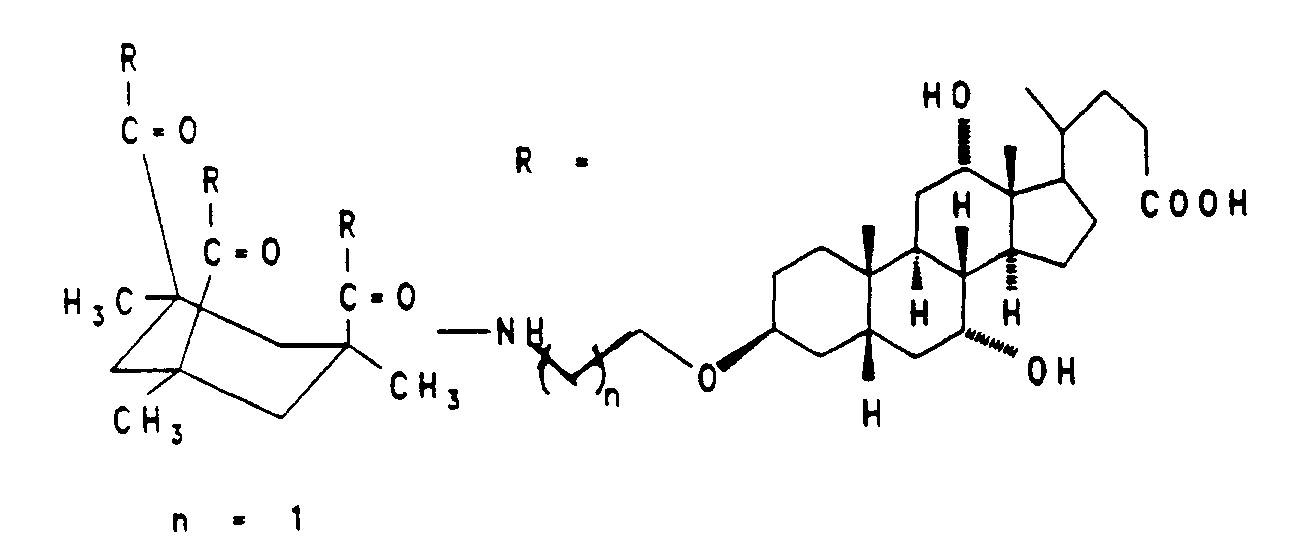
C₉₀H₁₄₇N₃O₁₈ (1558), MS (FAB, 3-NBA): 1559 (M + H⁺) -

C₉₉H₁₆₅N₃O₁₈ (1684), MS (FAB, 3-NBA): 1685 (M + H⁺) -
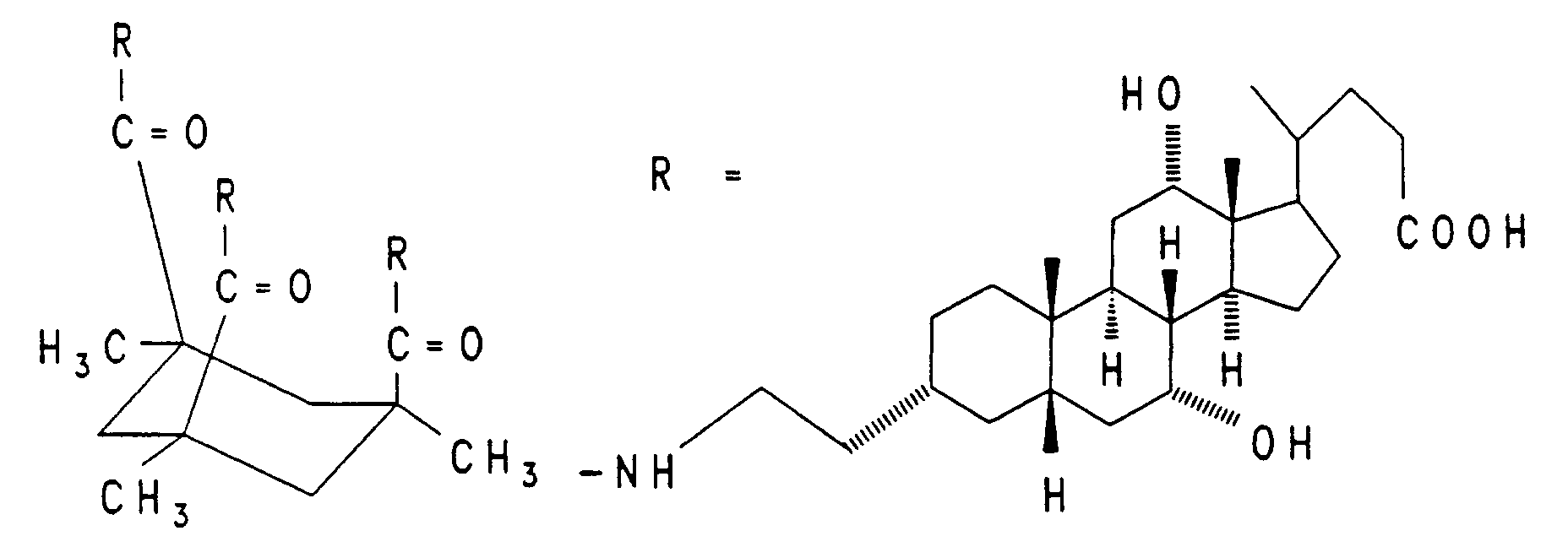
C₉₀H₁₄₇N₃O₁₅ (1510), MS (FAB, 3-NBA): 1511 (M + H⁺) -

C₈₄H₁₃₅N₃O₁₅ (1426), MS (FAB, 3-NBA): 1427 (M + H⁺) -

C₉₆H₁₅₉N₃O₂₁ (1690), MS (FAB, 3-NBA): 1713 (M + Na⁺) -

C₁₀₂H₁₇₁N₃O₂₄ (1822), MS (FAB, 3-NBA): 1823 (M + H⁺) -

C₁₀₂H₁₆₈N₆O₁₈ (1765), MS (FAB, 3-NBA): 1766 (M + H⁺) -

C₁₀₂H₁₇₁N₃O₁₈ (1726), MS (FAB, 3-NBA): 1727 (M + H⁺) -

5,18 g (0,02 Mol) des Säurederivats a werden in 350 ml trockenem Dichlormethan unter Zusatz von 6 ml Triethylamin unter Eiskühlung mit 21 g (0,04 Mol) Amin b (gelöst in 150 ml Dichlormethan) versetzt und nach beendeter Zugabe 6 h bei Raumtemperatur gerührt. Man filtriert gebildetes Salz ab, schüttelt mehrfach mit 2N Citronensäure und Wasser aus und reinigt den nach dem Trocknen und Einengen verbleibenden Rückstand durch Säulenfiltration über Kieselgel. Man erhält 15,9 g (63 %) Verbindung c, "Beispiel 38".
C₇₄H₁₂₄N₂O₁₄ (1265), MS (FAB, 3-NBA): 1266 (M + H⁺) -
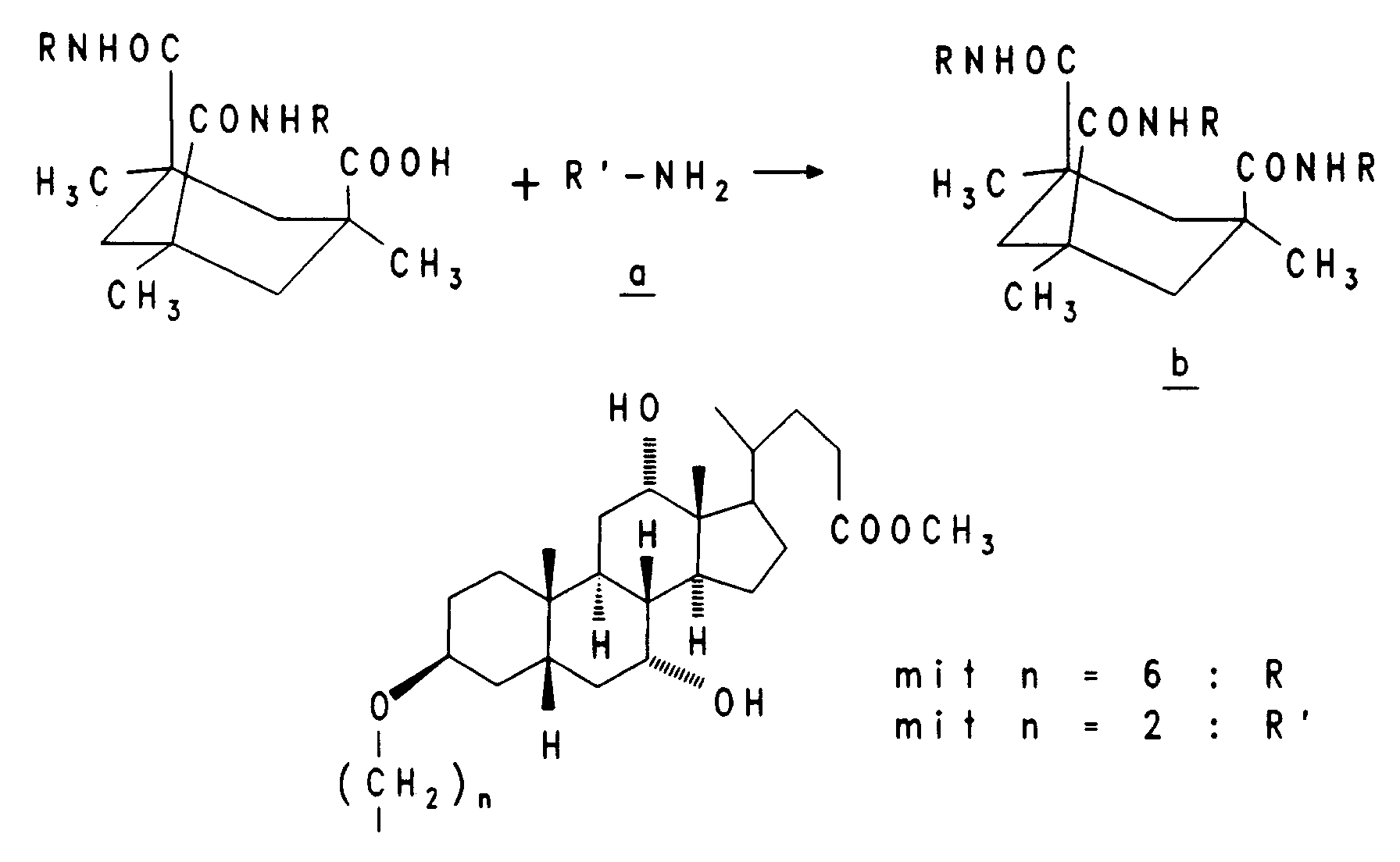
633 mg (0,5 mmol) "Beispiel 38" werden in 30 ml THF gelöst und mit 70 mg (0,52 mmol) Hydroxybenzotriazol und 110 mg (0,53 mmol) Dicyclohexylcarbodiimid aktiviert. Man gibt 243 mg (0,52 mmol) Amin a hinzu und rührt über Nacht bei Raumtemperatur. Anschließend wird wie unter "Beispiel 15" beschriebenen aufgearbeitet. Nach chromatographischer Reinigung erhält man 582 mg (68 %) Produkt b.
C₁₀₁H₁₆₉N₃O₁₈ (1712), MS (FAB, 3-NBA): 1713 (M + H⁺) -
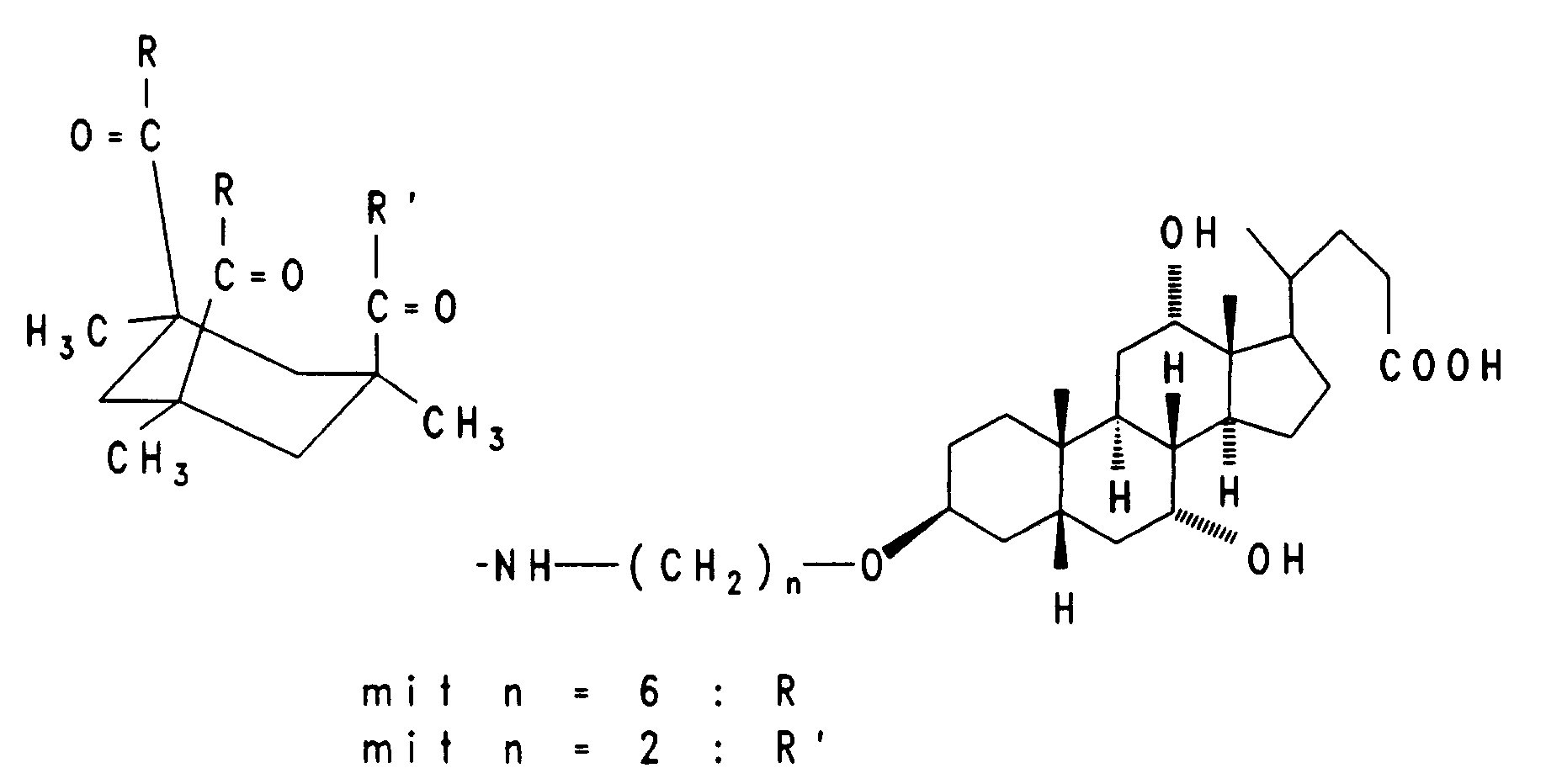
Die Substanz wird aus "Beispiel 39" durch alkalische Verseifung analog zu "Beispiel 16" hergestellt.
C₉₈H₁₆₃N₃O₁₈ (1670), MS (FAB, 3-NBA): 1671 (M + H⁺) -

Die Substanz wird analog zu "Beispiel 40" hergestellt unter Verwendung des R' entsprechenden dimeren Amins.
C₁₃₂H₂₂₂N₄O₂₂ (2216), MS (FAB, 3-NBA): 2217 (M + H⁺)
Die folgenden Beispielsubstanzen werden analog zu den in Beispiel 15 und 16 beschriebenen Umsetzungen unter Verwendung der entsprechenden Oligocarbonsäuren und Amine hergestellt. -

C₁₁₂H₁₈₀N₄O₂₄ (1965), MS (FAB, 3-NBA): 1966 (M + H⁺) -

c₁₂₈H₂₁₂N₄O₂₄ (2190), MS (FAB, 3-NBA): 2191 (M + H⁺) -

Wird bei der Umsetzung von ε-Truxillsäure zu trans,trans,trans-Cyclobutan-1,2,3,4-tetracarbonsäure (Chem. Ber. 83, 2521 (1960)) die Ozonolyse frühzeitig abgebrochen, erhält man nach der Aufarbeitung ein Produktgemisch, das chromatographisch getrennt werden kann (Kieselgel, CHCl₃/MeOH 6:1). Als erste Fraktion wird die neue 4-Phenylcyclobutan-1,2,3-tricarbonsäure (a), MS (FAB, 3-NBA) C₁₃H₁₂O₆ (264): 265 (M + Li⁺), als zweite Fraktion Cyclobutan-1,2,3,4-tetracarbonsäure (b) erhalten. - Die folgenden Beispielsubstanzen werden analog zu den in Beispiel 15 und 16 beschriebenen Umsetzungen unter Verwendung der entsprechenden Oligocarbonsäuren und Amine hergestellt.
-

C₉₁H₁₄₁N₃O₁₈ (1564), MS (FAB, 3-NBA): 1565 (M + H⁺) -

C₁₀₃H₁₆₅N₃O₁₈ (1732), MS (FAB, 3-NBA): 1733 (M + H⁺) -

C₁₁₂H₁₈₀N₄O₂₄ (1965), MS (FAB, 3-NBA): 1966 (M + H⁺) -

C₁₂₈H₂₁₂N₄O₂₄ (2190), MS (FAB, 3-NBA): 2191 (M + H⁺)
Claims (9)
- Gallensäurederivate der Formel (I),
(I) Z(-X-GS)n
in derGS einen Gallensäurerest oder modifizierten Gallensäurerest in Form der freien Säure, der Ester, in Form von Amiden oder in der Salzform oder einen an den Alkoholgruppen derivatisierten Gallensäurerest bedeutet,X eine Brückengruppe oder ein kovalente Bindung, wobei GS beliebig über X verbunden ist, darstelltZ eine zentrale Brückengruppe bedeutet undn drei oder vier ist. - Arzneimittel enthaltend eine Verbindung gemäß Anspruch 1.
- Hypolipidämikum enthaltend eine Verbindung gemäß Anspruch 1.
- Verwendung einer Verbindung gemäß Anspruch 1 als Arzneimittel.
- Gallensäurederivate gemäß Anspruch 1, dadurch gekennzeichnet, daß GS ein Rest der Formel II ist,
 E eine einfache Bindung, Sauerstoff oder NH bedeutet,Y eine freie Valenz zur Bindung der Gruppe X oder die folgenden Bedeutungen hat
-OL, -NHL, -NL₂,
eine über die Aminogruppe gebundene Aminosäure oder Aminosulfonsäure, wie z. B.
wobei L
H, einen Alkyl- oder Alkenylrest mit bis zu 10 C-Atomen, der verzweigt oder unverzweigt ist,
einen Cycloalkylrest mit 3 bis 8 C-Atomen,
einen Phenylrest, der unsubstituiert oder 1 bis 3fach substituiert ist mit F, Cl, Br, (C₁-C₄)Alkyl oder (C₁-C₄)-Alkoxy,
einen Benzylrest, der unsubstituiert oder 1 bis 3fach substituiert ist mit F, Cl, Br, (C₁-C₄)Alkyl oder (C₁-C₄)-Alkoxy,
und R⁶
Methyl, Isopropyl, Isobutyl, 2-Butyl, Benzyl, 4-Hydroxybenzyl, Hydroxymethyl, 1-Hydroxyethyl, H₃CSCH₂CH₂-, HO₂CCH₂-, HOCCH₂CH₂- bedeutet, oder
Y bedeutet eine freie Valenz zur Bindung eines weiteren Gallensäurerestes oder modifizierten Gallensäurerestes über dessen Ring A, wobei die Bindung über einen Linker mit der Bedeutung von X erfolgt,R¹ eine freie Valenz zur Bindung der Gruppe X oder H,
einen Alkylrest oder Alkenylrest mit bis zu 10 C-Atomen, der verwzeigt oder unverzweigt ist,
einen Cycloalkylrest mit 3 bis 8 C-Atomen,
einen Phenylrest, der unsubstituiert oder 1 bis 3fach substituiert ist mit F, Cl, Br, (C₁-C₄)-Alkyl oder (C₁-C₄)-Alkoxy, -N⊕H₃, -OPO₃⊖,
einen Benzylrest, der im Kern unsubstituiert oder 1 bis 3fach substituiert ist mit F, Cl, Br, (C₁-C₄)Alkyl, (C₁-C₄)-Alkoxy, -N⊕H₃, -OPO₃⊖ oder Phenyl, das seinerseits 1 bis 3fach substituiert sein kann mit F, Cl, Br, (C₁-C₄)-Alkyl oder (C₁-C₄)-Alkoxy, -N⊕H₃, -OPO₃⊖,
einen Biphenylmethylrest, der unsubstituiert oder 1 bis 3fach substituiert ist mit F, Cl, Br, (C₁-C₄)Alkyl, (C₁-C₄)-Alkoxy, -N⊕H₃, -OPO₃⊖,
einen Triphenylmethylrest, der unsubstituiert oder 1 bis 3fach substituiert ist mit F, Cl, Br, (C₁-C₄)-Alkyl oder (C₁-C₄)-Alkoxy, -N⊕H₃, -OPO₃⊖,
einen 1- oder 2-Naphthylmethylrest, der unsubstituiert oder 1 bis 3fach substituiert ist mit F, Cl, Br, (C₁-C₄)-Alkyl oder (C₁-C₄)-Alkoxy, -N⊕H₃, -OPO₃⊖,
einen 9-Fluorenylrest, der unsubstituiert oder 1 bis 3fach substituiert ist mit F, Cl, Br, (C₁-C₄)-Alkyl oder (C₁-C₄)-Alkoxy, -N⊕H₃, -OPO₃⊖,
einen 2-, 3- oder 4-Pyridylrest, einen Rest
R² bis R⁵, wobei R² und R³ bzw. R⁴ und R⁵ jeweils gemeinsam der Sauerstoff einer Carbonylgruppe, oder einzeln und jeweils unabhängig voneinander
- Gallensäurederivate gemäß Anspruch 1, dadurch gekennzeichnet, daßX eine Einfachbindung oder eine Gruppe der allgemeinen Formel IIIwobei
 A eine Alkylenkette, die verzweigt oder unverzweigt ist und in der Kette gegebenenfalls durch -O-, -S- oder Phenylen unterbrochen sein kann, wobei die Verknüpfung
 B eine Alkylenkette, die verzweigt oder unverzweigt ist und in der Kette gegebenenfalls durch -O-, -S- oder Phenylen unterbrochen sein kann, wobei die Verknüpfung
 L¹, L², L³ gleich oder verschieden sind und die Bedeutung von L haben, insbesondere aber Wasserstoff, C₁-C₄-Alkyl oder Benzyl bedeuten, sowieq 0 bis 5,r 0 oder 1,s 0 oder 1 undt 0 oder 1bedeuten.
 - Gallensäurederivate gemäß Anspruch 1, dadurch gekennzeichnet, daß die zentrale Brückengruppe Z einen offenkettigen Alkylrest mit bis zu 20 C-Aomen, wobei der Alkylrest geradkettig oder verzweigt ist und gegebenenfalls mit bis zu 6 Ätherbrücken unterbrochen ist, einen Cycloalkylrest mit 3 bis 8 C-Aomen oder einen Phenylrest darstellt, wobei die genannten Reste 3 bis

- Gallensäurederivate gemäß Anspruch 1, dadurch gekennzeichnet, daß GS einen Rest der Formel II darstellt, X eine Einfachbindung, oder einen Rest der Formel III, worin L¹, L² und L³ Wasserstoff, C₁-C₄-Alkyl oder Benzyl und die übrigen Symbole die in Anspruch 6 angegebenen Bedeutungen haben, ist und die zentrale Brückengruppe Z einen offenkettigen Alkylrest mit bis zu 20 C-Atomen, wobei der Alkylrest geradkettig oder verzweigt ist und gegebenenfalls mit bis zu 6 Ätherbrücken unterbrochen ist, einen Cycloalkylrest mit 3 bis 8 C-Atomen oder einen Phenylrest darstellt, wobei die genannten Reste 3 bis 4 -C = O-Gruppen aufweisen und über NH an X gebunden sind und wobei die Reste substituiert sein können mit NH₂, NO₂, Methyl oder Phenyl.
- Verfahren zur Herstellung von Gallensäurederivaten der Formel I gemäß Anspruch 1, dadurch gekennzeichnet, daß man aktivierte Carbonsäurederivate mit geeigneten die X-GS-Gruppierung aufweisenden Aminen zur Ausbildung einer Amidbindung zur Reaktion bringt.
Applications Claiming Priority (2)
| Application Number | Priority Date | Filing Date | Title |
|---|---|---|---|
| DE4219274 | 1992-06-12 | ||
| DE4219274 | 1992-06-12 |
Publications (3)
| Publication Number | Publication Date |
|---|---|
| EP0573848A2 true EP0573848A2 (de) | 1993-12-15 |
| EP0573848A3 EP0573848A3 (de) | 1995-06-07 |
| EP0573848B1 EP0573848B1 (de) | 1997-12-03 |
Family
ID=6460884
Family Applications (1)
| Application Number | Title | Priority Date | Filing Date |
|---|---|---|---|
| EP93108559A Expired - Lifetime EP0573848B1 (de) | 1992-06-12 | 1993-05-27 | Gallensäurederivate, Verfahren zu ihrer Herstellung und Verwendung dieser Verbindungen als Arzneimittel |
Country Status (21)
| Country | Link |
|---|---|
| US (1) | US5428182A (de) |
| EP (1) | EP0573848B1 (de) |
| JP (1) | JP3403218B2 (de) |
| KR (1) | KR100319562B1 (de) |
| AT (1) | ATE160783T1 (de) |
| AU (1) | AU663592B2 (de) |
| CA (1) | CA2098256C (de) |
| CY (1) | CY2117B1 (de) |
| CZ (1) | CZ285104B6 (de) |
| DE (1) | DE59307759D1 (de) |
| DK (1) | DK0573848T3 (de) |
| ES (1) | ES2111092T3 (de) |
| FI (1) | FI106801B (de) |
| GR (1) | GR3025799T3 (de) |
| HU (1) | HU216636B (de) |
| IL (1) | IL105980A (de) |
| NO (1) | NO304653B1 (de) |
| NZ (1) | NZ247827A (de) |
| SK (1) | SK280819B6 (de) |
| TW (1) | TW228004B (de) |
| ZA (1) | ZA934150B (de) |
Cited By (47)
| Publication number | Priority date | Publication date | Assignee | Title |
|---|---|---|---|---|
| EP0702026A2 (de) | 1994-09-14 | 1996-03-20 | Hoechst Aktiengesellschaft | Modifizierte Gallensäuren, Verfahren zu ihrer Herstellung und ihre Verwendung |
| US5840879A (en) * | 1996-12-06 | 1998-11-24 | Wang; Edge R. | Reagents and solid supports for improved synthesis and labeling of polynucleotides |
| EP1894564A2 (de) | 2003-04-05 | 2008-03-05 | AstraZeneca AB | Verwendung eines Ibat-Hemmers zur Behandlung oder Prophylaxe von Verstopfungen |
| WO2012064267A1 (en) | 2010-11-08 | 2012-05-18 | Albireo Ab | A pharmaceutical combination comprising an ibat inhibitor and a bile acid binder |
| WO2013063526A1 (en) | 2011-10-28 | 2013-05-02 | Lumena Pharmaceuticals, Inc. | Bile acid recycling inhibitors for treatment of hypercholemia and cholestatic liver disease |
| WO2014144650A2 (en) | 2013-03-15 | 2014-09-18 | Lumena Pharmaceuticals, Inc. | Bile acid recycling inhibitors for treatment of primary sclerosing cholangitis and inflammatory bowel disease |
| WO2014144485A1 (en) | 2013-03-15 | 2014-09-18 | Lumena Pharmaceuticals, Inc. | Bile acid recycling inhibitors for treatment of barrett's esophagus and gastroesophageal reflux disease |
| EP2995317A1 (de) | 2010-05-26 | 2016-03-16 | Satiogen Pharmaceuticals, Inc. | Gallensäurerückflusshemmer zur behandlung von diabetes, adipositas und entzündlichen magen-darm-erkrankungen |
| US9409875B2 (en) | 2013-04-26 | 2016-08-09 | Elobix Ab | Crystal modifications of elobixibat |
| US9688720B2 (en) | 2010-11-04 | 2017-06-27 | Albireo Ab | IBAT inhibitors for the treatment of liver diseases |
| WO2017138877A1 (en) | 2016-02-09 | 2017-08-17 | Albireo Ab | Oral cholestyramine formulation and use thereof |
| WO2017138878A1 (en) | 2016-02-09 | 2017-08-17 | Albireo Ab | Oral cholestyramine formulation and use thereof |
| EP3266457A1 (de) | 2011-10-28 | 2018-01-10 | Lumena Pharmaceuticals LLC | Gallensäurerückflusshemmer zur behandlung von cholestase-erkrankungen im kindesalter |
| US10183920B2 (en) | 2014-10-24 | 2019-01-22 | Elobix Ab | Crystal modifications of elobixibat |
| WO2019032026A1 (en) | 2017-08-09 | 2019-02-14 | Albireo Ab | CHOLESTYRAMINE GRANULES, ORAL FORMULATIONS OF CHOLESTYRAMINE AND THEIR USE |
| WO2019032027A1 (en) | 2017-08-09 | 2019-02-14 | Albireo Ab | CHOLESTYRAMINE TABLETS, ORAL FORMULATIONS OF CHOLESTYRAMINE AND THEIR USE |
| US10441604B2 (en) | 2016-02-09 | 2019-10-15 | Albireo Ab | Cholestyramine pellets and methods for preparation thereof |
| WO2019234077A1 (en) | 2018-06-05 | 2019-12-12 | Albireo Ab | Benzothia(di)azepine compounds and their use as bile acid modulators |
| US10709755B2 (en) | 2014-06-25 | 2020-07-14 | Elobix Ab | Solid formulation and method for preventing or reducing coloration thereof |
| US10722457B2 (en) | 2018-08-09 | 2020-07-28 | Albireo Ab | Oral cholestyramine formulation and use thereof |
| WO2020161217A1 (en) | 2019-02-06 | 2020-08-13 | Albireo Ab | Benzothiadiazepine compounds and their use as bile acid modulators |
| WO2020161216A1 (en) | 2019-02-06 | 2020-08-13 | Albireo Ab | Benzothiazepine compounds and their use as bile acid modulators |
| US10975046B2 (en) | 2018-06-20 | 2021-04-13 | Albireo Ab | Crystal modifications of odevixibat |
| US11007142B2 (en) | 2018-08-09 | 2021-05-18 | Albireo Ab | Oral cholestyramine formulation and use thereof |
| US11014898B1 (en) | 2020-12-04 | 2021-05-25 | Albireo Ab | Benzothiazepine compounds and their use as bile acid modulators |
| WO2021110886A1 (en) | 2019-12-04 | 2021-06-10 | Albireo Ab | Benzothia(di)azepine compounds and their use as bile acid modulators |
| WO2021110883A1 (en) | 2019-12-04 | 2021-06-10 | Albireo Ab | Benzothia(di)azepine compounds and their use as bile acid modulators |
| WO2021110884A1 (en) | 2019-12-04 | 2021-06-10 | Albireo Ab | Benzothia(di)azepine compounds and their use as bile acid modulators |
| WO2021110887A1 (en) | 2019-12-04 | 2021-06-10 | Albireo Ab | Benzothiazepine compounds and their use as bile acid modulators |
| WO2021110885A1 (en) | 2019-12-04 | 2021-06-10 | Albireo Ab | Benzothiadiazepine compounds and their use as bile acid modulators |
| US11111224B2 (en) | 2019-12-04 | 2021-09-07 | Albireo Ab | Benzothia(di)azepine compounds and their use as bile acid modulators |
| US11180465B2 (en) | 2019-12-04 | 2021-11-23 | Albireo Ab | Benzothia(di)azepine compounds and their use as bile acid modulators |
| US11225466B2 (en) | 2019-12-04 | 2022-01-18 | Albireo Ab | Benzothiadiazepine compounds and their use as bile acid modulators |
| WO2022029101A1 (en) | 2020-08-03 | 2022-02-10 | Albireo Ab | Benzothia(di)azepine compounds and their use as bile acid modulators |
| US11267794B2 (en) | 2019-12-04 | 2022-03-08 | Albireo Ab | Benzothia(di)azepine compounds and their use as bile acid modulators |
| WO2022117778A1 (en) | 2020-12-04 | 2022-06-09 | Albireo Ab | Benzothia(di)azepine compounds and their use as bile acid modulators |
| US11377429B2 (en) | 2020-08-03 | 2022-07-05 | Albireo Ab | Benzothia(di)azepine compounds and their use as bile acid modulators |
| WO2022253997A1 (en) | 2021-06-03 | 2022-12-08 | Albireo Ab | Benzothia(di)azepine compounds and their use as bile acid modulators |
| US11549878B2 (en) | 2018-08-09 | 2023-01-10 | Albireo Ab | In vitro method for determining the adsorbing capacity of an insoluble adsorbant |
| US11583539B2 (en) | 2020-11-12 | 2023-02-21 | Albireo Ab | Treating progressive familial intrahepatic cholestasis (PFIC) with IBAT inhibitors |
| EP4241840A2 (de) | 2019-02-12 | 2023-09-13 | Mirum Pharmaceuticals, Inc. | Verfahren zur behandlung von cholestase |
| US11801226B2 (en) | 2018-06-20 | 2023-10-31 | Albireo Ab | Pharmaceutical formulation of odevixibat |
| WO2023237728A1 (en) | 2022-06-09 | 2023-12-14 | Albireo Ab | Treating hepatitis |
| WO2024008766A1 (en) | 2022-07-05 | 2024-01-11 | Albireo Ab | Benzothia(di)azepine compounds and their use as bile acid modulators |
| WO2024121434A1 (en) | 2022-12-09 | 2024-06-13 | Albireo Ab | Asbt inhibitors in the treatment of renal diseases |
| WO2025146507A1 (en) | 2024-01-05 | 2025-07-10 | Albireo Ab | Benzothia(di)azepine compounds and their use as bile acid modulators |
| WO2025146508A1 (en) | 2024-01-05 | 2025-07-10 | Albireo Ab | Benzothia(di)azepine compounds and their use as bile acid modulators |
Families Citing this family (6)
| Publication number | Priority date | Publication date | Assignee | Title |
|---|---|---|---|---|
| EP0624593A3 (de) * | 1993-05-08 | 1995-06-07 | Hoechst Ag | Gallensäurederivate, Verfahren zu ihrer Herstellung und Verwendung dieser Verbindungen als Arzneimittel. |
| GB2355009A (en) | 1999-07-30 | 2001-04-11 | Univ Glasgow | Peptides conjugated to bile acids/salts |
| CA2562151C (en) | 2004-04-30 | 2016-09-06 | Alnylam Pharmaceuticals, Inc. | Oligonucleotides comprising a c5-modified pyrimidine |
| ES2318922B1 (es) * | 2005-05-30 | 2010-02-12 | Universidade De Santiago De Compostela | Nuevos dimeros derivados de acidos biliares funcionalizados en la posicion 3 del anillo a. metodo para la sintesis y aplicaciones. |
| KR100800312B1 (ko) * | 2006-01-25 | 2008-02-04 | (주)테크윙 | 테스트핸들러 및 테스트핸들러의 로딩방법 |
| CN101078006B (zh) | 2006-05-26 | 2012-06-06 | 上海凯信生物科技有限公司 | 一株高产四甲基吡嗪的短小芽孢杆菌 |
Family Cites Families (7)
| Publication number | Priority date | Publication date | Assignee | Title |
|---|---|---|---|---|
| US2931817A (en) * | 1956-05-31 | 1960-04-05 | Monsanto Chemicals | Steroid sulfite ester polymers |
| DE1768345B2 (de) * | 1968-05-03 | 1976-12-02 | Hoechst Ag, 6000 Frankfurt | Dimere steroid-21-alkylcarbonate und verfahren zu ihrer herstellung |
| US3916002A (en) * | 1973-12-17 | 1975-10-28 | Taubert Hans Dieter | Oligomeric steroid esters, process for their production, and therapeutic compositions containing the same |
| NL7415669A (nl) * | 1974-12-02 | 1976-06-04 | Akzo Nv | Werkwijze ter bereiding van een nieuwe ester van 19-nor-testosteron. |
| NZ240846A (en) * | 1990-12-06 | 1994-04-27 | Hoechst Ag | Dimeric bile acid derivatives; preparatory processes and pharmaceutical compositions |
| EP0548793A3 (en) * | 1991-12-20 | 1995-11-02 | Hoechst Ag | Ethylenic-unsaturated bile acid derivatives, process for their production and preliminary processes therefor |
| TW289021B (de) * | 1993-05-08 | 1996-10-21 | Hoechst Ag |
-
1993
- 1993-05-27 DK DK93108559T patent/DK0573848T3/da active
- 1993-05-27 EP EP93108559A patent/EP0573848B1/de not_active Expired - Lifetime
- 1993-05-27 AT AT93108559T patent/ATE160783T1/de not_active IP Right Cessation
- 1993-05-27 ES ES93108559T patent/ES2111092T3/es not_active Expired - Lifetime
- 1993-05-27 DE DE59307759T patent/DE59307759D1/de not_active Expired - Lifetime
- 1993-06-05 TW TW082104487A patent/TW228004B/zh active
- 1993-06-09 NZ NZ247827A patent/NZ247827A/en unknown
- 1993-06-10 FI FI932659A patent/FI106801B/fi active
- 1993-06-10 US US08/074,753 patent/US5428182A/en not_active Expired - Lifetime
- 1993-06-10 SK SK585-93A patent/SK280819B6/sk unknown
- 1993-06-10 IL IL105980A patent/IL105980A/xx not_active IP Right Cessation
- 1993-06-10 CZ CZ931134A patent/CZ285104B6/cs not_active IP Right Cessation
- 1993-06-11 AU AU40180/93A patent/AU663592B2/en not_active Ceased
- 1993-06-11 ZA ZA934150A patent/ZA934150B/xx unknown
- 1993-06-11 JP JP14037593A patent/JP3403218B2/ja not_active Expired - Lifetime
- 1993-06-11 HU HU9301716A patent/HU216636B/hu not_active IP Right Cessation
- 1993-06-11 CA CA002098256A patent/CA2098256C/en not_active Expired - Lifetime
- 1993-06-11 KR KR1019930010579A patent/KR100319562B1/ko not_active Expired - Fee Related
- 1993-06-11 NO NO931379A patent/NO304653B1/no unknown
-
1997
- 1997-12-30 GR GR970403445T patent/GR3025799T3/el unknown
-
1998
- 1998-09-29 CY CY9800035A patent/CY2117B1/xx unknown
Cited By (101)
| Publication number | Priority date | Publication date | Assignee | Title |
|---|---|---|---|---|
| US5641767A (en) * | 1994-09-14 | 1997-06-24 | Hoechst Aktiengesellschaft | Modified bile acids process for their preparation and their use |
| EP0702026A2 (de) | 1994-09-14 | 1996-03-20 | Hoechst Aktiengesellschaft | Modifizierte Gallensäuren, Verfahren zu ihrer Herstellung und ihre Verwendung |
| US5840879A (en) * | 1996-12-06 | 1998-11-24 | Wang; Edge R. | Reagents and solid supports for improved synthesis and labeling of polynucleotides |
| EP1894564A2 (de) | 2003-04-05 | 2008-03-05 | AstraZeneca AB | Verwendung eines Ibat-Hemmers zur Behandlung oder Prophylaxe von Verstopfungen |
| EP2995317A1 (de) | 2010-05-26 | 2016-03-16 | Satiogen Pharmaceuticals, Inc. | Gallensäurerückflusshemmer zur behandlung von diabetes, adipositas und entzündlichen magen-darm-erkrankungen |
| EP3593802A2 (de) | 2010-05-26 | 2020-01-15 | Satiogen Pharmaceuticals, Inc. | Gallensäurerückflusshemmer zur behandlung von diabetes, adipositas und entzündlichen magen-darm-erkrankungen |
| EP4137137A1 (de) | 2010-05-26 | 2023-02-22 | Satiogen Pharmaceuticals, Inc. | Gallensäurerecyclinghemmer und satiogene zur behandlung von diabetes, adipositas und entzündlichen magen-darm-erkrankungen |
| US10487111B2 (en) | 2010-11-04 | 2019-11-26 | Albireo Ab | IBAT inhibitors for the treatment of liver diseases |
| US12187812B2 (en) | 2010-11-04 | 2025-01-07 | Albireo Ab | IBAT inhibitors for the treatment of liver diseases |
| US12545705B2 (en) | 2010-11-04 | 2026-02-10 | Albireo Ab | IBAT inhibitors for the treatment of liver diseases |
| US9688720B2 (en) | 2010-11-04 | 2017-06-27 | Albireo Ab | IBAT inhibitors for the treatment of liver diseases |
| US9694018B1 (en) | 2010-11-04 | 2017-07-04 | Albireo Ab | IBAT inhibitors for the treatment of liver disease |
| US10981952B2 (en) | 2010-11-04 | 2021-04-20 | Albireo Ab | IBAT inhibitors for the treatment of liver diseases |
| US11261212B2 (en) | 2010-11-04 | 2022-03-01 | Albireo Ab | IBAT inhibitors for the treatment of liver diseases |
| US10221212B2 (en) | 2010-11-04 | 2019-03-05 | Albireo Ab | IBAT inhibitors for the treatment of liver diseases |
| US11732006B2 (en) | 2010-11-04 | 2023-08-22 | Albireo Ab | IBAT inhibitors for the treatment of liver diseases |
| US10093697B2 (en) | 2010-11-04 | 2018-10-09 | Albireo Ab | IBAT inhibitors for the treatment of liver diseases |
| US10011633B2 (en) | 2010-11-04 | 2018-07-03 | Albireo Ab | IBAT inhibitors for the treatment of liver diseases |
| US10000528B2 (en) | 2010-11-04 | 2018-06-19 | Albireo Ab | IBAT inhibitors for the treatment of liver diseases |
| WO2012064267A1 (en) | 2010-11-08 | 2012-05-18 | Albireo Ab | A pharmaceutical combination comprising an ibat inhibitor and a bile acid binder |
| US10512657B2 (en) | 2011-10-28 | 2019-12-24 | Lumena Pharmaceutials Llc | Bile acid recycling inhibitors for treatment of pediatric cholestatic liver diseases |
| EP3266457A1 (de) | 2011-10-28 | 2018-01-10 | Lumena Pharmaceuticals LLC | Gallensäurerückflusshemmer zur behandlung von cholestase-erkrankungen im kindesalter |
| US12350267B2 (en) | 2011-10-28 | 2025-07-08 | Shire Human Genetic Therapies, Inc. | Bile acid recycling inhibitors for treatment of pediatric cholestatic liver diseases |
| WO2013063526A1 (en) | 2011-10-28 | 2013-05-02 | Lumena Pharmaceuticals, Inc. | Bile acid recycling inhibitors for treatment of hypercholemia and cholestatic liver disease |
| US11376251B2 (en) | 2011-10-28 | 2022-07-05 | Shire Human Genetic Therapies, Inc. | Bile acid recycling inhibitors for treatment of pediatric cholestatic liver diseases |
| US11229661B2 (en) | 2011-10-28 | 2022-01-25 | Shire Human Genetic Therapies, Inc. | Bile acid recycling inhibitors for treatment of pediatric cholestatic liver diseases |
| EP3278796A1 (de) | 2011-10-28 | 2018-02-07 | Lumena Pharmaceuticals LLC | Gallensäurerückflusshemmer zur behandlung von hypercholämie und cholestatischer lebererkrankung |
| US12145959B2 (en) | 2011-10-28 | 2024-11-19 | Shire Human Genetic Therapies, Inc. | Bile acid recycling inhibitors for treatment of hypercholemia and cholestatic liver disease |
| WO2014144650A2 (en) | 2013-03-15 | 2014-09-18 | Lumena Pharmaceuticals, Inc. | Bile acid recycling inhibitors for treatment of primary sclerosing cholangitis and inflammatory bowel disease |
| WO2014144485A1 (en) | 2013-03-15 | 2014-09-18 | Lumena Pharmaceuticals, Inc. | Bile acid recycling inhibitors for treatment of barrett's esophagus and gastroesophageal reflux disease |
| US9701649B2 (en) | 2013-04-26 | 2017-07-11 | Elobix Ab | Crystal modifications of elobixibat |
| US9745276B2 (en) | 2013-04-26 | 2017-08-29 | Elobix Ab | Crystal modifications of elobixibat |
| US9409875B2 (en) | 2013-04-26 | 2016-08-09 | Elobix Ab | Crystal modifications of elobixibat |
| US10709755B2 (en) | 2014-06-25 | 2020-07-14 | Elobix Ab | Solid formulation and method for preventing or reducing coloration thereof |
| US10519120B2 (en) | 2014-10-24 | 2019-12-31 | Elobix Ab | Crystal modifications of elobixibat |
| US10183920B2 (en) | 2014-10-24 | 2019-01-22 | Elobix Ab | Crystal modifications of elobixibat |
| US10610543B2 (en) | 2016-02-09 | 2020-04-07 | Albireo Ab | Cholestyramine pellets and methods for preparation thereof |
| US10441604B2 (en) | 2016-02-09 | 2019-10-15 | Albireo Ab | Cholestyramine pellets and methods for preparation thereof |
| US10758563B2 (en) | 2016-02-09 | 2020-09-01 | Albireo Ab | Oral cholestyramine formulation and use thereof |
| US10786529B2 (en) | 2016-02-09 | 2020-09-29 | Albireo Ab | Oral cholestyramine formulation and use thereof |
| US10493096B2 (en) | 2016-02-09 | 2019-12-03 | Albireo Ab | Oral cholestyramine formulation and use thereof |
| US10799527B2 (en) | 2016-02-09 | 2020-10-13 | Albireo Ab | Oral cholestyramine formulation and use thereof |
| US10864228B2 (en) | 2016-02-09 | 2020-12-15 | Albireo Ab | Oral cholestyramine formulation and use thereof |
| US10441605B2 (en) | 2016-02-09 | 2019-10-15 | Albireo Ab | Oral cholestyramine formulation and use thereof |
| WO2017138877A1 (en) | 2016-02-09 | 2017-08-17 | Albireo Ab | Oral cholestyramine formulation and use thereof |
| WO2017138878A1 (en) | 2016-02-09 | 2017-08-17 | Albireo Ab | Oral cholestyramine formulation and use thereof |
| WO2019032026A1 (en) | 2017-08-09 | 2019-02-14 | Albireo Ab | CHOLESTYRAMINE GRANULES, ORAL FORMULATIONS OF CHOLESTYRAMINE AND THEIR USE |
| WO2019032027A1 (en) | 2017-08-09 | 2019-02-14 | Albireo Ab | CHOLESTYRAMINE TABLETS, ORAL FORMULATIONS OF CHOLESTYRAMINE AND THEIR USE |
| US10881685B2 (en) | 2017-08-09 | 2021-01-05 | Albireo Ab | Cholestyramine granules, oral cholestyramine formulations and use thereof |
| US11306064B2 (en) | 2018-06-05 | 2022-04-19 | Albireo Ab | Benzothia(di)azepine compounds and their use as bile acid modulators |
| WO2019234077A1 (en) | 2018-06-05 | 2019-12-12 | Albireo Ab | Benzothia(di)azepine compounds and their use as bile acid modulators |
| US10793534B2 (en) | 2018-06-05 | 2020-10-06 | Albireo Ab | Benzothia(di)azepine compounds and their use as bile acid modulators |
| US10975046B2 (en) | 2018-06-20 | 2021-04-13 | Albireo Ab | Crystal modifications of odevixibat |
| US11365182B2 (en) | 2018-06-20 | 2022-06-21 | Albireo Ab | Crystal modifications of odevixibat |
| US12508234B2 (en) | 2018-06-20 | 2025-12-30 | Albireo Ab | Pharmaceutical formulation of odevixibat |
| US12091394B2 (en) | 2018-06-20 | 2024-09-17 | Albireo Ab | Crystal modifications of odevixibat |
| US11802115B2 (en) | 2018-06-20 | 2023-10-31 | Albireo Ab | Pharmaceutical formulation of odevixibat |
| US11801226B2 (en) | 2018-06-20 | 2023-10-31 | Albireo Ab | Pharmaceutical formulation of odevixibat |
| US11549878B2 (en) | 2018-08-09 | 2023-01-10 | Albireo Ab | In vitro method for determining the adsorbing capacity of an insoluble adsorbant |
| US10722457B2 (en) | 2018-08-09 | 2020-07-28 | Albireo Ab | Oral cholestyramine formulation and use thereof |
| US11007142B2 (en) | 2018-08-09 | 2021-05-18 | Albireo Ab | Oral cholestyramine formulation and use thereof |
| US11773071B2 (en) | 2019-02-06 | 2023-10-03 | Albireo Ab | Benzothiazepine compounds and their use as bile acid modulators |
| US12187690B2 (en) | 2019-02-06 | 2025-01-07 | Albireo Ab | Benzothiadiazepine compounds and their use as bile acid modulators |
| WO2020161216A1 (en) | 2019-02-06 | 2020-08-13 | Albireo Ab | Benzothiazepine compounds and their use as bile acid modulators |
| WO2020161217A1 (en) | 2019-02-06 | 2020-08-13 | Albireo Ab | Benzothiadiazepine compounds and their use as bile acid modulators |
| US10975045B2 (en) | 2019-02-06 | 2021-04-13 | Aibireo AB | Benzothiazepine compounds and their use as bile acid modulators |
| US11603359B2 (en) | 2019-02-06 | 2023-03-14 | Albireo Ab | Benzothiadiazepine compounds and their use as bile acid modulators |
| US10941127B2 (en) | 2019-02-06 | 2021-03-09 | Albireo Ab | Benzothiadiazepine compounds and their use as bile acid modulators |
| EP4241840A2 (de) | 2019-02-12 | 2023-09-13 | Mirum Pharmaceuticals, Inc. | Verfahren zur behandlung von cholestase |
| EP4245367A2 (de) | 2019-02-12 | 2023-09-20 | Mirum Pharmaceuticals, Inc. | Verfahren zur behandlung von cholestase |
| EP4464376A2 (de) | 2019-02-12 | 2024-11-20 | Mirum Pharmaceuticals, Inc. | Genotyp- und dosisabhängige reaktion auf ein asbti bei patienten mit gallensalzexportpumpenmangel |
| EP4424363A2 (de) | 2019-02-12 | 2024-09-04 | Mirum Pharmaceuticals, Inc. | Verfahren zur wachstumssteigerung bei pädiatrischen patienten mit cholestatischer lebererkrankung |
| US12202809B2 (en) | 2019-12-04 | 2025-01-21 | Albireo Ab | Benzothia(di)azepine compounds and their use as bile acid modulators |
| WO2021110883A1 (en) | 2019-12-04 | 2021-06-10 | Albireo Ab | Benzothia(di)azepine compounds and their use as bile acid modulators |
| WO2021110886A1 (en) | 2019-12-04 | 2021-06-10 | Albireo Ab | Benzothia(di)azepine compounds and their use as bile acid modulators |
| US11267794B2 (en) | 2019-12-04 | 2022-03-08 | Albireo Ab | Benzothia(di)azepine compounds and their use as bile acid modulators |
| WO2021110884A1 (en) | 2019-12-04 | 2021-06-10 | Albireo Ab | Benzothia(di)azepine compounds and their use as bile acid modulators |
| US11111224B2 (en) | 2019-12-04 | 2021-09-07 | Albireo Ab | Benzothia(di)azepine compounds and their use as bile acid modulators |
| US11225466B2 (en) | 2019-12-04 | 2022-01-18 | Albireo Ab | Benzothiadiazepine compounds and their use as bile acid modulators |
| US11180465B2 (en) | 2019-12-04 | 2021-11-23 | Albireo Ab | Benzothia(di)azepine compounds and their use as bile acid modulators |
| WO2021110885A1 (en) | 2019-12-04 | 2021-06-10 | Albireo Ab | Benzothiadiazepine compounds and their use as bile acid modulators |
| WO2021110887A1 (en) | 2019-12-04 | 2021-06-10 | Albireo Ab | Benzothiazepine compounds and their use as bile acid modulators |
| US11891368B2 (en) | 2019-12-04 | 2024-02-06 | Albireo Ab | Benzothia(di)azepine compounds and their use as bile acid modulators |
| US11708340B2 (en) | 2019-12-04 | 2023-07-25 | Albireo Ab | Benzothia(di)azepine compounds and their use as bile acid modulators |
| US12024495B2 (en) | 2019-12-04 | 2024-07-02 | Albireo Ab | Benzothiazepine compounds and their use as bile acid modulators |
| US12060338B2 (en) | 2019-12-04 | 2024-08-13 | Albireo Ab | Benzothia(di)azepine compounds and their use as bile acid modulators |
| WO2022029101A1 (en) | 2020-08-03 | 2022-02-10 | Albireo Ab | Benzothia(di)azepine compounds and their use as bile acid modulators |
| US11377429B2 (en) | 2020-08-03 | 2022-07-05 | Albireo Ab | Benzothia(di)azepine compounds and their use as bile acid modulators |
| US11583539B2 (en) | 2020-11-12 | 2023-02-21 | Albireo Ab | Treating progressive familial intrahepatic cholestasis (PFIC) with IBAT inhibitors |
| US12447156B2 (en) | 2020-11-12 | 2025-10-21 | Albireo Ab | Treating progressive familial intrahepatic cholestasis (PFIC) with IBAT inhibitors |
| US11014898B1 (en) | 2020-12-04 | 2021-05-25 | Albireo Ab | Benzothiazepine compounds and their use as bile acid modulators |
| WO2022117778A1 (en) | 2020-12-04 | 2022-06-09 | Albireo Ab | Benzothia(di)azepine compounds and their use as bile acid modulators |
| US12134606B2 (en) | 2020-12-04 | 2024-11-05 | Albireo Ab | Benzothia(di)azepine compounds and their use as bile acid modulators |
| US11572350B1 (en) | 2020-12-04 | 2023-02-07 | Albireo Ab | Benzothia(di)azepine compounds and their use as bile acid modulators |
| US12365658B2 (en) | 2021-06-03 | 2025-07-22 | Albireo Ab | Benzothia(di)azepine compounds and their use as bile acid modulators |
| WO2022253997A1 (en) | 2021-06-03 | 2022-12-08 | Albireo Ab | Benzothia(di)azepine compounds and their use as bile acid modulators |
| WO2023237728A1 (en) | 2022-06-09 | 2023-12-14 | Albireo Ab | Treating hepatitis |
| WO2024008766A1 (en) | 2022-07-05 | 2024-01-11 | Albireo Ab | Benzothia(di)azepine compounds and their use as bile acid modulators |
| WO2024121434A1 (en) | 2022-12-09 | 2024-06-13 | Albireo Ab | Asbt inhibitors in the treatment of renal diseases |
| WO2025146508A1 (en) | 2024-01-05 | 2025-07-10 | Albireo Ab | Benzothia(di)azepine compounds and their use as bile acid modulators |
| WO2025146507A1 (en) | 2024-01-05 | 2025-07-10 | Albireo Ab | Benzothia(di)azepine compounds and their use as bile acid modulators |
Also Published As
| Publication number | Publication date |
|---|---|
| FI106801B (fi) | 2001-04-12 |
| NO932159L (no) | 1993-12-13 |
| US5428182A (en) | 1995-06-27 |
| AU663592B2 (en) | 1995-10-12 |
| NO932159D0 (no) | 1993-06-11 |
| IL105980A (en) | 1997-11-20 |
| ATE160783T1 (de) | 1997-12-15 |
| HU9301716D0 (en) | 1993-09-28 |
| ES2111092T3 (es) | 1998-03-01 |
| NZ247827A (en) | 1995-08-28 |
| DK0573848T3 (da) | 1998-08-10 |
| SK58593A3 (en) | 1994-03-09 |
| FI932659A0 (fi) | 1993-06-10 |
| ZA934150B (en) | 1994-01-13 |
| CA2098256C (en) | 2004-08-24 |
| CA2098256A1 (en) | 1993-12-13 |
| CY2117B1 (en) | 2002-04-26 |
| CZ285104B6 (cs) | 1999-05-12 |
| NO304653B1 (no) | 1999-01-25 |
| JP3403218B2 (ja) | 2003-05-06 |
| EP0573848A3 (de) | 1995-06-07 |
| KR940005652A (ko) | 1994-03-22 |
| FI932659L (fi) | 1993-12-13 |
| JPH0687884A (ja) | 1994-03-29 |
| EP0573848B1 (de) | 1997-12-03 |
| AU4018093A (en) | 1993-12-16 |
| HU216636B (hu) | 1999-07-28 |
| HUT64772A (en) | 1994-02-28 |
| IL105980A0 (en) | 1993-10-20 |
| TW228004B (de) | 1994-08-11 |
| SK280819B6 (sk) | 2000-08-14 |
| GR3025799T3 (en) | 1998-03-31 |
| KR100319562B1 (ko) | 2002-05-13 |
| CZ113493A3 (en) | 1994-01-19 |
| DE59307759D1 (de) | 1998-01-15 |
Similar Documents
| Publication | Publication Date | Title |
|---|---|---|
| EP0573848B1 (de) | Gallensäurederivate, Verfahren zu ihrer Herstellung und Verwendung dieser Verbindungen als Arzneimittel | |
| EP0624594B1 (de) | Monomere Gallensäurederivate, Verfahren zu ihrer Herstellung und Verwendung dieser Verbindungen als Arzneimittel | |
| EP0489423B1 (de) | Gallensäurederivate, Verfahren zu ihrer Herstellung und Verwendung dieser Verbindung als Arzneimittel | |
| EP0624596B1 (de) | Tetrazolderivate von Gallebnsäuren, Verfahren zu ihrer Herstellung und Verwendung dieser Verbindungen als Arzneimittel | |
| EP0624593A2 (de) | Gallensäurederivate, Verfahren zu ihrer Herstellung und Verwendung dieser Verbindungen als Arzneimittel | |
| EP0624595B1 (de) | nor-Gallensäurederivate, Verfahren zu ihrer Herstellung und Verwendung dieser Verbindungen als Arzneimittel | |
| EP0417725B1 (de) | Gallensäurederivate, Verfahren zu ihrer Herstellung, Verwendung als Arzneimittel | |
| DE19845405C2 (de) | Arylsubstituierte Propanolaminderivate und deren Verwendung | |
| EP0702026A2 (de) | Modifizierte Gallensäuren, Verfahren zu ihrer Herstellung und ihre Verwendung | |
| DE69527980T2 (de) | Chalcone und ihre ester mit antiproliferativer aktivität in gebärmutter, ovar- und brusttumoren | |
| DE19845406C2 (de) | Substituierte 1,3-Diaryl-2-pyridin-2-yl-3-(pyridin-2-ylamino)- propanolderivate, Verfahren zu deren Herstellung, diese Verbindungen enthaltende Arzneimittel und deren Verwendung | |
| DE2643936A1 (de) | Arzneimittel mit erythropoietischer wirksamkeit | |
| DE2932607C2 (de) | Chlorambucilderivate, Verfahren zur Herstellung derselben und Antitumormittel mit einem Gehalt derselben | |
| DE19845403B4 (de) | Mit Gallensäuren verknüpfte Propanolaminderivate, Verfahren zu deren Herstellung, diese Verbindungen enthaltende Arzneimittel und deren Verwendung | |
| DE2349922A1 (de) | Neue fusidinsaeurekonjugate, verfahren zu deren herstellung und pharmazeutische mischungen mit einem gehalt an diesen fusidinsaeurekonjugaten | |
| DE2517293C2 (de) | Neue Cardenolid-β-Glykoside, ihre Herstellung und Verwendung | |
| EP0815120B1 (de) | 17-difluormethylen-estratriene | |
| CH526526A (de) | Verfahren zur Herstellung eines neuen 6a-Methyl-19-nor-progesterons | |
| DE69102082T2 (de) | Ungesättigte Gallsäurederivate, Verfahren zu ihrer Herstellung und pharmazeutische Präparate diese enthaltend. | |
| DE1793694C3 (de) | Helveticosidderivate | |
| EP0030331B1 (de) | Neue C-3-verzweigte Cardenolid-glykoside, ihre Herstellung und Verwendung | |
| DE1593225C3 (de) | Reine alpha- und beta-anomere, optisch aktive 3-(2'-Tetrahydropyranyloxy)-Derivate von Steroid-Östrogenen sowie Verfahren zu deren Herstellung | |
| DE3514272A1 (de) | Dermatica | |
| DD296502A5 (de) | Verfahren zur Herstellung von Steroidamiden | |
| DE2141559A1 (de) | Neue fluorierte Progesteron Derivate |
Legal Events
| Date | Code | Title | Description |
|---|---|---|---|
| PUAI | Public reference made under article 153(3) epc to a published international application that has entered the european phase |
Free format text: ORIGINAL CODE: 0009012 |
|
| AK | Designated contracting states |
Kind code of ref document: A2 Designated state(s): AT BE CH DE DK ES FR GB GR IE IT LI LU MC NL PT SE |
|
| PUAL | Search report despatched |
Free format text: ORIGINAL CODE: 0009013 |
|
| AK | Designated contracting states |
Kind code of ref document: A3 Designated state(s): AT BE CH DE DK ES FR GB GR IE IT LI LU MC NL PT SE |
|
| 17P | Request for examination filed |
Effective date: 19951207 |
|
| 17Q | First examination report despatched |
Effective date: 19960308 |
|
| GRAG | Despatch of communication of intention to grant |
Free format text: ORIGINAL CODE: EPIDOS AGRA |
|
| GRAH | Despatch of communication of intention to grant a patent |
Free format text: ORIGINAL CODE: EPIDOS IGRA |
|
| GRAH | Despatch of communication of intention to grant a patent |
Free format text: ORIGINAL CODE: EPIDOS IGRA |
|
| GRAA | (expected) grant |
Free format text: ORIGINAL CODE: 0009210 |
|
| AK | Designated contracting states |
Kind code of ref document: B1 Designated state(s): AT BE CH DE DK ES FR GB GR IE IT LI LU MC NL PT SE |
|
| REF | Corresponds to: |
Ref document number: 160783 Country of ref document: AT Date of ref document: 19971215 Kind code of ref document: T |
|
| REG | Reference to a national code |
Ref country code: CH Ref legal event code: EP |
|
| REF | Corresponds to: |
Ref document number: 59307759 Country of ref document: DE Date of ref document: 19980115 |
|
| ITF | It: translation for a ep patent filed | ||
| ET | Fr: translation filed | ||
| REG | Reference to a national code |
Ref country code: ES Ref legal event code: FG2A Ref document number: 2111092 Country of ref document: ES Kind code of ref document: T3 |
|
| GBT | Gb: translation of ep patent filed (gb section 77(6)(a)/1977) |
Effective date: 19980205 |
|
| REG | Reference to a national code |
Ref country code: PT Ref legal event code: SC4A Free format text: AVAILABILITY OF NATIONAL TRANSLATION Effective date: 19980108 |
|
| REG | Reference to a national code |
Ref country code: DK Ref legal event code: T3 |
|
| PLBE | No opposition filed within time limit |
Free format text: ORIGINAL CODE: 0009261 |
|
| 26N | No opposition filed | ||
| REG | Reference to a national code |
Ref country code: GB Ref legal event code: IF02 |
|
| PGFP | Annual fee paid to national office [announced via postgrant information from national office to epo] |
Ref country code: MC Payment date: 20020418 Year of fee payment: 10 |
|
| PGFP | Annual fee paid to national office [announced via postgrant information from national office to epo] |
Ref country code: NL Payment date: 20020422 Year of fee payment: 10 Ref country code: AT Payment date: 20020422 Year of fee payment: 10 Ref country code: DK Payment date: 20020422 Year of fee payment: 10 |
|
| PGFP | Annual fee paid to national office [announced via postgrant information from national office to epo] |
Ref country code: SE Payment date: 20020423 Year of fee payment: 10 Ref country code: PT Payment date: 20020423 Year of fee payment: 10 |
|
| PGFP | Annual fee paid to national office [announced via postgrant information from national office to epo] |
Ref country code: CH Payment date: 20020424 Year of fee payment: 10 |
|
| PGFP | Annual fee paid to national office [announced via postgrant information from national office to epo] |
Ref country code: GR Payment date: 20020425 Year of fee payment: 10 |
|
| PGFP | Annual fee paid to national office [announced via postgrant information from national office to epo] |
Ref country code: BE Payment date: 20020521 Year of fee payment: 10 |
|
| PGFP | Annual fee paid to national office [announced via postgrant information from national office to epo] |
Ref country code: IE Payment date: 20020531 Year of fee payment: 10 |
|
| PGFP | Annual fee paid to national office [announced via postgrant information from national office to epo] |
Ref country code: LU Payment date: 20020604 Year of fee payment: 10 |
|
| PG25 | Lapsed in a contracting state [announced via postgrant information from national office to epo] |
Ref country code: LU Free format text: LAPSE BECAUSE OF NON-PAYMENT OF DUE FEES Effective date: 20030527 Ref country code: IE Free format text: LAPSE BECAUSE OF NON-PAYMENT OF DUE FEES Effective date: 20030527 Ref country code: AT Free format text: LAPSE BECAUSE OF NON-PAYMENT OF DUE FEES Effective date: 20030527 |
|
| PG25 | Lapsed in a contracting state [announced via postgrant information from national office to epo] |
Ref country code: SE Free format text: LAPSE BECAUSE OF NON-PAYMENT OF DUE FEES Effective date: 20030528 |
|
| PG25 | Lapsed in a contracting state [announced via postgrant information from national office to epo] |
Ref country code: MC Free format text: LAPSE BECAUSE OF NON-PAYMENT OF DUE FEES Effective date: 20030531 Ref country code: LI Free format text: LAPSE BECAUSE OF NON-PAYMENT OF DUE FEES Effective date: 20030531 Ref country code: CH Free format text: LAPSE BECAUSE OF NON-PAYMENT OF DUE FEES Effective date: 20030531 Ref country code: BE Free format text: LAPSE BECAUSE OF NON-PAYMENT OF DUE FEES Effective date: 20030531 |
|
| BERE | Be: lapsed |
Owner name: *HOECHST A.G. Effective date: 20030531 |
|
| PG25 | Lapsed in a contracting state [announced via postgrant information from national office to epo] |
Ref country code: PT Free format text: LAPSE BECAUSE OF NON-PAYMENT OF DUE FEES Effective date: 20031130 |
|
| PG25 | Lapsed in a contracting state [announced via postgrant information from national office to epo] |
Ref country code: NL Free format text: LAPSE BECAUSE OF NON-PAYMENT OF DUE FEES Effective date: 20031201 Ref country code: DK Free format text: LAPSE BECAUSE OF NON-PAYMENT OF DUE FEES Effective date: 20031201 |
|
| PG25 | Lapsed in a contracting state [announced via postgrant information from national office to epo] |
Ref country code: GR Free format text: LAPSE BECAUSE OF NON-PAYMENT OF DUE FEES Effective date: 20031203 |
|
| EUG | Se: european patent has lapsed | ||
| REG | Reference to a national code |
Ref country code: CH Ref legal event code: PL |
|
| NLV4 | Nl: lapsed or anulled due to non-payment of the annual fee |
Effective date: 20031201 |
|
| REG | Reference to a national code |
Ref country code: DK Ref legal event code: EBP |
|
| REG | Reference to a national code |
Ref country code: PT Ref legal event code: MM4A Free format text: LAPSE DUE TO NON-PAYMENT OF FEES Effective date: 20031130 |
|
| REG | Reference to a national code |
Ref country code: IE Ref legal event code: MM4A |
|
| PGFP | Annual fee paid to national office [announced via postgrant information from national office to epo] |
Ref country code: DE Payment date: 20120523 Year of fee payment: 20 |
|
| PGFP | Annual fee paid to national office [announced via postgrant information from national office to epo] |
Ref country code: GB Payment date: 20120523 Year of fee payment: 20 Ref country code: FR Payment date: 20120608 Year of fee payment: 20 |
|
| PGFP | Annual fee paid to national office [announced via postgrant information from national office to epo] |
Ref country code: IT Payment date: 20120518 Year of fee payment: 20 |
|
| PGFP | Annual fee paid to national office [announced via postgrant information from national office to epo] |
Ref country code: ES Payment date: 20120607 Year of fee payment: 20 |
|
| REG | Reference to a national code |
Ref country code: DE Ref legal event code: R071 Ref document number: 59307759 Country of ref document: DE |
|
| REG | Reference to a national code |
Ref country code: GB Ref legal event code: PE20 Expiry date: 20130526 |
|
| PG25 | Lapsed in a contracting state [announced via postgrant information from national office to epo] |
Ref country code: DE Free format text: LAPSE BECAUSE OF EXPIRATION OF PROTECTION Effective date: 20130528 Ref country code: GB Free format text: LAPSE BECAUSE OF EXPIRATION OF PROTECTION Effective date: 20130526 |
|
| REG | Reference to a national code |
Ref country code: ES Ref legal event code: FD2A Effective date: 20130808 |
|
| PG25 | Lapsed in a contracting state [announced via postgrant information from national office to epo] |
Ref country code: ES Free format text: LAPSE BECAUSE OF EXPIRATION OF PROTECTION Effective date: 20130528 |