EP0573864B1 - Verfahren zur Herstellung von Polyethersiloxanen - Google Patents
Verfahren zur Herstellung von Polyethersiloxanen Download PDFInfo
- Publication number
- EP0573864B1 EP0573864B1 EP93108726A EP93108726A EP0573864B1 EP 0573864 B1 EP0573864 B1 EP 0573864B1 EP 93108726 A EP93108726 A EP 93108726A EP 93108726 A EP93108726 A EP 93108726A EP 0573864 B1 EP0573864 B1 EP 0573864B1
- Authority
- EP
- European Patent Office
- Prior art keywords
- radical
- radicals
- process according
- polyether
- employed
- Prior art date
- Legal status (The legal status is an assumption and is not a legal conclusion. Google has not performed a legal analysis and makes no representation as to the accuracy of the status listed.)
- Expired - Lifetime
Links
- 229920000570 polyether Polymers 0.000 title claims description 41
- 239000004721 Polyphenylene oxide Substances 0.000 title claims description 37
- -1 siloxanes Chemical class 0.000 title claims description 20
- 238000000034 method Methods 0.000 title claims description 19
- 238000002360 preparation method Methods 0.000 title claims description 4
- RTZKZFJDLAIYFH-UHFFFAOYSA-N ether Substances CCOCC RTZKZFJDLAIYFH-UHFFFAOYSA-N 0.000 claims description 26
- 229920001296 polysiloxane Polymers 0.000 claims description 16
- 125000002887 hydroxy group Chemical group [H]O* 0.000 claims description 14
- 150000001875 compounds Chemical class 0.000 claims description 12
- 238000006243 chemical reaction Methods 0.000 claims description 11
- 229910018540 Si C Inorganic materials 0.000 claims description 10
- 229910010271 silicon carbide Inorganic materials 0.000 claims description 10
- 125000004432 carbon atom Chemical group C* 0.000 claims description 7
- 239000004593 Epoxy Substances 0.000 claims description 6
- 239000002841 Lewis acid Substances 0.000 claims description 6
- 150000007517 lewis acids Chemical class 0.000 claims description 6
- STMDPCBYJCIZOD-UHFFFAOYSA-N 2-(2,4-dinitroanilino)-4-methylpentanoic acid Chemical compound CC(C)CC(C(O)=O)NC1=CC=C([N+]([O-])=O)C=C1[N+]([O-])=O STMDPCBYJCIZOD-UHFFFAOYSA-N 0.000 claims description 4
- 150000001336 alkenes Chemical class 0.000 claims description 4
- 229910052739 hydrogen Inorganic materials 0.000 claims description 4
- 239000001257 hydrogen Substances 0.000 claims description 4
- UFHFLCQGNIYNRP-UHFFFAOYSA-N Hydrogen Chemical compound [H][H] UFHFLCQGNIYNRP-UHFFFAOYSA-N 0.000 claims description 3
- 239000003054 catalyst Substances 0.000 claims description 3
- 150000001338 aliphatic hydrocarbons Chemical class 0.000 claims description 2
- 239000012442 inert solvent Substances 0.000 claims description 2
- 150000002118 epoxides Chemical group 0.000 claims 7
- 125000002947 alkylene group Chemical group 0.000 claims 1
- 239000000203 mixture Substances 0.000 description 29
- YXFVVABEGXRONW-UHFFFAOYSA-N Toluene Chemical compound CC1=CC=CC=C1 YXFVVABEGXRONW-UHFFFAOYSA-N 0.000 description 24
- UIIMBOGNXHQVGW-UHFFFAOYSA-M Sodium bicarbonate Chemical compound [Na+].OC([O-])=O UIIMBOGNXHQVGW-UHFFFAOYSA-M 0.000 description 14
- WTEOIRVLGSZEPR-UHFFFAOYSA-N boron trifluoride Chemical compound FB(F)F WTEOIRVLGSZEPR-UHFFFAOYSA-N 0.000 description 14
- KPUWHANPEXNPJT-UHFFFAOYSA-N disiloxane Chemical class [SiH3]O[SiH3] KPUWHANPEXNPJT-UHFFFAOYSA-N 0.000 description 10
- 239000000126 substance Substances 0.000 description 9
- 239000007795 chemical reaction product Substances 0.000 description 8
- 238000001914 filtration Methods 0.000 description 8
- 150000002924 oxiranes Chemical group 0.000 description 8
- 239000011541 reaction mixture Substances 0.000 description 8
- 238000004611 spectroscopical analysis Methods 0.000 description 8
- XLYOFNOQVPJJNP-UHFFFAOYSA-N water Substances O XLYOFNOQVPJJNP-UHFFFAOYSA-N 0.000 description 8
- 229910015900 BF3 Inorganic materials 0.000 description 7
- JYYOBHFYCIDXHH-UHFFFAOYSA-N carbonic acid;hydrate Chemical compound O.OC(O)=O JYYOBHFYCIDXHH-UHFFFAOYSA-N 0.000 description 7
- 229910000030 sodium bicarbonate Inorganic materials 0.000 description 7
- 235000017557 sodium bicarbonate Nutrition 0.000 description 7
- 150000002009 diols Chemical class 0.000 description 6
- GOOHAUXETOMSMM-UHFFFAOYSA-N Propylene oxide Chemical compound CC1CO1 GOOHAUXETOMSMM-UHFFFAOYSA-N 0.000 description 5
- 125000003700 epoxy group Chemical group 0.000 description 5
- CCEFMUBVSUDRLG-KXUCPTDWSA-N (4R)-limonene 1,2-epoxide Natural products C1[C@H](C(=C)C)CC[C@@]2(C)O[C@H]21 CCEFMUBVSUDRLG-KXUCPTDWSA-N 0.000 description 4
- WEEGYLXZBRQIMU-UHFFFAOYSA-N 1,8-cineole Natural products C1CC2CCC1(C)OC2(C)C WEEGYLXZBRQIMU-UHFFFAOYSA-N 0.000 description 4
- XAYDWGMOPRHLEP-UHFFFAOYSA-N 6-ethenyl-7-oxabicyclo[4.1.0]heptane Chemical compound C1CCCC2OC21C=C XAYDWGMOPRHLEP-UHFFFAOYSA-N 0.000 description 4
- CCEFMUBVSUDRLG-XNWIYYODSA-N Limonene-1,2-epoxide Chemical compound C1[C@H](C(=C)C)CCC2(C)OC21 CCEFMUBVSUDRLG-XNWIYYODSA-N 0.000 description 4
- 238000004519 manufacturing process Methods 0.000 description 4
- 239000002904 solvent Substances 0.000 description 4
- IAYPIBMASNFSPL-UHFFFAOYSA-N Ethylene oxide Chemical compound C1CO1 IAYPIBMASNFSPL-UHFFFAOYSA-N 0.000 description 3
- WYURNTSHIVDZCO-UHFFFAOYSA-N Tetrahydrofuran Chemical compound C1CCOC1 WYURNTSHIVDZCO-UHFFFAOYSA-N 0.000 description 3
- 239000006260 foam Substances 0.000 description 3
- 125000003903 2-propenyl group Chemical group [H]C([*])([H])C([H])=C([H])[H] 0.000 description 2
- OKTJSMMVPCPJKN-UHFFFAOYSA-N Carbon Chemical compound [C] OKTJSMMVPCPJKN-UHFFFAOYSA-N 0.000 description 2
- XTHFKEDIFFGKHM-UHFFFAOYSA-N Dimethoxyethane Chemical compound COCCOC XTHFKEDIFFGKHM-UHFFFAOYSA-N 0.000 description 2
- 125000004429 atom Chemical group 0.000 description 2
- 238000009472 formulation Methods 0.000 description 2
- 239000003973 paint Substances 0.000 description 2
- 229920000642 polymer Polymers 0.000 description 2
- 229920005862 polyol Polymers 0.000 description 2
- 150000003077 polyols Chemical class 0.000 description 2
- 238000000926 separation method Methods 0.000 description 2
- 239000003381 stabilizer Substances 0.000 description 2
- YITMLDIGEJSENC-HWKANZROSA-N (e)-hexadec-2-ene Chemical compound CCCCCCCCCCCCC\C=C\C YITMLDIGEJSENC-HWKANZROSA-N 0.000 description 1
- VLJLXEKIAALSJE-UHFFFAOYSA-N 13-oxabicyclo[10.1.0]tridecane Chemical compound C1CCCCCCCCCC2OC21 VLJLXEKIAALSJE-UHFFFAOYSA-N 0.000 description 1
- GJEZBVHHZQAEDB-UHFFFAOYSA-N 6-oxabicyclo[3.1.0]hexane Chemical compound C1CCC2OC21 GJEZBVHHZQAEDB-UHFFFAOYSA-N 0.000 description 1
- SCHZHVCQMDPHKP-UHFFFAOYSA-N COCC(C)O[Zn]OC(C)COC Chemical compound COCC(C)O[Zn]OC(C)COC SCHZHVCQMDPHKP-UHFFFAOYSA-N 0.000 description 1
- XFXPMWWXUTWYJX-UHFFFAOYSA-N Cyanide Chemical compound N#[C-] XFXPMWWXUTWYJX-UHFFFAOYSA-N 0.000 description 1
- YITMLDIGEJSENC-UHFFFAOYSA-N Hexadecen Natural products CCCCCCCCCCCCCC=CC YITMLDIGEJSENC-UHFFFAOYSA-N 0.000 description 1
- 229920005830 Polyurethane Foam Polymers 0.000 description 1
- YZCKVEUIGOORGS-IGMARMGPSA-N Protium Chemical compound [1H] YZCKVEUIGOORGS-IGMARMGPSA-N 0.000 description 1
- DWAQJAXMDSEUJJ-UHFFFAOYSA-M Sodium bisulfite Chemical compound [Na+].OS([O-])=O DWAQJAXMDSEUJJ-UHFFFAOYSA-M 0.000 description 1
- 229910000831 Steel Inorganic materials 0.000 description 1
- HCHKCACWOHOZIP-UHFFFAOYSA-N Zinc Chemical compound [Zn] HCHKCACWOHOZIP-UHFFFAOYSA-N 0.000 description 1
- NIXOWILDQLNWCW-UHFFFAOYSA-N acrylic acid group Chemical group C(C=C)(=O)O NIXOWILDQLNWCW-UHFFFAOYSA-N 0.000 description 1
- 238000007259 addition reaction Methods 0.000 description 1
- 229910052799 carbon Inorganic materials 0.000 description 1
- 238000007334 copolymerization reaction Methods 0.000 description 1
- 229920006037 cross link polymer Polymers 0.000 description 1
- ZWAJLVLEBYIOTI-UHFFFAOYSA-N cyclohexene oxide Chemical compound C1CCCC2OC21 ZWAJLVLEBYIOTI-UHFFFAOYSA-N 0.000 description 1
- FWFSEYBSWVRWGL-UHFFFAOYSA-N cyclohexene oxide Natural products O=C1CCCC=C1 FWFSEYBSWVRWGL-UHFFFAOYSA-N 0.000 description 1
- SBZXBUIDTXKZTM-UHFFFAOYSA-N diglyme Chemical compound COCCOCCOC SBZXBUIDTXKZTM-UHFFFAOYSA-N 0.000 description 1
- 238000004821 distillation Methods 0.000 description 1
- 229940082150 encore Drugs 0.000 description 1
- 238000011067 equilibration Methods 0.000 description 1
- 238000005187 foaming Methods 0.000 description 1
- 239000012948 isocyanate Substances 0.000 description 1
- 150000002513 isocyanates Chemical class 0.000 description 1
- 238000006317 isomerization reaction Methods 0.000 description 1
- 239000004922 lacquer Substances 0.000 description 1
- 235000021190 leftovers Nutrition 0.000 description 1
- 239000000178 monomer Substances 0.000 description 1
- 125000004430 oxygen atom Chemical group O* 0.000 description 1
- 230000000704 physical effect Effects 0.000 description 1
- 229920002635 polyurethane Polymers 0.000 description 1
- 239000004814 polyurethane Substances 0.000 description 1
- 239000011496 polyurethane foam Substances 0.000 description 1
- 239000000376 reactant Substances 0.000 description 1
- 125000004469 siloxy group Chemical group [SiH3]O* 0.000 description 1
- 235000010267 sodium hydrogen sulphite Nutrition 0.000 description 1
- 239000010959 steel Substances 0.000 description 1
- 239000004094 surface-active agent Substances 0.000 description 1
- 239000012970 tertiary amine catalyst Substances 0.000 description 1
- YLQBMQCUIZJEEH-UHFFFAOYSA-N tetrahydrofuran Natural products C=1C=COC=1 YLQBMQCUIZJEEH-UHFFFAOYSA-N 0.000 description 1
- KSBAEPSJVUENNK-UHFFFAOYSA-L tin(ii) 2-ethylhexanoate Chemical compound [Sn+2].CCCCC(CC)C([O-])=O.CCCCC(CC)C([O-])=O KSBAEPSJVUENNK-UHFFFAOYSA-L 0.000 description 1
- 125000000391 vinyl group Chemical group [H]C([*])=C([H])[H] 0.000 description 1
- 229920002554 vinyl polymer Polymers 0.000 description 1
- 238000005406 washing Methods 0.000 description 1
- 239000011701 zinc Substances 0.000 description 1
- 229910052725 zinc Inorganic materials 0.000 description 1
Classifications
-
- C—CHEMISTRY; METALLURGY
- C08—ORGANIC MACROMOLECULAR COMPOUNDS; THEIR PREPARATION OR CHEMICAL WORKING-UP; COMPOSITIONS BASED THEREON
- C08G—MACROMOLECULAR COMPOUNDS OBTAINED OTHERWISE THAN BY REACTIONS ONLY INVOLVING UNSATURATED CARBON-TO-CARBON BONDS
- C08G77/00—Macromolecular compounds obtained by reactions forming a linkage containing silicon with or without sulfur, nitrogen, oxygen or carbon in the main chain of the macromolecule
- C08G77/04—Polysiloxanes
- C08G77/38—Polysiloxanes modified by chemical after-treatment
-
- C—CHEMISTRY; METALLURGY
- C08—ORGANIC MACROMOLECULAR COMPOUNDS; THEIR PREPARATION OR CHEMICAL WORKING-UP; COMPOSITIONS BASED THEREON
- C08G—MACROMOLECULAR COMPOUNDS OBTAINED OTHERWISE THAN BY REACTIONS ONLY INVOLVING UNSATURATED CARBON-TO-CARBON BONDS
- C08G77/00—Macromolecular compounds obtained by reactions forming a linkage containing silicon with or without sulfur, nitrogen, oxygen or carbon in the main chain of the macromolecule
- C08G77/42—Block-or graft-polymers containing polysiloxane sequences
- C08G77/46—Block-or graft-polymers containing polysiloxane sequences containing polyether sequences
Definitions
- the invention relates to a process for the preparation of polyether siloxanes which are free from excess polyethers and whose polyether residues are bound to the polysiloxane skeleton by Si-C bonds.
- polyethers with an olefinic double bond such as, for example, allyl polyether
- it is also necessary to work with an excess of polyether since part of the polyether escapes from the addition by isomerization and the addition occurs only in the presence of excess amounts of polyether economically reasonable time with respect to the SiH groups expires quantitatively. Even with such a procedure, there is the problem of separating off the isomerized or excess, unreacted amounts of allyl polyether.
- EP-A-0 485 637 discloses a process for the preparation of polyether siloxanes which involves the reaction of polysiloxanes which contain at least one 0H group in the molecule with a compound containing an epoxide group in the presence of a cyanide complex catalyst Has.
- the present invention is concerned with the technical problem of the production of polyethersiloxanes of defined functionality in as pure as possible, i.e. of excess, unreacted free form polyol components.
- the radicals R 1 can be the same or different. They are alkyl radicals with 1 to 4 carbon atoms or phenyl radicals. However, the condition must be fulfilled that at least 90% of the R 1 radicals are methyl radicals.
- the radicals R 2 can also be the same or different within the polymeric molecule and assume the meaning of the radicals R 1 . At least one radical R 2 must be a radical of the general formula II be.
- R 3 has the meaning of a hydrogen or an alkyl radical having 1 to 4 carbon atoms.
- R 3 is preferably a hydrogen radical.
- R 4 is a bridge member that connects the carbon of the CHR 3 group with one or more OH groups.
- R 4 is thus an (n + 1) -valent aliphatic hydrocarbon radical whose carbon chain can be interrupted by an oxygen atom and then takes on the meaning of an ether radical.
- n has a value of 1, 2 or 3.
- the radical R 2 is preferably a radical of the formula - (CH 2 ) x -OH, where x has a value from 2 to 6.
- the radicals R 2 are particularly preferably the radicals - (CH 2 ) 3 -OH and - (CH 2 ) 3 -OC 2 H 4 OH.
- the index a denotes the content of difunctional
- a has a value from 1 to 1000.
- b denotes the number of units with a trifunctional siloxy unit, where b has a value from 0 to 10.
- a polysiloxane of the formula I is then reacted with a compound which has at least one epoxy group, at least two epoxide groups having to be accounted for by each OH group of the remainder of the formula II.
- ethylene oxide, propylene oxide and butylene oxide can be used first. These can each be added alone or in the form of a mixture or in blocks to the OH group of the radical R 2 . Among these epoxides, ethylene oxide and propylene oxide are preferred.
- Suitable and advantageously used epoxides are the cycloaliphatic epoxides.
- suitable cycloaliphatic epoxides are cyclohexene oxide, vinylcyclohexene oxide, limonene oxide, cyclopentene oxide and cyclododecene oxide, vinylcyclohexene oxide and limonene oxide being particularly preferred.
- a particular advantage of the process according to the invention is that epoxyalkenes or epoxyalkenethers can also be used as epoxides.
- the addition of these epoxy compounds gives polyether siloxanes which have olefinic double bonds bonded laterally in the polyether chain.
- polysiloxanes are obtained which contain, for example, the following polyether grouping on one or more Si atoms:
- epoxy alkenes of the general formula can also be used be used.
- p is a number from 0 to 4 and q is a number from 1 to 4.
- a preferred example of an epoxyalkene ether is the allyl glycidyl ether.
- BF 3 is an example of a particularly suitable Lewis acid.
- Other suitable Lewis acids are AlCl 3 , SnCl 4 , bis (1-methoxy-2-propoxy) zinc.
- a solvent must be inert to the reactants. If Lewis acids and in particular BF 3 are used , tetrahydrofuran is unsuitable as a solvent since it is split up and incorporated in substantial amounts into the polyether group. Suitable solvents are dimethoxyethane, toluene, diethylene glycol dimethyl ether.
- the polyether siloxanes produced by the process according to the invention can be used for the same purposes as the polyether siloxanes known from the prior art.
- a preferred use is the use of these compounds as stabilizers in polyurethane foaming. Due to the production process, however, the compounds have the advantage that they are free from unreacted polyether mono- or diols, which e.g. would react with isocyanates in the production of polyurethane foams.
- the polyether siloxanes which still have at least one olefinic double bond in the polyether radical are suitable as macromonomers and are compounds accessible to copolymerization. They can therefore be used to modify polymers. It is also possible to carry out the reactions familiar to the chemist with the olefinic double bond, e.g. the addition reactions. An example of such a reaction is the reaction with sodium bisulfite.
- the silicone polyethers obtained are mixed in a self-curing lacquer system in a concentration of 1% and the mixture is applied to a Bonder steel sheet using a 40 ⁇ m wire doctor. After a curing time of 48 h, the release behavior is checked by a peel test with Tesa® 4154 (test 1).
- a measure of the scratch resistance of the paints obtained is the tensile force required to pull a 500 g sample body, which rests on three screws, over the paint at 30 cm / min (test 2).
- the foam-stabilizing properties of the resulting silicone polyethers are tested in a soft foam formulation with 100 parts of a polyether polyol, 4.0 parts of water, 0.1 part of a tertiary amine catalyst, 0.1 part of tin octoate and 0.5 part of a foam stabilizer.
- 0.5 parts of the substance to be tested are mixed into the formulation and the rise height of the foam is measured (test 3).
- Test 1 Test 2 Test 3 no apply 11.6 N 3.5 N 31.1 cm Substance from example 1 6.4 N 1.8 N collapse Substance from example 2 7.1 N 2.3 N collapse Substance from example 3 6.2 N 1.6 N 23.2 cm Substance from example 4 5.9 N 1.9 N collapse Substance from example 5 5.9 N 2.1 N collapse Substance from example 6 9.7 N. 3.2 N 32.6 cm Substance from example 7 8.5 N 2.7 N 31.7 cm Substance from example 8 5.1 N 1.4 N collapse
Landscapes
- Chemical & Material Sciences (AREA)
- Health & Medical Sciences (AREA)
- Chemical Kinetics & Catalysis (AREA)
- Medicinal Chemistry (AREA)
- Polymers & Plastics (AREA)
- Organic Chemistry (AREA)
- General Chemical & Material Sciences (AREA)
- Silicon Polymers (AREA)
Description
- Die Erfindung betrifft ein Verfahren zur Herstellung von Polyethersiloxanen, die frei von überschüssigen Polyethern sind und deren Polyetherreste durch Si-C-Bindungen an das Polysiloxangerüst gebunden sind.
- Bei der Herstellung von Polyethersiloxanen durch Umsetzung von Chlorpolysiloxanen mit Polyetherdiolen ist man gezwungen, einen Überschuß an Polyetherdiolen, gemessen an dem molaren Verhältnis von OH-Gruppen zu SiCl-Gruppen, einzusetzen, um die Bildung von A[ BA ]x -Polymeren oder vernetzten Polymeren zu vermeiden. Es ist jedoch in den meisten Fällen nicht möglich, das überschüssige Polyetherdiol aus dem Reaktionsgemisch zu entfernen. Eine destillative Abtrennung scheitert im allgemeinen an dem hohen Molekulargewicht des Polyetherdiols und dessen hierdurch bedingte physikalische Eigenschaften. Eine selektive Abtrennung des Polyetherdiols durch Auswaschen ist wirtschaftlich nicht durchführbar und ist häufig wegen der tensidischen Eigenschaften des Polyethersiloxans nicht möglich.
- Lagert man Polyether mit einer olefinischen Doppelbindung, wie z.B. Allylpolyether, an Wasserstoffsiloxane an, ist es ebenfalls notwendig, mit einem Überschuß an Polyether zu arbeiten, da ein Teil des Polyethers sich der Anlagerung durch Isomerisierung entzieht und die Anlagerung nur in Gegenwart überschüssiger Mengen Polyether in wirtschaftlich vertretbarer Zeit in bezug auf die SiH-Gruppen quantitativ abläuft. Auch bei einer solchen Verfahrensweise besteht das Problem der Abtrennung der isomerisierten oder überschüssigen, nicht umgesetzten Mengen Allylpolyether.
- Aus der EP-A-0 485 637 ist ein Verfahren zur Herstellung von Polyethersiloxanen bekannt, das die Umsetzung von Polysiloxanen, die mindestens eine 0H-Gruppe im Molekül enthalten, mit einer eine Epoxidgruppe enthaltenden Verbindung in Gegenwart eines Cyanid-Komplex-Katalysators zum Inhalt hat.
- Die vorliegende Erfindung befaßt sich mit dem technischen Problem der Herstellung von Polyethersiloxanen definierter Funktionalität in möglichst reiner, d.h. von überschüssigen, nicht umgesetzten Polyolkomponenten freier Form.
- Dieses Problem wird durch das erfindungsgemäße Verfahren gelöst, welches dadurch gekennzeichnet ist, daß man Polysiloxane der allgemeinen durchschnittlichen Formel

- R1
- gleich oder verschieden sind und Alkylreste mit 1 bis 4 Kohlenstoffatomen oder Phenylreste bedeuten, mindestens 90 % der Reste R1 aber Methylreste sind,
- R2
- die Bedeutung der Reste R1 haben können, aber mindestens ein Rest R2 ein Rest der allgemeinen Formel

R3 ein Wasserstoff- oder ein Alkylrest mit 1 bis 4 Kohlenstoffatomen ist,
R4 ein (n+1)-wertiger aliphatischer Kohlenwasserstoff- oder Etherrest ist, und
n einen Wert von 1, 2 oder 3 hat, - a
- einen Wert von 1 bis 1000 und
- b
- einen Wert von 0 bis 10 hat,
- In der Formel I können die Reste R1 gleich oder verschieden sein. Sie sind Alkylreste mit 1 bis 4 Kohlenstoffatomen oder Phenylreste. Es muß jedoch die Bedingung erfüllt sein, daß mindestens 90 % der Reste R1 Methylreste sind.
- Die Reste R2 können ebenfalls innerhalb des polymeren Moleküls gleich oder verschieden sein und die Bedeutung der Reste R1 annehmen. Mindestens ein Rest R2 muß aber ein Rest der allgemeinen Formel II

- Der Rest R2 ist vorzugsweise ein Rest der Formel -(CH2)x-OH, wobei x einen Wert von 2 bis 6 aufweist. Besonders bevorzugt sind als Reste R2 die Reste -(CH2)3-OH und -(CH2)3-O-C2H4OH.
- Der Index a kennzeichnet den Gehalt an difunktionellen

- Es ergibt sich somit, daß das durchschnittliche Molekül bei einem Wert von b = 0 mindestens 4 Si-Atome aufweist. Dabei ist zu beachten, daß es sich bei dieser Formel um eine allgemeine durchschnittliche Formel handelt, die die durchschnittliche Struktur und Zusammensetzung des Polyethersiloxans kennzeichnet.
- Bei dem erfindungsgemäßen Verfahren wird nun ein Polysiloxan der Formel I mit einer Verbindung umgesetzt, welche mindestens eine Epoxidgruppe aufweist, wobei auf jede OH-Gruppe des Restes der Formel II mindestens zwei Epoxidgruppen entfallen müssen.
- Als Verbindungen mit Epoxidgruppen kommen zunächst Ethylenoxid, Propylenoxid und Butylenoxid in Frage. Diese können jeweils alleine oder in Form eines Gemisches oder blockweise an die OH-Gruppe des Restes R2 angelagert werden. Unter diesen Epoxiden sind Ethylenoxid und Propylenoxid bevorzugt.
- Weitere geeignete und mit Vorteil einzusetzende Epoxide sind die cycloaliphatischen Epoxide. Beispiele geeigneter cycloaliphatischer Epoxide sind Cyclohexenoxid, Vinylcyclohexenoxid, Limonenoxid, Cyclopentenoxid und Cyclododecenoxid, wobei Vinylcyclohexenoxid und Limonenoxid besonders bevorzugt sind.
- Ein besonderer Vorteil des erfindungsgemäßen Verfahrens besteht darin, daß man als Epoxide auch Epoxyalkene oder Epoxyalkenether verwenden kann. Man erhält bei der Anlagerung dieser Epoxyverbindungen Polyethersiloxane, welche in der Polyetherkette seitenständig gebundene olefinische Doppelbindungen aufweisen. Bei Verwendung eines Epoxyalkens der allgemeinen Form


- Verbindungen dieser Art waren nach den bisher bekannten Methoden nicht herstellbar. Sie haben den großen Vorteil, aufgrund der olefinischen Doppelbindung weiteren Reaktionen zugänglich zu sein. So ist es möglich, derartige Polyethersiloxane mit Vinyl- oder (Meth)acrylmonomeren zu copolymerisieren. Sie können auch zur Modifizierung von Epoxiden dienen.
- Anstelle der Epoxyalkene können auch Epoxyalkenether der allgemeinen Formel

- Die Umsetzung der Polysiloxane der Formel I mit den Verbindungen mit Epoxidgruppen erfolgt in Gegenwart von Lewis-Säuren als Katalysatoren. In diesem Falle ist eine Temperatur von ≦ 60°C einzuhalten, da sich bei höheren Temperaturen Spaltungs und Äquilibrierungsreaktionen am Polysiloxangerüst störend bemerkbar machen.
- Beispiel einer besonders geeigneten Lewis-Säure ist BF3. Weitere geeignete Lewis-Säuren sind AlCl3, SnCl4, Bis(1-methoxy-2-propoxy)zink.
- Es kann ferner von Vorteil sein, die Umsetzung in Gegenwart eines Lösungsmittels durchzuführen. Das Lösungsmittel muß jedoch gegenüber den Reaktionspartnern inert sein. Im Falle der Verwendung von Lewis-Säuren und insbesondere von BF3 ist Tetrahydrofuran als Lösungsmittel ungeeignet, da es aufgespalten und in erheblichen Anteilen in die Polyethergruppe eingebaut wird. Geeignete Lösungsmittel sind Dimethoxyethan, Toluol, Diethylenglykoldimethylether.
- Die nach dem erfindungsgemäßen Verfahren hergestellten Polyethersiloxane können für die gleichen Verwendungszwecke, wie die aus dem Stand der Technik bekannten Polyethersiloxane, eingesetzt werden. Dabei ist ein bevorzugter Verwendungszweck die Verwendung dieser Verbindungen als Stabilisatoren bei der Polyurethanverschäumung. Die Verbindungen weisen herstellungsbedingt jedoch den Vorteil auf, daß sie frei von nicht umgesetzten Polyethermono- oder -diolen sind, welche z.B. bei der Herstellung von Polyurethanschäumen mit Isocyanaten reagieren würden. Wie bereits ausgeführt, eignen sich die Polyethersiloxane, welche im Polyetherrest noch mindestens eine olefinische Doppelbindung aufweisen, als Makromonomere und sind einer Copolymerisation zugängliche Verbindungen. Sie können deshalb zur Modifizierung von Polymeren verwendet werden. Es ist außerdem möglich, die dem Chemiker geläufigen Reaktionen mit der olefinischen Doppelbindung durchzuführen, wie z.B. die Additionsreaktionen. Beispiel einer solchen Reaktion ist die Umsetzung mit Natriumhydrogensulfit.
- In den folgenden Beispielen wird das erfindungsgemäße Verfahren noch näher erläutert, und es werden die Eigenschaften der erhaltenen Verbindungen gezeigt.
- Zu einer Mischung von 92,6 g (0,1 Mol) eines über Si-C-Gruppen gebundene Hydroxygruppen enthaltenden Siloxans der durchschnittlichen Formel


- Zu einer Mischung von 92,6 g (0,1 Mol) eines über Si-C-Gruppen gebundene Hydroxygruppen enthaltenden Siloxans der durchschnittlichen Formel
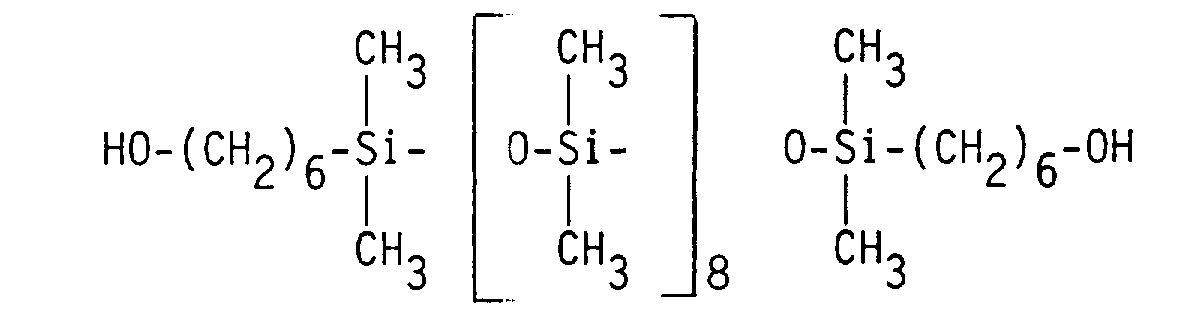


- Zu einer Mischung von 92,6 g (0,1 Mol) eines über Si-C-Gruppen gebundene Hydroxygruppen enthaltenden Siloxans der durchschnittlichen Formel


- Zu einer Mischung von 92,6 g (0,1 Mol) eines über Si-C-Gruppen gebundene Hydroxygruppen enthaltenden Siloxans der durchschnittlichen Formel


- Zu einer Mischung von 84,2 g (0,1 Mol) eines über Si-C-Gruppen gebundene Hydroxygruppen enthaltenden Siloxans der durchschnittlichen Formel
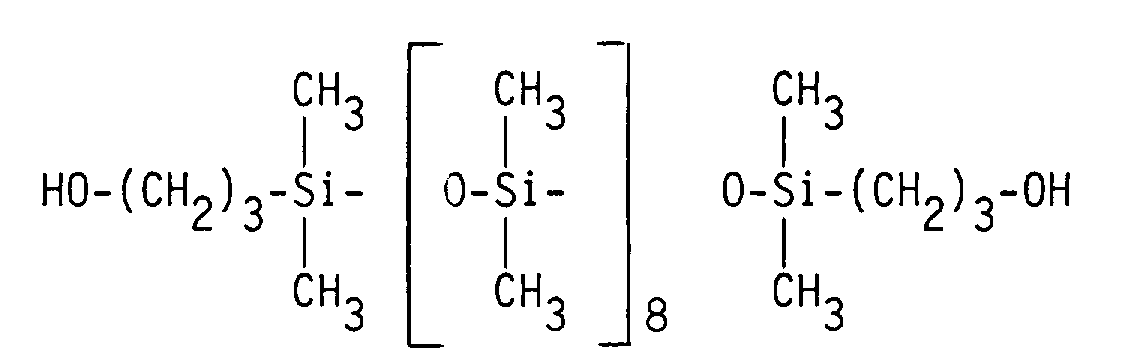


- Zu einer Mischung von 236 g (0,05 Mol) eines über Si-C-Gruppen gebundene Hydroxygruppen enthaltenden Siloxans der durchschnittlichen Formel

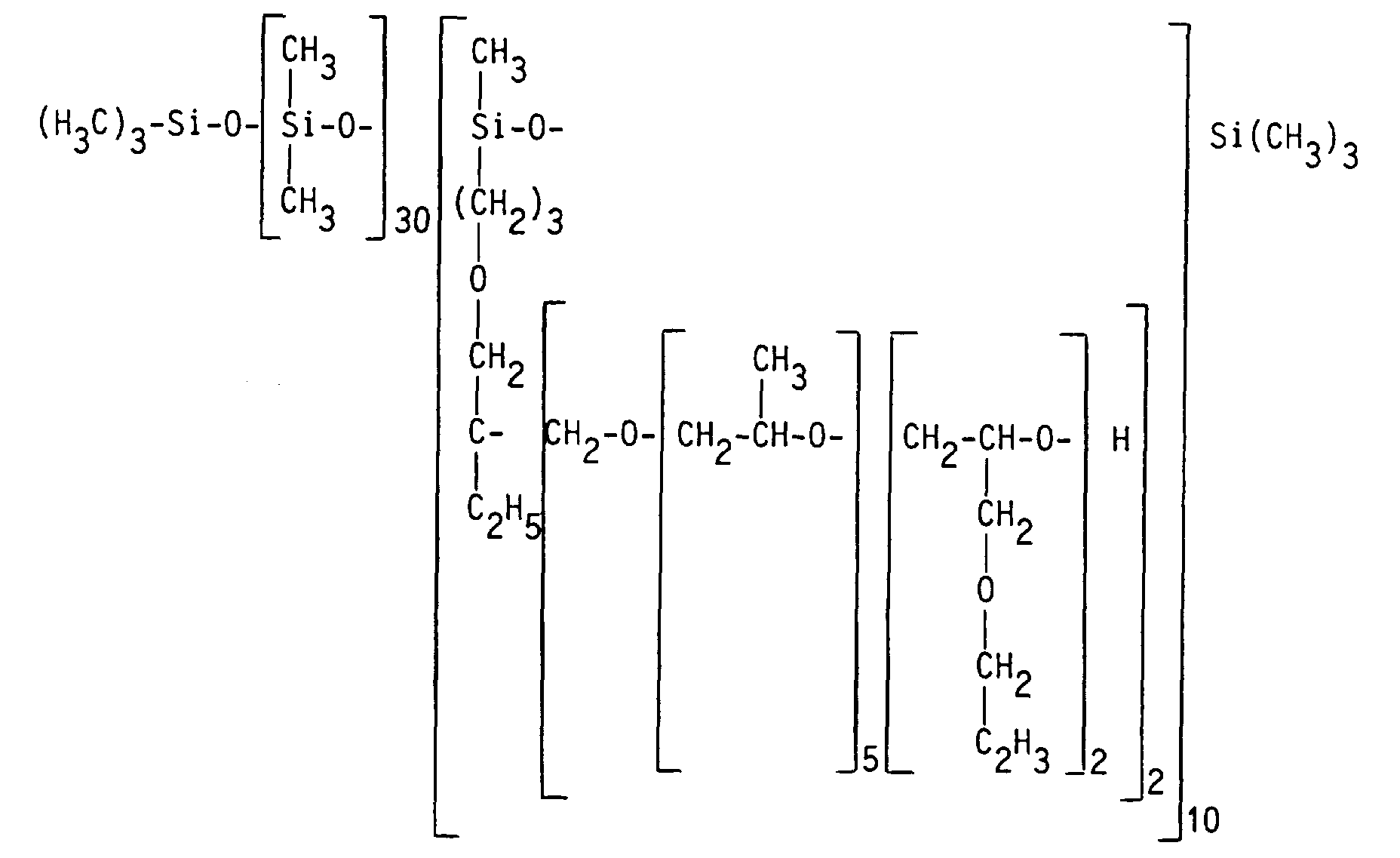
- Zu einer Mischung von 416 g (0,1 Mol) eines über Si-C-Gruppen gebundene Hydroxygruppen enthaltenden Siloxans der durchschnittlichen Formel


- Zu einer Mischung von 92,6 g (0,1 Mol) eines über Si-C-Gruppen gebundene Hydroxygruppen enthaltenden Siloxans der durchschnittlichen Formel


- Zur anwendungstechnischen Prüfung werden die erhaltenen Silikonpolyether einem selbsthärtenden Lacksystem in einer Konzentration von 1 % beigemischt und die Mischung mit einem 40-µm-Drahtrakel auf Bonder-Stahlblech aufgetragen. Nach einer Aushärtezeit von 48 h wird der Lack durch einen Abzugstest mit Tesa® 4154 auf sein Release-Verhalten überprüft (Test 1).
- Ein Maß für die Kratzfestigkeit der erhaltenen Lacke ist die Zugkraft, die nötig ist, um einen 500 g schweren Probenkörper, der auf drei Schrauben ruht, mit 30 cm/min über den Lack zu ziehen (Test 2).
- Die schaumstabilisierenden Eigenschaften der entstandenen Silikonpolyether werden in einer Weichschaumformulierung mit 100 Teilen eines Polyetherpolyols, 4,0 Teilen Wasser, 0,1 Teilen eines tertiären Aminkatalysators, 0,1 Teilen Zinnoktoat und 0,5 Teilen eines Schaumstabilisators getestet. Dafür werden jeweils 0,5 Teile der zu testenden Substanz zu der Formulierung zugemischt und die Steighöhe des Schaumes gemessen (Test 3).
Test 1 Test 2 Test 3 keine Zugabe 11,6 N 3,5 N 31,1 cm Substanz aus Beispiel 1 6,4 N 1,8 N Kollaps Substanz aus Beispiel 2 7,1 N 2,3 N Kollaps Substanz aus Beispiel 3 6,2 N 1,6 N 23,2 cm Substanz aus Beispiel 4 5,9 N 1,9 N Kollaps Substanz aus Beispiel 5 5,9 N 2,1 N Kollaps Substanz aus Beispiel 6 9,7 N 3,2 N 32,6 cm Substanz aus Beispiel 7 8,5 N 2,7 N 31,7 cm Substanz aus Beispiel 8 5,1 N 1,4 N Kollaps
Claims (9)
- Verfahren zur Herstellung von Polyethersiloxanen, deren Polyetherreste durch Si-C-Bindungen an das Polysiloxangerüst gebunden sind, dadurch gekennzeichnet, daß man Polysiloxane der allgemeinen durchschnittlichen Formel
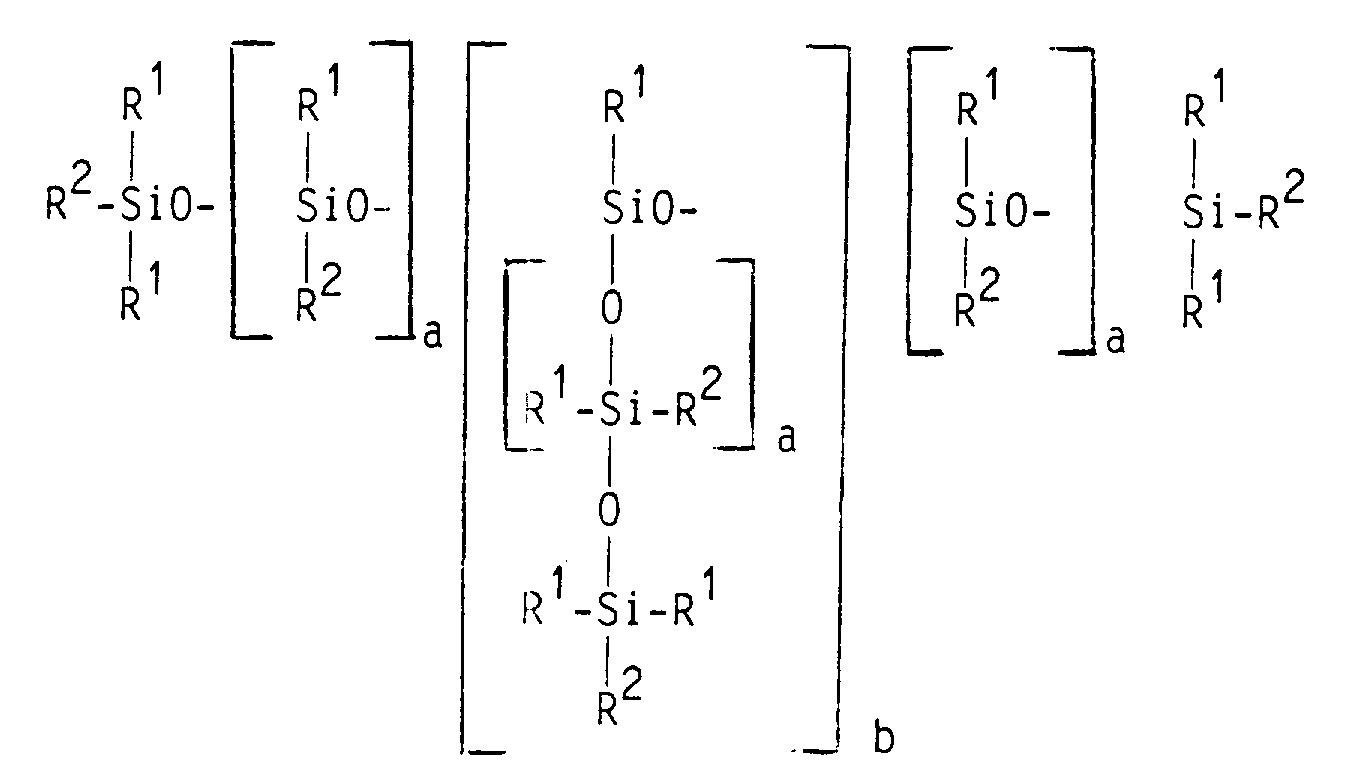 R1 gleich oder verschieden sind und Alkylreste mit 1 bis 4 Kohlenstoffatomen oder Phenylreste bedeuten, mindestens 90 % der Reste R1 aber Methylreste sind,R2 die Bedeutung der Reste R1 haben können, aber mindestens ein Rest R2 ein Rest der allgemeinen Formel
 R3 ein Wasserstoff- oder ein Alkylrest mit 1 bis 4 Kohlenstoffatomen ist,R4 ein (n+1)-wertiger aliphatischer Kohlenwasserstoff- oder Etherrest ist, undn einen Wert von 1, 2 oder 3 hat,a einen Wert von 1 bis 1000 undb einen Wert von 0 bis 10 hat,mit einer mindestens eine Epoxidgruppe aufweisenden Verbindung in solchen Mengen, daß auf eine OH-Gruppe mindestens zwei Epoxidgruppen entfallen, in Gegenwart von Lewis-Säuren bei Temperaturen von ≦ 60°C umsetzt und die Umsetzung gegebenenfalls in Gegenwart eines inerten Lösungsmittels durchführt.
 - Verfahren nach Anspruch 1, dadurch gekennzeichnet, daß mindestens ein Rest R2 der Rest -(CH2)3-OH ist.
- Verfahren nach Anspruch 1, dadurch gekennzeichnet, daß mindestens ein Rest R2 der Rest -(CH2)3-O-C2H4OH ist.
- Verfahren nach Anspruch 1, dadurch gekennzeichnet, daß man als Epoxide Alkylenoxide mit 2 bis 4 Kohlenstoffatomen einsetzt.
- Verfahren nach Anspruch 1, dadurch gekennzeichnet, daß man als Epoxide cycloaliphatische Epoxide einsetzt.
- Verfahren nach Anspruch 1, dadurch gekennzeichnet, daß man als Epoxide Epoxyalkene der allgemeinen Formel

- Verfahren nach Anspruch 1, dadurch gekennzeichnet, daß man als Epoxide Epoxyalkenether der allgemeinen Formel

- Verfahren nach Anspruch 7, dadurch gekennzeichnet, daß man Allylglycidether einsetzt.
- Verfahren nach einem oder mehreren der vorhergehenden Ansprüche, dadurch gekennzeichnet, daß man als Katalysator BF3 einsetzt.
Applications Claiming Priority (2)
| Application Number | Priority Date | Filing Date | Title |
|---|---|---|---|
| DE4219070A DE4219070A1 (de) | 1992-06-11 | 1992-06-11 | Verfahren zur Herstellung von Polyethersiloxanen |
| DE4219070 | 1992-06-11 |
Publications (3)
| Publication Number | Publication Date |
|---|---|
| EP0573864A2 EP0573864A2 (de) | 1993-12-15 |
| EP0573864A3 EP0573864A3 (en) | 1994-08-17 |
| EP0573864B1 true EP0573864B1 (de) | 1997-10-01 |
Family
ID=6460760
Family Applications (1)
| Application Number | Title | Priority Date | Filing Date |
|---|---|---|---|
| EP93108726A Expired - Lifetime EP0573864B1 (de) | 1992-06-11 | 1993-05-29 | Verfahren zur Herstellung von Polyethersiloxanen |
Country Status (3)
| Country | Link |
|---|---|
| US (1) | US5391679A (de) |
| EP (1) | EP0573864B1 (de) |
| DE (2) | DE4219070A1 (de) |
Families Citing this family (16)
| Publication number | Priority date | Publication date | Assignee | Title |
|---|---|---|---|---|
| DE4411079A1 (de) * | 1994-03-30 | 1995-10-05 | Bayer Ag | Neuartige Copolymere auf verzweigter Polysiloxan-Polyether-Basis, ein Verfahren zu ihrer Herstellung und ihre Verwendung |
| US5856369A (en) * | 1996-07-30 | 1999-01-05 | Osi Specialties, Inc. | Polyethers and polysiloxane copolymers manufactured with double metal cyanide catalysts |
| KR100281513B1 (ko) * | 1997-05-22 | 2001-02-15 | 울프 크라스텐센, 스트라쎄 로텐베르그 | 특히 당 라디칼 또는 당유도체인 폴리하이드록시오가닐 라디칼 및 폴리옥시 알킬렌 라디칼로 구성되는 오카노 폴리실록산 |
| DE69827751T2 (de) * | 1997-12-22 | 2005-12-01 | General Electric Co. | Dauerhafte hydrophile Beschichtung für Textilien |
| NZ509436A (en) * | 2000-03-24 | 2002-05-31 | Goldschmidt Ag Th | Siloxane-containing oil compositions with good spreading properties |
| US20020091219A1 (en) | 2001-01-08 | 2002-07-11 | Clement Katherine Sue | Certain silicone polyethers, methods for making them and uses |
| DE102006030531A1 (de) * | 2006-07-01 | 2008-01-03 | Goldschmidt Gmbh | Siliconstabilisatoren für flammgeschützte Polyurethan- bzw. Polyisocyanurat-Hartschaumstoffe |
| DE102008000903A1 (de) * | 2008-04-01 | 2009-10-08 | Evonik Goldschmidt Gmbh | Neue Organosiloxangruppen tragende Polyetheralkohole durch Alkoxylierung epoxidfunktioneller (Poly)Organosiloxane an Doppelmetallcyanid (DMC)-Katalysatoren, sowie Verfahren zu deren Herstellung |
| DE102008002713A1 (de) * | 2008-06-27 | 2009-12-31 | Evonik Goldschmidt Gmbh | Neue Polyethersiloxane enthaltende Alkoxylierungsprodukte durch direkte Alkoxylierung organomodifizierter alpha, omega-Dihydroxysiloxane an Doppelmetallcyanid (DMC)-Katalysatoren, sowie Verfahren zu deren Herstellung |
| DE102008043245A1 (de) * | 2008-10-29 | 2010-05-06 | Evonik Goldschmidt Gmbh | Siliconpolyether-Copolymersysteme sowie Verfahren zu deren Herstellung durch Alkoxylierungsreaktion |
| DE102008043343A1 (de) * | 2008-10-31 | 2010-05-06 | Evonik Goldschmidt Gmbh | Silikonpolyetherblock-Copolymere mit definierter Polydispersität im Polyoxyalkylenteil und deren Verwendung als Stabilisatoren zur Herstellung von Polyurethanschäumen |
| EP3663372B1 (de) * | 2018-12-06 | 2024-03-13 | Henkel AG & Co. KGaA | Härtbare zusammensetzung mit polysiloxan-polyalkylenglycol-bürstencopolymeren |
| PL3663371T3 (pl) * | 2018-12-06 | 2024-06-24 | Henkel Ag & Co. Kgaa | Wytwarzanie kopolimerów szczotkowych polisiloksanu i poli(glikolu alkilenowego) |
| US12264220B2 (en) | 2020-01-30 | 2025-04-01 | Evonik Operations Gmbh | Process for producing high-purity hydrosilylation products |
| US11732092B2 (en) | 2020-10-19 | 2023-08-22 | Evonik Operations Gmbh | Upcycling process for processing silicone wastes |
| EP4508115A1 (de) | 2022-04-13 | 2025-02-19 | Dow Global Technologies LLC | Herstellung von polyetherfunktionellen organosiliciumverbindungen |
Family Cites Families (12)
| Publication number | Priority date | Publication date | Assignee | Title |
|---|---|---|---|---|
| US2293868A (en) * | 1939-12-29 | 1942-08-25 | Carbide & Carbon Chem Corp | Polymerization products |
| US2538072A (en) * | 1947-06-11 | 1951-01-16 | Devoe & Raynolds Co | Epoxide preparation |
| US2819245A (en) * | 1955-03-07 | 1958-01-07 | Dow Corning | Siloxane-epoxide resin reaction products |
| US2846458A (en) * | 1956-05-23 | 1958-08-05 | Dow Corning | Organosiloxane ethers |
| US3057901A (en) * | 1960-05-13 | 1962-10-09 | Dow Corning | Hydroxyether organosilicon compounds |
| US4665239A (en) * | 1979-10-22 | 1987-05-12 | Basf Corporation | Polyethers modified with alpha olefin oxides |
| GB8314125D0 (en) * | 1983-05-21 | 1983-06-29 | Dow Corning Ltd | Polysiloxane-polyoxyalkylene copolymers |
| US5026810A (en) * | 1990-02-16 | 1991-06-25 | Gaf Chemicals Corporation | Vinyl ether siloxanes |
| DE4009889C1 (de) * | 1990-03-28 | 1991-06-13 | Th. Goldschmidt Ag, 4300 Essen, De | |
| US5290912A (en) * | 1990-05-11 | 1994-03-01 | Asahi Glass Company Ltd. | Process for producing a polyoxyalkylene compound |
| DE4104270A1 (de) * | 1991-02-13 | 1992-08-20 | Goldschmidt Ag Th | Organopolysiloxane mit an einer gemeinsamen spacergruppe gebundenen polyether- und ester-gruppen |
| US5175327A (en) * | 1992-01-27 | 1992-12-29 | Siltech Inc. | Process for the preparation of silonal alkoxylates |
-
1992
- 1992-06-11 DE DE4219070A patent/DE4219070A1/de not_active Withdrawn
-
1993
- 1993-05-17 US US08/062,675 patent/US5391679A/en not_active Expired - Fee Related
- 1993-05-29 EP EP93108726A patent/EP0573864B1/de not_active Expired - Lifetime
- 1993-05-29 DE DE59307444T patent/DE59307444D1/de not_active Expired - Fee Related
Also Published As
| Publication number | Publication date |
|---|---|
| DE4219070A1 (de) | 1993-12-16 |
| DE59307444D1 (de) | 1997-11-06 |
| US5391679A (en) | 1995-02-21 |
| EP0573864A3 (en) | 1994-08-17 |
| EP0573864A2 (de) | 1993-12-15 |
Similar Documents
| Publication | Publication Date | Title |
|---|---|---|
| EP0573864B1 (de) | Verfahren zur Herstellung von Polyethersiloxanen | |
| EP1679335B1 (de) | Siloxanblockcopolymere | |
| EP0867465B1 (de) | Verwendung von Blockcopolymeren mit verknüpften Siloxanblöcken bei der Herstellung von Polyrethanschaumstoffen | |
| EP0585771B1 (de) | Polysiloxan-Polyoxyalkylen-Blockmischpolymerisat mit unterschiedlichen Polyoxyalkylenblöcken im durchschnittlichen Molekül | |
| EP2042542B1 (de) | Verwendung linearer Siloxane und Verfahren zu deren Herstellung | |
| EP0168713B1 (de) | (Meth)acrylsäureestermodifizierte Organopolysiloxangemische, deren Herstellung und Verwendung als abhäsive Beschichtungsmassen | |
| EP2676986A1 (de) | Siliconpolyether und Verfahren zu deren Herstellung aus Methylidengruppen tragenden Polyethern | |
| EP2167562B1 (de) | Verfahren zur herstellung von polyurethan-schäumen auf basis von speziellen alkoxysilanfunktionellen polymeren | |
| DE2533074B2 (de) | Verfahren zur Herstellung von hochelastischen Polyurethanweichschäumen | |
| EP1754740A2 (de) | Verfahren zur Herstellung von Anlagerungsprodukten aus SiH-Gruppen enthaltenden Verbindungen an eine Doppelbindung aufweisenden Reaktionspatner in wässrigen Medien | |
| DE2215393B2 (de) | Siloxan-Polyoxyalkylen-Blockcopolymere, ihre Herstellung und Verwendung | |
| DE3786326T2 (de) | Härtungszusammensetzung. | |
| DE68927817T2 (de) | Polysiloxan-Polyethercopolymere und Verfahren zu deren Herstellung | |
| DE69419885T2 (de) | Zusammensetzung aus Organopolysiloxankopolymeren in einem Phenylether-Lösungsmittel | |
| EP0468305B1 (de) | Härtbare Epoxygruppen aufweisende Organopolysiloxane, Verfahren zu ihrer Herstellung und ihre Verwendung als härtbare Beschichtungsmittel mit abhäsiven Eigenschaften | |
| DE2323398B2 (de) | Verfahren zur Herstellung hydrolysierbarer Siloxan-Polyoxyalkylen-Blockmischpolymerer mit hohem Molekulargewicht | |
| EP0867462B1 (de) | Neuartige Siloxanblockcopolymere mit verknüpften Siloxanblöcken | |
| DE19707970A1 (de) | Polycarbonsäurefunktionelle Polyorganosiloxane | |
| EP0499051B1 (de) | Organopolysiloxane mit an einer gemeinsamen Spacergruppe gebundenen Polyether- und Ester-Gruppen | |
| DE4010153C2 (de) | ||
| EP0867461B1 (de) | Neuartige Siloxanblockcopolymere mit starren Spacern und deren Verwendung | |
| CH452186A (de) | Verfahren zur Herstellung von Polyurethanschaumstoffen | |
| DE4309831A1 (de) | Abhäsive Beschichtungsmasse mit einem den Grad der Abhäsivität beeinflussenden Zusatzmittel | |
| DE2301789B2 (de) | Siloxan-polyoxyalkylen-blockmischpolymere, verfahren zu deren herstellung und verwendung | |
| DE102007047866A1 (de) | Herstellung von organofunktionellen Siliziumverbindungen |
Legal Events
| Date | Code | Title | Description |
|---|---|---|---|
| PUAI | Public reference made under article 153(3) epc to a published international application that has entered the european phase |
Free format text: ORIGINAL CODE: 0009012 |
|
| 17P | Request for examination filed |
Effective date: 19930607 |
|
| AK | Designated contracting states |
Kind code of ref document: A2 Designated state(s): DE FR GB |
|
| PUAL | Search report despatched |
Free format text: ORIGINAL CODE: 0009013 |
|
| AK | Designated contracting states |
Kind code of ref document: A3 Designated state(s): DE FR GB |
|
| 17Q | First examination report despatched |
Effective date: 19960220 |
|
| GRAG | Despatch of communication of intention to grant |
Free format text: ORIGINAL CODE: EPIDOS AGRA |
|
| GRAH | Despatch of communication of intention to grant a patent |
Free format text: ORIGINAL CODE: EPIDOS IGRA |
|
| GRAH | Despatch of communication of intention to grant a patent |
Free format text: ORIGINAL CODE: EPIDOS IGRA |
|
| GRAA | (expected) grant |
Free format text: ORIGINAL CODE: 0009210 |
|
| AK | Designated contracting states |
Kind code of ref document: B1 Designated state(s): DE FR GB |
|
| ET | Fr: translation filed | ||
| REF | Corresponds to: |
Ref document number: 59307444 Country of ref document: DE Date of ref document: 19971106 |
|
| GBT | Gb: translation of ep patent filed (gb section 77(6)(a)/1977) |
Effective date: 19971203 |
|
| PLBE | No opposition filed within time limit |
Free format text: ORIGINAL CODE: 0009261 |
|
| STAA | Information on the status of an ep patent application or granted ep patent |
Free format text: STATUS: NO OPPOSITION FILED WITHIN TIME LIMIT |
|
| 26N | No opposition filed | ||
| PGFP | Annual fee paid to national office [announced via postgrant information from national office to epo] |
Ref country code: FR Payment date: 20010507 Year of fee payment: 9 |
|
| REG | Reference to a national code |
Ref country code: FR Ref legal event code: CD |
|
| REG | Reference to a national code |
Ref country code: GB Ref legal event code: IF02 |
|
| PG25 | Lapsed in a contracting state [announced via postgrant information from national office to epo] |
Ref country code: FR Free format text: LAPSE BECAUSE OF NON-PAYMENT OF DUE FEES Effective date: 20030131 |
|
| REG | Reference to a national code |
Ref country code: FR Ref legal event code: ST |
|
| PGFP | Annual fee paid to national office [announced via postgrant information from national office to epo] |
Ref country code: GB Payment date: 20030428 Year of fee payment: 11 |
|
| PGFP | Annual fee paid to national office [announced via postgrant information from national office to epo] |
Ref country code: DE Payment date: 20030514 Year of fee payment: 11 |
|
| PG25 | Lapsed in a contracting state [announced via postgrant information from national office to epo] |
Ref country code: GB Free format text: LAPSE BECAUSE OF NON-PAYMENT OF DUE FEES Effective date: 20040529 |
|
| PG25 | Lapsed in a contracting state [announced via postgrant information from national office to epo] |
Ref country code: DE Free format text: LAPSE BECAUSE OF NON-PAYMENT OF DUE FEES Effective date: 20041201 |
|
| GBPC | Gb: european patent ceased through non-payment of renewal fee |