EP0574800A2 - Verfahren zum Gerben von Leder und Pelzen - Google Patents
Verfahren zum Gerben von Leder und Pelzen Download PDFInfo
- Publication number
- EP0574800A2 EP0574800A2 EP93109174A EP93109174A EP0574800A2 EP 0574800 A2 EP0574800 A2 EP 0574800A2 EP 93109174 A EP93109174 A EP 93109174A EP 93109174 A EP93109174 A EP 93109174A EP 0574800 A2 EP0574800 A2 EP 0574800A2
- Authority
- EP
- European Patent Office
- Prior art keywords
- tanning
- compounds
- oder
- formula
- hydroxy
- Prior art date
- Legal status (The legal status is an assumption and is not a legal conclusion. Google has not performed a legal analysis and makes no representation as to the accuracy of the status listed.)
- Granted
Links
Classifications
-
- C—CHEMISTRY; METALLURGY
- C14—SKINS; HIDES; PELTS; LEATHER
- C14C—CHEMICAL TREATMENT OF HIDES, SKINS OR LEATHER, e.g. TANNING, IMPREGNATING, FINISHING; APPARATUS THEREFOR; COMPOSITIONS FOR TANNING
- C14C1/00—Chemical treatment prior to tanning
-
- C—CHEMISTRY; METALLURGY
- C14—SKINS; HIDES; PELTS; LEATHER
- C14C—CHEMICAL TREATMENT OF HIDES, SKINS OR LEATHER, e.g. TANNING, IMPREGNATING, FINISHING; APPARATUS THEREFOR; COMPOSITIONS FOR TANNING
- C14C3/00—Tanning; Compositions for tanning
- C14C3/02—Chemical tanning
- C14C3/08—Chemical tanning by organic agents
-
- C—CHEMISTRY; METALLURGY
- C07—ORGANIC CHEMISTRY
- C07D—HETEROCYCLIC COMPOUNDS
- C07D309/00—Heterocyclic compounds containing six-membered rings having one oxygen atom as the only ring hetero atom, not condensed with other rings
- C07D309/02—Heterocyclic compounds containing six-membered rings having one oxygen atom as the only ring hetero atom, not condensed with other rings having no double bonds between ring members or between ring members and non-ring members
- C07D309/08—Heterocyclic compounds containing six-membered rings having one oxygen atom as the only ring hetero atom, not condensed with other rings having no double bonds between ring members or between ring members and non-ring members with hetero atoms or with carbon atoms having three bonds to hetero atoms with at the most one bond to halogen, e.g. ester or nitrile radicals, directly attached to ring carbon atoms
- C07D309/10—Oxygen atoms
Definitions
- the invention relates to an improved method for single tanning, pre-tanning and co-tanning of skin and skin and for retanning leather and skin.
- DE-A-17 69 059 relates to a process for leather production by treating tannable material with zinc salts, water-soluble sulfates and aldehydes or aldehyde-releasing substances and aftertreatment with dulling agents.
- the object of the present invention was therefore to provide new tanning agents for single, pre-tanning and retanning, which no longer have the disadvantages of the agents of the prior art.
- C1 to C18 alkyl radicals R can be linear or branched, the C9 to C18 radicals, e.g. Nonyl, decyl, dodecyl, tridecyl, tetradecyl, hexadecyl or octadecyl are less preferred.
- Hydroxycarboxylic acid residues R originate e.g. of the following acids: hydroxyacetic acid, hydroxypropionic acid, lactic acid or hydroxystearic acid.
- the residues R can of course also be in salt form, e.g. as lithium, sodium, potassium or optionally substituted ammonium salts.
- R radicals are in particular C1 to C8 alkyl and C3- to C40-oxaalkyl such as CH3, C2H5, C3H7, C4H9, C5H11, C6H13, C7H15, C8H17, , CH2CH2OCH3, CH2CH2OC2H5, CH2CH2-OC4H9, CH2CHOH-CH2 (CH2CH2O) 2-CH3, (CH2CH2O) 3CH3, (CH2CH2O) 4CH3 or polyalkylene oxide groups.
- R 1 radicals correspond in particular to the formula in which R2 and n have the meanings given.
- one of the radicals R is preferably C1 to C4 alkyl, in particular methyl.
- Preferred compounds correspond to formula Ia in which B is a residue of the formula is, and n, R2 and R3 have the meanings given.
- R2 is preferably hydrogen and n is 4 to 10.
- alcoholic hydroxyl compounds can be added to 2-alkoxy-3,4-dihydro-2-pyranes in a manner known per se; preferred as the pyran compound is 2-methoxy-3,4-dihydro-2-pyran. Details of the production can be found in the corresponding examples.
- the tanning process according to the invention is outstandingly suitable for the sole tanning and pre-tanning of pelts and pelts in an aqueous liquor.
- the procedure is such that the pickled pelts, for example cowhide pelts with a gap thickness of 1.5 to 4 mm, or pelts, for example sheepskin pelts, at a pH of 2 to 7, in particular 2.5 to 4, and one Temperature of 15 to 50 °, in particular 25 to 45 ° C, are treated with an aqueous solution or dispersion of the compounds I for a period of 3 to 20 hours.
- the treatment takes place, for example, by walking in one Barrel.
- the required amount of compounds I is normally 2 to 30% by weight, in particular 5 to 20% by weight, based on the pelt weight.
- the liquor length, ie the percentage weight ratio of the treatment liquor to the goods, is usually 30 to 200% in the case of bare and 100 to 2000% in the case of pelts, in each case based on the bare weight.
- the leather or fur is usually adjusted to a pH of 4 to 8, in particular 5 to 7, for which purpose magnesium oxide, sodium carbonate or sodium hydrogen carbonate is used, optionally treated with further tanning agents and, if desired, dyed after the tanning process has ended and greased.
- the tanning process according to the invention is also excellently suitable for the tanning of bare and pelt bones together with the tanning agents of the main tanning, which can be, for example, chrome or aluminum tanning.
- the working conditions regarding pH, temperature and duration of the treatment are adjusted to the requirements of the main components of the tanning, the same applies to the treatment apparatus and the liquor length as well as to the aftertreatment.
- the required amount of compounds I is normally 0.1 to 20% by weight, in particular 0.5 to 15% by weight, based on the pelt weight.
- the tanning process according to the invention is also outstandingly suitable for retanning leather and fur which has already been tanned, for example chrome leather, in an aqueous liquor. It is usually carried out in such a way that the pickled pelts and skins, for example bovine pelts with a gap thickness of 1.5 to 4 mm, are used, for example, with a customary chromium-containing tanning agent such as a chromium (III) salt, for example chromium (III) sulfate , tanned in a manner known per se, the pretanned skins obtained in this way (in the case of chrome tanning "wet blues") and deacidified at a pH of 2 to 7, in particular 2.5 to 4, and at temperatures of 15 to 50 ° C., in particular 25 to 45 ° C, treated with an aqueous solution or dispersion of the compounds I for a period of 1 to 12 hours.
- a customary chromium-containing tanning agent such as
- This treatment takes place, for example, by drumming in a barrel.
- the needed amount of compounds of the formula I is normally 2 to 30% by weight, in particular 5 to 20% by weight, based on the shaved weight of the leather.
- the liquor length is usually 30 to 200% for bare and 100 to 2000% for bare, each based on the fold weight of the leather.
- the leather or fur is usually adjusted to a pH of 3 to 5, for example using magnesium oxide or an organic acid such as formic acid or its salts, and, if desired, dyed and greased after the treatment.
- the leather or fur retanned according to the invention may have been additionally treated with other tanning agents, such as polymer tanning agents or syntans, before retanning with the compounds I.
- the compounds I can also be used simultaneously with such additional tanning agents, for example in main tanning.
- tanning agents As additional or simultaneously used tanning agents, all usual agents with tanning effects on bare or fur bare are considered. A comprehensive treatment of such tanning agents can be found, for example, in Ullmanns Encyklopadie der Technische Chemie, 3rd edition, 11th volume, pages 585 to 612 (1960).
- the tannin classes to be mentioned individually are the mineral tannins, e.g. Chromium, aluminum, zinc and zirconium salts, the synthetic tanning agents such as the polymer tanning agents and syntans already mentioned above, and the vegetable (vegetable) tanning agents.
- leather and furs are produced which, in comparison to the products obtained with previously known aldehyde tannins such as glutardialdehyde, have not only a full and very soft feel and high shrinkage temperatures, but also a significantly improved tear and tensile strength.
- the leather and skins tanned according to the invention no longer have a disturbing yellow color.
- a clear advantage is the good penetration ability of even small amounts of the compounds to be used according to the invention.
- Another advantage of the tanning process according to the invention is the low volatility of the compounds of the formula I, which has an effect, for example, on the amount of these tanning agents used, which need only be relatively low.
- the compounds I are in a sense universal tanning agents, since they can be combined with all other customary tanning agents and can be used both for the sole, the pre, the with and for the retanning.
- a white leather with a shrinking temperature of approximately 85 ° C. was obtained, which was very soft and easy to grip.
- Example 4 Analogously to Example 4, 8% by weight of tannin, prepared according to Example 1, was used for single tanning.
- the leather thus obtained had a shrinking temperature of approximately 83 ° C.
- Well decalcified and pickled bare bark with a gap thickness of 2 mm was first used with a liquor length of 50% for 10 minutes with 1% fat liquor, then after the addition of approx. 0.7% tanning agent, according to Example 1 and 1% polymer tanning agent another drum in the barrel for 60 minutes. Then 1% of a synthetic tanning agent was added and drummed for another 60 minutes in the barrel. The pH was then adjusted to 3.9 overnight with magnesium oxide.
- the pH was then adjusted to about 4 using 1% by weight sodium formate.
- the retanned leather was dyed with a conventional leather dye, greased with a usual licker and finished in the usual way.
Landscapes
- Chemical & Material Sciences (AREA)
- Organic Chemistry (AREA)
- Chemical Kinetics & Catalysis (AREA)
- General Chemical & Material Sciences (AREA)
- Treatment And Processing Of Natural Fur Or Leather (AREA)
- Pyrane Compounds (AREA)
Abstract

verwendet, in der
- m
- die Zahlen 0 oder 1 und die Reste
- R
- unabhängig voneinander gegebenenfalls durch Hydroxy- oder Carboxy- substituiertes und/oder durch Sauerstoffatome unterbrochenes C₁- bis C₁₈-Alkyl oder einer der Reste R auch einen Rest der Formel

bedeuten, wobei
- R¹
- gegebenenfalls durch Hydroxy substituiertes und/oder durch Sauerstoffatome unterbrochenes Alkylen ist.
Description
- Die Erfindung betrifft ein verbessertes Verfahren zum Alleingerben, Vorgerben und Mitgerben von Blößen und Fellblößen und zum Nachgerben von Leder und Fell.
- Aldehyde und insbesondere Dialdehyde wie Glutardialdehyd werden als Ledergerbstoffe oft in der Literatur beschrieben und häufig in der Praxis eingesetzt. So betrifft beispielsweise die DE-A-17 69 059 ein Verfahren zur Lederherstellung durch Behandeln von gerbbarem Material mit Zinksalzen, wasserlöslichen Sulfaten und Aldehyden oder Aldehyde abspaltenden Stoffen und Nachbehandeln mit Abstumpfungsmitteln.
- Diese Verfahren und die durch diese Verfahren erhaltenen Leder und Felle weisen aber häufig eine Reihe von Nachteilen auf. Bei der Gerbung insbesondere mit Glutardialdehyd können aufgrund seiner hohen Reaktivität ungleichmäßige Gerbeffekte auftreten; dies ist insbesondere bei ungespaltenen Blößen der Fall, bei denen mit niedrigen Konzentrationen von Dialdehyd keine vollständige Durchgerbung erzielt wird. Weiterhin gestalten zu hohe Flüchtigkeiten und oft zu hohe Toxizitäten oder Gesundheitsgefährdungspotentiale der verwendeten Aldehyde die Gerbeverfahren problematisch, weil hierdurch Schutzmaßnahmen getroffen werden müssen und außerdem eine relativ hohe Einsatzmenge an Gerbstoff notwendig ist.
- Aufgabe der vorliegenden Erfindung war es daher, neue Gerbstoffe für die Allein-, Vor-, Mit- und Nachgerbung bereitzustellen, die die Nachteile der Mittel des Standes der Technik nicht mehr aufweisen.
- Die Erfindung betrifft nun ein Verfahren zum Gerben von Leder, das dadurch gekennzeichnet ist, daß man dazu Verbindungen der allgemeinen Formel I

verwendet, in der - m
- die Zahlen 0 oder 1 und die Reste
- R
- unabhängig voneinander gegebenenfalls durch Hydroxy- oder Carboxy- substituiertes und/oder durch Sauerstoffatome unterbrochenes C₁- bis C₁₈-Alkyl oder einer der Reste R auch einen Rest der Formel
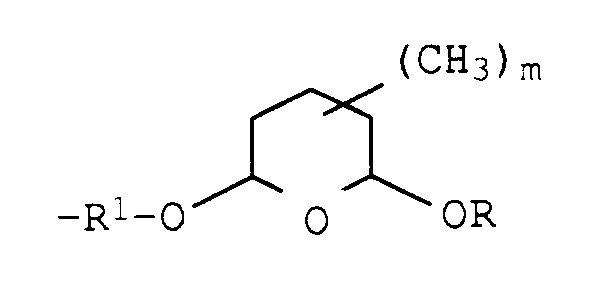
- R¹
- gegebenenfalls durch Hydroxy substituiertes und/oder durch Sauerstoffatome unterbrochenes Alkylen ist.
- C₁- bis C₁₈-Alkylreste R können linear oder verzweigt sein, wobei die C₉- bis C₁₈-Reste, z.B. Nonyl, Decyl, Dodecyl, Tridecyl, Tetradecyl, Hexadecyl oder Octadecyl weniger bevorzugt sind.
- Hydroxycarbonsäurereste R stammen z.B. von folgenden Säuren: Hydroxyessigsäure, Hydroxypropionsäure, Milchsäure oder Hydroxystearinsäure.
- Die Reste R können dabei natürlich auch in Salzform vorliegen, z.B. als Lithium-, Natrium-, Kalium- oder gegebenenfalls substituierte Ammoniumsalze.
- Reste R sind insbesondere C₁- bis C₈-Alkyl sowie C₃- bis C₄₀-Oxaalkyl wie CH₃, C₂H₅, C₃H₇, C₄H₉, C₅H₁₁, C₆H₁₃, C₇H₁₅, C₈H₁₇,

, CH₂CH₂OCH₃, CH₂CH₂OC₂H₅, CH₂CH₂-OC₄H₉, CH₂CHOH-CH₂ (CH₂CH₂O)₂-CH₃, (CH₂CH₂O)₃CH₃, (CH₂CH₂O)₄CH₃ oder Polyalkylenoxidgruppen. - Eine bevorzugte Gruppe von Resten R entspricht der Formel

in der - n
- 1 bis 20,
- R²
- Wasserstoff oder C₁- bis C₄-Alkyl und
- R³
- Wasserstoff oder C₁- bis C₈-Alkyl sind.
- Reste R¹ entsprechen insbesondere der Formel

in der R² und n die angegebenen Bedeutungen haben. - Aufgrund der Herstellung der Verbindungen der Formel I ist einer der Reste R vorzugsweise C₁- bis C₄-Alkyl, insbesondere Methyl.
- Bevorzugte Verbindungen entsprechen der Formel Ia

wobei
B ein Rest der Formel
ist, und n, R² und R³ die angegebenen Bedeutungen haben. - R² ist vorzugsweise Wasserstoff und n 4 bis 10.
- Erfindungsgemäß ist es wichtig, daß die Verbindungen der Formel I möglichst gut wasserlöslich sind. Durch Variation und Kombination der verschiedenen Substituenten ist es dem Fachmann leicht möglich, diese Wasserlöslichkeit zu erzielen.
- Die erfindungsgemäß zu verwendenden Verbindungen der Formel

sind neu; hinsichtlich der Bevorzugungen gilt das bereits Gesagte. - Zur Herstellung der Verbindungen der Formel I kann man in an sich bekannter Weise alkoholische Hydroxylverbindungen an 2-Alkoxy-3,4-dihydro-2-pyrane anlagern; bevorzugt als Pyranverbindung ist 2-Methoxy-3,4-dihydro-2-pyran. Einzelheiten der Herstellung können den entsprechenden Beispielen entnommen werden.
- Das erfindungsgemäße Gerbverfahren eignet sich in hervorragender Weise zum Alleingerben und Vorgerben von Blößen und Fellblößen in wäßriger Flotte. Hierbei geht man zweckmäßigerweise so vor, daß die gepickelten Blößen, beispielsweise Rindsblößen mit einer Spaltstärke von 1,5 bis 4 mm, oder Fellblößen, beispielsweise Schaffellblößen, bei einem pH-Wert von 2 bis 7, insbesondere 2,5 bis 4, und einer Temperatur von 15 bis 50°, insbesondere 25 bis 45°C, während eines Zeitraumes von 3 bis 20 Stunden mit einer wäßrigen Lösung oder Dispersion der Verbindungen I behandelt werden. Die Behandlung erfolgt beispielsweise durch Walken in einem Faß. Die benötigte Menge an Verbindungen I beträgt normalerweise, bezogen auf das Blößengewicht, 2 bis 30 Gew.-%, insbesondere 5 bis 20 Gew.-%. Die Flottenlänge, d.h. das prozentuale Gewichtsverhältnis der Behandlungsflotte zur Ware, beträgt üblicherweise 30 bis 200 % bei Blößen und 100 bis 2000 % bei Fellblößen, jeweils bezogen auf das Blößengewicht.
- Nach erfolgter Behandlung wird das Leder bzw. Fell üblicherweise auf einen pH-Wert von 4 bis 8, insbesondere 5 bis 7, eingestellt, wozu man beispielsweise Magnesiumoxid, Natriumcarbonat oder Natriumhydrogencarbonat verwendet, gegebenenfalls mit weiteren Gerbstoffen behandelt und nach Abschluß des Gerbeprozesses gewünschtenfalls gefärbt und gefettet.
- Das erfindungsgemäße Gerbverfahren eignet sich ebenfalls in hervorragender Weise zum tutgerben von Blößen und Fellblößen zusammen mit den Gerbstoffen der Hauptgerbung, welche beispielsweise eine Chrom- oder eine Aluminiumgerbung sein kann. In diesem Fall werden die Arbeitsbedingungen bezüglich pH-Wert, Temperatur und Dauer der Behandlung auf die Anforderungen der Hauptkomponenten der Gerbung eingestellt, das gleiche gilt für die Behandlungsapparatur und die Flottenlänge sowie für die Nachbehandlung. Die benötigte Menge an Verbindungen I beträgt hierbei normalerweise, bezogen auf das Blößengewicht, 0,1 bis 20 Gew.-%, insbesondere 0,5 bis 15 Gew.-%.
- Das erfindungsgemäße Gerbverfahren eignet sich ebenfalls in hervorragender Weise zum Nachgerben von bereits gegerbtem Leder und Fell, beispielsweise Chromleder, in wäßriger Flotte. Es wird in der Regel so durchgeführt, daß man die gepickelten Blößen und Felle, beispielsweise Rindsblößen mit Spaltstärken von 1,5 bis 4 mm, mit beispielsweise einem üblichen chromhaltigen Gerbstoff wie einem Chrom(III)-Salz, z.B. Chrom(III)-Sulfat, in an sich bekannter Weise gerbt, die so erhaltenen vorgegerbten Häute (bei Chromgerbung "Wetblues") entsäuert und bei einem pH-Wert von 2 bis 7, insbesondere 2,5 bis 4, und bei Temperaturen von 15 bis 50°C, insbesondere 25 bis 45°C, während eines Zeitraumes von 1 bis 12 Stunden mit einer wäßrigen Lösung oder Dispersion der Verbindungen I behandelt. Diese Behandlung erfolgt beispielsweise durch Walken in einem Faß. Die benötigte Menge an Verbindungen der Formel I beträgt normalerweise, bezogen auf das Falzgewicht des Leders, 2 bis 30 Gew.-%, insbesondere 5 bis 20 Gew.-%. Die Flottenlänge beträgt üblicherweise 30 bis 200 % bei Blößen und 100 bis 2000 % bei Fellblößen, jeweils bezogen auf das Falzgewicht des Leders.
- Nach und erforderlichenfalls auch vor der Behandlung wird das Leder bzw. Fell üblicherweise auf einen pH-Wert von 3 bis 5 eingestellt, wozu man beispielsweise Magnesiumoxid oder eine organische Säure wie Ameisensäure oder deren Salze verwendet, und nach der Behandlung gewünschtenfalls gefärbt und gefettet.
- Das erfindungsgemäß nachgegerbte Leder oder Fell kann vor der Nachgerbung mit den Verbindungen I zusätzlich mit anderen Gerbstoffen wie Polymergerbstoffen oder Syntanen behandelt worden sein. Auch können die Verbindungen I gleichzeitig mit derartigen zusätzlichen Gerbemitteln, beispielsweise in der Hauptgerbung, eingesetzt werden.
- Als zusätzliche oder gleichzeitig eingesetzte Gerbstoffe kommen alle üblichen Mittel mit Gerbwirkung auf Blößen oder Fellblößen in Betracht. Eine umfassende Abhandlung derartiger Gerbstoffe findet sich beispielsweise in Ullmanns Encyklopädie der technischen Chemie, 3. Auflage, 11. Band, Seiten 585 bis 612 (1960). Einzeln zu erwahnende Gerbstoffklassen sind die mineralischen Gerbstoffe, z.B. Chrom-, Aluminium-, Zink- und Zirkoniumsalze, die synthetischen Gerbstoffe wie die bereits oben genannten Polymergerbstoffe und Syntane, und die vegetabilischen (pflanzlichen) Gerbstoffe.
- Beim erfindungsgemäßen Gerbverfahren entstehen Leder und Pelze, die im Vergleich zu den mit bisher bekannten Aldehydgerbstoffen wie Glutardialdehyd erhaltenen Erzeugnissen neben einem vollen und sehr weichen Griff und neben hohen Schrumpfungstemperaturen eine deutlich verbesserte Reiß- und Zugfestigkeit aufweisen. Zudem weisen die erfindungsgemäß gegerbten Leder und Felle keine störende gelbe Farbe mehr auf. Ein klarer Vorteil ist das gute Penetrationsvermögen bereits geringer Mengen der erfindungsgemäß zu verwendenden Verbindungen.
- Ein weiterer Vorteil des erfindungsgemäßen Gerbverfahrens ist die geringe Flüchtigkeit der Verbindungen der Formel I, was sich beispielsweise auf die Einsatzmenge dieser Gerbstoffe auswirkt, welche nur verhältnismäßig gering zu sein braucht. Weiterhin stellen die Verbindungen I in gewissem Sinne Universalgerbstoffe dar, da sie mit allen anderen üblichen Gerbstoffen kombiniert werden können und sowohl für die Allein-, die Vor-, die Mit als auch für die Nachgerbung verwendbar sind.
- Allgemeine Herstellvorschrift für Verbindungen der Formel I
- Die Addition OH-gruppenhaltiger Produkte an 2-Methoxy-3,4-dihydro-2-pyran erfolgt säurekatalysiert bei 50 bis 100°C. Als Säuren kommen Mineral-, Sulfon- oder Carbonsäuren in Betracht. Die Reaktion kann IR-spektroskopisch verfolgt werden, da die C = C - Doppelbindungsbande bei 1650 cm⁻¹ bei der Anlagerung verschwindet.
- Zu 288 g eines Anlagerungsproduktes von Ethylenoxid an Glykol mit dem Molgewicht von ∼ 300 und 0,5 g -Toluolsulfonsäure werden bei 70°C 219 g 2-Methoxy-3,4-dihydro-2-pyran (MOP) zugetropft, wobei die Temperatur auf 85° ansteigt. Das Reaktionsgemisch wird anschließend 30 min bei 85° nachgerührt. Unter vermindertem Druck werden dann noch Spuren von nicht umgesetzten MOP entfernt.
- Ausbeute: 497,5 g
IR bei 1650 cm-1: geringe Absorption - Analog beispiel 1 erhält man bei der Umsetzung von MOP mit Glycerin folgendes Resultat:
92,1 g Glycerin
1 g p-Toluolsulfonsäure
114 g MOP
Ausbeute: 205,5 g IR (1650 cm⁻¹) = gering - Umsetzungsprodukt von MOP mit Glycolsäure Reaktionsführung wie Beispiel 1
97,3 g Glycolsäure
146 g MOP
Ausbeute: 242,3 g IR (1650 cm⁻¹) = geringe Absorption. - Gut entkälkte und gepickelte Rindsblöße mit einer Spaltstärke von 2 mm wurde bei einer Flottenlänge von 100 % in drei Portionen mit 10 Gew.-%, bezogen auf das Pickelgewicht der gemäß Beispiel 3 hergestellten Verbindung versetzt und 3 Stunden bei Raumtemperatur und einem pH-Wert von ca. 3 im Faß gewalkt. Anschließend wurde auf 40°C erwärmt und mit Magnesiumoxid ein pH-Wert von ca. 7 eingestellt. Nach kurzem Spülen wurde das Leder wie üblich fertiggestellt.
- Man erhielt ein weißes Leder mit einer Schrumpfungstemperatur von ca. 85°C, welches sehr weich und griffig war.
- Analog Beispiel 4 wurden 8 Gew.-% Gerbstoff, hergestellt gemäß Beispiel 1 zur Alleingerbung eingesetzt. Das damit erhaltene Leder besaß eine Schrumpfungstemperatur von ca. 83°C.
- Gut entkälkte und gepickelte Rindsblöße mit einer Spaltstärke von 2 mm wurde bei einer Flottenlänge von 50 % zunächst mit 1 % Fettlicker 10 Min., dann nach Zusatz von ca. 0,7 % Gerbstoff, hergestellt gemäß Beispiel 1 und 1 % Polymergerbstoff nochmals 60 Min. im Faß gewalkt. Anschließend wurde 1 % eines synthetischen Gerbstoffes zugegeben und nochmals 60 Min. im Faß gewalkt. Der pH-Wert wurde dann über Nacht mit Magnesiumoxid auf 3,9 eingestellt.
- Man erhält so ein sehr helles, vorgegerbtes Leder, mit einer Schrumpfungstemperatur von ca. 70°C, das sich problemlos falzen läßt. Durch Ausgerben mit Chrom- bzw. Aluminiumsalzen, synthetischen oder auch vegetabilischen Gerbstoffen können aus dieser Zwischenstufe sämtliche Lederarten hergestellt werden.
- Ein in üblicher Weise hergestelltes und auf 1,5 mm gefalztes Rindwetblue wurde in 100 % Flotte mit 2,5 Gew.-% Gerbstoff, (synthetisiert gemäß Beispiel 1) bezogen auf das Falzgewicht, versetzt und 90 Min. bei 40°C und einem pH-Wert von ca. 3,4 im Faß gewalkt. Anschließend wurde der pH-Wert mit 1 Gew.-% Natriumformiat und 0,5 Gew.-% Natriumhydrogencarbonat auf ca. 4,6 eingestellt.
- Nach der darauffolgenden Färbung und Fettung mit handelsüblichen Produkten und der üblichen Fertigstellung erhielt man ein weiches, volles Leder mit angenehmem Griff.
- Auf eine Stärke von 1,5 mm gefalztes Rindwetblue wurde zunächst gewaschen und anschließend in 50 Gew.-% Flotte (Prozentangaben beziehen sich auf Falzgewicht) mit 2 Gew.-% eines handelsüblichen schwach maskierten Chromgerbstoffes und 2,5 Gew.-% analog Beispiel 1 hergestelltem Gerbstoff 45 Min. im Faß gewalkt.
- Anschließend wurde der pH-Wert mit 1 Gew.-% Natriumformiat auf ca. 4 eingestellt. Nach erneutem Waschen wurde das nachgegerbte Leder mit einem üblichen Lederfarbstoff gefärbt, mit einem üblichen Licker gefettet und in üblicher Weise fertiggestellt.
- Man erhielt ein sehr weiches, volles und griffiges Leder mit sehr egaler Färbung.
Claims (5)
- Verfahren zum Gerben von Leder und Pelzen, dadurch gekennzeichnet, daß man dazu Verbindungen der allgemeinen Formel I
 m die Zahlen 0 oder 1 und die ResteR unabhängig voneinander gegebenenfalls durch Hydroxy- oder Carboxy- substituiertes und/oder durch Sauerstoffatome unterbrochenes C₁- bis C₁₈-Alkyl oder einer der Reste R auch einen Rest der Formelbedeuten, wobei
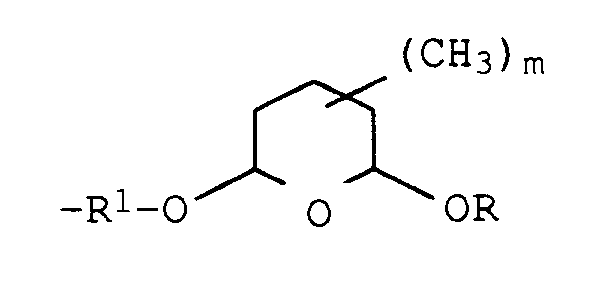 R¹ gegebenenfalls durch Hydroxy substituiertes und/oder durch Sauerstoffatome unterbrochenes Alkylen ist.
 - Verfahren gemäß Anspruch 1, dadurch gekennzeichnet, daß man dazu Verbindungen der Formel
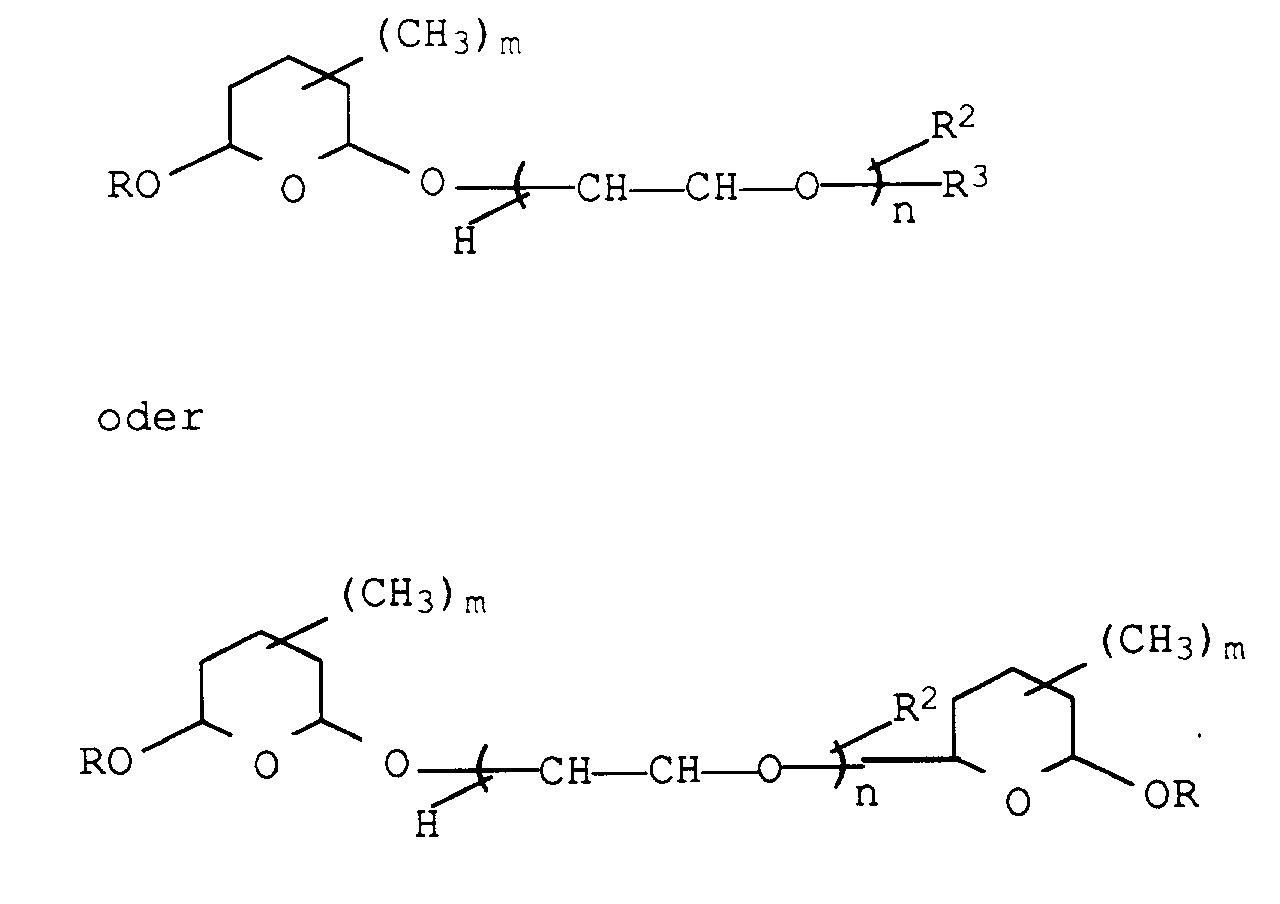 n die Zahlen 1 bis 20,R² Wasserstoff oder C₁- bis C₄-Alkyl undR³ Wasserstoff oder C₁- bis C₈-Alkyl bedeuten und m und R die angegebene Bedeutung haben.
 - Verfahren gemäß Abspruch 1, dadurch gekennzeichnet, daß man dazu Verbindungen der Formel

- Verbindungen der Formel

- Verbindungen der Formel gemäß Anspruch 4, bei denen m = O und R Methyl sind.
Applications Claiming Priority (2)
| Application Number | Priority Date | Filing Date | Title |
|---|---|---|---|
| DE4219419A DE4219419A1 (de) | 1992-06-13 | 1992-06-13 | Verfahren zum Gerben von Leder und Pelzen |
| DE4219419 | 1992-06-13 |
Publications (3)
| Publication Number | Publication Date |
|---|---|
| EP0574800A2 true EP0574800A2 (de) | 1993-12-22 |
| EP0574800A3 EP0574800A3 (de) | 1994-04-20 |
| EP0574800B1 EP0574800B1 (de) | 1996-08-21 |
Family
ID=6460964
Family Applications (1)
| Application Number | Title | Priority Date | Filing Date |
|---|---|---|---|
| EP93109174A Expired - Lifetime EP0574800B1 (de) | 1992-06-13 | 1993-06-08 | Verfahren zum Gerben von Leder und Pelzen |
Country Status (10)
| Country | Link |
|---|---|
| US (1) | US5360454A (de) |
| EP (1) | EP0574800B1 (de) |
| JP (1) | JPH0665599A (de) |
| KR (1) | KR940005807A (de) |
| AU (1) | AU4017993A (de) |
| BR (1) | BR9302293A (de) |
| CA (1) | CA2098128A1 (de) |
| DE (2) | DE4219419A1 (de) |
| ES (1) | ES2090777T3 (de) |
| MX (1) | MX9303342A (de) |
Families Citing this family (2)
| Publication number | Priority date | Publication date | Assignee | Title |
|---|---|---|---|---|
| KR20050097521A (ko) * | 2003-01-28 | 2005-10-07 | 바스프 악티엔게젤샤프트 | 무두제 및 방부제 |
| WO2018073010A1 (en) | 2016-10-18 | 2018-04-26 | Basf Se | Processes for making leather |
Family Cites Families (3)
| Publication number | Priority date | Publication date | Assignee | Title |
|---|---|---|---|---|
| US2619491A (en) * | 1948-07-08 | 1952-11-25 | Shell Dev | Tetrahydropyranyl ethers |
| DE1769059A1 (de) * | 1968-03-28 | 1971-08-19 | Basf Ag | Verfahren zur Herstellung von Leder |
| FI212374A7 (de) * | 1973-07-21 | 1975-01-22 | Basf Ag |
-
1992
- 1992-06-13 DE DE4219419A patent/DE4219419A1/de not_active Withdrawn
-
1993
- 1993-05-25 US US08/066,233 patent/US5360454A/en not_active Expired - Fee Related
- 1993-06-03 MX MX9303342A patent/MX9303342A/es unknown
- 1993-06-08 ES ES93109174T patent/ES2090777T3/es not_active Expired - Lifetime
- 1993-06-08 DE DE59303478T patent/DE59303478D1/de not_active Expired - Lifetime
- 1993-06-08 EP EP93109174A patent/EP0574800B1/de not_active Expired - Lifetime
- 1993-06-10 JP JP5138608A patent/JPH0665599A/ja not_active Withdrawn
- 1993-06-10 CA CA002098128A patent/CA2098128A1/en not_active Abandoned
- 1993-06-11 KR KR1019930010605A patent/KR940005807A/ko not_active Withdrawn
- 1993-06-11 AU AU40179/93A patent/AU4017993A/en not_active Abandoned
- 1993-06-11 BR BR9302293A patent/BR9302293A/pt not_active Application Discontinuation
Also Published As
| Publication number | Publication date |
|---|---|
| KR940005807A (ko) | 1994-03-22 |
| CA2098128A1 (en) | 1993-12-14 |
| AU4017993A (en) | 1993-12-16 |
| US5360454A (en) | 1994-11-01 |
| EP0574800A3 (de) | 1994-04-20 |
| ES2090777T3 (es) | 1996-10-16 |
| EP0574800B1 (de) | 1996-08-21 |
| BR9302293A (pt) | 1994-01-11 |
| DE4219419A1 (de) | 1993-12-16 |
| DE59303478D1 (de) | 1996-09-26 |
| MX9303342A (es) | 1994-01-31 |
| JPH0665599A (ja) | 1994-03-08 |
Similar Documents
| Publication | Publication Date | Title |
|---|---|---|
| EP2601317B1 (de) | Zusammensetzungen enthaltend wenigstens eine carbamoylsulfonatgruppen-haltige verbindung und ihre verwendung als gerbstoffe | |
| EP2956558B1 (de) | Verfahren zur herstellung von leder | |
| EP0814168B1 (de) | Verfahren zur Gerbung von Leder | |
| EP0569410B1 (de) | Verfahren zum alleingerben, vorgerben und mitgerben von blössen und fellblössen und zum nachgerben von leder und fell | |
| DE2626429A1 (de) | Verfahren zum gerben von haeuten | |
| EP0574800B1 (de) | Verfahren zum Gerben von Leder und Pelzen | |
| EP2205768B1 (de) | Verfahren zur herstellung von leder | |
| EP3440227B1 (de) | Zusammensetzung und verfahren zur gerbung basierend auf einem acetal eines aldehydischen gerbstoffes | |
| EP0026423B1 (de) | Verfahren zur Fettung und Imprägnierung von Leder und Pelzen | |
| DE2215948C3 (de) | Wäßrige Gerbstoff-Formulierungen und Verfahren zum Gerben, Vor- oder Nachgerben mit den Formulierungen | |
| DE19906190A1 (de) | Gerbverfahren | |
| DE3540211A1 (de) | Gerbstoff und verfahren zu seiner herstellung | |
| EP0554217B1 (de) | Wässrige Zusammensetzung zum Vorgerben von Hautblössen | |
| DE2549527C3 (de) | Verfahren zur Herstellung von Leder | |
| DE10028142A1 (de) | Chromgerbverfahren | |
| DE19507838A1 (de) | Verfahren und Verbindung zum Gerben von Leder und Pelzen | |
| DE102016004191A1 (de) | Zusammensetzung und Verfahren zur Gerbung basierend auf einem Acetal eines aldehydischen Gerbstoffes | |
| EP0585431B1 (de) | Verfahren zum fetten, füllen und hydrophobieren von ledern und pelzen | |
| DE336895C (de) | Verfahren zum Gerben tierischer Haeute | |
| DE1284028C2 (de) | Verfahren zum schnellgerben von haeuten | |
| DE920324C (de) | Verfahren zum Gerben von tierischen Haeuten und Fellen | |
| DE907339C (de) | Verfahren zum Gerben und Fetten von tierischen Haeuten | |
| DE687611C (de) | en | |
| WO2012150179A1 (de) | Verfahren zum konservieren von collagenfaserhaltigen substrat | |
| DE3306374A1 (de) | Verfahren zum gerben von haeuten mit einem hochbasischen chromgerbstoff |
Legal Events
| Date | Code | Title | Description |
|---|---|---|---|
| PUAI | Public reference made under article 153(3) epc to a published international application that has entered the european phase |
Free format text: ORIGINAL CODE: 0009012 |
|
| AK | Designated contracting states |
Kind code of ref document: A2 Designated state(s): BE CH DE ES FR GB IT LI NL PT |
|
| PUAL | Search report despatched |
Free format text: ORIGINAL CODE: 0009013 |
|
| AK | Designated contracting states |
Kind code of ref document: A3 Designated state(s): BE CH DE ES FR GB IT LI NL PT |
|
| 17P | Request for examination filed |
Effective date: 19940620 |
|
| 17Q | First examination report despatched |
Effective date: 19951012 |
|
| GRAH | Despatch of communication of intention to grant a patent |
Free format text: ORIGINAL CODE: EPIDOS IGRA |
|
| GRAA | (expected) grant |
Free format text: ORIGINAL CODE: 0009210 |
|
| GRAH | Despatch of communication of intention to grant a patent |
Free format text: ORIGINAL CODE: EPIDOS IGRA |
|
| AK | Designated contracting states |
Kind code of ref document: B1 Designated state(s): BE CH DE ES FR GB IT LI NL PT |
|
| REF | Corresponds to: |
Ref document number: 59303478 Country of ref document: DE Date of ref document: 19960926 |
|
| GBT | Gb: translation of ep patent filed (gb section 77(6)(a)/1977) |
Effective date: 19960906 |
|
| REG | Reference to a national code |
Ref country code: ES Ref legal event code: FG2A Ref document number: 2090777 Country of ref document: ES Kind code of ref document: T3 |
|
| ITF | It: translation for a ep patent filed | ||
| REG | Reference to a national code |
Ref country code: ES Ref legal event code: FG2A Ref document number: 2090777 Country of ref document: ES Kind code of ref document: T3 |
|
| ET | Fr: translation filed | ||
| SC4A | Pt: translation is available |
Free format text: 960919 AVAILABILITY OF NATIONAL TRANSLATION |
|
| PGFP | Annual fee paid to national office [announced via postgrant information from national office to epo] |
Ref country code: FR Payment date: 19970520 Year of fee payment: 5 |
|
| PGFP | Annual fee paid to national office [announced via postgrant information from national office to epo] |
Ref country code: NL Payment date: 19970527 Year of fee payment: 5 |
|
| PGFP | Annual fee paid to national office [announced via postgrant information from national office to epo] |
Ref country code: PT Payment date: 19970528 Year of fee payment: 5 |
|
| PGFP | Annual fee paid to national office [announced via postgrant information from national office to epo] |
Ref country code: CH Payment date: 19970529 Year of fee payment: 5 |
|
| PGFP | Annual fee paid to national office [announced via postgrant information from national office to epo] |
Ref country code: GB Payment date: 19970602 Year of fee payment: 5 |
|
| PGFP | Annual fee paid to national office [announced via postgrant information from national office to epo] |
Ref country code: BE Payment date: 19970612 Year of fee payment: 5 |
|
| PGFP | Annual fee paid to national office [announced via postgrant information from national office to epo] |
Ref country code: ES Payment date: 19970617 Year of fee payment: 5 |
|
| PGFP | Annual fee paid to national office [announced via postgrant information from national office to epo] |
Ref country code: DE Payment date: 19970624 Year of fee payment: 5 |
|
| PLBE | No opposition filed within time limit |
Free format text: ORIGINAL CODE: 0009261 |
|
| STAA | Information on the status of an ep patent application or granted ep patent |
Free format text: STATUS: NO OPPOSITION FILED WITHIN TIME LIMIT |
|
| 26N | No opposition filed | ||
| PG25 | Lapsed in a contracting state [announced via postgrant information from national office to epo] |
Ref country code: GB Free format text: LAPSE BECAUSE OF NON-PAYMENT OF DUE FEES Effective date: 19980608 |
|
| PG25 | Lapsed in a contracting state [announced via postgrant information from national office to epo] |
Ref country code: ES Free format text: LAPSE BECAUSE OF EXPIRATION OF PROTECTION Effective date: 19980609 |
|
| PG25 | Lapsed in a contracting state [announced via postgrant information from national office to epo] |
Ref country code: DE Free format text: LAPSE BECAUSE OF THE APPLICANT RENOUNCES Effective date: 19980624 |
|
| PG25 | Lapsed in a contracting state [announced via postgrant information from national office to epo] |
Ref country code: LI Free format text: LAPSE BECAUSE OF NON-PAYMENT OF DUE FEES Effective date: 19980630 Ref country code: CH Free format text: LAPSE BECAUSE OF NON-PAYMENT OF DUE FEES Effective date: 19980630 Ref country code: BE Free format text: LAPSE BECAUSE OF NON-PAYMENT OF DUE FEES Effective date: 19980630 |
|
| BERE | Be: lapsed |
Owner name: BASF A.G. Effective date: 19980630 |
|
| PG25 | Lapsed in a contracting state [announced via postgrant information from national office to epo] |
Ref country code: PT Free format text: LAPSE BECAUSE OF NON-PAYMENT OF DUE FEES Effective date: 19981231 |
|
| PG25 | Lapsed in a contracting state [announced via postgrant information from national office to epo] |
Ref country code: NL Free format text: LAPSE BECAUSE OF NON-PAYMENT OF DUE FEES Effective date: 19990101 |
|
| GBPC | Gb: european patent ceased through non-payment of renewal fee |
Effective date: 19980608 |
|
| REG | Reference to a national code |
Ref country code: CH Ref legal event code: PL |
|
| PG25 | Lapsed in a contracting state [announced via postgrant information from national office to epo] |
Ref country code: FR Free format text: LAPSE BECAUSE OF NON-PAYMENT OF DUE FEES Effective date: 19990226 |
|
| NLV4 | Nl: lapsed or anulled due to non-payment of the annual fee |
Effective date: 19990101 |
|
| REG | Reference to a national code |
Ref country code: FR Ref legal event code: ST |
|
| REG | Reference to a national code |
Ref country code: PT Ref legal event code: MM4A Free format text: LAPSE DUE TO NON-PAYMENT OF FEES Effective date: 19981231 |
|
| REG | Reference to a national code |
Ref country code: ES Ref legal event code: FD2A Effective date: 20000601 |
|
| PG25 | Lapsed in a contracting state [announced via postgrant information from national office to epo] |
Ref country code: IT Free format text: LAPSE BECAUSE OF NON-PAYMENT OF DUE FEES;WARNING: LAPSES OF ITALIAN PATENTS WITH EFFECTIVE DATE BEFORE 2007 MAY HAVE OCCURRED AT ANY TIME BEFORE 2007. THE CORRECT EFFECTIVE DATE MAY BE DIFFERENT FROM THE ONE RECORDED. Effective date: 20050608 |