EP0575751B1 - Verfahren zur Wiedergewinnung des Kunststoffes aus lackierten Kunststoffteilen - Google Patents
Verfahren zur Wiedergewinnung des Kunststoffes aus lackierten Kunststoffteilen Download PDFInfo
- Publication number
- EP0575751B1 EP0575751B1 EP93108142A EP93108142A EP0575751B1 EP 0575751 B1 EP0575751 B1 EP 0575751B1 EP 93108142 A EP93108142 A EP 93108142A EP 93108142 A EP93108142 A EP 93108142A EP 0575751 B1 EP0575751 B1 EP 0575751B1
- Authority
- EP
- European Patent Office
- Prior art keywords
- particles
- plastic
- process according
- fine
- coarse
- Prior art date
- Legal status (The legal status is an assumption and is not a legal conclusion. Google has not performed a legal analysis and makes no representation as to the accuracy of the status listed.)
- Expired - Lifetime
Links
Images
Classifications
-
- B—PERFORMING OPERATIONS; TRANSPORTING
- B29—WORKING OF PLASTICS; WORKING OF SUBSTANCES IN A PLASTIC STATE IN GENERAL
- B29B—PREPARATION OR PRETREATMENT OF THE MATERIAL TO BE SHAPED; MAKING GRANULES OR PREFORMS; RECOVERY OF PLASTICS OR OTHER CONSTITUENTS OF WASTE MATERIAL CONTAINING PLASTICS
- B29B17/00—Recovery of plastics or other constituents of waste material containing plastics
- B29B17/02—Separating plastics from other materials
-
- B—PERFORMING OPERATIONS; TRANSPORTING
- B29—WORKING OF PLASTICS; WORKING OF SUBSTANCES IN A PLASTIC STATE IN GENERAL
- B29B—PREPARATION OR PRETREATMENT OF THE MATERIAL TO BE SHAPED; MAKING GRANULES OR PREFORMS; RECOVERY OF PLASTICS OR OTHER CONSTITUENTS OF WASTE MATERIAL CONTAINING PLASTICS
- B29B17/00—Recovery of plastics or other constituents of waste material containing plastics
- B29B17/04—Disintegrating plastics, e.g. by milling
- B29B17/0412—Disintegrating plastics, e.g. by milling to large particles, e.g. beads, granules, flakes, slices
-
- B—PERFORMING OPERATIONS; TRANSPORTING
- B29—WORKING OF PLASTICS; WORKING OF SUBSTANCES IN A PLASTIC STATE IN GENERAL
- B29B—PREPARATION OR PRETREATMENT OF THE MATERIAL TO BE SHAPED; MAKING GRANULES OR PREFORMS; RECOVERY OF PLASTICS OR OTHER CONSTITUENTS OF WASTE MATERIAL CONTAINING PLASTICS
- B29B17/00—Recovery of plastics or other constituents of waste material containing plastics
- B29B17/02—Separating plastics from other materials
- B29B2017/0203—Separating plastics from plastics
-
- B—PERFORMING OPERATIONS; TRANSPORTING
- B29—WORKING OF PLASTICS; WORKING OF SUBSTANCES IN A PLASTIC STATE IN GENERAL
- B29B—PREPARATION OR PRETREATMENT OF THE MATERIAL TO BE SHAPED; MAKING GRANULES OR PREFORMS; RECOVERY OF PLASTICS OR OTHER CONSTITUENTS OF WASTE MATERIAL CONTAINING PLASTICS
- B29B17/00—Recovery of plastics or other constituents of waste material containing plastics
- B29B17/04—Disintegrating plastics, e.g. by milling
- B29B2017/0424—Specific disintegrating techniques; devices therefor
- B29B2017/0492—Projecting the material on stationary or moving impact surfaces or plates
-
- B—PERFORMING OPERATIONS; TRANSPORTING
- B29—WORKING OF PLASTICS; WORKING OF SUBSTANCES IN A PLASTIC STATE IN GENERAL
- B29K—INDEXING SCHEME ASSOCIATED WITH SUBCLASSES B29B, B29C OR B29D, RELATING TO MOULDING MATERIALS OR TO MATERIALS FOR MOULDS, REINFORCEMENTS, FILLERS OR PREFORMED PARTS, e.g. INSERTS
- B29K2023/00—Use of polyalkenes or derivatives thereof as moulding material
- B29K2023/04—Polymers of ethylene
- B29K2023/06—PE, i.e. polyethylene
-
- B—PERFORMING OPERATIONS; TRANSPORTING
- B29—WORKING OF PLASTICS; WORKING OF SUBSTANCES IN A PLASTIC STATE IN GENERAL
- B29K—INDEXING SCHEME ASSOCIATED WITH SUBCLASSES B29B, B29C OR B29D, RELATING TO MOULDING MATERIALS OR TO MATERIALS FOR MOULDS, REINFORCEMENTS, FILLERS OR PREFORMED PARTS, e.g. INSERTS
- B29K2023/00—Use of polyalkenes or derivatives thereof as moulding material
- B29K2023/10—Polymers of propylene
- B29K2023/12—PP, i.e. polypropylene
-
- B—PERFORMING OPERATIONS; TRANSPORTING
- B29—WORKING OF PLASTICS; WORKING OF SUBSTANCES IN A PLASTIC STATE IN GENERAL
- B29K—INDEXING SCHEME ASSOCIATED WITH SUBCLASSES B29B, B29C OR B29D, RELATING TO MOULDING MATERIALS OR TO MATERIALS FOR MOULDS, REINFORCEMENTS, FILLERS OR PREFORMED PARTS, e.g. INSERTS
- B29K2705/00—Use of metals, their alloys or their compounds, for preformed parts, e.g. for inserts
-
- B—PERFORMING OPERATIONS; TRANSPORTING
- B29—WORKING OF PLASTICS; WORKING OF SUBSTANCES IN A PLASTIC STATE IN GENERAL
- B29K—INDEXING SCHEME ASSOCIATED WITH SUBCLASSES B29B, B29C OR B29D, RELATING TO MOULDING MATERIALS OR TO MATERIALS FOR MOULDS, REINFORCEMENTS, FILLERS OR PREFORMED PARTS, e.g. INSERTS
- B29K2711/00—Use of natural products or their composites, not provided for in groups B29K2601/00 - B29K2709/00, for preformed parts, e.g. for inserts
- B29K2711/12—Paper, e.g. cardboard
-
- B—PERFORMING OPERATIONS; TRANSPORTING
- B29—WORKING OF PLASTICS; WORKING OF SUBSTANCES IN A PLASTIC STATE IN GENERAL
- B29L—INDEXING SCHEME ASSOCIATED WITH SUBCLASS B29C, RELATING TO PARTICULAR ARTICLES
- B29L2009/00—Layered products
- B29L2009/005—Layered products coated
-
- B—PERFORMING OPERATIONS; TRANSPORTING
- B29—WORKING OF PLASTICS; WORKING OF SUBSTANCES IN A PLASTIC STATE IN GENERAL
- B29L—INDEXING SCHEME ASSOCIATED WITH SUBCLASS B29C, RELATING TO PARTICULAR ARTICLES
- B29L2031/00—Other particular articles
- B29L2031/30—Vehicles, e.g. ships or aircraft, or body parts thereof
- B29L2031/3005—Body finishings
- B29L2031/302—Trim strips
-
- B—PERFORMING OPERATIONS; TRANSPORTING
- B29—WORKING OF PLASTICS; WORKING OF SUBSTANCES IN A PLASTIC STATE IN GENERAL
- B29L—INDEXING SCHEME ASSOCIATED WITH SUBCLASS B29C, RELATING TO PARTICULAR ARTICLES
- B29L2031/00—Other particular articles
- B29L2031/30—Vehicles, e.g. ships or aircraft, or body parts thereof
- B29L2031/3044—Bumpers
-
- B—PERFORMING OPERATIONS; TRANSPORTING
- B29—WORKING OF PLASTICS; WORKING OF SUBSTANCES IN A PLASTIC STATE IN GENERAL
- B29L—INDEXING SCHEME ASSOCIATED WITH SUBCLASS B29C, RELATING TO PARTICULAR ARTICLES
- B29L2031/00—Other particular articles
- B29L2031/30—Vehicles, e.g. ships or aircraft, or body parts thereof
- B29L2031/3055—Cars
-
- Y—GENERAL TAGGING OF NEW TECHNOLOGICAL DEVELOPMENTS; GENERAL TAGGING OF CROSS-SECTIONAL TECHNOLOGIES SPANNING OVER SEVERAL SECTIONS OF THE IPC; TECHNICAL SUBJECTS COVERED BY FORMER USPC CROSS-REFERENCE ART COLLECTIONS [XRACs] AND DIGESTS
- Y02—TECHNOLOGIES OR APPLICATIONS FOR MITIGATION OR ADAPTATION AGAINST CLIMATE CHANGE
- Y02P—CLIMATE CHANGE MITIGATION TECHNOLOGIES IN THE PRODUCTION OR PROCESSING OF GOODS
- Y02P20/00—Technologies relating to chemical industry
- Y02P20/50—Improvements relating to the production of bulk chemicals
- Y02P20/582—Recycling of unreacted starting or intermediate materials
-
- Y—GENERAL TAGGING OF NEW TECHNOLOGICAL DEVELOPMENTS; GENERAL TAGGING OF CROSS-SECTIONAL TECHNOLOGIES SPANNING OVER SEVERAL SECTIONS OF THE IPC; TECHNICAL SUBJECTS COVERED BY FORMER USPC CROSS-REFERENCE ART COLLECTIONS [XRACs] AND DIGESTS
- Y02—TECHNOLOGIES OR APPLICATIONS FOR MITIGATION OR ADAPTATION AGAINST CLIMATE CHANGE
- Y02W—CLIMATE CHANGE MITIGATION TECHNOLOGIES RELATED TO WASTEWATER TREATMENT OR WASTE MANAGEMENT
- Y02W30/00—Technologies for solid waste management
- Y02W30/50—Reuse, recycling or recovery technologies
- Y02W30/62—Plastics recycling; Rubber recycling
-
- Y—GENERAL TAGGING OF NEW TECHNOLOGICAL DEVELOPMENTS; GENERAL TAGGING OF CROSS-SECTIONAL TECHNOLOGIES SPANNING OVER SEVERAL SECTIONS OF THE IPC; TECHNICAL SUBJECTS COVERED BY FORMER USPC CROSS-REFERENCE ART COLLECTIONS [XRACs] AND DIGESTS
- Y10—TECHNICAL SUBJECTS COVERED BY FORMER USPC
- Y10S—TECHNICAL SUBJECTS COVERED BY FORMER USPC CROSS-REFERENCE ART COLLECTIONS [XRACs] AND DIGESTS
- Y10S241/00—Solid material comminution or disintegration
- Y10S241/38—Solid waste disposal
Definitions
- the invention relates to a method for recovering the plastic from painted plastic parts, which come in particular from the automotive industry.
- Plastic parts in the automotive sector can be made from a variety of different polymers. Frequently, however, they are binary or ternary thermoplastic molding compositions, preferably based on polypropylene or, albeit more rarely, based on polyethylene.
- the fields of application of such molding compositions include Wheel house linings, trunk linings, battery covers, battery boxes, side panels, bumpers, etc.
- Various methods are now known from practice for producing recyclates from molded parts, which to a large extent consist of thermoplastic materials.
- Bumpers consist essentially of elastomer-modified polypropylene, and polyethylene-polypropylene copolymers (EPM) and / or polyethylene-polypropylene-diene copolymers (EPDM) are often used for the modification as the rubber component.
- EPM polyethylene-polypropylene copolymers
- EPDM polyethylene-polypropylene-diene copolymers
- a whole series of additives for the targeted influencing of properties can be included in the binary or ternary plastic molding compound.
- unpainted used bumpers are first used disassembled and then pre-shredded into palm-sized chips by means of coarse cutting mills familiar to those skilled in the art, including all foreign substances such as lamps, brackets, steel beams etc. These pieces are then crushed by wet grinding under high pressure to a clean, fine regrind.
- the fine ground material is homogenized, stabilized with additives according to the intended use and finally blended with, for example, battery case ground material made of polypropylene copolymer in a ratio of about 1: 5 to 1: 6.
- the preparation of painted plastic parts is particularly difficult.
- Many molded parts are covered with a varnish based on polyurethane or acrylate for optical reasons or for protection purposes.
- the surfaces of the Plastic parts are pretreated, for example with a primer, by flame treatment, etching etc.
- the flame treatment is the most common for the molded parts.
- special methods such as plasma or corona treatment - a bond can be created with bonds between the lacquer layer and the molded part, which resists attempts to dissolve with all common solvents just as smoothly as possible with sandblasting or flame treatments.
- recyclates from painted plastic parts with a relatively high content of paint residues are significantly inferior to the recyclates from unpainted molded parts in important properties.
- painted bumpers which are prepared in analogy to the process described above for unpainted molded parts, result in recyclates and, in turn, molded parts which can be produced therefrom with surface defects which are particularly troublesome when repainting. They also show a decrease in the elongation at break and a decrease in the impact strength or cold impact strength and thus only have an overall range of properties which clearly lags behind the requirements that are customary today.
- the fine ground material consists either of very fine lacquer and plastic particles which are freely adjacent to one another and / or of fine plastic particles to which lacquer residues adhere. Only by adding an adhesion promoter suitable for incorporating the free lacquer material in the plastic material in a sufficient amount of approx. 1% to the fine ground material will the aforementioned properties be raised approximately to the level of coarse ground material from unpainted bumpers. However, there is still a noticeable drop in properties, so that, as a rule, only a low-value use of the recyclate should be considered without further removal of the lacquer.
- thermoplastic molding composition After finely grinding the lacquered ground material, the extrusion, degassing and sieving of the polypropylene melt, and for further use of the sieved material, granulation of the thermoplastic molding composition is now proposed for further quality improvement.
- melt filtration the melted fine ground material is pressed through a perforated plate or a packet of sieve plate inserts during the extrusion process. Due to the almost dust-fine grain of the paint particles, very fine sieve inserts (e.g. 500 ⁇ m, 250 ⁇ m etc.) are required.
- additional melt pump necessary, which makes the melt filtration process more expensive.
- Another object of the invention is to provide a process for producing a plastic recycling product freed from essential paint residues from painted plastic parts, which allows paint removal to be removed particularly effectively and which is less complex and therefore more economical than known processes.
- Another object is to create a recyclate from lacquered plastic products, in particular based on polypropylene-containing thermoplastic molding compositions, the properties of which are as close as possible to the regenerate and which in turn is suitable for high-quality applications.
- these and other tasks are solved by a process for recovering the plastic from painted plastic parts, in which the painted plastic parts are crushed into coarse particles, and the coarse particles are defibrated finely shredded and subjected to simultaneous stretching and shear stressing during the fine shredding, the deformation of the plastic particles detaching the adhering varnish, after which the resulting finely shredded plastic fibers and paint particles are subjected to a separation in a swim-sink system or a hydrocyclone .
- the problem on which the invention is based is solved by removing the adhering paint particles from the coated plastic parts in a multi-stage comminution process, so that ultimately paint-free plastic recycling products are obtained, which are then subsequently subjected to lacquered or unpainted without having to accept a particularly large loss in quality Products can be processed further.
- Plates made from a recyclate which is obtainable in the process according to the invention, have shown in laboratory tests that it is possible to produce parts which are determined both in the paint adhesion - here in particular in the climatic change test familiar to the person skilled in the art - and in the mechanical properties the lacquered panels - show no significant loss of quality compared to new goods.
- the comminution of the painted plastic parts is linked to a strong stretch-shear stress on the particles to be comminuted, in which Stretch-shear treatment the still coated particles are exposed to such high expansions and shear forces that the paint layer flakes off the coated plastic particles.
- the ground material is not ground to a fine powder in order to obtain the desired high level of lacquer detachment. Rather, the coarse particles are deformed or twisted, in particular stretched, according to the invention during fine comminution, in such a way that the paint particles which adhere to the coarse particles of plastic are chipped or peeled off. Due to the size of the chipping particles, which is clearly above the fine powder size known in the prior art, the subsequent separation is easier, which makes reprocessing more efficient and more economical.
- the method according to the invention advantageously combines a number of method steps, in particular comminution steps, for producing a recycled plastic product.
- the usually pre-shredded, painted plastic molded parts are first crushed into coarse particles in a coarse crushing stage.
- the coarse particles are then subjected to a stretch-shear treatment during a subsequent fine comminution stage at the same time as the fine comminution in order to detach the adhering lacquer, so that in effect a substantial proportion of the lacquer adhering to the plastic particles flakes off.
- the resulting plastic particles are then separated from the released paint particles in a separation step.
- the plastic product separated from the paint particles essentially becomes one receive paint-free, processed plastic product. Between the individual shredding steps, it can also always be advantageous to carry out additional separation and cleaning operations.
- the painted plastic parts is advantageous to roughly shred these starting materials for the recycling process. It is useful to bring the painted plastic parts to an average particle size of 4 to 12 mm.
- the size of the molded parts is preferably reduced to an amount of approximately 6 to 8 mm in the first coarse crushing pass.
- coarse shredding processes can also follow one another in order to achieve the desired grain size of the material, for example for reasons of capacity of the coarse shredding plant.
- the crushing in the first stage can be carried out either dry or wet.
- the bulky lacquered plastic parts including any metallic parts
- the bulky lacquered plastic parts are pre-shredded into roughly palm-sized chips in a shredder cutting mill before being roughly crushed.
- These pieces are then furthermore preferably subjected to a rough separation in order to remove any metallic fraction which may be obtained.
- the rough separation can be carried out, for example, by means of water, in which, due to the density differences, predominantly metallic fractions can be separated out as a sink fraction, while the floating plastic fraction, which mainly contains plastic, can be drawn off using a screw conveyor.
- the coarse particle material obtained with adhering lacquer is then subjected according to the invention in a fine comminution stage to a preferably fiberizing comminution, in which considerable deformation and shear forces are simultaneously exerted on the plastic particles.
- the particle material from the aggregate Coarse shredding stage preferably after further cleaning, separating and drying texts, transferred to the shredding unit of the fine shredding stage.
- the plastic material of the first coarse comminution is advantageously finely comminuted, so that, in a particularly expedient embodiment, a plastic fiber material of 0.5 to 6 mm in length and 0.005 to 0.5 mm in fiber thickness or fiber diameter, preferably in 1 to 3 mm in length and approx.
- the fine crushing should essentially perform three tasks.
- the coarse particles can be further comminuted, the comminution essentially being based on tearing the coarse particles or also on tearing off smaller particles from larger particles in a grinding-like process.
- any cutting crushing that may occur is only of secondary importance.
- the defibration of the plastic material is essential in the fine comminution stage.
- a decrease in the thickness of the material is preferred in the context of the invention due to the pulverizing grinding of the coarse plastic particles - primarily globular particles - whereas the length of the particles is subject to less severe decreases.
- the above-described fine comminution of the coarse plastic particles is effected in a preferred embodiment of the method according to the invention in that the coarse particles for fine comminution pass through the gap between a rotating and a fixed grinding disk of a grinding unit, which is simultaneously designed to generate sufficient shear forces.
- the particles When passing through the gap, the particles are moved further in the direction of the discharge and deformed, as it were tumbled, the size of the particles discharged from the grinding unit being determined by the gap distance between the rotating and the fixed grinding disc. Particles that are too large for the gap are torn apart due to the high forces that occur so that they fit through the gap.
- the coarse particles are preferably defibrated while they pass through a tapering gap between two grinding disks with a sawtooth profile.
- Coarser particles are detected in a gap area at a greater distance and moved further in the direction of the discharge. Due to the high forces and the gap tapering towards the discharge, the particles are torn apart, but at the same time, due to the deformation that occurs before tearing, which essentially corresponds to an expansion or stretching of the plastic particles, the third task of the fine comminution stage is also fulfilled.
- a further third function of the fine comminution stage is namely to thresh the plastic particles in such a way that the lacquer residues adhering to the particles spring off.
- the coating particles can, if at all, only partially participate in the expansion of the plastic particles and they flake off. After passing through the fine comminution stage, there is a mixture of relatively irregular plastic material fibers and flaked off paint particles.
- the material mixture once defibrated, is subjected to a sieving after the first passage through the grinding unit and if necessary, material deviating from the desired size is fed to the same grinding unit for renewed defibration.
- any unit known in practice which permits this type of material treatment can be used for the fiberizing grinding.
- mills with an impact effect in which an impact effect is exerted on the material, is particularly advantageous.
- These include in particular the known impact mills or impact plate mills, the latter in particular being used according to the invention as a grinding unit, preferably for selective comminution.
- the mixture of plastic material fibers and flaked-off paint particles is to be fed to a separation or separation stage for further processing.
- Another particularly expedient variant of the separation provides for a sieving of the mixture to classify the particles, for example by means of a vibrating sieve.
- the resulting plastic and paint particles in a floating sink system or a hydrocyclone undergo it can also be advantageous to separate the resulting plastic and paint particles in a floating sink system or a hydrocyclone undergo.
- separating water one can take advantage of the fact that the resulting plastic particles usually have a lower density than water, whereas the paint particles usually filled with fillers such as chalk are generally considerably heavier than water.
- the paint particles sink during water separation and can be sludge-suspended.
- the polymer particles floating on the water can be skimmed off as a liquor, collected and sent for further processing.
- the skimmed-off polymer particles can be assembled and processed immediately using any of the usual methods.
- the granules obtained have excellent reprocessing properties. It can either be uncut or useful as an additive to other molding compounds in all processing processes suitable for processing molding compounds.
- the recycled granulate can, for example, be further processed with all equipment commonly used for plastics processing, such as rollers, mixers, extruders, kneaders, etc. But it is also ideal for the injection molding process.
- thermoplastic molded parts that are coated can expediently be processed into a recycling product in high yield by the process according to the invention.
- the process according to the invention is preferably applicable to used painted molded parts which essentially contain polypropylene and / or polyethylene and / or ethylene-propylene copolymer (EPM) and / or ethylene-propylene-diene copolymer (EPDM), so that a processed one Plastic product is obtained which essentially has the same aforementioned substances.
- EPM ethylene-propylene copolymer
- EPDM ethylene-propylene-diene copolymer
- the process is generally not essentially disturbed by the additives usually contained in the thermoplastic-based molding compositions. In this way, in accordance with the additives present in the used part to be recycled, additives such as colorants, lubricants, fillers, antioxidants, UV stabilizers, flame retardants and / or inorganic fiber-treated plastic products are obtained.
- the plastic products prepared by a process according to the invention from used molded parts, in particular old painted bumpers are used for the production of new bumpers for automobiles, with essentially no drop in the elongation at break or impact strength for a 20% proportion of recycled material according to the invention and the low-temperature impact occurs and, at the same time, when the recycled thermoplastic molded parts are repainted, there are essentially no disruptive surface changes in the molded part.
- thermoplastic recycled plastic produced by the method according to the invention has an elongation at break of more than 50%, up to more than 100%.
- a recyclate obtained in the manner described is characterized by an extremely small proportion of residual paint particles in the recyclate. This results in the above-mentioned positive properties and in particular an extremely low waste compared to new molding compositions.
- thermoplastic recycled plastic according to the invention can be characterized in particular by the residual paint particles contained in it.
- the quality of the recyclate is therefore examined using a film test.
- a certain amount (approx. 0.2 g) of the recyclate to be tested is weighed out using an analytical balance.
- the weighed sample amount is then between two aluminum foils in a laboratory press heated to approx. 300 ° C with polished press plates at a temperature of approx. 200 ° C for one minute to a film with a wall thickness of approx. 0.03 - 0.04 mm and pressed with a diameter of 30 mm.
- the film is then cooled for about 30 minutes.
- the film produced is then examined on a light table and the inclusions are assessed.
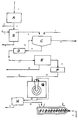
- the figure shows diagrammatically a schematic representation of the process sequence according to the invention.
- Lacquered plastic parts 1 and all existing foreign matter attached to them, for example brackets, lamps, etc., are transferred to the pre-shredder A.
- Metal parts 2 can be removed behind the pre-shredder A.
- rotating counter-rotating knives can be crushed into palm-sized parts.
- the pre-shredded chips 3 are subjected to a first rough separation in a swim-sink system B. Due to differences in density, the water 4 causes the chips to be separated into a sinking fraction and a floating fraction.
- the sink fraction 5, which consists essentially of metals, is drawn off and otherwise further processed.
- the swimming fraction 6, which preferably consists of a material rich in plastic, is drawn off, for example, with a screw conveyor and one for further processing Coarse wet mill C fed.
- the palm-sized chips of the good fraction are comminuted into a regrind 8 of approximately 6 to 8 mm.
- the wet grinding advantageously has a cooling effect and contributes to dust reduction.
- Parts 8 of the good fraction can optionally be returned to the coarse wet mill C in order to regrind portions of the good fraction that deviate from the specifications, for example after sieving.
- the moist material stream 8 from the coarse wet mill C is transferred to a centrifugal dryer D, and after it has dried, the material fraction 11 reaches a further separation into a hydrocyclone E. With turbulence in water, the density of the material fraction is carried out.
- the impact plate mill G is a shredding unit with a centrifugal impeller rotating in a conical housing with radially arranged strips between two impact plates. One baffle plate rotates in the opposite direction to the centrifugal wheel, while the other baffle plate is stationary.
- the regrind is fed axially through the fixed baffle plate, shredded between the centrifugal wheel and baffle plates and discharged through a gap between the two baffle plates on the periphery.
- the resulting good fraction 16 of an average fiber length of 1 to 3 mm and a fiber thickness of approx. 0.1 mm is finally subjected to a classification using a vibrating screen H.
- the paint detached in the impact mill 70 is screened out and removed.
- the material fraction 18 freed from the paint is fed to a vacuum granulation extruder L for further processing, so that a recycled material in the form of a granulate 19 is obtained, which preferably causes only an extremely small loss in quality due to very low paint particle residues.
Landscapes
- Engineering & Computer Science (AREA)
- Environmental & Geological Engineering (AREA)
- Mechanical Engineering (AREA)
- Separation, Recovery Or Treatment Of Waste Materials Containing Plastics (AREA)
- Processing And Handling Of Plastics And Other Materials For Molding In General (AREA)
- Paints Or Removers (AREA)
Applications Claiming Priority (2)
| Application Number | Priority Date | Filing Date | Title |
|---|---|---|---|
| DE4217005 | 1992-05-22 | ||
| DE4217005A DE4217005C2 (de) | 1992-05-22 | 1992-05-22 | Verfahren zur Wiedergewinnung des Kunststoffes aus lackierten Kunststoffteilen |
Publications (2)
| Publication Number | Publication Date |
|---|---|
| EP0575751A1 EP0575751A1 (de) | 1993-12-29 |
| EP0575751B1 true EP0575751B1 (de) | 1997-10-01 |
Family
ID=6459520
Family Applications (1)
| Application Number | Title | Priority Date | Filing Date |
|---|---|---|---|
| EP93108142A Expired - Lifetime EP0575751B1 (de) | 1992-05-22 | 1993-05-19 | Verfahren zur Wiedergewinnung des Kunststoffes aus lackierten Kunststoffteilen |
Country Status (14)
| Country | Link |
|---|---|
| US (1) | US5566889A (cs) |
| EP (1) | EP0575751B1 (cs) |
| JP (1) | JP3279732B2 (cs) |
| KR (1) | KR100278224B1 (cs) |
| CN (1) | CN1037077C (cs) |
| AT (1) | ATE158748T1 (cs) |
| CA (1) | CA2096768A1 (cs) |
| CZ (1) | CZ94793A3 (cs) |
| DE (2) | DE4217005C2 (cs) |
| ES (1) | ES2108777T3 (cs) |
| MX (1) | MX9302954A (cs) |
| NO (1) | NO931822L (cs) |
| PL (1) | PL170857B1 (cs) |
| RU (1) | RU2124438C1 (cs) |
Families Citing this family (44)
| Publication number | Priority date | Publication date | Assignee | Title |
|---|---|---|---|---|
| DE4338678A1 (de) * | 1993-11-12 | 1995-05-24 | Sikoplast Maschinenbau Heinric | Verfahren und Vorrichtung zum Entfernen von Verunreinigungen oder von Farbaufträgen von Kunststoffolienabschnitten |
| DE4409174C2 (de) * | 1994-03-17 | 1997-02-20 | Eghbal Ketabtchi Hamid | Verfahren und Vorrichtung zum Aufbereiten von bandförmigen Aufzeichnungsträgern |
| JP3177403B2 (ja) * | 1995-04-12 | 2001-06-18 | 富士重工業株式会社 | 塗装樹脂製品の塗膜剥離除去装置 |
| US7172143B2 (en) * | 1996-07-22 | 2007-02-06 | Antoine Vandeputte | Method and plant for separating polymeric materials |
| US7014132B2 (en) * | 1996-07-22 | 2006-03-21 | Antoine Vandeputte | Method and plant for separating polymeric materials |
| DE19715945A1 (de) * | 1997-04-16 | 1998-10-22 | Peter Wiedemann | Verfahren zum Entlacken von lackierten Substratteilen und Einrichtung zur Durchführung dieses Verfahrens |
| US6080473A (en) * | 1999-03-17 | 2000-06-27 | Premark Rwp Holdings, Inc. | ABS substrate extrusion process |
| US6007005A (en) * | 1999-03-17 | 1999-12-28 | Premark Rwp Holdings, Inc. | ABS recycling process |
| US6138929A (en) * | 1999-08-16 | 2000-10-31 | Montgomery; Michael | Process for removing paint from polymeric material |
| JP4226745B2 (ja) | 2000-01-18 | 2009-02-18 | 富士重工業株式会社 | 塗装樹脂製品の塗膜剥離装置 |
| JP2002086491A (ja) * | 2000-07-14 | 2002-03-26 | Canon Inc | 多層構造の樹脂成形品及び多層構造の樹脂成形品の製造方法 |
| DE10052597B4 (de) * | 2000-10-24 | 2005-07-14 | Peter Wiedemann | Verfahren zum Entlackieren von mit Lackschichten versehenen Kunststoffkörpern |
| US20050242003A1 (en) | 2004-04-29 | 2005-11-03 | Eric Scott | Automatic vibratory separator |
| US8172740B2 (en) | 2002-11-06 | 2012-05-08 | National Oilwell Varco L.P. | Controlled centrifuge systems |
| US8312995B2 (en) | 2002-11-06 | 2012-11-20 | National Oilwell Varco, L.P. | Magnetic vibratory screen clamping |
| DE10311278A1 (de) * | 2003-03-14 | 2004-09-23 | Theo Steil Gmbh | Verfahren zum Entfernen von Lackbeschichtungen auf einer Metallkonstruktion |
| US20060286230A1 (en) * | 2005-06-15 | 2006-12-21 | Kraft Foods Holdings, Inc. | Process for packing separation and granulation of processed food content thereof, and products and uses thereof |
| US8118172B2 (en) | 2005-11-16 | 2012-02-21 | National Oilwell Varco L.P. | Shale shakers with cartridge screen assemblies |
| KR100721761B1 (ko) * | 2006-05-03 | 2007-05-25 | 주식회사 강천엔비텍 | 재생 플라스틱 세척장치 |
| US8201693B2 (en) | 2006-05-26 | 2012-06-19 | National Oilwell Varco, L.P. | Apparatus and method for separating solids from a solids laden liquid |
| US20080083566A1 (en) * | 2006-10-04 | 2008-04-10 | George Alexander Burnett | Reclamation of components of wellbore cuttings material |
| US8231010B2 (en) | 2006-12-12 | 2012-07-31 | Varco I/P, Inc. | Screen assemblies and vibratory separators |
| US7980392B2 (en) | 2007-08-31 | 2011-07-19 | Varco I/P | Shale shaker screens with aligned wires |
| US8622220B2 (en) | 2007-08-31 | 2014-01-07 | Varco I/P | Vibratory separators and screens |
| US20090145836A1 (en) * | 2007-12-11 | 2009-06-11 | Paul William Dufilho | Vibratory separator screens & seals |
| US8133164B2 (en) | 2008-01-14 | 2012-03-13 | National Oilwell Varco L.P. | Transportable systems for treating drilling fluid |
| US9073104B2 (en) | 2008-08-14 | 2015-07-07 | National Oilwell Varco, L.P. | Drill cuttings treatment systems |
| FR2936432B1 (fr) * | 2008-09-30 | 2011-09-16 | Gallo Plastics | Procede de separation selective de materiaux organiques usages,fragmentes au moyen d'un milieu aqueux de densite choisie |
| US8113356B2 (en) | 2008-10-10 | 2012-02-14 | National Oilwell Varco L.P. | Systems and methods for the recovery of lost circulation and similar material |
| US9079222B2 (en) | 2008-10-10 | 2015-07-14 | National Oilwell Varco, L.P. | Shale shaker |
| US8556083B2 (en) | 2008-10-10 | 2013-10-15 | National Oilwell Varco L.P. | Shale shakers with selective series/parallel flow path conversion |
| US8944937B2 (en) | 2011-12-27 | 2015-02-03 | Nike, Inc. | Method of recycling a ball and ball for use in recycling method |
| US20130227881A1 (en) | 2012-03-05 | 2013-09-05 | Att Southern Inc. | Recycled plastic composite composition |
| US9193102B2 (en) | 2012-05-31 | 2015-11-24 | Nike, Inc. | Method of making and recycling a golf ball |
| CN102728584B (zh) * | 2012-06-12 | 2015-08-12 | 广州力宝珍科技有限公司 | 一种脱漆清洗方法及其脱漆清洗剂 |
| US9643111B2 (en) | 2013-03-08 | 2017-05-09 | National Oilwell Varco, L.P. | Vector maximizing screen |
| ITCO20130039A1 (it) * | 2013-09-19 | 2015-03-20 | C C S R L | "impianto e procedimento per il recupero di materie plastiche di prodotti da post-consumo, come paraurti e serbatoi di autoveicoli" |
| DE102014106888B4 (de) * | 2014-02-28 | 2015-11-05 | Diamat Maschinenbau Gmbh | Verfahren und Vorrichtung zur Delaminierung von gemahlener Kunststofffolie |
| EP2944445B1 (en) * | 2014-05-13 | 2017-03-22 | Rolan Investment OÜ | Device and a method for recycling mixed plastic waste |
| JP6865619B2 (ja) * | 2017-03-31 | 2021-04-28 | ユニ・チャーム株式会社 | リサイクル製品を製造する方法、リサイクル樹脂ペレット、及びリサイクルフィルム |
| RU2740290C1 (ru) * | 2020-02-12 | 2021-01-12 | Николай Анатольевич Бердников | Способ формования атактического полипропилена |
| US12345388B2 (en) | 2020-06-12 | 2025-07-01 | Motherson Innovations Company Limited | Functional means for imaging device, lighting module, rear view devices, driving assistance system and vehicle |
| CN113635480A (zh) * | 2021-08-26 | 2021-11-12 | 上海春阳滚塑制品有限公司 | 一种塑制品加工工艺 |
| DE102023104535A1 (de) | 2023-02-24 | 2024-08-29 | Recosal GmbH | Verfahren zum Recyclen von lackierten Kunststoffen |
Family Cites Families (13)
| Publication number | Priority date | Publication date | Assignee | Title |
|---|---|---|---|---|
| US4199109A (en) * | 1978-06-20 | 1980-04-22 | Toppan Printing Co., Ltd. | Method for recovering different plastic materials from laminated articles |
| DE3002061C2 (de) * | 1980-01-21 | 1982-02-11 | Herbert 5942 Kirchhundem Grünewald | Verfahren zur Trennung von Kunststoffen und Faserstoffen aus Mischabfällen |
| JPS5789924A (en) * | 1980-11-27 | 1982-06-04 | Kikuchi Kasei:Kk | Separation and recovery of synthetic resin waste lined with backing |
| DE3515536A1 (de) * | 1985-04-30 | 1986-11-06 | ALUPLAST Aluminium - Plastik Recycling GmbH, 5440 Mayen | Verfahren und vorrichtung fuer die aufbereitung von kunststoffabfaellen |
| DE3535633A1 (de) * | 1985-10-05 | 1987-04-09 | Theo Heitkaemper | Verfahren und anlage zum aufarbeiten von kunststoffmuell |
| US4809854A (en) * | 1987-01-12 | 1989-03-07 | Nelmor Co., Inc. | Flotation apparatus for reclaiming bonded, two-resin articles |
| US4830188A (en) * | 1987-09-30 | 1989-05-16 | Rutgers, The State University | Plastics separation and recycling methods |
| US4981876A (en) * | 1989-10-13 | 1991-01-01 | Davidson Textron Inc. | Method for separating and recovering layered plastics joined at an interface |
| US5011087A (en) * | 1990-05-14 | 1991-04-30 | Richardson Larry D | Method of and apparatus for continuously treating comminuted synthetic plastic containers and products having contaminants bonded thereto for recycling purposes |
| DE4106812C2 (de) * | 1991-03-04 | 1993-11-11 | Akw Apparate Verfahren | Verfahren zur Wiedergewinnung der Bestandteile von in Form eines Verbundes aus mindestens zwei fest verbundenen Schichten aus unterschiedlichen Kunststoffen vorliegenden Stoffen, sowie Anordnungen zur Durchführung des Verfahrens |
| TW215061B (cs) * | 1991-11-15 | 1993-10-21 | Pautekku Kk | |
| US5183212A (en) * | 1992-04-21 | 1993-02-02 | The B. F. Goodrich Company | Method for separating multilayer plastics into its components |
| DE4216638C1 (cs) * | 1992-05-20 | 1993-09-16 | Daimler-Benz Aktiengesellschaft, 70567 Stuttgart, De |
-
1992
- 1992-05-22 DE DE4217005A patent/DE4217005C2/de not_active Expired - Fee Related
-
1993
- 1993-05-19 CZ CZ93947A patent/CZ94793A3/cs unknown
- 1993-05-19 NO NO931822A patent/NO931822L/no unknown
- 1993-05-19 EP EP93108142A patent/EP0575751B1/de not_active Expired - Lifetime
- 1993-05-19 DE DE59307446T patent/DE59307446D1/de not_active Expired - Fee Related
- 1993-05-19 AT AT93108142T patent/ATE158748T1/de not_active IP Right Cessation
- 1993-05-19 ES ES93108142T patent/ES2108777T3/es not_active Expired - Lifetime
- 1993-05-20 US US08/064,620 patent/US5566889A/en not_active Expired - Fee Related
- 1993-05-20 MX MX9302954A patent/MX9302954A/es not_active IP Right Cessation
- 1993-05-21 CA CA 2096768 patent/CA2096768A1/en not_active Abandoned
- 1993-05-21 RU RU93005353A patent/RU2124438C1/ru active
- 1993-05-21 PL PL93299026A patent/PL170857B1/pl unknown
- 1993-05-22 KR KR1019930008909A patent/KR100278224B1/ko not_active Expired - Fee Related
- 1993-05-22 CN CN93107599A patent/CN1037077C/zh not_active Expired - Fee Related
- 1993-05-24 JP JP14424193A patent/JP3279732B2/ja not_active Expired - Fee Related
Also Published As
| Publication number | Publication date |
|---|---|
| JP3279732B2 (ja) | 2002-04-30 |
| ES2108777T3 (es) | 1998-01-01 |
| DE59307446D1 (de) | 1997-11-06 |
| DE4217005A1 (de) | 1993-11-25 |
| RU2124438C1 (ru) | 1999-01-10 |
| US5566889A (en) | 1996-10-22 |
| CA2096768A1 (en) | 1993-11-23 |
| CN1037077C (zh) | 1998-01-21 |
| EP0575751A1 (de) | 1993-12-29 |
| MX9302954A (es) | 1994-07-29 |
| DE4217005C2 (de) | 1994-03-03 |
| NO931822L (no) | 1993-11-23 |
| KR930023132A (ko) | 1993-12-18 |
| PL299026A1 (en) | 1994-01-10 |
| ATE158748T1 (de) | 1997-10-15 |
| NO931822D0 (no) | 1993-05-19 |
| CN1089542A (zh) | 1994-07-20 |
| PL170857B1 (pl) | 1997-01-31 |
| CZ94793A3 (en) | 1994-02-16 |
| JPH06134761A (ja) | 1994-05-17 |
| KR100278224B1 (ko) | 2001-02-01 |
Similar Documents
| Publication | Publication Date | Title |
|---|---|---|
| EP0575751B1 (de) | Verfahren zur Wiedergewinnung des Kunststoffes aus lackierten Kunststoffteilen | |
| EP2364246B1 (de) | Verfahren und vorrichtung zum abtrennen einzelner wertstoffe aus gemischtem, insbesondere zerkleinertem, kunstoffabfall | |
| EP2094462B1 (de) | Verfahren zum abtrennen von zellstoff und anderen anhaftenden stoffen beim recycling von abfallkunststoff, insbesondere mischkunststoff | |
| EP0876847B1 (de) | Verfahren zur Trennung von Mischkunststoffen | |
| EP2274103B1 (de) | Verfahren und anlage zur aufbereitung einer schweren, kunststoffreichen fraktion | |
| WO1993014915A2 (de) | Verfahren und vorrichtung zur erfassung und aufbereitung von verstreckte kunststoffe enthaltenden abfällen | |
| EP4090509A1 (de) | Verfahren zum recyclen eines transferprodukts | |
| DE4205309A1 (de) | Verfahren zur aufbereitung von reststoffen aus altautomobilen | |
| DE4330861A1 (de) | Flächiges Halbzeug aus GMT-Recyclat | |
| EP0716888B1 (de) | Verfahren zum Zerlegen und sortenreinen Trennen von zu recyclierenden Verbundbauteilen | |
| EP0635308A1 (de) | Verfahren und Vorrichtung zur Aufbereitung von Formkörpern aus unterschiedlichen Polymeren | |
| DE3002227C2 (cs) | ||
| DE4139257A1 (de) | Recycling-kunststofformmasse | |
| DE4133113C2 (de) | Recycling-verfahren und -anlage fuer im hausmuell und/oder krankenhausmuell enthaltene kunststoffabfaelle | |
| DE4106812A1 (de) | Verfahren zur wiedergewinnung von unterschiedlichen, jedoch bei gebrauch zusammen anfallenden kunststoffen und gegebenfalls weiteren materialien, sowie anordnungen zur durchfuehrung des verfahrens | |
| EP0670862A1 (de) | Verfahren zur verwertung von kunststoffhaltigen verbundwerkstoffen | |
| DE4220665C2 (de) | Verfahren zur Gewinnung von thermoplastischen Schaumstoffanteilen aus einem Kunststoffabfälle enthaltenden Gemenge | |
| DE2827335A1 (de) | Verfahren zum zurueckgewinnen von kunststoffen | |
| DE102023104535A1 (de) | Verfahren zum Recyclen von lackierten Kunststoffen | |
| DE4130082A1 (de) | Verfahren zur wiederverwertung von abfaellen oder altartikeln aus kunststoff, insbesondere vernetztem kunststoff | |
| DE4327164A1 (de) | Verfahren zur direkten Verarbeitung von Altprodukten aus Thermoplasten zu Halbzeugen oder Fertigprodukten | |
| DE102013006749A1 (de) | Verfahren zum Trennen von Aluminium-Butyl-Verbunden |
Legal Events
| Date | Code | Title | Description |
|---|---|---|---|
| PUAI | Public reference made under article 153(3) epc to a published international application that has entered the european phase |
Free format text: ORIGINAL CODE: 0009012 |
|
| AK | Designated contracting states |
Kind code of ref document: A1 Designated state(s): AT BE CH DE ES FR GB IT LI NL PT SE |
|
| 17P | Request for examination filed |
Effective date: 19940610 |
|
| 17Q | First examination report despatched |
Effective date: 19950505 |
|
| RAP1 | Party data changed (applicant data changed or rights of an application transferred) |
Owner name: MONTELL NORTH AMERICA INC. |
|
| GRAG | Despatch of communication of intention to grant |
Free format text: ORIGINAL CODE: EPIDOS AGRA |
|
| GRAH | Despatch of communication of intention to grant a patent |
Free format text: ORIGINAL CODE: EPIDOS IGRA |
|
| GRAH | Despatch of communication of intention to grant a patent |
Free format text: ORIGINAL CODE: EPIDOS IGRA |
|
| GRAA | (expected) grant |
Free format text: ORIGINAL CODE: 0009210 |
|
| AK | Designated contracting states |
Kind code of ref document: B1 Designated state(s): AT BE CH DE ES FR GB IT LI NL PT SE |
|
| REF | Corresponds to: |
Ref document number: 158748 Country of ref document: AT Date of ref document: 19971015 Kind code of ref document: T |
|
| REG | Reference to a national code |
Ref country code: CH Ref legal event code: NV Representative=s name: KEMIA S.A. Ref country code: CH Ref legal event code: EP |
|
| ITF | It: translation for a ep patent filed | ||
| REF | Corresponds to: |
Ref document number: 59307446 Country of ref document: DE Date of ref document: 19971106 |
|
| REG | Reference to a national code |
Ref country code: ES Ref legal event code: FG2A Ref document number: 2108777 Country of ref document: ES Kind code of ref document: T3 |
|
| ET | Fr: translation filed | ||
| GBT | Gb: translation of ep patent filed (gb section 77(6)(a)/1977) |
Effective date: 19971219 |
|
| REG | Reference to a national code |
Ref country code: PT Ref legal event code: SC4A Free format text: AVAILABILITY OF NATIONAL TRANSLATION Effective date: 19971230 |
|
| PLBE | No opposition filed within time limit |
Free format text: ORIGINAL CODE: 0009261 |
|
| 26N | No opposition filed | ||
| PGFP | Annual fee paid to national office [announced via postgrant information from national office to epo] |
Ref country code: SE Payment date: 19990414 Year of fee payment: 7 |
|
| PGFP | Annual fee paid to national office [announced via postgrant information from national office to epo] |
Ref country code: PT Payment date: 19990504 Year of fee payment: 7 |
|
| PGFP | Annual fee paid to national office [announced via postgrant information from national office to epo] |
Ref country code: AT Payment date: 19990512 Year of fee payment: 7 |
|
| PGFP | Annual fee paid to national office [announced via postgrant information from national office to epo] |
Ref country code: CH Payment date: 19990526 Year of fee payment: 7 |
|
| PG25 | Lapsed in a contracting state [announced via postgrant information from national office to epo] |
Ref country code: AT Free format text: LAPSE BECAUSE OF NON-PAYMENT OF DUE FEES Effective date: 20000519 |
|
| PG25 | Lapsed in a contracting state [announced via postgrant information from national office to epo] |
Ref country code: SE Free format text: LAPSE BECAUSE OF NON-PAYMENT OF DUE FEES Effective date: 20000520 |
|
| PG25 | Lapsed in a contracting state [announced via postgrant information from national office to epo] |
Ref country code: LI Free format text: LAPSE BECAUSE OF NON-PAYMENT OF DUE FEES Effective date: 20000531 Ref country code: CH Free format text: LAPSE BECAUSE OF NON-PAYMENT OF DUE FEES Effective date: 20000531 |
|
| PG25 | Lapsed in a contracting state [announced via postgrant information from national office to epo] |
Ref country code: PT Free format text: LAPSE BECAUSE OF NON-PAYMENT OF DUE FEES Effective date: 20001130 |
|
| REG | Reference to a national code |
Ref country code: CH Ref legal event code: PL |
|
| EUG | Se: european patent has lapsed |
Ref document number: 93108142.6 |
|
| REG | Reference to a national code |
Ref country code: PT Ref legal event code: MM4A Free format text: LAPSE DUE TO NON-PAYMENT OF FEES Effective date: 20001130 |
|
| REG | Reference to a national code |
Ref country code: GB Ref legal event code: IF02 |
|
| PGFP | Annual fee paid to national office [announced via postgrant information from national office to epo] |
Ref country code: FR Payment date: 20020508 Year of fee payment: 10 |
|
| PGFP | Annual fee paid to national office [announced via postgrant information from national office to epo] |
Ref country code: GB Payment date: 20020515 Year of fee payment: 10 |
|
| PGFP | Annual fee paid to national office [announced via postgrant information from national office to epo] |
Ref country code: ES Payment date: 20020522 Year of fee payment: 10 Ref country code: DE Payment date: 20020522 Year of fee payment: 10 |
|
| PGFP | Annual fee paid to national office [announced via postgrant information from national office to epo] |
Ref country code: NL Payment date: 20020529 Year of fee payment: 10 |
|
| PGFP | Annual fee paid to national office [announced via postgrant information from national office to epo] |
Ref country code: BE Payment date: 20020717 Year of fee payment: 10 |
|
| PG25 | Lapsed in a contracting state [announced via postgrant information from national office to epo] |
Ref country code: GB Free format text: LAPSE BECAUSE OF NON-PAYMENT OF DUE FEES Effective date: 20030519 |
|
| PG25 | Lapsed in a contracting state [announced via postgrant information from national office to epo] |
Ref country code: ES Free format text: LAPSE BECAUSE OF NON-PAYMENT OF DUE FEES Effective date: 20030520 |
|
| PG25 | Lapsed in a contracting state [announced via postgrant information from national office to epo] |
Ref country code: BE Free format text: LAPSE BECAUSE OF NON-PAYMENT OF DUE FEES Effective date: 20030531 |
|
| BERE | Be: lapsed |
Owner name: *MONTELL NORTH AMERICA INC. Effective date: 20030531 |
|
| PG25 | Lapsed in a contracting state [announced via postgrant information from national office to epo] |
Ref country code: NL Free format text: LAPSE BECAUSE OF NON-PAYMENT OF DUE FEES Effective date: 20031201 |
|
| PG25 | Lapsed in a contracting state [announced via postgrant information from national office to epo] |
Ref country code: DE Free format text: LAPSE BECAUSE OF NON-PAYMENT OF DUE FEES Effective date: 20031202 |
|
| GBPC | Gb: european patent ceased through non-payment of renewal fee |
Effective date: 20030519 |
|
| PG25 | Lapsed in a contracting state [announced via postgrant information from national office to epo] |
Ref country code: FR Free format text: LAPSE BECAUSE OF NON-PAYMENT OF DUE FEES Effective date: 20040130 |
|
| NLV4 | Nl: lapsed or anulled due to non-payment of the annual fee |
Effective date: 20031201 |
|
| REG | Reference to a national code |
Ref country code: FR Ref legal event code: ST |
|
| REG | Reference to a national code |
Ref country code: ES Ref legal event code: FD2A Effective date: 20030520 |
|
| PG25 | Lapsed in a contracting state [announced via postgrant information from national office to epo] |
Ref country code: IT Free format text: LAPSE BECAUSE OF NON-PAYMENT OF DUE FEES;WARNING: LAPSES OF ITALIAN PATENTS WITH EFFECTIVE DATE BEFORE 2007 MAY HAVE OCCURRED AT ANY TIME BEFORE 2007. THE CORRECT EFFECTIVE DATE MAY BE DIFFERENT FROM THE ONE RECORDED. Effective date: 20050519 |