EP0576016A1 - Diagnostik-Anlage mittels magnetischer Kernresonanz - Google Patents
Diagnostik-Anlage mittels magnetischer Kernresonanz Download PDFInfo
- Publication number
- EP0576016A1 EP0576016A1 EP93110132A EP93110132A EP0576016A1 EP 0576016 A1 EP0576016 A1 EP 0576016A1 EP 93110132 A EP93110132 A EP 93110132A EP 93110132 A EP93110132 A EP 93110132A EP 0576016 A1 EP0576016 A1 EP 0576016A1
- Authority
- EP
- European Patent Office
- Prior art keywords
- magnetic resonance
- high frequency
- nuclear magnetic
- resonance signal
- measuring device
- Prior art date
- Legal status (The legal status is an assumption and is not a legal conclusion. Google has not performed a legal analysis and makes no representation as to the accuracy of the status listed.)
- Granted
Links
Images




Classifications
-
- G—PHYSICS
- G01—MEASURING; TESTING
- G01R—MEASURING ELECTRIC VARIABLES; MEASURING MAGNETIC VARIABLES
- G01R33/00—Arrangements or instruments for measuring magnetic variables
- G01R33/20—Arrangements or instruments for measuring magnetic variables involving magnetic resonance
- G01R33/28—Details of apparatus provided for in groups G01R33/44 - G01R33/64
- G01R33/32—Excitation or detection systems, e.g. using radio frequency signals
- G01R33/34—Constructional details, e.g. resonators, specially adapted to MR
- G01R33/34084—Constructional details, e.g. resonators, specially adapted to MR implantable coils or coils being geometrically adaptable to the sample, e.g. flexible coils or coils comprising mutually movable parts
-
- A—HUMAN NECESSITIES
- A61—MEDICAL OR VETERINARY SCIENCE; HYGIENE
- A61B—DIAGNOSIS; SURGERY; IDENTIFICATION
- A61B5/00—Measuring for diagnostic purposes; Identification of persons
- A61B5/05—Detecting, measuring or recording for diagnosis by means of electric currents or magnetic fields; Measuring using microwaves or radio waves
- A61B5/055—Detecting, measuring or recording for diagnosis by means of electric currents or magnetic fields; Measuring using microwaves or radio waves involving electronic [EMR] or nuclear [NMR] magnetic resonance, e.g. magnetic resonance imaging
-
- G—PHYSICS
- G01—MEASURING; TESTING
- G01R—MEASURING ELECTRIC VARIABLES; MEASURING MAGNETIC VARIABLES
- G01R33/00—Arrangements or instruments for measuring magnetic variables
- G01R33/20—Arrangements or instruments for measuring magnetic variables involving magnetic resonance
- G01R33/28—Details of apparatus provided for in groups G01R33/44 - G01R33/64
- G01R33/285—Invasive instruments, e.g. catheters or biopsy needles, specially adapted for tracking, guiding or visualization by NMR
-
- G—PHYSICS
- G01—MEASURING; TESTING
- G01R—MEASURING ELECTRIC VARIABLES; MEASURING MAGNETIC VARIABLES
- G01R33/00—Arrangements or instruments for measuring magnetic variables
- G01R33/20—Arrangements or instruments for measuring magnetic variables involving magnetic resonance
- G01R33/28—Details of apparatus provided for in groups G01R33/44 - G01R33/64
- G01R33/288—Provisions within MR facilities for enhancing safety during MR, e.g. reduction of the specific absorption rate [SAR], detection of ferromagnetic objects in the scanner room
-
- G—PHYSICS
- G01—MEASURING; TESTING
- G01R—MEASURING ELECTRIC VARIABLES; MEASURING MAGNETIC VARIABLES
- G01R33/00—Arrangements or instruments for measuring magnetic variables
- G01R33/20—Arrangements or instruments for measuring magnetic variables involving magnetic resonance
- G01R33/28—Details of apparatus provided for in groups G01R33/44 - G01R33/64
- G01R33/32—Excitation or detection systems, e.g. using radio frequency signals
- G01R33/36—Electrical details, e.g. matching or coupling of the coil to the receiver
- G01R33/3642—Mutual coupling or decoupling of multiple coils, e.g. decoupling of a receive coil from a transmission coil, or intentional coupling of RF coils, e.g. for RF magnetic field amplification
- G01R33/3657—Decoupling of multiple RF coils wherein the multiple RF coils do not have the same function in MR, e.g. decoupling of a transmission coil from a receive coil
Definitions
- the present invention relates to a diagnostic system using a nuclear magnetic resonance phenomenon wherein a nuclear magnetic resonance signal receiving coil is inserted to a human body and a nuclear magnetic resonance image is formed.
- the general method was that the generated portion was detected by an endoscope or an X-ray diagnosis, and tissues of a living body of the generated portion was picked up, and was determined whether it is malignant or not.
- MR nuclear-magnetic resonance
- MRI magnetic resonance imaging device
- a human body is placed in a static magnetic field, and a predetermined high frequency magnetic field is applied to the human body to excite nuclei having spins of the tissues in the body cavity of the human body.
- MR signals having a predetermined frequency produced until the excited nuclei return to the original positions are detected and processed by a computer to obtain vertical cross-sectional images of the body cavity of the human body.
- the cross-sectional image obtained by the MRI device are extremely effective for diagnosis such as distinction of abnormal cells such as cells suffered from cancer from normal cells. It is known that MR signals from cancer tissues and normal tissues are generated at different relaxation time. Therefore, it is possible to diagnose whether the living tissues to be examined are suffered from cancer or not by imaging a difference between the MR signals in density based on the relaxation time.
- Fine and accurate images must be obtained to diagnose diseases of the digestive system such as as a tubular viscus and particularly to find the depths of its affected portions.
- the MR signal receiving body coil is provided externally of a patient body with the conventional apparatus, it is difficult to obtain fine and accurate cross sectional images of depth portions of the tubular viscus of the patient.
- a surface coil or receiving MR signals is placed on the abdomen of a patient and receives MR signals is placed on the abdomen of a patient and receives MR signals to diagnose the stomach walls.
- the signal-to-noise ratio hereinafter referred to as the "SN ratio" is too low to obtain images sufficient for required diagnosis.
- an insertion apparatus such as an endoscope or a probe, which is provided, on the distal end of an insertion section inserted in the body of a patient, with an MR signal receiving high frequency coil, for detecting MR signals, as disclosed in Published Examined Japanese Patent Application No. 3-5174 and Published Unexamined Patent Application No. 2-277440.
- a coil inserted in the patient's body receives MR signals and provides fine and accurate images having a good SN ratio.
- fine and accurate images can be obtained for diagnosing the depths of affected portions of tubular viscus.
- reference numeral 1 is an MRI apparatus, which comprises an MR signal measuring device 2.
- a high frequency coil which is an MR antenna for receiving an MR signal.
- the high frequency coil is connected to a cable 8 through a matching circuit arranged in the top end portion 5 of the endoscope 4.
- the matching circuit matches impedance between the high frequency coil and the cable 8, and the cable 8 transmits the MR signal received by the high frequency coil.
- the cable 8 is connected to the MR signal measuring device 2 through a front amplifier 9, and a universal code 10 of the endoscope is connected to a light power source device 11.
- the high frequency coil provided in the insertion section 5 of the endoscope 4 is not electrically insulated/separated from the nuclear magnetic resonance signal measuring device 2.
- the portion including the matching circuit and the cable 8 is in an electrically conductive live state.
- the present invention has been made in consideration of the above-mentioned problems, and an abject of the present invention is to provide a nuclear magnetic resonance diagnostic system wherein safety, in view of the patient leakage current, can be ensured with high reliability even if a high frequency coil is provided in an insertion section inserted to a human cavity.
- a diagnostic system a nuclear magnetic resonance phenomenon comprising an external magnetic field generator, provided externally, for generating a magnetic field in a living body, a thin diameter member capable of inserting to a body cavity and having flexibility, a high frequency coil, provided at a top end of the thin diameter member, for transmitting and receiving a high frequency, a nuclear magnetic resonance signal measuring device for receiving a nuclear magnetic resonance signal from the living body, and insulating and separating means, provided between the high frequency coil and the nuclear magnetic resonance signal measuring device, for electrically insulating and separating both high frequency coil and nuclear magnetic resonance signal measuring device in a manner that the nuclear magnetic resonance signal is transmittable between the high frequency coil and the nuclear magnetic resonance signal measuring device.
- An external magnetic field generator receives a nuclear magnetic resonance signal from, e.g., an excited hydrogen atom by the high frequency coil provided in the top end portion of the insertion section inserted to the body cavity of the patient.
- the nuclear magnetic resonance signal received by the high frequency coil is transmitted to the nuclear magnetic resonance signal measuring means of the external magnetic field generator separated by the separating means, and such received, transmitted and insulated unclear magnetic resonance signal is processed by the external magnetic field generator, and a nuclear magnetic resonance signal image can be formed.
- the diagnostic system of the present invention safety of the patient in view of electrical leakage can be ensured without deteriorating the quality of the MRI image, and extremely fine and accurate MR image-diagnosis can be performed in a safe state of MR diagnosis.
- Figs. 2 and 3 show a first embodiment of a diagnostic system using a unclear magnetic resonance phenomenon.
- An MR signal receiver of an MRI apparatus or an MR signal measuring device 2 is connected to a front-stage amplifier 9 through a separating means 12.
- a high frequency coil 6, which is a MR antenna for receiving an MR signal, is provided in a top end portion of an insertion portion 5 of an endoscope 4, which is inserted to a cavity of a living body 3 of a patient to be examined.
- the high frequency coil 6 and the front-stage amplifier 9 are connected to each other via a cable 8.
- the high frequency coil 6 is connected to the cable 6 through matching means or circuit 7.
- the matching circuit 7 matches impedance of the high frequency coil 6 and cable 8.
- the cable 8 transmits the MR signal received by the high frequency coil 6.
- the cable 8 is connected to the MR signal measuring device 2 through the front amplifier 9, and a universal code 10 of the endoscope 4 is connected to a light source device 11.
- Separating means 12 is formed of, e.g., transformer. If a side, which is connected to the MR signal measuring device 2, is a primary side and a side, which is connected to the high frequency coil 6, is a secondary side, a stabilizing d.c. voltage source 13 for supplying a bias voltage to the front-stage amplifier 9, e.g., a battery to which a voltage stabilizing circuit is attached is connected to the secondary side.
- a stabilizing d.c. voltage source 13 for supplying a bias voltage to the front-stage amplifier 9, e.g., a battery to which a voltage stabilizing circuit is attached is connected to the secondary side.
- the MRI apparatus 1 receives an MR signal sent from, e.g., a hydrogen atom by use of the high frequency coil 6 provided at the top end portion of the insertion portion 5 of the endoscope inserted to the cavity of the living body 3 of a patient.
- the MR signal received by the high frequency coil 6 is transmitted to the cable 8, whose impedance is matched by the matching circuit 7, and the received MR signal is amplified by the front-stage amplifier 9 using the stabilizing d.c. voltage source 13 as a power source.
- the MR signal measuring device 2 of the MRI apparatus 1 is electrically isolated/separated from the high frequency coil 6, which is connected to the cable 8, by separating means 12 such as transformer, and the MR signal is transmitted to the MR signal measuring device 2 of the MRI apparatus 1.
- the MR signal which is received by the MR signal measuring device 2, and transmitted, and isolated, is processed by the MRI apparatus 1, and an MR signal image is formed.
- a patient circuit forms the high frequency coil 6, the matching circuit 7, and the cable 8 for transmitting the signal, which are isolated/separated from the MRI apparatus 1.
- the leakage current to a patient mounting portion can be controlled to be lower than an allowable value, which is defined by IEC 601-1.
- IEC 601-1 an allowable value
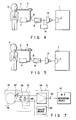
- Fig. 4 is a second embodiment of the present invention. Similar to the first embodiment, the front-stage amplifier 9 is connected to the cable 8, which is connected to the high frequency coil 6. The front-stage amplifier 9 is connected to the MR signal measuring device 2 of the MRI apparatus 1 through an isolation amplifier 14 serving as isolating/separating means for isolating/separating the signal and amplifying the signal.
- the stabilizing d.c. voltage source 13 which supplies the voltage to the front-stage amplifier 9 and the isolation amplifier 14, is connected to the front-stage amplifier 9 and the isolation amplifier 14 as shown in Fig. 4.
- the isolation amplifier 14 is an amplifier which passes the direct current
- the direct current which is isolated from the surrounding earth, is supplied to the front-stage amplifier 9 and the isolation amplifier 14 from the MRI apparatus 1, so that no connection of the stabilizing d.c. voltage source 13 is needed as shown in a modification of Fig. 5.
- the MR signal is received by the high frequency coil 6 formed at the top end portion of the insertion portion 5 of the endoscope 4.
- the received signal is amplified by the front stage amplifier 9, and isolated and separated by the isolation amplifier 14. Thereafter, the signal is inputted to the MR signal measuring device 2 of the MRI apparatus 1.
- the patient circuit which is inserted to the body of the patient 3, can be electrically isolated, and the safety of the patient 3 can be ensured in view of the leakage current. Moreover, since the signal can be amplified in the isolation and separation, an SN ratio of the diagnostic image can be improved.
- Figs. 6 to 9 are embodiments showing a diagnostic system in which an endoscope with a built-in high frequency antenna can be selectively connected to an arbitrary MR measuring device having various circuit characteristics.
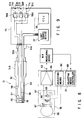
- Fig. 6 is a general view of the above diagnostic system
- Fig. 7 is a circuit diagram of matching means.
- a diagnostic system 20 comprises an MR endoscope 21, an MR detecting device or an MR measuring device 22, a magnet 23, a magnet driver 24, a camera control unit (CCU) 25, a monitor 26, and a light source device 27.
- CCU camera control unit
- the endoscope 21 forms a long and thin inserting portion 32, which is stretched to the forward portion from a handy controller 31, and a universal code 33, which is extended from the back portion of the handy controller 31.
- An objective optical system 37 which image-forms an incident light, which is inputted through a cover glass 36, on a focal plane, is arranged on a top end portion 35 of the insertion portion 32.
- An image device 38 such CCD is arranged on the focal plane of the objective optical system 37.
- a signal line 39 extends in the universal code 33 through the top end portion 35, the insertion portion 32, and the handy controller 31.
- the universal code 33 has a connector 41 in its end portion, and connected to the CCU 25 by the connector 41.
- the CCU 25 comprises a CCD driver 43 and a video processor 44.
- the image device 38 is driven by a CCD driving signal outputted from the CCD driving circuit 43.
- An image signal outputted from the image device 38 is sent to the video processor 44 through the signal line 39b and converted to a standard TV signal for a monitor display by the video processor 44, and outputted to the monitor 26.
- a light guide code 46 is extended from the side surface of the controller 31 of the endoscope 21, and is connected to the light source device 27 by a connector 47 provided at one end of the light guide code 46.
- the light source device 27 supplies electrical power to a light source 49 by a light source driver (not shown), and emits the light source 49.
- Light supplied from the light source 49 is focused on the focal plane by a capacitor lens 40.
- An end surface 51 of a light guide 50 which is extended in the insertion portion 32 of the endoscope 21 and the inside of the light guide code 46, is arranged on the focal plane. Thereby, light emitted from the light source 49 is passed through the end surface 51, and transmitted into the light guide 50.
- Light transmitted into the light guide 50 is emitted from an emission end surface 52 arranged on the top end portion 35, and an object to be examined in the body cavity can be lightened.
- a loop antenna 56 which is an MR antenna, and a matching circuit 57 connected to the loop antenna 56.
- the loop antenna 56 can be made of non-magnetic wire material having elasticity such as a wire in which a copper wire or spring material is plated with gold, or a wire in which a superelastic alloy and a copper wire are twisted.
- the loop-shape can be obtained by elasticity of the wire material.
- a signal line 58 is extended to the handy controller 31 from the matching circuit 57 through the insertion portion 32.
- the handy controller 31 has a pre-amplifier 59 and adjusting means for adjusting the matching circuit 57.
- the pre-amplifier 59 is connected to the adjusting circuit 57 through the signal line 58.
- a signal line 61 is extended to the outer portion of the endoscope 21 from the pre-amplifier 59, and connected to the MR measuring device 22 by an electrical contact 62 provided at the top end.
- the MR measuring device 22 comprises a high frequency generator 63, a tuning circuit 64, and an MR signal detector 65.
- the tuning circuit 64 tunes a high frequency, which is generated by the high frequency generator 63, to a resonance frequency corresponding to the type of an object to be measured. Then, the tuned high frequency is transmitted to the loop antenna through the matching circuit 57, and a high frequency magnetic field is outputted to the living body from the loop antenna 56.
- the loop antenna 56 serves as both a transmitter and a receiver and the MR signal sent from the living body is received by the loop antenna 56 and the MR signal is inputted to an MR signal detector 65 through the matching circuit 57, and the high frequency magnetic field is outputted to the living body from the loop antenna 56.
- the loop antenna 56 serves as both a transmitter and a receiver.
- the MR signal sent from the living body is received by the loop antenna 56, and inputted to the MR signal detector 65 through the matching circuit 57 and the pre-amplifier 59. Then, data of such as relaxation time can be obtained by the MR signal detector 65.
- Fig. 7 shows a circuit of the MR measuring section including the matching circuit 57.
- the matching circuit 57 which is connected to the loop antenna 56, has a variable capacitor 66, which is connected to the antenna 56 in parallel, and a variable capacitor 67, which is connected to the antenna 56 in series.
- these capacitors 66 and 67 the impedance between the side of the antenna 56 and the side of the high frequency generator 63, which the MR measuring device 22 has, is matched.
- these capacitors 66 and 67 are variable and the capacities of the capacitors 66 and 67 are adjusted by adjusting means 60, which is provided in the controller 31, the impedance to the connected MR measuring device 22 is matched.
- a diode 68 is connected to the loop antenna in parallel.
- the body 3 of the patient to be examined is mounted on a bed (not shown), and a static magnetic field is applied thereto by the magnet 23 driven by the magnet driver 24.
- the loop antenna was used as an MR antenna.
- the present invention is not limited to the MR antenna, and an antenna, which is generally used as an MR endoscope such a coil antenna, may be used.
- the living body 3 which an object to be examined is mounted on the bed (not shown), and the static magnetic field is applied thereto by the magnet 23.
- the insertion unit 22 of the MR endoscope 21 having the loop antenna for MR measurement is inserted from a body cavity 3a of the person to be examined such as a body cavity.
- An illumination light is supplied from the light source device 24 and an image signal, which is obtained from the objective optical system 37 through the image device 38, is examined by the monitor 26, and the loop antenna 56 of the top end portion 35 is arranged in the vicinity of the object to be examined such as an abnormal portion 3b.
- a high frequency is generated by the MR measuring device 22, and a high frequency magnetic field is transmitted to the abnormal portion 3b from the antenna 56.
- the direction of the high frequency is preferably perpendicular to the direction of the static magnetic field.
- the MR signal sent from the abnormal portion 3b is received by the antenna 56 and measured by the MR signal detector 65, thereby making it possible to determine a physiological change of the abnormal portion 3b, e.g., whether or not the the abnormal portion 3b is a cancer.
- the loop antenna 56 of the top end portion 35 and the MR measuring device 22 are matched by the matching circuit 57, which is suitably adjusted by adjusting means 60.
- the matching circuit 57 must be further adjusted.
- adjusting means shown in Fig. 7 is adjusted by hand to control the capacities of two variable capacitors 66 and 67 of the matching circuit 57, so that an impedance matching state, which is suitable for the different MR measuring device, can be obtained, and the different MR measuring device can be connected to MR endoscope 21.
- the circuit characteristic which is suitable for the MR measuring device 22 to be connected, can be obtained by the matching circuit 57, which is adjustably provided in the MR endoscope 21, and adjusting means 60 for adjusting the matching circuit.
- the matching circuit 57 which is adjustably provided in the MR endoscope 21, and adjusting means 60 for adjusting the matching circuit.
- adjusting means 60 is provided in the handy controller 31, the control operation can be easily performed.
- Fig. 8 shows a modification of the diagnostic system of Figs. 6 and 7. The following will explain the portions, which are different from those of Figs. 6 and 7.
- adjusting means controller 69 which detects a signal sent from the MR measuring device 22, and automatically adjusts adjusting means 39, is provided in the handy controller 31 of the MR endoscope 21.
- the MR signal which is received by the loop antenna 56, is sent to the MR measuring device 22 through the matching circuit 57 and the pre-amplifier 59. Then, the adjusting means controller 69 can control adjusting means 60 by the feedback from the MR measuring device 22.
- the adjusting means controller 69 controls the variable capacitors 66 and 67 of the matching circuit 57, and automatically measures the suitable adjustment between the MR measuring device 22 and the MR endoscope 21.
- the endoscope of Fig. 8 has a technical advantage in that operability can be improved since the automatic adjustment of the matching circuit is made without adjusting the matching circuit to the type of the MR measuring device to be connected.
- Fig. 9 shows other modification of the diagnostic system.
- a universal code 33a which has the light guide 50, the image device signal line 38, and the MR signal line 58, is provided to be extended from the handy controller 31a.
- the universal code 33a is formed by combining various types of cables and codes to one line.
- a connector 41a is provided at the end portion of the universal code 33a to be connected to a unit-shape controller 70.
- the controller 70 comprises the light source device 27 and the CCU 25, and a plurality of preamplifiers 59a, 59b, 59c ..., which are connected to each other in parallel.
- the MR signal line 58 is connected to the pre-amplifiers 59a, 59b, and 59c, which are formed in parallel.
- connection terminals 71a, 71b, and 71c are respectively extended from the pre-amplifiers, and connected to connection terminals 71a, 71b, and 71c, which are connected to the outer unit of the controller 70.
- connection terminals are connected to the MR measuring device as shown in Fig. 6.
- the connection terminal 71a is a terminal for a predetermined MR measuring device
- the connection terminal 71b is a terminal for the other MR measuring device
- connection terminal 71c is a terminal for further other MR measuring device.
- the necessary types of the preamplifiers, signal lines, and connection terminals can be provided in accordance with the type of the MR measuring device to be connected.
- the MR endoscope 21 can be selectively connected to various types of MR measuring devices having various circuit characteristics.
- the terminal may be selectively connected to the MR measuring device when connecting, and no adjustment is needed in accordance with the MR measuring device.
- the universal code 33a is formed as one line, the connection can be easily made, and time for connection can be reduced.
- Figs. 10 to 15 show various types of peripheral units to be used in the nuclear magnetic resonance image apparatus in the diagnostic system using the nuclear magnetic resonance phenomenon.
- the MR antenna is provided at the endoscope or the top end portion of the probe, thereby obtaining a fine and accurate image having a good S/N ratio and being effective to diagnose the depths of the disease of the tubular viscus.
- the peripheral units such as a light source device and a suction device are needed, and these peripheral units are inevitably used in the vicinity of the MRI apparatus in order to obtain the fine image having a good S/N ratio.
- the peripheral units are put under the strong static magnetic field, which the magnet of the MRI apparatus generates.
- the electromagnetic parts which are provided in the peripheral units, will not normally operated because of influence of the strong static magnetic field.
- the parts whose operations are influenced by magnetism are arranged in such a direction where influence of magnetism, which is generated by the nuclear magnetic resonance image apparatus, is reduced.
- the various types of peripheral units can be surely and normally operated without receiving influence of the strong static magnetic field, which the magnet of the nuclear magnetic resonance image apparatus generates.
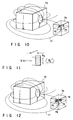
- the peripheral unit such as a light source device 74, which is necessary for the examination due to the endoscope, is provided in the vicinity of a magnet 73 of the MRI apparatus.
- the electromagnetic parts which receive influence of the magnetic field, such as a solenoid 75 and a relay 76 are provided.
- the electromagnetic parts e.g., solenoid 75 and relay 76, provided in the light source device 74, are arranged in a state that a direction B D of the magnetic field, which is generated when each part operates, is placed at a position, which is perpendicular to a direction B O of the static magnetic field, which the magnet 73 of the MRI apparatus generates.
- the magnetic flux 77 of the strong static electric field, which the magnet 73 generates is leaked into the housing of the the light source device 74 as a leakage magnetic flux.
- the direction of magnetic flux, which the electromagnetic part generates is set to be perpendicular to the outer magnetic flux, that is, leakage magnetic flux. Due to this, the electromagnetic part can be normally operated even under the environment in which the leakage magnetic flux sent from the outer unit exists.
- the operational direction of the solenoid 75 and the contact point opening/closing closing direction of the relay 76 are orthogonal to the direction of the leakage magnetic flux.
- the magnetic electronic parts which are provided in the light source device 74 and which are influenced by the magnetic field, e.g., solenoid 75 and relay 76, are contained in magnet shielding boxes 78 and 79 formed of, for example, electromagnetic steel, respectively.
- the respective electromagnetic parts are shielded from being magnetized by the magnet shielding boxes 78 and 79 formed of the electromagnetic steel. Since the electromagnetic steel has high magnetic permeability and low coercive force, a sufficient magnetic shielding function can be obtained even under the strong magnetic field, which the magnet 73 of the MRI apparatus generates.
- the electromagnetic parts are shielded from being magnetized by the magnet shielding boxes, so that the leakage magnetic flux can be further reduced, and even a part, which is sensitive to the magnet, can be normally operated.
- the problem of the magnetic filed which cannot be solved by only the mounting direction of the parts, can be solved.
- the normal operation of the parts can be obtained by the shielding effect.
- the various types of the peripheral units can be normally operated even under the strong magnetic field.
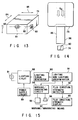
- Figs. 13 to 15 show the schematic structure of the light source device 74 for the endoscope.
- a discharge lamp 81 which is built in the light source device 74, is largely influenced by the static magnetic field.
- the discharge lamp 81 generates an arc discharge between the electrodes (not shown) and the discharge arc easily receives the influence of the magnetic field, and the arc is distorted in the magnetic field.
- the discharge lamp 81 is not turned on, or the discharge lamp 81 is turned on as the arc of the discharge lamp 81 is distorted. Due to this, the outer temperature of the lamp 81 increases, and the lamp 81 may be broken.
- the relative direction between the optical axis 82 of the discharge lamp 81 and the magnetic field is largely divided into three. More specifically, if the direction of the magnetic field, which is generated by the magnet, is set as shown by an arrow 83 or an arrow 84 in the figure, the discharge arc of the discharge lamp 81 is distorted, and the above-mentioned disadvantages occur. On the other hand, if the direction of the magnetic field, which is generated b the magnet 73, is set as shown by an arrow 85, the lamp can be normally turned on under the strong magnetic field since the discharge arc is not distributed in upper and lower directions to right and left directions between the electrodes. Therefore, if the direction of the optical axis 82 of the discharge lamp 81 is consistent with the direction of the magnetic field, the discharge lamp can be normally turned on under even strong magnetic field.
- Fig. 14 is one example showing the direction of the arrangement of the light source device 74 in the vicinity of the magnet 73 of the MRI apparatus in view of the above-mentioned characteristic.
- the axis of the magnet 73 is set to be orthogonal or perpendicular to the front panel of the light source device 74 to the rear panel.
- the light source device 74 is arranged before a bed 86 connected to the magnet 73.
- Fig. 15 is a block diagram showing the schematic structure of the light source device 74. More specifically, a lighting circuit 88 for lighting the discharge lamp 81 is connected to a power source circuit 89 for generating a lighting signal and a lighting signal generator 90, and controlled by a signal sent from a lighting/non-lighting discriminator 91. In the vicinity of the discharge lamp 81, a single or a plurality of magnetic flux detector, e.g., a flux direction/strength detector 92 including a hole element and/or a Wiegand wire is provided. The lighting/non-lighting discriminator 91 and a flux direction/strength display 93 are connected to the flux direction/strength detector 92.
- a flux direction/strength detector 92 including a hole element and/or a Wiegand wire
- the lighting/non-lighting discriminator 91 is connected to a warning/announcing circuit 94 in addition to the lighting signal generator 90. Moreover, a warning/announcing means 97 for warning/announcing by light and sound generated by a warning lamp 95 and a warning speaker 96 is connected to the warning/announcing circuit 94.
- the magnetic flux close to the discharge lamp 81 is divided into the strength of each directional component, and detected by the flux direction/strength detector 92.
- the detection signal is inputted to the flux direction/strength display 93, the strength of the magnetic flux of each direction is converted to density of magnetic flux and displayed, or the direction of the magnetic flux close to the lamp is displayed.
- the lighting/non-lighting discriminator 91 discriminates whether or not the magnetic field close to the discharge lamp 81 generates lighting defectiveness of the lamp. If it is discriminated that no lighting defectiveness is generated, a light allowing signal is inputted to the lighting signal generator 90, and a lighting signal is generated, and inputted to the lighting circuit. Then, based on this signal, the lighting circuit 88 turns on the discharge lamp 81.
- a light prohibiting signal is inputted to the lighting signal generator 90, and no lighting signal is generated, and the start of the lighting of the discharge lamp 38 is not performed.
- the light prohibiting signal is outputted to the warning/announcing circuit 94. Since strength of the magnetic field close to the lamp is high and lighting defectiveness is generated, the warning/announcing circuit 94 announces that the light source device 74 is in a light prohibiting state, and warns that the strength of the magnetic field, which has influence upon the lighting, is high.
- a protection function which determines whether or not the magnetic flux, which passes through the discharge lamp 81, influences the lamp lighting state, and which allows the lighting of the discharge lamp 81 only in the case that the light source device 74 is arranged in the direction that no lighting defectiveness occurs.
- the direction and position of the the light source device 74 are adjusted again with reference to the strength of the magnetic field displayed on the display, thereby making it possible to obtain the light allowing state. Due to this, it is possible to safely and surely perform the examination using the endoscope.
- the parts of the respective peripheral units whose operations are influenced by magnetism is arranged in such a direction where influence of magnetism, which is generated by the nuclear magnetic resonance image apparatus, is reduced.
- the various types of peripheral units, which are arranged close to the magnet of the nuclear magnetic resonance image apparatus can be surely and normally operated even under the strong magnetic field, and safety of the patient, which is examined and treated, can be ensured.
- the conventional treatment implement for the endoscope is normally formed of magnetic material. Due to this, if the treatment implement is inserted to the patient in the MRI apparatus, the treatment implement is attracted by the extremely strong static magnetic field of the magnet of the MRI apparatus, and danger is exerted on the patient. Moreover, the magnetic filed is largely disturbed by magnetism of the treatment implement, and the MR image is largely distorted, so that image-diagnosis cannot be performed.
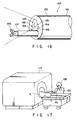
- Fig. 16 shows a top end side of an insertion section 101 of an endoscope 100 when an examination and treatment are performed by use of a treatment implement for endoscope under the examination by an endoscope.
- Reference numeral 102 is a top end portion provided in the insertion section 101 of the endoscope 100, and an observation optical system 103, an illumination optical system 104, an injection nozzle 105, and a channel 106 for treatment implement are provided thereon.
- An implement 107 is inserted to the channel 106 and is projected from the top end portion 102, and treatment is performed within the endoscope observation filed of vision by use of forceps.
- Fig. 17 shows a state that a medical expert inserts the insertion section 101 of the endoscope 100 to the patient 3 on an MRI apparatus 110, and examines the living body of the patient.
- the endoscope 100 is formed of non-magnetic material in order to be used in strong magnetic field of the MRI apparatus 110.
- a high frequency coil for receiving an MR signal from a disease portion (Fig. 3 and Figs. 6 to 9), and the medical expert can MR-image-diagnose the disease portion while observing it through the endoscope.
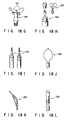
- Figs. 18A to 18L show a top end portion of each of various types of treatment implements for endoscope.
- Fig. 18A shows a forceps 114 having a pair of cups 113, which are freely opened and closed.
- Fig. 18B shows a forceps 116 having the pair of cups 113 and a needle 115.
- Fig. 18C shows a brush 119 for examining tissue, which is formed by putting a brush hair 118 on an inverse-U shaped wire 117.
- Fig. 18D shows a brush 122 for examining tissue, which is formed by putting a brush hair 121 on a rod-shape wire 120.
- Fig. 18E shows a crocodile holding forceps 124 having a forceps 123, which is freely opened and closed.
- Fig. 18F is a basket type holding forceps 126 having a basket 125.
- Fig. 18G shows a scissors forceps 128 having a pair of scissors 127.
- Fig. 18H is a clip device 130 having a clip 129.
- Fig. 18I shows an injection needle 131.
- Fig. 18J shows an elliptical high frequency snare 132 for an electrical scalpel.
- Fig. 18K is a snare (papillotomy knife) 133 for an electrical scalpel to cut a duodenum and a papilla.
- Fig. 18L shows a heat probe 134.
- Each of the above implements including the handy control section, insertion section, and top end mechanism is formed of non-magnetic material.
- plastic is used as the handy control section
- a resin-made tube is used as a sheath
- a non-magnetic metal such as phosphor bronze is used as a coil sheath
- a tungsten wire is used as a wire
- a titanium alloy is used as a top end portion
- copper or brass is used as other metallic parts
- a constant voltage diode is used as a heat element as shown in Fig. 18L.
- the treatment implement is not attracted even in the strong magnetic field of the magnet of the MRI apparatus 110 (Fig. 17). Therefore, the disease portion can be examined by the endoscope 100, the MR diagnostic image of the disease portion can be formed, necessary treatments, examination of living body, and examination of tissue can be performed immediately under the examination by the endoscope.
- the treatment implement since the treatment implement is formed of non-magnetic material, the treatment implement is not attracted by the extremely strong magnetic field of the magnet of the MRI apparatus 110 even if it is inserted to the patient 3 in the MRI apparatus 110, and no danger may be exerted on the patient 3.
- the treatment implement is non-magnetic, the magnetic field is not disturbed, and the MR image is not distorted, so that there can be obtained the technical advantage in which both fine and accurate image-diagnosis and the treatment using the endoscope can be performed.
- Figs. 18A to 18L show only a part of the examples of the treatment implements. If the other treatment implements are formed of non-magnetic material similar to the above embodiment, exactly the same technical advantage an be obtained. Therefore, the present invention is not limited to the treatment implements shown in the embodiment.
- the insertion section which has the flexible thin tube of the endoscope, is formed of non-magnetic material in order not to be attracted by the strong magnetic field of the magnet of the MRI apparatus and not to distort the MR image by disturbing the magnetic field.
- the insertion section having the flexible thin tube such as the endoscope it is difficult to structure a curved control section controlling a curved portion and a handy control section having an eye-piece by the non-magnetic member in view of processing and cost.
- the entire effective length of the insertion section is made longer not to be influenced by the magnetic field of the magnet, and the handy control section is used to be away from the magnet.
- the top end portion of the insertion section is inserted to the patient, and the scanning is performed by the MRI apparatus in a state that the handy control section is away from the magnet.
- the control section may be attracted by the magnetic field of the magnet during the scanning, and there may be occur a danger that the control section will collide with the patient.
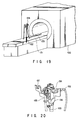
- Fig. 19 shows a hanger 132 for endoscope, which is provided on a bed 131 of the MRI apparatus 139, and which holds a control section 134 of an endoscope 133.
- Fig. 20 shows a state that a holding section 135 of the hunger 132 holds the control section 134.
- a hung section 136 and a switch 137 are provided in the holding section 135.
- the hung section 136 is directed to hold the control section 134 in order not to prevent the control section section 134 from being attracted by magnetic force of the magnet.
- the switch 137 is provided to be turned on by the control section 134 when the control section 134 is correctly held by the holding section 135.
- the switch 137 is connected to allowing means (not shown) of the MRI apparatus 130.
- the control section 134 of the endoscope 133 which is inserted to the patient, is held by the holding section 135 of the hunger 132 when the scanning is performed by the MRI apparatus 130.
- the control section 134 is correctly held and protected from being attracted by the magnetic force of the magnet, allowing means of the MRI apparatus 130 allows the MRI apparatus to scan. That is, the MRI apparatus 130 can scan only when the control section 134 of the endoscope 133 is held in a predetermined safe state.
- control section 134 of the endoscope 133 which is formed of the non-magnetic member, is not attracted by the magnet when the scanning is performed by the MRI apparatus 130, safety against the patient can be extremely improved. Therefore, there can be obtain a technical advantage in which the safety against the patient can be ensured without increasing the manufacturing cost of the endoscope 133.
- the same technical advantage can be also obtained by providing the hunger 132 on a trolley 138 for endoscope, which is formed of non-magnetic material, as shown in Fig. 21, without providing it in the bed 131 of the MRI apparatus 130.
- a technical advantage in which a light source device 139 for endoscope and a peripheral unit 140 can be contained in the trolley 138, in addition to the prevention of the attraction of the control section 134.
Landscapes
- Physics & Mathematics (AREA)
- Health & Medical Sciences (AREA)
- Life Sciences & Earth Sciences (AREA)
- Condensed Matter Physics & Semiconductors (AREA)
- General Physics & Mathematics (AREA)
- General Health & Medical Sciences (AREA)
- Pathology (AREA)
- Nuclear Medicine, Radiotherapy & Molecular Imaging (AREA)
- Biophysics (AREA)
- Molecular Biology (AREA)
- High Energy & Nuclear Physics (AREA)
- Engineering & Computer Science (AREA)
- Biomedical Technology (AREA)
- Heart & Thoracic Surgery (AREA)
- Medical Informatics (AREA)
- Radiology & Medical Imaging (AREA)
- Surgery (AREA)
- Animal Behavior & Ethology (AREA)
- Public Health (AREA)
- Veterinary Medicine (AREA)
- Magnetic Resonance Imaging Apparatus (AREA)
- Endoscopes (AREA)
Priority Applications (1)
| Application Number | Priority Date | Filing Date | Title |
|---|---|---|---|
| EP96118785A EP0766093B1 (de) | 1992-06-25 | 1993-06-24 | Diagnostik-Anlage |
Applications Claiming Priority (6)
| Application Number | Priority Date | Filing Date | Title |
|---|---|---|---|
| JP167627/92 | 1992-06-25 | ||
| JP4167627A JPH067319A (ja) | 1992-06-25 | 1992-06-25 | Mr内視鏡装置 |
| JP27185092 | 1992-10-09 | ||
| JP271850/92 | 1992-10-09 | ||
| JP5028088A JPH06237918A (ja) | 1993-02-17 | 1993-02-17 | 核磁気共鳴映像装置の周辺機器 |
| JP28088/93 | 1993-02-17 |
Related Child Applications (1)
| Application Number | Title | Priority Date | Filing Date |
|---|---|---|---|
| EP96118785A Division EP0766093B1 (de) | 1992-06-25 | 1993-06-24 | Diagnostik-Anlage |
Publications (2)
| Publication Number | Publication Date |
|---|---|
| EP0576016A1 true EP0576016A1 (de) | 1993-12-29 |
| EP0576016B1 EP0576016B1 (de) | 1998-04-15 |
Family
ID=27286075
Family Applications (2)
| Application Number | Title | Priority Date | Filing Date |
|---|---|---|---|
| EP96118785A Expired - Lifetime EP0766093B1 (de) | 1992-06-25 | 1993-06-24 | Diagnostik-Anlage |
| EP93110132A Expired - Lifetime EP0576016B1 (de) | 1992-06-25 | 1993-06-24 | Diagnostik-Anlage mittels magnetischer Kernresonanz |
Family Applications Before (1)
| Application Number | Title | Priority Date | Filing Date |
|---|---|---|---|
| EP96118785A Expired - Lifetime EP0766093B1 (de) | 1992-06-25 | 1993-06-24 | Diagnostik-Anlage |
Country Status (3)
| Country | Link |
|---|---|
| US (1) | US5402788A (de) |
| EP (2) | EP0766093B1 (de) |
| DE (2) | DE69332985T2 (de) |
Cited By (1)
| Publication number | Priority date | Publication date | Assignee | Title |
|---|---|---|---|---|
| EP0672914A1 (de) * | 1994-03-18 | 1995-09-20 | Olympus Optical Co., Ltd. | Vorrichtung zur Anwendung in Verbindung mit einem Apparat für die Bilderzeugung mittels magnetischer Resonanz |
Families Citing this family (13)
| Publication number | Priority date | Publication date | Assignee | Title |
|---|---|---|---|---|
| JP3544557B2 (ja) * | 1994-04-08 | 2004-07-21 | オリンパス株式会社 | 画像ファイル装置 |
| US5607441A (en) * | 1995-03-24 | 1997-03-04 | Ethicon Endo-Surgery, Inc. | Surgical dissector |
| AU7594798A (en) * | 1997-05-21 | 1998-12-11 | Cardiac M.R.I. Inc. | Cardiac mri with an internal receiving coil and an external receiving coil |
| JPH11275460A (ja) * | 1998-03-24 | 1999-10-08 | Mitsubishi Electric Corp | 信号出力回路、信号入力回路、信号入出力回路 |
| US7286868B2 (en) * | 2001-06-15 | 2007-10-23 | Biosense Inc. | Medical device with position sensor having accuracy at high temperatures |
| US6496714B1 (en) * | 2001-07-20 | 2002-12-17 | Koninklijke Philips Electronics N.V. | RF-safe invasive device |
| WO2008082661A2 (en) * | 2006-12-29 | 2008-07-10 | The Johns Hopkins University | Methods, systems and devices for local endoscopic magnetic resonance |
| CN101657141B (zh) * | 2007-02-26 | 2011-06-01 | 株式会社町田制作所 | 适用于磁共振成像的柔性内窥镜 |
| US9259582B2 (en) | 2011-04-29 | 2016-02-16 | Cyberonics, Inc. | Slot antenna for an implantable device |
| US9240630B2 (en) | 2011-04-29 | 2016-01-19 | Cyberonics, Inc. | Antenna shield for an implantable medical device |
| US9089712B2 (en) | 2011-04-29 | 2015-07-28 | Cyberonics, Inc. | Implantable medical device without antenna feedthrough |
| US9265958B2 (en) | 2011-04-29 | 2016-02-23 | Cyberonics, Inc. | Implantable medical device antenna |
| US9547056B2 (en) * | 2011-09-07 | 2017-01-17 | Koninklijke Philips N.V. | Dynamic modification of RF array coil/antenna impedance |
Citations (7)
| Publication number | Priority date | Publication date | Assignee | Title |
|---|---|---|---|---|
| EP0230168A1 (de) * | 1985-11-29 | 1987-07-29 | General Electric Cgr S.A. | Vorrichtung und Verfahren zur Justierung der Hochfrequenzantenne eines magnetischen Kernresonanzapparates |
| US4737712A (en) * | 1986-12-31 | 1988-04-12 | General Electric Company | Isolated power transfer and patient monitoring system with interference rejection useful with NMR apparatus |
| US4951009A (en) * | 1989-08-11 | 1990-08-21 | Applied Materials, Inc. | Tuning method and control system for automatic matching network |
| EP0385367A1 (de) * | 1989-02-27 | 1990-09-05 | Medrad Inc. | Sonde für Körperhöhlen und Schnittstelleneinrichtung für Magnetresonanzdarstellung und Spektroskopie |
| US5035231A (en) * | 1987-04-27 | 1991-07-30 | Olympus Optical Co., Ltd. | Endoscope apparatus |
| US5050607A (en) * | 1987-03-04 | 1991-09-24 | Huntington Medical Research Institutes | High resolution magnetic resonance imaging of body cavities |
| US5143068A (en) * | 1990-11-26 | 1992-09-01 | Resonex, Inc. | Flexible and curved radio frequency (RF) coil for the human shoulder for magnetic resonance imaging apparatus |
Family Cites Families (16)
| Publication number | Priority date | Publication date | Assignee | Title |
|---|---|---|---|---|
| US4572198A (en) * | 1984-06-18 | 1986-02-25 | Varian Associates, Inc. | Catheter for use with NMR imaging systems |
| DE3429386A1 (de) * | 1984-08-09 | 1986-02-27 | Siemens AG, 1000 Berlin und 8000 München | Kernspintomographiegeraet |
| US4672972A (en) * | 1984-08-13 | 1987-06-16 | Berke Howard R | Solid state NMR probe |
| US4950993A (en) * | 1985-11-29 | 1990-08-21 | Thomson-Cgr | Device and method for adjusting a radiofrequency antenna of a nuclear magnetic resonance apparatus |
| US4960106A (en) * | 1987-04-28 | 1990-10-02 | Olympus Optical Co., Ltd. | Endoscope apparatus |
| US5170789A (en) * | 1987-06-17 | 1992-12-15 | Perinchery Narayan | Insertable NMR coil probe |
| US5348010A (en) * | 1989-02-24 | 1994-09-20 | Medrea, Inc., Pennsylvania Corp., Pa. | Intracavity probe and interface device for MRI imaging and spectroscopy |
| JPH035174A (ja) * | 1989-06-02 | 1991-01-10 | Fujitsu Ltd | 水平プリンタ |
| JP2921694B2 (ja) * | 1990-01-17 | 1999-07-19 | オリンパス光学工業株式会社 | 磁気共鳴信号検出装置 |
| JP2566032B2 (ja) * | 1990-02-06 | 1996-12-25 | オリンパス光学工業株式会社 | 内視鏡 |
| JPH0473051A (ja) * | 1990-07-16 | 1992-03-09 | Olympus Optical Co Ltd | Nmr用検出装置 |
| JPH04129533A (ja) * | 1990-09-19 | 1992-04-30 | Toshiba Corp | Mri装置のプローブ |
| US5188111A (en) * | 1991-01-18 | 1993-02-23 | Catheter Research, Inc. | Device for seeking an area of interest within a body |
| US5265610A (en) * | 1991-09-03 | 1993-11-30 | General Electric Company | Multi-planar X-ray fluoroscopy system using radiofrequency fields |
| US5307814A (en) * | 1991-09-17 | 1994-05-03 | Medrad, Inc. | Externally moveable intracavity probe for MRI imaging and spectroscopy |
| US5271400A (en) * | 1992-04-01 | 1993-12-21 | General Electric Company | Tracking system to monitor the position and orientation of a device using magnetic resonance detection of a sample contained within the device |
-
1993
- 1993-06-21 US US08/080,224 patent/US5402788A/en not_active Expired - Fee Related
- 1993-06-24 EP EP96118785A patent/EP0766093B1/de not_active Expired - Lifetime
- 1993-06-24 EP EP93110132A patent/EP0576016B1/de not_active Expired - Lifetime
- 1993-06-24 DE DE69332985T patent/DE69332985T2/de not_active Expired - Fee Related
- 1993-06-24 DE DE69317943T patent/DE69317943T2/de not_active Expired - Fee Related
Patent Citations (7)
| Publication number | Priority date | Publication date | Assignee | Title |
|---|---|---|---|---|
| EP0230168A1 (de) * | 1985-11-29 | 1987-07-29 | General Electric Cgr S.A. | Vorrichtung und Verfahren zur Justierung der Hochfrequenzantenne eines magnetischen Kernresonanzapparates |
| US4737712A (en) * | 1986-12-31 | 1988-04-12 | General Electric Company | Isolated power transfer and patient monitoring system with interference rejection useful with NMR apparatus |
| US5050607A (en) * | 1987-03-04 | 1991-09-24 | Huntington Medical Research Institutes | High resolution magnetic resonance imaging of body cavities |
| US5035231A (en) * | 1987-04-27 | 1991-07-30 | Olympus Optical Co., Ltd. | Endoscope apparatus |
| EP0385367A1 (de) * | 1989-02-27 | 1990-09-05 | Medrad Inc. | Sonde für Körperhöhlen und Schnittstelleneinrichtung für Magnetresonanzdarstellung und Spektroskopie |
| US4951009A (en) * | 1989-08-11 | 1990-08-21 | Applied Materials, Inc. | Tuning method and control system for automatic matching network |
| US5143068A (en) * | 1990-11-26 | 1992-09-01 | Resonex, Inc. | Flexible and curved radio frequency (RF) coil for the human shoulder for magnetic resonance imaging apparatus |
Cited By (2)
| Publication number | Priority date | Publication date | Assignee | Title |
|---|---|---|---|---|
| EP0672914A1 (de) * | 1994-03-18 | 1995-09-20 | Olympus Optical Co., Ltd. | Vorrichtung zur Anwendung in Verbindung mit einem Apparat für die Bilderzeugung mittels magnetischer Resonanz |
| US5738632A (en) * | 1994-03-18 | 1998-04-14 | Olympus Optical Co., Ltd. | Device for use in combination with a magnetic resonance imaging apparatus |
Also Published As
| Publication number | Publication date |
|---|---|
| DE69317943D1 (de) | 1998-05-20 |
| EP0766093A1 (de) | 1997-04-02 |
| DE69332985D1 (de) | 2003-06-18 |
| EP0576016B1 (de) | 1998-04-15 |
| DE69332985T2 (de) | 2004-02-19 |
| US5402788A (en) | 1995-04-04 |
| DE69317943T2 (de) | 1998-08-06 |
| EP0766093B1 (de) | 2003-05-14 |
Similar Documents
| Publication | Publication Date | Title |
|---|---|---|
| US5402788A (en) | Diagnostic system using nuclear magnetic resonance phenomenon | |
| EP0672914B1 (de) | Vorrichtung zur Anwendung in Verbindung mit einem Apparat für die Bilderzeugung mittels magnetischer Resonanz | |
| US5035231A (en) | Endoscope apparatus | |
| US5427103A (en) | MRI apparatus for receiving nuclear-magnetic resonance signals of a living body | |
| US5323778A (en) | Method and apparatus for magnetic resonance imaging and heating tissues | |
| JP3260930B2 (ja) | 内視鏡挿入状態検出装置 | |
| JP2006517416A (ja) | 光mriカテーテルシステム | |
| WO2000062672A9 (en) | Methods for in vivo magnetic resonance imaging | |
| US20100134273A1 (en) | Radiofrequency safety of switchable segmented transmission lines | |
| JPH09238924A (ja) | 処置具及びこの処置具を備えた医用複合診断システム | |
| US5550471A (en) | Antenna cable for a diagnostic magnetic resonance apparatus | |
| AU779794B2 (en) | Methods for in vivo magnetic resonance imaging | |
| JP4028643B2 (ja) | Mr内視鏡 | |
| JP2001190518A (ja) | 磁気共鳴観測装置 | |
| JPH03212262A (ja) | 磁気共鳴信号検出装置 | |
| JP3244376B2 (ja) | 磁気共鳴観測装置 | |
| JPH06261881A (ja) | 核磁気共鳴信号診断装置 | |
| JP3691625B2 (ja) | 磁気共鳴観測装置 | |
| JP3234033B2 (ja) | 磁気共鳴観測装置 | |
| JPH11225986A (ja) | Mri内視鏡及びmri用rfコイル | |
| JPH08126627A (ja) | 医療用診断装置 | |
| JP3344753B2 (ja) | 磁気共鳴観測装置 | |
| JP3234089B2 (ja) | 磁気共鳴観測装置 | |
| JPH067319A (ja) | Mr内視鏡装置 | |
| JP3518911B2 (ja) | 磁気共鳴観測装置用プローブ |
Legal Events
| Date | Code | Title | Description |
|---|---|---|---|
| PUAI | Public reference made under article 153(3) epc to a published international application that has entered the european phase |
Free format text: ORIGINAL CODE: 0009012 |
|
| 17P | Request for examination filed |
Effective date: 19930624 |
|
| AK | Designated contracting states |
Kind code of ref document: A1 Designated state(s): DE FR GB NL |
|
| 17Q | First examination report despatched |
Effective date: 19960715 |
|
| GRAG | Despatch of communication of intention to grant |
Free format text: ORIGINAL CODE: EPIDOS AGRA |
|
| GRAG | Despatch of communication of intention to grant |
Free format text: ORIGINAL CODE: EPIDOS AGRA |
|
| GRAH | Despatch of communication of intention to grant a patent |
Free format text: ORIGINAL CODE: EPIDOS IGRA |
|
| GRAH | Despatch of communication of intention to grant a patent |
Free format text: ORIGINAL CODE: EPIDOS IGRA |
|
| GRAA | (expected) grant |
Free format text: ORIGINAL CODE: 0009210 |
|
| AK | Designated contracting states |
Kind code of ref document: B1 Designated state(s): DE FR GB NL |
|
| XX | Miscellaneous (additional remarks) |
Free format text: TEILANMELDUNG 96118785.3 EINGEREICHT AM 22/11/96. |
|
| REF | Corresponds to: |
Ref document number: 69317943 Country of ref document: DE Date of ref document: 19980520 |
|
| ET | Fr: translation filed | ||
| PLBE | No opposition filed within time limit |
Free format text: ORIGINAL CODE: 0009261 |
|
| STAA | Information on the status of an ep patent application or granted ep patent |
Free format text: STATUS: NO OPPOSITION FILED WITHIN TIME LIMIT |
|
| 26N | No opposition filed | ||
| REG | Reference to a national code |
Ref country code: GB Ref legal event code: IF02 |
|
| PGFP | Annual fee paid to national office [announced via postgrant information from national office to epo] |
Ref country code: FR Payment date: 20060608 Year of fee payment: 14 |
|
| PGFP | Annual fee paid to national office [announced via postgrant information from national office to epo] |
Ref country code: NL Payment date: 20060615 Year of fee payment: 14 |
|
| PGFP | Annual fee paid to national office [announced via postgrant information from national office to epo] |
Ref country code: GB Payment date: 20060621 Year of fee payment: 14 |
|
| PGFP | Annual fee paid to national office [announced via postgrant information from national office to epo] |
Ref country code: DE Payment date: 20060622 Year of fee payment: 14 |
|
| GBPC | Gb: european patent ceased through non-payment of renewal fee |
Effective date: 20070624 |
|
| NLV4 | Nl: lapsed or anulled due to non-payment of the annual fee |
Effective date: 20080101 |
|
| REG | Reference to a national code |
Ref country code: FR Ref legal event code: ST Effective date: 20080229 |
|
| PG25 | Lapsed in a contracting state [announced via postgrant information from national office to epo] |
Ref country code: NL Free format text: LAPSE BECAUSE OF NON-PAYMENT OF DUE FEES Effective date: 20080101 Ref country code: DE Free format text: LAPSE BECAUSE OF NON-PAYMENT OF DUE FEES Effective date: 20080101 |
|
| PG25 | Lapsed in a contracting state [announced via postgrant information from national office to epo] |
Ref country code: GB Free format text: LAPSE BECAUSE OF NON-PAYMENT OF DUE FEES Effective date: 20070624 |
|
| PG25 | Lapsed in a contracting state [announced via postgrant information from national office to epo] |
Ref country code: FR Free format text: LAPSE BECAUSE OF NON-PAYMENT OF DUE FEES Effective date: 20070702 |