EP0576020A2 - Zeichenerkennungsverfahren und -gerät - Google Patents
Zeichenerkennungsverfahren und -gerät Download PDFInfo
- Publication number
- EP0576020A2 EP0576020A2 EP93110144A EP93110144A EP0576020A2 EP 0576020 A2 EP0576020 A2 EP 0576020A2 EP 93110144 A EP93110144 A EP 93110144A EP 93110144 A EP93110144 A EP 93110144A EP 0576020 A2 EP0576020 A2 EP 0576020A2
- Authority
- EP
- European Patent Office
- Prior art keywords
- character
- strokes
- recognizing
- pattern
- character pattern
- Prior art date
- Legal status (The legal status is an assumption and is not a legal conclusion. Google has not performed a legal analysis and makes no representation as to the accuracy of the status listed.)
- Granted
Links
Images


Classifications
-
- G—PHYSICS
- G06—COMPUTING OR CALCULATING; COUNTING
- G06V—IMAGE OR VIDEO RECOGNITION OR UNDERSTANDING
- G06V10/00—Arrangements for image or video recognition or understanding
- G06V10/40—Extraction of image or video features
- G06V10/46—Descriptors for shape, contour or point-related descriptors, e.g. scale invariant feature transform [SIFT] or bags of words [BoW]; Salient regional features
-
- G—PHYSICS
- G06—COMPUTING OR CALCULATING; COUNTING
- G06V—IMAGE OR VIDEO RECOGNITION OR UNDERSTANDING
- G06V30/00—Character recognition; Recognising digital ink; Document-oriented image-based pattern recognition
- G06V30/10—Character recognition
- G06V30/24—Character recognition characterised by the processing or recognition method
- G06V30/242—Division of the character sequences into groups prior to recognition; Selection of dictionaries
Definitions
- the present invention relates to character recognizing method and apparatus in which even in the case a plurality of kinds of characters such as kanji (or chinese character), kana (or Japanese character), alphabetical character, numeral, and the like are mixedly inputted, the characters can be recognized by a recognition algorithm suitable for each input character.
- kanji or chinese character
- kana or Japanese character
- alphabetical character or numeral, and the like
- the character type is previously designated for an input area and the character pattern which has been inputted to the input area is recognized by a method suitable to the character type designated for such an area.
- Such a method can be applied to only a document such as a slip or the like having a fixed format, and a degree of freedom is low.
- JP-A-64-215808 there is an apparatus in which a large input character is judged to be a "kanji” and a small input character is decided to be a "kana", alphabetical character, or numeral on the basis of a size of character which is inputted or a position in a character frame, and the input character is recognized by a recognizing algorithm suitable for each character type.
- the size of character or the position of character in the character frame varies in dependence on a personal habit of the person who inputs the character or a situation at the time of the inputting operation.
- the size of input character is not always constant in dependence on the character type, so that a recognition rate is not improved.
- the invention has a plurality of recognizing algorithms so as to correspond to the recognition of character patterns having various characteristics.
- Another object of the invention is that by selecting a proper recognizing algorithm on the basis of the feature of strokes of an inputted character pattern, the inputted character pattern can be judged in accordance with the characteristics at a high fidelity as compared with a judging method based on the size whereby a recognition difference occurs depending on the person who inputs a character pattern or a mental state at the time of the inputting operation.
- Still another object of the invention is that characters to which each recognizing algorithm is applied are classified by the characteristics of the strokes of character irrespective of the exisiting classification such as a character type (kanji, kana, alphabetical character, numeral, or the like), for example, in case of the characters such as and whose characteristics are close to those of "kana” although they are "kanji” characters, the algorithm for "kana” is selected, and the inputted character can be recognized by the recognizing algorithm which can further raise a recognition rate.
- a character type kanji, kana, alphabetical character, numeral, or the like
- Reference numeral 12 denotes a coordinate input unit.
- an input plate in which a number of electrodes are arranged in both of the vertical and lateral directions or the like is used and the coordinate values of the position pressed by using an input pen 11 are inputted in the coordinate input unit 12.
- the coordinate data is sent to a central processing unit (hereinafter, simply referred to as a CPU) 82.
- a CPU central processing unit
- reference numeral 82a denotes an ROM to store control programs for executing processes, for example, as shown in flowcharts of Figs. 2 and 5 and a character pattern dictionary
- reference numeral 82b indicates an RAM to store various kinds of data.
- the CPU 82 executes the processes as shown in the flowcharts of Figs. 2 and 5.
- the coordinate values which are inputted from the coordinate input unit 12 are stored in the RAM 82b as pattern data which is inputted in the input unit 12.
- the inputted character values are subjected to a matching process with each of the pattern data in a character pattern dictionary stored in the ROM 82a, thereby obtaining a similarity.
- the character data which is determined by the similarity is outputted to a display controller 83 as a result of the recognition.
- the character pattern as a result of the recognition is displayed on a liquid crystal display unit (LCD) 84 under the control of the display controller 83.
- LCD liquid crystal display unit
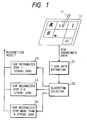
- Fig. 1 is a block diagram mainly showing a construction of a recognition unit of a character recognition processing apparatus according to the first embodiment of the invention.
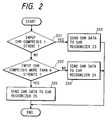
- Fig. 2 is a flowchart for executing an algorithm selecting process on the basis of the number of strokes of an input character.
- Fig. 3 shows an example of an input picture plane.
- reference numeral 11 denotes the pen to input characters and 12 indicates the coordinate input unit having an input board on which a number of transparent electrodes are arranged in both of the vertical and lateral directions.
- a character pattern is inputted onto the input board by using the input pen 11.
- the coordinate data of the position depressed by the input pen 11 is inputted.
- the coordinate data which is sequentially inputted by the input pen 11 is sent to a 1-character data extracter 21.
- the extracter 21 receives the coordinate data of the pen which is supplied from the input unit 12 and stores into the RAM 82b.
- a "recognition" key 47 in Fig. 3 is depressed by the pen 11, the coordinate data of the characters which has been stored so far is sent every character to an algorithm selector 22 according to the number of strokes of the input character.
- the extracting process of every character of the inputted coordinate data which is executed by the 1-character data extracter 21 is performed by a conventional discriminating method by character frames.
- Reference numerals 41, 42, 43, 44, 45, and 46 shown in Fig. 3 denote character frames.
- the coordinate data of each character frame is previously stored in the RAM 82b.
- the inputted coordinate data is compared with the coordinate data of the character frame, thereby judging to which character frame the coordinate data belongs.
- the coordinate data which has been inputted to each character frame is divided as coordinate data of one character. Now, assuming that characters were inputted as shown in Fig. 3, (which reads "naga" and means "long") is written in the area of the character frame 41.
- the divided character data is sequentially sent to the algorithm selector 22 based on the number of strokes of the input character in accordance with the order of the character frames. Therefore, when the characters are inputted as shown in Fig. 3, the character data is sent in accordance with the order of the characters such as (which reads "naga” and means “long”) (which reads "i”) (which reads “ichi” and means “one") (which reads "nichi” and means “day”) (which reads "nagai ichinichi” and means "one long day”)
- the algorithm selector 22 based on the number of strokes of input character receives the coordinate data which has been divided every character by the 1-character data extracter 21 and judges the number of strokes of the one-character data from the UP/DOWN information of the input pen 11 regarding the data of one character.
- Reference numeral 23 in Fig. 1 denotes the character recognizer for a character of one stroke.
- the recognizer 23 executes a recognition by, for example, an algorithm of the feature point method disclosed in JP-B-62-39460 or the like and generates the result of the recognition.
- Reference numeral 24 in Fig. 1 denotes a character recognizer for a character in which the number of strokes lies within a range from 2 to 6.
- the recognizer 24 performs a recognition by, for example, an algorithm of a well-known fundamental stroke vector method and generates the result of the recognition.
- Reference numeral 25 in Fig. 1 denotes a character recognizer for a character in which the number of strokes is equal to or larger than 7.
- the recognizer 25 performs a recognition by, for example, a recognizing algorithm as shown in JP-B-57-6151 or the like such that an input character is recognized by the sum of distances between the start points and end points of the input character and the start point and end point of a dictionary pattern and generates the result of the recognition.
- step S31 a check is made to see if an input character indicates a character pattern such that the number of pen lifting-up times is equal to 1 and the number of pen lifting-down times is equal to 1, namely, whether the input character indicates a character pattern of one stroke or not. If YES, step S33 follows and the character data is sent to the 1-character recognizer 23 in step S33.
- step S32 follows. It is now assumed that the characters are inputted as shown in Fig. 3, the data of one character is sequentially sent from the l-character data extracter 21 in accordance with the order of In case of the number of pen lifting-up times is equal to 8 and the number of pen lifting-down times is equal to 8 and it is decided that it is a character pattern of eight strokes, so that the processing routine advances to step S32. Since is a character pattern of two strokes, the processing routine also advances to step S32. Since is a character pattern of one stroke, the processing routine advances to step S33. Since is a character pattern of four strokes, step S32 follows. Since is a character pattern of one stroke, step S33 follows.
- step S32 a check is made to see if the number of strokes of the input character is equal to or larger than 7 or not. When it is less than 7, step S34 follows. In step S34, since the number of character data lies within a range from 2 to 6, the character data is sent to the character recognizer 24. When the number of strokes of the input character is equal to or larger than 7, step S35 follows. In step S35, since the number of strokes of the character data is equal to or larger than 7, the character data is sent to the character recognizer 25.
- step S35 When is sent in step S32, since the number of strokes of is equal to 8, step S35 follows. Since the number of strokes of is equal to 2, step S34 follows. Since the number of strokes of is equal to 4, step S34 follows.
- the character of one stroke such as or is recognized by using the recognizer using the algorithm suitable for the character of one stroke.
- the character such as in which the number of strokes lies within a range from 2 to 6 is recognized by the recognizer using the algorithm suitable for the character in which the number of strokes lies within a range from 2 to 6.
- the character such as of 7 strokes or more is recognized by using the algorithm suitable for the character of 7 strokes or more.
- the recognizer suitable for different characteristics can be applied without allowing the user to be aware of the recognizer in accordance with the number of strokes of the character. A more accurate recognizing method can be realized.
- the algorithm suitable for the input character can be used in accordance with a curvature of the stroke of the input character by replacing the algorithm selector 22 based on the number of strokes of the input character to an algorithm selector 26 based on a curvature of the stroke of the input character shown in Fig. 4.
- Fig. 4 is a block diagram showing a construction of a character recognition processing apparatus in the embodiment 2.
- Fig. 5 is a flowchart showing algorithm selecting processes based on the curvature of the stroke of the input character as a feature of the embodiment.
- Fig. 6 is a conceptual diagram to form a vector for the stroke.
- Fig. 7 shows an example of the input picture plane.
- each stroke of the coordinate data of one character which is sent from the l-character data extracter 21 is divided into ten equal segments on the basis of the distance.
- Direction change amounts of ten vectors are set to curvatures of the strokes.
- the character recognizer 27 for "kanji” recognizes a character by a conventional algorithm by the calculation of the distance between the start point and the end point or the like and generates the result of the recognition.
- the character recognizer 28 for "hirakana” recognizes the character by a conventional algorithm by a feature point method which is strong to the curve component or the like and generates the result of the recognition.
- each stroke of the input character is divided into ten equal segments with respect to the distance.
- a line segment is set into vectors in eight directions in accordance with the angle.
- Fig. 6 When a character is inputted, the stroke from the pen lifting-down operation to the pen lifting-up operation is divided into ten equal segments as shown on the left side.
- the positional correlation between the start point and end point of each of the partial strokes divided into ten equal segments is judged, thereby deciding to which one of the eight fundamental directional vectors as shown in Fig. 9 each segment corresponds. Due to this, either one of the eight directional vectors is decided with respect to each of the ten partial strokes obtained by dividing into ten equal segments.
- step S52 the absolute value of a value in which the change amounts of the vector train of the stroke were added is added every stroke and the resultant value is divided by the number of strokes. The result of the division is set to a curvature.
- a change amount when the vector changes from 1 to 6 is equal to 5, a change amount when the vector changes from 6 to 1 is equal to -5, a change amount when the vector changes from 1 to 7 is equal to 6, a change amount when the vector changes from 7 to 6 is equal to -1, a change amount when the vector changes from 6 to 4 is equal to -2, a change amount when the vector changes from 4 to 2 is equal to -2, and a change amount when the vector changes from 2 to 8 is equal to 6.
- the quotient which is obtained by dividing 7 by the number 1 of strokes is equal to 7 and this value is used as a curvature of Similarly, in case of the change amounts are equal to "8, 8, 8, 8, 8, 8, 8, 8, 2, 2" and "8, 8, 8, 8, 8, 8, 8, 7, 7, 7, 7".
- a change amount of when the vector changes from 8 of the first stroke to 2 is equal to -6.
- the absolute value of -6 is equal to 6.
- step S53 a threshold value of the curvature which has been set in the RAM 82b is compared with a curvature of the input character, thereby judging whether the curvature of the input character is larger than the threshold value or not. If YES, step S54 follows. When the curvature is larger than the threshold value, it is determined in step S54 that the input character is "hirakana", so that the coordinate value of one character is sent to the recognizer 28 in Fig. 4.
- step S56 follows.
- the input character is "kanji", so that the coordinate data of one character is sent to the recognizer 27 in Fig. 4.
- the input character whose curvature is larger than 3 is decided to be "large” in step S55. Since the curvature of is equal to 1.625, it is decided to be "small”. The processing routine advances to step S56. Since the curvature of is equal to 7, it is determined to be "large”. The processing routine advances to step S54.
- the input character such as which is constructed by straight line components is recognized by using the algorithm suitable for recognition of the straight line components.
- the input character such as which is constructed by curve components is recognized by using the algorithm suitable for the recognition of the curve components. Consequently, the more accurate recognizing method can be realized.
- the invention has means for judging the characteristics of a character from a feature amount of one inputted character, thereby allowing a suitable character recognizer to be adapted to the input character in accordance with the feature amount of the input character.
- a size of input character is not limited.
- Each suitable recognizer is naturally selected in accordance with the feature amount of the inputted character. The input character can be more accurately recognized.
Landscapes
- Engineering & Computer Science (AREA)
- Computer Vision & Pattern Recognition (AREA)
- Physics & Mathematics (AREA)
- General Physics & Mathematics (AREA)
- Multimedia (AREA)
- Theoretical Computer Science (AREA)
- Character Discrimination (AREA)
- Character Input (AREA)
Applications Claiming Priority (3)
| Application Number | Priority Date | Filing Date | Title |
|---|---|---|---|
| JP16767892A JP3155616B2 (ja) | 1992-06-25 | 1992-06-25 | 文字認識方法及び装置 |
| JP167678/92 | 1992-06-25 | ||
| JP16767892 | 1992-06-25 |
Publications (3)
| Publication Number | Publication Date |
|---|---|
| EP0576020A2 true EP0576020A2 (de) | 1993-12-29 |
| EP0576020A3 EP0576020A3 (de) | 1994-10-19 |
| EP0576020B1 EP0576020B1 (de) | 2002-03-06 |
Family
ID=15854197
Family Applications (1)
| Application Number | Title | Priority Date | Filing Date |
|---|---|---|---|
| EP93110144A Expired - Lifetime EP0576020B1 (de) | 1992-06-25 | 1993-06-24 | Zeichenerkennungsverfahren und -gerät |
Country Status (5)
| Country | Link |
|---|---|
| US (1) | US5812696A (de) |
| EP (1) | EP0576020B1 (de) |
| JP (1) | JP3155616B2 (de) |
| KR (1) | KR0123930B1 (de) |
| DE (1) | DE69331648T2 (de) |
Families Citing this family (18)
| Publication number | Priority date | Publication date | Assignee | Title |
|---|---|---|---|---|
| KR100356503B1 (ko) * | 1994-12-07 | 2002-12-11 | 엘지전자 주식회사 | 학습형문자인식장치 |
| JPH0991380A (ja) * | 1995-09-21 | 1997-04-04 | Canon Inc | 情報処理装置及び方法及び記憶媒体 |
| US6272243B1 (en) * | 1997-09-15 | 2001-08-07 | Motorola, Inc. | Method and apparatus for entering characters into a writing recognizer |
| US6108444A (en) * | 1997-09-29 | 2000-08-22 | Xerox Corporation | Method of grouping handwritten word segments in handwritten document images |
| US7610194B2 (en) * | 2002-07-18 | 2009-10-27 | Tegic Communications, Inc. | Dynamic database reordering system |
| US7286115B2 (en) | 2000-05-26 | 2007-10-23 | Tegic Communications, Inc. | Directional input system with automatic correction |
| US7750891B2 (en) | 2003-04-09 | 2010-07-06 | Tegic Communications, Inc. | Selective input system based on tracking of motion parameters of an input device |
| US6970599B2 (en) * | 2002-07-25 | 2005-11-29 | America Online, Inc. | Chinese character handwriting recognition system |
| US6801190B1 (en) * | 1999-05-27 | 2004-10-05 | America Online Incorporated | Keyboard system with automatic correction |
| US7821503B2 (en) | 2003-04-09 | 2010-10-26 | Tegic Communications, Inc. | Touch screen and graphical user interface |
| US7030863B2 (en) | 2000-05-26 | 2006-04-18 | America Online, Incorporated | Virtual keyboard system with automatic correction |
| US20030007018A1 (en) * | 2001-07-09 | 2003-01-09 | Giovanni Seni | Handwriting user interface for personal digital assistants and the like |
| JP4061094B2 (ja) * | 2002-03-15 | 2008-03-12 | インターナショナル・ビジネス・マシーンズ・コーポレーション | 音声認識装置、その音声認識方法及びプログラム |
| US7567239B2 (en) * | 2003-06-26 | 2009-07-28 | Motorola, Inc. | Method and system for message and note composition on small screen devices |
| US20060017702A1 (en) * | 2004-07-23 | 2006-01-26 | Chung-Yi Shen | Touch control type character input method and control module thereof |
| US8201087B2 (en) | 2007-02-01 | 2012-06-12 | Tegic Communications, Inc. | Spell-check for a keyboard system with automatic correction |
| US8225203B2 (en) | 2007-02-01 | 2012-07-17 | Nuance Communications, Inc. | Spell-check for a keyboard system with automatic correction |
| US20110060985A1 (en) * | 2009-09-08 | 2011-03-10 | ABJK Newco, Inc. | System and Method for Collecting a Signature Using a Smart Device |
Family Cites Families (10)
| Publication number | Priority date | Publication date | Assignee | Title |
|---|---|---|---|---|
| US4151512A (en) * | 1976-09-10 | 1979-04-24 | Rockwell International Corporation | Automatic pattern processing system |
| JPS5580183A (en) * | 1978-12-12 | 1980-06-17 | Nippon Telegr & Teleph Corp <Ntt> | On-line recognition processing system of hand-written character |
| JPS58169296A (ja) * | 1982-03-31 | 1983-10-05 | Fujitsu Ltd | オンライン手書文字認識装置 |
| US4531231A (en) * | 1983-01-19 | 1985-07-23 | Communication Intelligence Corporation | Method for distinguishing between complex character sets |
| JPS6239460A (ja) * | 1985-08-08 | 1987-02-20 | 株式会社 コルポ | 容器 |
| JPS6421588A (en) * | 1987-07-16 | 1989-01-24 | Nec Corp | Character recognition system |
| JPH061482B2 (ja) * | 1987-09-03 | 1994-01-05 | シャープ株式会社 | 図形入力方式 |
| JPH02105281A (ja) * | 1988-10-13 | 1990-04-17 | Canon Inc | 文字認識装置 |
| US5023918A (en) * | 1989-10-03 | 1991-06-11 | International Business Machines Corporation | Cross-product filter |
| US5121441A (en) * | 1990-09-21 | 1992-06-09 | International Business Machines Corporation | Robust prototype establishment in an on-line handwriting recognition system |
-
1992
- 1992-06-25 JP JP16767892A patent/JP3155616B2/ja not_active Expired - Fee Related
-
1993
- 1993-06-24 EP EP93110144A patent/EP0576020B1/de not_active Expired - Lifetime
- 1993-06-24 KR KR1019930011566A patent/KR0123930B1/ko not_active Expired - Fee Related
- 1993-06-24 DE DE69331648T patent/DE69331648T2/de not_active Expired - Fee Related
-
1997
- 1997-06-04 US US08/869,223 patent/US5812696A/en not_active Expired - Lifetime
Also Published As
| Publication number | Publication date |
|---|---|
| DE69331648D1 (de) | 2002-04-11 |
| KR940006056A (ko) | 1994-03-23 |
| DE69331648T2 (de) | 2002-08-08 |
| EP0576020A3 (de) | 1994-10-19 |
| JP3155616B2 (ja) | 2001-04-16 |
| EP0576020B1 (de) | 2002-03-06 |
| KR0123930B1 (ko) | 1997-12-09 |
| US5812696A (en) | 1998-09-22 |
| JPH0612524A (ja) | 1994-01-21 |
Similar Documents
| Publication | Publication Date | Title |
|---|---|---|
| US5812696A (en) | Character recognizing method and apparatus | |
| US7437001B2 (en) | Method and device for recognition of a handwritten pattern | |
| US6178263B1 (en) | Method of estimating at least one run-based font attribute of a group of characters | |
| KR100658119B1 (ko) | 문자 인식 장치 및 방법 | |
| EP2569930B1 (de) | Segmentierung einer word-bitmap in einzelne zeichen oder glyphen während eines ocr-verfahrens | |
| US7009612B2 (en) | Apparatus and method for font generation, and computer-readable storage medium recording program for the same | |
| EP0381773B1 (de) | Buchstabenerkennungsvorrichtung | |
| JP2730665B2 (ja) | 文字認識装置および方法 | |
| JPH06508465A (ja) | 文字ビットマップにおける終点特性を測定する手段を用いる文字認識システム及び方法 | |
| US6339655B1 (en) | Handwriting recognition system using substroke analysis | |
| US5625710A (en) | Character recognition apparatus using modification of a characteristic quantity | |
| CN101354749B (zh) | 字典制作方法、手写输入方法和设备 | |
| EP2545498B1 (de) | Einstellung der auflösung eines bildes mit einem durch ein ocr-verfahren analysierten text | |
| CN113537216B (zh) | 一种点阵字体文本行倾斜校正方法及装置 | |
| JP7382544B2 (ja) | 文字列認識装置及び文字列認識プログラム | |
| Nadeem et al. | Character recognition using template matching | |
| Naz et al. | Challenges in baseline detection of cursive script languages | |
| JPH09319828A (ja) | オンライン文字認識装置 | |
| JPH11338977A (ja) | 文字処理方法及び装置、記憶媒体 | |
| JP2592756B2 (ja) | 文字切り出し装置およびこれを用いた文字認識装置 | |
| JP3290097B2 (ja) | ストロークの判定方法および判定装置 | |
| JPH08147314A (ja) | 認識型文書ファイリング装置及びその制御方法 | |
| JPH09179938A (ja) | オンライン手書き文字認識装置 | |
| Kim et al. | Segmentation of touching characters in printed Korean/English document recognition | |
| JP3320083B2 (ja) | 文字認識装置及び方法 |
Legal Events
| Date | Code | Title | Description |
|---|---|---|---|
| PUAI | Public reference made under article 153(3) epc to a published international application that has entered the european phase |
Free format text: ORIGINAL CODE: 0009012 |
|
| AK | Designated contracting states |
Kind code of ref document: A2 Designated state(s): DE FR GB IT NL |
|
| PUAL | Search report despatched |
Free format text: ORIGINAL CODE: 0009013 |
|
| AK | Designated contracting states |
Kind code of ref document: A3 Designated state(s): DE FR GB IT NL |
|
| 17P | Request for examination filed |
Effective date: 19950301 |
|
| 17Q | First examination report despatched |
Effective date: 19990720 |
|
| GRAG | Despatch of communication of intention to grant |
Free format text: ORIGINAL CODE: EPIDOS AGRA |
|
| GRAG | Despatch of communication of intention to grant |
Free format text: ORIGINAL CODE: EPIDOS AGRA |
|
| GRAH | Despatch of communication of intention to grant a patent |
Free format text: ORIGINAL CODE: EPIDOS IGRA |
|
| GRAH | Despatch of communication of intention to grant a patent |
Free format text: ORIGINAL CODE: EPIDOS IGRA |
|
| REG | Reference to a national code |
Ref country code: GB Ref legal event code: IF02 |
|
| GRAA | (expected) grant |
Free format text: ORIGINAL CODE: 0009210 |
|
| AK | Designated contracting states |
Kind code of ref document: B1 Designated state(s): DE FR GB IT NL |
|
| PG25 | Lapsed in a contracting state [announced via postgrant information from national office to epo] |
Ref country code: NL Free format text: LAPSE BECAUSE OF FAILURE TO SUBMIT A TRANSLATION OF THE DESCRIPTION OR TO PAY THE FEE WITHIN THE PRESCRIBED TIME-LIMIT Effective date: 20020306 Ref country code: IT Free format text: LAPSE BECAUSE OF FAILURE TO SUBMIT A TRANSLATION OF THE DESCRIPTION OR TO PAY THE FEE WITHIN THE PRE;WARNING: LAPSES OF ITALIAN PATENTS WITH EFFECTIVE DATE BEFORE 2007 MAY HAVE OCCURRED AT ANY TIME BEFORE 2007. THE CORRECT EFFECTIVE DATE MAY BE DIFFERENT FROM THE ONE RECORDED.SCRIBED TIME-LIMIT Effective date: 20020306 Ref country code: FR Free format text: LAPSE BECAUSE OF FAILURE TO SUBMIT A TRANSLATION OF THE DESCRIPTION OR TO PAY THE FEE WITHIN THE PRESCRIBED TIME-LIMIT Effective date: 20020306 |
|
| REF | Corresponds to: |
Ref document number: 69331648 Country of ref document: DE Date of ref document: 20020411 |
|
| NLV1 | Nl: lapsed or annulled due to failure to fulfill the requirements of art. 29p and 29m of the patents act | ||
| EN | Fr: translation not filed | ||
| PLBE | No opposition filed within time limit |
Free format text: ORIGINAL CODE: 0009261 |
|
| STAA | Information on the status of an ep patent application or granted ep patent |
Free format text: STATUS: NO OPPOSITION FILED WITHIN TIME LIMIT |
|
| 26N | No opposition filed |
Effective date: 20021209 |
|
| PGFP | Annual fee paid to national office [announced via postgrant information from national office to epo] |
Ref country code: GB Payment date: 20090626 Year of fee payment: 17 Ref country code: DE Payment date: 20090630 Year of fee payment: 17 |
|
| GBPC | Gb: european patent ceased through non-payment of renewal fee |
Effective date: 20100624 |
|
| PG25 | Lapsed in a contracting state [announced via postgrant information from national office to epo] |
Ref country code: DE Free format text: LAPSE BECAUSE OF NON-PAYMENT OF DUE FEES Effective date: 20110101 |
|
| PG25 | Lapsed in a contracting state [announced via postgrant information from national office to epo] |
Ref country code: GB Free format text: LAPSE BECAUSE OF NON-PAYMENT OF DUE FEES Effective date: 20100624 |