EP0576879A2 - Procédé pour le détermination analytique de la concentration d'un composant d'un échantillon médicinal - Google Patents
Procédé pour le détermination analytique de la concentration d'un composant d'un échantillon médicinal Download PDFInfo
- Publication number
- EP0576879A2 EP0576879A2 EP93109189A EP93109189A EP0576879A2 EP 0576879 A2 EP0576879 A2 EP 0576879A2 EP 93109189 A EP93109189 A EP 93109189A EP 93109189 A EP93109189 A EP 93109189A EP 0576879 A2 EP0576879 A2 EP 0576879A2
- Authority
- EP
- European Patent Office
- Prior art keywords
- score
- concentration
- der
- analysis
- calibration curve
- Prior art date
- Legal status (The legal status is an assumption and is not a legal conclusion. Google has not performed a legal analysis and makes no representation as to the accuracy of the status listed.)
- Granted
Links
Images

Classifications
-
- G—PHYSICS
- G01—MEASURING; TESTING
- G01N—INVESTIGATING OR ANALYSING MATERIALS BY DETERMINING THEIR CHEMICAL OR PHYSICAL PROPERTIES
- G01N33/00—Investigating or analysing materials by specific methods not covered by groups G01N1/00 - G01N31/00
- G01N33/48—Biological material, e.g. blood, urine; Haemocytometers
- G01N33/50—Chemical analysis of biological material, e.g. blood, urine; Testing involving biospecific ligand binding methods; Immunological testing
- G01N33/53—Immunoassay; Biospecific binding assay; Materials therefor
- G01N33/543—Immunoassay; Biospecific binding assay; Materials therefor with an insoluble carrier for immobilising immunochemicals
- G01N33/54313—Immunoassay; Biospecific binding assay; Materials therefor with an insoluble carrier for immobilising immunochemicals the carrier being characterised by its particulate form
-
- G—PHYSICS
- G01—MEASURING; TESTING
- G01N—INVESTIGATING OR ANALYSING MATERIALS BY DETERMINING THEIR CHEMICAL OR PHYSICAL PROPERTIES
- G01N33/00—Investigating or analysing materials by specific methods not covered by groups G01N1/00 - G01N31/00
- G01N33/48—Biological material, e.g. blood, urine; Haemocytometers
- G01N33/50—Chemical analysis of biological material, e.g. blood, urine; Testing involving biospecific ligand binding methods; Immunological testing
- G01N33/68—Chemical analysis of biological material, e.g. blood, urine; Testing involving biospecific ligand binding methods; Immunological testing involving proteins, peptides or amino acids
-
- G—PHYSICS
- G01—MEASURING; TESTING
- G01N—INVESTIGATING OR ANALYSING MATERIALS BY DETERMINING THEIR CHEMICAL OR PHYSICAL PROPERTIES
- G01N33/00—Investigating or analysing materials by specific methods not covered by groups G01N1/00 - G01N31/00
- G01N33/48—Biological material, e.g. blood, urine; Haemocytometers
- G01N33/50—Chemical analysis of biological material, e.g. blood, urine; Testing involving biospecific ligand binding methods; Immunological testing
- G01N33/96—Chemical analysis of biological material, e.g. blood, urine; Testing involving biospecific ligand binding methods; Immunological testing involving blood or serum control standard
-
- Y—GENERAL TAGGING OF NEW TECHNOLOGICAL DEVELOPMENTS; GENERAL TAGGING OF CROSS-SECTIONAL TECHNOLOGIES SPANNING OVER SEVERAL SECTIONS OF THE IPC; TECHNICAL SUBJECTS COVERED BY FORMER USPC CROSS-REFERENCE ART COLLECTIONS [XRACs] AND DIGESTS
- Y10—TECHNICAL SUBJECTS COVERED BY FORMER USPC
- Y10S—TECHNICAL SUBJECTS COVERED BY FORMER USPC CROSS-REFERENCE ART COLLECTIONS [XRACs] AND DIGESTS
- Y10S436/00—Chemistry: analytical and immunological testing
- Y10S436/909—Nephelometry
-
- Y—GENERAL TAGGING OF NEW TECHNOLOGICAL DEVELOPMENTS; GENERAL TAGGING OF CROSS-SECTIONAL TECHNOLOGIES SPANNING OVER SEVERAL SECTIONS OF THE IPC; TECHNICAL SUBJECTS COVERED BY FORMER USPC CROSS-REFERENCE ART COLLECTIONS [XRACs] AND DIGESTS
- Y10—TECHNICAL SUBJECTS COVERED BY FORMER USPC
- Y10T—TECHNICAL SUBJECTS COVERED BY FORMER US CLASSIFICATION
- Y10T436/00—Chemistry: analytical and immunological testing
- Y10T436/11—Automated chemical analysis
Definitions
- the concentration of the sample can also be varied by adding sample liquid subsequently.
- Another alternative is to add additional antibodies after a first reaction has taken place, in order to infer from the input variables then obtained whether the concentration to be determined lies in the rising or falling part of the Heidelberg curve.
- a disadvantage of each of these methods is that complex additional handling steps are required. For this reason, they cannot be easily implemented on standard analysis machines.
- the additional measurement increases the measuring time and thus reduces the sample throughput of the automatic analyzer.
- German patent specification 27 24 722 describes an immunonephelometric method which is based on the determination of the temporal change (kinetics) of the turbidity and which should allow the measured value to be clearly assigned to the rising or falling part of the calibration curve without additional time expenditure.
- end point determinations had been carried out, ie the constant value of the measurement variable S was used as the input variable X, which is asymptotically established at the end of the aggregation reaction leading to the turbidity.
- German patent specification 27 24 722 it had been proposed to shorten the long measuring time required for determining the end point by means of a kinetic measurement.
- German patent specification 27 24 722 proposes to eliminate the ambiguity of this evaluation curve with the aid of a function of the measured variable V max , which should have different values depending on the respective excess state.
- Discriminator generation methods are methods by which numerical values are derived in a sequence of one or more steps in a precisely defined manner by selection and in most cases by additional combination of measured values S (t i ) measured at specific measuring times t i are suitable as discriminators.
- a discriminator generation method therefore consists of only one selection step, namely the selection of a specific measured value S (t i ).
- discriminators are usually derived from several S (t i ) values using defined mathematical methods, which are also referred to below as derivation methods.
- the kinetics S (t) of the measured variable S is characteristic of the concentration C of the analyte.
- the input variable X correlating with the concentration C is derived from the measured course of the curve S (t) (i.e. the kinetics of the reaction).
- the term input variable X encompasses any quantity that can be determined from measured kinetics and correlates with the concentration C. How this happens in detail depends on the respective analysis and the special features of the measuring device. With regard to the quality of the analysis, the input variable X should change as much as possible depending on the concentration. It does not have to be a physically interpretable quantity (such as the end point measurement signal, which corresponds to the maximum turbidity).
- the input variable X used for turbidity measurements is, in particular, as explained, the end point or plateau value of the turbidity and the maximum rate of change V max .
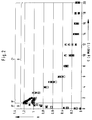
- C1 corresponds to the lowest, C5 the highest concentration. It can be seen that, for example, the end point value X1 ... X5 approximately reached after 300 sec. Does not change monotonically with the concentration, but rather increases from X1 to X2 and then decreases until X5.
- X f ⁇ 1 (C) in the form of a Heidelberg curve. Measurement results with two different batches of reagent are shown, with several measurements being carried out for each batch. The crosses denote a first batch and the squares a second batch of the test reagents. As a result, the scatter of measured values becomes clear both from measurement to measurement and from batch to batch.
- X is given in arbitrary units. Concentration C refers to an immunochemical test for urinary albumin ("MAU").
- MAU urinary albumin
- a measured value X 0.8 can correspond to a concentration of 0.5 or 3 g / l, depending on whether the C value is on the rising or falling part of the calibration curve.
- a training run is carried out, which serves to determine from S (t) kinetics, which were measured on calibrators, one for the respective analysis parameter, possibly even for a specific reagent batch, To develop a specifically coordinated discrimination algorithm consisting of a set of discriminators and a method of multivariate statistics that allows a clear assignment of measured kinetics S (t) to one of the sub-areas of the evaluation curve.
- S (t) is first determined on a plurality of calibrators of known concentrations, these concentrations being in both partial areas of the calibration curve.
- a relatively small number of such calibrator measurements for example six concentrations in each subarea A, B of the calibration curve, has proven to be sufficient.
- One then obtains, for example, twelve kinetics of the type shown in FIG. 1, the correct concentration C being known for each of the kinetics and thus also determining which of the subareas A, B of the calibration curve X f ⁇ 1 (C) the measured kinetics can be assigned.
- a set of discriminators is determined from the measured kinetics S (t) in each case according to a specific defined method, which is referred to as the discriminator generation method.
- the discriminator generation method for example, absorbance values at certain measuring times, gradients, curvatures and roughness values have been used successfully as discriminators.
- S (t) is not determined continuously, but at discrete measuring times t 1 ... t n , these discriminators can be calculated, for example, as follows.
- An extinction value S i at a measuring point i (measuring time t i ) can be adopted immediately.
- the term discriminator generation process includes also cases in which a measured value S (t) is selected for a specific point in time and accepted unchanged.
- auxiliary discriminators such as device settings or measured values relating to environmental conditions.
- Each of the discriminators is assigned a concentration value C j and a measurement time t i .
- the discriminator set is therefore dependent on the two independent variables C and t.
- Such a multidimensional value matrix which is dependent on several variables, can be converted from multivariate space into one-dimensional space using known methods of multivariate statistics.
- a method of multivariate statistics is used to calculate numerical values, so-called scores, from the discriminators of kinetics (ie from the discriminators that were determined from the course of S (t) measured on a calibrator). Since it is known in which section of the Heidelberg curve the respective concentration of the calibrator is located, each of the calculated scores is assigned to one of the sections A or B of the Heidelberg curve.
- the calculated scores of all calibrators can be clearly divided into two subsets in such a way that all scores that correspond to a concentration value in increasing part A of the Heidelberg curve lie on one side of the limit value (for example, are smaller than this limit value ), while the scores that correspond to a concentration value on the falling sub-area B of the Heidelberg curve lie on the other side of this limit value (for example, are larger than the limit value).
- a limit value that enables such a separation is called a limit score.
- the limit score is usually calculated using the same multivariate statistics method, which is used to calculate the scores from the kinetics.
- the training run consists of a plurality of repeated sections, each of which runs a discrimination algorithm that consists of a set of discriminator generation methods for determining the discriminators and a defined method of multivariate statistics, which maps the multidimensional space of the discriminators on the one-dimensionality of the scores.
- the multivariate statistics methods used can also be varied. In principle, this can also be done without human intervention, with different multivariate statistics methods being implemented in the system, which are each tested with the same set of discriminators or also with different sets of discriminators in the training run.
- the testing of the invention has shown that in practice empirical values can be obtained, according to which certain methods of multivariate statistics are suitable for certain analyzes. In these cases, it will be expedient to provide the system with this tried-and-tested method of multivariate statistics for the determination of a specific analyte, and only the discriminator generation methods will vary in the training run. However, this is not mandatory. Constellations are also possible in which it is advantageous to record a certain set of discriminators and to test them in the training run in combination with different methods of multivariate statistics.
- a discrimination algorithm that allows the desired separation of the scores into two subsets assigned to the sub-areas of the evaluation curve with (in the sense explained) sufficient reliability for practical purposes is referred to as an operational discrimination algorithm.
- the optimized discrimination algorithm is used as follows in an analysis run.
- the kinetics S (t) is determined on a sample to be analyzed. If the measurement takes place at discrete measuring times t i , the measuring times, calculated from the start of the reaction in each case, should coincide with the measuring times used in the training run during the analysis run.
- the methods of discriminant analysis are particularly preferred.
- discriminant analysis is used to assign objects to groups as clearly as possible on the basis of their p-features (p-dimensional feature vector).
- the group membership of each individual object is fixed and can be checked. Starting from a set of objects with known group membership, here the kinetics, the projection onto a one-dimensional space is determined in a p-dimensional space, which results in the best possible separation of the groups.
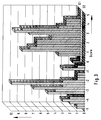
- FIG. 3 shows an example of a one-dimensional frequency distribution for the scores of two groups G1 and G2 of kinetics with discrimination that is better than 95%.
- the discrimination of the kinetics is therefore not 100% successful. It can be seen that a small part of the group G1 shown on the right in the figure has a score in the negative value range of the abscissa.
- the discrimination algorithm in this case does not allow a complete separation of the kinetics in the mathematical sense, such a result can often be completely sufficient for practical purposes, provided that the few incorrect assignments are of no practical importance for the medical-analytical result for the reasons explained above.
- the resubstitution and cross-validation methods have proven to be suitable for estimating the error rate.
- the rate of the misallocations is determined for the set of kinetics under consideration.
- the cross-validation method the analysis is carried out with (n-1) kinetics and it is checked whether the assignment of the n-th kinetics has been made correctly. Then the permutation is carried out and the error rate is then determined.
- a Hitachi 717 TM analyzer was used for the measurement, in which the photometric measurement is carried out in a cycle of 12 seconds, ie at a frequency of five measurements per minute. For each sample, the first measurement was carried out after twelve seconds and then further measurements with the mentioned measuring frequency within a kinetic, the device carrying out a triple measurement at each measuring point and using the mean measured value (median) for further processing.
- the training run was first carried out with the kinetics of Charge 1, i.e. the coefficients of the discriminant analysis method and the limit score were determined in a training run of the type described. With the help of the coefficients obtained in this way, the scores of all reaction kinetics, which were measured with the aid of reagent lot 2, were calculated. The assignment of the respective reaction kinetics to area A or area B of the Heidelberg curve was determined from their relation to the limit score. The same procedure was repeated in reverse, the kinetics measured on batch 2 being used for training and the kinetics from batch 1 subsequently being analyzed.
- ferritin was determined in serum samples of known concentration. 22 different concentrations in the range between 0 and 6000 ng ferritin / ml were measured with two different reagent batches, a six-fold determination being carried out for one batch and a ten-fold determination being carried out for the second batch. In this case, too, the discriminators and a process of multivariate statistics were optimized with the help of a training run of the type described until an operational discrimination algorithm was found.
- the following variables proved to be suitable as discriminators: the second to fourth curvature (t2 / t3; t3 / t4; t4 / t5) as well as the fifth and 25th extinction (each after the second pipetting at a measuring frequency of five measurements per minute) .
- the selected method was a non-parametric discriminant method of the mentioned statistical program package SAS.
- This example experimentally corresponded to example 1.
- the same discriminators and methods of discriminant analysis were used.
- the calibration curve was divided into three partial areas (A ', B', C 'in FIG. 2), namely a first partial area from 0 to 1.1 g MAU / ml, a second area from 1.1 to 1 , 5 g MAU / ml and a third partial range from 1.5 g MAU / ml to 7 g MAU / ml.
- the middle concentration range was chosen so that it covers a relatively small sub-range to the left and right of the maximum of the Heidelberg curve.
- the number of required limit scores increases. With three sub-areas, for example, two border scores are required in order to differentiate the middle area from the other two areas.
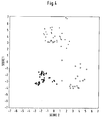
- FIG. 4 shows a graphical representation of the results, the scores for the individual measured concentrations being plotted in two dimensions. The scores for the first concentration range A 'are shown as filled in points, the scores for the second concentration range B' as circles and the scores for the third concentration range C 'as triangles.
Landscapes
- Health & Medical Sciences (AREA)
- Life Sciences & Earth Sciences (AREA)
- Engineering & Computer Science (AREA)
- Immunology (AREA)
- Hematology (AREA)
- Molecular Biology (AREA)
- Chemical & Material Sciences (AREA)
- Biomedical Technology (AREA)
- Urology & Nephrology (AREA)
- Cell Biology (AREA)
- Analytical Chemistry (AREA)
- Biotechnology (AREA)
- Pathology (AREA)
- Food Science & Technology (AREA)
- Medicinal Chemistry (AREA)
- Physics & Mathematics (AREA)
- Microbiology (AREA)
- Biochemistry (AREA)
- General Health & Medical Sciences (AREA)
- General Physics & Mathematics (AREA)
- Proteomics, Peptides & Aminoacids (AREA)
- Investigating Or Analysing Biological Materials (AREA)
- Analysing Materials By The Use Of Radiation (AREA)
- Nitrogen And Oxygen Or Sulfur-Condensed Heterocyclic Ring Systems (AREA)
Applications Claiming Priority (2)
| Application Number | Priority Date | Filing Date | Title |
|---|---|---|---|
| DE4221807 | 1992-07-03 | ||
| DE4221807A DE4221807C2 (de) | 1992-07-03 | 1992-07-03 | Verfahren zur analytischen Bestimmung der Konzentration eines Bestandteiles einer medizinischen Probe |
Publications (3)
| Publication Number | Publication Date |
|---|---|
| EP0576879A2 true EP0576879A2 (fr) | 1994-01-05 |
| EP0576879A3 EP0576879A3 (en) | 1994-05-18 |
| EP0576879B1 EP0576879B1 (fr) | 1998-10-21 |
Family
ID=6462371
Family Applications (1)
| Application Number | Title | Priority Date | Filing Date |
|---|---|---|---|
| EP93109189A Expired - Lifetime EP0576879B1 (fr) | 1992-07-03 | 1993-06-08 | Procédé pour le détermination analytique de la concentration d'un composant d'un échantillon médicinal |
Country Status (6)
| Country | Link |
|---|---|
| US (1) | US5420042A (fr) |
| EP (1) | EP0576879B1 (fr) |
| JP (1) | JPH06167501A (fr) |
| AT (1) | ATE172539T1 (fr) |
| DE (2) | DE4221807C2 (fr) |
| ES (1) | ES2123591T3 (fr) |
Cited By (3)
| Publication number | Priority date | Publication date | Assignee | Title |
|---|---|---|---|---|
| EP1460414A4 (fr) * | 2001-12-27 | 2009-08-05 | Arkray Inc | Procede de mesure de la concentration |
| CN104991056A (zh) * | 2015-08-05 | 2015-10-21 | 武汉林勉生物技术有限公司 | 一种血清学检测与定量分析的方法 |
| WO2020260277A1 (fr) | 2019-06-25 | 2020-12-30 | Albert-Ludwig-Universität Freiburg | Procédé et kit de mesure d'analytes dans des systèmes à deux composants et leurs utilisations |
Families Citing this family (18)
| Publication number | Priority date | Publication date | Assignee | Title |
|---|---|---|---|---|
| DE4427492A1 (de) * | 1994-08-03 | 1996-02-08 | Boehringer Mannheim Gmbh | Verfahren zur Analyse einer medizinischen Probe unter Vermeidung von Störbeiträgen aufgrund von Hämolyse |
| GB9609653D0 (en) * | 1996-05-09 | 1996-07-10 | Applied Research Ars Holding N | Method of assay |
| DE19736480B4 (de) * | 1997-08-21 | 2006-03-16 | Siemens Ag | System zum Überwachen eines Patienten |
| US6284472B1 (en) * | 1998-10-05 | 2001-09-04 | Dade Behring Inc. | Method for extending the range of an immunoassay |
| AUPR631601A0 (en) * | 2001-07-11 | 2001-08-02 | Commonwealth Scientific And Industrial Research Organisation | Biotechnology array analysis |
| US6697509B2 (en) * | 2001-10-04 | 2004-02-24 | Chromavision Medical Systems, Inc. | Method and apparatus for scoring the uptake of markers in cells |
| JP2005524124A (ja) * | 2001-10-17 | 2005-08-11 | コモンウェルス サイエンティフィック アンド インダストリアル リサーチ オーガニゼーション | システムの診断構成要素を識別するための方法および装置 |
| JP2004045384A (ja) * | 2002-05-22 | 2004-02-12 | Matsushita Electric Ind Co Ltd | 免疫学的測定方法、免疫学的測定装置、生体成分測定用トイレ、抗アルブミンモノクローナル抗体、それを産生する細胞株、およびアルブミン検出キット |
| EP1496362B1 (fr) * | 2003-07-09 | 2006-12-13 | Matsushita Electric Industrial Co., Ltd. | Dosage immunologique turbidimétrique et appareil associé |
| US20060205082A1 (en) * | 2005-03-10 | 2006-09-14 | Middleton John S | Reaction rate determination |
| US20070091109A1 (en) * | 2005-09-13 | 2007-04-26 | Roscoe Atkinson | Image quality |
| JP4915071B2 (ja) * | 2005-09-22 | 2012-04-11 | 株式会社ニコン | 顕微鏡、およびバーチャルスライド作成システム |
| CA2804843C (fr) * | 2012-02-06 | 2021-02-02 | Ortho-Clinical Diagnostics, Inc. | Fenetres temporelles multiples permettant d'etendre la plage dans un dosage |
| KR101750638B1 (ko) | 2012-12-20 | 2017-06-23 | 에프. 호프만-라 로슈 아게 | 체액의 샘플을 분석하는 방법 |
| CN104870982B (zh) * | 2012-12-20 | 2019-02-15 | 霍夫曼-拉罗奇有限公司 | 用于评估医学测量曲线的方法 |
| CN104380086A (zh) * | 2013-04-26 | 2015-02-25 | 松下知识产权经营株式会社 | 氧化物质定量方法以及氧化物质定量装置 |
| CN106068449A (zh) * | 2014-03-05 | 2016-11-02 | 思勘度股份有限公司 | 通过量化和解释颜色的分析物浓度 |
| CN109813269B (zh) * | 2019-02-25 | 2021-05-18 | 交通运输部公路科学研究所 | 结构监测传感器在线校准数据序列匹配方法 |
Family Cites Families (9)
| Publication number | Priority date | Publication date | Assignee | Title |
|---|---|---|---|---|
| CA1081497A (fr) * | 1976-06-02 | 1980-07-15 | Robert J. Anderson | Analyse nephelometrique de reactions immunologiques |
| US4157871A (en) * | 1976-06-02 | 1979-06-12 | Beckman Instruments, Inc. | System for rate immunonephelometric analysis |
| US4204837A (en) * | 1978-03-14 | 1980-05-27 | Beckman Instruments, Inc. | Method of rate immunonephelometric analysis |
| JPS55144546A (en) * | 1979-04-27 | 1980-11-11 | Tateishi Raifu Sci Kenkyusho:Kk | Judging method of cell sample |
| DE3347162A1 (de) * | 1983-12-27 | 1985-07-04 | Behringwerke Ag, 3550 Marburg | Photometrisches verfahren zur konzentrationsbestimmung bei reaktionen, die unter bildung oder verbrauch von streuzentren verlaufen |
| JPS63247644A (ja) * | 1987-04-02 | 1988-10-14 | Toa Medical Electronics Co Ltd | 免疫反応測定方法 |
| JPH02304355A (ja) * | 1989-05-18 | 1990-12-18 | Toa Medical Electronics Co Ltd | 血液データの解析方法 |
| JPH02304354A (ja) * | 1989-05-18 | 1990-12-18 | Toa Medical Electronics Co Ltd | 血液データの解析方法 |
| JPH03195951A (ja) * | 1989-12-25 | 1991-08-27 | Canon Inc | 統計データ表示方法 |
-
1992
- 1992-07-03 DE DE4221807A patent/DE4221807C2/de not_active Expired - Fee Related
-
1993
- 1993-06-08 ES ES93109189T patent/ES2123591T3/es not_active Expired - Lifetime
- 1993-06-08 DE DE59309071T patent/DE59309071D1/de not_active Expired - Fee Related
- 1993-06-08 AT AT93109189T patent/ATE172539T1/de not_active IP Right Cessation
- 1993-06-08 EP EP93109189A patent/EP0576879B1/fr not_active Expired - Lifetime
- 1993-06-29 US US08/084,008 patent/US5420042A/en not_active Expired - Lifetime
- 1993-07-02 JP JP5164842A patent/JPH06167501A/ja active Pending
Cited By (6)
| Publication number | Priority date | Publication date | Assignee | Title |
|---|---|---|---|---|
| EP1460414A4 (fr) * | 2001-12-27 | 2009-08-05 | Arkray Inc | Procede de mesure de la concentration |
| CN104991056A (zh) * | 2015-08-05 | 2015-10-21 | 武汉林勉生物技术有限公司 | 一种血清学检测与定量分析的方法 |
| WO2020260277A1 (fr) | 2019-06-25 | 2020-12-30 | Albert-Ludwig-Universität Freiburg | Procédé et kit de mesure d'analytes dans des systèmes à deux composants et leurs utilisations |
| CN114041055A (zh) * | 2019-06-25 | 2022-02-11 | 阿克托姆有限责任公司 | 用于以双组分体系测量分析物的方法和试剂盒及其用途 |
| EP4245862A2 (fr) | 2019-06-25 | 2023-09-20 | Actome GmbH | Procédé et kit de mesure d'analytes dans des systèmes à deux composants et leurs utilisations |
| EP4245862A3 (fr) * | 2019-06-25 | 2023-10-25 | Actome GmbH | Procédé et kit de mesure d'analytes dans des systèmes à deux composants et leurs utilisations |
Also Published As
| Publication number | Publication date |
|---|---|
| EP0576879A3 (en) | 1994-05-18 |
| DE59309071D1 (de) | 1998-11-26 |
| ES2123591T3 (es) | 1999-01-16 |
| JPH06167501A (ja) | 1994-06-14 |
| ATE172539T1 (de) | 1998-11-15 |
| US5420042A (en) | 1995-05-30 |
| EP0576879B1 (fr) | 1998-10-21 |
| DE4221807A1 (de) | 1994-01-05 |
| DE4221807C2 (de) | 1994-07-14 |
Similar Documents
| Publication | Publication Date | Title |
|---|---|---|
| EP0576879B1 (fr) | Procédé pour le détermination analytique de la concentration d'un composant d'un échantillon médicinal | |
| DE69905310T2 (de) | Reflexalgorithmus zur frühen und kostengünstigen Diagnose von myokardischen Infarkten geeignet für automatisierte diagnostische Plattformen | |
| DE69712937T2 (de) | Verfahren zur Bestimmung einer Kalibrierungskurve und Analyseverfahren und diesen Verfahren verwendendes Gerät. | |
| DE2847176C2 (de) | Verfahren zur photometrischen Bestimmung von Substanzen im Blutserum | |
| DE69633344T2 (de) | Kalibrierverfahren und vorrichtung fur durchflusscytometer | |
| DE69414001T2 (de) | Bestimmungsmethode | |
| DE69034111T2 (de) | Einrichtung zum Nachweis vom Down syndrom durch nichtinvasive Siebtestung des mütterlichen Blutes | |
| EP1630558B1 (fr) | Essai diagnostic à base de microsphères destiné à la détection d' anticorps dirigés contre les infections respiratoires aigües et la pneumonie atypique | |
| EP1141713A1 (fr) | Procede et dispositif pour determiner un analyte | |
| DE69328169T2 (de) | Prüfung vor der geburt für abnormitäten der chromosomen | |
| DE69024453T2 (de) | Verbessertes Kalibrierungsverfahren | |
| DE2661010C2 (de) | Immunologisches Reagens und nephelometrisches Untersuchungsverfahren | |
| DE69411189T2 (de) | Rücktitrations-messverfahren unter verwendung von zweiverschiedenen markern | |
| EP0263401B1 (fr) | Essai immunométrique | |
| DE69523027T2 (de) | Kalibrierung und Prüfung von Immunoassays zur Verminderung von Störungen | |
| DE69525400T2 (de) | Vorgeburtliche Überprüfung von Schwangerschaftsabnormitäten | |
| EP0833153A2 (fr) | Méthode pour la détermination instrumentale d'une variable dépendante du temps | |
| DE69021159T2 (de) | Verfahren zum immunochemischen Bestimmen von Haptenen. | |
| DE3855783T2 (de) | Gerät zur Analyse von partiellen molekularen Strukturen | |
| DE69906865T2 (de) | Automatisches Diagnosesystem zur Durchführung von Immunoassays und klinisch-chemischen Assays nach einem Reflexalgorithmus | |
| DE2725594A1 (de) | Verfahren zur analyse freier schilddruesenhormone | |
| EP0374686B1 (fr) | Méthode pour améliorer la correction et la reproduction de donnéös de mesure d essais immunométriques | |
| DE102014106918B4 (de) | Verfahren und Vorrichtung zur automatisierten Durchführung von affinitätsbasierten Assays | |
| DE3639279C3 (de) | Verfahren zur quantitativen Bestimmung von Antikörpern oder Antigenen nach der ELISA-Methode durch photometrische Auswertung | |
| DE4331018A1 (de) | Verfahren zur automatischen Bewertung von Fraktionsmustertypen, die Krankheiten betreffen |
Legal Events
| Date | Code | Title | Description |
|---|---|---|---|
| PUAI | Public reference made under article 153(3) epc to a published international application that has entered the european phase |
Free format text: ORIGINAL CODE: 0009012 |
|
| 17P | Request for examination filed |
Effective date: 19930608 |
|
| AK | Designated contracting states |
Kind code of ref document: A2 Designated state(s): AT BE CH DE DK ES FR GB GR IE IT LI LU NL PT SE |
|
| PUAL | Search report despatched |
Free format text: ORIGINAL CODE: 0009013 |
|
| AK | Designated contracting states |
Kind code of ref document: A3 Designated state(s): AT BE CH DE DK ES FR GB GR IE IT LI LU NL PT SE |
|
| 17Q | First examination report despatched |
Effective date: 19970716 |
|
| GRAG | Despatch of communication of intention to grant |
Free format text: ORIGINAL CODE: EPIDOS AGRA |
|
| GRAG | Despatch of communication of intention to grant |
Free format text: ORIGINAL CODE: EPIDOS AGRA |
|
| GRAG | Despatch of communication of intention to grant |
Free format text: ORIGINAL CODE: EPIDOS AGRA |
|
| GRAH | Despatch of communication of intention to grant a patent |
Free format text: ORIGINAL CODE: EPIDOS IGRA |
|
| GRAH | Despatch of communication of intention to grant a patent |
Free format text: ORIGINAL CODE: EPIDOS IGRA |
|
| GRAA | (expected) grant |
Free format text: ORIGINAL CODE: 0009210 |
|
| AK | Designated contracting states |
Kind code of ref document: B1 Designated state(s): AT BE CH DE DK ES FR GB GR IE IT LI LU NL PT SE |
|
| PG25 | Lapsed in a contracting state [announced via postgrant information from national office to epo] |
Ref country code: GR Free format text: LAPSE BECAUSE OF NON-PAYMENT OF DUE FEES Effective date: 19981021 |
|
| REF | Corresponds to: |
Ref document number: 172539 Country of ref document: AT Date of ref document: 19981115 Kind code of ref document: T |
|
| REG | Reference to a national code |
Ref country code: CH Ref legal event code: EP |
|
| GBT | Gb: translation of ep patent filed (gb section 77(6)(a)/1977) |
Effective date: 19981022 |
|
| REF | Corresponds to: |
Ref document number: 59309071 Country of ref document: DE Date of ref document: 19981126 |
|
| ET | Fr: translation filed | ||
| REG | Reference to a national code |
Ref country code: IE Ref legal event code: FG4D Free format text: GERMAN |
|
| REG | Reference to a national code |
Ref country code: ES Ref legal event code: FG2A Ref document number: 2123591 Country of ref document: ES Kind code of ref document: T3 |
|
| PG25 | Lapsed in a contracting state [announced via postgrant information from national office to epo] |
Ref country code: SE Free format text: LAPSE BECAUSE OF FAILURE TO SUBMIT A TRANSLATION OF THE DESCRIPTION OR TO PAY THE FEE WITHIN THE PRESCRIBED TIME-LIMIT Effective date: 19990121 Ref country code: PT Free format text: LAPSE BECAUSE OF FAILURE TO SUBMIT A TRANSLATION OF THE DESCRIPTION OR TO PAY THE FEE WITHIN THE PRESCRIBED TIME-LIMIT Effective date: 19990121 Ref country code: DK Free format text: LAPSE BECAUSE OF FAILURE TO SUBMIT A TRANSLATION OF THE DESCRIPTION OR TO PAY THE FEE WITHIN THE PRESCRIBED TIME-LIMIT Effective date: 19990121 |
|
| RAP4 | Party data changed (patent owner data changed or rights of a patent transferred) |
Owner name: ROCHE DIAGNOSTICS GMBH |
|
| PG25 | Lapsed in a contracting state [announced via postgrant information from national office to epo] |
Ref country code: LU Free format text: LAPSE BECAUSE OF NON-PAYMENT OF DUE FEES Effective date: 19990608 |
|
| PG25 | Lapsed in a contracting state [announced via postgrant information from national office to epo] |
Ref country code: LI Free format text: LAPSE BECAUSE OF NON-PAYMENT OF DUE FEES Effective date: 19990630 Ref country code: CH Free format text: LAPSE BECAUSE OF NON-PAYMENT OF DUE FEES Effective date: 19990630 |
|
| PG25 | Lapsed in a contracting state [announced via postgrant information from national office to epo] |
Ref country code: IE Free format text: LAPSE BECAUSE OF NON-PAYMENT OF DUE FEES Effective date: 19990820 |
|
| PLBE | No opposition filed within time limit |
Free format text: ORIGINAL CODE: 0009261 |
|
| STAA | Information on the status of an ep patent application or granted ep patent |
Free format text: STATUS: NO OPPOSITION FILED WITHIN TIME LIMIT |
|
| REG | Reference to a national code |
Ref country code: IE Ref legal event code: FD4D |
|
| 26N | No opposition filed | ||
| REG | Reference to a national code |
Ref country code: CH Ref legal event code: PL |
|
| PGFP | Annual fee paid to national office [announced via postgrant information from national office to epo] |
Ref country code: AT Payment date: 20010613 Year of fee payment: 9 |
|
| PGFP | Annual fee paid to national office [announced via postgrant information from national office to epo] |
Ref country code: NL Payment date: 20010628 Year of fee payment: 9 |
|
| PGFP | Annual fee paid to national office [announced via postgrant information from national office to epo] |
Ref country code: BE Payment date: 20010816 Year of fee payment: 9 |
|
| REG | Reference to a national code |
Ref country code: GB Ref legal event code: IF02 |
|
| PG25 | Lapsed in a contracting state [announced via postgrant information from national office to epo] |
Ref country code: AT Free format text: LAPSE BECAUSE OF NON-PAYMENT OF DUE FEES Effective date: 20020608 |
|
| PG25 | Lapsed in a contracting state [announced via postgrant information from national office to epo] |
Ref country code: BE Free format text: LAPSE BECAUSE OF NON-PAYMENT OF DUE FEES Effective date: 20020630 |
|
| BERE | Be: lapsed |
Owner name: *BOEHRINGER MANNHEIM G.M.B.H. Effective date: 20020630 |
|
| PG25 | Lapsed in a contracting state [announced via postgrant information from national office to epo] |
Ref country code: NL Free format text: LAPSE BECAUSE OF NON-PAYMENT OF DUE FEES Effective date: 20030101 |
|
| NLV4 | Nl: lapsed or anulled due to non-payment of the annual fee |
Effective date: 20030101 |
|
| PGFP | Annual fee paid to national office [announced via postgrant information from national office to epo] |
Ref country code: GB Payment date: 20060505 Year of fee payment: 14 |
|
| PGFP | Annual fee paid to national office [announced via postgrant information from national office to epo] |
Ref country code: FR Payment date: 20060605 Year of fee payment: 14 |
|
| PGFP | Annual fee paid to national office [announced via postgrant information from national office to epo] |
Ref country code: ES Payment date: 20060613 Year of fee payment: 14 |
|
| PGFP | Annual fee paid to national office [announced via postgrant information from national office to epo] |
Ref country code: IT Payment date: 20060630 Year of fee payment: 14 Ref country code: DE Payment date: 20060630 Year of fee payment: 14 |
|
| GBPC | Gb: european patent ceased through non-payment of renewal fee |
Effective date: 20070608 |
|
| REG | Reference to a national code |
Ref country code: FR Ref legal event code: ST Effective date: 20080229 |
|
| PG25 | Lapsed in a contracting state [announced via postgrant information from national office to epo] |
Ref country code: DE Free format text: LAPSE BECAUSE OF NON-PAYMENT OF DUE FEES Effective date: 20080101 |
|
| PG25 | Lapsed in a contracting state [announced via postgrant information from national office to epo] |
Ref country code: GB Free format text: LAPSE BECAUSE OF NON-PAYMENT OF DUE FEES Effective date: 20070608 |
|
| REG | Reference to a national code |
Ref country code: ES Ref legal event code: FD2A Effective date: 20070609 |
|
| PG25 | Lapsed in a contracting state [announced via postgrant information from national office to epo] |
Ref country code: FR Free format text: LAPSE BECAUSE OF NON-PAYMENT OF DUE FEES Effective date: 20070702 |
|
| PG25 | Lapsed in a contracting state [announced via postgrant information from national office to epo] |
Ref country code: ES Free format text: LAPSE BECAUSE OF NON-PAYMENT OF DUE FEES Effective date: 20070609 |
|
| PG25 | Lapsed in a contracting state [announced via postgrant information from national office to epo] |
Ref country code: IT Free format text: LAPSE BECAUSE OF NON-PAYMENT OF DUE FEES Effective date: 20070608 |