EP0577008A2 - Wiederverwendbare Magnetbandkassette - Google Patents
Wiederverwendbare Magnetbandkassette Download PDFInfo
- Publication number
- EP0577008A2 EP0577008A2 EP93110087A EP93110087A EP0577008A2 EP 0577008 A2 EP0577008 A2 EP 0577008A2 EP 93110087 A EP93110087 A EP 93110087A EP 93110087 A EP93110087 A EP 93110087A EP 0577008 A2 EP0577008 A2 EP 0577008A2
- Authority
- EP
- European Patent Office
- Prior art keywords
- tape
- tape cassette
- cassette
- recited
- reel
- Prior art date
- Legal status (The legal status is an assumption and is not a legal conclusion. Google has not performed a legal analysis and makes no representation as to the accuracy of the status listed.)
- Withdrawn
Links
- 239000000428 dust Substances 0.000 claims abstract description 62
- PPBRXRYQALVLMV-UHFFFAOYSA-N Styrene Chemical compound C=CC1=CC=CC=C1 PPBRXRYQALVLMV-UHFFFAOYSA-N 0.000 claims description 36
- 239000007787 solid Substances 0.000 claims description 2
- 230000002265 prevention Effects 0.000 claims 1
- 239000002184 metal Substances 0.000 abstract description 12
- 239000000463 material Substances 0.000 abstract description 3
- 238000004519 manufacturing process Methods 0.000 description 9
- DHKHKXVYLBGOIT-UHFFFAOYSA-N acetaldehyde Diethyl Acetal Natural products CCOC(C)OCC DHKHKXVYLBGOIT-UHFFFAOYSA-N 0.000 description 8
- 125000002777 acetyl group Chemical class [H]C([H])([H])C(*)=O 0.000 description 8
- 210000005069 ears Anatomy 0.000 description 8
- 238000000465 moulding Methods 0.000 description 6
- 238000004064 recycling Methods 0.000 description 5
- 238000003466 welding Methods 0.000 description 4
- 238000001746 injection moulding Methods 0.000 description 3
- 238000000034 method Methods 0.000 description 3
- 230000001737 promoting effect Effects 0.000 description 3
- 230000015572 biosynthetic process Effects 0.000 description 2
- 230000014759 maintenance of location Effects 0.000 description 2
- 230000002787 reinforcement Effects 0.000 description 2
- 230000000717 retained effect Effects 0.000 description 2
- 238000003860 storage Methods 0.000 description 2
- 230000006835 compression Effects 0.000 description 1
- 238000007906 compression Methods 0.000 description 1
- 238000000151 deposition Methods 0.000 description 1
- 230000000694 effects Effects 0.000 description 1
- 230000008030 elimination Effects 0.000 description 1
- 238000003379 elimination reaction Methods 0.000 description 1
- 239000002783 friction material Substances 0.000 description 1
- 238000003780 insertion Methods 0.000 description 1
- 230000037431 insertion Effects 0.000 description 1
- 239000002994 raw material Substances 0.000 description 1
Images






Classifications
-
- G—PHYSICS
- G11—INFORMATION STORAGE
- G11B—INFORMATION STORAGE BASED ON RELATIVE MOVEMENT BETWEEN RECORD CARRIER AND TRANSDUCER
- G11B23/00—Record carriers not specific to the method of recording or reproducing; Accessories, e.g. containers, specially adapted for co-operation with the recording or reproducing apparatus ; Intermediate mediums; Apparatus or processes specially adapted for their manufacture
- G11B23/02—Containers; Storing means both adapted to cooperate with the recording or reproducing means
- G11B23/04—Magazines; Cassettes for webs or filaments
- G11B23/08—Magazines; Cassettes for webs or filaments for housing webs or filaments having two distinct ends
- G11B23/087—Magazines; Cassettes for webs or filaments for housing webs or filaments having two distinct ends using two different reels or cores
- G11B23/08707—Details
- G11B23/08728—Reels or cores; positioning of the reels in the cassette
-
- G—PHYSICS
- G11—INFORMATION STORAGE
- G11B—INFORMATION STORAGE BASED ON RELATIVE MOVEMENT BETWEEN RECORD CARRIER AND TRANSDUCER
- G11B23/00—Record carriers not specific to the method of recording or reproducing; Accessories, e.g. containers, specially adapted for co-operation with the recording or reproducing apparatus ; Intermediate mediums; Apparatus or processes specially adapted for their manufacture
- G11B23/02—Containers; Storing means both adapted to cooperate with the recording or reproducing means
- G11B23/037—Single reels or spools
Definitions
- This invention relates to a tape cassette and, more particularly, to a recyclable videotape cassette having a tape reel with an integral reel spring, tape reel lock, and an improved leader clip, and related methods of assembly, disassembly, and recycling.
- a tape cassette usually includes a cover, a base and a pair of tape reels mounted therebetween for rotation. Also a metal reel spring extends from the cover to normally bias the tape reels toward the base.
- Each tape reel usually includes a planar lower flange, a planar upper flange, and a cylindrical hub connecting the two flanges.
- the lower flange can be a separate member connected to the hub, or can be integrally formed with the hub.
- the upper flange is usually separate and connected to the hub by lugs formed on the hub which pass through holes formed in the upper flange. The lugs are then heat deformed, welded or cam locked to hold the upper flange on the hub.
- the hub also usually includes centrally on its top surface a pivot button, again either formed separately or integrally therewith.
- This pivot button is usually made of a relatively expensive low friction material, such as acetal to minimize friction between the rotating tape reel and metal reel spring.
- a leader clip is also attached to the hub for securing a leader of the tape to the hub.
- the leader clip like the pivot button, has been made of acetal since styrene has been considered too rough, perhaps damaging the leader.
- the leaders of the two tape reels are connected to magnetic tape during loading of the cassette.
- Tape cassettes almost uniformly also include a multi-piece reel lock.
- Such multi-piece reel locks include a separate actuator, a pair of separate movable arms for respectively locking the reels, and a separate spring for biasing the arms toward the reels.
- cassettes as with all plastic consumer goods, a need exists to find ways to efficiently recycle, instead of merely depositing them in land fills.
- conventional cassette covers, bases and tape reel hubs are usually made of one type of styrene, the tape reel flanges made of another type of styrene, the pivot button and leader clip made of acetal, the various springs, including the dust door spring and reel leaf spring, of metal, the rollers of acetal and the tape of still another material.
- a recyclable tape cassette including a tape reel which is a one-piece, integrally molded member, including: a lower, planar, continuous flange; a central hub connected to the lower flange; and a reel spring molded integrally of the upper end of the tape reel.
- a leader clip can be formed separately and assembled on the hub, or can be integrally molded of the hub.
- the leader clip and reel spring can be formed together as one piece and attached to the hub, or they can be molded together integrally of the hub.
- the dust door cooperates with the tape reels and cassette base and cover to prevent despooling of the tape, when the cassette is not received by the tape player/recorder.
- the tape cassette base includes an opening to allow removal of the metal dust door spring.
- the cassette includes other openings to disengage the leader clips from outside the tape cassette, thereby allowing the tape and leader to be removed from the cassette without opening the cassette.
- the thickness of the cassette walls is less than conventional, but supports are added at the walls to reinforce the cassette and to assist in preventing despooling of tape.
- FIG. 1 is a perspective view of a tape cassette according to the present invention.
- FIG. 2 is a bottom view of one of the tape reels shown in FIG. 1.
- FIG. 2a is a top view of the integral reel spring means shown in FIGS. 1 and 2.
- FIG. 3 is a perspective view of a tape reel according to the present invention including an alternate embodiment of the integrally formed reel spring.
- FIG. 4 is a side view of the tape reel shown in FIG. 3 positioned between a cassette cover and base.
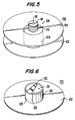
- FIG. 5 is a perspective view of an alternate embodiment of the tape reel according to the present invention.
- FIG. 6 is a perspective view of a tape reel lower flange and hub including a leader clip on which is integrally formed a reel spring.
- FIG. 7 is a side view of the tape reel shown in FIG. 6 positioned between a cassette cover and base.
- FIG. 8 is a perspective view of the separate leader clip and integral spring shown in FIG. 7.
- FIG. 9 is a perspective view of a one piece tape reel including a recess for receiving a leader clip.
- FIG. 10 is a perspective view of a tape reel according to the present invention having an integrally formed leader clip.
- FIG. 11 is a schematic view of a tape cassette according to the present invention including openings through which access to the leader clips can be gained.
- FIG. 12 is a schematic view of the tape cassette according to the present invention, and also showing a tool for disengaging the leader clip.
- FIG. 13 is a side, cross-sectional view of an alternate embodiment of a leader clip according to the present invention.
- FIG. 14 is a top view of a tape reel according to the present invention incorporating the leader clip shown in FIG. 13.
- FIG. 15 is close up view of the leader clip shown in FIG. 14 assembled in the tape reel.
- FIG. 16 is a top view of a tape reel including an integral reel spring.
- FIG. 17 is a top view of an another embodiment of a flange for a tape reel including an integral reel spring.
- FIG. 18 is another embodiment of a flange of a tape reel including an integral reel spring.
- FIG. 19 is another embodiment of a flange for a tape reel including an integral reel spring.
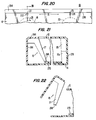
- FIG. 20 is a top view of the tape cassette according to the present invention illustrating reel retaining means.
- FIG. 21 is a side, cross-sectional view, of one of the reel retaining means engaged with a tape reel lower flange, when the dust door is in a first, closed position.
- FIG. 22 is a side, cross-sectional view of one of the reel retaining means disengaged from the tape reel lower flange, when the dust door is in a second, open position.
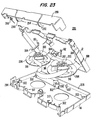
- FIG. 23 is a perspective view of an alternate embodiment of the tape cassette according to the present invention.
- FIGS. 24-26 are side, cross-sectional views of the tape reel retaining means of the videocassette shown in FIG. 23.
- FIG. 27 is a top view of a tape cassette base according to the present invention.
- FIG. 28 is a top view of a tape cassette cover according to the present invention.
- FIG. 29 is a side, cross-sectional view taken along line 29-29 of FIG. 27.
- FIG. 30 is a side, cross-sectional view taken along line 30-30 of FIG. 27.
- a recyclable tape cassette according to the present invention is generally indicated by reference numeral 10 and includes a cover 12, a base 14 and a dust door 16 pivotally connected between the cover 12 and base 14 by a spring 17 loaded against the cover 12.
- this cassette 10 preferably does not use windows like conventional cassettes.
- the present invention can use reel retaining means 15 in the form of integral tape reel locks 25, 27, as described below.
- the tape cassette uses a cam formed on the dust door, in cooperation with ribs/supports formed on the tape reel/cassette to restrain movement of the tape reels and thereby prevent despooling, as described below.
- guide posts 19, 21 are integrally molded on the cassette base 14 from styrene.
- the dust door 16 operates conventionally, but is just not locked in the closed position.
- the cassette cover 12 and base 14 can be connected by welding as is conventional, and more particularly by male/female plastic connections 29 and/or by ribs 31 and welding or otherwise adhering, and/or by screws.
- the front left corner of the cassette includes an opening 23 adjacent the dust door spring 17.
- the spring 23 can exit the opening 23 so that no metal remains in the cassette 10.
- Two tape reels 18, 20 are received between the cover 12 and base 14. At least the cover 12, base 14, and tape reels 18, 20 are preferably made of one type of plastic, e.g., styrene.
- Each tape reel 18, 20 includes a lower flange 24, a hollow hub 26 and an upper flange 28.
- the upper flange 28 is not absolutely necessary. However, it prevents the tape from telescoping if the cassette 10 is dropped.
- the upper flange 28 includes three equally spaced projecting planar ears 36. The ears 36 can be of different length, width or number.
- the flanges 24, 28 may be formed integrally with the hub 26, or may be formed separately and attached to the hub 26.
- a leader 30 (one shown in FIG. 1) is connected to each hub 26 via a leader clip 32, which is received in a recess 34 formed in the outer circumference of the hub 26. Tape 22 is attached to the free end of each leader 30.
- the leader clip 32 and upper flange 28 and an integral reel spring means 40 discussed below are formed as one piece and connected to the hub 26.
- a conventional, separate leader could be used with a tape reel 20 including an integral reel spring means 40 and upper flange 28.
- a coil spring 42 is formed including three curved arms, 44, 46, 48, one end 44a, 46a and 48a of each arm being connected to the inner circumference of the hub 26, and an opposite end 44b, 46b and 48b of each arm being connected to a central member 50.
- a pivot button 52 is integrally molded on the central member 50. It is preferable that the tape reel mold be gated close to the top of the pivot button 52, but not top dead center because a vestige caused by molding at top dead center might deleteriously effect operation of the pivot button 52. Alternatively, the mold could be gated on the back side of the button 52 using the hollow hub 26.
- the cassette base 14 and cover 12 also include various supports 35, 37, respectively, abutting the outer walls 38, 39. These supports 35, 37 are necessary because the cassette walls 38, 39 and planar area 41, 43 thickness is reduced about one-half relative to conventional cassette wall and planar area thickness to save on weight to reduce mailing costs, and help reinforce the thinner cassette 10 to withstand shipping, dropping, etc.
- Each intersection of a support 35, 37b and respective outer walls 38, 39 includes a pad or reinforcement 49 which is the same thickness as the conventional cassette wall.
- the reinforcements 49 help prevent molding imperfections (e.g. sink marks) at the interfaces of the thinned supports 35, 37 and thinned outer walls 38, 39
- FIG. 2 is a bottom view of the tape reel 18 shown in FIG. 1.
- the bottom 60 includes three spaced ribs 62 formed on the hub inner circumference 66 for cooperating with a finned spindle of an external tape player/recorder (not shown).
- the conventional cassette usually includes nine ribs. By eliminating some of the ribs, the function is preserved, but the mold is simplified, less plastic is used, and more room is made available to mold the integral spring means 40.
- the ribs 62 are preferably circumferentially offset from where the integral spring means connects to the hub 26, as best shown in FIG. 14, to facilitate molding of both the ribs 62 and integral spring means 40.
- each rib 62 could be formed at each connection of the reel spring means 40 to the hub 26.
- the lower flange 24 can be a solid member or have spaced openings 64.
- the ears 36 can also be seen in FIG. 2.
- the bottom 60 also includes an outer ring 68 which fits within one of the two openings 70 formed in the cassette base 14, and a ring 72 which is inwardly beveled to facilitate receipt of the spindle.
- FIG. 3 is a perspective view of a tape reel 80 according to another embodiment of the present invention.
- this tape reel 80 includes a lower flange 82 and a hollow hub 84.
- the upper portion of the hub 84 includes integral reel spring means 86 in the form of a coil 88 which extends upwardly from a relatively outer portion of the upper area of the hub 84 to a central axis of the hub 84.
- the coil 88 at a free end terminus 90 includes an integrally formed pivot button 92.
- An upper flange 94 (see FIG. 4), if desired, may be attached to the hub 84 in a conventional manner, such as through ultrasonic welding.
- a recess 96 formed in the outer circumference 98 of the hub 84 which receives a leader clip as described below.
- the bottom of the tape reel 80 according to this embodiment, and those that are described below, are similar to that shown in FIG. 2.
- FIG. 4 is a side view of the tape reel 80 shown in FIG. 3 loaded between the tape cassette cover 12 and base 14.
- the coil reel spring 88 is compressed when assembled in the tape cassette 10 between the cover 12 and base 14, since the distance between the tip of the pivot button 92 and the bottom of the lower flange 82, in the non-loaded state, is greater than the distance between the inner surfaces of the cover 12 and base 14 when same are mated. Due to this compression, the coil spring 88 normally urges the tape reel 80 in a direction from the cover 12 towards the base 14.
- FIG. 5 is another embodiment of a tape reel 100 according to the present invention.
- This tape reel 100 includes a lower flange 102, an upper flange 104, and a hub 106, on the upper surface of which is formed integral reel spring means 108.
- the spring means 108 is in the form of a coiled, columnar integral reel spring 110 having a pivot button 112 integrally molded centrally on a flat upper portion 114 thereof.
- FIG. 6 is a perspective view of another embodiment of a tape reel 120 according to the present invention.
- a lower flange 122 is connected to the hub 124.
- the upper flange 136 is shown in FIG. 7.
- the upper flange 136 may be attached to the hub in a conventional manner such as by ultrasonic welding.
- a leader clip 126 is attached to a recess 128 formed in the side of the hub 124 like that shown in FIG. 3.
- the leader clip 126 may be formed separately from the hub 124, or formed integrally with the hub 124 via a living hinge 154, as shown in FIG. 10 and described more fully below.
- reel spring means 130 in the form of a leaf spring 132 is formed integrally of the leader clip 126.
- leader clip 32, upper flange 28 and integral reel spring means 40 are formed as one piece
- the leader clip 126 and integral reel spring means 130 are formed as one piece and the upper flange 138, if one is used, can be formed separately and attached to the hub 124.
- the one piece leader clip 126/reel spring means 130 combination shown in FIG. 6 is preferably made of styrene.
- FIG. 7 illustrates the tape reel 120 shown in FIG. 6 positioned between the cassette cover 12 and base 14.
- the cover 12 in this embodiment includes a pivot button 134 formed integrally thereof.
- styrene abuts styrene so friction is low during tape reel rotation;
- acetal is not necessary as when a metal reel leaf spring of the prior art abuts a pivot button on a rotating tape reel.
- acetal could still be used because it exhibits better spring properties, i.e. good spring retention under stress, than styrene if only a single biasing connection is used between the spring and leader clip.
- This is in contrast to the multi (three leg) biasing connection spring shown in, e.g. FIGS. 1 and 2, which could be made of styrene.
- FIG. 8 illustrates the leader clip 126 shown in FIGS. 6 and 7 in greater detail.
- the leader clip 126 includes a generally rectangular member 138 which has the same radius as the hub 124.
- the leaf spring 132 is integrally formed by injection molding at the upper edge 139 of the rectangular member 138.
- Opposite sides of the leader clip include projections 140, 142 which fit within corresponding linear depressions 144, 146 formed in the hub (see FIG. 9).
- FIG. 9 shows a one piece tape reel 141 which includes a recess 143 having the side depressions 144, 146 for receiving the leader clip 126 shown in FIGS. 6-8.
- This tape reel 141 includes three upper ears 145 and three lower ears 147 which are respectively offset.
- FIG. 10 illustrates a tape reel 148 having a leader clip 150 integrally formed of a hub 152 according to the present invention.
- a linear living hinge 154 is formed between one of the sides of the leader clip 150 and the hub 154. Openings 156 are formed in the upper flange 160. Corresponding openings 158 formed in the lower flange 162 allow access to the leader clip 150, as discussed more fully below, for the purpose of removing the leader after the base 14 and cover 12 are mated.
- reel spring means 164 like that shown in FIG. 3, is integrally formed on the upper portion of the hub 152.
- FIG. 11 is a schematic view of an alternate embodiment of a tape cassette 166 according to the present invention with the dust door removed.
- each tape reel 167, 168 receives an end 169, 171 of a leader 170 via a removable leader clip 172 engaged in a recess 173, 175 of the respective tape reels.
- the leader clip 172 can be separate or integrally formed of the hub 176 as described herein. In either case, the leader clip 172 can be disengaged from the hub 176 from the outside of the cassette 166.
- an opening 174 in the cassette 166 adjacent each hub 176 allows access to the leader clip 172 from the outside of the cassette 10 without having to open the cassette 10.
- any holes 174 for access to the leader clip are formed in the cassette base to maintain the aesthetics of the cover of the cassette.
- the dust door 16 and spring 17 should be removed prior to removing the leader clips 172.
- the door 16 is flexed to remove boss 13b from hole 11 and the door 16 is pulled to the left, thereby removing the boss 13a from an opening 33 formed between walls of the cover 12 and base 14.
- the spring 17 is stripped from the boss 13a by the cassette base outer wall and falls inside a walled-in area 54 formed by the cover 12 and base 14.
- the spring 17 can then exit the front of the area 54 via the opening 23 formed at the front of the cassette.
- the dust door 16 and spring 17 can then be recycled.
- the tape and leader 170 are pulled all the way out. This causes the tape reels 167, 168 to rotate to a stop.
- the leader clips 172 always end up at the same place, which determines where the openings 174 are formed originally.
- a tool 178 like a flat head screw driver can then be used to disengage the leader clips 172 from recesses 173, 175 formed in the hubs 176, thereby allowing the tape 180 and leaders 170 to be removed from the cassette 10 all at one time. Once the tape 180 and leaders 170 are removed, the remainder of the tape cassette 10, which is all styrene, can be melted down and reused.
- a tape cassette made according to the present invention can be used by the consumer, returned, the dust door and dust door spring removed, the leader clips disengaged from the outside, the leaders and tape removed, without opening the cassette, and the remaining cassette, which is entirely styrene, recycled.
- FIGS. 13-15 Still another embodiment of the leader clip is shown in FIGS. 13-15.
- this leader clip 182 is preferably made of styrene.
- This leader clip 182 is a cylindrical member including a first hollow lower cylindrical portion 184 having an outer diameter "a" of about .201 inch and an inner diameter "b" of about 0.93 inch, and a second upper cylindrical portion 186 connected to the first portion by a molded bridge 188.
- the second portion has an outer diameter "c" of about .100 inch.
- the bottom edge 190 of the lower portion 184 is bevelled to facilitate insertion thereof into a recess 194 formed in the hub as described below.
- the bottom edge 191 of the upper portion 186 is rounded to facilitate movement of the upper portion 186 into the lower portion 184 as described below.
- FIG. 14 is the top view of a tape reel 192 according to the present invention including the leader clip 182 shown in FIG. 13.
- the tape reel 192 includes an integral reel spring means 198 similar to that shown in FIG. 1.
- this tape reel 192 there are three circumferentially spaced recesses 194, each of which could receive a leader clip 182. This provides flexibility during manufacturing of the cassette 10 since any one of the three recesses 194 can be used for applying a leader 196 via the leader clip 182.
- FIG. 15 is a top view of the leader clip 182 installed in the recess 194 with the leader 196 therebetween.
- the diameter "d" of the recess 194 is about .2055 inch, slightly larger than the outer diameter "a” of the lower portion 184 of the leader clip 182.
- the diameter "d” is greater than the distance "e” at the opening of the recess 194 to prevent the leader clip 182 from leaving the recess 194.
- a leader 196 is blown sideways by air into one of the recesses 194 and the lower portion 184 of the leader clip 182 (with the upper portion 186 connected thereto via the bridge 188) is placed in the recess 194 and supported from below.
- the leader 196 is loosely retained between the recess 194 and the outer diameter of the lower portion 184.
- the upper portion 186 of the leader clip 182 is then forced into the hollow 202 of the lower portion 184 of the leader clip 182, which breaks the bridge 188.
- the base 190 of the lower portion 184 is supported at this time so that the lower portion does not move.
- the leader clip 182 can be disengaged from the outside of the cassette using a tool 178, in this case configured as a punch.
- the cassette can include knot sensitive areas or knock outs 197 which would be opposite the openings 174, but would not be seen from the outside of the cassette.
- the punch 178 is then pushed through the hole 174 and against the upper portion 186, which pushes the upper portion through the knock out 197 and out of the cassette.
- the leaders 196 can be pulled out of the cassette with all tape. The lower portion can remain in the cassette for recycling since it is also made of styrene.
- FIG. 16 shows a top view of still another embodiment of a tape reel 204.
- a space 206 formed between an inner hub 208, on which the reel spring means 210 is formed, and an outer hub 212 from which extend three ears 214, and to which the tape (not shown) is wound.
- Spaces 216 are formed in the lower flange 218 below the ears 214 to facilitate molding of the ears 214.
- FIG. 17 is a top view of a tape reel flange 220 according to another embodiment of the present invention.
- the integral reel spring means 222 is in the form of three arms 224, each having a curved element 226 and a straight element 228.
- One end 230 of each curved element 226 is attached to an inner circumference 232 of a flange 240, and an end 234 of each straight element 228 combines with the other ends 234 of the straight elements 228 to form a common circular terminus 236 with a pivot button 238 formed thereon.
- FIG. 18 is the top view of another embodiment of a tape reel flange 242.
- the integral reel spring means 244 is in the form of three curved arms 246 which attach to three concentric circular members 248, each connected at two opposing points.
- the innermost circular member 248 includes a pivot button 250 formed thereon.
- FIG. 19 is another embodiment of a tape reel flange 252 according to the present invention.
- the integral reel spring means 254 includes a first circular member 256 attached to an inner circumference 258 at two points and three successively concentric inner circular members 260, again each connected to the others at two points.
- the innermost circular member 260 includes a pivot button 262.
- the tape cassette according to the present invention has a dust door 16 with tape reel retaining means 15 in the form of, e.g, a pair of projections 25, 27.
- the projections 25, 27 are preferably formed integrally of the dust door 16 during molding thereof.
- Each projection 25, 27 is a planar member connected to the dust door upper wall 264 and front wall 266, and extends at an angle thereto.
- Each projection 25, 27 can have an indented edge 268 to facilitate cooperation with the tape reel lower flange 270 outer periphery as described below.
- Openings 272, 274, formed at the front edge 276 of the cover 12, are linear and receive the projections 25, 27, respectively, when the dust door 16 is moving between the first, closed position and the second, open position.
- FIG. 21 is a side cross-sectional view of the projection 27 against the circumferential periphery of the tape reel lower flange 270, when the dust door 16 is in the first, closed position.
- the first, closed position of the dust door 16 illustrated by FIGS. 20, 21 is characteristic of when the tape cassette 10 is not being operated by the tape player/recorder, e.g., during shipping, handling, storage, etc. In this position, the reel locking means 15 reliably keeps the tape reels 18, 20 from rotating, thereby preventing despooling.
- tape reels float to some extent to compensate for the differing tolerances of various tape player/recorders/spindles. Due to this floating, when the projections 25, 27 abut the tape reels 18, 20, the tape reels 18, 20 are moved away from the dust door 16 toward the back end 278 of the cassette 10. To ensure that the tape reels 18, 20 do not move about freely, two of the supports, 37a and 37b, stop backward movement of the tape reels 18, 20. In this way, the tape reels 18, 20 are locked between the projections 25, 27 and the supports 37a, 37b.
- the player/recorder moves the dust door 16 from the first, closed position to the second, open position against the force of the dust door spring 17.
- operation of the dust door 16 is the same as with a conventional, biased, pivoting dust door.
- the projection 27 disengages from the periphery of the tape reel lower flange 270, which allows the tape reels 18, 20 to freely rotate for feeding the tape through the tape player/recorder.
- Each of the lower flanges 270 of the tape reels 18, 20, respectively, can include a plurality of teeth (not shown) formed circumferentially thereon. The teeth can cooperate with the projections 25, 27.
- a tape reel retaining means 15 is generally indicated by reference numeral 284.
- the reel retaining means 284 is in the form of integral tape reel cams 290, 292.
- a dust door 286 is pivotally connected between the cover 12 and base 14 by a spring 288 loaded against the cover 12 of the cassette 285.
- the front left corner of the cassette 285 again includes an opening 294 adjacent the dust door spring 288.
- the spring 288 can exit the opening 294 so that no metal remains in the cassette 285, thereby facilitating recycling.
- Two tape reels 296, 298 are received between the cover 12 and base 14. At least the cover 12, base 14, and tape reels 296, 298 are preferably again made of one type of plastic, e.g., styrene.
- the cassette base 14 and cover 12 also include various supports 302, 304, respectively, abutting the outer walls 306, 308. These supports serve to reinforce the thinner cassette.
- the supports 304 also cooperate with the reel retaining means 284 to hold the tape reels 296, 298 against rotation, as described below.
- the supports 302 partially underlie the support 304; the ribs 304 extending farther radially inward than the supports 302.
- the supports 304 are radially inward of the tape reel flange outer periphery.
- the base supports 302 can limit movement of the tape reel horizontally, whereas the supports 304 limit movement vertically, as discussed below.
- the cams 290, 292 are preferably formed integrally of the dust door 286 during molding thereof.
- Each cam 290, 292 is a radiused leg connected to the dust door 286 and extending inwardly therefrom.
- FIGS. 24-26 are side cross-sectional views of a cam 290 adjacent and above the circumferential periphery of the tape reel lower flange 310, when the dust door 286 is in the first, closed position.
- the first, closed position of the dust door 286 illustrated by FIGS. 24-26 is characteristic of when the tape cassette 10 is not being operated by the tape player/recorder, e.g., during shipping, handling, storage, etc. In this position, the reel retaining means 284 reliably prevents the tape reels 296, 298 from rotating, thereby preventing despooling, as described below.
- tape reels float to some extent.
- the cams 290, 292 are adjacent the tape reels 296, 298, (FIG. 3) they define a space for vertical movement at one end.
- the vertical walls 304 define a space in which vertical movement is limited. In this way, the tape reels 296, 298 are retained vertically between the cams, the supports 304 and the cassette base 14.
- the integral spring means on the tape reel does not always have to bear full pressure, since upward spring compressing movement is checked. Therefore, spring life can be extended.
- the cassette base 14 includes a plurality of unidirectional ribs 312 (see FIGS. 29, 30) .
- the bottom flange 314 of each tape reel 296, 298 also includes a plurality of unidirectional ribs 316, like those in FIGS. 29, 30.
- the ribs 312, 316 are each a distance "A" high.
- the distance between the bottom of the cam 290 and the top of the lower flange 310 is a distance "B" which is less than two times the distance "A". In this way, the cam 290 prevents the tape reel 310 from moving so that one rib 316 cannot jump another rib 312.
- the player/recorder moves the dust door 286 from the first, closed position to the second, open position against the force of the dust door spring 288.
- operation of the dust door 286 is the same as with a conventional, biased, pivoting dust door.
- the cam 290 is removed from the periphery of the tape reel 310 lower flange, which allows the tape reels 296, 298 to freely rotate in space "C" for feeding the tape through the tape player/recorder.
- a significant benefit of this invention over the prior art is that the various walls/receptacles usually required at the rear, central area of the cassette, and the related movable, multipiece reel lock, or even a one piece tape reel, are no longer necessary. This minimizes mold design and saves raw materials. It is noted, however, that due to industry standards for a movable reel lock, an opening 280 (FIG. 1) is still formed at the rear of the cassette base to allow a pin of the tape player/recorder, conventionally used to actuate a reel lock, free movement. The opening 280, however, is covered by a cylindrical member 282 to prevent the pin from catching the tape which may cross the path of the opening 280.
- the reel retaining means into a conventional dust door, tape reel and cassette cover and base the overall number of parts of the cassette is reduced, there is no need to change in any way the standards set for the cassette or the tape player/recorder design, assembly is facilitated because, particularly, spring loading of a reel lock is eliminated, and operation is more reliable because there are no cooperating moving parts, like spring biased arms.
- tape reel has been shown to be of the type intended for use in videotape recorders.
- the invention can be similarly applied to tape reels for use in audio or other recording and/or reproducing apparatus.
Landscapes
- Packaging Of Annular Or Rod-Shaped Articles, Wearing Apparel, Cassettes, Or The Like (AREA)
- Storage Of Web-Like Or Filamentary Materials (AREA)
Applications Claiming Priority (2)
| Application Number | Priority Date | Filing Date | Title |
|---|---|---|---|
| US90637792A | 1992-06-30 | 1992-06-30 | |
| US906377 | 1992-06-30 |
Publications (2)
| Publication Number | Publication Date |
|---|---|
| EP0577008A2 true EP0577008A2 (de) | 1994-01-05 |
| EP0577008A3 EP0577008A3 (en) | 1994-06-29 |
Family
ID=25422336
Family Applications (1)
| Application Number | Title | Priority Date | Filing Date |
|---|---|---|---|
| EP19930110087 Withdrawn EP0577008A3 (en) | 1992-06-30 | 1993-06-24 | Recyclable tape cassette |
Country Status (6)
| Country | Link |
|---|---|
| EP (1) | EP0577008A3 (de) |
| JP (1) | JPH0668643A (de) |
| BR (1) | BR9302694A (de) |
| CA (1) | CA2098859A1 (de) |
| MX (1) | MX9303935A (de) |
| TW (1) | TW255962B (de) |
Cited By (2)
| Publication number | Priority date | Publication date | Assignee | Title |
|---|---|---|---|---|
| WO1995023412A1 (en) * | 1994-02-25 | 1995-08-31 | Minnesota Mining And Manufacturing Company | Balanced reel hub for tape cassette reels |
| WO1997018072A1 (de) * | 1995-11-11 | 1997-05-22 | Emtec Magnetics Gmbh | Verfahren und vorrichtung zum demontieren von bandkassetten |
Family Cites Families (5)
| Publication number | Priority date | Publication date | Assignee | Title |
|---|---|---|---|---|
| JPS59186180A (ja) * | 1983-04-08 | 1984-10-22 | Hitachi Ltd | 磁気テ−プカ−トリッヂ |
| US4523727A (en) * | 1984-06-29 | 1985-06-18 | Minnesota Mining And Manufacturing Company | Non-oscillating spool for belt driven cartridge |
| WO1988008196A1 (en) * | 1987-04-13 | 1988-10-20 | John Michael Woodbury | Video cassettes |
| US5052634A (en) * | 1990-01-29 | 1991-10-01 | Shape Inc. | Static tape cassette reel lock |
| CA2050369A1 (en) * | 1990-10-02 | 1992-04-03 | Craig Lovecky | Dust door incorporating tape reel lock |
-
1993
- 1993-04-03 TW TW82102535A patent/TW255962B/zh active
- 1993-06-21 CA CA 2098859 patent/CA2098859A1/en not_active Abandoned
- 1993-06-24 EP EP19930110087 patent/EP0577008A3/en not_active Withdrawn
- 1993-06-29 BR BR9302694A patent/BR9302694A/pt not_active Application Discontinuation
- 1993-06-30 JP JP16172093A patent/JPH0668643A/ja not_active Withdrawn
- 1993-06-30 MX MX9303935A patent/MX9303935A/es unknown
Cited By (5)
| Publication number | Priority date | Publication date | Assignee | Title |
|---|---|---|---|---|
| WO1995023412A1 (en) * | 1994-02-25 | 1995-08-31 | Minnesota Mining And Manufacturing Company | Balanced reel hub for tape cassette reels |
| US5472150A (en) * | 1994-02-25 | 1995-12-05 | Minnesota Mining And Manufacturing Company | Balanced reel hub for tape cassette reels |
| WO1997018072A1 (de) * | 1995-11-11 | 1997-05-22 | Emtec Magnetics Gmbh | Verfahren und vorrichtung zum demontieren von bandkassetten |
| US6292994B1 (en) * | 1995-11-11 | 2001-09-25 | Emtec Magnetics Gmbh | Method and device for the disassembly of cassettes |
| CN1102486C (zh) * | 1995-11-11 | 2003-03-05 | 埃姆特克磁化股份有限公司 | 拆卸盒式磁带的方法与装置 |
Also Published As
| Publication number | Publication date |
|---|---|
| CA2098859A1 (en) | 1993-12-31 |
| JPH0668643A (ja) | 1994-03-11 |
| EP0577008A3 (en) | 1994-06-29 |
| BR9302694A (pt) | 1994-02-08 |
| MX9303935A (es) | 1994-04-29 |
| TW255962B (de) | 1995-09-01 |
Similar Documents
| Publication | Publication Date | Title |
|---|---|---|
| US7578464B2 (en) | Tape reel and information recording apparatus | |
| US4011940A (en) | Hinged storage container for tape cartridge with self-aligning walls | |
| US4871064A (en) | Cassette storage container | |
| CA1094036A (en) | Tape reel | |
| EP1492112B1 (de) | Magnetbandkassette | |
| EP0299649B1 (de) | Magnetbandkassette | |
| EP1083566A2 (de) | Bandkassette und Giessform zu ihrer Herstellung | |
| US5699973A (en) | Tape reel having air discharging grooves formed in flange | |
| KR960007238B1 (ko) | 정지 테이프 카세트 릴 잠금장치 | |
| CA2098859A1 (en) | Recyclable tape cassette | |
| US6994287B2 (en) | Tape cartridge | |
| EP0411673B1 (de) | Integrierte Rastfeder für einen Staubschutzdeckel einer Videokassette | |
| US4973012A (en) | Magnetic tape cassette | |
| US4993655A (en) | One-piece tape reel | |
| US5262916A (en) | Dust door incorporating tape reel lock | |
| US5777831A (en) | Tape cassette | |
| JPS61210593A (ja) | テープカセツト | |
| GB2248436A (en) | Tape cassette: reel lock | |
| JP3371163B2 (ja) | テープカセット | |
| JP3079803B2 (ja) | テープカセット収納ケース | |
| AU682460B2 (en) | Welded video cassette | |
| JPH06223532A (ja) | テープカセット | |
| JPS61210588A (ja) | テープカセツト | |
| JP2002313056A (ja) | 記録メディアカートリッジ | |
| JPH04143983A (ja) | テープカセット |
Legal Events
| Date | Code | Title | Description |
|---|---|---|---|
| PUAI | Public reference made under article 153(3) epc to a published international application that has entered the european phase |
Free format text: ORIGINAL CODE: 0009012 |
|
| AK | Designated contracting states |
Kind code of ref document: A2 Designated state(s): DE ES FR GB IT |
|
| PUAL | Search report despatched |
Free format text: ORIGINAL CODE: 0009013 |
|
| AK | Designated contracting states |
Kind code of ref document: A3 Designated state(s): DE ES FR GB IT |
|
| STAA | Information on the status of an ep patent application or granted ep patent |
Free format text: STATUS: THE APPLICATION IS DEEMED TO BE WITHDRAWN |
|
| 18D | Application deemed to be withdrawn |
Effective date: 19941230 |