EP0580062B1 - Procédé pour la fabrication des plaques de blindage épaisses - Google Patents
Procédé pour la fabrication des plaques de blindage épaisses Download PDFInfo
- Publication number
- EP0580062B1 EP0580062B1 EP19930111173 EP93111173A EP0580062B1 EP 0580062 B1 EP0580062 B1 EP 0580062B1 EP 19930111173 EP19930111173 EP 19930111173 EP 93111173 A EP93111173 A EP 93111173A EP 0580062 B1 EP0580062 B1 EP 0580062B1
- Authority
- EP
- European Patent Office
- Prior art keywords
- max
- process according
- slab
- temperature
- range
- Prior art date
- Legal status (The legal status is an assumption and is not a legal conclusion. Google has not performed a legal analysis and makes no representation as to the accuracy of the status listed.)
- Expired - Lifetime
Links
Images
Classifications
-
- C—CHEMISTRY; METALLURGY
- C21—METALLURGY OF IRON
- C21D—MODIFYING THE PHYSICAL STRUCTURE OF FERROUS METALS; GENERAL DEVICES FOR HEAT TREATMENT OF FERROUS OR NON-FERROUS METALS OR ALLOYS; MAKING METAL MALLEABLE, e.g. BY DECARBURISATION OR TEMPERING
- C21D9/00—Heat treatment, e.g. annealing, hardening, quenching or tempering, adapted for particular articles; Furnaces therefor
- C21D9/42—Heat treatment, e.g. annealing, hardening, quenching or tempering, adapted for particular articles; Furnaces therefor for armour plate
-
- C—CHEMISTRY; METALLURGY
- C21—METALLURGY OF IRON
- C21D—MODIFYING THE PHYSICAL STRUCTURE OF FERROUS METALS; GENERAL DEVICES FOR HEAT TREATMENT OF FERROUS OR NON-FERROUS METALS OR ALLOYS; MAKING METAL MALLEABLE, e.g. BY DECARBURISATION OR TEMPERING
- C21D8/00—Modifying the physical properties of ferrous metals or ferrous alloys by deformation combined with, or followed by, heat treatment
- C21D8/02—Modifying the physical properties of ferrous metals or ferrous alloys by deformation combined with, or followed by, heat treatment during manufacturing of plates or strips
- C21D8/0221—Modifying the physical properties of ferrous metals or ferrous alloys by deformation combined with, or followed by, heat treatment during manufacturing of plates or strips characterised by the working steps
- C21D8/0226—Hot rolling
-
- C—CHEMISTRY; METALLURGY
- C22—METALLURGY; FERROUS OR NON-FERROUS ALLOYS; TREATMENT OF ALLOYS OR NON-FERROUS METALS
- C22C—ALLOYS
- C22C38/00—Ferrous alloys, e.g. steel alloys
- C22C38/18—Ferrous alloys, e.g. steel alloys containing chromium
- C22C38/40—Ferrous alloys, e.g. steel alloys containing chromium with nickel
- C22C38/44—Ferrous alloys, e.g. steel alloys containing chromium with nickel with molybdenum or tungsten
-
- C—CHEMISTRY; METALLURGY
- C21—METALLURGY OF IRON
- C21D—MODIFYING THE PHYSICAL STRUCTURE OF FERROUS METALS; GENERAL DEVICES FOR HEAT TREATMENT OF FERROUS OR NON-FERROUS METALS OR ALLOYS; MAKING METAL MALLEABLE, e.g. BY DECARBURISATION OR TEMPERING
- C21D6/00—Heat treatment of ferrous alloys
- C21D6/001—Heat treatment of ferrous alloys containing Ni
-
- C—CHEMISTRY; METALLURGY
- C21—METALLURGY OF IRON
- C21D—MODIFYING THE PHYSICAL STRUCTURE OF FERROUS METALS; GENERAL DEVICES FOR HEAT TREATMENT OF FERROUS OR NON-FERROUS METALS OR ALLOYS; MAKING METAL MALLEABLE, e.g. BY DECARBURISATION OR TEMPERING
- C21D8/00—Modifying the physical properties of ferrous metals or ferrous alloys by deformation combined with, or followed by, heat treatment
- C21D8/02—Modifying the physical properties of ferrous metals or ferrous alloys by deformation combined with, or followed by, heat treatment during manufacturing of plates or strips
- C21D8/021—Modifying the physical properties of ferrous metals or ferrous alloys by deformation combined with, or followed by, heat treatment during manufacturing of plates or strips involving particular fabrication steps or treatments of ingots or slabs
-
- C—CHEMISTRY; METALLURGY
- C21—METALLURGY OF IRON
- C21D—MODIFYING THE PHYSICAL STRUCTURE OF FERROUS METALS; GENERAL DEVICES FOR HEAT TREATMENT OF FERROUS OR NON-FERROUS METALS OR ALLOYS; MAKING METAL MALLEABLE, e.g. BY DECARBURISATION OR TEMPERING
- C21D8/00—Modifying the physical properties of ferrous metals or ferrous alloys by deformation combined with, or followed by, heat treatment
- C21D8/02—Modifying the physical properties of ferrous metals or ferrous alloys by deformation combined with, or followed by, heat treatment during manufacturing of plates or strips
- C21D8/0247—Modifying the physical properties of ferrous metals or ferrous alloys by deformation combined with, or followed by, heat treatment during manufacturing of plates or strips characterised by the heat treatment
- C21D8/0263—Modifying the physical properties of ferrous metals or ferrous alloys by deformation combined with, or followed by, heat treatment during manufacturing of plates or strips characterised by the heat treatment following hot rolling
-
- Y—GENERAL TAGGING OF NEW TECHNOLOGICAL DEVELOPMENTS; GENERAL TAGGING OF CROSS-SECTIONAL TECHNOLOGIES SPANNING OVER SEVERAL SECTIONS OF THE IPC; TECHNICAL SUBJECTS COVERED BY FORMER USPC CROSS-REFERENCE ART COLLECTIONS [XRACs] AND DIGESTS
- Y02—TECHNOLOGIES OR APPLICATIONS FOR MITIGATION OR ADAPTATION AGAINST CLIMATE CHANGE
- Y02P—CLIMATE CHANGE MITIGATION TECHNOLOGIES IN THE PRODUCTION OR PROCESSING OF GOODS
- Y02P10/00—Technologies related to metal processing
- Y02P10/20—Recycling
Definitions
- the invention relates to a method for producing armored sheets with high hardness from steel slabs, in which the slabs hot rolled to a final thickness of over 50 mm and then hardened and started if necessary.
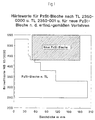
- Armor plates with a thickness in the area from 115 to 200 mm have a hardness of maximum 330 HB, like this in Figure 1 based on the hardness values assigned to the sheet thicknesses the BWB, technical delivery conditions armored steel, TL 2350-001, April 1980 and TL 2350-0000, Nov. 1990.
- a known measure to improve the bullet resistance of Armor consists of armor plates made of a homogeneous material to produce in such a way that by an appropriate annealing treatment the top and bottom of the sheets are different Accept harshness (DE 32 09 531 A1).
- the production of armored sheets is also more bulletproof known from non-homogeneous materials by two or more Steels of different hardenability by plating together be connected (EP-A1 0 142 042).
- By an appropriate Heat treatment is preferred with these two-ply steels
- Final thickness of less than 20 mm, preferably less than 15 mm, the one side, mostly facing the bombardment, a high hardness of up to to 720 HB, the other side given a hardness of up to 520 HB.
- the comparatively less hard part ensures this (Base material) compliance with the required jumping safety, during the hard part (edition) to an increase in bullet security should lead.
- clad armor plates with high degrees of hardness in practice are preferably only in sheet thicknesses up to used to about 40 mm.
- Armor consists in the fact that it consists of several layers of known homogeneous or plated armor plates, preferably with a Final thickness up to 40 mm. This is done in a more compact manner Form without gaps either as slat armor several steel sheets or as composite armor made of steel sheets in combination with other metallic or non-metallic Materials, or in bulkhead-like form with spaces in between Protective fewer or irrelevant substances (DE 40 31 550 A1).
- Compact or bulkhead-like composite armor is in usually very complex in construction and because of the sometimes cost-intensive Non-ferrous materials are also expensive in relation to what has been achieved Protection gain or the actually achieved improvement of Bulletproof.
- the invention is based on the object of a method for Manufacture of armor plates with a final thickness over 50 mm and a hardness of more than 430 HB, preferably with a hardness of to create more than 400 HB with a final thickness over approx. 75 mm improve the bullet resistance of armor made therefrom.
- the final thickness of the armor plate after hot rolling the continuous casting slab is in the range from over 50 to 200 mm, preferably up to 180 mm.
- the thickness of the continuous casting slab should allow the application of at least three forming stitches according to the invention to achieve the final thickness of the armor sheet rolled therefrom.
- the continuous casting slab is preferably at a temperature in the range heated and heated from 1,150 to 1,300 ° C.
- the continuously cast continuous slab is cooled according to the invention in air and by spraying both sides of it with pressurized water to a surface temperature of less than 1,050 ° C.
- This cooling preferably takes place in such a way that the heating temperature based on the surface of the both sides of the slab from a depth of more than 1/8 of the Slab thickness is retained up to a maximum of 1/4 of the slab thickness.
- slab the thickness of the two outer firmer ones Trays each in the range of 1/8 to 1/4 of the slab thickness.
- the reversing hot rolling of the armored sheets takes place without a break. If necessary, the surface temperature of the rolling stock between the individual forming stitches by air and / or due to splash water in the required temperature range of 1,050 can be kept up to 900 ° C. This means that the surface temperature during the entire hot rolling process in this Area.
- the armored sheet which was rolled to its final thickness, should cool down to room temperature by reheating to above Ac3 and Quench at a rate of ⁇ 1 K / s in oil or water be hardened.
- an annealing treatment in the temperature range from 100 to 500 ° C can be hardness in the range from 400 to 550 HB, in the temperature range from 100 to 400 ° C, preferably in the range of 430 up to 550 HB.
- the hardness is set depending on the temperature selected for the annealing treatment.
- Figure 1 shows with the hatched area where there is preference an armor sheet produced by the method according to the invention in In terms of its thickness and hardness in a diagram, which is the Brinell hardness depending on the sheet thickness for represents conventional armor plates. So far have been high hardness values only achieved with relatively thin sheets less than 50 mm thick, while thicker sheets always with lower hardness between 250 and a maximum of 430 HB were generated and used. From these well-known armor plates that sit after the invention Process manufactured sheet metal by the combination of high Hardness (greater than 400 HB, in particular greater than 430 HB) with great Sheet thickness (greater than 50 mm or 75 mm) significantly.
- Table 2 shows the thickness of the continuous cast slab produced, the heating temperature, the cooling treatment on the surface of the heated continuous casting slab just before hot rolling and the roll radius for two tests with the two steel melts A and B as production parameters.
- Table 2 also contains the surface temperature, the respective thickness h 1 of the rolled product, the resulting individual shape change value ⁇ h and the shape factor SF for the individual passes during hot rolling.
- Table 3 are manufactured according to the inventive method hardened armor plates with their produced after tempering mechanical properties, namely those on the sheet metal surface measured Brinell hardness and that in the longitudinal and transverse direction near the surface and at the core of those made from melts A and B. Armored sheets listed. The sheets are at one after hardening Temperature of 180 to 250 ° C was started, so that a high hardness, if possible only slightly below the starting hardness has stopped.
- the new homogeneous produced by the process according to the invention Armored sheets of great thickness and high hardness are able the bullet resistance of one layer and in particular of to improve multilayered armor significantly.
- the penetration depth of a projectile into a slat target conventional armored sheets for example, set at 100%, see above the depth of penetration decreases when using the inventive Armor plates by at least 20%, usually by 30% and about that.
- the quality of armor is determined by the combination of mass and space.
- the new thick armor plates of high hardness, as such or in combination with other materials, offer simple and comparatively inexpensive options for effective protective structures against the most varied types of serious threats, both with bullets and with shaped loads. Due to the new material quality, which is particularly evident in the highly dynamic loading caused by bombardment, considerably lighter constructions can be realized with the same bullet resistance. At the same time, the smallest possible depths can be achieved.
Landscapes
- Chemical & Material Sciences (AREA)
- Engineering & Computer Science (AREA)
- Mechanical Engineering (AREA)
- Materials Engineering (AREA)
- Metallurgy (AREA)
- Organic Chemistry (AREA)
- Physics & Mathematics (AREA)
- Thermal Sciences (AREA)
- Crystallography & Structural Chemistry (AREA)
- Heat Treatment Of Steel (AREA)
- Metal Rolling (AREA)
Claims (10)
- Procédé pour fabriquer des tôles de blindage de haute dureté à partir de brames en acier, dans lequel les brames sont laminées à chaud à une épaisseur finale de plus de 50 mm et, ensuite, trempées et éventuellement soumises à un revenu, caractérisé en ce qu'on produit tout d'abord une brame de coulée continueà partir d'un acier comprenantéventuellement, un ou plusieurs des constituants suivants0,25 à 0,32 % C0,05 à 0,75 % Si0,10 à 1,50 % Mn0,90 à 2,00 % Cr0,10 à 0,70 % Mo1,20 à 4,50 % Ni0,01 à 0,08 Alau maximum 0,015 % Pau maximum 0,005 % Sau maximum 0,012 % N
0,001 à 0,004 % Ble reste, Fe, y compris les impuretés habituellesau maximum 0,10 % Tiau maximum 0,050 % Nbau maximum 0,10 % Vensuite on la réchauffe et on la chauffe à coeur à une température de 1150°C ou plus,ensuite, après un refroidissement à une température superficielle de moins de 1050°C, dans l'air ou par pulvérisation d'eau sous pression sur les deux grandes faces,on la lamine à chaud à une température superficielle de 1050 à 900°C, avec des passes de formage qui comportent une déformation élémentaire de εh > 0,1 et avec un Shape-factor SF > 0,40, de préférence > 0,50, jusqu'à obtenir l'épaisseur finale. - Procédé selon la revendication 1,
caractérisé en ce que l'acier est allié avec
0,001 à 0,004% Bajoutés isolément ou en combinaison.au maximum 0,10 % Tiau maximum 0,050 % Nbau maximum 0,10 % V, - Procédé selon la revendication 2,
caractérisé en ce que la teneur en titane dans l'acier est de préférence adaptée à la teneur en azote existante dans l'acier, selon la relation - Procédé selon la revendication 1,
caractérisé en ce qu'on lamine la brame de coulée continue à chaud jusqu'à obtenir une épaisseur finale comprise dans l'intervalle de > 50 à 200 mm, de préférence égale à 180 mm. - Procédé selon la revendication 1,
caractérisé en ce qu'on réchauffe et qu'on chauffe à coeur la brame de coulée continue à une température de 1150 à 1300°C. - Procédé selon la revendication 1,
caractérisé en ce qu'on refroidit la brame de coulée continue en surface avant le laminage à chaud de telle manière que la température de chauffage à coeur reste maintenue, en partant de la surface des deux grandes faces de la brame, depuis une profondeur de plus de 1/8 de l'épaisseur de la brame jusqu'à 1/4 au maximum de l'épaisseur de la brame. - Procédé selon la revendication 1,
caractérisé en ce qu'on effectue le laminage à chaud avec un Shape-factor SF > 0,50. - Procédé selon la revendication 1,
caractérisé en ce qu'après le refroidissement jusqu'à la température ambiante, on trempe la tôle de blindage entièrement laminée à l'épaisseur finale par réchauffage à une température au-dessus de Ac3 et refroidissement brusque avec une vitesse ≥ 1 K/s dans l'huile ou dans l'eau. - Procédé selon une des revendications 1 à 8,
caractérisé en ce qu'on soumet la tôle de blindage trempée à un revenu à une température comprise dans l'intervalle de 100 à 500°C, avec réglage de la dureté dans l'intervalle de 400 à 550 HB. - Procédé selon une des revendications 1 à 8,
caractérisé en ce qu'on établit la dureté de la tôle de blindage sur une valeur de 430 à 550 HB, lors du processus de revenu jusqu'à une température de 400°C.
Applications Claiming Priority (3)
| Application Number | Priority Date | Filing Date | Title |
|---|---|---|---|
| DE4223895 | 1992-07-21 | ||
| DE19924223895 DE4223895C1 (de) | 1992-07-21 | 1992-07-21 | Verfahren zur Herstellung von dicken Panzerblechen |
| US08/152,034 US5458704A (en) | 1992-07-21 | 1993-11-12 | Process for the production of thick armour plates |
Publications (2)
| Publication Number | Publication Date |
|---|---|
| EP0580062A1 EP0580062A1 (fr) | 1994-01-26 |
| EP0580062B1 true EP0580062B1 (fr) | 1998-01-07 |
Family
ID=25916778
Family Applications (1)
| Application Number | Title | Priority Date | Filing Date |
|---|---|---|---|
| EP19930111173 Expired - Lifetime EP0580062B1 (fr) | 1992-07-21 | 1993-07-13 | Procédé pour la fabrication des plaques de blindage épaisses |
Country Status (3)
| Country | Link |
|---|---|
| US (1) | US5458704A (fr) |
| EP (1) | EP0580062B1 (fr) |
| DE (1) | DE4223895C1 (fr) |
Cited By (3)
| Publication number | Priority date | Publication date | Assignee | Title |
|---|---|---|---|---|
| US7967056B2 (en) | 2005-07-19 | 2011-06-28 | Giovanni Arvedi | Process and related plant for manufacturing steel long products without interruption |
| US8162032B2 (en) | 2005-07-19 | 2012-04-24 | Giovanni Arvedi | Process and plant for manufacturing steel plates without interruption |
| EP3321944B1 (fr) | 2014-09-17 | 2022-04-06 | Siemens Energy Global GmbH & Co. KG | Installation électrique résistante au bombardement |
Families Citing this family (33)
| Publication number | Priority date | Publication date | Assignee | Title |
|---|---|---|---|---|
| DE19736720C1 (de) * | 1997-08-19 | 1999-05-06 | Mannesmann Ag | Metallurgisches Gefäß |
| JPH11140585A (ja) | 1997-09-05 | 1999-05-25 | Timken Co:The | 最適強靭性を有する熱処理鋼 |
| RU2139357C1 (ru) * | 1999-04-14 | 1999-10-10 | Бащенко Анатолий Павлович | Способ изготовления стальных монолистовых бронеэлементов б 100 ст |
| EP1052296B1 (fr) * | 1999-05-08 | 2004-12-15 | ThyssenKrupp Stahl AG | Utilisation d'un acier pour la fabrication de plaques de blindage |
| DE10111304C2 (de) * | 2001-03-09 | 2003-03-20 | Buderus Edelstahlwerke Ag | Verfahren zur Herstellung von Rohren für schwere Geschütze |
| RU2185459C1 (ru) * | 2001-09-03 | 2002-07-20 | ООО "Баллистические защитные технологии "Форт" | Высокопрочная броневая листовая сталь |
| DE50202536D1 (de) * | 2001-12-19 | 2005-04-28 | Boehler Bleche Gmbh Muerzzusch | Wekstoff mit hoher ballistischer Schutzwirkung |
| FR2838138B1 (fr) * | 2002-04-03 | 2005-04-22 | Usinor | Acier pour la fabrication de moules d'injection de matiere plastique ou pour la fabrication de pieces pour le travail des metaux |
| DE10306063A1 (de) * | 2003-02-13 | 2004-08-26 | Pgam Advanced Technologies Ag | Verfahren zum Bearbeiten von Panzerstahl |
| RU2236482C1 (ru) * | 2003-06-18 | 2004-09-20 | Открытое Акционерное Общество "Научно-Исследовательский Институт Стали" | Броневая сталь |
| WO2005045351A1 (fr) * | 2003-11-06 | 2005-05-19 | Rufus Paul Roodt | Bouclier cuirasse |
| AT414341B (de) | 2003-11-07 | 2010-12-15 | Boehler Edelstahl Gmbh & Co Kg | Stahl für chemie - anlagen - komponenten |
| DE102004006093B3 (de) * | 2004-02-06 | 2005-12-01 | Fes Gmbh Fahrzeug-Entwicklung Sachsen | Verfahren zur Herstellung eines dreidimensional geformten Panzerungsbauteils für Fahrzeugkarosserien |
| DE102005014298B4 (de) * | 2005-03-24 | 2006-11-30 | Benteler Automobiltechnik Gmbh | Panzerung für ein Fahrzeug |
| RU2341583C2 (ru) * | 2006-05-05 | 2008-12-20 | Открытое Акционерное Общество "Научно-Исследовательский Институт Стали" (Оао "Нии Стали") | Броневая сталь |
| RU2327801C1 (ru) * | 2006-10-04 | 2008-06-27 | Институт металлургии и материаловедения им. А.А. Байкова РАН | Высокопрочная сталь мартенситного класса |
| DE102008014914B4 (de) * | 2007-08-23 | 2013-07-04 | Vps Vehicle Protection Systems Gmbh | Strukturteil für eine Fahrzeug-Panzerung |
| DE102008010168B4 (de) | 2008-02-20 | 2010-04-22 | Benteler Automobiltechnik Gmbh | Panzerung für ein Fahrzeug |
| CN101306499B (zh) * | 2008-06-23 | 2010-06-09 | 秦皇岛首秦金属材料有限公司 | 高炉炉壳用钢板的生产方法 |
| DE102008054078A1 (de) | 2008-10-31 | 2010-05-06 | Daimler Ag | Kraftfahrzeugkarosserie aus verschiedenen Stählen |
| RU2456368C1 (ru) * | 2011-02-08 | 2012-07-20 | Российская Федерация, от имени которой выступает Министерство промышленности и торговли (Минпромторг России) | Высокопрочная стойкая при динамическом воздействии сталь и способ производства листов из нее |
| RU2460823C1 (ru) * | 2011-02-08 | 2012-09-10 | Российская Федерация, от имени которой выступает Министерство промышленности и торговли (Минпромторг России) | Динамически стойкая сталь и способ производства листов из нее |
| RU2481407C1 (ru) * | 2011-10-26 | 2013-05-10 | Учреждение Российской академии наук Институт металлургии и материаловедения им. А.А. Байкова РАН | Способ деформационно-термического производства листового проката |
| US9410222B2 (en) | 2012-06-19 | 2016-08-09 | Buffalo Armory Llc | Method and apparatus for treating a steel article |
| US9410220B2 (en) * | 2012-06-19 | 2016-08-09 | Buffalo Armory Llc | Method and apparatus for treating a steel article |
| RU2499844C1 (ru) * | 2012-07-20 | 2013-11-27 | Федеральное государственное автономное образовательное учреждение высшего профессионального образования "Национальный исследовательский технологический университет "МИСиС" | Способ производства листовой стали |
| RU2520247C1 (ru) * | 2013-03-01 | 2014-06-20 | Общество с ограниченной ответственностью Научно-производственная фирма "ЛВС" | Высокопрочная броневая сталь и способ производства листов из нее |
| CN104233102A (zh) * | 2014-06-25 | 2014-12-24 | 山东德泰机械制造集团有限公司 | 精密铸造高强高韧铸钢 |
| RU2615426C1 (ru) * | 2015-12-03 | 2017-04-04 | Федеральное Государственное Унитарное Предприятие "Центральный научно-исследовательский институт черной металлургии им. И.П. Бардина" (ФГУП "ЦНИИчермет им. И.П. Бардина") | Способ производства горячекатаной высокопрочной коррозионно-стойкой стали |
| DE102019209666B4 (de) | 2019-07-02 | 2020-06-04 | Audi Ag | Strukturbauteile für Panzerungen |
| TR202018497A2 (tr) * | 2020-11-18 | 2022-02-21 | Coskunoez Kalip Makina Sanayi Ve Ticaret Anonim Sirketi | Demi̇r bazli alaşim kompozi̇syonu bu kompozi̇syondan üreti̇len parçalar ve üreti̇m yöntemi̇ |
| CN115341138B (zh) * | 2022-07-12 | 2024-04-19 | 江阴兴澄特种钢铁有限公司 | 一种高强防护钢板及其制造方法 |
| CN116426832B (zh) * | 2023-03-06 | 2024-12-06 | 本钢板材股份有限公司 | 一种中破深井开采套管用热轧钢板及其制备方法 |
Family Cites Families (8)
| Publication number | Priority date | Publication date | Assignee | Title |
|---|---|---|---|---|
| CA1028535A (fr) * | 1973-11-15 | 1978-03-28 | Bethlehem Steel Corporation | Methode de controle thermique au cours du laminage a chaud sur trains continus a chaud |
| JPS5810444B2 (ja) * | 1979-03-28 | 1983-02-25 | 住友金属工業株式会社 | 耐水素誘起割れ性のすぐれた鋼板の製造法 |
| US4431466A (en) * | 1981-03-16 | 1984-02-14 | Melampy Donald F | Method for making armor plate |
| JPH064889B2 (ja) * | 1983-01-14 | 1994-01-19 | 新日本製鐵株式会社 | 厚肉超高張力鋼の製造方法 |
| DE3340031C2 (de) * | 1983-11-05 | 1985-11-21 | Thyssen Stahl AG, 4100 Duisburg | Panzerblech und Verfahren zu seiner Herstellung |
| JPS61136624A (ja) * | 1984-12-08 | 1986-06-24 | Nippon Steel Corp | 降伏点42Kgf/mm↑2以上90Kgf/mm↑2未満の厚手断面の高靭性鋼材の製造法 |
| FR2652821B1 (fr) * | 1989-10-09 | 1994-02-18 | Creusot Loire Industrie | Acier de haute durete pour blindage et procede d'elaboration d'un tel acier. |
| DE4031550A1 (de) * | 1990-10-05 | 1992-04-09 | Daimler Benz Ag | Ballistische schutzpanzerung |
-
1992
- 1992-07-21 DE DE19924223895 patent/DE4223895C1/de not_active Expired - Fee Related
-
1993
- 1993-07-13 EP EP19930111173 patent/EP0580062B1/fr not_active Expired - Lifetime
- 1993-11-12 US US08/152,034 patent/US5458704A/en not_active Expired - Lifetime
Cited By (3)
| Publication number | Priority date | Publication date | Assignee | Title |
|---|---|---|---|---|
| US7967056B2 (en) | 2005-07-19 | 2011-06-28 | Giovanni Arvedi | Process and related plant for manufacturing steel long products without interruption |
| US8162032B2 (en) | 2005-07-19 | 2012-04-24 | Giovanni Arvedi | Process and plant for manufacturing steel plates without interruption |
| EP3321944B1 (fr) | 2014-09-17 | 2022-04-06 | Siemens Energy Global GmbH & Co. KG | Installation électrique résistante au bombardement |
Also Published As
| Publication number | Publication date |
|---|---|
| US5458704A (en) | 1995-10-17 |
| EP0580062A1 (fr) | 1994-01-26 |
| DE4223895C1 (de) | 1994-03-17 |
Similar Documents
| Publication | Publication Date | Title |
|---|---|---|
| DE4223895C1 (de) | Verfahren zur Herstellung von dicken Panzerblechen | |
| DE3340031C2 (de) | Panzerblech und Verfahren zu seiner Herstellung | |
| EP2123447B1 (fr) | Matière première composite dotée d'un effet de protection balistique | |
| EP3974554A1 (fr) | Produit plan en acier ayant une bonne résistance au vieillissement et son procédé de fabrication | |
| EP3625047A1 (fr) | Acier de sécurité ou acier résistant à l'usure et utilisation correspondante | |
| EP3724359B1 (fr) | Produit plat en acier laminé à chaud, à rigidité élevée, doté d'une résistance à la fissuration de bords élevée ainsi que d'une capacité de durcissement à la cuisson élevée et procédé de fabrication d'un tel produit plat en acier | |
| EP3642371A1 (fr) | Procédé de fabrication d'un composant en acier pourvu d'un revêtement métallique anticorrosion | |
| DE102018132860A1 (de) | Verfahren zur Herstellung von konventionell warmgewalzten, profilierten Warmbanderzeugnissen | |
| DE102017208252A1 (de) | Dreilagiger Verschleißstahl oder Sicherheitsstahl, Verfahren zur Herstellung einer Komponente und Verwendung | |
| DE69204706T2 (de) | Verfahren zur Herstellung einer rostfreien Verbundpanzerplatte und nach dem Verfahren hergestellter Behälter. | |
| DE2105851A1 (de) | Aluminiumwerkstoffe und deren Her stellung | |
| EP2623617A2 (fr) | Procédé de fabrication d'un composant de blindage et composant de blindage | |
| EP1052296B1 (fr) | Utilisation d'un acier pour la fabrication de plaques de blindage | |
| EP3115134A1 (fr) | Procédé de fabrication d'une tôle composite constituée d'un composite métallique multi-couches, tôle composite multi-couches et utilisation d'une telle tôle composite | |
| EP3853385A1 (fr) | Procédé de fabrication de tôles en acier ultrarésistantes et tôle en acier correspondante | |
| DE102006058066B3 (de) | Pulvermetallurgisch hergestelltes Stahlblech | |
| EP0247020B1 (fr) | Plaque de blindage | |
| EP3426808B1 (fr) | Utilisation d'un produit plat en acier traité thermique | |
| EP3894217A1 (fr) | Produit en acier comportant une grande capacité d'absorption d'énergie lors d'une sollicitation brusque et utilisation d'un tel produit en acier | |
| DE102019115165A1 (de) | Verfahren zum Erzeugen eines Stahlverbundwerkstoffs | |
| DE102020105046B4 (de) | Verfahren zur Herstellung eines Stahlflachprodukts und Verwendung eines solchen Stahlflachprodukts | |
| EP1321535A2 (fr) | Matériau de haute protection ballistique | |
| DE102017129793A1 (de) | Panzerungsbauteil und Verfahren zur Herstellung eines Panzerungsbauteils | |
| EP0481575A2 (fr) | Procédé de fabrication de tôles soudables à haute résistance mécanique et leur application | |
| DE69203139T2 (de) | Verfahren zum Herstellung von verschliessfestem plattiertem Blech sowie auf diese Weise hergestelltes Blech. |
Legal Events
| Date | Code | Title | Description |
|---|---|---|---|
| PUAI | Public reference made under article 153(3) epc to a published international application that has entered the european phase |
Free format text: ORIGINAL CODE: 0009012 |
|
| AK | Designated contracting states |
Kind code of ref document: A1 Designated state(s): DE FR GB SE |
|
| 17P | Request for examination filed |
Effective date: 19940707 |
|
| GRAG | Despatch of communication of intention to grant |
Free format text: ORIGINAL CODE: EPIDOS AGRA |
|
| 17Q | First examination report despatched |
Effective date: 19970428 |
|
| GRAG | Despatch of communication of intention to grant |
Free format text: ORIGINAL CODE: EPIDOS AGRA |
|
| GRAH | Despatch of communication of intention to grant a patent |
Free format text: ORIGINAL CODE: EPIDOS IGRA |
|
| GRAH | Despatch of communication of intention to grant a patent |
Free format text: ORIGINAL CODE: EPIDOS IGRA |
|
| GRAA | (expected) grant |
Free format text: ORIGINAL CODE: 0009210 |
|
| AK | Designated contracting states |
Kind code of ref document: B1 Designated state(s): DE FR GB SE |
|
| GBT | Gb: translation of ep patent filed (gb section 77(6)(a)/1977) |
Effective date: 19980107 |
|
| REF | Corresponds to: |
Ref document number: 59307913 Country of ref document: DE Date of ref document: 19980212 |
|
| ET | Fr: translation filed | ||
| PLBE | No opposition filed within time limit |
Free format text: ORIGINAL CODE: 0009261 |
|
| STAA | Information on the status of an ep patent application or granted ep patent |
Free format text: STATUS: NO OPPOSITION FILED WITHIN TIME LIMIT |
|
| 26N | No opposition filed | ||
| REG | Reference to a national code |
Ref country code: GB Ref legal event code: IF02 |
|
| PGFP | Annual fee paid to national office [announced via postgrant information from national office to epo] |
Ref country code: FR Payment date: 20110729 Year of fee payment: 19 |
|
| PGFP | Annual fee paid to national office [announced via postgrant information from national office to epo] |
Ref country code: DE Payment date: 20110720 Year of fee payment: 19 Ref country code: SE Payment date: 20110720 Year of fee payment: 19 Ref country code: GB Payment date: 20110720 Year of fee payment: 19 |
|
| REG | Reference to a national code |
Ref country code: SE Ref legal event code: EUG |
|
| GBPC | Gb: european patent ceased through non-payment of renewal fee |
Effective date: 20120713 |
|
| REG | Reference to a national code |
Ref country code: FR Ref legal event code: ST Effective date: 20130329 |
|
| PG25 | Lapsed in a contracting state [announced via postgrant information from national office to epo] |
Ref country code: GB Free format text: LAPSE BECAUSE OF NON-PAYMENT OF DUE FEES Effective date: 20120713 Ref country code: SE Free format text: LAPSE BECAUSE OF NON-PAYMENT OF DUE FEES Effective date: 20120714 Ref country code: FR Free format text: LAPSE BECAUSE OF NON-PAYMENT OF DUE FEES Effective date: 20120731 Ref country code: DE Free format text: LAPSE BECAUSE OF NON-PAYMENT OF DUE FEES Effective date: 20130201 |
|
| REG | Reference to a national code |
Ref country code: DE Ref legal event code: R119 Ref document number: 59307913 Country of ref document: DE Effective date: 20130201 |