EP0583005A1 - Luftströmungsverteiler für eine automatische Blutdruck-Messvorrichtung - Google Patents
Luftströmungsverteiler für eine automatische Blutdruck-Messvorrichtung Download PDFInfo
- Publication number
- EP0583005A1 EP0583005A1 EP93112834A EP93112834A EP0583005A1 EP 0583005 A1 EP0583005 A1 EP 0583005A1 EP 93112834 A EP93112834 A EP 93112834A EP 93112834 A EP93112834 A EP 93112834A EP 0583005 A1 EP0583005 A1 EP 0583005A1
- Authority
- EP
- European Patent Office
- Prior art keywords
- pressure
- cuff
- manifold
- solenoid
- port
- Prior art date
- Legal status (The legal status is an assumption and is not a legal conclusion. Google has not performed a legal analysis and makes no representation as to the accuracy of the status listed.)
- Withdrawn
Links
Images



Classifications
-
- A—HUMAN NECESSITIES
- A61—MEDICAL OR VETERINARY SCIENCE; HYGIENE
- A61B—DIAGNOSIS; SURGERY; IDENTIFICATION
- A61B5/00—Measuring for diagnostic purposes; Identification of persons
- A61B5/02—Detecting, measuring or recording for evaluating the cardiovascular system, e.g. pulse, heart rate, blood pressure or blood flow
- A61B5/021—Measuring pressure in heart or blood vessels
- A61B5/022—Measuring pressure in heart or blood vessels by applying pressure to close blood vessels, e.g. against the skin; Ophthalmodynamometers
- A61B5/0235—Valves specially adapted therefor
Definitions
- This invention relates to blood pressure monitoring, and more particularly, to an integrally formed manifold that interacts with and connects the elements of an automatic blood pressure monitoring device.
- Blood pressure is normally measured by placing a blood pressure cuff around the arm of a patient over the brachial artery.
- the cuff typically includes an inflatable bladder placed in an outer casing.
- the bladder is inflated to compress the arm of the patient, thereby pinching off the flow of blood through the brachial artery.
- the pressure in the bladder is gradually reduced while listening for sounds caused by the flow of blood through the brachial artery and measuring the air pressure in the bladder.
- the air pressure in the bladder is recorded as the systolic blood pressure.
- the air pressure in the bladder is recorded as the diastolic blood pressure.
- an instrument for automatically performing medical diagnostic tests is the ambulatory or bedside blood pressure monitor.
- These blood pressure monitors include a conventional blood pressure cuff connected through a tube to a monitoring instrument.
- the monitoring instrument includes an electric motor driving an air pump, a pressure transducer for measuring the air pressure in the cuff, and, if a separate transducer is not used, to also detect Korotkoff sounds or oscillometric pulses, which are generated by the flow of blood through the brachial artery. All of these components are generally controlled by a microprocessor.
- the monitoring instrument may also include a recording device, such as a magnetic tape recorder, or a digital display for providing a visual blood pressure indication.
- the motor is energized to inflate the cuff while the pressure in the cuff is monitored by the pressure transducer.
- the processor periodically actuates an air valve to incrementally bleed air from the cuff thereby reducing the cuff pressure.
- the transducer measures the cuff pressure and detects Korotkoff sounds or oscillometric pulses.
- the processor uses a rather complex algorithm, then determines the blood pressure from a table of cuff pressures and data indicating whether Korotkoff sounds or oscillometric pulses are detected at each cuff pressure. The blood pressure is then either recorded or displayed.
- a blood pressure monitoring device that consists of an integrally formed manifold which structurally and pneumatically interacts with and connects an air pump, a blood pressure cuff and a transducer.
- the manifold is a substantially unitary article, having an air inlet port, a transducer port, and two cuff ports, whereby the device may service either a high volume, sometimes called adult, or low volume, sometimes called infant, blood pressure cuff. While the blood pressure cuff to be used is coupled to the appropriate cuff port, the other cuff port is used to sample ambient pressure, thereby zeroing the system before it takes a measurement.
- the manifold further includes four valve seats, two for receiving a high- and low-pressure distribution valve, respectively, and two for receiving a high- and low-pressure relief valve, respectively.
- the high- and low-pressure distribution valves which control the flow of air to the first and second cuff ports, respectively, both utilize a solenoid, and therefore have two positions, namely, energized and de-energized. In the energized position, each distribution valve allows its corresponding cuff port to communicate with a first plenum chamber, the first plenum chamber being in communication with an air pump through the air inlet port. In the de-energized position, each distribution valve allows its corresponding cuff port to communicate with the atmosphere, and seals off communication between the cuff port and the first plenum chamber.
- a transducer for measuring the pressure in a blood pressure cuff and the corresponding amplitude of oscillometric pulses caused by the flow of blood through the brachial artery is mounted on and electrically connected to a circuit board.
- the manifold is mounted on the circuit board such that it is in communication with the transducer through the transducer port of the manifold.
- a blood pressure measurement is taken by zeroing the system and energizing the distribution valve corresponding to the active cuff port, namely, the cuff port to which the blood pressure cuff is coupled, thereby allowing the active cuff port to communicate with the first plenum chamber.
- the air pump is energized, thereby causing pressurized air to pass through the air inlet port into the first plenum chamber of the manifold, and through the active cuff port, thereby inflating the blood pressure cuff to a predetermined pressure.
- the pump is then de-energized, after which the transducer measures the pressure in the blood pressure cuff and any corresponding oscillometric pulses.
- the distribution valve corresponding to the active cuff port is then de-energized for a predetermined period of time, thereby allowing the blood pressure cuff to vent to atmosphere.
- a sequence of bleeding the blood pressure cuff for a predetermined period of time and measuring the pressure and amplitude of the corresponding oscillometric pulses is continued until both systolic and diastolic pressures are measured.
- the blood pressure cuff is then vented completely.
- the manifold also provides valve seats for receiving high- and low-pressure relief valves.
- the relief valves actuate only in an emergency situation arising when the pressure in the manifold exceeds a preset limit.
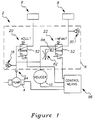
- Figure 1 is a schematic of a blood pressure monitoring device utilizing the manifold of Figure 2.
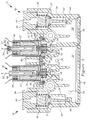
- Figure 2 is an exploded isometric view of a manifold for use in a blood pressure monitoring device.
- Figure 3 is a cross-sectional plan view taken on line 3-3 of Figure 2, showing the solenoids in a de-energized position.
- Figure 4 is a cross-sectional plan view taken on line 4-4 of Figure 2, showing the solenoids in an energized position.
- Figure 5 is a front plan view of the blood pressure monitoring device of Figure 2.
- the blood pressure monitoring device 2 has an air pump 4 which generates pressurized air when energized, a pressure transducer 10 for measuring the pressure and amplitude of oscillometric pulses in the blood pressure cuff 8, and a manifold 6 which connects and serves as an integral part of the components of the blood pressure monitoring device 2.
- the blood pressure monitoring device 2 utilizes control means 96 for energizing and de-energizing the air pump 4 and distribution and relief valves, as will be discussed below.
- the manifold 6 is an integrally formed, substantially unitary structure, which may be made, for example, by injection molding. All of the ports and valve seats, as will be described below, are an integral part of the manifold 6, thereby eliminating the need for intermediate hoses and clamps and thereby minimizing the inadvertent leakage of air from the blood pressure monitoring device 2. Utilizing such a unitary structure further serves to reduce the stress on the valves, thereby increasing the longevity of the device, and to reduce the size and cost of the blood pressure monitoring device.
- the manifold 6 has an air inlet port 14 to communicate with the air pump 4, a first cuff port 18 and a second cuff port 24, such that a blood pressure cuff 8 may be coupled to either the first cuff port 18 or the second cuff port 24.
- a blood pressure cuff 8 may be coupled to either the first cuff port 18 or the second cuff port 24.
- either an adult blood pressure cuff is coupled to the first cuff port 18 or an infant blood pressure cuff is coupled to the second cuff port 24, depending on the age of the patient whose blood pressure is being monitored. If an adult cuff is coupled to the first cuff port 18, the blood pressure monitoring device 2 samples ambient pressure through the second cuff port 24 at the beginning of a measurement to zero the system.
- the first cuff port 18 will be used to sample ambient pressure. It will be appreciated by one of ordinary skill in the art that the manifold 6 may be made to service only a single blood pressure cuff, as long as the system has some means for sampling ambient pressure to zero the system.
- the integral structure of the manifold 6 further includes two relief valve seats 66 adapted to receive a high-pressure relief valve 16 and a low-pressure relief valve 30, respectively, and two distribution valve seats 68 adapted to receive a high-pressure distribution valve 20 and a low-pressure distribution valve 22, respectively, the high- and low-pressure distribution valves 20 and 22 being mounted to the manifold by a yoke 80.
- the manifold 6 has a first plenum chamber 12 and a second plenum chamber 28.
- the first plenum chamber 12 is substantially closed from the atmosphere by cap 76 while the second plenum chamber 28 is substantially closed from the atmosphere by cap 78.
- the first plenum chamber 12 is in communication with the high-pressure relief valve 16, the air pump 4 through the air inlet port 14, the pressure transducer 10 through the transducer port 26, and selectively with the first and second cuff ports 18 and 24, as determined by the high-pressure distribution valve 20 and the low-pressure distribution valve 22, respectively, as will be discussed in greater detail below.
- the second plenum chamber as illustrated in Figures 3 and 4, communicates with the low-pressure relief valve 30, the second cuff port 24, and selectively with the first plenum chamber 12, as determined by the low-pressure distribution valve 22, as will be discussed in greater detail below.
- the high-pressure relief valve 16 and the low-pressure relief valve 30 each comprises a piston 32 having a stylus 42 which is fined with an o-ring 86, typically made of rubber.
- the piston 32 and o-ring 86 are seated in conical bore 34 by a compression spring 36 and a plug 38, the plug 38 being adapted to allow air to pass through it from the manifold 6 to atmosphere, for example, as illustrated in Figure 2, by having a cylindrical opening 40.
- the plug 38 may be threaded, thereby being adjustable.
- the amount of force applied to the piston 32 by the compression spring 36 governs the pressure at which the piston 32 will become unseated, thereby allowing air to pass from the manifold 6 to atmosphere through the opening 40 of plug 38.
- each of the relief valve seats 66 is beneficial because it allows the piston 32 and o-ring 86 to fit tightly in the conical bore 34 when the piston 32 is seated, such that when the relief pressure, which is governed by the compression spring 36 as noted above, is reached, the piston 32 becomes unseated, or "pops open,” suddenly. This action relieves the pressure in the manifold 6 quickly, constitutionalke a cylindrical bore and flat seat design which would act as a slow leak. This is advantageous because it is important to relieve the pressure as quickly as possible, in order to minimize discomfort and risk of injury to the patient whose blood pressure is being monitored.
- each piston 32 in its respective relief valve seat 66 is controlled by the stylus 42 of each piston 32.
- Each stylus 42 sits in its respective clearance opening 44 in manifold 6, the length and size of the stylus 42 being such to provide adequate alignment of the piston 32 while having sufficient clearance between the stylus 42 and the manifold 6 to reduce the drag on the stylus 42 as it moves to relieve the pressure in the manifold 6.
- Use of such a design is advantageous in that it reduces undesirable drag which occurs in alignment schemes using tight-fitting shafts and sleeves.
- the high-pressure distribution valve 20 and the low-pressure distribution valve 22 each comprises a sleeve 46, a cylindrical, stationary core 48 mounted axially in the sleeve 46, a solenoid coil 52, a compression spring 90 and a moving core 56.
- Each sleeve 46 is sealed in its respective distribution valve seat 68 by an o-ring 88, the moving core 56 and the stationary core 48 of each distribution valve being axially aligned with a corresponding solenoid port 54 in the manifold 6.
- each moving core 56 has a sealing surface 70 on its first end 72 and on its second end 74.
- the sealing surface may be made of rubber or any other suitable material.
- de-energizing the solenoid coils 52 allows the first cuff port 18 and second cuff port 24 to communicate with the atmosphere via the cylindrical passageway 50 in stationary core 48 of their corresponding distribution valves, 20 and 22, respectively.
- de-energizing the coils 52 vents the respective cuff ports 18 and 24 to atmosphere to gradually decrease the pressure in the cuff.
- sleeve 46 in each of the distribution valves 20 and 22 acts as a magnetic return path for the moving core 56, as well as an air-tight section of the air-flow path between the cuff ports 18 and 24, and the atmosphere.
- energizing the solenoid coils 52 in the high- and low-pressure distribution valves 20 and 22 allows the first plenum chamber 12 to communicate with the first and second cuff ports, 18 and 24, respectively. Under these circumstances, the pressure in the plenum chamber 12 equalizes to the pressure of the first and second cuff ports 18 and 24.
- the pressure transducer 10 is mounted on, and electrically connected by leads 60 to, circuit board 58.
- the manifold 6 is mounted on the circuit board 58 such that the transducer port 26, as illustrated in Figures 3 and 4, communicates with a pressure port, not shown, of the pressure transducer 10, such that the pressure transducer 10 measures the pressure and amplitude of oscillometric pulses in the blood pressure cuff 8 coupled to the manifold 6, via the first plenum chamber 12.
- An o-ring seal 92 is mounted between the manifold 6 and pressure transducer 10, thereby sealing the transducer 10 to the manifold 6.
- a blood pressure cuff 8 may be coupled to either the first cuff port 18 or the second cuff port 24 of manifold 6.
- the blood pressure monitoring device 2 therefore has two modes, namely, high-pressure, for inflating an adult cuff, and low-pressure, for inflating an infant cuff.
- the solenoid coil 52 in the low-pressure distribution valve 22 when operating in the high-pressure mode, such that the blood pressure cuff 8 is a relatively high-volume cuff and is coupled to the first cuff port 18, the solenoid coil 52 in the low-pressure distribution valve 22 is energized, thereby allowing the pressure transducer 10 to sample ambient pressure through the second cuff port 24 to zero the system.
- the solenoid coil 52 in the low-pressure distribution valve 22 is then de-energized, and the solenoid coil 52 in the high-pressure distribution valve 20 is energized, thereby allowing communication between the air pump 4 coupled to the manifold 6 through the air inlet port 14 and the blood pressure cuff 8 coupled to the manifold 6 via the first cuff port 18.
- the air pump 4 is then energized, causing pressurized air to pass through the air inlet port 14 into the first plenum chamber 12 and through the first cuff port 18 to inflate the blood pressure cuff 8 to a predetermined pressure, typically 30 mmHg above the expected systolic blood pressure, as measured by the pressure transducer 10.
- the pressure transducer 10 concurrently checks for the presence of oscillometric pulses in the cuff indicating a pressure below systole and, if necessary, the pressure is increased further until a pressure above systole is reached.
- the air pump 4 is de-energized.
- a check valve 94 prevents air from bleeding back through the air pump.
- the solenoid coil 52 in the high-pressure distribution valve 20 is de-energized for a predetermined period of time, thereby allowing air to vent from the blood pressure cuff 8 through the first cuff port 18 and through the cylindrical passageway 50 in the stationary core 48 to atmosphere.
- the high-pressure valve 20 is once again energized to couple the first cuff port 18 to the first plenum chamber 12, the pressure and amplitude of oscillometric pulses are measured through the transducer port 26 and recorded.
- a sequence of pressure bleeding by de-energizing the solenoid coil 52 for a predetermined period of time, re-energizing the solenoid coil 52, and taking pressure and amplitude measurements via the pressure transducer 10 continues until both systolic and diastolic pressures are detected. After systolic and diastolic pressures are detected, as determined by an empirical formula, the solenoid coil 52 in the high-pressure distribution valve 20 is de-energized to completely vent the blood pressure cuff 8 to atmosphere.
- the solenoid coil 52 in the low-pressure distribution valve 22 would also be energized, thereby venting the blood pressure cuff 8 through the second cuff port 24, the two cuff ports being in communication via the first plenum chamber 12.
- the solenoid coil 52 in the high-pressure distribution valve 20 is energized, thereby allowing the pressure transducer 10 to sample ambient pressure through the first cuff port 18, to zero the system.
- the solenoid coil 52 in the high-pressure distribution valve 20 is then de-energized, and the solenoid coil 52 in the low-pressure distribution valve 22 and the air pump 14 are energized, such that pressurized air generated by the air pump 4 inflates the blood pressure cuff 8 after passing through the first plenum chamber 12 and second cuff port 24.
- control means 96 for example a microprocessor, initiates a sequence of pressure-bleeding and measurement-taking of pressure and amplitude of oscillometric pulses, similar to that described above for the high-pressure mode.
- a flow restrictor 82 and filter 84 are installed over the cylindrical passageway 50 of the low-pressure distribution valve 22, to slow the rate at which air escapes from the infant blood pressure cuff, thereby allowing more precise control of the bleed step.
- the solenoid coils 52 in the high-pressure and low-pressure distribution valves 20 and 22 are both energized, such that the final bleed to deflate the blood pressure cuff 8 is through the first cuff port 18. This is quicker, and therefore more advantageous, given the flow restrictor 82 on the low-pressure distribution valve 22.
- the high-pressure relief valve 16 and the low-pressure relief valve 30 are set to relieve the pressure in the manifold if it exceeds a preset limit for a high-volume blood pressure cuff or a low-volume blood pressure cuff, respectively, whichever is in use at any given time.
- the high-pressure relief valve 16 when operating in the high-pressure mode, the high-pressure relief valve 16 will actuate when the pressure in the manifold, and therefore in the cuff, exceeds a predetermined value. For example, if operation in a high-pressure mode is typically in the range of 80-290 mmHg, the high-pressure relief valve 16 is set to actuate if the pressure reaches or exceeds 310 mmHg.
- the low-pressure relief valve 30 when operating in the low-pressure mode, the low-pressure relief valve 30 will actuate to relieve the pressure in the manifold 6, and therefore the blood pressure cuff 8, when the pressure exceeds a preset value. For example, if operation in the low-pressure mode is typically in the range of 40-170 mmHg, the low-pressure relief valve 30 will be set to actuate if the pressure reaches or exceeds 200 mmHg. It will be understood by one of ordinary skill in the art that the pressure at which the relief valves 16 and 30 actuate is adjustable, and the above values are given only as examples.
Landscapes
- Health & Medical Sciences (AREA)
- Life Sciences & Earth Sciences (AREA)
- Vascular Medicine (AREA)
- Cardiology (AREA)
- Biomedical Technology (AREA)
- Heart & Thoracic Surgery (AREA)
- Physiology (AREA)
- Biophysics (AREA)
- Pathology (AREA)
- Engineering & Computer Science (AREA)
- Ophthalmology & Optometry (AREA)
- Physics & Mathematics (AREA)
- Medical Informatics (AREA)
- Molecular Biology (AREA)
- Surgery (AREA)
- Animal Behavior & Ethology (AREA)
- General Health & Medical Sciences (AREA)
- Public Health (AREA)
- Veterinary Medicine (AREA)
- Measuring Pulse, Heart Rate, Blood Pressure Or Blood Flow (AREA)
Applications Claiming Priority (2)
| Application Number | Priority Date | Filing Date | Title |
|---|---|---|---|
| US929188 | 1992-08-11 | ||
| US07/929,188 US5464019A (en) | 1992-08-11 | 1992-08-11 | Airflow control manifold for automatic blood pressure monitoring device |
Publications (1)
| Publication Number | Publication Date |
|---|---|
| EP0583005A1 true EP0583005A1 (de) | 1994-02-16 |
Family
ID=25457449
Family Applications (1)
| Application Number | Title | Priority Date | Filing Date |
|---|---|---|---|
| EP93112834A Withdrawn EP0583005A1 (de) | 1992-08-11 | 1993-08-10 | Luftströmungsverteiler für eine automatische Blutdruck-Messvorrichtung |
Country Status (3)
| Country | Link |
|---|---|
| US (1) | US5464019A (de) |
| EP (1) | EP0583005A1 (de) |
| CA (1) | CA2103738A1 (de) |
Cited By (3)
| Publication number | Priority date | Publication date | Assignee | Title |
|---|---|---|---|---|
| WO1996006569A3 (en) * | 1994-08-26 | 1996-03-21 | Abatis Med Tech | Physiologic tourniquet |
| WO1996006568A3 (en) * | 1994-08-26 | 1996-04-11 | Abatis Med Tech | Physiologic tourniquet for intravenous regional anesthesia |
| US5931853A (en) * | 1995-08-25 | 1999-08-03 | Mcewen; James A. | Physiologic tourniquet with safety circuit |
Families Citing this family (13)
| Publication number | Priority date | Publication date | Assignee | Title |
|---|---|---|---|---|
| US5766130A (en) * | 1994-08-16 | 1998-06-16 | Selmonosky; Carlos A. | Vascular testing method |
| US5626142A (en) * | 1995-05-05 | 1997-05-06 | Marks; Lloyd A. | Multiple cuff blood pressure system |
| JP2710594B2 (ja) * | 1995-09-20 | 1998-02-10 | 日本コーリン株式会社 | 血圧測定装置 |
| DE19963623A1 (de) * | 1999-12-29 | 2001-07-12 | Braun Gmbh | Blutdruckmeßgerät und Verfahren zur Herstellung eines Teileträgers eines Blutdruckmeßgeräts |
| US6450966B1 (en) | 2000-05-03 | 2002-09-17 | Datex-Ohmeda, Inc. | Method for non-invasive blood pressure cuff identification using deflation pressure measurements |
| US7018337B2 (en) * | 2002-11-11 | 2006-03-28 | Ge Medical Systems Global Technology Company, Llc | Method and apparatus for automatic non-invasive blood pressure monitoring |
| GB0500117D0 (en) * | 2005-01-06 | 2005-02-09 | Talley Group Ltd | Pump assembly |
| US8083683B2 (en) * | 2007-10-19 | 2011-12-27 | Welch Allyn, Inc. | Dual lumen interchangeable monitor system |
| AR068182A1 (es) | 2008-05-14 | 2009-11-11 | Rodriguez Aranciva Ricardo | Esfigmomanometro multicamaras con conexion selectiva |
| US9033891B2 (en) * | 2008-05-14 | 2015-05-19 | Ricardo Rodriguez ARANCIVA | Multichamber sphygmomanometer with chamber selector |
| US10085654B2 (en) * | 2014-11-07 | 2018-10-02 | Welch Allyn, Inc. | Medical device |
| IT201900010248A1 (it) * | 2019-06-27 | 2020-12-27 | Tre Esse Progettazione Biomedica S R L | Dispositivo per la rilevazione della pressione venosa |
| MX2024006061A (es) | 2022-01-20 | 2024-07-31 | Spacelabs Healthcare L L C | Medición no invasiva de presión arterial de modo dual. |
Citations (5)
| Publication number | Priority date | Publication date | Assignee | Title |
|---|---|---|---|---|
| US4050311A (en) * | 1976-01-21 | 1977-09-27 | John Meredith Leach | Sphygmomanometer |
| EP0122123A2 (de) * | 1983-04-06 | 1984-10-17 | Critikon, Inc. | Selbsttätige Bestimmung der Manschettengrösse bei einem automatischen Blutdruckmesser |
| US4706684A (en) * | 1986-06-30 | 1987-11-17 | Spacelabs, Inc. | Ambulatory blood pressure apparatus |
| US4920971A (en) * | 1988-12-09 | 1990-05-01 | Blessinger Martin W | Pneumatic vein inflation device |
| US5022403A (en) * | 1987-03-11 | 1991-06-11 | Cas Medical Systems, Inc. | Automatic blood pressure measuring device and method with cuff size determination |
Family Cites Families (10)
| Publication number | Priority date | Publication date | Assignee | Title |
|---|---|---|---|---|
| US4175103A (en) * | 1978-04-17 | 1979-11-20 | General Motors Corporation | Carburetor |
| US4378807A (en) * | 1980-12-03 | 1983-04-05 | Clinical Data, Inc. | Blood pressure measurement apparatus |
| US4619481A (en) * | 1982-12-15 | 1986-10-28 | Grudzinskas Charles A | Inflatable seat cushion assembly |
| JPS59232531A (ja) * | 1983-06-15 | 1984-12-27 | 松下電工株式会社 | 血圧計 |
| US4718428A (en) * | 1984-02-17 | 1988-01-12 | Cortronic Corporation | Method for determining diastolic arterial blood pressure in a subject |
| US4774960A (en) * | 1986-10-30 | 1988-10-04 | Datascope Corporation | Method and apparatus for measuring blood pressure |
| US4858616A (en) * | 1988-03-17 | 1989-08-22 | Gms Engineering Corporation | Blood pressure measurement system for filtering low-frequency, high-amplitude noise |
| US4917116A (en) * | 1988-09-22 | 1990-04-17 | Cas Medical Systems, Inc. | Automatic blood pressure measuring device |
| US4944331A (en) * | 1989-06-22 | 1990-07-31 | Allied-Signal Inc. | Solenoid valve |
| US5285791A (en) * | 1992-01-21 | 1994-02-15 | Siemens Medical Electronics, Inc. | Noise damping system for an automatic blood pressure gauge |
-
1992
- 1992-08-11 US US07/929,188 patent/US5464019A/en not_active Expired - Fee Related
-
1993
- 1993-08-10 EP EP93112834A patent/EP0583005A1/de not_active Withdrawn
- 1993-08-10 CA CA002103738A patent/CA2103738A1/en not_active Abandoned
Patent Citations (5)
| Publication number | Priority date | Publication date | Assignee | Title |
|---|---|---|---|---|
| US4050311A (en) * | 1976-01-21 | 1977-09-27 | John Meredith Leach | Sphygmomanometer |
| EP0122123A2 (de) * | 1983-04-06 | 1984-10-17 | Critikon, Inc. | Selbsttätige Bestimmung der Manschettengrösse bei einem automatischen Blutdruckmesser |
| US4706684A (en) * | 1986-06-30 | 1987-11-17 | Spacelabs, Inc. | Ambulatory blood pressure apparatus |
| US5022403A (en) * | 1987-03-11 | 1991-06-11 | Cas Medical Systems, Inc. | Automatic blood pressure measuring device and method with cuff size determination |
| US4920971A (en) * | 1988-12-09 | 1990-05-01 | Blessinger Martin W | Pneumatic vein inflation device |
Cited By (5)
| Publication number | Priority date | Publication date | Assignee | Title |
|---|---|---|---|---|
| US5911735A (en) * | 1990-01-29 | 1999-06-15 | Mcewen; James A. | Time-limited physiologic tourniquet |
| US5607447A (en) * | 1993-09-28 | 1997-03-04 | Mcewen; James A. | Physiologic tourniquet |
| WO1996006569A3 (en) * | 1994-08-26 | 1996-03-21 | Abatis Med Tech | Physiologic tourniquet |
| WO1996006568A3 (en) * | 1994-08-26 | 1996-04-11 | Abatis Med Tech | Physiologic tourniquet for intravenous regional anesthesia |
| US5931853A (en) * | 1995-08-25 | 1999-08-03 | Mcewen; James A. | Physiologic tourniquet with safety circuit |
Also Published As
| Publication number | Publication date |
|---|---|
| CA2103738A1 (en) | 1994-02-12 |
| US5464019A (en) | 1995-11-07 |
Similar Documents
| Publication | Publication Date | Title |
|---|---|---|
| US5464019A (en) | Airflow control manifold for automatic blood pressure monitoring device | |
| US4178938A (en) | Pressure control systems | |
| US4333452A (en) | Pressure control systems | |
| US5090417A (en) | Medical diagnostic apparatus | |
| US4285340A (en) | Apparatus for controlling the pressure in a tracheal cuff | |
| US4657160A (en) | Pressure infusion control | |
| US4627440A (en) | Sphygmomanometric cuff pressurizing system | |
| US5069219A (en) | Self snugging universal blood pressure cuff | |
| US4459991A (en) | Blood pressure measuring equipment | |
| US9113818B2 (en) | Pressure measuring system, pressure measuring sensor assembly and a method of measuring a pressure | |
| US2753863A (en) | Sphygmomanometers | |
| GB2060826A (en) | Inflatable cuff system | |
| US20030114765A1 (en) | Blood pressure measuring apparatus | |
| US7018337B2 (en) | Method and apparatus for automatic non-invasive blood pressure monitoring | |
| US5718232A (en) | Calibration of segmental blood volume changes in arteries and veins for pulse volume recorder | |
| US8066645B2 (en) | Blood pressure bleed valve assembly | |
| AU5179899A (en) | Pressure controlled pad | |
| EP0576328B1 (de) | Automatisches Sphygmomanometer | |
| US5715828A (en) | Calibration of segmental blood volume changes in arteries and veins during detection of atherosclerosis | |
| EP0334255A1 (de) | Druckluftsteuersystem zum Überwachen des Blutdrucks eines Neugeborenen | |
| CN101166459B (zh) | 无毒液柱血压计 | |
| US3911903A (en) | Ocular pneumoplethysmograph and method of operation | |
| EP0418873B1 (de) | Automatische Blutdruckmessung in einer Überdruckkammer | |
| US5172697A (en) | Cuff inflation system | |
| JPH05103765A (ja) | 高気圧酸素治療装置 |
Legal Events
| Date | Code | Title | Description |
|---|---|---|---|
| PUAI | Public reference made under article 153(3) epc to a published international application that has entered the european phase |
Free format text: ORIGINAL CODE: 0009012 |
|
| AK | Designated contracting states |
Kind code of ref document: A1 Designated state(s): AT BE CH DE DK ES FR GB GR IE IT LI LU MC NL PT SE |
|
| 18D | Application deemed to be withdrawn |
Effective date: 19940817 |