EP0583511A1 - Méthode de communication domestique de messages sur un bus S d'un réseau RNIS - Google Patents
Méthode de communication domestique de messages sur un bus S d'un réseau RNIS Download PDFInfo
- Publication number
- EP0583511A1 EP0583511A1 EP92202514A EP92202514A EP0583511A1 EP 0583511 A1 EP0583511 A1 EP 0583511A1 EP 92202514 A EP92202514 A EP 92202514A EP 92202514 A EP92202514 A EP 92202514A EP 0583511 A1 EP0583511 A1 EP 0583511A1
- Authority
- EP
- European Patent Office
- Prior art keywords
- messages
- network
- terminals
- house
- bus
- Prior art date
- Legal status (The legal status is an assumption and is not a legal conclusion. Google has not performed a legal analysis and makes no representation as to the accuracy of the status listed.)
- Withdrawn
Links
Images

Classifications
-
- H—ELECTRICITY
- H04—ELECTRIC COMMUNICATION TECHNIQUE
- H04Q—SELECTING
- H04Q11/00—Selecting arrangements for multiplex systems
- H04Q11/04—Selecting arrangements for multiplex systems for time-division multiplexing
- H04Q11/0428—Integrated services digital network, i.e. systems for transmission of different types of digitised signals, e.g. speech, data, telecentral, television signals
- H04Q11/0435—Details
- H04Q11/0471—Terminal access circuits
-
- H—ELECTRICITY
- H04—ELECTRIC COMMUNICATION TECHNIQUE
- H04Q—SELECTING
- H04Q11/00—Selecting arrangements for multiplex systems
- H04Q11/04—Selecting arrangements for multiplex systems for time-division multiplexing
- H04Q11/0428—Integrated services digital network, i.e. systems for transmission of different types of digitised signals, e.g. speech, data, telecentral, television signals
- H04Q11/0435—Details
- H04Q11/0457—Connection protocols
-
- H—ELECTRICITY
- H04—ELECTRIC COMMUNICATION TECHNIQUE
- H04Q—SELECTING
- H04Q2213/00—Indexing scheme relating to selecting arrangements in general and for multiplex systems
- H04Q2213/097—Numbering
-
- H—ELECTRICITY
- H04—ELECTRIC COMMUNICATION TECHNIQUE
- H04Q—SELECTING
- H04Q2213/00—Indexing scheme relating to selecting arrangements in general and for multiplex systems
- H04Q2213/13097—Numbering, addressing
-
- H—ELECTRICITY
- H04—ELECTRIC COMMUNICATION TECHNIQUE
- H04Q—SELECTING
- H04Q2213/00—Indexing scheme relating to selecting arrangements in general and for multiplex systems
- H04Q2213/13174—Data transmission, file transfer
-
- H—ELECTRICITY
- H04—ELECTRIC COMMUNICATION TECHNIQUE
- H04Q—SELECTING
- H04Q2213/00—Indexing scheme relating to selecting arrangements in general and for multiplex systems
- H04Q2213/13176—Common channel signaling, CCS7
-
- H—ELECTRICITY
- H04—ELECTRIC COMMUNICATION TECHNIQUE
- H04Q—SELECTING
- H04Q2213/00—Indexing scheme relating to selecting arrangements in general and for multiplex systems
- H04Q2213/13202—Network termination [NT]
-
- H—ELECTRICITY
- H04—ELECTRIC COMMUNICATION TECHNIQUE
- H04Q—SELECTING
- H04Q2213/00—Indexing scheme relating to selecting arrangements in general and for multiplex systems
- H04Q2213/13209—ISDN
-
- H—ELECTRICITY
- H04—ELECTRIC COMMUNICATION TECHNIQUE
- H04Q—SELECTING
- H04Q2213/00—Indexing scheme relating to selecting arrangements in general and for multiplex systems
- H04Q2213/13216—Code signals, frame structure
-
- H—ELECTRICITY
- H04—ELECTRIC COMMUNICATION TECHNIQUE
- H04Q—SELECTING
- H04Q2213/00—Indexing scheme relating to selecting arrangements in general and for multiplex systems
- H04Q2213/1322—PBX
-
- H—ELECTRICITY
- H04—ELECTRIC COMMUNICATION TECHNIQUE
- H04Q—SELECTING
- H04Q2213/00—Indexing scheme relating to selecting arrangements in general and for multiplex systems
- H04Q2213/13299—Bus
-
- H—ELECTRICITY
- H04—ELECTRIC COMMUNICATION TECHNIQUE
- H04Q—SELECTING
- H04Q2213/00—Indexing scheme relating to selecting arrangements in general and for multiplex systems
- H04Q2213/204—ISDN protocol; ISO 7
-
- H—ELECTRICITY
- H04—ELECTRIC COMMUNICATION TECHNIQUE
- H04Q—SELECTING
- H04Q2213/00—Indexing scheme relating to selecting arrangements in general and for multiplex systems
- H04Q2213/216—Code signals; Framing (not synchronizing)
-
- H—ELECTRICITY
- H04—ELECTRIC COMMUNICATION TECHNIQUE
- H04Q—SELECTING
- H04Q2213/00—Indexing scheme relating to selecting arrangements in general and for multiplex systems
- H04Q2213/22—PBX
-
- H—ELECTRICITY
- H04—ELECTRIC COMMUNICATION TECHNIQUE
- H04Q—SELECTING
- H04Q2213/00—Indexing scheme relating to selecting arrangements in general and for multiplex systems
- H04Q2213/299—Bus
Definitions
- the invention relates to a method for communicating in-house messages along an S-bus of an ISDN-network between terminals TE connected to said S-bus and a network terminator NT2 and vice versa.
- the S-bus in an ISDN-network is basically suited for use as home-bus.
- the available channels will be used for transferring messages upstream from various TE terminals to the network terminator NT2 and for transferring messages downstream from said network terminator NT2 to the various terminals TE.
- the terminals connected to the S-bus may not only consist of regular terminals such as telephone sets, facsimile equipment or telex apparatuses transmitting messages which are destined to be transferred along the actual ISDN-network.
- the terminals may also consist of sensors and actuators, such as applied in burglary alarm systems, monitoring systems in hospitals or fire/smoke alarm systems.
- the D-channel is suited for transferring messages from the sensors and actuator type of sensors.
- the access procedure to this channel enables multidrop topologies in that the failsafe transmission and transmission priority are not endangered.
- the invention provides a method for communicating in-house messages along an S-bus of an ISDN-network between terminals TE connected to said S-bus and a network terminator NT2 and vice versa, whereby discrimination between regular messages and in-house messages is obtained by using inverted address field extension bits EA for in-house messages.
- the address extension bit would be equal to 1.
- the single octet address field in which the address field extension bit equals 1 is according to the CCITT recommendation Q.921 reserved for the exchange of LAPB-messages. So in case in the ISDN-network LAPB-messages are transferred it is preferred that messages of which the address frame comprises only one octet are excluded.
- Figure 1 illustrates schematically a number of conceivable S-bus configurations which can be used for in-house communication.
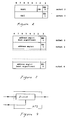
- Figure 2 illustrates the structure of the address frame as recommended by the CCITT for communication along the ISDN-network.
- Figure 3 illustrates the structure of the address frame for in-house communication as proposed by the invention.
- Figure 4 illustrates schematically a network terminator NT2 including a discriminator circuit.
- Figure 1A shows the simplest form of an S-bus suitable to be used as an in-house network.
- the bus consists of a cable comprising connectors through which various terminals can be connected to the cable at various locations.
- the cable S runs between a number of terminals TE and a network terminator NT1.
- the network terminator NT1 is of the first type and therefore only terminals of the type TE1 can be connected to the S-bus. As will be explained hereinafter this configuration is not suitable to bring the inventive ideas into practice.
- FIG. 1b Another in-house network is illustrated in figure 1b.
- the network comprises a number of terminals TE which are connected to an in-house exchange PABX which functions as a network terminator NT2.
- the local exchange PABX is connected to a further network terminator of type one NT1. Because all the terminals are connected to an NT2 it is possible to connect both ISDN-terminals such as telephone handsets, telex apparatuses and facsimile equipment to the local exchange as well as to connect none ISDN-terminals such as simple switches, sensors, actuators etc.
- This type of configuration is suitable to implement the invention as will be explained hereinafter.
- Figure 1c shows a more general view on the type of network in which the invention can be applied.
- the network comprises a number of terminators TE which are connected through a cable network S to a type two network terminator NT2.
- This network terminator NT2 might be connected to a type one network terminator NT1, which may be connected further to a local ISDN-exchange.
- the shown address field format contains the address field extension bits EA, a command/response indication bit C/R, a datalink layer surface access point identifier SAPI-subfield and a terminal end point identifier TEI-subfield.
- the address field range is extended by reserving the first transmitted bit of the address field octet to indicate the final octet of the address field. The presence of a 1 in the first bit of an address field octet signals that it is the final octet of the address field.
- the double octet address field for LAPD-operation shall have bit 1 of the first octet set to 0 and bit one of the second octet set to 1.
- all address field extension bits EA of an complete address frame are equal to zero except the address field extension bit of the last octet which is equal to 1.
- the terminals which are connected in figure 1c to the bus system S could be of the first category which transmits messages through NT2 and through NT1 to the ISDN-network L.
- Terminals of this first category are for instance telephone handsets, telex apparatuses and facsimile equipment.
- Other terminals which can be use purely within the in-house network are for instance senses and actuators which function in a burglary alarm system, in a fire or smoke alarm system, in a nurse alerting system in hospitals, etc. All these terminals only send messages upstream to the network terminator NT2 and a receive message downstream from this network terminator NT2.
- the network terminator NT2 should have the capability to discriminate between the messages received from terminals of the first category which have to be transferred to the further network terminator NT1 and messages received from the terminals of the second category which have to be returned and transmitted downstream on the bus system S.
- this discrimination mechanism is based on the use of inverted address field extension bits for terminals of a second category, i.e. terminals which are exclusively used for in-house network purposes.
- the address field structure which is according to the invention proposed for this type of terminals is illustrated in figure 3.
- all address field extension bits EA have the value 1 with the exception of the address field extension bit corresponding to the lowest significant address septet (octet 4 in figure 3) which has the value 0.
- the single octet address field is reserved for LAPB-operations in order to allow a single LAPB-datalink connection to be multiplexed along with LAPB-datalink connections.
- the support of LAPB is optional, both from user standpoint as well as from network standpoint.
- the application of the invention is excluded for an S-bus structure in a mixed system for LAPB-operations. Therefore, the method according to the invention is not conceivable with the minimum configuration illustrated in figure 1a.
- Figure 4 illustrates very schematically a network terminator NT2 which in agreement with the invention comprises a discriminator circuit for discriminating in-house address fields (illustrated in figure 3) and "normal" ISDN-address field (illustrated in figure 2). Messages received from in-house terminals are returned back to the downstream side of the S-bus structure whereas messages received from regular ISDN-terminals are transferred in a normal way.
Landscapes
- Engineering & Computer Science (AREA)
- Computer Networks & Wireless Communication (AREA)
- Data Exchanges In Wide-Area Networks (AREA)
Priority Applications (1)
| Application Number | Priority Date | Filing Date | Title |
|---|---|---|---|
| EP92202514A EP0583511A1 (fr) | 1992-08-17 | 1992-08-17 | Méthode de communication domestique de messages sur un bus S d'un réseau RNIS |
Applications Claiming Priority (1)
| Application Number | Priority Date | Filing Date | Title |
|---|---|---|---|
| EP92202514A EP0583511A1 (fr) | 1992-08-17 | 1992-08-17 | Méthode de communication domestique de messages sur un bus S d'un réseau RNIS |
Publications (1)
| Publication Number | Publication Date |
|---|---|
| EP0583511A1 true EP0583511A1 (fr) | 1994-02-23 |
Family
ID=8210857
Family Applications (1)
| Application Number | Title | Priority Date | Filing Date |
|---|---|---|---|
| EP92202514A Withdrawn EP0583511A1 (fr) | 1992-08-17 | 1992-08-17 | Méthode de communication domestique de messages sur un bus S d'un réseau RNIS |
Country Status (1)
| Country | Link |
|---|---|
| EP (1) | EP0583511A1 (fr) |
Cited By (2)
| Publication number | Priority date | Publication date | Assignee | Title |
|---|---|---|---|---|
| FR2738092A1 (fr) * | 1995-08-21 | 1997-02-28 | Teles Telematic Services Gmbh | Procede de transmission d'informations entre des appareils terminaux d'un raccordement de telecommunications rnis et raccordement correspondant |
| WO2000041384A3 (fr) * | 1999-01-04 | 2000-11-30 | Conexant Systems Inc | Systeme et procede pour detecter l'etat d'occupation d'une ligne telephonique, le raccordement d'un poste et le raccrochage a distance dans un modem |
Citations (2)
| Publication number | Priority date | Publication date | Assignee | Title |
|---|---|---|---|---|
| US4722082A (en) * | 1985-03-04 | 1988-01-26 | Kokusai Denshin Denwa Co., Ltd. | ISDN subscriber terminal control system |
| US4891813A (en) * | 1988-01-29 | 1990-01-02 | Racal Data Communications Inc. | Passive bus communication using alternate CRC |
-
1992
- 1992-08-17 EP EP92202514A patent/EP0583511A1/fr not_active Withdrawn
Patent Citations (2)
| Publication number | Priority date | Publication date | Assignee | Title |
|---|---|---|---|---|
| US4722082A (en) * | 1985-03-04 | 1988-01-26 | Kokusai Denshin Denwa Co., Ltd. | ISDN subscriber terminal control system |
| US4891813A (en) * | 1988-01-29 | 1990-01-02 | Racal Data Communications Inc. | Passive bus communication using alternate CRC |
Non-Patent Citations (3)
| Title |
|---|
| ISSLS'86 29 September 1986, TOKYO JP pages 150 - 155 M.FUJIOKA ET AL. * |
| NTT REVIEW vol. 1, no. 2, July 1989, TOKYO JP pages 46 - 52 H.ISHIKAWA * |
| PATENT ABSTRACTS OF JAPAN vol. 014, no. 316 (E-0949)6 July 1990 & JP-A-02 104 146 ( FUJITSU ) * |
Cited By (2)
| Publication number | Priority date | Publication date | Assignee | Title |
|---|---|---|---|---|
| FR2738092A1 (fr) * | 1995-08-21 | 1997-02-28 | Teles Telematic Services Gmbh | Procede de transmission d'informations entre des appareils terminaux d'un raccordement de telecommunications rnis et raccordement correspondant |
| WO2000041384A3 (fr) * | 1999-01-04 | 2000-11-30 | Conexant Systems Inc | Systeme et procede pour detecter l'etat d'occupation d'une ligne telephonique, le raccordement d'un poste et le raccrochage a distance dans un modem |
Similar Documents
| Publication | Publication Date | Title |
|---|---|---|
| US5784371A (en) | ATM electronic exchange network system and electrode exchange equipment for use in the same | |
| US4757526A (en) | Signal transfer arrangement | |
| US5453984A (en) | Communication system for multi-service communication terminal equipment in local networks | |
| US5347516A (en) | System for access from LAN to ISDN with means for changing between use of packet switch and line switch without interruption of data transmission | |
| EP0161031A1 (fr) | Système de télécommunication, en particulier système téléphonique | |
| EP0331190A2 (fr) | Méthode de gestion des paramètres d'adresse pour l'interconnexion de réseaux locaux et de réseaux RNIS | |
| JPS6230447A (ja) | Isdn端末間内線通信方式 | |
| EP0247675A1 (fr) | Transmetteur pour S-bus interface dans un système de télécommunication RNIS | |
| EP0515703A1 (fr) | Système de conférence à large bande | |
| US5341418A (en) | ISDN terminal adapter for access from analog signal equipment of four-wire full duplex type to ISDN | |
| EP0475749B1 (fr) | Terminal RNIS avec fonction de diagnostic | |
| EP0583511A1 (fr) | Méthode de communication domestique de messages sur un bus S d'un réseau RNIS | |
| JP2631801B2 (ja) | アナログ回線用非同期転送モード加入者回路 | |
| EP1093278A2 (fr) | Un réseau d'accès basé sur le Protocol Internet | |
| JP2551061B2 (ja) | Isdnの加入者線切替え方式 | |
| JP3081012B2 (ja) | サービス総合ディジタル通信網の加入者領域における装置 | |
| JPH08125765A (ja) | Isdnによる文字伝達方式及び遠隔会議システム | |
| JP3310339B2 (ja) | Isdn端末装置 | |
| KR0176409B1 (ko) | 전전자 교환기의 시험 및 유지보수 장치 | |
| Lin | A multi-function ISDN home communication system | |
| JP2569638B2 (ja) | ローカルプロトコルを付加したトランスポートプロトコル | |
| JPH0641412Y2 (ja) | Isdn電話系ユーザ端末装置 | |
| JP2933167B2 (ja) | 通信システム | |
| Welch | Signalling systems | |
| JPH08256152A (ja) | Atmユーザ構内網の呼処理制御方法 |
Legal Events
| Date | Code | Title | Description |
|---|---|---|---|
| PUAI | Public reference made under article 153(3) epc to a published international application that has entered the european phase |
Free format text: ORIGINAL CODE: 0009012 |
|
| AK | Designated contracting states |
Kind code of ref document: A1 Designated state(s): AT BE CH DE DK ES FR GB GR IE IT LI LU MC NL PT SE |
|
| RBV | Designated contracting states (corrected) |
Designated state(s): AT BE CH DE DK ES FR GB GR IT LI NL PT SE |
|
| 17P | Request for examination filed |
Effective date: 19940819 |
|
| 17Q | First examination report despatched |
Effective date: 19970509 |
|
| 18D | Application deemed to be withdrawn |
Effective date: 19970920 |