EP0583648A2 - Procédé de raffinage en continu avec des effluents réduits - Google Patents
Procédé de raffinage en continu avec des effluents réduits Download PDFInfo
- Publication number
- EP0583648A2 EP0583648A2 EP93111816A EP93111816A EP0583648A2 EP 0583648 A2 EP0583648 A2 EP 0583648A2 EP 93111816 A EP93111816 A EP 93111816A EP 93111816 A EP93111816 A EP 93111816A EP 0583648 A2 EP0583648 A2 EP 0583648A2
- Authority
- EP
- European Patent Office
- Prior art keywords
- oil
- alkali
- process according
- treatment
- effluent
- Prior art date
- Legal status (The legal status is an assumption and is not a legal conclusion. Google has not performed a legal analysis and makes no representation as to the accuracy of the status listed.)
- Withdrawn
Links
- 238000000034 method Methods 0.000 title claims abstract description 41
- 238000007670 refining Methods 0.000 title claims abstract description 19
- 239000002699 waste material Substances 0.000 title abstract description 3
- 239000003513 alkali Substances 0.000 claims abstract description 62
- XLYOFNOQVPJJNP-UHFFFAOYSA-N water Substances O XLYOFNOQVPJJNP-UHFFFAOYSA-N 0.000 claims abstract description 42
- 238000005406 washing Methods 0.000 claims abstract description 29
- 238000011282 treatment Methods 0.000 claims abstract description 27
- 125000005456 glyceride group Chemical group 0.000 claims abstract description 18
- 238000000926 separation method Methods 0.000 claims abstract description 17
- 239000000344 soap Substances 0.000 claims description 14
- 235000021588 free fatty acids Nutrition 0.000 claims description 11
- 239000002253 acid Substances 0.000 claims description 9
- 239000012535 impurity Substances 0.000 claims description 8
- UFTFJSFQGQCHQW-UHFFFAOYSA-N triformin Chemical compound O=COCC(OC=O)COC=O UFTFJSFQGQCHQW-UHFFFAOYSA-N 0.000 claims description 8
- 238000010306 acid treatment Methods 0.000 claims description 4
- 230000015572 biosynthetic process Effects 0.000 claims description 3
- 239000003921 oil Substances 0.000 abstract description 87
- 235000019198 oils Nutrition 0.000 description 83
- HEMHJVSKTPXQMS-UHFFFAOYSA-M Sodium hydroxide Chemical compound [OH-].[Na+] HEMHJVSKTPXQMS-UHFFFAOYSA-M 0.000 description 33
- 239000012071 phase Substances 0.000 description 21
- 235000011121 sodium hydroxide Nutrition 0.000 description 15
- OAICVXFJPJFONN-UHFFFAOYSA-N Phosphorus Chemical compound [P] OAICVXFJPJFONN-UHFFFAOYSA-N 0.000 description 10
- 229910052698 phosphorus Inorganic materials 0.000 description 10
- 239000011574 phosphorus Substances 0.000 description 10
- XEEYBQQBJWHFJM-UHFFFAOYSA-N Iron Chemical compound [Fe] XEEYBQQBJWHFJM-UHFFFAOYSA-N 0.000 description 7
- 238000006386 neutralization reaction Methods 0.000 description 7
- NBIIXXVUZAFLBC-UHFFFAOYSA-N Phosphoric acid Chemical compound OP(O)(O)=O NBIIXXVUZAFLBC-UHFFFAOYSA-N 0.000 description 4
- 235000019484 Rapeseed oil Nutrition 0.000 description 4
- 238000009874 alkali refining Methods 0.000 description 4
- 230000007935 neutral effect Effects 0.000 description 4
- 150000003904 phospholipids Chemical class 0.000 description 4
- 239000008346 aqueous phase Substances 0.000 description 3
- 229910052742 iron Inorganic materials 0.000 description 3
- 238000002156 mixing Methods 0.000 description 3
- 238000007127 saponification reaction Methods 0.000 description 3
- 239000003549 soybean oil Substances 0.000 description 3
- 235000012424 soybean oil Nutrition 0.000 description 3
- 239000002351 wastewater Substances 0.000 description 3
- 241000196324 Embryophyta Species 0.000 description 2
- 238000005054 agglomeration Methods 0.000 description 2
- 230000002776 aggregation Effects 0.000 description 2
- 229910000147 aluminium phosphate Inorganic materials 0.000 description 2
- 239000010775 animal oil Substances 0.000 description 2
- QVGXLLKOCUKJST-UHFFFAOYSA-N atomic oxygen Chemical compound [O] QVGXLLKOCUKJST-UHFFFAOYSA-N 0.000 description 2
- 238000004061 bleaching Methods 0.000 description 2
- 238000004332 deodorization Methods 0.000 description 2
- 238000011065 in-situ storage Methods 0.000 description 2
- 239000002184 metal Substances 0.000 description 2
- 229910052751 metal Inorganic materials 0.000 description 2
- 239000000203 mixture Substances 0.000 description 2
- 231100000252 nontoxic Toxicity 0.000 description 2
- 230000003000 nontoxic effect Effects 0.000 description 2
- 229910052760 oxygen Inorganic materials 0.000 description 2
- 239000001301 oxygen Substances 0.000 description 2
- 239000002245 particle Substances 0.000 description 2
- 239000008158 vegetable oil Substances 0.000 description 2
- 235000013311 vegetables Nutrition 0.000 description 2
- 239000001993 wax Substances 0.000 description 2
- RYGMFSIKBFXOCR-UHFFFAOYSA-N Copper Chemical compound [Cu] RYGMFSIKBFXOCR-UHFFFAOYSA-N 0.000 description 1
- NIPNSKYNPDTRPC-UHFFFAOYSA-N N-[2-oxo-2-(2,4,6,7-tetrahydrotriazolo[4,5-c]pyridin-5-yl)ethyl]-2-[[3-(trifluoromethoxy)phenyl]methylamino]pyrimidine-5-carboxamide Chemical compound O=C(CNC(=O)C=1C=NC(=NC=1)NCC1=CC(=CC=C1)OC(F)(F)F)N1CC2=C(CC1)NN=N2 NIPNSKYNPDTRPC-UHFFFAOYSA-N 0.000 description 1
- 235000019482 Palm oil Nutrition 0.000 description 1
- 235000019486 Sunflower oil Nutrition 0.000 description 1
- 230000002411 adverse Effects 0.000 description 1
- 239000011260 aqueous acid Substances 0.000 description 1
- 239000002585 base Substances 0.000 description 1
- 239000003729 cation exchange resin Substances 0.000 description 1
- 229940023913 cation exchange resins Drugs 0.000 description 1
- 238000005119 centrifugation Methods 0.000 description 1
- 238000006243 chemical reaction Methods 0.000 description 1
- 239000003795 chemical substances by application Substances 0.000 description 1
- 238000004040 coloring Methods 0.000 description 1
- 239000012141 concentrate Substances 0.000 description 1
- 238000001816 cooling Methods 0.000 description 1
- 229910052802 copper Inorganic materials 0.000 description 1
- 239000010949 copper Substances 0.000 description 1
- 235000012343 cottonseed oil Nutrition 0.000 description 1
- 239000002385 cottonseed oil Substances 0.000 description 1
- 238000010908 decantation Methods 0.000 description 1
- 238000009882 destearinating Methods 0.000 description 1
- 239000006185 dispersion Substances 0.000 description 1
- 238000004821 distillation Methods 0.000 description 1
- 235000013399 edible fruits Nutrition 0.000 description 1
- 239000008157 edible vegetable oil Substances 0.000 description 1
- 238000011156 evaluation Methods 0.000 description 1
- 230000005484 gravity Effects 0.000 description 1
- 238000010438 heat treatment Methods 0.000 description 1
- 230000036571 hydration Effects 0.000 description 1
- 238000006703 hydration reaction Methods 0.000 description 1
- 238000005984 hydrogenation reaction Methods 0.000 description 1
- 229910052500 inorganic mineral Inorganic materials 0.000 description 1
- 238000009533 lab test Methods 0.000 description 1
- 150000002739 metals Chemical class 0.000 description 1
- 235000010755 mineral Nutrition 0.000 description 1
- 239000011707 mineral Substances 0.000 description 1
- 239000004533 oil dispersion Substances 0.000 description 1
- 235000014593 oils and fats Nutrition 0.000 description 1
- 239000005416 organic matter Substances 0.000 description 1
- 239000002540 palm oil Substances 0.000 description 1
- -1 phosphatides Chemical class 0.000 description 1
- 238000001637 plasma atomic emission spectroscopy Methods 0.000 description 1
- 230000003134 recirculating effect Effects 0.000 description 1
- 150000003839 salts Chemical class 0.000 description 1
- 238000004062 sedimentation Methods 0.000 description 1
- 239000002600 sunflower oil Substances 0.000 description 1
- 235000020238 sunflower seed Nutrition 0.000 description 1
- 150000003626 triacylglycerols Chemical class 0.000 description 1
- 235000015112 vegetable and seed oil Nutrition 0.000 description 1
Images
Classifications
-
- C—CHEMISTRY; METALLURGY
- C11—ANIMAL OR VEGETABLE OILS, FATS, FATTY SUBSTANCES OR WAXES; FATTY ACIDS THEREFROM; DETERGENTS; CANDLES
- C11B—PRODUCING, e.g. BY PRESSING RAW MATERIALS OR BY EXTRACTION FROM WASTE MATERIALS, REFINING OR PRESERVING FATS, FATTY SUBSTANCES, e.g. LANOLIN, FATTY OILS OR WAXES; ESSENTIAL OILS; PERFUMES
- C11B3/00—Refining fats or fatty oils
- C11B3/02—Refining fats or fatty oils by chemical reaction
- C11B3/06—Refining fats or fatty oils by chemical reaction with bases
Definitions
- the present invention relates to a process for refining glyceride oils which process results in refined oils and waste streams, the disposal of which latter does not entail high processing costs and investments.
- the process according to the present invention is a process for refining glyceride oil comprising addition of alkali, a separation step and a water washing treatment, in which said alkali is concentrated and at least part of the aqueous water washing effluent is recycled to control the alkali strength.
- glycolide oils' as used herein is intended to encompass both vegetable and animal oils.
- the term is primarily intended to describe the so-called edible oils, i.e. oils derived from fruits or seeds of plants and used chiefly in foodstuffs, but it is understood that oils of which the end use is non-edible are to be included as well.
- Crude glyceride oils of in particular vegetable origin such as soybean oil, rapeseed oil, sunflower oil, cottonseed oil and the like contain a significant amount of non-triglyceride compounds including phosphatides, free fatty acids, odours, colouring matter, waxes and metals. Many of these impurities adversely affect taste, smell, appearance and keepability of the oil. It is therefore necessary to refine, i.e. to remove the gums and other impurities from the crude glyceride oils as much as possible.
- the first step in the refining of glyceride oil is the so-called degumming step, i.e. the removal of phosphatides (gums).
- degumming step i.e. the removal of phosphatides (gums).
- water is added to the crude glyceride oil to hydrate the phosphatides, which are subsequently removed by centrifugation.
- the resulting water-degummed oil often still contain unacceptably high levels of 'non-hydratable' phosphatides and in general residual phosphorus levels are achieved in the order of 100-250 ppm.
- This water-degummed oil is then normally treated with acid (GB 2,038,863), optionally followed by cooling and holding (DE 26 09 705) or a treatment with alkali (EP 0 195 991), to remove the residual phospholipids and associated trace-metals such as iron and copper.
- Subsequent refining includes either neutralisation of free fatty acids and separation of the soapstock thus formed (alkali refining), or physical refining, i.e. removal of free fatty acids by distillation.
- alkali refining neutralisation of free fatty acids and separation of the soapstock thus formed
- physical refining i.e. removal of free fatty acids by distillation.
- the resulting oil is then further refined by bleaching and deodorization.
- alkali refining Apart from the saponification of neutral oil through contact with the alkali solution and the entrainment of neutral oil upon separation of the soapstock and the subsequent washing stages, alkali refining further has the disadvantage over physical refining to yield vast effluent streams of high biological oxygen demand.
- disposal of wastewater from the conventional washing of alkali refined glyceride oil presents a problem to refiners because of increasingly stringent law.
- An efficient removal of remaining impurities by water washing is however essential for the oil quality and for subsequent bleaching, hydrogenation, winterizing, deodorization, etc. to be successful, and cannot simply be ommitted.
- the washing water is used more efficiently if the alkali refined oil is washed counter currently as suggested by G. Haraldsson in 'Degumming, Dewaxing and Refining', J.A.O.C.S., Vol. 60, Febr. 1983, Pages 205A.
- Counter current water washing results in a reduction of the wash water consumption by almost fifty percent but its impurity content and, as a result, its biological oxygen demand is increased in accordance.
- the present invention relates to a process for refining glyceride oil comprising addition of alkali, a separation step and a water washing treatment, in which said alkali is concentrated and at least part of the aqueous water washing effluent is recycled to control the alkali strength.
- lye strength is also a factor to be taken into account because this determines its density and thereby affects the separation characteristics during the centrifugal treatment or gravity settlement.
- amount of water and amount of lye are chosen within specific ranges determined as indicated above to arrive at a lye strength that allows separation and if this strength happens to be on the low side, salt is added to facilitate separation.
- Caustic soda is usually received in a concentrated form and diluted with water to the desired concentration prior to mixing it, in a determined amount, into the glyceride oil.
- the soapstock thus formed is removed from the neutralized oil by centrifugal separation or sedimentation and the neutral oil is, in a subsequent step, washed at least once to remove residual soaps and/or phospholipids.
- the diluted soapstock removed from the neutralized oil and the effluent water resulting from the water washing treatments are usually combined and treated with mineral acid to recover and concentrate the fatty matter on the one hand and to discart the aqueous effluent on the other.
- a degumming process comprises dispersing a non-toxic aqueous acid into the oil, mixing a base into the acid-in-oil dispersion in such a quantity that the pH of the aqueous phase is increased to above 2.5 but no substantial amount of soap is produced, separating the dispersion into an aqueous phase containing the gums and an oil phase comprising free fatty acids and finally washing the degummed oil.
- European patent application EP 0 348 004 discloses a refining process in which the degumming step is followed by a separation step in which undissolved particles are removed from the degummed glyceride oil upon holding the oil for a period of time and under temperature conditions as to cause agglomeration of said particles in the presence of an agent which promotes the agglomeration and which, according to the description, may be lye or caustic soda. Because this process necessitates subsequent washing stages to be operated, the present invention may also successfully be applied.
- the effluent water resulting from the subsequent water washing treatments is preferably added into the oil stream prior to the alkali treatment to dilute the concentrated alkali immediately upon its addition into the oil stream. Extented contact of the oil with concentrated alkali would lead to undue saponification of the neutral oil and result in a rather considerable refining loss. If on the other hand the effluent water is added to the oil subsequent to the addition of the concentrated alkali, the temperature of the alkali-oil mixture is preferably kept as low as possible, and most preferably below 40°C. Upon addition of the effluent water and the alkali, the oil stream is preferably mixed intimately.
- the concentration of the alkali added upon the alkali treatment is not that critical, although the higher is the alkali concentration and the more effluent water may be added to the oil stream to dilute the alkali, the higher the net savings will be.
- alkali concentrations ranging from 30 to 50° Baumé are suitable and advantageous.
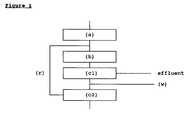
- a particular embodiment of the present invention is schematically represented in figure 1. It is an alkali neutralisation process which comprises an acid treatment (a) in which an acid is dispersed into the oil, an alkali treatment (b) in which a concentrated alkali is dispersed into the acidified glyceride oil to neutralize the dispersed acid as well as free fatty acids present in said acidified oil, a first centrifugal separation (c1) to yield an effluent phase comprising both phosphatides and soaps and having a low triglyceride oil content and an oil phase with reduced phosphorus and soap content, into which latter an amount of water is mixed (w) prior to being fed to a second centrifugal separator and a second centrifugal separation (c2) to yield an oil phase with minimum residual phosphorus and soap content and an aqueous heavy phase comprising a significant amount of triglyceride oil which is recycled (r) into the acidified oil at a stage prior or subsequent to the alkali treatment (b).
- This embodiment differs from our co-pending patent application EP 92200665.5 in that the aqueous heavy phase is recirculated into the oil stream right prior or subsequent to the alkali treatment, in that the alkali is concentrated and in that its strength is controlled in situ by the aqueous heavy phase.
- An additional advantage of this embodiment is that better use is made of the alkali, compared to traditional neutralisation processes.
- the alkali addition upon alkali treatment (b) may be reduced shortly after start-up of the process line, because the wet heavy phase which is recycled (r) from the second centrifuge (c2) into the acidified oil has a pH of above 7, and, as a result, adds to the neutralisation of the dispersed acid and free fatty acids present in the acidified oil.
- Another particularly useful embodiment of the present invention is a degumming process which comprises an acid treatment (a) in which an acid is dispersed into the oil, an alkali treatment (b) in which a concentrated alkali is dispersed into the acidified glyceride oil to raise the pH to above 2.5 without substantial formation of soaps, a first centrifugal separation (c1) to yield a gum phase with low triglyceride oil content and an oil phase with reduced phosphorus content into which oil phase an amount of water is mixed (w) prior to being fed to a second centrifugal separator and a second centrifugal separation (c2) to yield an oil phase with minimum residual phosphorus content and a wet gum phase which is recycled (r) into the acidified oil at the stage prior or subsequent to the alkali treatment (b).
- This embodiment differs from our co-pending patent application EP 92200543.4 in that the wet gum phase is recirculated into the oil stream right prior or subsequent to the alkali treatment, in that the alkali is concentrated and in that its strength is controlled in situ by the aqueous heavy phase.
- the type of oil to be treated by the process according to the present embodiment of the invention is not critical.
- crude or water-degummed edible triglyceride oils like soybean oil, sunflowerseed oil, rapeseed oil, palm oil and other vegetable oils as well as animal oils and fats can all be successivefully processed.
- the present invention is now illustrated by the following example wherein phosphorus and iron content of the oil are determined by plasma emission spectroscopy (A.J. Dijkstra and D. Meert, J.A.O.C.S. 59 (1982), 199), the soap content of the oil is determined by A.O.C.S. method Cc 17-79 and the free fatty acid content is determined by A.O.C.S. method Ca 5a-40.
- Partially water degummed rapeseed oil having a phosphorus content of 179 ppm, and iron content of 2.1 ppm and a free fatty acid content of 0.83 %, was alkali neutralized in accordance with the present invention.
- rapeseed oil at a throughput of 9 tons per hour and at a temperature ranging from 100 to 110°C, were finely dispersed 15 liters of phosphoric acid 80% strength and 20 liters of water per hour, whereupon the phosphoric acid - glyceride oil mixture was neutralized with 256 liters of lye 20°Bé per hour.
- the oil stream was then fed to a first centrifugal separator (R.S.A., Westfalia Separators A.G., ⁇ lde, Germany) operating at conditions as to yield an effluent phase comprising both phospholipids and soaps and having a low triglyceride oil content and an oil phase with reduced phosphorus and soap content.
- the oil phase resulting from the first centrifugal separator was then fed to a second centrifugal separator (C.S.A., Westfalia Separators A.G.
Landscapes
- Chemical & Material Sciences (AREA)
- Chemical Kinetics & Catalysis (AREA)
- Life Sciences & Earth Sciences (AREA)
- General Chemical & Material Sciences (AREA)
- Microbiology (AREA)
- Engineering & Computer Science (AREA)
- Oil, Petroleum & Natural Gas (AREA)
- Wood Science & Technology (AREA)
- Organic Chemistry (AREA)
- Fats And Perfumes (AREA)
Priority Applications (1)
| Application Number | Priority Date | Filing Date | Title |
|---|---|---|---|
| EP93111816A EP0583648A3 (fr) | 1992-08-19 | 1993-07-23 | Procédé de raffinage en continu avec des effluents réduits. |
Applications Claiming Priority (3)
| Application Number | Priority Date | Filing Date | Title |
|---|---|---|---|
| EP92114126 | 1992-08-19 | ||
| EP92114126 | 1992-08-19 | ||
| EP93111816A EP0583648A3 (fr) | 1992-08-19 | 1993-07-23 | Procédé de raffinage en continu avec des effluents réduits. |
Publications (2)
| Publication Number | Publication Date |
|---|---|
| EP0583648A2 true EP0583648A2 (fr) | 1994-02-23 |
| EP0583648A3 EP0583648A3 (fr) | 1995-02-01 |
Family
ID=26131046
Family Applications (1)
| Application Number | Title | Priority Date | Filing Date |
|---|---|---|---|
| EP93111816A Withdrawn EP0583648A3 (fr) | 1992-08-19 | 1993-07-23 | Procédé de raffinage en continu avec des effluents réduits. |
Country Status (1)
| Country | Link |
|---|---|
| EP (1) | EP0583648A3 (fr) |
Cited By (2)
| Publication number | Priority date | Publication date | Assignee | Title |
|---|---|---|---|---|
| GB2458709A (en) * | 2008-05-19 | 2009-09-30 | Smet Ballestra Engineering S A | Centrifugal separation process for refining triglyceride oils |
| WO2014158799A1 (fr) * | 2013-03-14 | 2014-10-02 | Dynamic Fuels Llc | Procédé d'élimination d'un contaminant d'une composition biologique contenant un contaminant utile comme matière première de biocarburant |
Citations (6)
| Publication number | Priority date | Publication date | Assignee | Title |
|---|---|---|---|---|
| DE2609705A1 (de) | 1975-03-10 | 1976-09-23 | Unilever Nv | Verfahren zum entschleimen von triglyceridoelen |
| GB2038863A (en) | 1978-12-19 | 1980-07-30 | Canada Packers Ltd | Continous process for contacting of triglyceride oils with an acid |
| EP0195991A2 (fr) | 1985-03-18 | 1986-10-01 | N.V. Vandemoortele International | Procédé de fabrication d'huiles végétales démucilaginées et gommes à haute teneur en acide phosphatidique |
| EP0348004A2 (fr) | 1988-06-21 | 1989-12-27 | Unilever N.V. | Procédé pour raffiner les huiles glycéridiques |
| EP0349718A2 (fr) | 1988-07-06 | 1990-01-10 | N.V. Vandemoortele International | Procédé de séparation en continu d'une phase gomme de l'huile triglycéride |
| EP0473985A2 (fr) | 1990-08-23 | 1992-03-11 | Krupp Maschinentechnik Gesellschaft Mit Beschränkter Haftung | Procédé de démucilagination |
Family Cites Families (3)
| Publication number | Priority date | Publication date | Assignee | Title |
|---|---|---|---|---|
| FR1108998A (fr) * | 1954-07-10 | 1956-01-19 | Separation Sa Franc Pour La | Perfectionnements au traitement des huiles végétales |
| SU1717621A1 (ru) * | 1990-01-30 | 1992-03-07 | Ташкентский Политехнический Институт Им.А.Р.Бируни | Способ рафинации серосодержащих растительных масел в мисцелле |
| ATE89599T1 (de) * | 1991-04-02 | 1993-06-15 | Vandemoortele Int Nv | Verfahren zur kontinuierlichen entschleimung eines glyceridoeles. |
-
1993
- 1993-07-23 EP EP93111816A patent/EP0583648A3/fr not_active Withdrawn
Patent Citations (6)
| Publication number | Priority date | Publication date | Assignee | Title |
|---|---|---|---|---|
| DE2609705A1 (de) | 1975-03-10 | 1976-09-23 | Unilever Nv | Verfahren zum entschleimen von triglyceridoelen |
| GB2038863A (en) | 1978-12-19 | 1980-07-30 | Canada Packers Ltd | Continous process for contacting of triglyceride oils with an acid |
| EP0195991A2 (fr) | 1985-03-18 | 1986-10-01 | N.V. Vandemoortele International | Procédé de fabrication d'huiles végétales démucilaginées et gommes à haute teneur en acide phosphatidique |
| EP0348004A2 (fr) | 1988-06-21 | 1989-12-27 | Unilever N.V. | Procédé pour raffiner les huiles glycéridiques |
| EP0349718A2 (fr) | 1988-07-06 | 1990-01-10 | N.V. Vandemoortele International | Procédé de séparation en continu d'une phase gomme de l'huile triglycéride |
| EP0473985A2 (fr) | 1990-08-23 | 1992-03-11 | Krupp Maschinentechnik Gesellschaft Mit Beschränkter Haftung | Procédé de démucilagination |
Non-Patent Citations (3)
| Title |
|---|
| A.J. DIJKSTRA; D. MEERT, J.A.O.C.S., vol. 59, 1982, pages 199 |
| G. HARALDSSON: "Degumming, Dewaxing and Refining", J.A.O.C.S., vol. 60, February 1983 (1983-02-01), pages 205A |
| R.E. BEAL; L.T. BLACK; E.L GRIFFIN; J.C. MENG: "Water-Recycle Washing of Refined Soybean Oil: Plant Scale Evaluation", J.A.O.C.S., vol. 50, July 1973 (1973-07-01), pages 260 - 263 |
Cited By (8)
| Publication number | Priority date | Publication date | Assignee | Title |
|---|---|---|---|---|
| GB2458709A (en) * | 2008-05-19 | 2009-09-30 | Smet Ballestra Engineering S A | Centrifugal separation process for refining triglyceride oils |
| WO2014158799A1 (fr) * | 2013-03-14 | 2014-10-02 | Dynamic Fuels Llc | Procédé d'élimination d'un contaminant d'une composition biologique contenant un contaminant utile comme matière première de biocarburant |
| KR20160018461A (ko) * | 2013-03-14 | 2016-02-17 | 레그 신써틱 퓨얼즈, 엘엘씨 | 바이오연료 공급원료로서 유용한 오염물-함유 생물학적 조성물에서 오염물 제거하는 방법 |
| CN105358666A (zh) * | 2013-03-14 | 2016-02-24 | Reg合成燃料有限责任公司 | 从用作生物燃料原料的含污染物的生物组合物中去除污染物的方法 |
| US9404064B2 (en) | 2013-03-14 | 2016-08-02 | Reg Synthetic Fuels, Llc | Method of removing a contaminant from a contaminant-containing biological composition useful as a biofuel feedstock |
| US9783763B2 (en) | 2013-03-14 | 2017-10-10 | Reg Synthetic Fuels, Llc | Method of removing a contaminant from a contaminant-containing biological composition useful as a biofuel feedstock |
| CN105358666B (zh) * | 2013-03-14 | 2019-07-16 | Reg合成燃料有限责任公司 | 从用作生物燃料原料的含污染物的生物组合物中去除污染物的方法 |
| KR102242873B1 (ko) | 2013-03-14 | 2021-04-20 | 레그 신써틱 퓨얼즈, 엘엘씨 | 바이오연료 공급원료로서 유용한 오염물-함유 생물학적 조성물에서 오염물 제거하는 방법 |
Also Published As
| Publication number | Publication date |
|---|---|
| EP0583648A3 (fr) | 1995-02-01 |
Similar Documents
| Publication | Publication Date | Title |
|---|---|---|
| DE2948367C2 (fr) | ||
| DE3751599T2 (de) | Extraktionsverfahren von pfanzenöl. | |
| US5239096A (en) | Degumming process for plant oils | |
| Wiedermann | Degumming, refining and bleaching soybean oil | |
| DE69408891T2 (de) | Verfahren zum Raffinieren von Öl und Fett | |
| EP0269277B1 (fr) | Procédé de démucilagination d'huiles triglycéridiques | |
| US6426423B1 (en) | Methods for treating phosphatide-containing mixtures | |
| DK153228B (da) | Fremgangsmaade til afgummiering af triglyceridolier | |
| EP0737238B1 (fr) | Procede d'elimination d'impuretes ayant la couleur de la chlorophylle presentes dans des huiles vegetales | |
| EP0478090B1 (fr) | Procédé pour raffiner de l'huile glycéridiques | |
| EP0507363B1 (fr) | Procédé pour l'élimination continue des gommes d'une huile glycéridique | |
| KR890001463B1 (ko) | 유(油)의 정제방법 | |
| US4609500A (en) | Refining of oil and product thereof | |
| EP0116408A2 (fr) | Purification d'huiles triglycerides en présence de borohydrures de métaux alcalins | |
| US5414100A (en) | Deacidification of vegetable oils | |
| EP0560121A2 (fr) | Procédé pour raffiner de l'huile glycéridique | |
| EP0583648A2 (fr) | Procédé de raffinage en continu avec des effluents réduits | |
| JPS6243476B2 (fr) | ||
| DE68907274T2 (de) | Verfahren zur kontinuierlichen Entfernung der Gumphase aus Triglyceride-Öl. | |
| CA1157883A (fr) | Demucilagination des huiles vegetales brutes par procede chimique | |
| CA2020307A1 (fr) | Procede de separation thermique de pate de neutralisation | |
| JP4064548B2 (ja) | 米ぬか油の製造方法 | |
| JPH07197076A (ja) | 食用植物原油の精製法 | |
| Dijkstra et al. | Several degumming processes for vegetable oils | |
| JPH07197075A (ja) | 食用植物原油の精製法 |
Legal Events
| Date | Code | Title | Description |
|---|---|---|---|
| PUAI | Public reference made under article 153(3) epc to a published international application that has entered the european phase |
Free format text: ORIGINAL CODE: 0009012 |
|
| AK | Designated contracting states |
Kind code of ref document: A2 Designated state(s): AT BE DE FR GB NL |
|
| PUAL | Search report despatched |
Free format text: ORIGINAL CODE: 0009013 |
|
| RHK1 | Main classification (correction) |
Ipc: C11B 3/06 |
|
| AK | Designated contracting states |
Kind code of ref document: A3 Designated state(s): AT BE DE FR GB NL |
|
| 17P | Request for examination filed |
Effective date: 19950114 |
|
| STAA | Information on the status of an ep patent application or granted ep patent |
Free format text: STATUS: THE APPLICATION IS DEEMED TO BE WITHDRAWN |
|
| 18D | Application deemed to be withdrawn |
Effective date: 19970201 |