EP0584455A2 - Brique légère percée de trous perpendiculaires au plan de pose - Google Patents
Brique légère percée de trous perpendiculaires au plan de pose Download PDFInfo
- Publication number
- EP0584455A2 EP0584455A2 EP93107414A EP93107414A EP0584455A2 EP 0584455 A2 EP0584455 A2 EP 0584455A2 EP 93107414 A EP93107414 A EP 93107414A EP 93107414 A EP93107414 A EP 93107414A EP 0584455 A2 EP0584455 A2 EP 0584455A2
- Authority
- EP
- European Patent Office
- Prior art keywords
- holes
- brick
- depressions
- brick according
- light brick
- Prior art date
- Legal status (The legal status is an assumption and is not a legal conclusion. Google has not performed a legal analysis and makes no representation as to the accuracy of the status listed.)
- Granted
Links
Images



Classifications
-
- E—FIXED CONSTRUCTIONS
- E04—BUILDING
- E04B—GENERAL BUILDING CONSTRUCTIONS; WALLS, e.g. PARTITIONS; ROOFS; FLOORS; CEILINGS; INSULATION OR OTHER PROTECTION OF BUILDINGS
- E04B2/00—Walls, e.g. partitions, for buildings; Wall construction with regard to insulation; Connections specially adapted to walls
- E04B2/02—Walls, e.g. partitions, for buildings; Wall construction with regard to insulation; Connections specially adapted to walls built-up from layers of building elements
- E04B2/14—Walls having cavities in, but not between, the elements, i.e. each cavity being enclosed by at least four sides forming part of one single element
- E04B2/16—Walls having cavities in, but not between, the elements, i.e. each cavity being enclosed by at least four sides forming part of one single element using elements having specially-designed means for stabilising the position
- E04B2/18—Walls having cavities in, but not between, the elements, i.e. each cavity being enclosed by at least four sides forming part of one single element using elements having specially-designed means for stabilising the position by interlocking of projections or inserts with indentations, e.g. of tongues, grooves, dovetails
-
- E—FIXED CONSTRUCTIONS
- E04—BUILDING
- E04B—GENERAL BUILDING CONSTRUCTIONS; WALLS, e.g. PARTITIONS; ROOFS; FLOORS; CEILINGS; INSULATION OR OTHER PROTECTION OF BUILDINGS
- E04B2/00—Walls, e.g. partitions, for buildings; Wall construction with regard to insulation; Connections specially adapted to walls
- E04B2/02—Walls, e.g. partitions, for buildings; Wall construction with regard to insulation; Connections specially adapted to walls built-up from layers of building elements
- E04B2002/0202—Details of connections
- E04B2002/0204—Non-undercut connections, e.g. tongue and groove connections
- E04B2002/0208—Non-undercut connections, e.g. tongue and groove connections of trapezoidal shape
-
- E—FIXED CONSTRUCTIONS
- E04—BUILDING
- E04B—GENERAL BUILDING CONSTRUCTIONS; WALLS, e.g. PARTITIONS; ROOFS; FLOORS; CEILINGS; INSULATION OR OTHER PROTECTION OF BUILDINGS
- E04B2/00—Walls, e.g. partitions, for buildings; Wall construction with regard to insulation; Connections specially adapted to walls
- E04B2/02—Walls, e.g. partitions, for buildings; Wall construction with regard to insulation; Connections specially adapted to walls built-up from layers of building elements
- E04B2002/0202—Details of connections
- E04B2002/0204—Non-undercut connections, e.g. tongue and groove connections
- E04B2002/0213—Non-undercut connections, e.g. tongue and groove connections of round shape
Definitions
- the invention relates to a perforated lightweight brick according to the preamble of claim 1.
- Such bricks are used for the construction of brick masonry mainly in residential construction, namely conventionally bricked or bricked as a flat brick with thin-bed mortar.
- the known bricks of this type have a slot perforation, the holes having a rectangular, elliptical, in any case elongated cross section and forming continuous vertical channels open at the top and bottom.
- the longitudinal axis of the hole cross section extends in the longitudinal direction of the brick and the holes of adjacent rows of holes are often offset with respect to one another in the longitudinal direction.
- the best in terms of thermal insulation, especially known in Germany, have a coefficient of thermal conductivity of ⁇ 0.15 [W / m ⁇ K] or worse.
- the invention is based on the object of proposing a lightweight brick which, with sufficient static strength, has a significantly better thermal insulation behavior than known lightweight bricks, in particular a coefficient of thermal conductivity ⁇ ⁇ 0.16 [W / m ⁇ K] exhibits and at the same time has a good airborne sound absorption capacity (sound rigidity) without any tendency towards longitudinal sound conduction.
- This object is achieved in the case of a perforated lightweight brick by the characterizing features of claim 1.
- the basic idea is that a hole arrangement with many small holes and short webs can achieve a high degree of rigidity and, given the proportion of holes, high compressive strength.
- the key determinant of the thermal properties is the web thickness. It is therefore advisable to proceed in such a way that the web thickness is first set to a value that is as small as possible and then patterns with increasing percentages of holes are to be examined for their static and acoustic suitability.
- all possible hole patterns come into consideration, the holes of which are not particularly slit-shaped.
- a hole cross-section in the form of a regular hexagon is particularly suitable.
- This structure specified in the honeycomb can be used extremely in a new dimension with thin webs.
- the compressive strength of a brick with honeycomb perforation is at least 25% higher for the same brick density than for bricks with conventional hole patterns.
- the ideal mouthpiece barrel is also remarkable about the honeycomb perforation. On the one hand, this is due to the fact that the web thicknesses are the same at every point. But even in comparison to a similarly filigree check pattern, the clay runs much better through the mouthpiece because the bridges do not cross, but only three bridges meet. In a crossroads, the clay shoots ahead because the friction is lower in this area. However, a good mouthpiece run means careful shaping of the thin-walled structure and thus the full use of its strength.
- the honeycomb pattern can itself be oriented as desired with respect to the longitudinal direction of the brick. However, it is preferable to lay the pattern in such a way that the heat path in the transverse direction of the brick is extended as much as possible, and this is the case when webs run perpendicular to the visible surfaces of the brick or two opposite corners of the hexagons face the visible surfaces. The heat path extension is then 33%.
- good ductility of the moist clay strand is important, which can be achieved by enriching the brick clay with a proportion of about 5 to 25% fat clay.
- Fat clay is a high quality clay with a high Al2O3 content. In this way, in addition to the structurally favorable perforation pattern, the strength of the brick is positively influenced despite the large number of perforations.
- the butt joint area is always problematic in terms of heat technology in known brick molds because of the large material accumulations at this point. This is especially true for heat-optimized slotted-hole bricks, since a thick outer layer of brick must support the structurally weak inner area to compensate.
- the proposed filigree small hole structure is so stable that the butt side can be provided with a relatively thin outer layer, which is at most about three times the thickness of the honeycomb webs, preferably two or two and a half times the thickness.
- the butt surfaces of the brick are essentially mirror-symmetrical to one another, according to the hole pattern and the course of the walls, which the holes successively in the transverse direction close to the outside, projections and depressions are formed so that the corresponding projections of two colliding bricks come into contact with one another and the corresponding depressions each together form a cavity.
- material accumulations are reduced to an unprecedented degree and thermal bridges are avoided.
- the structure of such a joint area differs only minimally from the rest of the hole pattern, because the cavities of the depressions, which add up in pairs, also form holes similarly.
- At least one tongue and one groove should be arranged to match each butt joint.
- a spring projecting beyond the projections is provided on one of the two abutting surfaces of a brick, which spring fits into one of the recesses of the adjacent brick which are provided anyway.
- several springs can also be provided on this joint surface be.
- one spring per brick is preferable because the brick can then be placed on the other joint surface if desired after extrusion. In order to be able to insert the spring easily into the associated depression, it is proposed to make this depression somewhat wider than the other depressions and accordingly to slightly deform the laterally adjacent holes.
- the brick inhibits the longitudinal sound conduction and is therefore particularly suitable for external walls. With regard to the brick density, values down to 0.4 kg / dm3 are possible.
- the brick is therefore extremely light and little clay material and, accordingly, little energy, in particular when firing, is required for its production.
- the low weight is advantageous when processing and transporting. Lower energy tonnage saves more energy.
- the low wall weight which has not been achieved so far, enables the brick to be used, for example, for partitions on unsupported ceilings, where bricks could not previously be used.
- the proposed bricks can be separated better in the transverse direction, which leads to lower losses due to brick smashing in practical construction work.
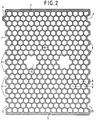
- the bricks have a hexagonal honeycomb pattern, the hexagons are arranged so that two opposite corners each point to the side walls 5 and part of the webs 6 is perpendicular to the side walls.
- the thickness of the webs is just over 2 mm.
- the percentage of holes in this honeycomb pattern is 66.5%.
- the hexagon holes are slightly blunted.
- the walls 7 of the bricks on the butt sides follow the outer wall sections of those hexagon holes which form the last, transverse row of holes of each brick. This results in projections 8 and depressions 9.
- the thickness of the walls 7 changes between approximately 3 and 4.5 mm and is therefore less than three times the web thickness.
- the spring 4 projects beyond the projections 8. If you disregard the area of this single tongue 4 and the associated groove 3, the butt-sided walls 7 of the two bricks are designed to be mirror-symmetrical to one another.
- the corresponding projections 8 lie against one another.
- the corresponding depressions 9 of both bricks each form a hexagonal cavity 10 with one another.
- the butt sides of the two bricks only experience irregularities in the area of tongue and groove, which are arranged in the vicinity of a side wall 5.
- the groove 3 is widened somewhat more than the other depressions 9.
- the tongue 4 contains a cavity 11 in the form of a partially cut hexagon.
- the cavities 10 and 11 act approximately like the other hexagon holes, so that the joint area as a whole continues the honeycomb structure and thereby has an almost undiminished heat-insulating effect.
- the brick shown completely in Fig. 2 has 21 rows of holes.
- the hole row spacing a is approximately 14 mm.
- the single wedge-shaped spring 4 fits into one of the three grooves 3, 12, 14 arranged next to the visible surfaces 5.
- the brick shown is 256 mm long and 312 mm wide (thickness of the brick wall).
- the clear width of the honeycomb (perpendicular to the webs) is 14 mm.
- the thickness of the side walls 5 is 7 mm and the thickness of the walls 7 measured 5.5 mm in the joint direction.
- the two abutting surfaces are essentially mirror-symmetrical to one another.
- this hole pattern scheme can also be used to design bricks for thicker or thinner walls in accordance with national standards, for which purpose more or fewer rows of holes must be provided in the longitudinal direction.
- the brick density class 0.5 kg / dm3 is achieved.
- bricks of the gross density class 0.8 kg / dm3 the unit weight is reduced from 13.5 kg to 9 kg.
- the same static pressure resistance is nevertheless achieved.
- the airborne sound absorption capacity in all spatial directions is superior to that of all previously known perforations.
- Computer calculations carried out, which are based on average cullet bulk densities, leave a coefficient of thermal conductivity measured on the dry brick ⁇ 0.11 [W / m ⁇ K] expect.
- the bricks with a round hole pattern according to FIG. 3 show the same principle of the formation of the abutting surface, in that protrusions 8 'and depressions 9' are also formed, as they result from a cut made in a transverse plane from the hole pattern.
- the projections have flat sections, the depressions are circular.
- the hole shape of the example according to FIG. 4 is a corner corner shortened in the transverse direction of the brick.
- the rows of holes are not offset from one another, but rather the webs form a cross-lattice. Nevertheless, corresponding projections 8 '' 'and depressions 9' '' are formed on the abutting surfaces.
- the projections contain holes 15 shortened to approximately half the length, so that the common cavity 10 ′′ ′′ formed by two depressions is approximately the size of a normal rectangle hole.
- the spring 4 '' ' is designed with wedge-shaped flanks.
Landscapes
- Engineering & Computer Science (AREA)
- Architecture (AREA)
- Physics & Mathematics (AREA)
- Electromagnetism (AREA)
- Civil Engineering (AREA)
- Structural Engineering (AREA)
- Building Environments (AREA)
- Finishing Walls (AREA)
- Nonwoven Fabrics (AREA)
- External Artificial Organs (AREA)
- Percussion Or Vibration Massage (AREA)
- Devices Affording Protection Of Roads Or Walls For Sound Insulation (AREA)
- Soundproofing, Sound Blocking, And Sound Damping (AREA)
- Road Paving Structures (AREA)
- Baking, Grill, Roasting (AREA)
- Fertilizing (AREA)
Priority Applications (1)
| Application Number | Priority Date | Filing Date | Title |
|---|---|---|---|
| DE9321414U DE9321414U1 (de) | 1992-08-24 | 1993-05-07 | Hochloch-Leichtziegel |
Applications Claiming Priority (6)
| Application Number | Priority Date | Filing Date | Title |
|---|---|---|---|
| DE19924228087 DE4228087A1 (de) | 1992-08-24 | 1992-08-24 | Hochlochziegel |
| DE4228087 | 1992-08-24 | ||
| DE4239616 | 1992-11-25 | ||
| DE19924239616 DE4239616A1 (de) | 1992-11-25 | 1992-11-25 | Hochloch-Leichtziegel |
| DE4305747 | 1993-02-25 | ||
| DE19934305747 DE4305747C2 (de) | 1993-02-25 | 1993-02-25 | Hochloch-Leichtziegel |
Publications (3)
| Publication Number | Publication Date |
|---|---|
| EP0584455A2 true EP0584455A2 (fr) | 1994-03-02 |
| EP0584455A3 EP0584455A3 (en) | 1994-06-01 |
| EP0584455B1 EP0584455B1 (fr) | 1995-08-30 |
Family
ID=27204116
Family Applications (1)
| Application Number | Title | Priority Date | Filing Date |
|---|---|---|---|
| EP93107414A Expired - Lifetime EP0584455B1 (fr) | 1992-08-24 | 1993-05-07 | Brique légère percée de trous perpendiculaires au plan de pose |
Country Status (4)
| Country | Link |
|---|---|
| EP (1) | EP0584455B1 (fr) |
| AT (1) | ATE127190T1 (fr) |
| DE (1) | DE59300532D1 (fr) |
| ES (1) | ES2078083T3 (fr) |
Cited By (4)
| Publication number | Priority date | Publication date | Assignee | Title |
|---|---|---|---|---|
| EP0639679A3 (fr) * | 1993-08-20 | 1996-04-10 | Unipor Ziegel Marketing Gmbh | Mur en maçonnerie en briques poreuses percées de trous perpendiculaires au plan de pose, ainsi que brique et mortier. |
| EP0909857A1 (fr) * | 1997-10-16 | 1999-04-21 | ZIEGELWERK BELLENBERG WIEST & CO. | Brique perforée légère |
| EP1596018A2 (fr) * | 2004-05-11 | 2005-11-16 | Ullermann, Klaus | Bloc de construction, masse et méthode de fabrication |
| DE102004023741B4 (de) * | 2003-05-12 | 2012-03-29 | Klaus Ullermann | Mauerstein sowie Masse und Verfahren zum Herstellen desselben |
Citations (1)
| Publication number | Priority date | Publication date | Assignee | Title |
|---|---|---|---|---|
| US2501185A (en) | 1945-12-07 | 1950-03-21 | Metals & Controls Corp | Temperature and pressure operated valve |
Family Cites Families (7)
| Publication number | Priority date | Publication date | Assignee | Title |
|---|---|---|---|---|
| GB434127A (en) * | 1934-02-23 | 1935-08-23 | Leslie Eric Hamson | Improvements in building and refractory bricks or blocks |
| DE802951C (de) * | 1949-11-12 | 1951-02-26 | Dachziegelwerke E C Spingler G | Viellochstein aus gebranntem Ton oder anderen Werkstoffen mit versetzt angeordneter Lochung |
| AT276706B (de) * | 1968-04-12 | 1969-12-10 | Wienerberger Baustoffind Ag | Stranggepreßter Hohlziegel |
| FR2296065A1 (fr) * | 1974-12-23 | 1976-07-23 | Sturm Jean Philippe | Elements de murs de maconnerie |
| AT339018B (de) * | 1975-09-09 | 1977-09-26 | Wienerberger Baustoffind Ag | Stranggepresster hohlziegel |
| DE2833412C2 (de) * | 1978-07-29 | 1982-12-09 | Johann 8081 Oberweikertshofen Kellerer | Hochlochziegel |
| DE3402541A1 (de) * | 1984-01-26 | 1985-08-01 | Ziegelmundstückbau Braun GmbH, 7990 Friedrichshafen | Gelochter stein, insbesondere grossblockziegel |
-
1993
- 1993-05-07 EP EP93107414A patent/EP0584455B1/fr not_active Expired - Lifetime
- 1993-05-07 AT AT93107414T patent/ATE127190T1/de not_active IP Right Cessation
- 1993-05-07 ES ES93107414T patent/ES2078083T3/es not_active Expired - Lifetime
- 1993-05-07 DE DE59300532T patent/DE59300532D1/de not_active Expired - Fee Related
Patent Citations (1)
| Publication number | Priority date | Publication date | Assignee | Title |
|---|---|---|---|---|
| US2501185A (en) | 1945-12-07 | 1950-03-21 | Metals & Controls Corp | Temperature and pressure operated valve |
Cited By (4)
| Publication number | Priority date | Publication date | Assignee | Title |
|---|---|---|---|---|
| EP0639679A3 (fr) * | 1993-08-20 | 1996-04-10 | Unipor Ziegel Marketing Gmbh | Mur en maçonnerie en briques poreuses percées de trous perpendiculaires au plan de pose, ainsi que brique et mortier. |
| EP0909857A1 (fr) * | 1997-10-16 | 1999-04-21 | ZIEGELWERK BELLENBERG WIEST & CO. | Brique perforée légère |
| DE102004023741B4 (de) * | 2003-05-12 | 2012-03-29 | Klaus Ullermann | Mauerstein sowie Masse und Verfahren zum Herstellen desselben |
| EP1596018A2 (fr) * | 2004-05-11 | 2005-11-16 | Ullermann, Klaus | Bloc de construction, masse et méthode de fabrication |
Also Published As
| Publication number | Publication date |
|---|---|
| ATE127190T1 (de) | 1995-09-15 |
| EP0584455B1 (fr) | 1995-08-30 |
| ES2078083T3 (es) | 1995-12-01 |
| EP0584455A3 (en) | 1994-06-01 |
| DE59300532D1 (de) | 1995-10-05 |
Similar Documents
| Publication | Publication Date | Title |
|---|---|---|
| EP0599283B1 (fr) | Brique légère percée de trous perpendiculaires au plan de pose | |
| EP1225282A2 (fr) | Elément isolant thérmique pour la construction | |
| EP0214524B1 (fr) | Moellon ou pavé en béton ou en matériau similaire | |
| DE9413502U1 (de) | Bauelement für die Wärmedämmung in Mauerwerk | |
| EP0584455B1 (fr) | Brique légère percée de trous perpendiculaires au plan de pose | |
| EP0540036B1 (fr) | Panneau de façade | |
| EP0382708B1 (fr) | Elément de support calorifuge pour des structures | |
| DE102004043494B4 (de) | Vorsatzschale als wärmedämmende Außenschale für ein mehrschaliges Mauerwerk | |
| EP0637655A2 (fr) | Panneau de façade extrudé | |
| DE3030846C2 (de) | Hochlochziegel | |
| DE4305747C2 (de) | Hochloch-Leichtziegel | |
| EP0606625B1 (fr) | Brique de remplissage | |
| DE2422236A1 (de) | Mauerstein, insbesondere hohlblockstein | |
| DE20208886U1 (de) | Ziegel | |
| DE2939832C2 (de) | Wandbaustein | |
| DE9321414U1 (de) | Hochloch-Leichtziegel | |
| CH692992A5 (de) | Wärmedämmendes, tragendes Bauelement. | |
| DE4239616A1 (de) | Hochloch-Leichtziegel | |
| EP0528753A1 (fr) | Bloc de construction à isolation thermique améliorée | |
| DE29518717U1 (de) | Leicht-Hochlochziegel | |
| DE3533485A1 (de) | Schalenmauerwerk | |
| DE807430C (de) | Hohlblockstein | |
| DE866382C (de) | Baustein und Bausteinanordnung | |
| CH662851A5 (de) | Baustein. | |
| DE936292C (de) | Mittels Strangpresse herzustellender Viellochmauerstein |
Legal Events
| Date | Code | Title | Description |
|---|---|---|---|
| PUAI | Public reference made under article 153(3) epc to a published international application that has entered the european phase |
Free format text: ORIGINAL CODE: 0009012 |
|
| AK | Designated contracting states |
Kind code of ref document: A2 Designated state(s): AT BE CH DE ES FR IT LI NL |
|
| PUAL | Search report despatched |
Free format text: ORIGINAL CODE: 0009013 |
|
| AK | Designated contracting states |
Kind code of ref document: A3 Designated state(s): AT BE CH DE ES FR IT LI NL |
|
| 17P | Request for examination filed |
Effective date: 19940915 |
|
| 17Q | First examination report despatched |
Effective date: 19950207 |
|
| GRAA | (expected) grant |
Free format text: ORIGINAL CODE: 0009210 |
|
| AK | Designated contracting states |
Kind code of ref document: B1 Designated state(s): AT BE CH DE ES FR IT LI NL |
|
| REF | Corresponds to: |
Ref document number: 127190 Country of ref document: AT Date of ref document: 19950915 Kind code of ref document: T |
|
| REF | Corresponds to: |
Ref document number: 59300532 Country of ref document: DE Date of ref document: 19951005 |
|
| ET | Fr: translation filed | ||
| ITF | It: translation for a ep patent filed | ||
| REG | Reference to a national code |
Ref country code: ES Ref legal event code: FG2A Ref document number: 2078083 Country of ref document: ES Kind code of ref document: T3 |
|
| PLAV | Examination of admissibility of opposition |
Free format text: ORIGINAL CODE: EPIDOS OPEX |
|
| PLBQ | Unpublished change to opponent data |
Free format text: ORIGINAL CODE: EPIDOS OPPO |
|
| PLBI | Opposition filed |
Free format text: ORIGINAL CODE: 0009260 |
|
| PLAV | Examination of admissibility of opposition |
Free format text: ORIGINAL CODE: EPIDOS OPEX |
|
| PLBF | Reply of patent proprietor to notice(s) of opposition |
Free format text: ORIGINAL CODE: EPIDOS OBSO |
|
| 26 | Opposition filed |
Opponent name: ROEBEN TONBAUSTOFFE GMBH Effective date: 19960525 |
|
| NLR1 | Nl: opposition has been filed with the epo |
Opponent name: ROEBEN TONBAUSTOFFE GMBH |
|
| PLBF | Reply of patent proprietor to notice(s) of opposition |
Free format text: ORIGINAL CODE: EPIDOS OBSO |
|
| PLBQ | Unpublished change to opponent data |
Free format text: ORIGINAL CODE: EPIDOS OPPO |
|
| PLAB | Opposition data, opponent's data or that of the opponent's representative modified |
Free format text: ORIGINAL CODE: 0009299OPPO |
|
| R26 | Opposition filed (corrected) |
Opponent name: ROEBEN TONBAUSTOFFE GMBH Effective date: 19960525 |
|
| NLR1 | Nl: opposition has been filed with the epo |
Opponent name: ROEBEN TONBAUSTOFFE GMBH |
|
| PLBO | Opposition rejected |
Free format text: ORIGINAL CODE: EPIDOS REJO |
|
| APAC | Appeal dossier modified |
Free format text: ORIGINAL CODE: EPIDOS NOAPO |
|
| APAE | Appeal reference modified |
Free format text: ORIGINAL CODE: EPIDOS REFNO |
|
| APAC | Appeal dossier modified |
Free format text: ORIGINAL CODE: EPIDOS NOAPO |
|
| PGFP | Annual fee paid to national office [announced via postgrant information from national office to epo] |
Ref country code: ES Payment date: 19980513 Year of fee payment: 6 |
|
| PGFP | Annual fee paid to national office [announced via postgrant information from national office to epo] |
Ref country code: BE Payment date: 19980527 Year of fee payment: 6 |
|
| PGFP | Annual fee paid to national office [announced via postgrant information from national office to epo] |
Ref country code: NL Payment date: 19980531 Year of fee payment: 6 |
|
| PG25 | Lapsed in a contracting state [announced via postgrant information from national office to epo] |
Ref country code: ES Free format text: THE PATENT HAS BEEN ANNULLED BY A DECISION OF A NATIONAL AUTHORITY Effective date: 19990508 |
|
| PG25 | Lapsed in a contracting state [announced via postgrant information from national office to epo] |
Ref country code: BE Free format text: LAPSE BECAUSE OF NON-PAYMENT OF DUE FEES Effective date: 19990531 |
|
| APCC | Communication from the board of appeal sent |
Free format text: ORIGINAL CODE: EPIDOS OBAPO |
|
| APCC | Communication from the board of appeal sent |
Free format text: ORIGINAL CODE: EPIDOS OBAPO |
|
| BERE | Be: lapsed |
Owner name: RIMMELE RAIMUND Effective date: 19990531 |
|
| PG25 | Lapsed in a contracting state [announced via postgrant information from national office to epo] |
Ref country code: NL Free format text: LAPSE BECAUSE OF NON-PAYMENT OF DUE FEES Effective date: 19991201 |
|
| NLV4 | Nl: lapsed or anulled due to non-payment of the annual fee |
Effective date: 19991201 |
|
| PLBQ | Unpublished change to opponent data |
Free format text: ORIGINAL CODE: EPIDOS OPPO |
|
| PLAB | Opposition data, opponent's data or that of the opponent's representative modified |
Free format text: ORIGINAL CODE: 0009299OPPO |
|
| APAC | Appeal dossier modified |
Free format text: ORIGINAL CODE: EPIDOS NOAPO |
|
| R26 | Opposition filed (corrected) |
Opponent name: ROEBEN TONBAUSTOFFE GMBH Effective date: 19960525 |
|
| PLBN | Opposition rejected |
Free format text: ORIGINAL CODE: 0009273 |
|
| 27O | Opposition rejected |
Effective date: 20000708 |
|
| REG | Reference to a national code |
Ref country code: ES Ref legal event code: FD2A Effective date: 20010604 |
|
| PGFP | Annual fee paid to national office [announced via postgrant information from national office to epo] |
Ref country code: AT Payment date: 20020531 Year of fee payment: 10 |
|
| PG25 | Lapsed in a contracting state [announced via postgrant information from national office to epo] |
Ref country code: AT Free format text: LAPSE BECAUSE OF NON-PAYMENT OF DUE FEES Effective date: 20030507 |
|
| PGFP | Annual fee paid to national office [announced via postgrant information from national office to epo] |
Ref country code: FR Payment date: 20040524 Year of fee payment: 12 |
|
| APAH | Appeal reference modified |
Free format text: ORIGINAL CODE: EPIDOSCREFNO |
|
| REG | Reference to a national code |
Ref country code: CH Ref legal event code: PUE Owner name: ZIEGELEIEN FREIBURG & LAUSANNE AG DUEDINGEN Free format text: RAIMUND RIMMELE#ALTSTEUSSLINGER STRASSE 24#D-89685 EHINGEN/DONAU (DE) -TRANSFER TO- ZIEGELEIEN FREIBURG & LAUSANNE AG DUEDINGEN#HAEGLIWEG 2#3186 DUEDINGEN (CH) Ref country code: CH Ref legal event code: NV Representative=s name: KELLER & PARTNER PATENTANWAELTE AG |
|
| PG25 | Lapsed in a contracting state [announced via postgrant information from national office to epo] |
Ref country code: FR Free format text: LAPSE BECAUSE OF NON-PAYMENT OF DUE FEES Effective date: 20060131 |
|
| REG | Reference to a national code |
Ref country code: FR Ref legal event code: ST Effective date: 20060131 |
|
| PGFP | Annual fee paid to national office [announced via postgrant information from national office to epo] |
Ref country code: IT Payment date: 20060531 Year of fee payment: 14 |
|
| REG | Reference to a national code |
Ref country code: CH Ref legal event code: NV Representative=s name: DTS ZUERICH |
|
| REG | Reference to a national code |
Ref country code: CH Ref legal event code: PCAR Free format text: DTS ZUERICH;RESIRAIN 1;8125 ZOLLIKERBERG (CH) |
|
| PLAB | Opposition data, opponent's data or that of the opponent's representative modified |
Free format text: ORIGINAL CODE: 0009299OPPO |
|
| PGFP | Annual fee paid to national office [announced via postgrant information from national office to epo] |
Ref country code: DE Payment date: 20080613 Year of fee payment: 16 |
|
| PG25 | Lapsed in a contracting state [announced via postgrant information from national office to epo] |
Ref country code: IT Free format text: LAPSE BECAUSE OF NON-PAYMENT OF DUE FEES Effective date: 20070507 |
|
| PG25 | Lapsed in a contracting state [announced via postgrant information from national office to epo] |
Ref country code: DE Free format text: LAPSE BECAUSE OF NON-PAYMENT OF DUE FEES Effective date: 20091201 |
|
| PGFP | Annual fee paid to national office [announced via postgrant information from national office to epo] |
Ref country code: CH Payment date: 20110503 Year of fee payment: 19 |
|
| REG | Reference to a national code |
Ref country code: CH Ref legal event code: PL |
|
| PG25 | Lapsed in a contracting state [announced via postgrant information from national office to epo] |
Ref country code: LI Free format text: LAPSE BECAUSE OF NON-PAYMENT OF DUE FEES Effective date: 20120531 Ref country code: CH Free format text: LAPSE BECAUSE OF NON-PAYMENT OF DUE FEES Effective date: 20120531 |