EP0584565A1 - Verfahren zum Färben von Polyurethankunststoffen mit Monoazoeinbaufarbstoffen sowie neue Monoazofarbstoffe - Google Patents
Verfahren zum Färben von Polyurethankunststoffen mit Monoazoeinbaufarbstoffen sowie neue Monoazofarbstoffe Download PDFInfo
- Publication number
- EP0584565A1 EP0584565A1 EP93112043A EP93112043A EP0584565A1 EP 0584565 A1 EP0584565 A1 EP 0584565A1 EP 93112043 A EP93112043 A EP 93112043A EP 93112043 A EP93112043 A EP 93112043A EP 0584565 A1 EP0584565 A1 EP 0584565A1
- Authority
- EP
- European Patent Office
- Prior art keywords
- optionally substituted
- ethyl
- methyl
- hydrogen
- dyes
- Prior art date
- Legal status (The legal status is an assumption and is not a legal conclusion. Google has not performed a legal analysis and makes no representation as to the accuracy of the status listed.)
- Withdrawn
Links
- 229920002635 polyurethane Polymers 0.000 title claims abstract description 35
- 239000004814 polyurethane Substances 0.000 title claims abstract description 35
- 229920003023 plastic Polymers 0.000 title claims abstract description 20
- 239000004033 plastic Substances 0.000 title claims abstract description 20
- 238000000034 method Methods 0.000 title claims description 26
- 238000004040 coloring Methods 0.000 title claims description 9
- 239000000975 dye Substances 0.000 claims abstract description 70
- -1 C1-C4-alkoxycarbonyl Chemical group 0.000 claims abstract description 29
- 229910052739 hydrogen Inorganic materials 0.000 claims abstract description 23
- 239000001257 hydrogen Substances 0.000 claims abstract description 23
- 150000002431 hydrogen Chemical class 0.000 claims abstract description 17
- 125000001997 phenyl group Chemical group [H]C1=C([H])C([H])=C(*)C([H])=C1[H] 0.000 claims abstract description 14
- 125000004442 acylamino group Chemical group 0.000 claims abstract description 13
- 229910052736 halogen Inorganic materials 0.000 claims abstract description 13
- 150000002367 halogens Chemical class 0.000 claims abstract description 13
- 125000002887 hydroxy group Chemical group [H]O* 0.000 claims abstract description 12
- 125000004169 (C1-C6) alkyl group Chemical group 0.000 claims abstract description 10
- 125000002924 primary amino group Chemical group [H]N([H])* 0.000 claims abstract description 10
- 125000003282 alkyl amino group Chemical group 0.000 claims abstract description 9
- 125000003917 carbamoyl group Chemical group [H]N([H])C(*)=O 0.000 claims abstract description 9
- 125000001309 chloro group Chemical group Cl* 0.000 claims abstract description 9
- 125000004093 cyano group Chemical group *C#N 0.000 claims abstract description 9
- 125000004663 dialkyl amino group Chemical group 0.000 claims abstract description 9
- 125000004191 (C1-C6) alkoxy group Chemical class 0.000 claims abstract description 7
- 125000006700 (C1-C6) alkylthio group Chemical group 0.000 claims abstract description 7
- 125000004957 naphthylene group Chemical class 0.000 claims abstract description 5
- 125000000843 phenylene group Chemical class C1(=C(C=CC=C1)*)* 0.000 claims abstract description 5
- 238000004043 dyeing Methods 0.000 claims abstract description 4
- 125000001495 ethyl group Chemical group [H]C([H])([H])C([H])([H])* 0.000 claims description 24
- 125000002496 methyl group Chemical group [H]C([H])([H])* 0.000 claims description 24
- ZAMOUSCENKQFHK-UHFFFAOYSA-N Chlorine atom Chemical group [Cl] ZAMOUSCENKQFHK-UHFFFAOYSA-N 0.000 claims description 18
- 239000000460 chlorine Chemical group 0.000 claims description 12
- 229910052801 chlorine Inorganic materials 0.000 claims description 12
- 238000006243 chemical reaction Methods 0.000 claims description 11
- 125000004739 (C1-C6) alkylsulfonyl group Chemical group 0.000 claims description 6
- 125000001731 2-cyanoethyl group Chemical group [H]C([H])(*)C([H])([H])C#N 0.000 claims description 6
- WKBOTKDWSSQWDR-UHFFFAOYSA-N Bromine atom Chemical group [Br] WKBOTKDWSSQWDR-UHFFFAOYSA-N 0.000 claims description 6
- 125000000217 alkyl group Chemical group 0.000 claims description 6
- 125000002947 alkylene group Chemical group 0.000 claims description 6
- 125000001797 benzyl group Chemical group [H]C1=C([H])C([H])=C(C([H])=C1[H])C([H])([H])* 0.000 claims description 6
- 125000001449 isopropyl group Chemical group [H]C([H])([H])C([H])(*)C([H])([H])[H] 0.000 claims description 6
- 125000000956 methoxy group Chemical group [H]C([H])([H])O* 0.000 claims description 6
- 125000004123 n-propyl group Chemical group [H]C([H])([H])C([H])([H])C([H])([H])* 0.000 claims description 6
- 239000011541 reaction mixture Substances 0.000 claims description 5
- 125000001140 1,4-phenylene group Chemical group [H]C1=C([H])C([*:2])=C([H])C([H])=C1[*:1] 0.000 claims description 4
- 125000004959 2,6-naphthylene group Chemical group [H]C1=C([H])C2=C([H])C([*:1])=C([H])C([H])=C2C([H])=C1[*:2] 0.000 claims description 4
- GDTBXPJZTBHREO-UHFFFAOYSA-N bromine Chemical group BrBr GDTBXPJZTBHREO-UHFFFAOYSA-N 0.000 claims description 4
- 229910052794 bromium Chemical group 0.000 claims description 4
- 125000004435 hydrogen atom Chemical group [H]* 0.000 claims 2
- 239000000376 reactant Substances 0.000 claims 1
- UFHFLCQGNIYNRP-UHFFFAOYSA-N Hydrogen Chemical compound [H][H] UFHFLCQGNIYNRP-UHFFFAOYSA-N 0.000 abstract description 15
- NYGZLYXAPMMJTE-UHFFFAOYSA-M metanil yellow Chemical group [Na+].[O-]S(=O)(=O)C1=CC=CC(N=NC=2C=CC(NC=3C=CC=CC=3)=CC=2)=C1 NYGZLYXAPMMJTE-UHFFFAOYSA-M 0.000 abstract description 4
- 230000015572 biosynthetic process Effects 0.000 abstract description 3
- 239000000243 solution Substances 0.000 description 26
- ZMXDDKWLCZADIW-UHFFFAOYSA-N N,N-Dimethylformamide Chemical compound CN(C)C=O ZMXDDKWLCZADIW-UHFFFAOYSA-N 0.000 description 19
- WNLRTRBMVRJNCN-UHFFFAOYSA-N adipic acid Chemical compound OC(=O)CCCCC(O)=O WNLRTRBMVRJNCN-UHFFFAOYSA-N 0.000 description 16
- 229920000728 polyester Polymers 0.000 description 14
- XLYOFNOQVPJJNP-UHFFFAOYSA-N water Substances O XLYOFNOQVPJJNP-UHFFFAOYSA-N 0.000 description 14
- 239000000203 mixture Substances 0.000 description 12
- 239000006260 foam Substances 0.000 description 10
- 229920000570 polyether Polymers 0.000 description 10
- 239000000843 powder Substances 0.000 description 10
- 239000004721 Polyphenylene oxide Substances 0.000 description 9
- 239000006185 dispersion Substances 0.000 description 9
- CSCPPACGZOOCGX-UHFFFAOYSA-N Acetone Chemical compound CC(C)=O CSCPPACGZOOCGX-UHFFFAOYSA-N 0.000 description 8
- 239000001361 adipic acid Substances 0.000 description 8
- 235000011037 adipic acid Nutrition 0.000 description 8
- 229920005862 polyol Polymers 0.000 description 8
- DNIAPMSPPWPWGF-UHFFFAOYSA-N Propylene glycol Chemical compound CC(O)CO DNIAPMSPPWPWGF-UHFFFAOYSA-N 0.000 description 7
- 238000000576 coating method Methods 0.000 description 7
- 239000010408 film Substances 0.000 description 7
- 150000003077 polyols Chemical class 0.000 description 7
- QTBSBXVTEAMEQO-UHFFFAOYSA-N Acetic acid Chemical compound CC(O)=O QTBSBXVTEAMEQO-UHFFFAOYSA-N 0.000 description 6
- RTZKZFJDLAIYFH-UHFFFAOYSA-N Diethyl ether Chemical compound CCOCC RTZKZFJDLAIYFH-UHFFFAOYSA-N 0.000 description 6
- MHAJPDPJQMAIIY-UHFFFAOYSA-N Hydrogen peroxide Chemical compound OO MHAJPDPJQMAIIY-UHFFFAOYSA-N 0.000 description 6
- YXFVVABEGXRONW-UHFFFAOYSA-N Toluene Chemical compound CC1=CC=CC=C1 YXFVVABEGXRONW-UHFFFAOYSA-N 0.000 description 6
- MTHSVFCYNBDYFN-UHFFFAOYSA-N diethylene glycol Chemical compound OCCOCCO MTHSVFCYNBDYFN-UHFFFAOYSA-N 0.000 description 6
- 229920001971 elastomer Polymers 0.000 description 6
- 239000000806 elastomer Substances 0.000 description 6
- 239000004753 textile Substances 0.000 description 6
- IAYPIBMASNFSPL-UHFFFAOYSA-N Ethylene oxide Chemical compound C1CO1 IAYPIBMASNFSPL-UHFFFAOYSA-N 0.000 description 5
- ZJCCRDAZUWHFQH-UHFFFAOYSA-N Trimethylolpropane Chemical compound CCC(CO)(CO)CO ZJCCRDAZUWHFQH-UHFFFAOYSA-N 0.000 description 5
- 239000011248 coating agent Substances 0.000 description 5
- 229920001228 polyisocyanate Polymers 0.000 description 5
- 239000005056 polyisocyanate Substances 0.000 description 5
- KBPLFHHGFOOTCA-UHFFFAOYSA-N 1-Octanol Chemical compound CCCCCCCCO KBPLFHHGFOOTCA-UHFFFAOYSA-N 0.000 description 4
- 229920005830 Polyurethane Foam Polymers 0.000 description 4
- 150000001298 alcohols Chemical class 0.000 description 4
- WERYXYBDKMZEQL-UHFFFAOYSA-N butane-1,4-diol Chemical compound OCCCCO WERYXYBDKMZEQL-UHFFFAOYSA-N 0.000 description 4
- 239000003054 catalyst Substances 0.000 description 4
- 125000005442 diisocyanate group Chemical group 0.000 description 4
- 239000004922 lacquer Substances 0.000 description 4
- 238000004519 manufacturing process Methods 0.000 description 4
- 229920003225 polyurethane elastomer Polymers 0.000 description 4
- 239000011496 polyurethane foam Substances 0.000 description 4
- 238000003756 stirring Methods 0.000 description 4
- WFDIJRYMOXRFFG-UHFFFAOYSA-N Acetic anhydride Chemical compound CC(=O)OC(C)=O WFDIJRYMOXRFFG-UHFFFAOYSA-N 0.000 description 3
- XEKOWRVHYACXOJ-UHFFFAOYSA-N Ethyl acetate Chemical compound CCOC(C)=O XEKOWRVHYACXOJ-UHFFFAOYSA-N 0.000 description 3
- LYCAIKOWRPUZTN-UHFFFAOYSA-N Ethylene glycol Chemical compound OCCO LYCAIKOWRPUZTN-UHFFFAOYSA-N 0.000 description 3
- SJRJJKPEHAURKC-UHFFFAOYSA-N N-Methylmorpholine Chemical compound CN1CCOCC1 SJRJJKPEHAURKC-UHFFFAOYSA-N 0.000 description 3
- 239000004433 Thermoplastic polyurethane Substances 0.000 description 3
- 239000002253 acid Substances 0.000 description 3
- 230000000740 bleeding effect Effects 0.000 description 3
- 239000007859 condensation product Substances 0.000 description 3
- 230000008878 coupling Effects 0.000 description 3
- 238000010168 coupling process Methods 0.000 description 3
- 238000005859 coupling reaction Methods 0.000 description 3
- 150000002009 diols Chemical class 0.000 description 3
- 238000000578 dry spinning Methods 0.000 description 3
- ACCCMOQWYVYDOT-UHFFFAOYSA-N hexane-1,1-diol Chemical compound CCCCCC(O)O ACCCMOQWYVYDOT-UHFFFAOYSA-N 0.000 description 3
- 230000003647 oxidation Effects 0.000 description 3
- 238000007254 oxidation reaction Methods 0.000 description 3
- 239000000047 product Substances 0.000 description 3
- 235000013772 propylene glycol Nutrition 0.000 description 3
- 239000003381 stabilizer Substances 0.000 description 3
- 239000000126 substance Substances 0.000 description 3
- 239000000725 suspension Substances 0.000 description 3
- 229920002803 thermoplastic polyurethane Polymers 0.000 description 3
- DVKJHBMWWAPEIU-UHFFFAOYSA-N toluene 2,4-diisocyanate Chemical compound CC1=CC=C(N=C=O)C=C1N=C=O DVKJHBMWWAPEIU-UHFFFAOYSA-N 0.000 description 3
- WFKWXMTUELFFGS-UHFFFAOYSA-N tungsten Chemical compound [W] WFKWXMTUELFFGS-UHFFFAOYSA-N 0.000 description 3
- 229910052721 tungsten Inorganic materials 0.000 description 3
- 239000010937 tungsten Substances 0.000 description 3
- 238000002166 wet spinning Methods 0.000 description 3
- PUPZLCDOIYMWBV-UHFFFAOYSA-N (+/-)-1,3-Butanediol Chemical compound CC(O)CCO PUPZLCDOIYMWBV-UHFFFAOYSA-N 0.000 description 2
- XLLIQLLCWZCATF-UHFFFAOYSA-N 2-methoxyethyl acetate Chemical compound COCCOC(C)=O XLLIQLLCWZCATF-UHFFFAOYSA-N 0.000 description 2
- UPMLOUAZCHDJJD-UHFFFAOYSA-N 4,4'-Diphenylmethane Diisocyanate Chemical compound C1=CC(N=C=O)=CC=C1CC1=CC=C(N=C=O)C=C1 UPMLOUAZCHDJJD-UHFFFAOYSA-N 0.000 description 2
- YEJRWHAVMIAJKC-UHFFFAOYSA-N 4-Butyrolactone Chemical compound O=C1CCCO1 YEJRWHAVMIAJKC-UHFFFAOYSA-N 0.000 description 2
- IRIAEXORFWYRCZ-UHFFFAOYSA-N Butylbenzyl phthalate Chemical compound CCCCOC(=O)C1=CC=CC=C1C(=O)OCC1=CC=CC=C1 IRIAEXORFWYRCZ-UHFFFAOYSA-N 0.000 description 2
- 239000004970 Chain extender Substances 0.000 description 2
- 229920000742 Cotton Polymers 0.000 description 2
- KFSLWBXXFJQRDL-UHFFFAOYSA-N Peracetic acid Chemical compound CC(=O)OO KFSLWBXXFJQRDL-UHFFFAOYSA-N 0.000 description 2
- NBIIXXVUZAFLBC-UHFFFAOYSA-N Phosphoric acid Chemical compound OP(O)(O)=O NBIIXXVUZAFLBC-UHFFFAOYSA-N 0.000 description 2
- GOOHAUXETOMSMM-UHFFFAOYSA-N Propylene oxide Chemical compound CC1CO1 GOOHAUXETOMSMM-UHFFFAOYSA-N 0.000 description 2
- VMHLLURERBWHNL-UHFFFAOYSA-M Sodium acetate Chemical compound [Na+].CC([O-])=O VMHLLURERBWHNL-UHFFFAOYSA-M 0.000 description 2
- FAPWRFPIFSIZLT-UHFFFAOYSA-M Sodium chloride Chemical compound [Na+].[Cl-] FAPWRFPIFSIZLT-UHFFFAOYSA-M 0.000 description 2
- KKEYFWRCBNTPAC-UHFFFAOYSA-N Terephthalic acid Chemical compound OC(=O)C1=CC=C(C(O)=O)C=C1 KKEYFWRCBNTPAC-UHFFFAOYSA-N 0.000 description 2
- WNLRTRBMVRJNCN-UHFFFAOYSA-L adipate(2-) Chemical compound [O-]C(=O)CCCCC([O-])=O WNLRTRBMVRJNCN-UHFFFAOYSA-L 0.000 description 2
- 150000001412 amines Chemical class 0.000 description 2
- 239000011324 bead Substances 0.000 description 2
- 229920001400 block copolymer Polymers 0.000 description 2
- 238000009835 boiling Methods 0.000 description 2
- CDQSJQSWAWPGKG-UHFFFAOYSA-N butane-1,1-diol Chemical compound CCCC(O)O CDQSJQSWAWPGKG-UHFFFAOYSA-N 0.000 description 2
- 239000003086 colorant Substances 0.000 description 2
- 238000001816 cooling Methods 0.000 description 2
- 150000004985 diamines Chemical class 0.000 description 2
- 239000004744 fabric Substances 0.000 description 2
- 239000000835 fiber Substances 0.000 description 2
- 238000005187 foaming Methods 0.000 description 2
- 239000011521 glass Substances 0.000 description 2
- 239000008187 granular material Substances 0.000 description 2
- ZSIAUFGUXNUGDI-UHFFFAOYSA-N hexan-1-ol Chemical compound CCCCCCO ZSIAUFGUXNUGDI-UHFFFAOYSA-N 0.000 description 2
- 238000010348 incorporation Methods 0.000 description 2
- 238000009434 installation Methods 0.000 description 2
- 238000004898 kneading Methods 0.000 description 2
- 238000003475 lamination Methods 0.000 description 2
- 239000007788 liquid Substances 0.000 description 2
- 239000000463 material Substances 0.000 description 2
- 229910052751 metal Inorganic materials 0.000 description 2
- 239000002184 metal Substances 0.000 description 2
- 238000002156 mixing Methods 0.000 description 2
- ZWRUINPWMLAQRD-UHFFFAOYSA-N nonan-1-ol Chemical compound CCCCCCCCCO ZWRUINPWMLAQRD-UHFFFAOYSA-N 0.000 description 2
- NFBAXHOPROOJAW-UHFFFAOYSA-N phenindione Chemical class O=C1C2=CC=CC=C2C(=O)C1C1=CC=CC=C1 NFBAXHOPROOJAW-UHFFFAOYSA-N 0.000 description 2
- XNGIFLGASWRNHJ-UHFFFAOYSA-N phthalic acid Chemical compound OC(=O)C1=CC=CC=C1C(O)=O XNGIFLGASWRNHJ-UHFFFAOYSA-N 0.000 description 2
- 238000002360 preparation method Methods 0.000 description 2
- 239000001632 sodium acetate Substances 0.000 description 2
- 235000017281 sodium acetate Nutrition 0.000 description 2
- 229920001169 thermoplastic Polymers 0.000 description 2
- 239000004416 thermosoftening plastic Substances 0.000 description 2
- IMNIMPAHZVJRPE-UHFFFAOYSA-N triethylenediamine Chemical compound C1CN2CCN1CC2 IMNIMPAHZVJRPE-UHFFFAOYSA-N 0.000 description 2
- WRIDQFICGBMAFQ-UHFFFAOYSA-N (E)-8-Octadecenoic acid Natural products CCCCCCCCCC=CCCCCCCC(O)=O WRIDQFICGBMAFQ-UHFFFAOYSA-N 0.000 description 1
- KYVBNYUBXIEUFW-UHFFFAOYSA-N 1,1,3,3-tetramethylguanidine Chemical compound CN(C)C(=N)N(C)C KYVBNYUBXIEUFW-UHFFFAOYSA-N 0.000 description 1
- XKQMKMVTDKYWOX-UHFFFAOYSA-N 1-[2-hydroxypropyl(methyl)amino]propan-2-ol Chemical compound CC(O)CN(C)CC(C)O XKQMKMVTDKYWOX-UHFFFAOYSA-N 0.000 description 1
- QPYKYDBKQYZEKG-UHFFFAOYSA-N 2,2-dimethylpropane-1,1-diol Chemical compound CC(C)(C)C(O)O QPYKYDBKQYZEKG-UHFFFAOYSA-N 0.000 description 1
- CSCNRHJJGXZFGX-UHFFFAOYSA-N 2-(4-aminophenyl)sulfonylethanol Chemical compound NC1=CC=C(S(=O)(=O)CCO)C=C1 CSCNRHJJGXZFGX-UHFFFAOYSA-N 0.000 description 1
- MWGATWIBSKHFMR-UHFFFAOYSA-N 2-anilinoethanol Chemical compound OCCNC1=CC=CC=C1 MWGATWIBSKHFMR-UHFFFAOYSA-N 0.000 description 1
- QTWJRLJHJPIABL-UHFFFAOYSA-N 2-methylphenol;3-methylphenol;4-methylphenol Chemical compound CC1=CC=C(O)C=C1.CC1=CC=CC(O)=C1.CC1=CC=CC=C1O QTWJRLJHJPIABL-UHFFFAOYSA-N 0.000 description 1
- LQJBNNIYVWPHFW-UHFFFAOYSA-N 20:1omega9c fatty acid Natural products CCCCCCCCCCC=CCCCCCCCC(O)=O LQJBNNIYVWPHFW-UHFFFAOYSA-N 0.000 description 1
- BWDBEAQIHAEVLV-UHFFFAOYSA-N 6-methylheptan-1-ol Chemical compound CC(C)CCCCCO BWDBEAQIHAEVLV-UHFFFAOYSA-N 0.000 description 1
- QSBYPNXLFMSGKH-UHFFFAOYSA-N 9-Heptadecensaeure Natural products CCCCCCCC=CCCCCCCCC(O)=O QSBYPNXLFMSGKH-UHFFFAOYSA-N 0.000 description 1
- 239000004604 Blowing Agent Substances 0.000 description 1
- BRLQWZUYTZBJKN-UHFFFAOYSA-N Epichlorohydrin Chemical compound ClCC1CO1 BRLQWZUYTZBJKN-UHFFFAOYSA-N 0.000 description 1
- CTQNGGLPUBDAKN-UHFFFAOYSA-N O-Xylene Chemical compound CC1=CC=CC=C1C CTQNGGLPUBDAKN-UHFFFAOYSA-N 0.000 description 1
- 239000005642 Oleic acid Substances 0.000 description 1
- ZQPPMHVWECSIRJ-UHFFFAOYSA-N Oleic acid Natural products CCCCCCCCC=CCCCCCCCC(O)=O ZQPPMHVWECSIRJ-UHFFFAOYSA-N 0.000 description 1
- 239000005662 Paraffin oil Substances 0.000 description 1
- ABLZXFCXXLZCGV-UHFFFAOYSA-N Phosphorous acid Chemical compound OP(O)=O ABLZXFCXXLZCGV-UHFFFAOYSA-N 0.000 description 1
- LGRFSURHDFAFJT-UHFFFAOYSA-N Phthalic anhydride Natural products C1=CC=C2C(=O)OC(=O)C2=C1 LGRFSURHDFAFJT-UHFFFAOYSA-N 0.000 description 1
- AWMVMTVKBNGEAK-UHFFFAOYSA-N Styrene oxide Chemical compound C1OC1C1=CC=CC=C1 AWMVMTVKBNGEAK-UHFFFAOYSA-N 0.000 description 1
- XSQUKJJJFZCRTK-UHFFFAOYSA-N Urea Chemical group NC(N)=O XSQUKJJJFZCRTK-UHFFFAOYSA-N 0.000 description 1
- 241000219422 Urtica Species 0.000 description 1
- 235000009108 Urtica dioica Nutrition 0.000 description 1
- 239000000853 adhesive Substances 0.000 description 1
- 230000001070 adhesive effect Effects 0.000 description 1
- 125000001931 aliphatic group Chemical group 0.000 description 1
- 125000004453 alkoxycarbonyl group Chemical group 0.000 description 1
- 229910052782 aluminium Inorganic materials 0.000 description 1
- XAGFODPZIPBFFR-UHFFFAOYSA-N aluminium Chemical compound [Al] XAGFODPZIPBFFR-UHFFFAOYSA-N 0.000 description 1
- 229910000147 aluminium phosphate Inorganic materials 0.000 description 1
- 150000001408 amides Chemical group 0.000 description 1
- 125000003118 aryl group Chemical group 0.000 description 1
- 239000011230 binding agent Substances 0.000 description 1
- 230000001680 brushing effect Effects 0.000 description 1
- 239000007853 buffer solution Substances 0.000 description 1
- JRWWCCITOITOFM-UHFFFAOYSA-N butane-1,1-diol;ethane-1,1-diol;hexanedioic acid Chemical compound CC(O)O.CCCC(O)O.OC(=O)CCCCC(O)=O JRWWCCITOITOFM-UHFFFAOYSA-N 0.000 description 1
- JHIWVOJDXOSYLW-UHFFFAOYSA-N butyl 2,2-difluorocyclopropane-1-carboxylate Chemical compound CCCCOC(=O)C1CC1(F)F JHIWVOJDXOSYLW-UHFFFAOYSA-N 0.000 description 1
- 229930188620 butyrolactone Natural products 0.000 description 1
- 238000003490 calendering Methods 0.000 description 1
- 239000004202 carbamide Chemical group 0.000 description 1
- VPKDCDLSJZCGKE-UHFFFAOYSA-N carbodiimide group Chemical group N=C=N VPKDCDLSJZCGKE-UHFFFAOYSA-N 0.000 description 1
- 150000001735 carboxylic acids Chemical class 0.000 description 1
- 239000012876 carrier material Substances 0.000 description 1
- 239000004359 castor oil Substances 0.000 description 1
- 235000019438 castor oil Nutrition 0.000 description 1
- 239000007795 chemical reaction product Substances 0.000 description 1
- 239000003153 chemical reaction reagent Substances 0.000 description 1
- 230000001112 coagulating effect Effects 0.000 description 1
- 239000008199 coating composition Substances 0.000 description 1
- 229930003836 cresol Natural products 0.000 description 1
- 210000003298 dental enamel Anatomy 0.000 description 1
- VAYGXNSJCAHWJZ-UHFFFAOYSA-N dimethyl sulfate Chemical compound COS(=O)(=O)OC VAYGXNSJCAHWJZ-UHFFFAOYSA-N 0.000 description 1
- SZXQTJUDPRGNJN-UHFFFAOYSA-N dipropylene glycol Chemical compound OCCCOCCCO SZXQTJUDPRGNJN-UHFFFAOYSA-N 0.000 description 1
- 239000002612 dispersion medium Substances 0.000 description 1
- 239000012153 distilled water Substances 0.000 description 1
- 238000001035 drying Methods 0.000 description 1
- 239000003995 emulsifying agent Substances 0.000 description 1
- 238000005516 engineering process Methods 0.000 description 1
- 150000002148 esters Chemical class 0.000 description 1
- 238000001125 extrusion Methods 0.000 description 1
- 239000011888 foil Substances 0.000 description 1
- DYDNPESBYVVLBO-UHFFFAOYSA-N formanilide Chemical compound O=CNC1=CC=CC=C1 DYDNPESBYVVLBO-UHFFFAOYSA-N 0.000 description 1
- 125000000524 functional group Chemical group 0.000 description 1
- ZEMPKEQAKRGZGQ-XOQCFJPHSA-N glycerol triricinoleate Natural products CCCCCC[C@@H](O)CC=CCCCCCCCC(=O)OC[C@@H](COC(=O)CCCCCCCC=CC[C@@H](O)CCCCCC)OC(=O)CCCCCCCC=CC[C@H](O)CCCCCC ZEMPKEQAKRGZGQ-XOQCFJPHSA-N 0.000 description 1
- 238000000227 grinding Methods 0.000 description 1
- 229910001385 heavy metal Chemical class 0.000 description 1
- RRAMGCGOFNQTLD-UHFFFAOYSA-N hexamethylene diisocyanate Chemical compound O=C=NCCCCCCN=C=O RRAMGCGOFNQTLD-UHFFFAOYSA-N 0.000 description 1
- GNOIPBMMFNIUFM-UHFFFAOYSA-N hexamethylphosphoric triamide Chemical compound CN(C)P(=O)(N(C)C)N(C)C GNOIPBMMFNIUFM-UHFFFAOYSA-N 0.000 description 1
- XXMIOPMDWAUFGU-UHFFFAOYSA-N hexane-1,6-diol Chemical compound OCCCCCCO XXMIOPMDWAUFGU-UHFFFAOYSA-N 0.000 description 1
- MEBJLVMIIRFIJS-UHFFFAOYSA-N hexanedioic acid;propane-1,2-diol Chemical compound CC(O)CO.OC(=O)CCCCC(O)=O MEBJLVMIIRFIJS-UHFFFAOYSA-N 0.000 description 1
- 238000001746 injection moulding Methods 0.000 description 1
- 239000012948 isocyanate Substances 0.000 description 1
- QXJSBBXBKPUZAA-UHFFFAOYSA-N isooleic acid Natural products CCCCCCCC=CCCCCCCCCC(O)=O QXJSBBXBKPUZAA-UHFFFAOYSA-N 0.000 description 1
- 150000002576 ketones Chemical class 0.000 description 1
- 150000002596 lactones Chemical class 0.000 description 1
- 229920002521 macromolecule Polymers 0.000 description 1
- 239000002609 medium Substances 0.000 description 1
- 238000002844 melting Methods 0.000 description 1
- 230000008018 melting Effects 0.000 description 1
- CRVGTESFCCXCTH-UHFFFAOYSA-N methyl diethanolamine Chemical compound OCCN(C)CCO CRVGTESFCCXCTH-UHFFFAOYSA-N 0.000 description 1
- 238000000465 moulding Methods 0.000 description 1
- AJDUTMFFZHIJEM-UHFFFAOYSA-N n-(9,10-dioxoanthracen-1-yl)-4-[4-[[4-[4-[(9,10-dioxoanthracen-1-yl)carbamoyl]phenyl]phenyl]diazenyl]phenyl]benzamide Chemical compound O=C1C2=CC=CC=C2C(=O)C2=C1C=CC=C2NC(=O)C(C=C1)=CC=C1C(C=C1)=CC=C1N=NC(C=C1)=CC=C1C(C=C1)=CC=C1C(=O)NC1=CC=CC2=C1C(=O)C1=CC=CC=C1C2=O AJDUTMFFZHIJEM-UHFFFAOYSA-N 0.000 description 1
- TVMXDCGIABBOFY-UHFFFAOYSA-N n-Octanol Natural products CCCCCCCC TVMXDCGIABBOFY-UHFFFAOYSA-N 0.000 description 1
- 239000004745 nonwoven fabric Substances 0.000 description 1
- LYRFLYHAGKPMFH-UHFFFAOYSA-N octadecanamide Chemical compound CCCCCCCCCCCCCCCCCC(N)=O LYRFLYHAGKPMFH-UHFFFAOYSA-N 0.000 description 1
- GLZWNFNQMJAZGY-UHFFFAOYSA-N octaethylene glycol Chemical compound OCCOCCOCCOCCOCCOCCOCCOCCO GLZWNFNQMJAZGY-UHFFFAOYSA-N 0.000 description 1
- OEIJHBUUFURJLI-UHFFFAOYSA-N octane-1,8-diol Chemical compound OCCCCCCCCO OEIJHBUUFURJLI-UHFFFAOYSA-N 0.000 description 1
- ZQPPMHVWECSIRJ-KTKRTIGZSA-N oleic acid Chemical compound CCCCCCCC\C=C/CCCCCCCC(O)=O ZQPPMHVWECSIRJ-KTKRTIGZSA-N 0.000 description 1
- 239000007800 oxidant agent Substances 0.000 description 1
- 239000003973 paint Substances 0.000 description 1
- 238000010422 painting Methods 0.000 description 1
- 239000002245 particle Substances 0.000 description 1
- 230000000485 pigmenting effect Effects 0.000 description 1
- 229920000233 poly(alkylene oxides) Polymers 0.000 description 1
- 229920001281 polyalkylene Polymers 0.000 description 1
- 229920000515 polycarbonate Polymers 0.000 description 1
- 239000004417 polycarbonate Substances 0.000 description 1
- 229920001225 polyester resin Polymers 0.000 description 1
- 239000004645 polyester resin Substances 0.000 description 1
- 229920005903 polyol mixture Polymers 0.000 description 1
- 239000011527 polyurethane coating Substances 0.000 description 1
- 229920003009 polyurethane dispersion Polymers 0.000 description 1
- 229920006264 polyurethane film Polymers 0.000 description 1
- 239000011148 porous material Substances 0.000 description 1
- 239000002244 precipitate Substances 0.000 description 1
- 150000003142 primary aromatic amines Chemical class 0.000 description 1
- AOHJOMMDDJHIJH-UHFFFAOYSA-N propylenediamine Chemical compound CC(N)CN AOHJOMMDDJHIJH-UHFFFAOYSA-N 0.000 description 1
- 230000000717 retained effect Effects 0.000 description 1
- 150000003839 salts Chemical class 0.000 description 1
- 238000007789 sealing Methods 0.000 description 1
- 150000003336 secondary aromatic amines Chemical class 0.000 description 1
- 239000011780 sodium chloride Substances 0.000 description 1
- APSBXTVYXVQYAB-UHFFFAOYSA-M sodium docusate Chemical group [Na+].CCCCC(CC)COC(=O)CC(S([O-])(=O)=O)C(=O)OCC(CC)CCCC APSBXTVYXVQYAB-UHFFFAOYSA-M 0.000 description 1
- XMVONEAAOPAGAO-UHFFFAOYSA-N sodium tungstate Chemical compound [Na+].[Na+].[O-][W]([O-])(=O)=O XMVONEAAOPAGAO-UHFFFAOYSA-N 0.000 description 1
- 239000007787 solid Substances 0.000 description 1
- 239000002904 solvent Substances 0.000 description 1
- 239000012798 spherical particle Substances 0.000 description 1
- 238000009987 spinning Methods 0.000 description 1
- 150000005846 sugar alcohols Polymers 0.000 description 1
- 150000003457 sulfones Chemical class 0.000 description 1
- 150000003462 sulfoxides Chemical class 0.000 description 1
- 239000000454 talc Substances 0.000 description 1
- 229910052623 talc Inorganic materials 0.000 description 1
- 235000012222 talc Nutrition 0.000 description 1
- 150000003568 thioethers Chemical class 0.000 description 1
- KSBAEPSJVUENNK-UHFFFAOYSA-L tin(ii) 2-ethylhexanoate Chemical compound [Sn+2].CCCCC(CC)C([O-])=O.CCCCC(CC)C([O-])=O KSBAEPSJVUENNK-UHFFFAOYSA-L 0.000 description 1
- 125000005628 tolylene group Chemical group 0.000 description 1
- STCOOQWBFONSKY-UHFFFAOYSA-N tributyl phosphate Chemical compound CCCCOP(=O)(OCCCC)OCCCC STCOOQWBFONSKY-UHFFFAOYSA-N 0.000 description 1
- 229940093635 tributyl phosphate Drugs 0.000 description 1
- 125000006000 trichloroethyl group Chemical group 0.000 description 1
- CYRMSUTZVYGINF-UHFFFAOYSA-N trichlorofluoromethane Chemical compound FC(Cl)(Cl)Cl CYRMSUTZVYGINF-UHFFFAOYSA-N 0.000 description 1
- 229960001147 triclofos Drugs 0.000 description 1
- JOYRKODLDBILNP-UHFFFAOYSA-N urethane group Chemical group NC(=O)OCC JOYRKODLDBILNP-UHFFFAOYSA-N 0.000 description 1
- 239000002966 varnish Substances 0.000 description 1
- 238000005406 washing Methods 0.000 description 1
- 238000009816 wet lamination Methods 0.000 description 1
- 238000004804 winding Methods 0.000 description 1
- 239000008096 xylene Substances 0.000 description 1
- 239000001043 yellow dye Substances 0.000 description 1
Classifications
-
- C—CHEMISTRY; METALLURGY
- C09—DYES; PAINTS; POLISHES; NATURAL RESINS; ADHESIVES; COMPOSITIONS NOT OTHERWISE PROVIDED FOR; APPLICATIONS OF MATERIALS NOT OTHERWISE PROVIDED FOR
- C09B—ORGANIC DYES OR CLOSELY-RELATED COMPOUNDS FOR PRODUCING DYES, e.g. PIGMENTS; MORDANTS; LAKES
- C09B29/00—Monoazo dyes prepared by diazotising and coupling
- C09B29/06—Monoazo dyes prepared by diazotising and coupling from coupling components containing amino as the only directing group
- C09B29/08—Amino benzenes
- C09B29/0833—Amino benzenes characterised by the substituent on the benzene ring excepted the substituents: CH3, C2H5, O-alkyl, NHCO-alkyl, NHCOO-alkyl, NHCO- C6H5, NHCOO-C6H5
- C09B29/0835—Amino benzenes characterised by the substituent on the benzene ring excepted the substituents: CH3, C2H5, O-alkyl, NHCO-alkyl, NHCOO-alkyl, NHCO- C6H5, NHCOO-C6H5 linked through -S-
-
- C—CHEMISTRY; METALLURGY
- C08—ORGANIC MACROMOLECULAR COMPOUNDS; THEIR PREPARATION OR CHEMICAL WORKING-UP; COMPOSITIONS BASED THEREON
- C08G—MACROMOLECULAR COMPOUNDS OBTAINED OTHERWISE THAN BY REACTIONS ONLY INVOLVING UNSATURATED CARBON-TO-CARBON BONDS
- C08G18/00—Polymeric products of isocyanates or isothiocyanates
- C08G18/06—Polymeric products of isocyanates or isothiocyanates with compounds having active hydrogen
- C08G18/28—Polymeric products of isocyanates or isothiocyanates with compounds having active hydrogen characterised by the compounds used containing active hydrogen
- C08G18/30—Low-molecular-weight compounds
- C08G18/38—Low-molecular-weight compounds having heteroatoms other than oxygen
- C08G18/3819—Low-molecular-weight compounds having heteroatoms other than oxygen having nitrogen
- C08G18/3836—Low-molecular-weight compounds having heteroatoms other than oxygen having nitrogen containing azo groups
-
- C—CHEMISTRY; METALLURGY
- C09—DYES; PAINTS; POLISHES; NATURAL RESINS; ADHESIVES; COMPOSITIONS NOT OTHERWISE PROVIDED FOR; APPLICATIONS OF MATERIALS NOT OTHERWISE PROVIDED FOR
- C09B—ORGANIC DYES OR CLOSELY-RELATED COMPOUNDS FOR PRODUCING DYES, e.g. PIGMENTS; MORDANTS; LAKES
- C09B29/00—Monoazo dyes prepared by diazotising and coupling
- C09B29/06—Monoazo dyes prepared by diazotising and coupling from coupling components containing amino as the only directing group
- C09B29/08—Amino benzenes
- C09B29/0805—Amino benzenes free of acid groups
- C09B29/0807—Amino benzenes free of acid groups characterised by the amino group
- C09B29/0809—Amino benzenes free of acid groups characterised by the amino group substituted amino group
- C09B29/0811—Amino benzenes free of acid groups characterised by the amino group substituted amino group further substituted alkylamino, alkenylamino, alkynylamino, cycloalkylamino aralkylamino or arylamino
- C09B29/0813—Amino benzenes free of acid groups characterised by the amino group substituted amino group further substituted alkylamino, alkenylamino, alkynylamino, cycloalkylamino aralkylamino or arylamino substituted by OH, O-C(=X)-R, O-C(=X)-X-R, O-R (X being O,S,NR; R being hydrocarbonyl)
-
- C—CHEMISTRY; METALLURGY
- C09—DYES; PAINTS; POLISHES; NATURAL RESINS; ADHESIVES; COMPOSITIONS NOT OTHERWISE PROVIDED FOR; APPLICATIONS OF MATERIALS NOT OTHERWISE PROVIDED FOR
- C09B—ORGANIC DYES OR CLOSELY-RELATED COMPOUNDS FOR PRODUCING DYES, e.g. PIGMENTS; MORDANTS; LAKES
- C09B62/00—Reactive dyes, i.e. dyes which form covalent bonds with the substrates or which polymerise with themselves
- C09B62/44—Reactive dyes, i.e. dyes which form covalent bonds with the substrates or which polymerise with themselves with the reactive group not directly attached to a heterocyclic ring
- C09B62/503—Reactive dyes, i.e. dyes which form covalent bonds with the substrates or which polymerise with themselves with the reactive group not directly attached to a heterocyclic ring the reactive group being an esterified or non-esterified hydroxyalkyl sulfonyl or mercaptoalkyl sulfonyl group, a quaternised or non-quaternised aminoalkyl sulfonyl group, a heterylmercapto alkyl sulfonyl group, a vinyl sulfonyl or a substituted vinyl sulfonyl group, or a thiophene-dioxide group
- C09B62/507—Azo dyes
- C09B62/51—Monoazo dyes
Definitions
- the dyes can, for example, by coupling diazotized amines of the formula HO-C2H4-O2S ⁇ (CH2) n ⁇ A ⁇ NH2 (IV), in which A and n have the meanings given above, on coupling components of the formula in which E, R1, R2, R3, R4, R5, m, x and y have the meanings given above, are prepared by processes which are customary per se, as described, for example, in US Pat. No. 4,271,072.
- Coupling components of the formula V can also be present as mixtures with randomly distributed alkylene oxide units, such as are obtained, for example, from the reaction of primary or secondary aromatic amines with alkylene oxides.
- Dyes of the formula II or III in which i is 1 and z is 1 or 2 or dyes of the formulas VI, VII and VIII, in which z is 1 or 2, can be oxidized by dyes of the formula II or III, in which i is 1 and z is 0 or of dyes of the formulas VI, VII and VIII, in which z is 0, with oxidizing agents such as, for example Hydrogen peroxide, peracetic acid, etc., optionally in the presence of oxidation catalysts (e.g. tungsten VI oxide, sodium tungstate, etc.) at temperatures of 0-100 ° C. If the oxidation is carried out in water as a solvent, one can work at pH values from 0 to 10, preferably at pH 2 to 10, optionally with the addition of a buffer system such as e.g. Acetic acid / sodium acetate.
- oxidizing agents such as, for example Hydrogen peroxide, peracetic acid, etc.
- oxidation catalysts e.g. tungsten VI oxide
- the process according to the invention for coloring polyurethane plastics is generally carried out in such a way that the dye of the formula (I) is added in a suitable form either before or during the formation of the polyurethane to either the polyol or polyisocyanate component or the reaction mixture.
- the further reaction is carried out in the usual way, ie as for non-colored polyurethane plastics. Information on this is, for example, G. Oertel, Plastics Handbook B. 7, Polyurethane, Hanser, Kunststoff, Vienna 1983; Engl. 1985 edition.
- the dyes can be added in bulk as dye powder or granules, but more appropriately as a solution or dispersion in a suitable solution or dispersion medium, both the individual dyes and dye mixtures being suitable.
- the polyurethane plastics colored by the process according to the invention can serve a wide variety of applications, for example as compacts, films, fibers, foams, lacquers and coating materials.
- the polyurethanes can also have other functional groups such as amide, urea or carbodiimide groups.
- Solutions or dispersions in high-boiling organic liquids for example aliphatic or aromatic esters of phosphoric acid, phosphonic acid, phthalic acid or adipic acid such as diphenylisopropyl, diphenylcresyl, diphenyloctyl, trichloroethyl and tributylphosphate or dioctyl, dibutylbenzyl and dibutyl benzyl phthalate, have been found for foam production - And octylbenzyl adipate, lactones, for example butyrolactone, alcohols, in particular liquid polyalcohols, for example octaethylene glycol and condensation products from adipic acid and 1,3-butanediol or 1,2-propylene glycol, ketones or ether, with boiling points above 180 ° C. and vapor pressures below 1 mbar Proven at 20 ° C.
- the polyurethane foams colored in this way can be both soft, semi-rigid or rigid foams and also so-called polyurethane integral foams.
- the polyurethane thermoplastics colored by the process according to the invention which are used for the production of moldings by injection molding, extrusion or calendering, are preferably obtained by dissolving or dispersing the dye in a polyol or in a diol used as chain extender, the reaction mixture or a of the components, preferably the polyol compound.
- Suitable polyols are both hydroxyl-containing polyesters, in particular reaction products of dihydric alcohols with dihydric carboxylic acids and hydroxyl-containing polyethers, in particular addition products of ethylene oxide, propylene oxide, styrene oxide or epichlorohydrin with water, alcohols or amines, preferably dialcohols.
- Chain-extending diols are, for example, ethylene glycol, diethylene glycol, butanediol, hexanediol, octanediol and hydroquinone- ⁇ -dihydroxyethyl ether.
- the dye can also be dissolved or dispersed in these reagents.
- suitable monoalcohols are hexanol, octanol, nonyl alcohol or isooctanol.
- the polyurethane systems dyed with dyes of the formula (I) by the process according to the invention are furthermore suitable for textile coating.
- the colored polyurethanes can be used as powders, solutions, granules or dispersions. Chemical and application technology details can be found in the specialist literature, for example Melliand Textile Reports 53 , 1272 to 1277 (1972); 52: 1094-1099 (1971); 51 , 1313 to 1317 (1970).
- the dye to be used in the process according to the invention is most appropriately dispersed in the polyol component before a prepolymer is prepared by reaction with a diisocyanate, which in the last stage is converted to a colored, free-flowing, thermoplastic polyurethane powder with chain extension using a diamine.
- the dye is most easily added to the polyol component in the production of polyurethane and incorporated into the polyurethane molecule during the reaction with the diisocyanate.
- the dye can either be incorporated into the crosslinkable polyurethane or mixed as a paste, dispersed in a suitable medium, for example a solution of a polyester polyurethane in methyl ethyl glycol / toluene, the crosslinkable polyurethane, the incorporation of the dye being carried out in the last reaction stage in the implementation with a diisocyanate.
- Polyurethane elastomers from which elastomer threads can be produced by customary methods, can be dyed using dyes of the formula (I).
- the dye is finely distributed in the dihydroxy component before an NCO group-containing prepolymer is prepared by reaction with a diisocyanate, in which the dye is chemically incorporated.
- a polyurethane elastomer solution is obtained in solution from the prepolymer, which, after the dry or wet spinning process, turns into threads, but also by brushing the elastomer solution onto glass plates and drying, for example for 30 minutes at 70 ° C. and 45 Minutes can be processed into films at 100 ° C.
- the process for coloring polyurethane paints with dyes of the formula (I) is advantageously carried out in such a way that the dye is dissolved in the solution which contains the polyisocyanate and polyol components.
- the colored lacquer is then applied to the surface to be lacquered and baked, for example, at 180 ° C. for 30 minutes, the dye being incorporated in a manner which is very fast to overcoating and bleeding.
- the dyes are expediently used in all applications in a concentration of 0.005 to 1.0% by weight, preferably 0.05 to 0.5% by weight, based on the polyol component.
- the process according to the invention gives yellow to red-colored polyurethane plastics of the most varied areas of application which are distinguished by a very good level of fastness.
- the dyes according to the invention have a significantly improved installation capacity with excellent thermal stability and photo stability.
- dye dispersions are prepared in which the adipic acid-propylene glycol adduct is formed by a poly-dipropylene glycol adipate with an OH number of 110 to 111 and an acid number of 0.2 or by a condensation product of adipic acid and butanediol (1,3) is replaced with an OH number of 114 and an acid number of 0.36.
- stearylamide and 1 g of stabilizer (2,6,2 ', 6'-tetraisopropyldiphenylcarbodiimide) are added, the mixture is heated to 90 ° C with stirring and mixed with equivalent amounts of 4,4'-diphenylmethane diisocyanate (74.6 g based on total OH) mixed at 60 ° C with vigorous stirring.
- the mixture is then poured onto a metal sheet, the solidified product is granulated and sprayed.
- a red-tinged, yellow-colored polyurethane elastomer molded part is obtained.
- the solution is mixed with 1% acetic anhydride and spun according to the usual dry spinning process, the fibers being wound up on bobbins pre-stretched by 0 to 30% during the winding and heat-set at 130 ° C. for one hour. Another part of the solution is spun after the wet spinning process.
- a 20% elastomer solution is fed with a delivery rate of approx. 1 ml / min through a nozzle with 20 bores of 0.12 mm diameter into a coagulating bath of 90% by weight water and 10% by weight hot to 80 to 85 ° C.
- Dimethylformamide of about 3 m in length and wound up at a take-off speed of 5 m / min after passing through a washing section (water / 90 ° C.).
- the coils are kept in water at 50 ° C for 1 hour and then dried.
- a preferably 24 to 26% elastomer solution is passed through a nozzle with 16 bores of 0.20 mm in diameter in a 5 m long shaft heated to 220 to 250 ° C., into which air of approx. 210 to 280 ° C. is blown. spun in.
- the threads are drawn off at a speed of approx. 100 m / min and after preparation with a talcum suspension, if necessary with stretching, e.g. wound at a speed of 125 to 175 m / min.
- the threads can then be thermally treated on spools or in a continuous form.
- the spinning speeds can also be higher, e.g. 300 to 400 m / min can be selected, whereby one can do without a subsequent stretching process.
- the color of the varnish is retained even after baking.
- the dye is built into the hardened binder. When painting over with a white stoving enamel, which is baked for 30 minutes at 130 ° C, no bleeding through of the dye is observed.
- a suspension of 140 g of the dye from Example 1 is adjusted to pH 3-4 in a solution of 2000 ml of water and 100 g of sodium chloride with 4.1 g of sodium acetate and 3.0 ml of acetic acid and then with 0.2 g of tungsten VI oxide and 140 ml of 35% hydrogen peroxide stirred for 12 hours at room temperature.
- the precipitate obtained is filtered off and washed well with water.
- 120 g of the dye of the above formula are obtained.
- the dye obtained is used analogously to Examples 1 to 8, giving reddish yellow colorations.
Landscapes
- Chemical & Material Sciences (AREA)
- Organic Chemistry (AREA)
- Health & Medical Sciences (AREA)
- Chemical Kinetics & Catalysis (AREA)
- Medicinal Chemistry (AREA)
- Polymers & Plastics (AREA)
- Polyurethanes Or Polyureas (AREA)
- Compositions Of Macromolecular Compounds (AREA)
- Coloring (AREA)
Abstract
Es wird die Verwendung zum Färben von Polyurethankunststoffen mit Monoazofarbstoffen beschrieben, die zum Einbau in den Kunststoff unter Ausbildung kovalenter Bindungen geeignet sind und sich durch die Formel <IMAGE> beschreiben lassen, als auch neue Monoazofarbstoffe der Formel <IMAGE> worin A: für gegenenfalls durch Alkyl oder Halogen substituiertes Phenylen oder Naphthylen steht, E: für C1-C4-Alkylen steht, R¹: für Wasserstoff oder für einen C1-C6-Alkylenrest, der gegebenenfalls durch -C1, -CN, Amino, Alkylamino, Dialkylamino, C1-C4-Alkoxycarbonyl, Aminocarbonyl und/oder Phenyl substituiert ist, steht, R², R³, R<4> und R<5>: unabhängig voneinander für Wasserstoff, Halogen, Hydroxy, Amino, Acylamino, C1-C6-Alkyl oder gegebenenfalls durch Hydroxy oder C1-C4-Alkylenoxideinheiten substituiertes C1-C6-Alkoxy, mono- oder di-C1-C6-Alkylamino, C1-C6-Alkylthio, C1-C6-Alkylsulfoxid oder C1-C6-Alkylsulfonyl stehen oder zwei dieser Reste einen ankondensierten Bensolring vervollständigen, der gegebenenfalls substituiert ist, m: für eine Zahl von 1 bis 4, n: für eine Zahl von 0 bis 2, x: für 1 oder 2, y: für 0 oder 1 steht, wobei die Summe aus x und y gleich 2 ist.
Description
- Die Erfindung betrifft ein Verfahren zum Färben von Polyurethankunststoffen mit Monoazofarbstoffen, die zum Einbau in den Kunststoff unter Ausbildung kovalenter Bindungen geeignet sind. Einbaufarbstoffe für Polyurethankunststoffe sind beispielsweise aus US-4 751 254 und GB-A-1 472 379 bekannt, weisen aber hinsichtlich der Erfordernisse, die an sie gestellt werden gewisse Nachteile auf. Nun wurde ein Verfahren zum Färben von Polyurethankunststoffen mit Farbstoffen gefunden, dadurch gekennzeichnet, daß man vor oder während der Polyadditionsreaktion dem Reaktionsgemisch oder einer der Eddukt-Komponenten wenigstens einen Farbstoff der Formel

zusetzt,
worin - A
- für gegebenenfalls durch Alkyl oder Halogen substituiertes Phenylen oder Naphthylen,
- E
- für C₁-C₄-Alkylen steht,
- R¹
- für Wasserstoff oder für einen C₁-C₆-Alkylenrest, der gegebenenfalls durch -Cl, -CN, Amino, Alkylamino, Dialkylamino, C₁-C₄-Alkoxycarbonyl, Aminocarbonyl und/oder Phenyl substituiert ist, steht,
- R², R³, R⁴ und R⁵
- unabhängig voneinander für Wasserstoff, Halogen, Hydroxy, Amino, Acylamino, C₁-C₆-Alkyl oder gegebenenfalls durch Hydroxy oder C₁-C₄-Alkylenoxideinheiten substituiertes C₁-C₆-Alkoxy, mono- oder di-C₁-C₆-Alkylamino, C₁-C₆-Alkylthio, C₁-C₆-Alkylsulfoxid oder C₁-C₆-Alkylsulfonyl stehen oder zwei dieser Reste einen ankondensierten Benzolring vervollständigen, der gegebenenfalls substituiert ist,
- m
- für eine Zahl von 1 bis 4, vorzugsweise 1 oder 2,
- n
- für eine Zahl von 0 bis 2,
- x
- für 1 oder 2,
- y
- für 0 oder 1,
- Von besonderem Interesse ist dabei ein Verfahren unter Verwendung von Farbstoffen der Formel

worin - A
- für 1,2-, 1,3- oder 1,4-Phenylen oder 2,6-Naphthylen steht, das gegebenenfalls durch Methyl, Ethyl, Chlor oder Brom substituiert ist,
- R², R³ und R⁴
- unabhängig voneinander für Wasserstoff, Methyl, Ethyl, n-Propyl, iso-Propyl, Chlor, Acylamino oder Methoxy stehen,
- i
- die Zahl 0 oder 1,
- k
- eine Zahl von 1 bis 4,
- z
- eine Zahl von 0 bis 2 bedeuten
- E, R¹, m, x und y
- die oben genannten Bedeutungen besitzen.
- In einer ganz besonders bevorzugten Verfahrensvariante verwendet man zum Färben von Polyurethankunststoffen Farbstoffe der Formel

worin - R¹
- für Wasserstoff, Methyl, Ethyl, Benzyl oder 2-Cyanoethyl steht und
- R², R³ und R⁴
- unabhängig voneinander für Wasserstoff, Methyl, Ethyl, Methoxy, Acetylamino oder Chlor stehen und
- k
- eine Zahl von 1 bis 4, vorzugsweise von 1 bis 2 bedeutet,
- m
- eine Zahl von 1 bis 4, vorzugsweise von 1 bis 2 bedeutet
- Weiterer Gegenstand der Erfindung sind neue Monoazofarbstoffe der Formel

worin - A
- für gegebenenfalls durch Alkyl oder Halogen substituiertes Phenylen oder Naphthylen,
- E
- für C₁-C₄-Alkylen steht,
- R¹
- für Wasserstoff oder für einen C₁-C₆-Alkylenrest, der gegebenenfalls durch -Cl, -CN, Amino, Alkylamino, Dialkylamino, C₁-C₄-Alkoxycarbonyl, Aminocarbonyl und/oder Phenyl substituiert ist, steht,
- R², R³ und R⁴
- unabhängig voneinander für Wasserstoff, Halogen, Hydroxy, Amino, Acylamino, C₁-C₆- Alkyl oder gegebenenfalls durch Hydroxy oder C₁-C₄-Alkylenoxideinheiten substituiertes C₁-C₆-Alkoxy, mono- oder di-C₁-C₆-Alkylamino, C₁-C₆- Alkylthio, C₁-C₆-Alkylsulfoxid oder C₁-C₆-Alkylsulfonyl stehen oder zwei dieser Reste einen ankondensierten Benzolring vervollständigen, der gegebenenfalls substituiert ist,
- m
- für eine Zahl von 1 bis 4,
- n
- für eine Zahl von 0 bis 2,
- x
- für 1 oder 2,
- y
- für 0 oder 1 steht,
- z
- für 0, 1 oder 2,
- k
- für eine Zahl von 1 bis 4 steht,
- A
- für 1,2-, 1,3- oder 1,4-Phenylen oder 2,6-Naphthylen steht, das gegebenenfalls durch Methyl, Ethyl, Chlor oder Brom substituiert ist,
- R¹
- für Wasserstoff oder für einen C₁-C₆-Alkylenrest, der gegebenenfalls durch -Cl, -CN, Amino, Alkylamino, Dialkylamino, C₁-C₄-Alkoxycarbonyl, Aminocarbonyl und/oder Phenyl substituiert ist, steht,
- R², R³ und R⁴
- unabhängig voneinander für Wasserstoff, Methyl, Ethyl, n-Propyl, iso-Propyl, Chlor, Acylamino oder Methoxy stehen,
- k
- eine Zahl von 1 bis 4,
- z
- eine Zahl von 0 bis 2,
- m
- für eine Zahl von 1 bis 4,
- x
- für 1 oder 2 und
- y
- für 0 oder 1 steht.
- Eine besonders bevorzugte Ausführungsform sind erfindungsgemäße Farbstoffe der Formel

worin - R¹
- für Wasserstoff, Methyl, Ethyl, Benzyl oder 2-Cyanoethyl steht und
- R², R³ und R⁴
- unabhängig voneinander für Wasserstoff, Methyl, Ethyl, Methoxy, Acetylamino oder Chlor stehen und
- k
- eine Zahl von 1 bis 4, vorzugsweise von 1 bis 2
- z
- eine Zahl von 0 bis 2,
- m
- für eine Zahl von 1 bis 4, vorzugsweise von 1 bis 2,
- x
- für 1 oder 2 und
- y
- für 0 oder 1 steht.
- Die Farbstoffe können beispielsweise durch Kuppeln diazotierter Amine der Formel
HO-C₂H₄-O₂S―(CH₂)n―A―NH₂ (IV),
in der A und n die oben genannten Bedeutungen besitzen, auf Kupplungskomponenten der Formel
in der E, R¹, R², R³, R⁴, R⁵, m, x und y die oben angeführten Bedeutungen haben, nach an sich üblichen Verfahren hergestellt werden, wie beispielsweise in US-4 271 072 beschrieben. - Kupplungskomponenten der Formel V können auch als Mischungen mit statistisch verteilten Alkylenoxideinheiten vorliegen, wie sie beispielsweise bei der Umsetzung von primären oder sekundären aromatischen Aminen mit Alkylenoxiden erhalten werden.
- Farbstoffe der Formel II bzw. III, in denen i gleich 1 und z gleich 1 oder 2 ist bzw. Farbstoffe der Formeln VI, VII und VIII, in denen z gleich 1 oder 2 ist, lassen sich durch Oxidation von Farbstoffen der Formel II bzw. III, in denen i gleich 1 und z gleich 0 ist bzw. von Farbstoffen der Formeln VI, VII und VIII, in denen z gleich 0 ist, mit Oxidationsmitteln wie z.B. Wasserstoffperoxid, Peressigsäure usw. gegebenenfalls in Gegenwart von Oxidationskatalysatoren (z.B. Wolfram-VI-oxid, Natriumwolframat usw.) bei Temperaturen von 0-100°C darstellen. Führt man die Oxidation in Wasser als Lösungsmittel durch, so kann man bei pH-Werten von 0 - 10 arbeiten, vorzugsweise bei pH 2 bis 10, gegebenenfalls unter Zusatz eines Puffersystems wie z.B. Essigsäure/Natriumacetat.
- Das erfindungsgemäße Verfahren zum Färben von Polyurethankunststoffen wird im allgemeinen so durchgeführt, daß der Farbstoff der Formel (I) in einer geeigneten Form vor oder während der Polyurethanbildung entweder der Polyol- oder Polyisocyanatkomponente oder dem Reaktionsgemisch zugegeben wird. Die weitere Reaktion wird in üblicher Weise, d.h. wie für nicht gefärbte Polyurethankunststoffe durchgeführt. Angaben dazu sind beispielsweise G. Oertel, Kunststoff-Handbuch B. 7, Polyurethane, Hanser, München, Wien 1983; engl. Ausgabe 1985 zu entnehmen.
- Die Farbstoffe können in Substanz als Farbstoffpulver oder Granulat, zweckmäßiger jedoch als Lösung oder Dispersion in einem geeigneten Lösungs- oder Dispergiermedium zugegeben werden, wobei sowohl die Einzelfarbstoffe als auch Farbstoffmischungen geeignet sind.
- Die nach dem erfindungsgemäßen Verfahren gefärbten Polyurethankunststoffe können den verschiedensten Anwendungszwecken dienen, beispielsweise als Preßkörper, Folien, Fasern, Schaumstoffe, Lacke und Beschichtungsmaterialien.
- Die Polyurethane können neben den charakteristischen Urethangruppierungen im Makromolekül auch noch andere funktionelle Gruppen wie Amid-, Harnstoff- oder Carbodiimidgruppen aufweisen.
- Für die Schaumstoffherstellung haben sich Lösungen oder Dispersionen in hochsiedenden organischen Flüssigkeiten, beispielsweise aliphatischen oder aromatischen Estern der Phosphorsäure, Phosphonsäure, Phthalsäure oder Adipinsäure wie Diphenylisopropyl-, Diphenylkresyl-, Diphenyloctyl-, Trichlorethyl- und Tributylphosphat oder Dioctyl-, Butylbenzyl- und Dibutylphthalat oder Dioctyl- und Octylbenzyladipat, Lactonen, beispielsweise Butyrolacton, Alkoholen, insbesondere flüssigen Polyalkoholen, beispielsweise Octaethylenglykol und Kondensationsprodukten aus Adipinsäure und Butandiol-1,3 oder Propylenglykol-1,2, Ketone oder Ether, mit Siedepunkten über 180°C und Dampfdrucken unter 1 mbar bei 20°C bewährt.
- Die so gefärbten Polyurethanschaumstoffe können sowohl Weich-, Halbhart- oder Hartschäumen als auch sogenannten Polyurethanintegralschaumstoffe sein.
- Die nach dem erfindungsgemäßen Verfahren gefärbten Polyurethan-Thermoplasten, die zur Herstellung von Formteilen durch Spritzgießen, Extrudieren oder Kalandrieren eingesetzt werden, werden vorzugsweise erhalten, indem man den Farbstoff, gelöst oder dispergiert in einem Polyol oder einem als Kettenverlängerer verwendeten Diol, der Reaktionsmischung oder einer der Komponenten, bevorzugt der Polyolverbindung zusetzt.
- Als Polyole kommen sowohl Hydroxylgruppen aufweisende Polyester, insbesondere Umsetzungsprodukte von 2-wertigen Alkoholen mit 2-wertigen Carbonsäuren und Hydroxylgruppen aufweisende Polyether, insbesondere Anlagerungsprodukte von Ethylenoxid, Propylenoxid, Styroloxid oder Epichlorhydrin an Wasser, Alkohole oder Amine, bevorzugt Dialkohole, in Frage.
- Kettenverlängernde Diole sind beispielsweise Ethylenglykol, Diethylenglykol, Butandiol, Hexandiol, Octandiol und Hydrochinon-β-dihydroxyethylether.
- Werden zur Herstellung des thermoplastischen Polyurethans auch Monoalkohole oder Monoamine eingesetzt, so kann der Farbstoff auch in diesen Reagenzien gelöst oder dispergiert werden. Als Monoalkohole kommen z.B. Hexanol, Octanol, Nonylalkohol oder Isooctanol in Frage.
- Die nach dem erfindungsgemäßen Verfahren mit Farbstoffen der Formel (I) gefärbten Polyurethansysteme eignen sich weiterhin für die Textilbeschichtung. Die gefärbten Polyurethane können dabei als Pulver, Lösungen, Granulate oder Dispersionen zur Anwendung kommen. Chemische und anwendungstechnische Einzelheiten können der Fachliteratur, z.B. Melliand Textilberichte 53, 1272 bis 1277 (1972); 52, 1094 bis 1099 (1971); 51, 1313 bis 1317 (1970), entnommen werden.
- Bei Beschichtungspulvern wird der dem erfindungsgemäßen Verfahren zu verwendende Farbstoff am zweckmäßigsten in der Polyolkomponente dispergiert, bevor ein Prepolymer durch Reaktion mit einem Diisocyanat hergestellt wird, das in der letzten Stufe unter Kettenverlängerung mit einem Diamin zu einem gefärbten, rieselfähigen, thermoplastischen Polyurethanpulver umgesetzt wird.
- Bei den Lösungen der Einkomponenten-Polyurethan-Beschichtungsmassen und bei den wäßrigen Dispersionen wird der Farbstoff bei der Polyurethanherstellung am einfachsten der Polyolkomponente zugesetzt und bei der Reaktion mit dem Diisocyanat in das Polyurethanmolekül eingebaut. Bei Zweikomponenten-Polyurethantextilbeschichtungsmassen kann der Farbstoff entweder in das vernetzbare Polyurethan eingebaut werden oder als Paste, dispergiert in einem geeigneten Medium, beispielsweise einer Lösung eines Polyesterpolyurethans in Methylethylglykol/Toluol, dem vernetzbaren Polyurethan zugemischt werden, wobei der Einbau des Farbstoffs sich in der letzten Reaktionsstufe bei der Umsetzung mit einem Diisocyanat vollzieht.
- Polyurethan-Elastomere, aus denen sich Elastomerfäden nach üblichen Verfahren herstellen lassen, können mit Farbstoffen der Formel (I) gefärbt werden.
- Dazu wird der Farbstoff in der Dihydroxykomponente fein verteilt, bevor durch Umsetzung mit einem Diisocyanat ein NCO-gruppenhaltiges Prepolymer hergestellt wird, in das der Farbstoff chemisch eingebaut ist.
- Durch Umsetzung mit einem als Kettenverlängerer dienenden Diamin wird in Lösung aus dem Prepolymer eine Polyurethan-Elastomerlösung erhalten, die nach dem Trocken- oder Naßspinnprozeß zu Fäden, aber auch durch Aufstreichen der Elastomerlösung auf Glasplatten und Auftrocknen beispielsweise während 30 Minuten bei 70°C und 45 Minuten bei 100°C zu Filmen verarbeitet werden kann.
- Einzelheiten zur Herstellung von Polyurethan-Elastomerlösungen können beispielsweise der Deutschen Offenlegungsschrift DE-A-1 962 602 entnommen werden.
- Das Verfahren zur Einfärbung von Polyurethanlacken mit Farbstoffen der Formel (I) wird zweckmäßigerweise so durchgeführt, daß der Farbstoff in der Lösung, die die Polyisocyanat- und Polyolkomponente enthält, gelöst wird. Sodann wird der angefärbte Lack auf die zu lackierende Fläche aufgetragen und beispielsweise 30 Minuten bei 180°C eingebrannt, wobei der Farbstoff sehr überlackier- und ausblutecht eingebaut ist.
- Die Farbstoffe werden in allen Anwendungen zweckmäßig in einer Konzentration von 0,005 bis 1,0 Gew.-%, bevorzugt 0,05 bis 0,5 Gew.-%, bezogen auf die Polyolkomponente, eingesetzt.
- Nach dem erfindungsgemäßen Verfahren werden gelb bis rot gefärbte Polyurethankunststoffe der verschiedensten Anwendungsgebiete erhalten, die sich durch ein sehr gutes Echtheitsniveau auszeichnen.
- Gegenüber den in GB-A-1 472 379 und US-4 751 254 beschriebenen Farbstoffen besitzen die erfindungsgemäßen Farbstoffe ein deutlich verbessertes Einbauvermögen bei hervorragender Thermostabilität und Fotostabilität.
- Die Prozent-Angaben der Beispiele bedeuten Gewichtsprozente, Teile bedeuten Gewichtsteile.
-
- a) Eine Mischung, bestehend aus 10,0 % des Farbstoffes der Formel

Zur Herstellung eines rotstichig gelb gefärbten Polyurethanschaumstoffs werden 0,5 Gew.-% der Farbstoffdispersion durch eine separate Dosierpumpe der Mischkammer der Verschäumungsapparatur gemäß der Deutschen Patentschrift 901 471 zugeführt. Nach intensiver Vermischung der Reaktionskomponenten (die Rezepturen für einen Polyether- und einen Polyesterschaum sind in den folgenden Absätzen beschrieben) erhält man einen gleichmäßig tiefgelb gefärbten Schaumstoff mit einheitlicher Porenweite, der sich durch sehr gute Lichtechtheit und Ausblutechheit auszeichnet. - b) Zur Herstellung eines Polyether-Schaumes werden 100 g eines üblichen trifunktionellen Polyethers, hergestellt aus Trimethylolpropan, Propylenoxid und Ethylenoxid (OH-Zahl 35), 4 g Wasser, 0,6 g eines Polysiloxan-Polyalkylen-Block-Copolymers als Stabilisator, 0,12 g Triethylendiamin als Katalysator, 0,16 g Zinn-octoat und Toluylen-di-isocyanat in einer Menge, die stöchiometrisch zu der eingesetzten Menge des Polyethers und des Wassers ist, eingesetzt.
- c) Zur Herstellung eines Polyester-Schaumes werden folgende Komponenten eingesetzt:
100 g eines Polyesters, hergestellt aus Adipinsäure und Diethylenglykol (OH-Zahl 50), 4 g Wasser, 1,4 g N-Methylmorpholin als Katalysator, 1,5 g eines Emulgators, der aus einem Ethylenoxidaddukt an ein Gemisch höherer Alkohole besteht, ein mittleres Molekulargewicht von 1100 und eine OH-Zahl von 52 aufweist, 3,8 g eines sulfonierten Castor-Öls, 0,2 g Paraffinöl und Toluylendiisocyanat in einer Menge, die stöchiometrisch zu der eingesetzten Menge Polyester und Wasser ist. - Wie im Beispiel 1 werden Farbstoffdispersionen hergestellt, bei denen das Adipinsäure-propylenglykol-Addukt durch ein Poly-dipropylenglykoladipat mit einer OH-Zahl von 110 bis 111 und einer Säurezahl von 0,2 oder durch ein Kondensationsprodukt aus Adipinsäure und Butandiol(1,3) mit einer OH-Zahl von 114 und einer Säurezahl von 0,36 ersetzt wird.
- Auch mit diesen Farbstoffdispersionen werden rotstichig gelbe Ether- bzw. Esterschäume hervorragender Echtheiten erhalten.
-
- a) Eine gelbe Farbstoffpaste aus 20 g des in Beispiel 1 genannten Farbstoffs und 80 g eines Polyethers, der durch Umsetzung von 1 Mol Trimethylolpropan und 3 Mol Ethylenoxid erhalten wird und eine OH-Zahl von 550 besitzt, wird wie folgt hergestellt:
In einem Dispersionskneter wird der Farbstoff mit einer solchen Mange des oben genannten Polyethers geknetet, daß man eine zähe, knetbare Masse erhält (auf 1 g Farbstoff werden hierfür ungefähr 0,4 g Polyether eingesetzt). Nach einer Knetzeit von 10 Minuten wird die Masse unter dauerndem Kneten sehr langsam mit der restlichen Menge Polyether verdünnt. Man erhält eine Farbpaste, die für die Färbung von hartem Polyurethan-Integralschaum eingesetzt wird. - b) 100 g eines Polyolgemisches der OH-Zahl 495 und einer Viskosität von 1150 mPa.s bei 25°C, bestehend aus 80 g eines Polyethers der OH-Zahl 550, der durch Anlagerung von Ethylenoxid an Trimethylolpropan erhalten wurde, und 20 g eines Polyesters der OH-Zahl 370, der durch Umsetzung von 1 Mol Adipinsäure, 2,6 Mol Phthalsäureanhydrid, 1,3 Mol Ölsäure und 6,9 Mol Trimethylolpropan erhalten wurde, werden mit 1 g eines Polysiloxan-Polyalkylenoxid-Block-Copolymerisats als Schaumstabilisator, 0,5 g Tetramethylguanidin als Katalysator, 5 g Monofluortrichlormethan als Treibmittel und 5 g der vorstehend beschriebenen Farbstoffpräparation vermischt. Das Gemisch wird einem Zweikomponenten-Dosiermischgerät zugeführt und dort zur Herstellung des aufschäumenden Reaktionsgemisches mit 155 g eines Polyisocyanates, das durch Phosgenierung von Anilin-Formaldehyd-Kondensaten und anschließende Umsetzung mit einem Diol der OH-Zahl 480 erhalten wurde, eine Viskosität von 130 mPa.s bei 25°C und einem NCO-Gehalt von 28 Gew.-% aufweist, intensiv vermischt und sofort in ein auf 60°C temperiertes Metallwerkzeug eingetragen. Nach 7 Minuten Entformungszeit kann das gelb gefärbte Formteil aus hartem Polyurethan-Integralschaumstoff mit einer Rohdichte von 0,6 g/cm³ entformt werden. Verglichen mit einem nicht eingefärbten, rohen Formteil sind die mechanischen Eigenschaften (ε-Modul, Biegefestigkeit, Bruchdehnung, Schlagzähigkeit, Formbeständigkeit in der Wärme usw.) des eingefärbten Formteils nicht erniedrigt.
- 100 g eines Ethandiol-Butandiol-Adipinsäurepolyesters vom Molgewicht 2000 (OH-Zahl 56) werden mit einer Paste aus 0,1 g des in Beispiel 1 beschriebenen Farbstoffs und 22 g Butandiol-1,4 sowie 1,2 g n-Octanol (0,037 Mol, bezogen auf Butandiol-1,4) verrührt. Es werden noch 0,3 g Stearylamid und 1 g Stabilisator (2,6,2',6'-Tetraisopropyldiphenylcarbodiimid) zugegeben, die Mischung unter Rühren auf 90°C erhitzt und mit äquivalenten Mengen 4,4'-Diphenylmethandiisocyanat (74,6 g auf Gesamt-OH bezogen) bei 60°C unter starkem Rühren vermischt. Anschließend wird die Mischung auf ein Blech gegossen, das erstarrte Produkt granuliert und verspritzt.
- Man erhält ein rotstichig gelb gefärbtes Polyurethan-Elastomer-Formteil.
-
- a) 482,5 g Hexandiolpolycarbonat vom Molgewicht 1050 werden bei 125°C und 14 Torr entwässert, man setzt 3,4 g des in Beispiel 1 beschriebenen Farbstoffs bei 120°C zu, verrührt 10 Minuten, läßt auf 100°C abkühlen, gibt 76,0 g 1,6-Diisocyanatohexan zu und hält eine Stunde bei 100°C.
Dann wird auf 60°C abgekühlt, 4,0 g N-Methyldiethanolamin und 169,5 g Aceton zufließen lassen und 3 Stunden bei 60°C gehalten.
Nach weiterer Abkühlung auf 50°C werden 3,1 ml Dimethylsulfat in 400 g Aceton zugegeben und 20 Minuten nachgerührt.
Man erhält 737 g einer 50 %igen Prepolymerlösung in Aceton mit einem NCO-Gehalt von 1,1 %. 743 g Prepolymer werden mit 165 g 1 n Propylendiaminlösung in Wasser und 578 g destilliertem Wasser bei 45°C unter gutem Rühren vermischt.
Das Aceton wird abdestilliert, der Rückstand mit Wasser gewaschen, durch ein 0,5 mm Sieb gesiebt, abgesaugt und getrocknet.
Man erhält ein rotstichig gelbes, leicht rieselfähiges thermoplastisches Polyurethanpulver mit einem Schmelzpunkt von 135°C, das für Textilbeschichtungen verwendet wird. - b) Das vorstehend beschriebene Pulver (kugelförmige Teilchen mit einem mittleren Durchmesser von 43 µm) wird auf ein Trennpapier mit einer Auftragsstärke von 100 g/m² aufgerakelt und dann in einem Düsenkanal von 12 m Länge und bei einer Bandgeschwindigkeit von 1,5 m/min einer Temperatur von 140°C ausgesetzt. Es bildet sich eine poröse Folie, die zähelastisch ist, ohne Schwierigkeit vom Träger getrennt und ohne anderweitige Unterstützung gehandhabt werden kann.
- c) Die gemäß Absatz b) hergestellte poröse Folie wird in einem 2. Streichvorgang erneut mit dem gleichen Pulver beschichtet (Auftragsstärke: 60 g/m²) und anschließend im Kanal wie in Beispiel 1 beschrieben bei 170°C behandelt Es entsteht eine homogene rotstichig gelb gefärbte Folie mit einer Gesamtstärke von 160 g/m² mit hoher Zugfestigkeit, sehr guten elastischen Eigenschaften und hervorragender Lichtechtheit.
- d) Die gemäß Absätzen b) und c) gebildeten Folien können auf konventionelle Weise durch ein- oder beidseitige Naßkaschierung mit beliebigen Trägermaterialien wie Baumwollgeweben, Polyestergewegen, Vliesstoffen usw. verbunden werden. Zur Naßkaschierung sind beispielsweise Polyurethanlösungen, Polyurethandispersionen oder andere Klebstoffe geeignet. Die Kaschierung kann aber auch nach dem Prinzip der Heißversiegelung mittels thermoplastischer Kunststoffpulver erfolgen.
- e) Eine nach Absatz b) hergestellte poröse Folie wird mit einer Schicht des Polyurethanpulvers aus Absatz a) (Auftragsstärke 80 g/m²) per Rakelauftrag versehen und der Einwirkung einer Temperatur von 145°C ausgesetzt. Im plastischen Zustand des Pulvers wird unter Druck ein Baumwoll-Nessel (80 g/m²) zukaschiert. Nach dem Abkühlen ist das Laminat fest verbunden und übersteht mehr als 1 000 000 Bally-Flexometer-Knickungen.
- 800 g eines Adipinsäure-Mischpolyesters mit Hexandiol-1,6 und 2,2-Dimethyl-propandiol-1,3 im Molverhältnis 65:35 (OH-Zahl = 65,9), in dem 0,8 g des in Beispiel 1 beschriebenen Farbstoffs fein dispergiert wurden, werden mit 15,5 g N,N-Bis-(β-hydroxy-propyl)-methylamin und 786 g einer Lösung von 260 g Diphenylmethan-4,4-diisocyanat in 650 g Dimethylformamid, die nach einstündigem Stehen einen NCO-Gehalt von 9,21 % aufwies, eine Stunde bei 60°C und drei Stunden bei 70 bis 80°C umgesetzt. Der NCO-Gehalt des Voradduktes liegt dann bei 2,37 %, bezogen auf die Festsubstanz.
- In 600 g obiger NCO-Voradduktlösung werden bei 50°C 37,7 g Terephthalsäure-bis-m-aminoanilid eingerührt und nach 3 Stunden mit 20 g Dimethylformamid verdünnt. Nach weiterem Ansteigen der Viskosität wird jeweils mit Dimethylformamid verdünnt, bis nach Zugabe von insgesamt 850 g Dimethylformamid nach ca. 20 Stunden eine homogene Elastomerlösung mit einer Viskosität von 64 Pa.s bei 20°C erhalten wird. Die inhärente Viskosität der Elastomersubstanz, gemessen in Hexamethylphosphoramid in 1 %iger Lösung bei 25°C, beträgt 1,30 dl/g. Die Lösung wird mit 1 % Acetanhydrid versetzt und nach üblichem Trockenspinnprozeß versponnen, wobei die Fasern bei der Aufwicklung um 0 bis 30 % vorgedehnt auf Spulen aufgewickelt und so eine Stunde bei 130°C thermofixiert werden. Ein weiterer Teil der Lösung wird nach dem Naßspinnprozeß versponnen.
- Eine 20 %ige Elastomerlösung wird mit einer Fördermenge von ca. 1 ml/min durch eine Düse mit 20 Bohrungen von 0,12 mm Durchmesser in ein 80 bis 85°C heißes Koagulierbad aus 90 Gew.-% Wasser und 10 Gew.-% Dimethylformamid von ca. 3 m Länge eingesponnen und mit einer Abzugsgeschwindigkeit von 5 m/min nach Passage einer Waschstrecke (Wasser/90°C) aufgewickelt. Die Spulen werden 1 Stunde in Wasser bei 50°C aufbewahrt und anschließend getrocknet.
- Eine vorzugsweise 24 bis 26 %ige Elastomerlösung wird durch eine Düse mit 16 Bohrungen von 0,20 mm Durchmesser in einem 5 m langen, auf 220 bis 250°C beheizten Schacht, in den Luft von ca. 210 bis 280°C eingeblasen wird, eingesponnen. Die Fäden werden mit einer Geschwindigkeit von ca. 100 m/min abgezogen und nach Präparation mit einer Talkum-Suspension, gegebenenfalls unter Verdehnung, z.B. mit einer Geschwindigkeit von 125 bis 175 m/min aufgewickelt. Die Fäden können anschließend auf Spulen oder in kontinuierlicher Form thermisch nachbehandelt werden. Die Spinngeschwindigkeiten konnen auch höher, z.B. 300 bis 400 m/min, gewählt werden, wobei man auf einen nachträglichen Verdehnungs-Prozeß verzichten kann.
- Man erhält rotstichig gelbe hochelastische Fäden mit sehr guten Licht- und Naßechtheiten sowie sehr guten thermischen, hydrothermischen und mechanischen Eigenschaften.
-
- a) 35 g des in Beispiel 1 beschriebenen Farbstoffs und 65 g einer 8,5 %igen Lösung einer Polyesterpolyurethans, das durch Umsetzung eines Polyesterharzes aus Hexandiol und Adipinsäure mit einem mittleren Molekulargewicht von 800 mit Toluylendiisocyanat (1,4) hergestellt wurde in Methylethylglykol/Toluol 1:1, werden in einer Perlmühle 12 Stunden gemahlen. Die entstehende Farbpaste ist zur Pigmentierung aller handelsüblichen Zweikomponenten-Polyesterpolyurethan-Textilbeschichtungsmassen geeignet.
- b) In einer Lösung, die aus 30 g eines vernetzbaren Polyesterpolyurethans mit endständigen OH-Gruppen und 70 g Ethylacetat besteht, werden langsam 10 g der in Absatz a) beschriebenen gelben Farbpaste eingerührt. Nach kurzer Zeit (3 bis 5 Minuten) erhält man eine stabile Dispersion, die nach Zusatz eines Polyisocyanats, hergestellt durch Umsatz von 1 Mol Trimethylolpropan und 3 Mol Toluylendiisocyanat und eines Schwermetallsalzes als Beschleuniger, für die Beschichtung von Textilien nach dem Umkehr- oder Direktverfahren geeignet ist. Die damit nach bekannten Verfahren hergestellten Polyurethanfilme sind gleichmäßig und stippenfrei licht- und lösungsmittelecht rotstichig gelb gefärbt.
- In einer 35 %igen Lösung eines phenolverkappten Polyisocyanats mit 12 % NCO und eines verzweigten Polyesters mit einem Hydroxylgehalt von 12 % im Gewichtsverhältnis 2:1 in gleichen Teilen Kresol, Xylol und Glykolmonomethyletheracetat werden 0,3 % des in Beispiel 1 beschriebenen Farbstoffs, bezogen auf Polyestergehalt, gelöst. Der rotstichig gelb angefärbte Lack wird auf Aluminiumfolie mit Hilfe einer 10 µm Lackhantel aufgetragen und anschließend 30 Minuten bei 180°C eingebrannt.
- Die Anfärbung des Lackes bleibt auch nach dem Einbrennen erhalten. Der Farbstoff ist in das ausgehärtete Bindemittel eingebaut. Beim Überlackieren mit einem weißen Einbrennlack, der 30 Minuten bei 130°C eingebrannt wird, wird kein Durchbluten des Farbstoffes beobachtet.
- Außer dem in den vorstehenden Beispielen eingesetzten Farbstoff wurden auch die Farbstoffe der folgenden Tabelle zum Einfärben von Polyurethankunststoffen in den angegebenen Farbtönen gemäß den Beispielen 1 bis 8 erfolgreich eingesetzt.


-

Eine Suspension von 140 g des Farbstoffes aus Beispiel 1 wird in einer Lösung von 2000 ml Wasser und 100 g Kochsalz mit 4,1 g Natriumacetat und 3,0 ml Essigsäure auf pH 3-4 gestellt und dann mit 0,2 g Wolfram-VI-oxid und 140 ml 35 %igem Wasserstoffperoxid 12 Stunden bei Raumtemperatur gerührt. Der erhaltene Niederschlag wird abgesaugt und gut mit Wasser nachgewaschen. Man erhält 120 g des Farbstoffes der obigen Formel. λmax (DMF): 420 nm. - Zum selben Ergebnis gelangt man, wenn man 76 g 4-(2-Hydroxyethylsulfonyl-)anilin diazotiert und bei 10°C und pH 3-4 auf 102 g 2-(2-Hydroxyethylthio-)N-(2-hydroxyethyl-)-anilin (80 %ige Ware) kuppelt und die so erhaltene Farbstoffsuspension mit 140 ml Wasserstoffperoxid und 0,2 g Wolfram-VI-oxid 12 Stunden bei Raumtemperatur oxidiert.
- Der erhaltene Farbstoff wird analog Beispiel 1 bis 8 eingesetzt, wobei man rotstichig gelbe Färbungen erhält.
-

Analog zur Darstellung im Beispiel 33, nur wird die Oxidation 1 Stunde bei 85°C durchgeführt. Ausbeute: 123 g, λmax (DMF): 411 nm. Entsprechend der Beispiele 1 bis 8 gefärbt, erhält man rotstichig gelbe Färbungen. - Setzt man weitere Thioether analog zu den Beispielen 33 und 34 zu Sulfoxiden bzw. Sulfonen um und färbt diese analog zu den Beispielen 1 bis 8 aus, so erhält man Farbstoffe der Formel
D - N = N - K
mit den in der folgenden Tabelle angegebenen Farbtönen.
mit Ausnahme der Farbstoffe

Bevorzugte Ausführungsformen sind Farbstoffe der Formel

worin
Claims (8)
- Verfahren zum Färben von Polyurethankunststoffen mit Farbstoffen, dadurch gekennzeichnet, daß man vor oder während der Polyadditionsreaktion dem Reaktionsgemisch oder einer der Edukt-Komponenten wenigstens einen Farbstoff der Formel
 A für gegebenenfalls durch Alkyl oder Halogen substituiertes Phenylen oder Naphthylen steht,E für C₁-C₄-Alkylen steht,R¹ für Wasserstoff oder für einen C₁-C₆-Alkylenrest, der gegebenenfalls durch -Cl, -CN, Amino, Alkylamino, Dialkylamino, C₁-C₄-Alkoxycarbonyl, Aminocarbonyl und/oder Phenyl substituiert ist, steht,R², R³, R⁴ und R⁵ unabhängig voneinander für Waserstoff, Halogen, Hydroxy, Amino, Acylamino, C₁-C₆-Alkyl oder gegebenenfalls durch Hydroxy oder C₁-C₄-Alkylenoxideinheiten substituiertes C₁-C₆-Alkoxy, mono- oder di-C₁-C₆-Alkylamino, C₁-C₆-Alkylthio, C₁-C₆-Alkylsulfoxid oder C₁-C₆-Alkylsulfonyl stehen oder zwei dieser Reste einen ankondensierten Benzolring vervollständigen, der gegebenenfalls substituiert ist,m für eine Zahl von 1 bis 4,n für eine Zahl von 0 bis 2,x für 1 oder 2,y für 0 oder 1 steht,wobei die Summe aus x und y gleich 2 ist.
 - Verfahren zum Färben von Polyurethankunststoffen gemäß Anspruch 1 mit wenigstens einem Farbstoff der Formel
 A für 1,2-, 1,3- oder 1,4-Phenylen oder 2,6-Naphthylen steht, was gegebenenfalls durch Methyl, Ethyl, Chlor oder Brom substituiert ist,R², R³ und R⁴ unabhängig voneinander für Wasserstoff, Methyl, Ethyl, n-Propyl, iso-Propyl, Chlor, Acylamino oder Methoxy stehen,i die Zahl 0 oder 1,k eine Zahl von 1 bis 4,z eine Zahl von 0 bis 2 bedeutenundE, R¹, m, x und y die in Anspruch 1 genannten Bedeutungen besitzen.
 - Verfahren zum Färben von Polyurethankunststoffen gemäß mindestens einem der Ansprüche 1 oder 2 mit wenigstens einem Farbstoff der Formel
 R¹ für Wasserstoff, Methyl, Ethyl, Benzyl oder 2-Cyanoethyl undR², R³ und R⁴ unabhängig voneinander für Wasserstoff, Methyl, Ethyl, Methoxy, Acetylamino oder Chlor stehenund i, k, m, x, y und z die in Anspruch 2 aufgeführten Bedeutungen haben.
 - Verfahren zum Färben von Polyurethankunststoffen gemäß wenigstens einem der Ansprüche 1 bis 3 mit wenigstens einem der folgenden Farbstoffe:


- Nach mindestens einem der Ansprüche 1 bis 4 gefärbte Polyurethankunststoffe.
- Farbstoffe der Formel
 A für gegebenenfalls durch Alkyl oder Halogen substituiertes Phenylen oder Naphthylen steht,E für C₁-C₄-Alkylen steht,R¹ für Wasserstoff oder für einen C₁-C₆-Alkylenrest, der gegebenenfalls durch -Cl, -CN, Amino, Alkylamino, Dialkylamino, C₁-C₄-Alkoxycarbonyl, Aminocarbonyl und/oder Phenyl substituiert ist, steht,R², R³ und R⁴ unabhängig voneinander für Wasserstoff, Halogen, Hydroxy, Amino, Acylamino, C₁-C₆-Alkyl oder gegebenenfalls durch Hydroxy oder C₁-C₄-Alkylenoxideinheiten substituiertes C₁-C₆-Alkoxy, mono- oder di-C₁-C₆-Alkylamino, C₁-C₆-Alkylthio, C₁-C₆-Alkylsulfoxid oder C₁-C₆-Alkylsulfonyl stehen oder zwei dieser Reste einen ankondensierten Benzolring vervollständigen, der gegebenenfalls substituiert ist,m für eine Zahl von 1 bis 4,n für eine Zahl von 0 bis 2,x für 1 oder 2,y für 0 oder 1,z für eine Zahl von 0 bis 2,k für eine Zahl von 1 bis 4 steht,wobei die Summe aus x und y gleich 2 ist,
mit Ausnahme der Farbstoffe
- Farbstoffe gemäß Anspruch 6 der Formel
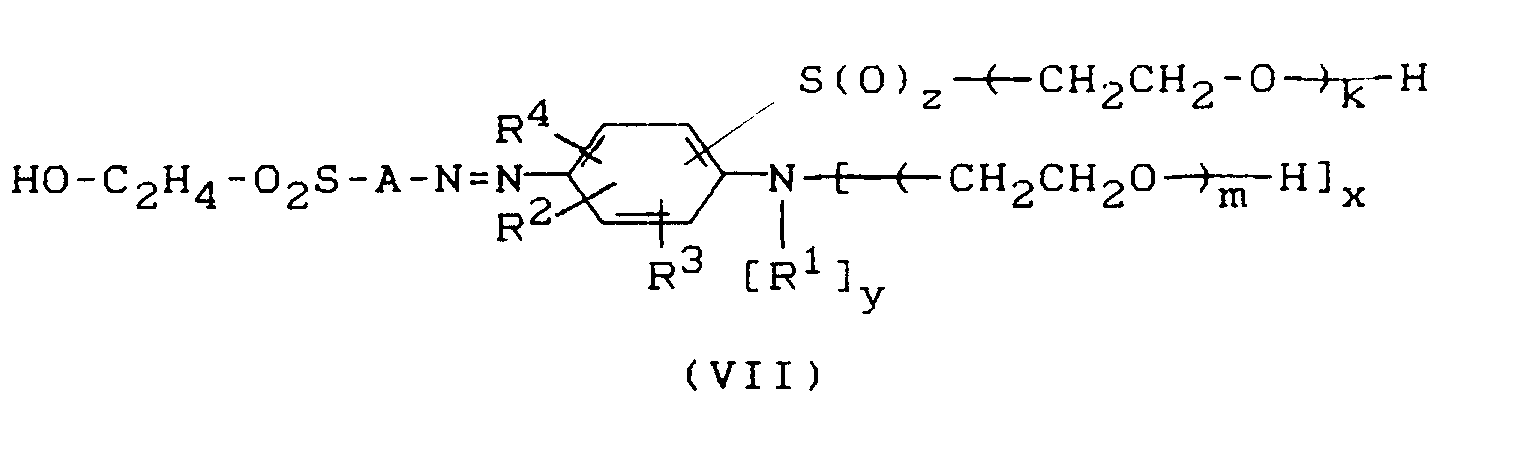 A für 1,2-, 1,3- oder 1,4-Phenylen oder 2,6-Naphthylen steht, das gegebenenfalls durch Methyl, Ethyl, Chlor oder Brom substituiert ist,R², R³ und R⁴ unabhängig voneinander für Wasserstoff, Methyl, Ethyl, n-Propyl, iso-Propyl, Chlor, Acylamino oder Methoxy stehen,undR¹, k, m, x, y und z die in Anspruch 6 genannten Bedeutungen besitzen.
 - Farbstoffe der gemäß Anspruch 6 der Formel
 R¹ für Wasserstoff, Methyl, Ethyl, Benzyl oder 2-Cyanoethyl steht undR², R³ und R⁴ unabhängig voneinander für Wasserstoff, Methyl, Ethyl, Methoxy, Acetylamino oder Chlor stehenund k, m, x, y und z die in Anspruch 6 angeführten Bedeutungen haben.
Applications Claiming Priority (2)
| Application Number | Priority Date | Filing Date | Title |
|---|---|---|---|
| DE4226374 | 1992-08-10 | ||
| DE19924226374 DE4226374A1 (de) | 1992-08-10 | 1992-08-10 | Verfahren zum Färben von Polyurethankunststoffen mit Monoazoeinbaufarbstoffen sowie neue Monoazofarbstoffe |
Publications (1)
| Publication Number | Publication Date |
|---|---|
| EP0584565A1 true EP0584565A1 (de) | 1994-03-02 |
Family
ID=6465203
Family Applications (1)
| Application Number | Title | Priority Date | Filing Date |
|---|---|---|---|
| EP93112043A Withdrawn EP0584565A1 (de) | 1992-08-10 | 1993-07-28 | Verfahren zum Färben von Polyurethankunststoffen mit Monoazoeinbaufarbstoffen sowie neue Monoazofarbstoffe |
Country Status (3)
| Country | Link |
|---|---|
| EP (1) | EP0584565A1 (de) |
| JP (1) | JPH06200173A (de) |
| DE (1) | DE4226374A1 (de) |
Cited By (4)
| Publication number | Priority date | Publication date | Assignee | Title |
|---|---|---|---|---|
| EP0750020A3 (de) * | 1995-06-19 | 1999-04-21 | Eastman Kodak Company | Polymerische Farbstoffe für optische Aufzeichnungsschichten und -elemente |
| WO2007126742A1 (en) * | 2006-03-31 | 2007-11-08 | Milliken & Company | Coated substrates and polymer dispersions suitable for use in making the same |
| US7824737B2 (en) | 2006-03-31 | 2010-11-02 | Milliken & Company | Synthetic leather articles and methods for producing the same |
| US8431648B2 (en) | 2006-03-31 | 2013-04-30 | Milliken & Company | Coated substrates and polymer dispersions suitable for use in making the same |
Families Citing this family (1)
| Publication number | Priority date | Publication date | Assignee | Title |
|---|---|---|---|---|
| DE102008054792A1 (de) * | 2008-12-17 | 2010-06-24 | Dystar Textilfarben Gmbh & Co. Deutschland Kg | Farbstoffe für die Polymerfärbung, Verfahren zu deren Herstellung und deren Verwendung |
Citations (8)
| Publication number | Priority date | Publication date | Assignee | Title |
|---|---|---|---|---|
| DE2426172A1 (de) * | 1974-05-29 | 1975-12-04 | Bayer Ag | Verfahren zum faerben von polyurethankunststoffen |
| DE2426171A1 (de) * | 1974-05-29 | 1975-12-04 | Bayer Ag | Verfahren zum faerben von polyurethankunststoffen |
| US4271072A (en) * | 1977-12-20 | 1981-06-02 | American Hoechst Corporation | Azo dyestuffs containing -SO2 CH2 CH2 OSO3 H and -N(CH2 CH2 OSO3 H)2 groups |
| EP0051808A2 (de) * | 1980-11-06 | 1982-05-19 | Hoechst Aktiengesellschaft | Wasserlösliche Monoazoverbindungen, Verfahren zu ihrer Herstellung und ihre Verwendung als Farbstoffe |
| EP0181585A2 (de) * | 1984-11-12 | 1986-05-21 | Hoechst Aktiengesellschaft | Faserreaktive Monoazoverbindungen, Verfahren zu ihrer Herstellung und ihre Verwendung als Farbstoffe |
| US4751254A (en) * | 1987-01-20 | 1988-06-14 | Milliken Research Corporation | Process for in situ coloration of thermosetting resins |
| EP0431389A2 (de) * | 1989-12-02 | 1991-06-12 | Bayer Ag | Azofarbstoffe und Verfahren zur Herstellung von [5-Amino-2-(2-hydroxyethylamino)phenyl](2-hydroxyethyl)-sulfon |
| EP0520241A2 (de) * | 1991-06-22 | 1992-12-30 | Bayer Ag | Verfahren zur Herstellung von Reaktivfarbstoffen und neue Reaktivfarbstoffe |
-
1992
- 1992-08-10 DE DE19924226374 patent/DE4226374A1/de not_active Withdrawn
-
1993
- 1993-07-28 EP EP93112043A patent/EP0584565A1/de not_active Withdrawn
- 1993-08-05 JP JP5212090A patent/JPH06200173A/ja active Pending
Patent Citations (9)
| Publication number | Priority date | Publication date | Assignee | Title |
|---|---|---|---|---|
| DE2426172A1 (de) * | 1974-05-29 | 1975-12-04 | Bayer Ag | Verfahren zum faerben von polyurethankunststoffen |
| DE2426171A1 (de) * | 1974-05-29 | 1975-12-04 | Bayer Ag | Verfahren zum faerben von polyurethankunststoffen |
| GB1472379A (en) * | 1974-05-29 | 1977-05-04 | Bayer Ag | Process for dyeing polyurethane resins |
| US4271072A (en) * | 1977-12-20 | 1981-06-02 | American Hoechst Corporation | Azo dyestuffs containing -SO2 CH2 CH2 OSO3 H and -N(CH2 CH2 OSO3 H)2 groups |
| EP0051808A2 (de) * | 1980-11-06 | 1982-05-19 | Hoechst Aktiengesellschaft | Wasserlösliche Monoazoverbindungen, Verfahren zu ihrer Herstellung und ihre Verwendung als Farbstoffe |
| EP0181585A2 (de) * | 1984-11-12 | 1986-05-21 | Hoechst Aktiengesellschaft | Faserreaktive Monoazoverbindungen, Verfahren zu ihrer Herstellung und ihre Verwendung als Farbstoffe |
| US4751254A (en) * | 1987-01-20 | 1988-06-14 | Milliken Research Corporation | Process for in situ coloration of thermosetting resins |
| EP0431389A2 (de) * | 1989-12-02 | 1991-06-12 | Bayer Ag | Azofarbstoffe und Verfahren zur Herstellung von [5-Amino-2-(2-hydroxyethylamino)phenyl](2-hydroxyethyl)-sulfon |
| EP0520241A2 (de) * | 1991-06-22 | 1992-12-30 | Bayer Ag | Verfahren zur Herstellung von Reaktivfarbstoffen und neue Reaktivfarbstoffe |
Cited By (5)
| Publication number | Priority date | Publication date | Assignee | Title |
|---|---|---|---|---|
| EP0750020A3 (de) * | 1995-06-19 | 1999-04-21 | Eastman Kodak Company | Polymerische Farbstoffe für optische Aufzeichnungsschichten und -elemente |
| WO2007126742A1 (en) * | 2006-03-31 | 2007-11-08 | Milliken & Company | Coated substrates and polymer dispersions suitable for use in making the same |
| US7824737B2 (en) | 2006-03-31 | 2010-11-02 | Milliken & Company | Synthetic leather articles and methods for producing the same |
| US7872069B2 (en) | 2006-03-31 | 2011-01-18 | Milliken & Company | Coated substrates and polymer dispersions suitable for use in making the same |
| US8431648B2 (en) | 2006-03-31 | 2013-04-30 | Milliken & Company | Coated substrates and polymer dispersions suitable for use in making the same |
Also Published As
| Publication number | Publication date |
|---|---|
| JPH06200173A (ja) | 1994-07-19 |
| DE4226374A1 (de) | 1994-02-17 |
Similar Documents
| Publication | Publication Date | Title |
|---|---|---|
| DE2530809C2 (de) | Verfahren zur Herstellung von gefärbten, gegebenenfalls verschäumten Polyurethankunststoffen | |
| DE2426172C3 (de) | Verfahren zum Färben von Polyurethankunststoffen | |
| DE68921931T2 (de) | Verfahren zur Herstellung von mit Anthraquinon-Farbstoffen gefärbten Polyurethanharzen und Verfahren zu ihrer Herstellung. | |
| DE2019324C3 (de) | Verfahren zur Herstellung von lichtechten Polyurethanionomeren | |
| EP0486881B1 (de) | Nichtwässrige Polyisocyanatzubereitung | |
| US4751254A (en) | Process for in situ coloration of thermosetting resins | |
| CA1147490A (en) | Process for coloring thermosetting resins | |
| EP0000029B1 (de) | Verfahren zur Herstellung von wässrigen Polyurethan-Dispersionen und -Lösungen und deren Verwendung zur Beschichtung von flexiblen Substraten | |
| DE3150174C2 (de) | Urethan-Rheologie-Modifiziermittel, Verfahren zu seiner Herstellung und seine Verwendung | |
| DE2426180A1 (de) | Verfahren zum faerben von polyurethankunststoffen | |
| EP0154768B1 (de) | Verfahren zur Herstellung von Polyurethanen, Polyurethane mit aromatischen Aminoendgruppen und ihre Verwendung | |
| DE2912864A1 (de) | Schichtfoermiges polyurethanmaterial und verfahren zur herstellung des materials | |
| CH623067A5 (de) | ||
| DE3127429A1 (de) | Urethan-rheologie-modifiziermittel, verfahren zu seiner herstellung und es enthaltende ueberzugsmassen | |
| DE112006000180B4 (de) | Feste Pigmentzubereitungen, enthaltend wasserlösliche oberflächenaktive Additive auf Polyurethanbasis, Verfahren zu deren Herstellung sowie deren Verwendung | |
| EP0166566B1 (de) | Harzfarbstoffe und Harzfärbung | |
| DE2425810A1 (de) | Poly(urethan)harnstoff-farbpulver | |
| DE3218272C2 (de) | ||
| DE4226374A1 (de) | Verfahren zum Färben von Polyurethankunststoffen mit Monoazoeinbaufarbstoffen sowie neue Monoazofarbstoffe | |
| DE2426171C3 (de) | Verfahren zum Färben von Polyurethankunststoffen | |
| EP1323769B1 (de) | Verfahren zur Aufbringung von Funktionsmaterialien auf thermoplastisches Polyurethan | |
| DE3629606A1 (de) | Verfahren zur herstellung von magnetischen aufzeichnungstraegern | |
| EP0395955B1 (de) | Pigmentpräparationen | |
| DE4112326A1 (de) | Oligourethan(harnstoffe) als pigmentbindemittel in organischem medium | |
| DE3527038C2 (de) |
Legal Events
| Date | Code | Title | Description |
|---|---|---|---|
| PUAI | Public reference made under article 153(3) epc to a published international application that has entered the european phase |
Free format text: ORIGINAL CODE: 0009012 |
|
| AK | Designated contracting states |
Kind code of ref document: A1 Designated state(s): CH DE FR GB LI |
|
| 17P | Request for examination filed |
Effective date: 19940728 |
|
| STAA | Information on the status of an ep patent application or granted ep patent |
Free format text: STATUS: THE APPLICATION HAS BEEN WITHDRAWN |
|
| 18W | Application withdrawn |
Withdrawal date: 19961209 |