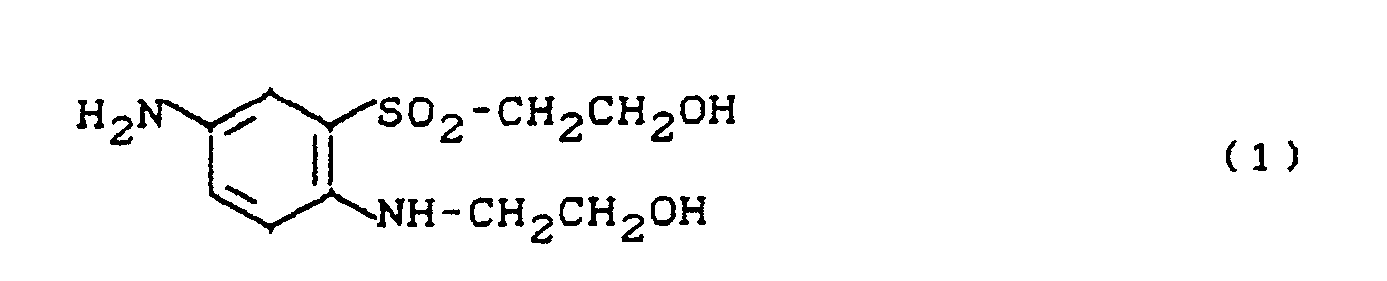
EP0431389A2 - Azofarbstoffe und Verfahren zur Herstellung von [5-Amino-2-(2-hydroxyethylamino)phenyl](2-hydroxyethyl)-sulfon - Google Patents
Azofarbstoffe und Verfahren zur Herstellung von [5-Amino-2-(2-hydroxyethylamino)phenyl](2-hydroxyethyl)-sulfon Download PDFInfo
- Publication number
- EP0431389A2 EP0431389A2 EP90122138A EP90122138A EP0431389A2 EP 0431389 A2 EP0431389 A2 EP 0431389A2 EP 90122138 A EP90122138 A EP 90122138A EP 90122138 A EP90122138 A EP 90122138A EP 0431389 A2 EP0431389 A2 EP 0431389A2
- Authority
- EP
- European Patent Office
- Prior art keywords
- formula
- azo
- dyes
- solution
- amino
- Prior art date
- Legal status (The legal status is an assumption and is not a legal conclusion. Google has not performed a legal analysis and makes no representation as to the accuracy of the status listed.)
- Granted
Links
- 239000000987 azo dye Substances 0.000 title claims description 17
- TZXNFIROZWDBSY-UHFFFAOYSA-N 2-[4-amino-2-(2-hydroxyethylsulfonyl)anilino]ethanol Chemical compound NC1=CC=C(NCCO)C(S(=O)(=O)CCO)=C1 TZXNFIROZWDBSY-UHFFFAOYSA-N 0.000 title claims description 8
- 238000000034 method Methods 0.000 title claims description 7
- 230000008569 process Effects 0.000 title claims description 5
- 238000004519 manufacturing process Methods 0.000 title abstract description 4
- 239000000975 dye Substances 0.000 claims abstract description 27
- 125000005337 azoxy group Chemical group [N+]([O-])(=N*)* 0.000 claims abstract description 15
- 125000000664 diazo group Chemical group [N-]=[N+]=[*] 0.000 claims abstract description 13
- 150000003457 sulfones Chemical class 0.000 claims abstract description 5
- UHOVQNZJYSORNB-UHFFFAOYSA-N Benzene Chemical compound C1=CC=CC=C1 UHOVQNZJYSORNB-UHFFFAOYSA-N 0.000 claims description 12
- IAYPIBMASNFSPL-UHFFFAOYSA-N Ethylene oxide Chemical compound C1CO1 IAYPIBMASNFSPL-UHFFFAOYSA-N 0.000 claims description 11
- IOJUPLGTWVMSFF-UHFFFAOYSA-N benzothiazole Chemical class C1=CC=C2SC=NC2=C1 IOJUPLGTWVMSFF-UHFFFAOYSA-N 0.000 claims description 11
- PAYRUJLWNCNPSJ-UHFFFAOYSA-N Aniline Chemical compound NC1=CC=CC=C1 PAYRUJLWNCNPSJ-UHFFFAOYSA-N 0.000 claims description 10
- UFWIBTONFRDIAS-UHFFFAOYSA-N Naphthalene Chemical compound C1=CC=CC2=CC=CC=C21 UFWIBTONFRDIAS-UHFFFAOYSA-N 0.000 claims description 6
- 238000002360 preparation method Methods 0.000 claims description 6
- 150000001412 amines Chemical class 0.000 claims description 4
- 125000003178 carboxy group Chemical group [H]OC(*)=O 0.000 claims description 4
- 125000000020 sulfo group Chemical group O=S(=O)([*])O[H] 0.000 claims description 4
- 150000001448 anilines Chemical class 0.000 claims description 3
- 239000012431 aqueous reaction media Substances 0.000 claims description 3
- 125000001072 heteroaryl group Chemical group 0.000 claims description 3
- NYGZLYXAPMMJTE-UHFFFAOYSA-M metanil yellow Chemical group [Na+].[O-]S(=O)(=O)C1=CC=CC(N=NC=2C=CC(NC=3C=CC=CC=3)=CC=2)=C1 NYGZLYXAPMMJTE-UHFFFAOYSA-M 0.000 claims description 2
- SHLOJACMEFWARO-UHFFFAOYSA-N n-(2-hydroxyethyl)-n-phenylacetamide Chemical class OCCN(C(=O)C)C1=CC=CC=C1 SHLOJACMEFWARO-UHFFFAOYSA-N 0.000 claims 1
- 239000000243 solution Substances 0.000 description 42
- XLYOFNOQVPJJNP-UHFFFAOYSA-N water Substances O XLYOFNOQVPJJNP-UHFFFAOYSA-N 0.000 description 32
- 238000006243 chemical reaction Methods 0.000 description 18
- 238000005160 1H NMR spectroscopy Methods 0.000 description 16
- IAZDPXIOMUYVGZ-WFGJKAKNSA-N Dimethyl sulfoxide Chemical compound [2H]C([2H])([2H])S(=O)C([2H])([2H])[2H] IAZDPXIOMUYVGZ-WFGJKAKNSA-N 0.000 description 15
- 239000000203 mixture Substances 0.000 description 13
- 230000009467 reduction Effects 0.000 description 11
- 238000006722 reduction reaction Methods 0.000 description 11
- FAPWRFPIFSIZLT-UHFFFAOYSA-M Sodium chloride Chemical compound [Na+].[Cl-] FAPWRFPIFSIZLT-UHFFFAOYSA-M 0.000 description 9
- 235000002639 sodium chloride Nutrition 0.000 description 9
- -1 2-hydroxyethylamino Chemical group 0.000 description 7
- MHAJPDPJQMAIIY-UHFFFAOYSA-N Hydrogen peroxide Chemical compound OO MHAJPDPJQMAIIY-UHFFFAOYSA-N 0.000 description 7
- 238000005859 coupling reaction Methods 0.000 description 7
- 230000003647 oxidation Effects 0.000 description 7
- 238000007254 oxidation reaction Methods 0.000 description 7
- IJGRMHOSHXDMSA-UHFFFAOYSA-N Atomic nitrogen Chemical compound N#N IJGRMHOSHXDMSA-UHFFFAOYSA-N 0.000 description 6
- VEXZGXHMUGYJMC-UHFFFAOYSA-N Hydrochloric acid Chemical compound Cl VEXZGXHMUGYJMC-UHFFFAOYSA-N 0.000 description 6
- CDBYLPFSWZWCQE-UHFFFAOYSA-L Sodium Carbonate Chemical compound [Na+].[Na+].[O-]C([O-])=O CDBYLPFSWZWCQE-UHFFFAOYSA-L 0.000 description 6
- HEMHJVSKTPXQMS-UHFFFAOYSA-M Sodium hydroxide Chemical compound [OH-].[Na+] HEMHJVSKTPXQMS-UHFFFAOYSA-M 0.000 description 6
- LFQSCWFLJHTTHZ-UHFFFAOYSA-N Ethanol Chemical compound CCO LFQSCWFLJHTTHZ-UHFFFAOYSA-N 0.000 description 5
- 230000008878 coupling Effects 0.000 description 5
- 238000010168 coupling process Methods 0.000 description 5
- 239000012458 free base Substances 0.000 description 5
- 239000011780 sodium chloride Substances 0.000 description 5
- 0 Cc(cccc1)c1N(*)** Chemical compound Cc(cccc1)c1N(*)** 0.000 description 4
- LYCAIKOWRPUZTN-UHFFFAOYSA-N Ethylene glycol Chemical compound OCCO LYCAIKOWRPUZTN-UHFFFAOYSA-N 0.000 description 4
- WCUXLLCKKVVCTQ-UHFFFAOYSA-M Potassium chloride Chemical compound [Cl-].[K+] WCUXLLCKKVVCTQ-UHFFFAOYSA-M 0.000 description 4
- NPXOKRUENSOPAO-UHFFFAOYSA-N Raney nickel Chemical compound [Al].[Ni] NPXOKRUENSOPAO-UHFFFAOYSA-N 0.000 description 4
- 229910000564 Raney nickel Inorganic materials 0.000 description 4
- QAOWNCQODCNURD-UHFFFAOYSA-N Sulfuric acid Chemical compound OS(O)(=O)=O QAOWNCQODCNURD-UHFFFAOYSA-N 0.000 description 4
- 238000007792 addition Methods 0.000 description 4
- 239000012736 aqueous medium Substances 0.000 description 4
- 239000003054 catalyst Substances 0.000 description 4
- 150000001875 compounds Chemical class 0.000 description 4
- 239000003995 emulsifying agent Substances 0.000 description 4
- 239000001257 hydrogen Substances 0.000 description 4
- 229910052739 hydrogen Inorganic materials 0.000 description 4
- 239000000543 intermediate Substances 0.000 description 4
- 229910052757 nitrogen Inorganic materials 0.000 description 4
- 239000000047 product Substances 0.000 description 4
- 150000003839 salts Chemical class 0.000 description 4
- LPXPTNMVRIOKMN-UHFFFAOYSA-M sodium nitrite Chemical compound [Na+].[O-]N=O LPXPTNMVRIOKMN-UHFFFAOYSA-M 0.000 description 4
- 125000001424 substituent group Chemical group 0.000 description 4
- FFRBMBIXVSCUFS-UHFFFAOYSA-N 2,4-dinitro-1-naphthol Chemical compound C1=CC=C2C(O)=C([N+]([O-])=O)C=C([N+]([O-])=O)C2=C1 FFRBMBIXVSCUFS-UHFFFAOYSA-N 0.000 description 3
- ZEHUKMUPQAYMII-UHFFFAOYSA-N 2-[2-(2-hydroxyethylsulfanyl)anilino]ethanol Chemical compound OCCNC1=CC=CC=C1SCCO ZEHUKMUPQAYMII-UHFFFAOYSA-N 0.000 description 3
- QTBSBXVTEAMEQO-UHFFFAOYSA-N Acetic acid Chemical compound CC(O)=O QTBSBXVTEAMEQO-UHFFFAOYSA-N 0.000 description 3
- UFHFLCQGNIYNRP-UHFFFAOYSA-N Hydrogen Chemical compound [H][H] UFHFLCQGNIYNRP-UHFFFAOYSA-N 0.000 description 3
- OKKJLVBELUTLKV-UHFFFAOYSA-N Methanol Chemical compound OC OKKJLVBELUTLKV-UHFFFAOYSA-N 0.000 description 3
- 238000005481 NMR spectroscopy Methods 0.000 description 3
- VMHLLURERBWHNL-UHFFFAOYSA-M Sodium acetate Chemical compound [Na+].CC([O-])=O VMHLLURERBWHNL-UHFFFAOYSA-M 0.000 description 3
- 239000002253 acid Substances 0.000 description 3
- 238000006193 diazotization reaction Methods 0.000 description 3
- 239000000155 melt Substances 0.000 description 3
- 239000003921 oil Substances 0.000 description 3
- 239000001632 sodium acetate Substances 0.000 description 3
- 235000017281 sodium acetate Nutrition 0.000 description 3
- 229910000029 sodium carbonate Inorganic materials 0.000 description 3
- XMVONEAAOPAGAO-UHFFFAOYSA-N sodium tungstate Chemical compound [Na+].[Na+].[O-][W]([O-])(=O)=O XMVONEAAOPAGAO-UHFFFAOYSA-N 0.000 description 3
- IIACRCGMVDHOTQ-UHFFFAOYSA-N sulfamic acid Chemical class NS(O)(=O)=O IIACRCGMVDHOTQ-UHFFFAOYSA-N 0.000 description 3
- 239000000725 suspension Substances 0.000 description 3
- UGNWTBMOAKPKBL-UHFFFAOYSA-N tetrachloro-1,4-benzoquinone Chemical compound ClC1=C(Cl)C(=O)C(Cl)=C(Cl)C1=O UGNWTBMOAKPKBL-UHFFFAOYSA-N 0.000 description 3
- RUFPHBVGCFYCNW-UHFFFAOYSA-N 1-naphthylamine Chemical compound C1=CC=C2C(N)=CC=CC2=C1 RUFPHBVGCFYCNW-UHFFFAOYSA-N 0.000 description 2
- MWGATWIBSKHFMR-UHFFFAOYSA-N 2-anilinoethanol Chemical class OCCNC1=CC=CC=C1 MWGATWIBSKHFMR-UHFFFAOYSA-N 0.000 description 2
- DXYYSGDWQCSKKO-UHFFFAOYSA-N 2-methylbenzothiazole Chemical compound C1=CC=C2SC(C)=NC2=C1 DXYYSGDWQCSKKO-UHFFFAOYSA-N 0.000 description 2
- HVBSAKJJOYLTQU-UHFFFAOYSA-N 4-aminobenzenesulfonic acid Chemical compound NC1=CC=C(S(O)(=O)=O)C=C1 HVBSAKJJOYLTQU-UHFFFAOYSA-N 0.000 description 2
- FZERHIULMFGESH-UHFFFAOYSA-N N-phenylacetamide Chemical class CC(=O)NC1=CC=CC=C1 FZERHIULMFGESH-UHFFFAOYSA-N 0.000 description 2
- 230000002378 acidificating effect Effects 0.000 description 2
- 150000007513 acids Chemical class 0.000 description 2
- 239000002585 base Substances 0.000 description 2
- 239000012230 colorless oil Substances 0.000 description 2
- 238000001816 cooling Methods 0.000 description 2
- 238000001035 drying Methods 0.000 description 2
- 239000000839 emulsion Substances 0.000 description 2
- 238000001914 filtration Methods 0.000 description 2
- 125000002485 formyl group Chemical group [H]C(*)=O 0.000 description 2
- WGCNASOHLSPBMP-UHFFFAOYSA-N hydroxyacetaldehyde Natural products OCC=O WGCNASOHLSPBMP-UHFFFAOYSA-N 0.000 description 2
- 238000006386 neutralization reaction Methods 0.000 description 2
- 230000020477 pH reduction Effects 0.000 description 2
- 229920000151 polyglycol Polymers 0.000 description 2
- 239000010695 polyglycol Substances 0.000 description 2
- 239000001103 potassium chloride Substances 0.000 description 2
- 235000011164 potassium chloride Nutrition 0.000 description 2
- 239000002244 precipitate Substances 0.000 description 2
- 238000001953 recrystallisation Methods 0.000 description 2
- 238000005185 salting out Methods 0.000 description 2
- JVBXVOWTABLYPX-UHFFFAOYSA-L sodium dithionite Chemical compound [Na+].[Na+].[O-]S(=O)S([O-])=O JVBXVOWTABLYPX-UHFFFAOYSA-L 0.000 description 2
- 235000010288 sodium nitrite Nutrition 0.000 description 2
- 238000001256 steam distillation Methods 0.000 description 2
- 238000003756 stirring Methods 0.000 description 2
- 229950000244 sulfanilic acid Drugs 0.000 description 2
- 150000003462 sulfoxides Chemical class 0.000 description 2
- 238000004809 thin layer chromatography Methods 0.000 description 2
- JKVBWACRUUUEAR-UHFFFAOYSA-N (4-chlorophenyl)sulfanyl-(2,4,5-trichlorophenyl)diazene Chemical compound C1=CC(Cl)=CC=C1SN=NC1=CC(Cl)=C(Cl)C=C1Cl JKVBWACRUUUEAR-UHFFFAOYSA-N 0.000 description 1
- CMOLPZZVECHXKN-UHFFFAOYSA-N 7-aminonaphthalene-1,3-disulfonic acid Chemical compound C1=C(S(O)(=O)=O)C=C(S(O)(=O)=O)C2=CC(N)=CC=C21 CMOLPZZVECHXKN-UHFFFAOYSA-N 0.000 description 1
- WQZGKKKJIJFFOK-GASJEMHNSA-N Glucose Natural products OC[C@H]1OC(O)[C@H](O)[C@@H](O)[C@@H]1O WQZGKKKJIJFFOK-GASJEMHNSA-N 0.000 description 1
- 238000004566 IR spectroscopy Methods 0.000 description 1
- DGAQECJNVWCQMB-PUAWFVPOSA-M Ilexoside XXIX Chemical compound C[C@@H]1CC[C@@]2(CC[C@@]3(C(=CC[C@H]4[C@]3(CC[C@@H]5[C@@]4(CC[C@@H](C5(C)C)OS(=O)(=O)[O-])C)C)[C@@H]2[C@]1(C)O)C)C(=O)O[C@H]6[C@@H]([C@H]([C@@H]([C@H](O6)CO)O)O)O.[Na+] DGAQECJNVWCQMB-PUAWFVPOSA-M 0.000 description 1
- MUTUILFALMARAO-UHFFFAOYSA-N NC1=C2C=CC=C(C2=CC=C1)S(=O)(=O)O.NC1=CC=C(C2=CC=CC=C12)S(=O)(=O)O.NC1=C(C=2C=CC=C(C2C=C1)S(=O)(=O)O)S(=O)(=O)O.NC1=CC=C2C=C(C=C(C2=C1)S(=O)(=O)O)S(=O)(=O)O.NC=1C=C2C=CC(=CC2=CC1)S(=O)(=O)O Chemical compound NC1=C2C=CC=C(C2=CC=C1)S(=O)(=O)O.NC1=CC=C(C2=CC=CC=C12)S(=O)(=O)O.NC1=C(C=2C=CC=C(C2C=C1)S(=O)(=O)O)S(=O)(=O)O.NC1=CC=C2C=C(C=C(C2=C1)S(=O)(=O)O)S(=O)(=O)O.NC=1C=C2C=CC(=CC2=CC1)S(=O)(=O)O MUTUILFALMARAO-UHFFFAOYSA-N 0.000 description 1
- IOVCWXUNBOPUCH-UHFFFAOYSA-M Nitrite anion Chemical compound [O-]N=O IOVCWXUNBOPUCH-UHFFFAOYSA-M 0.000 description 1
- 239000004952 Polyamide Substances 0.000 description 1
- ZLMJMSJWJFRBEC-UHFFFAOYSA-N Potassium Chemical compound [K] ZLMJMSJWJFRBEC-UHFFFAOYSA-N 0.000 description 1
- 239000007868 Raney catalyst Substances 0.000 description 1
- KEAYESYHFKHZAL-UHFFFAOYSA-N Sodium Chemical class [Na] KEAYESYHFKHZAL-UHFFFAOYSA-N 0.000 description 1
- XSQUKJJJFZCRTK-UHFFFAOYSA-N Urea Chemical compound NC(N)=O XSQUKJJJFZCRTK-UHFFFAOYSA-N 0.000 description 1
- 238000005903 acid hydrolysis reaction Methods 0.000 description 1
- 150000001298 alcohols Chemical class 0.000 description 1
- 150000001447 alkali salts Chemical class 0.000 description 1
- 238000005904 alkaline hydrolysis reaction Methods 0.000 description 1
- 125000003282 alkyl amino group Chemical group 0.000 description 1
- 125000000217 alkyl group Chemical group 0.000 description 1
- 125000004390 alkyl sulfonyl group Chemical group 0.000 description 1
- 229940045985 antineoplastic platinum compound Drugs 0.000 description 1
- 239000007864 aqueous solution Substances 0.000 description 1
- 230000008901 benefit Effects 0.000 description 1
- 235000010233 benzoic acid Nutrition 0.000 description 1
- 150000001559 benzoic acids Chemical class 0.000 description 1
- WQZGKKKJIJFFOK-VFUOTHLCSA-N beta-D-glucose Chemical compound OC[C@H]1O[C@@H](O)[C@H](O)[C@@H](O)[C@@H]1O WQZGKKKJIJFFOK-VFUOTHLCSA-N 0.000 description 1
- 230000015572 biosynthetic process Effects 0.000 description 1
- 239000004202 carbamide Substances 0.000 description 1
- 229910052799 carbon Inorganic materials 0.000 description 1
- 230000003197 catalytic effect Effects 0.000 description 1
- 238000010531 catalytic reduction reaction Methods 0.000 description 1
- 230000008859 change Effects 0.000 description 1
- 238000004440 column chromatography Methods 0.000 description 1
- 238000009833 condensation Methods 0.000 description 1
- 230000005494 condensation Effects 0.000 description 1
- 239000013078 crystal Substances 0.000 description 1
- 125000004663 dialkyl amino group Chemical group 0.000 description 1
- 238000004821 distillation Methods 0.000 description 1
- 238000004043 dyeing Methods 0.000 description 1
- 238000007046 ethoxylation reaction Methods 0.000 description 1
- 230000002349 favourable effect Effects 0.000 description 1
- 239000000835 fiber Substances 0.000 description 1
- DYDNPESBYVVLBO-UHFFFAOYSA-N formanilide Chemical group O=CNC1=CC=CC=C1 DYDNPESBYVVLBO-UHFFFAOYSA-N 0.000 description 1
- 239000008103 glucose Substances 0.000 description 1
- 238000010438 heat treatment Methods 0.000 description 1
- 150000002431 hydrogen Chemical class 0.000 description 1
- 238000002955 isolation Methods 0.000 description 1
- 239000010985 leather Substances 0.000 description 1
- 229910003002 lithium salt Inorganic materials 0.000 description 1
- 159000000002 lithium salts Chemical class 0.000 description 1
- 238000001819 mass spectrum Methods 0.000 description 1
- 238000002844 melting Methods 0.000 description 1
- 230000008018 melting Effects 0.000 description 1
- UKVIEHSSVKSQBA-UHFFFAOYSA-N methane;palladium Chemical compound C.[Pd] UKVIEHSSVKSQBA-UHFFFAOYSA-N 0.000 description 1
- GBMDVOWEEQVZKZ-UHFFFAOYSA-N methanol;hydrate Chemical compound O.OC GBMDVOWEEQVZKZ-UHFFFAOYSA-N 0.000 description 1
- 125000001624 naphthyl group Chemical group 0.000 description 1
- 125000004433 nitrogen atom Chemical group N* 0.000 description 1
- 239000003960 organic solvent Substances 0.000 description 1
- 239000007800 oxidant agent Substances 0.000 description 1
- JRKICGRDRMAZLK-UHFFFAOYSA-L persulfate group Chemical group S(=O)(=O)([O-])OOS(=O)(=O)[O-] JRKICGRDRMAZLK-UHFFFAOYSA-L 0.000 description 1
- 239000003444 phase transfer catalyst Substances 0.000 description 1
- 125000001997 phenyl group Chemical group [H]C1=C([H])C([H])=C(*)C([H])=C1[H] 0.000 description 1
- 150000003058 platinum compounds Chemical class 0.000 description 1
- 229920002647 polyamide Polymers 0.000 description 1
- 229910052700 potassium Inorganic materials 0.000 description 1
- 239000011591 potassium Substances 0.000 description 1
- 239000000843 powder Substances 0.000 description 1
- 238000001556 precipitation Methods 0.000 description 1
- 230000005588 protonation Effects 0.000 description 1
- 150000003254 radicals Chemical class 0.000 description 1
- 239000012429 reaction media Substances 0.000 description 1
- 229910052708 sodium Inorganic materials 0.000 description 1
- 239000011734 sodium Substances 0.000 description 1
- 239000000126 substance Substances 0.000 description 1
- 125000005420 sulfonamido group Chemical group S(=O)(=O)(N*)* 0.000 description 1
- 238000003786 synthesis reaction Methods 0.000 description 1
- 238000001665 trituration Methods 0.000 description 1
- 210000002268 wool Anatomy 0.000 description 1
- 239000001043 yellow dye Substances 0.000 description 1
Classifications
-
- C—CHEMISTRY; METALLURGY
- C09—DYES; PAINTS; POLISHES; NATURAL RESINS; ADHESIVES; COMPOSITIONS NOT OTHERWISE PROVIDED FOR; APPLICATIONS OF MATERIALS NOT OTHERWISE PROVIDED FOR
- C09B—ORGANIC DYES OR CLOSELY-RELATED COMPOUNDS FOR PRODUCING DYES, e.g. PIGMENTS; MORDANTS; LAKES
- C09B29/00—Monoazo dyes prepared by diazotising and coupling
- C09B29/06—Monoazo dyes prepared by diazotising and coupling from coupling components containing amino as the only directing group
- C09B29/08—Amino benzenes
- C09B29/0805—Amino benzenes free of acid groups
- C09B29/0807—Amino benzenes free of acid groups characterised by the amino group
- C09B29/0809—Amino benzenes free of acid groups characterised by the amino group substituted amino group
- C09B29/0811—Amino benzenes free of acid groups characterised by the amino group substituted amino group further substituted alkylamino, alkenylamino, alkynylamino, cycloalkylamino aralkylamino or arylamino
- C09B29/0813—Amino benzenes free of acid groups characterised by the amino group substituted amino group further substituted alkylamino, alkenylamino, alkynylamino, cycloalkylamino aralkylamino or arylamino substituted by OH, O-C(=X)-R, O-C(=X)-X-R, O-R (X being O,S,NR; R being hydrocarbonyl)
-
- C—CHEMISTRY; METALLURGY
- C07—ORGANIC CHEMISTRY
- C07C—ACYCLIC OR CARBOCYCLIC COMPOUNDS
- C07C315/00—Preparation of sulfones; Preparation of sulfoxides
- C07C315/04—Preparation of sulfones; Preparation of sulfoxides by reactions not involving the formation of sulfone or sulfoxide groups
-
- C—CHEMISTRY; METALLURGY
- C07—ORGANIC CHEMISTRY
- C07C—ACYCLIC OR CARBOCYCLIC COMPOUNDS
- C07C317/00—Sulfones; Sulfoxides
- C07C317/26—Sulfones; Sulfoxides having sulfone or sulfoxide groups and nitrogen atoms, not being part of nitro or nitroso groups, bound to the same carbon skeleton
- C07C317/32—Sulfones; Sulfoxides having sulfone or sulfoxide groups and nitrogen atoms, not being part of nitro or nitroso groups, bound to the same carbon skeleton with sulfone or sulfoxide groups bound to carbon atoms of six-membered aromatic rings of the carbon skeleton
- C07C317/34—Sulfones; Sulfoxides having sulfone or sulfoxide groups and nitrogen atoms, not being part of nitro or nitroso groups, bound to the same carbon skeleton with sulfone or sulfoxide groups bound to carbon atoms of six-membered aromatic rings of the carbon skeleton having sulfone or sulfoxide groups and amino groups bound to carbon atoms of six-membered aromatic rings being part of the same non-condensed ring or of a condensed ring system containing that ring
- C07C317/36—Sulfones; Sulfoxides having sulfone or sulfoxide groups and nitrogen atoms, not being part of nitro or nitroso groups, bound to the same carbon skeleton with sulfone or sulfoxide groups bound to carbon atoms of six-membered aromatic rings of the carbon skeleton having sulfone or sulfoxide groups and amino groups bound to carbon atoms of six-membered aromatic rings being part of the same non-condensed ring or of a condensed ring system containing that ring with the nitrogen atoms of the amino groups bound to hydrogen atoms or to carbon atoms
-
- C—CHEMISTRY; METALLURGY
- C09—DYES; PAINTS; POLISHES; NATURAL RESINS; ADHESIVES; COMPOSITIONS NOT OTHERWISE PROVIDED FOR; APPLICATIONS OF MATERIALS NOT OTHERWISE PROVIDED FOR
- C09B—ORGANIC DYES OR CLOSELY-RELATED COMPOUNDS FOR PRODUCING DYES, e.g. PIGMENTS; MORDANTS; LAKES
- C09B43/00—Preparation of azo dyes from other azo compounds
- C09B43/06—Preparation of azo dyes from other azo compounds by oxidation
-
- C—CHEMISTRY; METALLURGY
- C09—DYES; PAINTS; POLISHES; NATURAL RESINS; ADHESIVES; COMPOSITIONS NOT OTHERWISE PROVIDED FOR; APPLICATIONS OF MATERIALS NOT OTHERWISE PROVIDED FOR
- C09B—ORGANIC DYES OR CLOSELY-RELATED COMPOUNDS FOR PRODUCING DYES, e.g. PIGMENTS; MORDANTS; LAKES
- C09B62/00—Reactive dyes, i.e. dyes which form covalent bonds with the substrates or which polymerise with themselves
- C09B62/44—Reactive dyes, i.e. dyes which form covalent bonds with the substrates or which polymerise with themselves with the reactive group not directly attached to a heterocyclic ring
- C09B62/503—Reactive dyes, i.e. dyes which form covalent bonds with the substrates or which polymerise with themselves with the reactive group not directly attached to a heterocyclic ring the reactive group being an esterified or non-esterified hydroxyalkyl sulfonyl or mercaptoalkyl sulfonyl group, a quaternised or non-quaternised aminoalkyl sulfonyl group, a heterylmercapto alkyl sulfonyl group, a vinyl sulfonyl or a substituted vinyl sulfonyl group, or a thiophene-dioxide group
- C09B62/507—Azo dyes
- C09B62/51—Monoazo dyes
Definitions
- N ⁇ acetyl-N- (2-hydroxyethyl) aniline derivatives of the formula reacted, then to the aniline derivative of the formula hydrolyzed this with a diazotized amine D-NH 2 to monoazo dyes of the formula kuppeit, the azo dyes (5) to azo / azoxy dyes of the formula oxidized and finally this reductively cleaves to D- in a manner known per se NH2 and (1).
- the invention also relates to the new azo and azo / azoxy dyes of the formulas (5) and (6).
- D represents the rest of a diazo component, in particular from the benzene, naphthalene or hetaryl series.
- D can be substituted by conventional substituents, for example Cl, Br, F, C1-C4 -Alkyl, C1-C4 -Alkoxy, carbalkoxy, carboxy, amino, alkylamino, dialkylamino, sulfonamido, alkylsulfonyl and in particular sulfo.
- substituents for example Cl, Br, F, C1-C4 -Alkyl, C1-C4 -Alkoxy, carbalkoxy, carboxy, amino, alkylamino, dialkylamino, sulfonamido, alkylsulfonyl and in particular sulfo.
- substituents are preferred which do not undergo any change during the oxidation and reduction.
- the alkyl groups can have customary substituents,
- Diazo components containing sulfo groups or carboxy groups offer the advantage that the oxidation and the reduction can be carried out in an aqueous reaction medium.
- Azo or azo / azoxy dyes of the formulas are particularly preferred and since the reduction of (8) only gives (1), (7) can be prepared by diazotizing (1) and domes on (4),
- the reaction of the benzothiazoles (2) with excess ethylene oxide is preferably carried out in water at temperatures between 20 to 120 ° C, preferably between 40 to 90 ° C, and in an autoclave under 0.2 to 2.0 bar pressure carried out.
- the ethylene oxide is metered in so that a pH of 8 to 12, preferably 9.0 to 10.5, is established.
- the intermediate stages are likely run through, the aqueous benzothiazoles (2) are surprisingly obtained by simple ethylene oxide addition of 2- (2-hydroxyethylmercapto) -N-acyl-N- (2-hydroxyethyl) aniline of the formula (3).
- the ethoxylation reaction can also be carried out in a reaction medium composed of water and a water-miscible organic solvent. Additions of emulsifiers or phase transfer catalysts can accelerate the reaction. In principle, the reaction solutions can be directly implemented.
- the N-formyl or N-acetylaniline derivative of the formula (3) is both under acidic and under alkaline reaction conditions at temperatures from 80 to 120 ° C, optionally under pressure, hydrolyzable.
- the free aniline base of the formula (4) separates out as an oily phase at pH values above 7, ie under alkaline conditions.
- the coupling of (4) with diazotized amines D-NH2 to dyes of the formula (5) takes place most advantageously at 0 to 30 ° C and a pH range of 1.0 to 5.0 in an aqueous medium.
- the use of emulsifiers or coupling accelerators, such as urea can prove to be advantageous.
- the dyes (5) are usually obtained as crystalline compounds or can be salted out as such. Since the coupling reactions are relatively uniform in most cases, it is often possible to oxidize directly to (5) to azo / azoxy dyes of the formula (6) without intermediate isolation.
- the use of hydrogen peroxide in the presence of catalytic amounts of tungstates has proven to be advantageous.
- the oxidation takes place in an aqueous medium at 20 to 100 ° C., preferably at 40 to 80 ° C. and pH values from 6 to 8.
- aqueous medium at 20 to 100 ° C., preferably at 40 to 80 ° C. and pH values from 6 to 8.
- the corresponding sulfoxide compounds of the formula are used as intermediates go through what can be followed chromatographically.
- suitable oxidizing agents are, for example, perborates, persulfates or persulfonic acids.
- the azo / azoxy dyes of the formula (6) can be isolated as yellow to red, crystalline, water-soluble compounds. Their protonation solutions show a clear bathochromic shift.
- the azo component predominates in most dyes (6); as a rule, the azoxy content is limited to 5%, as in, for example, (8).
- the azo dye (8a) can be obtained relatively uniformly by recrystallization from water or alcohol.
- the reduction of (6) or (8) or (8a) to (1) and D-NH2 can be carried out by methods as described by R. Schröter in the manual for preparative methods of organic chemistry, Houben-Weyl, Volume XI, Part 1, pages 522 to 531.
- a reduction with sodium dithionite or glucose or a catalytic reduction with hydrogen proves to be favorable.
- Raney nickel, palladium-carbon or platinum compounds are primarily suitable as catalysts for this.
- the reductions are preferably carried out in water, water / alcohol mixtures or alcohols at 20 to 80 ° C.
- (1) can be directly implemented in this form, e.g. can be condensed with chloranil or diazotized, or isolated as a crystalline substance by concentrating the solution.
- aromatic amino carboxylic acids or aminosulfonic acids are appropriately used as diazo components, such as, for example 2-amino-benzoic acid 4-amino-benzoic acid 2-amino-benzenesulfonic acid 3-amino-benzenesulfonic acid 4-amino-benzenesulfonic acid 2-amino-4-methylbenzenesulfonic acid 6-amino-2-naphthalenesulfonic acid 7-amino-1,3-naphthalenedisulfonic acid 2-amino-1,5-naphthalenedisulfonic acid 4-amino-1-naphthalenesulfonic acid 5-amino-1-naphthalenesulfonic acid and others
- solutions usually result from which the benzoic acids or the aminosulfonic acids can be separated and separated as betaines by acidification and optionally salting out.
- (1) remains in the acidic aqueous solution and can be isolated or further reacted as already described. If one chooses aniline or ⁇ -naphthylamine as possible diazo components, after reduction the same can be separated from (1) by means of steam distillation. Other volatile aniline derivatives are also suitable as diazo components.
- the compound (1) is used, for example, for the production of interesting azo dyes, such as Example 17 from DOS 3 512 340 or Example 5 from EP 279 351 and for the production of triphendioxazine dyes, such as Example 1 from EP 153 599 Azo dyes of the formulas (5) and (6) are used for dyeing paper, wool, synthetic polyamide fibers or leather. Clear, brilliant yellow colorations are obtained.
- interesting azo dyes such as Example 17 from DOS 3 512 340 or Example 5 from EP 279 351
- triphendioxazine dyes such as Example 1 from EP 153 599
- Azo dyes of the formulas (5) and (6) are used for dyeing paper, wool, synthetic polyamide fibers or leather. Clear, brilliant yellow colorations are obtained.
- the formulas given for azo dyes containing sulfo groups and carboxy groups are those of the free acids.
- the salts are generally obtained in the preparation, in particular the alkali salts, such as sodium, potassium or lithium salts.
- reaction solution from Example 1 800 ml of reaction solution from Example 1 are mixed with 200 ml of 70% sulfuric acid and heated to 90-95 ° C for one hour. It is then cooled and neutralized with concentrated sodium hydroxide solution with external cooling and then adjusted to pH 12.5. A colorless oil separates out.
- Example 4 If the diazo component is varied in Example 4, further interesting dyes with azosulfide and azo / azoxysulfone structure can be prepared analogously to the coupling instructions (Example 4) and oxidation instructions (Example 5):
Landscapes
- Chemical & Material Sciences (AREA)
- Organic Chemistry (AREA)
- Chemical Kinetics & Catalysis (AREA)
- Organic Low-Molecular-Weight Compounds And Preparation Thereof (AREA)
- Coloring (AREA)
Abstract

reduktiv zu spalten. Gegenstand der Erfindung sind auch die genannten Azo/ Azoxyfarbstoffe.
Description
- Azofarbstoffe und Verfahren zur Herstellung von [5-Amino-2-(2-hydroxyethylamino)phenyl](z-hydroxyethyl)-sulfon
- Gegenstand der Erfindung ist ein Verfahren zur Herstellung von [5-Amino-2-(2-hydroxyethylamino)phenyl](2-hy-droxyethyl)sulfon der Formel


NH₂
und (1). - Gegenstand der Erfindung sind auch die neuen Azo- bzw. Azo/Azoxy-Farbstoffe der Formeln (5) und (6).
- D steht für den Rest einer Diazokomponente, insbesondere aus der Benzol-, Naphthalin- oder Hetaryl-Reihe.
- D kann durch übliche Substituenten substituiert sein, beispielsweise
Cl, Br, F, C₁-C₄
-Alkyl,
C₁-C₄
-Alkoxy, Carbalkoxy, Carboxy, Amino, Alkylamino, Dialkylamino, Sulfonamido, Alkylsulfonyl und insbesondere Sulfo, Es sind vorzugsweise solche Substituenten geeignet, die während der Oxidation und Reduktion keine Veränderung erfahren. Die Alkylgruppen können übliche Substituenten aufweisen, - Bevorzugt sind solche Azo- bzw. Azo/Azoxy-Farbstoffe der Formeln (5) und (6), worin der Rest D so gewählt ist, daß nach der Reduktion von (6) zu D-
NH₂
und (1) die Diazokomponente D-
NH₂
leicht abgetrennt und wieder in die Synthesefolge eingesetzt werden kann. Derartige Reste D sind beispielsweise

Cl, Br, C₁-C₄-
Alkyl,
C₁-C₄
-Alkoxy oder Carboxy. - Sulfogruppenhaltige oder carboxygruppenhaltige Diazokomponenten bieten den Vorteil, daß die Oxidation sowie die Reduktion in wäßrigem Reaktionsmedium durchgeführt werden können.
- Besonders bevorzugt sind Azo- bzw. Azo/Azoxy-Farbstoffe der Formeln


- Die Umsetzung der Benzothiazole (2) mit überschüssigem Ethylenoxid wird bevorzugt in Wasser bei Temperaturen zwischen 20 bis 120°C, vorzugsweise zwischen 40 bis 90°C, sowie im Autoklaven unter 0,2 bis 2,0 bar Druck durchgeführt. Das Ethylenoxid wird dabei so zudosiert, daß sich ein pH-Wert von 8 bis 12, vorzugsweise von 9,0 bis 10,5, einstellt. Vermutlich werden dabei die Zwischenstufen

- Die Ethoxylierungsreaktion kann auch in einem Reaktionsmedium, das sich aus Wasser und einem wassermischbaren organischen Lösemittel zusammensetzt, durchgeführt werden. Zusätze von Emulgatoren oder Phasentransferkatalysatoren können die Reaktion beschleunigen. Die Reaktionslösungen können im Prinzip direkt weiter umgesetzt werden.
- Das N-Formyl- bzw. N-Acetylanilin-Derivat der Formel (3) ist sowohl unter sauren wie unter alkalischen Reaktions bedingungen bei Temperaturen von 80 bis 120°C, gegebenenfalls unter Druck, hydrolysierbar. Die freie Anilinbase der Formel (4) scheidet sich bei pH-Werten oberhalb von 7, d.h. unter alkalischen Bedingungen, als ölige Phase ab.
- Die Kupplung von (4) mit diazotierten Aminen D-NH₂ zu Farbstoffen der Formel (5) erfolgt am günstigsten bei 0 bis 30°C und einem pH-Bereich von 1,0 bis 5,0 im wäßrigen Medium. Auch hier kann sich der Einsatz von Emulgatoren oder Kupplungsbeschleunigern, wie z.B. Harnstoff, als vorteilhaft erweisen. Die Farbstoffe (5) fallen meist als kristalline Verbindungen an bzw. können als solche ausgesalzen werden. Da die Kupplungsreaktionen in den meisten Fällen relativ einheitlich verlaufen, kann oftmals direkt ohne Zwischenisolierung von (5) zu Azo/Azoxy-Farbstoffen der Formel (6) oxidiert werden. Als vorteilhaft hat sich dabei der Einsatz von Wasserstoffperoxid in Gegenwart katalytischer Mengen an Wolframaten erwiesen. Die Oxidation erfolgt in wäßrigem Medium bei 20 bis 100°C, vorzugsweise bei 40 bis 80°C und pH-Werten von 6 bis 8. Dabei werden als Zwischenstufen die entsprechenden Sulfoxidverbindungen der Formel

- Die Azo/Azoxy-Farbstoffe der Formel (6) sind als gelbe bis rote, kristalline, wasserlösliche Verbindungen isolierbar. Ihre Lösungen zeigen bei Protonierung eine deutliche bathochrome Verschiebung. In den meisten Farbstoffen (6) überwiegt der Azo-Anteil; in der Regel ist der Azoxy-Anteil auf 5 % beschränkt, wie z.B. in (8). Durch Umkristallisieren aus Wasser oder Alkohol kann der Azofarbstoff (8a) relativ einheitlich erhalten werden.

- Die Reduktion von (6) bzw. (8) oder (8a) zu (1) und D-NH₂ kann nach Methoden erfolgen, wie sie von R. Schröter in Handbuch für praparative Methoden der organischen Chemie, Houben-Weyl, Band XI, Teil 1, Seite 522 bis 531, beschrieben werden. Als günstig erweist sich danach eine Reduktion mit Natriumdithionit oder Traubenzucker oder aber eine katalytische Reduktion mit Wasserstoff. Als Katalysatoren kommen dafür in erster Linie Raney-Nickel, Palladium-Kohle oder Platinverbindungen in Frage. Die Reduktionen werden bevorzugt in Wasser, Wasser-Alkohol-Gemischen oder Alkoholen bei 20 bis 80°C durchgeführt.
- Im Falle von (8) bzw. (8a) resultiert eine einheitliche Lösung von (1). (1) kann in dieser Form direkt weiter umgesetzt werden, z.B. mit Chloranil kondensiert oder aber diazotiert werden, oder durch Aufkonzentrieren der Lösung als kristalline Substanz isoliert werden.
- In allen anderen Fällen resultiert bei der Reduktion eine Lösung bzw. Suspension aus (1) und D-
NH₂
. Letzteres ist deshalb bereits als Diazokomponente so zu wählen, daß es nun nahezu quantitativ von (1) abgetrennt werden kann. Deshalb nimmt man zweckmäßig aromatische Aminocarbonsäuren oder Aminosulfonsäuren als Diazokomponenten, wie z.B.
2-Amino-benzoesäure
4-Amino-benzoesäure
2-Amino-benzolsulfonsäure
3-Amino-benzolsulfonsäure
4-Amino-benzolsulfonsäure
2-Amino-4-methylbenzolsulfonsäure
6-Amino-2-naphthalinsulfonsäure
7-Amino-1,3-naphthalindisulfonsäure
2-Amino-1,5-naphthalindisulfonsäure
4-Amino-1-naphthalinsulfonsäure
5-Amino-1-naphthalinsulfonsäure u.a.
- Führt man die Reduktionen in rein wäßrigem Medium durch, so resultieren in diesen Fällen meist Lösungen, aus denen durch Sauerstellen und gegebenenfalls Aussalzen die Benzoesäuren oder die Aminosulfonsäuren als Betaine ausgeschieden und abgetrennt werden können. (1) verbleibt in der sauren wäßrigen Lösung und kann wie bereits beschrieben isoliert oder weiter umgesetzt werden. Wählt man Anilin oder α-Naphthylamin als mögliche Diazokompomente, so ist nach Reduktion die Abtrennung derselben von (1) mittels Wasserdampfdestillation zu realisieren. Andere Wasserdampf-flüchtige Anilinderivate sind als Diazokomponenten ebenfalls geeignet.
- Die Verbindung (1) findet beispielsweise Verwendung fur die Herstellung interessanter Azofarbstoffe, wie Beispiel 17 aus DOS 3 512 340


- Die angegebenen Formeln für sulfogruppenhaltige und carboxygruppenhaltige Azofarbstoffe sind die der freien Säuren. Bei der Herstellung werden im allgemeinen die Salze erhalten, insbesondere die Alkalisalze, wie Natrium-, Kalium- oder Lithiumsalze.
- Eine Emulsion aus 135 g Benzothiazol und 1 g eines üblichen Emulgators in 500 ml Wasser wird auf 60°C erwärmt, und es wird für 1 Stunde Stickstoff durchgeleitet. Über einen Zeitraum von ca. 12 Stunden dosiert man dann insgesamt ca. 300 g Ethylenoxid so zu, daß ein pH-Wert zwischen 9,5 und 10,5 aufrechterhalten wird. Die Reaktion wird dünnschichtchromatographisch verfolgt. Sobald weniger als 1 % der Ausgangskonzentration des Benzothiazols nachweisbar sind, wird die Ethylenoxidzufuhr gestopt und die Reaktionslösung unter Durchleiten eines kräftigen Stickstoffstromes für weitere 2 Stunden auf 80C erwärmt. Nachdem auf diese Weise das restliche Ethylenoxid entfernt wurde, kühlt man die ca. 800 ml Reaktionslösung auf Raumtemperatur ab. Die Reaktionslösung enthält neben Glykol und geringen Mengen Polyglykolen relativ einheitliches Hydroxyethylanilin-Derivat der Formel

- Zur Charakterisierung des Produkts wird eine 80 ml-Probe der Lösung bei pH 7 extraktiv und destillativ aufgearbeitet. Es resultiert ein zähes farbloses Öl, dem aufgrund der
¹H-NMR
- und IR-Daten die obige Struktur zugeordnet werden kann. - IR (Nujol-Verreibung):
- 1662 cm-¹ (CO-Schw.)
- lH-NMR (d₆-DMSO): δ =
- 3,05 (2H,m); 3,48 (2H,m); 3,60 (2H, m); 3,65 (2H, m); 4,68 (t,
OH
); 4,94 (t,
OH
); 7,15-7,50 (m, 4H); 8,00 (s,
CHO
). - Massenspektrum: m/e =
- 241 (M+, 45 %); 213 (M+-CO, 45 %); 182 (65 %); 164 (55 %); 136 (100 %).
- 800 ml Reaktionslösung aus Beispiel 1 werden mit 200 ml einer 70 %igen Schwefelsäure versetzt und für eine Stunde auf 90-95°C erwärmt. Danach wird abgekühlt und unter Außenkühlung mit konzentrierter Natronlauge neutralisiert und anschließend auf pH 12,5 gestellt. Dabei scheidet sich ein farbloses Öl ab.
- (Die Reaktionslösung aus Beispiel 1 kann aber auch alkalisch hydrolysiert werden, indem man mit Natronlauge auf pH 12,5-13,0 stellt und für 30 Minuten auf 80-85°C erwärmt)
Das Öl wird abgetrennt und als Hydroxyethylanilin der Formel

- ¹H-NMR (d₆-DMSO): δ =
- 1,65 (s,
COCH₃
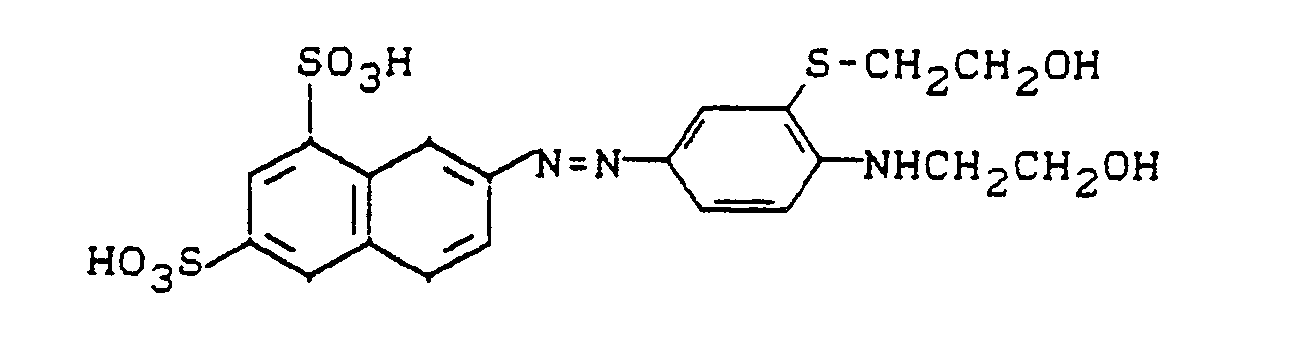
); 3,04 (dt, 1H); 3,12 (t, 2H); 3,50 (dt, 2H); 3,63 (t, 2H); 4,08 (dt, 1H); 4,60 (breit, 2 OH); 7,17-7,50 (m, 4H). - 23,6 g 7-Amino-l,3-naphthalindisulfonsäure-mono-Natrium-salz werden in 150 ml Wasser/50 g Eis und 20 ml konzentrierter Salzsäure angerührt und bei 5 bis 10°C tropfenweise mit 17 ml einer Natriumnitritlösung (300 g/l) versetzt. Die Diazotierung ist nach 1,5 Stunden beendet. Der geringe Überschuß an Nitrit wird durch Amidosulfonsaurezugabe zerstört. Die cremefarbene Suspension wird mit Sodalösung auf pH 2,5 gestellt. Dazu tropft man bei ca. 10°C eine auf pH 2,0 eingestellte Lösung von 15,0 g der freien Base aus Beispiel 2 in 100 ml Wasser. Es wird 4 bis 5 Stunden bei 10°C gerührt (pH 1,5-2,0). Zur Vervollständigung der Kupplungsreaktion wird der pH-Wert durch Zugabe von Natriumacetat auf 4,5 erhöht und erneut 2 Stunden nachgerührt. Es werden 40 g Kochsalz zugesetzt, 1 Stunde gerührt und der Niederschlag durch Absaugen isoliert. Nach dem Trocknen resultieren 48 g eines salzhaltigen Farbstoffes der Formel
H₂O
, pH 7-8)
- ¹H-NMR (d₆-DMS0) :δ =
- 2,88 (t, 2H); 3,35 (t, 2H); 3,50 (t, 2H); 3,65 (m, 2H); 5,15 (breites s, 2 0H); 6,17 (t, NH); 6,85 (d, 1H); 7,83-8,07 (m, 4H); 8,16 (s, 1H); 8,30 (s, 1H); 9,30 (s, 1H).
- 47 g des Farbstoffes aus Beispiel 4 werden in 250 ml Wasser bei pH 8-8,5 angerührt, mit 0,2 g Natriumwolframat versetzt und auf 70°C erwärmt. Man tropft 30 ml einer ca. 35 %igen wäßrigen Wasserstoffperoxidlösung zu- Die Temperatur sollte dabei zwischen 70 und 80°C betragen. Nach ca. 2 Stunden wird die Oxidation dünnschichtchromatographisch überprüft. Dabei ist auch das während der Oxidation durchlaufene Sulfoxid-Derivat nachweisbar. Es werden gegebenenfalls nochmals 10 bis 15 ml Wasserstoffperoxidlösung nachgesetzt, um auch das restliche Sulfoxid-Derivat zum Sulfon-Derivat aufzuoxidieren Es wird anschließend 2 Stunden bei 80°C gerührt, auf Raumtemperatur abgekühlt und mit verdünnter Schwefelsäure auf pH 0,5 bis 1,0 angesäuert. Der Farbstoff wird mit 35 g Kochsalz und 5 g Kaliumchlorid ausgesalzen und isoliert. Nach dem Trocknen erhält man 38 g eines salzhaltigen Farbstoffes der Formel

λmax = 406 nm (
H₂O
, pH 7-8)
- ¹H-NMR (d₆-DMSO) :δ =
- 3,42 (t, 2H); 3,55 (t, 2H); 3,68 (t, 2H); 3,75 (t, 2H); 5,0-5,3 (breit, 2 OH); 6,9 (breites s, NH); 7,13 (d, 1H); 7,98 (dd, 1H); 8,05-8,17 (m, 2H); 8,20 (s, 1H); 8,27 (d, 1H); 8,32 (d, 1H); 9,35 (d, 1H).
- Variiert man nun in Beispiel 4 die Diazokomponente, so sind analog zur Kupplungsvorschrift (Beispiel 4) und Oxidationsvorschrift (Beispiel 5) weitere interessante Farbstoffe mit Azosulfid- und Azo/Azoxysulfon-Struktur herstellbar:

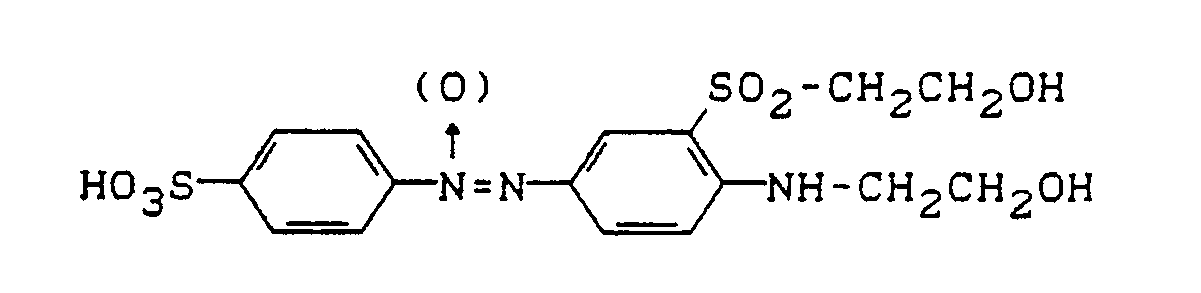
- 12,5 g 4-Aminobenzolsulfonsäure werden analog zu Beispiel 4 diazotiert, und die resultierende Suspension mit Sodalösung auf pH 2,5 gestellt. Dazu tropft man bei 5 bis 10°C eine auf pH 2,0 eingestellte Lösung von 15,0 g der freien Base aus Beispiel 2 in 100 ml Wassern Es wird 5 Stunden bei pH 1,5 bis 2,5 und 10°C und anschließend 3 Stunden bei pH 3,5 bis 4,0 und 10°C gerührt. Der pH-Wert wird dabei mit Natriumacetatlösung erhöht. Nach erfolgter Kupplung wird der pH-Wert mit Sodalösung auf 8,0 eingestellt. Es resultiert eine klare Lösung des Azofarbstoffes der Formel

H₂O
, pH 7-8)
- ¹H-NMR (d₆-DMSO): δ =
- 3,38 (t, 2H); 3,50 (t, 2H); 3,60-3,75 (m, 4H); 5,0 (breites s, 2 OH); 6,94 (t, NH); 7,08 (d, 1H); 7,78 (m, 4H); 8,05 (dd, 1H); 8,17 (d, 1H).
-
- A) 35 g des Farbstoffes aus Beispiel 5 werden in 150 ml Wasser bei pH 7 gelöst, mit 0,2 g Raney-Nickel-Katalysator versetzt und im Autoklaven mit der 2,5-fachen äquimolaren Menge Wasserstoff reduziert. Der Ansatz kann sich dabei auf 40 bis 50°C erwärmen. Nach Abtrennen des Katalysators resultiert eine klare, blaß-bräunliche Lösung, aus der nach Sauerstellen auf pH 1,0, Aussalzen mit 10 g Kochsalz und Abkühlen auf 15°C die 7-Amino-1,3-naphthalindisulfonsäure in Form des mono-Natriumsalzes ausgeschieden werden kann. In Lösung verbleibt das gewünschte [5-Amino-2-(2-hydroxyethyl-amino)phenyl](2-hydroxyethyl)sulfon der Formel

- B) Das gleiche Produkt bzw. die gleiche Lösung erhält man auch, wenn man 20 g des Farbstoffes aus Beispiel 16 in 100 ml Wasser bei pH 7-8 und 50°C innerhalb von 10 min mit 15,5 g Natriumdithionit umsetzt Die anfangs goldgelbe Lösung wird entfärbt, Man kühlt ab auf 20°C und stellt die Lösung mit Salzsäure auf pH 1,5. Nach Zugabe von 20 g Kochsalz rührt man ca. 4 bis 5 Stunden bis die 4-Aminobenzolsulfonsäure vollkommen ausgefällt ist. Nach Filtration resultiert eine Lösung von relativ einheitlichen [5-Amino-2-(2-hydroxyethylamino)-phenyl ](2-hydroxyethyl )sulfon.
- Dieses wichtige Zwischenprodukt wird ebenfalls erhalten, wenn man die Azo/Azoxyfarbstoffe der Beispiele 11 bis 16 analog zu Beispiel 17 A katalytisch hydriert und die ebenfalls gebildete Diazokomponente D-
NH₂
wie beschrieben abtrennt. - 18,8 g [5-Amino-2-(2-hydroxyethylamino)phenyl](2-hydroxyethyl)sulfon werden in 150 ml Wasser, 50 g Eis und 25 ml Salzsäure gelöst und bei 0 bis 3°C mit 17 ml einer Natriumnitritlösung (300 g/l) diazotiert. Die Diazotierung ist nach 30 Minuten beendet; es resultiert eine Lösung.
- 15,2 g der freien Base aus Beispiel 2 werden in 50 ml Wasser suspendiert und durch Zugabe von 25 ml Essigsäure gelöst. Diese Lösung fügt man zur fertigen Diazotierungslösung und erhöht den pH-Wert durch Zugabe von Natriumacetatlösung auf 3,5 bis 4,0. Mit Eis hält man die Reaktionstemperatur bei 0-5°C und rührt für 8 Stunden bei pH 3,5 bis 4,0. Es scheidet sich ein kristalliner gelber Niederschlag ab, der abgesaugt, mit 50 ml Wasser gewaschen und getrocknet wird. Man erhält 31,5 g des Azofarbstoffes der Formel

λmax = 458 nm (
H₂O
, pH 7-8)
- ¹H-NMR (d₆-DMSO) :δ =
- 2,87 (t, 2H); 3,35 (m, 4H); 3,50 (m, 4H); 3,60-3,75 (m, 6H); 4,95 (breites 5, 4 OH); 6,13 (t, NH); 6,77 (t, NH); 6,80 (d, 1H); 7,05 (d, 1H); 7,75 (dd, 1H); 7,90 (d, 1H); 7,95 (dd, 1H); 8,07 (d, 1H).
- 30 g des Azofarbstoffes aus Beispiel 18 werden in 150 ml Wasser suspendiert, die Mischung auf pH 8 gestellt und nach Zugabe von 0,2 g Natriumwolframat auf 60°C erwärmt (es kann aber auch anstelle des isolierten Farbstoffs die Kupplungsmischung aus Beispiel 18 direkt eingesetzt werden). Es werden langsam 30 ml einer 35 %igen Wasserstoffperoxidlösung zugetropft. Die Reaktion verläuft schwach exotherm. Bei 75°C resultiert eine klare orangerote Lösung. Es wird eine Stunde bei 75 bis 80°C nachgerührt und dann auf Raumtemperatur abgekühlt. Dabei kristallisiert der Azofarbstoff in goldgelben Kristallen aus. Zur Vervollständigung der Fällung wird mit 10 g Kaliumchlorid versetzt und auf 0°C abgekühlt. Man saugt ab, wäscht mit wenig Wasser nach und trocknet bei 60°C im Vakuum. Es resultieren 28,2 g Azofarbstoff der Formel

λmax = 442 nm (
H₂O
, pH 7-8)
- ¹H-NMR (d₆-DMSO): δ =
- 3,38 (t, 4H); 3,50 (t, 4H); 3,62-3,75 (m, 8H); 4,93 (t, 2 OH); 4,97 (t, 2 OH); 6,95 (t, 2 NH); 7,06 (d, 2H); 8,01 (dd, 2H); 8,12 (d, 2H).
- 25,8 g des Azofarbstoffes aus Beispiel 19 werden in 200 ml Wasser suspendiert, mit 0,2 g Raney-Nickel-Katalysator versetzt und im Autoklaven mit der 2-fachen äquimolaren Menge an Wasserstoff hydriert. Die Reaktion verläuft schwach exotherm; es wird eine Temperatur von 35 bis 40°C erreicht. Man erhält eine farblose Reaktionslösung, wenn man bei 40°C den Katalysator durch Filtration abtrennt. Aufkonzentrieren der Lösung am Rotationsverdampfer liefert 26 g einheitliches kristallines [5-Amino-2-(2-hydroxyethylamino)phenyl](2-hydroxy-ethyl)sulfon der Formel

- Kuppelt man diazotiertes Anilin in Analogie zu Beispiel 16 in wäßrigem Medium auf die freie Base 2-(2-Hydroxy-ethylmercapto)-N-(2-hydroxyethyl)anilin und oxidiert die erhaltene Azoverbindung bei 60-80°C mit Wasserstoffperoxidlösung, so resultiert ein kristallines Azosulfon der Formel

H₂O
, pH 7-8)) schmilzt bei 126°C. - 1 H-NMR (d₆-DMSO): δ =
- 3,38 (m, 2H); 3,50 (m, 2H); 3,68 (m, 2H); 3,73 (m, 2H); 4,90 (t, OH); 4,95 (t, OH); 6,92 (t, NH); 7,08 (d, 1H); 7,45-7,58 (m, 3H); 7,80 (d, 1H); 7,86 (d, 1H); 8,04 (dd, 1H); 8,18 (d, 1H).
- 20 g des Azofarbstoffes aus Beispiel 21 werden in 200 ml Wasser suspendiert, mit 0,2 g Raney-Nickel-Katalysator versetzt und im Autoklaven mit der 2-fachen äquimolaren Menge an Wasserstoff hydriert. Es wird dabei eine Temperatur von 40°C erreicht Nach Reaktionsende wird der Katalysator abgetrennt und das gebildete Anilin durch eine Wasserdampfdestillation restlos aus der Lösung entfernt. Die verbleibende Lösung, die [5-Amino-2-(2-hydroxyethyl-amino)phenyl](2-hydroxyethyl)sulfon enthält, kann direkt für weitere Umsetzungen, wie z.B. die Kondensation mit Chloranil eingesetzt werden (vgl. Beispiel 17). Obige Reduktion ist z.B. auch in Methanol oder in einem Methanol-Wasser-Gemisch durchführbar.
Saure oder alkalische Hydrolyse dieser N-Acetyl-Anilinverbindungen liefert in Analogie zu Beispiel 2 die freie Base 2-(2-Hydroxyethylmercapto)-N-(2-hydroxyethyl)-anilin.
Claims (7)
- Verfahren zur Herstellung von [5-Amino-2-(2-hydroxyethylamino)phenyl](2-hydroxyethyl)sulfon der Formel


CH₃,
mit Ethylenoxid in wäßrigem Reaktionsmedium zu N-Formyl-bzw. N-Acetyl-N-(2-hydroxyethyl)anilin-Derivaten der Formel


NH₂
und (1), worin D = Rest einer Diazokomponente. - Verfahren nach Anspruch 1, dadurch gekennzeichnet, daß Amine D-
NH₂
verwendet werden, die Sulfo- und/oder Carboxygruppen aufweisen oder D-
NH₂
für Anilin oder ∝-Naphthylamin steht. - Verfahren zur Herstellung des Sulfons der Formel


- Azofarbstoffe der Formel

- Azo/Azoxyfarbstoffe der Formel

D = Rest einer Diazokomponente, insbesondere aus der Benzol-, Naphthalin- oder Hetarylreihe. - Azofarbstoff der Formel

- Azo/Azoxyfarbstoff der Formel

Applications Claiming Priority (2)
| Application Number | Priority Date | Filing Date | Title |
|---|---|---|---|
| DE3939966A DE3939966A1 (de) | 1989-12-02 | 1989-12-02 | Azofarbstoffe und verfahren zur herstellung von (5-amino-2-(2-hydroxyethylamino)phenyl)(2-hydroxyethyl)-sulfon |
| DE3939966 | 1989-12-02 |
Publications (3)
| Publication Number | Publication Date |
|---|---|
| EP0431389A2 true EP0431389A2 (de) | 1991-06-12 |
| EP0431389A3 EP0431389A3 (en) | 1991-11-13 |
| EP0431389B1 EP0431389B1 (de) | 1993-12-29 |
Family
ID=6394721
Family Applications (1)
| Application Number | Title | Priority Date | Filing Date |
|---|---|---|---|
| EP90122138A Expired - Lifetime EP0431389B1 (de) | 1989-12-02 | 1990-11-20 | Azofarbstoffe und Verfahren zur Herstellung von [5-Amino-2-(2-hydroxyethylamino)phenyl](2-hydroxyethyl)-sulfon |
Country Status (4)
| Country | Link |
|---|---|
| US (1) | US5107025A (de) |
| EP (1) | EP0431389B1 (de) |
| JP (2) | JP2965677B2 (de) |
| DE (2) | DE3939966A1 (de) |
Cited By (4)
| Publication number | Priority date | Publication date | Assignee | Title |
|---|---|---|---|---|
| EP0568816A1 (de) * | 1992-04-14 | 1993-11-10 | Bayer Ag | Symmetrische Azofarbstoffe |
| EP0584565A1 (de) * | 1992-08-10 | 1994-03-02 | Bayer Ag | Verfahren zum Färben von Polyurethankunststoffen mit Monoazoeinbaufarbstoffen sowie neue Monoazofarbstoffe |
| EP0601406A1 (de) * | 1992-12-08 | 1994-06-15 | Bayer Ag | Verfahren zur Herstellung von (5-Amino-2-(2-hydroxyethylamino)phenyl)(2-hydroxyethyl)sulfon |
| US5432266A (en) * | 1991-06-22 | 1995-07-11 | Bayer Aktiengesellschaft | Fiber-reactive monoazo and disazo dyes |
Families Citing this family (1)
| Publication number | Priority date | Publication date | Assignee | Title |
|---|---|---|---|---|
| CN103554979A (zh) * | 2013-09-29 | 2014-02-05 | 天津德凯化工股份有限公司 | 一种活性红染料及其制备方法 |
Family Cites Families (4)
| Publication number | Priority date | Publication date | Assignee | Title |
|---|---|---|---|---|
| DE3439756A1 (de) * | 1984-02-11 | 1985-08-14 | Bayer Ag, 5090 Leverkusen | Triphendioxazin-vinylsulfon-farbstoffe |
| DE3502991A1 (de) * | 1984-07-20 | 1986-01-30 | Hoechst Ag, 6230 Frankfurt | Substituierte phenyloxethylsulfone und verfahren zu ihrer herstellung |
| DE3512340A1 (de) * | 1985-04-04 | 1986-10-16 | Bayer Ag, 5090 Leverkusen | Azoreaktivfarbstoffe |
| DE3735093A1 (de) * | 1987-10-16 | 1989-04-27 | Bayer Ag | Verfahren zur herstellung von 2,5-bis-(aminoarylamino)-benzochinonen |
-
1989
- 1989-12-02 DE DE3939966A patent/DE3939966A1/de not_active Withdrawn
-
1990
- 1990-10-25 US US07/603,097 patent/US5107025A/en not_active Expired - Fee Related
- 1990-11-20 EP EP90122138A patent/EP0431389B1/de not_active Expired - Lifetime
- 1990-11-20 DE DE90122138T patent/DE59004032D1/de not_active Expired - Fee Related
- 1990-11-27 JP JP2321385A patent/JP2965677B2/ja not_active Expired - Fee Related
-
1999
- 1999-05-07 JP JP11127198A patent/JP3111061B2/ja not_active Expired - Fee Related
Cited By (7)
| Publication number | Priority date | Publication date | Assignee | Title |
|---|---|---|---|---|
| US5432266A (en) * | 1991-06-22 | 1995-07-11 | Bayer Aktiengesellschaft | Fiber-reactive monoazo and disazo dyes |
| EP0568816A1 (de) * | 1992-04-14 | 1993-11-10 | Bayer Ag | Symmetrische Azofarbstoffe |
| US5434251A (en) * | 1992-04-14 | 1995-07-18 | Bayer Aktiengesellschaft | Symmetric azo dyestuffs |
| EP0584565A1 (de) * | 1992-08-10 | 1994-03-02 | Bayer Ag | Verfahren zum Färben von Polyurethankunststoffen mit Monoazoeinbaufarbstoffen sowie neue Monoazofarbstoffe |
| EP0601406A1 (de) * | 1992-12-08 | 1994-06-15 | Bayer Ag | Verfahren zur Herstellung von (5-Amino-2-(2-hydroxyethylamino)phenyl)(2-hydroxyethyl)sulfon |
| US5414131A (en) * | 1992-12-08 | 1995-05-09 | Bayer Aktiengesellschaft | Process for preparing [5-amino-2-(2-hydroxyethylamino)-phenyl](2-hydroxyethyl)sulphone |
| CN1040643C (zh) * | 1992-12-08 | 1998-11-11 | 拜尔公司 | 制备[5-氨基-2-(2-羟基乙氨基)-苯基](2-羟基乙基)砜的方法 |
Also Published As
| Publication number | Publication date |
|---|---|
| JP2965677B2 (ja) | 1999-10-18 |
| US5107025A (en) | 1992-04-21 |
| JP3111061B2 (ja) | 2000-11-20 |
| JPH03181454A (ja) | 1991-08-07 |
| DE59004032D1 (de) | 1994-02-10 |
| EP0431389B1 (de) | 1993-12-29 |
| DE3939966A1 (de) | 1991-06-06 |
| EP0431389A3 (en) | 1991-11-13 |
| JPH11349834A (ja) | 1999-12-21 |
Similar Documents
| Publication | Publication Date | Title |
|---|---|---|
| EP0153599B1 (de) | Triphendioxazin-vinylsulfon-Farbstoffe | |
| EP0107614B1 (de) | Reaktivfarbstoffe, deren Herstellung und Verwendung | |
| EP0568876B1 (de) | Reaktivfarbstoffe, deren Herstellung und Verwendung | |
| CH536870A (de) | Verfahren zur Herstellung von neuen Metallkomplexverbindungen von Azofarbstoffen | |
| EP0222098B1 (de) | Wasserlösliche Triphendioxazin-Verbindungen, Verfahren zu ihrer Herstellung und ihre Verwendung als Farbstoffe | |
| EP0431389B1 (de) | Azofarbstoffe und Verfahren zur Herstellung von [5-Amino-2-(2-hydroxyethylamino)phenyl](2-hydroxyethyl)-sulfon | |
| EP0154816B1 (de) | Sulfonsäuregruppenhaltige Azoverbindungen | |
| US5278291A (en) | Hydroxyethylthio hydroxyethylamino-phenyl-azo and -azoxy dyestuffs | |
| EP0292904B1 (de) | Wasserlösliche Naphthyl-azo-pyrazolon-Verbindungen, Verfahren zu ihrer Herstellung und ihre Verwendung als Farbstoffe | |
| EP0387579B1 (de) | Verdoppelte Reaktivfarbstoffe | |
| EP0603116B1 (de) | Azoreaktivfarbstoffe | |
| EP0501266B1 (de) | Bifunktionelle Reaktivfarbstoffe | |
| DE1220952B (de) | Verfahren zur Herstellung von cyclischen Azofarbstoffen | |
| EP0255020B1 (de) | Wasserlösliche Triphendioxazin-Verbindungen, Verfahren zu ihrer Herstellung und ihre Verwendung als Farbstoffe | |
| EP0601406B1 (de) | Verfahren zur Herstellung von (5-Amino-2-(2-hydroxyethylamino)phenyl)(2-hydroxyethyl)sulfon | |
| DE2054198C3 (de) | Wasserlösliche faserreaktive Azofarbstoffe, Verfahren zu ihrer Herstellung und ihre Verwendung zum Färben und Bedrucken von Leder, Wolle, Seide, synthetischen Polyamiden oder Polyurethanen, regenerierter oder nativer Cellulose oder regenerierten Proteinen | |
| EP0355492B1 (de) | Reaktivfarbstoffe | |
| EP0489360B1 (de) | Wasserlösliche Azoverbindungen, Verfahren zu ihrer Herstellung und ihre Verwendung als Farbstoffe | |
| EP0256331B1 (de) | N1-Substituierte 1H-Benzo-triazol-hydroxyethyl-sulfon-Verbindungen, Verfahren zu ihrer Herstellung und ihre Verwendung zur Herstellung von Farbstoffen | |
| EP0168739B1 (de) | Reaktivfarbstoffe | |
| AT259712B (de) | Verfahren zur Herstellung von neuen Azofarbstoffen und deren Metallkomplexverbindungen | |
| AT234244B (de) | Verfahren zur Herstellung von neuen Azofarbstoffen | |
| EP0190615A2 (de) | Reaktivfarbstoffe | |
| EP0102325A1 (de) | Monoazofarbstoffe, deren Herstellung und Verwendung | |
| CH463656A (de) | Verfahren zur Herstellung von Farbstoffen |
Legal Events
| Date | Code | Title | Description |
|---|---|---|---|
| PUAI | Public reference made under article 153(3) epc to a published international application that has entered the european phase |
Free format text: ORIGINAL CODE: 0009012 |
|
| 17P | Request for examination filed |
Effective date: 19901120 |
|
| AK | Designated contracting states |
Kind code of ref document: A2 Designated state(s): CH DE FR GB LI |
|
| PUAL | Search report despatched |
Free format text: ORIGINAL CODE: 0009013 |
|
| AK | Designated contracting states |
Kind code of ref document: A3 Designated state(s): CH DE FR GB LI |
|
| 17Q | First examination report despatched |
Effective date: 19930528 |
|
| GRAA | (expected) grant |
Free format text: ORIGINAL CODE: 0009210 |
|
| AK | Designated contracting states |
Kind code of ref document: B1 Designated state(s): CH DE FR GB LI |
|
| REF | Corresponds to: |
Ref document number: 59004032 Country of ref document: DE Date of ref document: 19940210 |
|
| GBT | Gb: translation of ep patent filed (gb section 77(6)(a)/1977) |
Effective date: 19940114 |
|
| ET | Fr: translation filed | ||
| PLBE | No opposition filed within time limit |
Free format text: ORIGINAL CODE: 0009261 |
|
| STAA | Information on the status of an ep patent application or granted ep patent |
Free format text: STATUS: NO OPPOSITION FILED WITHIN TIME LIMIT |
|
| 26N | No opposition filed | ||
| REG | Reference to a national code |
Ref country code: GB Ref legal event code: IF02 |
|
| PGFP | Annual fee paid to national office [announced via postgrant information from national office to epo] |
Ref country code: GB Payment date: 20021018 Year of fee payment: 13 Ref country code: FR Payment date: 20021018 Year of fee payment: 13 |
|
| PG25 | Lapsed in a contracting state [announced via postgrant information from national office to epo] |
Ref country code: GB Free format text: LAPSE BECAUSE OF NON-PAYMENT OF DUE FEES Effective date: 20031120 |
|
| PGFP | Annual fee paid to national office [announced via postgrant information from national office to epo] |
Ref country code: DE Payment date: 20031127 Year of fee payment: 14 |
|
| PGFP | Annual fee paid to national office [announced via postgrant information from national office to epo] |
Ref country code: CH Payment date: 20031128 Year of fee payment: 14 |
|
| GBPC | Gb: european patent ceased through non-payment of renewal fee |
Effective date: 20031120 |
|
| PG25 | Lapsed in a contracting state [announced via postgrant information from national office to epo] |
Ref country code: FR Free format text: LAPSE BECAUSE OF NON-PAYMENT OF DUE FEES Effective date: 20040730 |
|
| REG | Reference to a national code |
Ref country code: FR Ref legal event code: ST |
|
| PG25 | Lapsed in a contracting state [announced via postgrant information from national office to epo] |
Ref country code: LI Free format text: LAPSE BECAUSE OF NON-PAYMENT OF DUE FEES Effective date: 20041130 Ref country code: CH Free format text: LAPSE BECAUSE OF NON-PAYMENT OF DUE FEES Effective date: 20041130 |
|
| PG25 | Lapsed in a contracting state [announced via postgrant information from national office to epo] |
Ref country code: DE Free format text: LAPSE BECAUSE OF NON-PAYMENT OF DUE FEES Effective date: 20050601 |
|
| REG | Reference to a national code |
Ref country code: CH Ref legal event code: PL |