EP0584604A1 - Füller für ein bituminöses Mischgut - Google Patents
Füller für ein bituminöses Mischgut Download PDFInfo
- Publication number
- EP0584604A1 EP0584604A1 EP19930112556 EP93112556A EP0584604A1 EP 0584604 A1 EP0584604 A1 EP 0584604A1 EP 19930112556 EP19930112556 EP 19930112556 EP 93112556 A EP93112556 A EP 93112556A EP 0584604 A1 EP0584604 A1 EP 0584604A1
- Authority
- EP
- European Patent Office
- Prior art keywords
- filler
- rock
- mit
- mixture
- flour
- Prior art date
- Legal status (The legal status is an assumption and is not a legal conclusion. Google has not performed a legal analysis and makes no representation as to the accuracy of the status listed.)
- Granted
Links
Classifications
-
- C—CHEMISTRY; METALLURGY
- C08—ORGANIC MACROMOLECULAR COMPOUNDS; THEIR PREPARATION OR CHEMICAL WORKING-UP; COMPOSITIONS BASED THEREON
- C08L—COMPOSITIONS OF MACROMOLECULAR COMPOUNDS
- C08L95/00—Compositions of bituminous materials, e.g. asphalt, tar, pitch
-
- C—CHEMISTRY; METALLURGY
- C08—ORGANIC MACROMOLECULAR COMPOUNDS; THEIR PREPARATION OR CHEMICAL WORKING-UP; COMPOSITIONS BASED THEREON
- C08J—WORKING-UP; GENERAL PROCESSES OF COMPOUNDING; AFTER-TREATMENT NOT COVERED BY SUBCLASSES C08B, C08C, C08F, C08G or C08H
- C08J11/00—Recovery or working-up of waste materials
- C08J11/04—Recovery or working-up of waste materials of polymers
- C08J11/06—Recovery or working-up of waste materials of polymers without chemical reactions
-
- C—CHEMISTRY; METALLURGY
- C08—ORGANIC MACROMOLECULAR COMPOUNDS; THEIR PREPARATION OR CHEMICAL WORKING-UP; COMPOSITIONS BASED THEREON
- C08K—Use of inorganic or non-macromolecular organic substances as compounding ingredients
- C08K3/00—Use of inorganic substances as compounding ingredients
- C08K3/01—Use of inorganic substances as compounding ingredients characterized by their specific function
- C08K3/013—Fillers, pigments or reinforcing additives
-
- C—CHEMISTRY; METALLURGY
- C08—ORGANIC MACROMOLECULAR COMPOUNDS; THEIR PREPARATION OR CHEMICAL WORKING-UP; COMPOSITIONS BASED THEREON
- C08J—WORKING-UP; GENERAL PROCESSES OF COMPOUNDING; AFTER-TREATMENT NOT COVERED BY SUBCLASSES C08B, C08C, C08F, C08G or C08H
- C08J2361/00—Characterised by the use of condensation polymers of aldehydes or ketones; Derivatives of such polymers
- C08J2361/04—Condensation polymers of aldehydes or ketones with phenols only
- C08J2361/06—Condensation polymers of aldehydes or ketones with phenols only of aldehydes with phenols
-
- Y—GENERAL TAGGING OF NEW TECHNOLOGICAL DEVELOPMENTS; GENERAL TAGGING OF CROSS-SECTIONAL TECHNOLOGIES SPANNING OVER SEVERAL SECTIONS OF THE IPC; TECHNICAL SUBJECTS COVERED BY FORMER USPC CROSS-REFERENCE ART COLLECTIONS [XRACs] AND DIGESTS
- Y02—TECHNOLOGIES OR APPLICATIONS FOR MITIGATION OR ADAPTATION AGAINST CLIMATE CHANGE
- Y02W—CLIMATE CHANGE MITIGATION TECHNOLOGIES RELATED TO WASTEWATER TREATMENT OR WASTE MANAGEMENT
- Y02W30/00—Technologies for solid waste management
- Y02W30/50—Reuse, recycling or recovery technologies
- Y02W30/62—Plastics recycling; Rubber recycling
Definitions
- the invention relates to a filler for a bituminous mix, in particular asphalt mastic.
- Bituminous mix as a road surface especially in the form of stone mastic asphalt, usually consists of chippings in different grain sizes from about 2 mm to 16 mm, sands with different grain sizes between about 0.09 mm and 2 mm and a filler made of stone powder that stiffens the mix together, with the weight percent from grit to sand to filler behaving roughly like 75: 16: 9.
- Such industrial by-products are e.g. Mining rock of hard coal, iron and steel slags, power plant residues, building rubble, road construction or waste incineration ash. They are generally not reused or reused and mostly end up in landfills as hazardous waste. This is where the special problem of such by-products lies. It is usually not known how they are composed, so that their suitability as fillers for bituminous mixes is doubtful with regard to their environmental compatibility.
- the object of the invention is to provide a filler for a bituminous mix which, as an industrial by-product, contains a high percentage of natural raw materials, such as e.g. Rock flour, can substitute without harming the environment.
- the inventive solution proposed in this context according to claim 1 provides for a natural product, such as rock flour, to be mixed with a special pulverized industrial by-product of resin and cellulosic fibers.
- a natural product such as rock flour
- a special pulverized industrial by-product of resin and cellulosic fibers occurs in many branches of industry, especially where products have been processed by hand or machine that contain cellulose fibers in a resin bedding.
- the tests carried out here have shown that the natural products, such as rock flour, to a large extent can be substituted by pulverized industrial by-products of certain substance composition, whereby a clear stiffening of the mix shows.
- the mixing ratio of the natural product, e.g. Rock powder, on the one hand, and the powdered industrial by-product, on the other hand, can vary in size. Which mixing ratio is used in an individual case depends on which natural product is used and which substances make up the industrial by-product.
- a filler according to the invention proves to be expedient, in which a mixture proportion in the size of approximately 80% by weight has a grain size of ⁇ 0.09 mm. The remaining portion of the mixture in the amount of about 20% by weight can be in a grain size of up to about 2 mm.
- the invention has particularly recognized that drilling, grinding or milling powders can be used as pulverized resin with cellulosic fiber materials, which are used in larger quantities when machining clutch and / or brake linings in the various branches of industry, such as in the clutch or automotive industry, arise (claim 3).
- these flours had to be stored as special waste in appropriate landfills. This naturally entails a high level of transport technology, storage technology and financial expenses, combined with the risk of an enormous environmental impact.
- these flours can now be used almost completely. As a result, they no longer occur as hazardous waste and therefore no longer cause the problems associated with hazardous waste.
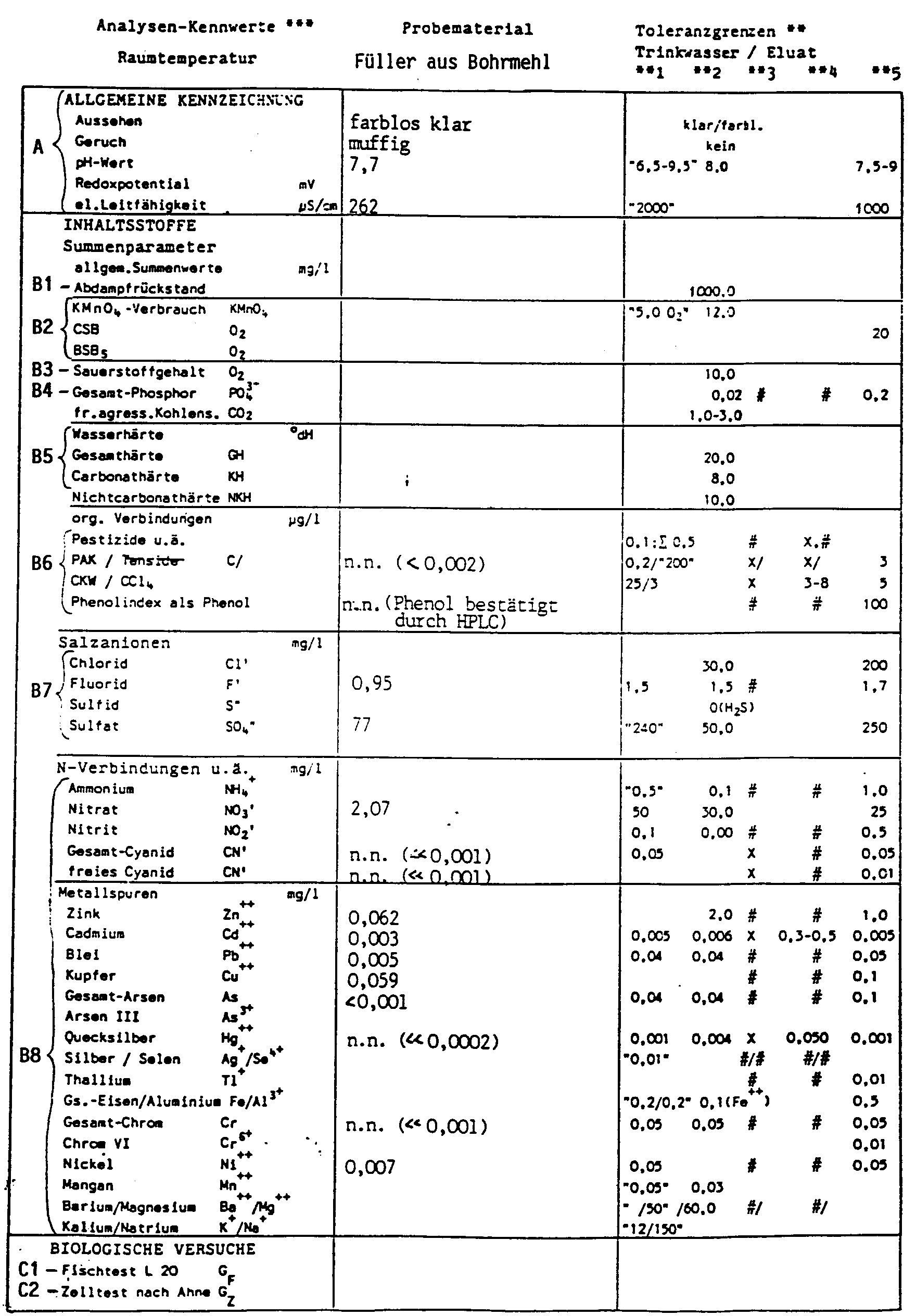
- the environmental compatibility of the filler according to the invention results from the example given in the table on page 9.
- the environmental compatibility was checked for the water-soluble substances which can be leached in a so-called S4 test and for the amounts of phenols which can be leached out in a modified leaching test from a Marshall test specimen which had been prepared using the filler according to the invention.
- the tolerance values of the Drinking Water Ordinance are to be used for interpretation.
- the checked S4 eluate of the filler is colorless and clear and has a musty smell.
- the distinct fecal smell from the e.g. Resin components not yet hardened from brake pads, which can still be determined on the powdered filler, can no longer be found in the aqueous leaching.
- the characteristic values for pH value and electrical conductivity show no abnormalities, which means that only low values are also available for water-soluble salts, as confirmed by the fluoride, sulfate and nitrate that have been checked as examples. Thereafter, no noticeable metal traces can be found in the test for water-soluble heavy metal traces. Only copper is slightly increased. This is probably due to the use of copper materials in the manufacture of the brake pads.
Landscapes
- Chemical & Material Sciences (AREA)
- Polymers & Plastics (AREA)
- Organic Chemistry (AREA)
- Health & Medical Sciences (AREA)
- Chemical Kinetics & Catalysis (AREA)
- Medicinal Chemistry (AREA)
- Engineering & Computer Science (AREA)
- Life Sciences & Earth Sciences (AREA)
- Sustainable Development (AREA)
- Civil Engineering (AREA)
- Materials Engineering (AREA)
- Structural Engineering (AREA)
- Compositions Of Macromolecular Compounds (AREA)
- Road Paving Structures (AREA)
- Solid-Sorbent Or Filter-Aiding Compositions (AREA)
Abstract
Description
- Die Erfindung richtet sich auf einen Füller für ein bituminöses Mischgut, insbesondere Asphaltmastix.
- Bituminöses Mischgut als Straßenbelag, insbesondere in Form von Splittmastixasphalt, setzt sich in der Regel aus Splitt in unterschiedlichen Korngrößen von etwa 2 mm bis 16 mm, Sanden mit unterschiedlichen Korngrößen zwischen etwa 0,09 mm und 2 mm sowie einem das Mischgut versteifenden Füller aus Gesteinsmehl zusammen, wobei sich die Gewichtsprozente von Splitt zu Sand zu Füller etwa wie 75:16:9 verhalten.
- Bei den bislang verwendeten Füllstoffen sind in der überwiegenden Mehrzahl solche verwendet worden, die aus natürlichen Vorkommen wie Kiesgruben, Steinbrüchen usw. stammen. Da jedoch in neuerer Zeit ein Umdenkungsprozeß dahingehend stattgefunden hat, daß die Gesamtheit der natürlichen Rohstoffe nicht unbegrenzt zur Verfügung steht und folglich mit diesen Rohstoffen sparsam umgegangen werden muß, sind Überlegungen angestellt worden, inwieweit industrielle Neben- oder Abfallprodukte die vorerwähnten Füllstoffe aus natürlichen Vorkommen ersetzen können.
- Solche industriellen Nebenprodukte sind z.B. Nebengestein der Steinkohle, Eisenhüttenschlacken, Kraftwerksrückstände, Bauschutt, Straßenaufbruch oder Müllverbrennungsasche. Sie werden in der Regel nicht wieder- oder weiterverwendet und landen zumeist als Sondermüll auf Deponien. Hier liegt dann auch das besondere Problem solcher Nebenprodukte. Es ist meist nicht bekannt, wie sie sich zusammensetzen, so daß ihre Eignung als Füller für bituminöses Mischgut im Hinblick auf ihre Umweltverträglichkeit zweifelhaft erscheint.
- Hiervon ausgehend liegt der Erfindung die Aufgabe zugrunde, einen Füller für ein bituminöses Mischgut bereitzustellen, der als industrielles Nebenprodukt zu einem hohen Prozentsatz natürliche Rohstoffe, wie z.B. Gesteinsmehl, substituieren kann, ohne daß die Umwelt negativ belastet wird.
- Die in diesem Zusammenhang vorgeschlagene erfindungsgemäße Lösung gemäß Patentanspruch 1 sieht vor, ein Naturprodukt, wie z.B. Gesteinsmehl, mit einem speziellen pulverisierten industriellen Nebenprodukt aus Harz und zellulosen Faserstoffen zu mischen. Ein solches Nebenprodukt fällt in vielen Industriezweigen an, und zwar insbesondere dort, wo Erzeugnisse von Hand oder maschinell bearbeitet wurden, die zellulose Faserstoffe in einer Harzeinbettung aufweisen. Bei den hierbei durchgeführten Versuchen hat sich herausgestellt, daß die Naturprodukte, wie z.B. Gesteinsmehl, zu einem hohen Anteil durch pulverisierte industrielle Nebenprodukte bestimmter Stoffzusammensetzung substituiert werden können, wobei sich eine deutliche Versteifung des Mischguts zeigt. Dieser Sachverhalt ist darauf zurückzuführen, daß auch in den durch die z.B. bohrende oder fräsende Bearbeitung anfallenden pulverförmigen Produkten die besonders in hakeliger Form vorliegenden Faserstoffe mindestens zum Teil freigesetzt sind und somit eine stabilisierende Wirkung beim Einsatz in Asphaltmischungen bewirken. Es ist keinerlei Neigung zum Entmischen festzustellen. Bei einem hohen Verdichtungswiderstand liegt ein äußerst standfester Splittmastixasphalt vor mit dem Ergebnis, daß insbesondere das bei stark belasteten Straßen bekannte Spurrillenproblem weitgehend eliminiert werden kann.
- Das Mischungsverhältnis des Naturprodukts, wie z.B. Gesteinsmehl, einerseits und des pulverisierten industriellen Nebenprodukts andererseits kann sich in unterschiedlichen Größenordnungen bewegen. Welches Mischungsverhältnis im Einzelfall zum Tragen kommt, hängt davon ab, welches Naturprodukt zur Anwendung gelangt und aus welchen Stoffen sich das industrielle Nebenprodukt zusammensetzt.
- Eine weitere vorteilhafte Ausführungsform der Erfindung wird in den Merkmalen des Patentanspruchs 2 gesehen. Danach erweist sich ein erfindungsgemäßer Füller als zweckmäßig, bei welchem ein Mischungsanteil in der Größe von etwa 80 Gew.% eine Korngröße von < 0,09 mm aufweist. Der restliche Anteil der Mischung in Höhe von etwa 20 Gew.% kann in einer Korngröße bis zu etwa 2 mm vorliegen.
- Die Erfindung hat insbesondere erkannt, daß als pulverisiertes Harz mit zellulosen Faserstoffen Bohr-, Schleif- oder Fräsmehle benutzt werden können, die in größeren Mengen bei der Bearbeitung von Kupplungs- und/oder Bremsbelägen in den verschiedenen Industriezweigen, wie z.B. in der Kupplungs- oder Automobilindustrie, anfallen (Patentanspruch 3). Bislang mußten diese Mehle als Sondermüll auf entsprechenden Deponien gelagert werden. Hiermit ist naturgemäß ein hoher transporttechnischer, lagerungstechnischer und finanzieller Aufwand verbunden mit der Gefahr einer enormen Umweltbelastung.
- Im Rahmen der Erfindung können jetzt diese Mehle nahezu vollständig weiterverwendet werden. Sie fallen folglich nicht mehr als Sondermüll an und verursachen demnach auch nicht mehr die mit Sondermüll einhergehenden Probleme.
- Siehe in diesem Zusammenhang zum Stand der Technik auch die Zeitschrift "Baustoff Recycling + Deponietechnik" 5/88, Seiten 12 bis 15 sowie die Sonderausgabe dieser Zeitschrift zur ENTSORGA '88, Seiten 18 bis 26.
- Die Umweltverträglichkeit des erfindungsgemäßen Füllers ergibt sich aus dem in der Tabelle gemäß Seite 9 angegebenen Beispiel. Hierbei erfolgte die Überprüfung auf Umweltverträglichkeit auf die in einem sogenannten S4-Versuch auslaugbaren wasserlöslichen Stoffe sowie auf die in einem modifizierten Auslaugversuch auslaugbaren Mengen an Phenolen aus einem Marshall-Probekörper, der mit dem erfindungsgemäßen Füller erstellt worden war. Zur Interpretation sind die Toleranzwerte der Trinkwasserverordnung heranzuziehen.
- Die Analysenverfahren waren wie folgt:
- Zu A:
- Aussehen und Geruch augenscheinlich; pH-Wert; Eh-Wert mit Potentiographen Metrohm; Leitfähigkeit mit Meßelektrode WTW (Bezugstemp. 20 °C).
- Zu B1:
- Abdampfrückstand durch Eindampfen bei 105 °C.
- Zu B2:
- Oxidierbarkeit = Gehalt an oxid. anorg./org. Stoffen, KMnO₄-Verbrauch nach KUBEL, pot. Titr. Mn⁷⁺ → Mn²⁺ der heißen schwefelsauren Probenlösung mit KMnO₄-Lösung nach Vorgabe von jeweils 15 ml KMnO₄- und Oxalsäurelösung. In () gesetzter Wert nach längerem Sieden der schwefels. Probenlösung zur Ausschaltung oxid. anorg. Stoffe (H₂S, NO₂) sowie korrigiert um 0,57 mg/l je mg Fe⁺⁺. Chemischer Sauerstoffbedarf CSB gem. DIN 38 409 - H 43-1, Cr⁶⁺ → Cr³⁺; pot. Rücktitration nicht verbrauchten Kaliumdichromats mit Ammoniumeisensulfat in schwefels. Lösung unter Quecksilbermaskierung der Chloride. Biochemischer Sauerstoffbedarf BSB₅. Messung des Sauerstoffgehalts amperometrisch mit WTW Oxi-Elektrode nach Zehrungsdauer 5 Tage gem. Verdünnungsmethode DEV H 5.
- Zu B3:
- Sauerstoffgehalt als O₂ amperometrisch mit WTW Oxi-Elektrode.
- Zu B4:
- Gesamtphosphor als PO₄ nach DEV D 11, photom. Best. des Gesamtphosphors nach Aufschluß mittels Schwefelsäure-Perchlorsäure.
- Zu B5:
- Freie gelöste aggressive Kohlensäure als CO₂ sowie die Karbonathärte KH und Nichtkarbonathärte NKH werden berechnet aus den Meßwerten: pH, Säure- und Basekapazität sowie Gesamthörte GH (1°DH = 10 mg/l CaO); hierzu Säure- und Basekapazität durch pot. Titration bis pH = 4,3 (m-Wert) sowie bis pH = 8,2 (p-Wert) mit 0,1 H NaOH oder HCl. Gesamthärte GH durch pot. Titr. mit Titriplexlösung mit Farbindikator MERCK.
- Zu B6:
- Organische Verbindungen. Pestizide u.ä. (Insektizide, Herbizide / poly-chlorierte/bromierte Biphenyle u. Terphenyle) mittels Gaschromatographie polycyclische aromatische Kohlenwasserstoffe PAK (engl. PAH). Dünnschicht-Chromatographie; Tenside photometrisch als Methylenblau- bzw. Bismutaktive Substanz mittels HPLC nach TVO-Liste; organische Chlorverbindungen mittels Gaschromatographie; Phenolindex als Phenol nach DIN 38 409 H 16, photometr. Best. im Chloroform-Extrakt.
- Zu B7:
- Chlorid- und Sulfidbestimmung pot. Titration mit 0,002 N AgNO₃ in acetonhaltiger, HNO₃-saurer Probelösung. Fluorid-Bestimmung, Metrohm-Potentiograph mit ionenspez. Fluoridelektrode in Tisab IV-Lösung. Sulfat-Bestimmung, lösl. Sulfat gravim. als Barium-Sulfat.
- Zu B8:
- Stickstoffverbindungen sowie Metalle mittels inverser Voltametrie/Polarographie mit internem (bei NH₄⁺ auch externem) Standard mit Metrohm-Polarograph; freie Cyanide und kompl. geb. Cyanide zuvor aufgeschlossen gem. DEV D 13. Metrohm-Application Bulletin Nr. 127 d für NH₄⁺, Nr. 70 d für NO₃, NO₂, Nr. 110 d für CN¹, Nr. 104, 108, 124 für Metalle, Nr. 122 d für As³⁺ und Gesamtarsen.
- Zu C1:
- Fischtest gem. DEV L 20; angegeben wird der Verdünnungsansatz (G = 8 bedeutet 1/8 Eluat + 7/8 Aquariumwasser), bei dem alle 5 eingesetzten Goldorfen über 48 h überlebten.
- Zu C2:
- Zelltest nach AHNE, angegeben wird die erste nicht letale Verdünnungsrate beim Test mit Forellenleberzellen; Zbl. Bakt. Hyg., I. Abt. Orig. B 180, 480 - 504 (1985).
- Das überprüfte S4-Eluat des Füllers ist farblos und klar sowie von muffigem Geruch. Der deutlich fäkalische Geruch aus den bei der Herstellung z.B. von Bremsbelägen noch nicht abgehärteten Harzkomponenten, der am pulverförmigen Füller noch feststellbar ist, findet sich in der wäßrigen Auslaugung nicht mehr. Die Kennwerte für pH-Wert und elektrische Leitfähigkeit zeigen keine Auffälligkeiten, womit auch bezüglich wasserlöslicher Salze ebenfalls nur niedrige Werte vorhanden sind, wie dies bei den exemplarisch überprüften Fluorid, Sulfat und Nitrat bestätigt wird. Danach können keine bemerkenswerten Metallspuren im Rahmen der Prüfung auf wasserlösliche Schwermetallspuren festgestellt werden. Lediglich Kupfer ist leicht erhöht. Dies dürfte vermutlich eine Ursache aus der Verwendung von Kupfermaterialien bei der Herstellung der Bremsbeläge sein.
- Desweiteren ist festzustellen, daß auch die Cyanide in den wasserlöslichen Spuren deutlich unter der Nachweisbarkeitsgrenze liegen. Ferner beweist die Tabelle, daß die Prüfung auf Anwesenheit von karzerogenen polycyclischen aromatischen Kohlenwasserstoffen negativ verlief.
- Im Hinblick auf das evtl. Vorhandensein von Phenolen ist festzustellen, daß die Überprüfung in einem Marshall-Probekörper, also in dem relevanten Bezugskörper in der Asphalttechnologie, der für eine 100 %ige Verdichtung des Asphalts steht, vorgenommen wurde. Das heißt, es wurde der Asphalt in verdichtetem Zustand untersucht, wie er auch in der Praxis vorliegt. Eine solche Verfahrensweise ist bei den einschlägigen Prüfinstitutionen üblich, um darzustellen, ob wasserlösliche schädliche Inhaltsstoffe in einem verfestigten oder in einem eingebundenen Zustand wasserunschädlich sind. Danach gibt der erfindungsgemäße Füller im eingebundenen Zustand in der bituminösen Mischung kein Phenol ab. Es wurde ein Phenolindex von nicht nachweisbar gefunden, das heißt unter 5 µg/l liegend.
- Damit liegt auch aus umweltverträglicher Sicht kein Vorbehalt gegen den erfindungsgemäßen Füller vor, da der Füller nicht so eingesetzt wird, wie er als Pulver produziert wird, sondern er wird zum Versteifen von Asphalt in einer bituminösen Umhüllung eingesetzt.
Claims (3)
- Füller für ein bituminöses Mischgut, insbesondere Asphaltmatrix, welcher aus einer Mischung aus einem gesteinsartigen Naturprodukt, wie z.B. Gesteinsmehl, einerseits und pulverisiertem Harz mit zellulosen Faserstoffen andererseits besteht.
- Füller nach Patentanspruch 1, dadurch gekennzeichnet, daß ein Mischungsanteil in der Größe von etwa 80 Gew.% eine Korngröße von < 0,09 mm aufweist.
- Füller nach einem der Patentansprüche 1 bis 3, dadurch gekennzeichnet, daß das pulverisierte Harz mit zellulosen Faserstoffen aus bei der Bearbeitung von Kupplungs- und/oder Bremsbelägen anfallendem mehlartigen Abrieb besteht.
Applications Claiming Priority (2)
| Application Number | Priority Date | Filing Date | Title |
|---|---|---|---|
| DE4227153A DE4227153C2 (de) | 1992-08-17 | 1992-08-17 | Füller für ein bituminöses Mischgut |
| DE4227153 | 1992-08-17 |
Publications (2)
| Publication Number | Publication Date |
|---|---|
| EP0584604A1 true EP0584604A1 (de) | 1994-03-02 |
| EP0584604B1 EP0584604B1 (de) | 1996-06-19 |
Family
ID=6465703
Family Applications (1)
| Application Number | Title | Priority Date | Filing Date |
|---|---|---|---|
| EP19930112556 Expired - Lifetime EP0584604B1 (de) | 1992-08-17 | 1993-08-05 | Füller für ein bituminöses Mischgut |
Country Status (6)
| Country | Link |
|---|---|
| EP (1) | EP0584604B1 (de) |
| JP (1) | JP3148476B2 (de) |
| AT (1) | ATE139551T1 (de) |
| DE (2) | DE4227153C2 (de) |
| ES (1) | ES2088199T3 (de) |
| SI (1) | SI9300430A (de) |
Cited By (1)
| Publication number | Priority date | Publication date | Assignee | Title |
|---|---|---|---|---|
| WO1999052981A1 (fr) * | 1998-04-09 | 1999-10-21 | R.C.A. (S.A.) | Joints de dilatation pour chaussees incorporant des matieres fibreuses |
Families Citing this family (2)
| Publication number | Priority date | Publication date | Assignee | Title |
|---|---|---|---|---|
| DE10248684B4 (de) * | 2002-10-18 | 2004-08-26 | Weiss, Rolf | Verfahren zum Herstellen von Einlegegravuren sowie Vorrichtung zum Durchführen des Verfahrens |
| CN110914368B (zh) | 2017-07-21 | 2023-05-02 | 花王株式会社 | 沥青组合物及其制造方法、以及沥青用添加剂 |
Citations (2)
| Publication number | Priority date | Publication date | Assignee | Title |
|---|---|---|---|---|
| DD140348A1 (de) * | 1978-12-06 | 1980-02-27 | Vyzk Ustav Gumarenske Plastik | Verbundmaterial |
| US4706893A (en) * | 1986-07-07 | 1987-11-17 | Astec Industries, Inc. | Method and apparatus for recycling roofing shingles as an additive to asphalt paving composition |
Family Cites Families (1)
| Publication number | Priority date | Publication date | Assignee | Title |
|---|---|---|---|---|
| DE4042064A1 (de) * | 1990-01-04 | 1991-07-11 | Friedrich Kadelka | Stabilisierender zusatzstoff fuer asphalt als strassenbelag und andere bituminoes gebundene baustoffe |
-
1992
- 1992-08-17 DE DE4227153A patent/DE4227153C2/de not_active Expired - Fee Related
-
1993
- 1993-08-05 EP EP19930112556 patent/EP0584604B1/de not_active Expired - Lifetime
- 1993-08-05 DE DE59302996T patent/DE59302996D1/de not_active Expired - Fee Related
- 1993-08-05 ES ES93112556T patent/ES2088199T3/es not_active Expired - Lifetime
- 1993-08-05 AT AT93112556T patent/ATE139551T1/de not_active IP Right Cessation
- 1993-08-17 JP JP20318693A patent/JP3148476B2/ja not_active Expired - Fee Related
- 1993-08-17 SI SI9300430A patent/SI9300430A/sl unknown
Patent Citations (2)
| Publication number | Priority date | Publication date | Assignee | Title |
|---|---|---|---|---|
| DD140348A1 (de) * | 1978-12-06 | 1980-02-27 | Vyzk Ustav Gumarenske Plastik | Verbundmaterial |
| US4706893A (en) * | 1986-07-07 | 1987-11-17 | Astec Industries, Inc. | Method and apparatus for recycling roofing shingles as an additive to asphalt paving composition |
Cited By (2)
| Publication number | Priority date | Publication date | Assignee | Title |
|---|---|---|---|---|
| WO1999052981A1 (fr) * | 1998-04-09 | 1999-10-21 | R.C.A. (S.A.) | Joints de dilatation pour chaussees incorporant des matieres fibreuses |
| FR2777921A1 (fr) | 1998-04-09 | 1999-10-29 | Rca Corp | Joints de dilatation pour chaussees incorporant des matieres fibreuses |
Also Published As
| Publication number | Publication date |
|---|---|
| DE59302996D1 (de) | 1996-07-25 |
| EP0584604B1 (de) | 1996-06-19 |
| DE4227153A1 (de) | 1994-02-24 |
| DE4227153C2 (de) | 1997-09-04 |
| SI9300430A (en) | 1994-03-31 |
| JP3148476B2 (ja) | 2001-03-19 |
| ATE139551T1 (de) | 1996-07-15 |
| JPH06184445A (ja) | 1994-07-05 |
| ES2088199T3 (es) | 1996-08-01 |
Similar Documents
| Publication | Publication Date | Title |
|---|---|---|
| DE2845128A1 (de) | Verfahren zur behandlung von giftigen und gefaehrlichen abfaellen | |
| EP0326561A1 (de) | Verfahren zur immobilisierung von schadstoffen im boden oder bodenähnlichen materialien. | |
| DE202013012947U1 (de) | Aufschlämmung zur Behandlung von Oxyanionenverunreinigungen im Wasser | |
| EP0156001A2 (de) | Verfahren zum Konditionieren kontaminierten Abfalls durch Zementieren | |
| DE3205717C2 (de) | ||
| EP0584604B1 (de) | Füller für ein bituminöses Mischgut | |
| DE4325486C2 (de) | Bauteil, insbesondere Baustein | |
| DE19540387C2 (de) | Dichtungssystem für einen Deponiebau sowie zur Absicherung von Altlastenstandorten und Verfahren zur Herstellung dieses Dichtunssystems | |
| DE19815205A1 (de) | Verfahren zur stofflichen Verwertung von mineralischen Abfällen verschiedener Zusammensetzung | |
| DE19530801C2 (de) | Verfahren zum Verfestigen von wasserhaltigem Rotschlamm | |
| DE10335363B3 (de) | Verwendung einer Lösung und Verfahren zur Herstellung eines Mittels zur Reduzierung von Chromanteilen in einer Zementverbindung sowie danach hergestelltes Mittel | |
| DE4344006C2 (de) | Mischung für Straßenbeläge | |
| DE19607081C2 (de) | Verfahren zum Immobilisieren von Schadstoff und zum Verfestigen des Immobilisats und Verwendung der erhaltenen Produkte | |
| DE9210974U1 (de) | Füller für ein bituminöses Mischgut | |
| Weigmann | Heavy metal levels in earthworms of a forest ecosystem influenced by traffic and air pollution | |
| DE3444783C2 (de) | Zuschlagstoff für den Straßenbau | |
| DE4036427C2 (de) | ||
| EP1837089A2 (de) | Verfahren zur Deponierbarmachung der Siebfeinmischfraktionen von Industrie-,Gewerbe-und Siedlungs-Mischabfällen | |
| DE3614183C2 (de) | ||
| DE10354242B3 (de) | Verfahren zur mikrobiologischen Dekontamination von mit Schadstoffen belastetem Straßenaufbruch | |
| EP2050517A2 (de) | Verfahren zum Aufbereiten von kontaminiertem mineralischen Gewässersediment- oder Bodenmaterial, sowie Baustoff | |
| DE69223605T2 (de) | Verfahren zur fixierung blei-kontaminierter umweltschädlicher industrieabfälle unter verwendung von klinoptilolite-zeolith | |
| DE19750894C2 (de) | Verfahren zur Verringerung des löslichen Chromatgehaltes von Holzaschen | |
| DE29608017U1 (de) | Schutzschicht, insbesondere für radioaktiv kontaminierte Böden | |
| EP0778248B1 (de) | Verwendung eines hydraulisch erhärtenden, feinteiligen Zweikomponentenbinders, für die Immobilisierung der in den Filterstäuben aus der Hausmüllverbrennung enthaltenen Schadstoffe |
Legal Events
| Date | Code | Title | Description |
|---|---|---|---|
| PUAI | Public reference made under article 153(3) epc to a published international application that has entered the european phase |
Free format text: ORIGINAL CODE: 0009012 |
|
| AK | Designated contracting states |
Kind code of ref document: A1 Designated state(s): AT BE CH DE DK ES FR GB GR IT LI LU NL PT SE |
|
| 17P | Request for examination filed |
Effective date: 19940219 |
|
| 17Q | First examination report despatched |
Effective date: 19950714 |
|
| GRAH | Despatch of communication of intention to grant a patent |
Free format text: ORIGINAL CODE: EPIDOS IGRA |
|
| GRAH | Despatch of communication of intention to grant a patent |
Free format text: ORIGINAL CODE: EPIDOS IGRA |
|
| GRAA | (expected) grant |
Free format text: ORIGINAL CODE: 0009210 |
|
| ITF | It: translation for a ep patent filed | ||
| AK | Designated contracting states |
Kind code of ref document: B1 Designated state(s): AT BE CH DE DK ES FR GB GR IT LI LU NL PT SE |
|
| PG25 | Lapsed in a contracting state [announced via postgrant information from national office to epo] |
Ref country code: NL Free format text: LAPSE BECAUSE OF FAILURE TO SUBMIT A TRANSLATION OF THE DESCRIPTION OR TO PAY THE FEE WITHIN THE PRESCRIBED TIME-LIMIT Effective date: 19960619 Ref country code: GR Free format text: LAPSE BECAUSE OF FAILURE TO SUBMIT A TRANSLATION OF THE DESCRIPTION OR TO PAY THE FEE WITHIN THE PRESCRIBED TIME-LIMIT Effective date: 19960619 Ref country code: DK Effective date: 19960619 |
|
| REF | Corresponds to: |
Ref document number: 139551 Country of ref document: AT Date of ref document: 19960715 Kind code of ref document: T |
|
| REG | Reference to a national code |
Ref country code: ES Ref legal event code: BA2A Ref document number: 2088199 Country of ref document: ES Kind code of ref document: T3 |
|
| REF | Corresponds to: |
Ref document number: 59302996 Country of ref document: DE Date of ref document: 19960725 |
|
| REG | Reference to a national code |
Ref country code: ES Ref legal event code: FG2A Ref document number: 2088199 Country of ref document: ES Kind code of ref document: T3 |
|
| PG25 | Lapsed in a contracting state [announced via postgrant information from national office to epo] |
Ref country code: AT Effective date: 19960805 |
|
| GBT | Gb: translation of ep patent filed (gb section 77(6)(a)/1977) |
Effective date: 19960715 |
|
| PG25 | Lapsed in a contracting state [announced via postgrant information from national office to epo] |
Ref country code: LU Free format text: LAPSE BECAUSE OF NON-PAYMENT OF DUE FEES Effective date: 19960831 Ref country code: LI Effective date: 19960831 Ref country code: CH Effective date: 19960831 Ref country code: BE Effective date: 19960831 |
|
| PG25 | Lapsed in a contracting state [announced via postgrant information from national office to epo] |
Ref country code: SE Effective date: 19960919 Ref country code: PT Effective date: 19960919 |
|
| ET | Fr: translation filed | ||
| NLV1 | Nl: lapsed or annulled due to failure to fulfill the requirements of art. 29p and 29m of the patents act | ||
| REG | Reference to a national code |
Ref country code: CH Ref legal event code: PL |
|
| PLBE | No opposition filed within time limit |
Free format text: ORIGINAL CODE: 0009261 |
|
| 26N | No opposition filed | ||
| PGFP | Annual fee paid to national office [announced via postgrant information from national office to epo] |
Ref country code: FR Payment date: 20010613 Year of fee payment: 9 |
|
| PGFP | Annual fee paid to national office [announced via postgrant information from national office to epo] |
Ref country code: GB Payment date: 20010801 Year of fee payment: 9 |
|
| PGFP | Annual fee paid to national office [announced via postgrant information from national office to epo] |
Ref country code: ES Payment date: 20010808 Year of fee payment: 9 |
|
| REG | Reference to a national code |
Ref country code: GB Ref legal event code: IF02 |
|
| PGFP | Annual fee paid to national office [announced via postgrant information from national office to epo] |
Ref country code: DE Payment date: 20020729 Year of fee payment: 10 |
|
| PG25 | Lapsed in a contracting state [announced via postgrant information from national office to epo] |
Ref country code: GB Free format text: LAPSE BECAUSE OF NON-PAYMENT OF DUE FEES Effective date: 20020805 |
|
| PG25 | Lapsed in a contracting state [announced via postgrant information from national office to epo] |
Ref country code: ES Free format text: LAPSE BECAUSE OF NON-PAYMENT OF DUE FEES Effective date: 20020806 |
|
| GBPC | Gb: european patent ceased through non-payment of renewal fee |
Effective date: 20020805 |
|
| PG25 | Lapsed in a contracting state [announced via postgrant information from national office to epo] |
Ref country code: FR Free format text: LAPSE BECAUSE OF NON-PAYMENT OF DUE FEES Effective date: 20030430 |
|
| REG | Reference to a national code |
Ref country code: FR Ref legal event code: ST |
|
| PG25 | Lapsed in a contracting state [announced via postgrant information from national office to epo] |
Ref country code: DE Free format text: LAPSE BECAUSE OF NON-PAYMENT OF DUE FEES Effective date: 20040302 |
|
| REG | Reference to a national code |
Ref country code: ES Ref legal event code: FD2A Effective date: 20030912 |
|
| PG25 | Lapsed in a contracting state [announced via postgrant information from national office to epo] |
Ref country code: IT Free format text: LAPSE BECAUSE OF NON-PAYMENT OF DUE FEES;WARNING: LAPSES OF ITALIAN PATENTS WITH EFFECTIVE DATE BEFORE 2007 MAY HAVE OCCURRED AT ANY TIME BEFORE 2007. THE CORRECT EFFECTIVE DATE MAY BE DIFFERENT FROM THE ONE RECORDED. Effective date: 20050805 |