EP0585590B1 - (Alpha, Omega)Phenylethinylsiloxanmonomere und daraus hergestellte Oligomere und Polymere - Google Patents
(Alpha, Omega)Phenylethinylsiloxanmonomere und daraus hergestellte Oligomere und Polymere Download PDFInfo
- Publication number
- EP0585590B1 EP0585590B1 EP93111705A EP93111705A EP0585590B1 EP 0585590 B1 EP0585590 B1 EP 0585590B1 EP 93111705 A EP93111705 A EP 93111705A EP 93111705 A EP93111705 A EP 93111705A EP 0585590 B1 EP0585590 B1 EP 0585590B1
- Authority
- EP
- European Patent Office
- Prior art keywords
- compound
- formula
- phenyl
- alkyl
- substituted
- Prior art date
- Legal status (The legal status is an assumption and is not a legal conclusion. Google has not performed a legal analysis and makes no representation as to the accuracy of the status listed.)
- Expired - Lifetime
Links
- -1 phenylethynyl siloxane Chemical class 0.000 title claims description 60
- 239000000178 monomer Substances 0.000 title claims description 43
- 229920000642 polymer Polymers 0.000 title claims description 24
- 150000001875 compounds Chemical class 0.000 claims description 87
- 125000001997 phenyl group Chemical group [H]C1=C([H])C([H])=C(*)C([H])=C1[H] 0.000 claims description 44
- 238000006243 chemical reaction Methods 0.000 claims description 32
- OKKJLVBELUTLKV-UHFFFAOYSA-N Methanol Chemical compound OC OKKJLVBELUTLKV-UHFFFAOYSA-N 0.000 claims description 30
- 125000004051 hexyl group Chemical group [H]C([H])([H])C([H])([H])C([H])([H])C([H])([H])C([H])([H])C([H])([H])* 0.000 claims description 23
- 125000000524 functional group Chemical group 0.000 claims description 22
- 125000002534 ethynyl group Chemical group [H]C#C* 0.000 claims description 18
- HSFWRNGVRCDJHI-UHFFFAOYSA-N Acetylene Chemical class C#C HSFWRNGVRCDJHI-UHFFFAOYSA-N 0.000 claims description 15
- 125000005843 halogen group Chemical group 0.000 claims description 15
- 229920001577 copolymer Polymers 0.000 claims description 13
- 238000000034 method Methods 0.000 claims description 13
- 125000004169 (C1-C6) alkyl group Chemical group 0.000 claims description 12
- KFZMGEQAYNKOFK-UHFFFAOYSA-N Isopropanol Chemical compound CC(C)O KFZMGEQAYNKOFK-UHFFFAOYSA-N 0.000 claims description 12
- 125000004029 hydroxymethyl group Chemical group [H]OC([H])([H])* 0.000 claims description 12
- JSRLURSZEMLAFO-UHFFFAOYSA-N 1,3-dibromobenzene Chemical compound BrC1=CC=CC(Br)=C1 JSRLURSZEMLAFO-UHFFFAOYSA-N 0.000 claims description 11
- XUIMIQQOPSSXEZ-UHFFFAOYSA-N Silicon Chemical group [Si] XUIMIQQOPSSXEZ-UHFFFAOYSA-N 0.000 claims description 9
- 239000002904 solvent Substances 0.000 claims description 9
- FYYHWMGAXLPEAU-UHFFFAOYSA-N Magnesium Chemical compound [Mg] FYYHWMGAXLPEAU-UHFFFAOYSA-N 0.000 claims description 8
- FJKIXWOMBXYWOQ-UHFFFAOYSA-N ethenoxyethane Chemical compound CCOC=C FJKIXWOMBXYWOQ-UHFFFAOYSA-N 0.000 claims description 8
- 239000011777 magnesium Substances 0.000 claims description 8
- 229910052749 magnesium Inorganic materials 0.000 claims description 8
- 238000010438 heat treatment Methods 0.000 claims description 7
- 150000002576 ketones Chemical class 0.000 claims description 7
- 125000000026 trimethylsilyl group Chemical group [H]C([H])([H])[Si]([*])(C([H])([H])[H])C([H])([H])[H] 0.000 claims description 7
- 150000001241 acetals Chemical class 0.000 claims description 6
- 125000004494 ethyl ester group Chemical group 0.000 claims description 6
- 239000001257 hydrogen Substances 0.000 claims description 5
- 229910052739 hydrogen Inorganic materials 0.000 claims description 5
- 230000003301 hydrolyzing effect Effects 0.000 claims description 5
- 239000002253 acid Substances 0.000 claims description 4
- 125000004435 hydrogen atom Chemical class [H]* 0.000 claims description 4
- 239000003795 chemical substances by application Substances 0.000 claims description 3
- QYKIQEUNHZKYBP-UHFFFAOYSA-N Vinyl ether Chemical compound C=COC=C QYKIQEUNHZKYBP-UHFFFAOYSA-N 0.000 claims description 2
- 125000001495 ethyl group Chemical group [H]C([H])([H])C([H])([H])* 0.000 claims description 2
- UEXCJVNBTNXOEH-UHFFFAOYSA-N Ethynylbenzene Chemical group C#CC1=CC=CC=C1 UEXCJVNBTNXOEH-UHFFFAOYSA-N 0.000 description 22
- KPUWHANPEXNPJT-UHFFFAOYSA-N disiloxane Chemical class [SiH3]O[SiH3] KPUWHANPEXNPJT-UHFFFAOYSA-N 0.000 description 15
- 229920001296 polysiloxane Polymers 0.000 description 15
- 150000003949 imides Chemical class 0.000 description 12
- 238000005160 1H NMR spectroscopy Methods 0.000 description 9
- 239000004642 Polyimide Substances 0.000 description 9
- ZMANZCXQSJIPKH-UHFFFAOYSA-N Triethylamine Chemical compound CCN(CC)CC ZMANZCXQSJIPKH-UHFFFAOYSA-N 0.000 description 9
- 239000011521 glass Substances 0.000 description 9
- 229920001721 polyimide Polymers 0.000 description 9
- 238000001644 13C nuclear magnetic resonance spectroscopy Methods 0.000 description 8
- 238000005133 29Si NMR spectroscopy Methods 0.000 description 8
- IJGRMHOSHXDMSA-UHFFFAOYSA-N Atomic nitrogen Chemical compound N#N IJGRMHOSHXDMSA-UHFFFAOYSA-N 0.000 description 8
- MZRVEZGGRBJDDB-UHFFFAOYSA-N N-Butyllithium Chemical compound [Li]CCCC MZRVEZGGRBJDDB-UHFFFAOYSA-N 0.000 description 8
- 230000015572 biosynthetic process Effects 0.000 description 8
- 239000007788 liquid Substances 0.000 description 8
- 238000006116 polymerization reaction Methods 0.000 description 8
- 229910000077 silane Inorganic materials 0.000 description 8
- SCPYDCQAZCOKTP-UHFFFAOYSA-N silanol Chemical compound [SiH3]O SCPYDCQAZCOKTP-UHFFFAOYSA-N 0.000 description 8
- 230000003595 spectral effect Effects 0.000 description 8
- 238000003786 synthesis reaction Methods 0.000 description 8
- 239000000463 material Substances 0.000 description 7
- 239000000203 mixture Substances 0.000 description 7
- XKRFYHLGVUSROY-UHFFFAOYSA-N Argon Chemical compound [Ar] XKRFYHLGVUSROY-UHFFFAOYSA-N 0.000 description 6
- RTZKZFJDLAIYFH-UHFFFAOYSA-N Diethyl ether Chemical compound CCOCC RTZKZFJDLAIYFH-UHFFFAOYSA-N 0.000 description 6
- KDLHZDBZIXYQEI-UHFFFAOYSA-N Palladium Chemical compound [Pd] KDLHZDBZIXYQEI-UHFFFAOYSA-N 0.000 description 6
- BLRPTPMANUNPDV-UHFFFAOYSA-N Silane Chemical compound [SiH4] BLRPTPMANUNPDV-UHFFFAOYSA-N 0.000 description 6
- NTNNSYWYERRQHG-UHFFFAOYSA-N bis(3-ethynylphenyl)-methyl-trimethylsilyloxysilane Chemical group C=1C=CC(C#C)=CC=1[Si](C)(O[Si](C)(C)C)C1=CC=CC(C#C)=C1 NTNNSYWYERRQHG-UHFFFAOYSA-N 0.000 description 6
- 239000003054 catalyst Substances 0.000 description 6
- 229920001971 elastomer Polymers 0.000 description 6
- 230000009477 glass transition Effects 0.000 description 6
- VLKZOEOYAKHREP-UHFFFAOYSA-N n-Hexane Chemical compound CCCCCC VLKZOEOYAKHREP-UHFFFAOYSA-N 0.000 description 6
- 239000005060 rubber Substances 0.000 description 6
- WGTYBPLFGIVFAS-UHFFFAOYSA-M tetramethylammonium hydroxide Chemical compound [OH-].C[N+](C)(C)C WGTYBPLFGIVFAS-UHFFFAOYSA-M 0.000 description 6
- 0 C[C@](C1C(*)C(C)CCC1)O Chemical compound C[C@](C1C(*)C(C)CCC1)O 0.000 description 5
- 238000005033 Fourier transform infrared spectroscopy Methods 0.000 description 5
- SZKKRCSOSQAJDE-UHFFFAOYSA-N Schradan Chemical group CN(C)P(=O)(N(C)C)OP(=O)(N(C)C)N(C)C SZKKRCSOSQAJDE-UHFFFAOYSA-N 0.000 description 5
- 229920001187 thermosetting polymer Polymers 0.000 description 5
- FOXHVQFDMVOJEF-UHFFFAOYSA-N (3-bromo-2-ethynylphenyl)-trimethylsilane Chemical compound C[Si](C)(C)C1=CC=CC(Br)=C1C#C FOXHVQFDMVOJEF-UHFFFAOYSA-N 0.000 description 4
- TZDXNFAAJNEYIO-UHFFFAOYSA-N 1-bromo-3-ethynylbenzene Chemical compound BrC1=CC=CC(C#C)=C1 TZDXNFAAJNEYIO-UHFFFAOYSA-N 0.000 description 4
- DCERHCFNWRGHLK-UHFFFAOYSA-N C[Si](C)C Chemical compound C[Si](C)C DCERHCFNWRGHLK-UHFFFAOYSA-N 0.000 description 4
- WYURNTSHIVDZCO-UHFFFAOYSA-N Tetrahydrofuran Chemical compound C1CCOC1 WYURNTSHIVDZCO-UHFFFAOYSA-N 0.000 description 4
- 125000000217 alkyl group Chemical group 0.000 description 4
- YGHUUVGIRWMJGE-UHFFFAOYSA-N chlorodimethylsilane Chemical compound C[SiH](C)Cl YGHUUVGIRWMJGE-UHFFFAOYSA-N 0.000 description 4
- JHIVVAPYMSGYDF-UHFFFAOYSA-N cyclohexanone Chemical compound O=C1CCCCC1 JHIVVAPYMSGYDF-UHFFFAOYSA-N 0.000 description 4
- 239000007789 gas Substances 0.000 description 4
- 239000000499 gel Substances 0.000 description 4
- 229910052757 nitrogen Inorganic materials 0.000 description 4
- 239000000047 product Substances 0.000 description 4
- 239000011541 reaction mixture Substances 0.000 description 4
- 239000000126 substance Substances 0.000 description 4
- 239000010409 thin film Substances 0.000 description 4
- CWMFRHBXRUITQE-UHFFFAOYSA-N trimethylsilylacetylene Chemical group C[Si](C)(C)C#C CWMFRHBXRUITQE-UHFFFAOYSA-N 0.000 description 4
- AOBSTWPULJFUFX-UHFFFAOYSA-N (3-ethynylphenyl)-methoxy-dimethylsilane Chemical compound CO[Si](C)(C)C1=CC=CC(C#C)=C1 AOBSTWPULJFUFX-UHFFFAOYSA-N 0.000 description 3
- WQONPSCCEXUXTQ-UHFFFAOYSA-N 1,2-dibromobenzene Chemical compound BrC1=CC=CC=C1Br WQONPSCCEXUXTQ-UHFFFAOYSA-N 0.000 description 3
- UHOVQNZJYSORNB-UHFFFAOYSA-N Benzene Chemical compound C1=CC=CC=C1 UHOVQNZJYSORNB-UHFFFAOYSA-N 0.000 description 3
- PMZURENOXWZQFD-UHFFFAOYSA-L Sodium Sulfate Chemical compound [Na+].[Na+].[O-]S([O-])(=O)=O PMZURENOXWZQFD-UHFFFAOYSA-L 0.000 description 3
- 229920002472 Starch Polymers 0.000 description 3
- YXFVVABEGXRONW-UHFFFAOYSA-N Toluene Chemical compound CC1=CC=CC=C1 YXFVVABEGXRONW-UHFFFAOYSA-N 0.000 description 3
- 229910052786 argon Inorganic materials 0.000 description 3
- 239000002131 composite material Substances 0.000 description 3
- 238000010511 deprotection reaction Methods 0.000 description 3
- 238000011067 equilibration Methods 0.000 description 3
- NLTHKDNFTSNCNA-UHFFFAOYSA-N ethynyl-dimethyl-(3-trimethylsilylphenyl)silane Chemical compound C[Si](C)(C)C1=CC=CC([Si](C)(C)C#C)=C1 NLTHKDNFTSNCNA-UHFFFAOYSA-N 0.000 description 3
- 238000009472 formulation Methods 0.000 description 3
- 229910052763 palladium Inorganic materials 0.000 description 3
- 239000008107 starch Substances 0.000 description 3
- 235000019698 starch Nutrition 0.000 description 3
- 230000000930 thermomechanical effect Effects 0.000 description 3
- XLYOFNOQVPJJNP-UHFFFAOYSA-N water Substances O XLYOFNOQVPJJNP-UHFFFAOYSA-N 0.000 description 3
- UQXAOAGLYCVFFI-UHFFFAOYSA-N (3-ethynylphenyl)-[(3-ethynylphenyl)-dimethylsilyl]oxy-dimethylsilane Chemical compound C=1C=CC(C#C)=CC=1[Si](C)(C)O[Si](C)(C)C1=CC=CC(C#C)=C1 UQXAOAGLYCVFFI-UHFFFAOYSA-N 0.000 description 2
- HEDRZPFGACZZDS-UHFFFAOYSA-N Chloroform Chemical compound ClC(Cl)Cl HEDRZPFGACZZDS-UHFFFAOYSA-N 0.000 description 2
- NTIZESTWPVYFNL-UHFFFAOYSA-N Methyl isobutyl ketone Chemical compound CC(C)CC(C)=O NTIZESTWPVYFNL-UHFFFAOYSA-N 0.000 description 2
- UIHCLUNTQKBZGK-UHFFFAOYSA-N Methyl isobutyl ketone Natural products CCC(C)C(C)=O UIHCLUNTQKBZGK-UHFFFAOYSA-N 0.000 description 2
- FXHOOIRPVKKKFG-UHFFFAOYSA-N N,N-Dimethylacetamide Chemical compound CN(C)C(C)=O FXHOOIRPVKKKFG-UHFFFAOYSA-N 0.000 description 2
- QVGXLLKOCUKJST-UHFFFAOYSA-N atomic oxygen Chemical compound [O] QVGXLLKOCUKJST-UHFFFAOYSA-N 0.000 description 2
- 239000006227 byproduct Substances 0.000 description 2
- 238000004587 chromatography analysis Methods 0.000 description 2
- 238000009833 condensation Methods 0.000 description 2
- 230000005494 condensation Effects 0.000 description 2
- 229910021419 crystalline silicon Inorganic materials 0.000 description 2
- 238000000113 differential scanning calorimetry Methods 0.000 description 2
- 229940113088 dimethylacetamide Drugs 0.000 description 2
- 230000007062 hydrolysis Effects 0.000 description 2
- 238000006460 hydrolysis reaction Methods 0.000 description 2
- KWGKDLIKAYFUFQ-UHFFFAOYSA-M lithium chloride Chemical compound [Li+].[Cl-] KWGKDLIKAYFUFQ-UHFFFAOYSA-M 0.000 description 2
- 238000011068 loading method Methods 0.000 description 2
- 238000004519 manufacturing process Methods 0.000 description 2
- 239000011159 matrix material Substances 0.000 description 2
- 238000006140 methanolysis reaction Methods 0.000 description 2
- 125000002496 methyl group Chemical group [H]C([H])([H])* 0.000 description 2
- 239000002245 particle Substances 0.000 description 2
- 230000035699 permeability Effects 0.000 description 2
- 229920001197 polyacetylene Polymers 0.000 description 2
- BWHMMNNQKKPAPP-UHFFFAOYSA-L potassium carbonate Chemical compound [K+].[K+].[O-]C([O-])=O BWHMMNNQKKPAPP-UHFFFAOYSA-L 0.000 description 2
- 229920005989 resin Polymers 0.000 description 2
- 239000011347 resin Substances 0.000 description 2
- 238000000926 separation method Methods 0.000 description 2
- 150000004756 silanes Chemical class 0.000 description 2
- 229920002050 silicone resin Polymers 0.000 description 2
- 229910052938 sodium sulfate Inorganic materials 0.000 description 2
- 235000011152 sodium sulphate Nutrition 0.000 description 2
- UOULCEYHQNCFFH-UHFFFAOYSA-M sodium;hydroxymethanesulfonate Chemical compound [Na+].OCS([O-])(=O)=O UOULCEYHQNCFFH-UHFFFAOYSA-M 0.000 description 2
- 239000008279 sol Substances 0.000 description 2
- YLQBMQCUIZJEEH-UHFFFAOYSA-N tetrahydrofuran Natural products C=1C=COC=1 YLQBMQCUIZJEEH-UHFFFAOYSA-N 0.000 description 2
- 238000002076 thermal analysis method Methods 0.000 description 2
- JOXIMZWYDAKGHI-UHFFFAOYSA-N toluene-4-sulfonic acid Chemical compound CC1=CC=C(S(O)(=O)=O)C=C1 JOXIMZWYDAKGHI-UHFFFAOYSA-N 0.000 description 2
- NLXLAEXVIDQMFP-UHFFFAOYSA-N Ammonia chloride Chemical class [NH4+].[Cl-] NLXLAEXVIDQMFP-UHFFFAOYSA-N 0.000 description 1
- WIWODVOUUOOIOV-UHFFFAOYSA-N C#Cc1cccc([SiH+]O)c1 Chemical compound C#Cc1cccc([SiH+]O)c1 WIWODVOUUOOIOV-UHFFFAOYSA-N 0.000 description 1
- PMLBAVPSWZJWOR-UHFFFAOYSA-N CC1C(C#C)=CC(S(C)(C)OC)=CC1 Chemical compound CC1C(C#C)=CC(S(C)(C)OC)=CC1 PMLBAVPSWZJWOR-UHFFFAOYSA-N 0.000 description 1
- BQYNTRWTSIBATH-UHFFFAOYSA-N C[SiH](C)C1=CC=CC(C#C[Si](C)(C)C)=C1 Chemical compound C[SiH](C)C1=CC=CC(C#C[Si](C)(C)C)=C1 BQYNTRWTSIBATH-UHFFFAOYSA-N 0.000 description 1
- OGSGMEYPSJJJMZ-UHFFFAOYSA-N Cc1cc(SO)ccc1 Chemical compound Cc1cc(SO)ccc1 OGSGMEYPSJJJMZ-UHFFFAOYSA-N 0.000 description 1
- UFHFLCQGNIYNRP-UHFFFAOYSA-N Hydrogen Chemical compound [H][H] UFHFLCQGNIYNRP-UHFFFAOYSA-N 0.000 description 1
- SECXISVLQFMRJM-UHFFFAOYSA-N N-Methylpyrrolidone Chemical compound CN1CCCC1=O SECXISVLQFMRJM-UHFFFAOYSA-N 0.000 description 1
- BPQQTUXANYXVAA-UHFFFAOYSA-N Orthosilicate Chemical compound [O-][Si]([O-])([O-])[O-] BPQQTUXANYXVAA-UHFFFAOYSA-N 0.000 description 1
- 229910007266 Si2O Inorganic materials 0.000 description 1
- 229910008423 Si—B Inorganic materials 0.000 description 1
- 239000000853 adhesive Substances 0.000 description 1
- 230000001070 adhesive effect Effects 0.000 description 1
- 238000006136 alcoholysis reaction Methods 0.000 description 1
- 150000004703 alkoxides Chemical class 0.000 description 1
- 150000001499 aryl bromides Chemical class 0.000 description 1
- 125000003118 aryl group Chemical group 0.000 description 1
- 150000001502 aryl halides Chemical class 0.000 description 1
- 238000009835 boiling Methods 0.000 description 1
- 125000001246 bromo group Chemical class Br* 0.000 description 1
- LLCSWKVOHICRDD-UHFFFAOYSA-N buta-1,3-diyne Chemical group C#CC#C LLCSWKVOHICRDD-UHFFFAOYSA-N 0.000 description 1
- 238000003965 capillary gas chromatography Methods 0.000 description 1
- 230000015556 catabolic process Effects 0.000 description 1
- 238000000576 coating method Methods 0.000 description 1
- 229920001940 conductive polymer Polymers 0.000 description 1
- 238000004132 cross linking Methods 0.000 description 1
- 238000006731 degradation reaction Methods 0.000 description 1
- 230000001419 dependent effect Effects 0.000 description 1
- 229910003460 diamond Inorganic materials 0.000 description 1
- 239000010432 diamond Substances 0.000 description 1
- 238000004821 distillation Methods 0.000 description 1
- 239000012153 distilled water Substances 0.000 description 1
- 238000005516 engineering process Methods 0.000 description 1
- VVADWNVSDOAJGL-UHFFFAOYSA-N ethynoxy-dimethyl-(3-trimethylsilylphenyl)silane Chemical compound C[Si](C)(C)C1=CC=CC([Si](C)(C)OC#C)=C1 VVADWNVSDOAJGL-UHFFFAOYSA-N 0.000 description 1
- KLTMZGCYQNBJNY-UHFFFAOYSA-N ethynyl(hydroxy)silane Chemical compound O[SiH2]C#C KLTMZGCYQNBJNY-UHFFFAOYSA-N 0.000 description 1
- 239000010408 film Substances 0.000 description 1
- 239000010419 fine particle Substances 0.000 description 1
- 238000004868 gas analysis Methods 0.000 description 1
- 238000004817 gas chromatography Methods 0.000 description 1
- 239000012456 homogeneous solution Substances 0.000 description 1
- 229920001519 homopolymer Polymers 0.000 description 1
- 239000012528 membrane Substances 0.000 description 1
- 229910052751 metal Inorganic materials 0.000 description 1
- 239000002184 metal Substances 0.000 description 1
- AJEVKNVATDBFGS-UHFFFAOYSA-N methoxy(2-phenylethynyl)silane Chemical group CO[SiH2]C#CC1=CC=CC=C1 AJEVKNVATDBFGS-UHFFFAOYSA-N 0.000 description 1
- 239000012044 organic layer Substances 0.000 description 1
- 238000006464 oxidative addition reaction Methods 0.000 description 1
- 239000001301 oxygen Substances 0.000 description 1
- 229910052760 oxygen Inorganic materials 0.000 description 1
- NFHFRUOZVGFOOS-UHFFFAOYSA-N palladium;triphenylphosphane Chemical compound [Pd].C1=CC=CC=C1P(C=1C=CC=CC=1)C1=CC=CC=C1.C1=CC=CC=C1P(C=1C=CC=CC=1)C1=CC=CC=C1.C1=CC=CC=C1P(C=1C=CC=CC=1)C1=CC=CC=C1.C1=CC=CC=C1P(C=1C=CC=CC=1)C1=CC=CC=C1 NFHFRUOZVGFOOS-UHFFFAOYSA-N 0.000 description 1
- 229910000027 potassium carbonate Inorganic materials 0.000 description 1
- 238000002360 preparation method Methods 0.000 description 1
- 150000003254 radicals Chemical class 0.000 description 1
- 238000000526 short-path distillation Methods 0.000 description 1
- 239000002210 silicon-based material Substances 0.000 description 1
- 125000005373 siloxane group Chemical group [SiH2](O*)* 0.000 description 1
- 125000004469 siloxy group Chemical group [SiH3]O* 0.000 description 1
- 230000006641 stabilisation Effects 0.000 description 1
- 238000011105 stabilization Methods 0.000 description 1
- 229910001220 stainless steel Inorganic materials 0.000 description 1
- 239000010935 stainless steel Substances 0.000 description 1
- 238000003756 stirring Methods 0.000 description 1
- 239000000758 substrate Substances 0.000 description 1
- 238000002411 thermogravimetry Methods 0.000 description 1
- 239000004634 thermosetting polymer Substances 0.000 description 1
- NRTLTGGGUQIRRT-UHFFFAOYSA-N triethylazanium;bromide Chemical compound [Br-].CC[NH+](CC)CC NRTLTGGGUQIRRT-UHFFFAOYSA-N 0.000 description 1
- 125000000391 vinyl group Chemical group [H]C([*])=C([H])[H] 0.000 description 1
- 229920002554 vinyl polymer Polymers 0.000 description 1
- 230000004580 weight loss Effects 0.000 description 1
Classifications
-
- C—CHEMISTRY; METALLURGY
- C07—ORGANIC CHEMISTRY
- C07F—ACYCLIC, CARBOCYCLIC OR HETEROCYCLIC COMPOUNDS CONTAINING ELEMENTS OTHER THAN CARBON, HYDROGEN, HALOGEN, OXYGEN, NITROGEN, SULFUR, SELENIUM OR TELLURIUM
- C07F7/00—Compounds containing elements of Groups 4 or 14 of the Periodic Table
- C07F7/02—Silicon compounds
- C07F7/08—Compounds having one or more C—Si linkages
- C07F7/0896—Compounds with a Si-H linkage
-
- C—CHEMISTRY; METALLURGY
- C07—ORGANIC CHEMISTRY
- C07F—ACYCLIC, CARBOCYCLIC OR HETEROCYCLIC COMPOUNDS CONTAINING ELEMENTS OTHER THAN CARBON, HYDROGEN, HALOGEN, OXYGEN, NITROGEN, SULFUR, SELENIUM OR TELLURIUM
- C07F7/00—Compounds containing elements of Groups 4 or 14 of the Periodic Table
- C07F7/02—Silicon compounds
- C07F7/08—Compounds having one or more C—Si linkages
- C07F7/0834—Compounds having one or more O-Si linkage
- C07F7/0836—Compounds with one or more Si-OH or Si-O-metal linkage
-
- C—CHEMISTRY; METALLURGY
- C07—ORGANIC CHEMISTRY
- C07F—ACYCLIC, CARBOCYCLIC OR HETEROCYCLIC COMPOUNDS CONTAINING ELEMENTS OTHER THAN CARBON, HYDROGEN, HALOGEN, OXYGEN, NITROGEN, SULFUR, SELENIUM OR TELLURIUM
- C07F7/00—Compounds containing elements of Groups 4 or 14 of the Periodic Table
- C07F7/02—Silicon compounds
- C07F7/08—Compounds having one or more C—Si linkages
- C07F7/0834—Compounds having one or more O-Si linkage
- C07F7/0838—Compounds with one or more Si-O-Si sequences
-
- C—CHEMISTRY; METALLURGY
- C07—ORGANIC CHEMISTRY
- C07F—ACYCLIC, CARBOCYCLIC OR HETEROCYCLIC COMPOUNDS CONTAINING ELEMENTS OTHER THAN CARBON, HYDROGEN, HALOGEN, OXYGEN, NITROGEN, SULFUR, SELENIUM OR TELLURIUM
- C07F7/00—Compounds containing elements of Groups 4 or 14 of the Periodic Table
- C07F7/02—Silicon compounds
- C07F7/08—Compounds having one or more C—Si linkages
- C07F7/18—Compounds having one or more C—Si linkages as well as one or more C—O—Si linkages
- C07F7/1804—Compounds having Si-O-C linkages
-
- C—CHEMISTRY; METALLURGY
- C08—ORGANIC MACROMOLECULAR COMPOUNDS; THEIR PREPARATION OR CHEMICAL WORKING-UP; COMPOSITIONS BASED THEREON
- C08G—MACROMOLECULAR COMPOUNDS OBTAINED OTHERWISE THAN BY REACTIONS ONLY INVOLVING UNSATURATED CARBON-TO-CARBON BONDS
- C08G77/00—Macromolecular compounds obtained by reactions forming a linkage containing silicon with or without sulfur, nitrogen, oxygen or carbon in the main chain of the macromolecule
- C08G77/04—Polysiloxanes
- C08G77/045—Polysiloxanes containing less than 25 silicon atoms
-
- C—CHEMISTRY; METALLURGY
- C08—ORGANIC MACROMOLECULAR COMPOUNDS; THEIR PREPARATION OR CHEMICAL WORKING-UP; COMPOSITIONS BASED THEREON
- C08G—MACROMOLECULAR COMPOUNDS OBTAINED OTHERWISE THAN BY REACTIONS ONLY INVOLVING UNSATURATED CARBON-TO-CARBON BONDS
- C08G77/00—Macromolecular compounds obtained by reactions forming a linkage containing silicon with or without sulfur, nitrogen, oxygen or carbon in the main chain of the macromolecule
- C08G77/04—Polysiloxanes
- C08G77/20—Polysiloxanes containing silicon bound to unsaturated aliphatic groups
-
- C—CHEMISTRY; METALLURGY
- C08—ORGANIC MACROMOLECULAR COMPOUNDS; THEIR PREPARATION OR CHEMICAL WORKING-UP; COMPOSITIONS BASED THEREON
- C08G—MACROMOLECULAR COMPOUNDS OBTAINED OTHERWISE THAN BY REACTIONS ONLY INVOLVING UNSATURATED CARBON-TO-CARBON BONDS
- C08G77/00—Macromolecular compounds obtained by reactions forming a linkage containing silicon with or without sulfur, nitrogen, oxygen or carbon in the main chain of the macromolecule
- C08G77/42—Block-or graft-polymers containing polysiloxane sequences
- C08G77/452—Block-or graft-polymers containing polysiloxane sequences containing nitrogen-containing sequences
- C08G77/455—Block-or graft-polymers containing polysiloxane sequences containing nitrogen-containing sequences containing polyamide, polyesteramide or polyimide sequences
Definitions
- the present invention relates generally to silicon-containing compounds, methods for the preparation of such compounds, and polymers thereof. More particularly, the present invention relates to phenylacetylene terminated siloxane monomers and higher oligomers, which can be polymerized to give thermoset resins, rubbers, and glasses.
- Thermoset silicone resins are known to have a limited shelf life once formulated. They may cure only after the addition of a catalyst or curing agent. They may only cure in the presence of moisture or in low cross-section. Finally, they do not give the desired thermal stability or range of thermomechanical properties. Although a variety of different curing silicone resins are available, none offers the advantages of an acetylene cured system as described herein.
- Acetylene-terminated imides and oligomers and polymers thereof are known; these are available from National Starch and Chemical Company under the tradename THERMID. They are useful for composite and electronic manufacture. It is desirable to extend this technology and to provide toughness to these polymers.
- thermoset monomers and polymers that have improved thermal stability and thermomechanical properties.
- Polymer Bulletin, vol. 23, (1990), p. 439 to 445 discloses a diethynyl terminated siloxane containing a schiff's base between the ethynyl-group and the siloxane group.
- the known siloxane is a product presenting no detectable glass transition temperature t g because of an increase in cross-linking.
- (alpha,omega) phenylethynyl siloxane monomers and oligomers and polymers thereof are provided.
- the new monomer is an acetylene-terminated siloxane compound having Formula A: where R 1 , R 2 , R 3 and R 4 are independently C 1 to C 6 alkyl, phenyl, or phenyl substituted with one or more C 1 or C 6 alkyl or halogen groups.
- the new monomer can be prepared by a process for forming an acetylene-terminated siloxane monomer compound having Formula A comprising the steps of
- the exemplary monomer is made by replacing one of the bromines on 1,3-dibromobenzene with a substituted acetylene, such as TMS-acetylene, where TMS represents the trimethylsilyl group.
- a substituted acetylene such as TMS-acetylene
- TMS represents the trimethylsilyl group.
- 1,3-dibromobenzene is converted to 3-TMS-ethynylbromobenzene by reacting 1,3-dibromobenzene with trimethysilylacetylene and triethylamine in the presence of a palladium catalyst.
- the 3-bromo protected phenyl acetylene is then reacted with an alkyllithium compound.
- n-butyllithium such as n-butyllithium, or with magnesium to form the corresponding lithio or Grignard compound, respectively, followed by reaction with a halogenated compound, such as chlorodimethylsilane, to form 3-trimethylsilylethynylphenyldimethyl silane.
- a halogenated compound such as chlorodimethylsilane
- the protected ethynylphenyl silane is subjected to deprotection and methanolysis of the Si-H bond to form 3-ethynylphenyldimethyl methoxy silane, employing methanol.
- This silane is then hydrolyzed to form the corresponding silanol.
- the silanol is then condensed by known methods to form the disiloxane.
- the new polymer in one embodiment is formed from the compound of Formula B above.
- Another embodiment of the new polymer is a copolymer formed from the compound of Formula B above with an acetylene-terminated compound.
- the new oligomer compound can be prepared by following steps (a) to (d) of the process for forming the monomer above and
- the new polymer can be prepared by following steps (a) to (d) of the process for forming the monomer above, and
- the new copolymer can be prepared by following the steps (a) to (d) of the process for forming the monomer above, and
- the disiloxane monomer can be reacted with a cyclic siloxane, having ⁇ 3 silicon atoms, each independently substituted with hydrogen, C 1 to C 6 alkyl, phenyl, or phenyl substituted with one or more alkyl or halogen groups, to form oligomers.
- a cyclic siloxane having ⁇ 3 silicon atoms, each independently substituted with hydrogen, C 1 to C 6 alkyl, phenyl, or phenyl substituted with one or more alkyl or halogen groups, to form oligomers.
- Both monomers and oligomers form thermoset polymers by heating to a temperature of at least about 250°C.
- the monomers, oligomers, and polymers formed from the monomers and oligomers offer several advantages.
- the monomers and oligomers are high boiling mobile liquids and as such are useful in the production of composites, coatings, and other resin systems.
- the cured monomers and oligomers are produced with little shrinkage during cure.
- the crosslink site is a very thermally stable acetylene cured site and this crosslink imparts improved thermal stability to the cured polymers.
- the siloxane oligomer because of the nature of the siloxane oligomer, the materials made are tailorable as to glass transition temperature, coefficient of thermal expansion, and processibility. In addition, the siloxane site offers resistance to heat and, importantly, to atomic oxygen degradation (as experienced in earth orbit).
- copolymers of the monomers or oligomers of the invention may be formed with acetylene-terminated imide resins.
- the monomers and oligomers serve to toughen the copolymers.
- the (alpha,omega)phenylethynyl siloxane monomer is represented as Formula A: where R 1 , R 2 , R 3 , and R 4 are each selected from the group consisting of C 1 to C 6 alkyl, phenyl, or phenyl substituted with one or more C 1 to C 6 alkyl or halogen groups.
- R 1 , R 2 , R 3 , and R 4 are each selected from the group consisting of C 1 to C 6 alkyl, phenyl, or phenyl substituted with one or more C 1 to C 6 alkyl or halogen groups.
- 1,3-dibromobenzene is converted to a protected 3-ethynylbromobenzene (1).
- This is accomplished by reacting 1,3-dibromobenzene with a substituted acetylene, R 5 -C ⁇ C-H.
- R 5 may be a functional group that leaves easily in a subsequent reaction, leaving H in its place; an example is the trimethylsilyl (TMS) group.
- TMS trimethylsilyl
- R 5 leaving groups include the acetals, ketones, ketals, hydroxymethyl, tetrahydropyran-protected hydroxymethyl, dimethylcarbinol, ethyl vinyl ether protected carbinol, and ethyl ester. The removal of these groups often requires several steps and/or strongly alkaline media.
- R 5 may be a functional group which remains, thereby affording tailorability of the properties of the final monomer, oligomer, or polymer; examples include phenyl, substituted phenyl, and C 1 to C 6 alkyl.
- the protected 3-ethynylbromobenzene (1) can be used to make a number of substituted phenylacetylenes other than silated phenylacetylenes.
- the 3-bromo protected phenyl acetylene (1) is then reacted with an alkyllithium compound, such as n-butyllithium, or with magnesium to form the corresponding lithio or Grignard compound, respectively, followed by reaction with a halogenated compound, such as chlorodimethylsilane, to form the corresponding silane compound (2).
- an alkyllithium compound such as n-butyllithium
- magnesium such as magnesium
- a halogenated compound such as chlorodimethylsilane
- the protected ethynylphenyl silane (2) is subjected to deprotection and alcoholysis of the Si-B bond to form 3-ethynylphenyldi(substituted) alkoxy silane (3), employing an alkyl or aryl alcohol, R 6 -OH, such as methanol, where R 6 is selected from the group consisting of C 1 to C 6 alkyl, phenyl, or phenyl substituted with one or more C 1 to C 6 alkyl or halogen groups.
- R 6 -OH such as methanol
- the latter siloxy compound (3) is useful for covalently attaching the phenyl acetylene linkage to a silicate or other metal alkoxide linkage in a "sol-gel" reaction.
- the resulting acetylene-containing sol, gel, or glass may serve as an anchor for further polymerization of acetylene or phenylacetylene.
- Properly doped (oxidized or reduced) polyacetylene and polyphenylacetylene are well-known electrically conductive polymers.
- compounds such as siloxy (3) may be useful for chemical stabilization and covalent attachment of the polymers (poly(phenyl)acetylenes) to sols, gels, and glasses. This could be accomplished by attaching the anchor and subsequently performing an acetylene polymerization reaction on the attached materials.
- optically active diacetylene molecules are known. Oxidative addition of other acetylene molecules to the covalently anchored acetylene could give covalently attached diacetylenes to the sol, gel, or glass.
- siloxy compound (3) is then hydrolyzed to form the corresponding silanol (4).
- the latter compound is useful for the same purposes as the siloxy compound (3), as described above.
- silanol (4) is then condensed by known methods, described, for example, in U.S. Patent 5,075,475, to form bis(3-ethynylphenyl)tetra(alkyl or aryl)-disiloxane (Formula A).
- the siloxane monomer (Formula A) can be reacted with a cyclic siloxane having ⁇ 3 silicon atoms, each substituted with R 7 and R 8 , to form oligomers having Formula B, as shown below.
- a catalyst such as tetramethyl ammonium hydroxide (NMe 4 OH) may be used.
- a preferred example of the cyclic siloxane is octamethyl tetracyclosiloxane.
- the monomers and oligomers thereof can be used to chemically stabilize polyacetylenes and diacetylenes into siloxane rubbers.
- the attachment would not be covalent, but would rely on the monomers or oligomers as a chemical compatibilizer.
- 1,3-dibromobenzene is converted to 3-TMS-ethynylbromobenzene (1'), where TMS represents the trimethylsilyl group.
- TMS represents the trimethylsilyl group.
- the 3-bromo-TMS protected phenyl acetylene (1') is then reacted with an alkyllithium compound, such as n-butyllithium, or with magnesium to form the corresponding lithio or Grignard compound, respectively, followed by reaction with a halogenated compound, such as chlorodimethylsilane, to form 3-trimethylsilyl-ethynylphenyldimethyl silane (2').
- an alkyllithium compound such as n-butyllithium
- magnesium such as magnesium
- a halogenated compound such as chlorodimethylsilane
- the TMS protected ethynylphenyl silane (2') is subjected to deprotection and methanolysis of the Si-H bond to form 3-ethynylphenyldimethyl methoxy silane (3'), employing methanol.
- This silane is then hydrolyzed to form the corresponding silanol (4').
- silanol is then condensed by known methods, described, for example, in U.S. Patent 5,075,475, to form bis(3-ethynylphenyl)tetramethyldisiloxane (Formula A').
- the siloxane monomer (Formula A') can be reacted with a cyclic siloxane, having ⁇ 3 silicon atoms, each substituted with R 7 and R 8 , to form oligomers having Formula B', as shown below.
- the preferred cyclic siloxane is octamethyl tetracyclosiloxane (D4).
- Formula B' 1,3-bis(3-ethynylphenyl)tetramethyldisiloxane (Formula B') is reacted with octamethyl tetracyclosiloxane (D4) in the presence of base, such as tetramethylammonium hydroxide, to form the oligomers.
- base such as tetramethylammonium hydroxide
- the average value of n is dependent on the ratio of the disiloxane (Formula A) and the cyclic siloxane (D4) at the start of the reaction. The greater the amount of D4, the higher the average value of n.
- Both the monomer and oligomers are polymerizable, and form thermoset polymers by heating to a temperature of at least about 250°C.
- Crosslinkages occur between acetylene functionalities.
- silicones are good materials for use as gas separation membranes, especially since they have excellent oxygen permeability.
- the polymers of Formula A and of Formula B and all of their copolymers may have useful and interesting properties in the nature of gas permeability and separation. These polymers and copolymers are also useful as adhesives and for forming composites.
- Copolymers which incorporate the monomers or oligomers of the invention in acetylene-terminated imides are formed by dissolving the monomer or oligomer and the imide in a suitable solvent to form clear, homogeneous solutions.
- suitable solvents include tetrahydrofuran, methyl isobutyl ketone, dimethyl acetamide, and cyclohexanone.
- Other common solvents have not been found to dissolve both the silicone and the imide to form such solutions.
- the solutions are conveniently cast onto a substrate and cured at an elevated temperature to form the copolymer. The curing temperature can go as high as about 300°C.
- a ramping cure cycle may be employed, utilizing a plurality of intermediate temperatures, and holding at each temperature for a period of time.
- the polymerization in the silicone rubbery phase acts to chemically adhere to and compatibilize the phenylacetylene to the polyimide phase.
- acetylene-terminated polyimides useful in the practice of the invention are shown below.
- X and Y are independently either a direct bond or a divalent radical selected from the group consisting of -CH 2 -, -C(CH 3 ) 2 -, -C(CF 3 ) 2 -, -O-, -S-, -CO-, -SO 2 -, and -Si(CH 3 ) 2 - and m has a value ranging from 0 to 20.
- all such compounds are termed "imides" herein.
- acetylene-terminated imides are commercially available under the trademark THERMID from National Starch and Chemical Company, Bridgewater, New Jersey.
- the copolymers of the present invention with acetylene-terminated imides find the same application as known polyimides.
- 1,3-Dibromobenzene (247 g, 1.05 mol), trimethylsilylacetylene (105 g, 1.07 mol), triethylamine (180 g, 1.78 mol), and toluene (200 mL) were dissolved with stirring in a dry nitrogen purged 1 L flask. Dry nitrogen was bubbled through this solution for 30 minutes. After removal of the bubbler, tetrakistriphenylphosphine palladium (1.0 g, 0.86 millimol) was added. The components of the reaction were heated to 90°C. The reaction was monitored at intervals by capillary gas chromatography.
- the compound had the following spectral characteristics: 1 H-NMR (CDCl 3 ) 7.7 (m, 1H), 7.55 (m, 2H), 7.33 (m, 1H), 3.43 (s, 3H), 3.1 (s, 1H), 0.38 (s, 6H); 13 C-NMR (CDCl 3 ) 137.8, 137.1, 133.6, 133.1, 127.8, 121.7, 83.8, 77.3, 50.6, -2.4; 29 Si-NMR (CDCl 3 ) 9.24; IR (thin film) 3293, 2958, 2832, 1466, 1385, 1254, 1114, 1086, 859, 842, 783, 695, 636 cm -1 .
- the silanol had the following spectral characteristics: 1 H-NMR (CDCl 3 ) 7.69 (m, 1H), 7.49 (m, 2H), 7.27 (m, 1H), 4.77 (brd s, 1H), 3.08 (s, 1H), 0.32 (s, 6H); 13 C-NMR (CDCl 3 ) 140.0, 136.5, 133.1, 132.6, 127.4, 121.4, 83.7, 77.0, -0.3; 29 Si-NMR (CDCl 3 ) 4.82.
- the heat of reaction was 70 calories/gram.
- the liquid had the following spectral characteristics: 1 H-NMR (CDCl 3 ) 7.68 (m, 2H), 7.55 (m, 4H), 7.31 (m, 2H), 3.09 (s, 2H), 0.36 (s, 12H); 13 C-NMR (CDCl 3 ) 139.8, 136.6, 133.1, 132.9, 127.6, 121.6, 83.9, 77.1, 0.6; 29 Si-NMR (CDCl 3 ) -0.82; IR (thin film) 3296, 2957, 2928, 1465, 1385, 1257, 1114, 1062, 858, 786 cm -1 .
- Example 6 Equilibration of octamethyl tetracyclosiloxane and 1,3-bis(3-ethynylphenyl)tetramethyldisiloxane.
- the flask contained at this point about 10% by weight D4 and 90% by weight mixed oligomers of D4 and the endcapping ethynylphenyldimethyl siloxane.
- the reaction was cooled, taken up in hexane, and washed three times with saturated ammonium chloride to remove the base.
- the solution was dried over sodium sulfate and evaporated on a rotary evaporator to give a pale yellow mobile liquid (2.2 g, 88% yield). Differential scanning calorimetric analysis of this liquid (argon, 10°C/minute) showed the characteristic exotherm of acetylene polymerization at 200° to 275°C.
- the heat of reaction was 15 calories/gram.
- the molecular weight (number average by 1 H NMR) was 1800.
- the liquid had the following spectral characteristics: 1 H-NMR (CDCl 3 ) 7.68 (m, 2H), 7.55 (m, 4H), 7.31 (m, 2H), 3.06 (s, 2H), 0.35 (s, 12B), 0.09 (brd s, 101H); 13 C-NMR (CDCl 3 ) 140.2, 136.7, 133.2, 132.7, 127.5, 121.5, 83.9, 77.0 (s, all 2C), 1.00 (s, 34C), 0.6 (s, 4C); 29 Si-NMR (CDCl 3 ) -2.63 (s, 2Si), -20.33 (s, 2Si), -21,85 (s, 17Si); IR (thin film) 3306, 2963, 2905, 1412, 1261, 1092, 1022, 860, 802 cm -1 .
- Each of the D4-equilibrated bis(3-ethynylphenyl)tetramethyldisiloxane from Example 6 and bis(3-ethynylphenyl)tetramethyldisiloxane from Example 5 were polymerized by heating to 250°C for 4 hours.
- the D4-equilibrated bis(3-bis(3-ethynylphenyl)dimethyl siloxane with molecular weight 1800 gave after a cure schedule (the cure schedule is given in Example 8, below) a golden soft rubber which was characterized by thermal analysis and FTIR.
- Thermal gas analysis in argon showed no weight loss to 450°C and then a 27% char yield to 1000°C.
- the coefficient of thermal expansion of the glass phase was 33 micrometer/meter/°C.
- the glass transition temperature of this material was -107°C.
- the coefficient of thermal expansion of the rubber phase was 372 micrometer/meter/°C.
- FTIR nitrogen, diamond cell
- oligomeric m-phenylethynyl siloxanes were made in a like manner using different ratios of D4 and bis(3-ethynylphenyl)dimethyl siloxane. There was obtained from one reaction which was an equilibration of equal amounts of D4 and bis(3-ethynylphenyl)dimethyl siloxane a mixture of oligomeric (alpha, omega)-phenylethynyl terminated siloxanes with number average equivalent weight of 740 and having the following spectral characteristics: 1 H-NMR (CDCl 3 ) 7.68 (m, 2H), 7.55 (m, 4H), 7.31 (m, 2H), 3.06 (s, 2H), 0.35 (s, 12B), 0.09 (brd s, 32H); 13 C-NMR (CDCl 3 ) 140.2 (m, oligomeric C-Si, 2C), 136.7, 133.2, 132.8, 127.6, 121.6, 84.0,
- oligomeric (alpha, omega)phenylethynyl terminated siloxanes with number average equivalent weight of 740 were polymerized by heating to 250° to 350°C.
- the resulting polymer had a coefficient of thermal expansion of 88 micrometer/meter/°C in the glass phase, a glass transition temperature of -27°C, and a coefficient of thermal expansion in the rubber phase of 270 micrometer/meter/-°C.
- oligomeric (alpha, omega)phenylethynyl terminated siloxanes with number average equivalent weight of 540 were polymerized by heating to 250° to 350°C.
- the resulting polymer had a coefficient of thermal expansion of 114 micrometer/meter/°C in the glass phase, a glass transition temperature of -60°C, and a coefficient of thermal expansion of 230 micrometer/meter/°C in the rubber phase.
- Example 8 Formation of Copolymers with Acetylene-Terminated Imides.
- Acetylene-terminated siloxane oligomers of 740 and 1900 molecular weight from Example 6 were each incorporated into a fluorinated polyimide, commercially available from National Starch under the trade designation FA700. With the appropriate solvent, these silicones could be incorporated into the polyimide.
- the silicones were homogeneously finely dispersed particles in the cured polyimide matrix. These dispersed particles resulted in improved toughness of the cured polyimide.
- Methyl isobutyl ketone was found to form clear, homogeneous solutions for both molecular weights of the silicone at both 5% and 10% silicone loadings.
- Dimethylacetamide only worked with 5% 740 mw silicone, to form a homogeneous solution. N-methyl pyrrolidone did not work in any formulation.
- the cured films showed very fine particles of the silicone dispersed homogeneously in the polyimide matrix.
Landscapes
- Chemical & Material Sciences (AREA)
- Organic Chemistry (AREA)
- Health & Medical Sciences (AREA)
- Chemical Kinetics & Catalysis (AREA)
- Medicinal Chemistry (AREA)
- Polymers & Plastics (AREA)
- Silicon Polymers (AREA)
- Macromonomer-Based Addition Polymer (AREA)
- Addition Polymer Or Copolymer, Post-Treatments, Or Chemical Modifications (AREA)
Claims (8)
- Siloxanverbindung mit endständigem Acetylen, mit der Formel B

- Siloxanverbindung mit endständigem Acetylen gemäß Anspruch 1, mit der Formel A

- Polymer, welches aus der Verbindung der Formel B aus Anspruch 1 gebildet ist.
- Copolymer, welches aus der Verbindung der Formel B aus Anspruch 1 mit einer Verbindung mit endständigem Acetylen gebildet ist.
- Verfahren zur Bildung einer Siloxanverbindung mit endständigem Acetylen mit der Formel A aus Anspruch 2, welches die folgenden Schritte umfaßt:(a) Umsetzen eines 1,3-Dibrombenzols mit einem substituierten Acetylen, um eine Verbindung mit der folgenden Formel zu bilden
 (b) Umsetzen der in Schritt "a" gebildeten Verbindung mit einer Alkyllithiumverbindung oder Magnesium, gefolgt von einer Umsetzung mit einer ausgewählten halogenierten Silanverbindung, um eine Verbindung mit der folgenden Formel zu bilden
 (c) Alkoholisieren der in Schritt "b" gebildeten Verbindung, um eine Verbindung mit der folgenden Formel zu bilden
 (d) Hydrolisieren der in Schritt "c" gebildeten Verbindung, um eine Verbindung mit der folgenden Formel zu bilden
 (e) Kondensieren der in Schritt "d" gebildeten Verbindung, um die Verbindung mit der Formel A zu bilden.
 - Verfahren zur Bildung einer Siloxanverbindung mit endständigem Acetylen aus Anspruch 1, welches die folgenden Schritte umfaßt:(a) Umsetzen von 1,3-Dibrombenzol mit einem substituierten Acetylen, um eine Verbindung mit der folgenden Formel zu bilden
 (b) Umsetzen der in Schritt "a" gebildeten Verbindung mit einer Alkyllithiumverbindung oder Magnesium, gefolgt von einer Umsetzung mit einer ausgewählten halogenierten Silanverbindung, um eine Verbindung mit der folgenden Formel zu bilden
 (c) Alkoholisieren der in Schritt "b" gebildeten Verbindung in Gegenwart einer Säure oder Base, um eine Verbindung mit der folgenden Formel zu bilden
 (d) Hydrolisieren der in Schritt "c" gebildeten Verbindung, um eine Verbindung mit der folgenden Formel zu bilden
 (e) Kondensieren der in Schritt "d" gebildeten Verbindung, um die Verbindung mit der Formel A zu bilden
 (f) Umsetzen der Verbindung der Formel A mit einem cyclischen Siloxan mit ≥3 Siliciumatomen, wobei jedes substituiert ist mit R7 und R8, wie oben definiert, um die Verbindung mit der Formel B zu bilden.
 - Verfahren zur Bildung eines Polymeren aus Anspruch 3, welches die folgenden Schritte umfaßt:(a) Umsetzen einer 1,3-Dibrombenzolverbindung mit einem ausgewählten Silylierungsmittel, um eine Verbindung mit der folgenden Formel zu bilden
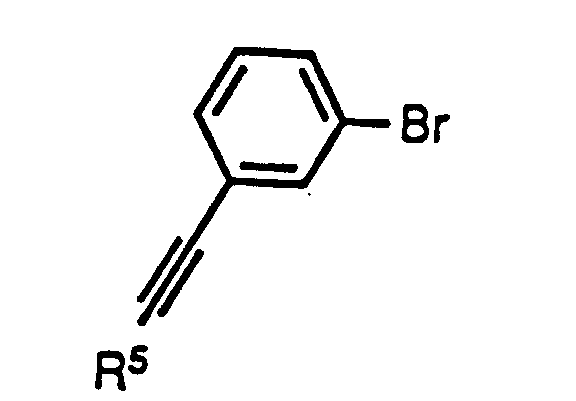 (b) Umsetzen der in Schritt "a" gebildeten Verbindung mit einer Alkyllithiumverbindung oder Magnesium, gefolgt von einer Umsetzung mit einer ausgewählten halogenierten Silanverbindung, um eine Verbindung mit der folgenden Formel zu bilden
 (c) Alkoholisieren der in Schritt "b" gebildeten Verbindung in Gegenwart einer Säure oder Base, um eine Verbindung mit der folgenden Formel zu bilden
 (d) Hydrolisieren der in Schritt "c" gebildeten Verbindung, um eine Verbindung mit der folgenden Formel zu bilden
 (e) Kondensieren der in Schritt "d" gebildeten Verbindung, um ein Monomer zu bilden, in welchem n = 0;(f) gegebenenfalls Umsetzen des Monomeren mit einem cyclischen Siloxan mit ≥3 Siliciumatomen, wobei jedes substituiert ist mit R7 und R8, wie oben definiert, um ein Oligomer zu bilden, in welchem n = 1 bis 20; und(g) Erwärmen des Monomeren oder des Oligomeren während eines Zeitraums auf eine Temperatur von mindestens ungefähr 250°C, um das Polymer zu bilden.
 - Verfahren zur Bildung eines Copolymeren gemäß Anspruch 4, welches die folgenden Schritte umfaßt:(a) Umsetzen einer 1,3-Dibrombenzolverbindung mit einem ausgewählten Silylierungsmittel, um eine Verbindung mit der folgenden Formel zu bilden
 (b) Umsetzen der in Schritt "a" gebildeten Verbindung mit einer Alkyllithiumverbindung oder Magnesium, gefolgt von einer Umsetzung mit einer ausgewählten halogenierten Silanverbindung, um eine Verbindung mit der folgenden Formel zu bilden
 (c) Alkoholisieren der in Schritt "b" gebildeten Verbindung in Gegenwart einer Säure oder Base, um eine Verbindung mit der folgenden Formel zu bilden
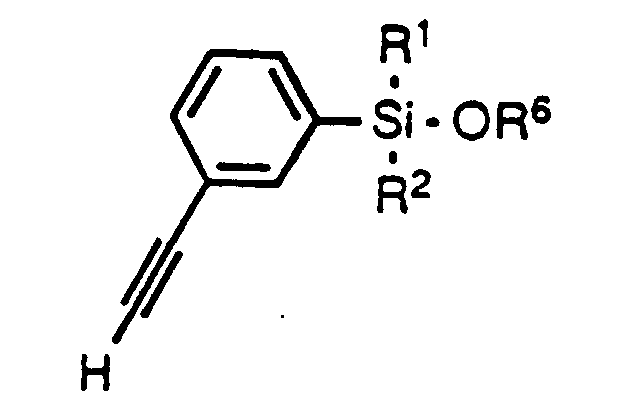 (d) Hydrolisieren der in Schritt "c" gebildeten Verbindung, um eine Verbindung mit der folgenden Formel zu bilden
 (e) Kondensieren der in Schritt "d" gebildeten Verbindung, um ein Monomer zu bilden, in welchem n = 0;(f) Umsetzen des Monomeren mit einem cyclischen Siloxan mit ≥3 Siliciumatomen, wobei jedes substituiert ist mit R7 und R8, wie oben definiert, um ein Oligomer zu bilden, in welchem n = 1 bis 20;(g) Auflösen von entweder dem Monomeren oder dem Oligomeren und der Verbindung mit endständigem Acetylen in einem ausgewählten Lösungsmittel, um eine Lösung zu bilden; und(h) Aushärten der Lösung bei einer erhöhten Temperatur.
Applications Claiming Priority (2)
| Application Number | Priority Date | Filing Date | Title |
|---|---|---|---|
| US07/939,326 US5329036A (en) | 1992-09-02 | 1992-09-02 | (alpha, omega)phenylethynyl siloxane monomers, oligomers, and polymers thereof |
| US939326 | 1992-09-02 |
Publications (2)
| Publication Number | Publication Date |
|---|---|
| EP0585590A1 EP0585590A1 (de) | 1994-03-09 |
| EP0585590B1 true EP0585590B1 (de) | 1997-12-29 |
Family
ID=25472973
Family Applications (1)
| Application Number | Title | Priority Date | Filing Date |
|---|---|---|---|
| EP93111705A Expired - Lifetime EP0585590B1 (de) | 1992-09-02 | 1993-07-21 | (Alpha, Omega)Phenylethinylsiloxanmonomere und daraus hergestellte Oligomere und Polymere |
Country Status (4)
| Country | Link |
|---|---|
| US (1) | US5329036A (de) |
| EP (1) | EP0585590B1 (de) |
| JP (1) | JP2716346B2 (de) |
| DE (1) | DE69315916T2 (de) |
Families Citing this family (6)
| Publication number | Priority date | Publication date | Assignee | Title |
|---|---|---|---|---|
| US5539137A (en) * | 1995-06-07 | 1996-07-23 | General Electic Company | Aryl substituted silicone fluids having high refractive indices and method for making |
| US6271280B1 (en) * | 2000-04-19 | 2001-08-07 | General Electric Company | Diacetylenic polyorganosiloxanes, intermediates therefor, and cured compositions prepared therefrom |
| US9475969B2 (en) * | 2012-12-20 | 2016-10-25 | Shin-Etsu Chemical Co., Ltd. | Organopolysiloxane compound having ethynyl groups, method for preparing linear organopolysiloxane compound having ethynyl groups at both terminals of molecular chain, method for preparing organopolysiloxane polymer having alkoxysilyl-ethylene group at terminal, room temperature curable composition and molded product which is cured product thereof |
| US9850349B2 (en) * | 2013-12-17 | 2017-12-26 | Shin-Etsu Chemical Co., Ltd. | Multicomponent room temperature-curable organopolysiloxane composition, cured product of said composition, and molded product comprising said cured product |
| CN114149587A (zh) * | 2021-12-30 | 2022-03-08 | 烟台德邦科技股份有限公司 | 一种可uv固化苯基乙烯基聚硅氧烷及其合成与胶黏剂的制备方法 |
| WO2025205941A1 (ja) * | 2024-03-29 | 2025-10-02 | 富士フイルム株式会社 | 樹脂組成物、硬化物、積層体、硬化物の製造方法、積層体の製造方法、半導体デバイスの製造方法、半導体デバイス、及び、化合物 |
Family Cites Families (3)
| Publication number | Priority date | Publication date | Assignee | Title |
|---|---|---|---|---|
| DE1165869B (de) * | 1964-03-19 | Elfriede Husemann Dr | Verfahren zur Herstellung von Polysiloxanen mit endstaendig ungesaettigten Gruppen | |
| US3096303A (en) * | 1954-05-25 | 1963-07-02 | Gen Electric | Novel organopolysiloxane compositions |
| JPH02124893A (ja) * | 1988-11-01 | 1990-05-14 | Hitachi Chem Co Ltd | 1,3−ビス(ジカルボキシフエニル)−1,1,3,3−テトラフエニルジシロキサン誘導体,その製造法及びそれを用いたポリイミドの製造法 |
-
1992
- 1992-09-02 US US07/939,326 patent/US5329036A/en not_active Expired - Lifetime
-
1993
- 1993-07-21 DE DE69315916T patent/DE69315916T2/de not_active Expired - Lifetime
- 1993-07-21 EP EP93111705A patent/EP0585590B1/de not_active Expired - Lifetime
- 1993-09-02 JP JP5218926A patent/JP2716346B2/ja not_active Expired - Fee Related
Also Published As
| Publication number | Publication date |
|---|---|
| DE69315916T2 (de) | 1998-08-27 |
| JP2716346B2 (ja) | 1998-02-18 |
| US5329036A (en) | 1994-07-12 |
| EP0585590A1 (de) | 1994-03-09 |
| DE69315916D1 (de) | 1998-02-05 |
| JPH06157550A (ja) | 1994-06-03 |
Similar Documents
| Publication | Publication Date | Title |
|---|---|---|
| US5298589A (en) | Highly functionalized polycyclosiloxanes and their polymerization into thermally reversible living rubbers | |
| US5412053A (en) | Polymers containing alternating silsesquioxane and bridging group segments and process for their preparation | |
| JP4465233B2 (ja) | 多官能性環状シロキサン化合物、この化合物から製造されたシロキサン系重合体及びこの重合体を用いた絶縁膜の製造方法 | |
| US6225247B1 (en) | Polymer precursor composition, crosslinked polymers, thermosets and ceramics made with silyl and siloxyl substituted carboranes with unsaturated organic end groups | |
| WO2012144480A1 (ja) | シロキサン化合物およびその硬化物 | |
| US20050131190A1 (en) | Multi-functional linear siloxane compound, a siloxane polymer prepared from the compound, and a process for forming a dielectric film by using the polymer | |
| EP0585590B1 (de) | (Alpha, Omega)Phenylethinylsiloxanmonomere und daraus hergestellte Oligomere und Polymere | |
| JP3459985B2 (ja) | ボラジン含有ケイ素系ポリマーの薄膜の製造方法及びボラジン含有ケイ素ポリマー | |
| JPS6352041B2 (de) | ||
| JPS61277692A (ja) | フエニレン基含有オルガノシランおよびその製造法 | |
| US6291623B1 (en) | Fluoroalkylsubstituted cyclotrisiloxanes, their use for preparation of new polymers and novel polymers | |
| JPH0324093A (ja) | トリアルキルシリルメチル基含有シラン化合物 | |
| JP3458157B2 (ja) | ボラジン含有ケイ素系共重合ポリマー及びその薄膜の製造方法 | |
| US5416233A (en) | Preparation of vinylsilane-benzocyclobutenes | |
| US3803196A (en) | Aliphatically unsaturated organopolysiloxanes | |
| US5286890A (en) | Aromatic amine terminated silicone monomers, oligomers, and polymers therefrom | |
| US5693735A (en) | Trimethylsiloxy group-containing polysiloxane and a process for producing the same | |
| JPH0747596B2 (ja) | 芳香族ポリイミドシラノール、その前駆物質及びそのポリマー | |
| EP0714952B1 (de) | Verfahren zur Härtung von einem Siloxan-Polymer | |
| JPS6330314B2 (de) | ||
| JPH04252228A (ja) | シリコーン含有エポキシ化合物及びその製法 | |
| Kandpal et al. | Studies on the synthesis and reaction of silicone oxirane dendrimer and their thermal and rheological properties | |
| JP2884073B2 (ja) | 新しい含シルセスキオキサンポリマーとその製造方法、およびハードコート膜、耐熱性素材 | |
| CN101014644A (zh) | 酸酐官能的倍半硅氧烷树脂 | |
| US5684111A (en) | Silylated dioxolane polymers and monomeric compounds |
Legal Events
| Date | Code | Title | Description |
|---|---|---|---|
| PUAI | Public reference made under article 153(3) epc to a published international application that has entered the european phase |
Free format text: ORIGINAL CODE: 0009012 |
|
| AK | Designated contracting states |
Kind code of ref document: A1 Designated state(s): DE FR GB NL |
|
| 17P | Request for examination filed |
Effective date: 19940905 |
|
| 17Q | First examination report despatched |
Effective date: 19951018 |
|
| GRAG | Despatch of communication of intention to grant |
Free format text: ORIGINAL CODE: EPIDOS AGRA |
|
| GRAG | Despatch of communication of intention to grant |
Free format text: ORIGINAL CODE: EPIDOS AGRA |
|
| GRAH | Despatch of communication of intention to grant a patent |
Free format text: ORIGINAL CODE: EPIDOS IGRA |
|
| GRAH | Despatch of communication of intention to grant a patent |
Free format text: ORIGINAL CODE: EPIDOS IGRA |
|
| GRAA | (expected) grant |
Free format text: ORIGINAL CODE: 0009210 |
|
| AK | Designated contracting states |
Kind code of ref document: B1 Designated state(s): DE FR GB NL |
|
| PG25 | Lapsed in a contracting state [announced via postgrant information from national office to epo] |
Ref country code: NL Free format text: LAPSE BECAUSE OF FAILURE TO SUBMIT A TRANSLATION OF THE DESCRIPTION OR TO PAY THE FEE WITHIN THE PRESCRIBED TIME-LIMIT Effective date: 19971229 |
|
| REF | Corresponds to: |
Ref document number: 69315916 Country of ref document: DE Date of ref document: 19980205 |
|
| ET | Fr: translation filed | ||
| NLV1 | Nl: lapsed or annulled due to failure to fulfill the requirements of art. 29p and 29m of the patents act | ||
| PLBE | No opposition filed within time limit |
Free format text: ORIGINAL CODE: 0009261 |
|
| STAA | Information on the status of an ep patent application or granted ep patent |
Free format text: STATUS: NO OPPOSITION FILED WITHIN TIME LIMIT |
|
| 26N | No opposition filed | ||
| REG | Reference to a national code |
Ref country code: GB Ref legal event code: 732E |
|
| REG | Reference to a national code |
Ref country code: FR Ref legal event code: TP Ref country code: FR Ref legal event code: CD Ref country code: FR Ref legal event code: CA |
|
| REG | Reference to a national code |
Ref country code: GB Ref legal event code: IF02 |
|
| PGFP | Annual fee paid to national office [announced via postgrant information from national office to epo] |
Ref country code: FR Payment date: 20110727 Year of fee payment: 19 |
|
| PGFP | Annual fee paid to national office [announced via postgrant information from national office to epo] |
Ref country code: DE Payment date: 20110713 Year of fee payment: 19 Ref country code: GB Payment date: 20110720 Year of fee payment: 19 |
|
| GBPC | Gb: european patent ceased through non-payment of renewal fee |
Effective date: 20120721 |
|
| REG | Reference to a national code |
Ref country code: FR Ref legal event code: ST Effective date: 20130329 |
|
| PG25 | Lapsed in a contracting state [announced via postgrant information from national office to epo] |
Ref country code: GB Free format text: LAPSE BECAUSE OF NON-PAYMENT OF DUE FEES Effective date: 20120721 Ref country code: DE Free format text: LAPSE BECAUSE OF NON-PAYMENT OF DUE FEES Effective date: 20130201 Ref country code: FR Free format text: LAPSE BECAUSE OF NON-PAYMENT OF DUE FEES Effective date: 20120731 |
|
| REG | Reference to a national code |
Ref country code: DE Ref legal event code: R119 Ref document number: 69315916 Country of ref document: DE Effective date: 20130201 |